Yesterday
p. 61 · Read in the full issue
antas announced in November, 1954, had decided to discontinue, at the nd of March, 1955, the flying-boat service dnnecting Sydney with Noumea and the lew Hebrides once a week and ydney with Noumea and Laucala Bay : iji) once a fortnight. In place was > be a Skymaster service operating a Y" service, once a week, connecting ydney with Tontouta, Vila and Santo, and Fadi. This was one of the news items üblished in PIM 20 years ago this month. lo one likes income tax, while conceding is a necessity, but in the BSIP 20 ears ago they liked it even less. After n unsuccessful challenge to the legality f the tax, taxpayers tried a new tack, ocal residents, traders and businessmen ent a petition to the Secretary of tafe for the Colonies asking for ie tax to be removed. Whitehall ras unimpressed. he rate of resignations by expatriates rom the Papua New Guinea civil ervice today is a matter for official oncern. Resignations were a problem Iso 20 years ago when over 70 of he field staff in the PNG Department of district Services and Native Affairs urned their jobs in, because they said hey found it impossible to live in the salaries paid.
fonga's King Taufa'ahau Tupou, when -rown Prince Tungi 20 years ago, described himself, after returning from i trip to the US, as "not a tourist, sut a market investigator". He was then *remier as well as heir to the throne, md said he was not happy that Tonga ivas practically dependent only on the :oconut. Some ideas he brought back fhen were involved with development of funa fishing, coconut by-products and macadamia nuts.
The enormous mass of iron ore— mixed with chromium, nickel, cobalt, manganese and other metals —that constituted a large part of New Caledonia was "beginning to assume international significance", R. W. Robson wrote in PIM in November, 1954. In a world which, while declaring its hatred of war, was daily preparing for "the final arbitration of arms", the availability of metal was a factor which the major countries dared not ignore, and he predicted boom times for New Caledonia.
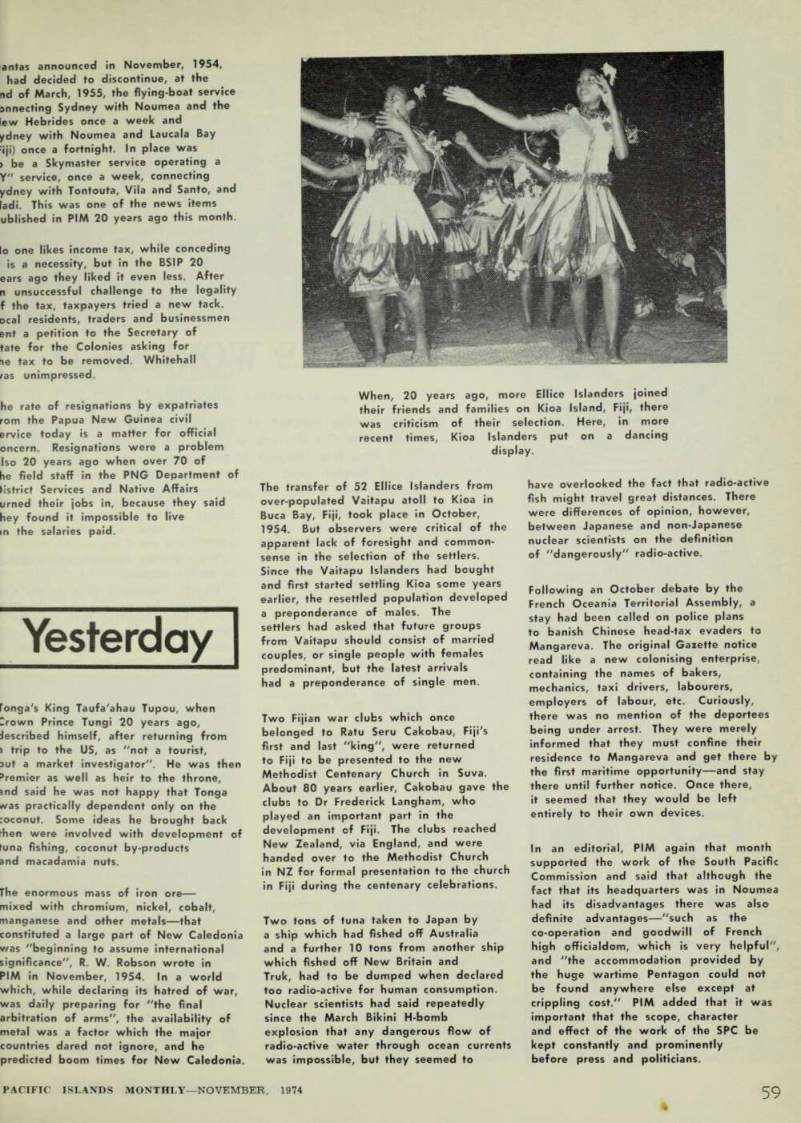
The transfer of 52 Ellice Islanders from over-populated Vaitapu atoll to Kioa in Buca Bay, Fiji, took place in October, 1954. But observers were critical of the apparent lack of foresight and common sense in the selection of the settlers.
Since the Vaitapu Islanders had bought and first started settling Kioa some years earlier, the resettled population developed a preponderance of males. The settlers had asked that future groups from Vaitapu should consist of married couples, or single people with females predominant, but the latest arrivals had a preponderance of single men.
Two Fijian war clubs which once belonged to Ratu Seru Cakobau, Fiji's first and last "king", were returned to Fiji to be presented to the new Methodist Centenary Church in Suva.
About 80 years earlier, Cakobau gave the clubs to Dr Frederick Langham, who played an important part in the development of Fiji. The clubs reached New Zealand, via England, and were handed over to the Methodist Church in NZ for formal presentation to the church in Fiji during the centenary celebrations.
Two tons of tuna taken to Japan by a ship which had fished ofF Australia and a further 10 tons from another ship which fished off New Britain and Truk, had to be dumped when declared too radio-active for human consumption.
Nuclear scientists had said repeatedly since the March Bikini H-bomb explosion that any dangerous flow of radio-active water through ocean currents was impossible, but they seemed to
have overlooked the fact that radio-active fish might travel great distances. There were differences of opinion, however, between Japanese and non-Japanese nuclear scientists on the definition of "dangerously" radio-active.
Following an October debate by the French Oceania Territorial Assembly, a stay had been called on police plans to banish Chinese head-tax evaders to Mangareva. The original Gazette notice read like a new colonising enterprise, containing the names of bakers, mechanics, taxi drivers, labourers, employers of labour, etc. Curiously, there was no mention of the deportees being under arrest. They were merely informed that they must confine their residence to Mangareva and get there by the first maritime opportunity —and stay there until further notice. Once there, it seemed that they would be left entirely to their own devices.
In an editorial, RIM again that month supported the work of the South Pacific Commission and said that although the fact that its headquarters was in Noumea had its disadvantages there was also definite advantages—"such as the co-operation and goodwill of French high officialdom, which is very helpful", and "the accommodation provided by the huge wartime Pentagon could not be found anywhere else except at crippling cost." PIM added that it was important that the scope, character and effect of the work of the SPC be kept constantly and prominently before press and politicians.
When, 20 years ago, more Ellice Islanders joined their friends and families on Kioa Island, Fiji, there was criticism of their selection. Here, in more recent times, Kioa Islanders put on a dancing display.