Writers Workshop
pp. 62-63 · Read in the full issue
By Marjorie Crocombe
The outstanding success of the Creative Writers Workshop which UNESCO and the University of the South Pacific sponsored at the USP in Suva from August 26 to September 6 was epitomised by the noted Tongan poet, composer and choreographer, Peni Tutu ila Malupo, who wrote the poem on the opposite page.
Peni’s poem was presented at an evening, well attended by an appre ciative audience, at which members of the workshop served up a rich diversity of songs, drama, poetry and short stories, much of it written by the members during the work shop.
Items were presented in a number of the Pacific's many national langu ages, as well as in neo-Melanesian (or Pidgin) and in English. Eti Sa’aga referred to them as “voices crying out in love, anger, sorrow, hope and shame”. The Pacific has never seen such a concentrated flowering of latent writing talent.
Denigrated, inhibited and withdrawn during the colonial era, the Pacific people are again beginning to take confidence and express themselves in traditional forms of expression that remain part of a valued heritage, as well as in new forms and styles re flecting the changes within the con tinuity of the unique world of our Island cultures.
The expressive arts were given a great stimulus by the workshop.
Member after member spoke of the confidence and motivation, as well as the skills and techniques generated by the workshop. They spoke of plans to return to Samoa, Rarotonga, Tarawa, Tonga, the New Hebrides and elsewhere across the Pacific to carry forward and expand the initiatives begun at the workshop.
It rests with the individuals who attended the workshop to give his
or her skills to those back home who did not have the opportunity to attend.
Why do we regard the workshop as such a success?
Firstly, because it gave people with the talents for writing, the opportun ity to meet together with people of other Pacific cultures between which there are great affinities, though we have been separated by great dis tances as well as colonial boundaries.
Secondly, we appreciated the fact that our consultants were deeply attuned to the cultures of the Pacific.
Albert Wendt of Samoa is familiar also with several other cultures.
Alistair Te Ariki Campbell, a noted New Zealand poet, shared a deep one-ness with us through his own Polynesian ancestry and his appre ciation of the hunger of Islanders to express themselves again after a hundred years of humiliation and lacking confidence. Jo Nacola of Fiji helped us to create our drama in its natural setting. Bob Smith has been in the Islands for some time and has absorbed a deep appreciation and understanding through which he gave us valuable technical assistance.
Thirdly, the organisation was undertaken by a committee of Islanders. We appreciated the help we have received from others, but in too many international meetings in the Pacific the presence and pressures of foreign advisers and experts is often too overpowering, and Pacific
ourtesy demands that we defer to le suggestions of distinguished isitors, even when we desperately r ant to organise in our own way, to take our own arrangements, to etermine our own priorities.
INESCO generously left these mat :rs to us and, despite the difficulties nd complexities of organisation over reat distances with limited com mnication, we appreciate arrange lents being a matter for Island elegates.
Where do we go from here?
The experience we underwent was jo valuable to lose, too rich to be sstricted to the privileged few who 'ere fortunate enough to attend. We re greatly concerned that this excit ig beginning will be fostered and eveloped.
Alistair Te Ariki Campbell addressing the Writers Workshop
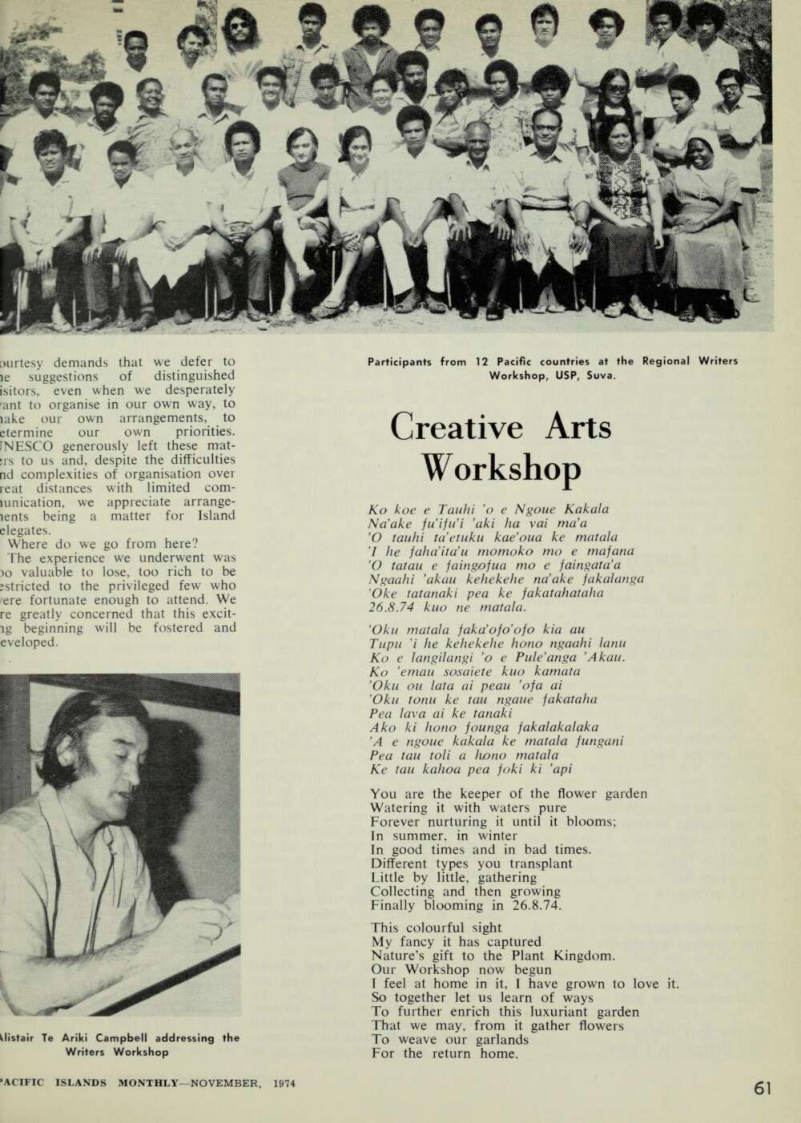
Participants from 12 Pacific countries at the Regional Writers Workshop, USP, Suva.