Magazine Section
pp. 59-60 · Read in the full issue
Fiji's 'East India Company was neither wealthy nor long-living
By A. M. Quanchi
Just over one hundred years ago a company was formed in Melbourne with the hope that it vould become an Australasian version of the powerful and wealthy British East India Company. It was the Polynesia Company.
The American Civil War had ruined the Southern dates’ cotton crops and European buyers were offering ligh prices for good quality cotton. The Fiji Islands, vith their rich soils, suitable climate and abundant abour supply suddenly became the new Eldorado, and luring the years 1868 to 1871 many hundreds of Vic orian colonists rushed to Fiji, to become, they hoped, wealthy cotton planters.
The Victorian domination of Fiji was supreme and he Melbourne press proudly claimed that: “The Fiji slands, commercially speaking, may be said to belong o Victoria. Victorian capital, Victorian enterprise and Victorian colonists are transforming the principal isle if the group into a Victorian settlement”.
Prior to this rush to Fiji in the late 1860’s the European population had only been numbered in tens, and political control was being disputed between the wo powerful chiefs, Cakobau and Ma’afu. Victoria lecided the time was ripe for Victoria to act, and the Melbourne Age urged action: “Taken possession of by us now, under proper development these islands would in time become a property of great worth to Victoria . . . the task would be an easy one”.
The undoubted wealth that could be obtained from :otton and other commercial and trading ventures, and the ease with which European political control over the islands could be assumed, appealed to the small group of investors and shareholders who had just formed the Polynesia Company.
They intended to make a deal with Cakobau on the
assumption that he was the paramount king over all Fiji, and thereby secure the monopoly rights over land development, banking, trade, customs and the overall rule in the island group.
A delegation to Fiji managed to get a charter grant ing them these rights signed by Cakobau, but the gift giving and champagne tactics, the complaints of the British Consul in Fiji and the fact that Cakobau wasn’t regarded as the paramount king, meant that the first charter was publicly rejected by the Colonial Office in London and by the Australasian authorities.
Eventually the company signed another charter which limited them to a land developing role. The initial sub scription to the company of 1,240 £2 shares was paid up and plans were made for a vessel to carry the pros pective land-owning shareholders to the company’s, leases in Fiji.
The Polynesia Company had attempted to keep its dealings over the charter secret, and at the same time to release exaggerated reports of Fiji’s potential to the press, even to the extent of a false “gold rush”.
The Melbourne press were enthusiastically covering events in Fiji, and with a spirit of European expansion ism into the “uncivilised world”, the Polynesia Com pany was considered by the Melbourne Age as an example of Victorian leadership: “Compared with the brilliant success of the Polynesia Company other com mercial enterprises simply languish in the shade”.
With the charter signed, land hungry colonists and investors took notice, and the fortunes of the company
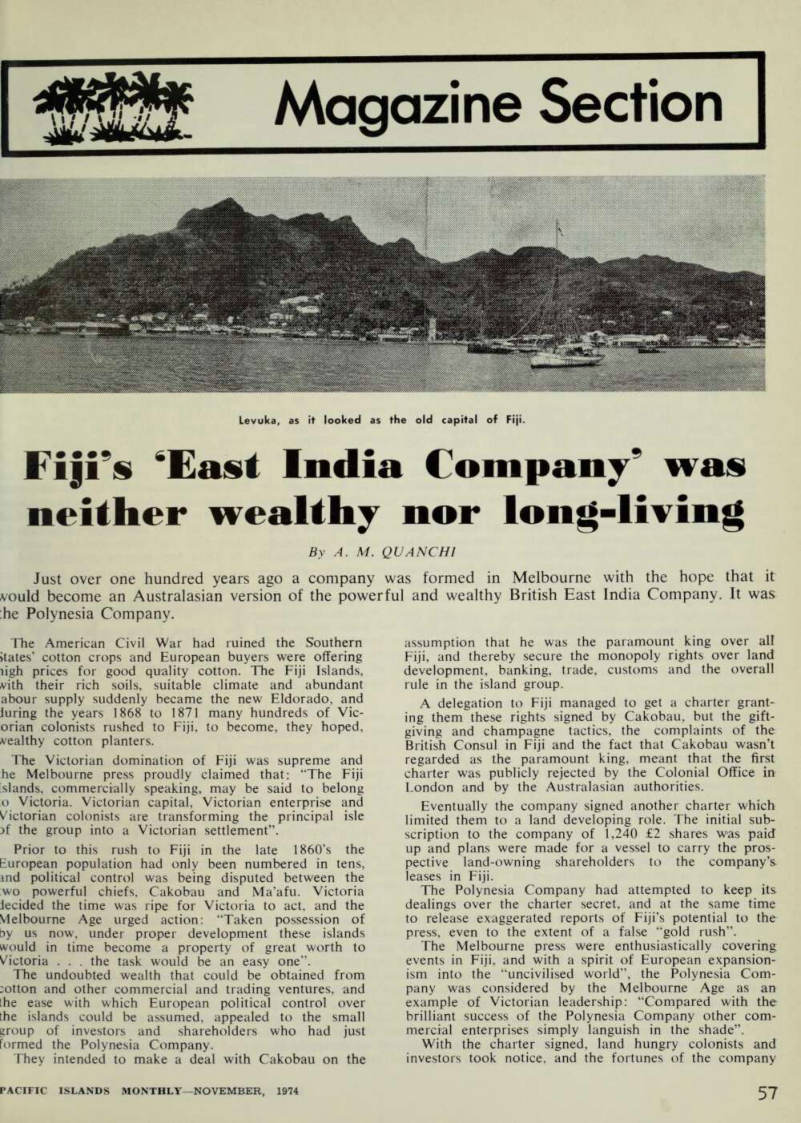
Levuka, as it looked as the old capital of Fiji.
rose even though nothing yet had been done to get a start in Fiji.
Victoria had at that time two commodities that were to be a great stimulus to the company’s activities. One was the newly-won wealth from the gold rushes, the other was an excess of population. Commercial, ship ping and trading interests saw in Fiji an opportunity to invest, and the current depression in the colonies made the promise of land and high returns from cotton planting, an attractive lure, not only to men of large and small capital, but also to men who had met failure on the fields, and who now sought that new Eldorado.
But the shareholders who had taken out their shares in land found, when they arrived in Fiji that there were often as many as four or five Fijian and European claimants to their lease.
The company found it could only take possession of 92,000 acres, not the 200,000 their charter granted.
So by 1871 the boom days were over, and for all its favourable press reports and grandiose schemes, the Polynesia Company eventually was to become a dismal failure.
By 1874 only 500 acres of its original grant were being cultivated and in 1880 it had to auction its blocks at Suva Point to provide a return for its shareholders.
The company’s story reflects the initial optimism, followed by frustration and discontent that typifies the expansion of the European community in Fiji. The grand dreams of success were dashed by the sudden hurricanes, the declining cotton market, the unwilling ness of the Fijians to work, and then after 1874 by a colonial government which put native interests before those of the European community.
When, in 1874, Britain annexed Fiji, the company had waged a persistent battle with the Imperial Government and the new Crown Colony Government to secure the lands which it laid claim to. It received an unsympathetic reply, and like other European land claimants in Fiji the company found it could only keep those lands actually being cultivated, or those for which airtight legal justification could be provided.
In 1870 at the height of the rush to Fiji the com pany’s affairs had already come unfavourably to the attention of the colonial authorities. The Colonial Office, the Victorian Governor, and the newly estab lished Fiji Times in Levuka were all warning of the dangers involved in risking money in Fiji, let alone with a company that had yet to give any signs of pro
gress.
Early in 1870 the Fiji Times noted, “It is nearly time that the shareholders of the company showed some energy in settling their land, as the prospectus of the company has been so long before the public in Fiji that residents have begun to think the company is a myth”.
As far as the European community in Fiji was con cerned, Victoria’s interest was not up to expectations.
For several years prior to the British annexation there had been agitation in both Melbourne and Levuka for Victoria to annex Fiji, but when Britain accepted this responsibility in 1874 any interest quickly died.
It is an interesting footnote that nearly 20 years after cession the European community in Fiji turned to Victoria once again and attempted to change Fiji’s mode of government by having the Colony of Victoria rule in place of the Crown Colony system that had been in force since 1874.
But Fiji no longer held the attractions it once did, and Victoria refused the invitation to incorporate Fiji into its colonial boundaries.
During this 1887 movement the Polynesia Company, not yet defunct, offered its assistance to the Fijian representatives who were then in Melbourne lobbying for the changeover of sovereignty.
The final condemnation of the company came from a Fiji Times editorial: “What may be said of this glori ous Polynesia Company is that it is dying. It spent its life in injuring Fiji and deluding Victoria”.
An emotive but succinct statement. The company had both stimulated, and been part of the European, and especially the Victorian rush to Fiji, but as was the case of numerous other examples of European expansion in the tropics, success and profits were not always as easy to come by as the illusion of the tropical Eldorado gave promise of.
Interest in Fiji, and the Pacific, waned after the col lapse of the rush. These sentiments that had been expressed in the Victorian Legislative Assembly in 1872 were not long lasting; “I think it is due to our position as the principal colony in Australia that we should be particularly careful with respect to the future of the South Sea Islands”.
But “this glorious company”, and Victorian aspira tions in the Islands, soon became a forgotten byway of the early history of both the Colony of Victoria and Fiji.
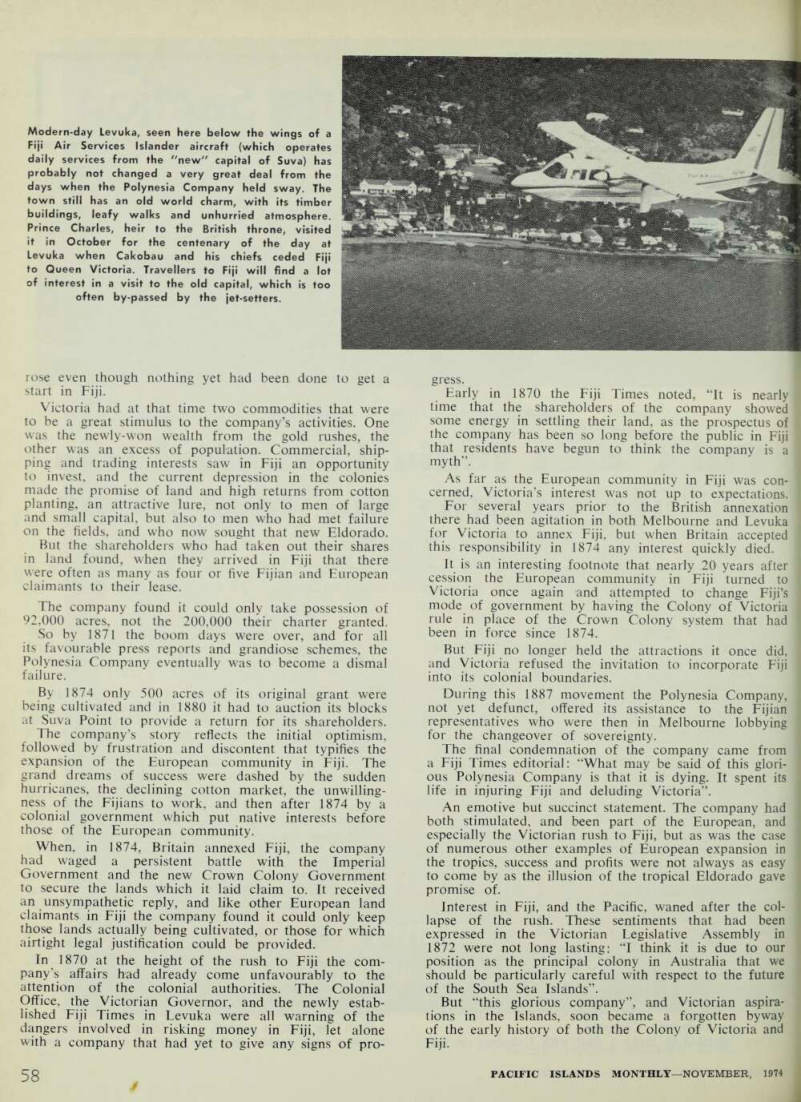
Modern-day Levuka, seen here below the wings of a Fiji Air Services Islander aircraft (which operates daily services from the "new" capital of Suva) has probably not changed a very great deal from the days when the Polynesia Company held sway. The town still has an old world charm, with its timber buildings, leafy walks and unhurried atmosphere.
Prince Charles, heir to the British throne, visited it in October for the centenary of the day at Levuka when Cakobau and his chiefs ceded Fiji to Queen Victoria. Travellers to Fiji will find a lot of interest in a visit to the old capital, which is too often by-passed by the jet-setters.