Yesterday
p. 52 · Read in the full issue
Increased freight rates from Australia to the islands are very much in the news these days. They were 20 years ago also. PIM, in October, 1954, an nounced that general cargo rates from Australian ports to Port Moresby went up from £9/10/- ($l9) to £lO/5/- ($20.50) a ton from October 1. The latest rise in current (1974) rates was 18 per cent, making the general rate $44.80 to $52 a tonne.
Western Samoa was expected to take another step on its road to self government 20 years ago PIM reported in October, 1954. Then, 162 representa tives (146 Samoans and 16 Europeans) were to sit down at historic Mulinu'u to make and consider proposals on a constitution for the ultimate independent state of Samoa. It had previously been made clear that the Samoans would design their own constitution. PlM's correspondent in Apia commented there seemed to be a general feeling of apathy and indifference about the convention. A section of the Samoans and most of the locally-born Europeans and part-Samoans were not enthusiastic about political changes, contending that Samoa was happy and prosperous and that early, rapid and incisive changes seemed unnecessary. Now, who'd say that today?
A familiarisation visit to the Cook Islands by the newly-appointed NZ Minister of External Territories, Mr T.
Clifton Webb, turned out to be more of a farewell gesture. He had barely returned to Wellington when he was appointed NZ High Commissioner in London, replacing the late Sir Frederick Doidce. Sir Frederick himself had also been External Territories Minister.
PIM was pleased to receive this letter from Mr Paul Kamsler, of Cairns in October, 1954: "Your PIM has a reputation for popping up in the most unexpected places. Three or four years ago I went into the house of the chief of a village in the mountains of Vietnam, south of Saigon, and there I saw the walls of his room were completely papered with PIM covers. I could not imagine how on earth they got there.
But I found out that the French Resident in the district was a former Tahiti official, and he got the PIM to keep in touch with Pacific friends, and he doled out the front covers as a favour to deserving chiefs. . . ."
Not unexpectedly, the death sentences
passed on 33 New Guinea natives who were concerned with the Telefomin murders, have been commuted. Instead of hanging, the natives will get 10 years' hard labour. All were implicated in the murders of Patrol Officer G. Harris, Patrol Officer G. Szarka and native policemen, Burotori and Purari, in November, 1953. PIM reported that rounding up the natives, and their trials, only recently concluded, had taken many months. The slow grinding of the mill of British justice—and these primitive natives got the whole treatment according to our law—must have been completely incomprehensible to the murderers, and commutation of their sentences after so long a delay was inevitable. ... If the ringleaders had been caught early, summarily tried and hanged in their own villages, the action would likely have been understood and respected and have had a salutary effect.
The NZ Government received a petition, signed by 180 Cook Islanders, calling for direct Maori representation in the NZ parliament. The NZ Government rejected the petition, PIM reported in October, 1954, after the petition com mittee of the House of Representatives recommended that no action be taken.
The Legislative Council of the Cook Islands, when it became aware the petition had been presented, indicated it had no knowledge that it had been
prepared.
There was a chance that the Western Pacific High Commission would eventually get a new patrol boat for the Solomons, the Kovala. In February, 1949, a PIM representative saw the launching of the boat at Balmain, Sydney. Three years later another PIM representative
saw it cruise down Sydney Harbour bound for the BSIP. The Kovala got as far as Ballina, on the north coast of NSW, and no further. PIM reported in October, 1954, it had learned that early in 1955 work should be completed cn "modifying and re-engining the craft with machinery more suited to the conditions and long steaming distances applicable in the Protectorate and the GEIC". In six years the ship had endless money poured into it, and had not done an hour's work.
Gallic heat was generated in the Assembly in Papeete soon after Governor Petitbon started speaking at the opening of a session. M. Ceran Jerusalemy, who had returned from Paris the previous day, interrupted the Governor to demand that he be reinstated as President of the Assembly in place of M. Mari. The heat seemed to have its genesis in a session almost a year earlier when a 15-10 vote electing M. Jerusalemy councillor to represent French Oceania in Paris was disputed. A police investigation showed a rigged ballot, and M. Bouillard, of the Porio faction, won a second ballot 13-12. M. Jerusalemy resigned as President in protest and M. Mari was elected. M. Jerusalemy went to Paris in an attempt to have the Bouillard decision quashed, and only returned in time for the session opened by Governor Petitbon. After the latest furore in the Assembly died down, a secret ballot at M. Jerusalemy's request, denied him reinstatement by 13 votes to 11.
Western Samoa taxpayers were happy 20 years ago when a departmental committee recommended a number of taxes be abolished entirely—Building Tax, Amusement Tax, Store Tax, Copra House Tax, and immigration and emigration charges. The salary tax should also be abandoned and replaced by a general income tax with some modifi cations.
During the closing stages of a session of the United States Congress, some questions were asked about pay —why wages below the Federal minimum of 75c were being paid to government employees in Guam and American Samoa.
The subject rose through a request from the Pentagon for legislation to legally exempt those areas and Wake Island from the minimum-wage law. The Secretary of Labour, Mr James P. Mitchell, admitted that on Guam alone, the US Navy was employing 15,000 Filipinos at less than minimum rates, but pointed out that previous Democratic adminis trations had done the same. His department was trying to devise a formula for raising wages in those islands, but an immediate rise to the legal 75 cent rate would seriously dislocate local economics.
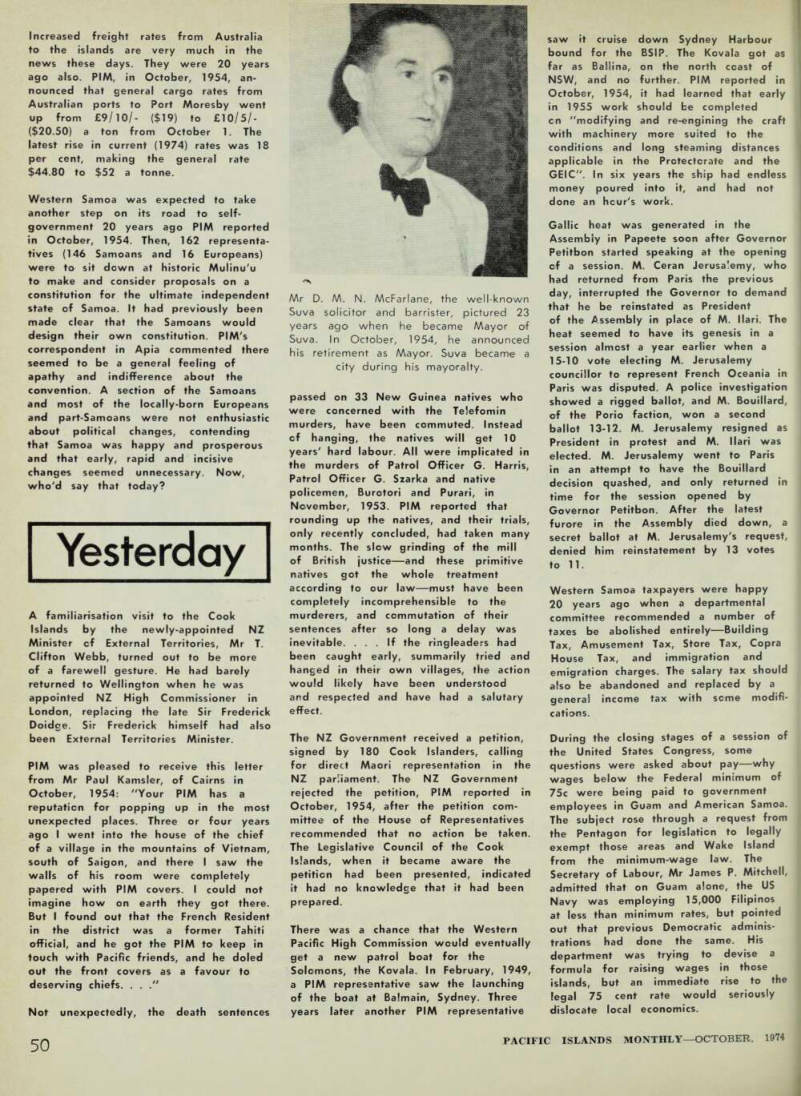
Mr D. M. N. McFarlane, the well-known Suva solicitor and barrister, pictured 23 years ago when he became Mayor of Suva. In October, 1954, he announced his retirement as Mayor. Suva became a city during his mayoralty.