Off Tonga's Beaten Track
pp. 43-49 · Read in the full issue

With A $7 Deck Passenger
From FELIX YEATS in Melbourne
Vavau’s northern cliffs are fading into the horizon astern as the MV Hifofua heads for the most far-flung islands of the scattered ocean empire of King Taufa’ahau Tupou IV. The wind is fresh from SE, on our star board quarter but the ship rolls only slightly to match the swells. Forty Tongan deck-passengers are sitting or lying on mats spread over our deck cargo of 44 gallon drums in the stern, and a tarpaulin on an over head frame protects them from the rain.
They chat merrily, oblivious of the discomfort; happy to be going home after holidays, perhaps in Tongatapu, or among the Haapai atolls or, maybe, even in NZ or Australia.
Ten more travellers are packed into the two small cabins, and two old ladies and a nursing mother are bedded down in the alleyway outside the officers’ cabins. I suspect that before the voyage is over, the two mates and chief engineer will have disobeyed company orders and given up their bunks out of Christian kindness of heart.
Our captain tells me he is worried by the weather reports of a storm brewing NE of Samoa, and hopes that he can complete this voyage before anything comes our way. The anchorages in the islands of Niua toputapu and Niuafoou are not good at the best of times and untenable in the westerly winds all too common at this time of year.
At 4 am I am awakened by the birdlike chatter of people on the
foredeck where I have been sleeping soundly wrapped in an army blanket.
The cone of Tafahi’s volcanic peak has been sighted as a darker mass against the starry sky, and our course has been altered to head straight for it. All is blackness on the bridge except for the faint glow of the steering compass; the captain is awake and comes to stand beside me.
“We are lucky there are no out lying reefs here” he says. “Our radar has been out of action a long time, but we are getting used to navigating the old-fashioned way at night and in some respects I am happier like this”.
Osika the mate stands in the bows holding onto one of the foremast stays. He wears a yellow plastic helmet tied with a string under his chin. He joined the old Hifofua as a galley boy in 1939, served on her until she was replaced by this ship in 1959 and was promoted chief mate only two years ago—a jovial man who seems to treat the seamen as a very tolerant father might do— nothing of the “bucko mate” about Osika! I have already heard him singing in a powerful voice, out standing even among others of his melody-loving race.
We pass a swirling mound of waves criss-crossing on a reef to star board, and alter course for a small island on the northern edge of Niua toputapu’s barrier reef. The anchor rattles down as the first lurid gash in the eastern sky tells of another sunrise. Our siren double-blasts our arrival to the islanders in the three
villages of Falehau, Vaipoa and the inevitable Hihofo (meaning western in the Tongan tongue). Already two small boats with outboards are head ing from shore towards the pass; I can not detect any sign of any pass myself but Osika assures me that there is one large enough to take the flat bottomed ferry barge. One of our cadets sits astride the foremast head and I wish my nerves were good enough to let me join him for what must be a splendid view of the lagoon in the early light.
There are six of these young men aboard, studying to be captains them selves one day. Our captain talks about them as I sit with him for breakfast. “Sorry no eggs, I hope you don’t mind fried mutton flap with toast?” The captain tells me that all feed alike on Hifofua, though he tells the steward to keep the last few eggs from every order for his own break fast table. “But even those are finished now, and we won’t get any more before we get back to Nukua lofa, if then,” he says with a wry smile. “Yes, we are really trying to get a training scheme started for both deck and engine room cadets. I think it may be very important for Tonga in the future”. I ask him how he finds his students. “Of course Ton gans are natural sailors, the best small boat sailors I have ever met, but it is hard to teach them main tenance —completely opposed to all their Polynesian philosophy.”
I am invited by Taufa, second mate, to lunch with friends in Vaipoa, so we set off along the track after disembarking at Falehau’s small wharf. It seems a pity that Hifofua is
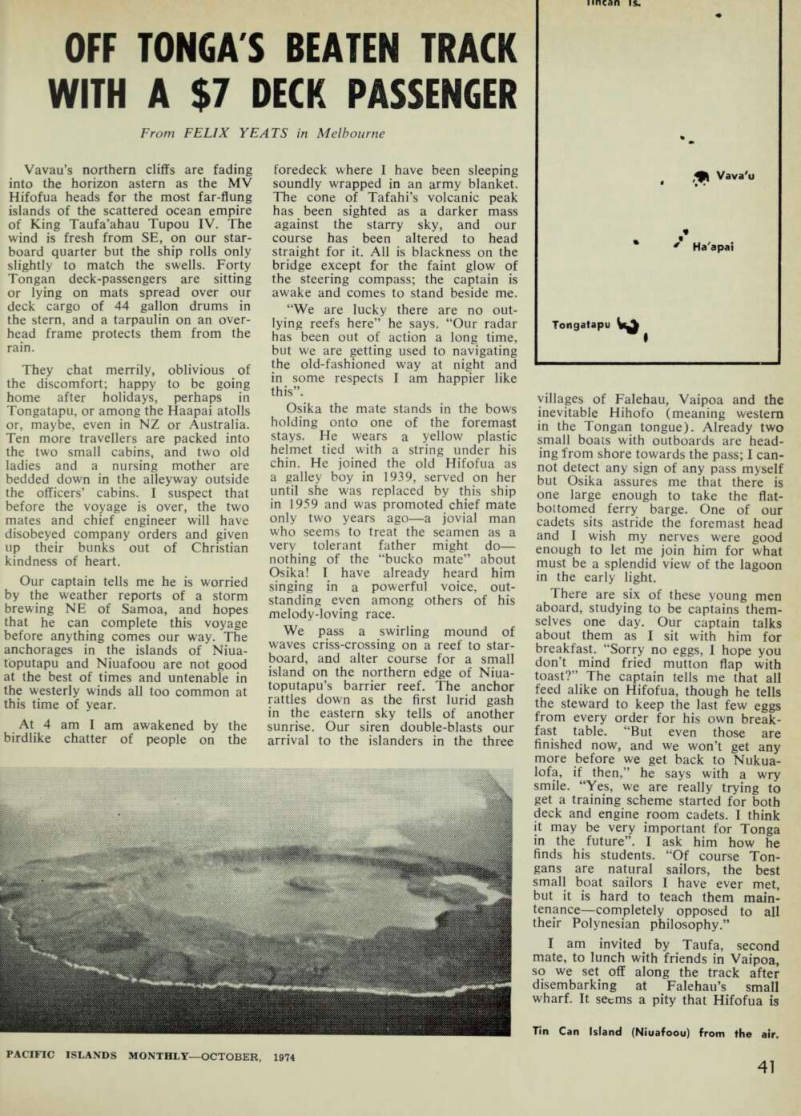
Tin Can Island (Niuafoou) from the air.
too big to come through the pass, as all is calm in the lagoon and there is hardly a ripple at the wharf. Taufa tells me that the government had a scheme to blast a deeper channel through the pass but funds are lack ing. Surely, this is the sort of prac tical work which should be financed by one of the proliferation of organisations such as the South Pacific Forum. South Pacific Commission, SPEC etc. Though. I suppose that they have little money left over for actual work after paying all the air fares and other expenses of their members gallivanting around the con ference circuits.
Our lunch is all prepared and served in a coconut leaf pola basket on the fresh cement floor of our host’s new cement block house. He apolo gises for the lack of chairs and table, saying that he had actually had a local carpenter make these but that his aunt had fancied them so he had to surrender even such newly acquired treasures to comply with Tongan custom. Uncles count for little in Tonga, but aunts and their offspring have all your possessions at their command.
After lunch we walk to a neigh bour’s house where a demure Tongan maiden is already straining pounded kava root into a locally-carved wooden kumete bowl. We sit in a ring drinking and talking until 1 feel that I am unable to drink any more, and apologise to my hosts as I stagger to my feet and walk back to the wharf. The villages here abound in lime bushes loaded with juicy fruit, but I see no signs of bananas or oranges though I am told that these are also plentiful. The horse-drop pings along the way make me sigh for my garden in Melbourne, so many years bereft of this nourishment. But 1 don't think that Osika would wel come me back aboard laden with such a basket.
Next day is Sunday, and only by a special dispensation of the strict Sab batarian law are we allowed to sail for the sister island of Niuafoou, 100 miles westward. The captain has spent much time anxiously listening to reports of the gale now intensifying 300 miles to our NE and fears that its associated trough of low pressure may spawn a hurricane to head in our direction.
“We have had a lot of engine trouble lately, but my chief engineer was working overtime in Vavau and thinks he has fixed it. Don't fancy breaking down with a storm around, though Hifofua is a very tough ship.”
The recent loss of the MV Uluilakeba in a hurricane in the Lau group of Fiji is fresh in my mind. After tea we haul up the anchor and head NW,
at first to round the offlying reef in visible in the gloom. The main engine turns at reduced speed as we do not want to come up on the island before first light.
That night the weather changes and an increasing NW wind brings the captain to the bridge where I have already been driven to take refuge from the rain and spray. But the hourly weather forecast from Hawaii is encouraging, so he retires to his bunk after sending a cadet to bring me a mug of cocoa. Another pas senger is sleeping in his day-cabin, so he cannot offer me a place to sleep and in any case 1 am travelling very cheaply with a deck passenger ticket only $7 for the round trip.
The wind holds in the NW, making conditions impossible at Futu, the main anchorage. Our captain decides to circle the island to find shelter enough to get the passengers ashore, so we cruise along a few hundred yards off the black cliffy shore. Old and new volcano craters stick up above the coconut palms, which stretch back up the slope to the rim of the main crater, two miles in diameter. No houses are visible, though some laughing children run out at one point and are delighted when the ship’s siren blows a greet ing.
Finally, a place is chosen and the passengers are sent ashore in our rowing lifeboat, towed by the motor boat. The rowboat can keep its position better in the surf, but I am glad I decided to stay aboard as we watch the boat edging through a narrow gap in the unfriendly rocks.
Four such trips and all are ashore.
The captain decides to let the ship drift during the night to save fuel, regaining our sheltered position by starting up the engine briefly every few hours.
The third mate, Petesa, has gone ashore with the passengers to arrange for pork and vegetables for the crew’s rations, and next morning he swims off to tell us that all will be provided and that the islanders are afraid we may sail away without unloading their long-awaited stores. There has been no ship here for four months. All the luxury goods—flour, sugar, soap, kerosene, etc, were exhausted long ago. The only tractor and the truck have been immobilised for more than a month for lack of fuel.
All that day we lie off the eastern coast, but in the evening the wind whips round to SSE and we go round to drift on and off the western shore that night. At daybreak we approach Futu, but great waves from yester day’s wind are dashing up the beach and breaking high over the natural
Continued p 46
From p 42
jetty, an outcrop of black volcanic rock. In the centre of the bay, a green oasis of coconut palms, hibiscus and ironwood trees surrounds the post master’s house and the copra shed.
All the rest was blotted out by the last big eruption 30 years ago, and the oasis is flanked on either side by wastes of black cinder, the crust of the lava flow. The concrete tower and buttresses of a church stand out bleak and stripped— stark reminders that once there was a village here.
A crowd of people is silent and hopeful on the shore—wondering again, perhaps, if we are going to sail away. A man runs down the jetty and plunges into the surf. The motorboat is quickly lowered and he is brought aboard, clutching a small tin con taining a letter which our captain shows me. “Can’t go off and leave them; look at this.” The postmaster’s plea is certainly compelling, and even his urgent request for a bar of soap doesn’t make me smile as it might have done. “Anyhow, it would cost us $2OO in fuel to go back to Vavau, and we’d lose all the freight”. So we stay and hope for better weather.
Next day, the sea is calmer at first, deceptively so, as our motorboat finds as it tries to tow drums of kerosene ashore. But Sione, the bos’n, is a good seaman and saves the boat from being caught in the surf; swimmers leap off the jetty and manhandle the drums to the beach. These Tongans are certainly tough! Small children splash at the water’s edge, pursuing each great wave as it recedes in a creamy foam, and then rushing shrieking up the sand as its successor threatens to engulf them. No over cautious parents here to spoil their fun as in our more safety-conscious lands. Their fathers are the men who swam out fearlessly with the mail to passing steamers, through water from which Hifofua’s crew caught two 80 lb sharks last night. A third, larger, broke the trace.
All the drums ashore, I enjoy shark steaks with the captain as a change from the mutton flap which is now finished. We are now five days behind schedule and running short of many of our everyday needs including soap and toilet paper. A sack of sugar and another of flour have been com mandeered from the hold for the crew ration, with the ready agreement of the consignee, afraid no doubt of losing all his cargo. There was an argument earlier today with the underpaid stevedores who were reluctant to work at all in so rough a sea until the captain threatened to return to Vavau forthwith.
That night, Thursday, we stay at
Rich Vegetation
anchor off the jetty, and next day at last the sea is calm enough to un load our long-awaited cargo. Calm enough, though 1 wouldn’t feel too happy if the sacks of flour, being thrown ashore from the crest of each wave, were mine! All day the work continues, and it is dusk again before the hold is empty.
Once more a night at anchor, and then we begin to load the copra to take back to Vavau. Last year a sack was worth only $3.50; now each brings $2O and our full load of 800 will be worth $16,000 to someone.
In all the other islands of Tonga, the people have their own smallholdings and make their own copra, $2O going into their own pockets for every sack they make.
After making their own, they can if they wish make copra on land belonging to the nobles, the king or the government and they get roughly a half-share of the profit. Here in Niuafoou, all the smallholdings were taken over by the government when
the population was evacuated after the eruption 30 years ago.
Some years later, the people were allowed to return, but the land re mained in the hands of two nobles and the government so these people have no choice but to work for some one else, and feel keenly that they are less free than their fellow-Tongans on other islands. However, there are signs the government will re-establish private smallholdings and a survey for this purpose is being carried out.
Next day, Sunday, I pluck up courage at last to go ashore for a walk, and stride off in the cool of early morning across the lava flow covering the site of the village of Aleleuta. Soon I am walking up a narrow track amid the most luxuriant vegetation I have seen since Tahiti, with butterflies and birds of many sorts and colours all around me in the greenery. From the rim of the main crater I look down to the lake 500 ft below and across to a group of small islands. The water’s edge has the same rich vegetation as that surrounding me, but there is no life sign in the crater and no canoes
on its placid waters. Maybe it is brackish, and maybe there are no fish!
The heat reflected on all sides is sweltering, and I marvel at the tiny ferns and other plants which have established themselves in the un friendly lava. Perhaps in another century all will be green again— unless a new eruption sets back Mother Nature’s efforts to reclothe the island.
Back at the ship I find the crew very happy—Petesa has bought a large pig and everyone is assured of plenty of pork (if nothing else) until we get back to Tonga. The storms of the last few days seem far away as the anchor comes up from the calm water of the bay next morning and we set course for Vavau with our full cargo of the precious coconut meat.
I wonder about the company profit and loss account for the voyage, which seems to have been carried out more as a public service than a purely business affair. Perhaps we in richer countries can learn something from the operations of Tonga’s Pacific Navigation Company?