Magazine Section
pp. 61-63 · Read in the full issue

Centenary Of The Day When Fiji
Conditions Were 'Not Chief-Like'
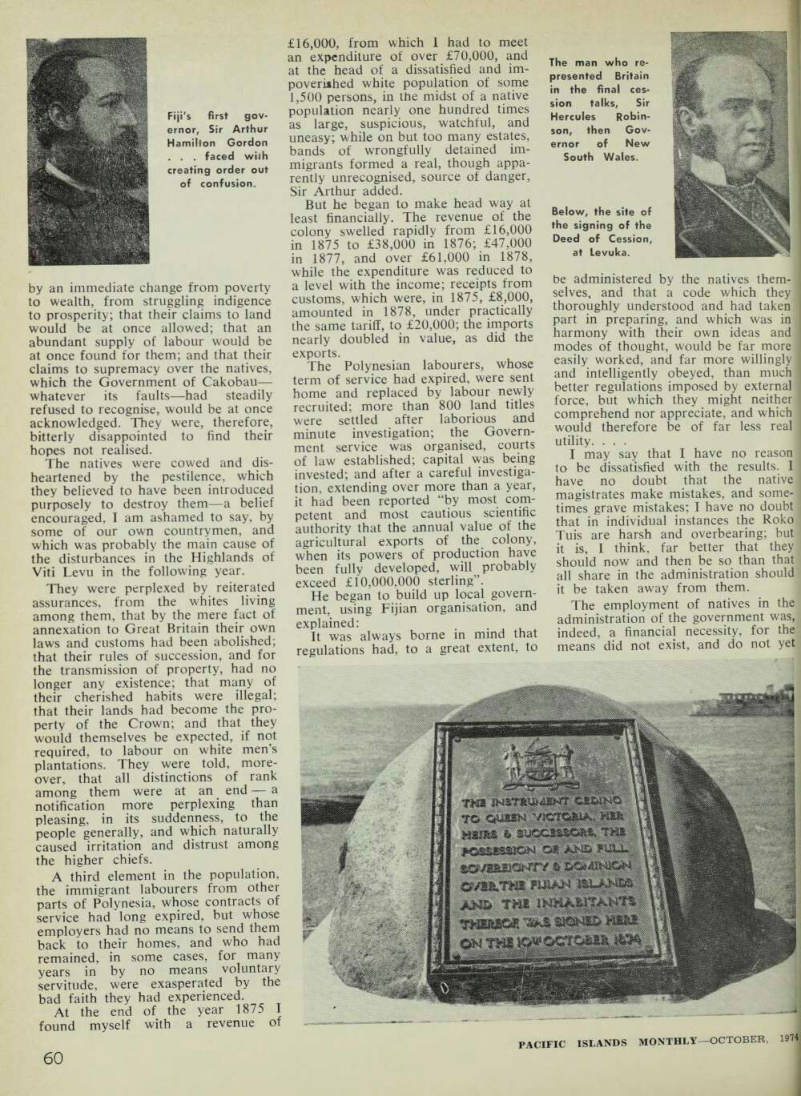
• This month is the hundredth anniversary of the cession of Fiji to the British Crown. On October 10, 1874, all the great Fijian chiefs assembled at Nasova, a mile from the town of Levuka, the old capital, and siqned the deed of cession. Fiji's King Cakobau later presented his old and favourite war dub—which he said had been the only known law of Fiji"—to Queen Victoria. But how did the infant colony prosper in those next few years after cession? K H
The act of cession followed protracted negotiations Britain having rejected the first petition by the great chiefs aimed at gaining the protection of England’s Queen. But finally Sir Hercules Robinson, then Governor of New South Wales, which itself was a colony, was deputed by the British Government to visit Fiji and explain to King Cakobau that Britain was willing to take over the responsibility. The state of the Cakobau government, Sir Hercules indicated, was parlous and there was no proper government in the country.
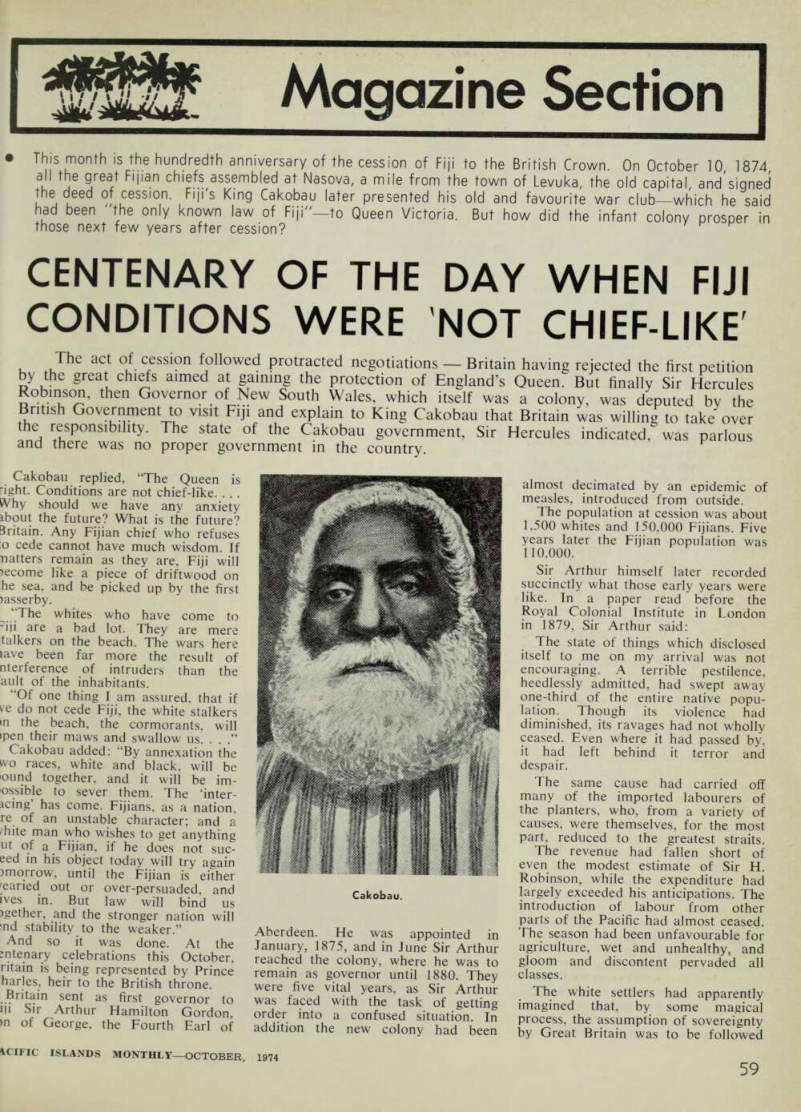
Cakobau replied, “The Queen is right. Conditions are not chief-like. . ..
Why should we have any anxiety ibout the future? What is the future?
Britain. Any Fijian chief who refuses o cede cannot have much wisdom. If natters remain as they are, Fiji will jecome like a piece of driftwood on he sea, and be picked up by the first jasserby.
“The whites who have come to 7 i\i are a bad lot. They are mere talkers on the beach. The wars here lave been far more the result of nterference of intruders than the ault of the inhabitants.
“Of one thing I am assured, that if ye do not cede Fiji, the white stalkers m the beach, the cormorants, will ipen their maws and swallow us. . . .”
Cakobau added: “By annexation the wo races, white and black, will be ound together, and it will be im ossible to sever them. The ‘inter ring’ has come. Fijians, as a nation, re of an unstable character; and a diite man who wishes to get anything ut of a Fijian, if he does not suc eed in his object today will try again amorrow, until the Fijian is either [earied out or over-persuaded, and ives in. But law will bind us jgether, and the stronger nation will :nd stability to the weaker.”
And so it was done. At the intenary celebrations this October, ritain is being represented by Prince harles, heir to the British throne.
Britain sent as first governor to ip Sir Arthur Hamilton Gordon, m of George, the Fourth Earl of
almost decimated by an epidemic of measles, introduced from outside.
The population at cession was about 1,500 whites and 150,000 Fijians. Five years later the Fijian population was 110,000.
Sir Arthur himself later recorded succinctly what those early years were like. In a paper read before the Royal Colonial Institute in London in 1879, Sir Arthur said: The state of things which disclosed itself to me on my arrival was not encouraging. A terrible pestilence, heedlessly admitted, had swept away one-third of the entire native popu lation. Though its violence had diminished, its ravages had not wholly ceased. Even where it had passed by, it had left behind it terror and despair.
The same cause had carried off many of the imported labourers of the planters, who, from a variety of causes, were themselves, for the most part, reduced to the greatest straits.
The revenue had fallen short of even the modest estimate of Sir H.
Robinson, while the expenditure had largely exceeded his anticipations. The introduction of labour from other parts of the Pacific had almost ceased.
The season had been unfavourable for agriculture, wet and unhealthy, and gloom and discontent pervaded all classes.
The white settlers had apparently imagined that, by some magical process, the assumption of sovereignty by Great Britain was to be followed
Aberdeen. He was appointed in January, 1875, and in June Sir Arthur reached the colony, where he was to remain as governor until 1880. They were five vital years, as Sir Arthur was faced with the task of getting order into a confused situation. In addition the new colony had been
Cakobau.
£16,000, from which I had to meet an expenditure of over £70,000, and at the head of a dissatisfied and im poverished white population of some 1,500 persons, in the midst of a native population nearly one hundred times as large, suspicious, watchful, and uneasy; while on but too many estates, bands of wrongfully detained im migrants formed a real, though appa rently unrecognised, source of danger, Sir Arthur added.
But he began to make head way at least financially. The revenue of the colony swelled rapidly from £16,000 in 1875 to £38,000 in 1876; £47,000 in 1877, and over £61,000 in 1878, while the expenditure was reduced to a level with the income; receipts from customs, which were, in 1875, £B,OOO, amounted in 1878, under practically the same tariff, to £20,000; the imports nearly doubled in value, as did the exports.
The Polynesian labourers, whose term of service had expired, were sent home and replaced by labour newly recruited; more than 800 land titles were settled after laborious and minute investigation; the Govern ment service was organised, courts of law established; capital was being invested; and after a careful investiga tion, extending over more than a year, it had been reported “by most com petent and most cautious scientific authority that the annual value of the agricultural exports of the colony, when its powers of production have been fully developed, will probably exceed £10,000,000 sterling”.
He began to build up local govern ment, using Fijian organisation, and explained: It was always borne in mind that regulations had, to a great extent, to
by an immediate change from poverty to wealth, from struggling indigence to prosperity; that their claims to land would be at once allowed; that an abundant supply of labour would be at once found for them; and that their claims to supremacy over the natives, which the Government of Cakobau — whatever its faults—had steadily refused to recognise, would be at once acknowledged. They were, therefore, bitterly disappointed to find their hopes not realised.
The natives were cowed and dis heartened by the pestilence, which they believed to have been introduced purposely to destroy them —a belief encouraged, I am ashamed to say, by some of our own countrymen, and which was probably the main cause of the disturbances in the Highlands of Viti Levu in the following year.
They were perplexed by reiterated assurances, from the whites living among them, that by the mere fact of annexation to Great Britain their own laws and customs had been abolished; that their rules of succession, and for the transmission of property, had no longer any existence; that many of their cherished habits were illegal; that their lands had become the pro perty of the Crown; and that they would themselves be expected, if not required, to labour on white men’s plantations. They were told, more over, that all distinctions of rank among them were at an end a notification more perplexing than pleasing, in its suddenness, to the people generally, and which naturally caused irritation and distrust among the higher chiefs.
A third element in the population, the immigrant labourers from other parts of Polynesia, whose contracts of service had long expired, but whose employers had no means to send them back to their homes, and who had remained, in some cases, for many years in by no means voluntary servitude, were exasperated by the bad faith they had experienced.
At the end of the year 1875 I found myself with a revenue of
be administered by the natives them selves, and that a code which they j thoroughly understood and had taken part in preparing, and which was in ! harmony with their own ideas and j modes of thought, would be far more j easily worked, and far more willingly and intelligently obeyed, than much better regulations imposed by external force, but which they might neither j comprehend nor appreciate, and which would therefore be of far less real utility. . . .
I may say that I have no reason to be dissatisfied with the results. I have no doubt that the native magistrates make mistakes, and some-, times grave mistakes; I have no doubt that in individual instances the Roko Tuis are harsh and overbearing; but it is, I think, far better that they should now and then be so than that all share in the administration should it be taken away from them.
The employment of natives in the administration of the government was, indeed, a financial necessity, for the means did not exist, and do not yet
Fiji's first gov ernor, Sir Arthur Hamilton Gordon . . . faced with creating order out of confusion.
Below, the site of the signing of the Deed of Cession, at Levuka.
The man who re presented Britain in the final ces sion talks, Sir Hercules Robin son, then Gov ernor of New South Wales.
exist, for the payment of such a staff of white officials as would have been required had the services of natives been dispensed with. But had no such imperative cause existed to render their employment inevitable, I should squally have deemed it to be required ay considerations of policy.
Unless removed from their habitual alaces of residence, and treated with i harshness wholly incompatible with he understanding on which the islands lad been ceded to England, chiefs of ntelligence, high rank, and great ocial influence, would have become, f stripped of all authority, and leprived of all employment except hat of brooding over their own hanged condition, very dangerous lements in the colony.
For, be it remembered, the legal ion-recognition of their position /ould not have in any way deprived hem of the power they possessed over bose who yielded to them an in tinctive and unquestioning obedience, ts it is, they are cheerful and willing ssistants to the Government in the erformance of its duties.
The results of the system actually dopted were apparent when the lountaineers of Viti Levu attacked le Christian villages of the Singa )ka. I apnealed to the Rokos for sip, and named thirty men as the antingent each was to send. Had the ime state of mind existed that I >und on my arrival, sullen and :luctant submission would at best ave been given to the order, and ore probably excuses would have jen made for the non-appearance of e force; the mischief would have •read, and a long and costly war ould have resulted. What was in ct the answer to the appeal? From most every province came double e number of men asked for—picked en out of a host of volunteers—and e troubles were suppressed by native rces alone, without delay and at a ifling cost. . . .
I will only say one word on the ture prospects of the colony imely, that I believe Fiji to be an Imirable field for the investment of rge capital, whether in sugar or ffee estates. Sugar grows spon neously, is of the first quality, and is a practically boundless market in ustralia.
As regards coffee culture, Fiji is >w in much the same position as jylon thirty or forty years ago, and have no doubt that those who now und estates there will find them in 1 long time amply remunerative. I ve never seen finer tobacco than at raised in Fiji, and the cotton oduced there is admitted to be of ; best description.
Fiji was set on its long road to lependence.