who ruled
pp. 61-103 · Read in the full issue
Nature lover who ruled The Solomons
By R. A. Lever
The combination in one individual the twin assets of administration d natural history is rare enough to of comment but this happy blend is present in C. M. Woodford, the st Resident Commissioner of the itish Solomon Islands Protectorate.
Unlike any official of similar stand l either before or since, Woodford d spent no less than three years as collector of natural history speci ms before his appointment and so irted off with an intimate know- Ige of the islands he had been osen to administer.
However, his experience of the cific did not start with his arrival the Solomons as, in 1882, he had -ved as an inspector of labour on :ruiting vessels in the Gilbert ands. This was followed by a four ar stay in Fiji and a brief visit to moa. Annexation of the main ands of the Solomons took place 1893 and some four years later oodford and his small party were
opped off by the Burns Philp
lamer Titmus at Gavutu from lence he was rowed to the small and of Tulagi. This was selected his base and future capital on the in counts of its deep, spacious rbour and its central position long the scattered islands.
In 1886 Woodford began his valu le collecting for the British useum (Natural History) making i base at Aola along the eastern rtion of the 80-mile-long island of aadalcanal which he described as t most fertile and most beautiful and of the group. Although a val surgeon, Lieut H. B. Guppy, d been the first naturalist in this ea, it fell to Woodford to write the st account of the animal life—A ituralist Among the Headhunters 890).
No matter where this book is >ened, it reveals glimpses of the scinating animal life whether it is description of the giant rats or scus (possum) of Guadalcanal, the
•nderous hornbill flying noisily high
cr the tree tops or the unusual egapodes laying their eggs in the nd of Savo’s beaches. Among a rge number of creatures new to
science described by specialists in England, one can name the noisy Woodford’s crow, a tree swift, lizard, gecko and a snake, all named after their discoverer.
In Harold Cooper’s Among Those Present, published by the Ministry of Information in 1946, it is stated that this large Woodford’s crow is peculiar to the western islands such as New Georgia but this is inaccurate as the bird occurs on Choiseul, Ysabel and Guadalcanal. It is not only among the mammals and birds that collections were made as one of Woodford’s best descriptions is of his capture with a net of a scarce birdwing butterfly on Malaita when the catcher, who was bathing, rushed at it stark naked. The number of bugs, moths, beetles and dragonflies that Woodford collected for the first time must be legion and his total contribution to zoology reached a very high level.
Woodford took full advantage of his three years stay to tour fairly extensively and one of the jobs he must have enjoyed doing most was to locate the exact spot on the north coast of Ysabel where the Spanish exploring party under Mendana made their landfall in 1568. This site was Estrella Bay and the descriptions of the headland and a prominent island as given in the journals were found to tally in all points with Woodford’s reconnaissance.
Another interesting account is given of his trip into the interior of Savo culminating with a descent into
the extinct volcano crater with its still active fumaroles belching sul phurous steam. At Alu in the Short lands, Woodford travelled by canoe, taking his turn with a paddle.
Several years after his departure for England Woodford returned, as already mentioned, to begin his official career in the islands he had come to know and love. A photo graph of the first “Residency”—for it must be put in inverted commas— shows a small building not unlike the basha so familiar to thousands of troops who served in Burma. The strong fronds of the sago palm trees (which provide ivory nuts) were used as thatching and when Mrs Wood ford came out from home she was the only white woman on Tulagi.
She was formerly Miss Florence Palmer of Bathurst, NSW.
The infant Protectorate was most fortunate in having as its first official someone who was so keenly in terested in agriculture for it was clear that copra would for long be the main revenue-producing product. At least as early as 1898, no less than 60 acres of land had been cleared of jungle and planted with a most impressive list of edible crops, a selec tion of species and many ornamental plants including several orchids—
Continued on p 101
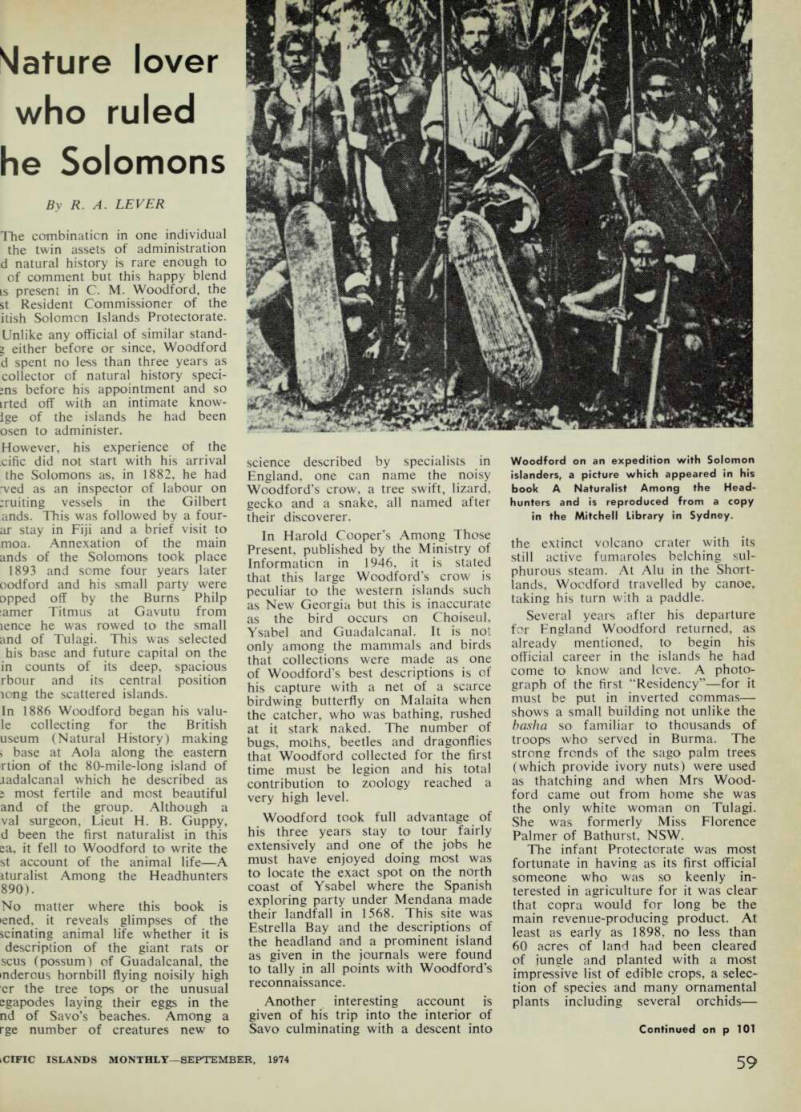
Woodford on an expedition with Solomon islanders, a picture which appeared in his book A Naturalist Among the Head hunters and is reproduced from a copy in the Mitchell Library in Sydney.
nething that the Solomons can al ys be counted on turning out. lat must have been almost unique ong official reports was detailed ormation on coconut cultivation, •ughing of the grass plains on adalcanal and even descriptions of ne of the important insect pests— written from first-hand knowledge. \s would be expected, many prob es arose during these pioneer days, the least being strong representa is from Lever Bros (the fore iner of the Unilever combine) to allowed to import coolie labour om the teeming millions of India”, rtunately this attempt was turned vn flat by Woodford’s chief in Fiji e High Commissioner for the ►stern Pacific) aided, one can be e, by emphatic dissent from lagi. Another problem was to zover and stop the illegal importa i of arms and ammunition, this ng a matter in which visiting war ps greatly helped by policing.
Woodford's term of office ended ly in 1914 by which time he was irly 62, having been born at avesend in 1852. Besides the ard of a CMG, Woodford was also recipient of the Gill Memorial
Medal from R °y al Geographical Society for his services to travel, During his official service he visited the , virtually unknown Rennell, Bellona and Sikaiana islands—the home of rather primitive peoples of Polynesian ancestry far from the main islands.
The unveiling, in Woodford’s memory, of a bronze plate on a memorial surmounted by a lamp standard was performed on the Tulagi waterfront by the then Officer Administering Government, Mr J. C.
Barley who had served under him.
One can be sure that Woodford, as a stickler for historical accuracy, would not have been amused at the inclusion in official reports (after his time) that Mendana had given the name Ysabel after his wife when it was well written up that it was to commemorate their departure from Peru in November, 1567, on St Ysabel’s Day. Woodford lived to the age of 75, dying at Steyning, Sussex, in October, 1927. How pleased he would be to know that the Advisory Council is rapidly giving place to a cabinet government with nearly all its members full-blooded Solomon Islanders.