Magazine Section
pp. 59-60 · Read in the full issue
Saipanese Recall A Day In June
When Thousands Leapt To Death
From FRANK ROSARIO and FLOYD TAKEUCHI in Saipan
Thirty years ago in June, the end the Imperial Japanese Empire as determined on the beaches and e hills of Saipan, biggest of the ariana Islands and “capital” of icronesia. That bloody battle, in lich over 14,000 Americans and l, Japanese were killed, wounded reported missing in action, was e most important turning point in e Pacific War. Once the strategic ands of the Marianas were secured, nerican B-29 bombers were finally thin striking range of the Japanese •meland. It was from Saipan, and nian to the south, that America is able to cripple Imperial Japan’s ilitary might.
For some of the residents of Sai n, memories of the invasion are clear today as they were 30 years o.
“It was Sunday, June 11, 1944, len the first wave of American anes came”, recounted Ignacio M. blan. Now the Marianas district dget officer, Sablan was fixing his :ycle in Garapan when the bomb l started. “American planes mbed Charlie dock and destroyed /eral oil tanks. I couldn’t estimate ; number of planes that were com l in. I looked up in the sky and Dught it was going to rain because sre was so much black smoke”.
Jose S. Pangelinan was a captain the second division of the Keiboo m, a Saipanese militia group.
Wien the invasion began, I told the tiers in my group to take their milies and hide in the caves”.
Pangelinan, who was 40 at the ne of the invasion, said, “I was ite fortunate that the commanding ficer, General Kurota, had been my issmate in Japan. He hid my family a cave and gave us a pass to show panese troops”.
“Japanese anti-aircraft guns sur rounded our cave”, he said. “We just sat and watched them fire at the waves and waves of American planes
flying above”.
Sablan witnessed much of the bombing, too. “On June 12”, he re
called, “planes began bombing again.
Bombs exploded before they reached the ground. We saw many Japanese Zeros shot down”.
Like Pangelinan, Sablan and his family sought safety in a cave. “We stayed in one cave, but decided to move on the evening of the 12th. We found another cave and stayed there until July 2. From that cave we could see from Agingan Point to the beach at Oleai”.
There were 63 people in Pange linan’s cave. The cave was only 15 ft square. “We saw thousands of Japanese wounded. My two sons, Donald and John, were very young at the time. But they helped me take water to those dying soldiers. We were lucky no one shot us”.
Pangelinan, now a co-editor of the Saipan newspaper I Gaseta, remem bers well the day American soldiers reached his cave. “It was June 16.
I told the others in the cave to keep still and not say a word.
“My daughter, Elphidia, was six at the time. I told her what to say when she saw the Americans coming.
She went outside, waved a white cloth, and shouted, ‘Welcome Ameri cans!’
“They told us to come out, one by one”, he said. “We couldn’t take any thing we owned. We were taken to a camp in Oleai, stayed there for two days, and then we were trans ferred to another one in Chalan Kiya”.
Many Saipanese, once in the safe custody of the advancing American troops, volunteered as scouts and interpreters.
Antonio Benavente, now Saipan’s sheriff, was 18 when the first Ameri can troops waded ashore. “I volun teered as a scout and was assigned to the 4th Marine Division”, he re called.
Benavente worked with another Saipanese, Mike Tenorio. According to Benavente, Tenorio landed with the Marines. “Mike had been a sailor on a Japanese ship with five other Saipanese. He was on Kwajalein when the American invasion started there. Of the five, Benavente said, he was the only survivor. The Americans captured him and took him to Hawaii
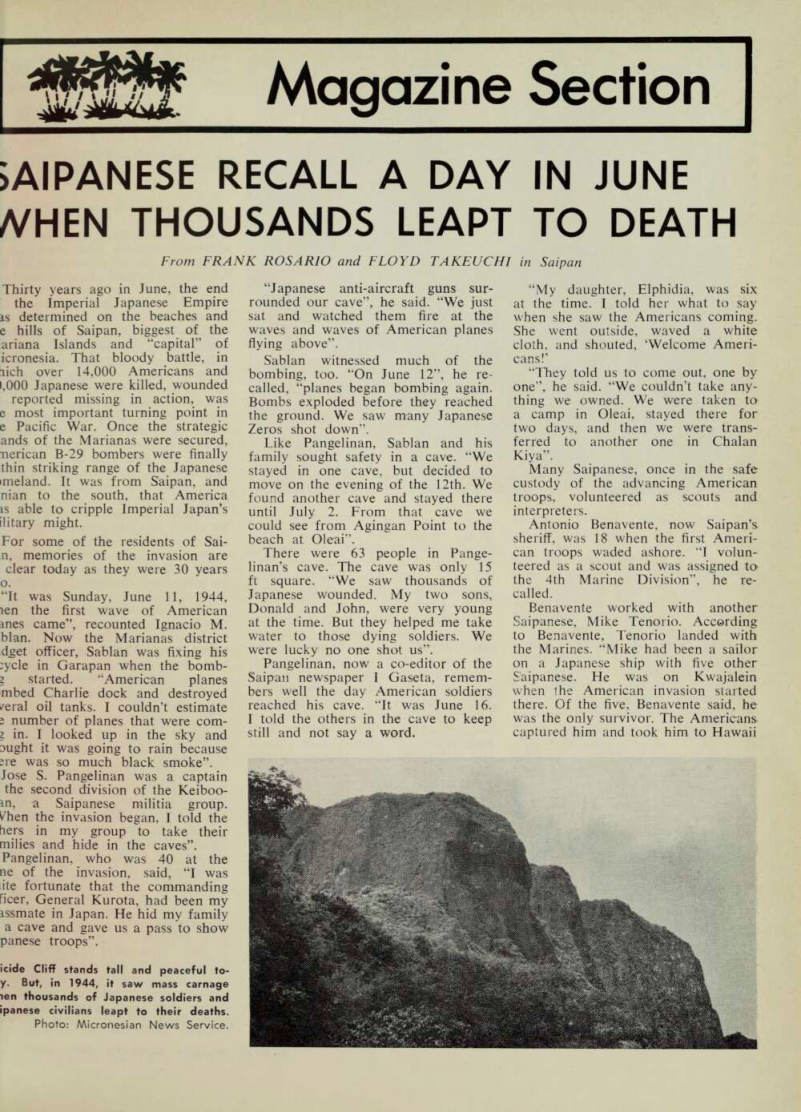
[?]icide Cliff stands tall and peaceful to [?]y. But, in 1944, it saw mass carnage [?]en thousands of Japanese soldiers and [?]ipanese civilians leapt to their deaths.
Photo: Micronesian News Service.
for interrogation. They wanted to know what the Japanese forces on Saipan were like”.
Tenorio is now a painter for the Trust Territory Public Works Department. But in 1944, he and Benavente assisted American forces in the invasion of Tinian and the routing of Japanese snipers on Saipan.
“Mike saved many Saipanese lives”, Benavente said. “He helped direct much of the US naval gunfire. He told them to shoot at the hills, and the beaches, and told them where Japanese gun emplacements were.
“We trained for six months at the camp of the sixth marine division”, reminisced Benavente, “that was located on what is now Capitol Hill, where the TT headquarters is”.
During that period Tenorio and Benavente helped capture about 50 Japanese snipers.
Jose Pangelinan also served as an interpreter and scout. He went with American troops to assure Saipanese still hiding in caves that they had nothing to fear if they surrendered.
He narrowly missed being killed once. “I was with two captains, two sergeants, and two privates when we were ambushed near Matansa. One captain grabbed his walkie-talkie and within three minutes several planes began circling us and dropping bombs”.
The Saipanese scouts helped save
many lives. Families that had taken refuge in the hills came out during the night hours under the cover of darkness. The American soldiers did not know whether they were Japanese or Saipanese, as both wore similar clothing.
The toll paid by both sides was enormous. Saipan’s hilly terrain ma de it difficult, and costly, for the advancing American army. Accordj ng to one account, Saipan seemed to be one hill after another for the Marine and Army units. Some of those hills were nicknamed as re minders of the bloody battles that took place on them: Dead Man’s Gulch, Poison Ridge, Impostor’s Hill, Death Valley, Nameless Crag, and Back Break Hill.
One Marine regiment worked their way to the top of Mount
Tapochau, Saipan’s highest peak.
Then they found themselves sur rounded by Japanese and were ordered to withdraw. Their corn manding officer decided to remain with their wounded and fight it out.
By morning, when another American patrol reached them, only five of the original group were alive, But perhaps the bloodiest fighting took place when Marine and Army units cornered the remaining Japan ese troops in Saipan’s Marpi area, the northernmost tip of the island.
It was here that the bloodiest
battle of the Saipan campaign took place. On the evening of July 6 over 3,000 Japanese soldiers, some only armed with pointed sticks, charged American positions near Tanapag village.
The Japanese troops stormed overl the beleaguered Americans. It was; bloody hand-to-hand combat. Many l of the Americans who managed to retreat to Tanapag were killed by US naval gunfire directed towards the area.
By the time reinforcements broke through, over 900 Americans had been killed or wounded and almost] every Japanese sold’er had died.
It was also in Marpi that one of the most tragic episodes of the war took p’ace. Many of the Japanese] and Saipanese civilians were con-i vinced that the “American devils” would kill them if they surrendered.
Pushed to the northern end of the? island by the American advance] they chose to kill themselves rather than to die in the hands of the enemy.
Suicide Cliff and Banzai Cliff were the sites of this mass carnage. “I saw more than 3,000 jump”, Bena-I vente recalled. “Whole family groups, mothers and fathers, were pushing their children, then leaping themselves.
“The US troops gave me a loud speaker to beg them to stop. I yelled in Japanese to them: ‘Don’t do it.
Come down. The Americans will not hurt you’.
“But they continued for he said. “Hundreds of them, leaping from that cliff”.
In the sea around Banzai Cliff, hundreds of bodies washed against each other as still others jumped to their deaths.
Today, Saipan’s beaches are quiet save for the laughter of child ren playing in the calm water. Hotels and swimming pools mark the sites of some of the heaviest beachfront fighting. The only Japanese guns that remain on Saipan are silent, rusty reminders of a violent past.
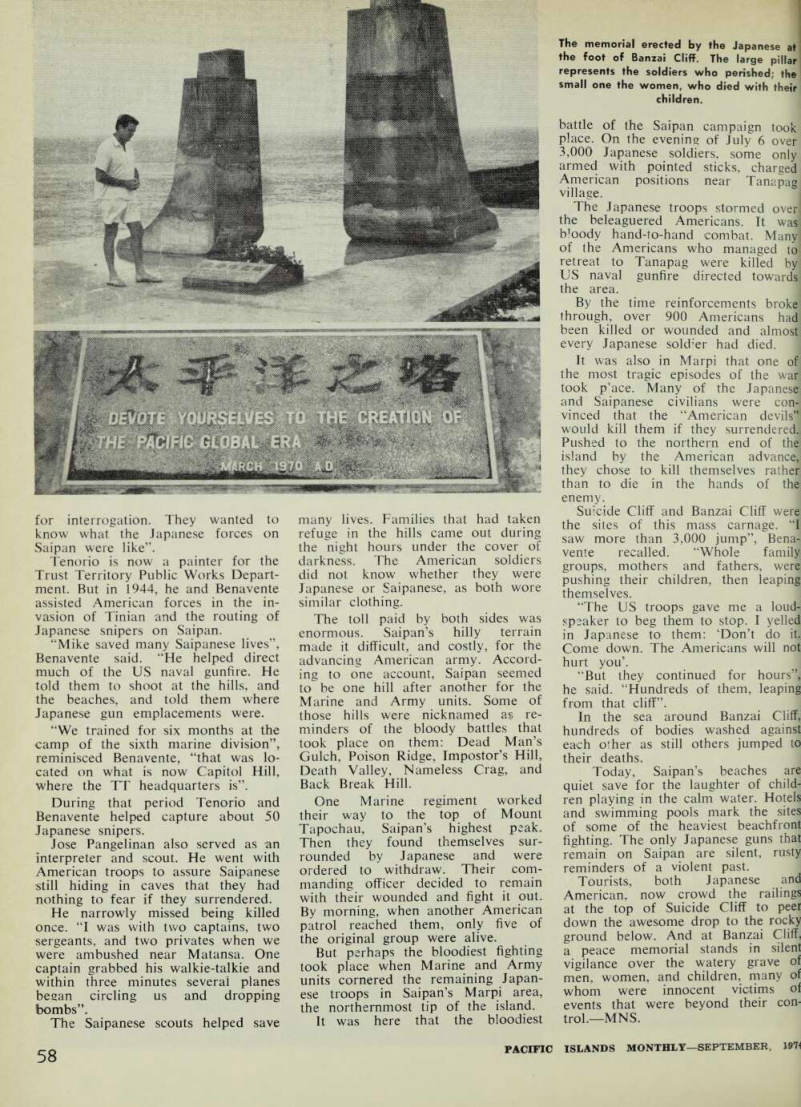
Tourists, both Japanese and American, now crowd the railings at the top of Suicide Cliff to peer down the awesome drop to the rocky ground below. And at Banzai Cliff, a peace memorial stands in silent vigilance over the watery grave of men, women, and children, many of whom were innocent victims of events that were beyond their con
trol.-
Mns.
The memorial erected by the Japanese at the foot of Banzai Cliff, The large pillar represents the soldiers who perished; the small one the women, who died with their children.