Yesterday
p. 50 · Read in the full issue
The lure of New Zealand for Polynesians has increased down the years. Twenty years ago, official figures in PIM showed that 5,000 Samoans, Niueans and Cook Islanders lived in NZ, most of them in Auckland and Wellington. The majority of them were Samoans. Official reasons for the migration were given as 'social problems' at home. Those social problems must still exist for the migration continues unabated, though the city lights, softer living and high wages are obvious magnets nowadays.
A young Rotuman, Officer Cadet P. R. Manueli, was at Sandhurst 20 years ago learning all about being a soldier in possibly the finest military academy in the world. He won a name for himself by winning a javelin event at the Pentangular Athletics Match in Brussels, with a throw of 161 ft 3 in., 11 ft better than his nearest rival. That Rotuman today is Colonel Paul Manueli, commander of the Fiji Military Forces.
Jim Shortall, a PIM correspondent for many years, paid a visit to the Cook Islands in 1954, and reported that he was most unimpressed with traffic safety in Rarotonga. He wrote: "Though Rarotonga has over 11 motor vehicles per mile of 21-mile encircling road, the people appear to be unaware of road rules. Cyclists, especially, use either side of the road at will. Cars pass them left or right—the driver hoping that they will hold that side until passed. Road education in the schools seems to be nil.
One of the sights of Rarotonga is the extraordinary method of double-banking on bicycles—the passenger takes his, or her, place squarely on the handlebars, facing, and completely blocking the view of the pilot, who pushes ahead quite unperturbed. Occasionally, there is an additional passenger on the rear." How about now?
The great llu farm experiment in the BSIP, met fhe same fate as the great pre-war African ground nut venture.
The farm, about 17 miles from Honiara, developed as a vegetable farm by the Americans during World War 11, was acquired by the BSIP Government, which hoped to turn reluctant Guadalcanal natives into farmers with llu as the show place. It is doubtful if one islander became a farmer because of llu, and as a farm it was of considerable embarrass ment to the government. Lack of
money, lack of staff and inability to coax practical men from New Zealand or Australia contributed to its failure. The farm was offered for sale by tender.
There seems to be a familiar ring about this item from PIM of September, 1954: "The NZ Government ship, Maui Pomare, cost the NZ taxpayers another £40,000 this year; will probably cost £BO,OOO next year . . ." The Moana Roa, which was withdrawn from the NZ-Cook Islands service in 1972, also turned in an annual loss running into thousands of dollars.
Vietnam was in turmoil in the 19505, and refugees were on the run from what were then known as the Vietminh from the north. There was a strong suggestion of sending these refugees to New Caledonia. This did not please the Caledonians, and a general meeting of the commercial employees' union decided to protest against the introduction of foreign labour. The protest resolution followed an announcement that a French officer from Saigon would visit New Caledonia to see about placing the Indo- Chinese refugees there. PlM's Noumea correspondent then wrote: "There are already 5,000 trouble-makers in New Caledonia—the Indo-Chinese indentured labour that was freed. Introduction of any more would swamp the Europeans".
Some colonial governors become popular.
One of these was Governor Petitbon, of Tahiti, regarded as the most popular occupant of the gubernatorial office in French Oceania for many years. So it was with general regret that the news was received of his transfer to Djibouti in Africa. There was surprise as well as he had only recently returned from vacation in France to what most people thought would be a full second term of two years.
Fiji has been talking about harnessing some of the rivers of Viti Levu for electric power for years. Near neighbour, Western Samoa, 20 years ago, had just
about completed a 1,000 kilowatt hydro power station to meet Apia's increasing demand for power. The project was expected to cost about £NZ250,000.
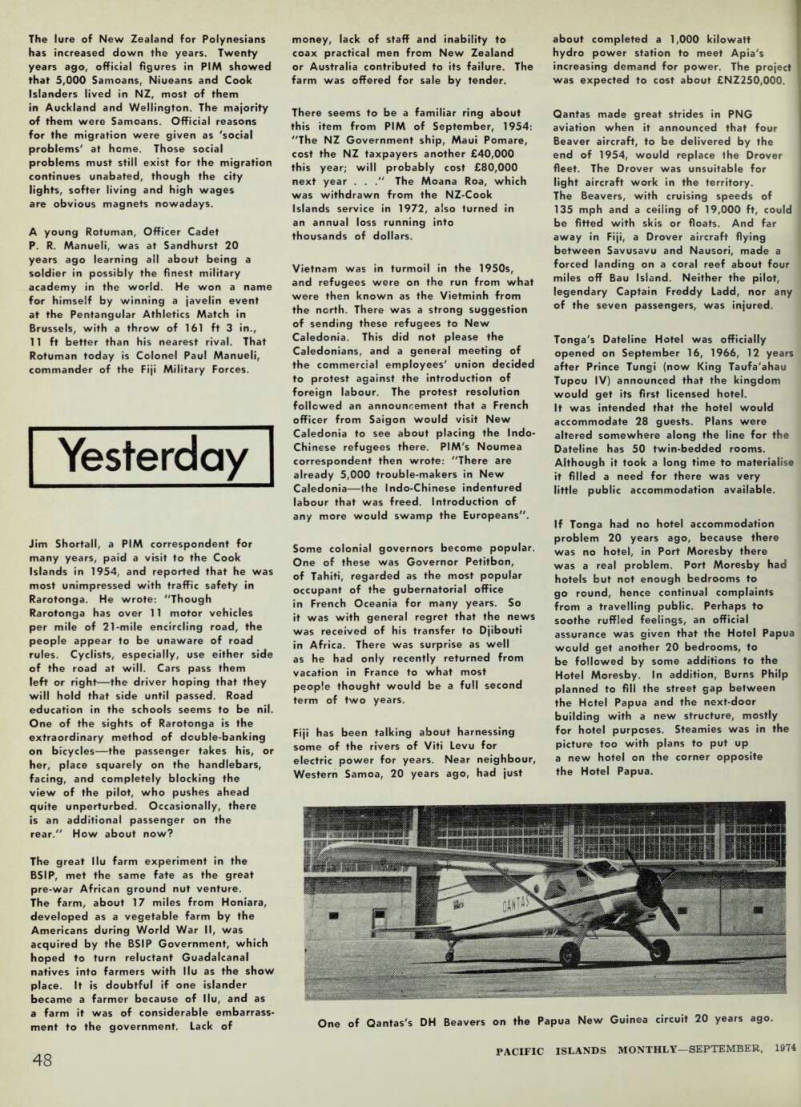
Qantas made great strides in PNG aviation when it announced that four Beaver aircraft, to be delivered by the end of 1954, would replace the Drover fleet. The Drover was unsuitable for light aircraft work in the territory.
The Beavers, with cruising speeds of 135 mph and a ceiling of 19,000 ft, could be fitted with skis or floats. And far away in Fiji, a Drover aircraft flying between Savusavu and Nausori, made a forced landing on a coral reef about four miles off Bau Island. Neither the pilot, legendary Captain Freddy Ladd, nor any of the seven passengers, was injured.
Tonga's Dateline Hotel was officially opened on September 16, 1966, 12 years after Prince Tungi (now King Taufa'ahau Tupou IV) announced that the kingdom would get its first licensed hotel.
It was intended that the hotel would accommodate 28 guests. Plans were altered somewhere along the line for the Dateline has 50 twin-bedded rooms.
Although it took a long time to materialise it filled a need for there was very little public accommodation available.
If Tonga had no hotel accommodation problem 20 years ago, because there was no hotel, in Port Moresby there was a real problem. Port Moresby had hotels but not enough bedrooms to go round, hence continual complaints from a travelling public. Perhaps to soothe ruffled feelings, an official assurance was given that the Hotel Papua would get another 20 bedrooms, to be followed by some additions to the Hotel Moresby. In addition, Burns Philp planned to fill the street gap between the Hotel Papua and the next-door building with a new structure, mostly for hotel purposes. Steamies was in the picture too with plans to put up a new hotel on the corner opposite the Hotel Papua.
One of Qantas's DH Beavers on the Papua New Guinea circuit 20 years ago.