Beware, The Worst Is
pp. 62-63 · Read in the full issue
Still To Come!
By Leonard Garae
I come from a small island called Aoba in the New Hebrides. Until recently, accounts of the incredible feats of brave warriors, their vietorious speeches, and custom songs composed in their honour were all handed down by word of mouth as there was no written literature. The story I am going to tell you was handed down in this way. Today people still believe that the events
it records actually happened.
About 200 years ago, the site which is known today as Vureas (where Vureas High School is situated), supported a large population.
It was said to have been one of the most densely populated areas on Aoba. Its original name was Nawalu which means ‘deep valley’. It was here that the men lived in their gamali (men’s club houses) and the women in their vale (ordinary houses). One can imagine them walking the well-trodden bush paths down to the beach to swim and to fish on sunny days. By sundown they would return heavily laden with red fishes and shells in woven baskets of coconut leaves.
Every day it happened that the men’s unfinished meals which were left in baskets in one particular gamali always vanished while the men were either working in the gardens or fishing, or while they were sleeping at night. k Finally one of them protested, “I won’t tolerate this any longer! Tonight I am to catch the thief whether it be man or woman, devil or human being. When I have done so, I will make him or her feel sorry for ever trying to enter our gamali and steal our food!”
“We are all with you!” shouted
the others and it was decided they should take action that very night, 'rwUSK was approaching and every!
U one re tired early pretending to he sleepy. Both doors were barred and each man listened intently for the slightest sound, while his hands rested on his bow and arrows. Sud denly, out of the piles of baking stones at each end of the gamali emerged two tall, hairy figures. They t’ptoed around feeling for food in the baskets hanging from the ceiling, “Now!” A man’s voice split the silence and all the men threw them^ selves at the two figures but without using their weapons. When the short but fierce fight ended? one G f t he intruders lay dead upon the floor, The second escaped their grip and sneaked out of the gamali.
As they ad staggered to their feet, a c j ear vo i ce shattered the night, sending echoes bouncing back from the hillsides around the deep sleepj ng va n ey> “Beware”, it said, “for this is just the beginning. The worst is still to CO me!”
Everyone was scared stiff. The men stood rooted to the spot and t h e i r hair stood on end. As the echoes died away, they heard the distant murmur of mourning. Not a man dared m ove until dawn, The smoke from the women’s fires rose high in the sky and the fresh ear i y morning breeze carried it away . The children ran out of the houses. The sound of their happy voices reached the men in the ill fated gamali and they realised it was daylight. What a sight met their eyes as they gazed around. Baking stones and pieces of unburnt wood were scattered everywhere around the
king ovens in the floor. And in sir midst was the final horror: a dy, with neither head, nor legs, r even hands, but covered with ig black hair. They hustled it out le and burnt it.
As the days wore on, their fear gan to increase as the devil’s dire sdiction kept ringing in their ears. i stormy nights when a dark veil clouds swept in over the valley d the wind tore through the coco t leaves like angry waves through fisherman's net, a weird sound like it of a widow mourning could be ard high up in the blackness which /ered the entire village like a mket, threatening to suffocate the eping inhabitants below. It is said it the sound was so terrifying that : women often covered their ears enever they heard it. .NE day when the weather was fine, the men forgot their fear 1 decided to go fishing. They led all day and came home carry : their catch to the gamali. As was ir custom, each man had his own iplace where he cooked this food, a short time there was a fire burn in each fireplace and other ivities were in progress such as cing the stones in the fire and ipping the fishes in green leaves, t during their absence, unknown them, the forked baking sticks I been removed, split in two, and arned, each with one side miss , to their original places, fn the glow of the dying fires the t man stretched out his hand for baking stick. Holding it close to fire, he noticed that it had been ipered with, Te turned to the man next to i and snarled, “Here, give me :k the other side of my baking ;k! Why did you have to steal it? lere is yours?” ‘This is mine! Oh! Where . . . ?” neighbour replied as he realised t his too was ruined. He turned the next man and blamed him it. This went on and there was much confusion that every man t his temper. A fight broke out. 0 men blocked the doors and :h time a man retreated towards ler door he was clubbed on the id. boon the whole village was alive h anxious people trying to find ; what was happening. Startled Idren ran madly everywhere; eping women could be heard call : for their husbands; while now 1 then a loud shriek rent the air 1 “Thud!” a man or woman or :hild dropped dead. No sooner had started than everybody became in ived and with little or no reason s drawn into the fray.
The fight was at its bloodiest when the survivors started retreating.
In spite of the size of the village, there was only one road out of Nawalu, and burning coconut fronds flickered along it as desperate men and women struggled frantically up the steep hillside, anxious to escape from the death-trap valley.
Thinking that the danger was over, a few of them slackened pace but had it really passed? In the lurid light of the flaming coconut leaves, a man who had forged ahead of the others, dripping with sweat, paused as he reached the crest of the hill and stood astride the path.
In his hand could be seen vividly one side of a bloody baking stick.
Too late the leading freedom dreamer tried to duck. The stick swung and with a sickening thud his dead body toppled and rolled down the hillside. One after another the exhausted villagers fell under the blows of his stick. Gradually he grew weary and was knocked off
by another man who, instead of escaping, quickly took his place and carried on the bloody work. The massacre continued until dawn.
THE last hero still stood his ground on the summit of the hill look ing down into the valley. Fighting his weariness, he thought he saw a movement far below among the slaughtered people. Straining his eyes, he saw an old woman approach him, leaning on a walking stick.
He was just about to swing his blood-covered weapon, when she looked up at him and calmly said, “Must there be no survivor left? Do you have to kill everyone?”
As if he had been struck by some invisible power, his mouth opened and the stick dropped from his hand.
He fell to his knees, put his hands over his face and gasped, “What have I done? Why didn’t you stop me before?”
His memory cleared and the full horror of his actions dawned upon him. But what could he do? It was too late. The devil’s death in the gamali had been avenged. The only survivors of the total population of Nawalu were an old woman and a remorseful young man. From the top of the hill to the valley below, blood had soaked into the leaves and earth and the path was strewn with corpses.
There is evidence that this village, Nawalu, really existed at one time.
Broken pieces of pottery, stone axes and human bones were unearthed about 200 metres from the seashore when a well was dug. If the village were still in existence today, what would the population of my island be? I wonder.
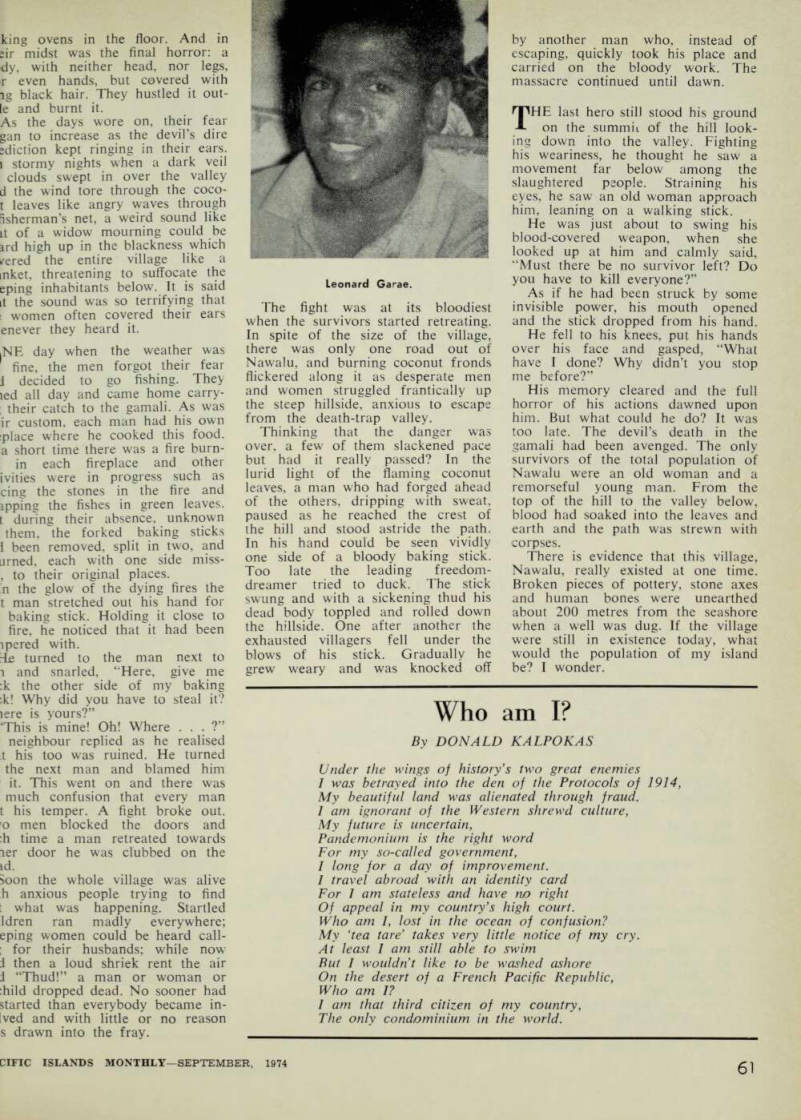
Leonard Garae.