to foot inflation bill
pp. 35-39 · Read in the full issue

Samoa wants more money to foot inflation bill
From FELISE VA’A in Apia
Last year, Western Samoa’s Minis ter of Finance, Sam Saili, told parlia ment there would be no more supple mentary budgets except in the event of an emergency. Hence, all govern ment departments had to prepare their estimates to cover the full year.
The statement aid not go unchallenged as the Opposition and certain observers felt that this was easier said than done. It was no surprise, therefore when rather be latedly a parliamentary session was called in July primarily to consider a Supplementary Appropriation Bill, the main purpose of which was to provide for a salary and wage in crease for public servants, the judiciary and MPs to keep up with the rising cost of living.
The cost was estimated at $237,175 for public servants, $4,000 for judi cial officers, $22,000 for Members of Parliament and $9,975 for govern ment village officials ( pulenuu ).
But, of course, this was not all there was to it. The bill also sought to spend $lOO,OOO on government stores, $70,000 for liquor, $50,000 for equity shares in the Vehicular Ferry Company, $70,000 for the production of a new decimal coinage in 1974, $50,000 for the completion of Beach Road redevelopment, $50,000 for drainage work at Faleolo Airport, $50,000 for extensions to Faleolo hangar, $20,000 for the wharf project consultancy fees and $18,500 for consultants’ accommoda tion.
The additional total expenditure would amount to $784,565 offset by an estimated increase in revenue of $712,880. This increase came mainly from import duties ($200,000), sale of liquor ($100,000) and sale of decimal coins ($150,000).
Balancing the new expenditure and increased revenues, a deficit of only $71,685 was recorded, and brought the estimated budgetary deficit for the year to $177,163, Minister Saili estimated.
Saili’s speech to parliament covered a wide range of topics but dealt mainly with questions relating to in flation, overseas reserves, exports, the proposed Development Bank, infrastructural development, the vehicular ferry project, tourism and New Zealand assistance.
It was obviously geared to justify-
ing the government's controversial economic policies laid down soon after the new political party took office early last year, and in a sense, it was intended to create confidence in the Mataafa government which has been severely criticised over its hand ling of economic affairs and its ex pulsion of the United Nations Development Project Office. (More correctly, if the most reliable sources are to be believed, the decision to expel the UNDP Office was not Cabinet’s decision, but solely the Prime Minister’s.) Now the question naturally arises, how well or how badly has the government done in its administration and control of economic affairs?
Saili attributed inflation to short ages in the supply of overseas raw materials, oil products especially, and to increased industrial unrest over seas. The main cause of internal cost of living increases was, therefore, “imported” inflation. Additional in flationary pressures had been caused when local production had failed to keep up with demands for agricul tural products.
Thus, the minister hinted, the government had been forced to adopt anti-inflationary measures: reducing unnecessary government expenditure and tightly controlling consumption credit.
“The Price Tribunal has tightened
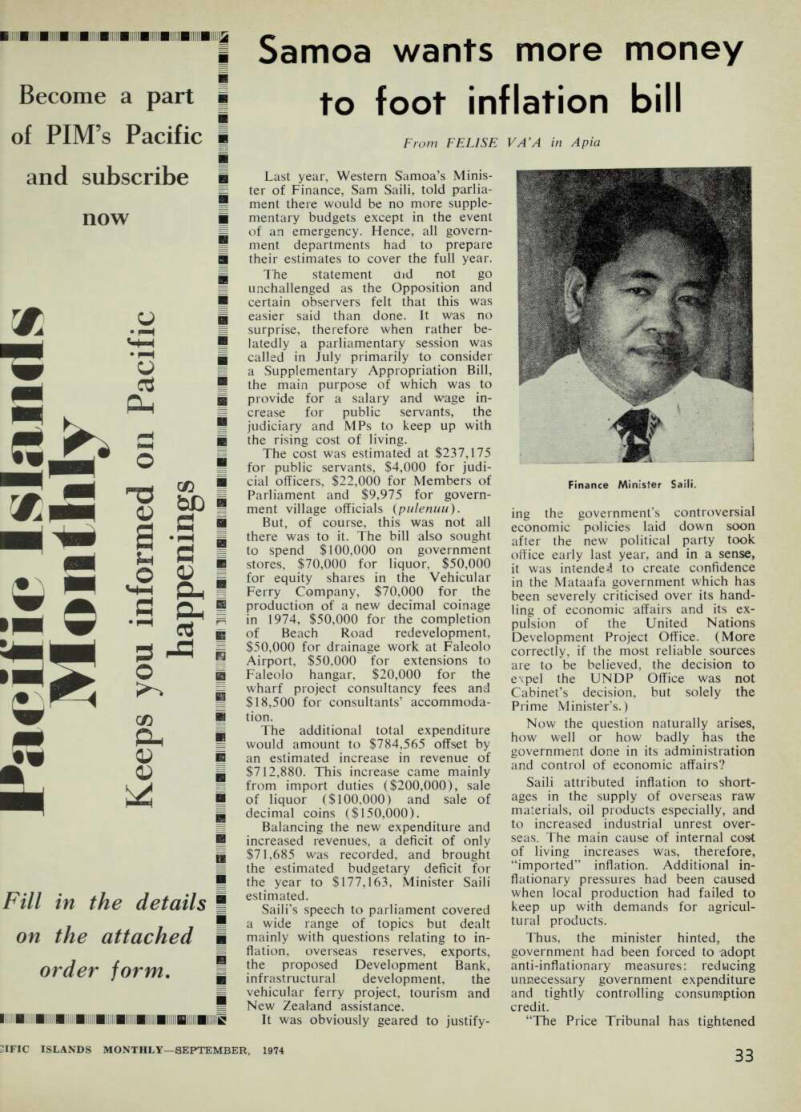
Finance Minister Saili.
ypocritica! statements
control over the essential food ns but in the longer term, the t way we can successfully combat srnational inflation, is to raise the el of productivity and increase icultural and industrial produc i”, he said. fo state an economic principle, if s one, however, is just like reciting ►oem that has been memorised for •ediency’s sake. To put that prin le into action is quite another ig and to the majority of Samoans > is the key issue. What has the itaafa government done to im •ve industrial and agricultural pro :tion? Very little, many expert icrvers of the local scene will say. >m this they will conclude that 'eminent statements on this point hypocritical. It seems that a lot future promises are made but at really matters to the majority Samoans is the NOW, the present ment.
Jaili said that during the first nine nths of 1973, the country’s over s reserves declined by about )0,000. By the fourth quarter, the icit was reduced to $BOO,OO0 —a re gain of $lOO,OOO. This was tainly not much to be proud of I seriously questioned the wisdom Saili’s financial and economic icies. Was a $lOO,OOO gain, for ;ance, an adequate recompense for widespread sufferings the noans had to endure from the be ning of the Mataafa regime? Saili’s ist that the economic actions taken April, 1973, enabled a reversal of serious trend, was in reality an pty one.
Jowever, there was a positive ; to Saili’s speech, and this was announcement that Western noa’s copra and cocoa were getting remely high prices in overseas rkets. Thus in July, an fob price about $1,400 a ton was received cocoa, and about $4OO a ton for •ra compared with $BBO per ton I $l5O per ton respectively 12 nths ago. fhis favourable state of affairs 1 enabled the government to allow maximum possible importation consumer and capital-goods com nsurate with keeping a necessary j 1 of overseas reserves, f this situation continued, it was •ected that a small balance of r ments deficit would occur in r 4. But again, many Samoans ecially in the villages, are hoping t Saili’s plans (for a smaller de t) could be achieved without un
necessary suffering to them through scarcity of goods, high prices and, most of all, unemployment.
Saili forecast that total agricultural export earnings for 1974 would exceed $W55,000,000 for the first time since 1964, compared with $W53.74 million for 1973. This high figure, however, is mainly the result of the high price for cocoa and copra.
Volume-wise, present exports are comparatively insignificant. In 1972, 1,890 tons of cocoa worth $896,376 were exported, whereas in 1973 only 1,218 tons of cocoa worth $1,072,189 were exported. In the first five months of 1974, 544 tons of cocoa, worth $487,599 were exported compared
with 249 tons worth $122,579 for the first five months in 1973. Copra exports in 1972 were 18,722 tons worth $1,378,850 whereas in 1973 only 13,946 tons worth $1,643,381 were exported.
For the first five months of 1974, 5,498 tons of copra worth $1,493,171 were exported compared with 6,902 tons worth $605,079 for the first five months of 1973. Banana exports fell from 94,333 cases in 1972 to 39,285 cases in 1973.
Says Saili: “It is anticipated that the 1974 exports of bananas will nearly approximate those for 1972, and a reversal of the decline of the banana export industry is definitely
king place with 30,285 cases ported in the five months to May , 1974, compared with 12,222 ses exported to May 31, 1973”.
Despite the tremendous input the •vernment allocates to agricultural velopment, the intended results are r from being clear. Basically the suits are still negative as the above ures and those of previous years 11 indicate, always keeping in mind at agriculture is the present and evious governments’ favourite pro ;t, the one that had the most atten »n and the one in which Samoa’s vernments have been placing Dost all their fragile eggs.
Saili blamed the lack of shipping tween New Zealand and Western moa as one of the obstacles to the •establishment of the banana indus r, but this is not convincing enough, le shipping people, principally the lion Steam Ship Co, could retaliate saying that the reason why there is a lack of shipping was that there ;re not enough exports from estem Samoa to justify increased vices.
This is not an attempt to belittle ; proposed enlarged Development nk of Western Samoa. Operating the Development Loan Fund, the ank” made 236 loans worth 5,895 to planters in 1972, 800 ms worth $286,285 in 1973 and 4 loans worth $214,602 in the first months of this year.
Virtually, all loans are made for ricultural projects but loans are w beginning to be made for other rposes like industrial development d fisheries. The fact that govern :nt is making loans available for :se purposes is highly commendable i it is to be hoped, however, that Jtomers use the money diligently i profitably. The government is w negotiating for a SUS 2 million n from the Asian Development nk to increase the local develop nt bank’s capital.
New Zealand will provide aid rth over SNZB million for de opment projects in Western Samoa ;r the next three-year period. This very encouraging as, in the past, hout this aid, economic progress Western Samoa would have been y minimal.
Ml in all, Saili’s frenetic attempt eliminate the deficit in Western noa’s balance of payments position y be a sincere gesture but hardly ensible in view of the unemploy nt and underemployment caused, ■haps as the previous Minister of lance, Tofa Siaosi, said, a certain icit level is acceptable but it is a ater evil to deprive people of s.