sake, not tor a friend!
p. 34 · Read in the full issue
UNDP sacked for honour's sake, not tor a friend!
From FELISE VA’A in Apia
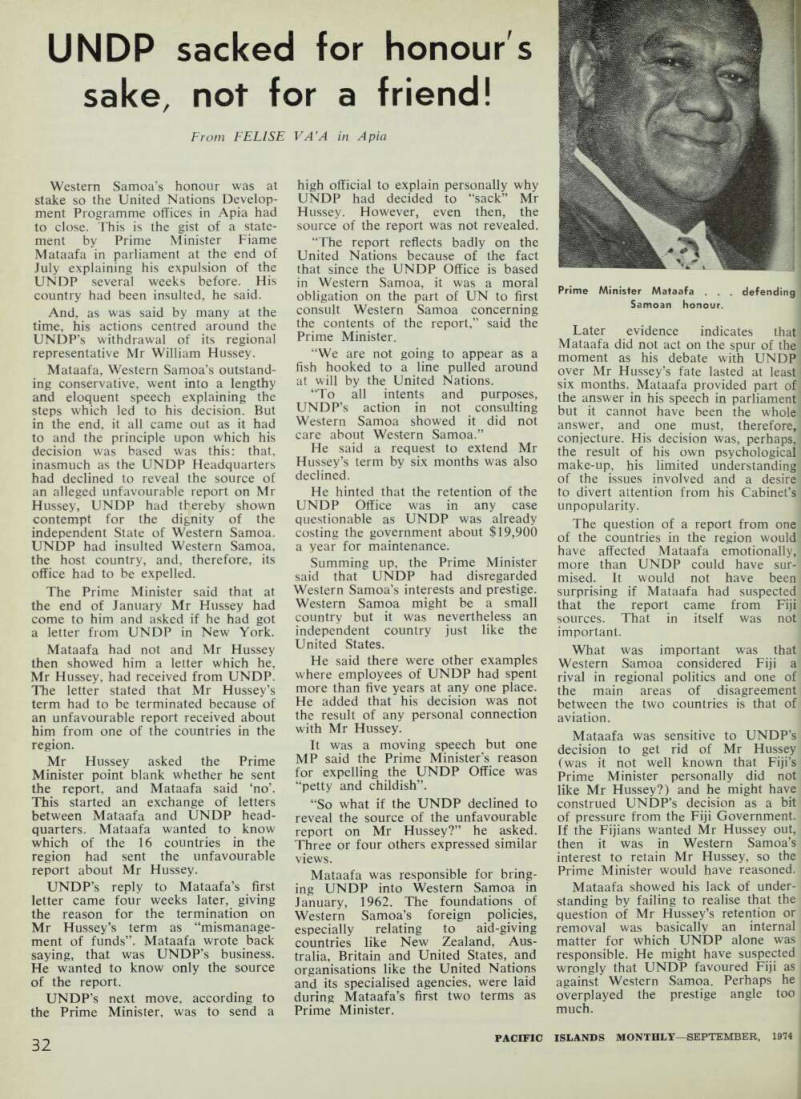
Western Samoa’s honour was at stake so the United Nations Develop ment Programme offices in Apia had to close. This is the gist of a state ment by Prime Minister Fiame Mataafa in parliament at the end of July explaining his expulsion of the UNDP several weeks before. His country had been insulted, he said.
And, as was said by many at the time, his actions centred around the UNDP’s withdrawal of its regional representative Mr William Hussey.
Mataafa, Western Samoa’s outstand ing conservative, went into a lengthy and eloquent speech explaining the steps which led to his decision. But in the end, it all came out as it had to and the principle upon which his decision was based was this; that, inasmuch as the UNDP Headquarters had declined to reveal the source of an alleged unfavourable report on Mr Hussey, UNDP had thereby shown contempt for the dignity of the independent State of Western Samoa.
UNDP had insulted Western Samoa, the host country, and, therefore, its office had to be expelled.
The Prime Minister said that at the end of January Mr Hussey had come to him and asked if he had got a letter from UNDP in New York.
Mataafa had not and Mr Hussey then showed him a letter which he, Mr Hussey, had received from UNDP.
The letter stated that Mr Hussey’s term had to be terminated because of an unfavourable report received about him from one of the countries in the region.
Mr Hussey asked the Prime Minister point blank whether he sent the report, and Mataafa said ‘no’.
This started an exchange of letters between Mataafa and UNDP head quarters. Mataafa wanted to know which of the 16 countries in the region had sent the unfavourable report about Mr Hussey.
UNDP’s reply to Mataafa’s first letter came four weeks later, giving the reason for the termination on Mr Hussey’s term as “mismanage ment of funds”. Mataafa wrote back saying, that was UNDP’s business.
He wanted to know only the source of the report.
UNDP’s next move, according to the Prime Minister, was to send a
high official to explain personally why UNDP had decided to “sack” Mr Hussey. However, even then, the source of the report was not revealed.
“The report reflects badly on the United Nations because of the fact that since the UNDP Office is based in Western Samoa, it was a moral obligation on the part of UN to first consult Western Samoa concerning the contents of the report,” said the Prime Minister.
“We are not going to appear as a fish hooked to a line pulled around at will by the United Nations.
“To all intents and purposes, UNDP’s action in not consulting Western Samoa showed it did not care about Western Samoa.”
He said a request to extend Mr Hussey’s term by six months was also declined.
He hinted that the retention of the UNDP Office was in any case questionable as UNDP was already costing the government about $19,900 a year for maintenance.
Summing up, the Prime Minister said that UNDP had disregarded Western Samoa’s interests and prestige.
Western Samoa might be a small country but it was nevertheless an independent country just like the United States.
He said there were other examples where employees of UNDP had spent more than five years at any one place.
He added that his decision was not the result of any personal connection with Mr Hussey.
It was a moving speech but one MP said the Prime Minister’s reason for expelling the UNDP Office was “petty and childish”.
“So what if the UNDP declined to reveal the source of the unfavourable report on Mr Hussey?” he asked.
Three or four others expressed similar views.
Mataafa was responsible for bring ing UNDP into Western Samoa in January, 1962. The foundations of Western Samoa’s foreign policies, especially relating to aid-giving countries like New Zealand, Aus tralia, Britain and United States, and organisations like the United Nations and its specialised agencies, were laid during Mataafa’s first two terms as Prime Minister.
Later evidence indicates that i Mataafa did not act on the spur of the moment as his debate with UNDP over Mr Hussey’s fate lasted at least six months. Mataafa provided part of the answer in his speech in parliament but it cannot have been the whole answer, and one must, therefore, conjecture. His decision was, perhaps, the result of his own psychological make-up, his limited understanding of the issues involved and a desire to divert attention from his Cabinet’s unpopularity.
The question of a report from one of the countries in the region would have affected Mataafa emotionally, more than UNDP could have sur mised. It would not have been surprising if Mataafa had suspected that the report came from Fiji sources. That in itself was not important.
What was important was that Western Samoa considered Fiji a rival in regional politics and one of the main areas of disagreement between the two countries is that of aviation.
Mataafa was sensitive to UNDP’s decision to get rid of Mr Hussey (was it not well known that Fiji’s Prime Minister personally did not like Mr Hussey?) and he might have construed UNDP’s decision as a bit of pressure from the Fiji Government.
If the Fijians wanted Mr Hussey out, then it was in Western Samoa’s interest to retain Mr Hussey, so the Prime Minister would have reasoned.
Mataafa showed his lack of under standing by failing to realise that the question of Mr Hussey’s retention or removal was basically an internal matter for which UNDP alone was responsible. He might have suspected wrongly that UNDP favoured Fiji as against Western Samoa. Perhaps he overplayed the prestige angle too much.
Prime Minister Mataafa . . . defending Samoan honour.