The Tokelaus, Where To Be Almost
pp. 41-45 · Read in the full issue

Forgotten Could Be A Blessing
From LAWRENCE BRACKEN in Pago Pago
Lying just below the equator, at out eight degrees south, are the tiny ands of Atafu, Nukunonu and ikaofu. Collectively they are called ; Tokelau Islands, governed by New aland, with the Tokelau Islands Iministrator living in Apia, Western moa. Historically, the Tokelaus dude Swains Island, which is now rt of American Samoa.
The Australian writer Louis Becke, 10 perhaps understood the Pacific ands as well if not better than any ier writer, called the Tokelaus mely and almost forgotten islands.” iday they are still lonely, but not rgotten. The New Zealand admini ation provides regular trips to the ands and assists many Tokelau ople to migrate to Western Samoa, lere there is a sizeable Tokelauan lony, as well as to New Zealand.
Those who choose to stay on the ilated little islands, about 1,500 of jm, live today better than they have the past, but in many ways in the Tie manner they did before the the ming of the Europeans. Atafu was icovered by a British expedition led Captain John Byron in 1765, who and it uninhabited. In 1791 Captain [ward Edwards was searching the cific for the Bounty mutineers and ited Nukunonu. An American laler, under Captain Stephen ocker, visited Fakaofu in 1839, and jorted on a pleasant visit with the ople living there.
Contact with foreigners was not vays so affable. In 1863 black ding ships from Peru carried off my people from Fakaofu, as well a few from Atafu and Nukunonu. ic German planters recruited for the >our trade, taking many people to irk on the plantations in Samoa, e Fiji planters recruited labour >m the Tokelaus, as well as the Iberts and Marshalls.
In 1889 the Tokelau Islands were ide a British protectorate and were msferred to New Zealand in 1925. iring World War II the Tokelaus
were an important segment of the coast-watchers organisation, but escaped the war’s main impact. They were, in reality, too lonely and forgotten, as Becke had said.
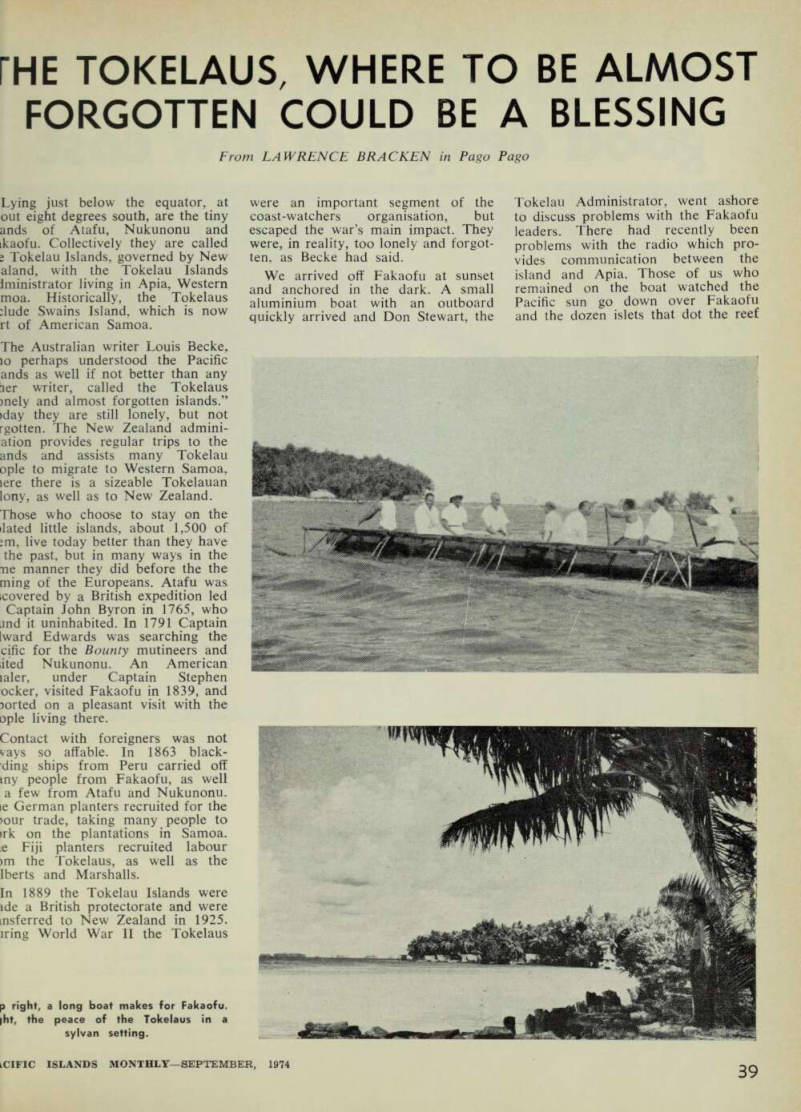
We arrived off Fakaofu at sunset and anchored in the dark. A small aluminium boat with an outboard quickly arrived and Don Stewart, the
Tokelau Administrator, went ashore to discuss problems with the Fakaofu leaders. There had recently been problems with the radio which pro vides communication between the island and Apia. Those of us who remained on the boat watched the Pacific sun go down over Fakaofu and the dozen islets that dot the reef
[?]p right, a long boat makes for Fakaofu. [?]ght, the peace of the Tokelaus in a sylvan setting.
Reluctant to move
around the island. It suddenly became obvious just how truly isolated the Pokelaus are, even in this age of nass tourism and jet planes.
Early next morning a group of Fokelauan long-boats put off from the sland and began unloading stocks of •ice, flour and other staples that had ieen brought to them. A typhoon had lestroyed most of the natural food :rops and it would take time for the sland’s food supply to catch up. The irst request was for cigarettes. The sland had run out a week before and hose who smoked were eager to con inue ihe habit.
About 600 people live on the tiny sland. They are crowded into neat hatch-sided houses, set along wide oral-covered paths that criss-cross he island. Stewart pointed out that his was by choice. A few years ago, he Tokelau administration, realising hat conditions were far too crowded, ad built a number of new houses nd a new water supply on another sland, which lies only about 500 ards from Fakaofu. However, the eople are reluctant to move to the ther island. It was only after the /ork was finished that they bothered 3 tell their benefactors that there /ere ancient ghosts on the other iland and they would be content to lay crowded.
On tour of the island, which took bout 30 minutes, we visited the andicraft co-operative, where the 'omen were busy with last-minute ricing of items for Apia. Then to the mall hospital and the new ware ouse, where the men were storing le rice and flour.
Administrator Stewart was busy in onversation with the two New Zea ind school teachers, whose house ad only recently burned down, latcrials for a new house would be n the next boat, he assured them, ut when would the next boat call?
On leaving we were all presented r ith paning gifts of shells and mats s we climbed in the long-boats and eaded out through the narrow pas ige in the reef. As the ship got nderway, the last of the Tokelauan oys were still jumping overboard to vim back to shore.
We set off northwest for Nukunonu nth i s wide lagoon, one of the lost beautiful in the Pacific. As our trip approached we could see several bkelauan sailing canoes out on the igoon, sailing as they have for enturies.
Nukunonu is dominated by a mas ive Catholic church which sits in the entre of the island, dividing it in
half. The single road (for Nukunonu has a truck!) runs through an arch way in the rear of the church.
I talked with a New Zealand teacher who had lived on Nukunonu for three years. She said that she and her husband and two children loved it and wouldn’t want to leave, despite the isolation. She showed me the school, a well-designed airy building, suited perfectly for a tropical climate.
The only problem was that they ran out of space and had built a Toke lauan-styie house next to the school, as an annex.
Her son, who was about 10 years old, and his Tokelauan friend showed me the island, both chatting in Toke lauan along the way. I was introduced to a Tokelauan nurse, who had studied in New Zealand. Together the four of us visited the new Nukunonu hospital, which was under construction at one end of the island. Again I was im pressed by the design, which lent it self well to such a situation.
Meanwhile, there was much prob lem-solving and reporting going on down on the beach, as Stewart met with the local leaders. Again we were given parting gifts in the Polynesian fashion, as we set out through the crashing surf for our ship. At the last minute people were still shoving letters into our hands, to be mailed to friends and relatives in Samoa and New Zeabnd.
After running north all night, we anchored at Atafu the next morning.
With the exception of the island of Puluwat, in Micronesia, Atafu is the most beautiful out-island Tve ever visited. Spacious and well laid-out, the houses are set along a labyrinth of paths lined with shells and flowers.
Another hospital was under con struction on Atafu. And again the school and the teacher’s house were impressive. A gang of children escorted us around the island, pointing out the sights. An old man in a wheel chair offered us fresh coconuts and talked of his days in Ania, before he returned to Atafu.
A young Tokelauan, who had come with us from Samoa, visited his family. He was leaving for the United States and had come home for one last visit. I met his brother, who was a teacher and who had lived in New Zealand. I asked him if he would like to return to New Zealand.
“No,” he said. “I am home here.
This is my island. I’ll stay here.”
As we left Atafu for the long trip back to Samoa, 1 almost envied his life in the Tokelaus. To be forgotten is bad. But to be almost forgotten in these times may be a blessing.
• Tokelauans in NZ, p 43.
How the Tokelauans fare in NZ
An NZ resettlement scheme has created a large Tokelauan centre in New Zealand and has
relieved population pressures on
the three atolls. How do the re settled islanders react to their
new and strange surroundings?
Meemia O’Brien, a student from the GEIC, who was in New Zea land recently on a health educa
tion diploma course, supplies an
answer.
The hurricane of 1966 caused nuch suffering and hardship to the Fokelauans. As a result, at their re juest, the New Zealand Government jlanned a permanent resettlement scheme for them in New Zealand.
The scheme started with 12 single nen, who were taken to Rotorua to vork for the forestry industry. In December of the same year, three named couples and their children vere resettled at Rotoehu, the men vorking for the forestry industry too. \part from the hurricane calamity, he New Zealand Government de cided it had to relieve the population 3ressure on the three atolls and pro
vide job opportunities which the re mote islands could not offer.
So far the scheme has brought about 500 Tokelauans to New Zealand. The three atolls are ex periencing a depletion of the younger generation because of the steady out flow to New Zealand. Some went of their own accord; others were brought out by relatives in New Zealand.
Many are still in the Taupo-Rotorua area; others have moved to Welling ton which has a thriving Tokelauan community.
Though New Zealand is largely free of the racial strife from which so many countries suffer, the islanders feel they are being deprived of cer tain rights and privileges. For example, Tokelauans have to live in New Zealand for 20 years to qualify for old-age benefits, 10 years for invalids, three years for widow’s benefit and a year for sickness and unemployment benefits.
Some islanders told me that when they applied for housing, they were given old worn-out houses; they were charged more than the usual price or a flat refusal was the answer. In employment they were often given menial tasks.
The migrants face very real prob lems of adjustment. The relaxed atmosphere of the islands and their simple diet accounts for a total lack of coronary complaints. But once in New Zealand with its sophisticated and complicated way of life, the Tokelauans often complain of anaemia, gout, colds, pneumonia, heart, joint and chest troubles.
During my field work in Rotorua, I visited four Tokelauan families.
They told me that the main problem they faced when they first arrived in New Zealand was adapting to their new environment.
Another was the language barrier, especially if they did not speak English fluently. Money in terms of budgeting and spending was another housewives’ headache.
One woman told me that she often felt lonely whenever her husband and children went to work and school.
Adaptation to a totally new environ ment could be quite a problem to islanders. However, once they are adapted and acclimatised, they feel at home immediately. Most of the islanders whom I have seen or met in New Zealand seemed to like their new home.