Magazine Section
pp. 69-71 · Read in the full issue
From Solitude On Wake Island
To High Drama
By W. G. Coppell
In March, 1974, the population of Wake Island was 437 men—2s military, 106 American contractor employees and 306 Filipino con tractor employees. These men live upon a coral atoll of a little over 2i square miles, none of which rises more than 12 ft above sea level.
They are there to maintain Wake Island Air Force base which pro vides for island support and emer gency aircraft.
There has been no commercial air traffic through Wake Airport since June 30, 1973, at which date the US Federal Aviation Administration gave up control of the island to the Air Force. Yet, it is unrealistic to think that Wake is now a forgotten comer of the Pacific, passed over by the major powers as the changing patterns of military strength and de ployment have rendered impotent the island bases over which the great and bloody battles of World War II were fought.
On March 9 this year, from Wake was launched a rocket with the code name Athena which was 143 in a series of launches with at least five more shots to follow, the last being on or about June 20. As the Wake Observer comments, “Athena pulsated into the blue sky in a faultless launch and an equally superb performance down range until it impacted in the ocean near Kwajalein Atoll and why not? Her name alone indicates what is expected of one of the Air Force’s most successful missiles”. This ulti mate level of military sophistication achieved on Wake is far removed from events, many of them primitive and crude, which have gone before in the history of this atoll.
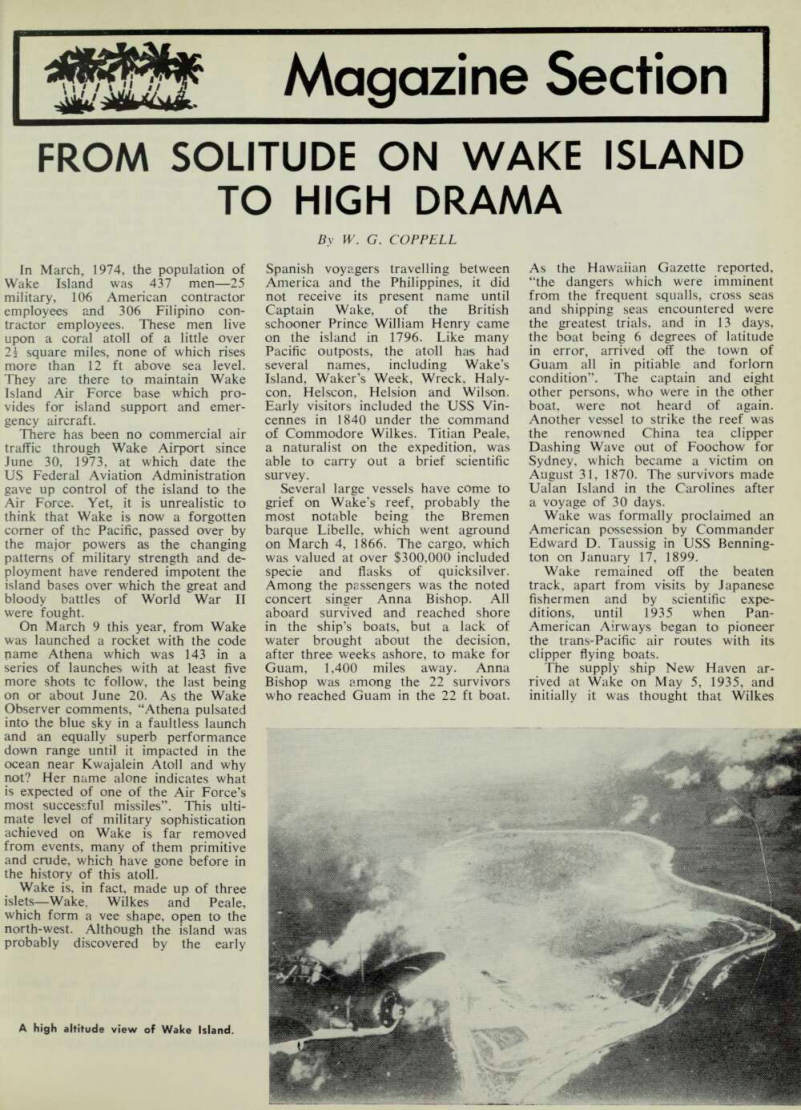
Wake is, in fact, made up of three islets—Wake. Wilkes and Peale, which form a vee shape, open to the north-west. Although the island was probably discovered by the early
Spanish voyagers travelling between America and the Philippines, it did not receive its present name until Captain Wake, of the British schooner Prince William Henry came on the island in 1796. Like many Pacific outposts, the atoll has had several names, including Wake’s Island, Waker’s Week, Wreck, Haly con, Helscon, Helsion and Wilson.
Early visitors included the USS Vin cennes in 1840 under the command of Commodore Wilkes. Titian Peale, a naturalist on the expedition, was able to carry out a brief scientific survey.
Several large vessels have come to grief on Wake’s reef, probably the most notable being the Bremen barque Libelle, which went aground on March 4, 1866. The cargo, which was valued at over $300,000 included specie and flasks of quicksilver.
Among the passengers was the noted concert singer Anna Bishop. All aboard survived and reached shore in the ship’s boats, but a lack of water brought about the decision, after three weeks ashore, to make for Guam, 1,400 miles away. Anna Bishop was among the 22 survivors who reached Guam in the 22 ft boat.
As the Hawaiian Gazette reported, “the dangers which were imminent from the frequent squalls, cross seas and shipping seas encountered were the greatest trials, and in 13 days, the boat being 6 degrees of latitude in error, arrived off the town of Guam all in pitiable and forlorn condition”. The captain and eight other persons, who were in the other boat, were not heard of again.
Another vessel to strike the reef was the renowned China tea clipper Dashing Wave out of Foochow for Sydney, which became a victim on August 31, 1870. The survivors made Ualan Island in the Carolines after a voyage of 30 days.
Wake was formally proclaimed an American possession by Commander Edward D. Taussig in USS Benning ton on January 17, 1899.
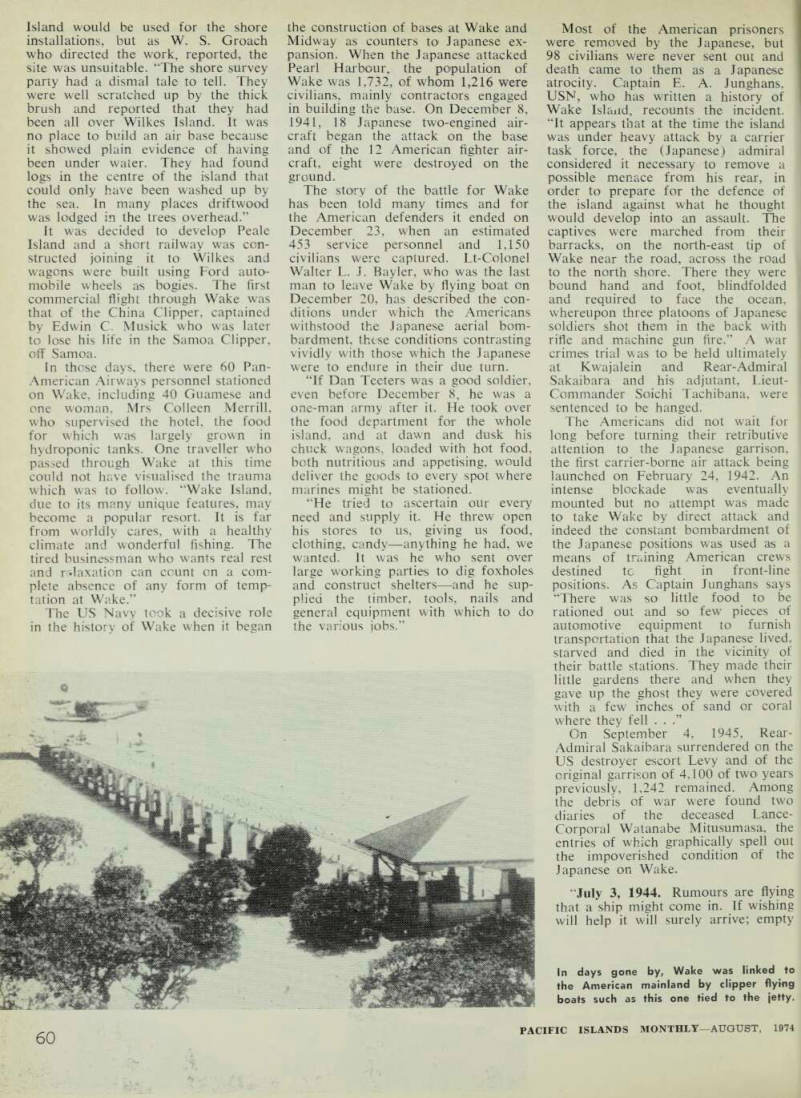
Wake remained off the beaten track, apart from visits by Japanese fishermen and by scientific expe ditions, until 1935 when Pan- American Airways began to pioneer the trans-Pacific air routes with its clipper flying boats.
The supply ship New Haven ar rived at Wake on May 5, 1935, and initially it was thought that Wilkes
A high altitude view of Wake Island.
Island would be used for the shore installations, but as W. S. Groach who directed the work, reported, the site was unsuitable. “The shore survey parly had a dismal tale to tell. They were well scratched up by the thick brush and reported that they had been all over Wilkes Island. It was no place to build an air base because it showed plain evidence of having been under water. They had found logs in the centre of the island that could only have been washed up by the sea. In many places driftwood was lodged in the trees overhead.”
It was decided to develop Peale Island and a short railway was con structed joining it to Wilkes and wagons were built using Ford auto mobile wheels as bogies. The first commercial flight through Wake was that of the China Clipper, captained by Edwin C. Musick who was later to lose his life in the Samoa Clipper, off Samoa.
In those days, there were 60 Pan-
American Airways personnel stationed
on Wake, including 40 Guamese and one woman, Mrs Colleen Merrill, who supervised the hotel, the food for which was largely grown in hydroponic tanks. One traveller who passed through Wake at this time could not have visualised the trauma which was to follow. “Wake Island, due to its many unique features, may become a popular resort. It is far from worldly cares, with a healthy climate and wonderful fishing. The tired businessman who wants real rest and relaxation can count on a com plete absence of any form of temp tation at Wake.”
The US Navy took a decisive role in the history of Wake when it began
the construction of bases at Wake and Midway as counters to Japanese ex pansion. When the Japanese attacked Pearl Harbour, the population of Wake was 1,732, of whom 1,216 were civilians, mainly contractors engaged in building the base. On December 8, 1941, 18 Japanese two-engined air craft began the attack on the base and of the 12 American fighter air craft, eight were destroyed on the ground.
The story of the battle for Wake has been told many times and for the American defenders it ended on December 23, when an estimated 453 service personnel and 1,150 civilians were captured. Lt-Colonel Walter L. J. Bayler, who was the last man to leave Wake by flying boat on December 20, has described the con ditions under which the Americans withstood the Japanese aerial bom bardment, these conditions contrasting vividly with those which the Japanese were to endure in their due turn.
“If Dan Teeters was a good soldier, even before December 8, he was a one-man army after it. He took over the food department for the whole island, and at dawn and dusk his chuck wagons, loaded with hot food, both nutritious and appetising, would deliver the goods to every spot where marines might be stationed.
“He tried to ascertain our every need and supply it. He threw open his stores to us, giving us food, clothing, candy—anything he had, we wanted. It was he who sent over large working parties to dig foxholes and construct shelters—and he sup plied the timber, tools, nails and general equipment with which to do the various jobs.”
Most of the American prisoners were removed by the Japanese, but 98 civilians were never sent out and death came to them as a Japanese atrocity. Captain E. A. Junghans.
USN, who has written a history of Wake Island, recounts the incident.
“It appears that at the time the island was under heavy attack by a carrier task force, the (Japanese) admiral considered it necessary to remove a possible menace from his rear, in order to prepare for the defence of the island against what he thought would develop into an assault. The captives were marched from their barracks, on the north-east tip of Wake near the road, across the road to the north shore. There they were bound hand and foot, blindfolded and required to face the ocean, whereupon three platoons of Japanese soldiers shot them in the back with rifle and machine gun fire.” A war crimes trial was to be held ultimately at Kwajalein and Rear-Admiral Sakaibara and his adjutant, Lieut- Commander Soichi Tachibana, were sentenced to be hanged.
The Americans did not wait for long before turning their retributive attention to the Japanese garrison, the first carrier-borne air attack being launched on February 24, 1942. An intense blockade was eventually mounted but no attempt was made to take Wake by direct attack and indeed the constant bombardment of the Japanese positions was used as a means of training American crews destined tc fight in front-line positions. As Captain Junghans says “There was so little food to be rationed out and so few pieces of automotive equipment to furnish transportation that the Japanese lived, starved and died in the vicinity of their battle stations. They made their little gardens there and when they gave up the ghost they were covered with a few inches of sand or coral where they fell . .
On September 4, 1945, Rear- Admiral Sakaibara surrendered on the US destroyer escort Levy and of the original garrison of 4,100 of two years previously, 1,242 remained. Among the debris of war were found two diaries of the deceased Lance- Corporal Watanabe Mitusumasa, the entries of which graphically spell out the impoverished condition of the Japanese on Wake.
“July 3, 1944. Rumours are flying that a ship might come in. If wishing will help it will surely arrive; empty
In days gone by, Wake was linked to the American mainland by clipper flying boats such as this one tied to the jetty.
stomachs cause many groans. Hunger gives me more pain than fighting the Yankees.
“July 20, 1944. Had a hot water bath which is rare indeed. Our food is terrible: three small crackers and a few beans. We are getting accus tomed to tree leaves.
“August 17, 1944. Four enlisted men and one officer died of starva tion today. We all desperately want a ship to come, but only planes come to this cursed place.
“October 14, 1944. American bombers at night drove all the birds from Ashishima (Wilkes). This is a tragedy because the sea swallow pro vides us with meat and eggs.
“October 20, 1944. The corporal committed suicide by taking mercuric chloride. He had stolen some food.
“December 12, 1944. Thinking about our homeland, nice rice and vegetables. But what’s on Wake but salted soup and beans. Recently I weighed only 101 lbs.
“March 11, 1945. All depends on fish from now on. We can’t stand the miserable dried rations any longer.”
Watanabe died of malnutrition sometime before September 4, 1945, and the last entry in his diary for some time in August said, “For eight months until August 7th suffering with many hardships, wandering be tween life and death, which it could not be forgotten. Hoping I don’t have to put down more reductions in diet in next diary. Praying to God to have more food. This is the end of Diary No. 6”.
What of life on Wake today. The Wake Observer gives us an interesting commentary on the life of a caretaker garrison on a base which now seldom makes the headlines. Golf is played on “this 6 hole, par 20 Red Monster, one hell of a course”; a bowling league conducts matches for some six teams, fishing is a popular sport, one resident raises orchids in his arboretum and a chess match between Rosales and Jatico is reported as a battle to equal those of Fisher and
Spassky.
It may be that the time-wheel is completing its cycle and that Wake may return to its earlier, untram melled mode. In the March 16 edition of Wake Observer, the acting base commander writes of the future fiscal support for Wake, “as it stands right now, we still do not know what level of support the Air Force needs next year. One thing is fairly sure, the Air Force will operate Wake Island for at least one and possibly two more years”.