Yesterday
p. 60 · Read in the full issue
PlM's Apia correspondent was upset in August, 1954, about an acute shortage of beer, causing a lot of complaints from residents. The corres pondent wrote that it was hard to understand why the government could not keep sufficient supplies in hand to meet the increasing demand, especially as it was more desirable for the younger generation to take beer rather than turn to hard liquor. Beer, like spirits, was a government monopoly, dispensed in quotas by the Health Department like a medicine. But stocks of "medicine" should never be allowed to dwindle. The government seemed to prefer to keep large stocks of hard liquor on hand. The last shipment of the Matua brought in about 1,000 cases of whisky, gin, wines and liqueurs—all "medicine".
The importance of yaqona (kava) to members of the Fiji Battalion trying to rout out communist terrorists in the Malayan jungles received prominence in a Queen competition in Suva to augment Lady Garvey's fund for gift parcels for the troops. Colonel Tom Campbell, Commander of the Fiji Military Forces, broadcasting an appeal for gift parcels, said that in spite of gifts of biscuits, soap and cigarettes, there was a clear need to raise more money, particularly for yaqona. "Nobody will deny the importance of yaqona in the everyday life of Fijians," he said.
"If you could see the delight that it brings to the troops, either before proceeding on a patrol or when they come in from a long and tedious patrol, you would realise how important it is to make this Fijian custom possible in a country 5,000 miles away".
Cook Islanders were flattered that the NZ Minister for Territories, Mr Clifton Webb, planned to visit them in August, 1954, as head of a fact-finding government mission. He was expected to inquire into such things as taxation (a sore point in the islands following an earlier visit by "sleuths" from NZ Inland Revenue Department), the citrus replanting scheme, the cool store, health and education services.
A correspondent of RIM, writing from the Cook Islands, referred to a previous report when a former Cl Fruit Control Director had said, "with a grim smile".
that the day of the native orange, which had grown uncultivated for over a century since Captain Bligh supplied the first pips, was over. That official had long since left the Cooks, and the grim smile was on the faces of those who viewed the dying-out of the introduced Valencias and the continued productiveness of the Bligh-derived item.
Nothing could kill the old "bush orange" which, if a little coarser than the fancy, imported fruit, retained all the virtues of its species. There were numerous crackpot prophets who had predicted its disappearance—it was the prophets who vanished!
PIM was quick to respond to an invitation from the Pacific Island Group of the UK Conservative Party to people in the area to discuss problems of the Islands. PIM posed several questions: Will the Conservative Common wealth Council tell us why the request of the Fiji Legislative Council of November, 1952, that Britain should make a formal inquiry into Fiji's acute population problem, has been ignored by the Colonial Office? Does the council think that the unlamented departure of Mr Lyttleton from the Colonial Office will open a new era, in which the more urgent problems of Britain's colonies may receive attention? Will the council try to explain what the British Colonial Office is trying to do in relation to the High Commission for the Western Pacific, where a highly qualified Governor, in the person of Sir Robert Stanley, has been given the
hopeless and heartbreaking task of making a silk purse out of a sow's ear —the silk purse being the potentially rich archipelagoes of Solomons and New Hebrides, and the hungry atolls of the Gilbert and Ellice chain; and the sow's ear being a fitting name for the insufficient resources at the Governor's disposal? Does the Colonial Office believe that private enterprise should be encouraged to go in and develop those three territories? If so, why has the Colonial Office carried on the policy of the Attlee Socialist Government, which forbade the re-entry of trading firms in the Solomons and the G & E Colony when the latter were recovered from the Japanese, and created a glorified socialist economy for the archipelagoes?
Twenty years ago, New Caledonia was about to receive a new governor— Mr Hoffeherr, formerly of the French Cameroons, and reputed to be an able financier and economist. His predecessor, Mr Raoul Angamarra, left New Caledonia with a fine reputation as an administrator.
Did the Western Papua crayfish industry ever get off the ground—or out of the sea? PIM, in August, 1954, told how the Toyer family and associates had not given up the thought of wealth from crayfish and were about to depart again for Daru. Fifteen months earlier the venture got away to a blast of publicity in the Australian Press, when the C-Gull left Sydney for Daru with a large party on board. C-Gull bogged down at Townsville, the crew dispersed and no more was heard about the industry till July, when it was reported that the C-Gull was being prepared to carry on to Daru from Townsville.
The promoters were only waiting for their company to be formed into a £lOO,OOO public company and the arrival of a freezer ship, the Cygnet.
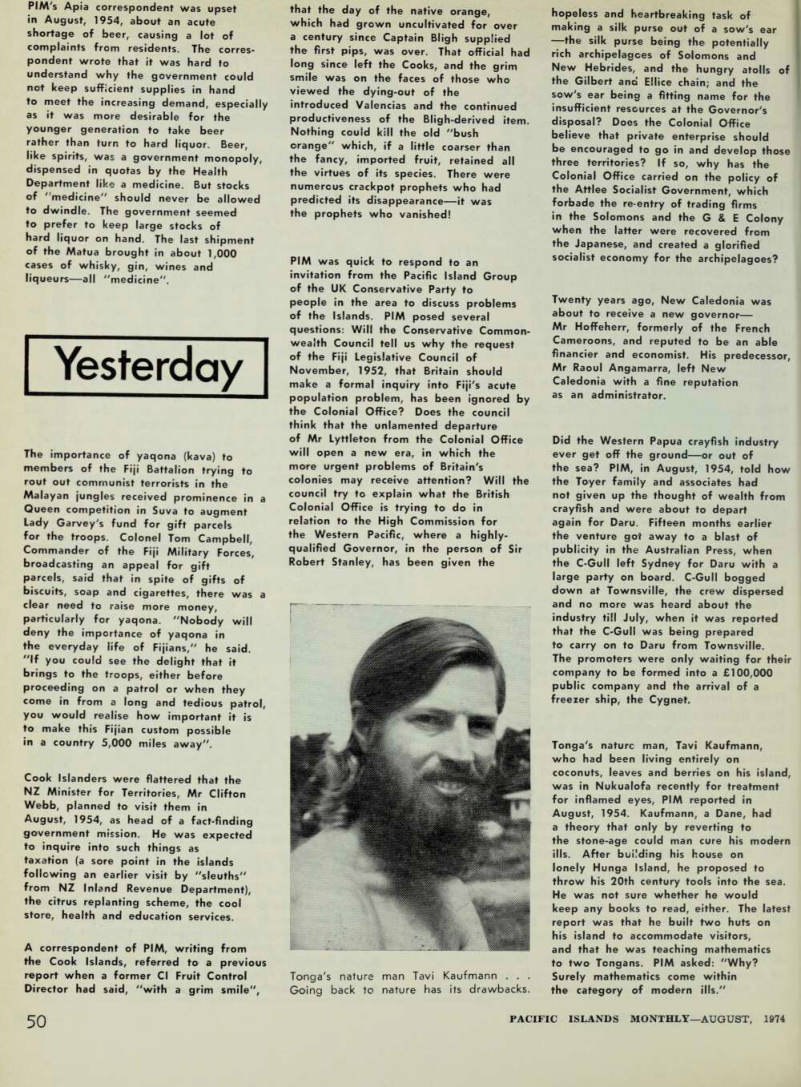
Tonga's nature man, Tavi Kaufmann, who had been living entirely on coconuts, leaves and berries on his island, was in Nukualofa recently for treatment for inflamed eyes, PIM reported in August, 1954. Kaufmann, a Dane, had a theory that only by reverting to the stone-age could man cure his modern ills. After building his house on lonely Hunga Island, he proposed to throw his 20th century tools into the sea.
He was not sure whether he would keep any books to read, either. The latest report was that he built two huts on his island to accommodate visitors, and that he was teaching mathematics to two Tongans. PIM asked: "Why?
Surely mathematics come within the category of modern ills."
Tonga's nature man Tavi Kaufmann ...
Going back to nature has its drawbacks.