Pukapuka remote but changing
p. 71 · Read in the full issue
From W. H. PERCIVAL in Rarotonga
Pukapuka Atoll, 715 miles north west of Rarotonga, is probably still one of the most isolated places in the world according to Miss Julia Hecht, an anthropologist of the University of Chicago, who returned to Rarotonga recently after spending 13 months on the atoll carrying out field studies, mainly on social organi sation. During her stay the longest period between supply vessels from Rarotonga was, as she put it, “One week short of six months”.
Yet, in spite of this isolation and being the most conservative of the 15 Cook Islands, things have changed in Pukapuka during recent years.
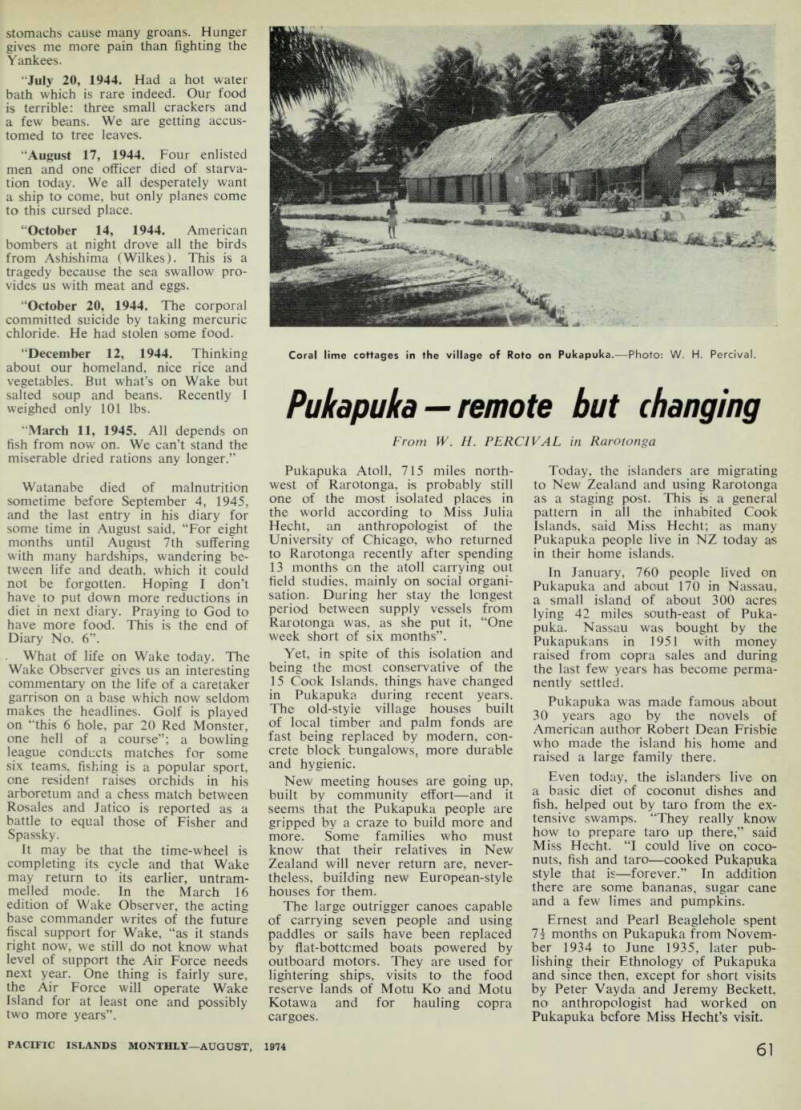
The old-style village houses built of local timber and palm fonds are fast being replaced by modern, con crete block bungalows, more durable and hygienic.
New meeting houses are going up, built by community effort—and it seems that the Pukapuka people are gripped by a craze to build more and more. Some families who must know that their relatives in New Zealand will never return are, never theless, building new European-style houses for them.
The large outrigger canoes capable of carrying seven people and using paddles or sails have been replaced by flat-bottcmed boats powered by outboard motors. They are used for lightering ships, visits to the food reserve lands of Motu Ko and Motu Kotawa and for hauling copra cargoes.
Today, the islanders are migrating to New Zealand and using Rarotonga as a staging post. This is a general pattern in all the inhabited Cook Islands, said Miss Hecht; as many Pukapuka people live in NZ today as in their home islands.
In January, 760 people lived on Pukapuka and about 170 in Nassau, a small island of about 300 acres lying 42 miles south-east of Puka puka. Nassau was bought by the Pukapukans in 1951 with money raised from copra sales and during the last few years has become perma nently settled.
Pukapuka was made famous about 30 years ago by the novels of American author Robert Dean Frisbie who made the island his home and raised a large family there.
Even today, the islanders live on a basic diet of coconut dishes and fish, helped out by taro from the ex tensive swamps. “They really know how to prepare taro up there,” said Miss Hecht. “I could live on coco nuts, fish and taro—cooked Pukapuka style that is—forever.” In addition there are some bananas, sugar cane and a few limes and pumpkins.
Ernest and Pearl Beaglehole spent lh months on Pukapuka from Novem ber 1934 to June 1935, later pub lishing their Ethnology of Pukapuka and since then, except for short visits by Peter Vayda and Jeremy Beckett, no anthropologist had worked on Pukapuka before Miss Hecht’s visit.
Coral lime cottages in the village of Roto on Pukapuka.— Photo: W. H. Percival