history ...
pp. 41-44 · Read in the full issue

Reef with a horrible history ...
By W. G. Coppell
Marooned for 44 days on one of the most dangerous and deadly reefs in the South Pacific, Middleton Reef, about 170 miles north of Lord Howe Island, four yachtees, owner-skipper Irfon Nicholas and his crew of three, a youth and two girls, were rescued on June 10 by the well-known fisher man-businessman Peter Warner in his Tonga-based and Tongan-crewed Ata, The castaways, who had found refuge in the wreck of a Japanese fishing boat high on the reef about a mile from where their yacht, the Sospan Each had stranded, were in good shape. They had lived on food salvaged from the yacht. Not one of them had any real experience of the sea or survival methods. Yet they came through. They were the luckiest people ever wrecked on Middleton, the graveyard of dozens of ships and scores of mariners and ships’ passen gers. Others fortunate to escape from the reef had nightmare experiences and sufferings to relate.
Peter Warner put this escapade in its right perspective when he said “So there’s nothing heroic about get ting people cut of trouble at sea. It’s been going on since men put to sea in ships. For young people, boys or girls, who are adventurous, this is my advice: Assess the capabilities of the vessel and its captain before ventur ing into the wild blue yonder”.
The four people from this latest wreck were taken from Middleton Reef by Peter Warner and the crew of the Ata hale and hearty after six weeks there when the past history of the reef tells us that they might
have been fortunate to have survived six days or even six hours.
Middleton and the companion reef Elizabeth have a history of ensnaring ships and their crews which goes back into the early days of the colony in New South Wales. Middleton was discovered and named on July 20, 1788, by Lieutenant Shortland, on the Alexander as he was returning to England after the voyage of the first fleet.
Like many of those who followed him in these waters, Shortland fell victim to the vagaries of the ocean currents. The next day he reported the discovery of a new island, with a remarkable peak, which he named Sir Charles Middleton’s Island, but it is clear that he had drifted to within sight of Lord Howe Island.
The first vessel reported as having come to grief upon Middleton was the whaler Britannia on August 24, 1806. As the captain deposed, “The sea was then breaking violently upon the ship, so as rendered it impossible to have got her off, or even were it possible to have got her off, she would have sunk immediately. We were then under the necessity of having recourse to our boats to save our lives. The first boat we attempted to lower into the water was unfortu nately stove by a surge of the sea, and the lives of the crew were saved
with difficulty”.
Eventually, the whole crew were able to quit the wreck in the ship’s boats, but of the three boats only two survived the voyage to the coast of New South Wales. A close examina tion of the depositions of the officers, however, cast doubts on the actual location of the stranding and it more than likely was upon Elizabeth Reef, 30 miles to the southward.
The two reefs, like many Pacific Ocean landmarks have had a variety of names. Middleton was also known as Golden Grove Reef after the ship of that name, which sighted the reef on November 10, 1788, when return ing to Sydney from Norfolk Island.
It is generally thought that Elizabeth
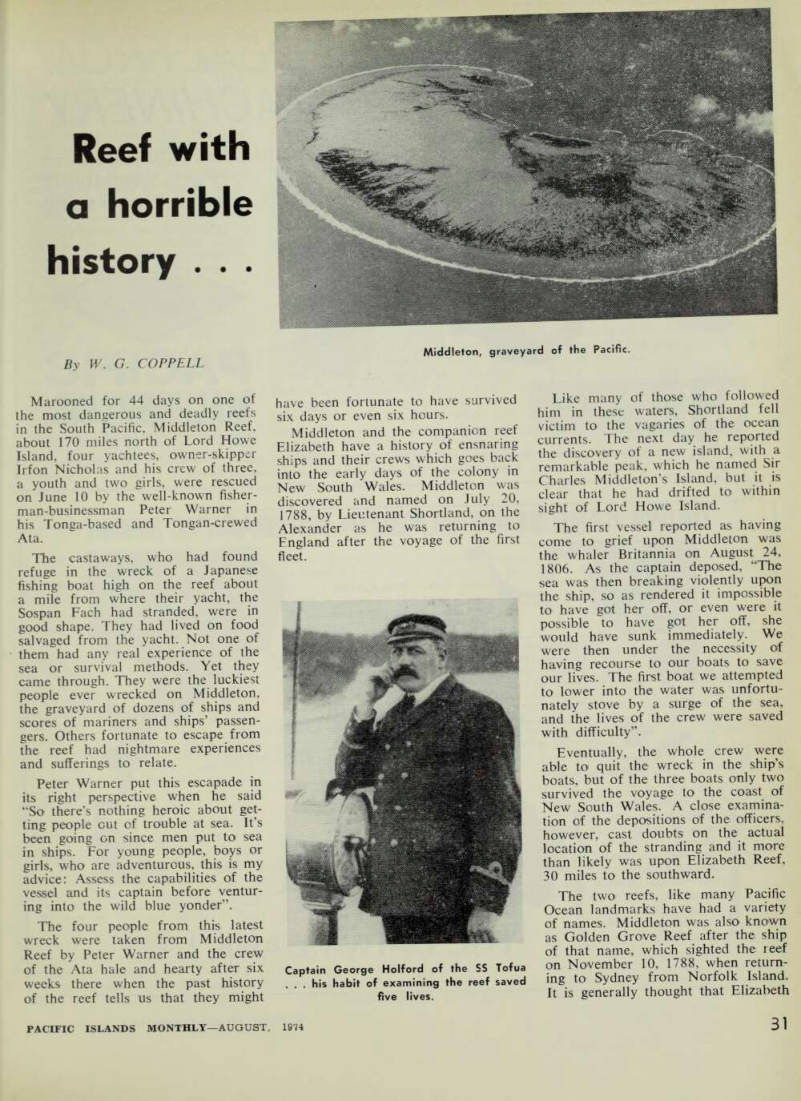
Middleton, graveyard of the Pacific.
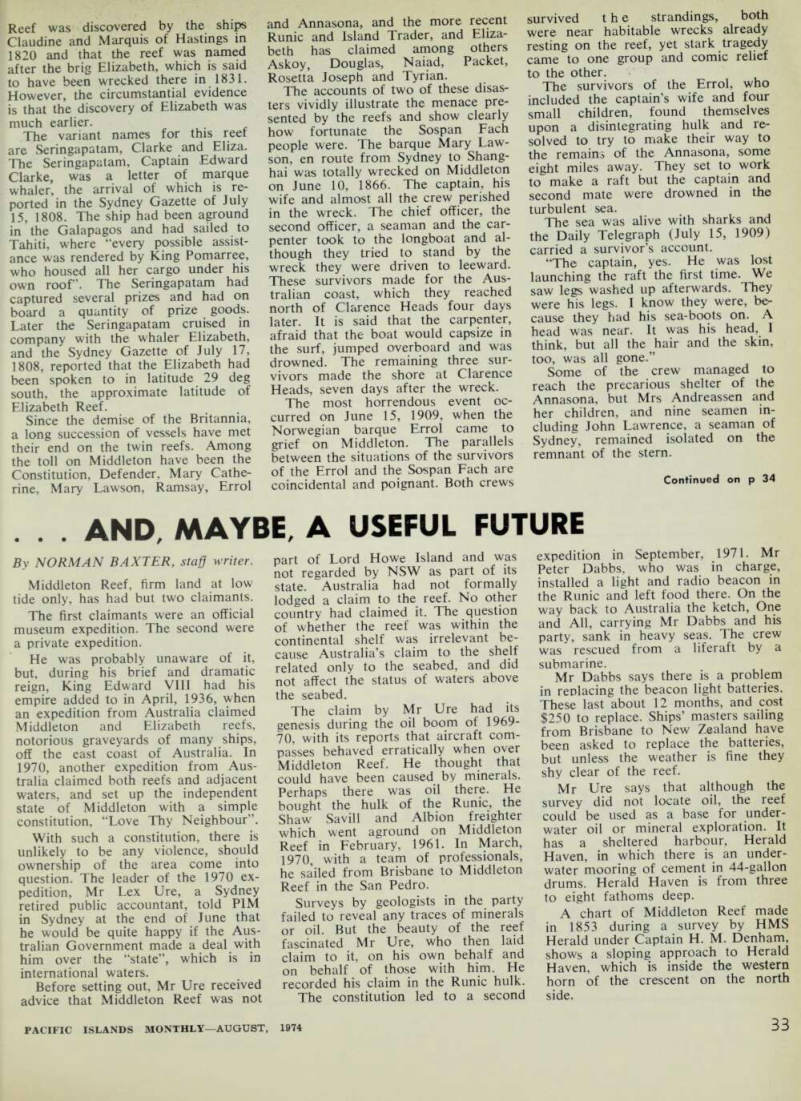
Captain George Holford of the SS Tofua ... his habit of examining the reef saved five lives.
Reef was discovered by the ships Claudine and Marquis of Hastings in 1820 and that the reef was named after the brig Elizabeth, which is said to have been wrecked there in 1831.
However, the circumstantial evidence is that the discovery of Elizabeth was much earlier.
The variant names for this reef are Seringapatam, Clarke and Eliza.
The Seringapatam, Captain Edward Clarke, was a letter of marque whaler, the arrival of which is re ported in the Sydney Gazette of July 15, 1808. The ship had been aground in the Galapagos and had sailed to Tahiti, where “every possible assist ance was rendered by King Pomarree, who housed all her cargo under his own roof’. The Seringapatam had captured several prizes and had on board a quantity of prize goods.
Later the Seringapatam cruised in company with the whaler Elizabeth, and the Sydney Gazette of July 17, 1808, reported that the Elizabeth had been spoken to in latitude 29 deg south, the approximate latitude of Elizabeth Reef.
Since the demise of the Britannia, a long succession of vessels have met their end on the twin reefs. Among the toll on Middleton have been the Constitution, Defender, Mary Cathe rine, Mary Lawson, Ramsay, Errol
and Annasona, and the more recent Runic and Island Trader, and Eliza beth has claimed among others Askoy, Douglas, Naiad, Packet, Rosetta Joseph and Tyrian.
The accounts of two of these disas ters vividly illustrate the menace pre sented by the reefs and show clearly how fortunate the Sospan Each people were. The barque Mary Law son, en route from Sydney to Shang hai was totally wrecked on Middleton on June 10, 1866. The captain, his wife and almost all the crew perished in the wreck. The chief officer, the second officer, a seaman and the car penter took to the longboat and al though they tried to stand by the wreck they were driven to leeward.
These survivors made for the Aus tralian coast, which they reached north of Clarence Heads four days later. It is said that the carpenter, afraid that the boat would capsize in the surf, jumped overboard and was drowned. The remaining three sur vivors made the shore at Clarence Heads, seven days after the wreck.
The most horrendous event oc curred on June 15, 1909, when the Norwegian barque Errol came to grief on Middleton. The parallels between the situations of the survivors of the Errol and the Sospan Each are coincidental and poignant. Both crews
survived th e standings, both were near habitable wrecks already resting on the reef, yet stark tragedy came to one group and comic relief to the other.
The survivors of the Errol, who included the captain’s wife and four small children, found themselves upon a disintegrating hulk and re solved to try to make their way to the remains of the Annasona, some eight miles away. They set to work to make a raft but the captain and second mate were drowned in the turbulent sea.
The sea was alive with sharks and the Daily Telegraph (July 15, 1909) carried a survivor’s account.
“The captain, yes. He was lost launching the raft the first time. We saw legs washed up afterwards. They were his legs. I know they were, be cause they had his sea-boots on. A head was near. It was his head, I think, but all the hair and the skin, too, was all gone.”
Some of the crew managed to reach the precarious shelter of the Annasona, but Mrs Andreassen and her children, and nine seamen in cluding John Lawrence, a seaman of Sydney, remained isolated on the remnant of the stem.
Continued on p 34
The accounts of the survivors lack coherence but it is plain that the mother and children suffered cruel deaths. A survivor stated, “The cap tain’s wife saw him drown, she took it quite easy. She never said anything.
She just looked and looked. She took it so well. She never screamed. She held her children close to her. She kissed the baby. She was a happy baby. She laughed after her father was drowned”.
The Daily Telegraph reported, “The stories of the survivors are con flicting. One man, withering in pain while he told his story in broken sentences, has alone given several versions of the horrors that followed.
But certain it is that the unfortunate woman and all her children are dead.
One survivor believes that the dis tracted mother threw the children overboard under the cover of dark ness rather than they should be eaten.
This proposal was made in an under tone, but the mother seemed to divine that something of the sort was sug gested. Lawrence, however, scouted the idea, but next morning all the children had disappeared. That day the mother died.”
Of the complement of 22 on the Errol five survived for four weeks, before being rescued by the Union Steamship Company’s Tofua, whose captain made a habit of examining the reef in case there were castaways.
The survivors had some time pre viously seen the smoke of a steamer, and the captain of the Suva was later to admit that a passenger had brought to his notice that there was a strange wreck on the reef.
“The captain replied that the wreck was an old one, and that sometimes when the tide was low two wrecks could be seen. The course of the Suva was not altered and the incident had passed out of the traveller’s mind
until today when he read of the ac count of the tragic fate of the Errol and her crew.”
Ralph Stock, a well-known yachts man cum-author wrote of Middleton in 1915. “it was worth seeing. Any thing more desolate and sinister than this gigantic horseshoe of coral out in the open sea, a menace to every storm-driven ship in a radius of a hundred miles, it would be difficult
to imagine.”
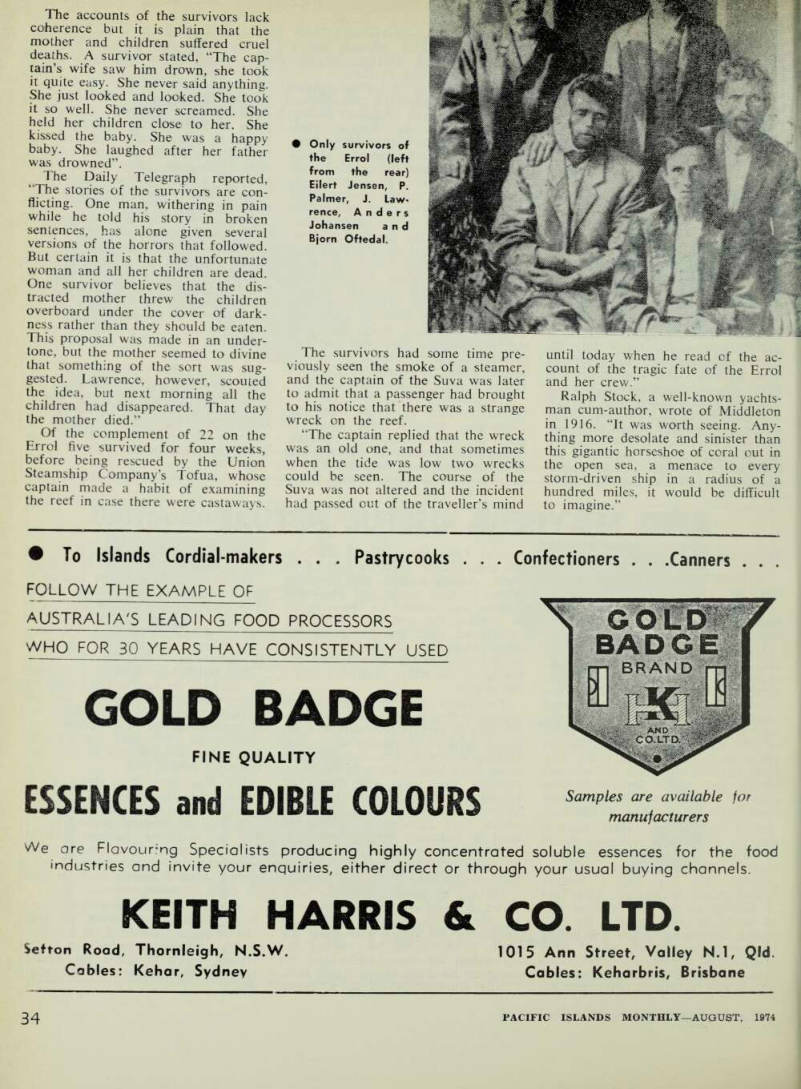
Only survivors of the Errol (left from the rear) Eilert Jensen, P.
Palmer, J. Law, rence, Anders Johansen and Bjorn Oftedal.