The Editor's Mailbag
pp. 33-39 · Read in the full issue


Mindless Claptrap
I, for one, am sick of the mindless claptrap being sung to sycophants by the chiefs of state of “newly-emergent nations”.
The most recent example, in late May, was the imposing figure of the Prime Minister of Fiji in Papua New Guinea proclaiming the brotherhood of his and Principal Minister Somare’s tribes. The Prime Minister even in vented some history, referring to an ancient intercourse between their ancestors! Any serious historian knows that such intercourse, if it had existed at all, would have consisted of barbeques rather than barter. The fragile Melanesian boats carried spears and cooking pots, not treaties and cultural missionaries.
All this nonsense would be laugh able if it were not being used by Melanesian politicians on gullible people to create a fictitious historical unity, the objective of which is to steal the lands and businesses of non indigenes settled in their respective islands. On the one hand the gifted leading ministers urge their former patrons —and everybody else —to pass out millions of dollars as “guilt offer ings” to the new sovereign states and simultaneously they kick the citizens of these former patrons—Australia,
New Zealand, Britain and France —in a tender spot by “localising” and nationalising the lands and businesses of these expatriates. Have these great leaders no pride? Have they no sense of justice?
The popular hymn of these new leaders is “hate the white man”. This hatred is based on the occasions— some of which undoubtedly occurred —of patronising pomposity and some cases of outright cruelty toward the ancestors of the present Melanesians by the predecessors of the present non-Melanesian owners and entre preneurs. Without doubt some lands now owned by non-Melanesians were acquired for less than fair value — indeed by outright theft by these predecessors.
However, let us face facts. There is not an acre of land in all of Mela nesia, or of any other country, which over the past milleniums has not been stolen or acquired by trickery or massacre from some prior owner.
It is not very logical to hate the posterity of despoilers; but at least let us be consistent. Let us hate as much the posterity of the principal despoilers of the Melanesians —the Melanesians themselves! Of course, what it boils down to is that the Europeans (and the Chinese) are a visible minority in Melanesia and their ancestors were the most recent “despoilers”; thus it is easy to direct all hatred toward them! And let us continue the inconsistency of this hatred with the equally illogical cast ing away of Melanesian pride by beg ging dollars from the previous rulers (while kicking out their citizens).
If this be nationhood and leader ship, then an old Byzantine expression is fitting—Bosh!
I respectfully suggest to the new “leaders” of the South Pacific that they quit seeking scapegoats for their own inadequacies and just plain get themselves and their peoples to work on the economies of their countries —now sliding from bad to grim. Making flowery speeches to each other and naming parks in honour of each other will not solve the real problems of the real world, any more than would stealing the most productive lands and enterprises from expatriates.
Who knows, some of these ex patriates may just kick back, with or without the lily-livered support of
their home governments.
L. N. Nevels, Jr.
Honolulu, Hawaii.
We're Great Printers!
I have been following the articles in PIM very closely on the subject of status for American Samoa and the US Trust Territory. During the early forties, I, and some millions of other Americans, became very familiar with the area —a “GI vaca tion”. For myself—Saipan, Tinian and the Philippines. I wish to com pliment you on a fine reporting job.
PIM has come a long way since I first became aware of it in the Philippines in 1946. Now four colour printing of superb quality. I’m in the business and I know fine printing when I see it!
E. J. Murnane
Vice-president,
E. H. Brown Advertising Agency.
Chicago, Illinois.
Aust-Nz Union
As a New Zealander I cannot allow Mr Teitler’s letter to go un challenged (PIM, June, p 28), and I am sure he would not wish it so.
While I have the impression that Mr Teitler was writing with “his tongue in his cheek”, I would suggest that his observations about New Zealand ers wishing to join their country to Australia have no foundation in fact.
In the first place, the origin of the two peoples are quite different although they may have originated in the same country. I am sure that Mr Teitler will forgive me for remind ing him that the original settlers of Australia were hardly volunteers, as was the case with New Zealand. The New Zealand pioneers fought for their country against our Maoris— and the descendants have since at tempted to repay for the consequence of the battles. Whereas in Australia the Aborigines are still fighting for their civil rights the Maori in New Zealand enjoys exactly the same edu cational, social, apd political oppor tunities as the European.
Secondly, the two countries are separated by a vast body of not always friendly water and such phy sical separation would hardly be conducive to a happy partnership. If Mr Teitler had studied his history he would have known that the alliance had already been tried, with unfortun ate results.
Thirdly, the methods of govern ment in the two countries are quite different: it has been said that Aust ralia has one of the best government systems in the world, having formed her constitution from the best of Great Britain and the United States of America. But Australia’s system
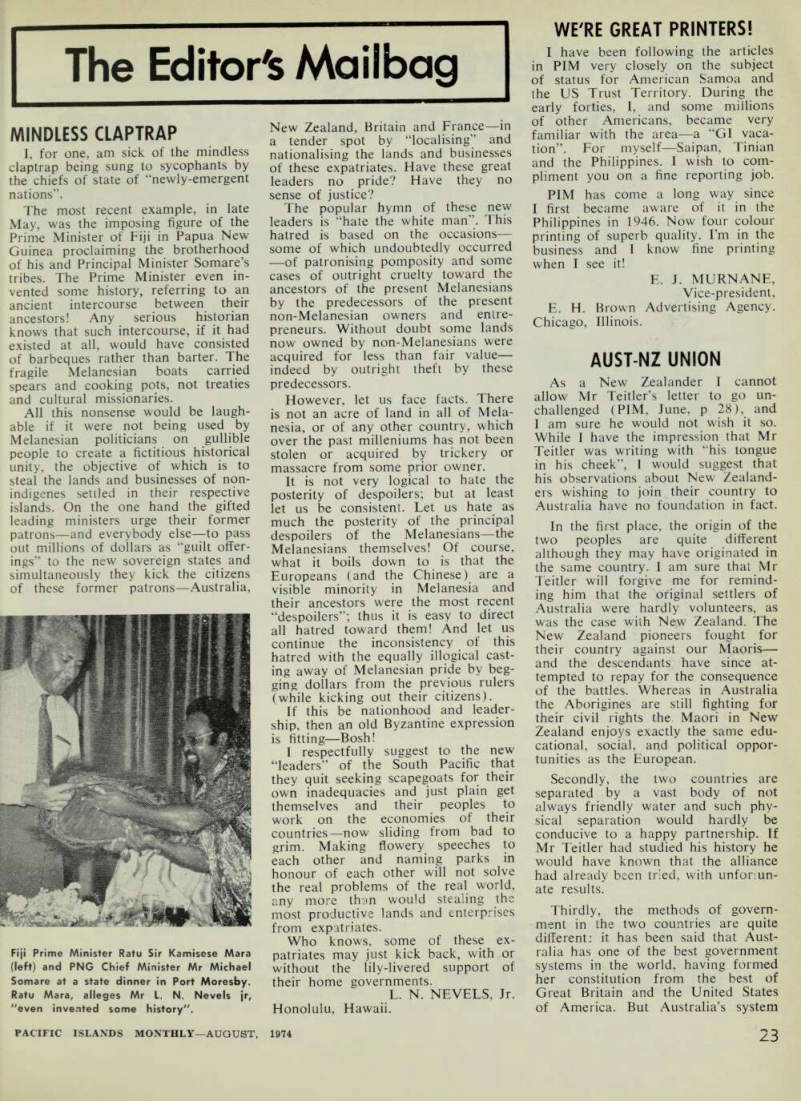
Fiji Prime Minister Ratu Sir Kamisese Mara (left) and PNG Chief Minister Mr Michael Somare at a state dinner in Port Moresby.
Ratu Mara, alleges Mr L. N. Nevels jr, "even invented some history".
Letters
of government, with its complexities, would be too much for the simple New Zealander.
It is possible that Mr Teitler has been misled or has been incorrect in his interpretation of the remarks made to him. Here is a nation which has much in common with Australia: natural resources, hard working people, vast areas of land, cosmopolitan population, similar government problems, just as many restless unions and labour shortages —and plenty of hot air. The question in many New Zealanders’ minds (I cannot speak for all my country men) is not “when will New Zea land join the Commonwealth of Australia?” but “when will Australia become the next state of the United States of America?”
Mr Teitler may have been better employed in drawing our attention to the rather peculiar attitudes of our Pacific Islands friends. While Fiji and Samoa are actively denouncing the deportation by Australia and New Zealand of illegal immigrants, the same nations are just as vocifer ously expecting these countries to assist them with their annual budgets.
It seems appalling to me that small Island territories are gaining indepen dence and yet expect their associate bigger nations to carry on contribut ing to their mismanaged economies.
This is true not only of the Cook Islands (who, in my opinion, are the worst offenders) but also of Fiji and, to a lesser extent. Western Samoa and Tonga. Fiji, in particular, has followed the Cook Islands example of reducing the number of Euro peans who may work in her islands —and many of these Europeans have assisted to give Fiji its present eco nomic independence, such as it is. I notice that the rot is now setting in in British Solomon Islands as well.
Surely one of the prime moves in the Pacific Area should be the free exchange of peoples, irrespective of colour, creed, or nationality.
In conclusion, may I say thank you, thank you, Stuart Inder! Your timely, accurate, and honest obser vation on the New Hebrides is the best thing that has been written about these islands. Of all the peoples in the Pacific who need both econ omic aid and friendly assistance, it is the New Hebrideans. Here again, the self-centred interest of the smaller
Pacific territories is evident. The New Hebrides has been overlooked too long—not only by the rest of the world but also by its sister islands in the Pacific.
Oleg Whimp.
Luganville, New Hebrides.
Nauruan Workers
To all those interested in Nauruan affairs, Mr Keke’s reply (PIM, May, p 29) to Mr Deiye’s letter (PIM, March, p 15) raises some interesting questions about President Deßoburt.
Mr Keke forecasts that negotiations the Nauruan Workers’ Organisation (NWO) will have with President Deßoburt will be “tough and grue some”. Why? Has the President, since he first fought for the Nauruan workers, changed sides and sympa thies? Does he not now see the wisdom in paying Nauruans a reason able salary to live on, and Nauruans with European skills, commensurate salaries?
As long as the government dis plays a distressing lack of concern for its skilled workers, expatriate labour will be “permanent stop-gap” —at least until the phosphate runs out!
If the NWO has “tough and grue some” negotiations with the President, it will not be because their claims are unreasonable but because the President, who is never on the island long enough to catch any of the local epidemics, has lost his feeling for those who are. In which case the old saying that ‘power corrupts’ will ring true on Nauru.
A. M. Kanani.
Melbourne, Vic.
Campus Wild Men
It is unfortunate that PIM has not been above the Fiji Times in its story about University of the South Pacific students headed: “Wild Men of the Campus” (PIM, April, p 16).
The Fiji Times (the source of your story) had sensationalised and dis storted out of proportion the incidents it reported.
As a student, I would like to give my perspective on the incidents: • The alleged “fight between Indian and Samoan students . . . with the Indians producing cane knives” is totally false because it never oc curred. The story is based on an incident between one Indian and a Samoan student in August, 1973. The
Letters
two students settled their differences immediately. © In February, 1974, a small group of Fijian and Samoan students had a fight because of a misunder standing and this was settled amic ably afterwards. • The Fijian politicians who spoke to a group of students were guests of the Fijian Cultural Society whose visit had been arranged by students (not members of the staff) a long time before and only coincided with the Fiji Times publicity attentions on USP. Their comments were elicited to give the public the impression that relations between students created a grave situation. © The Fijian student taken to hospital was not “seriously injured”.
Fights occur almost every weekend at tne dance halls and public bars
near the Fiji Times office, and yet it twice headlined these and other un related incidents at USP (and wrote two admonitory editorials) months after they occurred and had been settled. In giving people a misleading impression and arousing unwarranted alarm and criticisms, the Fiji Times had severely damaged the image of USP and this will take a long time to repair.
The staff members that the Vice- Chancellor chose to listen to before he banned the sale of liquor in the campus had never been to what was supposed to be a Staff/Student club.
If the USP Club failed in any way, it was by default of the majority of staff. These are the people whose reactionary attitude is strengthened by hearsay and gossip about students they don’t know and incidents which don’t affect them. If they had used the club, they might have learnt that “incidents” on campus are solved in formally on student initiatives without reference to the USP Disciplinary Committee.
There was no need for the intro
duction of the ridiculous draconian measures of discipline which the in nocent majority now suffer (eg any gathering of more than six people making “excessive” noise can be deemed to be a “party”, regardless of the type of beverage consumed, and those involved liable to expul sion!).
Most students feel that the USP Disciplinary Committee which is virtually composed of members of staff hasn’t any right to impose punishment on them. The Student Council has therefore asked the Vice- Chancellor to reconsider his decision about the USP Club and to accept the formation of a Disciplinary Com mittee composed entirely of students.
Jone Dakuvula.
University of the South Pacific, Suva, Fiji.
In the June issue of PIM, under the section headed Tropicalities, an article was published under the sub-heading Wild men of the campus.
Being the person responsible for public relations of the USP Students
Letters
Association, I cannot let such articles go unchallenged without correcting some of the distortions. The article clearly indicated that your corres pondent for the section headed Tropicalities, has deliberately dis torted the contents of the press release I made to the Fiji Times on May 22, 1974.
A copy of the release I made to the daily reads; The University of the South Paci fic Students Association is astonished at the information that has been pub lished by the Fiji Times about stu dent activities and other matters related to social life. While it has been very difficult for the USPSA to determine the sources of this in formation, the press has capitalised on them to create biased views of student activities in the minds of the people of this country.
The USPSA would like to express their views on the recent articles pub lished in the Fiji Times in the fol
lowing points:
• There has been an over emphasis of the various incidents that do take place on campus. Incidents which have occurred in the existence of this university have been con densed to look as if they took place during the last six months. • The credibility of the students and their activities has been con strued and irresponsibly reported.
Consequently, parents have begun to lose their confidence in the uni versity. • The USPSA appreciates the communicating role of the Press about student activities to the com munity of Fiji. But we would like that whatever information the people of Fiji get about university students should not be construed and irres ponsibly reported. • The USPSA is not happy with minimal effort of the university ad ministration to clarify the informa tion that has been reported in the Press. • The USPSA is alarmed at the emphasis that the Press has placed on incidents on campus as being racial. Most of the incidents that de velop between students on campus would be the same if the individuals were from the same ethnic groups. • Most of the constructive activi ties of students on the campus don’t
Letters
find their way into the limelight of
the Press.
Isikeli Maitaitoga
(Public Relations Officer, USPSA) University of the South Pacific, Suva, Fiji.
The Fiji Brownes
I was very interested in an article, Arundel, the shy Cecil Rhodes of the Pacific Islands (PIM, April, p 59).
I remember my grandmother Caroline telling me of Mr Arundel and how my grandfather, Captain Joseph Thomas Browne, used to take him to different islands.
My grandparents were stationed on Starbuck Island and I believe Caroline Island was named after my grand mother. They also lived for a time on Fanning and Vostock islands.
My grandfather gathered guano from the different islands and took the shipments to Sydney or New Zealand.
The Brownes had six children, all boys, and all born in the Line Islands.
They came to Fiji in the 1870 s and took up land from the Chief of Rewa known as Tukiwai, and part of Malata. They cultivated the land and planted cotton, sugar cane and bananas and brought in cattle and pigs.
Capt Browne came from the Isle of Wight and his wife Caroline was the daughter of the Rev Mugridge Orsmond, minister of the London Missionary Society stationed at Tahiti.
I would be most grateful for any help in obtaining information about my grandparents’ families.
R. F. Browne.
Nausori, Fiji.
Information Wanted
I am engaged in research on Aust ralian trade with the Pacific Islands, particularly Fiji, in the 19th and 20th centuries. If any of your readers could assist me with information about any of the following business firms which had offices in Sydney in the late 19th century and were in volved in Pacific trading activities, I should be most grateful: A. M. Brodziak & Co; W, & A.
McArthur; Moore & Moore (W.
Marshall Moore was a member of this firm); George Morgan & Co; William E. Morgan (also of Ade laide); Ebenezer Vickery & Sons.
Deryck Scarr
(Senior Fellow) Australian National University, PO Box 4, Canberra, ACT.