To Samoan Elections
p. 31 · Read in the full issue
No, No And No Again
From a Pago Pago correspondent
The voters of American Samoa have, for the third time, rejected a proposal to elect a governor and a lieutenant-governor by popular vote. The result of the June 18 referendum was close, with 2,093 (47 per cent) voting for the proposal and 2,341 (53 per cent) voting against. However, 21 per cent of the registered voters failed to vote.
This marks the third time in recent years that American Samoans have turned down proposals which would have led to local election of governors and lieutenant-governors. Both positions are currently filled by ap pointment from the Department of the Interior in Washington, D.C. In 1973 only 34 per cent of the voters favoured the proposal and in 1972 the issue was favoured by 17 per cent of the registered voters.
The idea of electing their own governor is beginning to appeal to the Samoans, however. The gap between the ayes and the noes has narrowed from 66 per cent in 1972, when the first vote was taken, and 32 per cent in 1973 to a mere six per cent in the June election.
American Samoa’s Office of Samoan Affairs and various local groups made great efforts to interest voters in the election and sent voter registration teams into every village to sign up qualified voters. However, total voter registration was down from previous elections. The failure of voters to cast ballots may be an ex pression of disinterest on the part of many people who feel that there have been too many elections on the issue in recent years.
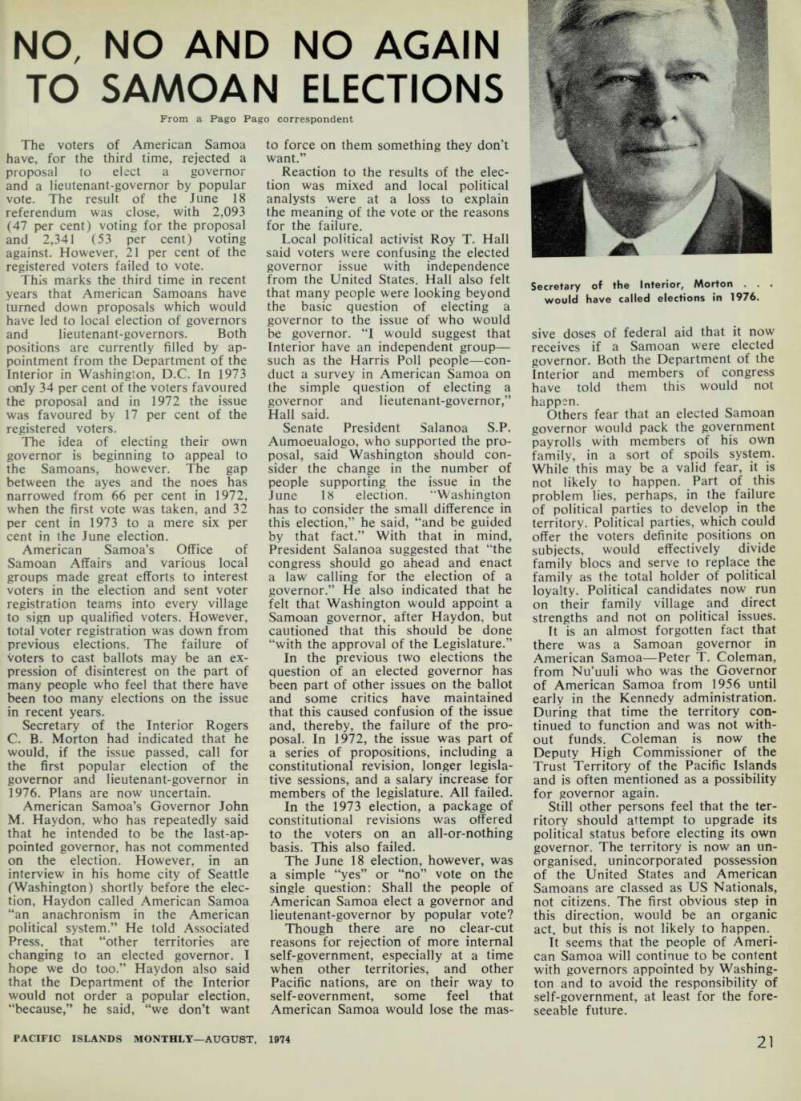
Secretary of the Interior Rogers C. B. Morton had indicated that he would, if the issue passed, call for the first popular election of the governor and lieutenant-governor in 1976. Plans are now uncertain.
American Samoa’s Governor John M. Haydon, who has repeatedly said that he intended to be the last-ap pointed governor, has not commented on the election. However, in an interview in his home city of Seattle (Washington) shortly before the elec tion, Haydon called American Samoa “an anachronism in the American political system,” He told Associated Press, that “other territories are changing to an elected governor. I hope we do too.” Haydon also said that the Department of the Interior would not order a popular election, “because,” he said, “we don’t want
to force on them something they don’t want.”
Reaction to the results of the elec tion was mixed and local political analysts were at a loss to explain the meaning of the vote or the reasons for the failure.
Local political activist Roy T. Hall said voters were confusing the elected governor issue with independence from the United States. Hall also felt that many people were looking beyond the basic question of electing a governor to the issue of who would be governor. “I would suggest that Interior have an independent group— such as the Harris Poll people—con duct a survey in American Samoa on the simple question of electing a governor and lieutenant-governor,”
Hall said.
Senate President Salanoa S.P.
Aumoeualogo, who supported the pro posal, said Washington should con sider the change in the number of people supporting the issue in the June 18 election. “Washington has to consider the small difference in this election,” he said, “and be guided by that fact.” With that in mind.
President Salanoa suggested that “the congress should go ahead and enact a law calling for the election of a governor.” He also indicated that he felt that Washington would appoint a Samoan governor, after Haydon, but cautioned that this should be done “with the approval of the Legislature.”
In the previous two elections the question of an elected governor has been part of other issues on the ballot and some critics have maintained that this caused confusion of the issue and, thereby, the failure of the pro posal. In 1972, the issue was part of a series of propositions, including a constitutional revision, longer legisla tive sessions, and a salary increase for members of the legislature. All failed.
In the 1973 election, a package of constitutional revisions was offered to the voters on an all-or-nothing basis. This also failed.
The June 18 election, however, was a simple “yes” or “no” vote on the single question: Shall the people of American Samoa elect a governor and lieutenant-governor by popular vote?
Though there are no clear-cut reasons for rejection of more internal self-government, especially at a time when other territories, and other Pacific nations, are on their way to self-eovernment, some feel that American Samoa would lose the mas-
sive doses of federal aid that it now receives if a Samoan were elected governor. Both the Department of the Interior and members of congress have told them this would not happen.
Others fear that an elected Samoan governor would pack the government payrolls with members of his own family, in a sort of spoils system.
While this may be a valid fear, it is not likely to happen. Part of this problem lies, perhaps, in the failure of political parties to develop in the territory. Political parties, which could offer the voters definite positions on subjects, would effectively divide family blocs and serve to replace the family as the total holder of political loyalty. Political candidates now run on their family village and direct strengths and not on political issues.
It is an almost forgotten fact that there was a Samoan governor in American Samoa —Peter T. Coleman, from Nu’uuli who was the Governor of American Samoa from 1956 until early in the Kennedy administration.
During that time the territory con tinued to function and was not with out funds. Coleman is now the Deputy High Commissioner of the Trust Territory of the Pacific Islands and is often mentioned as a possibility for governor again.
Still other persons feel that the ter ritory should attempt to upgrade its political status before electing its own governor. The territory is now an un organised, unincorporated possession of the United States and American Samoans are classed as US Nationals, not citizens. The first obvious step in this direction, would be an organic act, but this is not likely to happen.
It seems that the people of Ameri can Samoa will continue to be content with governors appointed by Washing ton and to avoid the responsibility of self-government, at least for the fore seeable future.
Secretary of the Interior, Morton. would have called elections in 1976.