price problem
pp. 45-47 · Read in the full issue
PNG's 'simple answer' to price problem
From Barry Wheeler
in Port Moresby Faced with the spectacle of women battling police in the streets during a violent protest against rising prices, Papua New Guinea has moved hastily to pacify its angry housewives by formulating a long-range plan to re duce the country’s dependence on im ported foodstuffs.
The protests, which early in June had politicians scurrying for cover before the wrath of the burly Papuan women of Port Moresby (PIM, July, p 7), were widely condemned as both an irresponsible and unlawful method of dramatising their grievances.
The women, wading into battle with a baby in on© arm and a placard wielded weapon-like in the other, provided the government with ample proof that not even police road blocks barring the way to Chief Minister Michael Somare’s offices would dissuade them from insisting the situation was serious enough to warrant extreme action.
Even the most chagrined of the politicians had to admit they were successful. The government im mediately launched an anti-inflation drive which included the withdrawal of a general import levy on food stuffs and the introduction of a more rigid system of controlling profit margins allowed to wholesalers and retailers.
As a placatory gesture it was more than enough to satisfy the enraged housewives, but the problem of highly priced imported foodstuffs supplementing a relatively meagre domestic production persisted.
The simple answer, according to a plan announced by Agriculture Minister John Guise, was to reduce PNG’s dependence on imports by stepping up the domestic production.
This could then be retailed at a much lower cost without the artificial loadings of freight charges and im ported inflation.
Should the plan be successfully implemented it will not only provide local producers with higher incomes and enable the housewife to make more purchases from the basic urban wage of $l5, but will gradually sweep costly imports off the supermarket shelves.
The first stage of the Agriculture Department blueprint calls for a more scientific and methodical ap proach to a traditional style of food production—more or less unchanged since tribesmen began sticking sweet potato plants into a backyard plot centuries ago.
A stock of seed supplies and a variety of suitable vegetables will be built up and dispensed to local growers along with technical assist ance and easy access to centralised marketing agencies. The government proposes to construct a number of deep freezer units at strategic points along the coast for the storage of fish and fresh foods which will be collected at regular intervals by a government-chartered ship supplied with financial aid from New Zealand.
Inland agriculture officers will go into the villages to buy fresh foods, then sell the produce themselves or assist local businessmen to market their goods.
To service more remote areas, privately-owned trucks will be hired by the government to transport the vegetables between pre-arranged pick up and vending points.
The lack of sugar production in Papua New Guinea has long been claimed by the government as a glaring example of Australia’s failure to develop properly certain areas of the country during the colonial era.
One of Chief Minister Michael Somare’s oft-stated criticisms of Aus tralian stewardship was that it pur posely discouraged the creation of a sugar industry so that it could unload a large portion of its own export crop on Papua New Guinea.
Now the government has ear marked $500,000 in the next financial year to establish two plantations and mill complexes as the first step to wards commercial production.
Technical advice sought from both Fiji and New Zealand will enable
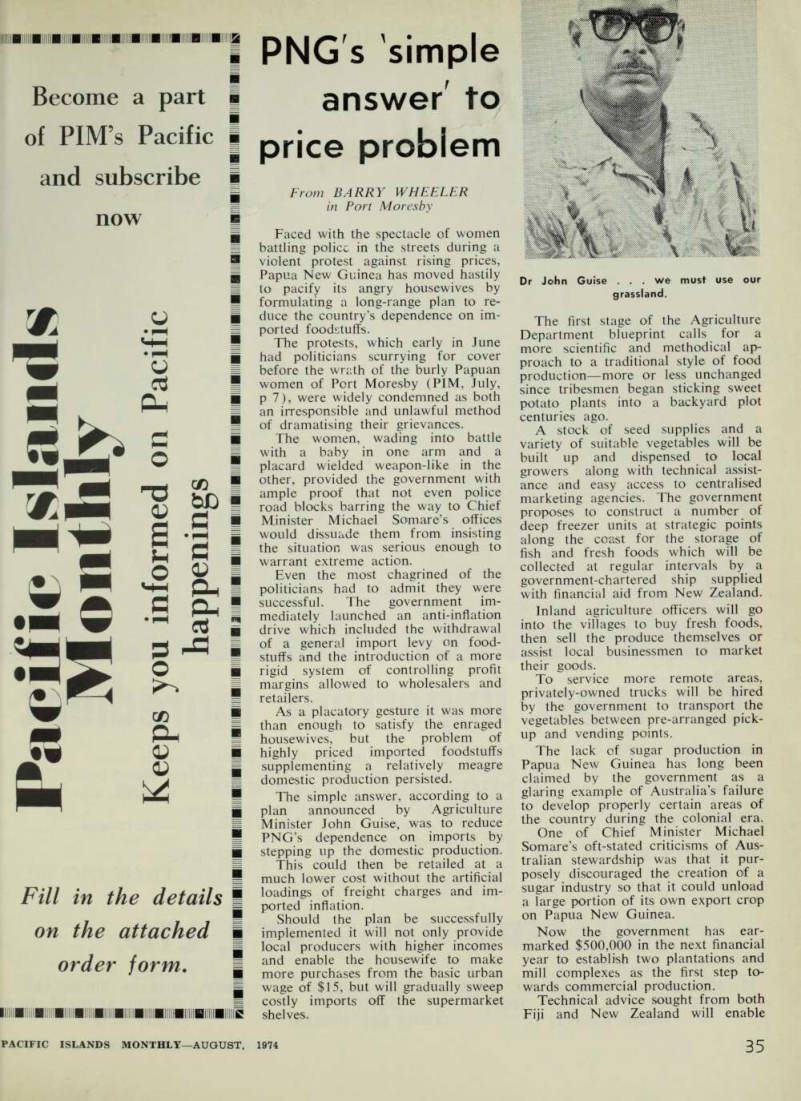
Dr John Guise ... we must use our grassland.
ocal planners to determine the mill capacities, location and type of pro cesses to be used for maximum out put.
“In the medium term I hope to see Papua New Guinea supply its own sugar needs and in the long term to export sugar,” said Dr Guise in a -eport to the House of Assembly.
The plan states that current beef cattle production numbers 15,000 carcases a year from a total of 150.000 head of cattle compared with imports of about 10,000 carcase equivalents of fresh beef and 40,000 carcase equivalents of canned beef.
With the assistance of a two-stage World Bank Credit, the Agriculture Department is aiming at the replace ment of all fresh meat and some canned meat imports with locally produced fresh and frozen beef by increasing the national cattle herd to 300.000 head by 1982.
“Although there are sufficient breeding cattle available within Papua New Guinea to enable increases of this magnitude to be achieved, the success of the programme will de pend heavily on our ability to make use of the thousands of acres of grassland which still remain to be developed in our country,” said Dr Guise.
One of the biggest single items on the PNG food bill—and also one of the biggest imports—is rice. Accord ing to Dr Guise the growth of the domestic rice industry has been slowed in the past by the poor return to a typical villager who plants an average of one acre for an annual income of about $6O. Consequently, village people have drifted into the better paying coffee and cocoa grow ing industries.
This has resulted in an annual domestic rice production of 2,000 tonnes while consumption is 56,000 tonnes. Moves are already under way to introduce a new, high-yielding variety of rice, but according to ex perts village growers will not be able to expand their foreseeable rate of production to make PNG self sufficient in the near future.
By inviting the participation of overseas companies and requesting technical aid from the United Nations, the government hopes to introduce large-scale mechanised and irrigated rice projects to supplement village production.
Also detailed in the plan are recommendations covering poultry, tuna and buffalo. Meanwhile, the Papuan women of Port Moresby, now the self-appointed watchdogs of rising prices, have promised to let the government know in their own fashion if the measures fail to have
any effect.-
Aap.
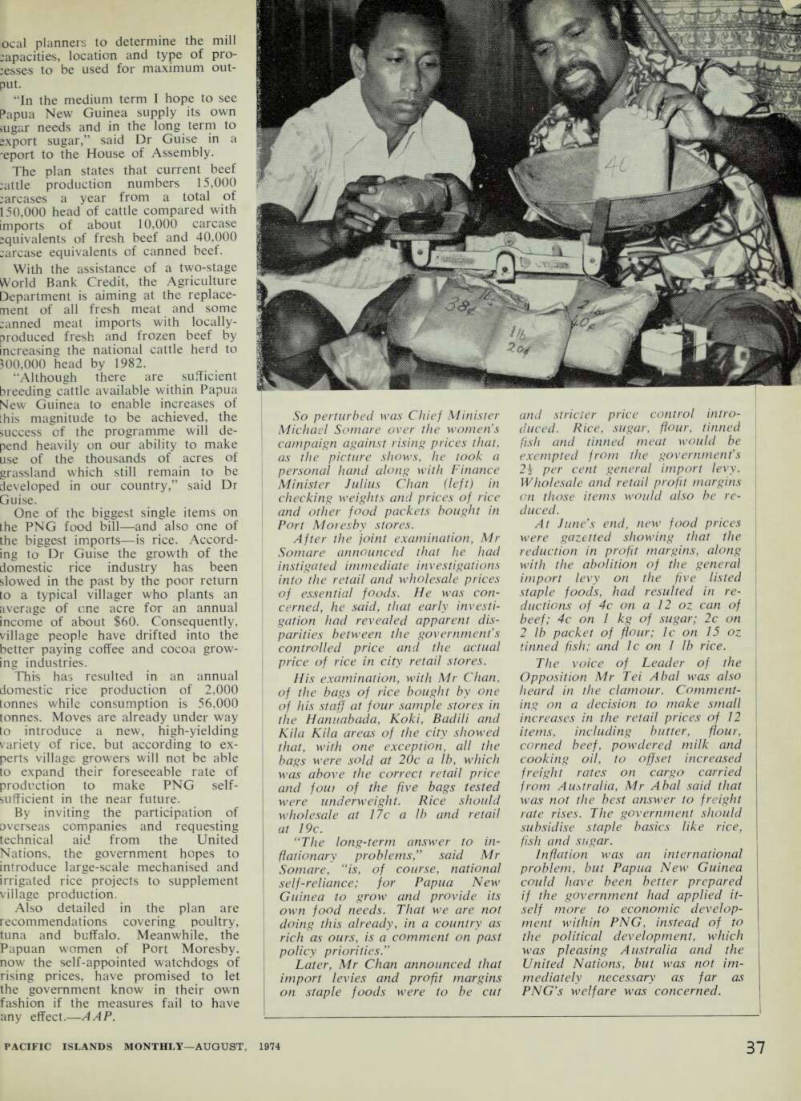
So perturbed was Chief Minister Michael Somare over the women’s campaign against rising prices that, as the picture shows, he took a personal hand along with Finance Minister Julius Chan (left) in checking weights and prices of rice and other food packets bought in Port Moresby stores.
After the joint examination, Mr Somare announced that he had instigated immediate investigations into the retail and wholesale prices of essential foods. He was con cerned, he said, that early investi gation had revealed apparent dis parities between the government’s controlled price and the actual price of rice in city retail stores.
His examination, with Mr Chan, of the bags of rice bought by one of his staff at four sample stores in the Hanuabada, Koki, Badili and Kila Kila areas of the city showed that, with one exception, all the bags were sold at 20c a lb, which was above the correct retail price and four of the five bags tested were underweight. Rice should wholesale at 17c a 1b and retail at 19c.
“The long-term answer to in flationary problems,” said Mr Somare, “is, of course, national self-reliance; for Papua New Guinea to grow and provide its own food needs. That we are not doing this already, in a country as rich as ours, is a comment on past policy priorities.”
Later, Mr Chan announced that import levies and profit margins on staple foods were to be cut
and stricter price control intro duced. Rice, sugar, flour, tinned fish and tinned meat would be exempted from the government’s 2\ per cent general import levy.
Wholesale and retail profit margins on those items would also be re duced.
At June’s end, new food prices were gazetted showing that the reduction in profit margins, along with the abolition of the general import levy on the five listed staple foods, had resulted in re ductions of 4c on a 12 oz can of beef; 4c on 1 kg of sugar; 2c on 2 lb packet of flour; 1c on 15 oz tinned fish; and 1c on 1 lb rice.
The voice of Leader of the Opposition Mr Tei Abal was also heard in the clamour. Comment ing on a decision to make small increases in the retail prices of 12 items, including butter, flour, corned beef, powdered milk and cooking oil, to offset increased freight rates on cargo carried from Australia, Mr Abal said that was not the best answer to freight rate rises. The government should subsidise staple basics like rice, fish and sugar.
Inflation was an international problem, but Papua New Guinea could have been better prepared if the government had applied it self more to economic develop ment within PNG, instead of to the political development, which was pleasing Australia and the United Nations, but was not im mediately necessary as far as PNG’s welfare was concerned.