Dockworker
pp. 81-85 · Read in the full issue
Fiji Debates
Redundancy
The Union Steam Ship Co of NZ Ltd will have full container services on its Pacific “triangle” service from Auckland by about the end of this year. The company is now looking for a suitable container ship to re place the remaining conventional cargo ships servicing Fiji, Tonga and Samoa.
This statement of the company’s policy emerged at an arbitration in quiry in Suva into a dispute between shipping companies and the Fiji Waterside Workers’ and Seamen’s Union. Mr Mervyn Hunt, the USS Co deputy manager in Fiji, said the vessel Union South Pacific, which the company has been using for about 10 months, although not ideal for the trade, was making a profit.
The ships it replaced incurred heavy losses.
The company carried about 60,000 tons of cargo to Fiji each year, and the volume was growing. One prob lem was that it was virtually a one way traffic. A ship might drop 1,300 tons of cargo in Fiji and leave with only 200 tons. The Union South Pacific delivered about 20 containers on each call in Suva.
He said that so far few Fiji com panies were geared to accept de livery of a container on their door steps, but the number was increas ing. One reason was that there were only two or three vehicles in Suva which could carry a 20-ton container load. The next container ship would probably be bigger than the Union South Pacific, which is on charter for five years.
Obviously the introduction of containers will reduce the number of men required on the wharf. But the union asked the arbitrator Mr Ramanlal Kapadia, to increase the wharf labour force from 452 to 600.
Mr John Chau, who audits the ac counts of the employer, the Port of Suva Labour Utilisation Board (formed by four shipping com panies) proposed that the wharf force be cut from 452 to 252, be cause the existing dock force was idle for 45 per cent of its time.
The arbitrator wanted to know if the companies could offer dismissed dockers a “golden handshake” pay ment as in other countries, where
mechanisation made men redundant.
Mr Peter Corbett, shipping man ager of Burns Philp (SS) Co Ltd, said the agents were not in a posi tion to comment on that. Local ship ping companies might well have to come to an arrangement with the dockers.
Taniela Veitata, former secretary of the union, who is serving a gaol term for theft from the docks, said some dockers spent all their working lives, 35 years or more, at Suva wharf. The reason Suva dockers usually worked for only 22 hours out of the 40 for which they were paid was that in comparison with dockers elsewhere “their work is so fast that they are paid for idle time while waiting for the next ship to arrive”.
Mr Corbett said that in spite of Mr Chau’s advice to dismiss 200 men, the board did not want to dis miss them at once. But the board’s financial position was such that it might have to. It lost $28,000 in 1973.
In a reference to a retiring age for dockers, Mr Corbett said the size of the work force could be cut if the age was set at 55. The companies realised that to insist on the 55-years limit now would cause hardship be cause the dockers would not have enough money to retire. The com panies were willing to keep a man on a contract basis after 55, if the man produced a fitness certificate.
Responsibility for the employment
of a wharf labour force is to pass from the port labour board to the national ports authority, when it comes into existence. Mr Corbett said shipping companies doubted the government’s ability to have it oper ating by January, 1975; they con sidered it would be June, 1975, be fore the authority became effective.
The authority will control all Fiji ports.
Recent direct negotiations with employers have resulted in Fiji watersiders winning a wage increase of 20c an hour. The new rates are 66c an hour for permanent wharfies and 70c for casuals.
FOOTNOTE: Union South Pacific started to take in water and de veloped a serious list in early June when 500 miles north of Auckland en route to Suva. She battled heavy seas for almost three days before limping back to Auckland. A tug stood by at one stage but was not required.
Niue, Cooks Get
Another Ship
The New Zealand Shipping Cor poration has bought a six-year-old 1,191-ton refrigerated freighter for the Cook Islands and Niue Island service.
The ship, the Jogela, which is likely to be renamed for the Pacific run, was built at Le Havre, and was previously owned by a West German line. She has three holds, fully re frigerated, with an insulated cargo capacity of 88,600 cubic feet. Her main engines and accommodation are aft and the ship has a variable pitch propeller for manoeuvre bility.
The ship is expected in New Zea land during the first week in July, and after minor alterations, will probably enter the service later that month.
The Jogela will join the corpora tion’s other vessel, the Lorena, in providing the service to the Pacific.
This service will be maintained when the Government-owned island trader, Moana Roa, is withdrawn from ser vice, and handed to the Royal New Zealand Navy.
The Lorena, 1,356 tons, was for merly owned by the Cook Islands Shipping Co, but was bought by the corporation to relieve a cargo build up on the Auckland waterfront of
freight for the Cook Islands which the Moana Roa was unable to clear.
Both the Lorena and the Jogela are able to enter the harbour at Avatiu, Rarotonga, and avoid the expense and inconvenience of lighter loading and unloading.
The provision of this two-ship ser vice honours a promise made by the New Zealand Prime Minister, Mr Kirk, and later reaffirmed by the New Zealand Minister of Island Affairs, Mr Amos, that a service would be maintained to the Cooks when the Moana Roa was with drawn.
The actual running of the ships is expected to be handled by the De partment of Maori and Island Affairs on a charter arrangement from the corporation. The Cook Islands Government will have a representa tive on the overall committee of management which will concern it self with policy matters.
The new service should also pro vide a more reliable service for Niue Island. The island copes well on a four-week shipping service, but if there is a longer “no boat” period, supplies of essential products be come exhausted, and major delays develop in the island’s building pro grammes.
Both Niue and the Cooks rely on the shipping service for shifting building equipment, heavy machin ery and other commodities essential to their development from New Zea land. And the islands also rely on the service to transport their agricul tural products, including passionfruit pulp (from Niue), pineapples, can ned fruit pulp, and juice, to the New Zealand markets.
Fiji Service
Loses A Ship
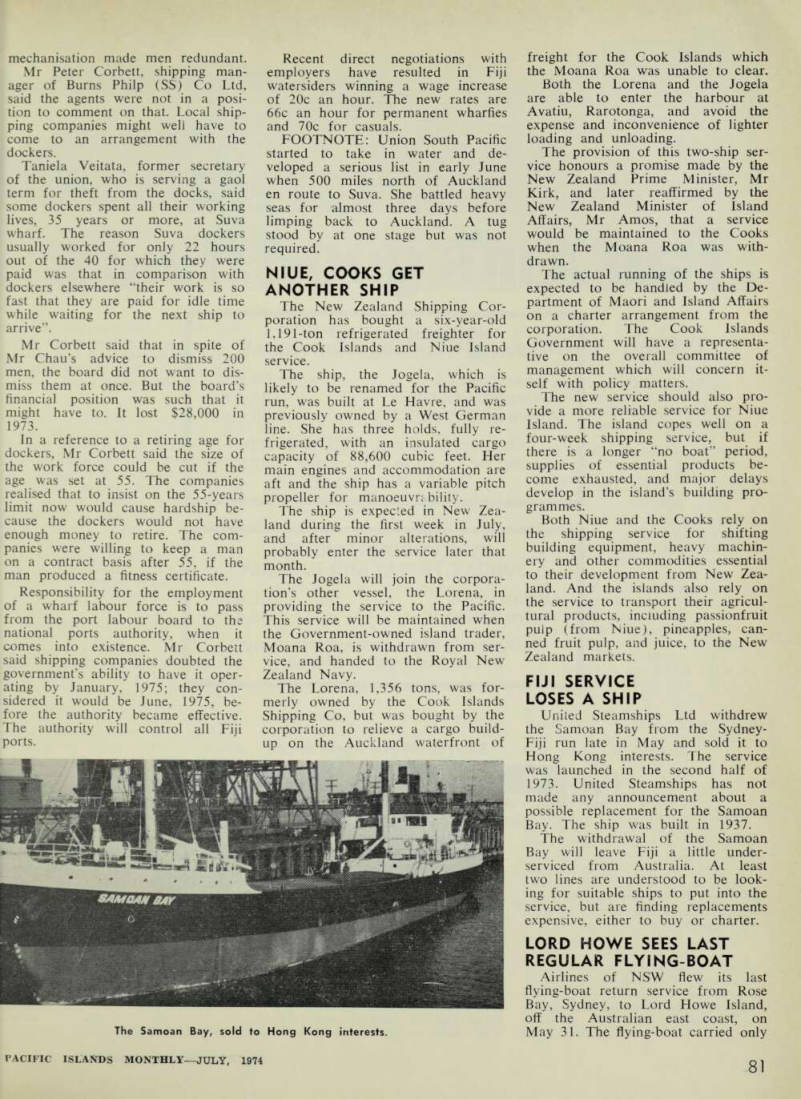
United Steamships Ltd withdrew the Samoan Bay from the Sydney- Fiji run late in May and sold it to Hong Kong interests. The service was launched in the second half of 1973. United Steamships has not made any announcement about a possible replacement for the Samoan Bay. The ship was built in 1937.
The withdrawal of the Samoan Bay will leave Fiji a little under serviced from Australia. At least two lines are understood to be look ing for suitable ships to put into the service, but are finding replacements expensive, either to buy or charter.
Lord Howe Sees Last
Regular Flying-Boat
Airlines of NSW flew its last flying-boat return service from Rose Bay, Sydney, to Lord Howe Island, off the Australian east coast, on May 31. The flying-boat carried only
The Samoan Bay, sold to Hong Kong interests.
a few passengers to Lord Howe Island, but returned with a full com plement. Now, in accordance with an undertaking given a few months ago, the airline will maintain a token flying-boat service to the island to keep communications open pending completion of the Lord Howe air strip, expected to be late August or
early September.
The manager of Airlines of NSW, Mr P. Steadman, said a special ceremony would be arranged for the last of the “communication link” services.
The two Sandringham aircraft used on the service have been sold to Antilles Air Boats, in the Carib bean. One of them was scheduled to leave Rose Bay on a ferry flight on June 17. The second will probably be ferried to the Caribbean early in 1975 if it can be salvaged after tak ing a battering from hurricane-force winds at the island on June 9. Winds gusting to 80 knots tore the aircraft from its moorings and ran it aground. On June 10, the army team which is laying an airstrip on the island helped to get the flying-boat above the high-water mark. The starboard float was torn off, the star board aileron and a starboard engine were damaged, and the passenger door caved in under the buffeting.
Meantime the New South Wales chapter of the Royal Australian In stitute of Architects has accused the Australian and NSW Governments of allowing construction of the Lord Howe Island airstrip to go ahead without adequate controls or an equivalent impact study. The chapter claims that army sappers are un necessarily destroying parts of the island in constructing the airstrip.