'Frightening ' Sydney delays
p. 85 · Read in the full issue
“Frightening” was the description
given by a Sydney shipping company manager in June when asked about delays on the Australian waterfront.
Thus importers in the Islands can brace themselves to meet another big hike in shipping costs.
Shippers servicing PNG met
the Australian Shippers Council early in June to negotiate a new round of price increases. The companies are Cunpac, New Guinea Australia Line, New Guinea Express Line and Kar lander. Watching developments closely were the shipping companies serving Fiji, for they have similar rising costs to meet.
A number of factors are involved: • Increased imports into Aust ralia through lower tariffs, creating a big demand for wharf space; • Industrial disputes; • Insufficient labour to meet de mands.
Bad weather in Brisbane and Mel bourne earlier in the year led to a number of ships being diverted to Sydney, which was unable to handle them quickly. Sydney was hit by cyclonic gales late in May, and there was continuous heavy rain early in June.
It took longer to load ships at the wharf; ships arriving in Sydney had to moor at dolphins in the harbour till wharf space was available.
Industrial troubles and labour shortages added to the troubles.
Conpac’s Nimos could usually turn round in Sydney, discharging cargo from Papua New Guinea and load ing about 2,000 tons for PNG, in about four days. On the last three voyages, to early June, the average turn-round time was 14 days.
New Guinea Express Line, a few months ago, turned its ships round in Sydney in about two days. Now
the company thinks in terms of a 17-day turn-round. It has chartered a ship to add to its permanent fleet of two to help lift cargo needed in
Png.
The New Guinea Australia Line with its fleet operating between Aust ralia and Papua New Guinea, made 13 trips in the first quarter of 1974, compared with 17 trips in the first quarter of 1973. The Coral Chief is a good example of delays in NGAL services. In April, 1973, the turn-round time in Sydney was three and a half to four days. In May, 1974, it was seven days. If Island importers can’t get their orders from Australia in time they will go elsewhere, and Australian ex ports will suffer, said Captain Graham, NEL manager.
Karlander is also hit by congestion in Sydney and Melbourne. What the fleet previously did in four weeks, now takes five weeks. This line attri butes much of its problems to the shortage of labour. Often it asks for four gangs and gets one.
Fiji Builds
Its Biggest Ship
The Fiji Government is building a new ship to replace the Tui Lau, which was wrecked six years ago.
The new ship, the biggest yet at tempted in Fiji, will be 138 ft long with a 28 ft beam and a draft of 8 ft 6 in. She will be 200 tons dead weight and will have a cargo capacity of 250 tons. Her 500 hp diesel engine is expected to give her a maximum speed of 10 knots.
The ship, at this stage, is expected to cost about $500,000. But if the cost of the Tui Ni Wasaliwa is a guide, and inflation continues ram pant, the final cost could be closer to $1 million.
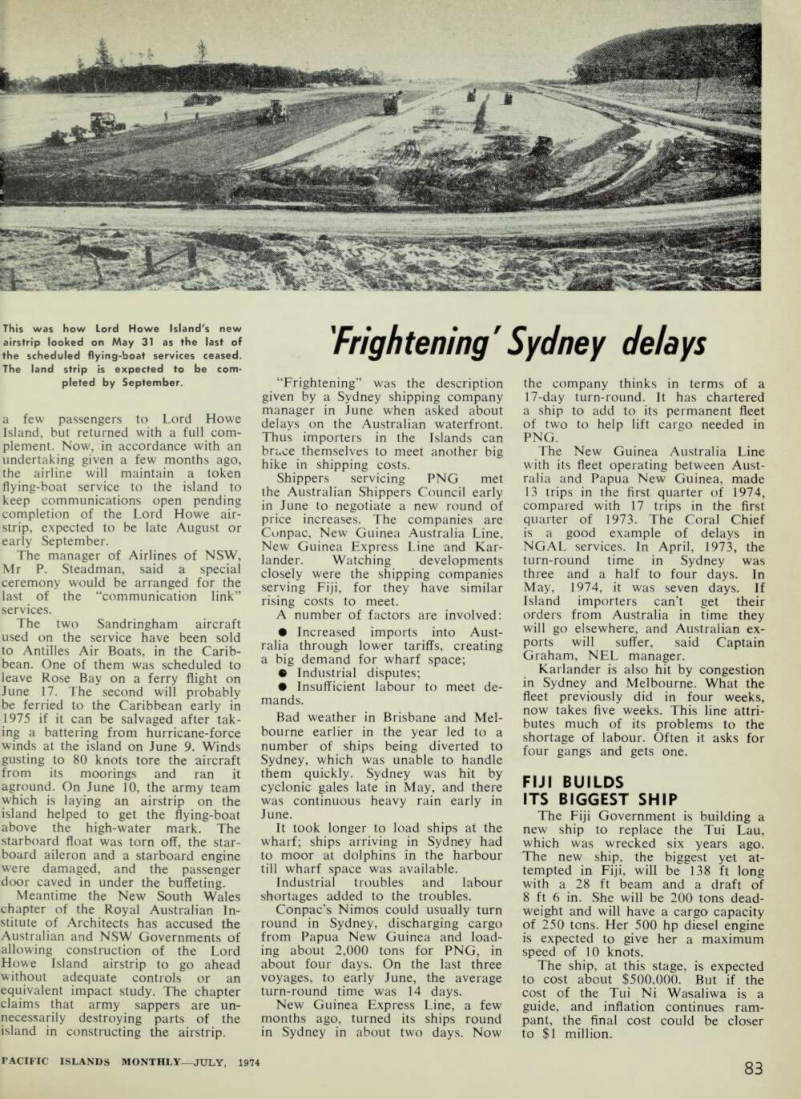
This was how Lord Howe Island's new airstrip looked on May 31 as the last of the scheduled flying-boat services ceased.
The land strip is expected to be com pleted by September.