Pacific Transport
pp. 79-81 · Read in the full issue

Tonga, Western Samoa Add To
Growing Problems Of Air Pacific
The fight by Air Pacific to retain its identity as the regional airline for the South Pacific continued in June, with all kinds of forces developing.
Tonga made the strongest attack by announcing more details of its own airline.
Air Pacific is owned by Fiji, Qantas, British Airways and Air New Zealand (holding majority of the shares) and with minor holdings by the Solomons, GEIC, Western Samoa and Tonga.
Some sceptics believed that King Taufa’ahau’s talk of forming a Tongan airline was a fishing expedi tion in the hope of getting a larger slice of Air Pacific. But in June the king pushed the affair further and brought the proliferation of airlines nearer. Air Nauru is extending, and with Tonga and Western Samoa getting serious, Air Pacific is battling.
A name has been chosen for the Tongan airline—not unexpectedly Friendly Islands Air. It has been an nounced in Nukualofa that the ex pected delivery date for the first Boeing 737 will be the end of this year, with a second 737 to follow soon after.
The king has been having lengthy discussions with the Japanese and has announced that, initially, his aircraft will be crewed by Japanese, and backed by Japanese ground and administrative staff. Local hostesses will be trained to take over from the Japanese girls but it is expected that “it will be some years” before locals will be able to take over other jobs.
The king said that initially about 24 Japanese would be required—for the first aircraft. Presumably, he will require more Japanese staff when the second plane arrives.
There are no firm plans for routes, but Tonga’s Minister for Works and Civil Aviation, Dr Langi Kavaliku, left Tonga on May 31 to visit world
capitals seeking landing rights for the new airline. Landing rights will probably also be sought in Pago Pago, Noumea, the Cook Islands and other Islands. He was accompanied by Secretary to Government Dan Tufui.
As New Zealand is responsible for foreign affairs for the Cooks, Tonga will have to talk to NZ about rights in the Cooks. As the Cooks, so far, is the sole preserve of Air New Zea land, this might be a sticky one, although there is little doubt that in the final outcome NZ would go along with what the Cooks wanted.
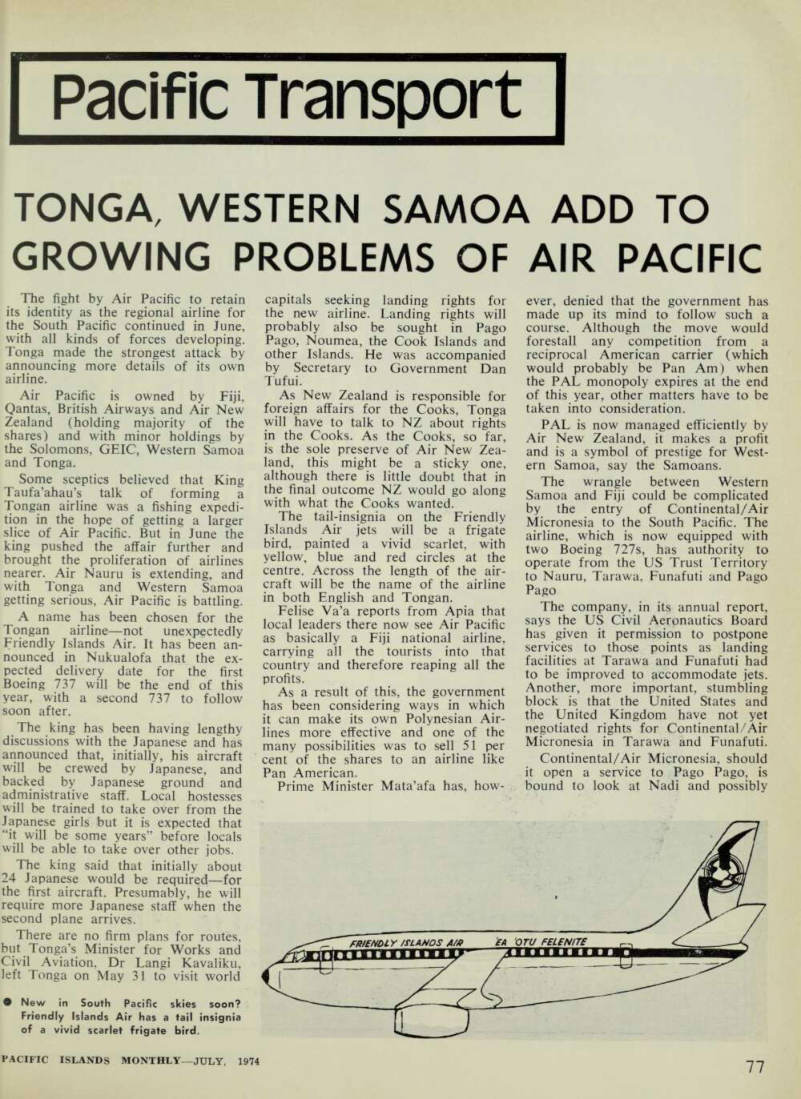
The tail-insignia on the Friendly Islands Air jets will be a frigate bird, painted a vivid scarlet, with yellow, blue and red circles at the centre. Across the length of the air craft will be the name of the airline in both English and Tongan.
Felise Va’a reports from Apia that local leaders there now see Air Pacific as basically a Fiji national airline, carrying all the tourists into that country and therefore reaping all the profits.
As a result of this, the government has been considering ways in which it can make its own Polynesian Air lines more effective and one of the many possibilities was to sell 51 per cent of the shares to an airline like Pan American.
Prime Minister Mata’afa has, how
ever, denied that the government has made up its mind to follow such a course. Although the move would forestall any competition from a reciprocal American carrier (which would probably be Pan Am) when the PAL monopoly expires at the end of this year, other matters have to be taken into consideration.
PAL is now managed efficiently by Air New Zealand, it makes a profit and is a symbol of prestige for West ern Samoa, say the Samoans.
The wrangle between Western Samoa and Fiji could be complicated by the entry of Continental/Air Micronesia to the South Pacific. The airline, which is now equipped with two Boeing 7275, has authority to operate from the US Trust Territory to Nauru, Tarawa, Funafuti and Pago Pago The company, in its annual report, says the US Civil Aeronautics Board has given it permission to postpone services to those points as landing facilities at Tarawa and Funafuti had to be improved to accommodate jets.
Another, more important, stumbling block is that the United States and the United Kingdom have not yet negotiated rights for Continental/Air Micronesia in Tarawa and Funafuti.
Continental/Air Micronesia, should it open a service to Pago Pago, is bound to look at Nadi and possibly
• New in South Pacific skies soon?
Friendly Islands Air has a tail insignia of a vivid scarlet frigate bird.
Honiara, the New Hebrides and New Caledonia to have a round-trip operation.
Aviation ministers from the various members of the South Pacific Forum will soon meet in Suva to discuss regional air services. Because of the heat already generated, it looks as though emotionalism, not realism, will govern much of the debates.
Fiji’s Prime Minister, Ratu Sir Kamisese Mara, warned at the last South Pacific Forum that civil avia tion would be “the real test of Pacific regional co-operation”.
Meanwhile, UTA and Air Pacific have reached agreement which allows UTA to resume its weekly service through Nadi with a DCIO. UTA has been operating to Fiji only once a week since the middle of February with a DCB. As a reciprocal arrange ment, Air Pacific will now be able to operate its BACIII from Nadi, via Vila and Noumea to Brisbane. A decision on when to take up the route was to go before the Air Pacific board in June. Air Pacific at present opera tes from Nadi to Brisbane via Vila and Honiara.
The hoped-for arrival of Air Nauru’s second F2B jet for Nauru’s Constitution Day celebrations on May 17, did not eventuate. The air line later expected to take delivery □f the aircraft, on lease, in Amster dam towards the end of June. Air Nauru was obviously confident the later delivery time was firm for it planned to start a weekly Nauru- Apia service on July 5. This will be a direct service, except for a refuel ling stop, probably at Wallis Island.
FOOTNOTE: In his speech from the throne to the Tonga Legislative Assembly on May 30, King Tau fa’ahau said the launching of Tonga’s new international airline was not done “to demonstrate any dissatis faction towards Air Pacific or Poly nesian Airlines, for we are deeply indebted to them for the services they have rendered Tonga in the past”. But he said Tonga had more than one or two gateways to the out side world, and she wanted to im prove communications and air cargo facilities. airfi , e f dS ’ °"t °v y p - fi _i, 11 , wou * d Air Airlines. The 7° n , 8 r p . lanned . a , ft airstri P <° take large ,ets <P resen ‘ s ‘ r, P ° n Tongatapu is 6,000 fIL a " K d tbree " ew hotel , s . were |° be bmU on Tongatapu, another at Vavau, and the , r ,? was hope for a bigger hotel on Eua.
The king also said “big changes” would take place with Tongan ship ping. Tonga would soon operate a 76,000 ton iron ore carrier, from the Pacific to the Atlantic, returning via the Mediterranean, but he gave no further facts. He said Tonga’s Pacific Navigation Company would prob ably also purchase the Frysna, now sailing between Tonga and NZ’s South Island, and use her on a re gular Tonga-NZ run. Tongans might also get the opportunity to crew vessels operating between Australia and PNG.
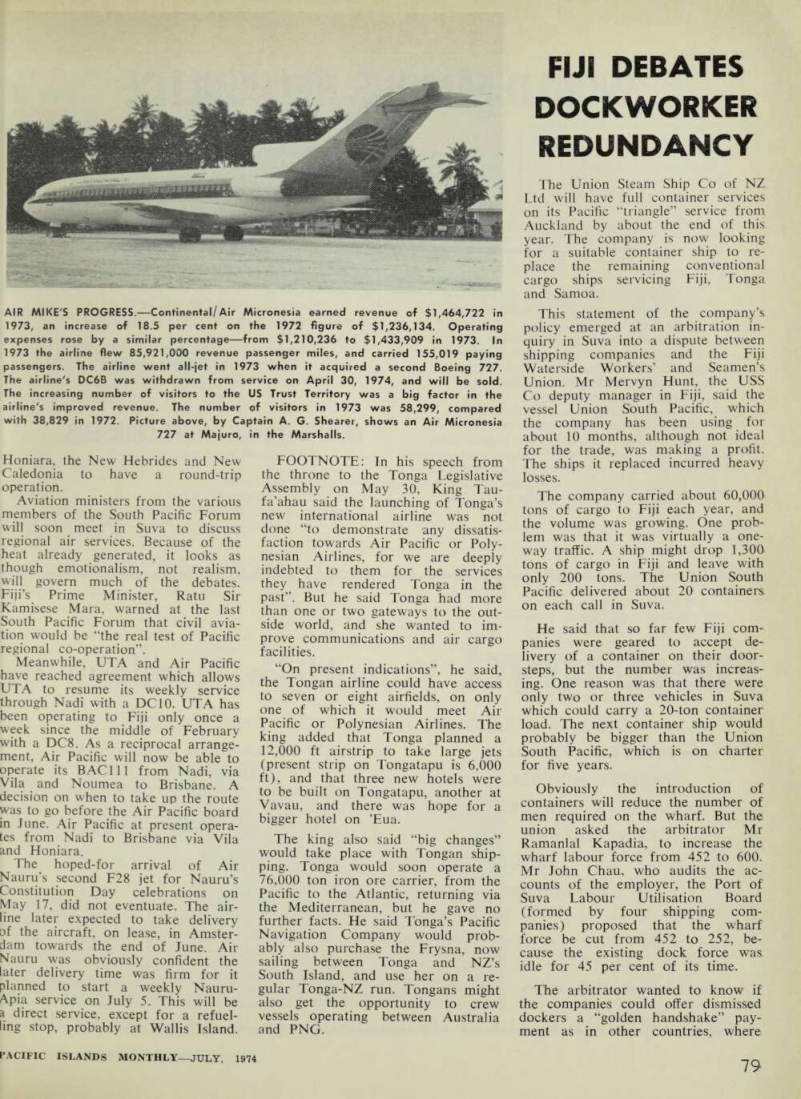
AIR MIKE'S PROGRESS.—Continental/Air Micronesia earned revenue of $1,464,722 in 1973, an increase of 18.5 per cent on the 1972 figure of $1,236,134. Operating expenses rose by a similar percentage—from $1,210,236 to $1,433,909 in 1973. In 1973 the airline flew 85,921,000 revenue passenger miles, and carried 155,019 paying passengers. The airline went all-jet in 1973 when it acquired a second Boeing 727.
The airline's DC6B was withdrawn from service on April 30, 1974, and will be sold.
The increasing number of visitors to the US Trust Territory was a big factor in the airline's improved revenue. The number of visitors in 1973 was 58,299, compared with 38,829 in 1972. Picture above, by Captain A. G. Shearer, shows an Air Micronesia 727 at Majuro, in the Marshalls.