The Editor's Mailbag
pp. 38-45 · Read in the full issue
Mission Effect On Art
Mr David Wetherell’s letter (PIM, May, p 33) takes issue with the as sertion made in my book review of Philip Rawson’s Primitive Erotic Art, that Christian missions exert devasta ting effect on primitive art.
Mr Wetherell may be an expert on Papua New Guinea missions, but I doubt that he is any authority in primitive art. The fact that several missions in Papua started schools to teach the natives to carve their tradi tional artefacts is quite commendable.
He does not, however, seem to ap preciate that these objects become merely tourist trade goods when the meaning behind them is lost. The mere fact that the native had to be taught to do the things which were an integral part of their culture is in itself a vindication of my statement.
With regard to my alleged “woolly assumption that Melanesian art forms changed because missionaries meddled with them”, I would point out that my remarks were not restricted to Melanesian, but encompassed pri mitive art from America to Africa and Iceland to Australia.
If Mr Wetherell has the time to read any of the textbooks on primitive art (including Erotic Primitive Art), he will find that almost all the authors, most of whom are museum curators, who have devoted a lifetime to field work and study of so-called primitive art and culture, are of the same opinion as myself.
The degradation of art and culture is a direct result of loss of belief.
In a section dealing with the effect of European culture on primitive peoples, one of these books (Oceanic Mythology—published by Hamlyn, p 16) contains the following, which may help Mr Wetherell to understand that not all missionaries, aside from the ones he quotes, had an affinity for primitive art or beliefs.
“In all this horror perhaps only the missionaries acted with any humanity or held out any hope, but they too wanted something, they wanted souls.
In many island communities the ac ceptance of the powerful gods of the Newcomers was accompanied by the total and deliberate destruction of their own gods. The Rev Ellis de scribed in Polynesian Researchers that the Tahitians burned their gods” . . .
“In Hapaai, in the Tongan group, the missionary John Williams watched while the gods were hung from the
rafters of the house in which they were adored”.
It is a relatively few years since the Haus Tambarans were burned in the Sepik and only a matter of months since a report of mission inspired burning of reputedly price less artefacts there.
Several years ago in Kavieng I was “entertained” by a story of a priest who put an abrupt halt to a Mallangan ceremony by setting the carvings alight with petrol.
It was not my intention to denigrate the work of the missions in the fields of health and welfare, and I am quite aware that a number of missionaries have made a dedicated study of the art and culture in their areas.
I would however, say that the record of the Christian missions in all fields is somewhat like the curate’s egg—“good in parts”.
Laurie Marshall.
Paddington, Sydney.
Whose Wreck?
I was recently cruising in Pacific waters in the Sitmar liner Fairstar.
En route to Vila we passed very close to Noumea while rounding the southern tip of New Caledonia. While waiting for the pilot vessel I noticed a vessel hard and fast on the reef that encircles Noumea.
The bridge officers informed us that it was a Chinese tanker —but it looked to me as if it might have been a Japanese freighter. Would you have this recorded in your magazine at the time of its grounding and its name and nationality? Or perhaps one of your readers in the area may know its history?
Hoping you can help me. I enjoy PIM and read it regularly.
Colin Ell Wood.
Cammeray, Sydney.
Southern Cross Relic
At a recent antique auction in Wellington I obtained a small wooden paddle (7 inches long), which has the following inscription: “Made out of a bit of the old Melanesian Mission Schooner Southern Cross 1874-1891” (on one side) and “O tano nomkel apen (Mot a for) A remembrance of Bishop Pat teson + and Bishop Selwyn +” (on the other side).
Being very interested in the (ship
ping) history of the Pacific (I am Assistant Manager, NZ, • for Royal Interocean Lines) and a regular reader of PIM, I wonder whether you would be able to provide me with any further information relat ing to the above. If not, perhaps you would know some reference books/ institutions/persons who might be able to help?
R. H. Bezuijen.
PO Box 194, Wellington, NZ.
Sucking Nauru's
Life-Blood
It was announced recently by Australia, that the Whitlam ad ministration has decided to cut the present government subsidy of $57 million on superphosphate bounty to the farmers. Hence, Australia de cided to sell the phosphate on the world market at $4O a ton. This is double the price being paid for our phosphate by both consumers, Japan and Australia. Japan is buying our phosphate at $l4 a ton, while Aust ralia is paying only $l2 a ton.
The Australian Prime Minister advised that the present subsidy of $57 million could be best utilised for other projects worthwhile to Australia, as, at present, the Aust ralian farmers are the only people who are benefiting under this subsidy.
Since Nauru became independent, Australia has been guaranteed a fair quota of rock phosphate. It is be yond reasonable doubt, that our phosphate is of the highest quality.
It is the second best in the world, after that of Ocean Island.
At present there is in fact phos phate in such countries as Morocco, Mauritius and in South America.
They are low-grade phosphates yet they are being sold at $4O a ton in the world market. If we concentrate selling our phosphate on the world market we will be getting $4O a ton rather than $l2 the Australian farmer is paying us.
If it is true that the Australian farmers are needing our phosphate, and by the fact alone, that the Australian farmers have become rich as a result of the phosphate, it would have been most generous of them to increase the price of our phos phate to at least $2O a ton. Now it appears that the Australian farmers are sucking the life-blood of the Nauruan people.
We have been administered by Australia for the last 70 years, and our phosphate has been in and out of Australia for that long. It is then up to the Australian people to con sider and judge whether despite the
fact that our phosphate is disappear ing at a fast rate, we are bound to increase the price of our phosphate, to $4O a ton as it is the present price of the phosphate in the world market. Can the Australian farmers
really maintain this price stability of
phosphate as does exist in Morocco and a few other countries?
As far as I see, the Republic Government of Nauru will welcome the suggestion of the Whitlam Government to have the phosphate be sold in the world market. It will not only triple the present price, but it will attract more countries to buy our phosphate in the near future.
Detonga Deiye.
Nauru.
First Contacts!
In your article on the Nauruan stamps (PIM, May p 16), Captain Fearn is mentioned as the “man who first sighted Nauru”. This claim smacks of the old ‘weren’t-we- Europeans-great’ type history book.
Surely Nauruans were the first to sight the island. By having imprinted on the commemorative stamps the words, “175th Anniversary of First Contact”, the Nauruan Government marks 1799 as the year in which the first contact was made with the out side world.
Similar attitudes claim Tasman and Cook as the discoverers of New Zealand, but we all know that the Maoris discovered the islands long before those intrepid sailors set foot on them. I do not wish to quibble but we should remember that the Pacific has a history which goes back many years before Europeans came on the scene.
I also have some comments to add to those of Mr Wetherell in his letter on p 33 of the same issue. 1 have not read the NG Quarterly article to which he refers.
There have been many instances in the East Sepik District (which I know well) of missionaries of diverse creeds destroying traditional artefacts or strongly discouraging their pro duction; and again many where en lightened missionaries, recognising the artistic and cultural significance of artefacts, have done their best to preserve them. However, mission in fluence is only one of the culprits.
The new, and secular concepts in troduced through European contact had more of a devastating effect; not
only on artefacts, but on whole culture patterns. The old incentives and facets of traditional culture— animism, reverence for ancestors, traditional warfare, etc—were pushed aside or demeaned by the ‘new ways’ —Christianity, the cash economy, the court system, and formal education, to name but a few of a host of innovations.
The milk has been spilt. Had it not been European culture then it would have been an Asian one that caused the destruction. It is rather a sterile academic exercise to lay the blame at anyone’s door and lament the decay of traditional culture without taking steps to revive what is good in the culture or at least to preserve the remnants. The govern ment-sponsored scheme for cultural revival in PNG provides an instance of steps taken in the right direction.
Paul Dennett.
Angoram, Papua New Guinea.
Cart Cook's Club
The three Rotuman war clubs mentioned by your correspondent, Elcombe E. Antonio (PIM, May, p 30) were originally Tongan. They were given to King Fonmanu I, of Noa’tau by Ma’afu of Niuafoou, Tonga, as tokens of peace and friend ship, after he and his Tongans in vaded Rotuma in the 1820 s.
King Fonmanu I, died before the handing over of the kingship, and his daughter, Princess Paurino of Pavau, surrendered the kingship to Ma’afu and received the war clubs on her father’s behalf. These three Tongan war clubs were later given away as gifts to European visitors by Princess Paurino.
The present Marafu of Noa’tau (Natanela Fakaraufono), who is the Paramount Chief of Rotuma, is a descendant of Ma’afu. The name Marafu is a corruption or variant of the Tongan Ma’afu. The present Deputy Paramount Chief of Rotuma is the Urekmat, who is Iliesa Inoke, a descendant of Princess Paurino of Pavau and King Fonmanu I, of Noa’tau.
There are two Rotuman versions of the story of these Tongan war clubs and the invasion of Rotuma by the Tongans. This version was given by the daughter of Princess Paurino, Mua, and it was recorded
by her husband, Ralifo Fesau of Fafaisino, a Methodist Missionary (Ralifo’s Diary—lBBo to 1909).
In my recent investigation con cerning this unpublished diary, I discovered that his grandson, Mr Elakima (Charlie) Antonio, 85, of Suva, had lost the manuscript while residing in Rewa in the 19305.
M. K. Inoke.
Raiwaqa, Suva.
I would like to correct Elcombe E.
Antonio regarding the Tongan war club and the three Rotuman war clubs he mentioned (PIM, May, p 30).
The war clubs were Tongan and they were given away as gifts not by Faefe, but by his wife, Paurino, who was the Paramount Chieftainess of Noa’tau.
The war clubs belonged to Ma’afu and his Tongans who invaded Rotuma in the early 19th century.
They were presented to Paramount Chieftainess Paurino when she sur rendered her leadership to the Tongans during the invasion.
Also, Faefe was not Ralifo’s father; he was his father-in-law. Ralifo was one of the translators of the Deed of Cession of Rotuma into the Fijian language and not into English.
The latter was translated by an Englishman.
Pavau Tribesman.
Vatukoula, Fiji.
Natural Hazards
The Research School of Pacific Studies, The Australian National University, has begun compilation of records of the occurrence of natural hazards in the Pacific island area. It is hoped to record and catalogue all available records on hurricanes, tsunamis, earthquakes and eruptions in the Island region from Papua New Guinea to Easter Island and south of latitude 20°N (excluding Hawaii).
The plan includes an initial listing of events over the last two centuries and the collection of information on their physical, social and economic impact.
The project is an interdisciplinary one. The research group would wel come any information on the occur rence and impact of hurricanes or other events and would be grateful if anyone having such information could write to the Head, Department of Human Geography, Research School of Pacific Studies, The Aust ralian National University, PO Box 4, Canberra, ACT, 2600, Australia.
R. Gerard Ward,
Professor of Geography.
Australian National University, Canberra.
Solomons' Mafia!
I have recently re-read Jim Bouti lier’s article on Kwaisulia—Malaita Big Man (PIM, July, p 53).
The Ramo on Attagege in my day —1938-1940—was Timi Kakaluae, who ran a great organisation rather on the lines of “the Godfather”. Not even police stepped ashore there.
Criminals were handed over, unless they were in the family. Timi him self always had fierce dogs near him.
Even Vouza, who was our Police Sergeant for Malaita, trod very warily.
Timi was absolute monarch and dictator of the Eastern Lagoon in those days. I believe he became a Christian before he died, but I was away from Malaita busy on other things. Perhaps Jim Boutilier could fill us in on the rest of the history.
Timi could have been a son or grand son of Kwaisulia.
Martin Clemens.
Toorak, Victoria.
Judgment On Thurston
On reading Mr L. G. Usher’s re view of Deryk Scarr’s I The Very Bayonet, (PIM, May, p 91), I was amused by the reviewer’s ob session about defending The Fiji Times of the last century. On Dr Scarr’s judgment about The Fiji Times as having a “racist editor”, Mr
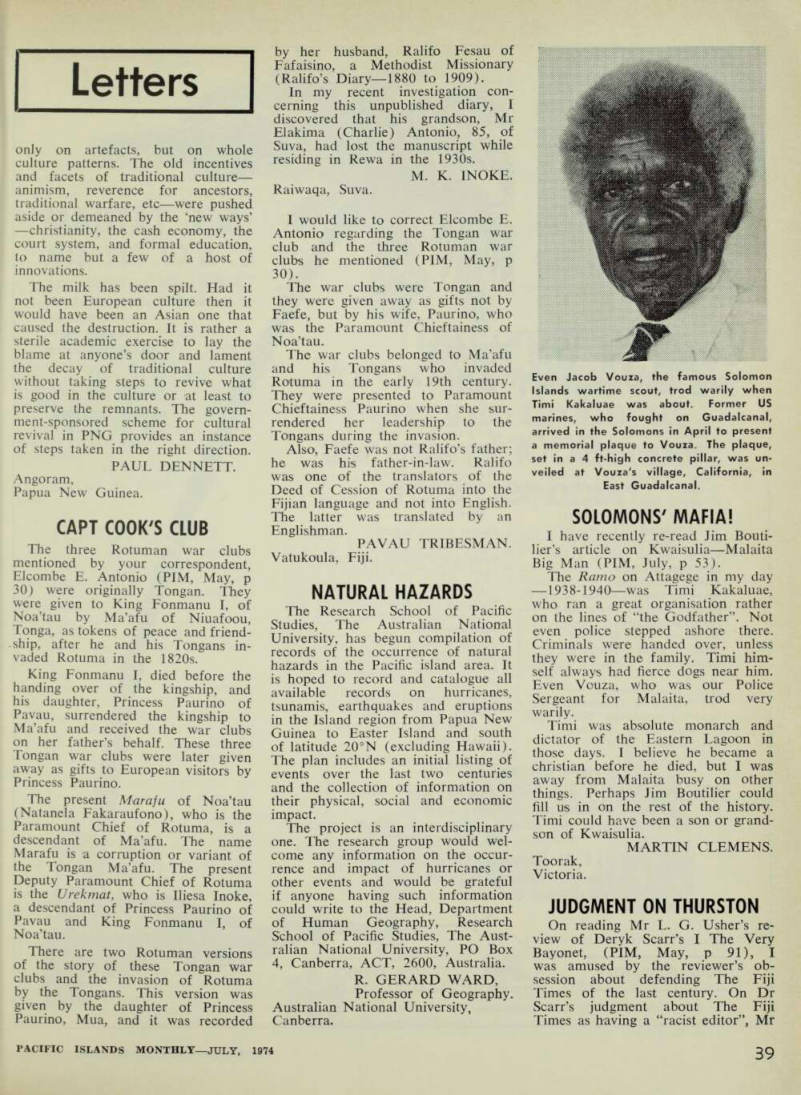
Even Jacob Vouza, the famous Solomon Islands wartime scout, trod warily when Timi Kakaluae was about. Former US marines, who fought on Guadalcanal, arrived in the Solomons in April to present a memorial plaque to Vouza. The plaque, set in a 4 ft-high concrete pillar, was un veiled at Vouza's village, California, in East Guadalcanal.
Usher says: “name-calling labels are no real substitute for a detached and balanced view of the whole scene”.
Mr Usher finds “great value in the massive research that has gone into the book” but “not in its judgment of either men or events!” Yet Mr Usher’s judgment of Sir John Bates Thurston as having a deep “love of the Fijian people” seems much less balanced or enlightening than Dr Scarr’s massively-researched judg ments.
At the end of the review, Mr Usher wishes for “a more rounded human study of a truly remarkable man”. It seems to me that in Mr Usher’s view, a “more rounded human study” of Thurston is one that finds past editors of The Fiji Times—even dead ones of over 100 years ago—infallible of human weakness.
Jone Dakuvula.
University of the South Pacific, Suva.
Planters Defended
It sickens many of us, black or white, that certain writers base their criticism merely on hearsay. Those like Kalkot Matas-Kele (probably a newcomer?) (PIM, May, p 41) im ply that planters, or “colons”, are responsible as organisers of party politics in the New Hebrides. Quite untrue.
Planters, who take their work seriously, are far too busy organising field work, transporting cargo, re cruiting workers, repairing machinery, fences, tending to the sick, training workers, etc, to find time for the juvenile game of cat-and-mouse politics.
Among the many questions we could ask ourselves, the following few have priority: • Without pioneer (foreign) planters, how would this country have developed in the first place? » Why was it necessary to intro duce outside work force, eg Ton kinese, Wallisians, Tahitians and Gilbertese—for development? • Who decided that this group of islands was to be called New Hebrides? • Why is it that customs and lan guages vary all around the group if all the people are one and the same, ie New Hebrideans? • Who were responsible for inter ference with island customs?
Apart from an occasional un pleasant, hot-headed person as one can find in any type of community and race, the majority of planters have, since early days, got on very well with indigenous people. They still do.
The Sin of Envy, affecting a hand ful of educated islanders, has only very recently been pressured by minority newcomers who seem to revel in manufacturing mental-bullets for the unsuspecting islander to fire.
Man-Santo.
Santo, New Hebrides.
Gutter Language
Here I go again. I do not wish to thrash the subject to death but I cannot resist replying to the over bearing bigots who become hysterical at the sight of bare bums and factual reporting. (PIM, Apr, Feb).
It seems that Mr Hall and Mr Cummings will be satisfied with no thing less than a return to so-called “Victorian morality”, when even table and piano legs were modestly draped and legs were “limbs”.
I am not an advocate of porno graphy (although the “Victorians” were); however, I am over 21 and
feel that I can make my own moral judgments on the media without heaping vitriolic abuse and advice on the heads of various unfortunate editors.
Until I read Mr Hall’s letter, I was unaware that the lass in I.
McDonald’s ad was bare bummed— oh pardon me, I mean bottomed, er posteriored? . . . hmmm, backed?
Fiona Kirk.
Edge Hill, Cairns, Queensland.
No Bsip Foot-And-Mouth
We read in the May issue of PIM, p 64, under “Fishing Ranchers”, that the BSIP is designated as a “Foot and-Mouth” disease area.
We would be interested to know from what authority and on what evidence this information was ob tained.
Australian veterinary consultants have regularly been visiting BSIP and performing animal disease studies and surveys since 1960. From 1967, two veterinary officers have between them performed more than four years of animal disease survey ing under the Australian South Paci fic Aid Programme, and since 1969, the protectorate has had a resident Government Veterinary Officer.
At no time has any evidence been discovered that foot-and-mouth disease is present in the protectorate.
We therefore most definitely re gard the BSIP as foot-and-mouth free and would be pleased if you could print a retraction in the next
issue of PIM.
D. J. Fisk.
Senior Information Officer, For Director of Information, Broad casting Museum and Library Services, Honiara, BSIP.
Sailing Backwards
Reference Herb Kane’s Polynesian expedition (“Hawaiians will sail back into history”, PIM, May, p 21), Nga Toki Matawharoa is a Maori war canoe built for the Centennial cele brations at Waitangi, New Zealand.
Hewn out of solid logs, scarfed together to give a length of 117 ft; traditional Maori carvings from stern to stern; not a sign of a screw or nail or a glued joint. What will Herb Kane’s Dillingham-built canoe look like? Plywood! Built-in buoyancy compartments, polyurethane-painted?
I suppose the crew will be taking a plastic drogue? Might prevent them from drifting backwards into
obscurity.
David Richardson.
Cairns, Queensland.