and eating
pp. 47-49 · Read in the full issue
Having their tourism cake and eating it too
From FELISE VA’A in Apia Is tourism a blessing in disguise or is it a curse? Western Samoans at all levels are still trying to find the answer to this question.
Before independence in 1962, West ern Samoans were generally shy of visitors and there was a tendency towards isolation. However, Western Samoa’s increased trade and cultural ties with foreign countries and membership in United Nations
agencies and regional organisations
have ensured that isolationism would not work.
The success of “internationalism” in Western Samoa was further given impetus through the work of foreign experts, particularly United Nations experts, working in the country.
Tourism has been attacked, mainly by some conservatives, because of the fear that it might result in the cor
; f h traditiona , Samoan way j-£ e 3 One critic has equated tourism in Western Samoa the exp i o u a ti 0 n of the poor the rich wil become richer ,j, e wi|| become e he said He accused , he gove^ nment of spe nding money on projects patentlv advantageous to the tourists while boat passengers still boarded and disembarked in the rain.
The critics of tourism have good grounds for their fear but in the final analysis, this fear seems exaggerated.
Tourism is unlikely to be sup planted as a major industry for obvious reasons. The process of modernisation in Western Samoa is a fact—this applies to tourism too. In recent years tourism has been the country’s second biggest money earner and it is not likely that the government will want to foresake such an important source of finance. The monetary advantages to Samoans through employment, skills and higher income are immense. And tourism’s supporters, hotel, taxi and restaurant owners are just as vocal as their opponents.
Despite the critics, tourism is here to stay in Western Samoa but to be fair to the critics it will probably end up by being more and better control led than previously.
Speaking to the Western Samoa Travel and Holiday Association recently, Minister of Finance, Sam Saili emphasised that the government considered tourism an important industry to be developed. Govern ment’s interest in tourism could be shown by the various financial and other incentives provided for hotels
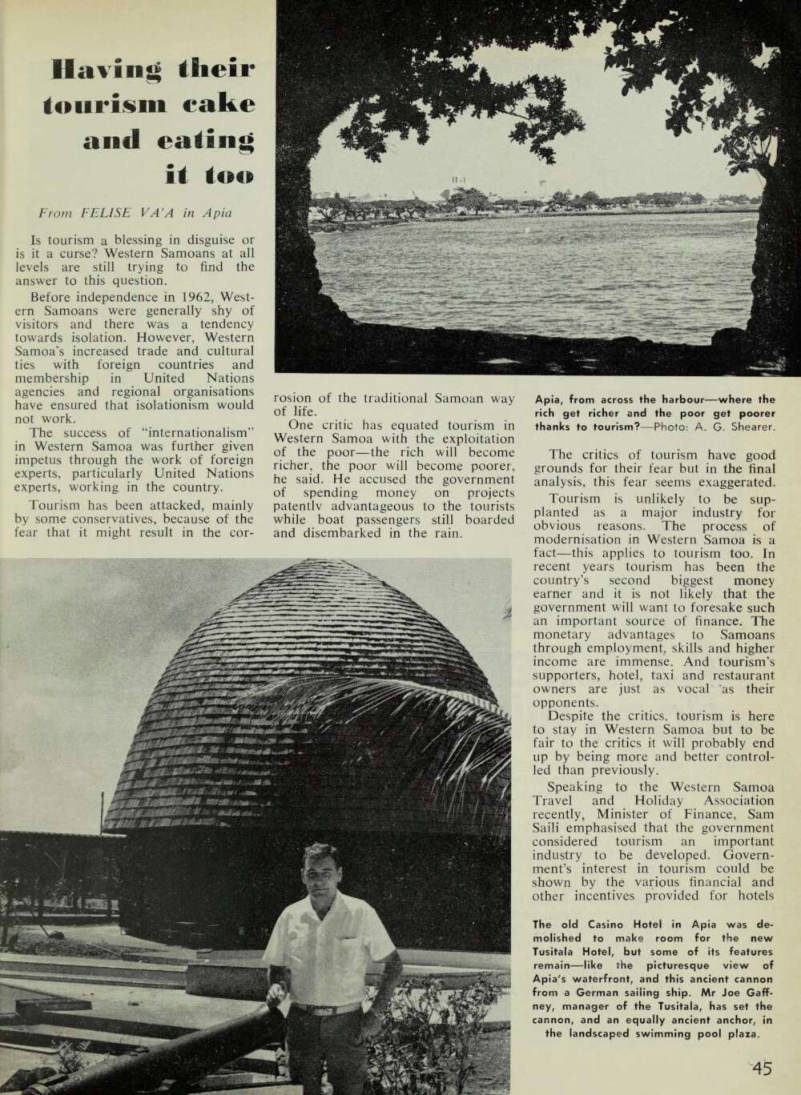
Apia, from across the harbour—where the rich get richer and the poor get poorer thanks to tourism?— Photo: A. G. Shearer.
The old Casino Hotel in Apia was de molished to make room for the new Tusitala Hotel, but some of its features remain—like the picturesque view of Apia's waterfront, and this ancient cannon from a German sailing ship. Mr Joe Gaff ney, manager of the Tusitala, has set the cannon, and an equally ancient anchor, in
the landscaped swimming pool plaza.
and tourist service establishments, government’s purchase of shares in Polynesian Airlines and the Tusitala Hotel, and efforts to improve roads and water supply, he said.
Other government plans for pro moting tourism were the extension of the tourist visa from three to seven days, and the upgrading to inter national standards of Faleolo Airport.
At the end of his speech (read by the Director of Economic Develop ment, Mr Hans Kruse) the minister dropped a bombshell. Beginning January next year, the government planned to introduce a 10 per cent surtax on all tourists visiting Western Samoa (See Business section, this issue).
The announcement was unexpected, especially as it was the same minister who had abolished the 10 per cent bed tax (imposed by the previous Tamasese Government) last year. The minister’s action at that time brought a lot of criticism from the Opposition.
Opposition Leader, Tupuola Efi, accused Saili of inconsistency because Saili had introduced stringent econo mic measures under the pretext that the government had no money, while at the same time abolishing a useful source of revenue.
The tourist people, however, have a chance to fight the measure as it is still to be brought up in parliament.
Indirectly, perhaps, the tax is one way of controlling the inflow of tourists to Western Samoa, and as such favours tourism’s opponents. Many people in the tourist industry say the surtax will discourage tourists from visiting Western Samoa and they point out that the bed tax produced an unfavourable reaction.
As for Western Samoa, tourism development, however, is going ahead full swing. Visitors had to be turned away in 1971 and 1972 because of lack of accommodation.
In 1972 only 20 double rooms were added as a result of expansion at the Hideaway Hotel. With this addition, according to a government report, Western Samoa’s total hotel capacity reached 175 rooms, consisting of 30 singles and 145 doubles, equal to 320 beds.
At the same time, 25 new double rooms at Aggie Grey’s and 35 double rooms at the Tiafau Hotel were near ing completion towards the end of 1972, and, more recently, the Tusitala Hotel (which has replaced the former Casino Hotel) opened with 45 rooms ready, and another 45 rooms to be completed this June.
The Royal Samoan Hotel (Ameri can owned) will ultimately have 450 double rooms. Preliminary work
(reclamation) has already started on this ultra-luxury hotel, the first stage of which is expected to be completed by 1975.
The same report said the tourist industry was the second largest foreign exchange earner after agri culture in 1972 when it earned $1,876,100 compared with $1,550,400 the previous year.
The report ended with this observa tion: “Tourism is expected to be one of the primary growth poles in the struggle for the development of West ern Samoa. Because of its economic importance and its unavoidable im pact on local culture, concrete policies regarding the control of hotel develop ment, hotel ownership and location, standards of hotel classification and inspection will soon be announced in a tourist master plan.”