Citizenship Wrangle
p. 37 · Read in the full issue
Racist Cry In Png
Prom a Port Moresby correspondent
Mixed-race people of Papua New Guinea who, a decade ago, fought for the privilege of taking Australian citizenship, then already extended to Asian residents of what was then a territory, now find the whole thing blowing up in their faces. They look like being the ones to suffer under proposed citizenship laws that are part of the PNG constitution to be debated at the late June session of the House of Assembly.
They are what a much publicised row in late May, between Father John Momis, deputy chairman of the Constitutional Planning Committee, and Mr Bruce Jephcott, Minister for Natural Resources, was all about.
From 1957 the Australian Govern ment allowed Chinese and Asian re sidents of PNG to apply for Aust ralian citizenship, it being argued that at the time of independence these people would otherwise be in a difficult position. No provision was made for the persons who formed and lived in the separate mixed-race community—about 900 in Papua and 1500 in New Guinea.
In Papua the mixed race people are mostly the result of unions be tween Papuans and Europeans but in New Guinea this was the exception, many of the people being the result of unions between Malays and New Guineans, Chinese and New Guineans, Japanese and New Guineans or unions between the children of these groups.
Because of their birth and because they did not become part of the village structure, they usually ended up having none of the privileges of any of the recognised racial groups.
They were, in status, in the same category as Papua New Guineans— Australian protected persons—but without the land-owning and other rights of indigenous people. On the other hand, they could not travel freely or live in Australia.
After 1964 the Australian Govern ment allowed them to take Austral ian citizenship on the same terms as the Asians and many did so, generally for the sake of their child
ren who appeared at the time to have a poor future in PNG.
Their children thus were able to migrate to Australia or seek employ ment there, although few of the mixed-race people themselves left PNG, unlike the more affluent Chinese who have been establishing assets in Australia for years as a hedge against the disruptions of in dependence in Papua New Guinea.
Under citizenship proposals for an independent PNG—the full extent of which will be unveiled only during the debate on the Constitution —it has been claimed by those allegedly in the know that to get automatic citizenship it will be necessary to have three indigenous grandparents; that automatic citizenship will be given to children of a Papua New Guinea father and a foreign mother but withheld from a child of a Papua New Guinean mother and a foreign father.
Chief Minister Michael Somare has himself been critical of these
provisions.
Mr Bruce Jephcott, in an outburst
in late May, called the proposals “racism at its worst”. He said that there was a significant number of persons of mixed race holding executive positions departmental heads, chairmen of boards, govern ment ministers etc—who all must resign on C (for constitution) Day.
Fr Momis, flying to the defence of what is proposed, then publicly castigated Mr Jephcott for “betray ing cabinet confidentiality and de liberately misrepresenting secret plans for post-independence citizenship”.
He said that it had been decided that automatic citizenship would now go to people having two in digenous grandparents—although not if he or she had already taken out Australian citizenship. In the latter case they would need to be natural ised but would be “given preference” over other foreign aspirants in terms of the number of years they would need to spend in PNG after C-day.
Father Momis’ statement made only a fleeting reference to the earlier reported requirement that for foreigners or stateless persons to qualify for citizenship the years to be served after C-day would be five years for white females and mixed race males, three years for mixed race females and eight years for white males.
But it’ll all come out in the wash in late June. The Assembly meeting is scheduled for June 24, with the second week expected to be devoted to informal discussions on the CPC report.
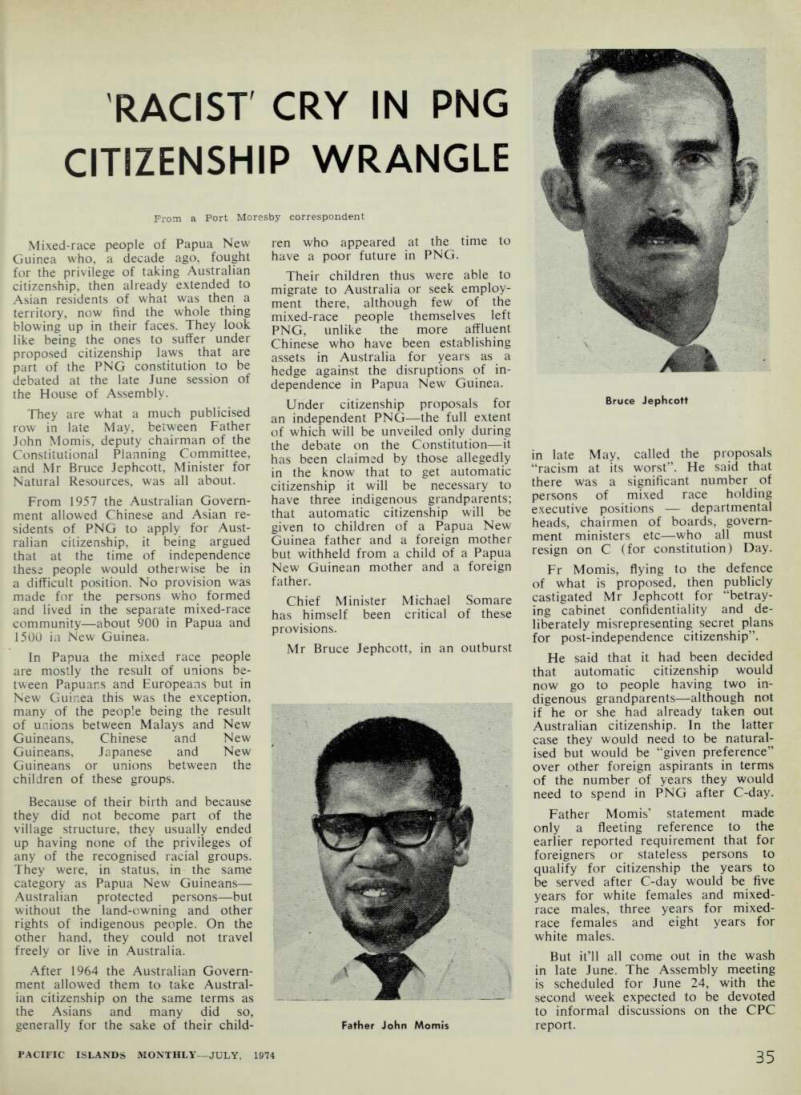
Father John Momis
Bruce Jephcott