Nutshell
pp. 34-35 · Read in the full issue
In a Nutshell
Maintaining public order has been codified in one law in the New Heb rides. In the past laws about public order applied separately to New Hebrideans, British and French citi zens. The Resident Commissioners recently made a joint regulation to safeguard law and order.
This law provides for control of meetings, processions and demonstra tions, wearing uniforms, drilling, be haviour which causes public alarm, damage and destruction to property and violence. The law sets out how meetings, processions and demonstra tions may be held. It is now an offence to spread false rumour which may cause public alarm or dissatis faction. It is also an offence to incite people to commit physical violence, and cause damage or destruction and to break the law.
Anyone who wears a prohibited uniform, or takes part in prohibited drilling, may be guilty of an offence.
The new law does not prevent or interfere with lawful and peaceful assemblies or processions.
Closed Circuit For King
—Japanese industrialist Mr Hukashi Momose, and his wife, made a special trip to Tonga in May to pre sent a colour television set and a video-casette-recorder to King Tau fa’ahau. A camera to go with the outfit is also on the way. The king, who was reported to be enthusiastic about the gift, is now self-contained as far as TV services goes although there is no black and white or colour transmission in Tonga.
Prohibited Exports.—It Is
now illegal to take nine rare animal species out of Fiji without a licence from the Department of Agriculture.
The prohibited species are the banded iguana, the Pacific boa, the venomous land snake, the Fiji tree frog, the Fiji land frog, the flying fox, the long-tailed fruit bat, the sheath-tailed bat and the Fiji goshawk.
Women In Agriculture.—
As women are the backbone of agri cultural work in Papua New Guinea, female agricultural officers were urgently needed, according to the PNG Minister for Agriculture who
announced recentl> that a concen trated drive would be made to re cruit 20 young women for entry to Vudal Agricultural College in 1975.
Png’S Bank Membership.—
A World Bank economic mission has arrived in Port Moresby for a fact finding tour of about a month. The mission’s findings will influence whether or not PNG’s application to join the International Bank for Re construction & Development and the International Development Associa tion, will be accepted.
Nz Teachers In Png
Eleven secondary school teachers from New Zealand have gone to Papua New Guinea to work for the remainder of 1974. The PNG Chief Minister, Mr Michael Somare, asked NZ Prime Minister, Kirk to send the teachers to help ease a tempo rary shortage caused by Australian teachers going home as PNG ap proaches independence. The teachers were recruited for science, English and social studies.
Food Legislation. —The
South Pacific Commission is making a survey of food legislation in the South Pacific in response to requests by a number of territories. The. sur vey will provide a basis for up-to date legislation suitable for the Pacific. The field covers the manu facture, retailing, import and ana lysis of foodstuffs.
Nauru Parliament.—The
Nauru Parliament met in May to dis cuss a supplementary finance bill, aimed at raising about $969,000 to add to the main budget. Papers authorising fund transfers within various departments were tabled.
YAQONA SCARCE.—Suva is ex periencing a shortage of yaqona (grog), through hurricane destruc tion of root crops on the main pro ducing islands of Moala and Kadavu.
The alternative source of Taveuni is unreliable. Planters there are after the high prices for copra and are ignoring yaqona. A trickle of sup plies is reaching the capital from Koro and Vanua Levu, but prices are very high.
Help For Mates.—The New
Zealand Federation of Labour at its annual conference gave $702 to the Fiji Trade Union Congress and pro mised another $B9O. The donations were made after the president of the FTUC, Mr Joveci Gavoka, said his organisation did not have a typist or even a typewriter.
TONGAN’S KO. —Heavyweight Tongan boxer, Mani Vaka, knocked out Canadian Earl McLeay in the second round in a bout at the Hono lulu International Centre in May.
Vaka set McLeay up with a left hook to the body and finished him off with a powerful right behind the ear.
RUGBY ADVANCE.—Following
their tour of Australia in 1973, when they tied the tests, Tonga Rugby players now look forward to more tours. Ahead are a tour of Wales, this year and a tour of New Zealand in 1975. The Welsh tour is, in effect, a tour of the UK, for in addition to six matches in Wales, there will be two in England and three in Scot land. On the way home the Tongans hope to play in the USA and Canada.
Market Disadvantage.—
Solomon Islands carvers are at a dis advantage with their artefacts in New Zealand, because they have to pay duty. NZ is a good market. The South Pacific Forum members, in September, 1973, decided to abolish duty on artefacts from member countries, but as the BSIP is not a member yet she misses out on the duty-free privilege. The BSIP may send an observer to forum meetings.
BIG SOCCER.—The BSIP plans to stage an “international” soccer festival at Honiara. Teams from Papua New Guinea and the New Hebrides are interested in playing.
Tracking Station.—The
United States will let Japan set up a scientific tracking station on Kwaja lein in the Marshalls. It will track and guide two experimental satellites which the Japan National Space De velopment Agency plans to launch in 1975 and 1976 from Tanegashima Island, south of Kyushu.
HOT DRlNKS.—Cascade Soft Drinks, a cordial factory opened 10 years ago on Norfolk Island, was burned down on May 23. The factory, which was started by Mr Jim Anderson, was taken over recently by new owners Mr and Mrs Paul Diehlsen, of Sydney, who hope to get back into production in a short time.
New Church Province.—
The Diocese of Melanesia will be come the Province of Melanesia, a self-governing church of the Anglican communion on January 26, 1975.
Then, the Archbishop of New Zea land will hand over to the new Archbishop of Melanesia. There will
be four dioceses within the new province Ysabel, Malaita, New Hebrides and Central Melanesia, which will cover Guadalcanal, San Cristobal and the Eastern Outer Islands.
Adi Cakobau School
TOUR. —Twenty-eight students and three senior teachers from the Adi Cakobau School in Fiji will make a concert tour of Australia in August.
The school has specialised for years in entertainment, mainly Fijian dancing and songs. Their recordings have found their way all over the world. The tour will begin with nine days in Melbourne, followed by visits to country areas in Victoria and New South Wales and ending with a five-day presentation in Syd ney. There will be 18 concerts, seven full-length performances and 11 shorter ones for schools.
Martyred Missionaries.—
During his visit to New Britain in May, Ratu Sir Kamisese Mara, Prime Minister of Fiji, took time oft to lay a wreath on a memorial to four pioneer Fijian missionaries killed and eaten at Talili Bay, Gazelle Peninsula, in 1878.
A Pub For Manus— Manus,
the only district in Papua New Guinea without an hotel of some sort, now at least has been granted a site for one, at Lorengau. Appli cant was the Local Government Council. The only obstacles now are the $50,000 needed to build the hotel and a liquor licence from the
Liquor Licensing Commission.
Ferry Service.— The New
Zealand Government has made a grant of $450,000 to Western Samoa to complete an inter-island vehicular ferry terminal. The terminal is linked with a roll-on, roll-off vehicular ferry service to be established be tween Upolu and Savai’i.
Suffishent Deterrent?
It was bad news recently for nine men convicted of fishing with ex plosives in the Solomons, an illegal practice now reaching serious pro portions. As well as being fined up to SSO, their three canoes with outboard engines were confiscated by the government.
But there was also good news.
Govco’s Finance Committee has decided to allow the men to buy back their canoes at half their estimated value. This is a once-in-a lifetime offer —future fireworks fishing offenders will lose their canoes for good.
MORE WATER.— A new water plant, processing 30 million gals a day, to be installed by 1976 will double Port Moresby’s water supply.
There will be almost enough water to supply many outlying villages.
The new plant will satisfy Port Moresby’s demands for the next six years.
Another T.T. District.—
The US Secretary of the Department of the Interior has responded favour ably to the Congress of Micronesia’s resolution that Kusaie Island, at pre sent part of Ponape District, become a separate administrative district within the Trust Territory. However it won’t happen overnight—the Sec retary has set January 1, 1977 for the big event and a great deal can happen in the TT and in the United States in 2i years. Kusaie is one of the most fertile islands of Micro nesia, the furthest east of the Caro lines, has a population of just on 4,000 people and has a romantic history. It was once the hang-out of the 19th century buccaneer, Bully Hayes.
OFF THE AlR.— lt’s back to teaching in the old-fashioned way in American Samoa as Instruction Tele vision has cancelled its daytime edu cation programmes for the remainder of this year due to the current power shortage affecting the territory.
Radio station WVUV has also been going off the air at night because neighbours don’t like the noise of the auxiliary generator brought in when mains power fails. As a protest, the station has been stoned, fuel to the generator turned off, cars of person nel damaged and staff members attacked.
Opening December.—The
major construction work is completed on Hotel Santo, Luganville, New Hebrides. It should be opening for business by the end of the year. The solid, modern looking building is on the site of the old Hotel Corsica which was burned down in 1972. It will have 22 self-contained, air con ditioned rooms, each with twin beds and a studio couch. There will be a bar, a restaurant, a snack bar and, later, a swimming pool.
BLACK BAN OFF.— The battle of the smelly feet appears to be over in Rabaul, at least for the time being. The management of the Palms Theatre and Rabaul Workers’ Asso ciation has come to an arrangement about the kind of footwear permitted in the theatre. Last February the
theatre banned people wearing thongs because they said other patrons com plained of the smell of uncovered feet. The dispute that ensued led to the closing of the theatre and a union black ban being put on cargo handling for the owners. New Britain Entertainments Pty Ltd.
FOLDED. —Norfolk Newsletter, produced by the Australian Depart ment of the Capital Territory, has ceased. The official reasons: (a) shortage of editorial staff; (b) need to prune expenditures; (c) shortage of paper. But according to its obituary notices: “If traditional, sources of reporting do not satisfy the important challenge of keeping Norfolk Island affairs before the public, the department will consider reintroducing the Newsletter”. It has been in operation about four years.
Meanwhile, another Islands pub lication feeling the paper pinch, the Papua New Guinea Government’s longstanding and popular Our News, has announced that in the next few months it will only go to press when it can get paper.
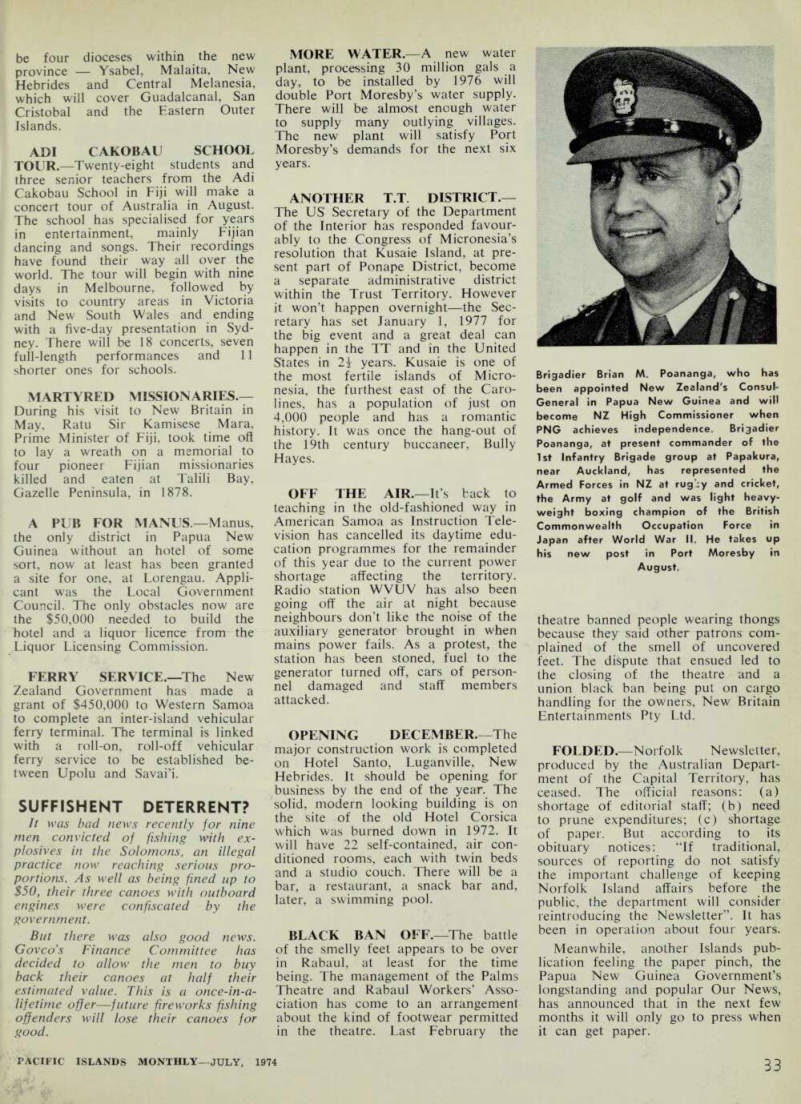
Brigadier Brian M. Poananga, who has been appointed New Zealand's Consul- General in Papua New Guinea and will become NZ High Commissioner when PNG achieves independence. Brigadier Poananga, at present commander of the Ist Infantry Brigade group at Papakura, near Auckland, has represented the Armed Forces in NZ at rugly and cricket, the Army at golf and was light heavy weight boxing champion of the British Commonwealth Occupation Force in Japan after World War II. He takes up his new post in Port Moresby in August.