Colourful, Bustling Jayapura
pp. 21-23 · Read in the full issue

From A Dull Hollandia To A
By R. S. Roosman
Relatively unknown to the outside world —even to many Indonesians— is Jayapura, the capital of Indonesia’s most eastern province West Irian, since last year renamed Irian Jaya.
Under the former Dutch regime it vas known as Hollandia. The town !iugs the shoreline of beautiful Humboldt Bay, now called Cendera vasih or Bird of Paradise Bay, and spreads up to the slopes of the Cyclop Mountains to the west.
A Trans-Australian Airline plane, since November 1, 1973, repainted vith Air Niugini colours, flew me fom Madang, PNG to Sentani air >ort in Indonesian territory. Located iear the shore of an idyllic lake of he same name, Sentani, 35 km away, s the closest airport to Jayapura, The winding road to the provincial :apital passes through Abepura, Irian aya’s university town. Cenderawasih Jniversity was established in 1962 luring the nine-month period after he UNTEA (United Nations Tem )orary Executive Authority) had aken over West Irian’s administration fom the Dutch on October 1, 1962 md before control was handed over o the Indonesians on May 1, of the bllowing year.
Since then five faculties have been istablished: the Law Faculty, ncluding studies in law, public and msiness administration; the Faculty )f Education; the Teachers’ Training Jollege, including Indonesian and English languages and literatures, listory, geography, mathematics and )hysics; the Faculty of Agriculture, vhich includes curricula in agricul ure, animal husbandry and forestry; md the Institute of Anthropology.
The present enrolment is approx mately 700 students, at least 60 per ent of whom are West Irianese. fhese local students are privileged to tay in specially-built dormitories at he university. Many more West rianese students are sent to other iniversities, mainly in Java, to study )ther disciplines such as sociology, iconomics and medicine. Cendera vasih lecturers still have to be re ruited from other parts of Indonesia.
Dr Roosman is Senior Lecturer in the Department of Political Studies at the University of Papua New Guinea.
With the little eating stalls and shops, mosques and churches, and sarong-clad people strolling along the road, the 15 km Abepura-Jayapura highway is definitely Indonesian, though flavoured with West Irianese characteristics. Local women can be seen carrying their string bags—in Papua New Guinea commonly referred to as bilum —and local men are extracting sago-flour from palm groves growing alongside the road.
Upon entering Jayapura, the visitor is welcomed with slogans on banners stretched high up in the air across the streets, varying from patriotic slogans to encouragement to win the coming
all-Indonesia sport competitions in Jakarta or an appeal for public sup port for a national money-saving drive.
During the last few years of administration under the energetic governor Acub Zainal, Jayapura has grown from a dull outpost to a bustling town with a population of over 100,000 in 1973, compared with barely 15,000 only 10 years before.
During that period, Indonesians from other parts of the country voluntarily transmigrated to the Jayapura area.
The majority were Macassarese from the southern tip of Celebes island, who are engaged mainly in petty trade and business; their presence dominates the busy Ampera evening bazaar in the centre of town. Chinese businessmen from Jakarta have also opened shops and restaurants in town, and Indonesian vessels anchoring at
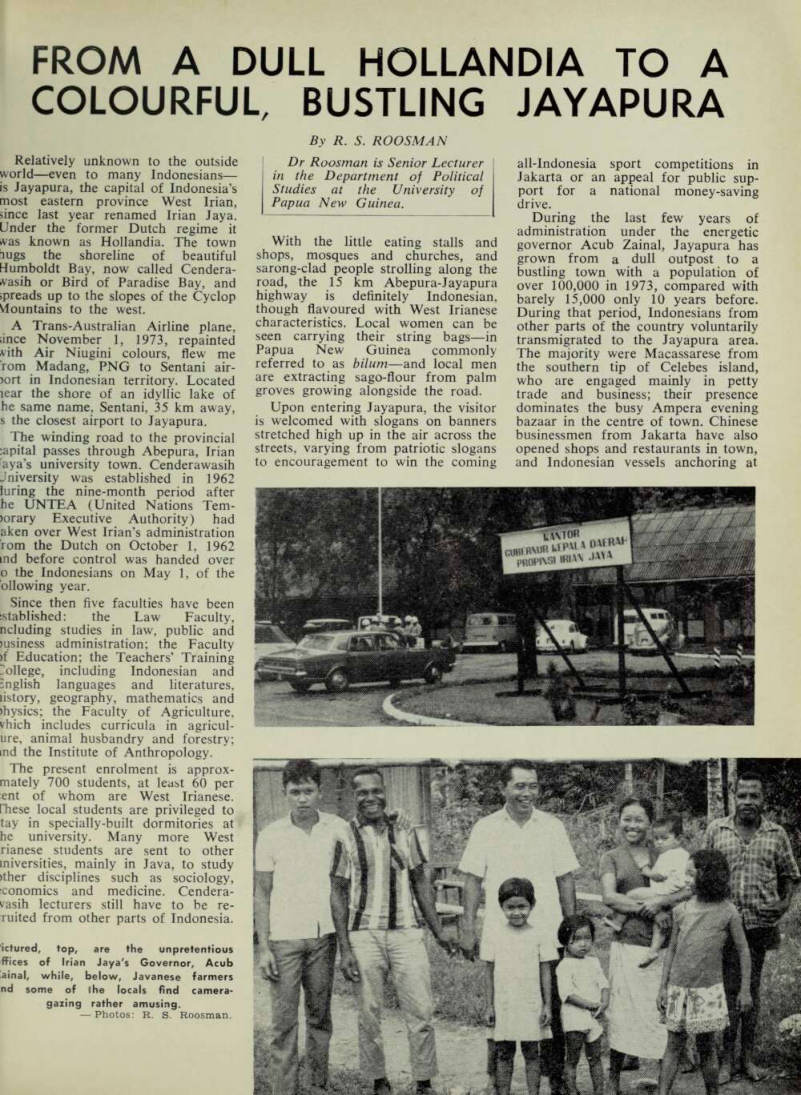
[?]ictured, top, are the unpretentious offices of Irian Jaya's Governor, Acub [?]ainal, while, below, Javanese farmers nd some of the locals find camera gazing rather amusing.
Photos: R. S. Roosman.
Jayapura’s harbour bring just about every commodity from Jakarta, Surabaya or Ujung Pandang (formerly Macassar).
A government-instigated project to resettle about 400 Javanese farmers at Dosai, about 60 km from Jayapura, has changed business life in the pro vincial capital, as rice, vegetables, fruit and other produce, some of which were formerly unknown in West Irian, appear steadily in Jaya pura’s open markets. Several hundred head of cattle imported from the Lesser Sunda Islands add to the pastoral character of the “Little Java” settlements, and meet to some extent the local demand for fresh meat. Experimental stations at Wamena in the fertile highlands have succeeded in producing abundant crops of European vegetables which are flown to Jayapura. Still, the marketing of these crops represents a constant problem for the admini stration.
In the early 60s Jayapura must have been an uninteresting place for Indo nesians who came from the more sophisticated areas. With all the shortages of daily commodities and its relative isolation, Jayapura was a government station to which many Indonesians resented being posted.
Officials and teachers from Java, Sumatra, and the Celebes were hired
only on short-term contracts with high salaries.
Things have changed lately. The handsome mansions left by the Dutch in 1963, the comfortable residences in the cool hills uptown —ironically referred to as Nirwana —housing the 400-500 foreigners working for the FUNDWI (Fund of the United Nations for the Development of West Irian) and the elite of Jayapura’s officialdom, together with recent ex pansion of downtown Jayapura into a smart residential and shopping centre, have made the town a more bearable place to live in.
The lack of entertainment in Jayapura has been compensated for by the establishment of two theatres showing mainly Indonesian films and Chinese movies from Hong Kong, and a nightclub for weary Jakartans to stretch their legs on the dance floor.
The beautiful white sand beaches in nearby Hamadi have become a favourite weekend picnic ground.
The main drive behind the develop ment of Jayapura township has been, among other factors, the fulfilment of Repelita, the government five-year plan for reconstruction. Unlike other urban centres in Indonesia, work is plentiful in Jayapura and earnings are twice or three times Jakarta wages. Prosperity in Jayapura is obvious: there are no beggars in the
streets and the crime rate in Jayapurat is remarkably low, A tendency is developing among new migrants to make Jayapura thein permanent home, as the pace ofi urbanisation has not yet caused pol lution due to overcrowding, enabling one to breathe fresh air in privacy* and because the chances of earning a living are still favourable.
West Irian’s population, estimated! at 950,000, differs from most of the other Indonesian provinces in thatl it is predominantly Christian. Mission work dates back to the beginning ofl this century, and the increase of the Muslim community is due to the influx of new migrants in the last! decade, who originated in Muslim areas such as the Southern Celebess and Sumatra.
In the spirit of Pancasila, the Indo- State philosophy which includes religious tolerance, mosques and churches stand side-by-side in peace ful co-existence. Both the Christian and Muslim communities are heavily involved in public education and social welfare. Many primary and secondary schools are built and run by the Christian and Muslim com munities respectively, and receive equal government subsidies if needed.
The Department of Religious Affairs in Jayapura is headed by a Roman Catholic Javanese, assisted by a Muslim official from the Batak area of Sumatra.
The inventive governor has changed the Friday working day—which is the Holy day of Congregation for the Muslims —into a sporting day. In Indonesia, where at least 80 per cent of the total population is Muslim, government offices close at 11.30 am on Fridays to give the officials the opportunity to go to mosques and join the noon prayers. In compliance with the governor’s instruction, one can see Jayapura officials having theii Friday morning off, and —dressed in their white sports costumes and tennis shoes—going to the sport centres in town instead.
Administration is being executed in accordance with the national pattern as it is stipulated in Jakarta. How ever, Irian Jaya is behind the other provinces in the process of instituting regional autonomy. There is a House of Representatives for Irian Jaya which has only an advisory function, and is lodged in a modern-style building on Jayapura’s waterfront.
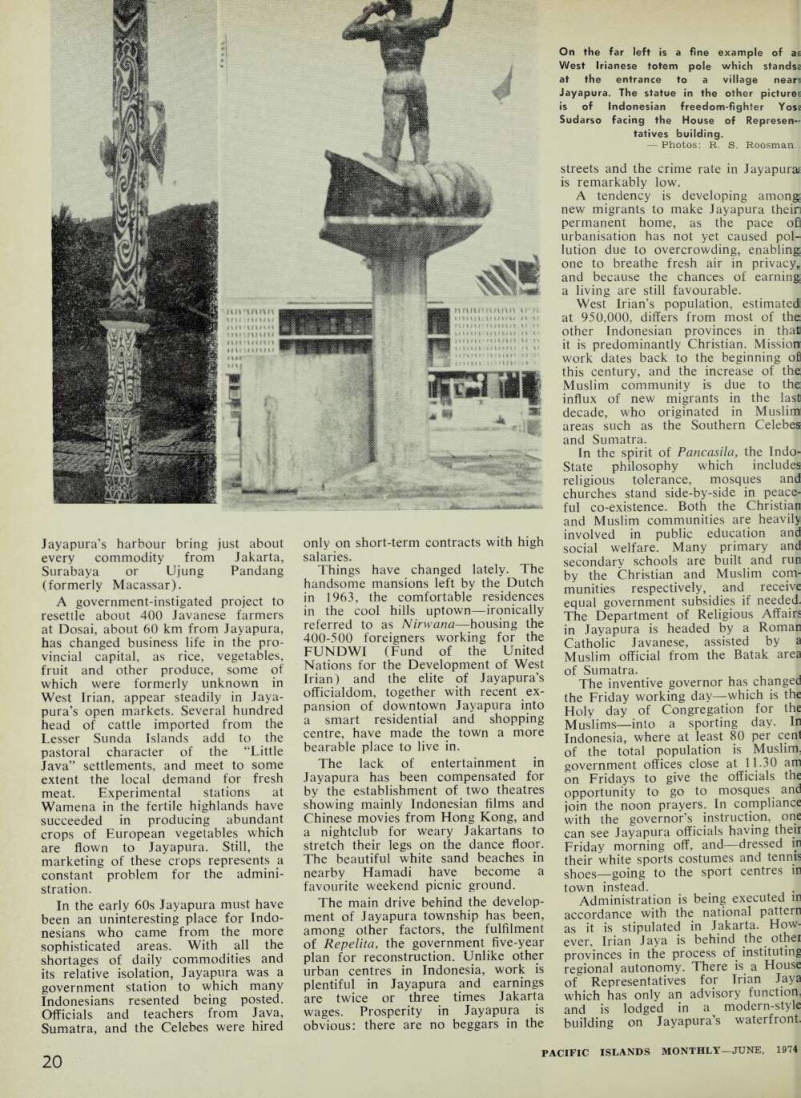
On the far left is a fine example of a West Irianese totem pole which stands at the entrance to a village near' Jayapura. The statue in the other picture is of Indonesian freedom-fighter Yos Sudarso facing the House of Represen tatives building.
Photos: R. S. Roosman.
fribal law seems to be too strong in Vest Irian to accept an immediate ndonesianisation of its grass roots ribal rule. A gradual approach oward district autonomy is embodied i a compromise which involves the mdowafi (tribal chief) in the local dministration as an adviser, while
tie government-appointed korano
erves as a liaison between the tribe nd the government.
The government’s efforts to eman ipate Irian Jaya with the rest of ndonesia will require time and specially patience to lift this pre istoric colossus out of its isolation.
Considering the methods being used y the government, it looks as if rian Jaya is becoming involved in le process of Indonesianisation at n ever-increasing tempo. Due to its ackwardness, West Irian is given pedal attention and priority in its evelopment to such an extent that ther provinces have become envious lat so much money has been
allocated for Irian Jaya, and relatively so much has been achieved there within such a short time.
The national five-year development plan includes a socialisation pro gramme for West Irian which aims to bring the numerous tribes out of their neolithic isolation and adjust them to the level the other Indonesians have achieved by now. It can be expected —so the governor told me last year that in the course of developments in Irian Jaya the desa (villaae) can be established in 1974 in the frame work of district autonomy.
Tourism in West Irian, which also receives government attention in the Repelita five-year plan, should have great prospects of attracting the international visitor: snow-capped mountains around the equator, the unique flora and fauna which are distinct from the rest of Asia, and its people, most of whom still live in a “fossilised” state—relics of the Stone Age, However, the handicaps
for developing a tourist industry in West Irian are substantial: the im passibility of the rugged terrain, the great distances, its relative isolation from the main world routes. The lack of good roads and accommoda tion are probably the main problems to cope with. Practically aU of the travelling and supplying has to be done by air.
Meanwhile, tourist hotels have been built with government subsidies in Jayapura, Biak, and some other tourist spots, but accommodation re mains scarce and qualitatively not up to international standards. Due to the high overhead costs, the tariffs are—even by Australian standards— rather expensive. Nevertheless, it might be worth the tourist’s money to visit Irian Jaya’s “Adventure Land” to see cultures of 5,000 years ago which will soon belong to the past, as the government plan to bring the primitive tribes to modern standards of civilisation is being actively pursued.