Tropica lities
pp. 16-18 · Read in the full issue
A Fiji island and a miraele
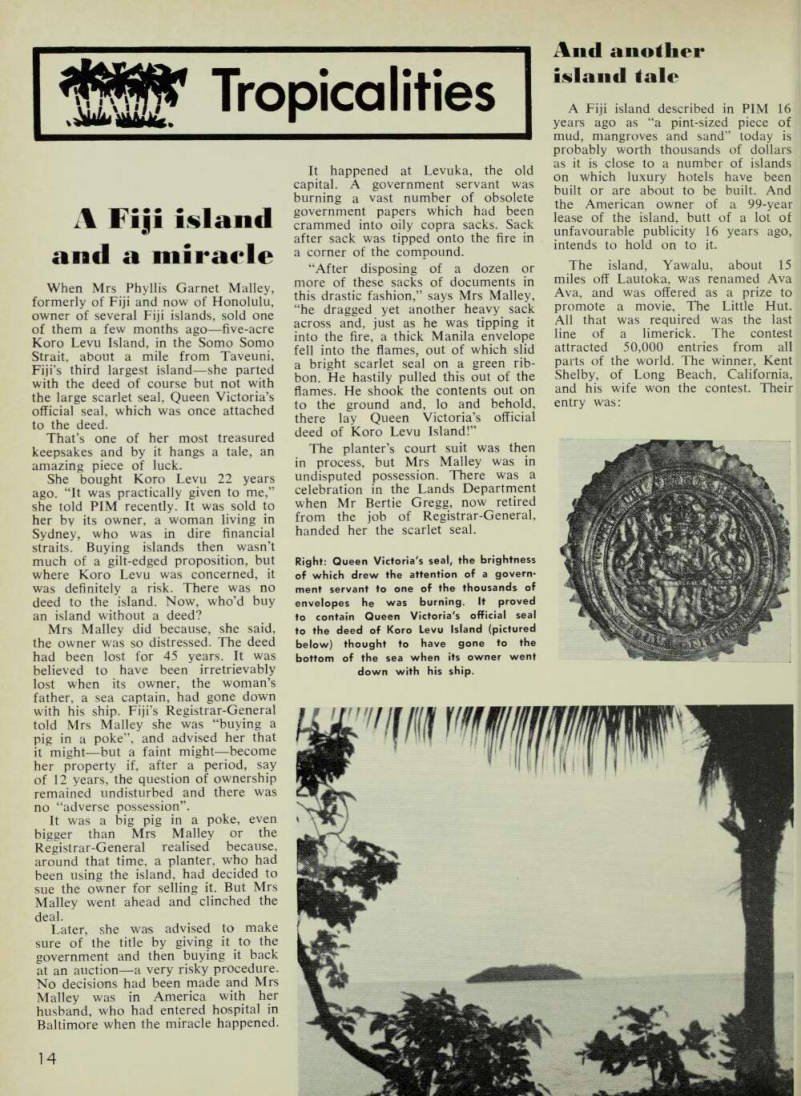
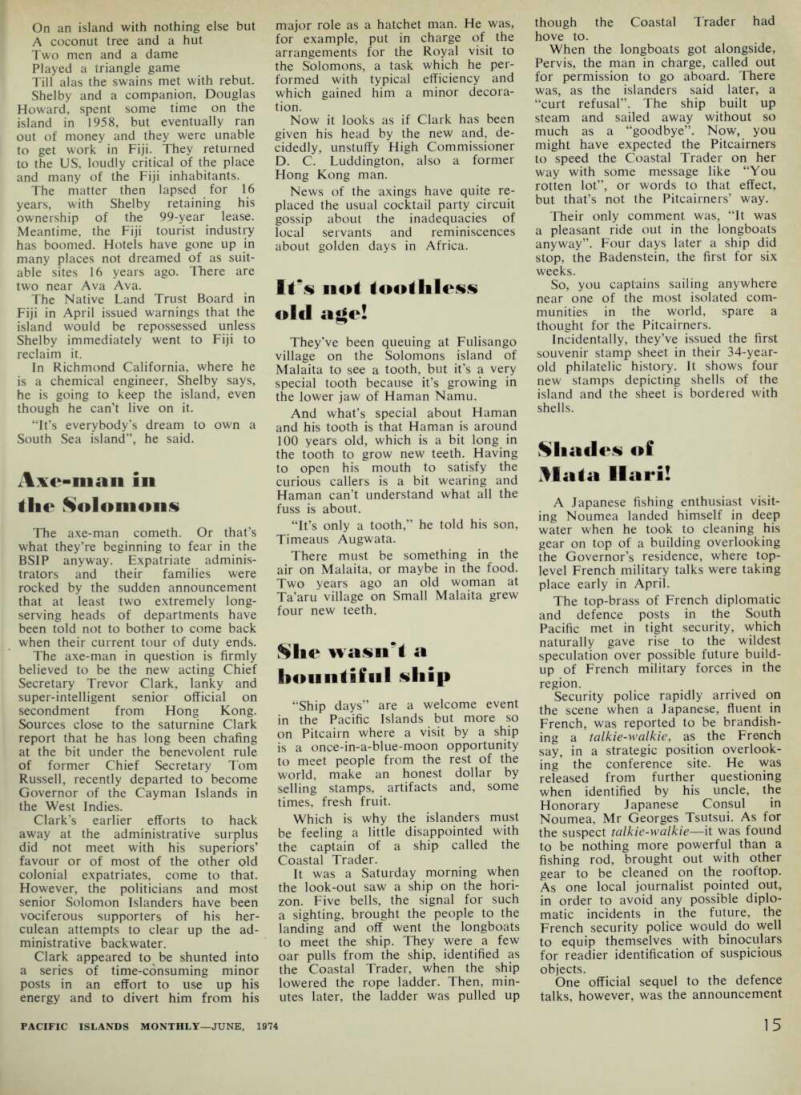
When Mrs Phyllis Garnet Malley, formerly of Fiji and now of Honolulu, owner of several Fiji islands, sold one of them a few months ago —five-acre Koro Levu Island, in the Somo Somo Strait, about a mile from Taveuni, Fiji’s third largest island—she parted with the deed of course but not with the large scarlet seal, Queen Victoria’s official seal, which was once attached to the deed.
That’s one of her most treasured keepsakes and by it hangs a tale, an amazing piece of luck.
She bought Koro Levu 22 years ago. “It was practically given to me,” she told PIM recently. It was sold to her by its owner, a woman living in Sydney, who was in dire financial straits. Buying islands then wasn’t much of a gilt-edged proposition, but where Koro Levu was concerned, it was definitely a risk. There was no deed to the island. Now, who’d buy an island without a deed?
Mrs Malley did because, she said, the owner was so distressed. The deed had been lost for 45 years. It was believed to have been irretrievably lost when its owner, the woman’s father, a sea captain, had gone down with his ship. Fiji’s Registrar-General told Mrs Malley she was “buying a pig in a poke”, and advised her that it might—but a faint might—become her property if, after a period, say of 12 years, the question of ownership remained undisturbed and there was no “adverse possession”.
It was a big pig in a poke, even bigger than Mrs Malley or the Registrar-General realised because, around that time, a planter, who had been using the island, had decided to sue the owner for selling it. But Mrs Malley went ahead and clinched the deal.
Later, she was advised to make sure of the title by giving it to the government and then buying it back at an auction—a very risky procedure.
No decisions had been made and Mrs Malley was in America with her husband, who had entered hospital in Baltimore when the miracle happened.
It happened at Levuka, the old capital. A government servant was burning a vast number of obsolete government papers which had been crammed into oily copra sacks. Sack after sack was tipped onto the fire in a corner of the compound.
“After disposing of a dozen or more of these sacks of documents in this drastic fashion,” says Mrs Malley, “he dragged yet another heavy sack across and, just as he was tipping it into the fire, a thick Manila envelope fell into the flames, out of which slid a bright scarlet seal on a green rib bon. He hastily pulled this out of the flames. He shook the contents out on to the ground and, lo and behold, there lay Queen Victoria’s official deed of Koro Levu Island!”
The planter’s court suit was then in process, but Mrs Malley was in undisputed possession. There was a celebration in the Lands Department when Mr Bertie Gregg, now retired from the job of Registrar-General, handed her the scarlet seal.
And another
island tale
A Fiji island described in PIM 16 years ago as “a pint-sized piece of mud, mangroves and sand” today is probably worth thousands of dollars as it is close to a number of islands on which luxury hotels have been built or are about to be built. And the American owner of a 99-year lease of the island, butt of a lot of unfavourable publicity 16 years ago, intends to hold on to it.
The island, Yawalu, about 15 miles off Lautoka, was renamed Ava Ava, and was offered as a prize to promote a movie, The Little Hut.
All that was required was the last line of a limerick. The contest attracted 50,000 entries from all parts of the world. The winner, Kent Shelby, of Long Beach, California, and his wife won the contest. Their entry was:
Right: Queen Victoria's seal, the brightness of which drew the attention of a govern ment servant to one of the thousands of envelopes he was burning. It proved to contain Queen Victoria's official seal to the deed of Koro Levu Island (pictured below) thought to have gone to the bottom of the sea when its owner went down with his ship.
On an island with nothing else but A coconut tree and a hut Two men and a dame Played a triangle game Till alas the swains met with rebut.
Shelby and a companion, Douglas Howard, spent some time on the island in 1958, but eventually ran out of money and they were unable to get work in Fiji. They returned to the US, loudly critical of the place and many of the Fiji inhabitants.
The matter then lapsed for 16 years, with Shelby retaining his ownership of the 99-year lease.
Meantime, the Fiji tourist industry has boomed. Hotels have gone up in many places not dreamed of as suit able sites 16 years ago. There are two near Ava Ava.
The Native Land Trust Board in Fiji in April issued warnings that the island would be repossessed unless Shelby immediately went to Fiji to reclaim it.
In Richmond California, where he is a chemical engineer, Shelby says, he is going to keep the island, even though he can’t live on it.
“It’s everybody’s dream to own a South Sea island”, he said.
Axe-man in
the Solomons
The axe-man cometh. Or that’s what they’re beginning to fear in the BSIP anyway. Expatriate adminis trators and their families were rocked by the sudden announcement that at least two extremely long serving heads of departments have been told not to bother to come back when their current tour of duty ends.
The axe-man in question is firmly believed to be the new acting Chief Secretary Trevor Clark, lanky and super-intelligent senior official on secondment from Hong Kong.
Sources close to the saturnine Clark report that he has long been chafing at the bit under the benevolent rule of former Chief Secretary Tom Russell, recently departed to become Governor of the Cayman Islands in the West Indies.
Clark’s earlier efforts to hack away at the administrative surplus did not meet with his superiors’ favour or of most of the other old colonial expatriates, come to that.
However, the politicians and most senior Solomon Islanders have been vociferous supporters of his her culean attempts to clear up the ad ministrative backwater.
Clark appeared to be shunted into a series of time-consuming minor posts in an effort to use up his energy and to divert him from his
major role as a hatchet man. He was, for example, put in charge of the arrangements for the Royal visit to the Solomons, a task which he per formed with typical efficiency and which gained him a minor decora tion.
Now it looks as if Clark has been given his head by the new and, de cidedly, unstuffy High Commissioner D. C. Luddington, also a former Hong Kong man.
News of the axings have quite re placed the usual cocktail party circuit gossip about the inadequacies of local servants and reminiscences about golden days in Africa.
It’s not toothless
old age!
They’ve been queuing at Fulisango village on the Solomons island of Malaita to see a tooth, but it’s a very special tooth because it’s growing in the lower jaw of Haman Namu.
And what’s special about Haman and his tooth is that Haman is around 100 years old, which is a bit long in the tooth to grow new teeth. Having to open his mouth to satisfy the curious callers is a bit wearing and Haman can’t understand what all the fuss is about.
“It’s only a tooth,” he told his son, Timeaus Augwata.
There must be something in the air on Malaita, or maybe in the food.
Two years ago an old woman at Ta’aru village on Small Malaita grew four new teeth.
Slit" wasn't a
bountiful ship
“Ship days” are a welcome event in the Pacific Islands but more so on Pitcairn where a visit by a ship is a once-in-a-blue-moon opportunity to meet people from the rest of the world, make an honest dollar by selling stamps, artifacts and, some times, fresh fruit.
Which is why the islanders must be feeling a little disappointed with the captain of a ship called the Coastal Trader.
It was a Saturday morning when the look-out saw a ship on the hori zon. Five bells, the signal for such a sighting, brought the people to the landing and off went the longboats to meet the ship. They were a few oar pulls from the ship, identified as the Coastal Trader, when the ship lowered the rope ladder. Then, min utes later, the ladder was pulled up
though the Coastal Trader had hove to.
When the longboats got alongside, Pervis, the man in charge, called out for permission to go aboard. There was, as the islanders said later, a “curt refusal”. The ship built up steam and sailed away without so much as a “goodbye”. Now, you might have expected the Pitcairners to speed the Coastal Trader on her way with some message like “You rotten lot”, or words to that effect, but that’s not the Pitcairners’ way.
Their only comment was, “It was a pleasant ride out in the longboats anyway”. Four days later a ship did stop, the Badenstein, the first for six weeks.
So, you captains sailing anywhere near one of the most isolated com munities in the world, spare a thought for the Pitcairners.
Incidentally, they’ve issued the first souvenir stamp sheet in their 34-year old philatelic history. It shows four new stamps depicting shells of the island and the sheet is bordered with shells,
Shades of
Mata llari!
A Japanese fishing enthusiast visit ing Noumea landed himself in deep water when he took to cleaning his gear on top of a building overlooking the Governor’s residence, where top level French military talks were taking place early in April.
The top-brass of French diplomatic and defence posts in the South Pacific met in tight security, which naturally gave rise to the wildest speculation over possible future build up of French military forces in the region.
Security police rapidly arrived on the scene when a Japanese, fluent in French, was reported to be brandish ing a talkie-walkie, as the French say, in a strategic position overlook ing the conference site. He was released from further questioning when identified by his uncle, the Honorary Japanese Consul in Noumea, Mr Georges Tsutsui. As for the suspect talkie-walkie —it was found to be nothing more powerful than a fishing rod, brought out with other gear to be cleaned on the rooftop.
As one local journalist pointed out, in order to avoid any possible diplo matic incidents in the future, the French security police would do well to equip themselves with binoculars for readier identification of suspicious objects.
One official sequel to the defence talks, however, was the announcement
that New Caledonia will be equipped with four military helicopters about October this year. The aircraft are known as Puma, another member of the armoured wild cat family cur rently in vogue. A company of cheetah-cat emergency strike troops were flown to the territory for the annual Alize exercises earlier this year. The Puma has a cruising speed of 240 km an hour and can carry 21 men with their equipment. As pointed out by sources close to the French administration, the helicopter is a significant example of France’s export weapons, “our best exchange currency at the moment”.
Though no other immediate military plans for New Caledonia were released officially after the talks, widespread rumours speedily suggest ed the possible build-up of new army and naval bases on the island. Prompt reaction came from the Union of Caledonian Youth (UJC), whose autonomist activities have already attracted the intervention of riot squad police (gardes mobiles).
At an April meeting, the UJC vigorously denounced the nuclear arms policy of the Paris government.
Speakers also warned against the dangers of having troops of the Foreign Legion based on the West Coast at Koumac, an air-sea opera tions base at Touho, on the East Coast, and possibly a missile base at Balabio, in the north. The Caledonian youth movement also protested at the number of retired French gendarmes and military men who, despite their comfortable pensions, are taking up posts which could otherwise go to Caledonians.
Pitcairners will
be set free!
Freedom from the colonial yoke for Pitcairn is on the horizon. The United Nations sub-committee of the Special Committee of 24 on Decoloni sation has drawn up its programme for 1974. It proposes to deal with 17 island territories in the Pacific and Caribbean regions.
First on the list is the GEIC, followed by Pitcairn and then the Solomons. Also in the list are the New Hebrides, American Samoa, Guam and the US Trust Territory of Micronesia.
Armed with the General Assembly’s resolution of December, 1973, the Committee of 24 will “recommend to the General Assembly the most ap propriate methods, and also the steps to be taken to enable the populations of these territories to exercise fully and without further delay their right to self-determination and indepen dence.”
Finding out what the Pitcairners want should be easy. The committee could ship all 79 of them to Lake Placid so that the United Nations can hear from the islanders’ own lips of their burning desire to be rid of their colonial masters. It would also be a good opportunity for the Pitcairners to sell their handicrafts, souvenirs and stamps to the United Nations’ delegates and staffs.
Wild men
of ihv campus
The involvement of students of the University of the South Pacific in brawls is likely to be transferred from the campus to places like dance halls in Suva. That charge was made by the public relations officer of the USP Students Association, Mr Isikeli Mataitoga, after the Vice-Chancellor, Dr Colin Aikman, banned the sale of liquor in the campus social club.
The ban was imposed, Dr Aikman explained, because of increasing drunkenness, violence and intimida tion on the campus. There were re ports of fights between Western Samoan and Indian students, with the Indians producing cane-knives after the Western Samoans used physical violence and Fijian and Samoan students engaging in a free for-all after a drinking spree.
In another case, a young Fijian student was admitted to the CWM Hospital in Suva with serious head injuries after a Western Samoan bashed him. Beer bottles and drink ing glasses were frequently broken on the walls in the club, and furni ture and fittings were ruined. An other report was that the on-campus students’ pregnancy in 1973 was the highest ever.
Lecturers, disturbed at the behavi our of these students, a small num ber only, pressed Dr Aikman to take stern action. They also asked Fijian leaders to help. Two Ministers, Mr Tone Naisara (Education, Youth and
Sport) and Mr Jonati Mavoa (Labour), an MP, Mr Mosese Qio nibaravi, and the manager of the Native Land Trust Board, Mr Josef ata Kamikamica, spoke to Fijian students.
“The behaviour of USP students, Fijians and other races, has been of concern to me and other responsible citizens”, Mr Naisara said later. “We look to the USP for future leaders in the South Pacific. I trust the stu dents will reconsider their actions and concentrate on providing the future leaders this region needs”.
Mr Mataitoga said the actions of a few irresponsible students were affecting all students. Students feared they would become victims of bash ings at Suva clubs and dance halls because of the closure of their own social clubs. Because students were regarded as a privileged lot attending university they attracted resentment.
Pruning the
Tree of Life
A love-making scene in the film Tree of Life was cut by the Censor ship Board in Honiara in May after receiving a complaint from a member of the public that it was offensive.
The proprietors of the Kukum Cinema in Honiara had ordered the film and planned to run it for the normal two nights. Censors moved in after the first showing, and despite the cuts, there was a full house when it was shown the second time a few nights later.
Taking advantage of the free publicity, the cinema showed it a third time, again to a large audience.
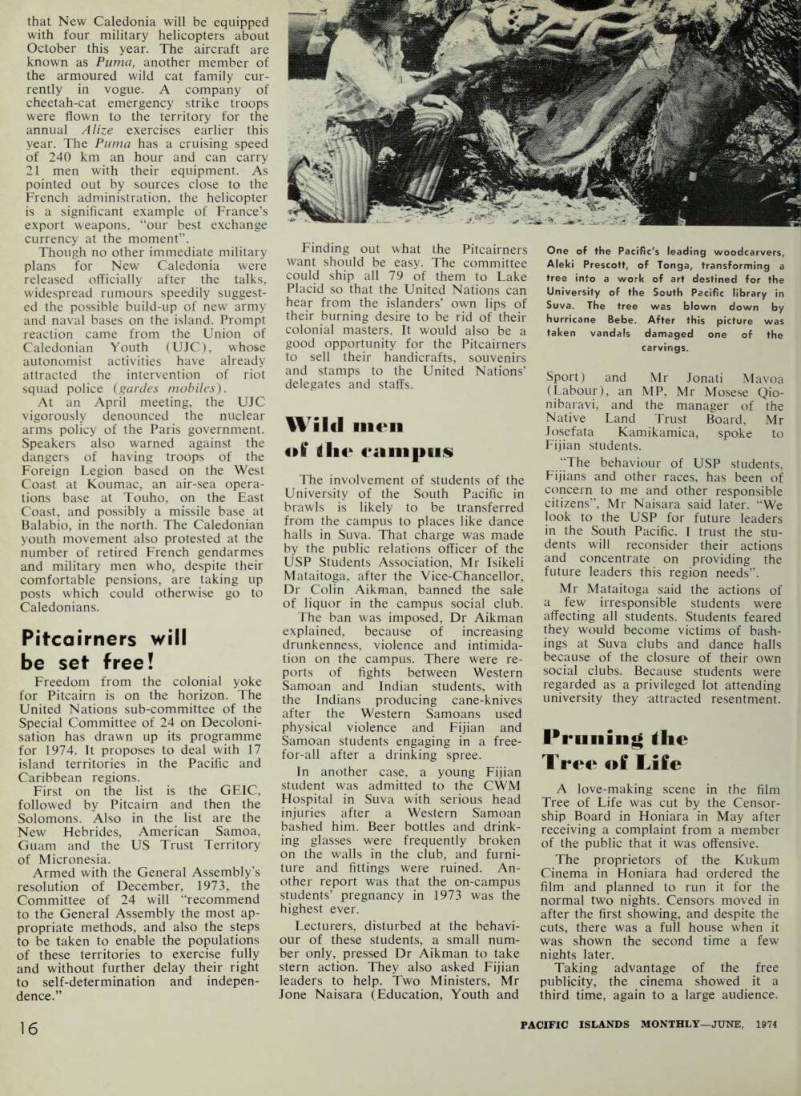
One of the Pacific's leading woodcarvers, Aleki Prescott, of Tonga, transforming a tree info a work of art destined for the University of the South Pacific library in Suva. The tree was blown down by hurricane Bebe. After this picture was taken vandals damaged one of the carvings.