The Mailbag
pp. 25-30 · Read in the full issue


Autopsy On Samoan Bananas
Some statements and assertions nade in an article, (PIM, April, p 15) under the heading The Farmers ire the Samoans’ Last Hope, from Va’a in Apia, require further sxamination.
It is stated that, one of the main easons for the decline in production ‘is lack of a steady market. The slew Zealand market for bananas is instable because it can only absorb o many cases of bananas from fVestern Samoa”.
It goes on to mention that, ■planters have never forgotten an in ident some years ago when hun- Ireds of cases of Samoan bananas vere stranded on the wharf and sold it give-away prices because the New Zealand banana quota from Western Samoa had been filled”.
Fruit Distributors Limited, operat ng under an agreement with the «Jew Zealand Government, com nenced operations in 1951 and has ibsorbed over the years practically ,11 the bananas that have been iffered by the Samoan Government or export.
It is interesting to note the vari tion in quantity between one year nd the next: 1951 62,715 large ases, 1952 65,883, 1953 240,518, 954 287,869, 1955 425,856, 1956 13,390, 1957 308,491, 1958 158,940, 1959 802,116, 1960 93,012, 1961 563,225, 1962 748,020, 963 711,196, 1964 616,803, 1965 12,504, 1966 72,800, 1967 93,146, 968 97,353, 1969 217,030, 1970 00,575; 1971 236,684 small cases, 972 108,005, 1973 40,738, a total f 8,176,869 cases.
It will be noted that the supply ose from 308,000 cases in 1957 to 58,000 cases in 1958 and these were 11 absorbed by the New Zealand larket.
The statement further on in the rticle that, “the Western Samoan iovernment has been talking about n agreement with New Zealand uaranteeing that it will be able to bsorb so many cases of Samoan ananas year in, year out”, can only e effective provided Samoa can uarantee to supply that quantity ear in, year out and judging by erformance this does not appear ossible.
It does seem strange for a state ment to be made that growers have been “discouraged” because a few hundred cases were not absorbed.
We believe the reason for this did not originate from a quota, but through the fact that more bananas were tendered for shipment than were estimated when shipping space was booked and there was no space available to take the larger quantity.
One should really look at the fact that since 1951 our company has bought 8,176,869 cases of bananas from Samoa and only a few hundred cases not shipped.
A statement is made that, “the New Zealand market is crying out for bananas”. This statement is cer tainly not correct. The New Zealand market can absorb a quantity of bananas and it has given preference to the Islands to supply New Zea land’s requirements first before pur chases are made from other coun tries. However, there are many countries able to supply New Zea land with its full requirements and at prices considerably lower than those that are being paid today by the importers to the supplying authorities in the Islands.
The suggestion is made in the article that “planters are complain ing that Fruit Distributors are ex ploiting them, making outrageous profits while the planters are getting only a minimal sum”.
In 1973, Island bananas were sold in New Zealand at a loss of $l.OO per case to the importers. The Pro duce Marketing Division in Samoa was paid SNZ2.BO for every case of bananas shipped to our company; the freight was paid of SNZI.S6 per case to Auckland and transport to the various distribution areas in New Zealand cost a further SNZI.OO per case. This made a total cost into store of $NZ5.36.
The company received from its distributors for those bananas which made a top price (and only a per centage do that), 54.32. The retail price of bananas in New Zealand is fixed by the Price Tribunal and our company has no say whatsoever in the retail price arrangement.
Again, we would like to reiterate that there is a good market for
bananas in New Zealand, but the fruit must not only be well-grown and of a high standard, but it must reach the market in New Zealand in good condition. Unfortunately, a large percentage of bananas shipped from the various Island groups do not conform to these basic require ments.
C. R. Walker
Managing Director.
Fruit Distributors Ltd, PO Box 171, Wellington (NZ).
Rags Or Flags?
After that PIM cover for Decem ber, the one with the clothesline, I thought that perhaps you were run ning out of ideas. If so, how about a cover containing the flags of the Pacific Islands that are covered in your fine magazine? With several areas having recently become inde pendent, no doubt they have new Bags. It just happens I like flags.
Robert E. Lee.
April 2, 1974. • Okay. Well allow that you like flags, if you allow that we like clotheslines.
Self-Government For Niue
Referring to your interview with Mr Rex in the April, PIM (p 41), I am one of the Niueans against this decision of internal self-government.
As far as I am concerned, Niue’s time for self-government is still a long, long way off but nevertheless this decision was not from the “True Niueans” but it was from the Niue Legislative Committee only.
Turning to the time when Professor Quentin-Baxter called here some years ago, most of the people in Niue decided that Niue should remain as it was without any change.
After Professor Quentin-Baxter left, news was then heard that Niue will become self-governing in 1974.
The people of Niue as a whole didn’t know that Mr Rex and his colleagues arranged this decision secretly with Professor Quentin-Baxter.
Letters then poured in to the editor of the Tohi Tala Niue complaining about this self-government decision.
The answers to those queries didn’t satisfy the people. When questioned on self-government, the Niue Legisla tive Assembly Committee hasn’t given good enough answers, ie, the people of Niue are not convinced yet.
I still recall Mr Young Vivian’s answer to my question, “What is self government?” His simple and easy answer was “Self-government is self help.”
Compare this answer with the speech made by Sir Honourable Norman Kirk on March 23, 1974 that self-government is self-determination.
To me, the terms self-heln and self determination are both different things altogether. Even Mr Rex and his colleagues told the people through the radio ZK 2ZN that if the people didn’t work for self-government, Niue would not be a trustworthy partner to New Zealand and the
United Nations. Niue’s demands in future will be ignored by New Zea land.
Again referring to Honourable Norman Kirk’s speech: “Whether Niue becomes self-governing or not, New Zealand will not leave Niue alone. New Zealand will help Niue in any way in the future.”
Comparing these facts it is true then that there’s something fishy going on with this thing, self-government.
To me and some staff and labour force in the Government of Niue, we believe and trust in every word which Norman Kirk said, but that has put us in a position where it is very hard for us to believe Mr Rex and his colleagues.
There have been a lot of speeches made by Mr Rex about this self government, which would mean forcing the people in the island to work for self-government. Mr Rex and his assembly members, to me, are looking for their own expenses but not for the people’s in Niue who vote them to be members from each individual village around the island.
Therefore, most of the people in Niue are aiming to leave the island and travel to New Zealand. There are ways and means which have been tried to stop this drifting to New Zealand but no hope at all.
So my own personal and general feeling about self-government is to cancel it or ignore it until some other time, then try it but not now or tomorrow.
Even I, I don’t know what self government is but I have to look for it and find the answer, and the answer is a bia NO.
T. F. Tongavaitama.
Anakule, Niue Island.
A Hostile Australia
As a Melanesian resident of the New Hebrides I do not hesitate to make a few comments on A.
Leman’s letter (PIM, April, p 21) particularly the last paragraph.
While Australia and New Zealand have been vigorously protesting about the French nuclear testing in the Pacific, it seems that there are some so-called friendly Australians who are making things difficult for us here by encouraging the French and the British to stay on in the New Hebrides. That is, they are en couraging colonialism.
What is the better way of life that A. Leman talked about? We are not even citizens of our own country because of the government system here. We are trying and want to be free from this oppressive system of administration but so-called friendly Australians here are not helping the
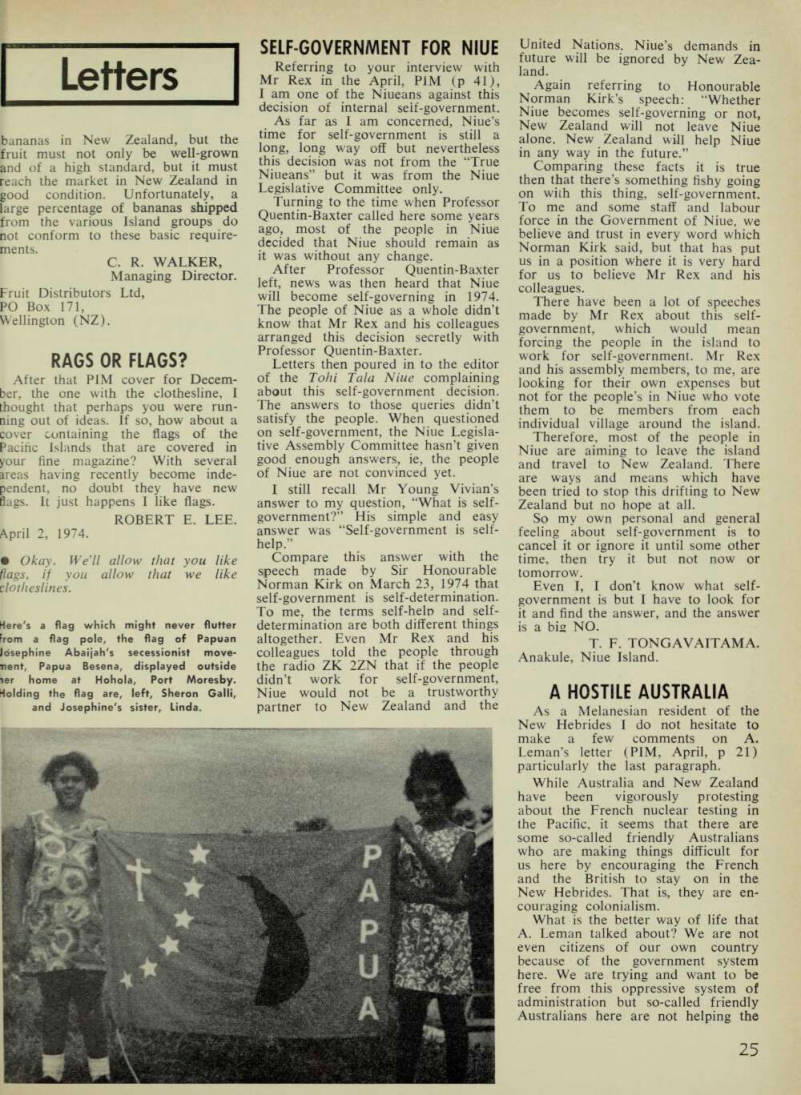
Here's a flag which might never flutter From a flag pole, the flag of Papuan [?]osephine Abaijah's secessionist move- Ment, Papua Besena, displayed outside [? [?]er home at Hohola, Port Moresby.
Holding the flag are, left, Sheron Galli, and Josephine's sister, Linda.
tuation by being here. The Mela esians do not invite these people to 3me here and assist with the de slopment of the New Hebrides, hey have invited themselves here ;cause they think there is so much ;re that they can get away with — nd and all!
We welcome the banks but I am ‘raid we cannot tolerate so-called dividual, friendly Australians yet.
'e hope that such people are not apegoats of the Whitlam govern ed.
What does A. Leman mean by ying, “Individual Australians are sisting considerably in the develop ed of the New Hebrides and in e joining together of residents ;re to work together to forget cial, tribal and religious differences order to seek economic and poli •al progress for all”.
We do not need to do that to seek onomic and political progress, sople always like to live with their fferences and this will exist even ars after independence. How on rth could the Australians, who low nothing about our tribal sys m, make us forget the differences? seems that A. Leman does not tow that we are not citizens of our m country and this is what we int before we begin to think of onomic development of our beauti l country.
It also seems that these Aust lians here are ignorant of our his ry. If it had not been for the reli )us organisations they would not ve been able to come here. This ice would have been a French ritory and the nuclear testing aid have been held here, which is t far from Australia, In the olical days the kings were guided the prophets. In the New Heb ies we want our governments to guided by the religious organisa ns so that it will be a happy place * all and not just for the present lite masters.
We believe Christ will bring, ough the religious organisations, ease to the down-trodden Mela sians. Christianity is neither black r white, so may A. Leman be lured that Christ will set us free •m the injustices that exist here ough Christian organisations that believe in. They will work for it aim.
While the Fijians have been forced leave Australia, some Australians
think that they have every right ini the world to live here in the New' Hebrides. As regards education! officials, their behaviour has been the; pattern in all developing countries* so it will be the same for the New' Hebrides.
J. Kaltolu.
Vila, New Hebrides.
Aust-Nz Union
Having travelled recently quite ai bit through both American andl Western Samoa and upon reading your article of the divided Samoasi (PIM, April, p 33), one is remindedl of a similar question of a confedera tion between Australia and New Zealand.
No one in Australia ever seriously considers—or for that matter even cares about—a confederation but as soon as one meets with New Zea landers, they start the subject saying they would be against it. My answer always is that Australia did not pro pose it in the first instance and can easily manage without NZ. But there is no doubt, New Zealanders have a (inferiority) complex about it.
The situation is similar with the Samoas. Western Samoa has a well organised, happy, healthy and clean country with the majority of land, people and wealth. It is the short sightedness of the American Samoans—like the New Zealanders —who would have nothing but gain if only they buried their false pride.
I believe the American Govern ment would be quite happy to part with their “colony”: it has no longer any military value and it only costs them a lot of money without any thing in return.
Meanwhile, just like the Austral ians have no sleepless nights aboul the New Zealanders joining them.
Western Samoans do not worry toe much about their brothers in Ameri can Samoa.
But it is a shame, here and there ; if one thinks of all the money anc3 manpower that is wasted by these duplicate governments and how life of the individual is made miserable by unnecessary and unwarranted “red tape” and regulations betweer these two lots of brother countries!
Let’s ask Mr Kissinger if he has some spare time when he is finished in the Middle East.
Georges M. Teitler.
Killara, NSW.