Yesterday
p. 56 · Read in the full issue
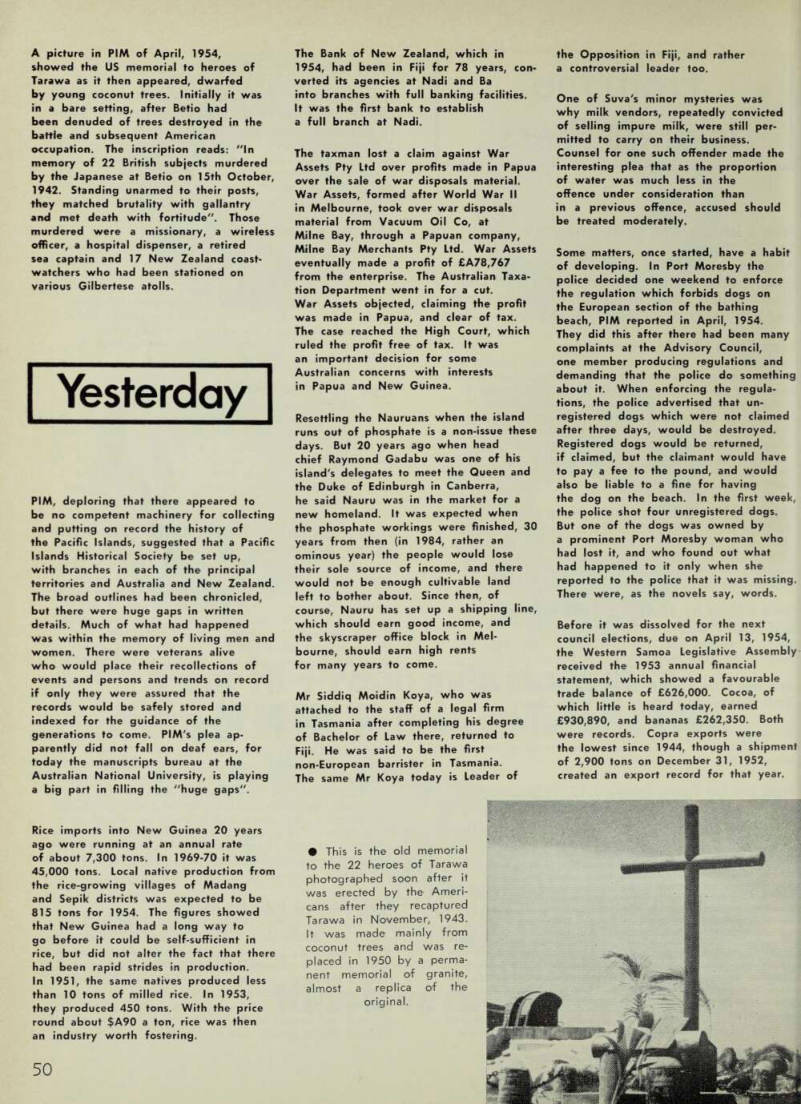
A picture in PIM of April, 1954, showed the US memorial to heroes of Tarawa as it then appeared, dwarfed by young coconut trees. Initially it was in a bare setting, after Betio had been denuded of trees destroyed in the battle and subsequent American o<cupation. The inscription reads: "In memory of 22 British subjects murdered by the Japanese at Betio on 15th October, 1942. Standing unarmed to their posts, they matched brutality with gallantry and met death with fortitude". Those murdered were a missionary, a wireless officer, a hospital dispenser, a retired sea captain and 17 New Zealand coast watchers who had been stationed on various Gilbertese atolls.
PIM, deploring that there appeared to be no competent machinery for collecting and putting on record the history of the Pacific Islands, suggested that a Pacific Islands Historical Society be set up, with branches in each of the principal territories and Australia and New Zealand.
The broad outlines had been chronicled, but there were huge gaps in written details. Much of what had happened was within the memory of living men and women. There were veterans alive who would place their recollections of events and persons and trends on record if only they were assured that the records would be safely stored and indexed for the guidance of the generations to come. PlM's plea ap parently did not fall on deaf ears, for today the manuscripts bureau at the Australian National University, is playing a big part in filling the "huge gaps".
Rice imports into New Guinea 20 years ago were running at an annual rate of about 7,300 tons. In 1969-70 it was 45,000 tons. Local native production from the rice-growing villages of Madang and Sepik districts was expected to be 815 tons for 1954. The figures showed that New Guinea had a long way to go before it could be self-sufficient in rice, but did not alter the fact that there had been rapid strides in production.
In 1951, the same natives produced less than 10 tons of milled rice. In 1953, they produced 450 tons. With the price round about SA9O a ton, rice was then an industry worth fostering.
The Bank of New Zealand, which in 1954, had been in Fiji for 78 years, con verted its agencies at Nadi and Ba into branches with full banking facilities.
It was the first bank to establish a full branch at Nadi.
The taxman lost a claim against War Assets Pty Ltd over profits made in Papua over the sale of war disposals material.
War Assets, formed after World War II in Melbourne, took over war disposals material from Vacuum Oil Co, at Milne Bay, through a Papuan company, Milne Bay Merchants Pty Ltd. War Assets eventually made a profit of £A78,767 from the enterprise. The Australian Taxa tion Department went in for a cut.
War Assets objected, claiming the profit was made in Papua, and clear of tax.
The case reached the High Court, which ruled the profit free of tax. It was an important decision for some Australian concerns with interests in Papua and New Guinea.
Resettling the Nauruans when the island runs out of phosphate is a non-issue these days. But 20 years ago when head chief Raymond Gadabu was one of his island's delegates to meet the Queen and the Duke of Edinburgh in Canberra, he said Nauru was in the market for a new homeland. It was expected when the phosphate workings were finished, 30 years from then (in 1984, rather an ominous year) the people would lose their sole source of income, and there would not be enough cultivable land left to bother about. Since then, of course, Nauru has set up a shipping line, which should earn good income, and the skyscraper office block in Mel bourne, should earn high rents for many years to come.
Mr Siddiq Moidin Koya, who was attached to the staff of a legal firm in Tasmania after completing his degree of Bachelor of Law there, returned to Fiji. He was said to be the first non-European barrister in Tasmania.
The same Mr Koya today is Leader of
the Opposition in Fiji, and rather a controversial leader too.
One of Suva's minor mysteries was why milk vendors, repeatedly convicted of selling impure milk, were still per mitted to carry on their business.
Counsel for one such offender made the interesting plea that as the proportion of water was much less in the offence under consideration than in a previous offence, accused should be treated moderately.
Some matters, once started, have a habit of developing. In Port Moresby the police decided one weekend to enforce the regulation which forbids dogs on the European section of the bathing beach, PIM reported in April, 1954.
They did this after there had been many complaints at the Advisory Council, one member producing regulations and demanding that the police do something about it. When enforcing the regula tions, the police advertised that un registered dogs which were not claimed after three days, would be destroyed.
Registered dogs would be returned, if claimed, but the claimant would have to pay a fee to the pound, and would also be liable to a fine for having the dog on the beach. In the first week, the police shot four unregistered dogs.
But one of the dogs was owned by a prominent Port Moresby woman who had lost it, and who found out what had happened to it only when she reported to the police that it was missing.
There were, as the novels say, words.
Before it was dissolved for the next council elections, due on April 13, 1954, the Western Samoa Legislative Assembly received the 1953 annual financial statement, which showed a favourable trade balance of £626,000. Cocoa, of which little is heard today, earned £930,890, and bananas £262,350. Both were records. Copra exports were the lowest since 1944, though a shipment of 2,900 tons on December 31, 1952, created an export record for that year.
This is the old memorial to the 22 heroes of Tarawa photographed soon after it was erected by the Ameri cans after they recaptured Tarawa in November, 1943.
It was made mainly from coconut trees and was re placed in 1950 by a perma nent memorial of granite, almost a replica of the
original.