Magazine Section
pp. 65-67 · Read in the full issue
Arundel, The Shy Cecil Rhodes
Of The Pacific Islands
By Robert Langdon
Probably no one man has figured so largely in the economic develop ment of the Islands as the man who has been described as the Cecil Rhodes of the Pacific John T.
Arundel. Yet, as an individual he was a misty personality even though he was one of the dominant figures in the Pacific phosphate and copra industries from 1870 until his death in 1919.
At the time of his death, Arundel was one of the principal shareholders in the Pacific Phosphate Company, the organisation which then mined the phosphate deposits of Ocean Island and Nauru. These deposits were acquired in the following year by the British, Australian and New Zealand governments for £3,500,000.
Some 30 years earlier, it was largely through Arundel’s representa tions that the British flag was raised over most of the Phoenix Islands in the Central Pacific; and he himself took possession of Vostok Island on behalf of Queen Victoria in 1873.
Yet Arundel never figured in Who’s Who, the Dictionary of National Biography, or other such reference books, and when he died no obituary notice of him appeared in The Times. Many basic details about him are, therefore, not readily available; nor are they to be found among his papers, even though these include a series of diaries spanning the half century from 1870 until his death.
We have not been able to find out, for example, when or where he was born; in what circumstances he first came to the Pacific, or how he ac
quired the capital for his first enter prises.
However, it seems that he was a son of the Rev John Arundel, secre tary from 1819 to 1846 of the London Missionary Society, which sent its first missionaries to the Pacific in 1797.
His first extant diary covers the beginning of what he described as his third voyage round the world. He was then employed by Houlder Brothers and Company of London, who had interests in several guano islands in the Central Pacific. On that voyage, he travelled from England to Australia, via the Suez Canal, thence to Auckland, Raro tonga, the Society Islands and finally Starbuck Island, one of the Line Islands. At Starbuck, he spent a couple of weeks “collecting guano”, and then returned to Australia.
During the next few years, Arundel was in and out of Starbuck several times. He also visited a number of other islands in that vicinity, includ ing Caroline, Fanning, Vostok and Flint, which were exploited for phos phate.
By the early 1880 s, Arundel had branched out on his own; and having
obtained leases from the British Government for Flint and Caroline Islands, he began systematically planting them with coconuts, employ ing labourers from the islands there abouts. By mid-1882, 155,000 nuts had been planted.
Meanwhile, Arundel prospected for guano in many islands, including Tetiaroa, an atoll some 26 miles from Tahiti, where he found “many natives placed there by the king to look after his pigs”. He also spent some time in 1881 looking unsuccessfully for Victoria Island, an island reputed to exist near the Cook Group.
By 1886, Arundel had developed plans to plant several of the Phoenix Islands Sydney, Enderbury, Hull, Gardner and Canton with coco nuts. The first of these islands was then held by Arundel on lease from the British Government; the rest were leased by one C. A. Williams, of New London, Connecticut.
A prospectus issued by Arundel at the time proposed the formation of “a Small Private Company for the purpose of Cocoa Nut Cultivation and the Manufacture of Copra, Coir, and other products of the Cocoa
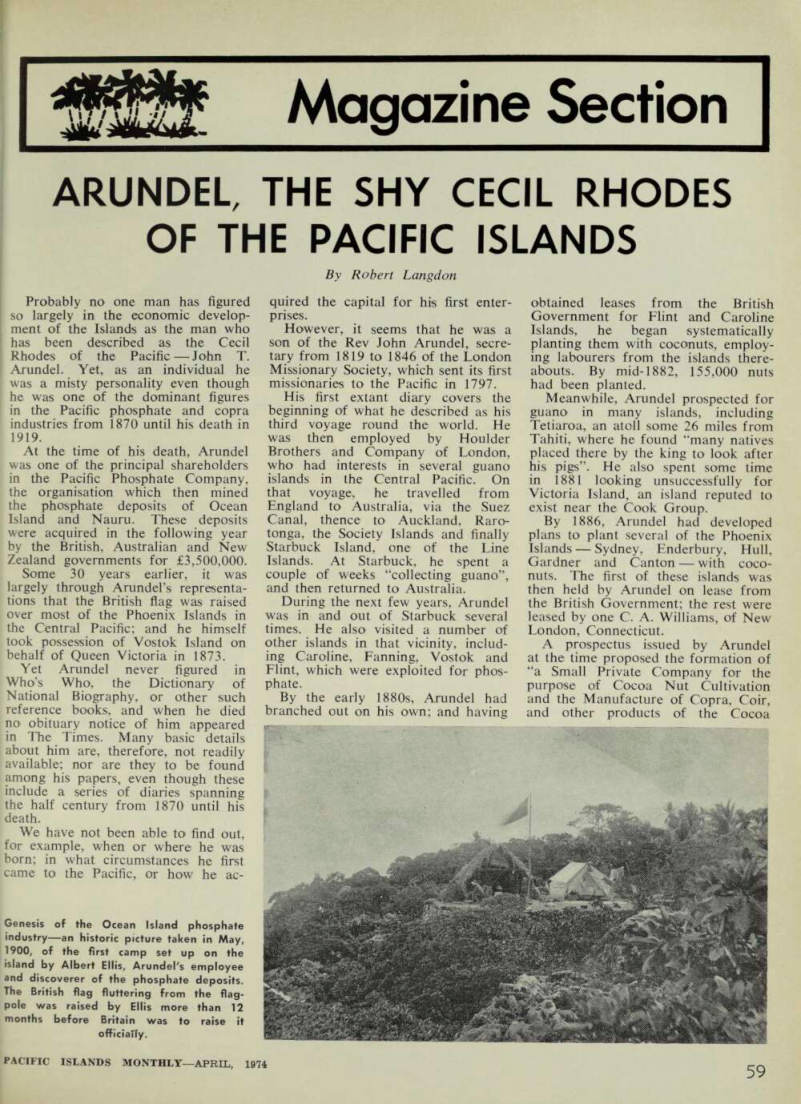
Genesis of the Ocean Island phosphate industry—an historic picture taken in May, 1900, of the first camp set up on the island by Albert Ellis, Arundel's employee and discoverer of the phosphate deposits.
The British flag fluttering from the flag pole was raised by Ellis more than 12 months before Britain was to raise it officially.
Nut”. The two objects of the com pany were: © To acquire from Arundel his rights and interest in the coconut plantations on Flint and Caroline Islands, “distant about 400 miles from Tahiti . . .” © To plant “some or all of the Phoenix Islands with coconuts”.
“The Islands of the Phoenix Group,” the prospectus said, “are daily becoming more valuable from the increased communication between the Samoan or Navigator’s Group (from which they are only 600 miles dis tant) and the Australasian Colonies and San Francisco, and thereby with the outer world.
“The Mail Line of Steamers be tween San Francisco, Honolulu, Auckland, and Sydney, passes through the Samoan Group—and the Steamers call off the West Cape of Tutuila, on both their upward and downward journeys, every four weeks . . . The lime from Samoa to the Phoenix Group is from four to six days.”
After mentioning other ships that connected Samoa with the outside world, the prospectus added: “It is also very probable that the New Cable to be laid across the Pacific from Victoria, Vancouver Island, or
San Francisco to Auckland and Sydney, will pass through the Phoenix Group ... All this opening up of communication naturally enhances the importance and value of the Phoenix Group, and there is no doubt that in the race after Pacific Islands, which is now taking place among the Great European Powers, these will before long attract considerable atten tion . . .”
The prospectus advocated the plant ing of half a million coconuts in the Phoenix Group, and it estimated that even if no more than £l4 per ton were obtained for copra, and no use was made of the fibre, those islands should be yielding an annual profit of £30,000 by 1895.
Arundel’s appeal, by means of his prospectus, led to the formation of John A. Arundel and Co, which, not long afterwards, acquired most of the interests of C. A. Williams in the Phoenix Group, and then obtained leases for those islands from the British Government.
Following this, HMS Egeria was sent to the group in 1889 to take Birnie, Phoenix, Hull and Sydney Islands under British protection; and HMS Curacoa was assigned to visit
Gardner Island for that purpose in 1892.
The new company thrived, and in due course it was absorbed into a larger company, the Pacific Islands Company Ltd, of London. The PI Company also acquired the business interests of a Sydney firm, Henderson and Macfarlane, which had trading stores in the Tokelau, Gilbert, Ellice and Marshall groups, plus coconut plantations on Christmas and Suwar row Islands.
Arundel became vice-chairman of the new company, the chairman being Lord Stanmore, formerly Sir Arthur Gordon, the first Governor of Fiji and first High Commissioner for the Western Pacific.
Lord Stanmore said at the first ordinary general meeting of the new company held in London on April 19, 1899, that its object was “to bring about the fusion of large firms trad ing in the Pacific, in order to avoid unnecessary competition, and to con duct the businesses with greater economy”.
He also stated that Arundel had made a visit to “various parts of the world” during the previous two years, and that this had resulted in the acquisition by purchase or con cession of: ® Clipperton Island, containing valuable guano' deposits, about 650 miles from Acapulco, Mexico. (A concession from the Mexican Govern ment.) & Rabi Island, Fiji, containing
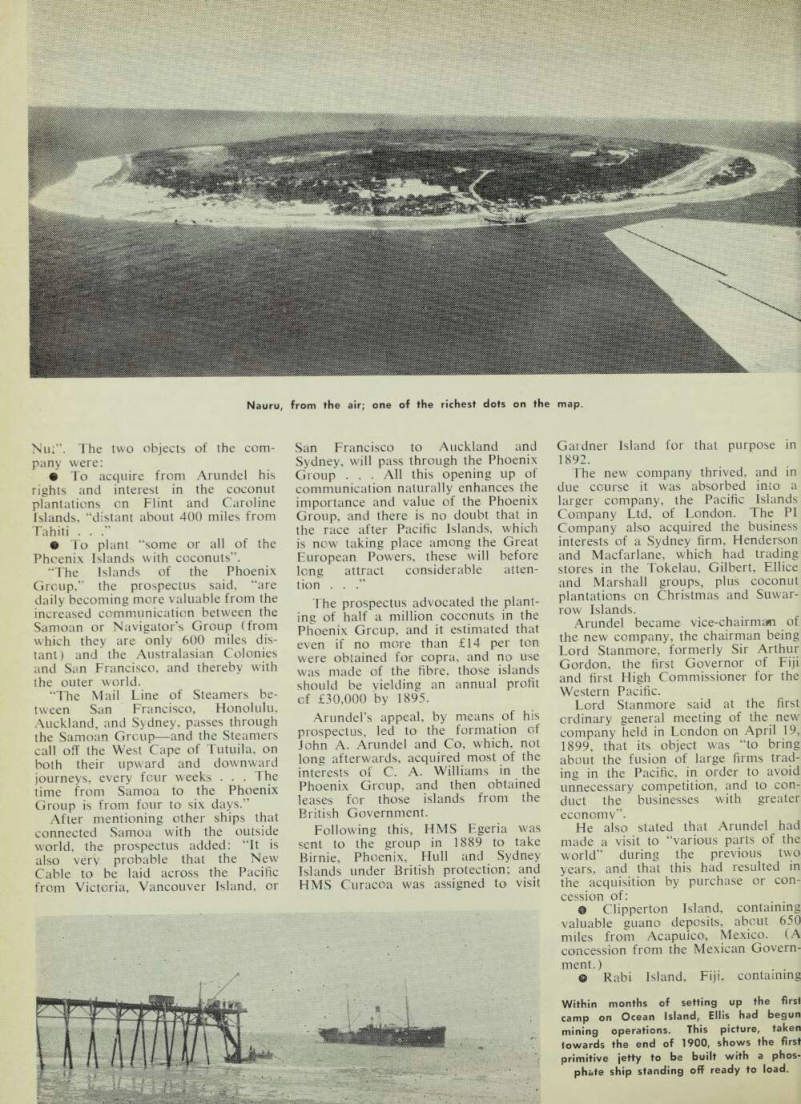
Nauru, from the air; one of the richest dots on the map.
Within months of setting up the first camp on Ocean Island, Ellis had begun mining operations. This picture, taken towards the end of 1900, shows the first primitive jetty to be built with a phos phate ship standing off ready to load.
I several thousand coconut trees. (On I a 10-year lease, with the option of
I purchase.)
• St Heliers Estate, Taveuni, Fiji, I which included 180 acres planted with [ coconuts. (Formerly owned by Sir John Thurston, then Governor of Fiji.) • Bua Estate, Vanua Levu, Fiji. • Vostok Island, containing a de posit of guano and also very suitable I for coconut planting. • Freehold property on Butaritari, Gilbert Islands.
Lord Stanmore said that profits divisible among the ordinary share holders for the year 1897 were only £2,160, and that those for 1898 were expected to amount to £7,000. How ever, it was hoped that during 1899 “the full benefit would be felt of the original idea on which the Company was started”, and that there would be “a considerable avoidance of compe tition and economy in working”.
The year 1899, however, did not turn out as hoped. As Lord Stanmore said at the next annual meeting of shareholders in December, 1900, there had been “errors in the management” and in the “mode of keeping and rendering accounts in Australasia”; and the company’s receipts had been iniuriously affected by a series of unfortunate incidents not likely to recur . . .”
“But,” Lord Stanmore went on, “however disappointing the past re sults may prove to be, the Directors are glad to be able to give a far more cheering account of the prospects for the immediate future. The Crown has recently granted to the Company through the Colonial Office, at a nominal rent for a long term of years, the exclusive privilege of exploiting phosphates from Ocean Island, an island which contains perhaps some of the richest deposits of that character ... in any part of the world.”
The discovery of the phosphate de posits at Ocean Island was the work of one of Arundel’s employees, Albert F. Ellis. In his book Ocean Island and Nauru, Ellis described how he returned to Sydney from those islands ,m 1900 with a cargo of copra and ‘bearing news worth many such [cargoes”. Arundel was at the wharf to meet him, and, as Ellis said, “it was decided to start work at Ocean Island forthwith”.
In May of the following year, Ellis accompanied Arundel and various
German officials to Nauru, then nart of Germany’s Marshall Islands Pro tectorate. As the topography of that island was similar to that of Ocean Island, it was suspected that valuable phosphate deposits would also be found there, and this soon proved to be the case. Later, Ellis wrote, a meeting of the chiefs representing each tribe was held to acquaint them with the “recent developments”.
“They were told,” he said, “it had been found that the rocks and soil on the high portion of the island were useful to white men, and that the company whom we repre sented would pay them for the phos phate at a stated rate, “The chiefs were gravely interested; one of them thought it was hardly the thing for the white men to have to pay for rocks, and another sug gested that when they were being re moved, we might leave behind sufficient for them to make the special stone sinkers they use for their fishing lines . .
Back in London, negotiations were soon put in train to sell off the non phosphate side of the Pacific Islands Company’s business, and to amalga mate what remained with the Jaluit Gesellschaft of Hamburg to form the Pacific Phosphate Company. Mean while, a licence was obtained from the British Government to exploit the Ocean Island deposits for 98 years from January 1, 1902; and a 94-year concession was obtained from the German Government for the exploita tion of the deposits at Nauru and other islands in the Marshall Group.
The total extent of the deposits at Ocean Island and Nauru were esti mated in 1901 to be more than 54 million tons. Before long the com pany was exporting up to 200,000
tons a year. This enabled it to pay a dividend of about 50 per cent on a paid-up capital of £250,000.
In the early days of the Phosphate Company, Arundel still held a mana gerial post and travelled extensively.
In 1907, he visited a number of is lands in the eastern Pacific in search of new phosphate deposits.
This trip resulted in the discovery of high-grade deposits at Makatea, near Tahiti, and the subsequent for mation of the Compagnie Francaise des Phosphates de I’Oceanie, in which the Phosphate Company had a large financial interest.
Arundel, accompanied by his family, made his last visit to the Pacific in 1909. They travelled in the SS Ocean Queen, which narrowly escaped a serious accident at Nauru when a mooring windlass collapsed, causing a four-ton anchor, 160 fathoms of chain, and 90 fathoms of seven-inch steel wire hawser to slide into the sea.
Arundel, who was on the bow of the steamer at the time, rushed aft expecting to find legs and arms muti lated, and bodies all over the deck.
But by good fortune there were no casualties.
However, soon afterwards, in pass ing close to Makatea, something went wrong with the Ocean Queen’s engines, the vessel drifted on the reef, and became a total loss.
Arundel resigned from his mana gerial post soon after the accidents.
“He was then well on in years,” Ellis wrote, “his health was not good, and was naturally affected by these events.
His later years were spent quietly in England, though his interest in island matters continued keen to the last . . .”
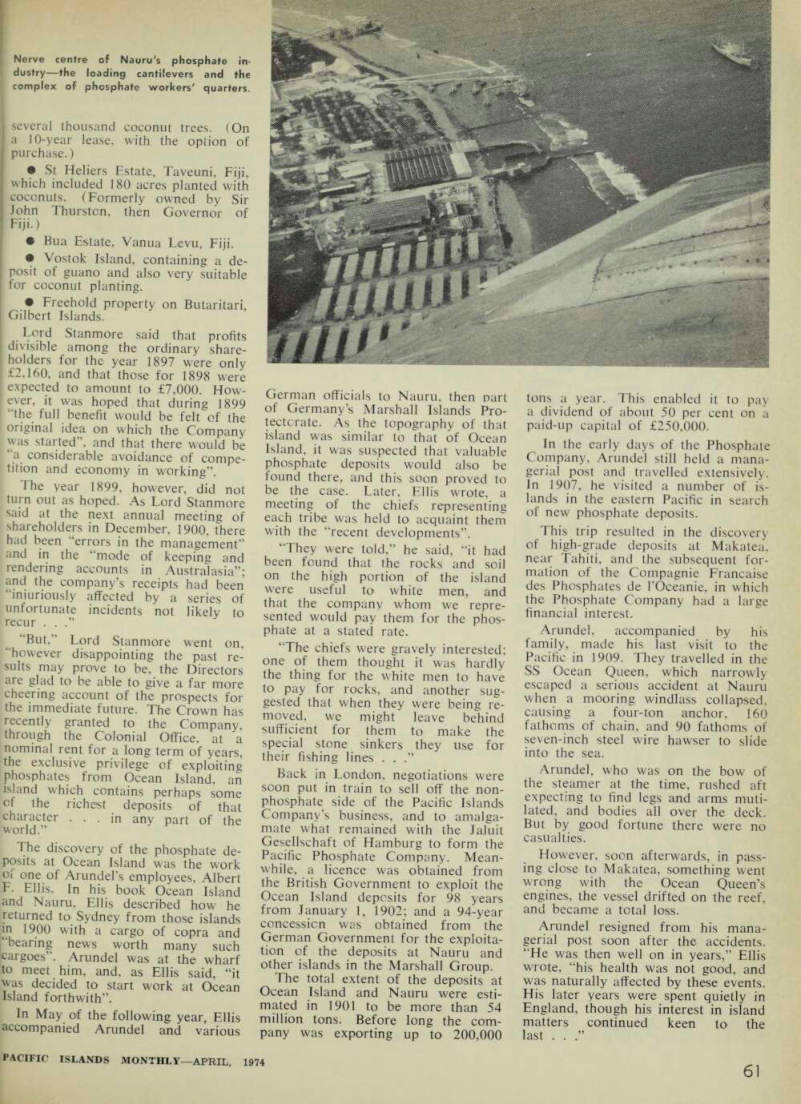
Nerve centre of Nauru's phosphate in dustry—the loading cantilevers and the complex of phosphate workers' quarters.