Pacific Islands Monthly

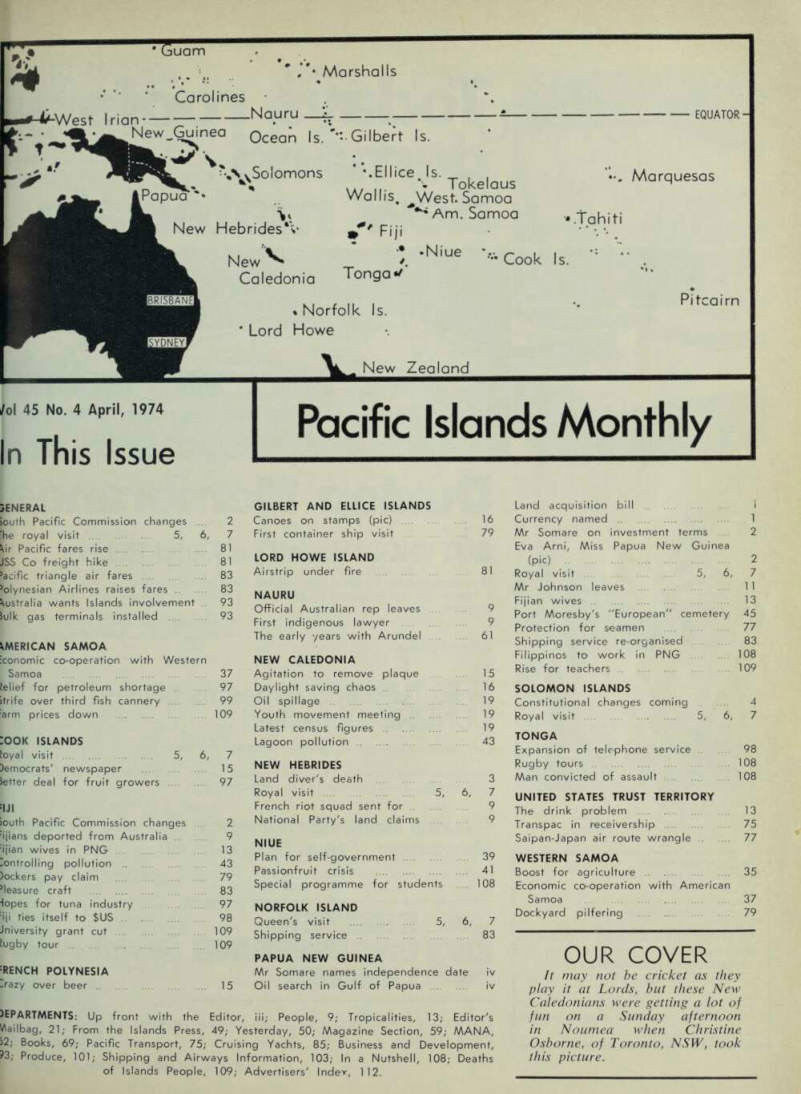
News Magazine Of The South Pacific
April, 1974
AUSTRALIA, N.Z., P.N.G., FIJI, N. HEBRIDES 60c TONGA, W. SAMOA, 8.5.1. P., G.E.I.C. 60c
Cooks, Norfolk, Niue, Nauru 60C
AM CAMOA UAU/AII IIirDAMCriA rum & i nr.
Our Cover
It may not be cricket as they play it at Lords, but these New Caledonians were getting a lot of fun on a Sunday afternoon in Noumea when Christine Osborne, of Toronto, NSW, took this picture.
Advertisements & other items, p. 2 (1 item)
After you don’t believe the way the brand
new decks sound, you won’t believe
the way they’re
The beauty of Pioneer’s cassette decks is the way they reproduce high fidelity sound from unbelievably tiny cassettes. In fact, no others on the market with prices comparable to Pioneer’s new CT-5151, CT-4141 A, and CT-3131A give you so much sound for the money. Take, for instance, CT-5151, the top-notch among the three featured here. With a frequency response range from 30 to 16,000 Hz, a built-in *Dolby noise reduction unit, and long life ferrite solid tape head, you’re going to want to compare CT-5151 with most of the expensive reelto-reel decks. CT-5151 is, indeed, loaded with a lot more features like normal/chromium dioxide
tape selector (bias/equalizer
independently
switchable), full-automatic stop mechanism, tape
running pilot light, peak level indicator, over-level limiter, electronically controlled DC motor, and even a memory rewind switch. If you’ve ever doubted the sound quality of cassette tape, now’s the time to hear it all over again. On the C; CT-4141 A, and CT-3131A, just a few of quality high fidelity products made by Pioneer.
To see and listen to any of these, please contact one of the following: Dimensions: 15-5/8(W) x 9-1/2(D) x 3-3/4(H) inches.
Weight: CT-5151 101 b. 9 oz.
CT-4141A 101 b. 6 oz.
CT-3131A 9 lb. 11 oz.
/C CVCI
3, now’afc* M r •
EZMZJ
CT-414
CT-3131A
SSPBIII
BBSS3EBX
CT-5151 Australia Fiji Islands Lae Rabaul Port Moresby Madang Pioneer Electronics Australia Pty. Ltd., 256-8, City Road, South Melbourne, Victoria 3205, Australia, Tel: 696605, Branches in all states Brijlal & Company, G.P.O. Box No. 362, Suva, Fiji Islands, Tel; 22 258 Hagemeyer (Australasia) 8.V., P.O. Box No. 90, Lae, New Guinea, Tel: 2718 Hagemeyer (Australasia) 8.V., P.O. Box No. 63, Rabaul, New Guinea Hagemeyer (Australasia) 8.V., P.O. Box No. 1428, Boroko, Port Moresby, New Guinea Hagemeyer (Australasia) 8.V., P.O. Box No. 673, Madang, T.P.N.G.
New Zealand Norfolk Islands Nauru Island Tahiti New Caledonia American Samoa Tee Vee Radio Ltd., P.O. Box NO. 5029, Auckland, New Zealand, Tel; 763-064 Burns Philp (South Sea) Co., Ltd., Norfolk Islands, South Pacific Jacob Enterprises, P.O. Box No. 4, Nauru Island Ets. PERFECt, B.P. 594, Papeete, Tahiti, Tel: 20 407 Menard Freres, B.P. 123, Noumea, New Caledonia, Tel: 52-22 Transpac Corporation, P.O. Box 1477. Pago Pago, American Samoa 96799, Tel: 2227
In This Issue
General
louth Pacific Commission changes 2 fhe royal visit ... 5,6, 7 \ir Pacific fares rise 81 JSS Co freight hike 81 *acific triangle air fares 83 Polynesian Airlines raises fares 83 Vustralia wants Islands involvement . 93 lulk gas terminals installed 93
American Samoa
iconomic co-operation with Western , Samoa 37
telief for petroleum shortage 97
►trife over third fish cannery 99 : arm prices down 109
:Ook Islands
toy a I visit 5,6, 7 )emocrats' newspaper 15 letter deal for fruit growers 97
Iji
outh Pacific Commission changes 2 ijians deported from Australia 9 ijian wives in PNG 13 controlling pollution 43 )ockers pay claim 79 Measure craft 83 Hopes for tuna industry 97 : iji ties itself to SUS 98 Jniversity grant cut 109 togby tour 109
: Rench Polynesia
>azy over beer 15
Gilbert And Ellice Islands
Canoes on stamps (pic) 16 First container ship visit 79
Lord Howe Island
Airstrip under fire 81
Nauru
Official Australian rep leaves 9 First indigenous lawyer 9 The early years with Arundel 61
New Caledonia
Agitation to remove plaque 15 Daylight saving chaos 16 Oil spillage 19 Youth movement meeting 19 Latest census figures 19 Lagoon pollution 43
New Hebrides
Land diver's death 3 Royal visit 5,6, 7 French riot squad sent for 9 National Party's land claims 9
Niue
Plan for self-government 39 Passionfruit crisis ... 41 Special programme for students ... 108
Norfolk Island
Queen's visit 5,6, 7 Shipping service 83
Papua New Guinea
Mr Somare names independence date iv Oil search in Gulf of Papua iv
JEPARTMENTS: Up front with the Editor, iii; People, 9; Tropicalities, 13; Editor's V'ailbag, 21; From the Islands Press, 49; Yesterday, 50; Magazine Section, 59; MANA, i 2; Books, 69; Pacific Transport, 75; Cruising Yachts, 85; Business and Development, ?3; Produce, 101; Shipping and Airways Information, 103; In a Nutshell, 108; Deaths of Islands People, 109; Advertisers' Index, 112.
Land acquisition bill i Currency named 1 Mr Somare on investment terms 2 Eva Arni, Miss Papua New Guinea (pic) 2 Royal visit 5,6, 7 Mr Johnson leaves 11 Fijian wives 13 Port Moresby's “European" cemetery 45 Protection for seamen 77 Shipping service re-organised 83 Filippinos to work in PNG 108 Rise for teachers 109
Solomon Islands
Constitutional changes coming 4 Royal visit 5,6, 7
Tonga
Expansion of telephone service 98 Rugby tours 108 Man convicted of assault 108
United States Trust Territory
The drink problem 13 Transpac in receivership 75 Saipan-Japan air route wrangle 77
Western Samoa
Boost for agriculture 35 Economic co-operation with American Samoa 37
Dockyard pilfering 79
Advertisements & other items, p. 4 (1 item)
Todays roofs
M g lilt
demand
new materials
"31 > .mm m s m m *.« ■*■■ , Illustrations depict: Roman Catholic Seminary, Suva.
Pacific Fishing Company, Levuka.
The Fiji Times’ Extensions, Suva.
I The General Manager, I Shelter Engineering Limited.
P.O. Box 10-043, Christchurch, New Zealand.
Please forward information on
□ BUTYNOL ROOFING MEMBRANE
□ SHELTERLINE & DUNLINE ROOFING
I MEMBRANES
I □ MEMBRANES FOR WATER I
MANAGEMENT
NAME ■
ADDRESS
Dunlop Membranes
BUTYNOL’Based on Butyl Rubber
One-ply roofing has far less weight and bulk than built-up systems.
Therefore, the architect gains greater design freedom plus reduced loads on supporting members.
For the owner, certain structural costs are lowered and maintenance problems minimised. The contractor benefits from reduced materials handling, lower shipping costs and a work day with more productive hours.
SHELTERLINE Asbestos backed
DUNLINE • Unbacked
Both based on well-proven Hypalon* Synthetic Rubber.
Hurricane Bebe' October 1972 and Cyclone Lottie' December 1973 produced no problems for Dunlop Membranes and Adhesives. © Dunlop membranes are widely used also for Water
Management - Ponds, Reservoirs, etc.
$
SHELTER
ENGINEERING
LIMITED
A DUNLOP COMPANY
•HYPALON is a registered Du Pont trademark for chlorosulfonated polyethylene synthetic rubber. 2263
Pacific Islands
Monthly
FOUNDED BY R. W. ROBSON IN 1930
Published Monthly By
Pacific Publications (Aust.) Pty. Ltd.,
f 29 ALBERTA ST., SYDNEY, N.S.W., 2000.
Postal Address: G.P.O. BOX 3408, SYDNEY,
N.S.W., 2001.
Telegraphic Address: PACPUB, Sydney.
Telex 25168.
Telephones: 61-9197, 61-7101, 61-4369.
onsulting Directors: R. W. Robson, Judy Tudor.
Chief Executives: Manager: Selwyn Hughes.
Publisher: Stuart Inder.
Director of Advertising; W. A. Gasnier.
Pacific Islands Monthly
Editor: Stuart Inder.
Assistant Editor: John Carter.
Advertising Manager: W. A. Gasnier.
Circulation Manager: Barry Badger.
Subscription Rates:
Pacific Islands Monthly” is airfreighted to all ibscribers and agents in the Pacific Islands id the U.S.A.; copies to Nauru and other reas go by surface mail, ustralia (incl. Lord Howe and Thursday Is.), ew Zealand, Papua New Guinea, Fiji, New ebrides, Tonga, Western Samoa, Solomon ilands, Gilbert & Ellice Islands, Cook Islands, orfolk Island, Niue and Nauru Islands: $6.80 ocal currency); American Samoa, Hawaii, iicronesia and Guam; $12.00 US; New aledonia and French Polynesia 1,100 CFP; S Mainland: $14.00 US; United Kingdom: 5-10. Elsewhere $B.OO Aust.
Representatives
ji: Advertising—A. F. Woods, Imex (Pacific) mited. Suite 2A, Victoria Arcade, Suva, Fiji, 0. Box 3117, Lami, SUVA. Telephone: 22-502. (lex. 2124. Distribution—Desai Book Depot Ltd., P.O. Box 160, SUVA. Tel.: 311-424.
Jpua New Guinea: PORT MORESBY, PNG Print ig Co. Pty. Ltd., P.O. Box 633; LAE, P.O. Box 27; RABAUL, Mr. David Simpson, P.O. Box 164 (c/- Rabaul Photographic. Tel.; 2677.) ench Polynesia. Distribution—Hachette Paci que, 10 Ave Bruat, Papeete, sw Zealand; Pacific Publications, C.P.O. Box 229, Auckland. 379-494. Representative: John jedding. Civic House, 291 Queen St., Auckland, Tel.: 379-494. lited Kingdom: Advertising—Overseas Publicity d., 214 Oxford Street, London, WIN OEA. lone: 01-636 8296/7. Subscriptions—T. B. raham. Park House, 22 Park Street, Croydon,
Cr9 3Np. Tel.: 01-6884177.
ipan: Advertising—Universal Media Corpora tion, C.P.O. Box 46, Tokyo. Tel.: 666-3036. ictoria: Advertising Pacific Publications iust.) Pty. Ltd., 33 Lonsdale Street, elbourne, Vic. 3006. Telephone: 662-3263. iieensland: Advertising—Beale Media Services, 52 St. Paul's Terrace, Fortitude Valley, Qld., 4006. Tel.: 52-5827. awaii and U.S. Mainland only: N. Grogan, 554 Hayden Street, Honolulu, 96815. end change of address notices, Form 3579 id new subscriptions to P.O. Box 2193, Honolulu, Hawaii, U.S.A. 96805). icond class postage paid at Honolulu, Hawaii.
Copyright ©, 1974,
Pacific Publications (Aust) Pty. Ltd.
April, 1974 Vol. 45, No. 4
Up Front
with the Editor
The pastime in Port Moresby these days, where I am writing this column, is a game called Guess the Constitution. It’s been going on for months, but it ends in May when the Constitutional Planning Com mittee finally tables its long-awaited, frequently-delayed final report.
It’ll be a bulky document and while I don’t claim to know its de tails, I confidently predict it will be controversial. Papua New Guinea’s draft constitution will establish some new and important principles not seen in any constitution anywhere.
You can also say it will be a “tough” constitution in the effect it will have on the present expatriate society here. The constitution mak ers have gone back to the grass roots for what Chief Minister Somare, who is chairman of the CPC, has described as a “home grown” product. He means to imply more than the obvious fact that it is being drawn up locally and not, say, in Canberra.
It is a constitution which repre sents local thinking and aspirations.
The motivation behind it is that PNG is for the New Guineans and has to be preserved for them. The thinking is that constitutions ordin arily don’t get changed much, so you need to write into them, now, the kind of safeguards that will be re quired 20 years from now.
I suspect the European or Chinese who has lived most or all his life here will find the citizenship pro visions unpalatable, and 1 say this even though I don’t know the de tails.
In the current Assembly meeting we have seen two bills introduced (on land and on coffee) in which the draughtsmen have had to define a “non-overseas person”, and these probably give us a clue to citizenship.
In the land bill a non-overseas person is defined as “a person at least three of whose grandparents were born in PNG and who is re cognised as being a member of a tribe, moiety, clan, subclan or other customary social or land-holding group indigenous to PNG”.
In the coffee bill, a “local person” is described as a person “three of whose grandparents were born in PNG and one or more of whose grandparents were born in the neigh bouring area”. The neighbouring area is defined as the British Solo mons, Irian Jaya and any other place specified by notice.
The citizenship provisions will, I believe, be among the controversial items in the final report, but they may not reach the House of Assembly in exactly the same form as recommended by the CPC. The report is being studied by cabinet, and the CPC could make compro mises at this stage, although there is a strong element on the commit tee which believes the report must go to the parliament untouched.
From what I understand, the con stitution is aimed at avoiding a multi-racial society, on the grounds that if you make it easy for ex patriates to become citizens you will confirm them as a privileged class of people who by their education and broader outside contacts can continue to dominate the business of the country. To avoid this the con stitution has to be tough on some people who would genuinely like to become citizens and who would be good citizens. Already in this current Assembly meeting we have seen introduction of a bill aimed at con fiscating expatriate-held land for the benefit of New Guineans who might be landless, and this is only one of a line of measures meant to safe guard the rights of citizens—that is, black citizens.
The theory behind the consti tution is good, and the constitution might work well in practice too.
Perhaps PNG really is creating a constitutional benchmark that will be used as a model for years to come.
But there is always the danger that by their nature some of the inno vations will be unsatisfactory—in which case it is good to hear, as I have, that PNG’s constitution is not being designed “for ever”. —Stuart Inder
Pacific Islands Monthly
Its Definitely-Probably-Possibly
-Maybe December 1 For Png!
Within 12 hours of announcing the target date for PNG independence as December 1, 1974, Chief Minister Michael Somare was making it clear that the date wasn’t “exact”, and that if the House of Assembly doesn’t agree with it then the government will find another date.
It may have to. December 1 is a nice, round date that comes exactly 12 months after self-government, and enables the necessary legislative machinery of the Australian Govern ment and the UN Trusteeship to operate smoothly—but a lot of people in Papua New Guinea are frightened of taking the step.
Just how strong their objections are we probably won’t know until the end of April, when there is a special sitting of the Assembly to debate Mr Somare’s target date, and along with it, the all-important report of the Constitutional Planning Committee.
The committee’s report was meant to be introduced at the February/March sittings of the House, but the task of putting the final details together turned out simply to be too much for the committee. But by mid-March most sections of the report were in the hands of the Chief Minister for cabinet perusal.
Mr Somare’s target date announce ment was a last-minute decision, pressed upon him by continual de mands for him to clear up apprehen sion and uncertainty by giving the country a clue to his thinking. He made his announcement to the Assembly on March 12, the evening before the House adjourned. The drama of it wasn’t lost on Somare the politician, who began his an nouncement urbanely and increased the speed and dramatic quality of his delivery until he finally thundered, “Mr Speaker ... I intend to move in the April sittings of this House that this House supports the Ist Decem ber, 1974, as the date on which Papua New Guinea should become independent!”
He continued to thunder: “Papua New Guinea has all the prerequisites
Prom a Port Moresby correspondent of an independent country. We have the leaders, as demonstrated by the able men on both sides of this House. We have the manpower re sources—just look around at our people succeeding in every field, assisted where necessary by over seas skilled officers who have agreed to stay and assist us through the first difficult years until our training institu tions have turned out enough skilled young men and women to satisfy our needs.
“Ours is an extremely rich country when you consider the resources we have available for development.
Financial assistance has been promised from Australia for the next three years which will be suf ficient to maintain and improve the government services throughout PNG until existing and planned projects contribute substantially to our re venue.”
The Chief Minister stressed at least twice that the step to independence was not a large step, and the timing was not a major issue. This is in accordance with his view that the major political step took place last December 1 when PNG became self governing, and that independence is
nothing much more than a mad inery measure. But the House’s n action to his target date showe that perhaps the electorate doesn agree with him, and that it thinl independence is something to b feared.
There were cheers from the mini: terial benches and boos from th Opposition at the announcement, an the 25 minutes allowed for questior were often noisy and disorderly, wit Speaker Barry Holloway frequentl calling for order.
The burden of their complain was that this was not an issue to b decided by the Chief Minister or pei haps even the House—that ther should be a referendum of the peopli Opposition Leader Tei Abal went s far as to suggest that the Chit Minister was tricking the peoph who, he claimed, had been led t believe that independence wouldn come before September of next yea Tei also' wanted to know whether th date was the Chief Minister’s or Aui tralia’s.
The first accusation was unfair, th second had the seeds of truth in ths the Australian Prime Minister an the Chief Minister both want earl
independence and the Australian Government has been encouraging the Chief Minister for all its worth.
The Chief Minister dispensed with tnost of his questioners by pointing out that the resolution had yet to come before the House, and that April was the time for debate. But he also argued that there was no point to a referendum, because the people elected the members to make the decisions. Leaders had a mandate to lead.
But next morning, at question time in the House, Mr Somare found himself under more pressure from members, including his own back benchers, who were not so self confident of their leadership abilities, and were clearly worried about what they might expect from their electors.
What system of government would we have, asked one—ministerial or presidential? Will the government set up a committee to explain indepen dence to the people? Would Aus tralia please give $8 million to each of the undeveloped districts?
Mr Somare seemed more thought ful, more conciliatory. He stressed that his announcement was meant to be helpful—to give the members time to discuss the date with their electors, and for people to think about it. He had not set an exact date for inde pendence, and the House would still have to agree with it.
Obviously there will be much thinking in the next month, as people react in their own time. The im mediate mood of PNG is one of guarded acceptance; an attitude of it had - to - come - but - what - should we-think-about-it?
Although perhaps in some quarters there is restrained excitement, the step is recognised as a serious one despite the Chief Minister’s efforts to play it down.
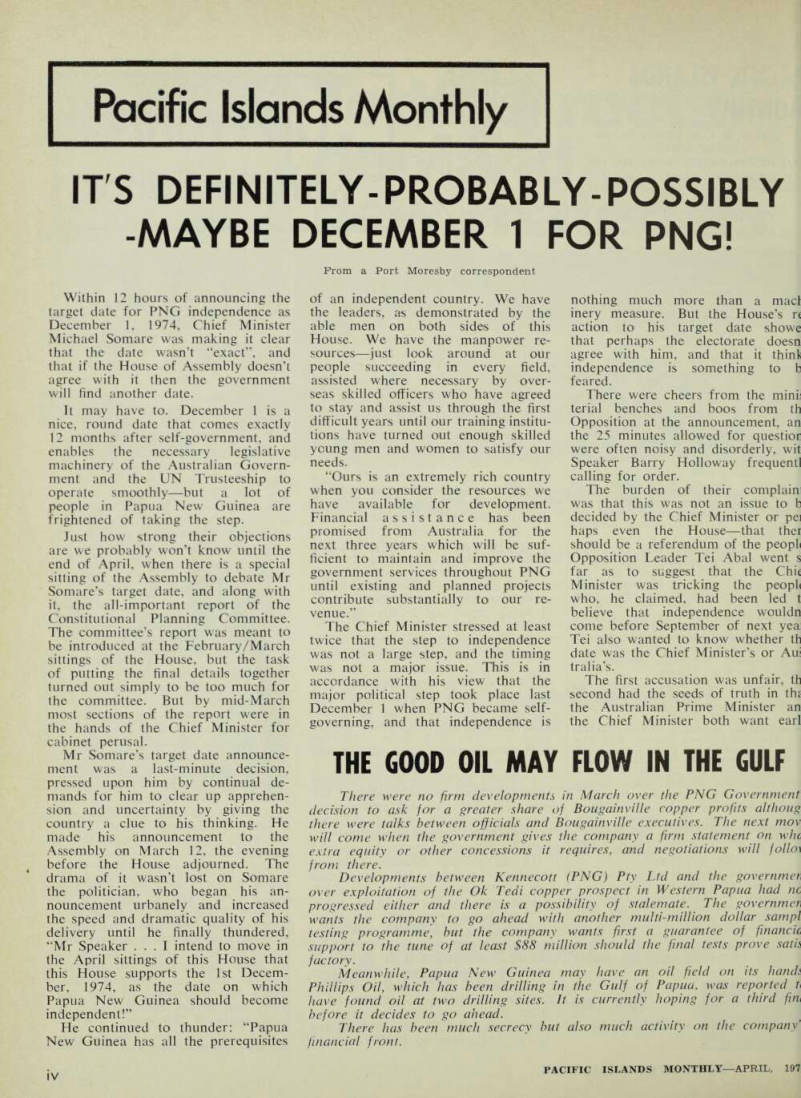
Mr Somare ... was trying to be helpful.
The Good Oil May Flow In The Gulf
There were no firm developments in March over the PNG Government decision to ask for a greater share of Bougainville copper profits althoug there were talks between officials and Bougainville executives. The next mov will come when the government gives the company a firm statement on who extra equity or other concessions it requires, and negotiations will folfa from there.
Developments between Kennecott (PNG) Pty Ltd and the governmer over exploitation of the Ok Tedi copper prospect in Western Papua had nc progressed either and there is a possibility of stalemate. The governmen wants the company to go ahead with another multi-million dollar sampl testing programme, but the company wants first a guarantee of financic support to the tune of at least $BB million should the final tests prove satii factory.
Meanwhile, Papua New Guinea may have an oil field on its handi Phillips Oil, which has been drilling in the Gulf of Papua, was reported t , have found oil at two drilling sites. It is currently hoping for a third fin . before it decides to go ahead.
There has been much secrecy but also much activity on the company ’ financial front.
land problem
Racist bill to solve PNG's land problem
The PNG Government is wasting no time in bringing into operation some of the more controversial pro posals of the Commission of Inquiry into Land Matters although the com mission’s final report has yet to be adopted in the House of Assembly.
The government is now establish ing a special section within the Lands Department with the main purpose of ensuring prompt follow up action immediately the commiss ion’s recommendations are approved by the Assembly.
Meanwhile, the bulky Land Acquisition Bill has thudded on to the desks of Assembly members who have been asked to approve it. They will probably do this in the May meeting. The bill is designed to take away land from expatriates and put it into the hands of New Guineans.
In as much as it is designed to assist one race at the expense of others, it is, of course, racist. It confines itself to properties at present held by
expatriate interests.
“We are dealing here with prob lems which arise from the colonial administration by Australia”, said Land Minister Thomas Kavali, “and not with future foreign investment which is encouraged in accordance with the government’s investment guidelines.
“It is thought that potential in vestors will be impressed by the
government’s willingness to deal with the present problems which repre sent a genuine threat to foreign in vestment”.
The threat the minister talks about is the threat posed by hostile New Guinean squatters on expatriate owned plantations and land, particu larly in the Gazelle Peninsula.
Mr Kavali said these activities were a threat to law and order be cause the New Guineans affected by alienated land said the government was unwilling or unable to solve their problems and, thus, took mat ters into their own hands.
Whether or not the bill can re solve these problems remains to be seen. The PNG Post-Courier asks whether the bill won’t inspire others “to squat on land probably never before in dispute, with hopes of
equal success”.
There is also the effect on over seas investment despite the minister’s assurances. Who is to know whether future governments won’t be tempted to use the powers on the Statute Book in other ways? It is fairly in volved legislation requiring more safeguards than the usual bill. For example, it provides a compensation formula for the acquisition of land plus an additional compensation factor to allow the government to take into account the amount of funds available or likely to be avail able when paying compensation. As the Australian Government has been asked for a lump sum to enable acquisition to take place, there will be some doubt as to the amount of money in the kitty for this factor.
The bill applies to “undeveloped land, or land used wholly or partly for primary production or for any
other prescribed purpose”.
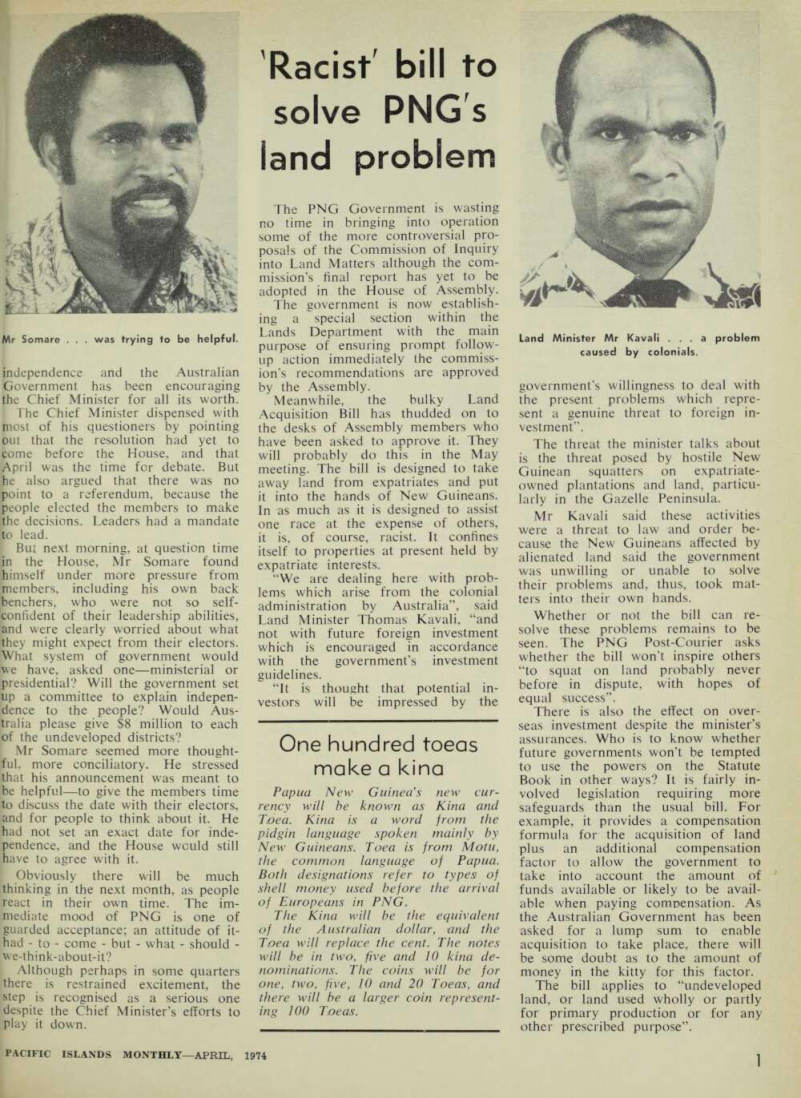
Land Minister Mr Kavali ... a problem caused by colonials.
One hundred toeas
make a kina
Papua New Guinea’s new cur rency will be known as Kina and Toea. Kina is a word from the pidgin language spoken mainly by New Guineans. Toea is from Motu, the common language of Papua.
Both designations refer to types of shell money used before the arrival of Europeans in PNG.
The Kina will be the equivalent of the Australian dollar, and the Toea will replace the cent. The notes will be in two, five and 10 kina de nominations. The coins will be for one, two, five, 10 and 20 Toeas, and there will be a larger coin represent ing 100 Toeas.
says Somare
You invest on our terms' says Somare
By a staff writer
Future foreign investment in Papua New Guinea will be on Papua New Guinea’s terms. This message came through loud and clear when the PNG Chief Minister, Mr Michael Somare, addressed the Australian Institute of Directors in Sydney on March 14. He conceded his country needed foreign invest ment and loans to meet its commit ments to its people.
“But we are resolved to channel that investment for the greatest poss ible benefit to the people of Papua New Guinea”, Mr Somare said. In vestment would not be allowed till a company complied with registra tion requirements.
A new agency, the National In vestment and Development Author ity, would work towards setting priorities for investment. In some fields, such as petroleum and natural gas, PNG would actively seek foreign investment because only overseas companies had the capital and organised skills to develop the country’s resources.
But there were some areas, such as road transport and agriculture, where foreign participation would be actively discouraged. Investment priorities would spell out those dis tinctions.
Mr Somare said any major invest ment would not only be expected to employ the maximum number of New Guineans, but would also be required to provide training to in crease the number of skilled citizens, PNG could not afford to allow major companies to acquire a trained work force simply by in creasing wage rates and attracting workers from other industries. That would have a disastrous effect on efforts to control inflation.
Mr Somare said investors would also increasingly be required to buy supplies from local sources, when ever supplies were available at com petitive prices. The highlands could produce almost all vegetables, yet millions of dollars were spent each year on imported vegetables. As part of the investment policy, steps would be taken to ensure that food bought for company use came from PNG.
“We will make sure that our re sources are exploited in a way that contributes to our own goals and
needs”, the Chief Minister said.
“One most important basic principle is that these resources belong to the people of Papua New Guinea. In some industries we already have New Guineans who can do the work required, but we still need foreign
corporations to supply the capital
and overall management and market ing knowledge. In other industries, such as mining, and oil and gas production, we have few trained people, and we may choose that foreign companies should assist while training our citizens.
“But we will keep control of the way in which our resources are de veloped. We also intend to be sure that resource development does not create a small privileged class of New Guineans. We want the benefits to go to the mass of the people. For this reason, there will be increasing emphasis on taxation of resource projects so that the benefits can be redistributed to the people through government projects. There will also be increasing emphasis on govern ment ownership of resource ventures, in partnership with foreign corpora tions”.
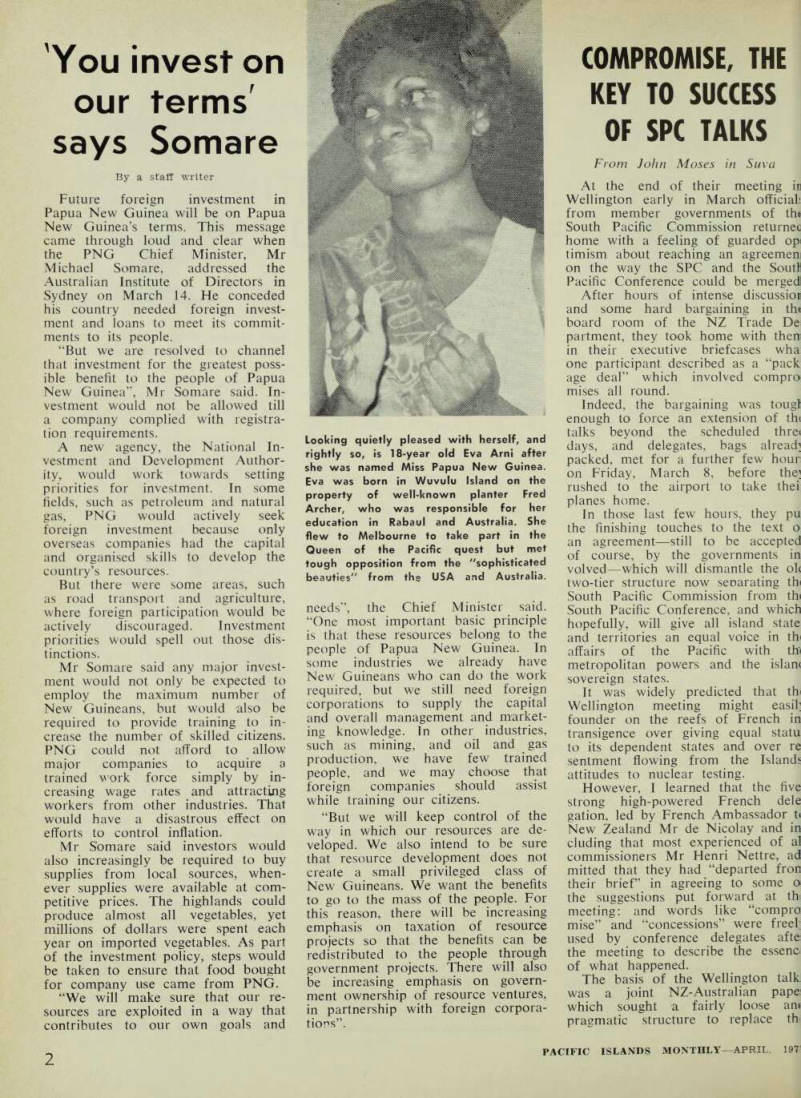
Looking quietly pleased with herself, and rightly so, is 18-year old Eva Arni after she was named Miss Papua New Guinea.
Eva was born in Wuvulu Island on the property of well-known planter Fred Archer, who was responsible for her education in Rabaul and Australia. She flew to Melbourne to take part in the Queen of the Pacific quest but met tough opposition from the "sophisticated beauties" from the USA and Australia.
Compromise, The
Key To Success
Of Spc Talks
From John Moses in Suva At the end of their meeting in Wellington early in March official: from member governments of th« South Pacific Commission returnee home with a feeling of guarded opi timism about reaching an agreemem on the way the SPC and the SoutH Pacific Conference could be mergedl After hours of intense discussion and some hard bargaining in th« board room of the NZ Trade De partment, they took home with then in their executive briefcases wha one participant described as a “pack age deal” which involved compn> mises all round.
Indeed, the bargaining was tougl enough to force an extension of tin talks beyond the scheduled thre* days, and delegates, bags already packed, met for a further few hour on Friday, March 8, before the: rushed to the airport to take thei planes home.
In those last few hours, they pu the finishing touches to the text o an agreement—still to be accepted of course, by the governments in volved—which will dismantle the ole two-tier structure now seoarating thi South Pacific Commission from the South Pacific Conference, and which hopefully, will give all island state and territories an equal voice in th< affairs of the Pacific with thi metropolitan powers and the islanc
sovereign states.
It was widely predicted that th< Wellington meeting might easih founder on the reefs of French in transigence over giving equal statu to its dependent states and over re sentment flowing from the Islands attitudes to nuclear testing.
However, I learned that the five strong high-powered French dele gation, led by French Ambassador U New Zealand Mr de Nicolay and in eluding that most experienced of al commissioners Mr Henri Nettre, ad mitted that they had “departed fron their brief” in agreeing to some o the suggestions put forward at th meeting: and words like “compro mise” and “concessions” were freel; used by conference delegates afte: the meeting to describe the essence of what happened.
The basis of the Wellington talk was a joint NZ-Australian pape: which sought a fairly loose am pragmatic structure to replace th'
1947 Canberra Agreement which established the SPC and which is now clearly out of date, and a basic aim was to convince both the Brit ish and the French that a much more democratic organisation would not be politically embarrassing to them.
In the event, and to the surprise of some of the participants, it was a British submission in reply to the Anzac paper which displayed a cer tain rigidity and insensitivity to Island aspirations, and was couched in the kind of formal and legalistic language the Antipodeans were try ing to avoid.
There was a feeling that Britain’s harder-than-expected line had some thing to do with France’s attitudes on the Common Market: but in any case, British attitudes may very easily be different now that a new government is in power.
Perhaps the most important thing about the Wellington talks, in fact, is what did not happen, rather than what did.
The pessimists felt that under no circumstances would France permit a situation which would give its Paci fic dependencies the right publicly to criticise, in a Pacific forum, the metropolitan power: and that in any case, there were basic constitutional difficulties involved which would give France an excuse for what would amount to a walk-out.
This did not happen, and the pre sence in the French delegation of a constitutional expert suggests that the French are seeking some way of remaining in whatever new organis ation eventually emerges without being pinned down to the kind of constitution and procedures which could create ructions in Paris.
Obviously, there are still difficul ties to overcome, some of them con ceptual, some of them practical: Fiji, for example, has reservations about noting proposals.
Its delegation, headed by Dr Vlacu Salato, reserved its decision m the proposal that the eight parti cipating governments forming the lew Administrative Committee—in essence the old commission—should etain their plural votes, their own md one for each of their dependent erritories. The Fiji Government will lave to decide on that one. It has dways been opposed to the principle.
But in concept, it is a great leap :orward in Pacific affairs that repre ientatives of the metropolitan pow ers, the independent Pacific states md the dependent territories should ie thinking of sitting down together vith equal votes and equal voices— ;ven when the votes and the voices nay be embarrassing to and critical if the non-island powers.
Strange story
of a death dive and a tabu
Did a tabu play a part in a land dive death on Pentecost during the recent royal tour of the New Heb rides or was it an accident? Land diving is known as Gol. John Mark Tabi, about 38, died from in juries received in a land dive on South Pentecost on February 16. He was one of several divers in a Gol exhibition for the Queen. One landed softly in the mud, his fall broken by the vines round his ankles, Tabi broke his spine as the vines snapped and he plunged to the ground. He died two days later.
Inhabitants of South Pentecost, during an investigation into Tabi’s death by Mr Darval Wilkins, a British District Agent, advanced theories which suggested there was something supernatural about the death. Mr Wilkins came to the con clusion there was nothing mysterious —just plain human failing.
South Pentecostians gave Mr Wil kins several explanations, reported the New Hebrides newspaper Nakamal. These included: • Tabi had broken a tabu in in sisting that he jump from a platform (Wagol) constructed by another person (Obid of Ranwash); • The vines selected by Obid, who was small and light, were not suitable for Tabi, a comparatively stocky man; © The Gol site was tabu ground; • There were too many super visors and confusion arose and as a result the vines, which were to be attached to the jumper’s ankles, were not well measured; • Tabi jumped with Massing (love potion). (This was the explan ation given for the death of Barakon of Londible village who died in a similar accident many years ago.) The local inhabitants did not tell Mr Wilkins of the widespread belief that Gol was out of season, when the vines have a greater moisture content and a greater tendency to break. Tabi broke a tabu in using another man’s platform. Obid with drew because he had hurt a knee, but failed to cut down his platform, as he should have done.
Tabi, with two previous jumps behind him, was anxious to take part, and when he heard Obid’s plat form was vacant he disregarded custom and insisted on using the platforms and vines. Tabi’s sister
and other relatives were so con cerned, and so convinced of tragic consequences that they wept loudly as Tabi climbed to the platform.
When the Gol site was chosen it was not mentioned that the ground was tabu. Kilman, the senior Gol supervisor, pointed this out later, but the site had already been cleared and it was too late to look for an other one. The tabu arose because a man died there suddenly and un expectedly many years ago.
A Gol is normally arranged by one region with one supervisor. The Gol for the Queen was complicated because several Church of Christ villages wished to take part as the site was on Church of Christ Miss ion ground. Adherents of the church were anxious to renew active parti cipation in Gol and in custom generally. Mission leaders, since the turn of the century, vigorously banned adherents from taking part in any traditional ceremonies.
The outcome was that there were three senior supervisors—two from the Church of Christ and Kilman.
Kilman was ostensibly in charge, but was often overruled. He took the view there were too many “cooks” and the length of Obid’s ropes was poorly estimated.
There were widespread rumours that Tabi jumped with Massing tucked inside his briefs. It is gener ally accepted that Massing can back fire against the person using it and can destroy him if it is used in the wrong way. Some people said they noticed the Massing but it was not confirmed that Tabi had any.
Mr Wilkins concluded that the accident was caused by a combin ation of factors: • Primarily a misjudgment by the
Continued on p 101
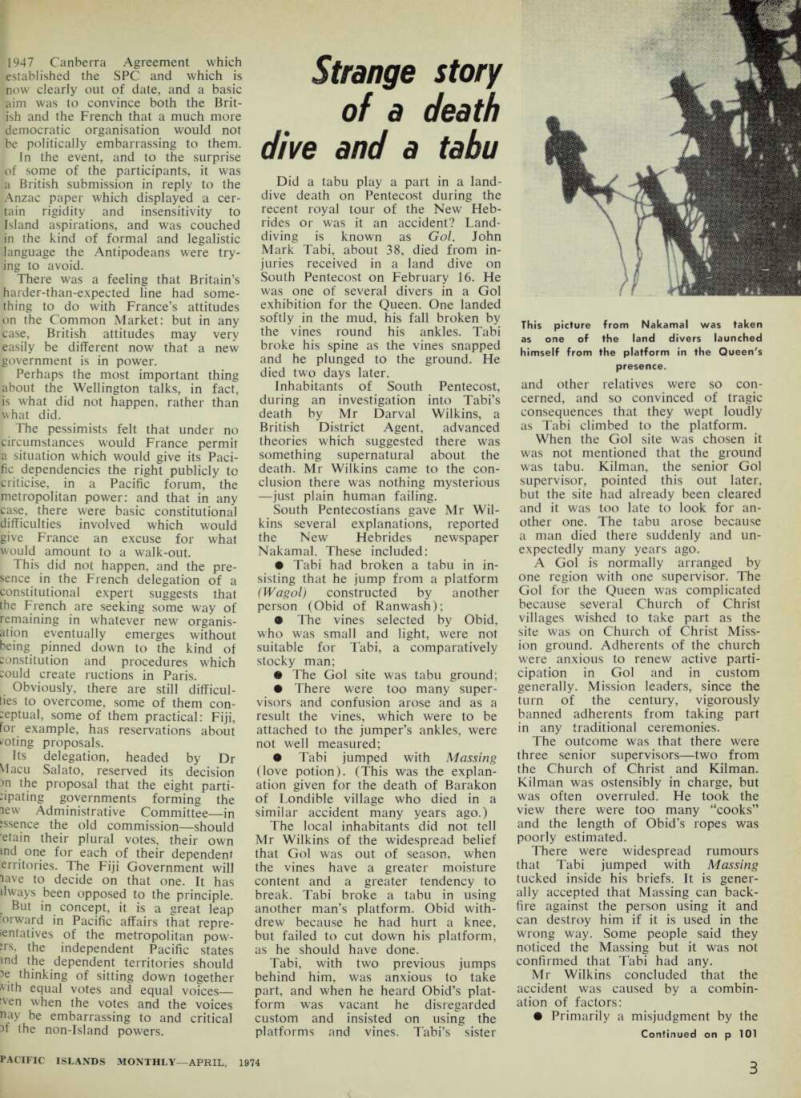
This picture from Nakamal was taken as one of the land divers launched himself from the platform in the Queen's presence.
supervisors (in turn because there were too many of them) of technical details; © The length of the vines and the positioning of the stays supporting the platform, which break when ten sion is applied; O Misjudgment on Tabi’s part in jumping either too far out or too short. (The supervisor indicates to the jumper where he should try to land).
It is traditional on South Pente cost that on the death of a man, gifts are made to the maternal uncle. In this case it was Kilman who had protested against Tabi using Obid’s vacant platform. The other two supervisors paid $2O each to Kilman on tabu ground. Obid was fined for failing to cut down the platform which he had constructed for him self.
The British Administration will offer between $2OO and $250 to Tabi’s family to help in bringing up his children. The money will be used primarily for school fees.
the Solomons big change
Back to party politics for the Solomons big change
From a special correspondent in Honiara
By the time this is published the Solomon Islands will almost cer tainly have chosen their first chief minister and formed their first cabinet within a ministerial system of government.
These changes became likely fol lowing the report of a special select committee on constitutional develop ment which was presented to the Governing Council in November 1972. The report itself was sup posedly put to the test during the general election of May-June 1973 and finally endorsed by the new Governing Council during its first meeting in July.
The constitutional changes mark an important step in the Solomon Islands’ political development. The new Legislative Assembly will have more powers than the old Govern ing Council and it should be able to exercise considerable influence, if not control, over the executives’ activi ties.
On the other hand the formation of a cabinet of ministers, led by the chief minister and presumably com manding the support of a majority of the parliamentarians, will place greater emphasis on executive pow ers than was the case under the old constitution. Undoubtedly it will be some time before the exact nature of the relationship between legis lature and executive is clarified.
Accompanying. but independent
of, the constitutional changes has been the emergence of political par ties. Contrary to some popular opinion, political parties are not new to the Solomon Islands—although successful ones may be. Since Mariano Kelesi and Eric Lawson tried to set up a Democratic Party in 1965, there have been a number of sporadic attempts to organise par liamentary political groups. Peter Salaka’s Labour Party, the more re cent Solomon United National Party led by David Kausimae and even Joe Bryan’s People’s Protection Party are all examples of political parties which never really got off the ground.
The 1973 general election marked the first real upsurge in political party fortunes. Well before the elec tion a group of civil servants, includ ing the president of the Civil Ser vants’ Association, had begun to form a loose association. Although no attempt was made to organise an electoral alliance or to announce any common policies, a certain commit ment was made by the group to seek collectively for more rapid advance ment, particularly political advance ment, for the Solomon Islands.
Out of about 13 election candi dates who had belonged to the civil servants’ group, 10 were successful in the general election. Of equal significance was the defeat of a num ber of the members of the previous
Governing Council, including three
of its five committee chairmen.
Originally, six out of the 24 parlia mentarians elected in the 1973 general election had previous parlia mentary experience, but a successful petition to the High Court and subsequent by-election has now re duced that number to five.
The new Governing Council there fore began life with almost a com pletely new set of faces. From the beginning it became apparent that the old members who had been re elected did not wield much influence over the new members. Initially the ex-civil servants’ group of members behaved with some circumspection and did not immediately seek to organise a political party. A spirit of compromise seemed to be ex pressed in the election of the five committee chairmen, three of whom
came from among the old members.
Unless there are radical changes during March it seems likely that the United Solomon Islands Party will be in a position to control the elec tion of chief minister and the appointment of the cabinet of ministers. In February USIPA re examined its own leadership and elevated Philip Solodia Funifaka into the premier position, suggesting that he will be the party’s nominee for chief ministership. It seems probable, however, that the present senior secretary for social services, Fred Osifelo, will be appointed as the first Speaker of the Legislative Assembly.
As Osifelo and Solodia Funifaka are both from the same part of Malaita, it is likely that USIPA will decide to nominate another one of its lead ers for the position of chief minister.
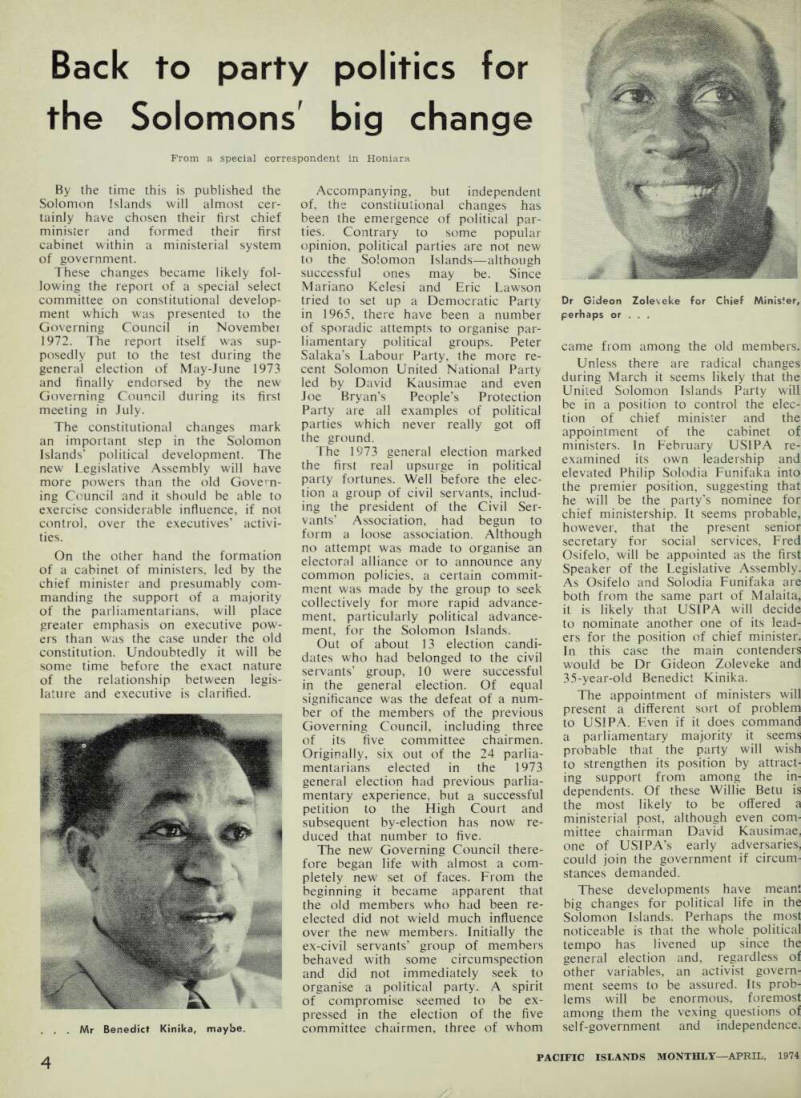
In this case the main contenders would be Dr Gideon Zoleveke and 35-year-old Benedict Kinika.
The appointment of ministers will present a different sort of problem to USIPA. Even if it does command a parliamentary majority it seems probable that the party will wish to strengthen its position by attract ing support from among the in dependents. Of these Willie Betu is the most likely to be offered a ministerial post, although even com mittee chairman David Kausimae, one of USIPA’s early adversaries, could join the government if circum stances demanded.
These developments have meant big changes for political life in the Solomon Islands. Perhaps the most noticeable is that the whole political tempo has livened up since the general election and, regardless of other variables, an activist govern ment seems to be assured. Its prob lems will be enormous, foremost among them the vexing questions of self-government and independence.
... Mr Benedict Kinika, maybe.
Dr Gideon Zoleveke for Chief Minister, perhaps or ...
The Queen Sees Her Islands
By a staff writer
Back in cold old Britain in March, in the centre of a political crisis and a fuel shortage, Queen Elizabeth was warming herself no doubt on the memories of her royal tour of the South Pacific.
She was forced unexpectedly to return to London because of the political crisis, and as a result had to cancel the major part of her Australian tour, and a tour of Indo nesia. But she did complete the month-long Islands sector, which was satisfying for her and the peo ple she visited.
It was something more than a routine royal progress—this visit she made to the Cook Islands, Norfolk Island, the New Hebrides, the Brit ish Solomons and Papua New Guinea. Prince Philip had been urg ing her to do it for years. He himself has travelled widely and mostly well off the beaten track since he and the Queen first visited Tonga and Fiji . together 20 years ago. He’s very well-informed on the Islands, As the Queen said in Port Moresby, “Although this is my first visit to Papua New Guinea, I have been well prepared by my husband, who has been here twice already, and my son, who came here while he was at school in Australia, and I’m delighted to have been able to confirm their glowing accounts for myself”.
Most times on her tour the Queen was accompanied by Philip, Princess Anne and her husband, Captain Mark Phillips, and Lord Louis Mountbatten.
In the Cooks the Queen was greeted by 10,000 warriors, including 100 high ranking chiefs, then borne aloft by burly warriors on an ata, a portable throne reserved for high chiefs and royalty. There was a two seater version for Princess Anne and
Captain Phillips. After welcoming
speeches by High Commissioner, Mr G. Brocklehurst, and Premier, Sir Albert Henry, the Queen knighted Sir Albert in a quick, private cere mony in the old terminal building, attended by only 27 members of the
Henry family.
The next day, she officially opened Rarotonga’s new $l4 million jetport, cautioning the Cook Islanders to guard their traditions against the in fluences of the jet-age world, before flying to the Commonwealth Games at Christchurch—leaving Sir Albert
wondering how to foot the bill for the 28-hour royal visit . . . $40,000.
Perhaps NZ would help?
On Norfolk Island, which has no wharf, the sea was in an exception ally bad temper thanks to the pass ing of cyclone Pam, but skilled boat men descended from the Bounty mutineers got the Queen and her party ashore in 20ft government launches without so much as a wet foot, and ahead of schedule.
Said senior boatman, Richard Douran: “The Queen was a better sailor than half the others we took from the yacht during the day!”
The Royal party picnicked inform ally in the grounds of Government House with about half the island’s population but cancelled dinner and returned early to the Britannia through rising seas, leaving the Ad ministrator, Air Commodore Pickerd, with enough roast lamb to last a month.
A short shipboard spell, then on to Vila where three New Hebrideans, not affiliated with any political party, quietly raised a banner to the Queen reading: “You are not our Queen. We are stateless. We are un protected. We are fed up”—a pretty accurate criticism of the condo minium which didn’t appear to up set anyone. There was concern among the royal party later, how ever, when they witnessed the remarkable Pentecost land divers and saw one man crash head first into the ground when the vines about his ankles broke. He died two days later.
A French writer in a local news paper wrote this about the Queen’s visit to the New Hebrides: “The Empire has crumbled. Indeed the Empire is dead. But the Royal Family remains—for the British, a factor in their stability. But what did the royal family’s visit mean?
For the great majority of New Heb rideans, a warm curiosity”.
And for a select few, an honour bestowed by the Queen. French Resident Commissioner, Mr Robert Langlois, was made an honorary Commander of the Royal Victorian Order; Mr Michael Townsend, As sistant British Resident Commiss ioner, and Mr Anthony Worner, Royal Visit Co-ordinator, were named Members of the order, and Messrs Silas Manggu and Andre Djamouth, both British Residency
staff members, received the Royal Victorian Medal.
Further north in the Solomons there wasn’t just warm curiosity— there was great excitement, large crowds, spirited dancing (mostly in teeming rain) and enthusiastic ex pressions of loyalty.
But the crowds could never equal in size those of Papua New Guinea, where the Queen was clearly wel come, even by those politicians so fervently nationalistic as to be anti white. The royal visit began in Bou gainville where hundreds of spear carrying warriors greeted “Mrs Queen”. The Royal party was greeted by Chief Minister Michael Somare and Australian High Com missioner Les Johnson and intro duced to local leaders and MPs, among them Paul Lapun and Don natus Mola. Absent were Father John Momis, Bougainville’s Regional member and outspoken critic of the Bougainville Copper company, who said, “Sorry, too busy”, and Raphael Bele, the Bougainville Central mem ber who said nothing from his village three miles away!
Unofficially greeting the Queen were a Buka Islander who presented a secessionist petition to intervening hands and a colourful local eccen tric who changed his mind and gave his homemade flag to Mr Somare instead.
On to Rabaul, where a crowd of thousands gave the royal family a subdued welcome—they were dis appointed that the Queen was wear ing street clothes and not a crown and robes!
Then Goroka, where about 8,000 tribesmen who had come from as far as 200 miles away put on the biggest display of finery and war dances seen in the Highlands. Royal cameras clicked away as Asaro mud men, moss men in green fuzz and Tufa men in towering headgear per formed their art. Lord Snowdon will be jealous.
In Port Moresby an estimated
50,000 shouting and waving people
lined the route from the airport to the town. There was no support for the lone voice of Miss Josephine Abaijah, who wanted to make a political issue out of this tour, des cribing it as an affront to the Papuan and nothing but a colonial stunt.
(Pictures over page)
Royal Tour Highlights
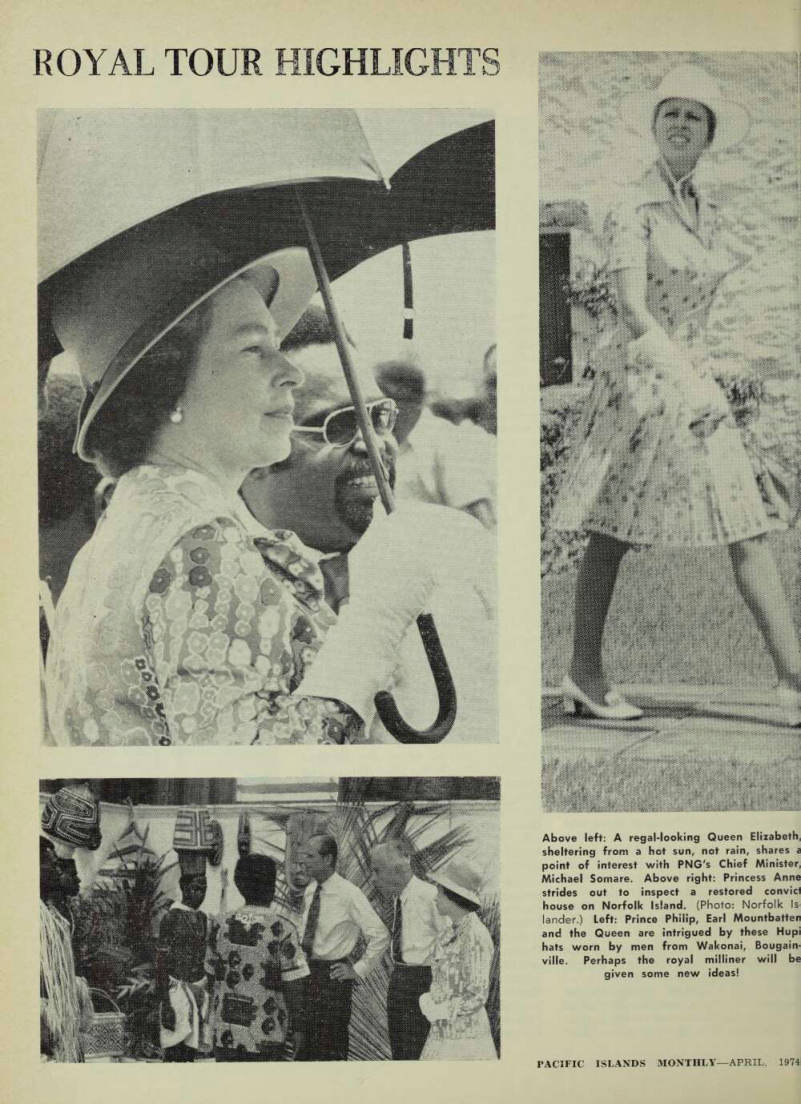
Above left: A regal-looking Queen Elizabeth, sheltering from a hot sun, not rain, shares a point of interest with PNG's Chief Minister, Michael Somare. Above right: Princess Anne strides out to inspect a restored convict house on Norfolk Island. (Photo: Norfolk Is lander.) Left: Prince Philip, Earl Mountbatten and the Queen are intrigued by these Hupi hats worn by men from Wakonai, Bougain ville. Perhaps the royal milliner will be given some new ideas!
Above: In the Solomons the Queen is presented, by many
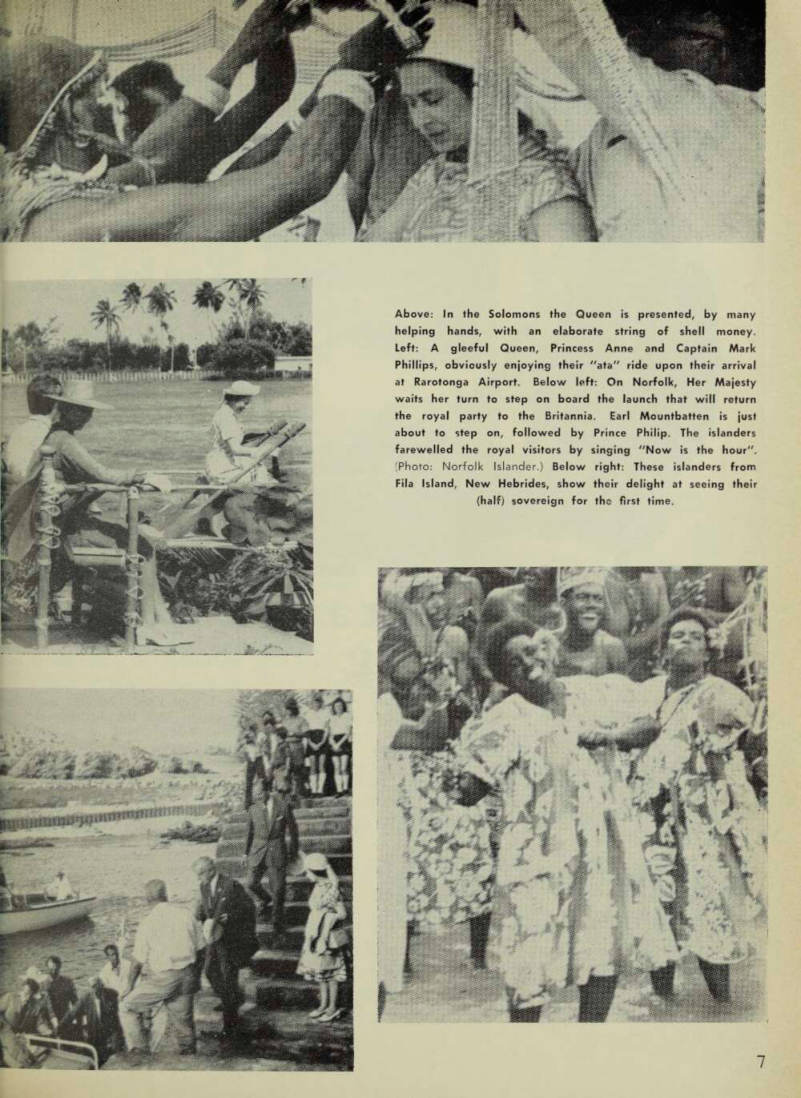
helping hands, with an elaborate string of shell money.
Left: A gleeful Queen, Princess Anne and Captain Mark Phillips, obviously enjoying their "ata" ride upon their arrival at Rarotonga Airport. Below left: On Norfolk, Her Majesty waits her turn to step on board the launch that will return the royal party to the Britannia. Earl Mountbatten is just about to step on, followed by Prince Philip. The islanders farewelled the royal visitors by singing "Now is the hour". (Photo: Norfolk Islander.) Below right: These islanders from Fila Island, New Hebrides, show their delight at seeing their (half) sovereign for the first time.
People
• Ex-PNG Administrator Mr L.
W. Johnson and his wife were given a warm send-off when they left Port) Moresby on March 20 en route for a Hawaiian holiday at the Honolulu home of Professor Frank Johnson, who was a frequent visitor to Govern ment House during his stint at the University of Papua New Guinea.
When the holiday’s over, Mr Johnson will take up his new job as head of the new Australian Development As sistance Agency. He will help to give away more than $360 million of which $2lO million will go to Papua New Guinea. • The Republic of Nauru’s of ficial representative in Australia, Mr Tony Holmes, will move to Sydney in late April to take up a new ap pointment as assistant director of the Australian Federation of Con tractors. He leaves the republic after more than 5i years, first on Nauru as legal officer with the De partment of Justice, and as official representative in Melbourne for the last 2i years. His successor has not yet been selected, but the tipping is that he will be a Nauruan national. • Mr Justice Clifford Grant, an Englishman, has been appointed Chief Justice of Fiji, succeeding Sir John Nimmo, who retired in Feb ruary. Almost immediately after his appointment, Mr Justice Grant left Fiji on leave. In his place, Mr Justice Timoci Tuivaga, was named as acting Chief Justice, the first Fijian to hold the highest judicial office in the country. • Nauru’s first lawyer from the island nation’s own ranks is Mr Leo Keke, recently admitted as barrister and solicitor by the supreme court of the Australian Capital Territory, Canberra. Mr Keke graduated in law at the end of last year from the University of Tasmania and is expected to spend a year with a law firm in Melbourne before taking up a post with the republic. He is a brother of Nauru’s first university graduate, dentist Ludwig Keke. • Mr Brian Holloway, who began a career as a police officer in South Australia, and went to Papua New Guinea in 1948 as an assistant sub inspector has been appointed PNG’s new Commissioner of Police, suc ceeding Mr N. A. M. Nicholls, who will retire in May,
Advertisements & other items, p. 14 (1 item)
heavily insured,relax.
When your business is
And prepare for a
rude awakening.
Having your operation heavily
insured is no guarantee of real security. You may be overinsured in some areas —and dangerously underinsured in others, ('all Bain Dawes. We’ll study your whole operation and see just where you’re exposed to risk. Then we’ll advise you how to minimise (and in some cases, eliminate) those risks, and arrange a balanced insurance plan that will give you real protection at the lowest possible price. Call us today for a
preliminary talk.
Insurance Brokers and Risk Management Consultants
Bam Dawes
formerly Harvey Trinder
Hunter Street, Port Moresby. Phone 2241.
And at Sydney, Newcastle, Melbourne, Brisbane, Adelaide, Perth, Hobart, Launceston.
UNITED KINGDOM, EUROPE, NORTH AMERICA, NEW ZEALAND.
BD4/7115CLHM
French wield
a big stick in N. Hebrides
From a Vila correspondent
French High Commissioner J-G Eriau summoned a riot squad of gendarmes to the New Hebrides in March only hours after demonstrat ors greeted his own arrival in Vila.
About 50 gendarmes with helmets, arms and shields flew out of Nou mea at 4.30 am on March 7 aboard two naval planes. The previous morning, the High Commissioner’s motorcade was stopped in Vila by a road block of almost 300 peo ple, some carrying axes and cane fcnives. Mr Eriau, who is also Governor of New Caledonia, was making his first official three-day yisit to the New Hebrides since assuming office in Noumea in fanuary.
The demonstrators, from the Isle if Fila, were contesting ownership )f the Frouin family concession. The irotestors had begun fencing in the jroperty with barbed wire. They :leared the road after Mr Eriau got >ut of his car to talk to them.
Earlier, as the French official left Bauerfield airfield, about 100 young )eople claiming to be the Syndicate )f New Hebridean Workers held ban ters demanding tighter control of trices. Reaction to this movement vas swift, since the British and 7 rench Residencies promptly an tounced their decision to set up a ystem of price controls in the con lominium.
As far as the land rights demon tration was concerned, the French •ress quoted Mr Eriau as saying he lad been greeted “in rather un xpected fashion” by “a band of
boys strangely attired”. He added: “We do not intend to let people take justice into their own hands”. The High Commissioner referred to talks scheduled soon in London between French and British authorities. The three most important subjects of discussion would be the creation of municipalities, judicial reform and an extension of the part played by the Advisory Council.
Meanwhile, in the expectation of further demonstrations, the French temporarily flew in their gardes mobiles (riot squad) with the con sent of their British partners in the condominium.
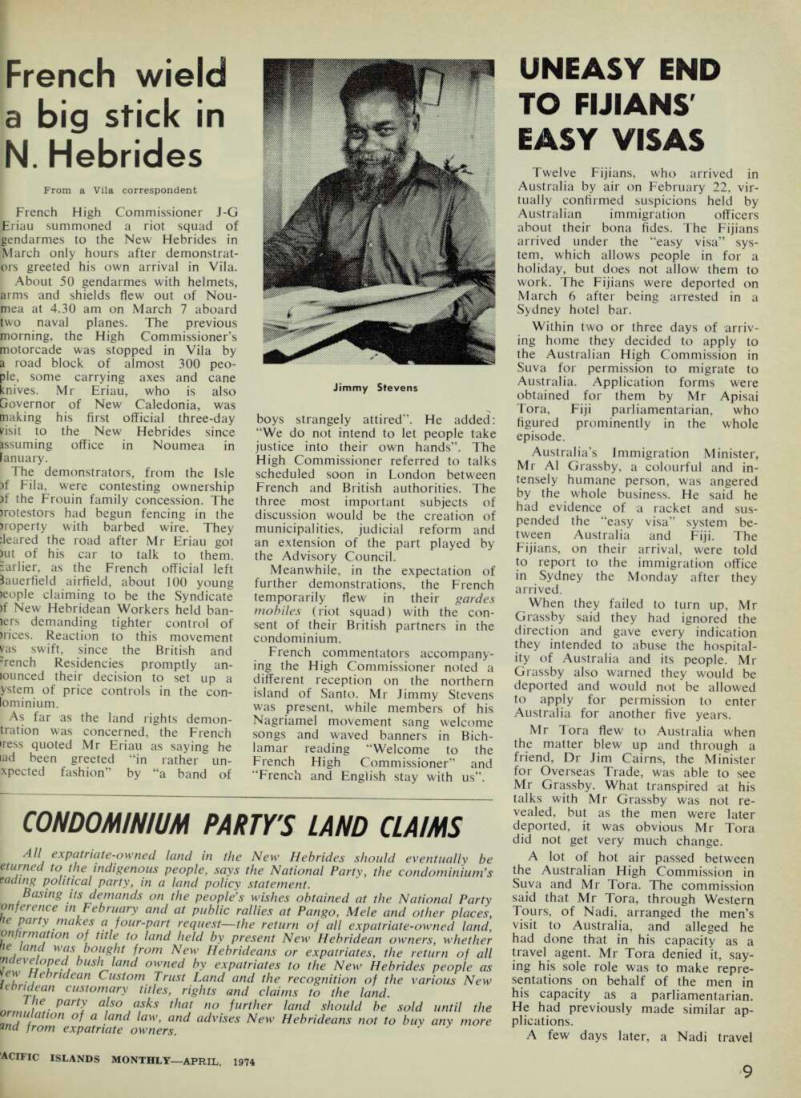
French commentators accompany ing the High Commissioner noted a different reception on the northern island of Santo. Mr Jimmy Stevens was present, while members of his Nagriamel movement sang welcome songs and waved banners in Bich lamar reading “Welcome to the French High Commissioner” and “French and English stay with us”.
Jimmy Stevens
Condominium Party's Land Claims
All expatriate-owned land in the New Hebrides should eventually be eturned to the indigenous people, says the National Party, the condominium's eadmg political party, in a land policy statement.
Basing its demands on the people’s wishes obtained at the National Party conference in February and at public rallies at Pango, Mele and other places, e party makes a four-part request—the return of all expatriate-owned land, nfirmation of title to land held by present New Hebridean owners, whether ; W j s ,bought from New Hebrideans or expatriates, the return of all bust L land ™ned by expatriates to the New Hebrides people as / a Hebridean Custom Trust Land and the recognition of the various New iebndean customary titles, rights and claims to the land. nrJnir Part l aso “ sks that no . f urther land should be sold until the „„ i f atlon °f a land law, and advises New Hebrideans not to buy any more ana from expatriate owners.
Uneasy End
To Fijians'
Easy Visas
Twelve Fijians, who arrived in Australia by air on February 22, vir tually confirmed suspicions held by Australian immigration officers about their bona fides. The Fijians arrived under the “easy visa” sys tem, which allows people in for a holiday, but does not allow them to work. The Fijians were deported on March 6 after being arrested in a Sydney hotel bar.
Within two or three days of arriv ing home they decided to apply to the Australian High Commission in Suva for permission to migrate to Australia. Application forms were obtained for them by Mr Apisai Tora, Fiji parliamentarian, who figured prominently in the whole episode.
Australia’s Immigration Minister, Mr A1 Grassby, a colourful and in tensely humane person, was angered by the whole business. He said he had evidence of a racket and sus pended the “easy visa” system be tween Australia and Fiji. The Fijians, on their arrival, were told to report to the immigration office in Sydney the Monday after they arrived.
When they failed to turn up, Mr Grassby said they had ignored the direction and gave every indication they intended to abuse the hospital ity of Australia and its people. Mr Grassby also warned they would be deported and would not be allowed to apply for permission to enter Australia for another five years.
Mr Tora flew to Australia when the matter blew up and through a friend, Dr Jim Cairns, the Minister for Overseas Trade, was able to see Mr Grassby. What transpired at his talks with Mr Grassby was not re vealed, but as the men were later deported, it was obvious Mr Tora did not get very much change.
A lot of hot air passed between the Australian High Commission in Suva and Mr Tora. The commission said that Mr Tora, through Western Tours, of Nadi, arranged the men’s visit to Australia, and alleged he had done that in his capacity as a travel agent. Mr Tora denied it, say ing his sole role was to make repre sentations on behalf of the men in his capacity as a parliamentarian.
He had previously made similar ap plications.
A few days later, a Nadi travel
Advertisements & other items, pp. 15-16 (2 items)
9
ACIFIC ISLANDS MONTHLY—APRIL, 1974
Water
A \V
AQUA GENIE
Out-performs anything in its price range! Only $l3O HYDRO-PAK (Left) from $325 TWIN-PAK (Above) from $360 New RM2 range of shallow and deep well models, capacities to 1180 g.p.h., pressures to 75 p.s.i.
Australia’s largest and most advanced range of
WATER
PRESSURE
SVSTEfIIS
From only $l3O
ECON-O-JET
Packaged water systems.
From Only $lB9 I i m m ft I l. ‘J” Series High Pressure Unit Range of multi-stage deep and shallow well capacities models, from 200 to 2600 g.p.h., pressures from 20 toi2o p.s.i., depths to 300 ft. From $453
fcl
Water Equipment Catalogue 288 Pages—covers pumps of all types, irrigation, water conditioning, domestic and commercial pool filtration. Price $2, post Uee surface mail (enclose cheque/ money order) VIC.: DUNLOP/IBC LTD., 795 Springvale Rd., Mulgrave, 3170. Ph. 560-6222; N.S.W.: FLEXHIDE PT Y - LTD^ 536 Botany Rd., Alexandria, 2015. Ph. 699-8444;TRUFLEX PTY. LTD., 990 Hunter St., Newcastle W., 2302. Ph.
69-1688; OLD.: DUNLOP/IBC LTD., Station Rd.,
Yeerongpilly, 4105. Ph. 40-9011; S.A : DUNLOP/IBC LTD., 98 Churchill Rd., Prospect, 5082. Ph. 44-6944.
NAME
ADDRESS.
PHONE Jj
rediscoverino water
Easy Visas
agency, Speedways International, confirmed it had issued tickets for the 12 men to go to Australia. The tickets were given to Mr Tora who presented passports and valid Aust ralian visas for the 12 men.
That tended to cloud the main ‘ issue—that the 12 men, by their actions, had made it more difficult for Fiji people to get into Australia for holidays. It was quite natural that Australia would call for more detailed investigations of the bona tides of potential holiday-makers.
Under the “easy visa” system, all applicants have to do is sign a de claration, which includes an un i supnorted statement that they have enough money to support themselves during their stay in Australia.
Mr Tora, speaking in Melbourne, said the deportation proved that the “White Australia policy” and its discrimination against coloured peo ple was still alive and kicking. He challenged Mr Grassby to a public debate about the policy. He made no remark about Australia, like any other country, having the right to decide its own immigration policy.
On his return to Fiji he accused the Australian immigration officers of thumping the table and being abusive to the Fijians. It sub sequently transpired that language was the main barrier, and once an interpreter was secured the inter views went along smoothly.
Mr Grassby in the Australian Parliament eight days after the men were returned to Fiji, said the Fijians had come to Australia under false pretences, and said that Mr Tora had arranged for them to come to Australia through a travel agency of which he was a director. The group had admitted that Mr Tora arranged for them to have return tickets on the basis of a later repayment to Mr Tora.
Mr Grassby said the deportation of the group was essential, to protect them from years of exploitation and to protect the standards of living and employment in Australia.
Australia rejected the “exploiters of our region” who kept victims in a lifetime of bondage to pay for return fares they never had, and for ac commodation of up to 17 in a room.
Statements by Mr Tora that Aus tralia had two sets of immigration standards and that the 12 men would have been treated differently had they been white, were “utterly false”, Mr Grassby said.
Advertisements & other items, pp. 17-18 (1 item)
New Loveliness
for yonr skin
Keeping your complexion beautiful is essentially your own responsibility.
Only you can give your skin the vital beauty care it needs. Only you can resolve to keep it young and pretty by giving it the beauty benefits of a unique tropically moist oil blend.
Oil of Ulan, with its tremendous potential to help prevent wrinkledryness, can do much to ward off those tiny age lines a woman fears most. Because this unique beauty fluid enjoys complete compatibility with the skin’s own natural fluids, it helps to balance those precious “Liquid” assets of combined oil and moisture that gives the complexion its youthful softness and bloom.
Almost every skin has a moisture problem, and this unique beauty fluid can help to solve this very important aspect of complexion care. It is natural for the moisture content of the outer layer to evaporate constantly, but, when your skin is subjected to harsh climatic conditions the evaporation rate speeds up. Tiny lines, and flaky patches will appear prematurely unless there is some form of relief for the thirsty, parched skin.
Oil of Ulan assists in providing this relief, by supplementing the natural oil and moisture and helping protect the skin’s outer layer against wrinkle dryness. This helps nature to maintain the dew-fresh look that gives your complexion its youthful bloom.
A film of Oil of Ulan smoothed aver the face and neck will greatly help to protect your skin from the depletory effect of artificial indoor environments and natural elements such as wind and sun.
This moist oil blend provides an ideal beautifying base for make-up, and at the same time brings out the best in your complexion. By smoothing this beauty fluid on morning and night, your complexion gains smoothness and loveliness.
From the earliest teens, through middle age to the later years, a beautiful complexion can be the living proof of your daily devotion. Pledge the remarkable beauty benefits of Oil of Ulan (which is available from pharmacies and beauty counters) to your complexion today.
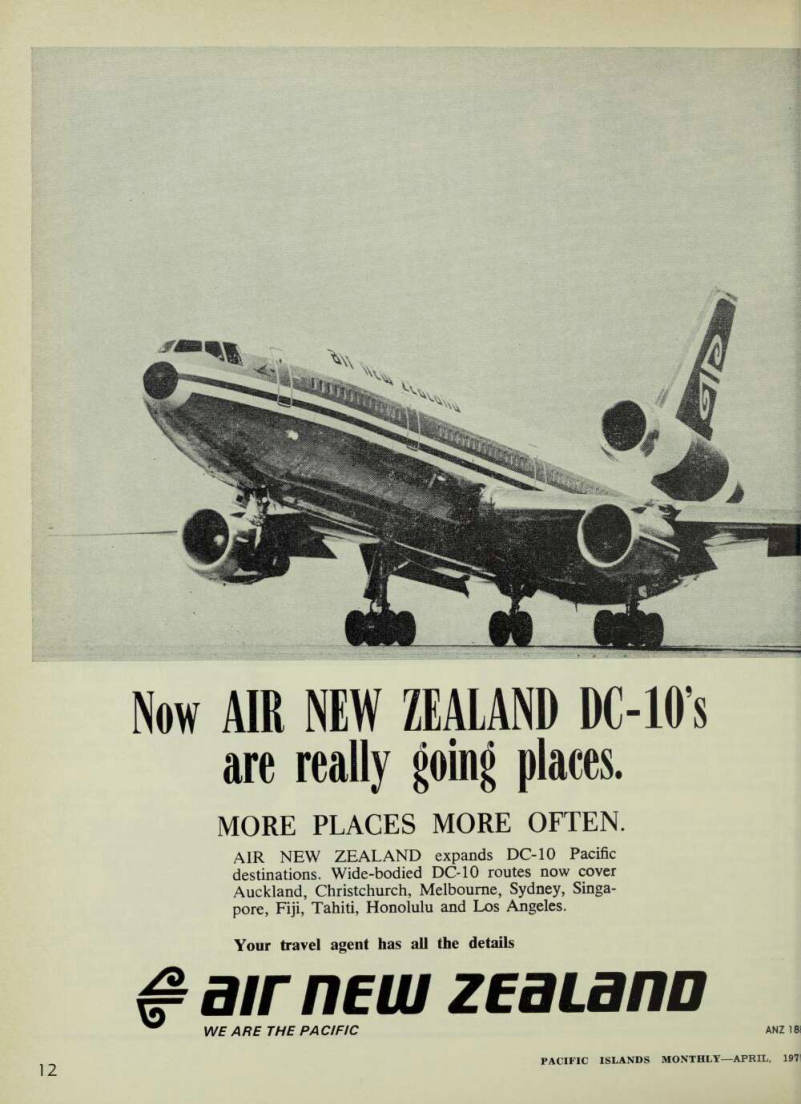
Now MR NEW ZEMAND DC-lO’s
are really going places.
MORE PLACES MORE OFTEN.
AIR NEW ZEALAND expands DC-10 Pacific destinations. Wide-bodied DC-10 routes now cover Auckland, Christchurch, Melbourne, Sydney, Singapore, Fiji, Tahiti, Honolulu and Los Angeles.
Your travel agent has all the details
air new ZEaiano
V WE ARE THE PAC/F/C
Tropicalities
Fiji’s btisv
ambassadors
in i\ew Guinea
Until recent years, Papua New Guinea’s doctors, dentists and other medical staff were trained at the Fiji School of Medicine. In an amazingly short space of years, many of these people have come to leading positions in Papua New Guinea. During their time in Fiji they made many friends, who have since become significant political connections, but many of them also acquired Fiji-born wives who have done a great deal to increase
inter-Pacific understanding.
The many Fijian and part-Fijian wives, and a handful of Fijian men in Port Moresby have formed a Viti Club which is very active and which supports members in times of dif ficulty. Even though many of the wives have been in New Guinea for up to 20 years, they still retain strong links with Fiji. For example, when hurricane Bebe struck the group in 1972, they organised a fund-raising campaign and sent $720 to the Prime Minister’s Hurricane Relief Fund. Just recently they again organised a col lection for the victims of hurricane Lottie and have sent $512 to the Prime Minister’s Hurricane Relief Fund for that purpose.
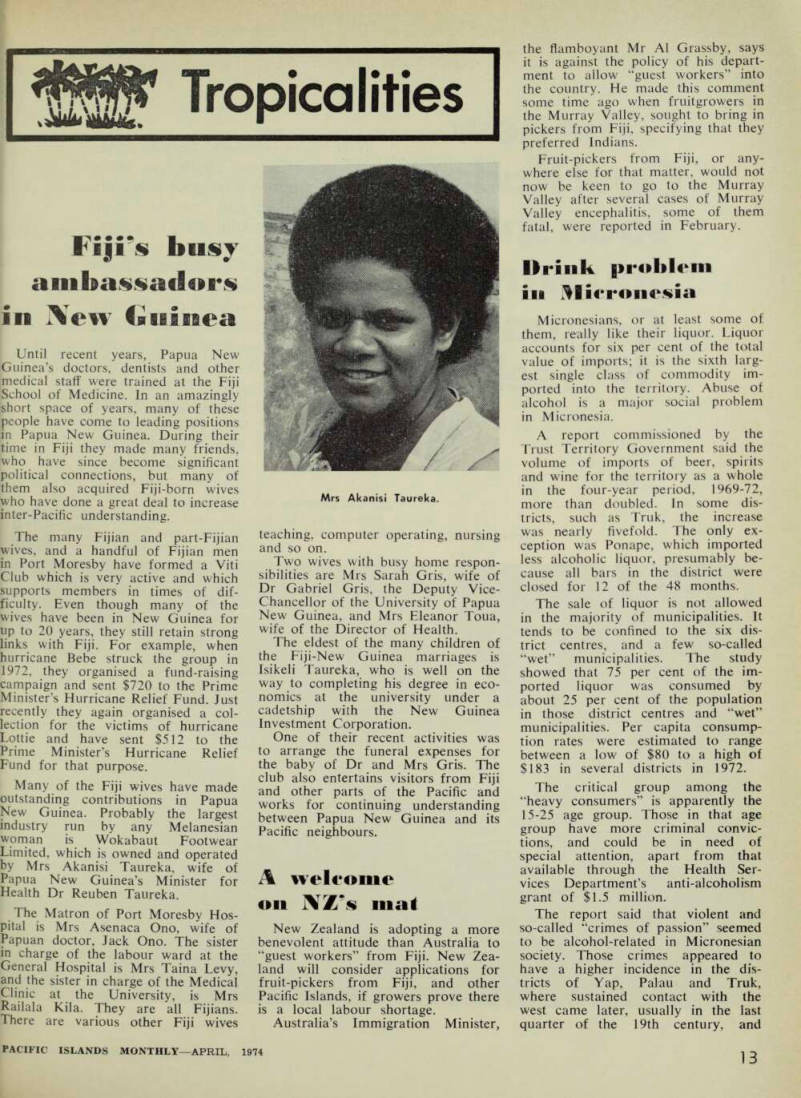
Many of the Fiji wives have made outstanding contributions in Papua New Guinea. Probably the largest industry run by any Melanesian woman is Wokabaut Footwear Limited, which is owned and operated by Mrs Akanisi Taureka, wife of Papua New Guinea’s Minister for Health Dr Reuben Taureka.
The Matron of Port Moresby Hos pital is Mrs Asenaca Ono, wife of Papuan doctor, Jack Ono, The sister in charge of the labour ward at the General Hospital is Mrs Taina Levy, and the sister in charge of the Medical Clinic at the University, is Mrs Railala Kila. They are all Fijians.
There are various other Fiji wives
teaching, computer operating, nursing and so on.
Two wives with busy home respon sibilities are Mrs Sarah Gris, wife of Dr Gabriel Gris, the Deputy Vice- Chancellor of the University of Papua New Guinea, and Mrs Eleanor Toua, wife of the Director of Health, The eldest of the many children of the Fiji-New Guinea marriages is Isikeli Taureka, who is well on the way to completing his degree in eco nomics at the university under a cadetship with the New Guinea Investment Corporation.
One of their recent activities was to arrange the funeral expenses for the baby of Dr and Mrs Gris. The club also entertains visitors from Fiji and other parts of the Pacific and works for continuing understanding between Papua New Guinea and its Pacific neighbours.
A welcome
on NZ's mat New Zealand is adopting a more benevolent attitude than Australia to “guest workers” from Fiji. New Zea land will consider applications for fruit-pickers from Fiji, and other Pacific Islands, if growers prove there is a local labour shortage.
Australia’s Immigration Minister,
the flamboyant Mr A 1 Grassby, says it is against the policy of his depart ment to allow “guest workers” into the country. He made this comment some time ago when fruitgrowers in the Murray Valley, sought to bring in pickers from Fiji, specifying that they preferred Indians.
Fruit-pickers from Fiji, or any where else for that matter, would not now be keen to go to the Murray Valley after several cases of Murray Valley encephalitis, some of them fatal, were reported in February,
II rink problem
in Micronesians, or at least some of them, really like their liquor. Liquor accounts for six per cent of the total value of imports; it is the sixth larg est single class of commodity im ported into the territory. Abuse of alcohol is a major social problem in Micronesia.
A report commissioned by the Trust Territory Government said the volume of imports of beer, spirits and wine for the territory as a whole in the four-year period, 1969-72, more than doubled. In some dis tricts, such as Truk, the increase was nearly fivefold. The only ex ception was Ponape, which imported less alcoholic liquor, presumably be cause all bars in the district were closed for 12 of the 48 months.
The sale of liquor is not allowed in the majority of municipalities. It tends to be confined to the six dis trict centres, and a few so-called “wet” municipalities. The study showed that 75 per cent of the im ported liquor was consumed by about 25 per cent of the population in those district centres and “wet” municipalities. Per capita consump tion rates were estimated to range between a low of $BO to a high of $lB3 in several districts in 1972.
The critical group among the “heavy consumers” is apparently the 15-25 age group. Those in that age group have more criminal convic tions, and could be in need of special attention, apart from that available through the Health Ser vices Department’s anti-alcoholism grant of $1.5 million.
The report said that violent and so-called “crimes of passion” seemed to be alcohol-related in Micronesian society. Those crimes appeared to have a higher incidence in the dis tricts of Yap, Palau and Truk, where sustained contact with the west came later, usually in the last quarter of the 19th century, and
Mrs Akanisi Taureka.
Advertisements & other items, pp. 20-24 (1 item)
Opel Kadett
The new
soon shows
you why it’s
Germany’s
N°l seller.
In its native Germany, despite some pretty famous opposition, more people are now buying Opel Kadett than any other car. And their reasons could easily be yours.
Clean and modern styling.
Roomy, relaxing interiors. Tuned suspension. Robust and responsive engines. Rack-and-pinion steering.
Miserly petrol consumption, low maintenance costs. Kadett puts all this and more together.
And does it beautifully. 2-door or 4-door sedans. 3-door CarA Van. Or the dashing Kadett coupe. One of them should be your next car.
See and drive the new Opel Kadett at Joseph Cheval and Cie., Noumea, New Caledonia.
Sociedade Agricola Patria e Trabalho, Lda, Dili, Portugese Timor.
LaiWoa, Papeete, Tahiti.
S' % K A 648
'So this is a Lamborghini, 1 she breathed, as we sped down the autostrada towards Thrin.
“Yes,” I said, offering her a Benson and Hedges. “Five forward gears and 170 in top.”
“Can you prove that?” she demanded.
“Do I really have to? You did say you only wanted a little car to do the shopping.” & m / W mt w 0w Benson & When onlvlhe best will do. -mKJm 016 P 3408 6 73
serve simply with SAO
Arnott’s Sao biscuits are the handiest cracker biscuits you can buy. No sooner is one pack finished than you’re opening another. They’re always fresh and ready when you want them, pack after pack. Just take anything you fancy and...
rnott'S "" Biscuits
There is no Substitute for Quality
drinking Tahitians
more abruptly; and also where the clash between traditionally-expected behaviour patterns and so-called western values was most acute.
Evidence from the Marianas and to a lesser extent, the Marshalls, suggested the exposure to alterna tives of using alcohol could, in time, produce alternative behaviours, which would be less threatening so cially, and less physically hazardous.
Those beer
drinking Tahitians
The French press in the Pacific has noted with surprise that French Polynesia last year consumed a total af 90,000 hectolitres of beer (2 mil lion gallons). Beer has become so popular that it is reported to “often pass into the housewife’s shopping basket ahead of milk, bread or meat”. The overall intake means that an the average every adult is drink ing over a pint of beer per day, and there are some who don’t touch i drop.
Local brews are most popular, vith brands such as Hinano, Manuia md Vahine amounting to 77,483 lectolitres (1 hectolitre = 100 litres = 180 pints).
Imported beers totalled 12,234 lectolitres last year. Small quantities :ame from the USA (34,914 litres) md New Zealand (84 litres). The /alue of this imported beer was CFP 51 million (about $A430,000 in 1973).
While the consumption of im icrted beer rose about 5,000 hecto litres, there was a decided drop of 2,600 hectolitres in locally-produced brew. The situation for Tahitian breweries is expected to improve this pear, however, in view of the in :reased import taxes being applied to overseas beer.
In the meantime, the matter opens up a field of research to any socio logist who may wish to study the possible relationships between this tendency towards non-French drink ing habits and the move for internal autonomy.
New Caledonia’s
bronze insult
A plaque depicting Melanesian warriors handing over their arms to French masters continues to stand in Noumea central park as a bone of contention between young Caledo nians and the French authorities.
The bronze plaque is attached to the pedestal of a statue of Admiral
Olry, an early governor of the colony.
In his recent book, New Caledonia in the Heyday of Postcards (PIM, March, p 71), Patrick O’Reilly includes a photo of the statute with the remark that “this bronze plaque has recently been transferred to a discreet corner of the town’s museum”.
However, a walk through the park in February showed the offending plaque still in place. A petition was then being circulated by the militant Melanesian Foulards Rouges and the Union of Caledonian Youth (UJC), demanding the removal of the plaque which they claim is an insult to the Canaque people and Caledonians generally, a denial of fraternity and equality and an insulting portrayal of racial submission of black man to white.
Agitation for removal of the plaque was raised in the Territorial Assembly in 1972.
A thorn in
Sir Albert's side
Leader of the Cook Islands par liamentary Opposition Tom Davis and his Democratic Party have jab bed another thorn into the side of Premier Sir Albert Henry and the ruling Cook Islands Party. The thorn is a new newspaper, Demo cratic News, which by the end of January, had appeared twice.
A six-page cyclostyled publication in a style almost identical with that of the Cook Islands News, Demo cratic News doesn’t pull its punches.
A two-edged weapon —it comes in English and Maori—it puts the boot into Sir Albert’s administration with
articles headlined “Audit Report 1971”, “Government as static as fruit prices”, “No encouragement for our people” and “Who fouled the fuel shortage?”
One item alleges that “Anybody who is not a supporter of the Cook Islands Party is being subjected to discrimination and victimisation.
Every way in which they try to im prove their position is blocked and thwarted by a system of licences and controls and outright intimida tion. This is being done on an island and an individual basis. At least one overseas company has been told in plain language that if it sympathises with the Democratic Party, it would receive nothing but hostility from the Government. How can our people progress when the present Govern ment deliberately sets out to divide our country and keep it divided”.
An unusual feature of the new newspaper is its frequent use of poetry, some of it pointedly direct, and some obscure to all but those in the know.
Over the years, the Democratic News has had several predecessors dating back to the battles of Te Torea and loi Karanga, which filled the role in turn in the Moss ad ministration (PIM, Feb p 57). Te Akatauira (The Morning Star) which was published on Rarotonga by Albert Henry and Willie Watson, served as a political sounding board for the former, who was just be ginning a career largely in opposi tion to the NZ administration. Its life extended from 1936 until the early years of World War II when it came under NZ censorship and ceased publication.
Democratic News could provide
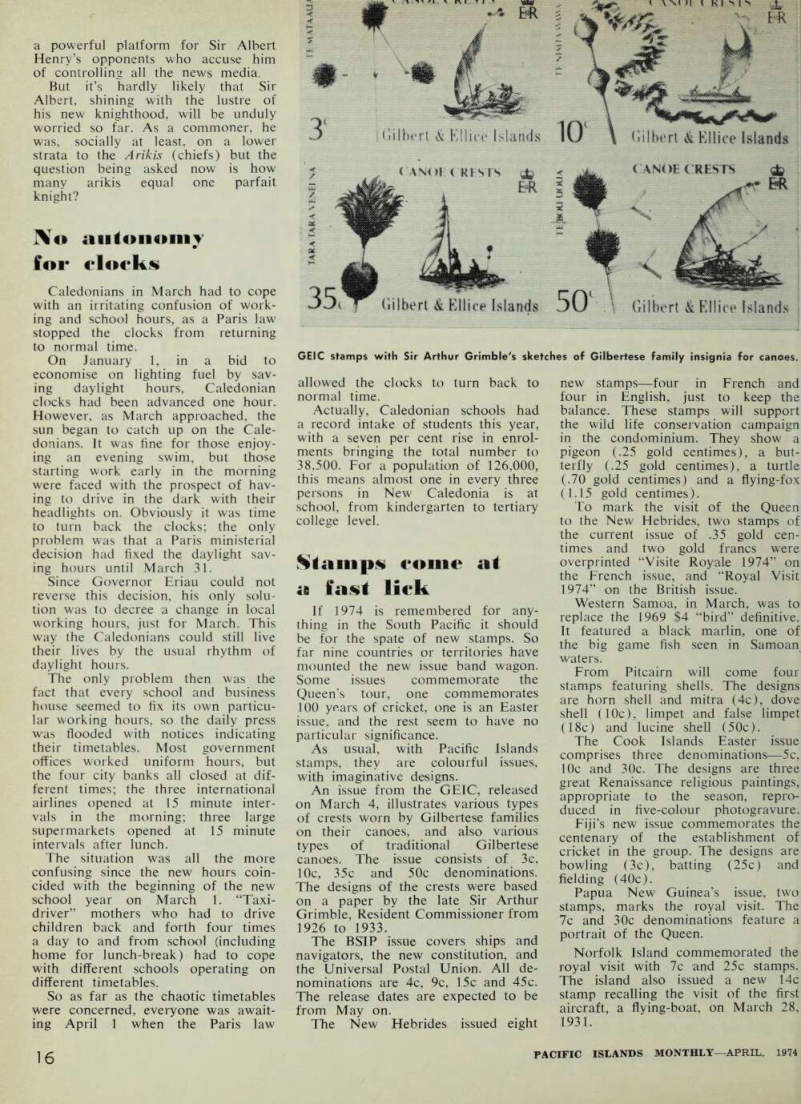
Dr Tom Davis.
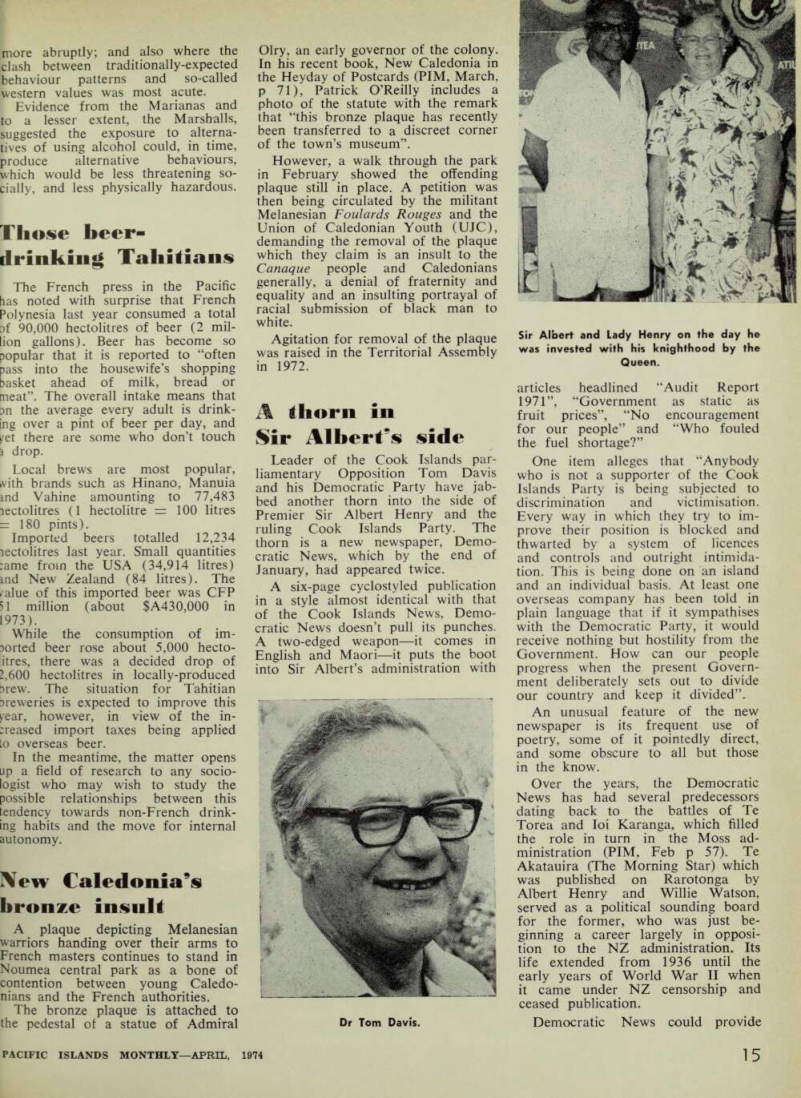
Sir Albert and Lady Henry on the day he was invested with his knighthood by the Queen.
a powerful platform for Sir Albert Henry’s opponents who accuse him of controlling all the news media.
But it’s hardly likely that Sir Albert, shining with the lustre of his new knighthood, will be unduly worried so far. As a commoner, he was, socially at least, on a lower strata to the Arikis (chiefs) but the question being asked now is how many arikis equal one parfait knight?
No autonomy
for rlorks
Caledonians in March had to cope with an irritating confusion of work ing and school hours, as a Paris law stopped the clocks from returning to normal time.
On January 1, in a bid to economise on lighting fuel by sav ing daylight hours, Caledonian clocks had been advanced one hour.
However, as March approached, the sun began to catch up on the Cale donians. It was fine for those enjoy ing an evening swim, but those starting work early in the morning were faced with the prospect of hav ing to drive in the dark with their headlights on. Obviously it was time to turn back the clocks; the only problem was that a Paris ministerial decision had fixed the daylight sav ing hours until March 31.
Since Governor Eriau could not reverse this decision, his only solu tion was to decree a change in local working hours, just for March. This way the Caledonians could still live their lives by the usual rhythm of daylight hours.
The only problem then was the fact that every school and business house seemed to fix its own particu lar working hours, so the daily press was flooded with notices indicating their timetables. Most government offices worked uniform hours, but the four city banks all closed at dif ferent times; the three international airlines opened at 15 minute inter vals in the morning; three large supermarkets opened at 15 minute intervals after lunch.
The situation was all the more confusing since the new hours coin cided with the beginning of the new school year on March 1. “Taxi driver” mothers who had to drive children back and forth four times a day to and from school (including home for lunch-break) had to cope with different schools operating on different timetables.
So as far as the chaotic timetables were concerned, everyone was await ing April 1 when the Paris law
allowed the clocks to turn back to normal time.
Actually, Caledonian schools had a record intake of students this year, with a seven per cent rise in enrol ments bringing the total number to 38,500. For a population of 126,000, this means almost one in every three persons in New Caledonia is at school, from kindergarten to tertiary
college level.
Stamps 4*ome at
a fast lick
If 1974 is remembered for any thing in the South Pacific it should be for the spate of new stamps. So far nine countries or territories have mounted the new issue band wagon.
Some issues commemorate the Queen’s tour, one commemorates 100 years of cricket, one is an Easter issue, and the rest seem to have no
particular significance.
As usual, with Pacific Islands stamps, they are colourful issues,
with imaginative designs.
An issue from the GEIC, released on March 4, illustrates various types of crests worn by Gilbertese families on their canoes, and also various types of traditional Gilbertese canoes. The issue consists of 3c, 10c, 35c and 50c denominations.
The designs of the crests were based on a paper by the late Sir Arthur Grimble, Resident Commissioner from 1926 to 1933.
The BSIP issue covers ships and navigators, the new constitution, and the Universal Postal Union. All de nominations are 4c, 9c, 15c and 45c.
The release dates are expected to be from May on.
The New Hebrides issued eight
new stamps—four in French and four in English, just to keep the balance. These stamps will support the wild life conservation campaign in the condominium. They show a pigeon (.25 gold centimes), a but terfly (.25 gold centimes), a turtle (.70 gold centimes) and a flying-fox (1.15 gold centimes).
To mark the visit of the Queen to the New Hebrides, two stamps of the current issue of .35 gold cen times and two gold francs were overprinted “Visite Royale 1974” on the French issue, and “Royal Visit 1974” on the British issue.
Western Samoa, in March, was to replace the 1969 S 4 “bird” definitive.
It featured a black marlin, one of the big game fish seen in Samoan waters.
From Pitcairn will come four stamps featuring shells. The designs are horn shell and mitra (4c), dove shell (10c), limpet and false limpet (18c) and lucine shell (50c).
The Cook Islands Easter issue comprises three denominations—sc, 10c and 30c. The designs are three great Renaissance religious paintings, appropriate to the season, repro duced in five-colour photogravure.
Fiji’s new issue commemorates the centenary of the establishment of cricket in the group. The designs are bowling (3c), batting (25c) and fielding (40c).
Papua New Guinea’s issue, two stamps, marks the royal visit. The 7c and 30c denominations feature a portrait of the Queen.
Norfolk Island commemorated the royal visit with 7c and 25c stamps.
The island also issued a new 14c stamp recalling the visit of the first aircraft, a flying-boat, on March 28, 1931.
GEIC stamps with Sir Arthur Grimble's sketches of Gilbertese family insignia for canoes.
fight an
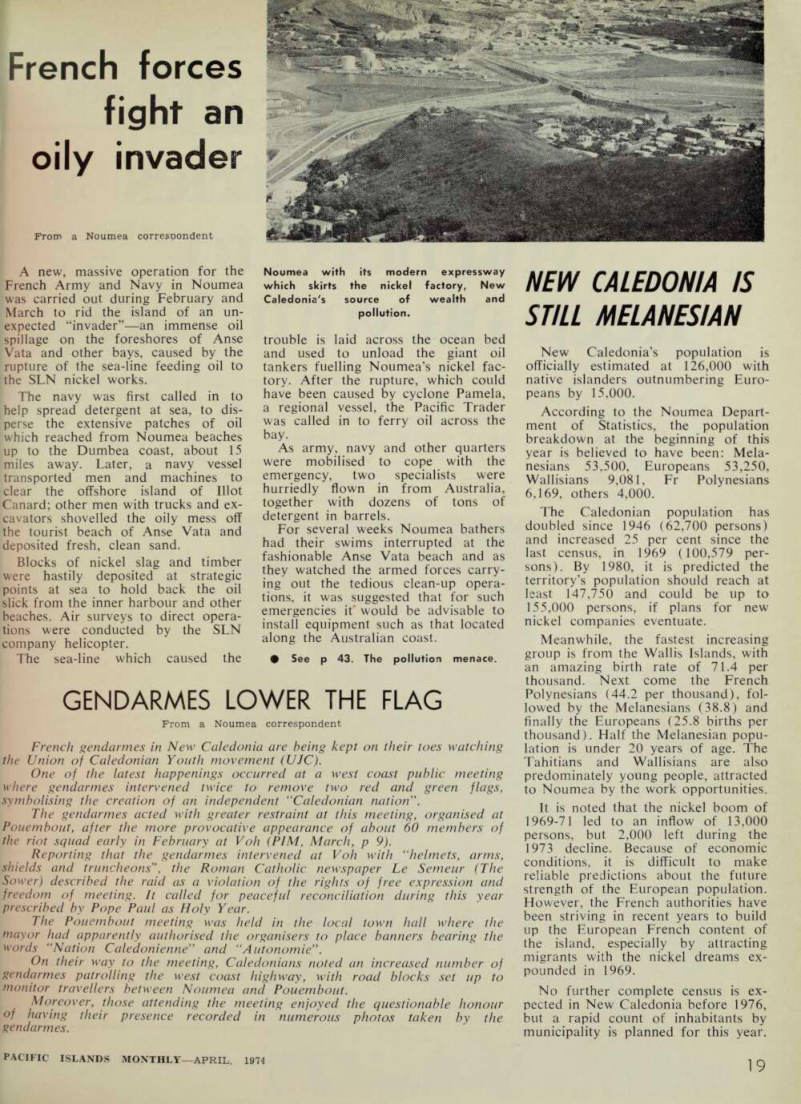
French forces fight an oily invader
Prom a Noumea correspondent A new, massive operation for the French Army and Navy in Noumea was carried out during February and March to rid the island of an un expected “invader”—an immense oil spillage on the foreshores of Anse Vata and other bays, caused by the rupture of the sea-line feeding oil to the SEN nickel works.
The navy was first called in to help spread detergent at sea, to dis perse the extensive patches of oil which reached from Noumea beaches up to the Dumbea coast, about 15 miles away. Later, a navy vessel transported men and machines to clear the offshore island of Illot Canard; other men with trucks and ex cavators shovelled the oily mess off the tourist beach of Anse Vata and deposited fresh, clean sand.
Blocks of nickel slag and timber were hastily deposited at strategic points at sea to hold back the oil slick from the inner harbour and other beaches. Air surveys to direct opera tions were conducted by the SLN company helicopter.
The sea-line which caused the
trouble is laid across the ocean bed and used to unload the giant oil tankers fuelling Noumea’s nickel fac tory. After the rupture, which could have been caused by cyclone Pamela, a regional vessel, the Pacific Trader was called in to ferry oil across the bay.
As army, navy and other quarters were mobilised to cope with the emergency, two specialists were hurriedly flown in from Australia, together with dozens of tons of detergent in barrels, For several weeks Noumea bathers had their swims interrupted at the fashionable Anse Vata beach and as the y w f t< * ed the armed forces carry ,'P* ou . the tedlous , sle5 le , a "‘, U ? tlons - “ was suggested that for such emergencies it would be advisable to install equipment such as hat located alon 8 the Australian coast.
• See p 43. The pollution menace.
Noumea with its modern expressway which skirts the nickel factory, New Caledonia's source of wealth and pollution.
Gendarmes Lower The Flag
From a Noumea correspondent French gendarmes in New Caledonia are being kept on their toes watching the Union of Caledonian Youth movement (UJC).
One of the latest happenings occurred at a west coast public meeting where gendarmes intervened twice to remove two red and green flags, symbolising the creation of an independent “Caledonian nation”.
The gendarmes acted with greater restraint at this meeting, organised at Pouembout, after the more provocative appearance of about 60 members of the riot squad early in February at Voh (PIM, March, p 9).
Reporting that the gendarmes intervened at Voh with “helmets, arms, shields and truncheons” , the Roman Catholic newspaper Le Semeur (The Sower) described the raid as a violation of the rights of free expression and freedom of meeting. It called for peaceful reconciliation during this year prescribed by Pope Paul as Holy Year.
The Pouembout meeting was held in the local town hall where the mayor had apparently authorised the organisers to place banners bearing the words “Nation Caledonienne” and “Autonomie”.
On their way to the meeting, Caledonians noted an increased number of gendarmes patrolling the west coast highway, with road blocks set up to monitor travellers between Noumea and Pouembout.
Moreover, those attending the meeting enjoyed the questionable honour of having their presence recorded in numerous photos taken by the gendarmes.
New Caledonia Is
Still Melanesian
New Caledonia’s population is officially estimated at 126,000 with native islanders outnumbering Euro peans by 15,000.
According to the Noumea Depart ment of Statistics, the population breakdown at the beginning of this year is believed to have been: Mela nesians 53,500, Europeans 53,250, Wallisians 9,081, Fr Polynesians 6,169, others 4,000.
The Caledonian population has doubled since 1946 (62,700 persons) and increased 25 per cent since the last census, in 1969 (100,579 per sons). By 1980, it is predicted the territory’s population should reach at least 147,750 and could be up to 155,000 persons, if plans for new nickel companies eventuate.
Meanwhile, the fastest increasing group is from the Wallis Islands, with an amazing birth rate of 71.4 per thousand. Next come the French Polynesians (44.2 per thousand), fol lowed by the Melanesians (38.8) and finally the Europeans (25.8 births per thousand). Half the Melanesian popu lation is under 20 years of age. The Tahitians and Wallisians are also predominately young people, attracted to Noumea by the work opportunities.
It is noted that the nickel boom of 1969-71 led to an inflow of 13,000 persons, but 2,000 left during the 1973 decline. Because of economic conditions, it is difficult to make reliable predictions about the future strength of the European population.
However, the French authorities have been striving in recent years to build up the European French content of the island, especially by attracting migrants with the nickel dreams ex pounded in 1969.
No further complete census is ex pected in New Caledonia before 1976, but a rapid count of inhabitants by municipality is planned for this year.
Advertisements & other items, p. 26 (1 item)
To stand tall
in 118 countries
you need to
keep on your toes
Staying on top in the business world means backing a programme of continuing innovation with a sound service programme.
So Otis employs some 50,000 specialists in 118 countries researching, making, installing and servicing Otis elevators, escalators and allied transportation systems.
Otis keeps moving people and things. While looking for better ways of doing it.
Otis Elevator Company Ltd., Nukuwatu Street, Lami, Suva, FIJI.
Telephone 361-248 Suva. 36372 A
The Mailbag
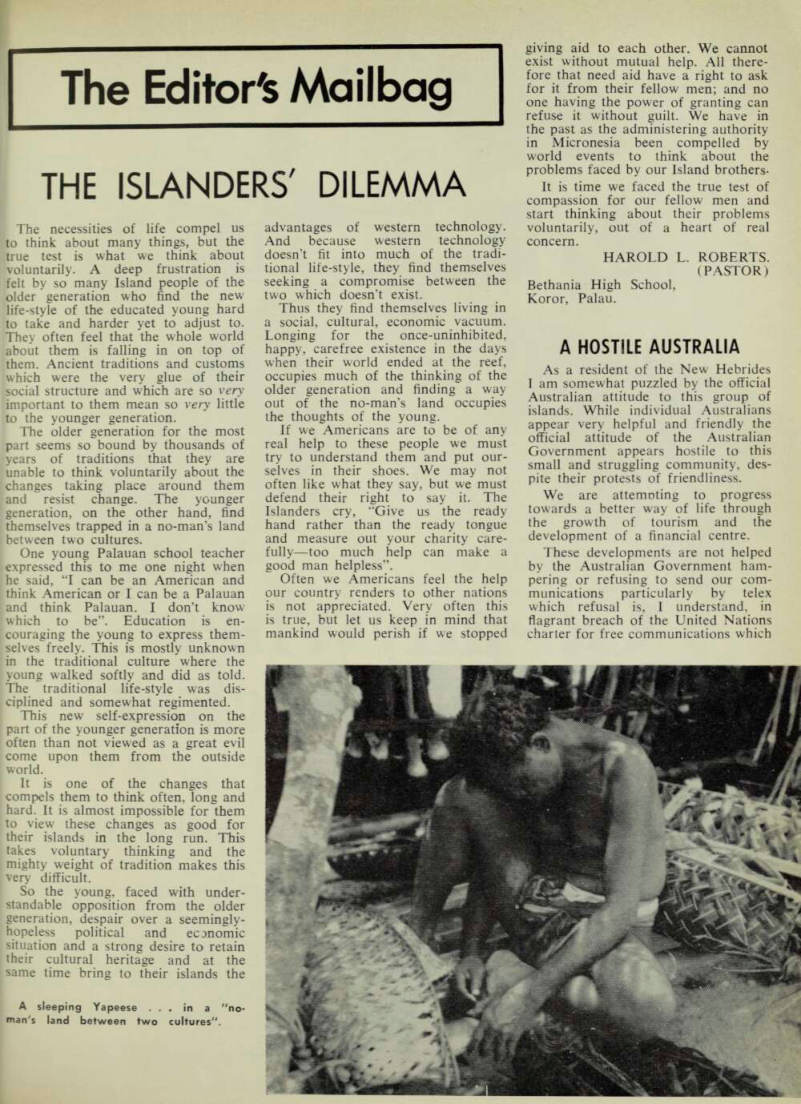

The Islanders' Dilemma
The necessities of life compel us to think about many things, but the true test is what we think about voluntarily. A deep frustration is felt by so many Island people of the older generation who find the new life-style of the educated young hard to take and harder yet to adjust to.
They often feel that the whole world about them is falling in on top of them. Ancient traditions and customs which were the very glue of their social structure and which are so very important to them mean so very little to the younger generation.
The older generation for the most part seems so bound by thousands of years of traditions that they are unable to think voluntarily about the changes taking place around them and resist change. The younger generation, on the other hand, find themselves trapped in a no-man’s land between two cultures.
One young Palauan school teacher expressed this to me one night when he said, “I can be an American and think American or I can be a Palauan and think Palauan. I don’t know which to be”. Education is en couraging the young to express them selves freely. This is mostly unknown in the traditional culture where the young walked softly and did as told.
The traditional life-style was dis ciplined and somewhat regimented.
This new self-expression on the part of the younger generation is more often than not viewed as a great evil come upon them from the outside world.
It is one of the changes that compels them to think often, long and hard. It is almost impossible for them to view these changes as good for their islands in the long run. This takes voluntary thinking and the mighty weight of tradition makes this very difficult.
So the young, faced with under standable opposition from the older generation, despair over a seemingly hopeless political and economic situation and a strong desire to retain their cultural heritage and at the same time bring to their islands the
advantages of western technology.
And because western technology doesn’t fit into much of the tradi tional life-style, they find themselves seeking a compromise between the two which doesn’t exist.
Thus they find themselves living in a social, cultural, economic vacuum.
Longing for the once-uninhibited, happy, carefree existence in the days when their world ended at the reef, occupies much of the thinking of the older generation and finding a way out of the no-man’s land occupies the thoughts of the young.
If we Americans are to be of any real help to these people we must try to understand them and put our selves in their shoes. We may not often like what they say, but we must defend their right to say it. The Islanders cry, “Give us the ready hand rather than the ready tongue and measure out your charity care fully—too much help can make a good man helpless”.
Often we Americans feel the help our country renders to other nations is not appreciated. Very often this is true, but let us keep in mind that mankind would perish if we stopped
giving aid to each other. We cannot exist without mutual help. All there fore that need aid have a right to ask for it from their fellow men; and no one having the power of granting can refuse it without guilt. We have in the past as the administering authority in Micronesia been compelled by world events to think about the problems faced by our Island brothers- It is time we faced the true test of compassion for our fellow men and start thinking about their problems voluntarily, out of a heart of real concern.
Harold L. Roberts.
(Pastor)
Bethania High School, Koror, Palau.
A Hostile Australia
As a resident of the New Hebrides I am somewhat puzzled by the official Australian attitude to this group of islands. While individual Australians appear very helpful and friendly the official attitude of the Australian Government appears hostile to this small and struggling community, des pite their protests of friendliness.
We are attemoting to progress towards a better way of life through the growth of tourism and the development of a financial centre.
These developments are not helped by the Australian Government ham pering or refusing to send our com munications particularly by telex which refusal is, I understand, in flagrant breach of the United Nations charter for free communications which
A sleeping Yapeese ... in a "no man's land between two cultures".
Letters
they profess to recognise. Vital mes sages and even the shipment of sup plies have been refused by the Aus tralian Government or their unions, even when these are required for disaster relief.
Funds required for development purposes and investment here cannot be sent owing to the refusal of the Australian Government and they have even refused to allow the repayment of our own money or the payment of interest on these when these funds are urgently required by the New Hebridean residents who originally deposited them in, or lent them to, concerns in Australia and now require them for helping to build a better society here.
As mentioned above, individual Australians are assisting considerably in the development of the New Hebrides and in the joining together of residents here to work together, to forget racial, tribal and religious differences in order to seek economic and political progress for all. There are, however, somewhat puzzling ex ceptions, particularly in connection with religious organisations which have entered the political arena and who, through their local represen tatives and, on occasion, education officials in nearby localities, appear to be preaching racial discord and hatred. It would be extremely interesting to learn how they can reconcile Christianity with some of the extreme political views preached by them.
A. Leman.
Vila, New Hebrides.
Sheer Ecstasy
After receiving the February issue of my new PIM subscription, I sin cerely regret that I had not become a subscriber at an earlier time. The scope of PlM’s coverage is indeed impressive.
In the February issue I was im mediately struck by the Indian couple appearing cn the cover. I felt certain that I had met or known the gentle man, yet I was unable to place him until I checked the credit inside the cover. Vimal Sharma was a language instructor in Hindi in the Peace Corps training in which I participated during the latter part of 1968 here in Hawaii.
After that three-month experience,
Letters
none of us could forget “Bimbo” as we came to know him.
The same issue of PIM brought to me the sad news of the passing of Mr James Madhavan. Although I met Mr Madhavan only once, I came to know that he was a highly respected representative in Macuata on the island of Vanua Levu where I spent my first year as a Peace Corps Volunteer. Macuata and the whole of Fiji lost a valuable representative of the people when it lost James Mad havan.
Little did I know that another sur prise was in store for me when I read the Cruising Yachts section of the January issue which I picked up at the news-stand. As I perused the page, I couldn’t help but wonder whether or not my aunt’s and uncle’s good friends were ever mentioned in this particular section. My eye caught the picture at the bottom of the page, the yacht looked familiar, and, sure enough, the caption confirmed that Chuck and Van Carter had indeed
reached the South Pacific. I clipped and quickly sent the story to my aunt and uncle in California who have known the Carters for many years.
As you can tell, my interest in PIM is nothing less than ecstatic. Keep up the good work.
David Rhudy.
Honolulu, Hawaii.
Polynesian Settlement
In regard to Robert Langdon’s re view of The Settlement of Polynesia by Levison, Ward and Webb (PIM, Jan, p 69) it seems to me that both Mr Langdon and the authors missed an aspect of society which could and almost certainly did initiate voyages into the complete unknown through out prehistory. These are the voyages of people expelled from society for two reasons: the first—military de feat; the second—exile which especi ally in the smaller islands and the tight societies like Samoa must have been considered tantamount to capital punishment.
The remnants of losing sides in war must have frequently taken to the sea with no idea of a destination as an immediate alternative to being
ground up by war clubs or being put into the ground oven for the victory feast of the winning side. They might not have had much hope of arriving anywhere but anything was preferable to staying where they were. Of course, conditions of starvation and going astray on known routes of sea travel could have been a large factor in the discovery of new lands.
Exile in some form must have been common. Captain Gray, in his Amerika Samoa and Its Naval Ad ministration discusses what must have been a fair example in chapter 18— The Case of the Skipjack in which a low-ranking Samoan who, after catch ing a skipjack, was cooking it for himself and family rather than turn ing it over to his chief as provided by Fa’a Samoa. Normal punishment of such a case was that the house and crops including coconut trees of the offender should be forthwith destroyed and provision made that he could not in the future live, farm or fish there. Generally, the penalty was supported by all Samoa but in this case it was not, and that is another story.
The point is that this type of thing must have been widespread and been the cause of significant numbers of people finding themselves and family at sea with return impossible on pain
Letters
of death. Without going into the pros and cons of navigation, etc, it seems a fair guess that a percentage of them made it to somewhere.
Over a span of several hundred years or maybe a couple of thousand, we could expect that most of the islands in the latitudes habitable and navigable by those primitive tropical people, must have been visited and those capable of supporting a popu lation were nearly all inhabited at the time of Western contact. And one of the triggers that could have propelled them into completely unknown areas and lands was fear of staying in their homeland and once at sea, ignorance of geography, navigation, and the handling of their vessel led to many kinds of terminations to their voyages.
And once the exiles were settled, succeeding generations certainly felt some urge to return to the homeland, and even would have had they some clues as to where it was. I remember some years ago there was a sort of spate of young people in Easter Island clandestinely preparing boats and some even getting away to voyages to Tahiti. I believe at least one boatload was picked up within two days of Tahiti—rather disgusted with their grandmother who had given them the course to Tahiti and told them the voyage would take 33 days. Since they were 33 days out of Easter Island when picked up, and could not even see Tahiti, their grand mother had a sizable credibility gap!
The approach of Messrs Levison, Ward and Webb in The Settlement of Polynesia is an interesting and new contribution to the literature on the subject. It is very doubtful that com puter technology is now advanced enough for this method to be useful in this field; and comprehensive facts of known drift voyages must be ex tremely difficult to come by.
Anthropology in both the Western Hemisphere and Oceania seems to be suffering from more than a paucity of data. This may be overcome to some degree; after all, sensible work is only about 100 years old, and the tech niques and technology are certainly not fully developed. Also, if affluence continues to increase more talent will be trained and available to attack the subject. New discoveries must be ex pected.
The other affliction suffered by the discipline of anthropology seems to be that anthropologists seem to be un
commonly contentious and con temptuous when they attain status in the field. The hostility of anthro pologists in general against Thor Heyerdahl and his theories and work would appear to stem as much from academic jealousy of his financial success as to their understandable dislike of some of the far-out theoris ing in Aku Aku.
If anthropology is to be considered a science by those of us outside the field, they are going to have to stop the infighting and stop issuing flat statements of “did” and “did not!”
Don’t call anyone a “charlatan” or “nut” until there is reasonable proof.
George R. Jacobs.
Glendale, Calif.
The Mccoskers
I am at present collecting material before writing an historical biography based on the life of my parents Stan and Marjorie McCosker. As they spent a great deal of their lives in the Islands of New Guinea, particularly New Britain, readers of PIM may be able to help.
My father first went to Rabaul, New Britain, in 1924 as plantation manager for the Melanesian Com pany. In 1929 my parents married in Rabaul. They then lived at Witu, (Ningan), and Londip. In 1936 with W. and F. King they bought Matala plantation 50 miles from Rabaul on the south coast. My parents lived
Letters
there until 1956. During the last war my father served first with NGVR and later ANGAU.
I am sure there are “oldtimers” who remember well my parents and I would like to contact these and also any men who fought with my father in the war. Could readers please write if they knew my parents or tell me about any “Befores” who may have known them. I am most anxious to contact any members of the Gilmour family, late of Put Put, New Britain.
Anne Mccosker.
Green Tiles, Mill Lane, Chalfont St Giles, Bucks, England.
Cart Cook's Club
I read the brief Tropicalities en titled “Thar’s gold in them thar huts! [sic.]” (PIM, Jan p 12) with great interest and enjoyed the photo of the Tongan club.
However, I would like to make a comment concerning Laurie Marsh all’s point about Tongan clubs and Cook, and the point that Marshall “was sure that, if Cook had been able to choose which Tongan club took his life, he’d have picked the one pictured here in PIM.”
While doing my dissertation re search on a Tongan topic in the Mitchell Library in 1970 and 1971 I came across a photo and the follow ing information: from “Cook, James —small picture file—Relics 27 and 28:”
Photo of a framed document— document reads; “Capt Cook was killed on the 14th Feb, 1779 by the Indians of Owhyee—he was first stabbed, and with a club gave him a blow on the back of the head.
“This is the identical Club given to me by the late Admiral John Hun ter.” [With a comment by Mander- Jones]: “The Department of Ethno graphy at the British Museum has identified the club from a photo graph as being Tongan.”
Cook was apparently killed with a Tongan club, but not one of the elaborate “leaf-stalk” clubs depicted in Tropicalities.
Incidentally, there is probably more “artifact gold” in “them thar museums” around the world than in some of the islands. The voyagers (and missionaries) of the 18th and
Letters
19th Century were quite efficient in their “artifact gathering.”
Charles F. Urbanowicz
California State University.
Arts Festival Filmed
In reply to Ata Matai’s letter (PIM, Feb, p 31): The Me’etu’upaki? I love it on film! And the New Hebrides as well! Mine is only a super 8 film but it captures the variety and richness of Pacific Dancing; catches the danc ers from close-up, underneath, side ways; shows some of the crafts — people and their work etc.
I am an ethnic dancer; meaning that my interest goes to the dancers of all nations and how they act as a true mirror of life: history, religion, social structure etc. Resident now in Australia, I was an eager visitor to the Pacific Festival.
It was an eye-opener and of shatter ing impact to me. When I first saw the Me’etu’upaki I fell into the grip of trembling awe: here was some thing from the beginning of time, from the very well-spring of crea tivity!
The sitting dance of the women of Lau with their nodding flower quills was of similar impact!
The dynamic men’s dances, the use of the flicking small head movements: everything was a complete revel ation!
As to the meaning of the multitude of items performed: it was most dif ficult to find out. I kept asking and investigating: and have now three different explanations of the Laka- Laka!
No one seemed quite sure as to the exact meaning of the many gestures and words in the Fijian mekes. I still wonder whether they are sung in an ancient type of Fijian language, not used now for everyday speech.
My little film lasts for an hour. I have shown it with an explanatory lecture to my circle of people here, whose wonder and interest was greatly aroused.
I am deeply aware that the waves of violent changes in the world are also touching now the Pacific Islands.
I would love to go out making a film on the arts and crafts of the people, and would bring to this venture a concerned and loving mind and eye.
Have you any idea how I could get this to be subsidised?
Wera Goldman
Bondi 2026, Australia.
Advertisements & other items, pp. 28-38 (1 item)
Kodak pocket
m m y B I, s a m *
Go-anywhete
camera
Now you’ll get the pictures you used to miss Camera measures: 4 1 /2" x 2" x 1 Small enough to slip into your pocket. Light enough to carry anywhere. So simple to usejust drop in the new 110-size film cartridge, aim, and shoot. Yet it takes big 3V2" x 4 7 /8" color pictures. Choose from the range of five new Kodak pocket Instamatic camera outfits — each complete with wrist strap, Kodacolor II film, magicube and instructions. There’s one priced to suit your pocket. See your local island photo dealer.
KODAK (Australasia) PTY. LTD.
K6l
DEAD HEAT!
(* /Z * c / >
that's the result
every time—to decide
Australia's most popular
copper fitting!
Ask any plumber and he will “tip” that there is just nothing to choose between the three stablemates-
“YOßKSHlßE” “YORKWAY” &
“YORKSIL”
Precision made and conforming to S.A.A. Standard 8181, for use with light gauge copper tubing . . . you’re on a winner for every application with a Yorkshire Imperial capillary fitting!
Ask your supplier tor Yorkshire Imperial fittings: —
YORKSHIRE
IMPERIAL
YORKSHIRE IMPERIAL AUSTRALIA PTY. LTD.
144-154 Milperra Road, Revesby, N.S.W. 2212. Phone 77-0561 VIC. 569 0859 OLD. 36 0455 W.A. 24 1017 S.A. 43 4445 3Y/6B
DAIWA BANK SERVING YOU IN THE PACIFIC BASIN r & Head Office : Osaka, Japan With 137 Branches throughout Japan Singapore Representative Office Suite No. 1007, 10th Floor Robina House 1 Shenton Way, Singapore 1 Republic of Singapore Cable Address: SINGDAIWA Affiliated Bank P.T BANK PERDANIA Djalan Raya Mangga Besor 7&9 Djakarta ( Our Correspondent Banks are in city— Apia, Suva, Lae.
Madang Port Moresby, Rabaul, Wewak. Guam, all Principal cities in Australia and New Zealand Contact your banker or our office. y Los Angeles Agency 555 South Flower St. Suite 4040 Los Angeles. Calif. 90071 Sydney Representative Office Bth Floor Prudential Building 39-49, Martin Place, Sydney
THE DAIWA BANK LTD.
Head Office : 21. Bingomachi 2-chome, Higashi-ku, Osaka, Japan Overseas : London, New York, Los Angeles, Frankfurt, Sydney, Singapore
✓ f / 1
PmPiefflpefro/ IRON ■ %%% ernurrr*
Australia's best selling non-electric Iron! For reliability, ease of handling, and excellence of quality at a low price, you can't beat the HANOI. It's simplicity itself to operate—NO PUMPING IS REQUIRED. IT'S IMPOSSIBLE TO OVERFILL THE FUEL TANK and one filling does approximately 2 hours effortless ironing. Attractively finished in nickel plate. Spare parts always available.
THE PORTABLE OUTDOORS COOKER at a sensible price!
Twin independent burners for fast cooking. Twin tanks for double capacity. Steel case, when opened, acts as triple-wind shield. Rustproof. Noisy or silent burners as required. Small or large porcelain enamel ovens also available separately. HANOI —the lowest priced QUALITY Twin Burner Portable!
umnEimi
SPTY. Evans Rd., Salisbury North. Ph. 47 2122
LTD. BRISBANE, QUEENSLAND, AUSTRALIA
D YOU LL WELCOME OUR TROPICAL
MODULAR HOME UNITS...IN EVERYWAY!
• PRE-CONSTRUCTED IN N.Z. AND
PRE-TREATED FOR TROPIC CONDITIONS
• SHIPPED KNOCKED-DOWN TO YOUR
DESTINATION
• EASILY ERECTED ON SITE WITH MINIMUM
SKILLED LABOUR
• OFFER LUXURY AT A REASONABLE PRICE Perfect for holiday and permanent homes or commercial and industrial
housing projects.
4 models to choose from: ‘Leisuredeck’, (illustrated) ‘Sunseeker’, ‘Castaway’, ‘Sunlover in 1,2,3-bedroom units. . . modular construction streamlines design, gives flexibility . . . pre-construction cuts costs and assembly-but not quality. . . maintenance-free pre-coated insulated
Permalum metal weather-boarding . . .
pre-piped plumbing unit. Plus many other quality features! m
welcome! homes limited
Like to know more? Mail this coupon now!
To: The Manager, Welcome Homes Ltd Box 12203, Penrose, Auckland, N.Z.
Please send me, withoutobligation, brochureson your Modular Home Units.
Name Address Already performance-proven in the New Hebrides, Pitcairn and Japan.
Property Located At 6649
In Lae, we’re the motel
people come back to.
They come back for a dip in our pool, the individually air conditioned, comfortably fitted units, first class fully licensed restaurant, our friendliness, our cocktail bar, and attention to the finest detail.
In Lae, stay at the Huon Gulf, and next time round you’ll come back.
Book direct, or through any office of Ansett Airlines.
Huon Gulf Motel
Markham Road Lae. Phone: Lae 3204 (As from October Ist phone 42 4844) A Division of Ansett Transport Industries Limited
AHO/228
Save hundreds of dollars
on Australia’s most efficient
WALK IN, ALUMINIUM
COOLROOMS AND
FREEZE ROOMS
Hundreds already installed! The most economical supplementary coolrooms for bottles and food, providing the largest storage capacity of any comparable coolrooms of the same exterior dimensions. Five sizes —from 90360 cu. ft. capacity; 16 models offering normal temp., two temp., deep freeze, or for pastry and ice storage applications. White vinyl interior, embossed rustproof aluminium exterior. • SUPPLIED IN EASY-TO-ERECT, DO-IT-YOURSELF KIT FORM • PETROL AND PETROL-ELECTRIC MODELS ARE AVAILABLE FOR AREAS WHERE POWER IS LIMITED OR NON-EXISTENT Available from: AUSTRALIAN NEW CALEDONIA EXPORTS (SILVER & BARDA), 363 George St., Sydney, 2000 and Branches.
BRECKWOLDT & CO., 276 Pitt St., Sydney, 2000 and Branches.
PETER FISHER TRADING PTY. LTD., 321 Pitt St., Sydney, 2000.
HAGEMEYER (A'SIA), 59 Anzac Pde., Kensington, 2033 and Branches
Manufactured by:
KERR BROS, 65 York St., Sydney, 2000.
NELSON & ROBERTSON PTY. LTD., 197 Clarence St., Sydney. 2000.
RABAUL TRADING CO. PTY. LTD., P.O. Box 219, Rabaul and Branches.
ROY GALLIMORE & ASSOCIATES, P.O. Box 179, Vila, New Hebrides.
C. SULLIVAN (EXPORT) PTY. LTD., 60 Margaret St., Sydney, 2000 and Branches.
W. S. TAIT & CO. PTY. LTD., 31 Macquarie Place, Sydney, 2000 and Branches.
WARBURTONFRANKI
199 Parramatta Road, Cnr. Skarratt Street, Auburn, N.S.W. 2144, Australia. Phone: 648-1711.
Powered by Kelvinator.
Five-year warranty on compressor. Early delivery.
PETER FISHER TRADING
PTY. LTD.
321 PITT STREET, SYDNEY, 2000, AUSTRALIA
TELEPHONE: 26-1109 CABLES: "FISHERION", SYDNEY
EXPORTERS TO THE PACIFIC
ISLANDS
Some of the firms and products we represent: GREENLITES waterproof matches LUCKY STAR tinned fish REDHEADS safety matches FOREMOST CONSOLIDATED MAURI BROS, yeast PMU food products TOOHEYS beer
CLUB RUM
ROGOVI VODKA
FRENCH KNIT car seat covers THREE STAR corned beef
CRAVEN confectionery
BROWNBUILT office furniture ADVANCE containers HARDIE'S building products SEBEL furniture BEARD beds and mattresses KLINKII plywood STERLING bakery machinery WHITE ABBEY Scotch whisky BATA shoes SPC tinned fruit LIFESAVERS confectionery CHILTONIAN biscuits
MACHETTES
ATLAS plastic ware BOND'S underwear BOND'S outerwear ANDY spotlights COUNTRY CLUB shirts PAULCALL tools ASTRA razor blades WENGER quality knives VAN DER LAAN tinned meat WARBURTON FRANKI coolrooms DURABUILT prefabricated houses THREE X (XXX) tinned hake BRONTE tinned meat HEINEKEN beer
SHEATH KNIVES
GOLDEN STATE evaporated milk SMALL chocolate GOLDSTEIN—Food equipment MIN IT aerosols SHELLEY'S soft drinks TWISTIES rice snacks ERN MACKIE bakery equipment CHEEZELS cheese flavoured snacks
AND MANY MORE
S. E. TATHAM & CO. PTY. LTD.
ASKEW HOUSE, 364 LONSDALE ST.
G.P.O. BOX B—CABLES "SET"
TELEPHONE: 601125
Buyers for the Pacific Islands
PAPUA NEW GUINEA: S. E. TATHAM (P.N.G.) PTY. LTD.,
LAE: MALEKULA ST. (P.O. BOX 1562).
PORT MORESBY: CNR. GOROA & MUNAHU STS., GORDON
(P.O. BOX 6733, BOROKO).
FU[: S. E. TATHAM (FIJI) LTD.,
LAUTOKA P.O. BOX 366,
SUVA G.P.O. BOX 671,
MELBOURNE, 3001, AUSTRALIA.
AND IN
YOUR GUARANTEE
FOR SERVICE
SINCE 1924
BRISBANE
ACREAGE
LAND
LUSH 5-10 ACRE LOTS IN A
TRANQUIL SUB-TROPIC VALLEY
ESTATE
66£NL£(GH
I
GOU>
coast
eeAwezefzr
CEDARVALE PARK
represents a magnificent investment for grazing, retirement or rapid capital gain. Choice fertile acreage close to booming Brisbane is virtually irreplaceable at today's prices.
With 43 inches average rainfall, this fertile parkland valley is cleared sown to improved pasture and serviced by sealed roads.
Accessibility is another plus factor 40 minutes drive to Brisbane an hour to the Gold Coast only minutes to Hotel, School and Railway with regular bus services toßrisbaneonthe nearby highway.
Seldom are we privileged to offer such outstanding small acreage parcels the most sought after of all land. Select with every confidence your block on Cedarvale Park.
FROM $A 8500 10% DEPOSIT
and easy terms available
Note: Interstate and overseas clients buy at precisely the same prices as our Brisbane buyers absolutely no distinction or loading applies.
ENQUIRE NOW - CLIP THIS AD AND MAI L WITH YOUR NAME & ADDRESS
MATTHEWS & JOHNSON
HEAD OFFICE: FLOOR 22, BRISBANE PLAZA,
68 QUEEN ST., BRISBANE 4000. PH.: 21 3550 Member; The Real Estate Institute of Queensland
NEW CALEDONIA
Pacific Motors S.A.
B.P. C 2,
NOUMEA CEDEX
TAHITI
Ets, Donald,
P.O. Box 131. PAPEETE
BRITISH SOLOMON ISLANDS
NEW HEBRIDES
CONDOMINIUM
Pentecost Pacific S.A., Santo and Port Vila
These MF distributors,
can show you, the greater
the load on the MF2I Trailer
the better the grip!
The all-steel, hydraulictipping MF2I is a “goanywhere” unit with large section tyres to give good flotation on wet ground and MF’s famous rear axle design. which puts 25% of the load on the tractor’s rear wheels. The bigger the load, the better the grip! Capacity is 3Vz tons, tray area 60 square feet. A powerful IViassey Ferguson MF 74012 hydraulic ram tips the tray to 56 degrees for fast, clean unloading. Everything about this trailer is planned for one-man operation. What’s more, it’s built for years of tough work in the field or on the road.
SEWERED
HILLTOP
HOMESITES
Between Brisbane and
the Gold Coast
fAORETCm
BAY
BEENLa CM
ESTATE
GOUP
COAST
HOLMVIEW PARK
at Beenleigh has 180° panoramic views of the unspoiled Logan River Valley offers prestige living in a unique rural setting.
ALL AMENITIES - Town water, electricity, kerb and channelled bitumen roads and sewerage.
TRANSPORT This Estate overlooks the Pacific Highway and Holmview Station. 16 daily commuter trains into Brisbane.
SCHOOLS AND CHURCHES -
Primary and secondary schools are Vi mile distant in Beenleigh as are Churches and Kindergarten.
SHOPPING Bustling Beenleigh has supermarkets. Chemists, Hotels, and Doctors, together with police, ambulance and veterinary services.
RECREATION Fishing and water skiing on the Logan River Bowling Club and Olympic Pool in Beenleigh sailing on Moreton Bay and the Gold Coast 30 minutes drive away.
INVESTMENT POTENTIAL -
Perfect, smog-free living conditions: a great place for retirement or a sound investment. Local land values rose 100% in the last 3 years, NOTE: Interstate and overseas clients buy at precisely the same price as our Brisbane buyers no distinction or loading applies.
FROM $6450 ON 10% DEPOSIT
easy terms available
I E NQ uT RE *NOW ”~CL 17 TH iT Ad"aND ""
MAIL WITH YOUR NAME & ADDRESS
MATTHEWS & JOHNSON
HEAD OFFICE: FLOOR 22, BRISBANE PLAZA,
68 QUEEN ST.. BRISBANE 4000. PH.: 21 3550 Member: The Real Estate Institute of Queensland
The night; the
lights went out
u i n *"V. r r; rn & m at w» to to "|7 1-v i* /* v **>. *•*** >v Ml« ik « v Some clever, far-sighted individualist had a Generator Set all ready to go. CLAE makes light work for you. We have a complete range of mighty Detroit and Bedford generator sets priced to suit your bank account and your purpose. To provide light, power for heating, cooking or manufacturing. To run profit producing industrial and agricultural equipment. Efficient. Dependable. Simple to maintain. Protection for any future emergency. See CLAE. They have the power! /m /
ihe power
/ CLAE ENGINE SALES & SERVICE \ / 31 Hoskins Ave., Bankstown, N.S.W. \ / 2200. Phone 709 4777. \ / Branches at: Brisbane, Rockhampton, Mackay and Townsville.
Distributors and dealers in all states. / Please send me details of.. / Name \ ¥/ \ 1 f Address „ \ 1
A Divided Samoa, But
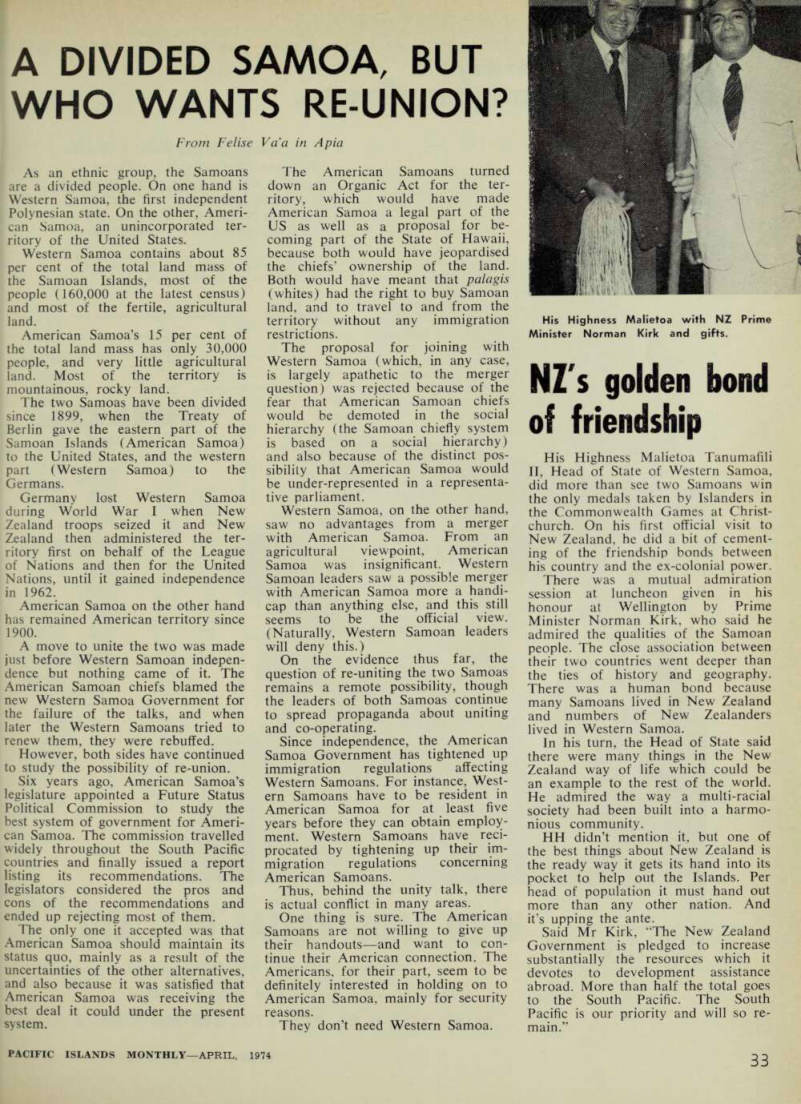
Who Wants Re-Union?
From Felise Vaa in Apia
As an ethnic group, the Samoans are a divided people. On one hand is Western Samoa, the first independent Polynesian state. On the other, Ameri can Samoa, an unincorporated ter ritory of the United States.
Western Samoa contains about 85 per cent of the total land mass of the Samoan Islands, most of the people (160,000 at the latest census) and most of the fertile, agricultural land.
American Samoa’s 15 per cent of the total land mass has only 30,000 people, and very little agricultural land. Most of the territory is mountainous, rocky land.
The two Samoas have been divided since 1899, when the Treaty of Berlin gave the eastern part of the Samoan Islands (American Samoa) to the United States, and the western part (Western Samoa) to the Germans.
Germany lost Western Samoa during World War I when New Zealand troops seized it and New Zealand then administered the ter ritory first on behalf of the League of Nations and then for the United Nations, until it gained independence in 1962.
American Samoa on the other hand has remained American territory since 1900.
A move to unite the two was made just before Western Samoan indepen dence but nothing came of it. The American Samoan chiefs blamed the new Western Samoa Government for the failure of the talks, and when later the Western Samoans tried to renew them, they were rebuffed.
However, both sides have continued to study the possibility of re-union.
Six years ago, American Samoa’s legislature appointed a Future Status Political Commission to study the best system of government for Ameri can Samoa. The commission travelled widely throughout the South Pacific countries and finally issued a report listing its recommendations. The legislators considered the pros and cons of the recommendations and ended up rejecting most of them.
The only one it accepted was that American Samoa should maintain its status quo, mainly as a result of the uncertainties of the other alternatives, and also because it was satisfied that American Samoa was receiving the best deal it could under the present system.
The American Samoans turned down an Organic Act for the ter ritory, which would have made American Samoa a legal part of the US as well as a proposal for be coming part of the State of Hawaii, because both would have jeopardised the chiefs’ ownership of the land.
Both would have meant that palagis (whites) had the right to buy Samoan land, and to travel to and from the territory without any immigration restrictions.
The proposal for joining with Western Samoa (which, in any case, is largely apathetic to the merger question) was rejected because of the fear that American Samoan chiefs would be demoted in the social hierarchy (the Samoan chiefly system is based on a social hierarchy) and also because of the distinct pos sibility that American Samoa would be under-represented in a representa tive parliament.
Western Samoa, on the other hand, saw no advantages from a merger with American Samoa. From an agricultural viewpoint, American Samoa was insignificant. Western Samoan leaders saw a possible merger with American Samoa more a handi cap than anything else, and this still seems to be the official view. (Naturally, Western Samoan leaders will deny this.) On the evidence thus far, the question of re-uniting the two Samoas remains a remote possibility, though the leaders of both Samoas continue to spread propaganda about uniting and co-operating.
Since independence, the American Samoa Government has tightened up immigration regulations affecting Western Samoans, For instance, West ern Samoans have to be resident in American Samoa for at least five years before they can obtain employ ment. Western Samoans have reci procated by tightening up their im migration regulations concerning American Samoans.
Thus, behind the unity talk, there is actual conflict in many areas.
One thing is sure. The American Samoans are not willing to give up their handouts —and want to con tinue their American connection. The Americans, for their part, seem to be definitely interested in holding on to American Samoa, mainly for security reasons.
They don’t need Western Samoa.
NZ's golden bond
of friendship
His Highness Malietoa Tanumafili 11, Head of State of Western Samoa, did more than see two Samoans win the only medals taken by Islanders in the Commonwealth Games at Christ church. On his first official visit to New Zealand, he did a bit of cement ing of the friendship bonds between his country and the ex-colonial power.
There was a mutual admiration session at luncheon given in his honour at Wellington by Prime Minister Norman Kirk, who said he admired the qualities of the Samoan people. The close association between their two countries went deeper than the ties of history and geography.
There was a human bond because many Samoans lived in New Zealand and numbers of New Zealanders lived in Western Samoa.
In his turn, the Head of State said there were many things in the New Zealand way of life which could be an example to the rest of the world.
He admired the way a multi-racial society had been built into a harmo nious community.
HH didn’t mention it, but one of the best things about New Zealand is the ready way it gets its hand into its pocket to help out the Islands. Per head of population it must hand out more than any other nation. And it’s upping the ante.
Said Mr Kirk, “The New Zealand Government is pledged to increase substantially the resources which it devotes to development assistance abroad. More than half the total goes to the South Pacific. The South Pacific is our priority and will so re main.”
His Highness Malietoa with NZ Prime Minister Norman Kirk and gifts.
Advertisements & other items, pp. 40-41 (1 item)
Wild (Australia) Pty. Ltd.
Best in their class-
but never enough until now.
At last, however,the Wild NKOI,N 10 and NKIO levels are available in sufficient quantities and at a lower price. The new Wild factory in Singapore is producing them with the high precision expected of and guaranteed by Wild Heerbrugg.
I want to hear more about the lower-priced Wild send me your special brochure.
Name: Address; I
EBRBRUGG
Wild NKOI Dumpy Level
WILD (AUSTRALIA) PTY. LTD.
45 Epping Road, North Ryde, N.S.W. 11 Buchanan Street, West End, Brisbane, Old. 83-85 Palmerston Crescent, South Melbourne, 3205.
BRIAN BELL & CO. PTY. LTD., BOROKO, T.P.N.G.
Become a part of PlM’s Pacific and subscribe now
Pacific Islands Monthly Keeps you informed on Pacific happenings
Fi// in the details on the attached order form.
The Farmers Are The
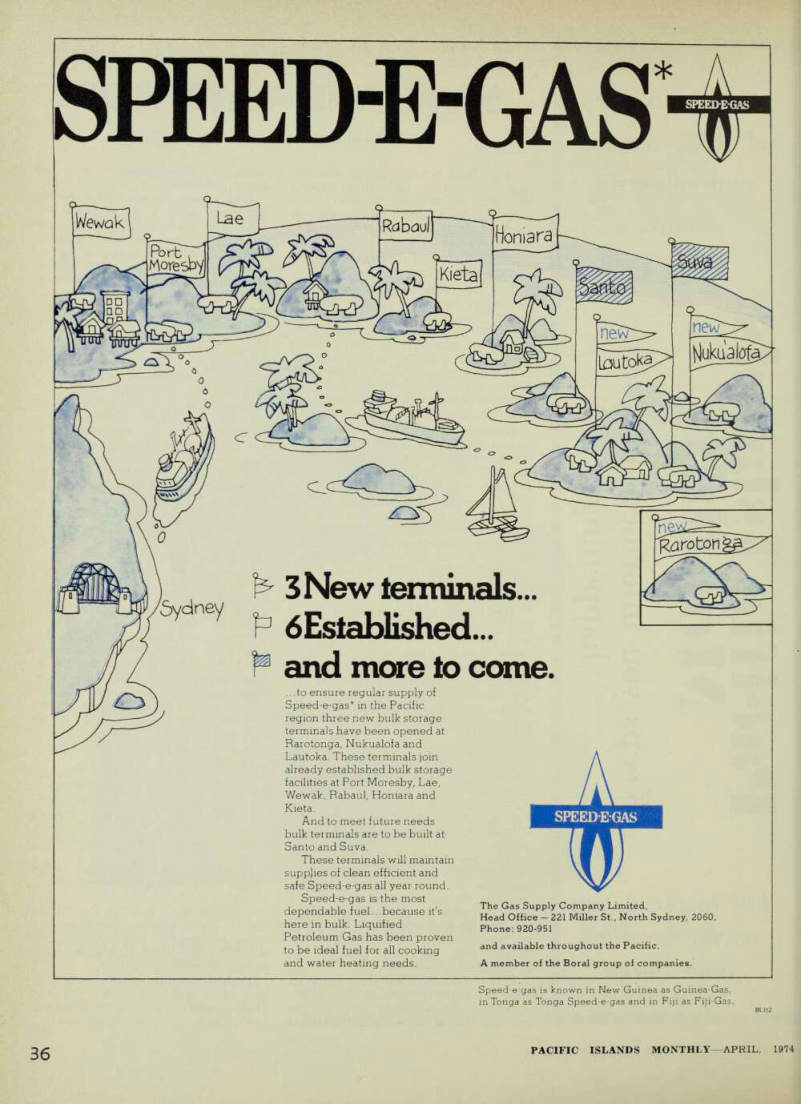
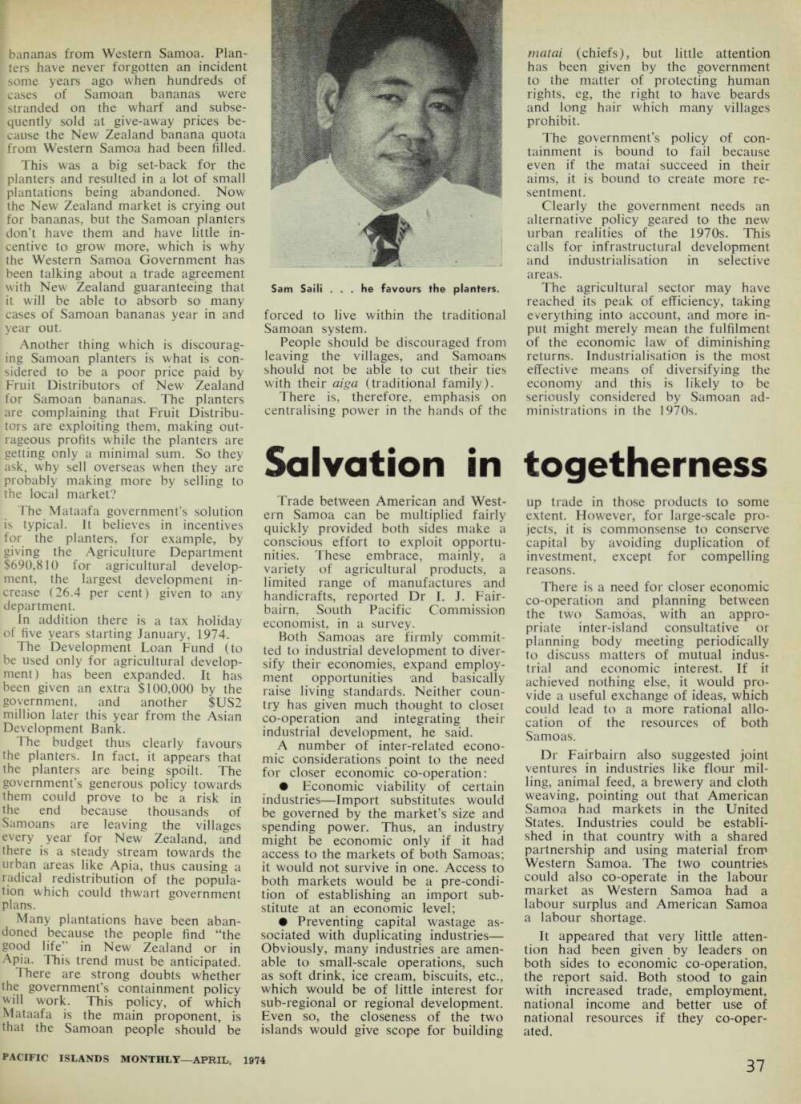
Samoans' Last Hope
From FELISE VA’A in Apia.
Faced with a trade deficit which is spiralling while its agricultural exports are shrinking, Western Samoa is plan ning big development in the agricul tural sector at the expense of govern ment services.
Money saved on maintenance of its services will be spent on development.
To the present government, de velopment means essentially agricul tural development which Finance Minister Sam Saili has rightly des cribed as their biggest and quickest money earner. Industrial development is of secondary importance because, as Saili argues, the market for industrial goods in Western Samoa is compara tively insignificant.
However, he considers export-type industries to be ideal and this is why the government is pushing for an in dustrial free zone, which at the moment is a remote possibility.
To promote productivity in the agricultural and industrial sectors, the government is providing a number of incentives, including a five-year tax holiday for planters and fishermen, the introduction of a second bank, possibly the First National City Bank of New York.
The income from the agricultural and industrial sectors, it is hoped, will enable infrastructural develop ment to take place at an increased rate over a long-term period. The present government’s relegation of infrastructure to a secondary position shows a marked contrast with the economic policies of the previous government.
The Tamasese government, under Tofa Siaosi, always stressed the im portance of infrastructural develop ment and, in fact, during that govern ment’s three-year term there was an unprecedented growth in such de velopment, especially with roads and airports.
Saili has argued repeatedly that infrastructural development, though desirable, is weak because it doesn’t generate the necessary income to pay for itself, whereas agricultural and in dustrial development would earn lots of money and make infrastructural development not only possible but profitable.
The previous government, however, took the opposite view, putting infra structural development first on the grounds that it made agricultural and
industrial development easier and more profitable.
Both viewpoints are valid, the only difference being in the emphasis.
As for agriculture, the Mataafa government certainly has cause for worry. Continuing drops in agricul tural exports have led to a balance of payments deficit, which is definitely going to continue in 1974. In 1973, export earnings for the first nine months came to $2.46 million as com pared with $2.33 million in 1972.
Saili hopes that the total agricul tural exports for 1973 will be $4 million, as compared with total ex ports of $3.3 million in 1972.
Even if he hits the target, it will still be far from satisfactory as Western Samoa in the early 1960 s was earning over $5 million annually from exports.
In 1973, less copra was exported, but it earned more. For the first nine months of 1973, 11,207 tons were ex ported compared with 12,082 for the same period in 1972. However, its worth was $1.17 million as compared with $922,000 for 1972.
Cocoa exports to September 30, 1973, were only 530 tons worth $391,000, compared with 1,403 tons worth $615,000 for the corresponding period in 1972.
Particularly depressing was the fact that only 28,273 cases of bananas worth $54,500 were exported for the same period, compared with 85,044 cases worth $183,250 for the first nine months of 1972. Taro exports, however, doubled and earned $237,000 to last September 30 while timber exports were about equal with those of 1972.
Saili said in his budget: “The per formance of the agricultural sector generally is sluggish and this sector has not come anywhere near to achieving the objectives set in the Second Five Year Development Plan.”
Naturally, the question arises, “What went wrong in the agricultural sector?”
It would seem that the decline was due to many factors; hurricanes, for instance, but the last hurricane was in 1968 and things should have im proved by now.
Perhaps another major reason is the lack of a steady market. The New Zealand market is unstable because it can absorb only so many cases of
bananas from Western Samoa. Plan ters have never forgotten an incident I some years ago when hundreds of cases of Samoan bananas were [ stranded on the wharf and subse quently sold at give-away prices be cause the New Zealand banana quota from Western Samoa had been filled.
This was a big set-back for the planters and resulted in a lot of small plantations being abandoned. Now the New Zealand market is crying out for bananas, but the Samoan planters don’t have them and have little in centive to grow more, which is why the Western Samoa Government has been talking about a trade agreement with New Zealand guaranteeing that it will be able to absorb so many cases of Samoan bananas year in and year out.
Another thing which is discourag ing Samoan planters is what is con sidered to be a poor price paid by Fruit Distributors of New Zealand for Samoan bananas. The planters are complaining that Fruit Distribu tors are exploiting them, making out rageous profits while the planters are getting only a minimal sum. So they ask, why sell overseas when they are probably making more by selling to the local market?
The Mataafa government’s solution is typical. It believes in incentives for the planters, for example, by giving the Agriculture Department $690,810 for agricultural develop ment, the largest development in crease (26.4 per cent) given to any department.
In addition there is a tax holiday of five years starting January, 1974.
The Development Loan Fund (to be used only for agricultural develop ment) has been expanded. It has been given an extra $lOO,OOO by the government, and another SUS 2 million later this year from the Asian Development Bank.
The budget thus clearly favours the planters. In fact, it appears that the planters are being spoilt. The government's generous policy towards them could prove to be a risk in the end because thousands of Samoans are leaving the villages every year for New Zealand, and there is a steady stream towards the urban areas like Apia, thus causing a radical redistribution of the popula tion which could thwart government plans.
Many plantations have been aban doned because the people find “the good life” in New Zealand or in Apia. This trend must be anticipated.
There are strong doubts whether the government’s containment policy will work. This policy, of which Mataafa is the main proponent, is that the Samoan people should be
forced to live within the traditional Samoan system.
People should be discouraged from leaving the villages, and Samoans should not be able to cut their ties with their aiga (traditional family).
There is, therefore, emphasis on centralising power in the hands of the
matai (chiefs), but little attention has been given by the government to the matter of protecting human rights, eg, the right to have beards and long hair which many villages prohibit.
The government’s policy of con tainment is bound to fail because even if the matai succeed in their aims, it is bound to create more re sentment.
Clearly the government needs an alternative policy geared to the new urban realities of the 19705. This calls for infrastructural development and industrialisation in selective areas.
The agricultural sector may have reached its peak of efficiency, taking everything into account, and more in put might merely mean the fulfilment of the economic law of diminishing returns. Industrialisation is the most effective means of diversifying the economy and this is likely to be seriously considered by Samoan ad ministrations in the 19705.
Sam Sail! ... he favours the planters.
Advertisements & other items, p. 42 (1 item)
Speed-E-Gas
Lae
Wewak
Rabaul
Honiara
Port .
Moresby
Kiitaj
□□ □ □ new
new
Hukuaim^
cL °°
butoka
ne o
Sydney
3 New terminals...
P 6Established...
and more to come.
Rarotonjg^
.. to ensure regular supply of Speed-e-gas* in the Pacific region three new bulk storage terminals have been opened at Rarotonga, Nukualofa and Lautoka. These terminals join already established bulk storage facilities at Port Moresby, Lae, Wewak, Rabaul, Honiara and Kieta.
And to meet future needs bulk terminals are to be built at Santo and Suva.
These terminals will maintain supplies of clean efficient and safe Speed-e-gas all year round.
Speed-e-gas is the most dependable fuel...because it's here in bulk. Liquified Petroleum Gas has been proven to be ideal fuel for all cooking and water heating needs.
SPEEDEGAS
The Gas Supply Company Limited, Head Office 221 Miller St., North Sydney, 2060.
Phone:92o-951 and available throughout the Pacific.
A member of the Boral group of companies.
Speed-e-gas is known in New Guinea as Guinea-Gas, in Tonga as Tonga Speed-e-gas and in Fiji as Fiji-Gas.
Salvation in togetherness
Trade between American and West ern Samoa can be multiplied fairly quickly provided both sides make a conscious effort to exploit opportu nities. These embrace, mainly, a variety of agricultural products, a limited range of manufactures and handicrafts, reported Dr I. J. Fair bairn, South Pacific Commission economist, in a survey.
Both Samoas are firmly commit ted to industrial development to diver sify their economies, expand employ ment opportunities and basically raise living standards. Neither coun try has given much thought to closer co-operation and integrating their industrial development, he said.
A number of inter-related econo mic considerations point to the need for closer economic co-operation: • Economic viability of certain industries—lmport substitutes would be governed by the market’s size and spending power. Thus, an industry might be economic only if it had access to the markets of both Samoas; it would not survive in one. Access to both markets would be a pre-condi tion of establishing an import sub stitute at an economic level; • Preventing capital wastage as sociated with duplicating industries— Obviously, many industries are amen able to small-scale operations, such as soft drink, ice cream, biscuits, etc., which would be of little interest for sub-regional or regional development.
Even so, the closeness of the two islands would give scope for building
up trade in those products to some extent. However, for large-scale pro jects, it is commonsense to conserve capital by avoiding duplication of investment, except for compelling reasons.
There is a need for closer economic co-operation and planning between the two Samdas, with an appro priate inter-island consultative or planning body meeting periodically to discuss matters of mutual indus trial and economic interest. If it achieved nothing else, it would pro vide a useful exchange of ideas, which could lead to a more rational allo cation of the resources of both Samoas.
Dr Fairbairn also suggested joint ventures in industries like flour mil ling, animal feed, a brewery and cloth weaving, pointing out that American Samoa had markets in the United States. Industries could be establi shed in that country with a shared partnership and using material from Western Samoa. The two countries could also co-operate in the labour market as Western Samoa had a labour surplus and American Samoa a labour shortage.
It appeared that very little atten tion had been given by leaders on both sides to economic co-operation, the report said. Both stood to gain with increased trade, employment, national income and better use of national resources if they co-oper ated.
Advertisements & other items, p. 44 (1 item)
A.R.C. reinforcing fabric
% ■-W • '-.«■ V , -f ■*v * - - ■*7 yfSqf*' I? *' W: -' ; £T* izm*Wf' i :g& a * ■■-w a ■ i <Mt f -» ■** $. , -&L.& < ] >.T* * <-\
does all your heavy work.
A.R.C. reinforcing fabric is designed and manufactured to do the heavy work in all concrete construction. The resistance welded wire fabric is available in rectangular or square mesh, in flat sheets or rolls and is produced to conform with Australian Standard 1304.
A.R.C. reinforcing fabric permits maximum construction speed and economies while retaining full design strength. The cost and time saved in laying fabric outweighs the use of other reinforcing materials. In addition, A.R.C. manufacture mesh in galvanised and bright wire to suit rural, industrial and domestic applications.
For details and prices of the A.R.C. range of reinforcing fabrics and other meshes contact: The Export Department, A.R.C. Industries Limited, 440 Collins Street, Melbourne, 3000, Victoria, Australia.
Cables: “Benignant”, Melbourne
A.R.C.
m 02241
Blue-Print For Niue-With
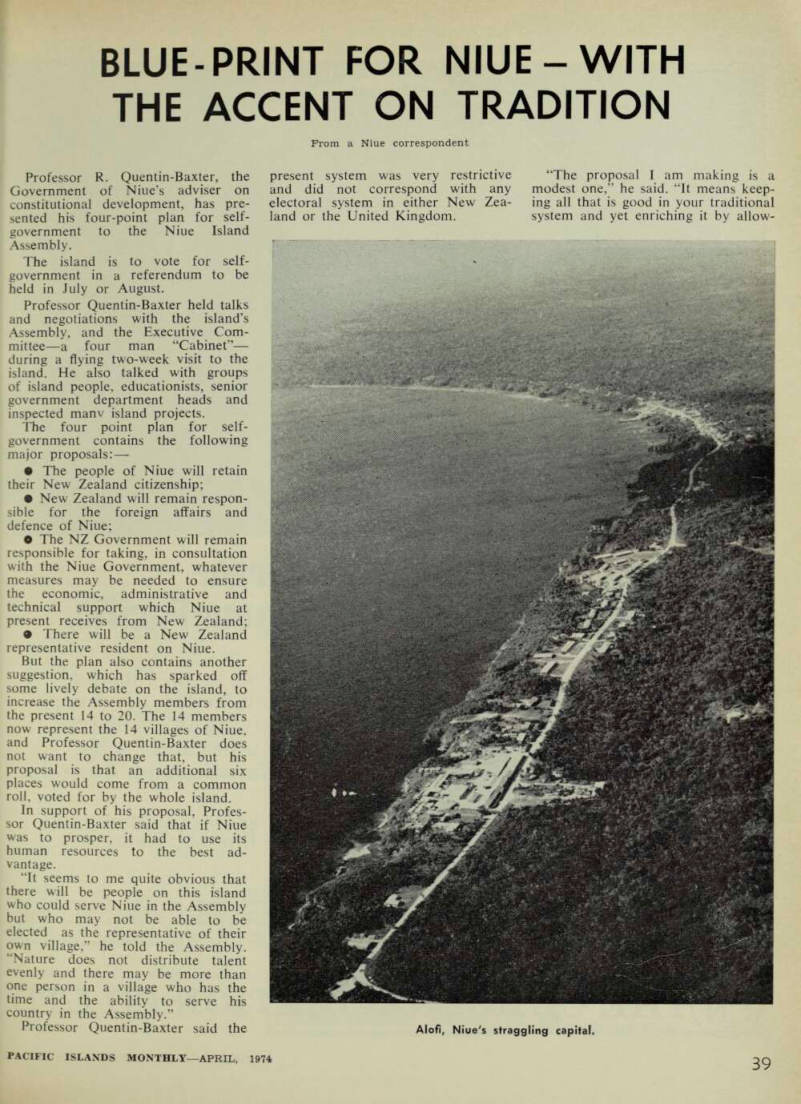
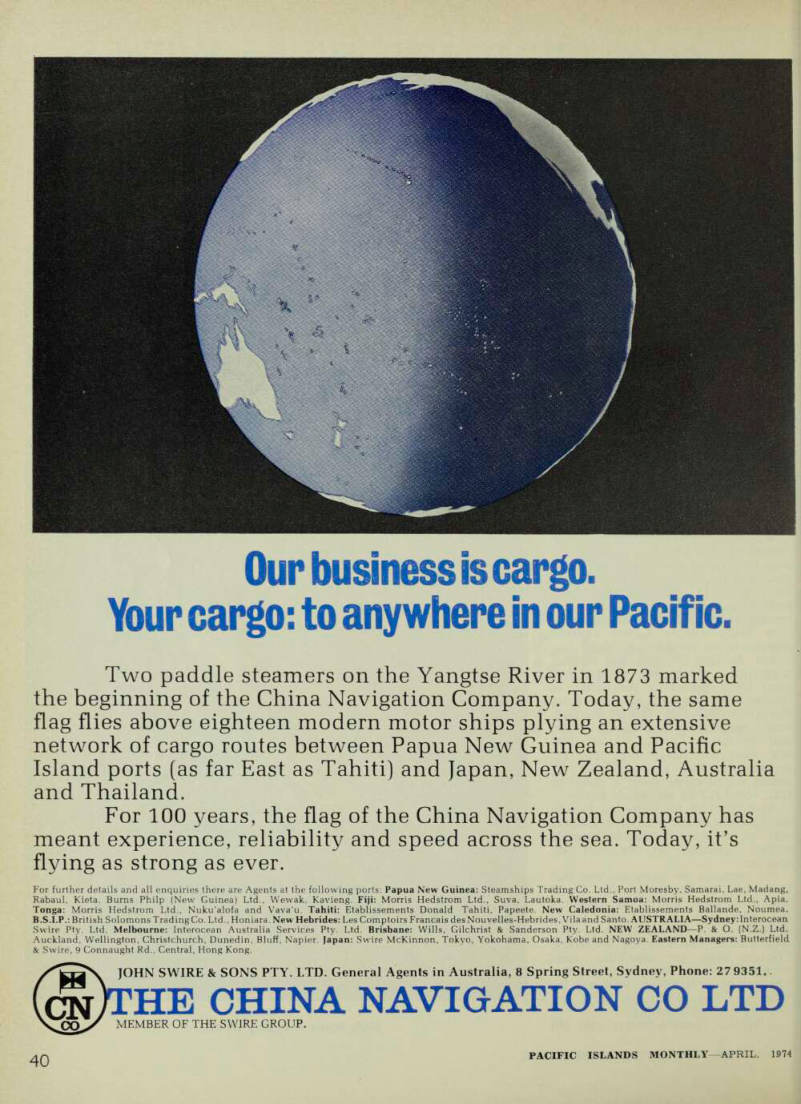
The Accent On Tradition
From a Niue correspondent
Professor R. Quentin-Baxter, the Government of Niue’s adviser on constitutional development, has pre sented his four-point plan for self government to the Niue Island Assembly.
The island is to vote for self government in a referendum to be held in July or August.
Professor Quentin-Baxter held talks and negotiations with the island’s Assembly, and the Executive Com mittee —a four man “Cabinet” — during a flying two-week visit to the island. He also talked with groups of island people, educationists, senior government department heads and inspected manv island projects.
The four point plan for self government contains the following major proposals:— • The people of Niue will retain their New Zealand citizenship; • New Zealand will remain respon sible for the foreign affairs and defence of Niue; O The NZ Government will remain responsible for taking, in consultation with the Niue Government, whatever measures may be needed to ensure the economic, administrative and technical support which Niue at present receives from New Zealand; • There will be a New Zealand representative resident on Niue.
But the plan also contains another suggestion, which has sparked off some lively debate on the island, to increase the Assembly members from the present 14 to 20. The 14 members now represent the 14 villages of Niue, and Professor Quentin-Baxter does not want to change that, but his proposal is that an additional six places would come from a common roll, voted for by the whole island.
In support of his proposal, Profes sor Quentin-Baxter said that if Niue was to prosper, it had to use its human resources to the best ad vantage.
“It seems to me quite obvious that there will be people on this island who could serve Niue in the Assembly but who may not be able to be elected as the representative of their own village,” he told the Assembly.
“Nature does not distribute talent evenly and there may be more than one person in a village who has the time and the ability to serve his country in the Assembly.”
Professor Quentin-Baxter said the
present system was very restrictive and did not correspond with any electoral system in either New Zea land or the United Kingdom.
‘The proposal I am making is a modest one,” he said. “It means keep ing all that is good in your traditional system and yet enriching it by allow-
Alofi, Niue's straggling capital.
ing the possibility of other people, who have special gifts and who are willing to offer their services, to join the representatives of the 14 villages in the Assembly.
“I believe this would be a good balance between the traditional system and the needs of the future, I believe it would enrich your own Assembly and that in future assemblies the 20 representatives would be better equip ped than ever before to carry the much greater responsibility that the Assembly has now acquired.”
After the Niue Constitution Bill has gone through the NZ Parliament, the islanders will have to decide by vote whether they want self-government on the basis of the new constitution.
Should they vote against it, which is very unlikely, they would be back under New Zealand’s wing as a dependency.
In Australia in February as guest of the Australian Government, Mr R. R. Rex, Niue’s Leader of Govern ment Business and favourite for the job of Premier, told PlM’s man they expected to be self-governing towards the latter part of this year. The present Assembly would continue to govern until general elections in March next year.
“I don’t think the elections will bring many changes in the Assembly,” said Mr Rex. “I’m optimistic about the result and feel we’ll be back in power,”
He said that New Zealand had doubled the amount of aid to Niue over the next three years to a total of $5.4 million. He had had talks with members of the Australian Government and while they had made no specific promises they said they were prepared to assist Niue with technical aid.
The Niueans are hoping that tourism will boost their living standards now that the island’s first tourist resort hotel is almost ready to open its doors—and Americans will be welcome to call.
An embarrassed Mr Rex denied Australian newspaper reports that he had said they didn’t want Americans on Niue.
“I didn’t say that,” protested Mr Rex to PIM. “I said that having seen other places exposed to the pattern of American tourism, we would have to be careful that the pattern of our island life is not upset.
“I think other places have been spoilt by tourism and their life-pat tern has been upset, but we will wel come American tourists though, at the same time, we will try to ensure that life-style is not changed. We don’t want the Americans to feel they are not wanted. They are.”
There’ll be one big change on the island and it won’t be through
tourism. Niue, financed by New Zealand, is going all-electric.
“We’ve been given the green light to go ahead with reticulation of electricity right round the island,” said Mr Rex. “We’ve been dreaming of electricity for years.” . £ , . *
Passionfruit crisis
Niue Island has a recurring passionfruit crisis. Lack of freezer space on the island, plus a delay in getting new freezers from New Zealand, are the crux of the problem. Most commercial freezers, and a few private freezers as well, were crammed with passionfruit in January, just before
the arrival of the Luhesand, which was expected to carry a cargo of freezer goods, placing a further strain on available freezer space till the Moana Roa arrived to pick up the
passionfruit.
Fortunately, the squeeze did not occur as the Luhesand had only a small amount of freezer cargo. Then the Moana Roa made a special trip to Niue to pick up the bulk passion fruit, which totalled more than 20 tons. The ship arrived at an oppor tune time to pick up the fruit, as New Zealand was then out of it.
Another freezer space crisis was ex pected to develop late in February.
Advertisements & other items, pp. 46-48 (1 item)
Our business is cargo.
I \ X. x i ■ 1 ss U ■
Your cargo: to anywhere in our Pacific.
Two paddle steamers on the Yangtse River in 1873 marked the beginning of the China Navigation Company. Today, the same flag flies above eighteen modern motor ships plying an extensive network of cargo routes between Papua New Guinea and Pacific Island ports (as far East as Tahiti) and Japan, New Zealand, Australia and Thailand.
For 100 years, the flag of the China Navigation Company has meant experience, reliability and speed across the sea. Today, it’s flying as strong as ever.
For further details and all enquiries there are Agents at the following ports: Papua New Guinea: Steamships Trading Co. Ltd., Port Moresby, Samarai, Lae, Madang, Rabaul, Kieta. Burns Philp {New Guinea) Ltd., Wewak, Kavieng. Fiji: Morris Hedstrom Ltd., Suva, Lautoka. Western Samoa: Morris Hedstrom Ltd., Apia.
Tonga; Morris Hedstrom Ltd., Nukualofa and Vava’u. Tahiti: Etablissements Donald Tahiti, Papeete. New Caledonia: Etablissements Ballande, Noumea. 8.5.1. P.; British Solomons Trading Co. Ltd , Honiara. New Hebrides: Les Comptoirs Francais desNouvelles-Hebrides, Vilaand Santo. AUSTRALIA—Sydney: Interocean Swire Pty. Ltd. Melbourne: Interocean Australia Services Pty. Ltd. Brisbane: Wills, Gilchrist & Sanderson Pty. Ltd. NEW ZEALAND — P. & O. (N.Z.) Ltd.
Auckland, Wellington, Christchurch, Dunedin, Bluff, Napier. Japan: Swire McKinnon, Tokyo, Yokohama, Osaka, Kobe and Nagoya. Eastern Managers; Butterfield & Swire, 9 Connaught Rd., Central, Hong Kong.
JOHN SWIRE & SONS PTY. LTD. General Agents in Australia. 8 Spring Street, Sydney, Phone: 27 9351.
HE CHINA NAVIGATION CO LTD
MEMBER OF THE SWIRE GROUP.
m CN CO
5 * 1
JAMES SANDY & COY.
637 GARDENERS ROAD,
MASCOT, NSW 2020, AUST-
VENTILATING
VRE
LO
ows
IN THE HOME
Add beauty and sunshine to your home by installing Australia's most economical, attractive louvre windows ... Sandy adjustable all-louvre windows.
Every modern feature is incorporated-in them, and they can be fitted with plain or figured glass blades ... also, temparature reducing folded aluminium blades.
IN INDUSTRY
The most practical answer to provide weather-resistance and controlled ventilation to factories, offices and stores is the use of Sandy Adjustable Aluminium Louvres. They are most economical in installation and offer durability at such low cost!
Concentrated Pea-Ben
is lethal to flies, mosquitoes
and all insect pests ...
Yet so pure it's safe to spray anywhere With tropical weather providing ideal conditions for prolifically breeding flies and mosquitoes, serious outbreaks of disease can be spread by swarms of these insect invaders. Once more householders are urged to combat this threat to public health by killing every disease carrying insect seen. A.N.I. Research Chemists are constantly at work world-wide to ensure that Pea-Beu aerosol insecticide is effective in eliminating flies and mosquitoes from households. Pea-Beu is specifically formulated to contain pyrethrins, one of the most powerful insecticidal ingredients known deadly to mosquitoes, and all insect pests and yet harmless to man and his pets.
V V The Deadliest Traffickers of Disease Four centuries ago flies were suspected of spreading tropical ulcers. Modern pathologists have proved they spread a whole list of infections, ranging from mild but unpleasant stomach upsets to infective hepatitis, bacillary, dysentery, typhoid and persistent ameobiasis. Worse still, flies transmit crippling scourges such as cholera, smallpox, poliomyelitis, opthalmia and trachoma. A highly efficient method of fly extermination is to use powerful Pea-Beu aerosol insecticide. A few short bursts of Pea-Beu in a room will kill all flies on the wing.
The permeating action of Pea-Beu also spreads into hidden comers of the room, thus eliminating any hidden insects.
The mosquitoe’s record is just as grim.
Besides wrecking your night’s rest with their irritating whine and inflicting painful toxic bites, mosquitoes pass on many serious diseases including malaria, hepatitis, dengue and yellow fever, disfiguring elephantiasis and encephalitis.
Total Killing Power with Total Safety Controlling these dangerous diseasespreaders demands rapid destruction wherever they appear. Long-term research was needed to formulate the insect spray that combines high killing potential with complete safety for users, as powerful Pea-Beu aerosol does. Pea-Beu is particularly effective as the wide action spray ensures total coverage of any room. Pea Beu’s efficient spray seeks out and destroys insects before they have a chance to bring irritation and illness to your family. n
Pea-Beu the safe, powerful insecticide
Fiji Gets Tough With Offenders ...
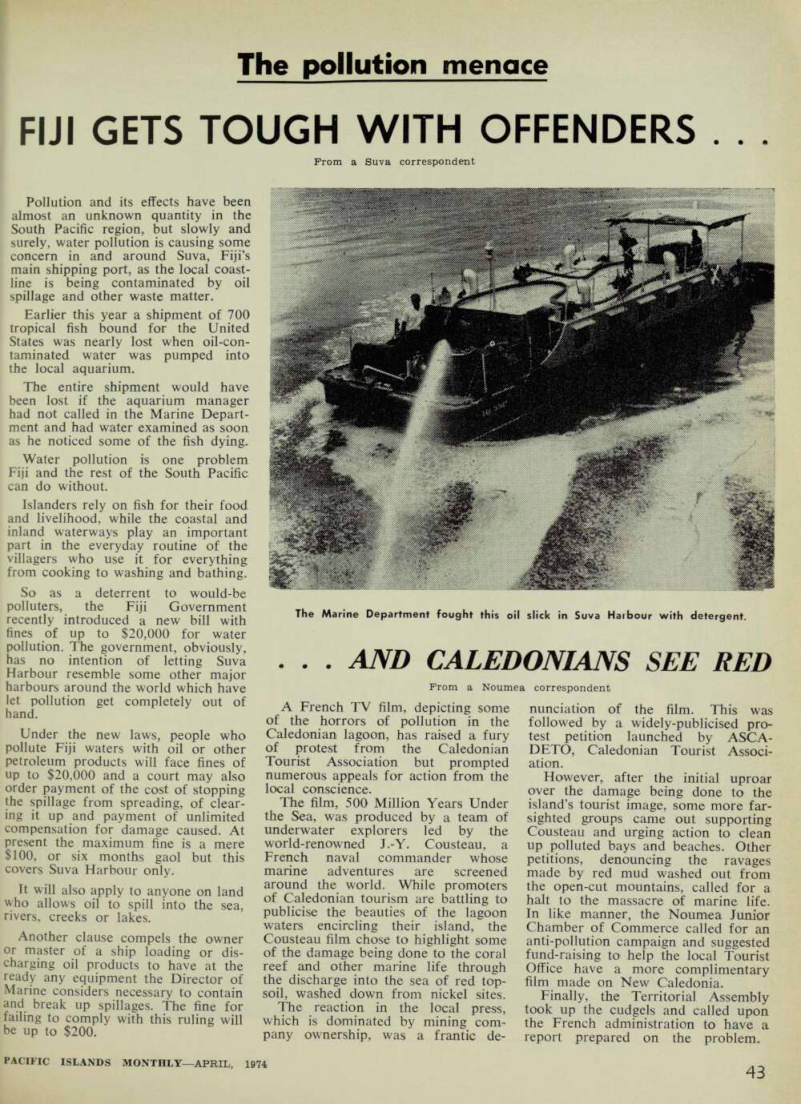
The pollution menace
... And Caledonians See Red
Prom a Suva correspondent
Pollution and its effects have been almost an unknown quantity in the South Pacific region, but slowly and surely, water pollution is causing some concern in and around Suva, Fiji’s main shipping port, as the local coast line is being contaminated by oil spillage and other waste matter.
Earlier this year a shipment of 700 tropical fish bound for the United States was nearly lost when oil-con taminated water was pumped into the local aquarium.
The entire shipment would have been lost if the aquarium manager had not called in the Marine Depart ment and had water examined as soon as he noticed some of the fish dying.
Water pollution is one problem Fiji and the rest of the South Pacific can do without.
Islanders rely on fish for their food and livelihood, while the coastal and inland waterways play an important part in the everyday routine of the villagers who use it for everything from cooking to washing and bathing.
So as a deterrent to would-be polluters, the Fiji Government recently introduced a new bill with fines of up to $20,000 for water pollution. The government, obviously, has no intention of letting Suva Harbour resemble some other major harbours around the world which have let pollution get completely out of hand.
Under the new laws, people who pollute Fiji waters with oil or other petroleum products will face fines of up to $20,000 and a court may also order payment of the cost of stopping the spillage from spreading, of clear ing it up and payment of unlimited compensation for damage caused. At present the maximum fine is a mere $lOO, or six months gaol but this covers Suva Harbour only.
It will also apply to anyone on land who allows oil to spill into the sea, rivers, creeks or lakes.
Another clause compels the owner or master of a ship loading or dis charging oil products to have at the ready any equipment the Director of Marine considers necessary to contain and break up spillages. The fine for failing to comply with this ruling will be up to $2OO.
From a Noumea correspondent
A French TV film, depicting some of the horrors of pollution in the Caledonian lagoon, has raised a fury of protest from the Caledonian Tourist Association but prompted numerous appeals for action from the local conscience.
The film, 500 Million Years Under the Sea, was produced by a team of underwater explorers led by the world-renowned J.-Y. Cousteau, a French naval commander whose marine adventures are screened around the world. While promoters of Caledonian tourism are battling to publicise the beauties of the lagoon waters encircling their island, the Cousteau film chose to highlight some of the damage being done to the coral reef and other marine life through the discharge into the sea of red topsoil, washed down from nickel sites.
TTie reaction in the local press, which is dominated by company ownership, was a frantic de-
nunciation of the film. This was followed by a widely-publicised pro test petition launched by ASCA DETO, Caledonian Tourist Associ ation.
However, after the initial uproar over the damage being done to the island’s tourist image, some more far sighted groups came out supporting Cousteau and urging action to clean up polluted bays and beaches. Other petitions, denouncing the ravages made by red mud washed out from the open-cut mountains, called for a halt to the massacre of marine life, In like manner, the Noumea Junior Chamber of Commerce called for an anti-pollution campaign and suggested fund-raising to help the local Tourist Office have a more complimentary film made on New Caledonia, Finally, the Territorial Assembly took up the cudgels and called upon the French administration to have a report prepared on the problem.
The Marine Department fought this oil slick in Suva Harbour with detergent.
Advertisements & other items, p. 50 (1 item)
I >Jsst
■ * a®%i
ETC.
mm 1 ( sv &^ '
I ''KG N£1(37.47L8)
e^2B.
WHTOIfS
HQ >“^™T
STEEL ,q %
|:J
p. SVONEV J|
P° Uc f OF ABSIMWMff.HI
snmnit! si OF Sr I ■mfiSf WWKWS vifj
Guinea's National Heritage
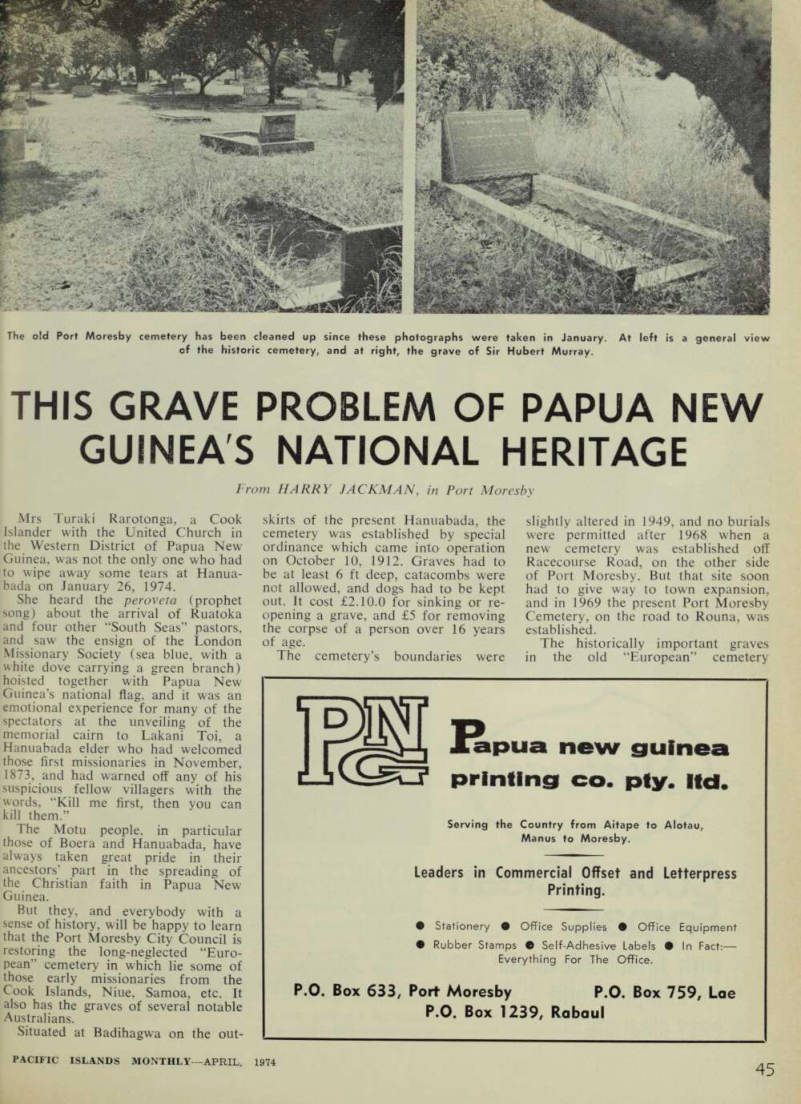

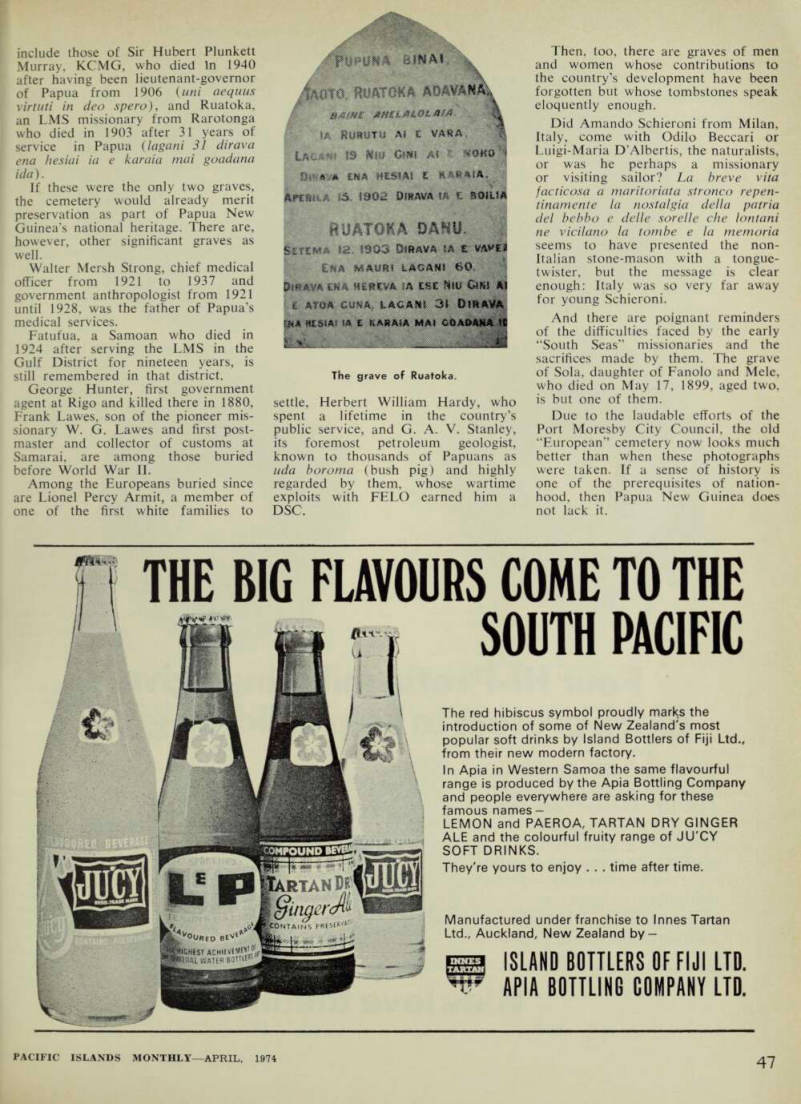
This Grave Problem Of Papua New
From HARRY JACKMAN, in Port Moresby
Mrs Turaki Rarotonga, a Cook Islander with the United Church in the Western District of Papua New Guinea, was not the only one who had to wipe away some tears at Hanua bada on January 26, 1974.
She heard the peroveta (prophet song) about the arrival of Ruatoka and four other “South Seas” pastors, and saw the ensign of the London Missionary Society (sea blue, with a white dove carrying a green branch) hoisted together with Papua New Guinea’s national flag, and it was an emotional experience for many of the spectators at the unveiling of the memorial cairn to Lakani Toi, a Hanuabada elder who had welcomed those first missionaries in November, 1873, and had warned off any of his suspicious fellow villagers with the words, “Kill me first, then you can kill them.”
The Motu people, in particular those of Boera and Hanuabada, have always taken great pride in their ancestors’ part in the spreading of the Christian faith in Papua New Guinea.
But they, and everybody with a sense of history, will be happy to learn that the Port Moresby City Council is restoring the long-neglected “Euro pean” cemetery in which lie some of those early missionaries from the Cook Islands, Niue, Samoa, etc. It also has the graves of several notable Australians.
Situated at Badihagwa on the out
skirts of the present Hanuabada, the cemetery was established by special ordinance which came into operation on October 10, 1912. Graves had to be at least 6 ft deep, catacombs were not allowed, and dogs had to be kept out. It cost £2.10.0 for sinking or re opening a grave, and £5 for removing the corpse of a person over 16 years of age.
The cemetery’s boundaries were
slightly altered in 1949, and no burials were permitted after 1968 when a new cemetery was established off Racecourse Road, on the other side of Port Moresby. But that site soon had to give way to town expansion, and in 1969 the present Port Moresby Cemetery, on the road to Rouna, was established.
The historically important graves in the old “European” cemetery
The old Port Moresby cemetery has been cleaned up since these photographs were taken in January. At left is a general view of the historic cemetery, and at right, the grave of Sir Hubert Murray.
include those of Sir Hubert Plunkett Murray, KCMG, who died In 1940 after having been lieutenant-governor of Papua from 1906 {uni aequus virtuti in deo spero), and Ruatoka, an LMS missionary from Rarotonga who died in 1903 after 31 years of service in Papua ( lagani 31 dirava ena hesiai ia e karaia mai goadana ida ).
If these were the only two graves, the cemetery would already merit preservation as part of Papua New Guinea’s national heritage. There are, however, other significant graves as well.
Walter Mersh Strong, chief medical officer from 1921 to 1937 and government anthropologist from 1921 until 1928, was the father of Papua’s medical services.
Fatufua, a Samoan who died in 1924 after serving the LMS in the Gulf District for nineteen years, is still remembered in that district, George Hunter, first government agent at Rigo and killed there in 1880, Frank Lawes, son of the pioneer mis sionary W. G. Lawes and first post master and collector of customs at Samarai, are among those buried before World War 11.
Among the Europeans buried since are Lionel Percy Armit, a member of one of the first white families to
settle, Herbert William Hardy, who spent a lifetime in the country’s public service, and G. A. V. Stanley, its foremost petroleum geologist, known to thousands of Papuans as uda boroma (bush pig) and highly regarded by them, whose wartime exploits with FELO earned him a
Dsc.
Then, too, there are graves of men and women whose contributions to the country’s development have been forgotten but whose tombstones speak eloquently enough.
Did Amando Schieroni from Milan, Italy, come with Odilo Beccari or Luigi-Maria D’Albertis, the naturalists, or was he perhaps a missionary or visiting sailor? La breve vita facticosa a maritoriata stronco repen tinamente la nostalgia della patria del bebbo e delle sorelle che lontani ne vicilano la tombe e la memoria seems to have presented the non- Italian stone-mason with a tongue twister, but the message is clear enough: Italy was so very far away for young Schieroni.
And there are poignant reminders of the difficulties faced by the early “South Seas” missionaries and the sacrifices made by them. The grave of Sola, daughter of Fanolo and Mele, who died on May 17, 1899, aged two, is but one of them.
Due to the laudable efforts of the Port Moresby City Council, the old “European” cemetery now looks much better than when these photographs were taken. If a sense of history is one of the prerequisites of nation hood, then Papua New Guinea does not lack it.
The grave of Ruatoka.
Advertisements & other items, pp. 51-55 (2 items)
printing co. pty. ltd.
D apua new guinea
Serving the Country from Aitape to Alotau, Manus to Moresby.
Leaders in Commercial Offset and Letterpress Printing. • Stationery 0 Office Supplies 0 Office Equipment • Rubber Stamps 0 Self-Adhesive Labels • In Fact; — Everything For The Office.
P.O. Box 633, Port Moresby P.O. Box 759, Lae P.O, Box 1239, Rabaul
- / it € m c t w m 4 i m.
imheam
Cook & Clean
Frypan
with detachable cradle
for complete and
easy cleaning
Now Sunbeam presents an electric frypan that comes apart for complete cleaning the easy way. New “cook and clean” cradle combines legs, buffet handles and bottom shield —helps keep out grease from cooking, removes for cleaning. Clean the pan in the dishwasher or sink, and the cradle in the sink. Then put them back together with the twist of a knob.
Super accurate heat control also removes for complete frypan immersibility. Has a high dome vented cover which tilts to six positions, together with Sunbeam’s special pan tilt lever for grilling. Truly Australia’s new “easy-clean” frypan. L 83.4140 .
THE BIG FLAVOURS COME TO THE
SOUTH PACIFIC
mi" €? ?■ » MM > P
XrtanDs
QingerJ^
‘'OOR
■3 The red hibiscus symbol proudly marks the introduction of some of New Zealand's most popular soft drinks by Island Bottlers of Fiji Ltd., from their new modern factory.
In Apia in Western Samoa the same flavourful range is produced by the Apia Bottling Company and people everywhere are asking for these famous names -
LEMON and PAEROA, TARTAN DRY GINGER
ALE and the colourful fruity range of JU'CY
SOFT DRINKS.
They're yours to enjoy . . . time after time.
Manufactured under franchise to Innes Tartan Ltd., Auckland, New Zealand by-
ISLAND BOTTLERS Of FIJI LTD.
APIA BOTTLING COMPANY LTD.
Four Hi-Protin milk rings give
extra protein to help children grow.
Protein is vital in assisting the healthy growth of children.
HI-PROTIN milk rings also contain essential vitamins and minerals for balanced development.
HI-PROTIN is specially baked to assist the healthy development of infants gums and jaws.
Delicious HI-PROTIN, good for everyone-from baby to grandpa All enquiries: Arnott-Brockhoff-Guest Pty, Ltd., Burwood, Victoria, Australia, 3125. 277 V, j
Kids love them
From the
Islands Press
From a letter by Thomas B. Aitcheson in The Fiji Times: Most matches manufactured locally are of poor quality. Match-heads appear in all shapes and I sizes—double heads, triple heads, ragged heads and half-heads. Some matches are even headless.
From Tonga Chronicle commentary:
Today in Tonga, the escalation of prices and inflation are becoming everyday words, and in the confusion now prevalent because of the effects of these events, further increase in prices and rising costs have not the impact it should have.
Not because consumers can now well afford these price increases, but they have now adopted an attitude of nonchalance because they fully realise there is little they can do about it. Prices are getting far beyond the consumers' resources that the only alternative is to "crawl into their shell" and await some sort of a miracle.
From the New Hebrides Radio Group News: Airlifted from Tanna last week, a pineapple with 100 heads. This curiosity is now being examined by Department of Agriculture specialists . . . Large numbers of fruits in the developing stages are not uncommon, but 100 is a very large number indeed.
From a letter by Benedict J. Teitiaki in the GEIC Atoll Pioneer: Being a woman does not give anyone the right to judge what other people should or should not do.
And this from a letter by Miss T. Birati in the Atoll Pioneer in reply to the letter above: I think that Teitiaki in his overeagerness (I wonder why!) to discredit Miss T. A. Kaburoro's arguments and saying she has no brains has made himself appear to be a conceited, pompous ass.
From the Fiji Times, February 13, 1974: Police are searching for Panapasa Ralawati, alias Vanapasa Pussy Gosh and Pana Natua (pictured) who escaped from custody at Nadi on Friday,
February 20.
From an editorial in the Samoa Times: Samoans do not view life through dark glasses. They live life in the raw. Death is nothing new, nor is it something to be disguised. Death is death. Every day a Samoan child of seven or eight is cutting off a chicken's head, spattering blood all over himself. Everywhere girls watch pigs being throttled to death with crowbars across their necks. Far be it from us to suggest that the killing of these animals is the same as the death of human beings. What we are saying is that the Samoan's outlook on death is conditioned by the environment in which he lives, and is different
from that of guests in this country. And we report according to Samoan standards.
From a letter by Rev C. R. Skewes (Free Wesleyan Church of Tonga) in the Tonga Chronicle on plans to introduce television: . . . Viewing television may help us forget our problems temporarily but it cannot be claimed to be meeting a development need. Rather it is a prestigious consumer luxury the implementation of which should be deferred indefinitely or flatly rejected.
From the Nauru Bulletin: The management of the Nauru Co-operative Society Store has made an appeal to those people who took the folding chairs from the Denig Oval during the NCS Golden Week celebrations, to return them to the NCS No 1 Store. A spokes man for NCS said there were approximately 120 chairs believed to have been taken during the concert nights.
The people concerned are advised to return these chairs immediately or they can make arrangements to purchase them at $7.50 each.
From the Tonga Chronicle: The subject of salary increase for Civil Servants has been discussed by almost every department in the Government Service. No one knows for certain whether there is going to be a salaries increase or if there is, when it is going to take place. If every civil servant's desk is searched, or even his or her pockets, one is sure to find a piece of paper with calculations of that person's hope for the increase and the back pay that is likely to be coming.
From a letter by Socialist in the PNG Post-Courier on the "nationalising" of medical services: ... It seems to me that you private doctors have been hiding all this time in your luxurious caves and gulping fortune after fortune into your bellies from people up there . . . Papua New Guinea, if you did not know, has been a socialist land ever since it became self-governing. We do not need inhumane individuals in this country. One either stays and provides services which the mass benefits from or goodbye and good luck, wherever you go.
From a speech reported in The Fiji Times: “I don’t believe there are many teeth left in Tahiti,” the head of the dental department of the University of Adelaide, Dr Elizabeth Fanning, said in Suva. Dr Fanning said Tahiti’s girls were beautiful, but naturally she looked at their teeth first. “I think the teeth in Fiji are beautiful,” she said. Passing through the country (Fiji), she was impressed to see corn being sold to passengers at bus stops and peanuts on sale at most bus stands instead of sweets. She said she hoped this practice would continue. “People should keep to their local customs and not change to our lousy Western habits,” she said.
From the New Hebrides Nakamal: . . . The National Party would gain still more audience among the islanders if it included more of the worthies from all the ethnic groups. The wisdom of the elder islanders is still presently necessary and enriching in the face of modern problems. To freely ignore or feign to ignore it is a hindrance to Custom, so greatly extolled by the National Party; that will be highly prejudicial to the progress and impact of the National Party. Young and old from all ethnic groups must collaborate . . .
Yesterday
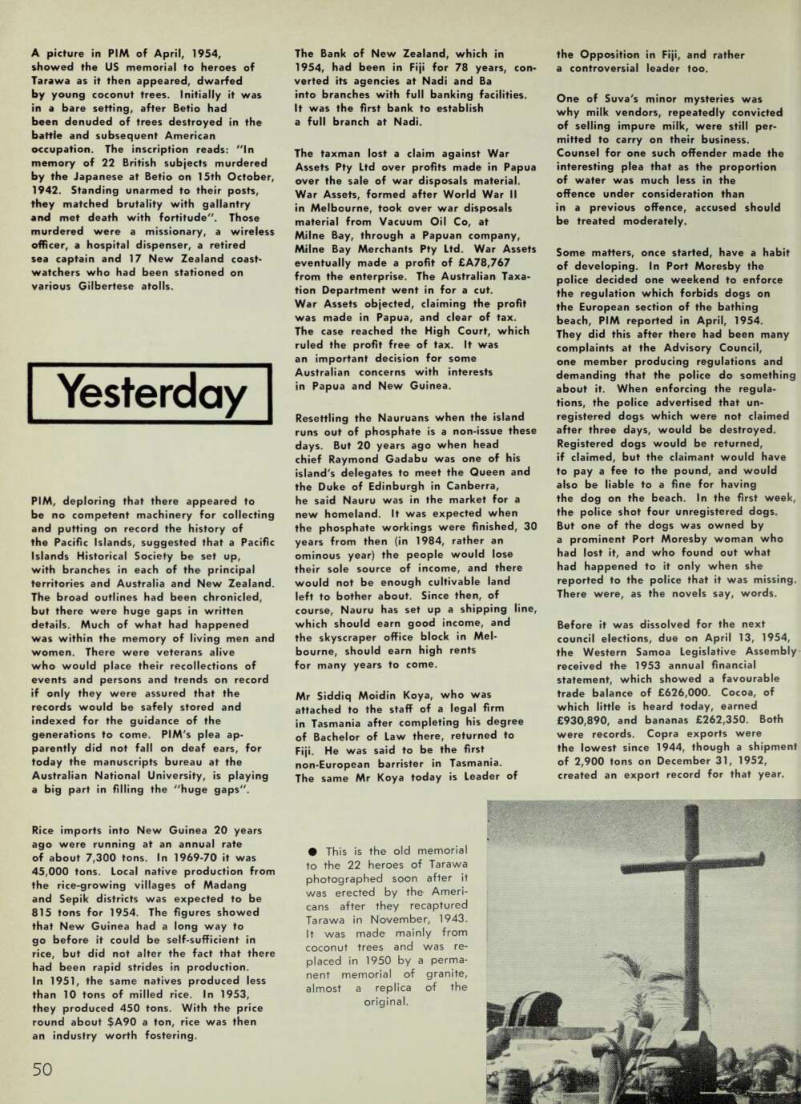
A picture in PIM of April, 1954, showed the US memorial to heroes of Tarawa as it then appeared, dwarfed by young coconut trees. Initially it was in a bare setting, after Betio had been denuded of trees destroyed in the battle and subsequent American o<cupation. The inscription reads: "In memory of 22 British subjects murdered by the Japanese at Betio on 15th October, 1942. Standing unarmed to their posts, they matched brutality with gallantry and met death with fortitude". Those murdered were a missionary, a wireless officer, a hospital dispenser, a retired sea captain and 17 New Zealand coast watchers who had been stationed on various Gilbertese atolls.
PIM, deploring that there appeared to be no competent machinery for collecting and putting on record the history of the Pacific Islands, suggested that a Pacific Islands Historical Society be set up, with branches in each of the principal territories and Australia and New Zealand.
The broad outlines had been chronicled, but there were huge gaps in written details. Much of what had happened was within the memory of living men and women. There were veterans alive who would place their recollections of events and persons and trends on record if only they were assured that the records would be safely stored and indexed for the guidance of the generations to come. PlM's plea ap parently did not fall on deaf ears, for today the manuscripts bureau at the Australian National University, is playing a big part in filling the "huge gaps".
Rice imports into New Guinea 20 years ago were running at an annual rate of about 7,300 tons. In 1969-70 it was 45,000 tons. Local native production from the rice-growing villages of Madang and Sepik districts was expected to be 815 tons for 1954. The figures showed that New Guinea had a long way to go before it could be self-sufficient in rice, but did not alter the fact that there had been rapid strides in production.
In 1951, the same natives produced less than 10 tons of milled rice. In 1953, they produced 450 tons. With the price round about SA9O a ton, rice was then an industry worth fostering.
The Bank of New Zealand, which in 1954, had been in Fiji for 78 years, con verted its agencies at Nadi and Ba into branches with full banking facilities.
It was the first bank to establish a full branch at Nadi.
The taxman lost a claim against War Assets Pty Ltd over profits made in Papua over the sale of war disposals material.
War Assets, formed after World War II in Melbourne, took over war disposals material from Vacuum Oil Co, at Milne Bay, through a Papuan company, Milne Bay Merchants Pty Ltd. War Assets eventually made a profit of £A78,767 from the enterprise. The Australian Taxa tion Department went in for a cut.
War Assets objected, claiming the profit was made in Papua, and clear of tax.
The case reached the High Court, which ruled the profit free of tax. It was an important decision for some Australian concerns with interests in Papua and New Guinea.
Resettling the Nauruans when the island runs out of phosphate is a non-issue these days. But 20 years ago when head chief Raymond Gadabu was one of his island's delegates to meet the Queen and the Duke of Edinburgh in Canberra, he said Nauru was in the market for a new homeland. It was expected when the phosphate workings were finished, 30 years from then (in 1984, rather an ominous year) the people would lose their sole source of income, and there would not be enough cultivable land left to bother about. Since then, of course, Nauru has set up a shipping line, which should earn good income, and the skyscraper office block in Mel bourne, should earn high rents for many years to come.
Mr Siddiq Moidin Koya, who was attached to the staff of a legal firm in Tasmania after completing his degree of Bachelor of Law there, returned to Fiji. He was said to be the first non-European barrister in Tasmania.
The same Mr Koya today is Leader of
the Opposition in Fiji, and rather a controversial leader too.
One of Suva's minor mysteries was why milk vendors, repeatedly convicted of selling impure milk, were still per mitted to carry on their business.
Counsel for one such offender made the interesting plea that as the proportion of water was much less in the offence under consideration than in a previous offence, accused should be treated moderately.
Some matters, once started, have a habit of developing. In Port Moresby the police decided one weekend to enforce the regulation which forbids dogs on the European section of the bathing beach, PIM reported in April, 1954.
They did this after there had been many complaints at the Advisory Council, one member producing regulations and demanding that the police do something about it. When enforcing the regula tions, the police advertised that un registered dogs which were not claimed after three days, would be destroyed.
Registered dogs would be returned, if claimed, but the claimant would have to pay a fee to the pound, and would also be liable to a fine for having the dog on the beach. In the first week, the police shot four unregistered dogs.
But one of the dogs was owned by a prominent Port Moresby woman who had lost it, and who found out what had happened to it only when she reported to the police that it was missing.
There were, as the novels say, words.
Before it was dissolved for the next council elections, due on April 13, 1954, the Western Samoa Legislative Assembly received the 1953 annual financial statement, which showed a favourable trade balance of £626,000. Cocoa, of which little is heard today, earned £930,890, and bananas £262,350. Both were records. Copra exports were the lowest since 1944, though a shipment of 2,900 tons on December 31, 1952, created an export record for that year.
This is the old memorial to the 22 heroes of Tarawa photographed soon after it was erected by the Ameri cans after they recaptured Tarawa in November, 1943.
It was made mainly from coconut trees and was re placed in 1950 by a perma nent memorial of granite, almost a replica of the
original.
Advertisements & other items, pp. 57-64 (1 item)
Pacific!
tk Qhirm Ghirardelh
NET WT 2*i OZ./70.88 GR.
MILK CHOCOLATE
FROM
THE
SOUTH
PACIFIC!
WT.2*02./70.58C
T he flavorfu! Macadamia nuts are grown for Ghirardelh on the Matana and No/a Plantations of Koro, one of the beautiful and temperate islands of Fiji. In these southern latitudes the trees grow up to 60 feet tall and the nuts develop an exceptionally fine taste. They are tender, crunchy, superbly flavorful. These are the Noble Macadamia Nuts of the South Pacific. On the wrapper is a picture of Captain Bligh's Cove on the plantations where the nuts are grown. hirardelli makes over 50 different prized chocolate items in its new California plant. Many hours are spent mixing and kneading the secret chocolate formulas that make up the many varieties of bars, chocolate drinks, chips and other exclusive products such as the macadamia nut bar. These exclusive items are now being exported around the world.
Ghirardelh®
GHIRARDELLI CHOCOLATE COMPANY, SAN'LEANDRO, CALIFORNIA 94578, U.S.A.
THIRTY THREE PACIFIC LTD.
Please contact THIRTY-THREE PACIFIC LTD., 2415 Octavia Street, San Francisco, California 94109, U.S.A., 415/921-0463 for information regarding Macadamia Nut Bars or the many other fine Ghirardelh products. (Telex) 335-320 (GOLDENGRN SNLO)
It took time to perfect the
NEW Hyster electrics.
Time to make the best.
4 &|; %
HYSUR
■ u We could have added new Hyster electric trucks to our extensive lift truck range some time ago. After all, we knew what people wanted, and we had the dealer and service network to back our sales Australia-wide.
But long after electric lift trucks first hit the market, we were busy perfecting a better hydraulic system to overcome the oil leaks and minimise the battery drain other manufacturers weren't so concerned about.
We wanted to make ours the top performance electric. An easy-handling truck with a short turning radius. Longer life between charges. Smoother deceleration. And single pedal control to keep the drivers happy.
Now we’ve built these advantages into a range of Hyster electric trucks with'load capacities of up to 10,000 lbs (5,000 kgs). We believe they're the world's finest, and they’re available from your Hyster dealer. Ask to see them in action. Or contact Hyster Australia Pty. Ltd., Ashford Avenue, Miiperra, N.S.W. 2214. Telephone Sydney 77 0511,
HYSTER AUSTRALIA PTY. LTD.
HR39.84
So Superior It’s Sensational!
Discover the easy, delicious way famous chefs use to enhance the flavor of meat, poultry, fish . . . casseroles, stews and gravies.
There's no substitute for "vintage flavor"
Kikkoman the preferred soy sauce.
Ml KIKKOMAN SHOYU CO., LTD.
Nihonbashi, Tokyo 103, Japan
ft m 1-Xl i
/F w' um;
mm > a - 'luoou \
O'QTn
sc S-- nr 5 = v : -
for the lively, alert Burns Philp family For most of 90 years Burns Philp people have been busy learning new things. Know-how is an important part of the company’s tradition, so it is not surprising that much of our modern effort is devoted to education and training.
This effort is visible almost everywhere in the Islands.
Training local managers, sponsoring students at near and distant schools, on-the-job training in specific skills —these are all part of it. They lead to better opportunities for individuals and better service by all the Burns Philp companies.
Best of all, the fun of education never ends. There is always something new to know, something more difficult to do, something challenging to discover. That keeps Burns Philp alert and lively.
Bums
Philp
GROUP OF COMPANIES B
PRINCIPAL OFFICE—7 BRIDGE STREET SYDNEY NSW 2000 AUSTRALIA
you’d like to know
more of Australia?
its people and way of life?
see it on film!
AUSTRALIAN FILMS ARE AVAILABLE
THROUGHOUT THE PACIFIC
Department of Information PAPUA & Extension Services, NEW GUINEA Konedobu.
Administrative Officer, NORFOLK IS.
Kingston.
TONGA
Information Office, Nuku'Alofa.
AMERICAN Teaching Resource Centre, SAMOA Department of Education, Pago Pago.
Australian Consulate, 1000 Bishop Street, Honolulu.
Information Office, Bairiki, Tarawa.
Nelson Memorial Library, Apia.
Australian High Commission, 3 Central Street, Suva.
HAWAII
MARSHALL IS.
GILBERT &
ELLICE IS.
WESTERN SAMOA
NAURU
NEW
HEBRIDES
FIJI
NEW
CALEDONIA
NEW ZEALAND
District Director of Education, Majuro.
Office of the Australian Representative.
Information Office, British Residency, Port Vila.
Australian Consulate, 45 Tee rue de Verdun, Noumea.
Trade Commission, Aust. Government Trade Commission Bank of New Zeeland House, Cathedral Square, Christchurch.
A FILM AUSTRALIA
ETON ROAD, LINDFIELD, N.S.W., 2070. PHONE 46-3241.
The blue beyond. The earth below.
A path between the two. That only youth may
Making the endless blue and m
bleach-white sands one...
HONDA.
A young man whose desire to reach the summit of success knows no limits. At work or at play, he thrives on new challenges, new ways to satisfy his zest for the active life. Every day more people are finding themselves in HONDA. Leader in motorcycles. Holder of the title of having V 3 of the world’s market. With sales in more than countries. By offering the right combination of power, performance, and ride in a wide range to suit every individual. It’s all of what it takes to be a world leader in motorcycles
... HONDA!
k KO 15 ip m m t-r - & /. ft 'll N J ‘ J- K m V 1 World’s Largest Motorcycle Manufacturer o*^ 'mm
MOXdRXO.. LTD.TOKYO, JAPAN
m M, . / :%V.t ® u J ,EA ' 5 " Steamshlps -W in 9 Co ■ Ltd * TERRITORY: J.C. Tenorio Enterprise P.O. Box 137. Saipan / Ftefl ISLANDS: Coral Island MnftmLßO. B6x 296. Suva / Gilbert & Etlrfedsfands gpieW%/ Majors PIO. B6x 296. / itor (Samoa) Ltd. p.O. Box^ .WESTERN SAMOA: MtftoMJistfibutd E.M. Jones tid. P.O. Box NukuaJ Establissements Ballande, Noumea / TAHITI. Ets. COMIMPBX P.O. .Papeete^ACOOfOfSLA^ioiT: cV«klsVands PO. Box 92,Rarotonga /NAURU ISLAND; Nauru Cooperative •. • ,♦r• r ’ * ■ i 4 ~,-Ta /_ AMERICAN S/yVIOAtsJMax Har'eck lrtc. P.O. Box99,’Pag6Pago*) , ifatoOA J Ltd ' 34' Nukualofa/ SOLOMON ISLANDS? British Solomons’'Trading Co., Ltd/ P.O. Box 94, Honiara /NEW CALEDONIA:
- 0?; ' - ■ rnim ■ • ■ ;'■■ -A mm 11 1■ ' I i I smmMm llwMrM*”
JBk - I&MshBSK 1
v * •■iwi ■ V; . , . m L ; Hi
Til
■ llfil' 5' Jl
Shipboard romances seldom last.
...mind you we’ve had some good things going for a while. But I’ve been thinking a lot about us-and my export business-lately. You’re not the reliable girl I thought you were.
Twice last month you were late—and I can t afford to have all that capital tied up in you.
Now, don’t go blowing your stacks-you’d be the first to admit that you cost me plenty for warehousing, multiple handling, cartage and insurance.
While you were weighing anchor someplace you shouldn’t have been; I’ve been weighing the facts. I know 1 didn’t dig planes before-but things have changed. While you’ve been charging me more and more each year, that beautifully groomed air cargo service has remained stable. You know the one I mean-Qantas. You always were a little jealous of her.
Let’s not part bad friends-maybe we can take a nice sea holiday together again sometime. But business is business... Must be off now. Got to call my freight forwarder.
He’s a real matchmaker for me and Qantas.
QT2958/ 73A
The
marketing
Edge.
Magazine Section
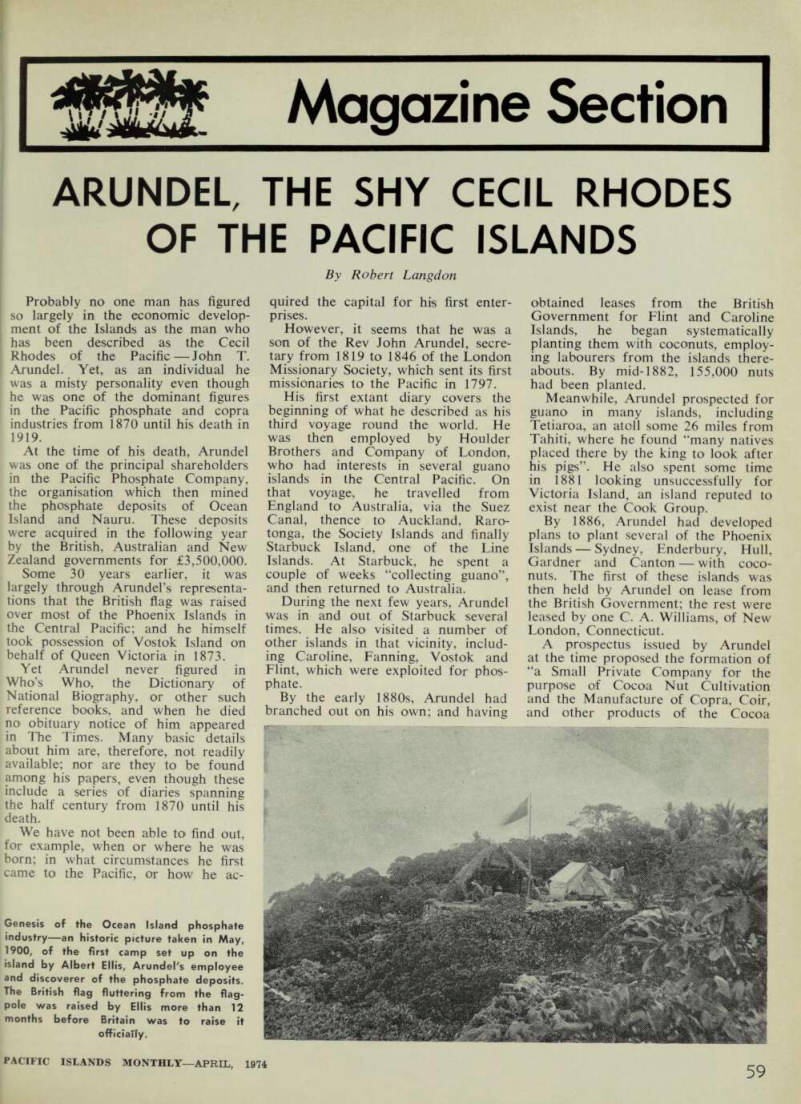
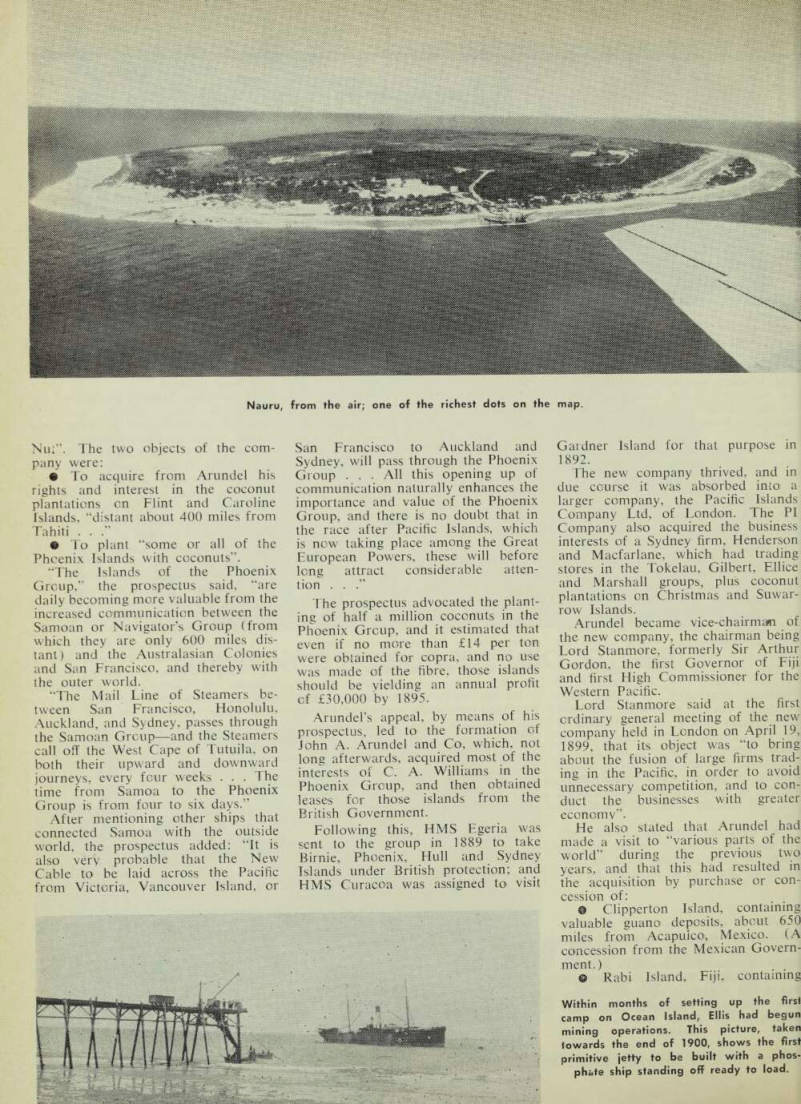
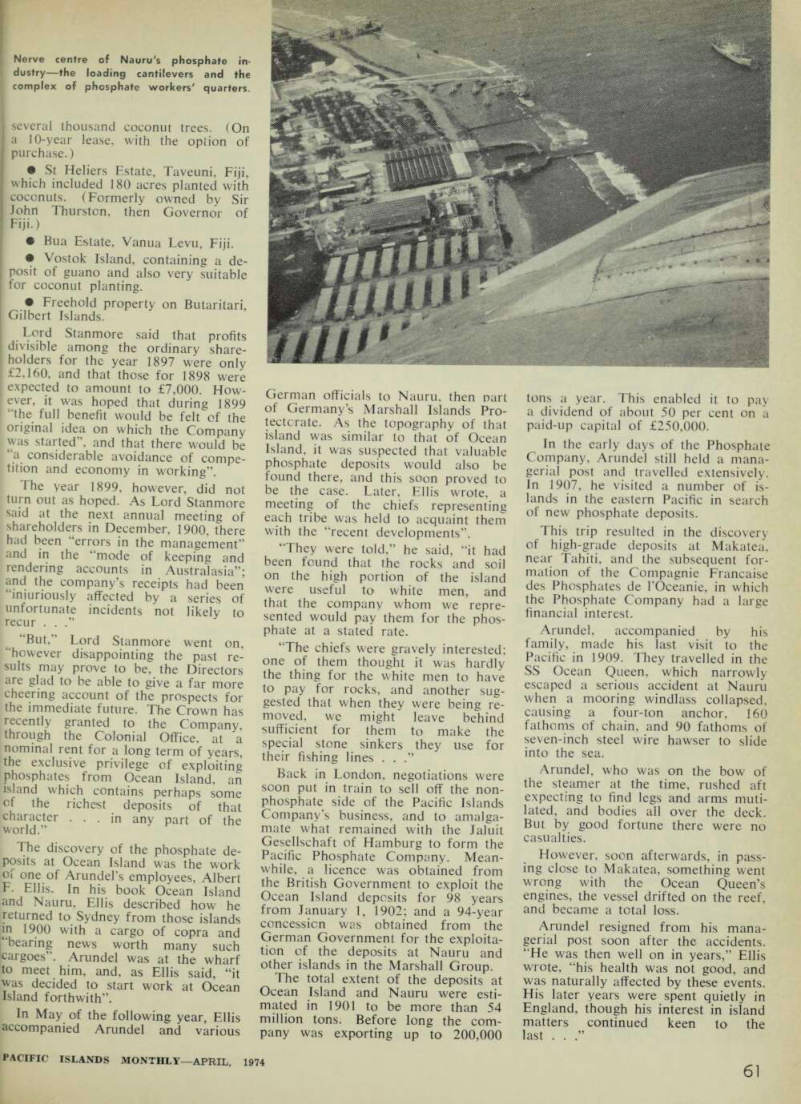
Arundel, The Shy Cecil Rhodes
Of The Pacific Islands
By Robert Langdon
Probably no one man has figured so largely in the economic develop ment of the Islands as the man who has been described as the Cecil Rhodes of the Pacific John T.
Arundel. Yet, as an individual he was a misty personality even though he was one of the dominant figures in the Pacific phosphate and copra industries from 1870 until his death in 1919.
At the time of his death, Arundel was one of the principal shareholders in the Pacific Phosphate Company, the organisation which then mined the phosphate deposits of Ocean Island and Nauru. These deposits were acquired in the following year by the British, Australian and New Zealand governments for £3,500,000.
Some 30 years earlier, it was largely through Arundel’s representa tions that the British flag was raised over most of the Phoenix Islands in the Central Pacific; and he himself took possession of Vostok Island on behalf of Queen Victoria in 1873.
Yet Arundel never figured in Who’s Who, the Dictionary of National Biography, or other such reference books, and when he died no obituary notice of him appeared in The Times. Many basic details about him are, therefore, not readily available; nor are they to be found among his papers, even though these include a series of diaries spanning the half century from 1870 until his death.
We have not been able to find out, for example, when or where he was born; in what circumstances he first came to the Pacific, or how he ac
quired the capital for his first enter prises.
However, it seems that he was a son of the Rev John Arundel, secre tary from 1819 to 1846 of the London Missionary Society, which sent its first missionaries to the Pacific in 1797.
His first extant diary covers the beginning of what he described as his third voyage round the world. He was then employed by Houlder Brothers and Company of London, who had interests in several guano islands in the Central Pacific. On that voyage, he travelled from England to Australia, via the Suez Canal, thence to Auckland, Raro tonga, the Society Islands and finally Starbuck Island, one of the Line Islands. At Starbuck, he spent a couple of weeks “collecting guano”, and then returned to Australia.
During the next few years, Arundel was in and out of Starbuck several times. He also visited a number of other islands in that vicinity, includ ing Caroline, Fanning, Vostok and Flint, which were exploited for phos phate.
By the early 1880 s, Arundel had branched out on his own; and having
obtained leases from the British Government for Flint and Caroline Islands, he began systematically planting them with coconuts, employ ing labourers from the islands there abouts. By mid-1882, 155,000 nuts had been planted.
Meanwhile, Arundel prospected for guano in many islands, including Tetiaroa, an atoll some 26 miles from Tahiti, where he found “many natives placed there by the king to look after his pigs”. He also spent some time in 1881 looking unsuccessfully for Victoria Island, an island reputed to exist near the Cook Group.
By 1886, Arundel had developed plans to plant several of the Phoenix Islands Sydney, Enderbury, Hull, Gardner and Canton with coco nuts. The first of these islands was then held by Arundel on lease from the British Government; the rest were leased by one C. A. Williams, of New London, Connecticut.
A prospectus issued by Arundel at the time proposed the formation of “a Small Private Company for the purpose of Cocoa Nut Cultivation and the Manufacture of Copra, Coir, and other products of the Cocoa
Genesis of the Ocean Island phosphate industry—an historic picture taken in May, 1900, of the first camp set up on the island by Albert Ellis, Arundel's employee and discoverer of the phosphate deposits.
The British flag fluttering from the flag pole was raised by Ellis more than 12 months before Britain was to raise it officially.
Nut”. The two objects of the com pany were: © To acquire from Arundel his rights and interest in the coconut plantations on Flint and Caroline Islands, “distant about 400 miles from Tahiti . . .” © To plant “some or all of the Phoenix Islands with coconuts”.
“The Islands of the Phoenix Group,” the prospectus said, “are daily becoming more valuable from the increased communication between the Samoan or Navigator’s Group (from which they are only 600 miles dis tant) and the Australasian Colonies and San Francisco, and thereby with the outer world.
“The Mail Line of Steamers be tween San Francisco, Honolulu, Auckland, and Sydney, passes through the Samoan Group—and the Steamers call off the West Cape of Tutuila, on both their upward and downward journeys, every four weeks . . . The lime from Samoa to the Phoenix Group is from four to six days.”
After mentioning other ships that connected Samoa with the outside world, the prospectus added: “It is also very probable that the New Cable to be laid across the Pacific from Victoria, Vancouver Island, or
San Francisco to Auckland and Sydney, will pass through the Phoenix Group ... All this opening up of communication naturally enhances the importance and value of the Phoenix Group, and there is no doubt that in the race after Pacific Islands, which is now taking place among the Great European Powers, these will before long attract considerable atten tion . . .”
The prospectus advocated the plant ing of half a million coconuts in the Phoenix Group, and it estimated that even if no more than £l4 per ton were obtained for copra, and no use was made of the fibre, those islands should be yielding an annual profit of £30,000 by 1895.
Arundel’s appeal, by means of his prospectus, led to the formation of John A. Arundel and Co, which, not long afterwards, acquired most of the interests of C. A. Williams in the Phoenix Group, and then obtained leases for those islands from the British Government.
Following this, HMS Egeria was sent to the group in 1889 to take Birnie, Phoenix, Hull and Sydney Islands under British protection; and HMS Curacoa was assigned to visit
Gardner Island for that purpose in 1892.
The new company thrived, and in due course it was absorbed into a larger company, the Pacific Islands Company Ltd, of London. The PI Company also acquired the business interests of a Sydney firm, Henderson and Macfarlane, which had trading stores in the Tokelau, Gilbert, Ellice and Marshall groups, plus coconut plantations on Christmas and Suwar row Islands.
Arundel became vice-chairman of the new company, the chairman being Lord Stanmore, formerly Sir Arthur Gordon, the first Governor of Fiji and first High Commissioner for the Western Pacific.
Lord Stanmore said at the first ordinary general meeting of the new company held in London on April 19, 1899, that its object was “to bring about the fusion of large firms trad ing in the Pacific, in order to avoid unnecessary competition, and to con duct the businesses with greater economy”.
He also stated that Arundel had made a visit to “various parts of the world” during the previous two years, and that this had resulted in the acquisition by purchase or con cession of: ® Clipperton Island, containing valuable guano' deposits, about 650 miles from Acapulco, Mexico. (A concession from the Mexican Govern ment.) & Rabi Island, Fiji, containing
Nauru, from the air; one of the richest dots on the map.
Within months of setting up the first camp on Ocean Island, Ellis had begun mining operations. This picture, taken towards the end of 1900, shows the first primitive jetty to be built with a phos phate ship standing off ready to load.
I several thousand coconut trees. (On I a 10-year lease, with the option of
I purchase.)
• St Heliers Estate, Taveuni, Fiji, I which included 180 acres planted with [ coconuts. (Formerly owned by Sir John Thurston, then Governor of Fiji.) • Bua Estate, Vanua Levu, Fiji. • Vostok Island, containing a de posit of guano and also very suitable I for coconut planting. • Freehold property on Butaritari, Gilbert Islands.
Lord Stanmore said that profits divisible among the ordinary share holders for the year 1897 were only £2,160, and that those for 1898 were expected to amount to £7,000. How ever, it was hoped that during 1899 “the full benefit would be felt of the original idea on which the Company was started”, and that there would be “a considerable avoidance of compe tition and economy in working”.
The year 1899, however, did not turn out as hoped. As Lord Stanmore said at the next annual meeting of shareholders in December, 1900, there had been “errors in the management” and in the “mode of keeping and rendering accounts in Australasia”; and the company’s receipts had been iniuriously affected by a series of unfortunate incidents not likely to recur . . .”
“But,” Lord Stanmore went on, “however disappointing the past re sults may prove to be, the Directors are glad to be able to give a far more cheering account of the prospects for the immediate future. The Crown has recently granted to the Company through the Colonial Office, at a nominal rent for a long term of years, the exclusive privilege of exploiting phosphates from Ocean Island, an island which contains perhaps some of the richest deposits of that character ... in any part of the world.”
The discovery of the phosphate de posits at Ocean Island was the work of one of Arundel’s employees, Albert F. Ellis. In his book Ocean Island and Nauru, Ellis described how he returned to Sydney from those islands ,m 1900 with a cargo of copra and ‘bearing news worth many such [cargoes”. Arundel was at the wharf to meet him, and, as Ellis said, “it was decided to start work at Ocean Island forthwith”.
In May of the following year, Ellis accompanied Arundel and various
German officials to Nauru, then nart of Germany’s Marshall Islands Pro tectorate. As the topography of that island was similar to that of Ocean Island, it was suspected that valuable phosphate deposits would also be found there, and this soon proved to be the case. Later, Ellis wrote, a meeting of the chiefs representing each tribe was held to acquaint them with the “recent developments”.
“They were told,” he said, “it had been found that the rocks and soil on the high portion of the island were useful to white men, and that the company whom we repre sented would pay them for the phos phate at a stated rate, “The chiefs were gravely interested; one of them thought it was hardly the thing for the white men to have to pay for rocks, and another sug gested that when they were being re moved, we might leave behind sufficient for them to make the special stone sinkers they use for their fishing lines . .
Back in London, negotiations were soon put in train to sell off the non phosphate side of the Pacific Islands Company’s business, and to amalga mate what remained with the Jaluit Gesellschaft of Hamburg to form the Pacific Phosphate Company. Mean while, a licence was obtained from the British Government to exploit the Ocean Island deposits for 98 years from January 1, 1902; and a 94-year concession was obtained from the German Government for the exploita tion of the deposits at Nauru and other islands in the Marshall Group.
The total extent of the deposits at Ocean Island and Nauru were esti mated in 1901 to be more than 54 million tons. Before long the com pany was exporting up to 200,000
tons a year. This enabled it to pay a dividend of about 50 per cent on a paid-up capital of £250,000.
In the early days of the Phosphate Company, Arundel still held a mana gerial post and travelled extensively.
In 1907, he visited a number of is lands in the eastern Pacific in search of new phosphate deposits.
This trip resulted in the discovery of high-grade deposits at Makatea, near Tahiti, and the subsequent for mation of the Compagnie Francaise des Phosphates de I’Oceanie, in which the Phosphate Company had a large financial interest.
Arundel, accompanied by his family, made his last visit to the Pacific in 1909. They travelled in the SS Ocean Queen, which narrowly escaped a serious accident at Nauru when a mooring windlass collapsed, causing a four-ton anchor, 160 fathoms of chain, and 90 fathoms of seven-inch steel wire hawser to slide into the sea.
Arundel, who was on the bow of the steamer at the time, rushed aft expecting to find legs and arms muti lated, and bodies all over the deck.
But by good fortune there were no casualties.
However, soon afterwards, in pass ing close to Makatea, something went wrong with the Ocean Queen’s engines, the vessel drifted on the reef, and became a total loss.
Arundel resigned from his mana gerial post soon after the accidents.
“He was then well on in years,” Ellis wrote, “his health was not good, and was naturally affected by these events.
His later years were spent quietly in England, though his interest in island matters continued keen to the last . . .”
Nerve centre of Nauru's phosphate in dustry—the loading cantilevers and the complex of phosphate workers' quarters.
mana
is a vehicle for Pacific Islands’ writers and artists to publish their work. It is an organ of the South Pacific Creative Arts Society and its editorial committee comprises writers from many islands.
Material for publication must be sent direct to MANA’s editor, Marjorie Crocombe, South Pacific Creative Arts Society, Box 5083, Suva.
Contributors this month are Papuan Tau Vagi, who is at Malmaluan Training Centre, New Britain; Linda Oti, of Marovo Lagoon in the Solomons; Kali Vatoko, from the New Hebrides; Raymond C. Pillai, a regular contributor from Fiji; and Ellice Islander Asuelu Fakamua. In this issue Marjorie Crocombe interviews Fo’ua Tofinga, a prominent leader of the Kioa community now living in Suva. Kioa is a Fiji island bought in 1946 by the people of Vaitupu in the Ellice Islands to alleviate future land shortage.
The Bush Knives
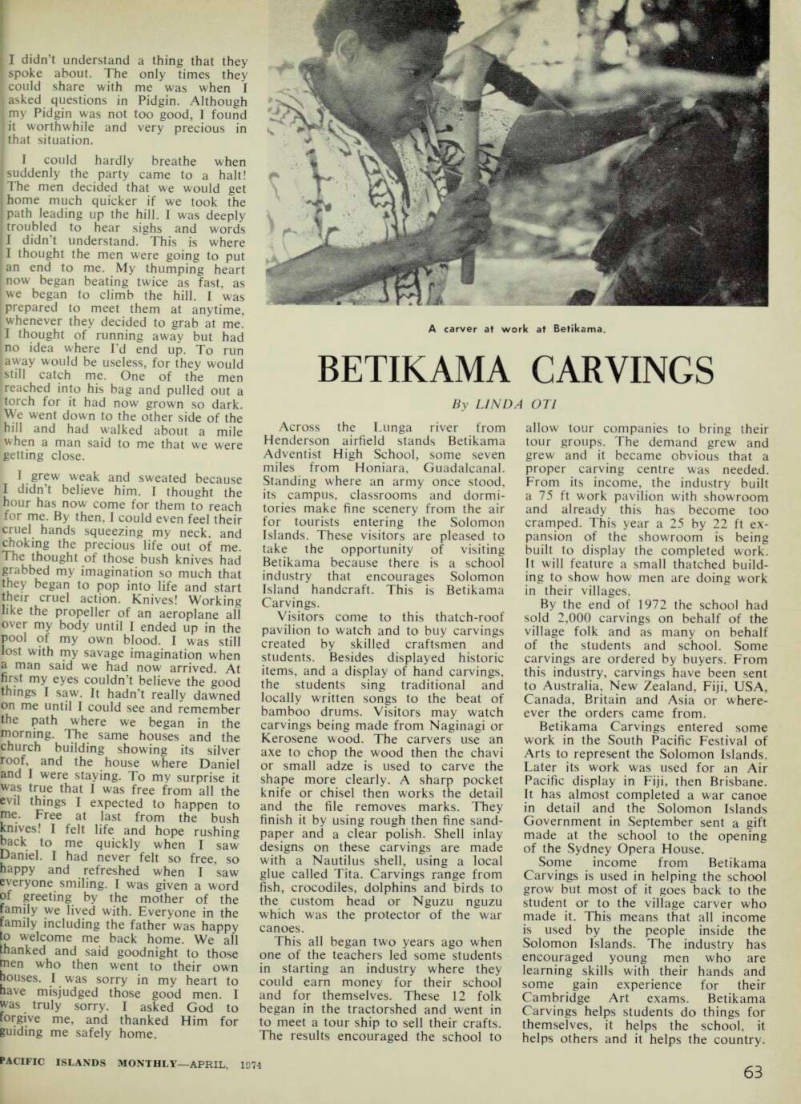
By Tau Vagi
Daniel and I were among all the Malmaluan students sent to the United Church circuits in the Gazelle Area, to observe village life. The two of us were sent to spend our one week’s holiday at Vunamami Circuit. Daniel and I lived in a village called Maku rapau in that same circuit.
This is an incident in which 1 had one of the most uncomfortable ex periences of my life. It was when I found myself walking among a party of three strangers one night.
Like a helpless slave I was led through the coconut plantation by a party of four men. I, with the rest of the party, was just returning from a day out gathering shell-fish from the beaches nearby. I was really frightened when I noticed that it was getting dark. Now entering the thickly vegetated area, mostly of cocoa and coconut trees, 1 began to be haunted by the evil thoughts and imaginations of manslaughter.
Creating the atmosphere with ghostly and evil thoughts, I could
clearly imagine two of the men hold ing me with their strong hands, whil the third slashed me with his shar bush knife. All of these men wer carrying long, thin bush knives whic made me feel scared. I was also we: aware of the problems that lead t fights in these areas, and that at an} time we too might be ambushed b others hiding among the dar bushes. I found myself trapped i between the party and the suspecte enemies. I was new to this area an didn’t know where all the uncountabl little paths led to, how far we ha walked so far, or how much longe it was going to take us to get hom< I kept walking like a blind man onl following the instructions of other not knowing what was happening a the time. , , , The place got darker and dark* as those fearful and evil thoughts an imagination began to get brighter an clearer. There was one more bi problem that I also faced. The me were talking in their own language I wasn’t too happy about this becam
I didn’t understand a thing that they I spoke about. The only times they I could share with me was when I I asked questions in Pidgin. Although I my Pidgin was not too good, I found Jit worthwhile and very precious in j that situation.
I could hardly breathe when I suddenly the party came to a halt!
I The men decided that we would get I home much quicker if we took the path leading up the hill. I was deeply I troubled to hear sighs and words I didn’t understand. This is where I thought the men were going to put an end to me. My thumping heart now began beating twice as fast, as we began to climb the hill. I was prepared to meet them at anytime, whenever they decided to grab at me.
I thought of running away but had no idea where I'd end up. To run away would be useless, for they would still catch me. One of the men reached into his bag and pulled out a torch for it had now grown so dark.
We went down to the other side of the hill and had walked about a mile when a man said to me that we were getting close. i I grew weak and sweated because I didn’t believe him. I thought the hour has now come for them to reach for me. By then, I could even feel their cruel hands squeezing my neck, and choking the precious life out of me.
The thought of those bush knives had grabbed my imagination so much that they began to pop into life and start their cruel action. Knives! Working like the propeller of an aeroplane all over my body until I ended up in the pool of my own blood. I was still lost with my savage imagination when a man said we had now arrived. At first my eyes couldn’t believe the good things I saw. It hadn’t really dawned on me until I could see and remember the path where we began in the morning. The same houses and the church building showing its silver roof, and the house where Daniel and I were staying. To my surprise it was true that I was free from all the evil things I expected to happen to me. Free at last from the bush knives! I felt life and hope rushing back to me quickly when I saw Daniel. I had never felt so free, so happy and refreshed when I saw everyone smiling. I was given a word of greeting by the mother of the family we lived with. Everyone in the family including the father was happy to welcome me back home. We all thanked and said goodnight to those men who then went to their own houses. I was sorry in my heart to have misjudged those good men. I was truly sorry. I asked God to forgive me, and thanked Him for guiding me safely home.
Betikama Carvings
By Linda Oti
Across the Lunga river from Henderson airfield stands Betikama Adventist High School, some seven miles from Honiara, Guadalcanal.
Standing where an army once stood, its campus, classrooms and dormi tories make fine scenery from the air for tourists entering the Solomon Islands. These visitors are pleased to take the opportunity of visiting Betikama because there is a school industry that encourages Solomon Island handcraft. This is Betikama Carvings.
Visitors come to this thatch-roof pavilion to watch and to buy carvings created by skilled craftsmen and students. Besides displayed historic items, and a display of hand carvings, the students sing traditional and locally written songs to the beat of bamboo drums. Visitors may watch carvings being made from Naginagi or Kerosene wood. The carvers use an axe to chop the wood then the chavi or small adze is used to carve the shape more clearly. A sharp pocket knife or chisel then works the detail and the file removes marks. They finish it by using rough then fine sand paper and a clear polish. Shell inlay designs on these carvings are made with a Nautilus shell, using a local glue called Tita. Carvings range from fish, crocodiles, dolphins and birds to the custom head or Nguzu nguzu which was the protector of the war canoes.
This all began two years ago when one of the teachers led some students in starting an industry where they could earn money for their school and for themselves. These 12 folk began in the tractorshed and went in to meet a tour ship to sell their crafts.
The results encouraged the school to
allow tour companies to bring their tour groups. The demand grew and grew and it became obvious that a proper carving centre was needed.
From its income, the industry built a 75 ft work pavilion with showroom and already this has become too cramped. This year a 25 by 22 ft ex pansion of the showroom is being built to display the completed work.
It will feature a small thatched build ing to show how men are doing work in their villages.
By the end of 1972 the school had sold 2,000 carvings on behalf of the village folk and as many on behalf of the students and school. Some carvings are ordered by buyers. From this industry, carvings have been sent to Australia, New Zealand, Fiji, USA, Canada, Britain and Asia or where ever the orders came from.
Betikama Carvings entered some work in the South Pacific Festival of Arts to represent the Solomon Islands.
Later its work was used for an Air Pacific display in Fiji, then Brisbane.
It has almost completed a war canoe in detail and the Solomon Islands Government in September sent a gift made at the school to the opening of the Sydney Opera House.
Some income from Betikama Carvings is used in helping the school grow but most of it goes back to the student or to the village carver who made it. This means that all income is used by the people inside the Solomon Islands. The industry has encouraged young men who are learning skills with their hands and some gain experience for their Cambridge Art exams. Betikama Carvings helps students do things for themselves, it helps the school, it helps others and it helps the country.
A carver at work at Betikama.
A Political Song Of
The New Hebrides
Yumi mas tingling
Songs can help develop national awareness and national unity. New Hebridean leaders now realise that their fragmented tribes, languages and islands have made it easy for the colonial governments to divide and rule.
A Pidgin song recently written by an up-coming young New Hebridean, Mr Kali Vatoko, promises to become a popular hit. Here it is in Pidgin with an English translation:
By Kali Vatoko
Chorus
Yumi mas tingling Se yumi ol brata Everyone nomo Ol man New Hebrides
Verses
1. Kaontri blong yumi E mi gat tu kaf man Mekem man aelan Karanke tumas 2. Skul I strong samting I lusum taem long yu Be biaen long em Bai yu klat tumas 3. God 1 wetem yumi We pies yumi stap Wonem yumi mekem E —mi stap yet 4. Sorry olgeta Yu falla I go nao Blong leftem ap
Name New Hebrides
5. We pies yu wok
Remember New Hebrides
Yu pikinini Blong New Hebrides Everyone nomo Ol man New Hebrides.
We all must think All of us are brothers Every single one of us We’re people of the New Hebrides.
This country of ours It has two governments They make the people of the islands
Hopelessly confused.
Education is a powerful tool It takes time But if you persevere You’ll be glad in the long run.
God is waiting for all of us In our various places What we are going to do Remains to be seen. 1 feel for all of us You must now set to And lift right up The name of the New Hebrides.
Wherever you work Remember the New Hebrides You are the children Of the New Hebrides Every single one of us We are all New Hebridean.
This Solomon Islands frigate bird motif comes from an art resource book on Solomons art called Images and Islands by Adrian Allen and others. Frequently used as decoration on canoes, in some areas the frigate bird is regarded as a sacred bird (Thanks to the authors for permission to use this.)
Waiting For The
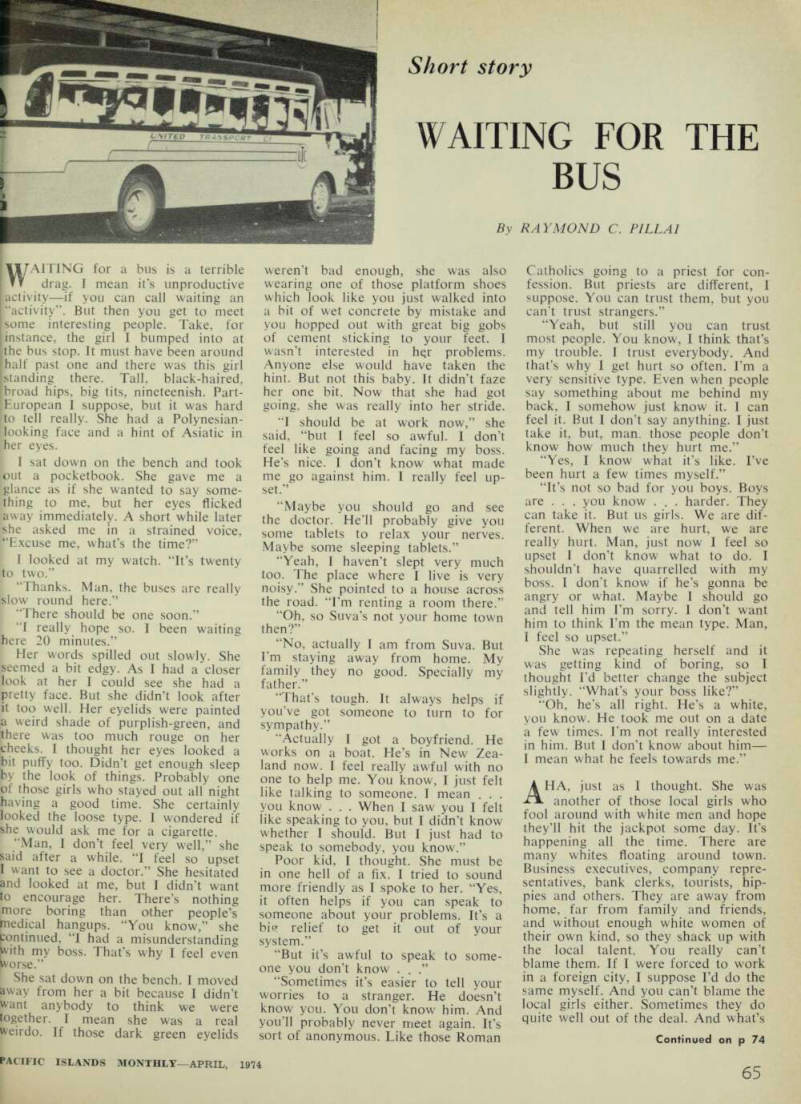
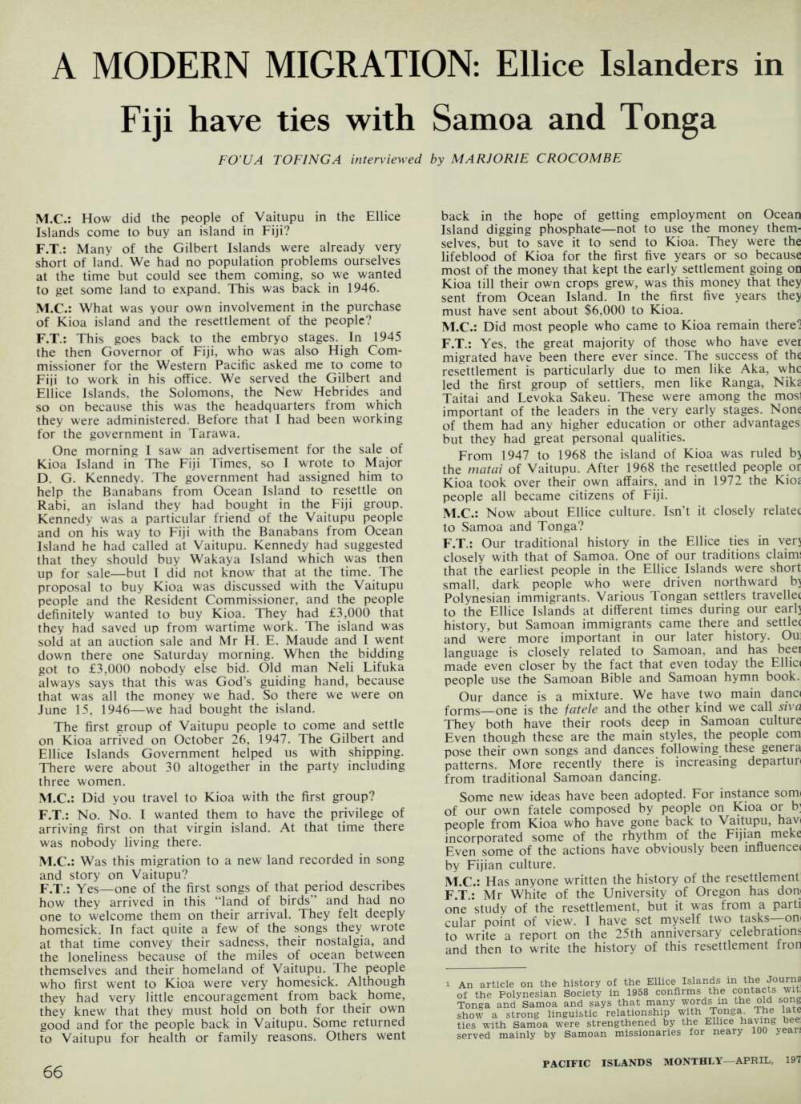
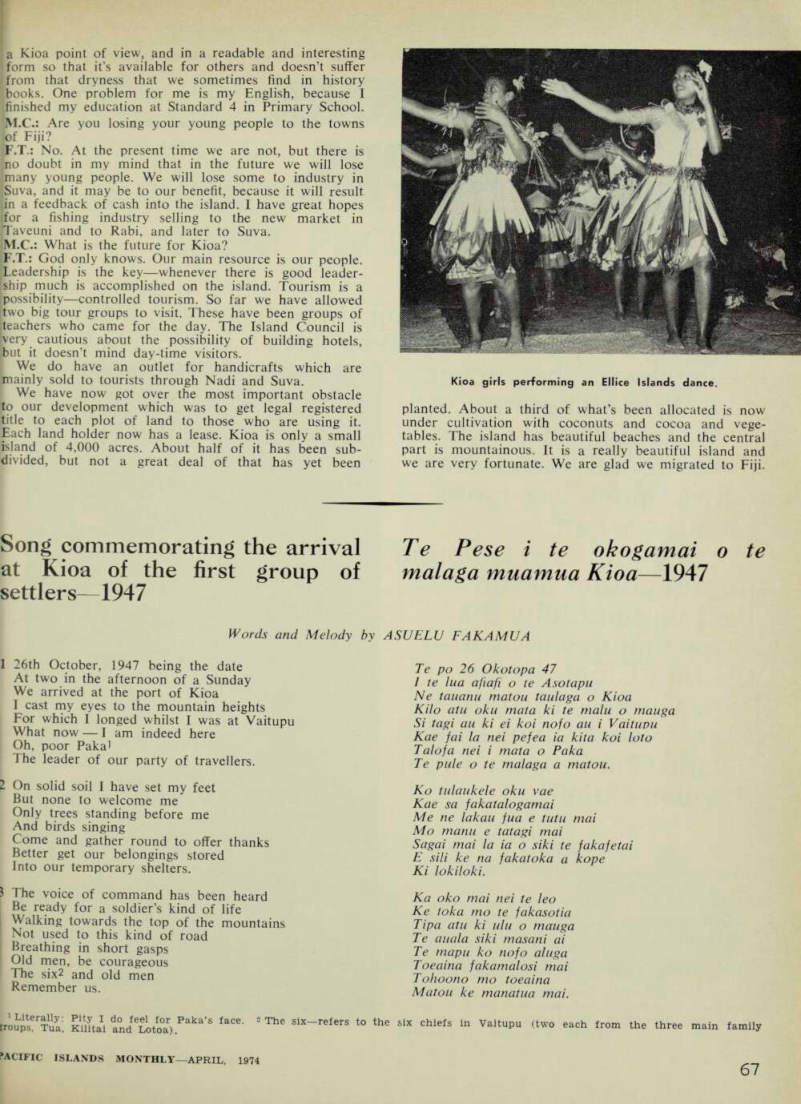
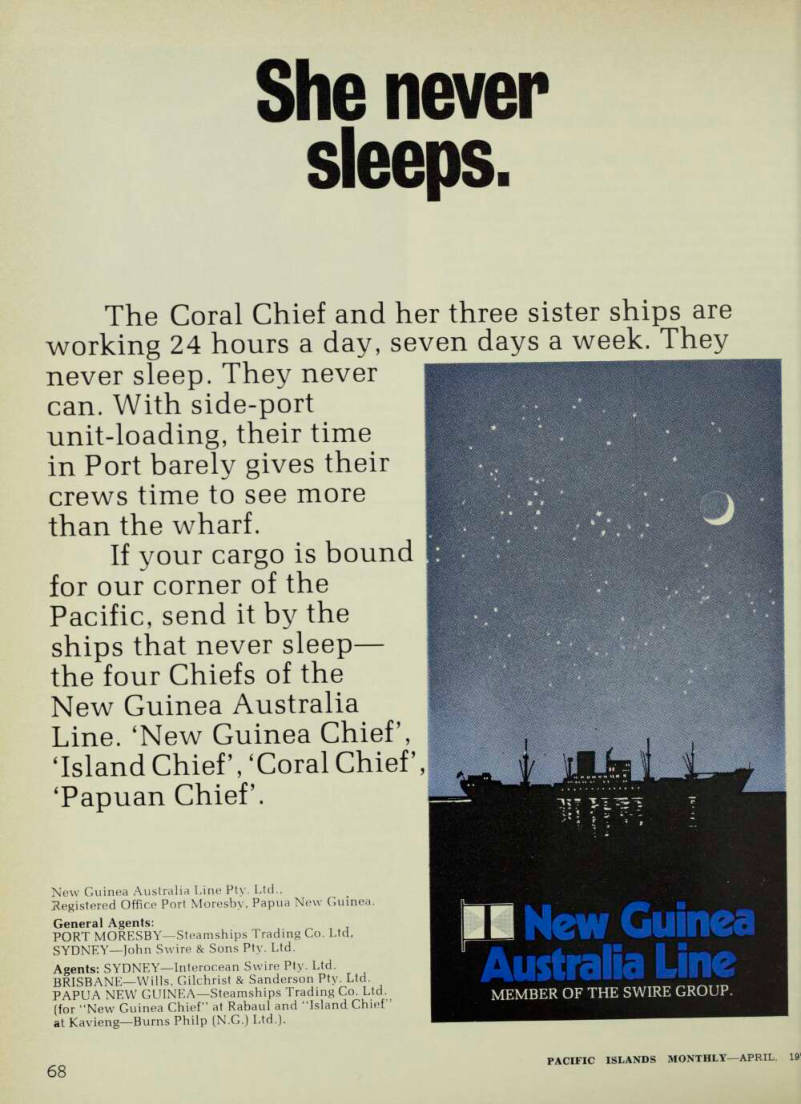
Short story
Bus
By Raymond C. Pillai
WAITING for a bus is a terrible drag. I mean it’s unproductive activity—if you can call waiting an “activity”. But then you get to meet some interesting people. Take, for instance, the girl I bumped into at the bus stop. It must have been around half past one and there was this girl standing there. Tall, black-haired, broad hips, big tits, nineteenish. Part- European I suppose, but it was hard to tell really. She had a Polynesian looking face and a hint of Asiatic in her eyes.
I sat down on the bench and took lout a pocketbook. She gave me a glance as if she wanted to say some thing to me, but her eyes flicked away immediately. A short while later |she asked me in a strained voice, [“Excuse me, what’s the time?”
I looked at my watch. “It’s twenty to two.”
“Thanks. Man, the buses are really slow round here.” “There should be one soon.”
“I really hope so. I been waiting here 20 minutes.”
Her words spilled out slowly. She seemed a bit edgy. As I had a closer look at her I could see she had a pretty face. But she didn’t look after it too well. Her eyelids were painted a weird shade of purplish-green, and there was too much rouge on her cheeks. I thought her eyes looked a bit puffy too. Didn’t get enough sleep by the look of things. Probably one of those girls who stayed out all night having a good time. She certainly looked the loose type. I wondered if she would ask me for a cigarette.
“Man, I don’t feel very well,” she said after a while. “I feel so upset I want to see a doctor.” She hesitated and looked at me, but I didn’t want to encourage her. There’s nothing more boring than other people’s medical hangups. “You know,” she continued, “I had a misunderstanding kith my boss. That’s why I feel even
p'orse.”
She sat down on the bench. I moved away from her a bit because I didn’t want anybody to think we were together. I mean she was a real weirdo. If those dark green eyelids
weren’t bad enough, she was also wearing one of those platform shoes which look like you just walked into a bit of wet concrete by mistake and you hopped out with great big gobs of cement sticking to your feet. 1 wasn’t interested in hqr problems.
Anyone else would have taken the hint. But not this baby. It didn’t faze her one bit. Now that she had got going, she was really into her stride.
“I should be at work now,” she said, “but I feel so awful. I don’t feel like going and facing my boss.
He’s nice. I don’t know what made me go against him. I really feel up set.”
“Maybe you should go and see the doctor. He’ll probably give you some tablets to relax your nerves.
Maybe some sleeping tablets.”
“Yeah, I haven’t slept very much too. The place where I live is very noisy.” She pointed to a house across the road. “I’m renting a room there.”
“Oh, so Suva’s not your home town then?”
“No, actually I am from Suva. But I’m staying away from home. My family they no good. Specially my father.”
“That’s tough. It always helps if you’ve got someone to turn to for sympathy.”
“Actually I got a boyfriend. He works on a boat. He’s in New Zea land now. 1 feel really awful with no one to help me. You know, I just felt like talking to someone. I mean . . , you know . . . When I saw you I felt like speaking to you, but I didn’t know whether I should. But I just had to speak to somebody, you know.”
Poor kid, I thought. She must be in one hell of a fix. I tried to sound more friendly as I spoke to her. “Yes, it often helps if you can speak to someone about your problems. It’s a biff relief to get it out of your system.”
“But it’s awful to speak to some one you don’t know . . .”
“Sometimes it’s easier to tell your worries to a stranger. He doesn’t know you. You don’t know him. And you’ll probably never meet again. It’s sort of anonymous. Like those Roman
Catholics going to a priest for con fession. But priests are different, I suppose. You can trust them, but you can’t trust strangers.”
“Yeah, but still you can trust most people. You know, I think that’s my trouble. I trust everybody. And that’s why I get hurt so often. I’m a very sensitive type. Even when people say something about me behind my back, I somehow just know it. I can feel it. But I don’t say anything. I just take it, but, man. those people don’t know how much they hurt me,”
“Yes, I know what it’s like. I’ve been hurt a few times myself.”
“It’s not so bad for you boys. Boys are . . . you know . . . harder. They can take it. But us girls. We are dif ferent. When we are hurt, we are really hurt. Man, just now I feel so upset I don’t know what to do. I shouldn’t have quarrelled with my boss. I don't know if he’s gonna be angry or what. Maybe I should go and tell him I’m sorry. I don’t want him to think I’m the mean type. Man, I feel so upset.”
She was repeating herself and it was getting kind of boring, so I thought I'd better change the subject slightly. “What’s your boss like?”
“Oh, he’s all right. He’s a white, you know. He took me out on a date a few times. I'm not really interested in him. But I don’t know about him— I mean what he feels towards me.”
AHA, just as 1 thought. She was another of those local girls who fool around with white men and hope they’ll hit the jackpot some day. It’s happening all the time. There are many whites floating around town.
Business executives, company repre sentatives, bank clerks, tourists, hip pies and others. They are away from home, far from family and friends, and without enough white women of their own kind, so they shack up with the local talent. You really can’t blame them. If I were forced to work in a foreign city, I suppose I’d do the same myself. And you can’t blame the local girls either. Sometimes they do quite well out of the deal. And what’s
Continued on p 74
wrong with that? Half the world lives by selling itself to the other half. If this girl wanted to fool around with her boss, the best of luck to her.
And if she had a quarrel with him, that was her own problem. Why should I get involved in her affairs?
Still, there was a certain loneliness and helplessness about her that made you want to help her. It’s not that she looked delicate or anything like that. She was taller and heavier than me, and it’s hard to feel protective towards a girl who’s bigger than you physically. But somehow I felt a bit sorry for her.
“I’m going away for good,” she said suddenly.
“Are you going to emigrate to Aus tralia or somewhere?”
“No ... I mean ... I feel so miserable. When you are hurt inside, there are so many temptations. If you see electric wires, you feel like touching them. If you see a bottle of tablets, you feel like taking the whole lot and killing yourself . . .”
“Aw, come on,” I said. “That’s no way to talk. Running away from prob lems doesn’t solve them. You have to make the best of things. Today you may think life’s not worth living any more. Tomorrow the sun will rise and shine again. You’ll find some thing new to cheer you up, then you’ll think you were so stupid to think about suicide.” 1 felt a bit stupid myself, giving out with all this bogus philosophy, but when you deal with people you always have to say things you don’t really believe.
A bus pulled up and squealed to a halt. We both stood up, them some thing made me change my mind. I mumbled that I was going the other way and sat down again. After she had gone I felt a little guilty. Maybe I should have gone to town with her, just to keep her spirits up. Anyhow, it was too late now. It’s not very often that you get an opportunity to help a fellow human being. I had my chance, but I guess I blew it.
SOME months later a picture in the Fiji Times caught my eye. It was a wedding photograph. The groom was an American businessman and the bride was—you guessed it—my bus stop friend. So, I thought to my self, she had struck gold in the end, even if it meant dumping her boy friend who was working on the boat.
Well, that’s life for you. If you want happiness nowadays, you’ve got to grab it wherever you find it and not worry about the cost. Call it selfish ness if you like. I call it pragmatism.
It's a tough world that we live in.
A MODERN MIGRATION: Ellice Islanders in
Fiji have ties with Samoa and Tonga
FO’UA TOFINGA interviewed by MARJORIE CROCOMBE
M.C.: How did the people of Vaitupu in the Ellice Islands come to buy an island in Fiji?
F.T.: Many of the Gilbert Islands were already very short of land. We had no population problems ourselves at the time but could see them coming, so we wanted to get some land to expand. This was back in 1946.
M.C.: What was your own involvement in the purchase of Kioa island and the resettlement of the people?
F.T.: This goes back to the embryo stages. In 1945 the then Governor of Fiji, who was also High Com missioner for the Western Pacific asked me to come to Fiji to work in his office. We served the Gilbert and Ellice Islands, the Solomons, the New Hebrides and so on because this was the headquarters from which they were administered. Before that I had been working for the government in Tarawa.
One morning I saw an advertisement for the sale of Kioa Island in The Fiji Times, so I wrote to Major D. G. Kennedy. The government had assigned him to help the Banabans from Ocean Island to resettle on Rabi, an island they had bought in the Fiji group.
Kennedy was a particular friend of the Vaitupu people and on his way to Fiji with the Banabans from Ocean Island he had called at Vaitupu. Kennedy had suggested that they should buy Wakaya Island which was then up for sale—but I did not know that at the time. The proposal to buy Kioa was discussed with the Vaitupu people and the Resident Commissioner, and the people definitely wanted to buy Kioa. They had £3,000 that they had saved up from wartime work. The island was sold at an auction sale and Mr H. E. Maude and I went down there one Saturday morning. When the bidding got to £3,000 nobody else bid. Old man Neli Lifuka always says that this was God’s guiding hand, because that was all the money we had. So there we were on June 15, 1946 —we had bought the island.
The first group of Vaitupu people to come and settle on Kioa arrived on October 26, 1947. The Gilbert and Ellice Islands Government helped us with shipping.
There were about 30 altogether in the party including three women.
M.C.: Did you travel to Kioa with the first group?
F.T.: No. No. I wanted them to have the privilege of arriving first on that virgin island. At that time there was nobody living there.
M.C.: Was this migration to a new land recorded in song and story on Vaitupu?
F.T.: Yes—one of the first songs of that period describes how they arrived in this “land of birds” and had no one to welcome them on their arrival. They felt deeply homesick. In fact quite a few of the songs they wrote at that time convey their sadness, their nostalgia, and the loneliness because of the miles of ocean between themselves and their homeland of Vaitupu. The people who first went to Kioa were very homesick. Although they had very little encouragement from back home, they knew that they must hold on both for their own good and for the people back in Vaitupu. Some returned to Vaitupu for health or family reasons. Others went
back in the hope of getting employment on Ocean Island digging phosphate—not to use the money them selves, but to save it to send to Kioa. They were the lifeblood of Kioa for the first five years or so because most of the money that kept the early settlement going on Kioa till their own crops grew, was this money that they sent from Ocean Island. In the first five years they must have sent about $6,000 to Kioa.
M.C.; Did most people who came to Kioa remain there*] F.T.: Yes, the great majority of those who have ever migrated have been there ever since. The success of the resettlement is particularly due to men like Aka, whc led the first group of settlers, men like Ranga, Nike Taitai and Levoka Sakeu. These were among the mosi important of the leaders in the very early stages. None of them had any higher education or other advantages but they had great personal qualities.
From 1947 to 1968 the island of Kioa was ruled bj the matai of Vaitupu. After 1968 the resettled people or Kioa took over their own affairs, and in 1972 the Kioa people all became citizens of Fiji.
M.C.: Now about Ellice culture. Isn’t it closely relatec to Samoa and Tonga?
F.T.: Our traditional history in the Ellice ties in ver} closely with that of Samoa. One of our traditions claimi that the earliest people in the Ellice Islands were short small, dark people who were driven northward b} Polynesian immigrants. Various Tongan settlers travellec to the Ellice Islands at different times during our earl} history, but Samoan immigrants came there and settlet and were more important in our later history. Ou: language is closely related to Samoan, and has beei made even closer by the fact that even today the Ellic< people use the Samoan Bible and Samoan hymn book.
Our dance is a mixture. We have two main dana forms —one is the fatele and the other kind we call siva They both have their roots deep in Samoan culture Even though these are the main styles, the people com pose their own songs and dances following these genera patterns. More recently there is increasing departun from traditional Samoan dancing.
Some new ideas have been adopted. For instance som of our own fatele composed by people on Kioa or b; people from Kioa who have gone back to Vaitupu, havi incorporated some of the rhythm of the Fijian meke Even some of the actions have obviously been influence! by Fijian culture.
M.C.: Has anyone written the history of the resettlement F.T.: Mr White of the University of Oregon has don one study of the resettlement, but it was from a parti cular point of view. I have set myself two tasks—oh to write a report on the 25th anniversary celebrations and then to write the history of this resettlement fron
i An article on the history of the Ellice Islands in the Journa of the Polynesian Society in 1958 confirms the contacts wit.
Tonga and Samoa and says that many words in the old song show a strong linguistic relationship with Tonga. The late ties with Samoa were strengthened by the Ellice having bee. served mainly by Samoan missionaries for neary 100 year
a Kioa point of view, and in a readable and interesting form so that it’s available for others and doesn’t suffer I from that dryness that we sometimes find in history ,books. One problem for me is my English, because I jfinished my education at Standard 4 in Primary School.
M.C.: Are you losing your young people to the towns of Fiji?
F.T.: No. At the present time we are not, but there is |no doubt in my mind that in the future we will lose jmany young people. We will lose some to industry in |Suva, and it may be to our benefit, because it will result in a feedback of cash into the island. I have great hopes nor a fishing industry selling to the new market in iTaveuni and to Rabi, and later to Suva.
M.C.: What is the future for Kioa?
F.T.: God only knows. Our main resource is our people. (Leadership is the key—whenever there is good leader ship much is accomplished on the island. Tourism is a possibility—controlled tourism. So far we have allowed two big tour groups to visit. These have been groups of keachers who came for the day. The Island Council is wery cautious about the possibility of building hotels, [but it doesn’t mind day-time visitors.
We do have an outlet for handicrafts which are [mainly sold to tourists through Nadi and Suva.
We have now got over the most important obstacle to our development which was to get legal registered title to each plot of land to those who are using it.
Each land holder now has a lease. Kioa is only a small island of 4,000 acres. About half of it has been sub divided, but not a great deal of that has yet been
planted. About a third of what’s been allocated is now under cultivation with coconuts and cocoa and vege tables. The island has beautiful beaches and the central part is mountainous. It is a really beautiful island and we are very fortunate. We are glad we migrated to Fiji.
Kioa girls performing an Ellice Islands dance.
Song commemorating the arrival
at Kioa of the first group of settlers—1947
Te Pese i te okogamai o te malaga muamua Kioa — 1947
Words and Melody by ASUELU FAKAMUA
1 26th October, 1947 being the date At two in the afternoon of a Sunday We arrived at the port of Kioa I cast my eyes to the mountain heights For which I longed whilst I was at Vaitupu What now I am indeed here Oh, poor Paka l The leader of our party of travellers. 2 On solid soil I have set my feet But none to welcome me Only trees standing before me And birds singing Come and gather round to offer thanks Better get our belongings stored Into our temporary shelters.
J The voice of command has been heard Be ready for a soldier’s kind of life Walking towards the top of the mountains i Not used to this kind of road Breathing in short gasps Old men, be courageous 1 The si\2 and old men Remember us.
Te po 26 Okotopa 47 I te lua afiafi o te Asotapu Ne tauanu matou taulaga o Kioa Kilo atu oku mata kite malu o mauga Si tagi an ki ei koi nofo au i Vaitupu Kae fai la nei pefea ia kita koi loto Talofa nei i mata o Paka Te pule o te malaga a matou.
Ko tulaukele oku vae Kae sa fakatalogamai Me ne lakau fua e tutu mai Mo manu e tatagi mai Sagai mai la ia o siki te fakafetai E sili ke na fakatoka a kope Ki lokiloki.
Ka oko mai nei te leo Ke toka mo te fakasotia Tipa atu ki ulu o mauga Te auala siki masani ai Te mapu ko nofo aluga Toeaina fakamalosi mai Tohoono mo toeaina Matou ke manatua mai.
Uups er Tua, Smii a°nd fe S)to 0 a r ) Paka ’ S six Tefers to the six chief s In Vaitupu (two each from the three main family
Advertisements & other items, p. 74 (1 item)
sleeps.
She never
The Coral Chief and her three sister ships are working 24 hours a day, seven days a week. They never sleep. They never can. With side-port unit-loading, their time in Port barely gives their crews time to see more than the wharf.
If your cargo is bound for our corner of the Pacific, send it by the ships that never sleep— the four Chiefs of the New Guinea Australia Line. ‘New Guinea Chief’, ‘lsland Chief,‘Coral Chief’,| ‘Papuan Chief’. ■
i \JLkj >
slew Guinea Australia Line Pty. Ltd., Registered Office Port Moresby. Papua New Guinea.
General Agents: 3 ORT MORESBY—Steamships Trading Co. Ltd.
SYDNEY —John Swire & Sons Pty. Ltd. \gents: SYDNEY —Interocean Swire Pty. Ltd.
BRISBANE —Wills, Gilchrist & Sanderson Pty. Ltd. 3 APUA NEW GUlNEA—Steamships Trading Co. Ltd for “New Guinea Chief’ at Rabaul and “Island Chief it Kavieng—Burns Philp (N.G.) Ltd.).
■■New Guinea
Australia Line
MEMBER OF THE SWIRE GROUP.
Books, Reviews, Writers
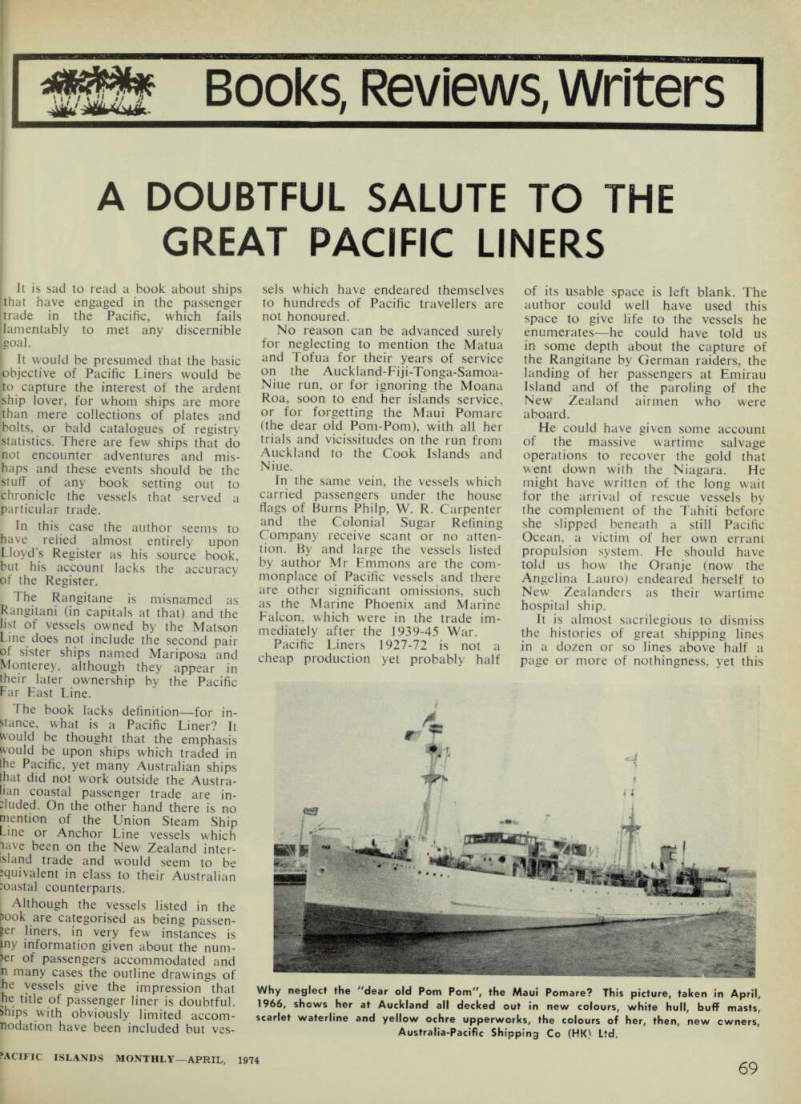
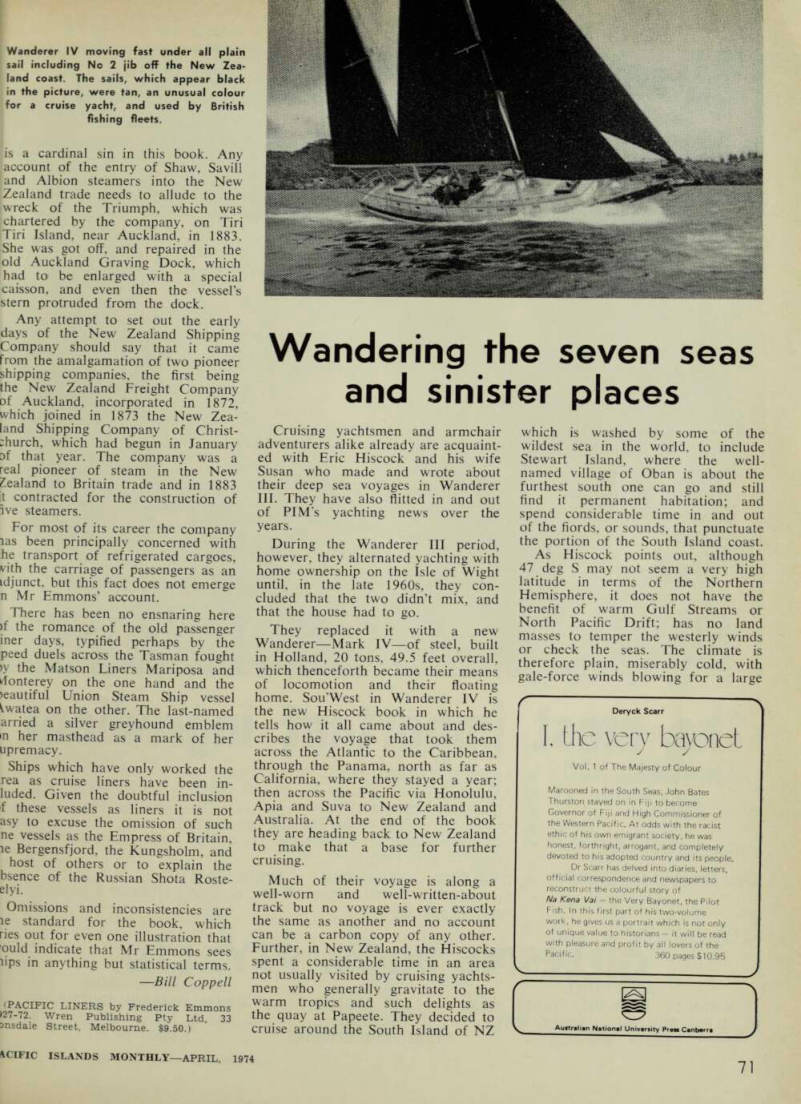
A Doubtful Salute To The
Great Pacific Liners
It is sad to read a book about ships that have engaged in the passenger trade in the Pacific, which fails lamentably to met any discernible
[goal.
It would be presumed that the basic [objective of Pacific Liners would be •to capture the interest of the ardent [ship lover, for whom ships are more [than mere collections of plates and bolts, or bald catalogues of registry statistics. There are few ships that do not encounter adventures and mis haps and these events should be the stuff of any book setting out to chronicle the vessels that served a particular trade.
In this case the author seems to have relied almost entirely upon Lloyd’s Register as his source book, but his account lacks the accuracy of the Register.
The Rangitane is misnamed as Rangitani (in capitals at that) and the list of vessels owned by the Matson Line does not include the second pair of sister ships named Mariposa and Monterey, although they appear in their later ownership by the Pacific Far East Line.
The book lacks definition—for in stance, what is a Pacific Liner? It would be thought that the emphasis would be upon ships which traded in the Pacific, yet many Australian ships that did not work outside the Austra lian coastal passenger trade are in cluded. On the other hand there is no mention of the Union Steam Ship Line or Anchor Line vessels which )ave been on the New Zealand inter island trade and would seem to be equivalent in class to their Australian
poastal counterparts.
Although the vessels listed in the book are categorised as being passen ger liners, in very few instances is fny information given about the num ber of passengers accommodated and n many cases the outline drawings of he vessels give the impression that he title of passenger liner is doubtful.
Ships with obviously limited accom nodation have been included but ves
sels which have endeared themselves to hundreds of Pacific travellers are not honoured.
No reason can be advanced surely for neglecting to mention the Matua and Tofua for their years of service on the Auckland-Fiji-Tonga-Samoa- Niue run, or for ignoring the Moana Roa, soon to end her islands service, or for forgetting the Maui Pomare (the dear old Pom-Pom), with all her trials and vicissitudes on the run from Auckland to the Cook Islands and Niue.
In the same vein, the vessels which carried passengers under the house flags of Burns Philp, W. R. Carpenter and the Colonial Sugar Refining Company receive scant or no atten tion. By and large the vessels listed by author Mr Emmons are the com monplace of Pacific vessels and there are other significant omissions, such as the Marine Phoenix and Marine Falcon, which were in the trade im mediately after the 1939-45 War.
Pacific Liners 1927-72 is not a cheap production yet probably half
of its usable space is left blank. The author could well have used this space to give life to the vessels he enumerates —he could have told us in some depth about the capture of the Rangitane by German raiders, the landing of her passengers at Emirau Island and of the paroling of the New Zealand airmen who were aboard.
He could have given some account of the massive wartime salvage operations to recover the gold that went down with the Niagara. He might have written of the long wait for the arrival of rescue vessels by the complement of the Tahiti before she slipped beneath a still Pacific Ocean, a victim of her own errant propulsion system. He should have told us how the Oranje (now the Angelina Lauro) endeared herself to New Zealanders as their wartime hospital ship.
It is almost sacrilegious to dismiss the histories of great shipping lines in a dozen or so lines above half a page or more of nothingness, yet this
Why neglect the "dear old Pom Pom", the Maui Pomare? This picture, taken in April, 1966, shows her at Auckland all decked out in new colours, white hull, buff masts, scarlet waterline and yellow ochre upperworks, the colours of her, then, new owners,
Australia-Pacific Shipping Co (HK) Ltd.
is a cardinal sin in this book. Any account of the entry of Shaw, Savill and Albion steamers into the New Zealand trade needs to allude to the wreck of the Triumph, which was chartered by the company, on Tiri Tiri Island, near Auckland, in 1883.
She was got off, and repaired in the old Auckland Graving Dock, which had to be enlarged with a special caisson, and even then the vessel’s stern protruded from the dock.
Any attempt to set out the early days of the New Zealand Shipping Company should say that it came From the amalgamation of two pioneer shipping companies, the first being the New Zealand Freight Company of Auckland, incorporated in 1872, which joined in 1873 the New Zea land Shipping Company of Christ :hurch, which had begun in January of that year. The company was a real pioneer of steam in the New Zealand to Britain trade and in 1883 it contracted for the construction of ive steamers.
For most of its career the company las been principally concerned with he transport of refrigerated cargoes, vith the carriage of passengers as an idjunct, but this fact does not emerge n Mr Emmons’ account.
There has been no ensnaring here >f the romance of the old passenger iner days, typified perhaps by the peed duels across the Tasman fought >y the Matson Liners Mariposa and donterey on the one hand and the >eautiful Union Steam Ship vessel on the other. The last-named arried a silver greyhound emblem m her masthead as a mark of her upremacy.
Ships which have only worked the rea as cruise liners have been in luded. Given the doubtful inclusion f these vessels as liners it is not asy to excuse the omission of such ne vessels as the Empress of Britain, ie Bergensfjord, the Kungsholm, and host of others or to explain the bsence of the Russian Shota Roste elyi.
Omissions and inconsistencies are ie standard for the book, which ries out for even one illustration that ould indicate that Mr Emmons sees lips in anything but statistical terms. —Bill Coppell >o? ACIFIC Ii NERS by Frederick Emmons >27-72. Wren Publishing Pty Ltd, 33 onsdale Street, Melbourne. $9.50.)
Wanderer IV moving fast under all plain sail including No 2 jib off the New Zea land coast. The sails, which appear black in the picture, were tan, an unusual colour for a cruise yacht, and used by British fishing fleets.
Advertisements & other items, p. 76 (1 item)
Kunkii
>/ r. m ' ,r f Wa
runrh
the most versatile ply for tropical application *
thejobmh^Wifl^
\ Whatever » , strong? eAW “ h “^:aS , S SI - ft
ar eTeS n prated,
or weather resistant-)?™ r weather re , and treated to wthstan® 1 humid conditions, roc t building-count onKlmto A Winkil P^XtluCßuloVo
count of!
1 % TS
KUNKII
Wandering the seven seas

and sinister places
Cruising yachtsmen and armchair adventurers alike already are acquaint ed with Eric Hiscock and his wife Susan who made and wrote about their deep sea voyages in Wanderer 111. They have also flitted in and out of PI M’s yachting news over the years.
During the Wanderer 111 period, however, they alternated yachting with home ownership on the Isle of Wight until, in the late 19605, they con cluded that the two didn’t mix, and that the house had to go.
They replaced it with a new Wanderer—Mark IV—of steel, built in Holland, 20 tons, 49.5 feet overall, which thenceforth became their means of locomotion and their floating home. Sou’West in Wanderer IV is the new Hiscock book in which he tells how it all came about and des cribes the voyage that took them across the Atlantic to the Caribbean, through the Panama, north as far as California, where they stayed a year; then across the Pacific via Honolulu, Apia and Suva to New Zealand and Australia. At the end of the book they are heading back to New Zealand to make that a base for further cruising.
Much of their voyage is along a well-worn and well-written-about track but no voyage is ever exactly the same as another and no account can be a carbon copy of any other.
Further, in New Zealand, the Hiscocks spent a considerable time in an area not usually visited by cruising yachts men who generally gravitate to the warm tropics and such delights as the quay at Papeete. They decided to cruise around the South Island of NZ
which is washed by some of the wildest sea in the world, to include Stewart Island, where the well named village of Oban is about the furthest south one can go and still find it permanent habitation; and spend considerable time in and out of the fiords, or sounds, that punctuate the portion of the South Island coast.
As Hiscock points out, although 47 deg S may not seem a very high latitude in terms of the Northern Hemisphere, it does not have the benefit of warm Gulf Streams or North Pacific Drift; has no land masses to temper the westerly winds or check the seas. The climate is therefore plain, miserably cold, with gale-force winds blowing for a large
proportion of the time.
The sounds, moreover, offer hazards [of another kind. These long fingers of water protruding into the mountainous land are very deep right up to the rock bound shores and pro vide little water shallow enough to anchor a yacht. They also frequently act as wind tunnels for the prevailing wind. Apart from tourists at Milford Sound, at the extreme north of Fiordland, and occasional fishermen and deerstalkers in others of the dozen drowned valleys that make up the complex, the sounds are as Nature left them, having scarcely felt the hand of man.
“During our years of voyaging,” says Hiscock, “we have spent nights in some strange, wild and lonely places . . . but somehow Sportsmans Cove [in Dusky Sound] seemed more lonely than most and far more lonely than the open oceans hundreds, or thousands, of miles from land. When darkness came after a flaming scarlet and orange sunset that was not so much beautiful as frightening, there was scarcely a sound; no creature stirred though there must have been many around us; no fish disturbed the mirror surface of the inky water; there was absolutely nothing to be heard but the chilly tinkle of the little stream, the ticking of the French :arnage clock in the saloon and the beating of one’s heart. Here, it seemed, was a place utterly separated From man and from any form of wild ife; silent and sinister.”
They were not sorry to depart next Doming, bound for Breaksea Sound hrough Acheron Passage, a specta :ular seven-mile waterway only half i mile wide in places and from each ; ide of which 3,000 ft and 4,000 ft nountains rear into the sky.
The voyagers visited Doubtful, fhompson, George and Milford ounds before they called it quits, :xperiencing inches of rain, wild vinds, the companionship of fisher nen and some of the most spectacular cenery in the world. Plus, of course, he west coast’s celebrated sandflies, lews of which was first recorded by r aptain Cook who visited Dusky ►ound in 1770 and said . . small •lack sandflies which are very lumerous and so troublesome that hey exceed everything of the kind hat I ever met with,”
Two hundred years later the
Hiscocks could still heartily endorse Cook’s opinion. Not even modern insect repellant had any effect for more than 10 minutes, they said.
“One could watch the creatures hovering over an anointed area of skin until the first effects were off and then come in to attack, and we wondered what they lived on when there were no humans around.”
There is an appendix to the book giving all technical data on Wanderer IV and early chapters with a running account of the bugs, and their re medies, seemingly inherent in such a
custom-made ship.
Judy Tudor.
(Sou’West In Wanderer Iv. By Eric
Hiscock Oxford University Press, 7 Bowen Crescent, Melbourne. $11.00.1
Advertisements & other items, pp. 77-78 (2 items)
71
ACIFIC ISLANDS MONTHLY—APRIL, 1974
I. the very bayonet
Deryck Scarr
/ / Vol. 1 of The Majesty of Colour Marooned in the South Seas, John Bates Thurston stayed on in Fiji to become Governor of Fiji and High Commissioner of the Western Pacific. At odds with the racist ethic of his own emigrant society, he was honest, forthright, arrogant, and completely devoted to his adopted country and its people.
Dr Scarr has delved into diaries, letters, official correspondence and newspapers to reconstruct the colourful story of Na Kena Vai the Very Bayonet, the Pilot Fish. In this first part of his two-volume work, he gives us a portrait which is not only of unique value to historians - it will be read with pleasure and profit by all lovers of the Pacific. 360 pages $10.95 13 Australian National University Praia Canberra
■ mm >'•l ilii o : ,• ; V- - "V m : .v m m •>-••• $ © *PttW4 U . : 25
KGKfT
1 H *l^ s* &
the most important ingredient
BREAD FLOURS:
CAKE FLOURS:
BISCUIT FLOURS;
SPECIALITY FLOURS:
MAINTOP — h 'gh protein bread flout ANCHOR —bakers flour • 50/50 MEAL —brown bread MEDlUM—cake and pastry • SPONGE —sponge cakes SPECIAL CAKE —madeira and cup cakes STRONG —cracker biscuits • MEDIUM —Shortbreads SOFT —sweet biscuits RYE flour • RYE meal • KIBBLED RYE SHARPS —roti chapati flour • 100% STONE GROUND
WHOLEMEAL
GILLESPIE BROS. PTY. LTD.
HEAD OFFICE: BRISBANE OFFICE:
52 UNION ST,, PYRMONT, SYDNEY, N.S.W. CABLE ADDRESS: ALBION BRISBANE, (G.P.O. BOX 2518, SYDNEY, 2001.) "GILLESPIE", (P.O. BOX 8, ALBION BRISBANE, 4010.) PHONE: 660-4933. SYDNEY AND BRISBANE. PHONE: 6-1121.
Compendium Of
Maritime Trivia
Ever heard of a single masted schooner? How would you like to buy an adze or perhaps aVB marine steam engine? A marine equivalent to the best selling Whole Earth Catalog, the Mariner’s Catalog, edited by David R. Getchell, is one of the most enter taining collection of bits and pieces this writer has ever come across.
Crammed with tools, fittings and instruments, many of which most people thought never got past 1901. the catalog also contains tips and ideas, such as a recipe for tallow, how to cast ballast, lots of interesting books and where to get them, un usual boat plans and a plea for con tributions to make future editions more complete.
Modern tools and materials are by no means neglected, quite the con trary, but the book does stick mostly to the rare hard-to-get items. • Profusely illustrated (just like a real catalog with line drawings, photographs and lots of delightful little thumbnail sketches of odd or interesting rigs, they are all given the effect of etchings to maintain the “olde worlde” impression which is quite charming and easy to read. ® Professional fishermen will also find the Mariner’s Catalog infor mative and entertaining, with such subjects as winches and nets, well covered. © Engrossing reading even if you don’t own a boat (how about the address of a maker of scale models) 192 pages of information and a must on any bookshelf, for this first issue will certainly become a collector’s
item in years to come-
John Collins.
(The Mariner’S Catalog. $4 95
National Fisherman and International Marine Publishing, Camden, Maine, USA )
An accolade
for Hawaii
The team of contributing authors and compilers, the Department of Geography and the University of Hawaii Press, are far too modest.
Working under the aegis of Professor R. Warwick Armstrong, they have produced a volume which hides its many virtues under the brevity of its title Atlas of Hawaii. Here is no mere atlas, it is more, indeed far more.
Within its cover are a gazetteer, a comprehensive survey, botanical and zoological treatises and a concise survey of the Hawaiian material culture.
Although the primary concern is with Hawaii, the Atlas must be seen as an invaluable source book on a whole host of aspects of the Pacific basin generally. The comprehensive, yet concise statements on meteorology, ocean currents, water resources, geo logical structure and demographic changes may be applied as models to other island situations far from Hawaii.
The contribution on the water cycle is just as apposite to Tahiti, Raro tonga or Viti Levu, and the most competently-written section on fish and marine invertebrates will serve as a brilliant introduction to many a neophyte examining the wonders of the Pacific Island reefs and lagoons for the first time.
The authors and the University of Hawaii Press must be congratulated
on the production of a volume, which in its level of presentation would have few peers in its class. A whole range of visual material has been used to give an added dimension.
The cartography Is first class and obviously has the needs of the reader at heart; for instance, an insert on a map that appears early in the Atlas, which has a statement on the use of pronunciation marks in the Hawaiian orthography, must help those un initiated in the sounding of Poly nesian place-names. A great deal of use has been made of graphic re presentations and a thoughtful and colourful distribution of bar graphs, pie charts and other graphic forms adds greatly to the information.
This is no dry-as-dust academic atlas as great use has been made of photographs, line drawings and the reproduction of fine engravings. These enhance and give aesthetic pleasure to the reader on many of the pages.
Typical of this imaginative treatment are the line drawings of Hawaiian artefacts, which appear frequently as marginal adornments, or the quite entrancing reproduction of early ornithological illustrations. The Atlas of Hawaii is quite understandably an expensive production, but is a must for the serious Pacific student or for the collector of Pacificana.
Bill Coppell
(Atlas Of Hawaii, R. Warwick
Armstrong (ed), University of Hawaii Press, Honolulu. SUSIS.) • Two new paperbacks should provide good value for intending pil grims to Europe. World’s Best Travel Bargains start in London, by Arthur Tatchford, a Cockney now living in California, furnishes information ranging from renting a house in the country or a chalet in Switzerland to exploring England’s waterways or cruising to Casablanca. There are details of cross-Channel ferries, car and caravan hire companies, sight seeing, accommodation and package holiday bargains, with prices quoted in SUS. Something to suit all ranges of pocket, it is available from the Joyer Company, Box 707, Corona del Mar, California 92625, for $U54.95 plus 50 cents postage. • Down Under in Europe, by NZ dentist Peter Bolot and Australian journalist, Sue Miles, prepares the under-30 Australasian for his Euro pean working holiday in an ex tremely readable, often humorous 136 pages of useful information and hints. Everything from travel pre parations to warnings about European loos to the sizes of bikinis permitted in certain places is recorded. Essen tial reading for first-timers at 51.25 from Pan, distributed by Collins, of Sydney.
Advertisements & other items, pp. 79-80 (3 items)
73
ACIFIC ISLANDS MONTHLY—APRIL, 1974
Harris
BOOK COMPANY
(ESTABLISHED 1930)
We carry over 10,000 titles on all subjects in stock and would be pleased to quote for your requirements.
Please send your enquiries to;
HARRIS BOOK COMPANY,
G.P.O. Box 16670, Hong Kong
Three new
Pacific
Books
THE
SOLOMON
ISLANDS
Janet Kent All you wanted to know about the Solomon Islands, and couldn't find until now. Janet Kent tells the Solomons story . . . the people, the geography, the history, World War II and its aftermath ... in this 221-page book which includes 19 pages of illustrations and maps.
Price: Australia and overseas, $8.95 Aust., including postage; U.S.A., $12.00 U.S. posted.
FIJI FIJI
A beautifully produced, hard bound book of 128 pages and 145 fullcolour photographs. Whether or not you intend to visit Fiji , . . "Fiji Fiji" will make a fascinating addition to your library . . . What to see . . . How to get there . . .
Colourful maps of the islands and the cities and towns . . . these are just some of the subjects covered in this splendid book.
I Price: Australia $4.50 Aust., plus $l.OO posted; Overseas countries, $4.50 Aust., plus $l.lO posted; I U.S.A., $8.40 U.S. posted.
TAHITI
I AND ITS ISLANDS
j Here is a book of the stuff that I dreams are made of! 128 pages, ) 164 full-colour photographs and j many informative colour maps of one of the most beautiful areas on earth. This is a book that will appeal to the dreamer or the tourist, and covers all the 120 islands of French Polynesia.
Price: Australia, $4.50 Aust., plus $l.OO posted; Overseas countries, $4.50 Aust., plus $l.lO posted; U.S.A., $8.40 U.S. posted.
Fill in the details
on the attached
\ order form .
Waiting for the bus
PACIFIC ISLANDS MONTHLY— APRIL, 197 V
Waiting for the bus (Continued from p 65)
Pacific Transport

Tt Troubles-Transpac Founders
And Air Route Wrangle Re-Opens
Transport in Micronesia is operat ing in murky water and cloudy skies.
Transpacific Shipping Lines (Trans pac) has been placed in receivership, and the line’s exclusive franchise is apparently at an end. In the air, the wrangle about the right for the lucra tive Saipan-Japan route was reopened by the US Civil Aeronautics Board, and Air Micronesia has asked the CAB to allow it to suspend its weekly Saipan-Okinawa service.
February was a month of drama for Transpac, with a confused situ ation developing about who was the receiver, and some doubt about whether Transpac was in default of its franchise. The sequence of events was: • A meeting in Honolulu between representatives of the United States and Trust governments to discuss Transpac’s position. Among those who attended were the TT High Commissioner, Mr Edward E. John ston, and the Director of Territorial Affairs, Mr Stanley S. Carpenter; • The resignation of the managing director of Transpac, Mr C. Douglas Echols, who said two things should have emerged from the Honolulu meeting: (1) An infusion of working capital from the government, or a government-guaranteed line of credit should have been set up with a Micronesian financial institution. (2) A positive statement of assurance :ould have been given to Transpac :reditors that the TT Government stood behind its shipping line; • Infighting at a meeting of share holders which ended only after a shareholder produced a court order .emporarily restraining the govern ment from exercising voting rights for H 0,000 Transpac shares held in trust ?y the Attorney-General, Mr Richard • Miyamoto; • An ultimatum from the owners }f the Lotte Reith, on charter to Franspac, that the ship would be liverted with her cargo in mid-ocean f back payments due on her charter vere not paid. The ship was then on
her way to Saipan from Japan with more than 2,000 tons of pre-paid cargo, said to be worth S 2 million, for all TT districts; • Transpac was officially declared m a ‘‘state of insolvency”; • Mr David M. Sablan, a Saipan businessman, was appointed receiver; i Mr Sablan resigned ° n February 19, four days after appointment, but had to remain as receiver till a suecessor was chosen and recognised by the IT High Court; • Mr Michael J. Oremus, former lianspac manager of operations and traffic was then appointed receiver, but resigned after being notified of the government s intention to place Transpac in default of the franchise.
This resignation apparently left Mr Sablan as the receiver as Mr Oremus had not been recognised by the TT High Court, although it is possible that recognition would have been forthcoming had Mr Oremus not re signed; • The Transpac general manager, Mr William Penrose, who remained in his position at the specific request of Mr Sablan, said that as far as he was concerned the franchise was not in default, and ‘‘we have received no notice of default”; • Mr Johnston, speaking to the Guam Chamber of Commerce on February 27, said that a decision to terminate the Transpac franchise for servicing the islands was made follow
ing the Honolulu meeting three weeks earlier.
Mr Oremus received a letter giving nodce of default soon after he was named receiver, but he declined to sign it to acknowledge receipt.
Mr Penrose said Mr Sablan had told him that he, too, had not re ceived any notice of default.
The situation about the Lotte Reith was not at all clear. The owners, Orion Shiffahrts Gasellschaft, of Hamburg, could have sold the cargo at auction. The Deputy High Com missioner, Mr Peter T. Coleman, when he received the owners’ ulti matum, placed Transpac in receiver ship. A telegram was then sent to the owners saying the government would guarantee the “receiver will be prepared to pay regular charter hire payments that are now due”. The owners replied they would need pay ment before the ship would be allowed to enter any port, but there were signs that she would not be diverted.
Mr Sablan, after his appointment, and before his resignation, spoke of needs for containers at Guam to be moved to the TT districts. The port authority was one of the Transpac creditors, and earlier this year re fused to handle any further Transpac voyages till past bills had been paid.
A legal complication developed while there was a doubt whether Transpac was in default of its fran chise. Mr Penrose said he had learned that plans were being made to have a Daiwa Company (Japan) ship, the Ponape Maru, call at Saipan. Mr Penrose said approval of entry would be a violation of the franchise agree ment. On this and other legal prob lems a conference was to be held be tween Mr Miyamoto and a law specialist from the US Admiralty, Mr John Meadows.
Transpac, formerly MILI, has served Micronesia under an almost entirely exclusive franchise since 1968.
Mr Johnston, in his Guam speech, said the TT Government was in terested in lines which wanted per mission to discharge and pick up cargo, but which were not seeking any kind of exclusive franchise or guarantee. The whole question of TT shipping would be resolved “in a few weeks”, when a decision would be made about which of several pro posals from other shipping companies would be accepted. Both US and Japanese companies had expressed an interest in serving Micronesia.
Transpac has faced a mounting list of problems, mostly financial, and has been under steady attack by congress men. Congressmen are now con cerned about the plight of employees
of Transpac.
Micronesians File massive suit
Transpac, Mr Echols, Mr Penrose, and counsel for Transpac, Mr James White, were named in a multi million dollar suit filed in the TT High Court by five Micronesian stockholders in Transpac—Pedro R.
Deleon Guerrero, Antonio L. Tai sacan, Jesus A. Sonoda, Segundo T.
Sablan and Ermas Ngiraelbaed.
They alleged that Echols can celled the charter and purchase operation on two vessels, highly adapted to inter-island service, previously chartered by MILI, re sulting in a loss of $4 million: and that he fraudulently and negligently caused the cancellation of the Mathias Reith and Grette Reith charters, and probably a third ship, the Lotte Reith, would be taken off charter, resulting in the loss of the ship and an option to purchase.
The plaintiffs alleged that all three ships were chartered for about $5OO a day, then above the average mar ket rate, but now the going rate had increased above that, and the loss of the charter under the old agreement had resulted in a direct financial loss for the company of $1.5 million.
They also alleged that the officials of Transpac, Echols in particular, used Transpac money to provide junkets for relatives of employees, with no resulting benefit to the company.
Another claim was that, as Echols had taken away the power of the members of the board, the company had lost $2,5 million in profits.
In another count against Echols, they alleged Transpac practised dis crimination in employment prac tices, and cited an example of a Micronesian, who applied for the post of assistant operations manager, and was not considered. Because of the discriminate hiring policy, the company lost $125,000.
The plaintiffs claim $8,132,000 from Echols.
They allege that Transpac, through White’s negligence, lost $250,000 through increased court actions against the shipping line, and demanded he pay back that amount.
Penrose was accused of false statements to the Rate Review Board about container use, and the claim against him is for $500,000.
Advertisements & other items, pp. 81-82 (2 items)
75
•ACIFIC ISLANDS MONTHLY—APRIL, 1974
Wunderflex
bends a little...
to give a lot.
It gives versatility—use it inside or outside; for the whole house, garages, extensions, etc.
It gives flexibility—practically eliminates on-site breakages; handles easily; cuts and fixes simply.
Wunderflex gives performance —it's fire and water resistant —vermin proof too.
In sheets 3 ft. x 1 ft. to jumbo 10 ft. x 4 ft., all at lowest cost for building board, bend Wunderflex to your needs now.
iViunderlich
Wunderflex
wiadf ll\l AUSTRALIA MARKETED BY C.S.R. BUILDING MATERIALS A p D n E RT N SALES 4 o\oNNELL STREET, SYDNEY, AUSTRALIA 2000
AVAILABLE FROM
Papua and New Guinea;
Steamships Trading Company Ltd.
Norfolk Island;
Irvine's Building Supply Centre
E3238C
'Ugly questions' raised in 'war'

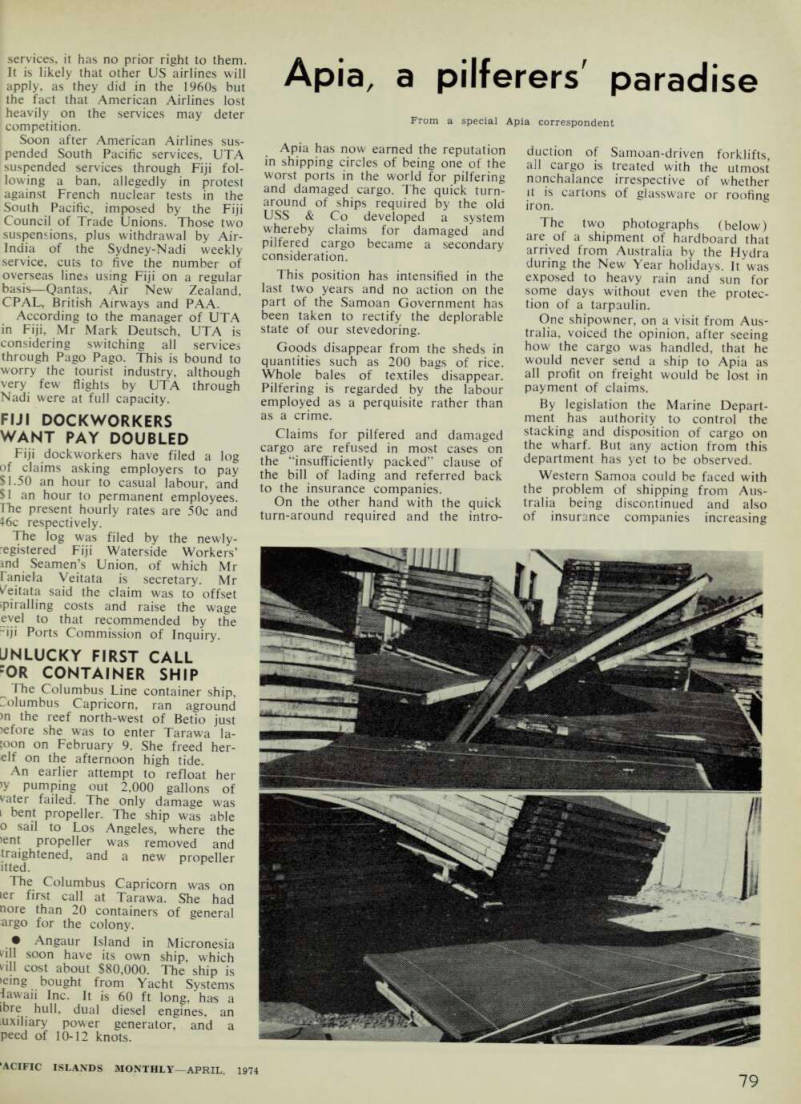
over Saipan-Japan air route
From a Washington correspondent
The Micronesian air “war” was resumed when the US Civil Aero nautics Board, apparently after com pleting opening hearings and sitting down to prepared recommendations for President Nixon about the Saipan-Japan air route, decided it wanted to hold new hearings on Saipan to continue investigations into the case. It was unable to de cide the matter on information so far received, and it wanted to know where the Micronesians stood.
There are three applicants for the route—Pan American World Air ways, Continental Air Micronesia, the heavyweights, and Northwest Orient Airlines, a hopeful. North west Orient could now be a leading contender because the CAB has questioned the fitness of the other two carriers for the service.
The route will be even more attractive now that the US has opened the Trust Territory for in vestment and commerce by all nations.
CAB took issue with the recom mendation of its administrative law judge that PAA should be awarded the route because the judge’s opin ion was that “only slight weight” should be given to the preferences of the Micronesians. The judge had said that views coming from Micro nesia had been “seriously devalued” because of attempts to influence public opinion in Micronesia, which were “intense, persistent and per vasive” on the part of the two major contenders—Continental and
Paa.
The board said that raised “ugly questions” about the fitness of both carriers. The charges, if true, could well constitute breaches of the rules of conduct in board proceedings, and thus call into question carrier fitness.
During the final round of hearings in November, the board heard 12 Micronesian spokesmen, eight of whom spoke on behalf of Conti nental and four for PAA. The officially-recorded position of the Congress of Micronesia favoured Continental on the basis that award of the route to it would most bene fit the six districts of the Trust Territory.
The CAB said it was influenced in its decision to order further hear ings by letters from both the State and Interior departments, which said that the board should attach
considerable weight to the views of Micronesians, which were in official resolutions of the Congress of Micronesia and the various district legislatures. The new hearings for Saipan were ordered to air the charges of lobbying against the air lines, as well as to decide the actual wishes of the people.
Air Micronesia, a subsidiary of Continental, has asked the CAB to allow it to suspend its weekly ser vice between Saipan and Okinawa.
Two reasons are given—the need to conserve fuel and economics.
Png Plans To
Protect Its Seamen
The Papua New Guinea Govern ment plans to safeguard the country’s seamen who are employed in overseas ships. A number of overseas shipping lines, which rarely use PNG ports are recruiting PNG seamen.
The Minister for National Develop ment, Mr Gavera Rea, said it was apparent the underlying reason was to take advantage of the lower wage levels of PNG, compared with wages paid to seamen from other countries.
Legislation is now being prepared to give PNG seamen better protection in international shipping.
Mr Rea said that until the legisla tion came into force, limitations would be placed on employing PNG seamen in ships, other than those operating in the Pacific region, or on a regular basis between Papua New Guinea and Australian ports.
A Gap In South
Pacific Skies
American Airlines suspended all Pacific services south of Hawaii early in March. The last flights north were from Sydney on March 2, and Auck land, Nadi and Pago Pago on March 3. The airline received approval from the US Civil Aeronautics Board for the suspension.
Suspension of the flights is not the end of the matter. American Airlines and Pan American World Airways have agreed to a swap of services— PAA to take over from American in die South Pacific, and American to take over unprofitable PAA ser vices in the Caribbean. The CAB will open a hearing into the proposed exchange in May but it may be many months before it gives a decision.
Though PAA is a major contender for American Airlines South Pacific
services, it has no prior right to them.
It is likely that other US airlines will apply, as they did in the 1960 s but the fact that American Airlines lost heavily on the services may deter competition.
Soon after American Airlines sus pended South Pacific services, UTA suspended services through Fiji fol lowing a ban, allegedly in protest against French nuclear tests in the South Pacific, imposed by the Fiji Council of Trade Unions. Those two suspensions, plus withdrawal by Air- India of the Sydney-Nadi weekly service, cuts to five the number of overseas lines using Fiji on a regular basis—Qantas, Air New Zealand, CPAL, British Airways and PAA.
According to the manager of UTA in Fiji, Mr Mark Deutsch, UTA is considering switching all services through Pago Pago. This is bound to worry the tourist industry, although very few flights by UTA through Nadi were at full capacity.
Fiji Dockworkers
Want Pay Doubled
Fiji dockworkers have filed a log of claims asking employers to pay 51.50 an hour to casual labour, and $1 an hour to permanent employees.
The present hourly rates are 50c and
46c respectively.
The log was filed by the newly registered Fiji Waterside Workers’ md Seamen’s Union, of which Mr Pamela Veitata is secretary. Mr said the claim was to offset ipiralling costs and raise the wage evel to that recommended by the H iji Ports Commission of Inquiry.
Jnlucky First Call
= Or Container Ship
The Columbus Line container ship, Columbus Capricorn, ran aground )n the reef north-west of Betio just >efore she was to enter Tarawa la goon on February 9. She freed her elf on the afternoon high tide.
An earlier attempt to refloat her >y pumping out 2,000 gallons of vater failed. The only damage was i bent propeller. The ship was able o sail to Los Angeles, where the >ent propeller was removed and traightened, and a new propeller itted.
The Columbus Capricorn was on icr first call at Tarawa. She had nore than 20 containers of general argo for the colony. • Angaur Island in Micronesia yill soon have its own ship, which vi\\ cost about $BO,OOO. The ship is >emg bought from Yacht Systems lawau Inc. It is 60 ft long, has a ibre hull, dual diesel engines, an uxiliary power generator, and a peed of 10-12 knots.
Advertisements & other items, p. 84 (1 item)
machine, make sure
8228 1- £
When you buy a
everything you need
comes with it.
m Mm m m M And that includes a good dealer. Because even the best machines and best tools dont last forever. Then you need help ... and if it wasn’t there to begin with it wont be there when you need it.
So evaluate the dealer behind the machine as carefully as you do the machine itself.
CT E. is a well established Caterpillar Dealer in the South Pacific with immediate Parts availability - and un- A*s?ngfe sou"rce° P what you've been looking for. And that's what we can offer you.
L
CARPENTERS
EQUIPMENT
TRACTOR E
YOUR
DEALER
PH ONE: 240 51-4
POSTAL: PRIVATE MAIL BAG SUVA FIJI ISLANDS
TELEX: CARPTRAC FJ2ISO. CABLES: CARPTRAC.
SUVA
Apia, a pilferers' paradise


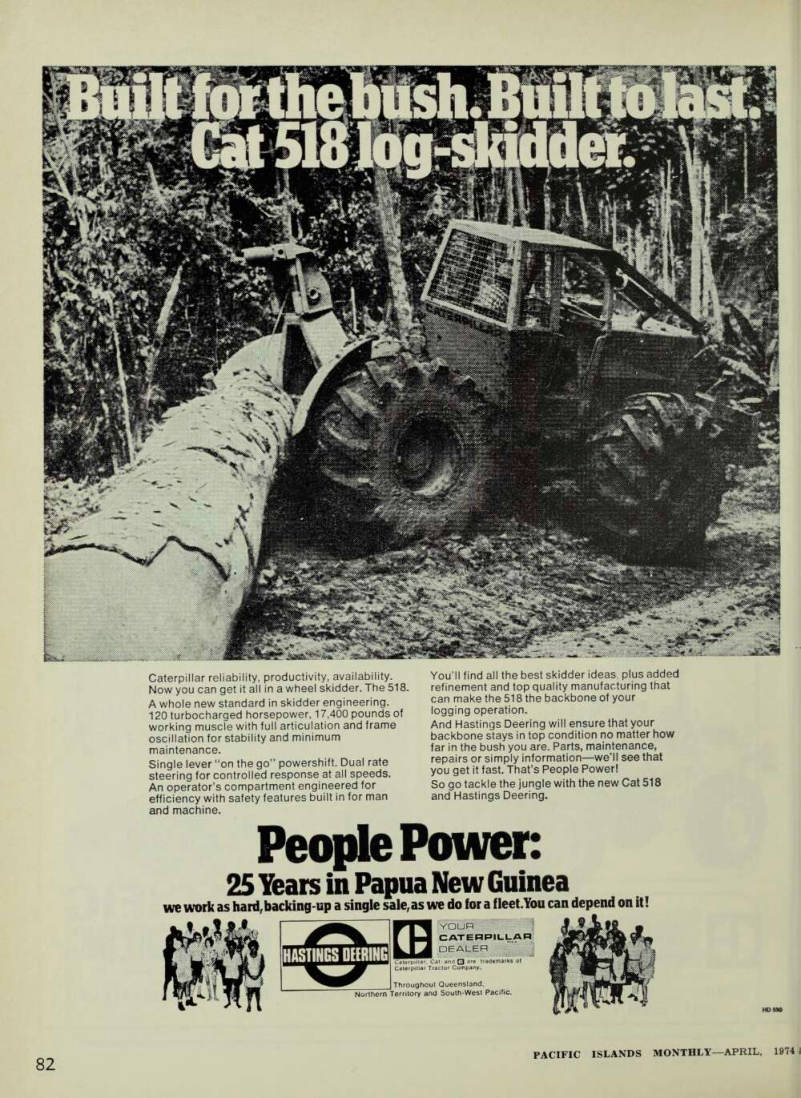
From a special Apia correspondent
Apia has now earned the reputation in shipping circles of being one of the worst ports in the world for pilfering and damaged cargo. The quick turnaround of ships required by the old E 4 . .
This position has intensified in the last two years and no action on the part of the Samoan Government has been taken to rectify the deplorable state of our stevedoring.
Goods disappear from the sheds in quantities such as 200 bags of rice.
Whole bales of textiles disappear.
Pilfering is regarded by the labour employed as a perquisite rather than as a crime.
Claims for pilfered and damaged cargo are refused in most cases on the “insufficiently packed” clause of the bill of lading and referred back to the insurance companies.
On the other hand with the quick turn-around required and the intro-
duction of Samoan-driven forklifts all cargo is treated with the utmost nonchalance irrespective of whether it is cartons of glassware or roofine iron <w~> during the New Year holidays. It was exposed to heavy rain and sun for some days without even the protec tion of a tarpaulin, One shipowner, on a visit from Aus tralia, voiced the opinion, after seeing how the cargo was handled, that he would never send a ship to Apia as all profit on freight would be lost in payment of claims, By legislation the Marine Depart ment has authority to control the stacking and disposition of cargo on *he wharf. But any action from this department has yet to be observed, Western Samoa could be faced with the problem of shipping from Aus tralia being discontinued and also of insurance companies increasing
insurance rates to a higher than ever level, or of refusing all insurance on goods to Apia.
The Western Samoa Government instigates inquiries into minor deficiencies at the drop of the hat but they have yet to notice what trouble the stevedoring organisation is storing up for this country in the future.
Regional shipping is not the answer to the problem that is building up.
The answer is right on our domestic doorstep and that must be with an overhaul of our stevedoring and the handling of the imported cargo from ship to shed and delivery to the con signees.
Air Pacific Puts
Up The Fares
Air Pacific has offset higher fuel and operating costs by increasing fares on regional routes by an aver age of about six per cent. Baggage and air cargo rates have also been lifted. These increases followed higher fares imposed on local (Fiji) routes, in February.
The new fares, with the amount of the increase in brackets, is: Suva- Nukualofa, $43.50 ($2.20); Suva- Apia, $64.50 ($4.10); Suva-Vila, $85.50 ($5.40); Suva-Tarawa, $198.80 ($12.60); Suva-Nauru, $256.50
(sl6.3o); Suva-Port Moresby, $277.90 ($17.60); Suva-Honiara, $186.20 ($11,80); Suva-Brisbane, $325.40 ($20.70).
Nz Wages Rise
Echoes In Islands
Inflation in Fiji, Tonga and Samoa was given another boost on February 18 when the Union Steam Ship Co of NZ Ltd lifted freight rates by a total of 1U per cent. The actual freight rate rise was 4\ per cent, to which was added a bunker surcharge of 7 per cent.
The freight increase was imposed because of a general wage rise in NZ, while the bunker surcharge became necessary because of a huge increase in the cost of fuel.
The increase is likely to give further impetus to moves to set up a regional shipping line. Shipping officials from South Pacific Forum member countries have agreed that a report by the South Pacific for Economic Co-operation is a reason able basis for setting up a regional shipping line.
These officials, at a recent meeting at Nadi, endorsed the report. Their comments and the report were to be placed before the South Pacific Forum meeting in Rarotonga in late March,
Lord Howe's Strip
Raises The Dust
Work on the Lord Howe Island air strip would take about 30 weeks from the scheduled starting time in March, the Australian Minister for Defence, Mr Lance Barnard, announced late in February. The strip is being built by Australian Army sappers as a con struction agency for the NSW Gov ernment and the Federal Department of Transport. If all goes as scheduled, work should be finished early in October.
The proposal to lay the strip is still under fire on two aspects—harm to the environment, and commercial realities. Conservationists say a strip would permanently disfigure the island. From the commercial angle, the strip will be too short for any thing except nine or 10-seater air craft.
Fares would probably be too high for the island to continue to attract holiday-makers, the main source of revenue, from the mainland.
There seems little chance that the conservationists will be able to dis suade the federal government from going ahead with the strip. The gov ernment, said Federal Minister for the Environment and Conservation Dr Cass, in the House of Representa
lives in March, was faced with the alternative “let the people rot on the island or provide a regular shipping service”. But conditions made a ship ping service almost impossible.
An environment-impact study found that construction of the airstrip would not damage the island’s environment to any major extent, the minister said.
Samoan Is
Pal's Traffic Chief
Mr George S. Hunt has taken up the position of traffic superintendent for
Polynesian Air lines at Faleolo Airport. The first Samoan to fill the post he re places Mr Peter Clarke, who was on secondment from Air New Zealand for three years. Mr Hunt, in August, 1973, after becoming traffic superinten dent designate,
underwent intensive training and familiarisation at Suva and Apia. He holds a BA degree and Diploma of Education from Hawaii. He taught in Western Samoa, Hawaii and Aus tralia before joining Polynesian Air lines. He is married and has four children.
Mr Hunt
Advertisements & other items, pp. 85-89 (2 items)
•Acific Islands Monthly—April, 1974
Gboo
GOODfYEAR
G 8
CROSS PLY TYRE
G 8 offers you improved wetskid protection smoother handling and quieter softer ride. Three choices: G 8 Custom G 8 Super Cushion G 8 ■ W
GOOD/YEAR
GBOO
RADIAL PLY TYRE
You get extra tyre toughness, longer tread life and more fuel economy from Goodyear GBOO, Custom GBOO Rib or GBOO Grand Prix.
Boroko Motors Ltd.
P.O. Box 1259 Boroko, Port Moresby
Papua, NEW GUINEA
Solomon Motors Ltd.
P.O. Box 20, Mendana Avenue, Honiara Guadalcanal, SOLOMON ISLANDS Societe Generate d'Automobiles B.P. 554 Noumea
NEW CALEDONIA
Coral Island Traders P.O. Box 296 Suva
FIJI
Guam Tire & Supply Co.
P.O. Box 1486 Agana
GUAM
SOHECO
8.P.208 Port Vila
NEW HEBRIDES
Morris Hedstrom Ltd.
Apia
WESTERN SAMOA
Haleck Service Center P.O. Boxll3B Pago Pago
AMERICAN SAMOA 96920
Service Mobil B.P. 306 Papeete
TAHITI
Santo Engineers Santo
NEW HEBRIDES
Morris Hedstrom Ltd.
Nukualofa
TONGA
Q 640
YOU GET A BETTER DEAL FROM
PA CIFIC MA CH/NERY
HP A C .
YOUR
New and Used Equipment
Parts Availability
Throughout the Pacific
CATERPILLAR
DEALER
HAWAII GUAM
808-677-9111 746-4479
TRUST TERRITORY OF THE
PACIFIC ISLANDS
AMERICAN SAMOA
PACIFIC
MACHINERY,INC.
SUBSIDIARY Of THEO. H, DAVIES A CO.. ETD.
TLX 723397 CABLE “PAMACAT”
u m ...
Caterpillar reliability, productivity, availability.
Now you can get it all in a wheel skidder. The 518.
A whole new standard in skidder engineering. 120 turbocharged horsepower, 17,400 pounds of working muscle with full articulation and frame oscillation for stability and minimum maintenance.
Single lever “on the go” powershift. Dual rate steering for controlled response at all speeds.
An operator’s compartment engineered for efficiency with safety features built in for man and machine.
You’ll find all the best skidder ideas, plus added refinement and top quality manufacturing that can make the 518 the backbone of your logging operation.
And Hastings Deering will ensure that your backbone stays in top condition no matter how far in the bush you are. Parts, maintenance, repairs or simply information —we’ll see that you get it fast. That’s People Power!
So go tackle the jungle with the new Cat 518 and Hastings Deering.
People Power:
25 Years in Papua New Guinea
we work as hard, backing-up a single sale,as we do for a fleet. You can depend on it! w mm
HASTINGS DEERING
YOUR
CATERPILLAR
DEALER
Throughout Queensland, Northern Territory and South-West Pacific.
rORPE
£ u S™“ ERS ' SHIPBUILDERS IN WOOD & STEEL . SHIP REPAIR . METALOCK CASTINGS REPAIR • SHEETMETAL FABRICATORS • ELECTRICAL. AIRCONDITIONING & REFRIGERATION ENGINEERS ELECTROPLATERS • COMMERCIAL KITCHEN. COOLSTORE & BAR INSTALLATIONS • JOINERY, UPHOLSTERY & FURNITURE
MANUFACTURERS • TIMBER,PLYWOOD & STEEL SUPPLIES.
CARPENTERS FIJI LTD.
P.0.80X 296. CABLES MILLERS SUVA.TELEX 2195FJ
Transport Briefs
• Polynesian Airlines has hiked fares to offset an average rise of 86.3 per cent in fuel costs. New one-way fares are: Apia-Pago Pago SWSIS; Apia-Tonga, $47.20; Apia-Nadi, $54.
Excursion fares have been increased as follows: Apia-Pago Pago, $22 return; Apia-Tonga, $55 return. The recently introduced group fares between Apia and Pago Pago was increased to $l7 return. • Karlander has sold the Salamaua to a Singapore buyer. For some years she has been operating from Sydney to Lord Howe Island, Norfolk Island and New Caledonia. Karlander in tends to put another ship on this run.
As a stop-gap, the Pacific Navigation Ship, the Tauloto, carried cargo to those islands from Australian ports. • A new pleasure craft, which can also be used for general charter work and big game fishing, has been added to the fleet which operates from the Tradewinds Hotel, Suva. The craft, Sundowner, has a maximum speed of 27 knots and cruises at 20 knots with 12 people and a full complement of diving tanks and equipment. • A new shipping service from Sydney to Norfolk Island and New Caledonia was scheduled to leave Sydney on March 26. The service, on
a three-weekly basis, will be provided by the Port de France. Agents are Hetherington Kingsbury in Sydney and South Pacific Shipping Co (Norfolk Island) Ltd, on Norfolk Island. ® The New Guinea Australia Line-Conpac joint service has rationalised its Australia/Papua New Guinea schedules with the intro duction of a direct service from Melbourne to Port Moresby and Lae. The first trip, in the Tenos, was to be from Melbourne on March 20. The two lines also introduced another direct service—from Lae to Brisbane, with the Tenos. After call ing at Brisbane the Tenos will sail on to Melbourne. The first Lae- Brisbane service was scheduled to start loading at Lae on March 31. • The special air fare of $112.82 covering the Pacific triangle of Fiji, Tonga and Western Samoa, is now available for travellers on excursion fares from New Zealand and Aust ralia. The circle trip is offered by both Air Pacific and Polynesian Air lines. The circle trip offers economy class travel in either direction, but in one direction only from any point —Nadi, Apia, Nukualofa, Suva, Nadi. The fare is valid all the year round and requires no minimum stay period. The maximum stay period is one year.
Advertisements & other items, pp. 89-90 (2 items)
Icific Islands Monthly— April, 1974
nediioyd Koninklijke Nedlloyd bv
y I i i vm^
Fibreglass Islander 43' and Karitane 29'
especially designed for tropical conditions
Satisfied Customers in the whole of clean. Both boats are built to a Lloyds Draught: sft. Displacement 16 tons the South Pacific have proven the moulding specification. The construe- KARITANE 29 suitability of "Islander 43” and tion is heavy duty fibreglass laminate Length: 29ft. Beam: 9ft.
"Karitane 29” for tropical conditions, equal in strength to an equivalent Draught: 2ft. 7m.
Their fibreglass construction is highly steel boat. Displacement 4 7 tons, resistant to weathering, rot, corrosion, ISLANDER 43 For further mtorma ton (including marine organisms etc., and is easy to Length; 42ft. 6m. Beam: 12ft. lines drawings) contact: Trp /'vil TT 1 P A P.O Box 2056, South Dunedin, New Zealand. Phones 54-108 & 54-109 tVlj-rL & A&ll 1 UIN or George & Ashton (P. 1.) Ltd., Suva, Fiji. P.O. Box 296. Phone 26-249.
nediioyd Koninklijke Nedlloyd bv
REGULAR SAILINGS BY FAST, MODERN CARGO VESSELS from HEW ZEALAND via PANAMA to:
EUROPE
(MEDITERRANEAN & NORTH CONTINENT)
and from AUSTRALIA to;
CENTRAL AMERICA & CARIBBEAN
INDUCEMENT SAILINGS BY CARCARRIER
heavy-lift facilities—refrigerated space—cargo deeptanks
For further particulars apply to Agents: from EUROPE via PANAMA to:
PAPEETE, NOUMEA,
APIA, SUVA, LAUTOKA,
NEW ZEALAND.
Ets. Donald Tahiti Papeete.
Agence Maritime et Aerienne Caledonienne S.A. A.M.A.C., Noumea.
Russell & Somers (Wellington) Ltd.
Wellington, N.Z.
D. F. Nelson & Co. Ltd. Island Transport Ltd.
Apia. Suva, Lautoka.
NEDLLOYD
Interocean Australia Services Pty. Ltd. General Representative Pacific Sydney. Box 194 ' Wellington, N.Z.
Cruising
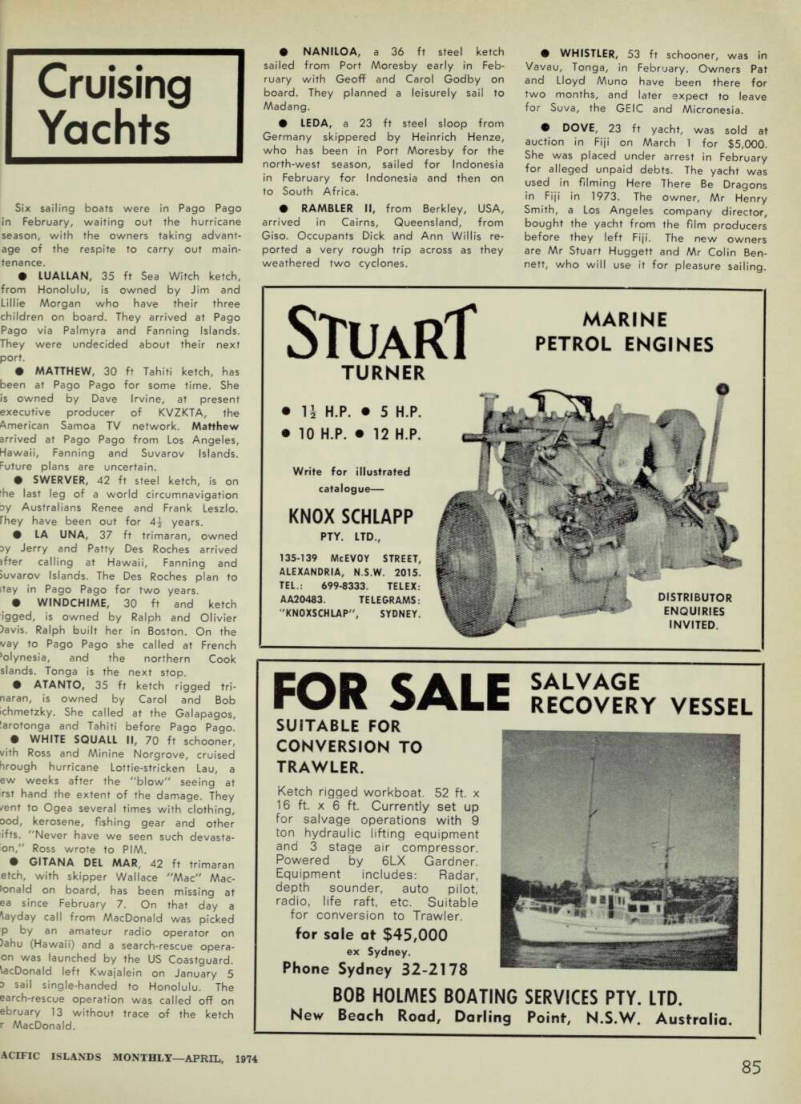
Yachts
Six sailing boats were in Pago Pago In February, waiting out the hurricane season, with the owners taking advant age of the respite to carry out main tenance. • LUALLAN, 35 ft Sea Witch ketch, from Honolulu, is owned by Jim and Lillie Morgan who have their three children on board. They arrived at Pago Pago via Palmyra and Fanning Islands.
They were undecided about their next port. • MATTHEW, 30 ft Tahiti ketch, has been at Pago Pago for some time. She is owned by Dave Irvine, at present executive producer of KVZKTA, the American Samoa TV network. Matthew arrived at Pago Pago from Los Angeles, Hawaii, Fanning and Suvarov Islands.
Future plans are uncertain. • SWERVER, 42 ft steel ketch, is on fhe last leg of a world circumnavigation oy Australians Renee and Frank Leszlo.
Fhey have been out for 4i years. • LA UNA, 37 ft trimaran, owned ay Jerry and Patty Des Roches arrived after calling at Hawaii, Fanning and Juvarov Islands. The Des Roches plan to itay in Pago Pago for two years. • WINDCHIME, 30 ft and ketch igged, is owned by Ralph and Olivier )avis. Ralph built her in Boston. On the vay to Pago Pago she called at French ’olynesia, and the northern Cook stands. Tonga is the next stop. • ATANTO, 35 ft ketch rigged tri naran, is owned by Carol and Bob ichmetzky. She called at the Galapagos, larotonga and Tahiti before Pago Pago. • WHITE SQUALL 11, 70 ft schooner, vith Ross and Minine Norgrove, cruised hrough hurricane Lottie-stricken Lau, a ew weeks after the “blow" seeing at rst hand the extent of the damage. They /ent to Ogea several times with clothing, ood, kerosene, fishing gear and other ifts. “Never have we seen such devasta ion," Ross wrote to PIM. • GUANA DEL MAR, 42 ft trimaran etch, with skipper Wallace "Mac" Mac >onald on board, has been missing at ea since February 7. On that day a tayday call from MacDonald was picked p by an amateur radio operator on )ahu (Hawaii) and a search-rescue opera on was launched by the US Coastguard.
McDonald left Kwajalein on January 5 3 sail single-handed to Honolulu. The earch-rescue operation was called off on ebruary 13 without trace of the ketch r MacDonald.
• NANILOA, a 36 ft steel ketch sailed from Port Moresby early in February with Geoff and Carol Godby on board. They planned a leisurely sail to Madang. • LEDA a 23 ft steel sloop from Germany skippered by Heinrich Henze, who has been ,n Port Moresby for the north-west season sailed for Indonesia m February for Indonesia and then on to South Africa. • RAMBLER 11, from Berkley, USA, arrived in Cairns, Queensland, from Giso. Occupants Dick and Ann Willis reported a very rough trip across as they weathered two cyclones.
• WHISTLER, 53 ft schooner, was in Vavau, Tonga, in February. Owners Pat and Lloyd Muno have been there for two months, and later expect to leave for Suva, the GEIC and Micronesia. , DOVE, 23 f , h was so|d auction in Fiji on March , fo , j 5 QOO. she was p aced unde , arrest .„ Feb , for a e ged unpaid debts. The yacht was used fi ming Here There Be „ $ in Fiji in 1973. The owner, Mr Henry Smith, a Los Angeles company director, bought the yacht from the film producers' before they left Fiji. The new owners are Mr Stuart Huggett and Mr Colin Ben nett, who will use it for pleasure sailing.
Advertisements & other items, pp. 91-92 (2 items)
85
ACIFIC ISLANDS MONTHLY—APRIL, 1974
STuarT
TURNER
• U H.P. • 5 H.P.
• 10 H.P. • 12 H.P.
Write for illustrated catalogue—
KNOX SCHLAPP
PTY. LTD.,
135-139 McEVOY STREET,
ALEXANDRIA, N.S.W. 2015.
TEL.: 699-8333. TELEX:
AA20483. TELEGRAMS:
"KNOXSCHLAP", SYDNEY.
MARINE
PETROL ENGINES
DISTRIBUTOR
ENQUIRIES
INVITED.
FOR SALE
SALVAGE
RECOVERY VESSEL
SUITABLE FOR
CONVERSION TO
TRAWLER.
Ketch rigged workboat. 52 ft. x 16 ft. x 6 ft. Currently set up for salvage operations with 9 ton hydraulic lifting equipment and 3 stage air compressor.
Powered by 6LX Gardner.
Equipment includes: Radar, depth sounder, auto pilot, radio, life raft, etc. Suitable for conversion to Trawler. for sole at $45,000 ex Sydney.
Phone Sydney 32-2178 S ;
808 HOLMES BOATING SERVICES PTY. LTD.
New Beach Road, Darling Point, N.S.W. Australia.
Bank of Hawaii is the bank of the Pacific.
You can bank on it... in Guam JiLTamuning t Koror -mSt Yap Jf Saipan Roi Naimir JL Kwajalein JltPonape Tahiti % American Samoa.
All in all, we have 70 branches throughout Hawaii and the Pacific offering full banking services. May we help you?
Bank of Hawaii the bank of the Pacific® affiliate of Banque de Tahiti
British pacific Jet
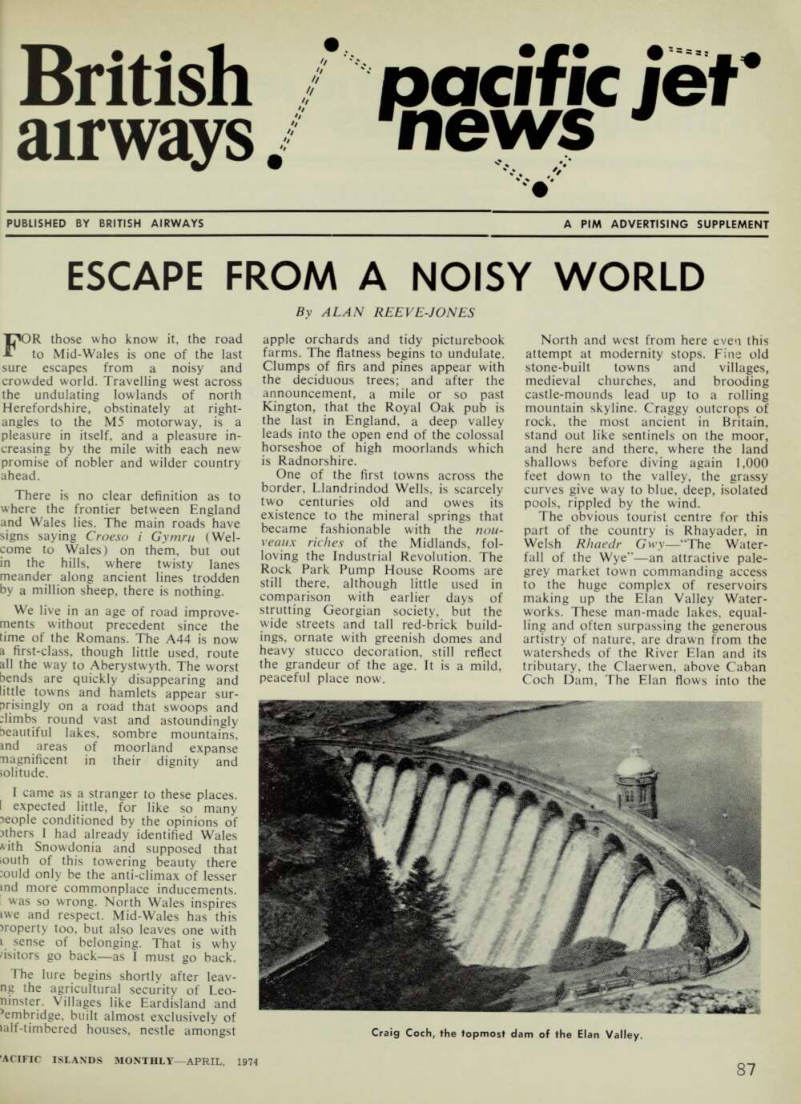
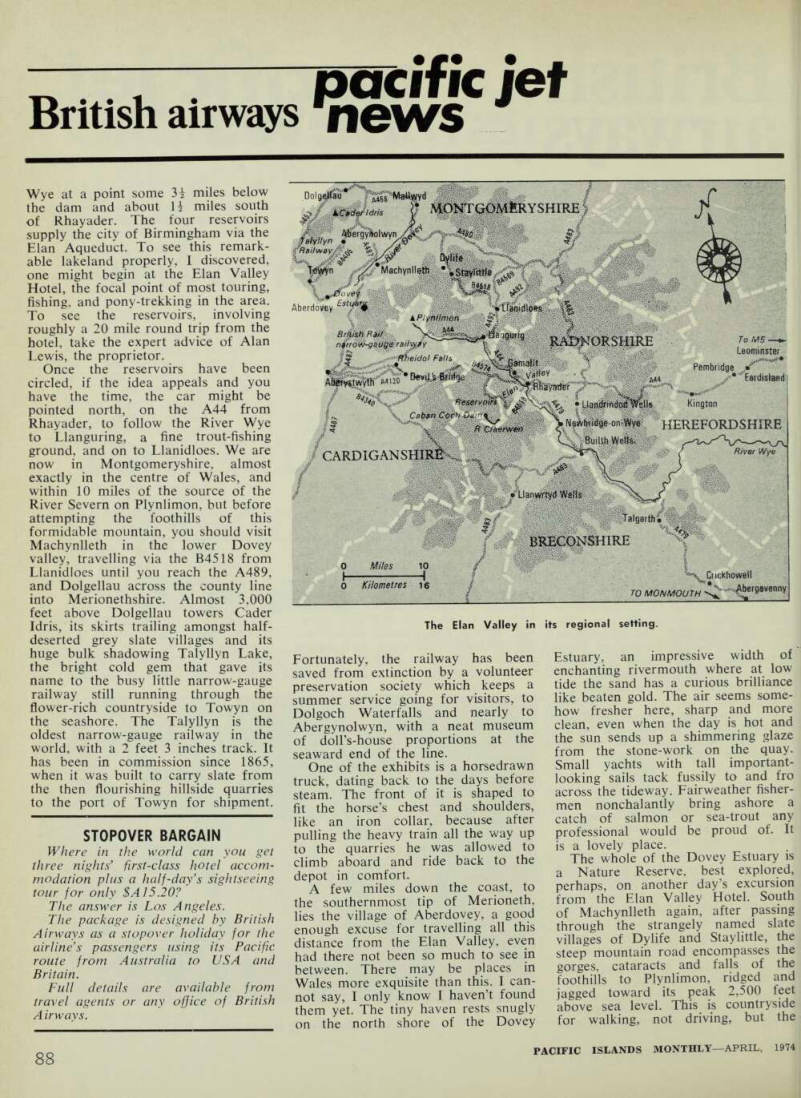
airways news
Escape From A Noisy World
Published By British Airways
A Pim Advertising Supplement
By Alan Reeve-Jones
rR those who know it, the road to Mid-Wales is one of the last sure escapes from a noisy and crowded world. Travelling west across the undulating lowlands of north Herefordshire, obstinately at right angles to the M 5 motorway, is a pleasure in itself, and a pleasure in creasing by the mile with each new promise of nobler and wilder country ahead.
There is no clear definition as to where the frontier between England and Wales lies. The main roads have signs saying Croeso i Gy mm (Wel come to Wales) on them, but out in the hills, where twisty lanes meander along ancient lines trodden by a million sheep, there is nothing.
We live in an age of road improve ments without precedent since the time of the Romans. The A 44 is now a first-class, though little used, route all the way to Aberystwyth. The worst bends are quickly disappearing and little towns and hamlets appear sur prisingly on a road that swoops and :limbs round vast and astoundingly beautiful lakes, sombre mountains, and areas of moorland expanse magnificent in their dignity and »olitude.
I came as a stranger to these places.
I expected little, for like so many people conditioned by the opinions of others I had already identified Wales vith Snowdonia and supposed that iouth of this towering beauty there :ould only be the anti-climax of lesser md more commonplace inducements. was so wrong. North Wales inspires iwe and respect. Mid-Wales has this )roperty too, but also leaves one with i sense of belonging. That is why visitors go back—as I must go back.
The lure begins shortly after leav ng the agricultural security of Leo ninster. Villages like Eardisland and s embridge, built almost exclusively of lalf-timbered houses, nestle amongst
apple orchards and tidy picturebook farms. The flatness begins to undulate.
Clumps of firs and pines appear with the deciduous trees; and after the announcement, a mile or so past Kington, that the Royal Oak pub is the last in England, a deep valley leads into the open end of the colossal horseshoe of high moorlands which is Radnorshire.
One of the first towns across the border, Llandrindod Wells, is scarcely two centuries old and owes its existence to the mineral springs that became fashionable with the nou veaux riches of the Midlands, fol loving the Industrial Revolution. The Rock Park Pump House Rooms are still there, although little used in comparison with earlier days of strutting Georgian society, but the wide streets and tall red-brick build ings, ornate with greenish domes and heavy stucco decoration, still reflect the grandeur of the age. It is a mild, peaceful place now.
North and west from here even this attempt at modernity stops. Fine old stone-built towns and villages, medieval churches, and brooding castle-mounds lead up to a rolling mountain skyline. Craggy outcrops of rock, the most ancient in Britain, stand out like sentinels on the moor, and here and there, where the land shallows before diving again 1,000 feet down to the valley, the grassy curves give way to blue, deep, isolated pools, rippled by the wind.
The obvious tourist centre for this part of the country is Rhayader, in Welsh Rhaedr Gwy —“The Water fall of the Wye”—an attractive pale grey market town commanding access to the huge complex of reservoirs making up the Elan Valley Water works. These man-made lakes, equal ling and often surpassing the generous artistry of nature, are drawn from the watersheds of the River Elan and its tributary, the Claerwen, above Caban Coch Dam, The Elan flows into the
Craig Coch, the topmost dam of the Elan Valley.
Wye at a point some 3i miles below the dam and about H miles south of Rhayader. The four reservoirs supply the city of Birmingham via the Elan Aqueduct. To see this remark able lakeland properly, I discovered, one might begin at the Elan Valley Hotel, the focal point of most touring, fishing, and pony-trekking in the area.
To see the reservoirs, involving roughly a 20 mile round trip from the hotel, take the expert advice of Alan Lewis, the proprietor.
Once the reservoirs have been circled, if the idea appeals and you have the time, the car might be pointed north, on the A 44 from Rhayader, to follow the River Wye to Llanguring, a fine trout-fishing ground, and on to Llanidloes. We are now in Montgomeryshire, almost exactly in the centre of Wales, and within 10 miles of the source of the River Severn on Plynlimon, but before attempting the foothills of this formidable mountain, you should visit Machynlleth in the lower Dovey valley, travelling via the 84518 from Llanidloes until you reach the A 489, and Dolgellau across the county line into Merionethshire. Almost 3,000 feet above Dolgellau towers Cader Idris, its skirts trailing amongst half deserted grey slate villages and its huge bulk shadowing Talyllyn Lake, the bright cold gem that gave its name to the busy little narrow-gauge railway still running through the flower-rich countryside to Towyn on the seashore. The Talyllyn is the oldest narrow-gauge railway in the world, with a 2 feet 3 inches track. It has been in commission since 1865, when it was built to carry slate from the then flourishing hillside quarries to the port of Towyn for shipment.
Fortunately, the railway has been saved from extinction by a volunteer preservation society which keeps a summer service going for visitors, to Dolgoch Waterfalls and nearly to Abergynolwyn, with a neat museum of doll’s-house proportions at the seaward end of the line.
One of the exhibits is a horsedrawn truck, dating back to the days before steam. The front of it is shaped to fit the horse’s chest and shoulders, like an iron collar, because after pulling the heavy train all the way up to the quarries he was allowed to climb aboard and ride back to the depot in comfort.
A few miles down the coast, to the southernmost tip of Merioneth, lies the village of Aberdovey, a good enough excuse for travelling all this distance from the Elan Valley, even had there not been so much to see in between. There may be places in Wales more exquisite than this. I cannot say, I only know I haven’t found them yet. The tiny haven rests snugly on the north shore of the Dovey
Estuary, an impressive width of enchanting rivermouth where at low tide the sand has a curious brilliance like beaten gold. The air seems some how fresher here, sharp and more clean, even when the day is hot and the sun sends up a shimmering glaze from the stone-work on the quay.
Small yachts with tall important looking sails tack fussily to and fro across the tideway. Fairweather fisher men nonchalantly bring ashore a catch of salmon or sea-trout any professional would be proud of. it is a lovely place, The whole of the Dovey Estuary is a Nature Reserve, best explored, perhaps, on another day s excursion from the Elan Valley Hotel. South of Machynlleth again, after passing through the strangely named slate villages of Dyhfe and Stayhttle, the steep mountain road encompasses me gorges, cataracts and falls of the foothills to Plynlimon, and jagged toward its peak 2,500 feet above sea level. This is countryside for walking, not driving, but the
The Elan Valley in its regional setting.
view from the main summit, with North and South Wales in one panoramie sweep, amply pays for the energy expended.
Just south of here, and 12 miles from the coast at Aberystwyth, is Devil’s Bridge, where the fast-flowing Rheidol and its tributary, the Mynach, swirl into a natural basinlike cavity spanned by three bridges, one above the other. The lowest of these, deep down in the gorge is medieval; the second was built in 1753, and the third, carrying the present-day turnpike, in 1901. The most pleasant way to complete the journey to Aberystwyth now is to park your car and take a return trip through the Vale of Rheidol on British Rail’s narrowgauge steam train. The stop at the other end is long enough for a further jaunt, on the miniature cliff railways to the heights of Constitution Hill.
Now head back for Rhayader, across the empty moorland on the 84340 as a change from the A 44.
It is a wild, hilly road of bends and sheep and sudden dark woods, with green, spreading downland and lonely pools, a sprinkling of farmsteads, and mysterious tracks leading up and away to the mountains. About 12 miles out of Aberystwyth, turn eastwards along the now well-surfaced trail known as the Old Coach Road, because once stage coaches fought
through gales and blizzards to bring the mail and a few hardy passengers all the way from London. Bogs and marshes which today lend colour to the landscape were then a hazard for the horse that missed his footing or the coachman who drowsed at the reins.
At Rhayader there is everything for a memorable and inexpensive holiday.
If you like riding ponies, find “Trevor the Trek”. If it’s fishing, talk to Alan Lewis. If you’re interested in local events, read the “County Times and Gazette”. If you’d like to buy some charming Welsh earthenware to take home, go to the Dragon Pottery. If you want anything else—ask anyone.
If you feel like having a meal com parable with the best to be found in London, they’ll send you to the New Inn at Newbridge-on-Wye.
But the ride back to England is paved with more splendours yet. From Builth to Talgarth the mountains lessen their height, slowly and grumblingly, like thunder reluctant to go; but by the time Crickhowell is reached, and afterwards Abergavenny, the fields have spread with crops again, the sheep have gone, and the River Usk laughs along the side of the road for some distance, to turn away when the signposts point to Monmouth. The journey is done, for over to the east is Gloucestershire.
Advertisements & other items, p. 93 (1 item)
’Acific Islands Monthly—April, 1974
Stopover Bargain
Where in the world can you get three nights’ first-class hotel accom modation plus a half-day’s sightseeing tour for only 5A15.20?
The answer is Los Angeles.
The package is designed by British Airways as a stopover holiday for the airline’s passengers using its Pacific route from Australia to USA and Britain.
Full details are available from travel agents or any office of British A irways.
Holidaymaking In 1974
A Cooks tour has been synonymous with travel ever since English men first began to go abroad for pleasure.
Cooks have gone a long way since then and their tours are now world-wide. However, their tremendous experience in Europe over so many years has made the Continent their speciality.
This year’s series of European holidays in association with British Airways offers great variety. There is for instance, the “Eight Countries” 5243, lasting 13 days, travelling by air-conditioned coach.
The Road to Russia” lakes 18 days, five of which are by Baltic steamer, calling at Helsinki and Copenhagen en route to Leningrad— thence by rail to Moscow. The return journey from Moscow is by way of Poland, Germany and Belgium. The cost is $389.
There are numerous tours of Britain ranging from four days around the Shakespeare country, the Severn and Wye Valleys ($B6) to r i < V?? S ’ round trip from London to Inverness . including the English P lstrict > the Scottish Highlands, Edinburgh, York and Cambridge {5264).
The air fare has, of course, to be added to these prices. There is a supplement for single room in hotels.
A brochure with full details is available from travel agents or any office of British Airways.
another computer
British Airways achieves another computer breakthrough in USA
British Airways has achieved an other breakthrough into the United States computer market with the sale to United Airlines of its com puter passenger check-in system— along with the rights to market the system in America—and of an ad vanced computer software tool.
United, largest airline in the Western World, has signed a con tract worth SA 150,000 for the sys tem and followed it with a $A9,000 purchase of “step-by-step” trace, a tool which enables processes to be monitored in the highly complex area of realtime programming.
The American airline, with its headquarters in Chicago, has one of the world’s most powerful comput ing centres in Denver, Colorado, where it is equipped with IBM 360/195 central processors. In close association with British Airways, it is making minor modifications to the computer programmes to tailor them to the American domestic carrier needs.
The British Airways computer check-in system has become the most successful commercial aviation computer package yet marketed with sales worth SAI.S million to eight other airlines, including Qantas.
Mr Peter Hermon, British Airways Group Management Services Direc tor, points out: “United Airlines chose our system against inter national competition after consider ing six others as part of their enhanced customer service scheme.
“This further penetration of the fiercely competitive American com puter market represents quite an achievement by British Airways”. • The flight number of the British Airways super VC 10 flight from Melbourne to London, which calls at Sydney, Nadi, Honolulu, Los Angeles and New York, has been changed from 8A594 to 8A590. The flight in the opposite direction re tains the same number—BAs9L
Advertisements & other items, p. 95 (1 item)
British airways nsWS
89
ij..., . pacificist British airways nsWS
*ACIFIC ISLANDS MONTHLY—APRIL, 1974
Britain Starts Walk-On
Air Services
An experimental jet shuttle ser vice will be introduced by British Airways on its domestic services be tween London and Glasgow from next (northern) winter.
Passengers will not need to make reservations or buy tickets in advance.
They will be guaranteed seats on the flights which will be run in sec tions of one or more aircraft and will operate at regular intervals in both directions from early morning to late at night. Departures will be at easy-to-remember times, making timetable searching unnecessary.
Frequency will be adjusted accord ing to demand.
At the same time improvements, including simpler reservations and ticketing arrangements, a roomier executive class of service with two instead of three abreast seating and an air to ground message service, will be introduced on London/ Edinburgh, London/Belfast routes.
If the walk-on type of service proves a success British Airways will extend it to other major domestic routes and to some international routes such as Paris, Brussels, Amsterdam and Dublin.
More than 1.7 million passengers a year fly on British Airways major domestic trunk routes —nearly 700,000 on London/Glasgow alone.
April The First
—The Big Day
April 1 is a big day in the annals of British aviation history. This year it was the date of the formal estab lishment of British Airways, the new airline created by the merger of BO AC and British European Airways. We’re all one big British Airways now — and BO AC and British European Airways cease to exist.
And ifs 50 years ago—April 1, 1924 —that Britain’s first government sponsored airline was formed. That was Imperial Airways, the company which pioneered Britain’s air routes of the world before the second world war.
Another of our important April 1 landmarks was: 1940, the “vesting” date appointed by the British parlia ment for the setting up of BO AC.
July
Coming Events In Britain
Some highlights of the next few months 1974
June
1 International TT Motorcycle Races Isle of Man, and 3, 5, 7 June. 5 Horse Racing: Epsom Summer Meeting Epsom, Surrey, to 8 June (provisional) (The Derby—5th; the Oaks —8th). 7 Aldeburgh Festival of Music and the Arts Aldeburgh, Suffolk, to 25 June , - . 7 International Antiques Fair Earls Court, London, to 18 June. 8 Clyde Fair International Ayrshire, Bute Renfrewshire, Dunbarton shire, Argyll, Lanarkshire and Glasgow, to 23 June (provisional). 11 Three Counties Agricultural Show. Malvern, Worcestershire, to 13 June. 15 The Queen's Official Birthday: Trooping the Colour. Horse Guards Parade, London. 18 Horse Racing: Royal Ascot Ascot, Berkshire, to 21 June (pro visional). , 18 Royal Highland Agricultural Show Ingliston, near Edinburgh, to 21 June. 21 Bath Festival Bath, Somerset, to 30 June. 24 Lawn Tennis Championships Wimbledon, London, to 6 July. 26 Royal Norfolk Agricultural Show, Showground. New Costessey, Norwich, Norfolk, and 27 June. . 28 Royal National Rose Society's Show. Royal Horticultural Society Halls, London, and 29 June (provisional).
July
City of Belfast International Rose Trials Dixon Park, Belfast, to September. 1 British Jousting Society Tower of London, to 6 July. 1 City of London Festival. London, to 13 July. 2 Llangollen international Eisteddfod Llangollen, Denbighshire, to 7 4 Henley Royal Regatta, Henley-on-Thames, Oxfordshire, to 7 July. 5 Cheltenham International Festival of Music Cheltenham, Gloucester shire, to 14 July, , , . . 9 Great Yorkshire Agricultural Show. Great Yorkshire Showground, Harrogate, Yorkshire, to 11 July.
10 Royal Tournament: Displays by the Armed Forces Earls Court, London, to 27 July. 10 Open Golf Championship Royal Lytham & St Annes, Lancashire to 13 July. 13 Son et Lumiere Winchester Cathedral, Winchester, Hampshire, to 5 October (excluding Sundays). 14 Start Tall Ships Feeder Race Dartmouth, Devon/Corunna, Spain. 17 World Show Jumping Championships. Hickstead, near Bolney, Sussex, to 21 July. 19 Henry Wood Promenade Concerts Royal Albert Hall, London to 14 September, provisional. 20 The Daily Telegraph and BP Round-Britain Power Boat Race. Start and finish London, to 3 August. 23 Royal Welsh Agricultural Show Llanelwedd, Builth Wells, Brecon shire, to 25 July. 26 County Landowners Association Game Fair Stratfield Saye, Hampshire, near Reading, Berkshire, to 27 July.
August
4 Harrogate Festival of Arts and Sciences. Harrogate, Yorkshire, to 17 August. 4 Tall Ships Parade of Sail Solent, Isle of Wight. 5 Royal National Eisteddfod, Carmarthen, to 10 August. 16 Edinburgh Military Tattoo. Castle Esplanade, Edinburgh, to 7 September. ... . 17 Royal Scottish Academy Festival Exhibition. Royal Scottish Academy, Edinburgh, to 15 September (provisional). 18 Edinburgh International Festival. Edinburgh, to 7 September. 18 Three Choirs Festival Gloucester, to 23 August.
September
2 International Air Show. Farnborough, Hampshire, to 8 September. 7 Praemar Royal Highland Gathering. Braemar, Aberdeenshire. 12 World 3-Day Event Chamoionship (Horse Trials). Burley, Rmgwood, 14 Horse Racing; St Leger Doncaster, Yorkshire. . ... 27 Newcastle Festival Newcastle upon Tyne, Northumberland, to 10l October.
October
16 International Motor Exhibition Earls Court, London, to 26 October.. 19 Bath Bach Festival Bath, Somerset, to 26 October.
Advertisements & other items, pp. 97-98 (1 item)
Seiko
/ automat*:
f SWST-
sun'bl ' M X m / ) ' / i \ »J Automatic self-winding,Water resistant Second setting device, Instant day and date setting Automatic self-winding, Water resistant- Second setting device, Instant day and date setting
Technology of the future.
Dedication of the past.
Seiko, the quality watch of today.
Every Seiko watch is a triumphant merger of Seiko’s unique microelectronic-technology and time-honored tradition of handcraftsmanship.
Add to all this Seiko’s insistence on making every part of every Seiko watch, thus quality-controlling every step.
This unique merging of future technology and past dedication creates the quality watch of today; Seiko.
SEIKO
K. Hattorl & Co., Ltd., Tokyo, Japan.
Someday ail watches will be made this wav.
We’re big on
little things
at Toyota.
There are a lot of things that make a Toyota a great automobile. Big things like computerized quality control. And little things like eye tests.
For the last five years we've been running tests to determine the limits of visibility under various conditions. We test with men and with women. On country roads and city streets. Then we use the results to design our cars from the shape of the windscreen, to the size of the mirrors, to the position and brightness of the headlamps.
Compared to our more sophisticated testing and research, or compared to our performance and styling, eye tests may seem insignificant.
But the little things we do add up.
Because we've been doing them for 36 years. And we'll keep on doing them. Because they go a long way toward making you satisfied.
TOYOTA
Business and Development
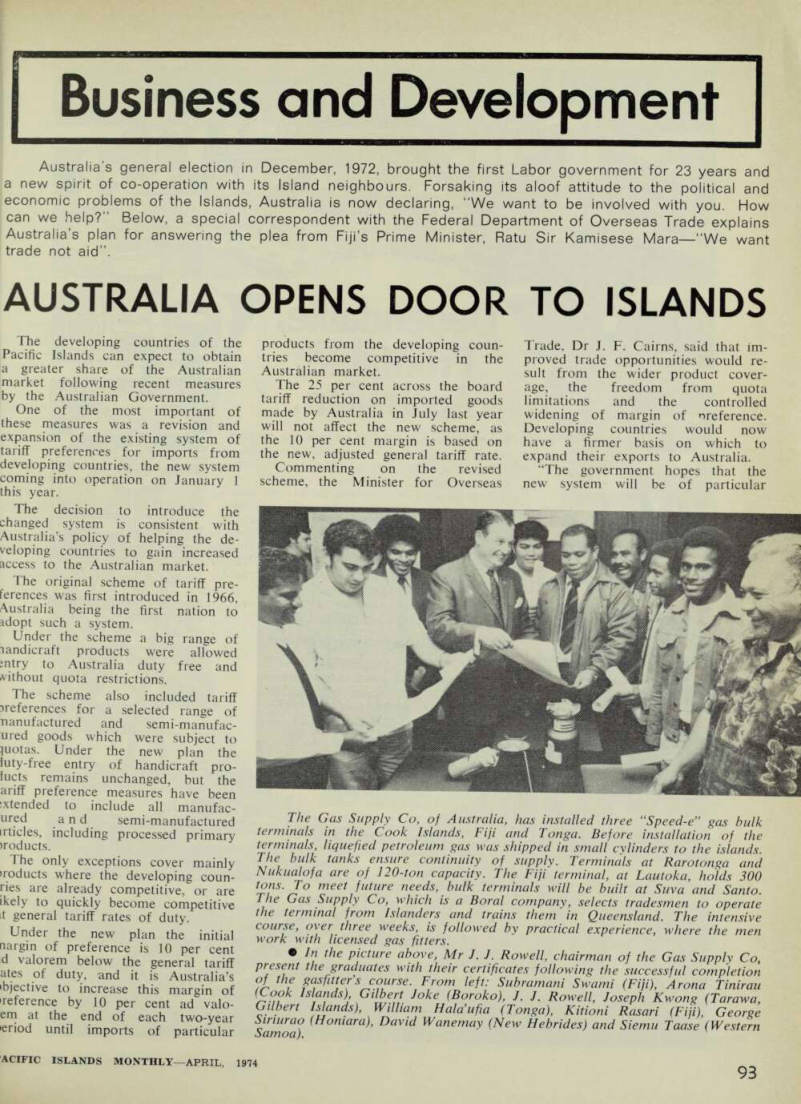


Australia Opens Door To Islands
Australia’s general election in December, 1972, brought the first Labor government for 23 years and a new spirit of co-operation with its Island neighbours. Forsaking its aloof attitude to the political and economic problems of the Islands, Australia is now declaring, “We want to be involved with you. How can we help?” Below, a special correspondent with the Federal Department of Overseas Trade explains Australia’s plan for answering the plea from Fiji’s Prime Minister, Ratu Sir Kamisese Mara—“We want trade not aid”.
The developing countries of the Pacific Islands can expect to obtain a greater share of the Australian market following recent measures by the Australian Government.
One of the most important of these measures was a revision and expansion of the existing system of tariff preferences for imports from developing countries, the new system coming into operation on January 1 this year.
The decision to introduce the changed system is consistent with Australia’s policy of helping the de veloping countries to gain increased access to the Australian market.
The original scheme of tariff pre ferences was first introduced in 1966, Australia being the first nation to adopt such a system.
Under the scheme a big range of aandicraft products were allowed ;ntry to Australia duty free and without quota restrictions.
The scheme also included tariff areferences for a selected range of nanufactured and semi-manufac ured goods which were subject to juotas. Under the new plan the luty-free entry of handicraft pro lucts remains unchanged, but the ariff preference measures have been extended to include all manufac ured a n d semi-manufactured irticles, including processed primary >roducts.
The only exceptions cover mainly •roducts where the developing coun ries are already competitive, or are ikely to quickly become competitive it general tariff rates of duty.
Under the new plan the initial nargin of preference is 10 per cent d valorem below the general tariff ates of duty, and it is Australia’s •bjective to increase this margin of 'reference by 10 per cent ad valo em at the end of each two-year •eriod until imports of particular
products from the developing coun tries become competitive in the Australian market.
The 25 per cent across the board tariff reduction on imported goods made by Australia in July last year will not affect the new scheme, as the 10 per cent margin is based on the new, adjusted general tariff rate.
Commenting on the revised scheme, the Minister for Overseas
Trade, Dr J. F. Cairns, said that im proved trade opportunities would re sult from the wider product cover age, the freedom from quota limitations and the controlled widening of margin of Developing countries would now have a firmer basis on which to expand their exports to Australia.
“The government hopes that the new system will be of particular
The Gas Supply Co, of Australia, has installed three “Speed-e” gas bulk terminals in the Cook Islands, Fiji and Tonga. Before installation of the terminals, liquefied petroleum gas was shipped in small cylinders to the islands.
The bulk tanks ensure continuity of supply. Terminals at Rarotonga and Nukualofa are of 120-ton capacity. The Fiji terminal, at Lautoka, holds 300 tons. To meet future needs, bulk terminals will be built at Suva and Santo.
The Gas Supply Co, which is a Boral company, selects tradesmen to operate the terminal from Islanders and trains them in Queensland. The intensive course, over three weeks, is followed by practical experience, where the men work with licensed gas fitters.
In the picture above, Mr J. J. Rowell, chairman of the Gas Supply Co, present the graduates with their certificates following the successful completion of the gas fitter’s course. From left: Subramani Swami (Fiji), Arona Tinirau (cook Islands), Gilbert Joke (Boroko), J. J. Rowell, Joseph Kwong (Tarawa, Gilbert Islands), William Hala’ufia (Tonga), Kitioni Rasari (Fiji), George Siriurao (Honiara), David Wanemay (New Hebrides) and Siemu Taase (Western samoa)
Promotional Help
help to countries in the Pacific and Asian regions who look to Australia as a natural trading partner” he said.
Australia has become increasingly aware that many exporters in the developing countries lack the de tailed knowledge of the Australian market and did not nave the re sources to obtain it, which is essen tial if they are to gain the maximum benefits from the new scheme.
For this reason, Dr Cairns also announced an important new com plement to it, in that the Department of Overseas Trade would provide help in obtaining this knowledge.
Trade inquiries can be referred to the Department for Market investi gation and also for help in the trade promotion field. The department will arrange commercial contacts for visiting exporters from the develop ing countries and will continue its :lose liaison with the Australian based commercial representatives of he governments of those countries.
These activities indicate the type af assistance which Australia is eady to provide to developing coun ries. Increased contact between ex )orters from those countries and \ustralia is expected to bring other iceds to light and the department vill assist with these within its re sources.
The Australian Government is dso aware that such marketing issistance and preferences will only >e of benefit to the developing coun ries if they have products for xport.
It is for this reason that Australia upports the three priorities collec ively identified by the Islands and iccepted in the Suva communique •f the South Pacific Forum, namely he development of further process ag of primary products, rationalis tion of import-substitution indus ries, and the establishment of xport-oriented manufacturing indus ries as a means of encouraging and eveloping viable economies.
Australia, as a member of the louth Pacific Forum, sees its role s participating actively in the work f the forum and the South Pacific Sureau of Economic Co-operation, articularly concerning efforts to dvance the economic viability and evelopment of the Island member ountries.
Australia is following a positive uiding role, offering constructive dvice and expertise where possible, nd necessary or specific proposals nd work priorities.
Australia is also willing to work closely with the Islands in finding solutions to their problems and recogmses that there are various means by which assistance might be pro-
greafer Scesf
ducts to Australia through the new system of tariff preferences and marketing assistance, there is potential for co-operation in achieving fair commercial access to each other’s markets for particular commodifies. There is scope for mutual recognition of the benefits which arise from private direct investment, particularly joint ventures linked with the Islands’ development plans.
Similarly, the advantages of mutual encouragement of co operation in consultancy and con struction services, including joint vent ures and the use of local sub contractors should be examined as a m f ai ] s °f making the maximum Poetical use of island resources, At the international level, there is scope for mutual support for the negotiation of international agree ments to improve the conditions of trade in primary products, to over come the uncertainties in the inter national commodity trade and to improve access to international markets.
Hopes for tuna
industry in Fiji
Fiji should have a commercial skipjack tuna industry within the next two years, following a survey extending over nine months. The survey team had as an adviser, Mr Robert Lee, manager of the United Nations Development Programme/ Food and Agricultural Organisation tuna project.
On its last trip the team, using the Tui Ni Wasaliwa, a new tuna re search boat belonging to the fisheries division of the Department of Agri culture and Fisheries, caught more than 18 tons of skipjack tuna in five days of fishing. The ship made four trips; on the first three the total catch was 12 tons.
Mr Lee said the fishing team showed that local fisheries staff, trained in pole fishing, could do an excellent job.
On its last trip the crew caught the bait in Kadavu waters, then fished in the southern Lau area.
Fiji’s Prime Minister, Ratu Sir Kamisese Mara, and the Minister for Agriculture, Fisheries and Forests, Mr Doug Brown, met the Tui Ni Wasaliwa when it returned to Suva after its last trip.
Odd man out of gas
in American Samoa?
American Samoa, hard hit by gasoline shortages in recent months, may finally get some relief.
Governor John M. Haydon has assented to a bill, sponsored by Senator Galea’i Poumele, which gives the Governor emergency powers to regulate and ration the use of petroleum.
Pointing out the lack of petroleum resources in the territory, as well as the lack of refining capabilities and shipping difficulties, the Governor said that “in the event of a delay in replenishing our fuel supplies, American Samoa would be in a "ather serious situation which would lecessitate control measures by the government”.
Hawaii and the territory of Guam dready are rationing gasoline in the so-called “Oregon” manner, issuing ?as by odd and even licence lumbers.
Better deal for
Cooks fruit growers
The lot of Cook Islands’ fruit pro filers could improve should New Zealand implement recommendations nade by a committee of inquiry into
the Cook Islands-New Zealand fresh fruit trade. One immediate benefit would be a rise of $1.12 for a 56 lb case of bananas supplied by the Cook Islands Primary Produce Board— from $2.80 to $3.92.
The committee of inquiry was a te- 1 ™ 11 effort by a Wellington lawyer, Mr David Shand. The Mmister of Trade and Industry, tabling Mr Shand s report m Parliament said the recommendations and complex issues involved would be studied “with some urgency”.
Mr Shand was required to go into the handling, pricing and cost of fresh fruit from production to consumption.
He concluded that poor handling in
NZ, slow unloading and rail transport were factors in poor-quality fruit reaching the NZ market, He recommended that fresh fruit shou ld be loaded last in the Cook Islands so that it could be unloaded fi rst in New Zealand. Fruit Distribu tors Ltd , which bought the fruit should be allowed to use road trans port in preference to the railways where this wou!d hdp to maintain a reasonable quality of fruit for the market The ships Moana Roa and Lorena should eventually be withdrawn from the Cook Islands run and replaced with newer, specially-designed ships.
There should be one or two other
points, outside Auckland, where fruit could be unloaded to help save dis tribution costs.
The present wholesale commission of 10 per cent could be reduced by a two-tier commission system. The maximum retail price of Cook Is lands’ bananas should be increased to 17c a pound, and rigidly tied to stricter quality inspection in the Cook Islands.
Mr Shand said in some respects Fruit Distributors had served the Cook Islands satisfactorily, and was not making, and had not made, ex cessive profits overall. But the obliga tions of the company towards the Cook Islands should be made more precise by annual price negotiations and medium-term supply agreements with the Cook Islands.
The report, although it applies to the Cook Islands, could be a blue print for other island groups which supply produce to New Zealand.
More teleohoneS
v
for T OtIQQ
a . aI ~V , Tonga is about to take a great leap
aee^Th^Asian 6
has aonroved a loan of P SUSI3 mil j£ s „ » which To °* a sU ®Ji : add SUS3OO,OOO, to improve and expand th telenhone service on Ton?a-
tapu, pSe SLe S
for two other groups and improve the radio telephone link between Tongatapu, Vavau and Haapai. a 2,200-line automatic exchange w jn replace Nukualofa’s manual switchboard and provide more lines so that Nukualofa may be connected w j t h all parts of Tongatapu. The old switchboard will be installed at Vavau to give that island its first telephone service, Pangai, in the Haapai islands, will receive a new manual switchboard.
Upgrading the radio-telephone link
covering the three major groups willl be a vast i m p rovemen t as inter-islandl communication at present is possible; ° nly for short periods 011 workin S= days.
The work will be carried out the Tele g ra P bs a °d Telephones? 3 P , 8 y .* The loan from the Asian Develop ment Bank is on very favourable; terms—l.s per cent interest. It is re payable m 30 years, which includes? a seven-year period of grace, c* * J .
■ drops Sterling
£—-, lL 0 lIC J n |L r rnc w J OUllu Fiji has broken another tie withi Britain. From February 25 she tiedl her currency to the US dollar instead! of the British pound sterling. The;
change immediately revalued Fijts
currency by li per cent, The change had been advocated ini
several circles for some time, as cur rency realignments in Australia and New Zealand had sent up the cost of living in Fiji. Fiji made some attempts to buy commodities else where, but with little success.
The general manager of the Central Monetary Authority in Fiji, Mr lan Craik, said traders buying in Aus tralia and New Zealand did not know exactly how much the goods would eventually cost because of the fluctuat ing value of sterling.
Other currencies, including the US dollar, had fluctuated in the last 20 months, but the US dollar was return ing to stability. The Fiji Government believed that fixing the value of the Fiji dollar in relation to the US dollar offered the best hope, for the time being, of some stability in exchange transactions with her principal trading partners.
Since a previous statement on the Fiji exchange rate policy on January 16, the Fiji dollar appreciated by about 6i per cent in relation to the US and Australian dollars.
Strife over Pogo Pago
fish cannery plan
From a Pago Pago correspondent An announcement by Castle and Cooke, Inc, of its intentions to build a SUS 7.6 million fish cannery in American Samoa has drawn a great amount of political cross-fire.
Bumble Bee Seafoods, a division nf Castle and Cooke, Inc, will oper ate the plant, which is scheduled to begin operation in January of 1976.
Fhe initial capacity of the plant will be about 100 tons of fish daily and company officials expect the plant to employ about 300 persons.
Star Kist, Inc and Van Camp Sea foods both operate fish canneries in Pago Pago at the present time, employing about 1,200 Samoans, *dth a payroll of more than S 3 mil lion per year.
A series of resolutions has been introduced in the American Samoa Fono, one requesting that Castle and Cooke look elsewhere for a ocation. Two other resolutions have welcomed the company to American Samoa.
Most of the opposition to the can nery proposition seems to be coming from American Samoa’s Delegate at-Large, A. U. Fuimaono, who is nased in Washington, (DC), and acts as a representative for the American Samoa Legislature in the United States.
Fuimaono said in Washington that :annery operations do not benefit the Samoan people and were a drain on the island’s power and water system.
Advertisements & other items, pp. 99-106 (4 items)
93
ACIFIC ISLANDS MONTHLY—APRIL, 1974
Dependable,
?T3TIP
igi
Profitable,
Australian.
You’ll see “Made in Australia” on products ranging from foods to cultivators in many Pacific markets.
Why do so many importers order from Australia?
Because Australia means ready availability, a wider range, competitive prices, better business.
And Australian suppliers match the quality of their products with their technical advice and service, i The demand is growing all the time and so is the range- Canned, Packaged and Processed Foods, Mining Machinery, ' Domestic and Industrial Refrigeration Equipment, Pumps, Agricultural Machinery, Materials Handling Equipment, Radio and Telecommunications Equipment, Earthmoving Equipment, Hand and Power Tools, Electrical Equipment and Building Materials.
Quality and value that's only hours away For more information contact the Australian Trade Commissioner.
Australian High Commission Trade Office Cnr. Pratt and Joske Streets, SUVA, Fiji. (P.O. Box 1252) Phone 25624 Australian Department of Overseas Trade
W. H. GROVE & SONS LTD.
ESTABLISHED 1896
ISLAND MERCHANTS
Exporters to the Pacific of Dairy Products and all New Zealand consumer and manufactured goods.
ENTRUST YOUR REQUIREMENTS TO THE
ESTABLISHED FIRM
P.O. Box 3718, Cables
AUCKLAND GROVE AUCKLAND
AUSTRALIA'S FASTEST GROWING EXPORT AGENT
PACIFIC DIESEL
AND TECHNICAL AGENCIES
P.O. BOX 7, MARRICKVILLE, N.S.W., 2204.
PHONE; 55 3473, 55 3867. TELEX; AA 25568.
CABLE; DIESELTECH.
FOR
• VIEMME DIESEL ENGINES
• SIERRA ALL TERRAIN VEHICLES
• ARCHIMEDES RENTA OUTBOARDS
• INFLATABLE RUBBER BOATS
• KAWASAKI GENERATORS, PUMPS, ENGINES
EXPRESS EXPORT ACTION
Spray with Marino
Marino Blowamist 35. Sprays chemicals, dust or flame for effective control of pests, insects, weeds, fungus and timber re-growth. Extremely portable, with weight evenly distributed between front and back. Its simple operation is further ehhanced by a pistol grip handle and quickly replaceable liquid containers.
Marino Jetting Units. Marino makes a range of 11 different jetting and fire fighting units at prices and pressures to suit all applications. Up to 10 gallons per minute at ,80 psi. <r K' Marino Fibreglass Centrifugal Pump.
A small, light and extremely versatile pump with corrosion-resistant stainless steel shaft and seals.
Suitable for drive by V-belt or direct flexible coupling—to 2800 rpm electric motor. Suction %” BSP, delivery Vz" BSP shaft diameter. m Marino Tractor Mister. Tractor mounted to provide widespread control over weeds and insects — covering up to 600 acres per day with swathe widths of up to 100 feet.
The Marino Tractor Mister comes complete with 44 gallon galvanised steel tank, and is also available in a motor driven model.
Marino Master Mister. Similar to Marino Tractor Mister in most respects, the Marino Master Mister is usually truck mounted. Powered by its own 7 hp motor and provides a wide swathe by manual operation.
TO: MARINO ENGINEERING
PTY. LTD.
360 Fison Avenue, Eagle Farm,!
Old., Aust, 4007. Ph. 68 5544 Send details of Marino
imm
Marino Engineering Pty. Limited
Name Address Postcode 360 Fison Avenue, Eagle Farm,
IQId., Australia,4oo7
Phone 68 5544 i * ME7740
KERR RROS. THE VICON PEOPLE
FOR THE PACIFIC ISLANDS
YOU'LL SPREAD A LOAD MORE ACCURATELY
WITH THE VICON VARI/SPREADER
And with the Vari/Spreader it is accuracy built to last —the use of corrosion resistant materials sees to that. • Strong, rust free, easy to clean hopper, moulded from glass fibre reinforced polyester. • Stainless steel regulating plate. • Polyester spreading bowl. • Stainless steel spout.
"Versatility" is the right word for the Vicon Vari/Spreader. It broadcasts fertilisers, grain, grass and clover seeds all with equal guaranteed precision. • Spreads as little as 5 lb of grass seed per acre i 2,500 lb per acre of fertiliser. • P.T.O. driven. • Effective spreading with up to 24 ft.
MAKE THE VARI/SPREADER YOUR CHOICE FOR
LONG DISTANCE ACCURACY
For further information contact:
KERR BROTHERS PTY. LIMITED
65 YORK STREET, SYDNEY, N.S.W. 2000.
flow to tell a perfect golf course
two easy lessons
(1) It has a Harvin Electric Automatic Syste (2) And, of course, Harvin golf course equipi Fhat's why the Fijian Hotel has >uch a perfect golf course.
But don't take our promise, fake our pictures, fhe Harvin "Rain Bird" watering system can be Automatically Dperated. That means a sizeable saving in labour costs because the sprinkler system can be timed to operate only at night. The course is :herefore available for maximum jse.
Harvin also leave their mark on golf courses with their equipment. Such :hings as flag poles, cups, callwasher units, tee markers and signs are all available.
Harvin "Rain Bird" Automatic Watering System and Harvin Course Equipment The Perfect partners for any golf course.
I m i seas mm - :JT Harvin Limited Head Office
CHRISTCHURCH
565 Wairakei Road, Phone 588-029 3 lines P.O. Box 20-030 Bishopdale Branches at Auckland & Palmerston North, New Zealand. are sole agents for #W W UM***% U.SA.
Please write for consultation on your watering problem
WE NEED
SOW LOCAL
DEALERS
10 SELL OUR
SEWING
NAOVNES.
We’re a leading European sewing machine company that urgently needs dealers in the South Pacific region. We’re offering excellent margins, warranties and thorough training for the successful applicants. The brand is well known. And our products are sold throughout the world.
The quality of our machines puts us way above the rest.
This is a great opportunity for you to share in our success and in the success of our machines.
Apply in writing to: Sewing Machine Export, Box 247, G.P.0.,
BRISBANE, QLD. 4001
AUSTRALIA.
LBQ 0974
Australia
is your
*§ wm "i
aindand
From Australia comes one of nature’s finest products delicious, nutritious Australian golden butter. Fresh to you from rich, green Australian pastures.
When you buy dairy products butter, cheese or ghee from your store or supermarket, look for the word “AUSTRALIA” on the pack. It’s your guarantee of quality and flavour.
All the best —from Australia to you.
95
ACIFIC ISLANDS MONTHLY—APRIL, 1974
97
’ACIFIC ISLANDS MONTHLY—APRIL, 1974
Produce Prices
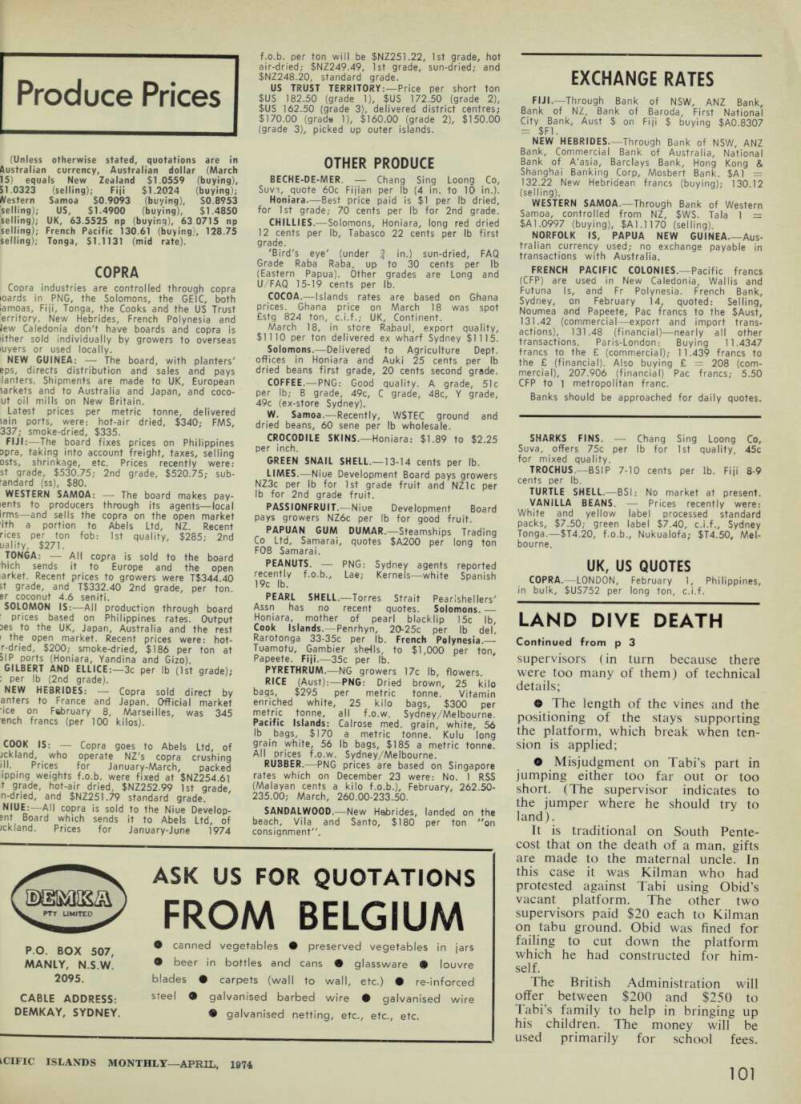
(Unless otherwise stated, quotations are in Australian currency, Australian dollar (March 15) equals New Zealand $1.0559 (buying), S 1 0323 (selling); Fiji $1.2024 (buying); Western Samoa 50.9093 (buying), $0.8953 selling); US, $1.4900 (buying), $1.4850 selling); UK, 63.5525 np (buying), 63 0715 np selling); French Pacific 130.61 (buying), 128.75 selling); Tonga, $1.1131 (mid rate).
Copra
Copra industries are controlled through copra toards in PNG, the Solomons, the GEIC, both lamoas, Fiji, Tonga, the Cooks and the US Trust erritory. New Hebrides, French Polynesia and lew Caledonia don't have boards and copra is (ither sold individually by growers to overseas iuyers or used locally.
NEW GUINEA: The board, with planters' eps, directs distribution and sales and pays lanters. Shipments are made to UK, European larkets and to Australia and Japan, and coco ut oil mills on New Britain.
Latest prices per metric tonne, delivered lain ports, were: hot-air dried, $340; FMS, 337; smoke-dried, $335.
FIJI: —The board fixes prices on Philippines opra, taking into account freight, taxes, selling osts, shrinkage, etc. Prices recently were: st grade, $530.75; 2nd grade, $520.75; sub ‘andard (ss), $BO.
WESTERN SAMOA: The board makes pay icnts to producers through its agents—local Irms —and sells the copra on the open market ith a portion to Abels Ltd, NZ. Recent rices per ton fob: Ist quality, $285; 2nd uality, $271.
TONGA: All copra is sold to the board hich sends it to Europe and the open arket. Recent prices to growers were T 5344.40 st grade, and T 5332.40 2nd grade, per ton. er coconut 4.6 seniti.
SOLOMON IS: —All production through board prices based on Philippines rates. Output jes to the UK, Japan, Australia and the rest 1 the open market. Recent prices were: hot r-dried, $200; smoke-dried, $lB6 per ton at SIP ports (Honiara, Yandina and Gizo).
GILBERT AND ELLICE:— 3c per lb (Ist grade); : per lb (2nd grade).
NEW HEBRIDES: Copra sold direct by anters to France and Japan. Official market •ice on February 8, Marseilles, was 345 ench francs (per 100 kilos).
C l °P K J Copra goes to Abels Ltd, of jckland, who operate NZ's copra crushing ill. Prices for January-March, packed ippmg weights f.o.b. were fixed at $NZ254.6l t grade, hot-air dried, $NZ252.99 Ist grade, n-dried, and $NZ251.79 standard grade.
NIUE: —AII copra is sold to the Niue Develop snt Board which sends it to Abels Ltd, of ickland. Prices for January-June 1974
f.o.b. per ton will be $NZ251.22, Ist grade, hot air-dried; $NZ249.49, Ist grade, sun-dried; and $NZ248.20, standard grade.
US TRUST TERRITORY:— Price per short ton SUS 182.50 (grade 1), SUS 172.50 (grade 2), SUS 162.50 (grade 3), delivered district centres; $170.00 (grade 1), $160.00 (grade 2), $150.00 (grade 3), picked up outer islands.
Other Produce
BECHE-DE-MER. Chang Sing Loong Co, Suva, quote 60c Fijian per lb (4 in. to 10 in.).
Honiara. —Best price paid is $1 per lb dried, for Ist grade; 70 cents per lb for 2nd grade.
CHILLIES. —SoIomons, Honiara, long red dried 12 cents per lb. Tabasco 22 cents per lb first grade.
'Bird's eye' (under % in.) sun-dried, FAQ Grade Raba Raba, up to 30 cents per lb (Eastern Papua). Other grades are Long and U/FAQ 15-19 cents per lb.
COCOA. —lslands rates are based on Ghana prices. Ghana price on March 18 was spot £stg 824 ton, c.i.f.; UK, Continent.
March 18, in store Rabaul, export quality, $lllO per ton delivered ex wharf Sydney $lll5.
Solomons. —Delivered to Agriculture Dept, offices in Honiara and Auki 25 cents per lb dried beans first grade, 20 cents second grade.
COFFEE. —PNG: Good quality. A grade, 51c per lb; 8 grade, 49c, C grade, 48c, Y grade, 49c (ex-store Sydney).
W. Samoa. —Recently, WSTEC ground and dried beans, 60 sene per lb wholesale.
CROCODILE SKlNS.— Honiara: $1.89 to $2.25 per inch.
GREEN SNAIL SHELL.— I 3-14 cents per lb.
LIMES. —Niue Development Board pays growers NZ3c per lb for Ist grade fruit and NZlc per lb for 2nd grade fruit.
PASSIONFRUIT. —Niue Development Board pays growers NZ6c per lb for good fruit.
PAPUAN GUM DUMAR.— Steamships Trading Co Ltd, Samarai, quotes SA2OO per long ton FOB Samarai.
PEANUTS. PNG: Sydney agents reported recently f.0.b., Lae; Kernels—white Spanish 19c lb.
PEARL SHELL. —Torres Strait Pearlshellers' Assn has no recent quotes. Solomons.
Honiara, mother of pearl blacklip 15c lb.
Cook Islands. —Penrhyn, 20-25 c per lb del.
Rarotonga 33-35 c per lb. French Polynesia.— Tuamotu, Gambier shells, to $l,OOO per ton, Papeete. Fiji. —3sc per lb.
PYRETHRUM. —NG growers 17c lb, flowers.
RICE (Aust): — PNG: Dried brown, 25 kilo bags, $295 per metric tonne. Vitamin enriched white, 25 kilo bags, $3OO per metric tonne, all f.o.w. Sydney/Melbourne.
Pacific Islands: Calrose med. grain, white, 56 lb bags, $l7O a metric tonne. Kulu long grain white, 56 lb bags, $lB5 a metric tonne.
All prices f.o.w. Sydney/Melbourne.
RUBBER. —-PNG prices are based on Singapore rates which on December 23 were: No. 1 RSS (Malayan cents a kilo f.0.b.), February, 262.50- 235.00; March, 260.00-233.50.
SANDALWOOD. —New Hebrides, landed on the beach, Vila and Santo, $lBO per ton "on consignment".
SHARKS FINS. Chang Sing Loong Co, Suva, offers 75c per lb for Ist quality, 45c for mixed quality.
TROCHUS.— BSIP 7-10 cents per lb. Fiji 8-9 cents per lb.
TURTLE SHELL. —BSI: No market at present.
VANILLA BEANS. Prices recently were: White and yellow label processed standard packs, $7.50; green label $7.40, c.i.f., Sydney Tonga.—sT4.2o, f.0.b., Nukualofa; $T4.50, Mel bourne.
Uk, Us Quotes
COPRA. LONDON, February 1, Philippines, in bulk, SUS7S2 per long ton, c.i.f.
Exchange Rates
FlJl.— Through Bank of NSW, ANZ Bank, Bank of NZ, Bank of Baroda, First National City Bank, Aust $ on Fiji $ buying $A0.8307
= Sfi.
NEW HEBRIDES. —Through Bank of NSW, ANZ Bank, Commercial Bank of Australia, National Bank of A'asia, Barclays Bank, Flong Kong & Shanghai Banking Corp, Mosbert Bank. SAI = 132.22 New Hebridean francs (buying); 130.12 (selling).
WESTERN SAMOA. —Through Bank of Western Samoa, controlled from NZ, SWS. Tala 1 = $A 1.0997 (buying), $ A 1.1170 (selling).
Norfolk Is, Papua New Gulnea.—Aus
tralian currency used; no exchange payable in transactions with Australia.
FRENCH PACIFIC COLONIES.— Pacific francs (CFP) are used in New Caledonia, Wallis and Futuna Is, and Fr Polynesia. French Bank, Sydney, on February 14, quoted: Selling, Noumea and Papeete, Pac francs to the sAust, 131.42 (commercial —export and import trans actions), 131.48 (financial) —nearly all other transactions. Paris-London: Buying 11.4347 trancs to the £ (commercial); 11.439 francs to the £ (financial). Also buying £ = 208 (com mercial), 207.906 (financial) Pac francs; 5.50 CFP to 1 metropolitan franc.
Banks should be approached for daily quotes.
Advertisements & other items, pp. 107-108 (3 items)
101
LAND DIVE DEATH
Continued from p 3
LCIFIC ISLANDS MONTHLY—APRIL, 1974
t
Move in with the
birth of a nation.
i i
Papua New Guinea House
This is the new headquarters of Papua New Guinea in Sydney. The new home of the Trade Commission, the centre of the tourist industry, the Head Office of Air Niugini and the centre of all other Consular activities.
The location: adjacent to the junction of I Market and Clarence Streets (225 Clarence Street), which makes it a very handy place to be (right in the heart of things). It also can be a very handy place for you to be if your business involves doing business with Papua New Guinea.
We have areas available from 900 sq. ft. up to whole floors of 4,800 sq. ft. As befits the home of an emerging nation, all the amenities, furnishings and carpets are well above average.
For a very diplomatic personal tour, contact: Mr. Gerhard Keilig, A. V. Jennings Industries (Australia) Limited, N.S.W. Division Development Group, B. Tower, 815 Pacific Highway, Chatswood, 2067. Tel. 412 2044
JEND6-3
Shipping & Airways Information
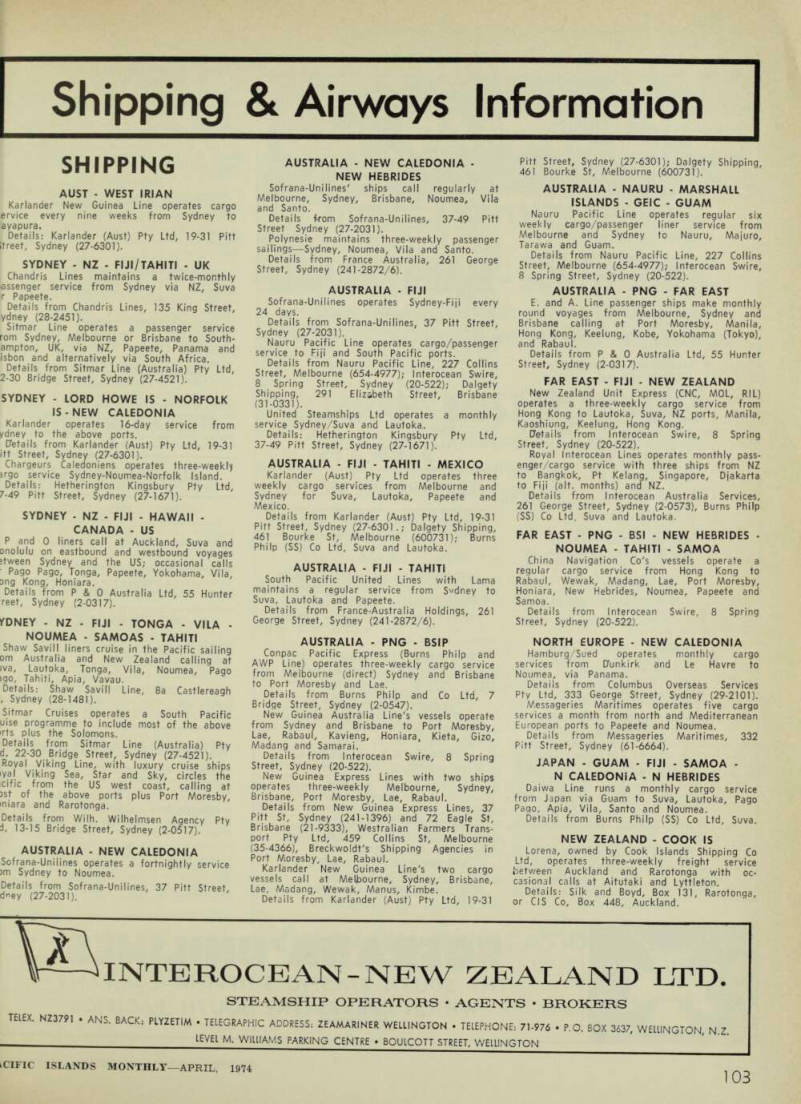
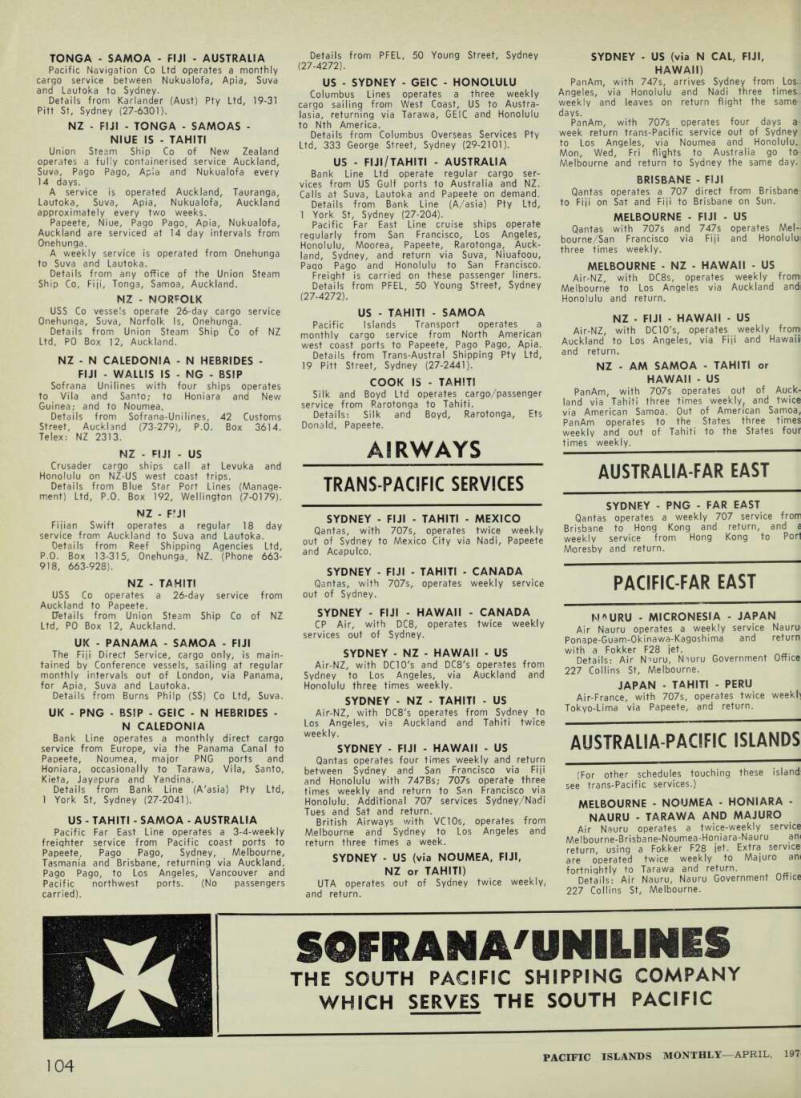
Shipping
Aust ■ West Irian
Karlander New Guinea Line operates cargo ervice every nine weeks from Sydney to ayapura.
Details: Karlander (Aust) Pty Ltd, 19-31 Pitt itreet, Sydney (27-6301).
SYDNEY ■ NZ - FIJl/TAHITI - UK Chandris Lines maintains a twice-monthly assenger service from Sydney via NZ, Suva r Papeete.
Details from Chandris Lines, 135 King Street, ydney (28-2451).
Sitmar Line operates a passenger service rom Sydney, Melbourne or Brisbane to South ampton, UK, via NZ, Papeete, Panama and isbon and alternatively via South Africa.
Details from Sitmar Line (Australia) Pty Ltd, 2-30 Bridge Street, Sydney (27-4521).
SYDNEY - LORD HOWE IS - NORFOLK
Is-New Caledonia
Karlander operates 16-day service from ydney to the above ports.
Details from Karlander (Aust) Pty Ltd, 19-31 itt Street, Sydney (27-6301).
Chargeurs Caledoniens operates three-weekly argo service Sydney-Noumea-Norfolk Island.
Details: Hetherington Kingsbury Pty Ltd, 7-49 Pitt Street, Sydney (27-1671).
SYDNEY - NZ - FIJI - HAWAII -
Canada - Us
P and 0 liners call at Auckland, Suva and onolulu on eastbound and westbound voyages ;tween Sydney and the US; occasional calls ■ Pago Pago, Tonga, Papeete, Yokohama, Vila, ang Kong, Honiara.
Details from P & 0 Australia Ltd, 55 Hunter reet, Sydney (2-0317).
YDNEY - NZ - FIJI - TONGA - VILA -
Noumea - Samoas - Tahiti
Shaw Savill liners cruise in the Pacific sailing om Australia and New Zealand calling at iva, Lautoka, Tonga, Vila, Noumea, Pago igo, Tahiti, Apia, Vavau.
Details: Shaw Savill Line, 8a Castlereagh , Sydney (28-1481).
Sitmar Cruises operates a South Pacific uise programme to include most of the above irts plus the Solomons.
Details from Sitmar Line (Australia) Pty d, 22-30 Bridge Street, Sydney (27-4521).
Royal Viking Line, with luxury cruise ships yal Viking Sea, Star and Sky, circles the cific from the US west coast, calling at )st of the above ports plus Port Moresby, •niara and Rarotonga.
Details from Wilh. Wilhelmsen Agency Pty i. 13-15 Bridge Street, Sydney (2-0517).
Australia ■ New Caledonia
Sofrana-Unilines operates a fortnightly service >m Sydney to Noumea.
Details from Sofrana-Unilines, 37 Pitt Street dney (27-2031).
Australia ■ New Caledonia -
New Hebrides
Sofrana-Unilines' ships call regularly at Melbourne, Sydney, Brisbane, Noumea, Vila and Santo.
Details from Sofrana-Unilines, 37-49 Pitt Street Sydney (27-2031).
Polynesie maintains three-weekly passenger sailings—Sydney, Noumea, Vila and Santo.
Details from France Australia, 261 George Street, Sydney (241-2872/6).
Australia - Fiji
Sofrana-Unilines operates Sydney-Fiji every 24 days.
Details from Sofrana-Unilines, 37 Pitt Street, Sydney (27-2031).
Nauru Pacific Line operates cargo/passenger service to Fiji and South Pacific ports.
Details from Nauru Pacific Line, 227 Collins Street, Melbourne (654-4977); Interocean Swire, 8 Spring Street, Sydney (20-522); Dalgety Shipping, 291 Elizabeth Street, Brisbane (31-0331).
United Steamships Ltd operates a monthly service Sydney/Suva and Lautoka.
Details: Hetherington Kingsbury Pty Ltd, 37-49 Pitt Street, Sydney (27-1671).
AUSTRALIA - FIJI ■ TAHITI - MEXICO Karlander (Aust) Pty Ltd operates three weekly cargo services from Melbourne and Sydney for Suva, Lautoka, Papeete and Mexico.
Details from Karlander (Aust) Pty Ltd, 19-31 Pitt Street, Sydney (27-6301.; Dalgety Shipping, 461 Bourke St, Melbourne (600731); Burns Philp (SS) Cos Ltd, Suva and Lautoka.
Australia - Fiji - Tahiti
South Pacific United Lines with Lama maintains a regular service from Sidney to Suva, Lautoka and Papeete.
Details from France-Australia Holdings, 261 George Street, Sydney (241-2872/6).
Australia - Png - Bsip
Conpac Pacific Express (Burns Philp and AWP Line) operates three-weekly cargo service from Melbourne (direct) Sydney and Brisbane to Port Moresby and Lae.
Details from Burns Philp and Cos Ltd, 7 Bridge Street, Sydney (2-0547).
New Guinea Australia Line's vessels operate from Sydney and Brisbane to Port Moresby, Lae, Rabaul, Kavieng, Honiara, Kieta, Gizo, Madang and Samarai.
Details from Interocean Swire, 8 Spring Street, Sydney (20-522).
New Guinea Express Lines with two ships operates three-weekly Melbourne, Sydney, Brisbane, Port Moresby, Lae, Rabaul.
Details from New Guinea Express Lines, 37 Pitt St, Sydney (241-1396) and 72 Eagle St, Brisbane (21-9333), Westralian Farmers Trans port Pty Ltd, 459 Collins St, Melbourne (35-4366), Breckwoldt's Shipping Agencies in Port Moresby, Lae, Rabaul.
Karlander New Guinea Line's two cargo vessels call at Melbourne, Sydney, Brisbane, Lae, Madang, Wewak, Manus, Kimbe.
Details from Karlander (Aust) Pty Ltd, 19-31
Pitt Street, Sydney (27-6301); Dalgety Shipping, 461 Bourke St, Melbourne (600731).
Australia - Nauru - Marshall
Islands - Geic - Guam
Nauru Pacific Line operates regular six weekly cargo/passenger liner service from Melbourne and Sydney to Nauru, Majuro, Tarawa and Guam.
Details from Nauru Pacific Line, 227 Collins Street, Melbourne (654-4977); Interocean Swire, 8 Spring Street, Sydney (20-522).
Australia - Png - Far East
E. and A. Line passenger ships make monthly round voyages from Melbourne, Sydney and Brisbane calling at Port Moresby, Manila, Hong Kong, Keelung, Kobe, Yokohama (Tokyo), and Rabaul.
Details from P & 0 Australia Ltd, 55 Hunter Street, Sydney (2-0317).
FAR EAST - FIJI - NEW ZEALAND New Zealand Unit Express (CNC, MOL, RIL) operates a three-weekly cargo service from Hong Kong to Lautoka, Suva, NZ ports, Manila, Kaoshiung, Keelung, Hong Kong.
Details from Interocean Swire, 8 Spring Street, Sydney (20-522).
Royal Interocean Lines operates monthly pass enger/cargo service with three ships from NZ to Bangkok, Pt Kelang, Singapore, Djakarta to Fiji (alt. months) and NZ.
Details from Interocean Australia Services, 261 George Street, Sydney (2-0573), Burns Philp (SS) Cos Ltd, Suva and Lautoka.
FAR EAST - PNG - BSI - NEW HEBRIDES -
Noumea - Tahiti - Samoa
China Navigation Co's vessels operate a regular cargo service from Hong Kong to Rabaul, Wewak, Madang, Lae, Port Moresby, Honiara, New Hebrides, Noumea, Papeete and Samoa.
Details from Interocean Swire, 8 Spring Street, Sydney (20-522).
North Europe - New Caledonia
Hamburg/Sued operates monthly cargo services from Dunkirk and Le Havre to Noumea, via Panama.
Details from Columbus Overseas Services Pty Ltd, 333 George Street, Sydney (29-2101).
Messageries Maritimes operates five cargo services a month from north and Mediterranean European ports to Papeete and Noumea.
Details from Messageries Maritimes, 332 Pitt Street, Sydney (61-6664).
JAPAN - GUAM - FIJI - SAMOA -
N Caledonia - N Hebrides
Daiwa Line runs a monthly cargo service from Japan via Guam to Suva, Lautoka, Pago Pago, Apia, Vila, Santo and Noumea.
Details from Burns Philp (SS) Cos Ltd, Suva.
New Zealand - Cook Is
Lorena, owned by Cook Islands Shipping Cos Ltd, operates three-weekly freight service between Auckland and Rarotonga with oc casional calls at Aitutaki and Lyttleton.
Details: Silk and Boyd, Box 131, Rarotonga, or CIS Cos, Box 448, Auckland.
TONGA - SAMOA - FIJI - AUSTRALIA Pacific Navigation Cos Ltd operates a monthly cargo service between Nukualofa, Apia, Suva and Lautoka to Sydney.
Details from Karlander (Aust) Pty Ltd, 19-31 Pitt St, Sydney (27-6301).
NZ - FIJI - TONGA - SAMOAS -
Niue Is - Tahiti
Union Steam Ship Cos of New Zealand operates a fully containerised service Auckland, Suva, Pago Pago, Apia and Nukualofa every 14 days.
A service is operated Auckland, Tauranga, Lautoka, Suva, Apia, Nukualofa, Auckland approximately every two weeks.
Papeete, Niue, Pago Pago, Apia, Nukualofa, Auckland are serviced at 14 day intervals from Onehunga.
A weekly service is operated from Onehunga to Suva and Lautoka.
Details from any office of the Union Steam Ship Cos, Fiji, Tonga, Samoa, Auckland.
Mz - Norfolk
USS Cos vessels operate 26-day cargo service Onehunga, Suva, Norfolk Is, Onehunga.
Details from Union Steam Ship Cos of NZ Ltd, PO Box 12, Auckland.
NZ - N CALEDONIA - N HEBRIDES - FIJI - WALLIS IS - NG - BSIP Sofrana Unilines with four ships operates to Vila and Santo; to Honiara and New Guinea; and to Noumea.
Details from Sofrana-Unilines, 42 Customs Street, Auckland (73-279), P.O. Box 3614.
Telex; NZ 2313.
Nz - Fiji - Us
Crusader cargo ships call at Levuka and Honolulu on NZ-US west coast trips.
Details from Blue Star Port Lines (Manage ment) Ltd, P.O. Box 192, Wellington (7-0179).
Nz - F(Ji
Fijian Swift operates a regular 18 day service from Auckland to Suva and Lautoka.
Details from Reef Shipping Agencies Ltd, P.O. Box 13-315, Onehunga, NZ. (Phone 663- 918, 663-928).
Nz - Tahiti
USS Cos operates a 26-day service from Auckland to Papeete.
Details from Union Steam Ship Cos of NZ Ltd, PO Box 12, Auckland.
UK - PANAMA - SAMOA - FIJI The Fiji Direct Service, cargo only, is main tained by Conference vessels, sailing at regular monthly intervals out of London, via Panama, for Apia, Suva and Lautoka.
Details from Burns Philp (SS) Cos Ltd, Suva.
UK • PNG • BSIP - GEIC - N HEBRIDES -
N Caledonia
Bank Line operates a monthly direct cargo service from Europe, via the Panama Canal to Papeete, Noumea, major PNG ports and Honiara, occasionally to Tarawa, Vila, Santo, Kieta, Jayapura and Yandina.
Details from Bank Line (A'asia) Pty Ltd, 1 York St, Sydney (27-2041).
US - TAHITI - SAMOA - AUSTRALIA Pacific Far East Line operates a 3-4-weekly freighter service from Pacific coast ports to Papeete, Pago Pago, Sydney, Melbourne, Tasmania and Brisbane, returning via Auckland, Pago Pago, to Los Angeles, Vancouver and Pacific northwest ports. (No passengers carried).
Details from PFEL, 50 Young Street, Sydney (27-4272).
US ■ SYDNEY - GEIC - HONOLULU Columbus Lines operates a three weekly cargo sailing from West Coast, US to Austra lasia, returning via Tarawa, GEIC and Honolulu to Nth America.
Details from Columbus Overseas Services Pty Ltd, 333 George Street, Sydney (29-2101).
Us - Fiji/Tahiti - Australia
Bank Line Ltd operate regular cargo ser vices from US Gulf ports to Australia and NZ.
Calls at Suva, Lautoka and Papeete on demand.
Details from Bank Line (A/asia) Pty Ltd, 1 York St, Sydney (27-204).
Pacific Far East Line cruise ships operate regularly from San Francisco, Los Angeles, Honolulu, Moorea, Papeete, Rarotonga, Auck land, Sydney, and return via Suva, Niuafoou, Pago Pago and Honolulu to San Francisco.
Freight is carried on these passenger liners.
Details from PFEL, 50 Young Street, Sydney (27-4272).
Us - Tahiti - Samoa
Pacific Islands Transport operates a monthly cargo service from North American west coast ports to Papeete, Pago Pago, Apia.
Details from Trans-Austral Shipping Pty Ltd, 19 Pitt Street, Sydney (27-2441),
Cook Is ■ Tahiti
Silk and Boyd Ltd operates cargo/passenger service from Rarotonga to Tahiti.
Details: Silk and Boyd, Rarotonga, Ets Donald, Papeete.
Advertisements & other items, pp. 109-110 (2 items)
103
ICIFIC ISLANDS MONTHLY—APRIL, 1974
Interocean-New Zealand Ltd.
STEAMSHIP OPERATORS • AGENTS • BROKERS
TELEX. NZ3791 . ANS. BACK: PLYZETIM • TELEGRAPHIC ADDRESS: ZEAMARINER WELLINGTON • TELEPHONE: 71-976 • P.O. BOX 3637, WELLINGTON, N Z IEVEL M. WILLIAMS PARKING CENTRE « BOULCQTT STREET, WELLINGTON
SOFRANA'UNILINES
THE SOUTH PACIFIC SHIPPING COMPANY
WHICH SERVES THE SOUTH PACIFIC
Airways
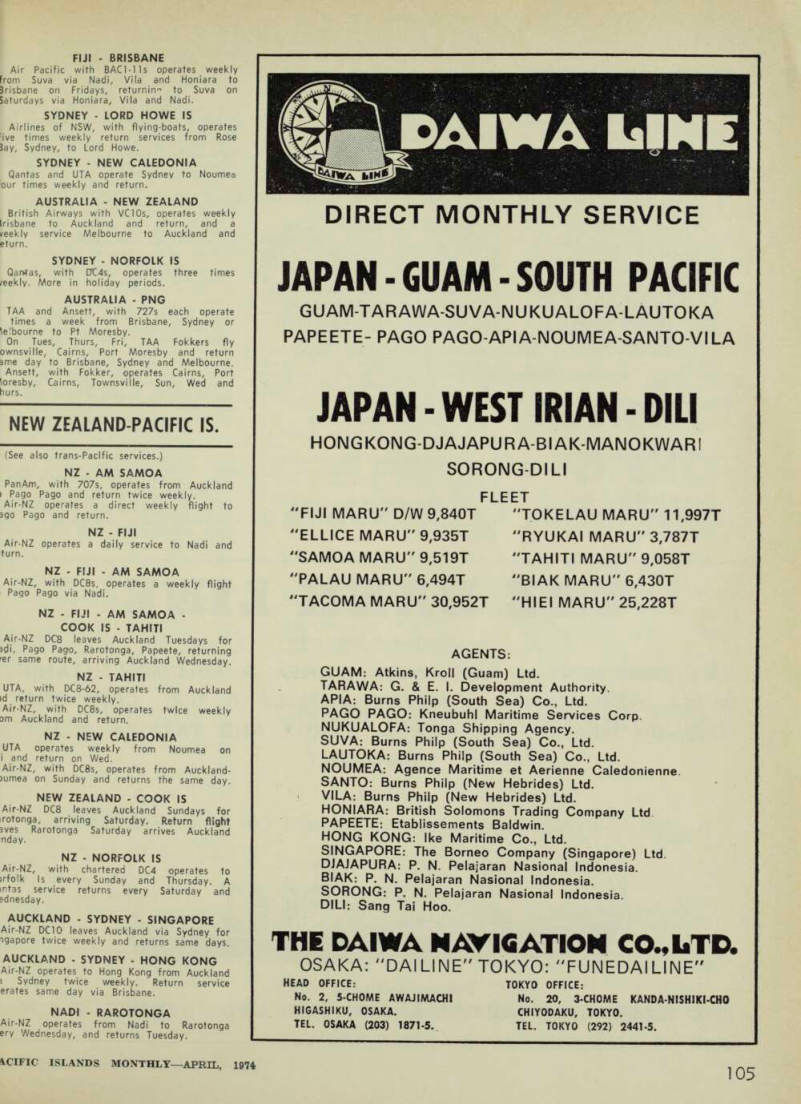
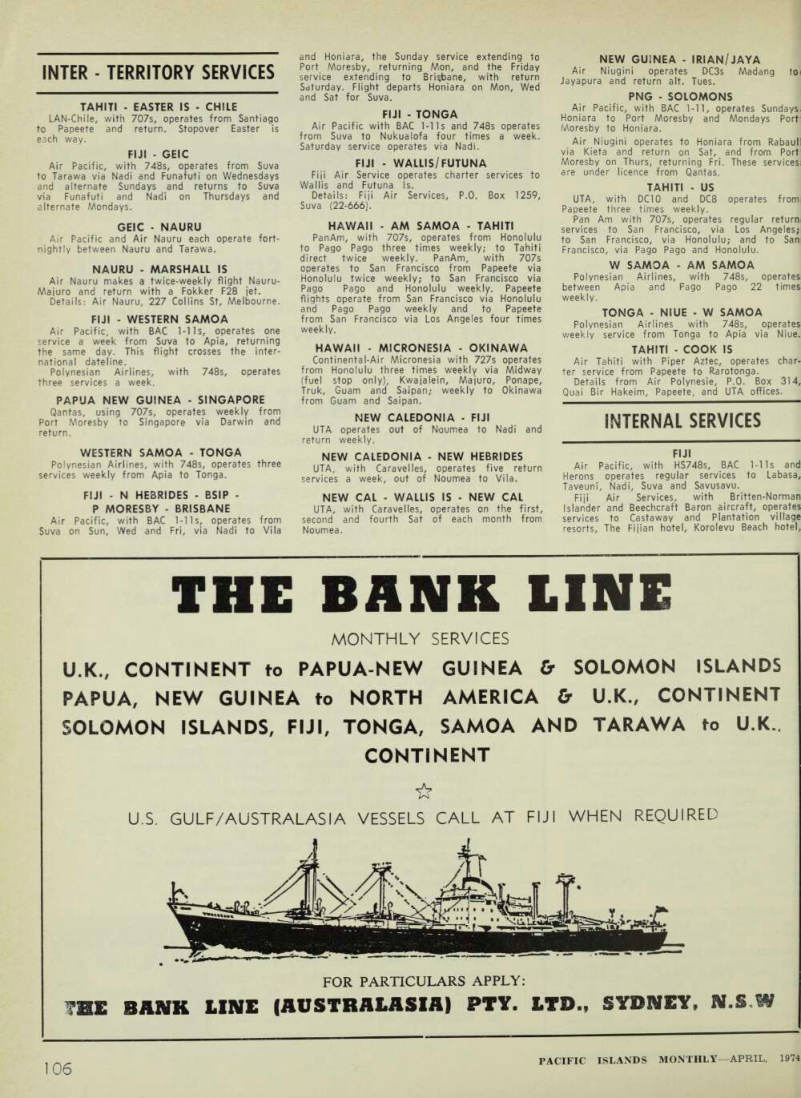
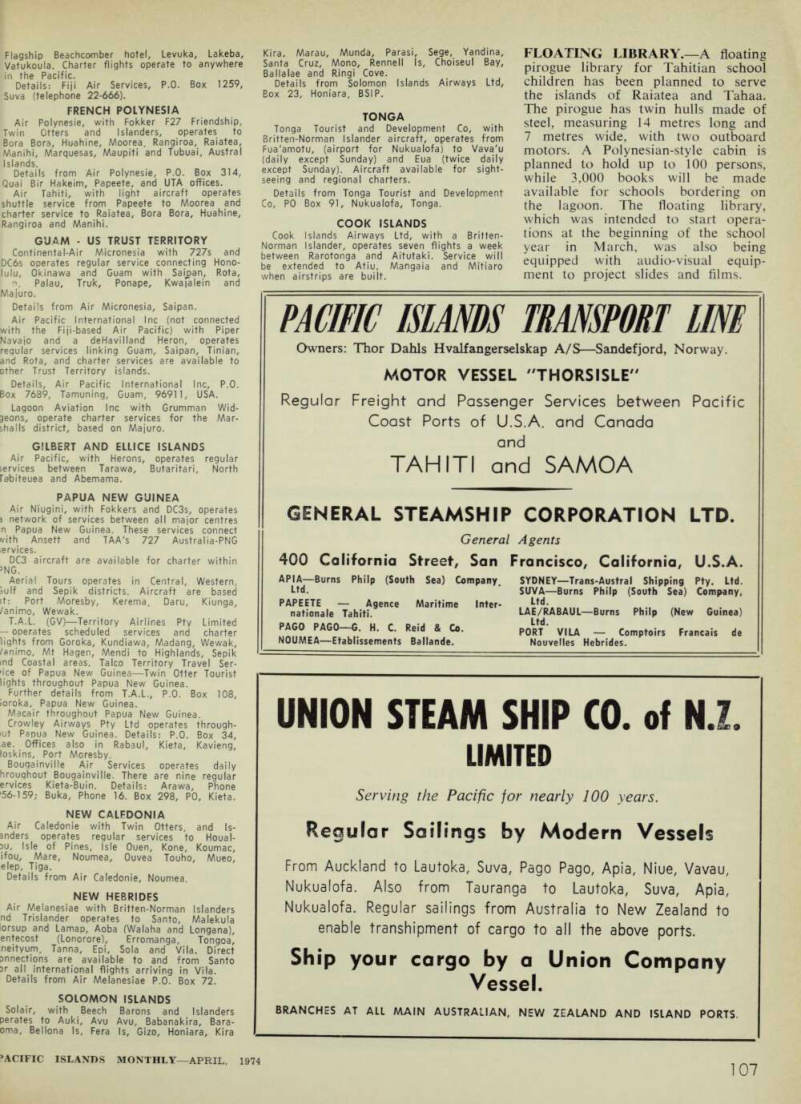
Trans Pacific Services
SYDNEY - FIJI - TAHITI - MEXICO Qantas, with 7075, operates twice weekly out of Sydney to Mexico City via Nadi, Papeete and Acapulco.
SYDNEY - FIJI - TAHITI - CANADA Qantas, with 7075, operates weekly service out of Sydney.
SYDNEY - FIJI ■ HAWAII - CANADA CP Air, with DCS, operates twice weekly services out of Sydney.
SYDNEY - NZ - HAWAII ■ US Air-NZ, with DClO's and DCB's operates from Sydney to Los Angeles, via Auckland and Honolulu three times weekly.
SYDNEY - NZ - TAHITI - US Air-NZ, with DCB's operates from Sydney to Los Angeles, via Auckland and Tahiti twice weekly.
SYDNEY - FIJI - HAWAII - US Qantas operates four times weekly and return between Sydney and San Francisco via Fiji and Honolulu with 74785; 707 s operate three times weekly and return to San Francisco via Honolulu. Additional 707 services Sydney/Nadi Tues and Sat and return.
British Airways with VClOs, operates from Melbourne and Sydney to Los Angeles and return three times a week.
Sydney - Us (Via Noumea, Fiji,
Nz Or Tahiti)
UTA operates out of Sydney twice weekly, and return.
SYDNEY ■ US (via N CAL, FIJI,
Hawaii)
PanAm, with 7475, arrives Sydney from Los- Angeles, via Honolulu and Nadi three times.. weekly and leaves on return flight the same days.
PanAm, with 707 s operates four days a week return trans-Pacific service out of Sydney to Los Angeles, via Noumea and Honolulu.
Mon, Wed, Fri flights to Australia go to-.
Melbourne and return to Sydney the same day.
Brisbane - Fiji
Qantas operates a 707 direct from Brisbane to Fiji on Sat and Fiji to Brisbane on Sun.
Melbourne - Fiji - Us
Qantas with 707 s and 747 s operates Mel bourne/San Francisco via Fiji and Honolulu* three times weekly.
MELBOURNE - NZ - HAWAII - US Air-NZ, with DCBs, operates weekly from; Melbourne to Los Angeles via Auckland andi Honolulu and return.
NZ - FIJI - HAWAII - US Air-NZ, with DClO's, operates weekly from; Auckland to Los Angeles, via Fiji and Hawaii and return.
NZ - AM SAMOA - TAHITI or
Hawaii - Us
PanAm, with 707 s operates out of Auck land via Tahiti three times weekly, and twice via American Samoa. Out of American Samoa, PanAm operates to the States three times weekly and out of Tahiti to the States four times weekly.
Australia-Far East
Sydney - Png - Far East
Qantas operates a weekly 707 service from Brisbane to Hong Kong and return, and a weekly service from Hong Kong to Port Moresby and return.
Pacific-Far East
- Micronesia - Japan
Air Nauru operates a weekly service Nauru Ponape-Guam-Okinawa-Kagoshima and return with a Fokker F2B jet.
Details: Air N->uru, Nauru Government Office 227 Collins St, Melbourne.
Japan - Tahiti - Peru
Air-France, with 7075, operates twice weekh Tokyo-Lima via Papeete, and return.
Australia-Pacific Island
(For other schedules touching these island; see trans-Pacific services.)
Melbourne - Noumea - Honiara -
Nauru - Tarawa And Majuro
Air Nauru operates a twice-weekly service Melbourne-Brisbane-Noumea-Honiara-Nauru ani return, using a Fokker F2B jet. Extra service are operated twice weekly to Maiuro am fortnightly to Tarawa and return.
Details; Air Nauru, Nauru Government Office 227 Collins St, Melbourne.
Fiji - Brisbane
Air Pacific with BACI-lls operates weekly From Suva via Nadi, Vila and Honiara to Brisbane on Fridays, returnin'’ to Suva on Saturdays via Honiara, Vila and Nadi.
Sydney - Lord Howe Is
Airlines of NSW, with flying-boats, operates : ive times weekly return services from Rose Jay, Sydney, to Lord Howe.
Sydney - New Caledonia
Qantas and UTA operate Sydney to Noumea our times weekly and return.
Australia - New Zealand
British Airways with VClOs, operates weekly Irisbane to Auckland and return, and a veek ly service Melbourne to Auckland and eturn.
Sydney - Norfolk Is
Qantas, with DC4s, operates three times reekly. More in holiday periods.
Australia - Png
TAA and Ansett, with 727 s each operate times a week from Brisbane, Sydney or \elbourne to Pt Moresby.
On Tues, Thurs, Fri, TAA Fokkers fly ownsville, Cairns, Port Moresby and return ame day to Brisbane, Sydney and Melbourne.
Ansett, with Fokker, operates Cairns, Port loresby, Cairns, Townsville, Sun, Wed and hurs.
New Zealand-Pacific Is.
(See also trans-Padfic services.)
Nz - Am Samoa
PanAm, with 7075, operates from Auckland • Pago Pago and return twice weekly.
Air-NZ operates a direct weekly flight to ago Pago and return.
Nz - Fiji
Air-NZ operates a daily service to Nadi and turn.
Nz - Fiji - Am Samoa
Air-NZ, with DCBs, operates a weekly flight Pago Pago via Nadi.
NZ - FIJI - AM SAMOA -
Cook Is - Tahiti
Air-NZ DCS leaves Auckland Tuesdays for adi, Pago Pago, Rarotonga, Papeete, returning r er same route, arriving Auckland Wednesday.
Nz - Tahiti
UTA, with DCB-62, operates from Auckland id return twice weekly.
Air-NZ, with DCBs, operates twice weekly om Auckland and return.
Nz - New Caledonia
UTA operates weekly from Noumea on i and return on Wed.
Air-NZ, with DCBs, operates from Auckland >umea on Sunday and returns the same day.
New Zealand - Cook Is
Air-NZ DCS leaves Auckland Sundays for rotonga, arriving Saturday. Return flight aves Rarotonga Saturday arrives Auckland nday.
Nz - Norfolk Is
Air-NZ, with chartered DC4 operates to irfolk Is every Sunday and Thursday. A mtas service returns every Saturday and sdnesday.
Auckland - Sydney - Singapore
Air-NZ DCIO leaves Auckland via Sydney for igapore twice weekly and returns same days.
Auckland - Sydney - Hong Kong
Air-NZ operates to Hong Kong from Auckland i Sydney twice weekly. Return service erates same day via Brisbane.
Nadi - Rarotonga
Air-NZ operates from Nadi to Rarotonga ery Wednesday, and returns Tuesday.
Inter - Territory Services
Tahiti - Easter Is - Chile
LAN-Chile, with 7075, operates from Santiago to Papeete and return. Stopover Easter is each way.
Fiji - Geic
Air Pacific, with 7485, operates from Suva to Tarawa via Nadi and Funafuti on Wednesdays and alternate Sundays and returns to Suva via Funafuti and Nadi on Thursdays and alternate Mondays.
Geic - Nauru
Air Pacific and Air Nauru each operate fort nightly between Nauru and Tarawa.
Nauru ■ Marshall Is
Air Nauru makes a twice-weekly flight Nauru- Majuro and return with a Fokker F2B jet.
Details: Air Nauru, 227 Collins St, Melbourne.
Fiji • Western Samoa
Air Pacific, with BAC 1-1 Is, operates one service a week from Suva to Apia, returning the same day. This flight crosses the inter national dateline.
Polynesian Airlines, with 7485, operates three services a week.
Papua New Guinea ■ Singapore
Qantas, using 7075, operates weekly from Port Moresby to Singapore via Darwin and return.
Western Samoa - Tonga
Polynesian Airlines, with 7485, operates three services weekly from Apia to Tonga.
FIJI - N HEBRIDES - BSIP -
P Moresby - Brisbane
Air Pacific, with BAC 1-1 Is, operates from Suva on Sun, Wed and Fri, via Nadi to Vila
and Honiara, the Sunday service extending to Port Moresby, returning Mon, and the Friday service extending to Brisbane, with return Saturday. Flight departs Honiara on Mon, Wed and Sat for Suva.
Fiji - Tonga
Air Pacific with BAC 1-1 Is and 748 s operates from Suva to Nukualofa four times a week.
Saturday service operates via Nadi.
Fiji - Wallis/ Futuna
Fiji Air Service operates charter services to Wallis and Futuna Is.
Details: Fiji Air Services, P.O. Box 1259, Suva (22-666).
Hawaii - Am Samoa - Tahiti
PanAm, with 7075, operates from Honolulu to Pago Pago three times weekly; to Tahiti direct twice weekly. PanAm, with 707 s operates to San Francisco from Papeete via Honolulu twice weekly; to San Francisco via Pago Pago and Honolulu weekly. Papeete flights operate from San Francisco via Honolulu and Pago Pago weekly and to Papeete from San Francisco via Los Angeles four times weekly.
Hawaii - Micronesia - Okinawa
Continental-Air Micronesia with 727 s operates from Honolulu three times weekly via Midway (fuel stop only), Kwajalein, Majuro, Ponape, Truk, Guam and Saipan; weekly to Okinawa from Guam and Saipan.
New Caledonia - Fiji
UTA operates out of Noumea to Nadi and return weekly.
New Caledonia - New Hebrides
UTA, with Caravelles, operates five return services a week, out of Noumea to Vila.
NEW CAL - WALLIS IS - NEW CAL UTA, with Caravelles, operates on the first, second and fourth Sat of each month from Noumea.
New Guinea - Irian/Java
Air Niugini operates DC3s Madang to; Jayapura and return alt. Tues.
Png - Solomons
Air Pacific, with BAC 1-11, operates Sundays; Honiara to Port Moresby and Mondays Porti Moresby to Honiara.
Air Niugini operates to Honiara from Rabaull via Kieta and return on Sat, and from Port: Moresby on Thurs, returning Fri. These services; are under licence from Qantas.
Tahiti - Us
UTA, with DCIO and DCS operates from; Papeete three times weekly.
Pan Am with 7075, operates regular return; services to San Francisco, via Los Angeles;: to San Francisco, via Honolulu; and to Sam Francisco, via Pago Pago and Honolulu.
W Samoa - Am Samoa
Polynesian Airlines, with 7485, operates; between Apia and Pago Pago 22 times; weekly.
Tonga - Niue - W Samoa
Polynesian Airlines with 7485, operates; weekly service from Tonga to Apia via Niue.
Tahiti - Cook Is
Air Tahiti with Piper Aztec, operates char ter service from Papeete to Rarotonga.
Details from Air Polynesie, P.O. Box 314, Quai Bir Hakeim, Papeete, and UTA offices.
Internal Services
Fiji
Air Pacific, with HS74Bs, BAC 1-1 Is and Herons operates regular services to Labasa, Taveuni, Nadi, Suva and Savusavu.
Fiji Air Services, with Britten-Norman Islander and Beechcraft Baron aircraft, operates services to Castaway and Plantation village resorts. The Fijian hotel, Korolevu Beach hotel.
Flagship Beachcomber hotel, Levuka, Lakeba, Vatukoula. Charter flights operate to anywhere in the Pacific, Details: Fiji Air Services, P.O. Box 1259, Suva (telephone 22-666).
French Polynesia
Air Polynesie, with Fokker F 27 Friendship, Twin Otters and Islanders, operates to Bora Bora, Huahine, Moorea, Rangiroa, Raiatea, Manihi, Marquesas, Maupiti and Tubuai, Austral Islands.
Details from Air Polynesie, P.O. Box 314, Quai Bir Hakeim, Papeete, and UTA offices.
Air Tahiti, with light aircraft operates shuttle service from Papeete to Moorea and charter service to Raiatea, Bora Bora, Huahine, Rangiroa and Manihi.
Guam - Us Trust Territory
Continental-Air Micronesia with 727 s and DC6s operates regular service connecting Hono lulu, Okinawa and Guam with Saipan, Rota, n, Palau, Truk, Ponape, Kwaialein and Majuro.
Details from Air Micronesia, Saipan.
Air Pacific International Inc (not connected with the Fiji-based Air Pacific) with Piper Navajo and a deHavilland Heron, operates regular services linking Guam, Saipan, Tinian, and Rota, and charter services are available to other Trust Territory islands.
Details, Air Pacific International Inc, P.O.
Box 7689, Tamuning, Guam, 96911, USA.
Lagoon Aviation Inc with Grumman Wid geons, operate charter services for the Mar shalls district, based on Majuro.
Gilbert And Ellice Islands
Air Pacific, with Herons, operates regular services between Tarawa, Butaritari, North fabiteuea and Abemama.
Papua New Guinea
Air Niugini, with Fokkers and DC3s, operates i network of services between all major centres n Papua New Guinea. These services connect vith Ansett and TAA's 727 Australia-PNG ervices.
DC3 aircraft are available for charter within >NG.
Aerial Tours operates in Central, Western, Julf and Sepik districts. Aircraft are based it: Port Moresby, Kerema, Daru, Kiunga, /animo, Wewak.
T.A.L. (GV) —Territory Airlines Pty Limited operates scheduled services and charter lights from Goroka, Kundiawa, Madang, Wewak, /animo, Mt Hagen, Mendi to Highlands, Sepik ind Coastal areas. Talco Territory Travel Ser 'ice of Papua New Guinea—Twin Otter Tourist lights throughout Papua New Guinea.
Further details from T.A.L., P.O. Box 108, Soroka, Papua New Guinea.
Macair throughout Papua New Guinea.
Crowley Airways Pty Ltd operates through out Papua New Guinea. Details: P.O. Box 34, ae. Offices also in Rabaul, Kieta, Kavieng, loskins. Port Moresby.
Bougainville Air Services operates daily hroughout Bougainville. There are nine regular ervices Kieta-Buin. Details: Arawa, Phone 56-159; Buka, Phone 16. Box 298, PO, Kieta.
New Caledonia
Air Caledonie with Twin Otters, and Is anders operates regular services to Houal )u, Isle of Pines, Isle Ouen, Kone, Koumac, ifou, Mare, Noumea, Ouvea Touho, Mueo, elep, Tiga.
Details from Air Caledonie, Noumea.
New Hebrides
Air Melanesiae with Britten-Norman Islanders nd Trislander operates to Santo, Malekula orsup and Lamap, Aoba (Walaha and Longana), entecost (Lonorore), Erromanga, Tongoa, neityum, Tanna, Epi, Sola and Vila. Direct pnnections are available to and from Santo )r all international flights arriving in Vila.
Details from Air Melanesiae P.O. Box 72.
Solomon Islands
Solair, with Beech Barons and Islanders perates to Auki, Avu Avu, Babanakira, Bara oma, Bellona Is, Fera Is, Gizo, Honiara, Kira
Kira, Marau, AAunda, Parasi, Sege, Yandina, Santa Cruz, Mono, Rennell Is, Choiseul Bay, Ballalae and Ringi Cove.
Details from Solomon Islands Airways Ltd, Box 23, Honiara, BSIP.
Tonga
Tonga Tourist and Development Co, with Britten-Norman Islander aircraft, operates from Fua'amotu, (airport for Nukualofa) to Vava'u (daily except Sunday) and Eua (twice daily except Sunday). Aircraft available for sight seeing and regional charters.
Details from Tonga Tourist and Development Co, PO Box 91, Nukualofa, Tonga.
Cook Islands
Cook Islands Airways Ltd, with a Britten- Norman Islander, operates seven flights a week between Rarotonga and Aitutaki. Service will be extended to Atiu, Mangaia and Mitiaro when airstrips are built.
FLOATING LIBRARY.—A floating pirogue library for Tahitian school children has been planned to serve the islands of Raiatea and Tahaa.
The pirogue has twin hulls made of steel, measuring 14 metres long and 7 metres wide, with two outboard motors. A Polynesian-style cabin is planned to hold up to 100 persons, while 3,000 books will be made available for schools bordering on the lagoon. The floating library, which was intended to start opera tions at the beginning of the school year in March, was also being equipped with audio-visual equip ment to project slides and films.
Advertisements & other items, pp. 111-113 (3 items)
105
\CIFIC ISLANDS MONTHLY—APRIL, 1974
Daiwa Line
fciH*
DIRECT MONTHLY SERVICE
JAPAN - GUAM - SOUTH PACIFIC
GUAM-TARAWA-SUVA-NUKUALOFA-LAUTOKA
PAPEETE- PAGO PAGO-APIA-NOUMEA-SANTO-VILA
JAPAN-WEST IRIAN-DILI
HONGKONG-DJAJAPURA-BIAK-MANOKWARI
SORONG-DI LI
FLEET
"FIJI MARU" D/W 9,840 T
"ELLICE MARU" 9,935 T
"SAMOA MARU" 9,519 T
"PALAU MARU" 6,494 T
"TACOMA MARU" 30,952 T
"TOKELAU MARU" 11,997 T
"RYUKAI MARU" 3/787T
"TAHITI MARU" 9,058 T
"BIAK MARU" 6,430 T
"HIEI MARU" 25,228 T
AGENTS:
GUAM: Atkins, Kroll (Guam) Ltd.
TARAWA: G. & E. I. Development Authority.
APIA: Burns Philp (South Sea) Co., Ltd.
PAGO PAGO: Kneubuhl Maritime Services Corp.
NUKUALOFA: Tonga Shipping Agency.
SUVA: Burns Philp (South Sea) Co., Ltd.
LAUTOKA: Burns Philp (South Sea) Co., Ltd.
NOUMEA: Agence Maritime et Aerienne Caledonienne SANTO: Burns Philp (New Hebrides) Ltd.
VILA; Burns Philp (New Hebrides) Ltd.
HONIARA: British Solomons Trading Company Ltd PAPEETE: Etablissements Baldwin.
HONG KONG: Ike Maritime Co., Ltd.
SINGAPORE: The Borneo Company (Singapore) Ltd.
DJAJAPURA: P. N. Pelajaran Nasional Indonesia.
BIAK: P. N. Pelajaran Nasional Indonesia.
SORONG: P. N. Pelajaran Nasional Indonesia.
DILI: Sang Tai Hoo.
THE DAIWA NAVIGATION CO.. LTD.
OSAKA: "DAILINE" TOKYO: "FUNEDAILINE"
HEAD OFFICE: TOKYO OFFICE:
No. 2, 5-CHOME AWAJIMACHI No. 20, 3-CHOME KANOA-NISHIKI-CHO
HIGASHIKU, OSAKA. CHIYODAKU, TOKYO.
TEL. OSAKA (203) 1871-5. TEL. TOKYO (292) 2441-5.
THE BANK LINE
MONTHLY SERVICES
U.K., CONTINENT to PAPUA-NEW GUINEA & SOLOMON ISLANDS PAPUA, NEW GUINEA to NORTH AMERICA & U.K., CONTINENT SOLOMON ISLANDS, FIJI, TONGA, SAMOA AND TARAWA to U.K.,
CONTINENT
w U.S. GULF/AUSTRALASIA VESSELS CALL AT FIJI WHEN REQUIRED J /
FOR PARTICULARS APPLY;
HE BANK LINE (AUSTRALASIA) PTY. LTD., SYDNEY, N.S.W
PACIFIC ISLANDS TRANSPORT LINE
Owners: Thor Dahls Hvalfangerselskap A/S —Sandefjord, Norway.
MOTOR VESSEL "THORSISLE"
Regular Freight and Passenger Services between Pacific
Coast Ports of U.S.A. and Canada
and
TAHITI and SAMOA
GENERAL STEAMSHIP CORPORATION LTD.
400 California Street, San Francisco, California, U.S.A.
APIA —Burns Philp (South Sea) Company, SYDNEY—Trans-Austral Shipping Pty. Ltd.
General Agents Ltd.
PAPEETE Agence Maritime Inter- LAE/RABAUL—Burns Philp (New Guinea) Ltd.
SUVA—Burns Philp (South Sea) Company, Ltd. nationale Tahiti.
PAGO PAGO—G. H. C. Reid & Co.
NOUMEA—Etablissements Ballande.
PORT VILA Comptoirs Francais de Nouvelles Hebrides.
UNION STEAM SHIP CO. of N.L
LIMITED
Serving the Pacific for nearly 100 years.
Regular Sailings by Modern Vessels
From Auckland to Lautoka, Suva, Pago Pago, Apia, Niue, Vavau, Nukualofa. Also from Tauranga to Lautoka, Suva, Apia, Nukualofa. Regular sailings from Australia to New Zealand to enable transhipment of cargo to all the above ports.
Ship your cargo by a Union Company Vessel.
BRANCHES AT ALL MAIN AUSTRALIAN, NEW ZEALAND AND ISLAND PORTS.
107
*ACIFIC ISLANDS MONTHLY—APRIL, 1974
Nutshell
In a Nutshell
Micronesia Census.—The 1973
census showed that the Trust Territory, on September 18, had a population of 114,973. The district populations were: Marianas, 14,335: Marshalls, 25,044; Palau, 12,674; Ponape, 23,251; Truk, 31,600; Yap, 7,869. Ship residents numbered 200.
The figures represented an annual average increase of 3.5 per cent since the Peace Corps census of March 26, 1967. One of the most significant results was a tremendous movement of population during recent years from the outer islands to the district centres AIRCRASH DEATHS.—Thirteen people have died in less than a month in light plane crashes in PNG.
The first, near Goroka on February 18, killed seven people. They were
in a Territory Airlines Cessna 206.
Two days later a Chee Air Pty Ltd Cessna crashed near the runway at Aseki, but no one was injured. An other Cessna owned by the Catholic Mission crashed near Aitape killing the pilot and passenger on March 1.
Nine days later a French priest, Father Jean Besson, known in PNG, where he had worked for 22 years, as the “flying priest”, died when his
single-engined Pilatus Porter plane
crashed at Kanabea on an airstrip he had built. Three deaths followed on March 13 when a Cessna 206 plunged among houses at Lae just after take-off. Killed were the pilot, Gavin Hoskins, of South Australia, a German woman and her young son.
No Polynesian Jurors. —
William Henasi Lasina Ilolahia, a Tongan student, claimed after he was found guilty in the Auckland Supreme Court of assault with in tent to injure, that he had been tried and found guilty by a jury of 12 pakehas (whites) in the city with the
largest Polynesian population. He
claimed he had acted in self-defence and for the protection of his wife
when he struck Ross John Stubbing in the face with a beer bottle, caus ing Stubbing to lose an eye. Mr Justice Chilwell said he did not doubt the sincerity of Ilolahia’s views, but he had to administer the law. He sentenced the Tongan to six months’ imprisonment.
A NEW IDEA.—Education as far as senior pupils at Niue High School are concerned has taken on new meaning this year. A special “work experience” programme has been introduced for boys, and involves them in spending a few hours each week working in the various government departments, and experiencing other forms of em ployment. It is designed to give the students a taste of working life as well as an insight into the type of work undertaken. For senior girls, there will be a new course related to human relationships, and child care. This will ultimately lead to actual practical experience in running a play centre in one of the villages.
Rescuer Rescued.—Tongan
boxer, Joey Santos, was rescued from a deep hole at Auckland surf beach, after he got into difficulties when trying to rescue three other people in difficulties. An attractive young life-saver, Vivienne Reimann, 18, dragged Santos to safety, while other life-savers rescued the people Santos intended to help.
Mr Kirk The King.—New
Zealand’s Prime Minister, Mr Kirk, was given a new name, Aumai Lelei le Igoa Ipu a Tumua ma Pule at the first Samoan royal kava ceremony performed in NZ. The title means he has been accepted by the royal families of Samoa. He is—in Samoan eyes—the King of New Zealand. A royal kava ceremony can only be performed by members of Samoan nobility, and involves much ancient Samoan mythology. The ceremony may split the Samoan community. Mr M. Faleauto, presi dent of the Samoan branch of the NZ Labour Party, said he had hac telephone calls threatening him wit! death if he held the ceremony. Thej were made by jealous rivals, whc thought he had no right to offer a title to Mr Kirk, he said.
Filippinos For Png.—It Seems
that Australia isn’t the only country casting a longing eye on the Philip
pines as a labour source. A team of senior public servants visited the Philippines in February as part of a PNG Government recruiting cam paign to fill staff shortages in essen tial services.
The initial emphasis is on finding teachers, but medical officers, nurs ing tutors, engineers, architects, technical officers and other skilled workers are also being sought, to fill about 200 vacancies that cannot be filled by the usual methods. Poor response has resulted from advertis ing in Australia.
The first group of recruits, on two-year contracts, should arrive at the end of April.
Community Centre.—The
Roman Catholic Church in Auck land will soon build an $BO,OOO Polynesian community centre at Mangere. The centre is the brain child of the Rev Father T. Brock man, chaplain in Auckland for the Catholic Cook Islands community.
He has worked with Cook Islanders in Auckland since 1965, and for eight years before that was in the Cooks. Father Brockman said it was important, socially, for Islands peo ple to have a place of their own, and to feel that they “belonged” in Auckland.
Rise For Teachers.—Ex
patriate temporary teachers in Papua New Guinea, who recently went on a two-day strike for more wages, have been given a six per cent in crease back-dated to November 12 last year. The Australian Govern ment refused to foot the bill for a daimed 20 per cent rise, and the six aer cent increase will be paid by the PNG Government.
VO FALL-OUT. —Radiation from France’s nuclear tests off Mururoa n July and August, 1973, had fallen o pre-test levels by the end of Dctober, the NZ National Radiation laboratory reported in February, fhe laboratory said recorded levels lid not constitute a public health lazard.
Varsity Grant Cut.— Fiji’S
’rime Minister, Ratu Sir Kamisese Tara, says his government will scale lown its annual grant to the Univer ity of the South Pacific from an verage of 16.8 per cent to 11 per ent during the next three years. He 3ld a news conference in Suva that he government was facing financial tnngency and had to “cut its suit ccording to the cloth.” And the JSP would have to do the same. The ecision meant Fiji’s total contri ution to the university would rise rom $1,300,000 this year to 1,750,000 in 1977.
Common Sunday School.—
The Congregational Christian Church, Roman Catholic and Me thodist churches in Western Samoa have agreed to form a common Sun day School system. They will use a common curriculum and teaching methods.
BIG PAYOUT. —American Samoa paid out a record $870,000 in social security cash benefits in 1973. More than 1,500 beneficiaries now re ceive social security payments in American Samoa. The $870,000 was broken down as follows: Retired workers and dependants, $357,000; survivors of workers who have died, $378,000; severely disabled workers under 65 and dependants, $135,000.
Produce Prices Down.— Farm
prices dropped considerably recently in American Samoa. There were a few exceptions. Taro went from 21c to 15c a pound, breadfruit from 9c to 4c a pound, cucumbers from 40c to 12c and Chinese cabbage from 40c to 25c a pound. Bananas rose from 5c to 10c lb. A produce de velopment at Manu’a yielded its first taro recently.
RUGBY TOUR.— A Fiji Rugby team will make a 12-match tour of New Zealand in July and August.
The itinerary, which includes two “tests” against Maori teams, is July 24, Buller; July 27, Otago; July 31, North Otago; August 3, Canterbury; August 7, Marlborough; August 10, Waikato; August 14, King Country; August 17, Maoris at Auckland; August 21, Hawkes Bay; August 24, North Auckland; August 28, Wanga nui; August 31, Maoris, at Welling ton.
AIR CRASH PAYOUT.— Territory Airlines agreed to pay $1,500 com pensation to the relatives of three children killed when a Cessna air craft crashed in New Guinea on February 18. The airline manager, Mr Denis Buchanan said relatives demanded compensation soon after the crash was reported. It was alleged that they threatened violence if the claims were not met. He agreed to pay $5OO to each of the relatives of the children to cover funeral costs. Eleven people were killed in the crash.
Advertisements & other items, pp. 114-115 (1 item)
Karljuvder
MORE PORTS / MORE OFTEN
with
KARLANDER NEW GUINEA LINE: Serving; Ft. Moresby, Samara I, Lae, Madang, Rabaul, Wewak, Manus Is., Kieta, Honiara, Yandina, Gizo, Vila, Norfolk Is., and Lord Howe Is.
KARLANDER KANGAROO LINE: Serving: Los Angeles, San Francisco,
Auckland, Melbourne, Suva, Lautoka.
AUSTRALIAN TERRITORY LINER SERVICES: Serving; Melbourne,
Sydney, Newcastle, Brisbane, Weipa, Gove, Thursday Is.
Managing Agents
KARLANDER (AUSTRALIA) PTY. LIMITED
19-31 Pitt Street, Sydney
General Agents
Brisbane: F. H. Stephens Pty. Ltd.
Melbourne: F. H. Stephens (Vic.) Pty. Ltd.
Pt. Moresby: Carpenter Shipping Agencies.
Samarai; Burns Philp (N.G.) Ltd.
San Francisco: Transpacific Transportation Co.
Los Angeles: Transpacific Transportation Co.
Madang: B. J. Back Pty. Ltd.
Yandina: Levers Pacific Plantations Co. Ltd.
Santo; Burns Philp (N.H.) Ltd.
Lord Howe Is.: R. Wilson Leanda Lei.
Thursday Is.; Torres Industries Ltd.
Manus Is.: Edgell & Whiteley Ltd.
Rabaul: Rabaul Trading Co. Ltd.
Honiara: E. V. Lawson Pty. Ltd.
Kieta: Breckwoldt & Co. Pty. Ltd.
Lae: N.G.G. Trading Company.
Wewak; Burns Philp (N.G.) Ltd.
Fiji: Burns Philp (S.S.) Ltd.
Gizo: British Solomon Trading Co.
Vila: Burns Philp (N.H.) Ltd.
Norfolk Is.: Burns Philp (S.S.) Ltd.
Turners and Growers
FRESH FRUIT & VEGETABLES
9828
Turners Supply Co
FRESH FRUIT & VEGETABLES
Islands People

Deaths of Islands People
Mr C. Vandenberg Mr Charles Vandenberg, a former senior civil servant in Fiji, died in Suva recently, aged 64. Mr Vanden berg was born in Ceylon. He served with several government departments, and was prominent in welfare organ isations attached to the Roman Catholic Church. A government language interpreter for many years, he was fluent in English, Fijian and several Indian languages.
Judge Pablo Ringang
Judge Pablo Ringang, presiding judge of Palau and one of the long est-serving members of the Trust Territory judiciary, died at Koror after a long illness. He was 62. He joined the TT judiciary in 1946. On May 1, 1973, he received the Attor ney-General’s annual Law Day Award for service to the judiciary.
Judge Ringang attended the Japan ese elementary school in Palau, and attended high school in Japan from 1927 to 1930. He took legal courses at Waseda College (now Waseda University of Japan).
Mr N. Young Mr Norris Young, 87, a fifth generation descendant of midshipman Edward Young, of the Bounty, died recently on Pitcairn Island. His fore bear and Fletcher Christian, who led the Bounty mutiny in 1789, were the only officers among the mutineers.
Mr Young was Island Magistrate from 1945 to 1948.
Mrs Maurice Lenormand Mrs Maurice Lenormand died in Noumea in late February, aged 54 years. Member of a Melanesian family from Lifou, Loyalty Islands, she was the wife of the metropolitan French pharmacist who became Caledonian deputy to the French National As sembly and still continues as leader of the autonomist Union Caledonienne party.
Mrs Lenormand, who had eight children and several grandchildren, was buried after a ceremony at the Protestant Teirmle in Noumea.
Mr N. M. Fraser Mr Nigel Mac Donnell Fraser, who died recently, was well known in New Guinea for many years, having settled there soon after World War I. He was in his late 70s. On his return to
Australia after the war he took up land at Yeppoon in Queensland. Next he moved to a plantation at Witu in New Guinea.
This venture “folded up”, so Mr Fraser joined the staff of the Bulolo Gold Dredging Co. For many years he worked as a medical assistant for Dr Carl Gunther. Mr Fraser married Dorothy Spark, a pianist-entertainer in Burns Philp ships.
Dr S. Buresova Dr Savenaca Buresova, who served for many years in the Fiji medical service, died recently, aged 65. He was a graduate of the Central Medical School, Suva, fore runner to the Fiji School of Medi cine. Dr Buresova served in many rural parts of Fiji. His last position was at the CWM Hospital, Suva.
He leaves a widow and six children.
Mr L. V. 'Akau'ula Mr Latu Vula ’Akau’ula, 43, of Kolomotu’a, near Nukualofa, died at sea near Sydney in the Tauloto on February 28. He was a sea cook.
Before becoming a seaman he was a soldier in the Tonga Defence Force. His body was returned to Tonga for burial.
Advertisements & other items, pp. 115-118 (3 items)
’Acific Islands Monthly—April, 1974
Islands with expert
serves the
insurance service
and advice.
QUEENSLAND INSURANCE
COMPANY LIMITED
(Incorporated 1886 in Australia)
Head Office: 82 Pitt Street, Sydney FlJl—Branch Office, Suva, Manager for Fiji: F. N. Davies (A.A.1.1.).
LAUTOKA —District Manager: U. Singh.
HONIARA (8.5.1. P.) —Breckwoldt & Company (5.1.) Pty.
Limited. , , NEW CALEDONIA —T. A. Hagen, Ste. W. A. Johnston, S.A.R.L. —Noumea. . .
NEW HEBRIDES —Resident Officer: R. J. Allsop (A.A.1.1.) Vila; Santo; Bums Philp (New Hebrides) Ltd.
TAHITI —Arthur Chung: Immeuble 8.1., Front de Mer, Papeete.
NIUE, NORFOLK ISLAND, SAMOA, TONGA and other South Sea Islands—Burns Philp (South Sea) Company Ltd.
QUEENSLAND INSURANCE (P.N.G.)LTD
PAPUA NEW GUINEA
Head Office, Port Moresby: General Manager; D. J Granter.
District Managers at Rabaul: C. D. Dickings; Lae: R. Jackson; Mt. Hagen: D. F. Carroll.
V337R
FOR SALE
NORFOLK ISLAND—TAX FREE
Exclusive Nursery & Florist Shop, situated in the heart of commercial centre. Two blocks freehold, total 2,000 sq yds of which 200 sq yds Sarlon shade houses. House with furnished accom. for 4 and small shop. Reason for selling: other business commitm.
For capable couple this is the opportunity of a life time at $45,000 plus s.a.v.
Genuine enquiries only to: Norfolk Florist, P.O. Box 155, Norfolk Island.
FOR SALE
SOUTH SEA RESIDENCE
2-storey residence, built 1970 on J ac. freehold block on exclusive Coral Coast, for immediate sale in Fiji. Large reception areas, 4 bedrooms, 4 bathrooms, all modern amenities. Solar roof heating system. Elect'y and water supply from town services, plus bore water as needed. Surrounded by lawns, gardens, facing Korotogo lagoon. Could make 2 residences.
Unique views.
Price: $95,000 Fijian.
For details write "Advertiser", P.O. Box 107, Sigatoka, Fiji, or phone Fiji 50-227.
FOR SALE
M.V. LIUTASI
HULL* Flhreala<:« 35 5 feet BREADTH - 11 feet. DEPTH: 4.5 feet. GROSS TONNAGE: 13.7.
CAPACITY - OF FRESH WATER TANKS: 175 galls. CAPACITY ° F ™
A.N.U. Press 71 A. 38 Adams Ind 23, 42 Aggie Grey HI Air New Zealand 12 Allied Manufacturing & Trading Industries 17 Ansett Hotels 26, 111 Arnott's Biscuits 18 Aust. Dairy Board 101 Aust. Film Unit 56 Bacardi cov. iii Bain Dawes 8 Bank of Hawaii 86 Bank Line 106 Beachcomber Hotel 111 B. 87-90 Brockhoff's 48 Brunton 44 Burns Philp 54, 55 Carpenter, W. R. 78, 83 Clae Engines 32
Com. N. G. Timbers 70 Daiwa Bank 24 Daiwa Line 105 Darcey, B. F. 11l Demka 102 Dept. Overseas Trade 94 Dunlop N.Z. ii Fisher, Peter 27 Fisher & Co. 11l Gas Supply 36
G.M.H. 14
General Brokerage 112 George & Ashton 84 Gillespie Bros 72 Ghirardelli Chocolates Goodyear 80 Grove, W.H. 95 Handi Works 24 Harris Book Co. 73 Harvin 98 Hastings Deering 82
Holmes, Bob 85 Honda 57 Hyster 52 1.8. C. 10 Innes Schweppes 47 Interocean-N.Z. Ltd. 103 International Dateline Hotel 111 Jennings, A. V. 100 Karlander Line 108 Kerr Bros 97 Kikkoman Shoyu 53 Knox Schlapp 85 Kodak 22 Mabin Blowers 112 Marino Eng. 96 Massey-Ferguson 30 Matthews & Johnson 29, 31 Nedlloyd 84 New Era Sewing Machines 99
Nissan cov. iv Otis 20 Pacific Diesel 95 Pacific Line 107 Pacific Machinery 81 Park View Motel 111 Pioneer Electric cov. ii PNG Printing 45 Qantas 58 Q'ld. Insurance HC Samoan Hideaway 115 Sandy, James 41 Seiko 91 Sofrana Unilines 10^ Southern Pac Ins 115 Sunbeam 46 Swire, John 40, 6£ Tatham, S. E. 2£ Tonga's Port of Refuge 111 Toyota 9i Turners 108, IOS Union S.S. Co. 10> Warburton Franki 26 Welcome Homes 2f Wild 34 Wunderlich 76 Yorkshire Imperial 2£
Advertisements & other items, pp. 118-120 (3 items)
Wholly set up and printed In Australia by PAClFl ° Te^ , p ®“°fY l ? 9 N I | 7) . ,AUST ' I PTY LTD " 2 “ *"*** Street ’ Sydney ’ 2 °°°
Wholly set up and printed In Australia by PAClFl ° Te^ , p ®“°fY l ? 9 N I 7) . ,AUST ' I PTY LTD " 2 “ *"*** Street ’ Sydney ’ 2 °°° nrnierPßrn AT THE QPO SYDNEY FOR TRANSMISSION BY POST AS A NEWSPAPER CATEGORY B, AT a THE GPO^ YONa* (ront cover „ re< , ommend ed Australian retail price only.
Lcific Islands Monthly—April, 1974
Bacardi
ice and
what else?
... nothing else if you feel so inclined, for there’s no real problem where and how and what you drink Bacardi rum with.
Because Bacardi rum is so light, dry, highly refined and pure it complements every mixer, yet remains distinctively itself. Bacardi and Coke and ice ... Bacardi and ginger... Bacardi and tonic with a zest of lemon or lime ... Bacardi and fruit juice ... Mix up your own Bacardi party.
Because...
Anything
goes with
Bacardi rum
BACARDI
rum-the mixableone. * m > i ti N^V Bacardi and the Bat Device are registered trade marks of Bacardi and Company Limited.
“Coca-Cola” and “Coke” are the registered trade marks of The Coca-Cola Company.
BAC/2382/72
m ■* 3»«i, » '• m % ■ >1 ~v 3w *'• •< /♦ r^JB F , S& .- -m ■■<r> , ' . •«-,«' ••■ And wherever you’ll go in over 120 nations throughout the world you’ll find proud DATSUN drivers.
Perhaps the main reason is that DATSUN was designed to meet a wide variety of conditions—mountain roads and super highways, blistering suns and freezing temperatures. DATSUN is indeed the international car that has precision engineering and a stunning string of rally victories behind it.
Its superb handling, safety features and high speed efficiency make DATSUN the choice of young and old alike. DATSUN-the car that really satisfies the world over.
DATSUN
NISSAN
DATSUN distributor network covers the following areas; Pijj.T P W C . W Samoa , .Mow rnlpHflnk.Nftff Hebrides* B.S.LP.-Timor* Norfolk »