Guinea's National Heritage
pp. 51-53 · Read in the full issue

This Grave Problem Of Papua New
From HARRY JACKMAN, in Port Moresby
Mrs Turaki Rarotonga, a Cook Islander with the United Church in the Western District of Papua New Guinea, was not the only one who had to wipe away some tears at Hanua bada on January 26, 1974.
She heard the peroveta (prophet song) about the arrival of Ruatoka and four other “South Seas” pastors, and saw the ensign of the London Missionary Society (sea blue, with a white dove carrying a green branch) hoisted together with Papua New Guinea’s national flag, and it was an emotional experience for many of the spectators at the unveiling of the memorial cairn to Lakani Toi, a Hanuabada elder who had welcomed those first missionaries in November, 1873, and had warned off any of his suspicious fellow villagers with the words, “Kill me first, then you can kill them.”
The Motu people, in particular those of Boera and Hanuabada, have always taken great pride in their ancestors’ part in the spreading of the Christian faith in Papua New Guinea.
But they, and everybody with a sense of history, will be happy to learn that the Port Moresby City Council is restoring the long-neglected “Euro pean” cemetery in which lie some of those early missionaries from the Cook Islands, Niue, Samoa, etc. It also has the graves of several notable Australians.
Situated at Badihagwa on the out
skirts of the present Hanuabada, the cemetery was established by special ordinance which came into operation on October 10, 1912. Graves had to be at least 6 ft deep, catacombs were not allowed, and dogs had to be kept out. It cost £2.10.0 for sinking or re opening a grave, and £5 for removing the corpse of a person over 16 years of age.
The cemetery’s boundaries were
slightly altered in 1949, and no burials were permitted after 1968 when a new cemetery was established off Racecourse Road, on the other side of Port Moresby. But that site soon had to give way to town expansion, and in 1969 the present Port Moresby Cemetery, on the road to Rouna, was established.
The historically important graves in the old “European” cemetery
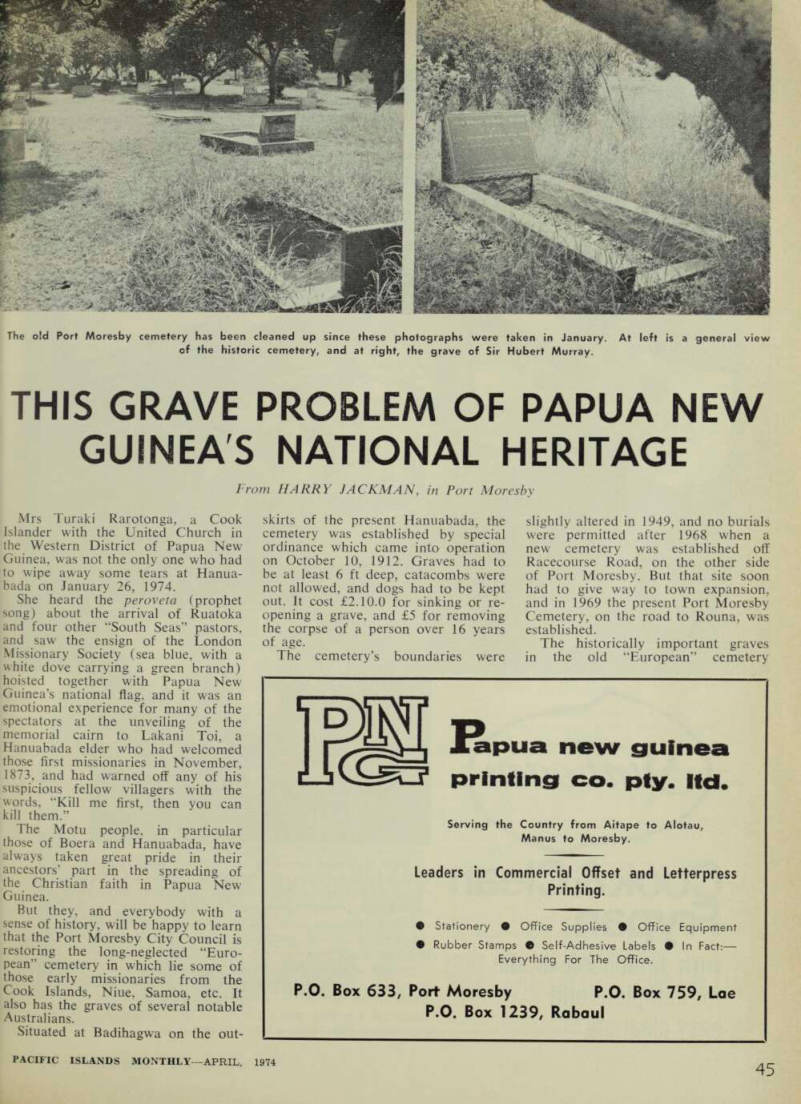
The old Port Moresby cemetery has been cleaned up since these photographs were taken in January. At left is a general view of the historic cemetery, and at right, the grave of Sir Hubert Murray.
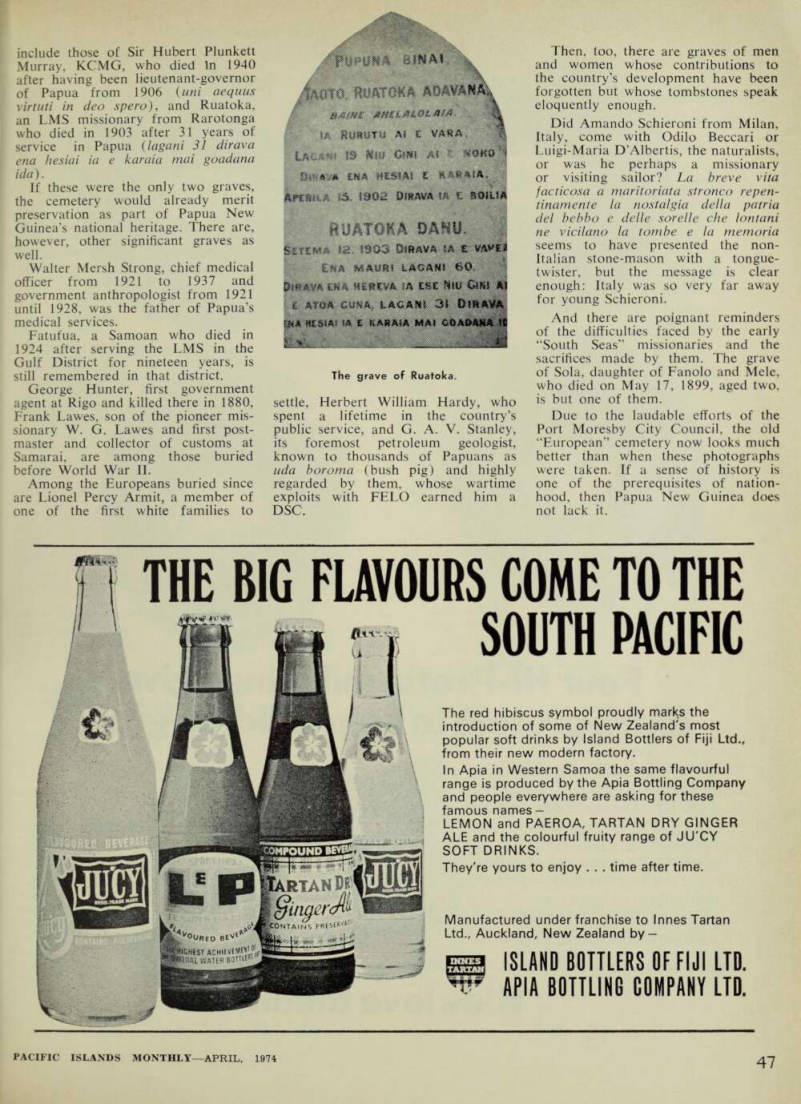
include those of Sir Hubert Plunkett Murray, KCMG, who died In 1940 after having been lieutenant-governor of Papua from 1906 {uni aequus virtuti in deo spero), and Ruatoka, an LMS missionary from Rarotonga who died in 1903 after 31 years of service in Papua ( lagani 31 dirava ena hesiai ia e karaia mai goadana ida ).
If these were the only two graves, the cemetery would already merit preservation as part of Papua New Guinea’s national heritage. There are, however, other significant graves as well.
Walter Mersh Strong, chief medical officer from 1921 to 1937 and government anthropologist from 1921 until 1928, was the father of Papua’s medical services.
Fatufua, a Samoan who died in 1924 after serving the LMS in the Gulf District for nineteen years, is still remembered in that district, George Hunter, first government agent at Rigo and killed there in 1880, Frank Lawes, son of the pioneer mis sionary W. G. Lawes and first post master and collector of customs at Samarai, are among those buried before World War 11.
Among the Europeans buried since are Lionel Percy Armit, a member of one of the first white families to
settle, Herbert William Hardy, who spent a lifetime in the country’s public service, and G. A. V. Stanley, its foremost petroleum geologist, known to thousands of Papuans as uda boroma (bush pig) and highly regarded by them, whose wartime exploits with FELO earned him a
Dsc.
Then, too, there are graves of men and women whose contributions to the country’s development have been forgotten but whose tombstones speak eloquently enough.
Did Amando Schieroni from Milan, Italy, come with Odilo Beccari or Luigi-Maria D’Albertis, the naturalists, or was he perhaps a missionary or visiting sailor? La breve vita facticosa a maritoriata stronco repen tinamente la nostalgia della patria del bebbo e delle sorelle che lontani ne vicilano la tombe e la memoria seems to have presented the non- Italian stone-mason with a tongue twister, but the message is clear enough: Italy was so very far away for young Schieroni.
And there are poignant reminders of the difficulties faced by the early “South Seas” missionaries and the sacrifices made by them. The grave of Sola, daughter of Fanolo and Mele, who died on May 17, 1899, aged two, is but one of them.
Due to the laudable efforts of the Port Moresby City Council, the old “European” cemetery now looks much better than when these photographs were taken. If a sense of history is one of the prerequisites of nation hood, then Papua New Guinea does not lack it.
The grave of Ruatoka.