Fiji Gets Tough With Offenders ...
p. 49 · Read in the full issue
The pollution menace
... And Caledonians See Red
Prom a Suva correspondent
Pollution and its effects have been almost an unknown quantity in the South Pacific region, but slowly and surely, water pollution is causing some concern in and around Suva, Fiji’s main shipping port, as the local coast line is being contaminated by oil spillage and other waste matter.
Earlier this year a shipment of 700 tropical fish bound for the United States was nearly lost when oil-con taminated water was pumped into the local aquarium.
The entire shipment would have been lost if the aquarium manager had not called in the Marine Depart ment and had water examined as soon as he noticed some of the fish dying.
Water pollution is one problem Fiji and the rest of the South Pacific can do without.
Islanders rely on fish for their food and livelihood, while the coastal and inland waterways play an important part in the everyday routine of the villagers who use it for everything from cooking to washing and bathing.
So as a deterrent to would-be polluters, the Fiji Government recently introduced a new bill with fines of up to $20,000 for water pollution. The government, obviously, has no intention of letting Suva Harbour resemble some other major harbours around the world which have let pollution get completely out of hand.
Under the new laws, people who pollute Fiji waters with oil or other petroleum products will face fines of up to $20,000 and a court may also order payment of the cost of stopping the spillage from spreading, of clear ing it up and payment of unlimited compensation for damage caused. At present the maximum fine is a mere $lOO, or six months gaol but this covers Suva Harbour only.
It will also apply to anyone on land who allows oil to spill into the sea, rivers, creeks or lakes.
Another clause compels the owner or master of a ship loading or dis charging oil products to have at the ready any equipment the Director of Marine considers necessary to contain and break up spillages. The fine for failing to comply with this ruling will be up to $2OO.
From a Noumea correspondent
A French TV film, depicting some of the horrors of pollution in the Caledonian lagoon, has raised a fury of protest from the Caledonian Tourist Association but prompted numerous appeals for action from the local conscience.
The film, 500 Million Years Under the Sea, was produced by a team of underwater explorers led by the world-renowned J.-Y. Cousteau, a French naval commander whose marine adventures are screened around the world. While promoters of Caledonian tourism are battling to publicise the beauties of the lagoon waters encircling their island, the Cousteau film chose to highlight some of the damage being done to the coral reef and other marine life through the discharge into the sea of red topsoil, washed down from nickel sites.
TTie reaction in the local press, which is dominated by company ownership, was a frantic de-
nunciation of the film. This was followed by a widely-publicised pro test petition launched by ASCA DETO, Caledonian Tourist Associ ation.
However, after the initial uproar over the damage being done to the island’s tourist image, some more far sighted groups came out supporting Cousteau and urging action to clean up polluted bays and beaches. Other petitions, denouncing the ravages made by red mud washed out from the open-cut mountains, called for a halt to the massacre of marine life, In like manner, the Noumea Junior Chamber of Commerce called for an anti-pollution campaign and suggested fund-raising to help the local Tourist Office have a more complimentary film made on New Caledonia, Finally, the Territorial Assembly took up the cudgels and called upon the French administration to have a report prepared on the problem.
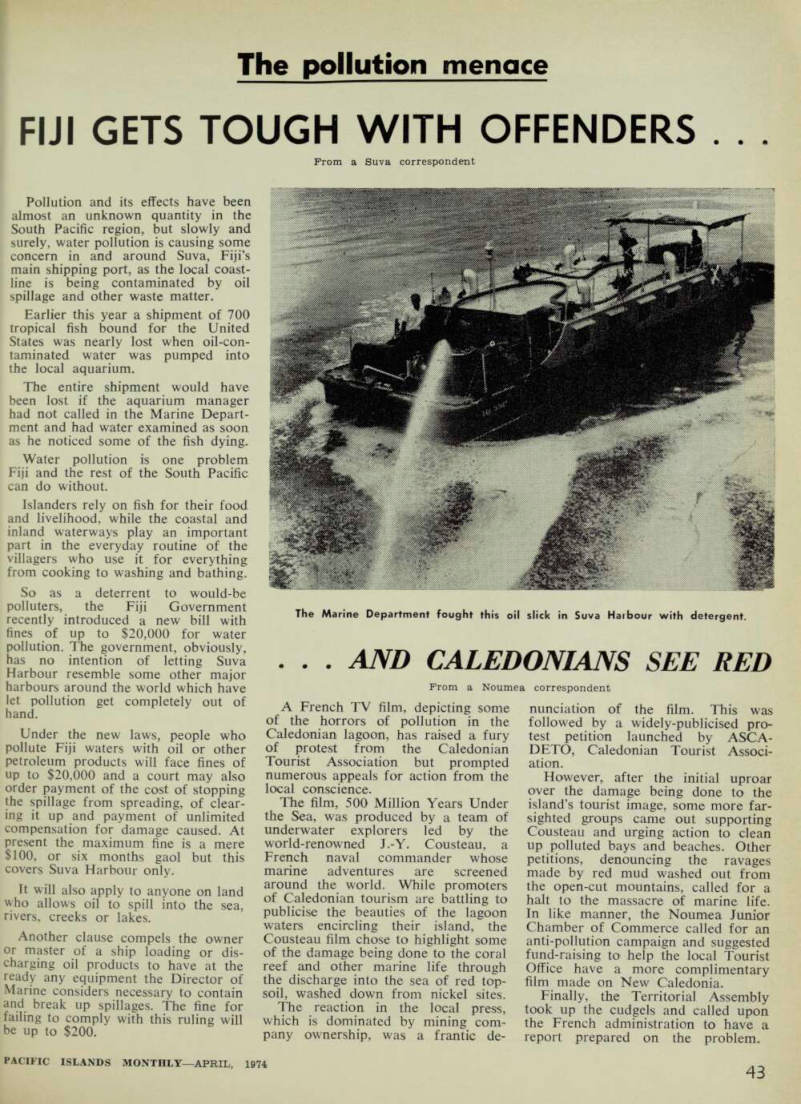
The Marine Department fought this oil slick in Suva Harbour with detergent.