Blue-Print For Niue-With
pp. 45-47 · Read in the full issue
The Accent On Tradition
From a Niue correspondent
Professor R. Quentin-Baxter, the Government of Niue’s adviser on constitutional development, has pre sented his four-point plan for self government to the Niue Island Assembly.
The island is to vote for self government in a referendum to be held in July or August.
Professor Quentin-Baxter held talks and negotiations with the island’s Assembly, and the Executive Com mittee —a four man “Cabinet” — during a flying two-week visit to the island. He also talked with groups of island people, educationists, senior government department heads and inspected manv island projects.
The four point plan for self government contains the following major proposals:— • The people of Niue will retain their New Zealand citizenship; • New Zealand will remain respon sible for the foreign affairs and defence of Niue; O The NZ Government will remain responsible for taking, in consultation with the Niue Government, whatever measures may be needed to ensure the economic, administrative and technical support which Niue at present receives from New Zealand; • There will be a New Zealand representative resident on Niue.
But the plan also contains another suggestion, which has sparked off some lively debate on the island, to increase the Assembly members from the present 14 to 20. The 14 members now represent the 14 villages of Niue, and Professor Quentin-Baxter does not want to change that, but his proposal is that an additional six places would come from a common roll, voted for by the whole island.
In support of his proposal, Profes sor Quentin-Baxter said that if Niue was to prosper, it had to use its human resources to the best ad vantage.
“It seems to me quite obvious that there will be people on this island who could serve Niue in the Assembly but who may not be able to be elected as the representative of their own village,” he told the Assembly.
“Nature does not distribute talent evenly and there may be more than one person in a village who has the time and the ability to serve his country in the Assembly.”
Professor Quentin-Baxter said the
present system was very restrictive and did not correspond with any electoral system in either New Zea land or the United Kingdom.
‘The proposal I am making is a modest one,” he said. “It means keep ing all that is good in your traditional system and yet enriching it by allow-
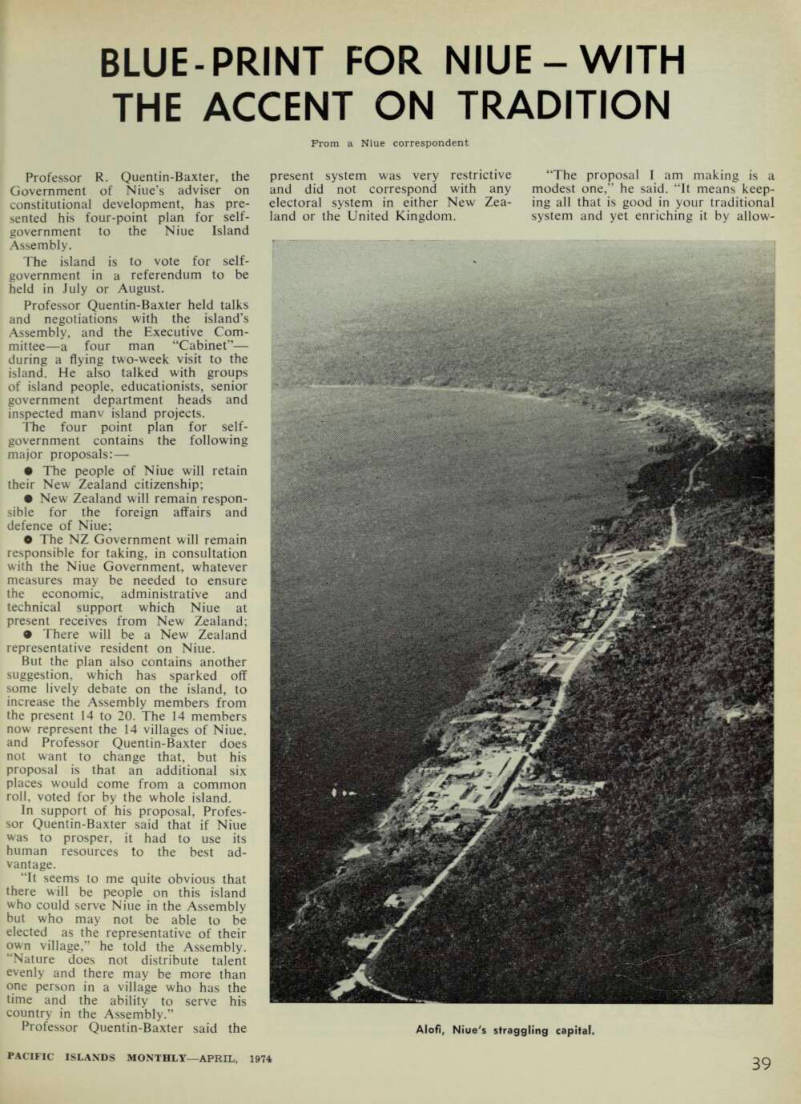
Alofi, Niue's straggling capital.
ing the possibility of other people, who have special gifts and who are willing to offer their services, to join the representatives of the 14 villages in the Assembly.
“I believe this would be a good balance between the traditional system and the needs of the future, I believe it would enrich your own Assembly and that in future assemblies the 20 representatives would be better equip ped than ever before to carry the much greater responsibility that the Assembly has now acquired.”
After the Niue Constitution Bill has gone through the NZ Parliament, the islanders will have to decide by vote whether they want self-government on the basis of the new constitution.
Should they vote against it, which is very unlikely, they would be back under New Zealand’s wing as a dependency.
In Australia in February as guest of the Australian Government, Mr R. R. Rex, Niue’s Leader of Govern ment Business and favourite for the job of Premier, told PlM’s man they expected to be self-governing towards the latter part of this year. The present Assembly would continue to govern until general elections in March next year.
“I don’t think the elections will bring many changes in the Assembly,” said Mr Rex. “I’m optimistic about the result and feel we’ll be back in power,”
He said that New Zealand had doubled the amount of aid to Niue over the next three years to a total of $5.4 million. He had had talks with members of the Australian Government and while they had made no specific promises they said they were prepared to assist Niue with technical aid.
The Niueans are hoping that tourism will boost their living standards now that the island’s first tourist resort hotel is almost ready to open its doors—and Americans will be welcome to call.
An embarrassed Mr Rex denied Australian newspaper reports that he had said they didn’t want Americans on Niue.
“I didn’t say that,” protested Mr Rex to PIM. “I said that having seen other places exposed to the pattern of American tourism, we would have to be careful that the pattern of our island life is not upset.
“I think other places have been spoilt by tourism and their life-pat tern has been upset, but we will wel come American tourists though, at the same time, we will try to ensure that life-style is not changed. We don’t want the Americans to feel they are not wanted. They are.”
There’ll be one big change on the island and it won’t be through
tourism. Niue, financed by New Zealand, is going all-electric.
“We’ve been given the green light to go ahead with reticulation of electricity right round the island,” said Mr Rex. “We’ve been dreaming of electricity for years.” . £ , . *
Passionfruit crisis
Niue Island has a recurring passionfruit crisis. Lack of freezer space on the island, plus a delay in getting new freezers from New Zealand, are the crux of the problem. Most commercial freezers, and a few private freezers as well, were crammed with passionfruit in January, just before
the arrival of the Luhesand, which was expected to carry a cargo of freezer goods, placing a further strain on available freezer space till the Moana Roa arrived to pick up the
passionfruit.
Fortunately, the squeeze did not occur as the Luhesand had only a small amount of freezer cargo. Then the Moana Roa made a special trip to Niue to pick up the bulk passion fruit, which totalled more than 20 tons. The ship arrived at an oppor tune time to pick up the fruit, as New Zealand was then out of it.
Another freezer space crisis was ex pected to develop late in February.