Yesterday
p. 69 · Read in the full issue
January-February are two of the worst months of the hurricane season as the crew of the Tasman Steamships' Vasu would aver after huge changes of course to avoid a big "blow" which just missed Fiji. The Vasu, 300 tons, bound for Auckland from Fanning Island, took a severe buffeting, but eventually arrived at Auckland, without damage. The Vasu, then owned by Burns Philp (SS) Co Ltd, sank off Boscowan Island, near Tonga in June, 1956.
A visitor to Auckland was Mr Percy Edmunds, of Tahiti, who was manager for nearly 30 years of the 40,000-acre sheep station which occupied most of Easter Island. He was the last Englishman to speak to the German officers of Von Spec's Pacific Squadron in 1914. When the German squadron called at Easter Island, Edmunds knew nothing of the outbreak of World War I. He supplied the vessels with fresh meat and in due course they departed. Easter Island was undoubtedly the last Pacific port of call made by the German squadron.
The Fiji Legislative Council set in motion in December, 1952, a train of events, which culminated in the Burns Commission of 1959, to inquire into popu lation, natural resources, etc. It took a long time to get off the ground, and as early as February, 1954, PIM was asking why, for at that time the pro posal was under consideration by the Pacific Islands Sub-Group of the Commonwealth Council of the Conserva
tive Party (it was not apparently called PISGCCCP). PIM asked why, a year after the request was first made for an inquiry, the matter should still be wandering around the halls and by-ways of the British Conservative Party.
The success of three test services across the Pacific by Orient Lines was confirmed when the shipping line announced there would be two additional services at the end of the year, making five for 1954.
These services by the Oronsay and the Orcades, followed the same itinerary— Sydney-Auckland-Suva-Honolulu-San Francisco-Vancouver. Unless there was some unforeseen slump in the demand for transpacific passages, Orient was expected to add more services to the same run in 1955. This, in fact, happened, and with P and O joining in, and later both lines as P and O-Orient, the number of services was stepped up considerably. Some were extended to take in the Far East to give a circular return service to Sydney north, east, south-west and west, or vice versa.
And some of the services returned to the UK a new way, via Acapulco and Panama Canal. Now, of course, except for cruises, travellers are taking to the air and line voyages are fading out.
Queen Elizabeth is to visit Papua New Guinea for the first time this month.
But 20 years ago, Papua New Guinea sent a delegation to Canberra to meet her.
Those privileged to make the trip were the Administrator, Brigadier D. M.
Cleland, and Mrs Cleland, Bishop P. N.
W. Strong, Messrs E. A. James, MLC, E. J. Frame, D. Barrett, MLC, James Leahy, Paul Mason, Simogun, MLC, Willie Gavera, Gabriel Achun, and Mesdames Myra Humphries and Doris Booth, MLC.
Norfolk Island and Nauru delegations also made the trip to Canberra. Their delegations were—Norfolk: Brigadier C. H. B. Norman (Administrator) and Mrs Norman, Messrs H. S. Christian and P.
Adams. Nauru: Mr J. K. Lawrence (Acting Administrator) and Mrs Lawrence, Messrs Raymond Gadabu and Austin Bernicke.
With only three New Guineans out of a party of 13, the PNG contingent couldn't be regarded as representative, but that is the way it was before the winds of change really got going.
No one really likes paying taxes, so officialdom has to get after the dodgers.
Where the taxing authority is not geared for this sort of work, catching up with the dodgers is a difficult task. Twenty years ago, in Fiji, the Acting Commis sioner of Inland Revenue, Mr Bill Drysdale, got to grips with the old administrative difficulty there —the dodging of income tax by well-to-do merchants. Mr Bill
Drysdale said the net was being widened to rope in all defaulters. He said a few Indian cane-farmers sent in income tax returns, but that happy state was coming to an end. He added, cryptically, that no racial pot had any call to describe any kettle as black in the matter of dodging, where possible.
Tahiti almost had a harem 20 years ago.
It was reported, with some authority, that the French Government had decided to give the deposed Sultan of Morocco asylum in Tahiti. A home was being prepared immediately for the former Sultan, three wives, two sons, an unspecified number of daughters, and 20 concubines. To TEAL (now Air New Zealand) was to fall the honour of carrying them from Sydney, via Auckland and Suva, to Papeete. But—nothing eventuated.
If Sir Paul Hasluck paid an official visit to Papua New Guinea now, it would be as Governor-General of Australia. But 20 years ago he went there as Australia's Territories Minister to officially open the Commonwealth New Guinea Timbers Ltd new plywood factory at Bulolo.
The venture was jointly owned by Bulolo Gold Dredging Ltd and the Australian Government. The enterprise was expected to add £5 million ($lO million) annually to the value of PNG's overseas exports.
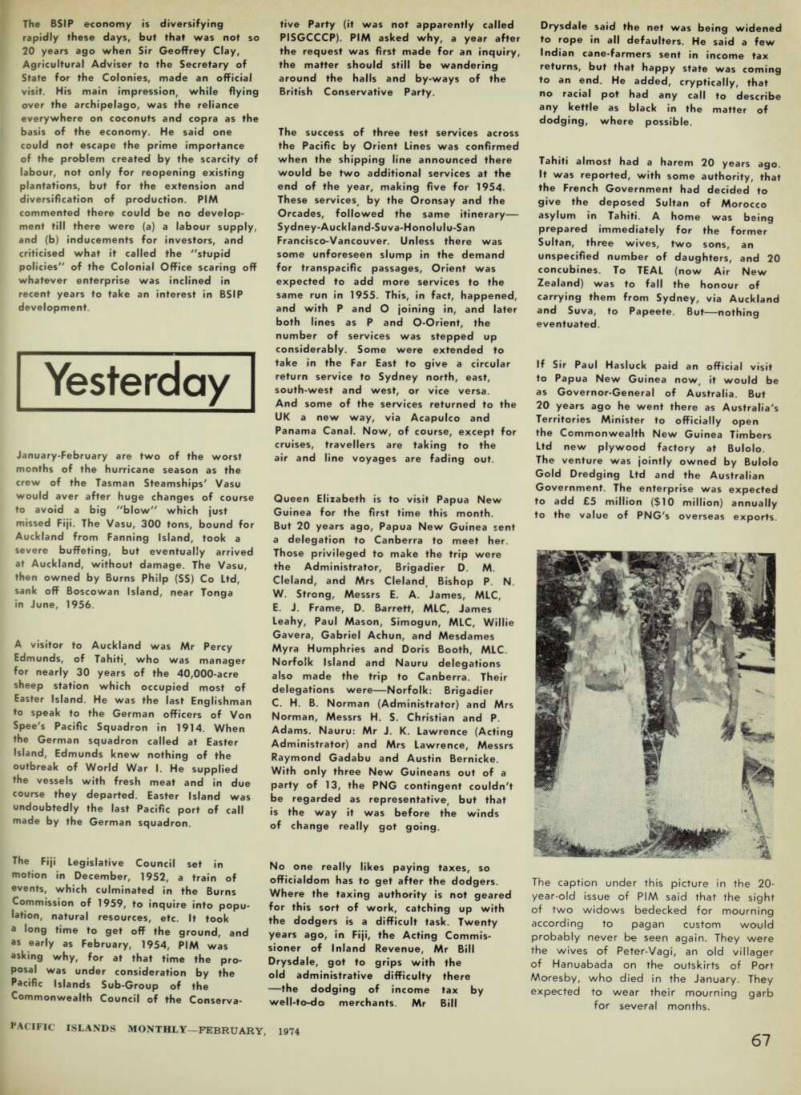
The caption under this picture in the 20year-old issue of PIM said that the sight of two widows bedecked for mourning according to pagan custom would probably never be seen again. They were the wives of Peter-Vagi, an old villager of Hanuabada on the outskirts of Port Moresby, who died in the January. They expected to wear their mourning garb for several months.