Books, Reviews, writers
pp. 70-71 · Read in the full issue
A Marquesan Tragedy - Anu's
First Venture Into Fiction
A novel published by an academic press is an unusual occurrence and possibly something of a gamble, but the ANU has found what will surely become a classic for its first venture into this field of publishing.
In Thunder from the Sea, Willow dean Chattel-son Handy has captured with extraordinary sensitivity the trauma of contact between a Pacific Island people and Europeans. Using oral traditions and a few brief re ferences available from European sources, she has re-created, one is almost tempted to say reconstructed, the life of the Nukuhivan chief, Pakoko, from his birth and early years in a strong, viable Marquesan society, to his execution at the hands of French rulers in 1845.
From 1792 the Nukuhivans were visited by European and American vessels seeking supplies, souls, sandal wood and, finally, territorial posses sions. No chief could pick a safe course between the various attractions offered by the foreigners and the numerous attendant evils.
While some chiefs welcomed foreign goods and beachcombers, Pakoko clung to the ways of the grandfathers and withdrew from the contaminating influences of the beach to a high valley in Taiohae, where he gathered round him the master crafts men and priests, whose skills were being increasingly ridiculed and un dermined. Through his eyes the up heaval and partial rejection of Nukuhivan society, which accom panied the arrival of the Europeans, are revealed.
In accepting this novel the ANU Press has not, in fact, stepped far outside its usual academic bent since the whole book is based on a wealth of anthropological, historical and personal knowledge. Handy, an American anthropologist, first visited the Marquesas in 1920, returned to the islands several times and wrote widely about them.
Thunder from the Sea is the cul mination of her extensive academic knowledge together with her close
association and empathy with a people who have suffered so tragic ally since contact with Europeans.
Only a person with this degree of knowledge could have attempted an interpretation of the process of culture contact from an Islander’s point of view, and have achieved such a ring of truth. However, this is only one side of the coin.
Many anthropologists and his torians have written learnedly about contact, but this book is so much more than anthropology or history.
Handy has made the creative leap from dry facts into the lives and minds of the Islanders and develop ed a theme of great drama and ex citement, which will carry almost any reader away. Yet for the Pacific specialist, the details are sound.
It will be most interesting to compare Handy’s interpretations of contact events in Nukuhiva with those of the beachcomber, Edward Robarts, who was on the island between 1800 and 1806, and whose journal will be published by the ANU Press early next year. Robarts, or Hard To Cook as Handy claims he was called by the Marquesans, who found him stubborn and set in his own ways, is a destructive force in Pakoko’s eyes—the cause of a famine that ravaged the island during this period.
In contrast, Robarts saw himself as a protector of the Nukuhivans and a guide to European shipping.
Although writing in the 20th century, Handy has been able to derive so much more from the existing : material than the man on the spot who was untrained in any anthro pological sense and who, in many ways, was unable to step beyond the ; bounds of his own culture.
In Thunder from the Sea a neat ; balance is struck between Pakoko’s j early life on Nukuhiva before con- ■ tact and the process of disruption j and change that followed the advent : of Europeans. Dynastic rivalry, can- ■ nibalism, warfare, feasting, dancing ; and work are woven together to ( reveal the strong fabric of traditional i society.
Against this background, Pakoko, < deprived of his chiefly position be- cause of a compromise between rival I families over succession, is forced toe prove himself by his own skills and! power. Driven by ambition he leaves? his home valley of Taiohae to seeki his fortune among the Taipis, whde respect the tabu placed upon him by\ the Taipi chief but never truly accept* him.
By hard work, skill and an element* of trickery, Pakoko establishes his? ascendancy over the Taipi chief withri
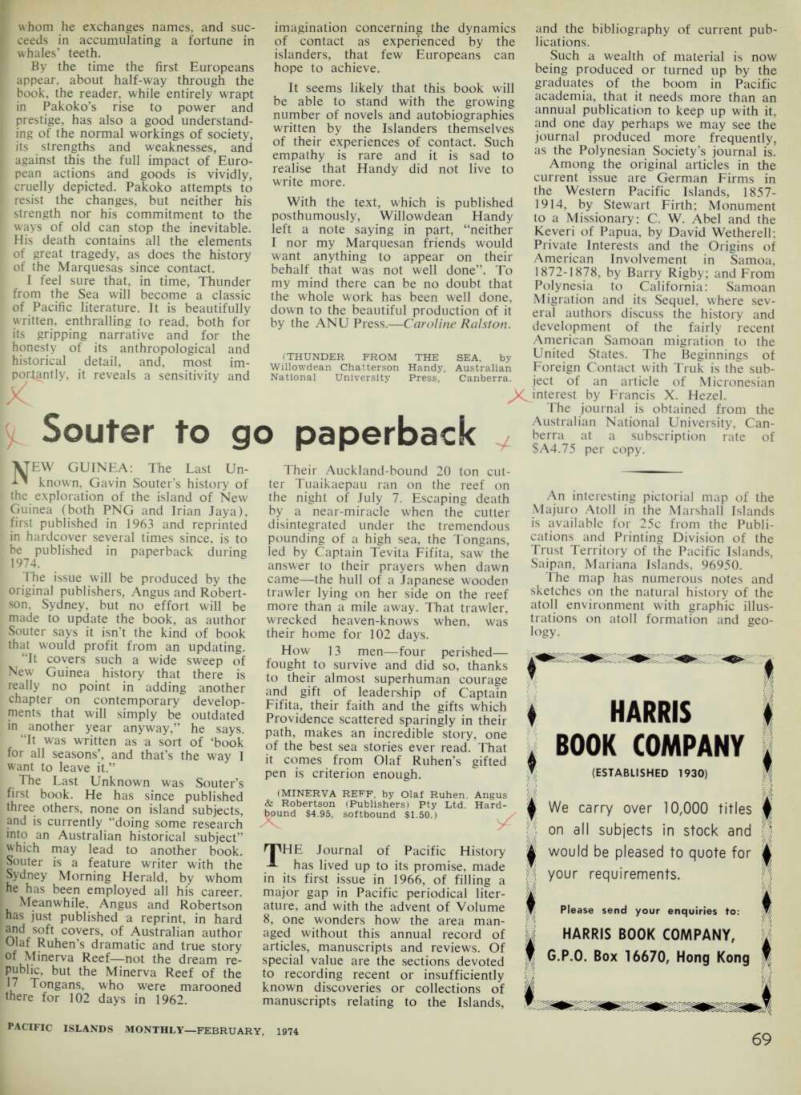
The valley of Typee on Nukuhiva where much of the action in Thunder from the Sea is located.
whom he exchanges names, and suc ceeds in accumulating a fortune in whales’ teeth.
By the time the first Europeans appear, about half-way through the book, the reader, while entirely wrapt in Pakoko’s rise to power and prestige, has also a good understand ing of the normal workings of society, its strengths and weaknesses, and against this the full impact of Euro pean actions and goods is vividly, cruelly depicted. Pakoko attempts to resist the changes, but neither his strength nor his commitment to the ways of old can stop the inevitable.
His death contains all the elements of great tragedy, as does the history of the Marquesas since contact.
I feel sure that, in time, Thunder from the Sea will become a classic of Pacific literature. It is beautifully written, enthralling to read, both for its gripping narrative and for the honesty of its anthropological and historical detail, and, most im portantly, it reveals a sensitivity and
imagination concerning the dynamics of contact as experienced by the islanders, that few Europeans can hope to achieve.
It seems likely that this book will be able to stand with the growing number of novels and autobiographies written by the Islanders themselves of their experiences of contact. Such empathy is rare and it is sad to realise that Handy did not live to write more.
With the text, which is published posthumously, Willowdean Handy left a note saying in part, “neither I nor my Marquesan friends would want anything to appear on their behalf that was not well done”. To my mind there can be no doubt that the whole work has been well done, down to the beautiful production of it by the ANU Press. —Caroline Ralston.
(Thunder From The Sea, By
Willowdean Chatterson Handy, Australian National University Press, Canberra.