Pacific Islands Monthly

News Magazine Of The South Pacific
February, 1974
AUSTRALIA, N.Z., PN G., FIJI, N. HEBRIDES 60c TONGA, W. SAMOA, 8.5.1. P., G.E.I.C. 60c
Cooks, Norfolk, Niue, Nauru 60C
Am. Samoa, Hawaii, Micronesia, Guam $L.Oo
NEW CALEDONIA AND FRENCH POLYNESIA 100 CFP
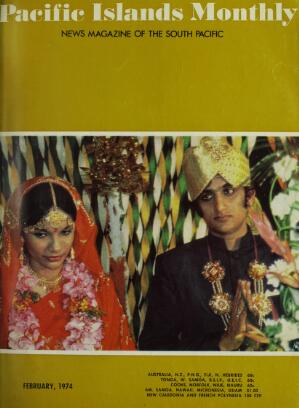
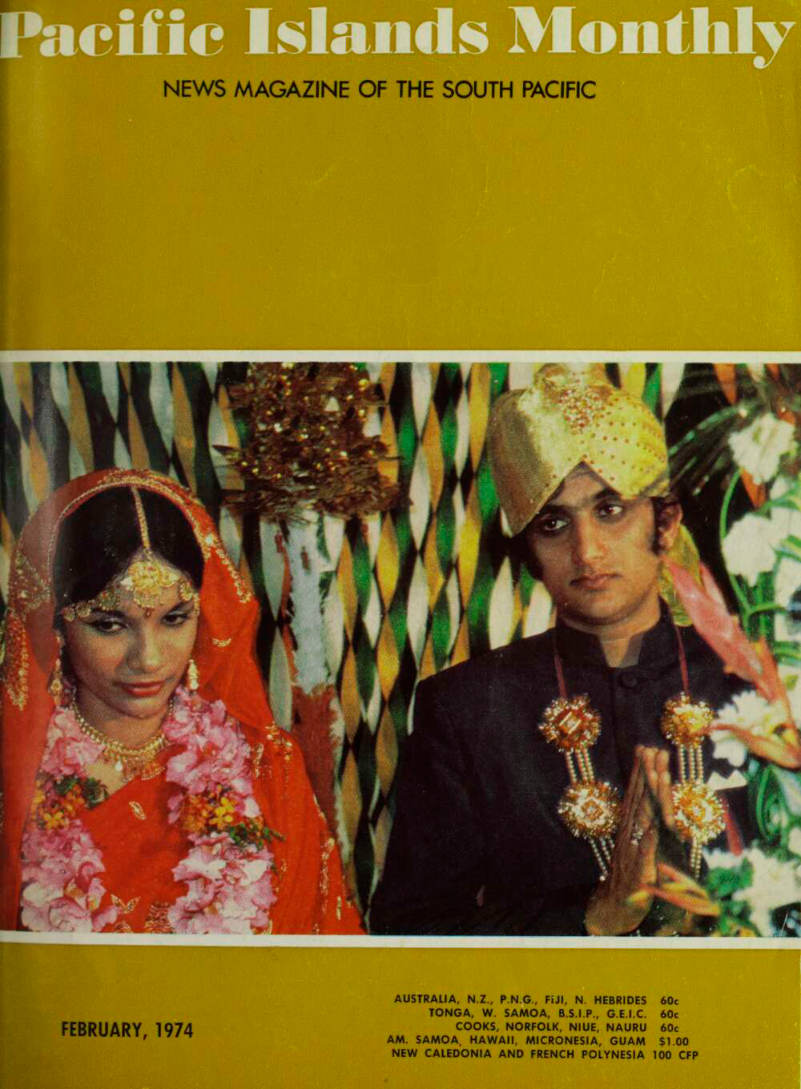
Our Cover
Indian brides and bridegrooms and weddings with full Hindu rites are amo n g the most glamorous of Fiji “happenings” as evidenced by the attractive couple on our cover—Vimal Sharma, a Suva journalist with the Hindi newspaper Shanti Dut, of which his father, Mr G. D.
Sharma, is editor, and his bride, Manjula Maharaj, of Suva.
Vimal’s outfit was ordered speci ally from India. Their marriage was some time ago but the picture is still worth looking at.
The outlook of modern Indian youth is changing, particularly where marriage customs are con cerned. PIM examines this on page 9.
Advertisements & other items, p. 2 (1 item)
Wrebigon
little things
at Toyota.
There are a lot of things that make a Toyota a great automobile. Big things like computerized quality control. And little things like eye tests.
For the last five years we've been running tests to determine the limits of visibility under various conditions. We test with men and with women. On country roads and city streets. Then we use the results to design our cars from the shape of the windscreen, to the size of the mirrors, to the position and brightness of the headlamps.
Compared to our more sophisticated testing and research, or compared to our performance and styling, eye /" tests may seem insignificant. . —.— But the little things we do add up.
Because we've been doing them for 36 years. And we'll keep on doing them. Because they go a long way toward making you satisfied.
TOYOTA
In This Issue
General
SP Commission meeting 3 Fuel crisis 7 Air Pacific development 8 Mail thefts 8 Guam Games date 15 American Airlines withdraw service 73
American Samoa
Looting after government building fire 18 Samoans win army enlistment rights 18 Unsafe fishing dories 79 Air fares rise 83
Cook Islands
UFO sighted over Mauke 8 Premier as a boy (pic) 11 Totalisator opens 11 Japanese ships worry minister 15
Fiji
Fuel crisis 7 Air Pacific moves 8 $1,500 haircut 9 Indian marriage customs 9 Bad omens for 1974 10 Lauans isolated 77 Qantas charter flights 77 Taveuni estate development 91 Company to use coal 93 Negotiations with EEC 93 Death of Mr Madhavan 100
French Polynesia
Nuclear tests 8 Eddie Lund dies 11
Gilbert And Ellice Islands
Census figures 8
Lord Howe Island
Army sappers to build airstrip 83
Nauru
President's daughter married 8
New Caledonia
Beating petrol restrictions 7 A second nickel factory? 37 Free petrol for shoppers 47 Bank's expansion plans 90
New Hebrides
Advisory Council 5 Shell fossils found 12 Tax haven benefits 43 Japanese investments 89 Bank's new subsidiary 90
Norfolk Island
Death of Mrs M. Forbes 100
Papua New Guinea
Moving to independence 5 Development of Arawa 19 Port Moresby's fashions 23 Memories of Tommy Grahamslaw 27 Coast freight rates rise 77 Shipping pool 79 Landing craft for Defence Force ... 83
Pitcairn Island
Election day 13
Solomon Islands
Bride price control 12 The road to independence 33 1974 budget 35
Tonga
Mail thefts . ... 8 Air fares rise 83 Bank's secret accounts 92 Approach to EEC 93
United States Trust Territory
Marianas-US talks 6 War dead recovered 8 Transpac in freight rates wrangle 75
Western Samoa
Fiery budget debate 39 Economic hari-kari 39 Air fares rise 81 Approach to EEC 93
DEPARTMENTS: Up Front with the Editor, 3; In a Nutshell, 8; Tropicalities, 11; People, 17; Bulletin Board, 21; Editor's Mailbag, 27; From the Islands Press, 48; Magazine Section, 57; MANA, 60; Yesterday, 67; Books, 68; Pacific Transport, 73; Cruising Yachts, 83; Business and Development, 89; Produce, 94; Shipping and Airways Infor mation, 95; Deaths of Islands People, 100; Advertisers' Index, 104.
Advertisements & other items, p. 4 (1 item)
Completely
Start precautions against
disease carrying insects with. . .
The Insect Spray
that is
Completely ,
Completely
Effective
m IN
Rigid testing selects only
pure, safe ingredients In formulating insect sprays, the aim is maximum effectiveness against many species of pests with maximum safety for humans and pets. A.N.I. Research Chemists are at work world-wide to ensure that concentrated Pea- Beu aerosol insecticide satisfies in all respects. Its active insecticidal ingredient is pyrethrins . . . proven the most potent insect-killing substance available. All raw materials must conform to rigid specifications of chemical purity. A programme of progress checking then operates at every stage of processing from mixing the insectkilling concentrate and high-grade ‘carrier’ to injecting the propellant which produces Pea-Beu’s high-speed spray Rigid quality control of every stage of manufacture ensures that Pea-Beu is brought to you in the purest, safest and most effective form. Because of this Pea-Beu is also really effective against every type of insect pest including flies and mosquitoes. mm «
Pyrethrins: Nature’s
pest control
From the small, innocent-looking white Pyrethrum daisy, modern chemistry extracts pure pyrethrins. This syrup fluid is so deadly to all insects, even the microscopic quantities carried in droplets of Pea-Beu spray kill instantly on contact. Yet pyrethrins are absolutely harmless to the human system, even in infants. Pea-Beu aerosol insecticide is also guaranteed safe near any warm-blooded domestic animal and near food. Even in the pure state, the odour of pyrethrins is neither overpowering nor unpleasant.
Harmless to spray freely
anywhere
As a powerful space spray, Pea-Beu effectively rids any room of dangerous cockroaches, mosquitoes and other biting insects and plays a major role in family health-protection. In addition it is perfectly safe to spray in kitchen cupboards or on pantry shelves, with no risk of food contamination. The unique strength of the Pea-Beu formula kills the toughest cockroach and colonies of ants rapidly too, yet cannot affect humans or pets in any way.
Pea-Beu aerosol insecticide is so strong it is effective in killing flies, mosquitoes and every type of insect pest.
Powerful Pea-Beu kills all insects —yet it’s so pure it’s safe to spray anywhere
Pea-Beu the safe, powerful insecticide
Up Front
with the Editor
After 27 years, the moment of truth is at hand for the South Pacific Commission. Can it now serve the people for whom it was created, or must it collapse?
We should know following a con ference to be held in Wellington, NZ, in March, of its present eight mem bers—NZ, Australia, Britain, France, the US, Western Samoa, Fiji and Nauru. It’s a review meeting, ar ranged as a result of a resolution ap proved by the South Pacific Con ference in Guam last year.
Participants will be asked to recog nise that the Canberra Agreement, which in February, 1947, established the SPC “to promote the economic and social welfare and advancement of the peoples of the non-self governing territories of the South Pacific region”, is out of date.
They will be asked to revise it so that “it will reflect the needs and as pirations of the Pacific people”. They will be asked to merge the South Pacific Commission with the South Pacific Conference (to be then known as The South Pacific Conference), and with the help of a number of committees and an annual meeting, give the new organisation into the control of all nations and territories of the South Pacific, whether or not they happen to be full members (such as the eight).
They will be asked to guarantee democratic operation of the new organisation by giving every partici pant country one vote, and by allow ing the chairman to be selected on occasions by the conference members, so that the smaller territories can have a turn. The conference would also be allowed to discuss any subject it thinks relevant, whether or not it happens to be political. Furthermore, there would be no ceiling on the amount of money any country offered the organisation.
All this is pretty heady stuff.
If adopted it will establish the com mission as a vast international com mittee of Islanders with the means to
help themselves with social and tech nical expertise, and able to swap in formation, gossip, fears and worries —and, one hopes, joys.
It could be a genuine and effective forum for people such as the New Caledonians and French Polynesians, whose SPC votes are currently held by France, and for the Solomon Islands and the Gilbert and Ellice, whose votes are held by Britain.
But will the Wellington meeting achieve this? I suspect that depends upon France. The French have been extremely rigid over the future of what really are French colonies in the Pacific but which she thinks of as integral parts of France. The French islands have reason to regard La Belle France with both respect and affection, but there is plenty of evidence that they also want greater freedom within the republic frame work.
Without doubt the islanders would like their own vote on the SPC and a right to talk in public on any sub ject they like, including the subject of nuclear explosions. But will France feel she is able to give them those rights on the SPC without a loosening of control?
If she doesn’t, the Wellington con ference could end in disaster, be cause the mood of the rest of the Pacific is to strip the SPC of its colonial past before it dies of the weight it’s carrying.
The alternative is to close it down, which would be a great loss while the organisation still has some role to play; or let it split apart through the walk-out, or expulsion, of France —which would be even more re grettable because of the attendant recriminations.
But perhaps I’m unnecessarily pessimistic. France’s new Minister for Overseas Territories, Mr Bernard Stasi, is said to hold liberal views, and be less rigid on the question of Islands’ autonomy. We shall see.
Stuart Inder
Pacific Islands
Monthly
FOUNDED BY R. W. ROBSON IN 1930
Published Monthly By
Pacific Publications (Aust.) Pty. Ltd.,
29 Alberta St., Syctney, N.S.W., 2000.
Postal Address: G.P.O. BOX 3408, SYDNEY,
N.S.W., 2001.
Telegraphic Address: PACPUB, Sydney.
Telex 25168.
Telephones: 61-9197, 61-7101, 61-4369.
Consulting Directors: R. W. Robson, Judy Tudor.
Chief Executives: Manager: Selwyn Hughes.
Publisher: Stuart Inder, Director of Advertising: W. A. Gasnier.
Pacific Islands Monthly
Editor: Stuart Inder.
Assistant Editor; John Carter.
Advertising Manager: W. A. Gasnier.
Circulation Manager: Barry Badger.
Subscription Rates:
"Pacific Islands Monthly" is airfreighted to all subscribers and agents in the Pacific Islands and the U.S.A.; copies to Nauru and other areas go by surface mail.
Australia (incl. Lord Howe and Thursday Is.)# New Zealand, Papua New Guinea, Fiji, New Hebrides, Tonga, Western Samoa, Solomon Islands, Gilbert & Ellice Islands, Cook Islands Norfolk Island, Niue and Nauru Islands: $6.80 (local currency); American Samoa, Hawaii, Micronesia and Guam; $12.00 US; New Caledonia and French Polynesia 1,100 CFP; US Mainland: $14.00 US; United Kingdom; £5-10. Elsewhere $B.OO Aust.
Representatives
Fiji: A. F. Woods, Imex (Pacific) Limited, Suite 2A, Victoria Arcade, Suva, Fiji. P.O. Box 2026, Government Buildings, SUVA. Telephone: 22-502.
Telex. 2124.
Papua New Guinea: PORT MORESBY, PNG Print ing Co. Pty. Ltd., P.O. Box 633; LAE, P.O. Box 227; RABAUL, Mr. CTavid Simpson, P.O. Box 164 (c/- Rabaul Photographic. Tel.: 2677.) French Polynesia. Distribution —Hachette Paci fique, 10 Ave Bruat, Papeete.
New Zealand: Pacific Publications, C.P.O. Box 2229, Auckland. 379-494. Representative: John Spedding, Civic House, 291 Queen St., Auckland, Tel.: 379-494.
United Kingdom; Overseas Publicity Ltd., 214 Oxford Street, London, WIN OEA. Phone: 01-636 8296/7.
Japan: Advertising—Universal Media Corpora tion, C.P.O. Box 46, Tokyo. Tel.: 666-3036.
Victoria: Advertising Pacific Publications (Aust ) Pty. Ltd., 33 Lonsdale Street, Melbourne, Vic. 3006. Telephone: 662-3263.
Queensland: Advertising—Beale Media Services, 232 St. Paul's Terrace, Fortitude Valley, Qld., 4006. Tel.: 52-5827.
Hawaii and U.S. Mainland only: N. Grogan, 3354 Hayden Street, Honolulu, 96815. (Send change of address notices, Form 3579 and new subscriptions to P.O. Box 2193, Honolulu, Hawaii, U.S.A. 96805).
Second class postage paid at Honolulu, Hawaii.
Copyright ©, 1974,
Pacific Publications (Aust) Pty. Ltd.
February, 1974 Vol. 45, No. 2
Advertisements & other items, p. 6 (1 item)
The Finest Country Made
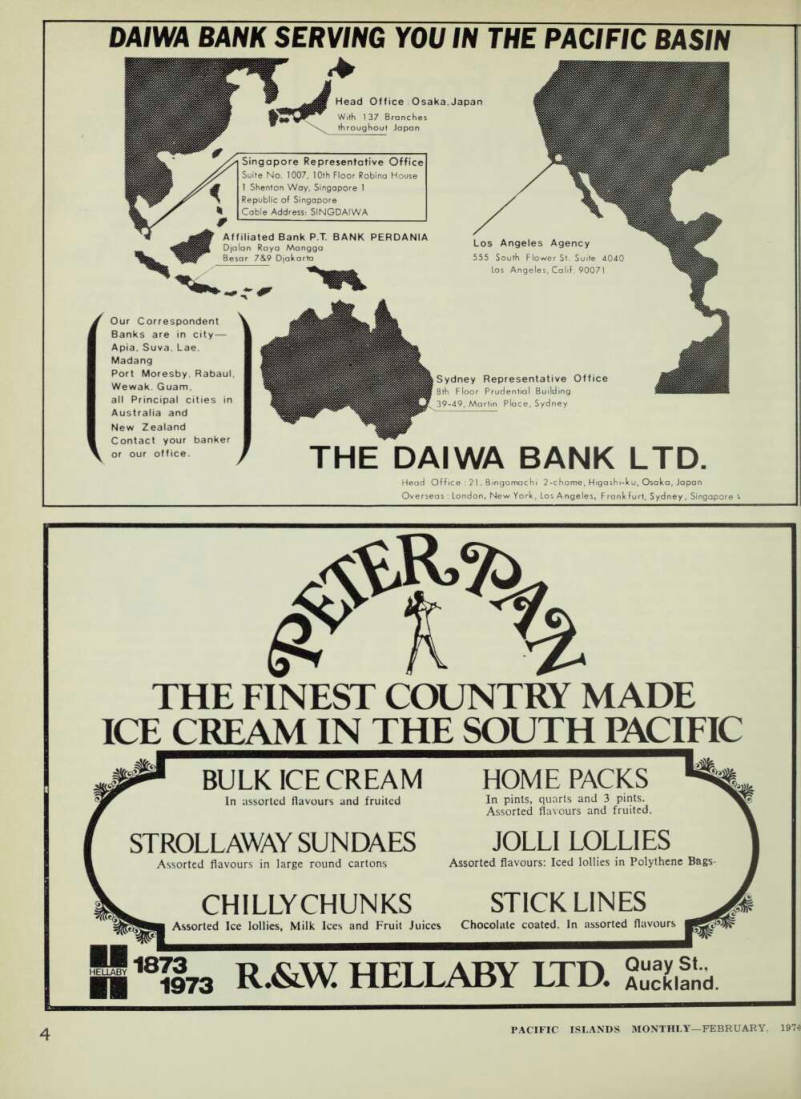
DAIWA BANK SERVING YOU IN THE PACIFIC BASIN r * Head Office ;Osaka, Japan With 137 Branches throughout Japan Singapore Representative Office Suite No. 1007, 10th Floor Robina House 1 Shenton Way, Singapore 1 Republic of Singapore Cable Address: SINGDAIWA Affiliated Bank P.T BANK PERDANIA Djalan Raya Mangga Besar 7&9 Djakarta Our Correspondent Banks are in city— Apia, Suva. Lae.
Madang Port Moresby. Rabaul Wewak. Guam, all Principal cities in Australia and New Zealand Contact your banker or our office. y Los Angeles Agency 555 South Flower St. Suite 4040 Los Angeles, Calif. 90071 Sydney Representative Office Bth Floor Prudential Building 39-49, Martin Place, Sydney
THE DAIWA BANK LTD
Head Office : 21. Bingomachi 2-chome, Higashi-ku, Osaka, Japan Overseas : London, New York, Los Angeles, Frankfurt, Sydney, Singapore <
& £ •f £
THE FINEST COUNTRY MADE
ICE CREAM IN THE SOUTH PACIFIC
BULK ICECREAM
In assorted flavours and fruited
HOME PACKS
In pints, quarts and 3 pints.
Assorted flavours and fruited.
STROLLAWAY SUNDAES JOLLI LOLLIES
Assorted flavours in large round cartons Assorted flavours: Iced lollies in Polythene
CHILLY CHUNKS STICK LINES
Assorted Ice lollies, Milk Ices and Fruit Juices Chocolate coated. In assorted flavours
R &W HELLABY LTD. Slan'd
Independence aim is this year!
Pacific Islands Monthly
From correspondents in Port Moresby and Canberra.
With self-government under their belt since December 1, Papua New Guinea leaders are now working to wards independence in September.
There has been no announcement, and there is not likely to be any for some months.
Chief Minister Michael Somare and his cabinet are anxious to avoid possible confrontation with the political Opposition through announc ing their target date. They plan to wait until the final report by the constitutional planning committee is introduced into the House of As sembly in late February or early March, and debated in special session in April.
By this time, it is reckoned, self government would have satisfied the Opposition that it is unnecessary for them to fear that more haste has created less speed, and they will then have seen the necessity for a clear declaration of independence.
The country is all but independent now. Only defence and foreign rela tions lie outside the government’s control, and legislation to administer the defence force is now being drawn up.
Some other areas have been “re served” for Australia until indepen dence, but these have been chosen by PNG itself for the sake of con venience. They are matters affecting civil aviation, the House of Assembly and electoral policy, the Public Solicitor, the Supreme Court and the administration of other courts.
PNG has already tightened up on its immigration rules, but will soon make PNG more accessible to tourists by requiring only a visa to be stamped in a passport instead of the present irksome system of issuing separate “entry permits”, practised by the Australian administration.
PNG’s own officers took over con trol of the present permit system in Australia from January 14, following the arrival in Canberra of Oala Oala- Rarua as PNG Commissioner in Aus tralia, and Robin Kumaina in Sydney as PNG representative there. With independence, Oala Rarua will be come High Commissioner and Kumaina probably consul-general.
Oala Rarua, a Papuan, formerly Lord Mayor of Port Moresby, is occupying a leased house in Brassey Street, Deakin, an attractive Canberra suburb, with his wife, Paruru, and their children Loa, 14, Ruth, 12, Ovia, 10, Konio, 8, and Oala Jr, 3.
The PNG office is close by in a house in fashionable Red Hill, at 24 Beagle Street, opposite that of the Spanish Embassy and close to those ed the British and Fiji High Commissio r ns - , , In the PNG Commissioners office, with its distinctive bird-of-paradise emblem outside, the Commissioner is assisted by first-secretary Anton Farapo, from Kerema, secondsecretary Dominic Duya, from the Southern Highlands, and administrative assistant Toro Aihi.
Also in Canberra, and available for help if needed, is a staff of about 40 Australian public servants formerly part of the staff of the Department of External Territories, which ceased to exist in December. These remnants, mostly technical people, now comprise the Papua New Guinea Office, which is a wing of the Australian Department of Foreign Affairs, and directed by the former Minister for Territories, Mr Bill Morrison (now Minister Assisting the Foreign Minister in PNG Matters), with a staff of permanent officers led
by John Greenwell, director, Alan Kerr, assistant-director (government), and Brian Leedham, assistant-director (economics). This office will also probably disappear on independence, but meanwhile is operating in the Derwent House quarters of the de funct Territories Department.
The PNG Office controls the Sydney office, where most of the former departmental staff are operat ing in the same building in Market Street, but PNG is negotiating to lease a 10-storey building in Clarence Street with an option to buy. The building will be called Papua New Guinea House.
Robin Kumaina, assisted in the office by Serege Saiada, is living in the Sydney suburb of Gordon with his wife and family, in a house bought by the PNG Government.
In PNG itself, 1974 opened with a mixed record.
When Self-government Day, Christ mas and the New Year all passed in PNG with hardly an incident— beyond a policeman killed while in vestigating a game of cards on Self government Day—the leaders of the new nation felt pleased. But that was before Friday, January 11.
There was a riot in Port Moresby
(over page)
the night before, not the usual tribal fighting but rioting between the guardians of law and order.
Outside Port Moresby’s Murray Barracks, members of the Defence Force—a figure of 200 was given— pelted police with rocks, bottles and traffic signs after police had arrested some peace disturbers. Soldiers in plain clothes stormed out of the barracks and the fight was on. The police replied with tear gas and eventually quelled the rioters by 3 am on the Friday.
Both sides had their apologists and Defence Minister Albert Maori Kiki ordered a court of inquiry. Mr Kiki assured the Australian Government that law and order hadn’t collapsed; that this and other incidents were isolated. Mr Kiki was earlier the centre of a storm of criticism over a statement he made in Melbourne on January 8 on his cure for violence.
“If law and order gets out of hand, we may consider the possibility of hooking up some people,” he said at a news conference. “If you kill some body, probably you will get hooked up,” and he added that the death penalty could be used as part of the general tightening up of the country’s internal security laws.
The Opposition spokesman on foreign relations, Mr Anton Parao, replied the following day. “This is very bad publicity for our country,” he said, adding that it would make Australians think PNG supported out dated ideas which most of the world condemned as inhumane.
Mr Somare didn’t become em broiled. A few days earlier, on January 5, he took his seat on a traditional throne as clan chieftain of the Saet clan of the Murik Lakes, Sepik River. His enthronement climaxed long initiation ceremonies which had their origin in a shadowy past. He was following in his father’s footsteps and silently declaring his support for tradition although several phases of the ceremony were omitted.
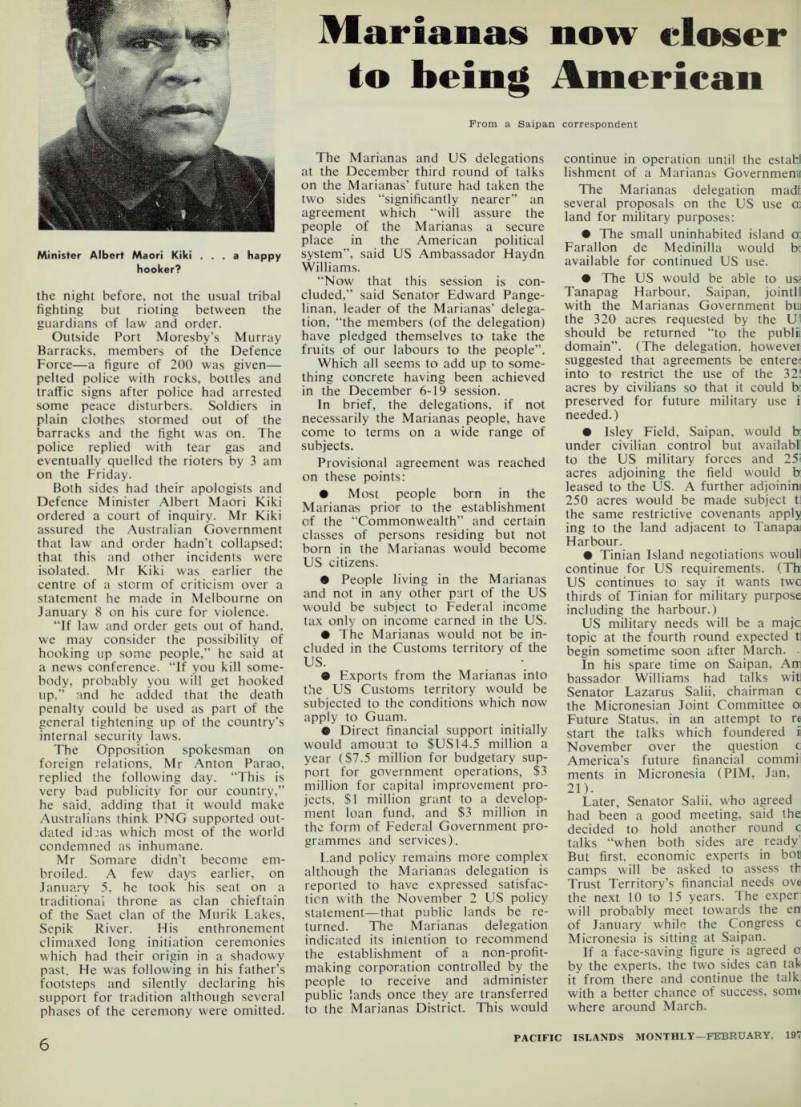
Minister Albert Maori Kiki ... a happy hooker?
New Hebrides Wants Some Action
Calling for a new deal for New Hebrideans, Mr George Kalkoa told members of the Advisory Council at its Budget session that he was pes simistic about the condominium’s future prosperity. He wanted a new deal and an end to what he called “exploitation”. The expertise of the United Nations technical service should be enlisted to help the group towards further prosperity.
The British Resident Commissioner, Mr du Boulay, replying to a question by Mr Delacroix about elections in 1974, said electoral reform was being discussed. He had attended such a discussion in London. But a meeting
which was to have been held between Britain and France in November on the subject had been unavoidably postponed. The council would be kept informed of further develop ments.
Archdeacon Rawcliffe said the two metropolitan governments should “get a move on” so that some progress could be made on electoral pro cedures, and in having representation for the New Hebrides people in the council.
Mr du Boulay said he could con firm, from his own experience, that the metropolitan governments were aware of the need for urgency.
to being American
Marianas now closer to being American
From a Saipan correspondent
The Marianas and US delegations at the December third round of talks on the Marianas’ future had taken the two sides “significantly nearer” an agreement which “will assure the people of the Marianas a secure place in the American political system”, said US Ambassador Haydn Williams, “Now that this session is con cluded,” said Senator Edward Pange linan, leader of the Marianas’ delega tion, “the members (of the delegation) have pledged themselves to take the fruits of our labours to the people”.
Which all seems to add up to some thing concrete having been achieved in the December 6-19 session.
In brief, the delegations, if not necessarily the Marianas people, have come to terms on a wide range of subjects.
Provisional agreement was reached on these points: • Most people born in the Marianas prior to the establishment of the “Commonwealth” and certain classes of persons residing but not born in the Marianas would become US citizens. 0 People living in the Marianas and not in any other part of the US would be subject to Federal income tax: only on income earned in the US. • The Marianas would not be in cluded in the Customs territory of the US. 0 Exports from the Marianas into the US Customs territory would be subjected to the conditions which now apply to Guam. ® Direct financial support initially would amount to SUSI4.S million a year ($7.5 million for budgetary sup port for government operations, $3 million for capital improvement pro jects, Si million grant to a develop ment loan fund, and S 3 million in the form of Federal Government pro grammes and services).
Land policy remains more complex although the Marianas delegation is reported to have expressed satisfac tion with the November 2 US policy statement —that public lands be re turned. The Marianas delegation indicated its intention to recommend the establishment of a non-profit making corporation controlled by the people to receive and administer public lands once they are transferred to the Marianas District. This would
continue in operation until the estabd lishment of a Marianas Government The Marianas delegation mad! several proposals on the US use oo land for military purposes: • The small uninhabited island oc Farallon de Medinilla would be available for continued US use. • The US would be able to us?
Tanapag Harbour, Saipan, joint!! with the Marianas Government bit the 320 acres requested by the Ul should be returned “to the publii domain’’. (The delegation, however suggested that agreements be entered into to restrict the use of the 32! acres by civilians so that it could be preserved for future military use i needed.) • Isley Field, Saipan, would b: under civilian control but availabll to the US military forces and 25i acres adjoining the field would b: leased to the US. A further adjoinini 250 acres would be made subject tl the same restrictive covenants apply ing to the land adjacent to Tanapai Harbour. • Tinian Island negotiations woull continue for US requirements. (Th US continues to say it wants two thirds of Tinian for military purpose including the harbour.) US military needs will be a majc topic at the fourth round expected tl begin sometime soon after March. - In his spare time on Saipan, Ann bassador Williams had talks will Senator Lazarus Salii, chairman c the Micronesian Joint Committee ot Future Status, in an attempt to re start the talks which foundered ii November over the question c America’s future financial commii ments in Micronesia (PIM, Jan, 21).
Later, Senator Salii, who agreed had been a good meeting, said the decided to hold another round c talks “when both sides are ready’
But first, economic experts in bot) camps will be asked to assess th Trust Territory’s financial needs ove the next 10 to 15 years. The exper will probably meet towards the en of January while the Congress c Micronesia is sitting at Saipan.
If a face-saving figure is agreed a by the experts, the two sides can tak it from there and continue the talk: with a better chance of success, sorm where around March.
fairy godmother, beats fuel crisis ...
La belle France, Caledonians' fairy godmother, beats fuel crisis ...
From a Noumea correspondent
As predicted, the introduction of petrol restrictions in Noumea im mediately inspired the French inhab itants to make use of the “System D”, —ways of working round the law.
Actually, the French have a very tolerant attitude towards harsh laws, since every citizen knows that the rules are only meant for some other poor fellow who isn’t smart enough to wrangle a good deal for himself. (Hence, Anglo-Saxons are considered stupid for their system of waiting in queues and insisting that even their patricians obey the same rules as the plebs).
But experts in the “System D” cer tainly had their wits tested by the Caledonian petrol restrictions. On December 4, it was announced the sale of petrol by jerrican was for bidden; petrol sales were prohibited between 3 pm Fridays and 6 am Mon days and petrol could not be used for pleasure boats. Later, traffic was limited to a maximum speed of 100 km an hour on Caledonian roads, while an hour’s daylight saving was introduced on January 1.
Siphoning of petrol from one car to another was forbidden, even by employees trying to help their boss.
But despite the police penalties, there was such a rush on sales of siphoning tubes that the press took great pains to describe the bodily harm resulting from inhalation of petrol fumes and the ghastly medical treatments that could be consequently required.
Protests against the petrol re strictions were immediate and wide spread. Loudest outcry came from the inland, where the residents were particularly hostile that plans were proceeding for the island’s seventh annual Safari motor trial around the island, yet the locals were restricted in their work and other movements, especially with petrol sales forbidden for the four days over both the Christmas and New Year periods.
Inland residents, especially, de plored the Safari waste of petrol and unnecessary damage to already poor grade roads. The Territorial Assem bly called for the cancellation of the trial, but the answer from the French Administration was firm: the assem bly has no power to intervene.
A nickel company newspaper, co sponsor of the trial, produced a front page editorial painstakingly explain ing the Safari could not be cancelled since another sponsor, UTA French
Airlines, had already gone to such trouble to line up metropolitan French drivers, journalists and cameramen to come and cover the event.
The impact for Caledonian tourism could not be sacrificed.
Finally, in face of heated reactions, the Bourail lap was eliminated while at another west coast town, Voh, angry residents blocked the road to Safari drivers.
If motoring and tourist promoters had succeeded with “System D”, the boating fraternity was not to be left behind. At the Cercle Nautique yacht club, it was claimed that the 400-odd craft, worth about SAIO million, could not be sacrificed for want of regular use. A system of petrol allocations with the issue of special tickets was thus approved for such pleasure craft.
The whole shock of the oil drama provided a wonderful exercise for
Paris to reinforce ihe popular stimu lus-response pattern of Caledonians holding out their hand and being “saved” by the French motherland.
Initially, British and US distributors announced they would cut the island’s oil supplies by up to 20 per cent, In proclaiming the sudden restrict ions, the French authorities had claim ed the situation was serious ... but then not really serious when it came to a local demand for the cancellation of the Safari. Still, serious enough for an SOS to be promptly despatched to France, with an almost unbeliev ably prompt reply insisting that France sought to guarantee New Caledonia the same quantity of oil this year as she obtained in 1973.
So the crisis at least served the purpose of reminding Caledonians how unwise it would be to demand internal self-government from such a kind fairy godmother.
supplies are dwindling
... But other islands find supplies are dwindling
The world fuel crisis is starting to bite in the Pacific Islands. As suppliers cannot guarantee deliveries some form of fuel rationing has become necessary. In most cases this is voluntary, with a threat of mandatory cuts; in other cases there are legal restrictions on the use of fuel, On top of the shortage the Arab exporting nations have imposed savage increases in the price of fuel, and this will eventually flow through to commercial and domestic users of fuel. Inflationary trends will be given another boost.
There was panic buying of fuel in the Cook Islands after Mobil advised there would be a 20 per cent cut in supplies. Some customers produced 44 and four-gallon drums, and it soon became apparent the available bulk supply was seriously reduced.
On December 10, the government introduced stringent energy fuel rationing in Rarotonga. There were also economy measures in the outer islands, which have very little motor traffic. The Rarotonga weekly ration was five gallons for trucks, three gallons for cars and utilities and only half a gallon for motorcycles. Kero-
sene and diesel fuel were also rationed.
The Nauru Phosphate Commission, which supplies power to the island, warned that greater efforts than pre viously were needed to conserve power. There had been savings, but not enough, and official restrictions loomed. Nauru is expected to receive its next shipment of fuel in March, by which time the island will be down to two weeks’ supply. The suppliers will not guarantee the quantity in the next shipment.
In the GEIC there was also panic buying, which resulted in motorists being restricted to one gallon and motor-cyclists to half a gallon. It was ordered that petrol had to go into a vehicle tank, effectively cutting off attempts to fill containers. In some circumstances, with official per mission, fuel could be sold in con tainers. Some GEIC bus services were withdrawn; others were re scheduled.
Tonga initially relied on an appeal to cut the use of fuel after oil com panics advised supplies would be cut
Continued on p 101
by 20 to 25 per cent. The Electricity Board is the biggest user of fuel in Tonga. The government appealed to the people to cut out the use of appliances, or use them sparingly, and restrict lighting to an absolute mini mum. People were asked to cut out unnecessary motoring, and, where possible, to use gas instead of electricity for cooking. The govern ment warned against hoarding of fuel, saying it was an offence to build up stocks in times of scarcity.
Western Samoa also experienced panic buying, which was unnecessary as Mr Peter Paul, managing director of Gold Star Transport Co, said there was enough petrol for everybody.
But that did not stop motorists top ping up their tanks, and queueing up outside petrol stations. There was a 20 per cent cut in oil for power generators, and voluntary cuts were called for.
Fiji must be close to official ration ing. The government made an early appeal for restraints, and although there was some response almost rijjt across the board, it was not sufficient.
The government wanted a 20 per cent cut in power output, but the target was not reached. The cuts in power were likely to lead to further argu ment over the building of hydro electric power stations.
In the US Trust Territory the fuel problems have delayed the return to their home on Bikini of the people who were evacuated for the nuclear tests in the late 19405. It had been hoped to return them from Kili, where they have been living, by Christmas, but this proved too opti mistic.
Officials are unable to say when they can ship building materials to Bikini.
Nutshell
In a Nutshell
Big moves are afoot with Air Pacific. The airline is about to move into the big time with its expected nomination by the Fiji Government as the dominion’s international flag carrier.
It will still be known as Air Pacific on the regional and international routes but, as the internal airline, it will revert to its old name of Fiji Airways. Staff changes are pending and these will bring back to Fiji a familiar figure, who helped to build Fiji Airways—Mr Chris Ritchie, manager in the 19605, who is leaving a Qantas executive post to become managing director of Air Pacific. He is expected in Suva in February.
Mr Kit Naidu has been appointed sales manager of Air Pacific, succeed ing Mr David McEwen, who is re turning to Qantas after being on secondment in Fiji for 5i years. Mr Naidu joined Qantas at Nadi in November, 1966.
MAIL THEFTS. —-Mail raiding is rife in parts of the Pacific. The Chief Justice of Tonga, Mr Justice Roberts, recently sentenced two post office employees to prison terms of two years and 18 months for having stolen mail. He warned that such crime must be stopped at all costs, and if it did not he would not hesi tate to pass the heaviest sentence the law allowed. Probation for first offenders would not be considered.
About the same time the Luhesand arrived in Tonga from New Zealand, via Apia, with 255 bags of mail from Australia and New Zealand. Thirty four of the bags had been tampered with. The contents of some parcels were missing while other parcels had been emptied.
The third mate of the ship told the Chief Postmaster at Nukualofa that the thefts occurred at Apia. That was not the first time mail for Tonga had been tampered with when the ship arrived via Samoa.
In Papua New Guinea, the Minister for Posts and Telegraphs, Mr Kaibelt Diria, reported that 10 bags of mail were stolen from Jack sons Airport terminal storage office of Macair about mid-December. 60,000 IN GElC.— Early counting in the recent census in the GEIC suggests a total population close to 60,000. The figures from all islands,
except Tabiteuea, Aranuka, Abaiang and Nanumea added up to 47,024, and the census officials expected those islands would add at least 11,500, to give a figure of about 58,500. Add another 1,800 Gilbert and Ellice Is landers working in Nauru and the total would be more than 60,000, compared with a little more than 55,000 counted in the 1968 census.
MAUKE’S UFO.— Mauke Islanders in the Cooks claim they recently saw an unidentified flying object explode at low level, in silence. The object, on an east to west course, burned brightly for about two minutes before its silent explosion. Most of the 800 population of the island said they saw the UFO.
Remains Recovered.—A Jap
anese team searching for war dead recovered the remains of 1,971 Japanese servicemen killed in Truk, Ponape and the Marshall Islands in World War 11. Some of the bones were recovered from a sunken sub marine in Truk lagoon, and some from a cave on Ponape.
PRICE OFFENCE.— Morris Hed strom Ltd was fined $2OO in Suva in January for failure to comply with a price control order. It was alleged that the company sold 20 100-lb bags of rice to a Samabula shopkeeper at $14.70 a bag instead of the wholesale control price of $13.66. The com pany was not represented at the hearing.
Png Rural Wages—A Board
of six will hold an inquiry to see whether the current $5.90 a week for rural workers in Papua New Guinea should be increased to $6.40. The board will also inquire into other matters covering rural workers.
Bsip Tourist Hopes.— The
Solomon Islands Tourist Authority is looking for a flow-on benefit from a big increase in the number of tourists visiting the New Hebrides, which had more than 12,000 tourists in 1973.
The chairman of the authority, Mr James Tedder, who recently attended a tourism conference in Noumea, said the New Hebrides could overtake New Caledonia in tourism. People seemed to be moving away from the more crowded resort areas, and the BSIP could benefit from that trend.
REBELS FREED. —lndonesia has released 67 former Irianese rebels in Irian Jaya. The group, members of the Free Papua Movement, read a statement of loyalty to the Indonesian Government. The movement wants an independent Papuan state, sepa rated from Indonesia. Many of its members fled into Eastern Papua be
fore Indonesia held its “referendum”' on the future of the country in 1969 J
Santa Maria Shake.— Majon
earth tremors shook volcano*-' threatened Santa Maria Island fromr late in December to the middle oft January. Readings were 7.5 on the 3 Richter scale. There has been strongs earthquake activity in the area fon some time, causing a French scientist! to predict that Mt Caret on the island! would erupt. On this warning, about! 450 people who lived on the island! were evacuated to a nearby island last!
December. Santa Maria, knowm locally as Gaua, is one of the Banks* Islands in northern New Hebrides.
NAURU WEDDING.— In one ofi Nauru’s biggest celebrations for years,.
Jeanette, 21-year-old daughter of 3 President Hammer Deßoburt, was* married at the Orro Protestant] Church in December to Gordon Basill Hiram, member of a well-knowni island family. About 2,000 guests en joyed a special entertainment staged! for the occasion by the Betela Dance: Troupe from the Cook Islands, which: was on its way home after a concert] tour of Japan.
BOMB TESTS.— The French are; drilling in the coral rock of Fanga taufa Atoll near Mururoa where they hope to hold underground nuclear tests by 1975. The first experimental I hole was 650 metres deep going through 400 metres of coral and lava before reaching a layer of basalt, which makes up the summit of the underground volcano on which Fan gataufa sits.
The aim is to transfer testing from the atmosphere over Mururoa and Fangataufa Atolls, where they have been held since 1966, and which have become subject to increasing criticism from Pacific countries. But the 1974 tests will be held in the atmosphere according to a statement by President Pompidou, of France.
He said that France was determined to carry out its test programme.
Following studies of the experi mental hole, digging was scheduled to start in January to sink the shaft where the tests will be carried out 1,500 metres underground in the basalt, where there will be no risk of radioactivity seeping into the at mosphere.
It has now been revealed that one of the 1973 tests off Mururoa, was the dropping of a tactical bomb from ai Mirage 111 fighter-bomber. It was: only the first or second time the; French exploded a bomb that way.
The usual practice was to explode the bomb while it was suspended from a balloon about 300 metres above ground.
Love Laughs At Locksmiths And
Ancient Indian Traditions
From Vijendra Kumar in Lautoka
Krishna and Lila are in their early j 20s and have been married for about four years. The couple lives with Krishna’s elder brother on the family owned farmstead. Krishna works in the neighbouring town of Lautoka as a tailor. Lila, like thousands of young Indian wives, is content to stay home and keep herself busy in household chores. Like most young starry-eyed couples, they find life enjoyable.
Though Krishna and Lila are like any average, young Indian couple, they represent a new breed of men and women who are breaking away from the shackles of tradition ally-conservative marriage patterns.
Indentured labourers from India, who first came to Fiji in 1879, were mainly from backward rural areas.
Naturally, they brought with them strict religious and social norms pre valent in rural India.
One of these was the age-old marriage system which does not re cognise pre-marriage romantic con tact between a boy and a girl. The traditional Indian view is that love comes after marriage. Ridiculous as this sounds, the system has worked— both in India and in Fiji.
According to a social worker who is associated with marriage counsel ling among Fiji Indians, about 80 per cent of all marriages are still arranged by the couple’s parents.
“But recently there has begun a shift from the traditional system. The educated and sophisticated young Indian men and women are beginning to look for their partners in defiance of their parents and society,” he says.
The marriages and deaths registry in Suva reports that it is receiving a flood of applications for special marriage licences from young Indian men. It said it issued an average of 50 licences a week.
Special licences are issued without the consent of the parents (if those concerned are over 21) and permit the marriage to take place immediately. A regular marriage application requires public notice.
Young Indians have started a mild social revolution which is bound to shake the infrastructure of Indian society. . The bulwark of the Indian society is its closely-knit family unit. It has either a patriarch or matriarch at
the head who literally holds the family reins. Such major family events as marriages, mourning, celebration of a birth, are determined by the head. Sons in the family must live within the unit even after their marriage and contribute to a pool for expenses to support the entire family.
But, according to the social worker, the family unit is gradually disinte grating. Educated young wives, who often have a career of their own, just have no stomach for their in laws authoritarian supervision.
Husbands too want to lead their own independent lives and bring up their children as they want, and not as their parents would direct them.
“Sometimes, this sort of attitude creates a great deal of bitterness between a son and his parents, but most parents are beginning to accept it,” the social worker says.
Like Krishna and Lila, many young Indian men and women are search ing for, and finding fairy-tale romances leading to successful
marriages. The story of Krishna and Lila is like a chapter from a Vic torian romance. Krishna comes from rustic North Indian stock. Lila is a fragile and cloistered flower from an opulent and fiercely clannish Gujerati (merchant class) community. Their homes were a couple of chains apart and the inevitable happened. Cupid’s arrows found their marks and the two fell in love.
But, to Lila’s father, marriage to an “outsider” was unthinkable. While attempts were being made to end the romance by sending Lila away to another country, the couple eloped and lay hidden for a week. Frantic searches failed to unearth them. When the moonstruck pair emerged from hiding, Lila’s father felt he had no choice but to consent to the marriage, as in his eyes his daughter was defiled. Though the two families are on speaking terms, the marriage has not brought them any closer.
A marriage, according to the old order, is normally arranged through an intermediary or a “marriage broker”. He is usually the local priest or the village barber, both itinerant professionals. A girl’s father approaches him to look for a suitable groom. The priest may sometimes look up the girl’s horoscope to find out when and where a suitable groom may be found.
When he has found a likely prospect, the girl’s parents and relations call on the boy’s parents with a proposal. This is followed by a visit from the boy’s parents. The prospective groom also visits the girl’s house to view the “merchan dise.” If she is beautiful, he normally falls for her, if she is plain, he or his spokesman may drop a hint that a dowry—cash, a car or a piece of land—would make the girl more attractive. If the girl is ugly, it is unlikely that even a large dowry may appeal to him.
Plain girls usually end up old maids or as second wives to decrepit but lecherous widowers. To most Indian men, a girl is beautiful if she is light-skinned. Dark-skinned girls, even though they may have the classic features of Nefertiti, are just not attractive.
The new marriages, where love counts above all else, are cutting
across religious and sectarian barriers.
Modern young Indians, with their sophisticated education and awareness of social mores in Western countries, have scant regard for religious and social taboos. Several Hindu boys, some from Brahmin families, have “tarnished” the family honour by marrying Muslim or Christian girls.
True, some of them have bowed to fanatical demands from the girl’s parents by converting to either Islam or Christianity. But often, there are no such pressures.
Significantly, inter-racial marriages are very rare. There are some Indo- Fijian marriages which have turned out to be very happy relationships.
One of my Indian friends, who is married to a Fijian girl, is the proud father of three extremely beautiful children. They are a perfect example of eugenics. His wife is not only highly-educated but comes from a chiefly family. The couple is respected and accepted by both communities.
There are. on the other hand, examples of thwarted love. Maria, a young attractive Fijian girl, fell in
love with a Muslim boy. His parents reluctantly agreed to a marriage but the girl’s parents, who belong to an aristocratic family, objected. The girl had to bow to their wishes or face ostracism.
Together, with the new trends in marriage patterns, the Indian society faces a threat from another direction.
The Civil Courts are crammed with divorce or separation cases. Accord ing to one court officer, the com monest ground for divorce proceed ings is desertion by the husband, who often leaves his wife for another woman. In a large number of cases, the triangular relationship involves the husband’s sister-in-law. She could be his elder brother’s wife or his wife’s younger sister. In rare cases, the husband may accuse his wife of adultery and seek a divorce.
Another common practice among Indians is for a man to have one legal wife and one or more de facto wives. Some leading politicians are openly living in menage a trois and they still enjoy the confidence and respect of the public. Some of my
own friends have two or even three* wives. I know one man who i:i legally married to the elder sistei* and began a relationship with then younger sister soon after the marriages Both sisters live under the same roofl I don’t know if he has a ‘triple bed’l Because of the repressive sodas structure of the Indian society, it ha;i an unstable core. Social welfarr workers and civil courts sometimes get to hear of the seamier side oc life. Cases of incestuous relationship between father and daughter, mothes and son, brother and sister and th«i much more common uncle-niecc syndrome are not uncommon.
Corrupt priest and withdoctorr prey on innocent girls whose simpld and trusting parents take them to thu vultures for healing or exorcising evil spirits. Illicit pregnancies are comi mon and almost every Indian settle ment has a mid-wife abortionist.
Against this background, the ques for love and freedom by rebellious youth comes like a fresh breez« from Camelot.
A dollar a hair?
Young Kailas Prasad had his hair cut in Fiji and it cost his father somewhere around $1,500.
But it wasn’t an ordinary haircut.
Kailas, aged 16 months, was taken by his father Mr Dhani Prasad, a devout Hindu, living in Waihi, New Zealand, to have his first haircut in a traditional Hindu ceremony.
The boy and his father had to wait in Fiji for more than two weeks before the ceremony could be performed. Mr Prasad, who went to live in New Zealand from Fiji 12 years ago, said that according to Hindu tradition the first hair was bad hair because it came from the stomach and should be cut out in a special ceremony.
His three elder sons, also born in New Zealand, have made the same trip and Mr Prasad hap pily footed the bill of several thousand dollars.
The latest ceremony would cost about $1,500.
About That Comet
Some Citizens Know
From Vijendra Kumar in Lautoka
CHRISTMAS was one of Fiji’s guietest ever. The usual at mosphere of Yuletide cheer and bonhomie were sadly missing. And the New Year was more or less a non-event. But for the banging of empty oil drums by carefree children on New Year’s Eve, one would have hardly noticed.
Indeed, there was little to be joyful about. Just a few days be fore the festive season, Fiji was stunned by the sinking of two inter-island vessels which claimed 84 lives. In November, the people suffered a brutal shock with the realisation that the world energy crisis had invaded their homes.
Last year was crisis-ridden.
Early in the year, the government imposed rigid prices and in comes regulations in a futile attempt to curb inflation. The
government’s repeated claims that
statistics showed that the policy was working did not convince the masses who wanted, not statistical data, but tangible evidence of a price fall in goods and rents.
Continued labour troubles plagued industry. Unions called strikes at will. Even the Fiji Sugar
and General Workers’ Union, which is legally prohibited from calling strikes, withdrew all its labour, forcing Fiji’s all four sugar mills to close down for more than a week.
The civil servants, normally a docile body, went on strike. So did several other groups. All these wildcat strikes proved one thing: No government can wipe out in dustrial unrest just by legislation.
The controversial Trade Disputes Act, which the government ram med through earlier in the year, proved ineffective.
As if man-made disasters were not enough, a freak cyclone which weathermen had named Lottie, slammed Kadavu south of Viti Levu, flattening homes and crops.
The previous year it was Hurricane Bebe from which nation-wide devastation Fiji is still recovering.
In superstitious Fiji, the omens for 1974 are worse. The vernacular newspapers have been carrying stories of doom from astrologers and other star-gazers. Most of their projections, the newspapers report, are based on the sudden emergence of the comet Kahoutek.
One Hindi newspaper carried a front page banner headline saying that there were prophecies of world-wide destruction. A comet was regarded as a sure omen of misfortune since the creation of the earth, it wrote.
"In 9 BC, after sighting a comet, the oracles warned King Herod that a child would be born who would be more powerful than the king. As a result, Herod had thousands of new-born children slaughtered. Jesus was born,” the weekly Jai Fiji wrote.
The paper cited another his torical case when a comet ap peared in 451. The same year, Attila the Hun rampaged Europe.
"According to Hindu scriptures,” the paper said, “death and destruc tion would stalk the planet in the form of a comet. Most Christians believe that the world would be destroyed after a Middle East war and Jesus would be re-born to save mankind.”
In the villages and farming settlements, the talk invariably turns to Kahoutek. There is general agreement among the simple folk that it is an omen signifying the end of this world.
"What can one do against Fate?” an old woman asked me during a discussion on the sub ject. "I am prepared to meet my maker,” she added resignedly.
Tropicalities
Sir Albert
has a flutter
Christmas Eve brought more than Father Christmas and his presents to the Cook Islands. It also brought legal betting on sports in the shape of the Totalisator through which the islanders can have their flutter on horses in the Cooks, in New Zealand and presumably, in other countries like Australia.
Parliament passed the necessary legislation on December 21 and the tote opened for its first performance on Christmas Eve. Some of the pun ters queued for half an hour before the windows opened. The doubtful honour of being the first to put his money on was Premier Albert Henry (now Sir Albert) who thus gave it his official blessing. First bets were on the Queen Elizabeth II Handicap run at Auckland on Christmas Day with a commentary broadcast in the Cooks. There were no reports that Sir Albert was on a winner. In the first 10 minutes of business more than $lOO was wagered.
The Totalisator Board, which has Dr Joseph Williams as its chairman, must have been pleased with the first
day’s operations which yielded $633.50 of which the board gets 20 per cent and the successful gamblers shared $5OO. The Cook Islands News, which is now devoting much space to the race cards and results, repor ted that investments on the Cooks tote gave a much higher return than those in New Zealand, particularly for the third horse, Not Again, which paid $21.40 for a dollar compared with a dividend of $4.95 in Auck land.
According to the Minister of Soc ial Services Mr T. A. Henry, all sur plus money made by the tote after paying the winners, who get 80 per cent of the gross takings, with five per cent going for tax and 15 per cent for expenses, will be paid into a fund to provide grants for local sports clubs and other organ isations. There may be something left after expenses are paid because all the tote workers are giving their services without charge.
There was a national raffle held at Raratonga on Christmas Eve also with a profit target of $2,500 to go to the Cook Islands Sports Associat ion.
How about a football pool?
Drums roll
for Eddie Lund
After Eddie Lund, the celebrated composer and pianist of Tahiti, died in Los Angeles in December, aged 64 his ashes were flown to Papeete for burial. And that’s how it should be. For many years Eddie was the director of Quinn’s Tahitian Hut in Papeete, the most famous cabaret in the South Pacific, now defunct. He was the composer of numerous Tahitian songs and dances, many of which were recorded and played throughout the world. He was also
the author of a mass which was per formed each Christmas in Papeete, James A. Michener once described Lund in his days at Quinn’s in these words: “By the door, on a raised dais, sits the frenzied American pianist, Eddie Lund, the Tahitian wonder boy. Small, underweight, bald-headed, he is a jovial tunesmith who produces one lilting song after another. He has written an island opera, dozens of popular ditties and hymns. He writes only Tahitian words, rare bouncy jobs ... He looks like Eddie Foy, eats huge meals, loves to gamble with Chinamen and starts everv conversation with ‘Hey!’”
Lund was born in Vancouver on October 12, 1909. He attended school in Vancouver and university at Portland, Oregon, then served in the US Army in World War 11. He first visited Tahiti as a tourist in 1935 and became a resident in 1938.
Ilc'dirated to
Paeifieana
Dr John Cumpston, former Aus tralian Consul in Noumea and official historian for the Australian Depart ment of Foreign Affairs, now occupy ing himself with his small private publishing firm, Roebuck (PO Box 17, Aranda, Canberra), completes this month yet another service for Paeifieana and Australiana collectors.
He’s successfully taken on produc tion of volume nine of the facsimile indexed edition of The Sydney Gazette, Australia’s first newspaper, published from 1803. Earlier volumes in this series, filled with early Pacific Islands intelligence, have been pro
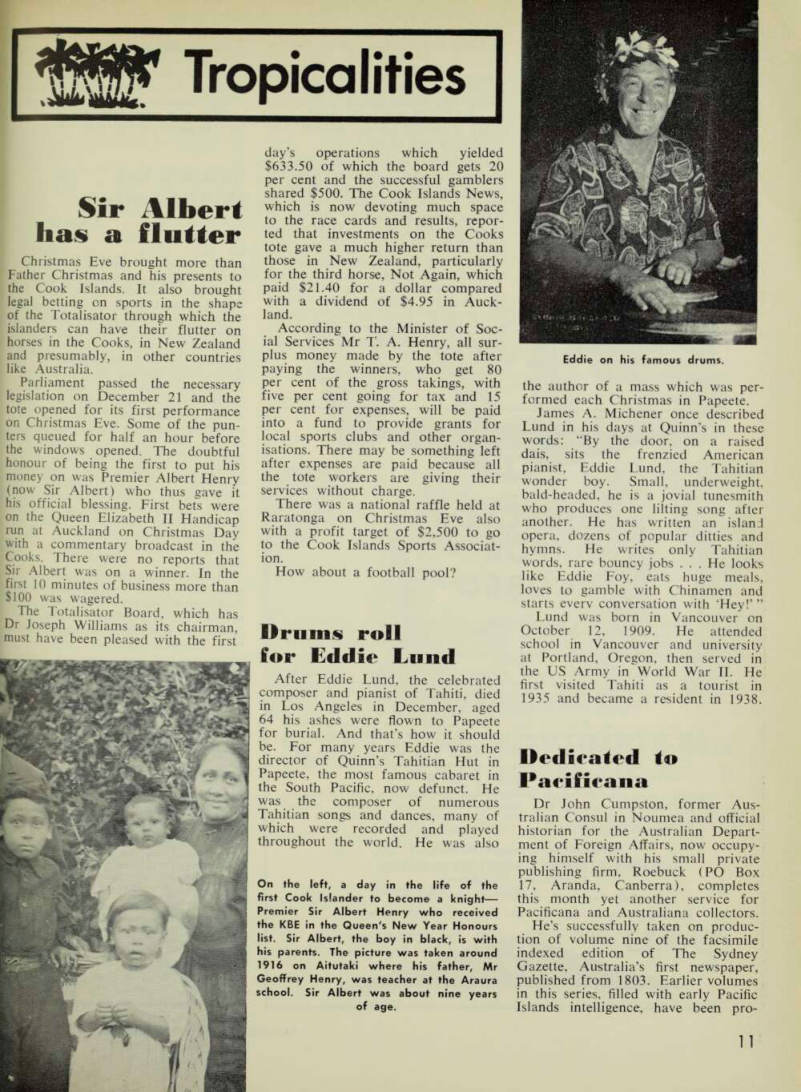
On the left, a day in the life of the first Cook Islander to become a knight— Premier Sir Albert Henry who received the KBE in the Queen's New Year Honours list. Sir Albert, the boy in black, is with his parents. The picture was taken around 1916 on Aitutaki where his father, Mr Geoffrey Henry, was teacher at the Araura school. Sir Albert was about nine years of age.
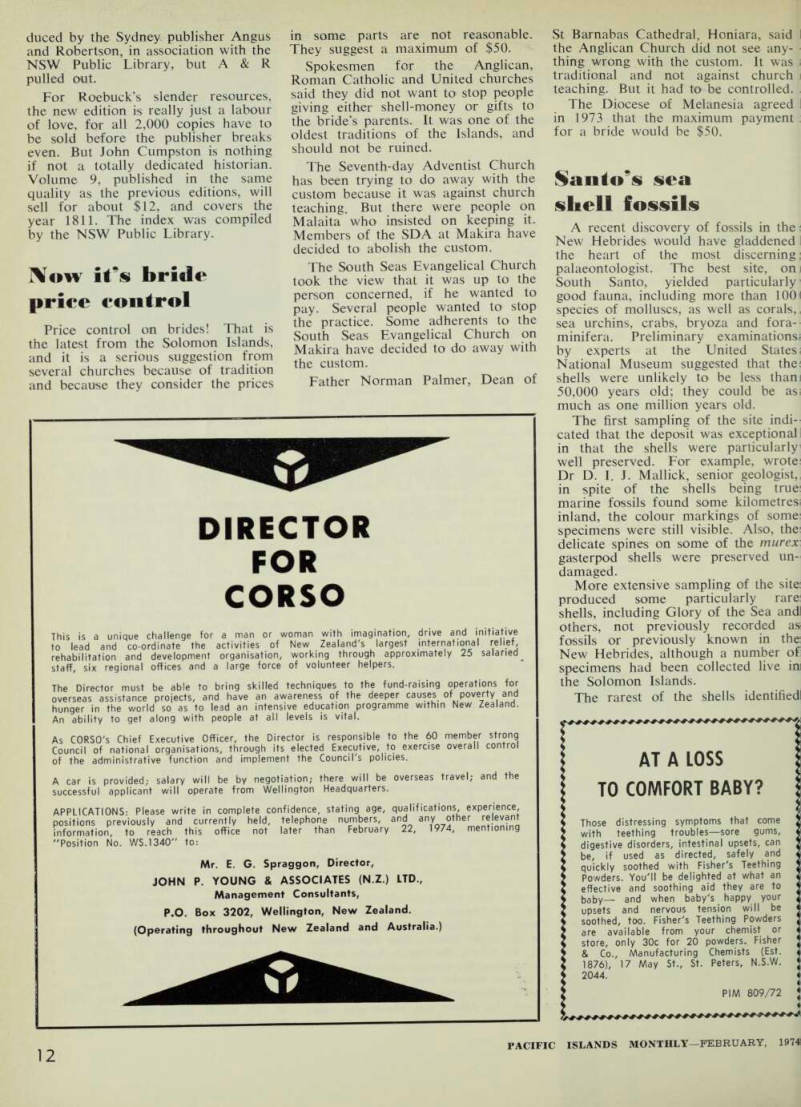
Eddie on his famous drums.
duced by the Sydney publisher Angus and Robertson, in association with the NSW Public Library, but A & R pulled out.
For Roebuck’s slender resources, the new edition is really just a labour of love, for all 2,000 copies have to be sold before the publisher breaks even. But John Cumpston is nothing if not a totally dedicated historian.
Volume 9, published in the same quality as the previous editions, will sell for about $l2, and covers the year 1811. The index was compiled by the NSW Public Library.
Now it’s bride
price control
Price control on brides! That is the latest from the Solomon Islands, and it is a serious suggestion from several churches because of tradition and because they consider the prices
in some parts are not reasonable.
They suggest a maximum of $5O.
Spokesmen for the Anglican, Roman Catholic and United churches said they did not want to stop people giving either shell-money or gifts to the bride’s parents. It was one of the oldest traditions of the Islands, and should not be ruined.
The Seventh-day Adventist Church has been trying to do away with the custom because it was against church teaching. But there were people on Malaita who insisted on keeping it.
Members of the SDA at Makira have decided to abolish the custom.
The South Seas Evangelical Church took the view that it was up to the person concerned, if he wanted to pay. Several people wanted to stop the practice. Some adherents to the South Seas Evangelical Church on Makira have decided to do away with the custom.
Father Norman Palmer, Dean of
St Barnabas Cathedral, Honiara, said I the Anglican Church did not see any- • thing wrong with the custom. It was < traditional and not against church i teaching. But it had to be controlled. .
The Diocese of Melanesia agreed 1 in 1973 that the maximum payment ; for a bride would be $5O.
Santo’s sea
shell fossils
A recent discovery of fossils in the; New Hebrides would have gladdened J the heart of the most discerning; palaeontologist. The best site, onj South Santo, yielded particularly 1 good fauna, including more than 100( species of molluscs, as well as corals,, sea urchins, crabs, bryoza and fora-minifera. Preliminary examinations* by experts at the United States j National Museum suggested that the; shells were unlikely to be less thani 50,000 years old; they could be as; much as one million years old.
The first sampling of the site indi cated that the deposit was exceptional] in that the shells were particularly 1 well preserved. For example, wrote; Dr D. I. J. Mallick, senior geologist,, in spite of the shells being true: marine fossils found some kilometres* inland, the colour markings of some: specimens were still visible. Also, the: delicate spines on some of the murex\ gasterpod shells were preserved un damaged.
More extensive sampling of the site: produced some particularly rare; shells, including Glory of the Sea andl others, not previously recorded as fossils or previously known in the; New Hebrides, although a number of: specimens had been collected live ini the Solomon Islands.
The rarest of the shells identified!
was the cypraea porteri, previously known only from one solitary speci men taken live in the Philippines.
Other rare species include conus sowerbii and conus kimioi, which were usually collected only by dredg ing. This suggested that the deposits containing the South Santo fossils probably accumulated in fairly deep water.
The fossils were discovered during a mapping operation by the Geo logical Survey Department of the British National Service.
Spreading the
Word by raeht
An Auckland couple, Mr and Mrs Ron Russell, returned in December to their home after completing an 18months’ cruise around the South Pacific Islands in their yacht Day spring. But, they weren’t the ordinary yachtee type. TTiey went as mission aries, believing, they told the Auck land Star, that God wants them to evangelise among the Islanders, In their more than 5,000-mile travels they visited islands in Fiji and the GEIC. They also acted as agents for the Bible Society and distributed Bibles wherever they went.
So far, they say, they have only skimmed the surface and expect to leave in April for three years’ work among the Islands.
Mr Russell’s comment about the Islanders’ faith should raise a few missionary eyebrows—“ The people in the islands we have visited have a good idea of Christianity”.
Election day
on Pitcairn
Presumably taking advantage of an abundance of peace and goodwill, the Pitcairn Islanders have traditionally held their elections on Christmas Day. This year there was total unanimity—and with it history was made, women for the first time taking their place on the Island Council.
In his regular radio chat with the Seventh-day Adventist centre in Cali fornia, Tom Christian reported that two women—Thelma Brown and Carol Christian—had been elected unopposed to Pitcairn’s chief adminis trative body. At the same time Ivan Christian was elected unopposed as chairman of the council.
The simplicity of election pro cedure in Pitcairn, just as simply summed up by Tom Christian, is worth noting: “Our laws say that if
a person is nominated and seconded by the public, and there are no opposing names for the post, then there is no need for balloting.”
While democratically - speaking it rules out the reasonable possibility of a single nominee being rejected by a majority, the system has much to commend it in terms of moneysaving: no balloting, no registrations, no scrutineers.
Christmas 1973 on Pitcairn seemed as good a time as any for a holiday.
With fuel supplies at a low ebb, many of the items of “modern living” on Pitcairn were not working. So, after celebrating Christmas Eve with carols by doodwi nut torches (good light but a bit smoky) and Christmas Day
with a “non-election election”, half the islanders set off for a week’s holiday on Oeno Island, 75 miles to the north-west. (The other islands in the Pitcairn group are Henderson and Dude—uninhabited like Oeno.) The trip was made in the 36-foot long boats.
On the fuel front, it was back to modern living early in January when supplies turned up. Arrangements have been made to secure supplies indefinitely. The Pitcairners had a kind of census last September and later the island’s Miscellany published the names of all the Pitcairners, ages and all, which wasn't difficult. There were only 71 of them plus seven
“foreigners” who weren’t named.
The 71 shared five family names— Christian, Brown, Clark, Warren and Young.
New Year
equality wish
One form of New Year wish ex pressed in Noumea was that expatriate public servants from France should share more “liberte, egalite et fra temite” with their Caledonian col leagues.
The metropolitan French public servants enjoy various privileges, in cluding an “away from home allow ance” for service in New Caledonia.
This allowance amounts to 14 months extra salary, about SAB,OOO for the lower ranks, which is repeated for each term of about four years’ service.
After a heated protest made in the Territorial Assembly, the majority urged that this allowance be reduced to a minimum of three months extra salary, payable only on the first term in the territory. Needless to say, the Caledonian Assembly could only “express a wish”, which like many a New Year resolution, has no power to see it carried out.
Hunger knows
no borders
When the Cook Islands Minister of Supportive Services, Mr I. Akar uru, visited Penrhyn Island recently he saw three Japanese and Korean fishing vessels outside the reef near Omoka village and a fourth one anchored outside the reef near Tautua village, eight miles away across the lagoon.
Foreign vessels are not supposed to call at the outer Cooks except in an emergency as there is a big risk of insect pests, plant diseases and human epidemics being introduced from the visiting ships. The intro duction of the rhinoceros beetle to the northern Cooks is especially dreaded as, apart from a little pearl shell, copra is their only export. The tuna boats are based at Pago Pago, American Samoa which has the beetle.
Mr Akaruru found that the Resi dent Agent at Penrhyn had tried to discourage the fishing boats from staying, but had received no support from the islanders because Penrhyn had run out of rice, flour, sugar and tobacco, and the Penrhyn people were visiting the fishing vessels to try to obtain supplies.
The islanders were in no danger
of starving as there are ample supplies of coconuts and lagoon fish, but even atoll dwellers have become accus tomed to a little more variety in their diet. Had they been approaching starvation level, the Resident Agent would have radioed the Premier’s De partment and the government would have chartered one of the two local traders to take food supplies there, a chore which would have cost the Cook Islands taxpayers $4OO a day for a seven or eight-day voyage, plus the cost of emergency food supplies.
Calls at the northern Cooks by the two local traders, Manuvai and Moana are infrequent due to the poor cargoes offering. Very little copra is made when world prices are low. However, due to recent improvements in copra prices, copra cargoes have been wait ing to be uplifted.
First French win
in Guam Games
The French won their point over the date of the 1975 Guam Games, arguing that the choice of July 5-17 was catastrophique because it was in the school term and most of their athletes were high school students who could hardly mix swotting with training. The dates have now been changed to August 9-22.
Advertisements & other items, pp. 14-19 (1 item)
Director
FOR
CORSO
This is a unique challenge for a man or woman with imagination, drive and initiative to lead and co-ordinate the activities of New Zealand's largest international relief, rehabilitation and development organisation, working through approximately 25 salaried staff, six regional offices and a large force of volunteer helpers.
The Director must be able to bring skilled techniques to the fund-raising operations for overseas assistance projects, and have an awareness of the deeper causes of poverty and hunger in the world so as to lead an intensive education programme within New Zealand.
An ability to get along with people at all levels is vital.
As CORSO's Chief Executive Officer, the Director is responsible to the 60 member strong Council of national organisations, through its elected Executive, to exercise overall control of the administrative function and implement the Council's policies.
A car is provided; salary will be by negotiation; there will be overseas travel; and the successful applicant will operate from Wellington Headquarters.
APPLICATIONS: Please write in complete confidence, stating age, qualifications, experience, positions previously and currently held, telephone numbers, and any other relevant information, to reach this office not later than February 22, 1974, mentioning "Position No. W 5.1340" to: Mr. E. G. Spraggon, Director, JOHN P. YOUNG & ASSOCIATES (N.Z.) LTD., Management Consultants, P.O. Box 3202, Wellington, New Zealand. (Operating throughout New Zealand and Australia.)
AT A LOSS
TO COMFORT BABY?
Those distressing symptoms that come with teething troubles —sore gums, digestive disorders, intestinal upsets, can be, if used as directed, safely and quickly soothed with Fisher's Teething Powders. You'll be delighted at what an effective and soothing aid they are to baby— and when baby's happy your upsets and nervous tension will be soothed, too. Fisher's Teething Powders are available from your chemist or store, only 30c for 20 powders. Fisher & Co., Manufacturing Chemists (Est. 1876), 17 May St., St. Peters, N.S.W. 2044.
PIM 809/72
V %
SUNUOVERS INTERNATIONAL
COLLECTION
New Reactamatics Handmade Frames New Rainbows Gradu Tints Aluminium Frames Latest High Fashion New Super Polarised
A. RIETTE (EXPORT) PTY LIMITED
Telegrams & Cables Ramartime Telephone 255144. 300 George St. Sydney 2000
S. E. TATHAM & CO. PTY. LTD.
ASKEW HOUSE, 364 LONSDALE ST.
MELBOURNE, 3001, AUSTRALIA.
G.P.O. BOX B—CABLES "SET"
TELEPHONE: 601125
Buyers for the Pacific Islands
PAPUA NEW GUINEA: S. E. TATHAM (P.N.G.) PTY. LTD.,
LAE: MALEKULA ST. (P.O. BOX 1552).
PORT MORESBY; CNR. GOROA & MUNAHU STS., GORDON
(P.O. BOX 6733, BOROKO).
FU[; S. E. TATHAM (FIJI) LTD.,
LAUTOKA P.O. BOX 366,
SUVA G.P.O. BOX 671,
YOUR GUARANTEE
FOR SERVICE
AND IN
SINCE 1924
In Lae, we’re the motel
people come back to.
They come back for a dip in our pool, the individually air conditioned, comfortably fitted units, first class fully licensed restaurant, our friendliness, our cocktail bar, and attention to the finest detail.
In Lae, stay at the Huon Gulf, and next time round you’ll come back.
Book direct, or through any office of Ansett Airlines.
Huon Gulf Motel
Markham Road, Lae. Phone: Lae 42 4844 A Division of Ansett Transport Industries Limited
AHO/228R
WUI 1 I III ll I 1 ICI I
and their Loading Machines
» « V \
IMPS
1 <4 nf* . i “ !-f s \ *^ When it comes to speed in the air, pretty well all cargo services are the same.
But, on the ground, it’s a different matter. This is where Qantas excels.
Because we’re loaded with talent.
With men, machinery and know-how that are second to none.
Together they handle 67 flights a week, with the most modern container handling facilities in the Southern Hemisphere.
With a team like this it’s not surprising that Qantas containers and Unit Load Devices can not only save you money, but time as well.
And, check our special commodity rates, too. Ring your freight forwarder Or Qantas.
The people who know that speed on the ground is just as important as speed in the air.
The
marketing
Edge.
a HNTHS
tinned
Become a part of PlM's
Pacific and subscribe now.
Pacific Islands
Monthly
Keeps you informed on
Pacific happenings.
The Pacific is PIAA!
For more than 40 years PIM has been reporting on events in the Pacific. Social and political changes, economic development, historical background, regular columnists and commentators, personalities and travel.
You'll read:— • A big magazine section • Extracts from the Islands Press • Fascinating historical articles • Island creative writers • Tropicalities • Shipping and cruising yachts • News of sport • Letters from readers • Business and development news • Plus all the latest Pacific news and views
Fill in the details
on the attached
order form.
People
WESTERN Samoan Mrs Teuane Tibbo, who lives in Auckland (NZ), has held an exhibition of her paintings in Auckland—at the age of 84. She didn’t embark on her career until nine years ago, when she saw her daughter’s paintings and told her she could do better herself. And she proved it. Now she paints Samoan scenes of the old days. For her second husband—her first was killed in a shooting accident in Samoa— she married Englishman Edward Victor Tibbo, who was banished for life from Samoa when he became involved in the Mau struggles for independence in the 19205. Her paint ings come from her memories as does the story she tells of the first white man she saw—a big man, her father’s friend, who frightened her when he asked for a lock of her hair to make himself a watch-chain. Later, she heard his name—Robert Louis Stevenson. • Neal Corbett, director of the Office of Samoan Information in Pago Pago, was expecting a Christ mas tree just before the festival. A former colleague in United Press International, for whom Neal worked for 20 years, was bringing the tree in a US military aircraft. But he never got his tree. The aircraft, on a flight to New Zealand and Antarctica, had by-passed American Samoa.
Later, Neal was told by early morn ing telephone that his tree had been ceremoniously planted near the South Pole. • Mr Lonno Joe, 36, the Trust Territory’s first kidney transplant patient, will soon return to Kusaie, where he has a wife and six children.
In May, 1973, at the St Francis Hospital, Honolulu, surgeons trans planted a kidney from one of his family—he has eight brothers and sisters. He was kept under close ob servation in Honolulu till November 16, when he was flown to Ponape for weekly blood studies. • Mr Suresh Gandhi this month becomes the assistant manager of the ANZ Bank in Fiji. He is the first “local” to reach executive status with the ANZ Bank, and it is the first time any Australian or New Zealand bank operating in Fiji has appointed a local resident to a management position. ® Dramatist, Mr. Arthur Jawodim bari, 24, is to be lecturer in practical drama at the Centre for Creative Arts in the University of Papua New Guinea. Mr Jawodimbari has just completed a tour through Asia, Africa, and the United States during which he was studying developments in the management and performance
of popular theatres, particularly those using traditional music and dancing of those areas. He was looking for ideas which will encourage such theatres in Papua New Guinea. His tour was sponsored by the Depart ment of Education. Prior to his trip he was a research assistant with the Department of English at the Univer sity of Papua New Guinea. A Bachelor of Arts he comes from Konje village in the Northern District. • Mr Mahalieel Am, of Aoba in the New Hebrides, is believed to be the condominium's first indigenous modern painter. He was in Vila in November at the invitation of artist Mr Joe Barrett to meet some of the Vila painters of whom there are quite a few. Already he has a local follow ing and what’s more, has sold some of his canvasses overseas. One is on display in Texas and another in Hawaii. His talents speak for them selves. Mr Am is a deaf mute. ® Mr John Lester Chipper, well known Rabaul resident and business man, is the new president of Rabaul Town Council, beating the former president, Mr Henry Chow, by nine votes to seven. Mr Andrew Siegers was elected senior vice-president and Mr Onias Tomano the junior vice president. • Miss Dora Moata, 28, of Bou gainville, is a one-woman orchestra.
She plays the piano, trombone, clarinet, flute, guitar and violin and has just returned home with a Diploma of Music Education which she has obtained after two years at the Newcastle Conservatorium of Music, N.S.W. She will lecture in music at the Gaulim Teachers’ Col lege, in Rabaul. • Father Edward Tremblay, for 31 years a Roman Catholic missionary in Tonga, as well known by Pacific mariners as by his flock, had three visitors call on him at Coos Bay, Oregon (USA) where he is in re tirement. Early in January, the Ton gan ship Niuvakai sailed into Coos Bay and her captain, Bologna Tav’alube, and two of his crew, radio operator Latu Akail’ola and William Ha’angana, stepped ashore for a re union with Fr Tremblay, who, years ago, taught basic seamanship to many Tongans including Bologna.
is all blaze but no glory
American Samoa office fire is all blaze but no glory
From a Pago Pago correspondent
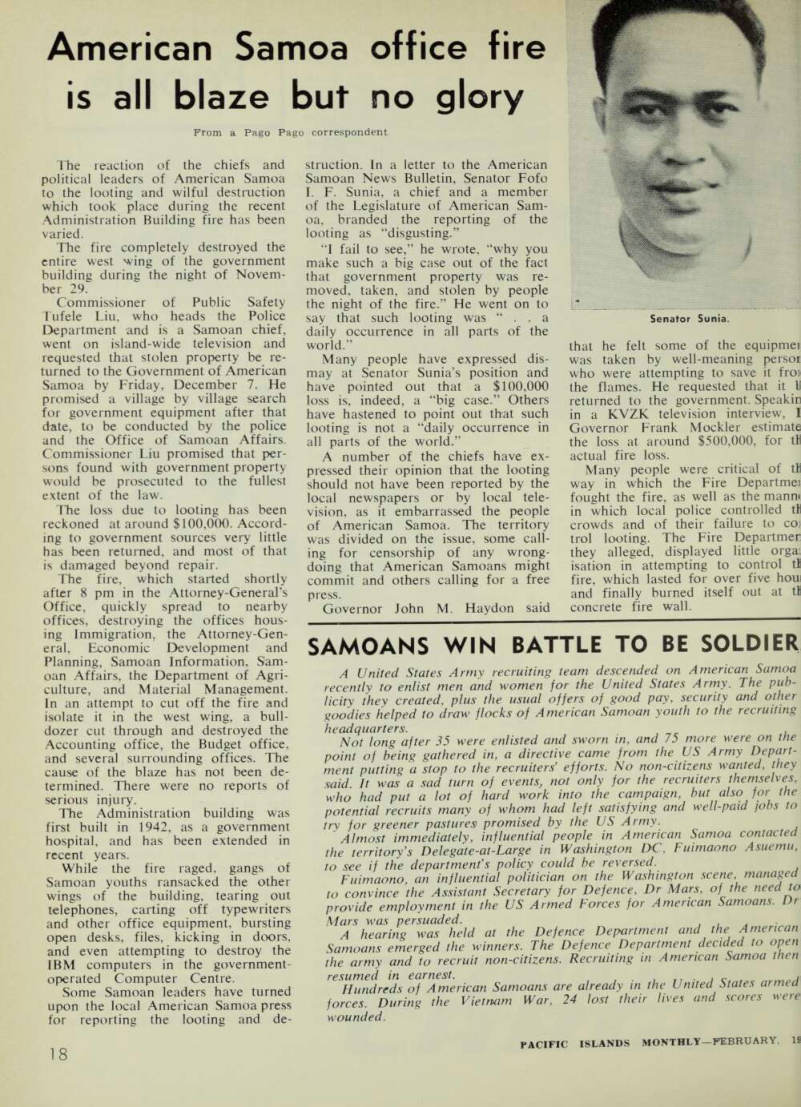
The reaction of the chiefs and political leaders of American Samoa to the looting and wilful destruction which took place during the recent Administration Building fire has been varied.
The fire completely destroyed the entire west wing of the government building during the night of Novem ber 29.
Commissioner of Public Safety Tufele Liu, who heads the Police Department and is a Samoan chief, went on island-wide television and requested that stolen property be re turned to the Government of American Samoa by Friday, December 7. He promised a village by village search for government equipment after that date, to be conducted by the police and the Office of Samoan Affairs.
Commissioner Liu promised that per sons found with government property would be prosecuted to the fullest extent of the law.
The loss due to looting has been reckoned at around $lOO,OOO. Accord ing to government sources very little has been returned, and most of that is damaged beyond repair.
The fire, which started shortly after 8 pm in the Attorney-General’s Office, quickly spread to nearby offices, destroying the offices hous ing Immigration, the Attorney-Gen eral, Economic Development and Planning, Samoan Information, Sam oan Affairs, the Department of Agri culture, and Material Management.
In an attempt to cut off the fire and isolate it in the west wing, a bull dozer cut through and destroyed the Accounting office, the Budget office, and several surrounding offices. The cause of the blaze has not been de termined. There were no reports of serious injury.
The Administration building was first built in 1942, as a government hospital, and has been extended in recent years.
While the fire raged, gangs of Samoan youths ransacked the other wings of the building, tearing out telephones, carting off typewriters and other office equipment, bursting open desks, files, kicking in doors, and even attempting to destroy the IBM computers in the government operated Computer Centre.
Some Samoan leaders have turned upon the local American Samoa press for reporting the looting and de
struction. In a letter to the American Samoan News Bulletin, Senator Fofo I. F. Sunia, a chief and a member of the Legislature of American Sam oa. branded the reporting of the
looting as “disgusting.”
“I fail to see,” he wrote, “why you make such a big case out of the fact that government property was re moved, taken, and stolen by people the night of the fire.” He went on to say that such looting was “ . . a daily occurrence in all parts of the world.”
Many people have expressed dis may at Senator Sunia’s position and have pointed out that a $lOO,OOO loss is, indeed, a “big case.” Others have hastened to point out that such looting is not a “daily occurrence in all parts of the world.”
A number of the chiefs have ex pressed their opinion that the looting should not have been reported by the local newspapers or by local tele vision, as it embarrassed the people of American Samoa. The territory was divided on the issue, some call ing for censorship of any wrong doing that American Samoans might commit and others calling for a free press.
Governor John M. Haydon said
that he felt some of the equipmei was taken by well-meaning persoi who were attempting to save it fron the flames. He requested that it b returned to the government. Speakin in a KVZK television interview, 1 Governor Frank Mockler estimate the loss at around $500,000, for tH actual fire loss.
Many people were critical of tb way in which the Fire Departmei fought the fire, as well as the mannt in which local police controlled tb crowds and of their failure to coi trol looting. The Fire Departmer they alleged, displayed little orga: isation in attempting to control tB fire, which lasted for over five houi and finally burned itself out at tB concrete fire wall.
Senator Sunia.
Samoans Win Battle To Be Soldier
A United States Army recruiting team descended on American Samoa recently to enlist men and women for the United States Army. The Pub licity they created, plus the usual offers of good pay, security and other goodies helped to draw flocks of American Samoan youth to the recruiting headquarters. , Not long after 35 were enlisted and sworn in, and 75 more were on the point of being gathered in, a directive came from the US Army Depart ment putting a stop to the recruiters’ efforts. No non-citizens wanted, they said. It was a sad turn of events r, not only for the recruiters themselves, who had put a lot of hard work into the campaign, but also for the potential recruits many of whom had left satisfying and well-paid jobs to try for greener pastures promised by the US Army.
Almost immediately, influential people in American Samoa contacted the territory’s Delegate-at-Large in Washington DC. Fuimaono Asuemu. to see if the department’s policy could be reversed.
Fuimaono, an influential politician on the Washington scene, managed to convince the Assistant Secretary for Defence, Dr Mars, of the need to provide employment in the US Armed Forces for American Samoans. Dr
Mars was persuaded. , , .
A hearing was held at the Defence Department and the American Samoans emerged the winners. The Defence Department decided to open the army and to recruit non-citizens. Recruiting in American Samoa then Hundreds of American Samoans are already in the United States armed forces. During the Vietnam War, 24 lost their lives and scores were wounded.
Copper Town's Golden Days Ahead
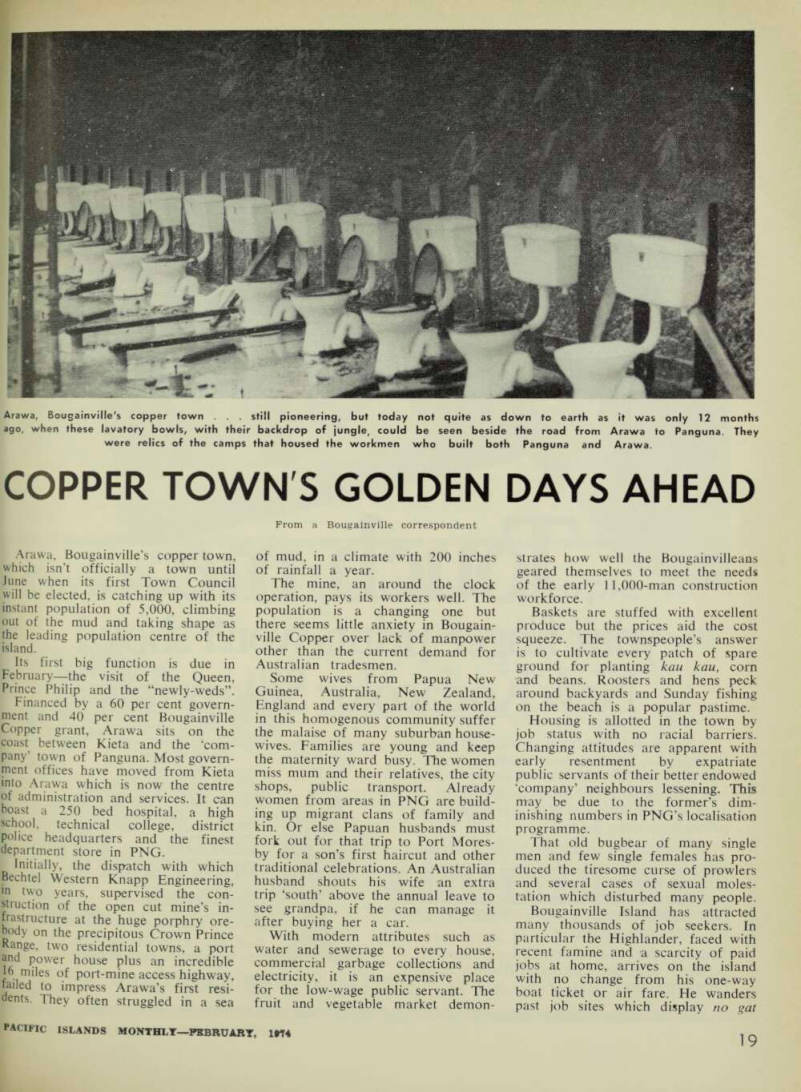

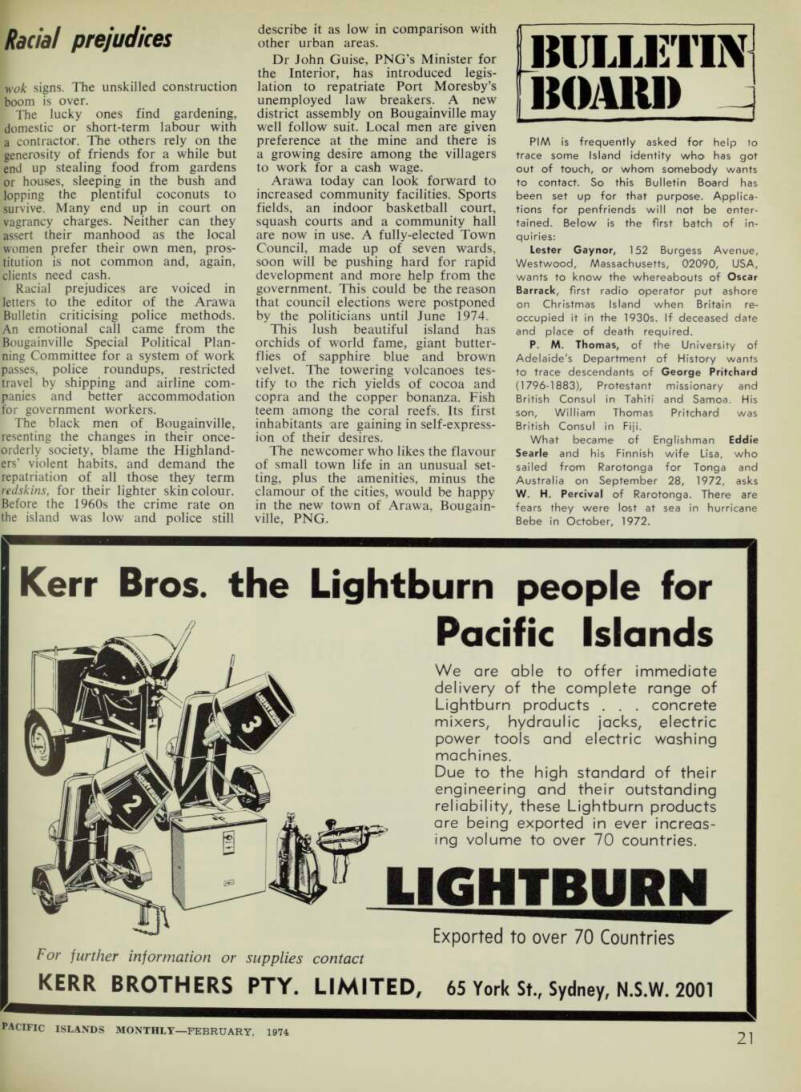
From a Bougainville correspondent
Arawa, Bougainville’s copper town, which isn’t officially a town until June when its first Town Council will be elected, is catching up with its instant population of 5,000, climbing out of the mud and taking shape as the leading population centre of the island.
Its first big function is due in February—the visit of the Queen, Prince Philip and the “newly-weds”.
Financed by a 60 per cent govern ment and 40 per cent Bougainville Copper grant, Arawa sits on the coast between Kieta and the ‘com pany’ town of Panguna. Most govern ment offices have moved from Kieta into Arawa which is now the centre of administration and services. It can boast a 250 bed hospital, a high school, technical college, district police headquarters and the finest department store in PNG.
Initially, the dispatch with which Bechtel Western Knapp Engineering, m two years, supervised the con struction of the open cut mine’s in frastructure at the huge porphry ore body on the precipitous Crown Prince Range, two residential towns, a port and power house plus an incredible 16 miles of port-mine access highway, failed to impress Arawa’s first resi dents. They often struggled in a sea
of mud, in a climate with 200 inches of rainfall a year.
The mine, an around the clock operation, pays its workers well. The population is a changing one but there seems little anxiety in Bougain ville Copper over lack of manpower other than the current demand for Australian tradesmen.
Some wives from Papua New Guinea, Australia, New Zealand, England and every part of the world in this homogenous community suffer the malaise of many suburban house wives. Families are young and keep the maternity ward busy. The women miss mum and their relatives, the city shops, public transport. Already women from areas in PNG are build ing up migrant clans of family and kin. Or else Papuan husbands must fork out for that trip to Port Mores by for a son’s first haircut and other traditional celebrations. An Australian husband shouts his wife an extra trip ‘south’ above the annual leave to see grandpa, if he can manage it after buying her a car.
With modern attributes such as water and sewerage to every house, commercial garbage collections and electricity, it is an expensive place for the low-wage public servant. The fruit and vegetable market demon
strates how well the Bougainvilleans geared themselves to meet the needs of the early 11,000-man construction workforce.
Baskets are stuffed with excellent produce but the prices aid the cost squeeze. The townspeople’s answer is to cultivate every patch of spare ground for planting kau kau, corn and beans. Roosters and hens peck around backyards and Sunday fishing on the beach is a popular pastime.
Housing is allotted in the town by job status with no racial barriers.
Changing attitudes are apparent with early resentment by expatriate public servants of their better endowed ‘company’ neighbours lessening. This may be due to the former’s dim inishing numbers in PNG’s localisation programme.
That old bugbear of many single men and few single females has pro duced the tiresome curse of prowlers and several cases of sexual moles tation which disturbed many people.
Bougainville Island has attracted many thousands of job seekers. In particular the Highlander, faced with recent famine and a scarcity of paid jobs at home, arrives on the island with no change from his one-way boat ticket or air fare. He wanders past job sites which display no gat
Arawa, Bougainville's copper town . still pioneering, but today not quite as down to earth as it was only 12 months ago, when these lavatory bowls, with their backdrop of jungle, could be seen beside the road from Arawa to Panguna. They were relics of the camps that housed the workmen who built both Panguna and Arawa.
Racial prejudices
wok signs. The unskilled construction boom is over.
The lucky ones find gardening, domestic or short-term labour with a contractor. The others rely on the generosity of friends for a while but end up stealing food from gardens or houses, sleeping in the bush and lopping the plentiful coconuts to survive. Many end up in court on vagrancy charges. Neither can they assert their manhood as the local women prefer their own men, pros titution is not common and, again, clients need cash.
Racial prejudices are voiced in letters to the editor of the Arawa Bulletin criticising police methods.
An emotional call came from the Bougainville Special Political Plan ning Committee for a system of work passes, police roundups, restricted travel by shipping and airline com panies and better accommodation for government workers.
The black men of Bougainville, resenting the changes in their once orderly society, blame the Highland ers’ violent habits, and demand the repatriation of all those they term redskins, for their lighter skin colour.
Before the 1960s the crime rate on the island was low and police still
describe it as low in comparison with other urban areas.
Dr John Guise, PNG’s Minister for the Interior, has introduced legis lation to repatriate Port Moresby’s unemployed law breakers. Anew district assembly on Bougainville may well follow suit. Local men are given preference at the mine and there is a growing desire among the villagers to work for a cash wage.
Arawa today can look forward to increased community facilities. Sports fields, an indoor basketball court, squash courts and a community hall are now in use. A fully-elected Town Council, made up of seven wards, soon will be pushing hard for rapid development and more help from the government. This could be the reason that council elections were postponed by the politicians until June 1974.
This lush beautiful island has orchids of world fame, giant butter flies of sapphire blue and brown velvet. The towering volcanoes tes tify to the rich yields of cocoa and copra and the copper bonanza. Fish teem among the coral reefs. Its first inhabitants are gaining in self-express ion of their desires.
The newcomer who likes the flavour of small town life in an unusual set ting, plus the amenities, minus the clamour of the cities, would be happy in the new town of Arawa, Bougain ville, PNG.
Advertisements & other items, p. 22 (1 item)
Touch me...
#: & m 0* m
your finger-prints won’t show!
NewKodacolor Silk-prints
You needn’t be afraid to touch Kodacolor Silk-prints. You can pass them around among your friends without worry the silk surface actually hides fingerprints.
It cuts down on glare too and makes your prints look even better.
So, when you’ve finished that Kodacolor film in your camera, let Kodak process it into these beautiful new Kodacolor Silk-prints. The silk surface and rounded corners add an extra touch of elegance to the big, borderless look. *See and feel the difference for yourself ... on the Kodacolor Silk-print display card at photo dealers.
Remember, Kodak quality is yours for the asking . . . where you see this sign:
ASK FOR
COLOR
PROCESSING
B y Kodak KODAK (Australasia) PTY. LTD.
See your local Island dealer.
Available from 110, 126 and 135-size full-frame color negatives.
K6l 4653
Bulletin
Board
PIM is frequently asked for help to trace some Island identity who has got out of touch, or whom somebody wants to contact. So this Bulletin Board has been set up for that purpose. Applica tions for penfriends will not be enter tained. Below is the first batch of in quiries: Lester Gaynor, 152 Burgess Avenue, Westwood, Massachusetts, 02090, USA, wants to know the whereabouts of Oscar Barrack, first radio operator put ashore on Christmas Island when Britain re occupied it in the 19305. If deceased date and place of death required.
P. M. Thomas, of the University of Adelaide's Department of History wants to trace descendants of George Pritchard (1796-1883), Protestant missionary and British Consul in Tahiti and Samoa. His son, William Thomas Pritchard was British Consul in Fiji.
What became of Englishman Eddie Searle and his Finnish wife Lisa, who sailed from Rarotonga for Tonga and Australia on September 28, 1972, asks W. H. Percival of Rarotonga. There are fears they were lost at sea in hurricane Bebe in October, 1972.
Advertisements & other items, pp. 23-24 (1 item)
Ughtburn
CN M
Kerr Bros, the Lightburn people for
Pacific Islands
We are able to offer immediate delivery of the complete range of Lightburn products . . . concrete mixers, hydraulic jacks, electric power tools and electric washing machines.
Due to the high standard of their engineering and their outstanding reliability, these Lightburn products , are being exported in ever increasing volume to over 70 countries.
UGHTBURN
Exported to over 70 Countries For further information or supplies contact KERR BROTHERS PTY. LIMITED, 65 York St., Sydney, N.S.W. 2001
Wunderflex bends a little...
to give a lot.
It gives versatility—use it inside or outside; for the whole house, garages, extensions, etc.
It gives flexibility—practically eliminates on-site breakages handles easily: cuts and fixes simply.
Wunderflex gives performance —it's fire and water resistant —vermin proof too.
In sheets 3 ft. x 1 ft. to jumbo 10 ft. x 4 ft., all at lowest cost for building board, bend Wunderflex to your needs now.
kViunderlich
Wunderflex
iahf in AUSTRALIA MARKETED BY C.S.R. BUILDING MATERIALS L A p D n E R V N SALES 4O'CONNELL STREET, SYDNEY, AUSTRALIA 2000
AVAILABLE FROM
Papua and New Guinea:
Steamships Trading Company Ltd
Norfolk Island:
Irvine's Building Supply Centre
E3238C
Png, Proudly Independent In
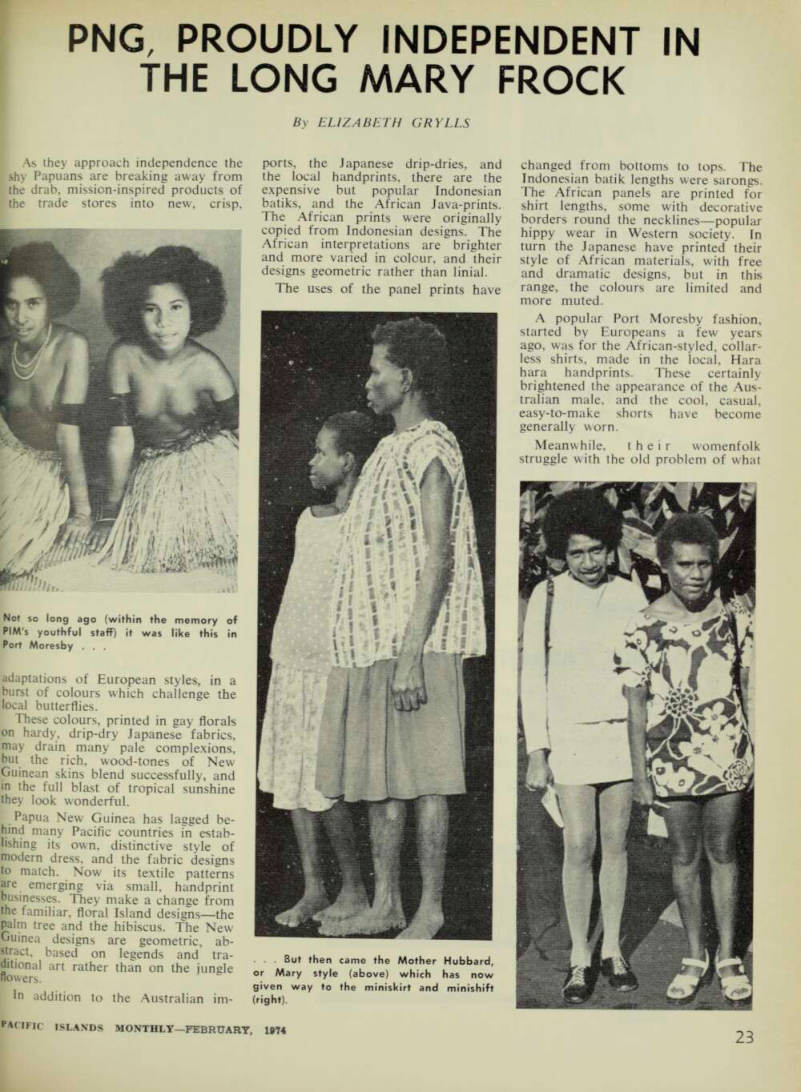
The Long Mary Frock
By Elizabeth Grylls
As they approach independence the shy Papuans are breaking away from the drab, mission-inspired products of the trade stores into new, crisp,
adaptations of European styles, in a burst of colours which challenge the local butterflies.
These colours, printed in gay florals on hardy, drip-dry Japanese fabrics, may drain many pale complexions, but the rich, wood-tones of New Guinean skins blend successfully, and in the full blast of tropical sunshine they look wonderful, Papua New Guinea has lagged be hind many Pacific countries in estab lishing its own, distinctive style of modem dress, and the fabric designs to match. Now its textile patterns are emerging via small, handprint businesses. They make a change from the familiar, floral Island designs—the palm tree and the hibiscus. The New Guinea designs are geometric, ab stract, based on legends and tra ditional art rather than on the jungle flowers.
In addition to the Australian im
ports, the Japanese drip-dries, and the local handprints, there are the expensive but popular Indonesian batiks, and the African Java-prints.
The African prints were originally copied from Indonesian designs. The African interpretations are brighter and more varied in colour, and their designs geometric rather than linial.
The uses of the panel prints have
changed from bottoms to tops. The Indonesian batik lengths were sarongs.
The African panels are printed for shirt lengths, some with decorative borders round the necklines—popular hippy wear in Western society. In turn the Japanese have printed their style of African materials, with free and dramatic designs, but in this range, the colours are limited and more muted.
A popular Port Moresby fashion, started by Europeans a few years ago, was for the African-styled, collar less shirts, made in the local, Kara hara handprints. These certainly brightened the appearance of the Aus tralian male, and the cool, casual, easy-to-make shorts have become generally worn.
Meanwhile. their womenfolk struggle with the old problem of what
Not so long ago (within the memory of PIM's youthful staff) it was like this in Port Moresby . . .
. . But then came the Mother Hubbard, or Mary style (above) which has now given way to the miniskirt and minishift (right).
Big Success Story
they are wearing South, fearful ■ arriving on leave in Australia win suitcases of frocks, either too lore or too short. The advent of the mioi with boots, struck horror into thei hearts. It would make melting wee in the tropics.
The maxi had a different receptioo Changing into a long frock for ajf evening occasion is a welcome relil in an area of one-climate dressim and the various longs—frocks, pam frocks, pant-suits, skirts—have ; been worn as they come into vogu; The big success story is the lox Mary frock.
The Mary blouse, familiar all ow the South Pacific, was used to cow Tolai nakedness during the Germ* administration. The pattern was oft Bavarian peasant blouse, originally \ garment of rustic charm; roum necked, gathered bodice, puffs' sleeved.
The New Guinea version was j limp, faded, figure-muffling garmen Its use, over the years, spread to ; parts of New Guinea. In the Hig lands, where the weather can be ch:r the blouse gained length. Came tt days when the mini was really mil the Australian girls saw the posi bilities of the brighter, better mas blouses in the Chinese shops.
They wore them, not as bulL tops over skirts and laplaps, but gay, knee-displaying frocks, partioi larly useful during pregnancies. T 1 Chinese dressmakers were not slol to catch on. More mini-Marys we’ made, and in its next variation tr Mary frock went all the way dow making the maxi-Mary.
Falling straight from the bodii narrowing slightly round the knea and bursting into a flounce at t bottom, in vivid florals the style gained its old-time charm. Its u;i are endless and it blooms everywhea from the beach to the ballroom, fro' dining out to going to market.
Melanesian dressing is more stah than the Australian. Few have t thrill, or the bother about going leave, and, having little, they spea less on clothes. The young sophisi cates have settled for the mini shr which is right for the climate, as suits their looks very well; but t Mary has made some sort of ciro - They have also adopted the miu Mary, and wear the long-Mary :
special occasions.
Perhaps it will prove to be 1 national dress of new, independo Papua New Guinea.
Advertisements & other items, pp. 26-28 (2 items)
Braybon
u
Portable
Power
n
Units
240 VOLT
50 CYCLE A.C.
Mobile or
Stationary
Will work for YOU!
ca Suitable for field \ maintenance including welder, x power tools, multiple shearing heads, pumping units, etc. and general household appliances and lighting. c "1;
OUTPUT CAPACITIES AVAILABLE;
1 K.V.A., 240 VOLT A.C., 4 AMP 2 K.V.A., 240 VOLT A.C., 8 AMP 3f K.V.A., 240 VOLT A.C., 16 AMP
K.V.A., 240 VOLT A.C., 30 AMP
$234 $272 $330 $5BO (Electric starts available on 3f and K.V.A. models) Write for illustrative brochure.
Braybon Bros
V btv i rn
PTY. LTD.,
2 ROTHWELL AVENUE, CONCORD WEST 2138.
Tel.: 73-3246.
SYDNEY, AUSTRALIA.
Share a vision
Soqulu Plantation Taveuni
w A beautiful estate is quickly but unobtrusively becoming a reality on the garden island. One acre lots, most with breathtaking views, are being prepared for sale at
amazingly low prices.
This is a rare opportunity to buy some of Fiji's very limited freehold land either as a straight investment or for your enjoyment in the future. Genuinely interested investors will be flown to see Soqulu Plantation at no obligation. Most lots are only $6,790 and some are as low as $3890.
Our full story is told in a lavish booklet, available free on
request.
Soaulu plantation
” Call, write or easiest of all,
mail this coupon today.
To Soqulu Plantation Sales Officii
■ ■fiUn B ° X 200, Suva (Phone No - 23350) ■ Vlf mm Please send me a copy Of your full I "I Wr colour booklet.
NAME j
ADDRESS "
" •s*& . , m v; ’ im The slopes of Taveuni afford lovely sea views from almost every lot.
The developer, J.W. Mclntire, has already built his own luxurious home on Soqulu and resides there permanently M With an acre per lot, it is easy to envisage the finished project looking as uncluttered as this.
I
S\enAerCtacKets'.
Cheesev
\ nder savoury re \ong an ° ea ’ i [♦ >p p p : : £ T*: •-':® -'j£x ■ j:if* sm O0W°"
•«gs&s?-
There’s value, variety and quality in
BRDCKHOFF BISCUITS
5544 78x6 'U m& mmm ■ ssa
25
IFIC ISLANDS MONTHLY—FEBRUARY, 1974
The Editor's Mailbag
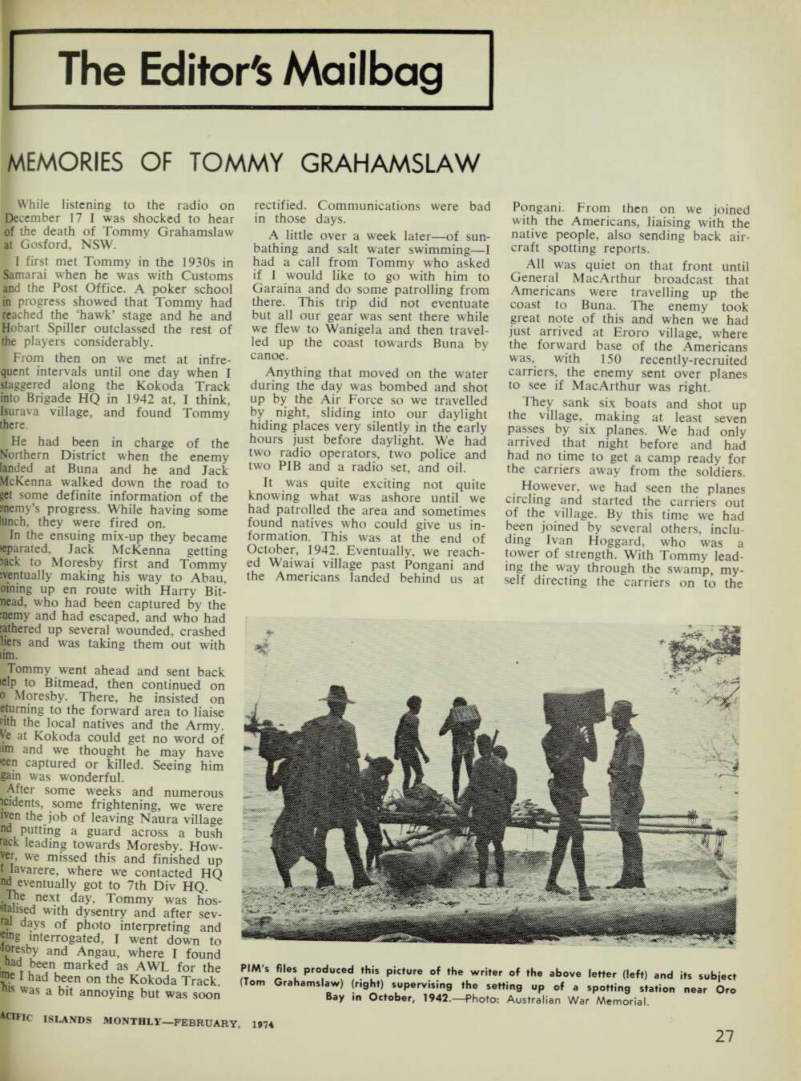


Memories Of Tommy Grahamslaw
I While listening to the radio on December 17 I was shocked to hear of the death of Tommy Grahamslaw at Gosford, NSW.
I first met Tommy in the 1930 s in Samarai when he was with Customs and the Post Office. A poker school in progress showed that Tommy had reached the ‘hawk’ stage and he and Hobart Spiller outclassed the rest of the players considerably.
I From then on we met at infre quent intervals until one day when I staggered along the Kokoda Track into Brigade HQ in 1942 at, I think, Isurava village, and found Tommy there.
He had been in charge of the Northern District when the enemy landed at Buna and he and Jack McKenna walked down the road to get some definite information of the ;nemy’s progress. While having some lunch, they were fired on.
In the ensuing mix-up they became icparated. Jack McKenna getting Jack to Moresby first and Tommy wentually making his way to Abau, oining up en route with Harry Bit nead, who had been captured by the snemy and had escaped, and who had fathered up several wounded, crashed liers and was taking them out with lim.
Tommy went ahead and sent back iclp to Bitmead, then continued on o Moresby. There, he insisted on chiming to the forward area to liaise Jith the local natives and the Army, ye at Kokoda could get no word of im and we thought he may have captured or killed. Seeing him gain was wonderful.
After some weeks and numerous indents, some frightening, we were iven the job of leaving Naura village nd putting a guard across a bush rack leading towards Moresby. How ycr, we missed this and finished up t lavarere, where we contacted HQ nd eventually got to 7th Div HQ.
The next day. Tommy was hos italised with dysentry and after sev . days of photo interpreting and jmg interrogated, I went down to and An § au ’ where I found nad been marked as AWL for the I had been on the Kokoda Track, nis was a bit annoying but was soon
rectified. Communications were bad in those days.
A little over a week later—of sun bathing and salt water swimming—I had a call from Tommy who asked if I would like to go with him to Garaina and do some patrolling from there. This trip did not eventuate but all our gear was sent there while we flew to Wanigela and then travel led up the coast towards Buna by canoe.
Anything that moved on the water during the day was bombed and shot up by the Air Force so we travelled by night, sliding into our daylight hiding places very silently in the early hours just before daylight. We had two radio operators, two police and two PIB and a radio set, and oil.
It was quite exciting not quite knowing what was ashore until we had patrolled the area and sometimes found natives who could give us in formation. This was at the end of October, 1942. Eventually, we reach ed Waiwai village past Pongani and the Americans landed behind us at
Pongani. From then on we joined with the Americans, liaising with the native people, also sending back air craft spotting reports.
All was quiet on that front until General MacArthur broadcast that Americans were travelling up the coast to Buna. The enemy took great note of this and when we had just arrived at Eroro village, where the forward base of the Americans was, with 150 recently-recruited carriers, the enemy sent over planes to see if MacArthur was right.
They sank six boats and shot up the village, making at least seven passes by six planes. We had only arrived that night before and had had no time to get a camp ready for the carriers away from the soldiers.
However, we had seen the planes circling and started the carriers out of the village. By this time we had been joined by several others, inclu ding Ivan Hoggard, who was a tower of strength. With Tommy lead ing the way through the swamp, my self directing the carriers on to the
PIM's files produced this picture of the writer of the above letter (left) and its subject (Tom Grahamslaw) (right) supervising the setting up of a spotting station near Oro Bay in October, 1942. Photo: Australian War Memorial.
Letters
correct road and Ivan pushing them out of their houses, we had only just started the evacuation when the first attack came.
Tommy was about half-way through the coastal belt of swamp and 50 yards from me, when I saw him jump into the air and then fall into the water. Leaves and twigs fell all round him and bullets slashed through the undergrowth.
I ran over to where he was under water with smoke from the incen diaries all round him. Hauling him out I saw he showed no very ob vious signs of wounds so I put him behind a fair-sized tree and some natives behind another, while I scraped the mud off him.
He was unhurt but a bit stunned by having so many bullets around him. I think there were seven passes made from different directions and we had to keep circling the tree.
The planes were very low and I emptied two tommy gun mags at them, I could hear Ivan doing the same. The Americans were taken too much by surprise to get their arms to work.
By this time, some of our own planes had arrived, having been war ned by the radio operators out in the bush nearby, and soon there was a dreadful silence. I don’t know what the casualties were but not one na tive was injured.
Ivan and I took Tommy back later and tried to make out just how he had not been hit. It was almost a miracle as the leaves and brush above where he had been had been cut about and the sticks under him were also slashed, behind him as well as in front. He must have been in a blind spot somehow as everything missed him. Ground fire was credited with one plane and Ivan and I used to stick our chests out as no one else had fired, or we had not heard any one.
From then on Tommy was given increasingly greater responsibility with appropriate rank and at the end of the war was in charge of what the Army called Southern Region.
After the war we met in Samarai a few times and again in Moresby.
Once he took me around all the old Army camps which are now built over. We corresponded regularly, once a year or so, and my letter and card for this year were written and awaiting a boat for posting when the news of his death was received.
Tommy Grahamslaw, civilian sold ier, who rose through sheer ability to the positions he held, did not shout from the house tops. He was rather unassuming and a very ap proachable person who helped many people to the best of his ability, which was considerable. His staff, after the war and never to his face, called him “Uncle Tom” affectionately and 1 know that many others besides myself will mourn the loss of a true friend and an honest and upright man. —Goodbye Tommy, old friend.
John D. Wilkinson
Sewa Bay, Papua New Guinea.
Gutter language
I have been a regular reader of PIM, for many years, and 1 always have enjoyed reading it, and finding out how ‘The other half lives in our Pacific region; also 1 took pride in the fact that, here at least, there was one publication one could pick up and read without being subjected to pornographic tripe.
This does not now appear to be the case, as evidenced by the ‘gutter language’ in the December copy of PIM, (line 29, p 62, col 3).
In any case, to compare the prom iscuous sexual habits of the human race to the simple act of procreation of pigs and dogs, is to demean those lowly animals.
Please endeavour to keep your pages clean, as they have been in the past.
Should there be any repetition of a similar nature, I for one, will no doubt cease to peruse your otherwise interesting publication.
You, Sir, are now on probation, which my dictionary defines as, ‘sus pension of sentence with liberty on good behaviour, under supervision, especially allowed to a first offender’.
Unquote.
I feel, also, that I will not be alone in my decision to cease receiving your magazine, if further breaches occur.
H. W. Cummings
North Queensland.
O The reference by Mr Cum mings is the only instance we can remember of that particular four letter word having appeared in PIM —and Mr Cummings need have no fear that PIM is suddenly about to become pornographic. The expression was contained in a short story by New Guinean writer Joseph Wohuin angu, in our regular MAN A pages, which are edited independently, and most competently, by Marjorie Tuainekore Crocombe. She presum ably considered the expression an apt
description of an old man’s attitude to the behaviour of the young, and important in the context of the story.
Certainly we did.
Samoan land
Asa constant reader of PIM I have come to appreciate and value Mr Felise Va’a’s articles on Western Samoa.
PIM has considerable historical value, and Mr Va’a’s articles will un doubtedly help it to sustain this function, I think, therefore, that it is proper to make a historical com ment so that present-day readers will not misunderstand important events in Samoa which occurred many years ago.
Mr Va’a, in his December article (PIM, Dec, p 21) says that the earliest Europeans exploited the Sam oans ruthlessly in acquiring land; fertile Samoan land was bought not for a song but for a pipe or a rifle; a lot of the land now owned by the Western Samoa Trust Estates Cor poration was acquired in this way; and the Germans put a stop to this in 1900.
I doubt whether this is historically accurate. The whole story is well told by the late and well-remembered R. P. Gilson in chapter 16 of his book Samoa, 1830-1900. The rivalry among Britain, Germany and the United States over the competing in terests in Samoa nearly caused a war, which may have been averted by the hurricane of 1889.
However, immediately after the hurricane, the three powers sat down in Berlin and drew up an agreement which became known as the Berlin Act of 1889, and which was accepted and agreed to by the then King of Samoa. This act established a con dominium, which in Samoa came to be known as “the rule of the three powers”.
It contained general provisions for the ordering of European and Samoan affairs, but the most important and enduring were the provisions relating to land. The Berlin Act set up a land commission to which all European claims to Samoan land were to be brought, and issued strict instruct iors as to the conditions which had to be fulfilled before any European claims to Samoan land could be ad judged valid.
This applied to all purported dis posals of Samoan land to Europeans, no matter when the transaction had taken place. It is unnecessary to re capitulate here the conditions for validity laid down by the act, but Gilson obviously considers them to have been reasonably sound. He notes that the total land claims presen ted to the commission amounted to
Letters
[ 1,691,893 acres, whereas the com- I mission validated claims to only 135,300 acres, namely 8 per cent of the total claims.
The claims of the big German plantation firm (Deutsche Handels un Plantagen-Gesellschaft der Sudsee Inseln zu Hamburg; known as ‘the long handled name firm’, or DHPG) were mostly allowed because they complied with the conditions relating to defined boundaries, adequate con sideration, and development capital already spent.
These lands became reparations to the New Zealand Government in 1919 after World War I; were then passed by the New Zealand Government to the Samoan Government in 1959 as part of the move towards indepen dence, and now form the Western Samoa Trust Estates.
Considering the history of colonial territories generally, the Berlin Act, with its total prohibition of sales of Samoan land for the future, and its establishment of the land commission with strict conditions applicable to approvals of disposal of Samoan land already made, has placed Samoa in a somewhat unique position.
This prohibition on the sale of Samoan land was continued by the German regime in 1900 and, as Mr Va’a says, the Land & Titles Court was then established, to control dis posal of and succession to Samoan land. This situation continued through the New Zealand regime, and on into independence.
The Constitution of the Indepen dent State of Western Samoa bears in its provisions relating to land, the distinct imprint of the Berlin Act of 1889.
Guy Powles
Wellington.
NZ. • Sir Guy Powles, the New Zeal and Ombudsman, is a former High Commissioner of Western Samoa , before Samoan independence.
A prehistoric Columbus
Through either a printing or editor ial error, my review of the book The Settlement of Polynesia: A Computer Simulation (PIM, Jan, p 69), at tributed both to me and to the auth ors something that neither of us said or would wish to say (p 71).
In my original typescript, 1 stated that the authors had made a certain assertion about voyages away from the South American coast in “pre- Columbian times”. This was, some how, altered to “prehistoric Colum bian times”. The first phrase means before Columbus; the second, if not meaningless, can only mean that Columbus himself was prehistoric.
Robert Langdon
Canberra,
Act.
Arts festival filmed
Every time Victor Carell comes out of his shell to defend his good work in the South Pacific Festival of Arts, he emphasises the contri butions made by countries, organi sations and individuals. Carell’s stand is now well-known and it reinforces the good spirit that made the first South Pacific Festival of Arts such a success—the spirit that makes this part of the world well-known for its hospitality.
However, if such a viewpoint is used continuously to defend the fes tival against the questions and criti cisms raised, then, in my opinion, the festival loses the artistic intregrity it deserves. For one thing, there is an honest outcry from the Islanders that the festival’s stance on arts reflected a cultural sell-out: emphasised in the styles used during the festival. Here, 1 am thinking of the emphasis placed on the professionalism of the perfor mances done in the Civic Centre and other such venues.
Such a criticism should not be swayed aside because some rich guy sacrificed his time, or energy, or money in order to make the festival a successful occasion. Rather, Carell’s answers (to such criticisms) ought to spotlight the dynamics of a cul tural festival: the artistic lifestyles of such things created to suit the whims of hotel owners. It is for that reason that Carell should listen to what Islanders are saying, now. It is under this chapter of the festival that I would consider the views expressed by Dr Larkin (PIM, Nov, 1972 p 65). It is also under the heading that I now review the film, The South Pacific Festival of Arts, Personally, I felt that C. Slatter’s review of the film (PIM, Sept, 1973, p 65) was too kind. The film should never have been made at all. The rea sons are the results of my obser vations in the festival, and also my disappointment in the obvious themes depicted in the movie.
For the first film of the South Pacific Festival of Arts, one would hope that it would be a portrait in motion, that would document the
meaning of cultural arts m the South Pacific. This would be achieved if the historical scenarios, and the meanings of the performances were explained.
The legends, myths, folklores depicted in performances should also have been treated as such. Instead the film was still: in that it harboured the usual colourful, and meaningless, scenes which have been associated with ‘kaleidoscopic eyes’ of the moneylenders. How many people who saw the mekes or the lakalakas under stood the themes of these perform ances? As to now, I can only re member these performances by the painted faces of the performers; and the Fiji Military Forces Band playing God Save The Queen —as a prelude to these items.
There is no doubt that there is an art in praising the Queen (if one is thinking of an investiture!), but such art is stupid. However, there is no doubt these things have been over looked due to the lack of knowledge of the Pacific precepts, which have been unfortunately missed in the narration.
With due respect to Raymond Burr, I find his narration superficial: he scans over the pretty objects and boringly glorifies such things as the sunsets, floodlights, etc. Everyone should know by now that the South Pacific is the place where there arc swaying palms and golden sunsets. (Thanks to Hollywood for perpetu ating that die-hard, way-out, distorted myth.) The South Pacific is attractive enough to sell on its own image with out Raymond Burr, who has no doubt good intentions, but his bourgeois image invites charges of commercial ism.
Finally, in the future, we, the Island ers, will need a document to help us in our studies or in our thinking towards a South Pacific Identity. The festival would have been an ideal forum in which we hope to develop a dialectic in Cultural Arts and that would have been achieved if the film had offered lucid and deep frames of references for such a hope.
I would love to have seen the Tongan Me’etu’upaki and the New Hebridean dances being filmed. But above all, I wish that the film had provided a documented piece of cul tural work put together in a coherent and straightforward manner. How ever, I wish to state that these views are not against Mr Carell, per se, whom I regard very highly. Rather they are aired in the hope that all of us who participate in cultural arts will see that the consequences or complacency kills creativity.
Ata Ma’Ia’I
University of the South Pacific Suva, Fiji.
Advertisements & other items, pp. 29-34 (2 items)
27
ACIFIC ISLANDS MONTHLY—FEBRUARY, 1974
MF2I blade keeps levelling
These MF distributors
can show you how the
and grading costs low
No special operating skill is required with this versatile implement. You’ll be amazed at the way the MF2I handles general dirt moving, road building, ditching, back-filling, levelling, cleaning and dozens of other jobs. The MF2I quickly attaches to an MF 135 tractor and depth controlled by the tractors’ hydraulics. Pitch and angle of the blade are adjustable; from the tractor seat and I blade can be completely) reversed for back-filling..
Make a full 6 foot or 8 foot! cut with blade extensions..
Grader wheel, side plate* and scarifier kits available..
MF Massey Ferguson ©. © A MF 74011
The night the
lights went out
logs
*-V * \ - / r t~.
' rh / s UT a ij m k* a Vnir Some clever, far-sighted individualist had a Generator Set all ready to go. CLAE makes light work for you. We have a complete range of mighty Detroit and Bedford generator sets priced to suit your bank account and your purpose. To provide light, power for heating, cooking or manufacturing. To run profit producing industrial and agricultural equipment. Efficient. Dependable. Simple to maintain. Protection for any future emergency. See CLAE. They have the power!
Ihe power
/ CLAE ENGINE SALES & SERVICE V / 31 Hoskins Ave., Bankstown, N.S.W. V / 2200. Phone 709 4777. / Branches at: Brisbane, Rockhampton, ' Mackay and Townsville, Distributors and dealers in all states. / Please send me details of / / Name 10771 \
4> I * > I
Mixmaster Mixer
3 times better than any
other mixer. Designed especially for famliy food preparation. 12-speed mixfinder dial indicates the correct speed for each mixing action. Complete with 2 heat-resistant bowls and juice extractor. Sunbeam’s, exclusive 3-way beating action extra large, contoured beaters, and automatic bowl movement — gives perfect aeration and more even mixing. It can handle everything from beating one egg to mixing a large fruit cake.
L 83.33
Lie Through The Villages
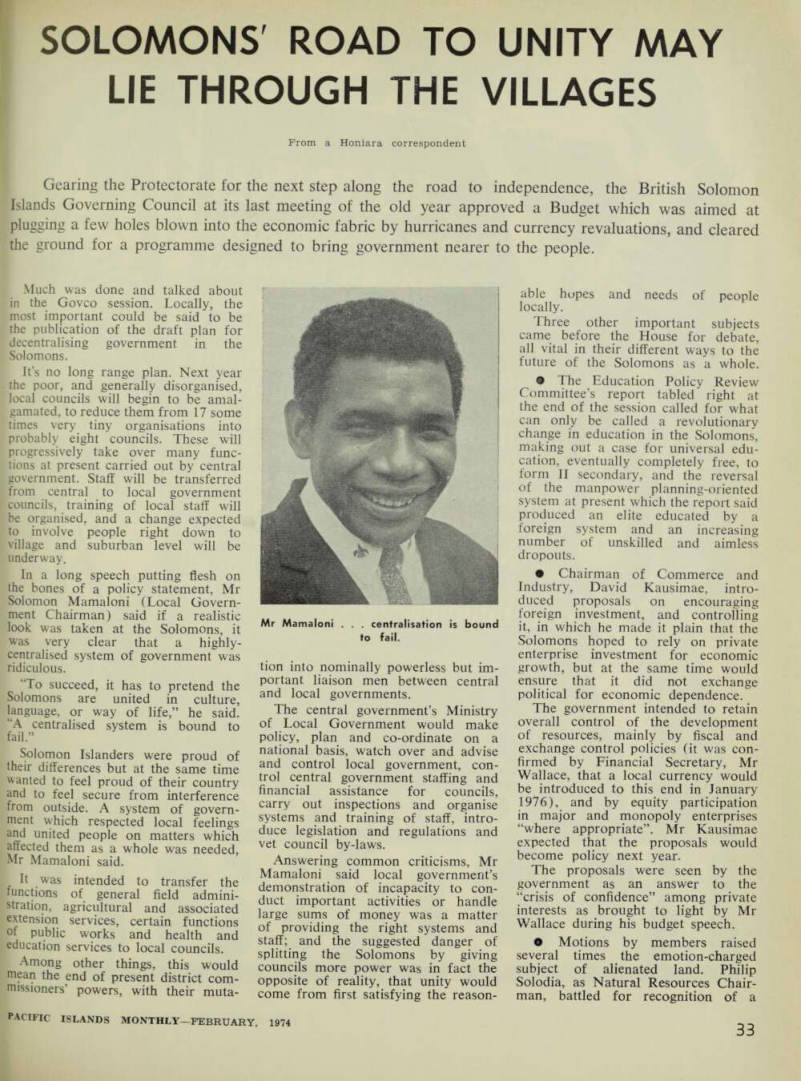

Solomons' Road To Unity May
From a Honiara correspondent
Gearing the Protectorate for the next step along the road to independence, the British Solomon Islands Governing Council at its last meeting of the old year approved a Budget which was aimed at plugging a few holes blown into the economic fabric by hurricanes and currency revaluations, and cleared the ground for a programme designed to bring government nearer to the people.
Much was done and talked about in the Govco session. Locally, the most important could be said to be the publication of the draft plan for decentralising government in the Solomons, It’s no long range plan. Next year the poor, and generally disorganised, local councils will begin to be amal gamated, to reduce them from 17 some times very tiny organisations into probably eight councils. These will progressively take over many func tions at present carried out by central government. Staff will be transferred from central to local government councils, training of local staff will be organised, and a change expected to involve people right down to village and suburban level will be underway.
In a long speech putting flesh on the bones of a policy statement, Mr Solomon Mamaloni (Local Govern ment Chairman) said if a realistic look was taken at the Solomons, it was very clear that a highly centralised system of government was ridiculous.
“To succeed, it has to pretend the Solomons are united in culture, language, or way of life,” he said.
“A centralised system is bound to fail.”
Solomon Islanders were proud of their differences but at the same time wanted to feel proud of their country and to feel secure from interference from outside. A system of govern ment which respected local feelings and united people on matters which affected them as a whole was needed, Mr Mamaloni said.
It was intended to transfer the functions of general field admini stration, agricultural and associated extension services, certain functions of public works and health and education services to local councils.
Among other things, this would mean the end of present district com missioners’ powers, with their muta-
tion into nominally powerless but im portant liaison men between central and local governments.
The central government’s Ministry of Local Government would make policy, plan and co-ordinate on a national basis, watch over and advise and control local government, con trol central government staffing and financial assistance for councils, carry out inspections and organise systems and training of staff, intro duce legislation and regulations and vet council by-laws.
Answering common criticisms, Mr Mamaloni said local government’s demonstration of incapacity to con duct important activities or handle large sums of money was a matter of providing the right systems and staff; and the suggested danger of splitting the Solomons by giving councils more power was in fact the opposite of reality, that unity would come from first satisfying the reason
able hopes and needs of people locally.
Three other important subjects came before the House for debate, all vital in their different ways to the future of the Solomons as a whole. ® The Education Policy Review Committee’s report tabled right at the end of the session called for what can only be called a revolutionary change in education in the Solomons, making out a case for universal edu cation, eventually completely free, to form II secondary, and the reversal of the manpower planning-oriented system at present which the report said produced an elite educated by a foreign system and an increasing number of unskilled and aimless dropouts. • Chairman of Commerce and Industry, David Kausimae, intro duced proposals on encouraging foreign investment, and controlling it, in which he made it plain that the Solomons hoped to rely on private enterprise investment for economic growth, but at the same time would ensure that it did not exchange political for economic dependence.
The government intended to retain overall control of the development of resources, mainly by fiscal and exchange control policies (it was con firmed by Financial Secretary, Mr Wallace, that a local currency would be introduced to this end in January 1976), and by equity participation in major and monopoly enterprises “where appropriate”. Mr Kausimae expected that the proposals would become policy next year.
The proposals were seen by the government as an answer to the “crisis of confidence” among private interests as brought to light by Mr Wallace during his budget speech. o Motions by members raised several times the emotion-charged subject of alienated land. Philip Solodia, as Natural Resources Chair man, battled for recognition of a
Mr Mamaloni . . . centralisation is bound to fail.
policy of government controlled and planned acquisition of large tracts of agricultural land and their development generally as joint ventures with foreign investors who could supply expertise, as these lands could be taken over A number of members shouted for return of land to the original owners, but it was difficult to know whether they were only putting forward their constituents’ desires (which they certainly were) or whether they really wanted all foreign-owned land resumed. No motions actually called for this to happen, and in the light of the foreign investment policy proposals it seems that emotion will give way to pragmatism when it comes to the crunch.
The government also came out with a statement defining its attitude to matters of tradition and custom.
Summing up, the preservation by
each ethnic or linguistic area of the Solomons of its way of life was to be encouraged, so long as it was acceptable to the local people and in accordance with natural justice, „ . . ‘ he n B ht °f pagans to follow their religious practices was to be respected, £***? th f dominance of the various C , hnst,an faiths m the Solomons, and p ‘ ani ?l ng for . econ L omi c development sh ° uld recognise the power and un- PoHance of traditional leaders and chiefs , and the llnes and other com rnunal groups.
The next session of Governing Council scheduled for April will see its transformation into a legislative assembly, the choosing by members of a chief minister and ministry, and the reality of self-government by a body of legislators committed to collective responsibility for the first time.
Advertisements & other items, p. 36 (1 item)
Klinku
/ / mi ,• / r >j 'n\ M % Mi the
rlhsru
nvast versatile p|y for tropical appßcatiorv e
■ra ,sr-rs“
1 VSSSgSa
jsss=4-
\ your Klinku plywoods
“'-“Sfssf-
count on
KLINKU
BSI's housekeeping bill
New taxes will swell BSI's housekeeping bill
Australian currency revaluations hit Solomon Islands’ customs revenue so hard that the Financial Secretary, Mr R. J. Wallace, has had to introduce some new taxes, and increase others to meet a threatened gap between revenue and expenditure in 1974.
The budget for 1974 includes a 10 per cent surcharge on the existing tariff on all imported goods, other than meat and fish preparations, rice, flour, sugar, detergents, petrol and kerosene.
The surcharge on all alcohol other than beer will be 20 per cent. The beer surcharge will be 10 per cent.
There will also be an increase of 10 per cent in the preferential (10 per cent) and general (27T per cent) tariffs on non-alcoholic beverages, and a new preferential tariff of 37i per cent on all imported fresh and frozen fruits and vegetables, and on prepared foods for household pets.
Mr Wallace told Governing Council that the estimate of local revenue for 1974 of $6,259,325, was about $700,000 more than the revised estimate for 1973. He expected that natural growth at existing levels of
taxations, fees and payment of ser vices would provide about $520,000 of the extra amount, and he proposed to raise the balance of $lBO,OOO through the new taxation, The BSIP had expected about $1.9 million in 1973 from export duties, but the latest estimate, be cause of the Australian revaluations, was $1.5 million. As import duties provided about one-third of the BSIP revenue it was quickly apparent how serious was the loss of about $400,000. As it was, imports which attracted little or no duty had risen whll e imports of manufactured goods, as clothing and household equipment, which attracted high duty, had fallen.
Mr Wallace lamented that the BSIP, like a number of other terri tories, was unable to take advantage of the current high prices for copra, Consistently low prices for a long
period discouraged local production.
Hurricane Ida and drought also cut * nto production, so that the 1973 ex- P ort figure was expected to be only 18,000 tons, compared with about 22,000 tons in 1972.
The timber industry was making
steady progress in exporting. In the first nine months of 1973 the ex ports totalled about 6.6 million cubic feet, which was about 400,000 cubic feet better than the figure for the first nine months of 1972.
Solomon Taiyo, a fishing com pany in which the BSIP had a sub stantial equity, started fishing about the middle of May and caught near ly 5,000 tonnes of fish, worth about $1.5 million by the middle of No vember. Exports of fish, 4,205 tonnes, earned about $71,000 in ex port duty. Export duty on fish for 1973 was expected to be about $lOO,OOO. Solomon Taiyo now em ployed 265 Solomon Islanders—l 34 of them at sea.
An encouraging feature in the search for minerals, was granting to CRA Explorations reconnaissance permits for Gela. The company, which was a subsidiary of CRA in Aust ralia, has applied for a reconn aissance permit for all San Cristobal and Santa Isabel.
The oil palm project was making satisfactory progress on 2,900 acres.
Mr Wallace said that as the BSIP moved to the last stage of the Sixth Development Plan, there was a sig nificant decline in the work available in the construction industry. But bank deposits and advances had been main tained. It seemed there was a lot of money in the country lying idle.
It had been suggested from sev eral quarters there was a crisis of confidence among private interests.
Overseas traders and investors were waiting to learn of the new govern ment's policies before building up stocks and supplies and developing their businesses. Early clarification of the government’s policy towards foreign investment and to foreign traders in particular, would probably help to restore some confidence.
Mr Wallace was speaking before Mr David Kausimae (Commerce and Industry Chairman) announced guide lines to be followed by foreign investors. (PIM, Jan, p 89). Mr Kau simae said he expected the proposals for control of investments, which em bodied the guidelines, would become policy in 1974.
The 1974 budget provided for an appropriation of $12,422,930 for services. Statutory expenditure would be $362,565. The estimate of local revenue was $6,259,325. Total aid sought from the UK was $6,049,465.
Total recurrent expenditure, inclu ding statutory expenditure, but ex cluding a 7i per cent deduction from personal emoluments, was estimated at $7,973,670, which was $260,000 more than the approved estimate for 1973.
Advertisements & other items, pp. 37-38 (2 items)
Solomons' Plan For Unity
35
PACIFIC ISLANDS MONTHLY—F’EBRUARY, 1974
Continued from p 33
sleeps.
She never
The Coral Chief and her three sister ships are working 24 hours a day, seven days a week. They never sleep. They never can. With side-port unit-loading, their time in Port barely gives their crews time to see more than the wharf.
If your cargo is bound for our corner of the Pacific, send it by the ships that never sleep— the four Chiefs of the New Guinea Australia Line. ‘New Guinea Chief’, ‘lsland Chief’, ‘Coral Chief,] ‘Papuan Chief’.
New Guinea Australia Line Pty. Ltd., Registered Office Port Moresby, Papua New Guinea.
General Agents: PORT MORESBY—Steamships Trading Co. Ltd.
SYDNEY—John Swire & Sons Pty. Ltd.
Agents: SYDNEY—lnterocean Swire Pty. Ltd.
BRISBANE—WiIIs. Gilchrist & Sanderson Pty. Ltd.
PAPUA NEW GUlNEA—Steamships Trading Co. Ltd. (for “New Guinea Chief” at Rabaul and “Island Chief” at Kavieng—Burns Philp (N.G.) Ltd.).
Kiln v\ -; ■
Caledonians'
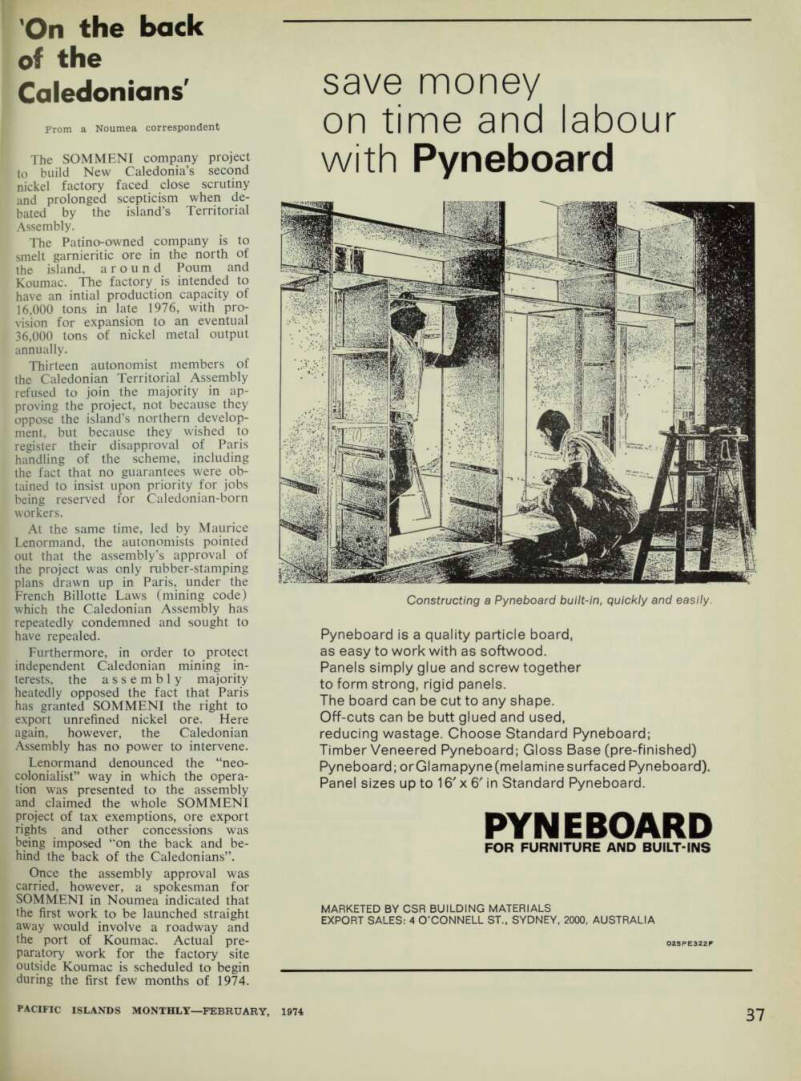
'On the back of the Caledonians'
From a Noumea correspondent
The SOMMENI company project to build New Caledonia’s second nickel factory faced close scrutiny and prolonged scepticism when de bated by the island’s Territorial Assembly.
The Patino-owned company is to smelt garnieritic ore in the north of the island, around Poum and Koumac. The factory is intended to have an intial production capacity of 16.000 tons in late 1976, with pro vision for expansion to an eventual 36.000 tons of nickel metal output annually.
Thirteen autonomist members of the Caledonian Territorial Assembly refused to join the majority in ap proving the project, not because they oppose the island’s northern develop ment, but because they wished to register their disapproval of Paris handling of the scheme, including the fact that no guarantees were ob tained to insist upon priority for jobs being reserved for Caledonian-born workers.
At the same time, led by Maurice Lenormand, the autonomists pointed out that the assembly’s approval of the project was only rubber-stamping plans drawn up in Paris, under the French Billotte Laws (mining code) which the Caledonian Assembly has repeatedly condemned and sought to have repealed.
Furthermore, in order to protect independent Caledonian mining in terests, the assembly majority heatedly opposed the fact that Paris has granted SOMMENI the right to export unrefined nickel ore. Here again, however, the Caledonian Assembly has no power to intervene.
Lenormand denounced the “neo colonialist” way in which the opera tion was presented to the assembly and claimed the whole SOMMENI project of tax exemptions, ore export rights and other concessions was being imposed “on the back and be hind the back of the Caledonians”.
Once the assembly approval was carried, however, a spokesman for SOMMENI in Noumea indicated that the first work to be launched straight away would involve a roadway and the port of Koumac. Actual pre paratory work for the factory site outside Koumac is scheduled to begin during the first few months of 1974.
Advertisements & other items, pp. 39-40 (1 item)
with Pyneboard
save money
on time and labour
il m§ ■ ■ Kl mi I Constructing a Pyneboard built-in, quickly and easily.
Pyneboard is a quality particle board, as easy to work with as softwood.
Panels simply glue and screw together to form strong, rigid panels.
The board can be cut to any shape.
Off-cuts can be butt glued and used, reducing wastage. Choose Standard Pyneboard; Timber Veneered Pyneboard; Gloss Base (pre-finished) Pyneboard: orGlamapyne(melaminesurfaced Pyneboard).
Panel sizes up to 16' x6' in Standard Pyneboard.
PYNEBOARD
FOR FURNITURE AND BUILT-INS
MARKETED BY CSR BUILDING MATERIALS
EXPORT SALES: 4 O’CONNELL ST.. SYDNEY. 2000, AUSTRALIA
025PE322F
or
RUM
at its best... say
fnpte
OVERPROOF AND UNDERPROOF
In 5 oz. and 13 oz. flasks and 26 oz. and 40 oz. bottles.
BLENDED AND BOTTLED BY JOHN WALKER & SONS LIMITED.
X 36 )
3 YOU LL WELCOME OUR TROPICAL
MODULAR HOME UNITS...IN EVERYWAY!
• PRE-CONSTRUCTED IN N.Z. AND
PRE-TREATED FOR TROPIC CONDITIONS
• SHIPPED KNOCKED-DOWN TO YOUR
DESTINATION
• EASILY ERECTED ON SITE WITH MINIMUM
SKILLED LABOUR
• OFFER LUXURY AT A REASONABLE PRICE Perfect for holiday and permanent homes orcommercial and industrial housing projects. 4 models to choose from: Leisuredeck , (illustrated) ‘Sunseeker’, Castaway’, Sunlover’ in 1,2,3-bedroom units. . . modular construction streamlines design, gives flexibility . . . pre-construction cuts costs and assembly-but not quality. . maintenance-free pre-coated insulated Permalum metal weather-boarding . . pre-piped plumbing unit. Plus many other quality features! m
welcome! homes limited
Like to know more? Mail this coupon now!
To: The Manager, Welcome Homes Ltd Box 12203, Penrose, Auckland, N.Z.
Please send me, without obligation, brochures on your Modular Home Units.
Name Address Already performance-proven in the New Hebrides, Pitcairn and Japan.
Property Located At 664^J
Samoan Fono Fight
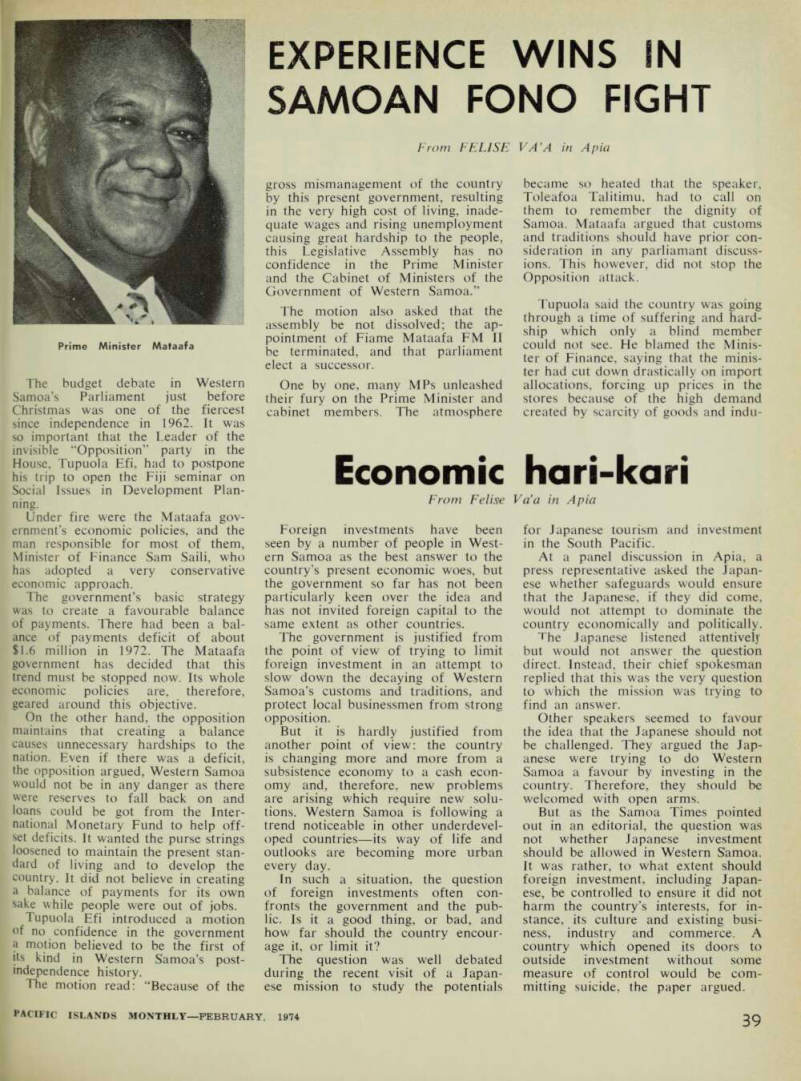
Experience Wins In
From FELISE VA’A in Apia
The budget debate in Western Samoa’s Parliament just before Christmas was one of the fiercest since independence in 1962. It was so important that the Leader of the invisible “Opposition” party in the House, Tupuola Efi, had to postpone his trip to open the Fiji seminar on Social Issues in Development Plan ning.
Under fire were the Mataafa gov ernment’s economic policies, and the man responsible for most of them, Minister of Finance Sam Saili, who has adopted a very conservative economic approach.
The government’s basic strategy was to create a favourable balance of payments. There had been a bal ance of payments deficit of about $1.6 million in 1972. The Mataafa government has decided that this trend must be stopped now. Its whole economic policies are, therefore, geared around this objective.
On the other hand, the opposition maintains that creating a balance causes unnecessary hardships to the nation. Even if there was a deficit, the opposition argued, Western Samoa would not be in any danger as there were reserves to fall back on and loans could be got from the Inter national Monetary Fund to help off set deficits. It wanted the purse strings loosened to maintain the present stan dard of living and to develop the country. It did not believe in creating a balance of payments for its own sake while people were out of jobs.
Tupuola Efi introduced a motion of no confidence in the government a motion believed to be the first of its kind in Western Samoa’s post
independence history.
The motion read: “Because of the
gross mismanagement of the country by this present government, resulting in the very high cost of living, inade quate wages and rising unemployment causing great hardship to the people, this Legislative Assembly has no confidence in the Prime Minister and the Cabinet of Ministers of the Government of Western Samoa.”
The motion also asked that the assembly be not dissolved; the ap pointment of Fiame Mataafa FM II be terminated, and that parliament elect a successor.
One by one, many MPs unleashed their fury on the Prime Minister and cabinet members. The atmosphere
became so heated that the speaker, Toleafoa Talitimu, had to call on them to remember the dignity of Samoa. Mataafa argued that customs and traditions should have prior con sideration in any parliamant discuss ions. This however, did not stop the
Opposition attack.
Tupuola said the country was going through a time of suffering and hard ship which only a blind member could not see. He blamed the Minis ter of Finance, saying that the minis ter had cut down drastically on import allocations, forcing up prices in the stores because of the high demand created by scarcity of goods and indu
Prime Minister Mataafa
cing some merchants to cut out some essential services.
Tupuola also expressed concern at rising unemployment, directly a re sult of the government’s attempt to save money, he alleged.
“It’s very easy to write your pencil and wipe out jobs. But what consider ation has been given to the father who has lost his job? His wife and children? Without jobs, people will steal, not so much because they be lieve in it but because they simply have to survive,” Tupuola contended.
He lamented the fact that the poorest would pay the dearest.
Forecasting an explosive social situation in 1974, ex-Secretary to Government Lauofo Meti charged that the budget proposals would re sult in the laying-off of teachers, drivers and casual workers in the Public Works Department and fewer school places and hospital beds, while Leota Pita, publisher of the South Seas Star, accused Minister Saili of making money the people’s master rather than their slave. Merely be cause he wanted to protect his reser ves, the minister had become insen sitive to the sufferings of the Samoan people, he said.
With its existence, and the Budget, at stake, the Mataafa government fought back vigorously, the Cabinet ministers taking almost a week to re turn the fire. The attack had been well sustained but so was the defence, especially in the hands of veterans like Prime Minister Mataafa and Minister of Lands Lesatele Rapi.
And the veterans saved the Cabinet from a humiliating defeat. Before the ballot on the Appropriations Bill’s second reading, the Opposition thought they could count on 22 members to defeat it, and allow Tupuola’s ‘no confidence’ motion to be brought in automatically. Unfor tunately for him, however, five Opposition supporters decamped.
Two didn’t turn up, and three voted for the government, giving it a win by nearly 26 votes to 17.
Their hopes dashed, the Opposition attempted a graceful withdrawal and the bill went through without any further serious opposition. Next day, with all its business for 1973 settled, parliament adjourned.
Government’s narrow win should be of grave concern to them, espec ially as Tupuola remarked afterwards that he had not withdrawn his ‘no confidence’ motion. Probably he means to reintroduce it in 1974.
The Opposition’s defeat has left a bitter taste for the leader, Tupuola Eh- He has been accused by his enemies of trying to disturb the
traditional equilibrium in Samoan politics, an equilibrium which gener ally favours the Tama Aiga (or the four highest ranking chiefs). To a Samoan this could be one of the most hurtful criticisms to be made against him and no doubt Tupuola has felt its sting.
On the other hand Tupuola is gen erally recognised as the Opposition leader and he feels his duty is to criticise the government within a parliamentary framework.
Tupuola himself has dared to chal lenge the Tama Aiga.
“A person should not be made a prime minister simply because he is a Tama Aiga. The criterion should
really be, does he have the ability to lead the nation?” is his argument.
After the fight, Tupuola, in a speech at the seminar at Suva (p 43) explaining his non-appearance at the opening, said the attempt to over throw their government “would have come off if the Speaker had allowed a call for division. The Speaker’s ruling was hard to fault—a division is permissible only after a debate; there cannot be a debate on the first reading. A voice vote is a voice vote whereas a division is a debate. Hence, the intended defeat of the Budget and the motion of ‘no confidence’ that was to follow were thwarted. Here is a classic case of tyranny of freedom.”
Economic hari-kari
From Felise Va'a in Apia
Foreign investments have been seen by a number of people in West ern Samoa as the best answer to the country’s present economic woes, but the government so far has not been particularly keen over the idea and has not invited foreign capital to the same extent as other countries.
The government is justified from the point of view of trying to limit foreign investment in an attempt to slow down the decaying of Western Samoa’s customs and traditions, and protect local businessmen from strong opposition.
But it is hardly justified from another point of view: the country is changing more and more from a subsistence economy to a cash econ omy and, therefore, new problems are arising which require new solu tions. Western Samoa is following a trend noticeable in other underdevel oped countries—its way of life and outlooks are becoming more urban every day.
In such a situation, the question of foreign investments often con fronts the government and the pub lic. Is it a good thing, or bad, and how far should the country encour age it, or limit it?
The question was well debated during the recent visit of a Japan ese mission to study the potentials
for Japanese tourism and investment in the South Pacific.
At a panel discussion in Apia, a press representative asked the Japan ese whether safeguards would ensure that the Japanese, if they did come, would not attempt to dominate the country economically and politically, The Japanese listened attentively but would not answer the question direct. Instead, their chief spokesman replied that this was the very question to which the mission was trying to find an answer.
Other speakers seemed to favour the idea that the Japanese should not be challenged. They argued the Jap anese were trying to do Western Samoa a favour by investing in the country. Therefore, they should be welcomed with open arms.
But as the Samoa Times pointed out in an editorial, the question was not whether Japanese investment should be allowed in Western Samoa.
It was rather, to what extent should foreign investment, including Japan ese, be controlled to ensure it did not harm the country’s interests, for in stance, its culture and existing busi ness, industry and commerce. A country which opened its doors to outside investment without some measure of control would be com mitting suicide, the paper argued.
Advertisements & other items, pp. 42-44 (1 item)
Marine Diesels
Reliable YA
Contributing to the Full Life
YANM AR is a Japanese diesel engine maker, and was the first in the world to succeed to developing a truly small diesel engine. From 3HP up to 2,000 HP, YANMAR is producing a full range of diesel engines, ideal for an unlimited variety of applications. YANMAR diesel engines are already winning high reputations in more than 130 countries around the world.
In the YSE,TE, and SME series, YANMAR has developed a line of high performance diesels specially for marine power units. The secret of the exceptional power which these units develop lies in the unique combustion performance, not attainable by any competitive unit.
YANMAR diesels are ideal for the rationalization of the fishing industry among the pacific islands and for inter-island transport.
DEALERSHIPS
YANMAR is seeking dealers on the following islands Interested parties located on following islands please contact address given below.
Fiji, New Hebrides, New Caledonia, Gilbert and Ellice, Tahiti, Tonga, Nauru, American Samoa, Western Samoa, Cook Is.
SMESeries
14~50HP EL Series 37 HP ns.
Series
>~I2HP
rroSS??
YANMAR
\ DIESEL ENCINEI
YAM MAR DIESEL ENGINE CO,LTD
1-11-1, Marunouchi, Chiyoda-ku, Tokyo, Japan Cable. YANMAR TOKYO Telex: TOK 0222-2310
VENTILATING
VRE
L
OWS
IN THE HOME
Add beauty and sunshine to your home by installing Australia's most economical, attractive louvre windows ... Sandy adjustable all-louvre windows.
Every modern feature is incorporated-in them, and they can be fitted with plain or figured glass blades ... also, temperature reducing folded aluminium blades.
IN INDUSTRY
The most practical answer to provide weather-resistance and controlled ventilation to factories, offices and stores is the use of Sandy Adjustable Aluminium Louvres. They are most economical in installation and offer durability at such low cost!
Motospecs didn’t
win a New Zealand
Export Award
just because of the
names behind
—_ m Names like SCANIA. WIX. MONROE-WYLIE.
OUa flaiflWl REPCO. ARMOURED KNIGHT. TURTLE
WAX. ARROW INSTRUMENTS. S-K WAYNE. WOLF. RUBERY OWEN, BLACK- HAWK. SIDCHROME. Etc. Etc Big names that mean, quite simply, the best automotive/industrial parts in the World. Of course, the quality of our products played an important part in our winning the Export Award. But so did service. And remarkable sales success. Which explains why Motospecs are New Zealand's largest exporters of automotive/industrial parts, and why our reputation for efficient, personal service is known throughout the South Pacific. We can prove it. Think of a problem, drop Motospecs a line, and we'll solve it. Personally.
DISTRIBUTED BY
MOTOR SPECIALTIES LTD
HEAD OFFICE. 30-90 ANZAC AVENUE, AUCKLAND, I.
•BRANCHES THROUGHOUT NEW ZEALAND.'
MOTOR SPECIALITIES INDUSTRIES LIMITED
GROUP EXPORT DIVISION, P.O. BOX 3201
AUCKLAND, NEW ZEALAND
benefits from its
The New Hebrides benefits from its tax haven status
By BOB PAUL, leading New Hebrides businessman
The New Hebrides seems to have passed through the stage of being a haven for companies and persons allegedly avoiding taxa tion in overseas countries and is now benefiting from the resultant publicity after being “discovered’’ by the press and Government of Australia and other countries.
It has been always virtually a tax haven but for some reason was not in the limelight until re cently.
We now see the benefits. The reservoir of money is being tapped for major developments within the New Hebrides, such as a modem abattoir which will be of consider able value to the burgeoning beef industry. Along with this goes a considerable amount of ‘know how’ which benefits the cattle men.
Top class bulls are being im ported with a general upgrading of the cattle industry and an eye on the world market for beef.
Scientific pig and poultry farms and new hotels are being built and the existing ones upgraded with the resultant upsurge in tourist traffic.
New businesses are opening up or pending, and New Hebrideans are participating in joint ventures, in particular the tourist business.
Most of this is attributable to the ready finance available from “tax haven” money which must be placed. As money must be used where better to invest it than in the New Hebrides itself and so reap the benefits of the tax haven?
In turn, the tax haven benefits from the use of this money.
It is significant that the majority of the development today is on the and the growing financial influence British side of the condominium of the British companies, banks, trust companies, lawyers and ac countants have reversed the trend whereby the British influence was
waning and the French increasing.
From the general point of view one sees a new brand of business people who are in the main not politically inclined—a client is a client to them, not a Frenchman, a New Hebridean, a British or what-have-you. These astute pro fessionals with their international outlook have given a new vitality to such bodies as the Chamber of Commerce and one can see that condominium finances will be under close scrutiny from now on.
There has been a surprising re sponse by the New Hebrideans themselves to the sophisticated facilities available for the many banks. Whereas the condominium has its own loans board for agri cultural and development purposes at very low interest, there is now a tendency for the New Hebrides to finance its projects through the normal banking channels which take less time and afford the privacy the government scheme lacks.
One is inclined to believe that thinking New Hebrideans prefer to make their own way and do their business along with the normal business people rather than face the indignity of the handouts, which have become so much a way of life here and which, some feel, places them under an obliga tion.
The increase in demand for trained staff has opened up new avenues for the training of students in office work and more New Hebrideans are employed by these companies in work which gives them added responsibilities they are very proud to shoulder.
Now that the speculators have been weeded out, I see a bright future for the New Hebrides. The shake-up has done a lot of good.
I see this as an investment haven rather than a tax haven.
colonialism?

A seminar on colonialism?
From Felise Va’a in Suva
Social issues in Development Plan ning was the theme of a seminar held by the South Pacific Commission and the South Pacific Social Sciences Association at the University of the South Pacific in Suva towards the year-end. Hardly a platform for politicians, but, in the midst of 14 sessions with about four speakers to a session, colonialism found itself arraigned.
Not surprisingly, the majority of the accusing fingers were New Hebri dean or Solomon Islander, but colonialism had its defenders; not outright supporters but pleaders ready to prove that the defendant had his good points.
Government officials, church lea ders, academisc, journalists, youth leaders and prominent citizens from most of the Island countries discus sed development planning with the aid of wide-ranging papers covering topics like region’s role, sociali sation in the development process, the effects of development on culture, the mass media’s values and moti vations in national planning, who gets what from development, the casualties of development planning, role of youth, creative arts in de velopment planning, social and poli tical constraints of development planning, national integrity and self respect, tourism, decision paralysis in development planning, political inde pendence and economic independ ence.
The tone of the papers reflected the background of the speakers. Thus, the speakers from the New Hebrides and the Solomons emphasised colon ialism in their papers. It was not so much the topic that amazed the par ticipants, It was the vehemence of their condemnation of colonialism and neo-colonialism, George Kalkoa, senior executive officer of the British Administration, New Hebrides spoke on National In tegrity and Self-Respect. He lamented the fact that New Hebrideans were stateless persons, a condition which caused a lot of embarrassment for travelling New Hebrideans, for which he blamed the British and French administrations.
“What is my problem? Well, the answer is: I am facing an animal with three heads—first, the British, second
Three-Headed
Animal
the French, third the condominium.
If you look at these three very care fully, you will note that there are two governments and three administra tions. The New Hebrides is known as a condominium but I would think the appropriate name is pandemonium,” said Kalkoa, leader of a nationalistic party in the New Hebrides, having independence as its aim.
“It must have one government, one system of court, one system of edu cation, one legal system, a legislative council, land reforms, and political independence,” he said.
The New Hebrideans were oppress ed and they aimed to liberate them selves from their oppressions, he maintained. The oppressors exploited and raped by virtue of their power and could not liberate either them selves or the oppressed.
During question time, Kalkoa was hard put to explain why the French wanted to stay in the New Hebrides.
One Indian student exclaimed that the only way the New Hebrideans could
rid themselves of their inferiority complex was through violence, a method which Kalkoa did not sup port.
In short, though everyone sympa thised with Kalkoa’s problem, it was evident that rational and not emotional arguments would have more power with international bodies who could lend support to New Hebridean nationalistic aims.
One British administrator, also a participant, remarked, “It is not easy to talk about independence when you consider that the New Hebrides con sists of several hundred different races speaking their own languages, and numerous islands divided by wide spans of ocean.”
Francis Bugotu, senior education officer in the Solomons argued. “The psychology of neo-colonialism is a disguised and often silent one. Its strength lies behind clever and effec tive manipulation and planned role playing on the part of the colonialist causing confused passivity in the minds of the colonialised.”
However, when Ata Ma’i’ai, a stu dent at the University of the South Pacific asked him what could be done to counter this subtlety, Bugotu
was not able to answer, but he issued a challenge to the peoples of the South Pacific to “stand in the centre of the ring and be involved in the development process.”
He preferred local solutions to problems and condemned the copy ing of European solutions, reiter ating R. Keesing’s statement that the blatantly presumptuous British assur ance of cultural superiority and pater nalism in dealing with the ‘child-like savages’ had withered Melanesian pride and identity.
These statements did not go un challenged. “White” university pro fessors took the view that though the colonialists may have had a bad effect in some respects, yet they have also done a lot of good to native races.
One participant offered a com promise—things colonial should not necessarily be condemned because they are colonial (for they may in fact be useful to the Pacific peoples).
On the other hand, the Pacific peo ples should not be guilty of ethnocen trism, which is a belief that only things Island can be good.
But perhaps the statement by Sione Tupouiua, chairman of the seminar’s
Continued on p 47
organising committee, reflected the opinion held by the majority of the
seminar participants.
Commenting on Kalkoa's paper, he suggested the New Hebrideans should find more constructive meth ods of solving their problems than simply condemning the colonial pow ers. However, he praised the integ rity and courage of the speaker for presenting his views.
He believed in the right of the Island peoples to do their own thing and not be dependent on the colonial powers.
Mr Tupuola Efi, of Western Samoa, who spoke on political and economic independence, never once mentioned colonialism, but stressed the need to control foreign investment.
A limited quantity of foreign in vestments could be used when it brought technical expertise and catered to a self-generated export market he said, but foreign equity capital was financially and socially the most ex pensive import for any developing country. The possibility of economic control or even dominance by foreign investors and the long-term domin ance of foreign equity investments was too great a price to pay for a few initial easy years.
Advertisements & other items, pp. 46-48 (3 items)
the most important ingredient
m Tm. - •?. 4^, m 000 r * m & mm - I 1 -.' . -sft- « V’-V Wk
N.S.W.
25 HG NET
m . .
I fl m 'tyr- I
jKJL
the most important ingredient
BREAD FLOURS;
CAKE FLOURS;
BISCUIT FLOURS;
SPECIALITY FLOURS;
MAINTOP —high protein bread flour ANCHOR —bakers flour • 50/50 MEAL —brown bread MEDIUM —cake and pastry • SPONGE —sponge cakes SPECIAL CAKE —madeira and cup cakes STRONG —cracker biscuits • MEDIUM —Shortbreads SOFT —sweet biscuits RYE flour • RYE meal • KIBBLED RYE SHARPS —roti and chapati flour • 100% STONE GROUND
WHOLEMEAL
GILLESPIE BROS. PTY. LTD.
HEAD OFFICE- BRISBANE OFFICE:
52 UNION ST., PYRMONT, SYDNEY, N.S.W. CABLE ADDRESS: „ AL ®‘ o v N ' o “ B , A n N u E ' bdkm Ml^Anin (G.P.O. BOX 2518, SYDNEY, 2001.) "GILLESPIE", (P.O. BOX 8, ALBION, BRISBANE, 4010.
PHONE: 660-4933. SYDNEY AND BRISBANE. PHONE: 6-1121.
PmPttWpM
7 * ✓ / m
Australia's best selling non-electric Iron! For reliability, ease of handling, and excellence of quality at a low price, you can't beat the HANOI. It's simplicity itself to operate—NO PUMPING IS REQUIRED. IT'S IMPOSSIBLE TO OVERFILL THE FUEL TANK and one filling does approximately 2 hours effortless ironing. Attractively finished in nickel plate. Spare parts always available.
THE PORTABLE OUTDOORS COOKER at a sensible price!
Twin independent burners for fast cooking. Twin tanks for double capacity. Steel case, when opened, acts as triple-wind shield. Rustproof. Noisy or silent burners as required. Small or large porcelain enamel ovens also available separately. HANOI —the lowest priced QUALITY Twin Burner Portable! ■I A Rim imnDlfC Pry Evans Rd., Salisbury North. Ph. 47 2122 bIMIRKJI milf nl%o LTD. BRISBANE, QUEENSLAND, AUSTRALIA
Jones Lang
Property Consultants & Real Estate Agents
hmmm
•Jf EXPERIENCED IN REAL ESTATE
VALUATIONS IN THE SOUTH
PACIFIC ISLANDS
m *
SKILLED IN DEVELOPMENT
CONSULTANCY
* EXPERTS IN THE PREPARATION
OF FEASIBILITY STUDIES
■ h iIP m
JONES LANG
\ m t t #* ■ >
EKHS
Property Consultants & Real Estate Agents Mi
SYDNEY
NORWICH HOUSE", 6-10 O’CONNELL STREET, SYDNEY. N.S.W., 2000 • CABLES "WONDERMENT" SYDNEY • TELEX 22844 • TELEPHONE 2 035*
MELBOURNE ADELAIDE BRISBANE PERTH CANBERRA
HONGKONG SINGAPORE NEW ZEALAND
Free petrol for shoppers!

From a Noumea corresoondent
As international airline and shipp i n g compan i es began curtailing their
operations and raising prices to face
the q jj cr j s i s? certain business houses j n N oumea were ac tually offering free petrol and free plane rides to their clients.
The Supermarche Week-End store on the outskirts of Noumea suddenly made a sporting offer: every customer purchasing as much as 3,000 francs at a CEE worth ot goods ISAibj at a certain date would receive a free . . f ?0 f t , ot 20 lltres ot petrol . , )^ lth , Pans en l.°y m f s J* ch favour- % re at ,l l on D W ur c °!JJ ltries ’ the f" ren ch Republic shares little ot some other nations crisis over the rationing ot oil supplies. And so, while local air services remained unthreatened, a Noumea furniture store, Central Meubles, tempted clients j om mland New Caledonia to ny dp'Y ll and choose a new lounge or dining suite.
The store offered to repay the return airfare or car expenses of any
person making a purchase to the value of almost SASOO. If the pur chase was double this value, a free meal was thrown in, while two meals and an overnight hotel room were added for a buyer spending $1,700.
In addition, the company offered to P ick PP and set down customers travelling through Magenta domestic airport, on the outskirts of Noumea.
These were not the only recent temptations set before Caledonian One building company consumers, une nuiiamg company was offering a free air-conditioner in each bedroom for prefabricated homes ordered during the month be fore Christmas. Prisunic supermarket advertised free goldfish to children w ho v j s hed the store accompanied by t h e j r paren t s . Finally, a newly launched hairdresser offered a money back guaran tee to clients undergoing his hair-straightening technique, ] n a u ? while Noumea business houses search for new devices to get through the nickel island’s current economic gloom, there is plenty of oil fuel and other goodies to give away.
Advertisements & other items, pp. 49-58 (3 items)
Coolrooms And
Save hundreds of dollars
on Australians most efficient
WALK IN, ALUMINIUM
COOLROOMS AND
FREEZE ROOMS
Hundreds already installed! The most economical supplementary coolrooms for bottles and food, providing the largest storage capacity of any comparable coolrooms of the same exterior dimensions. Five sizes —from 90-360 cu. ft. capacity; 16 models offering normal temp., two temp., deep freeze, or for pastry and ice storage applications. White vinyl interior, embossed rustproof aluminium exterior. • SUPPLIED IN EASY-TO-ERECT, DO-IT-YOURSELF KIT FORM • PETROL AND PETROL-ELECTRIC MODELS ARE AVAILABLE FOR AREAS WHERE POWER IS LIMITED OR NON-EXISTENT Available from: AUSTRALIAN NEW CALEDONIA EXPORTS (SILVER & BARDA), 363 George St., Sydney, 2000 and Branches.
BRECKWOLDT & CO., 276 Pitt St., Sydney, 2000 and Branches.
PETER FISHER TRADING PTY. LTD., 321 Pitt St., Sydney, 2000.
HAGEMEYER (A'SIA), 59 Anzac Pde., Kensington, 2033 and Branches.
Manufactured by:
KERR BROS, 65 York St., Sydney, 2000.
NELSON & ROBERTSON PTY. LTD., 197 Clarence St., Sydney 2000.
RABAUL TRADING CO. PTY. LTD., P.O. Box 219, Rabaul and Branches.
ROY GALLIMORE & ASSOCIATES, P.O. Box 179, Vila, New Hebrides.
C. SULLIVAN (EXPORT) PTY. LTD., 60 Margaret St., Sydney, 2000 and Branches.
W. S. TAIT & CO. PTY. LTD., 31 Macquarie Place, Sydney, 2000 and Branches. % 199 Parramatta Road, Cnr. Skarratf Street, Auburn, N.S.W. 2144, Australia. Phone: 648-1711.
Powered by Kelvinator.
Five-year warranty on compressor. Early delivery.
From the
Islands Press
From a report in the Tonga Chronicle of a seminar at the University of the South Pacific in Suva on Social Issues in Development Planning: On the subject of contraceptives. Professor John McCreary, of Victoria University, New Zealand, advocated that we should
always #/ loop before we leap."
From the GEIC Atoll Pioneer reporting a debate in the Legislative Council on the Custody of Children Bill: Mr Tito Teburoro (Tabiteuea North) said customs were not always good and from time to time they should be corrected. As we got more civilised we needed new customs, a new way of life. He didn’t like the customs of wearing short skirts, but girls preferred them. He didn’t like boys who went overseas and came back with long hair —his son had long hair.
From the Papua New Guinea Post-Courier reporting comments by the Lord Mayor of Port Moresby, Mr Jacob Lemeki, on the employment of
expatriates:
Expatriates doing jobs Papua New Guineans could do should be given jobs only if they accept local wages and conditions when PNG citizenship is enforced. . . . "The majority of these people now in Port Moresby city hate to pay any form of tax except the income tax," he said. . . . "Some members of the Ministerial staff (expatriates) should also be replaced because they are a pain in the neck," he said.
From a speech by Cook Islands Minister of Finance G. A. Henry in the Legislative Assembly as reported in the Cook Islands News: His people on Aitutaki . . . were complaining about their leader (the Resident Agent) and calling him names like Hitler and Taramea because he was like a poison. . . . They were all afraid to open their mouths because he might hear of it. He had even established spies around the island. He was a great problem for all from the top to the bottom, he said.
The island was like a mad house.
Extract from a letter by J-E. Barbier in the New Hebrides Nakamal: . . . Certain regions in the New Hebrides are renowned for being francophone, others anglophone. Messengers are sent to these regions to assure the inhabitants of the indestructible protection of the Power looking over them. And also to assure the Power of their fidelity. When the circumstance calls for it, “actors” put on their plastic smiles and perform the
kow-tow. ... In certain villages, French and English schools ignore, observe and fight one another and each year the race is on to see who can recruit the most children. Competition without a name but whose victim will be, sooner or later, the pupil.
From a speech at the British Secondary School by the new British Resident Commissioner in the New Hebrides, Mr du Boulay, reported in Nakamal. . . . While you have been living and working here in English language and in British tradition, there are contemporaries of yours, maybe even friends and relatives, who have been studying in French, absorbing a French culture and tradition. Some people deplore this; they argues that it will create divisions and confusion among the people of the New Hebrides, and they imagine they see a sort of competition between French and British in the New s Hebrides. I don't see things like this at all. On the contrary, I think it can and should be a piece of great good fortune for the country to have in this way access to two great European cultures and civilisations.
From an advertisement in The Fiji Times: Hens! Hens! Hens! Live hens available again from today. Many were turned away.
From the American Samoa News Bulletin: All Good Samaritans, who carried government property' away from the Administration Building to save it from Thursday night’s fire (Nov 29) will no longer be regarded as Good Samaritans if the equipment is not returned by Friday (Dec 7). Commissioner of Public Safety Tufele Li’a said missing items are still 1 being brought back, but a vast majority is still unaccounted for. It includes air-conditioners, type writers, adding machines, telephones and office furniture..
From the New Hebrides Group News: A campaign by an evangelistic team on South-east Ambrym led by church leaders of the Presbyterian mission in the area has just completed the task of destroying “nakaimas” or poison magic in 11 villages. . . . Report from Ulei this morning said that during the recent campaign nine strong “nakaimas” were destroyed. Eight of them were actually taken from one man. Places considered to be tabu in the area, because local people strongly believe in them, were also made common by offering of prayers and short services.
From the BSI News Sheet: A pussy cat helped the people of Vuturua on Small Gela to kill many rats in their houses in October, and the villagers put on a big feast in the cat’s honour..
The cat was the only one which had survived after the malaria eradication men sprayed DDT around Gela Island. The cat took over the duties of rat killing: for the whole of Vuturua village going from house to house, and it was loved by the villagers. When the headman of Vuturua village heard that the pet had died he called all his people to make a feast. The villagers killed a pig, caught fish and prepared local foods.
From a letter by L. T. Ma'ake in Tonga Chronicle,
alleging police brutality:
A person who was suspected of thieving had to endure this harrowing experience. He was taken to prison and tortured to death until he would own up, which is very barbaric indeed.
Sqdi
Come up to Kool
for extra freshness
£ r A ■c? *
SQDi
/ Jl—
T-"Sv'
2A -c £5. ■&L * e :X' ■ R m. * $ U597-8/71
\fter you don t believe the way the brand
new decks sound, you won’t believe
the way they’re priced.
The beauty of Pioneer’s cassette decks is the way they reproduce high fidelity sound from unbelievably tiny cassettes. In fact, no others on the market with prices comparable to Pioneer’s new CT-5151, CT-4141 A, and CT-3131A give you so much sound for the money. Take, for instance, CT-5151, the top-notch among the three featured here. With a frequency response range from 30 to 16,000 Hz, a built-in *Dolby noise reduction unit, and long life ferrite solid tape head, you’re going to want to
switchable), full-automatic stop mechanism, tape
running pilot light, peak level indicator, over-level limiter, electronically controlled DC motor, and even a memory rewind switch. If you’ve ever doubted the sound quality of cassette tape, now’s the time to hear it all over again. On the CT-5151, CT-4141 A, and CT-3131A, just a few of many quality high fidelity products made by Pioneer.
To see and listen to any of these, please contact one of the following: compare CT-5151 with most of the expensive reelto-reel decks. CT-5151 is, indeed, loaded with a lot more features like normal/chromium dioxide
tape selector (bias/equalizer
independently
Dimensions: 15-5/8(W) x 9-1/2(D) x 3-3/4(H) inches.
Weight: CT-5151 101 b. 9 oz.
CT-4141A 101 b. 6 oz.
CT-3131A 9 lb. 11 oz. r
CT-4141A
CT-5151 CTt3l3l A Australia Pioneer Electronics Australia Pty. Ltd., 256-8, City Road, South Melbourne, Victoria 3205, Australia, Tel; 696605, Branches in all states Fiji Islands Brljlal & Company, G.P.O. Box No. 362, Suva, Fiji Islands, Tel: 22 258 Lae Hagemeyer (Australasia) 8.V., P.O. Box No. 90, Lae, New Guinea, Tel: 2718 Rabaul Hagemeyer (Australasia) 8.V., P.O. Box No. 63, Rabaul, New Guinea Port Moresby Hagemeyer (Australasia) 8.V., P.O. Box No. 1428, Boroko, Port Moresby, New Guinea Madang Hagemeyer (Australasia) 8.V., P.O. Box No. 673, Madang, T.P.N.G.
New Zealand Tee Vee Radio Ltd., P.O. Box No. 5029, Auckland, New Zealand, Tel; 763-064 Norfolk Islands Burns Phllp (South Sea) Co., Ltd., Norfolk Islands, South Pacific Nauru Island Jacob Enterprises, P.O. Box No. 4, Nauru Island Tahiti Ets. PERFECT, B.P. 594, Papeete, Tahiti, Tel: 20 407 New Caledonia Menard Freres, B.P. 123, Noumea, New Caledonia. Tel: 52-22 American Samoa Transpac Corporation, P.O. Box 1477, Pago Pago, American Samoa 96799, Tel: 2227 ‘“DOLBY” is a trademark of DOLBY LABORATORIES INC.
—it 1 v-n M \ n n m i r a w
-.A *JB™L 4
an m *& feiw SB I v £3 1 ' ’ i S3K m .': ■■■ m £®clto
Flour that's milled fresh
when called for by your shipping agent Milled fresh—when called for—then packed in clean, strong sacks or drums. That's the reason why Mungo Scott's have the largest output of any mill in Australia, Mungo Scott's skilled laboratory staff put to practice every modern method to ensure you receive the finest quality entoleted flour.
Since 1894 . . . Mungo Scott "a good firm to do business with". We pride ourselves on documentation. bakers flour e sharps e meals CAKE FLOUR * BISCUIT FLOUR • SPONGE FLOUR
MUNGO SCOTT -
FLOUR MILLERS
A DIVISION OF ALLIED MILLS INDUSTRIES PTY. LTD.
Summer Hill, N.S.W., Australia Cable & Telegraphic SUPERB Sydney Phone: 797-8333 A
.i—— fsistsife hsiiwSi5ii~H ;
n r n
i mi mi
a WLf^: too m H A for the lively, alert Burns Philp family For most of 90 years Burns Philp people have been busy learning new things. Know-how is an important part of the company’s tradition, so it is not surprising that much of our modern effort is devoted to education and training.
This effort is visible almost everywhere in the Islands.
Training local managers, sponsoring students at near and distant schools, on-the-job training in specific skills —these are all part of it. They lead to better opportunities for individuals and better service by all the Burns Philp companies.
Best of all, the fun of education never ends. There is always something new to know, something more difficult to do, something challenging to discover. That keeps Burns Philp alert and lively.
DOING GOOD BUSINESS FOR THE ISLANDS
BURn/ PHILP
GROUP OF COMPANIES
PRINCIPAL OFFICE—7 BRIDGE STREET SYDNEY NSW 2000 AUSTRALIA
■7 ■ 1 m mm '■;■■■
RT-296R
Radio/Cassette Recorder • ♦ • •»« • •• • • • »•» • • 9
RP-212S
MW/SW
2-band Radio
KT 215 C
Cassette Recorder Electric Fan Go ahead, dive into portable sound with undreamed of fidelity. These Toshiba sensations bring your favorite sounds wherever you are.( Don't take chances with a good time, take . M , i; Toshiba every time.
Check these outstanding features; KT-215C Cassette Recorder: Built-in microphone, 1C head, automatic shut-off, push-button operation, tape counter, AC/DC.
RP-212S MW/SW 2-band Radio: Shortwave and medium wave reception, pulls-in distant stations, extra large speaker built-in and exterior antennas.
RT-296R Radio/Cassette Recorder; Remarkable tonal richness, medium wave and thrt3 shortwave bands, simultaneous recording while listening, tuning meter, automatic level control, tape counter, automatic shut-off, dynamic mike, light weight, AC/DC.
On hot summer days and nights, cool off with one of Toshiba's superior and silent electric fans. A full line of fans with many unusual features is available at your Toshiba dealer's.
tfoSuba
...In Touch with Tomorrow
, y?: « • i *3
»»«J. ’MM.
r i ■•■ T » <■ i"3 « ' r »• r 9 « -i ■ ... ■■-'■. • ■ ? * ■- ■'-• > -^'' ;-• i d|f . > - C" ' „ , , -»•* ■ ■;. ■ .. 'Jt >v...
'■ •■•"«.■ ; »’?• '• ... , : . ■ :&■ ••;*. - Mm ‘ ■•■■ - ■/ . : ft* ■ L „ - , i. • . ■ ,v- r ;*’■■ k ‘ .. ■' ■ ■ -V ■’•' ' ’?*>?■ -I •■».- •-W. - •*•,*»«. • • ‘ i v '*;.•• *;-.f • ...-»;•% V—li'i - - . . v r T >*f . ,^v. ■ -■ - '■■■ • *. <■' *■ ** • V r#i * r* IK* gp.'O* aar*s-» ■a* %w u the flag we’ve flown for a hundred years.
Two paddle steamers on the Yangtse River in 1873 marked the beginning of the China Navigation Company. Today, the same flag flies above eighteen modern motor ships plying an extensive network of cargo routes between Papua New Guinea and Pacific Island ports (as far East as Tahiti) and Japan, New Zealand, Australia
and Thailand.
For 100 years, the flag of the China Navigation Company has meant experience, reliability and speed across the sea. Today, it’s flying as strong as ever.
For further details and all enquiries there are Agents at the following ports: Papua New Guinea: Steamships Trading Co. Ltd., Port Moresby. Samarai, Lae, Madang, Rabaul, Kieta. Burns Philp (New Guinea) Ltd., Wewak, Kavieng. Fiji: Morris Hedstrom Ltd., Suva, Lautoka. Western Samoa: Morris Hedstrom Ltd., Apia.
Tonga: Morris Hedstrom Ltd,, Nuku’alofa and Vava’u. Tahiti: Etablissements Donald, Tahiti, Papeete. New Caledonia: Etablissements Ballande, Noumea. 8.5.1. P.: British Solomons Trading Co. Ltd., Honiara. New Hebrides: Les Comptoirs Francais des Nouvelles-Hebrides, Vila and Santo. AUSTRALIA—Sydney: Interocean Swire Pty. Ltd. Melbourne: Interocean Australia Services Pty. Ltd. Brisbane; Wills, Gilchrist & Sanderson Pty. Ltd. NEW ZEALAND —P. & O. (N.Z.) Ltd.
Auckland, Wellington, Christchurch, Dunedin, Bluff, Napier. Japan: Swire McKinnon, Tokyo, Yokohama, Osaka, Kobe and Nagoya. Eastern Managers; Butterfield & Swire, 9 Connaught Rd., Central, Hong Kong.
JOHN SWIRE & SONS PTY. LTD. General Agents in Australia, 8 Spring Street, Sydney, Phone: 27 9351.
THE CHINA NAVIGATION CO LTD
T CN co
MEMBER OF THE SWIRE GROUP.
IS 008
A 4sS^^\ m V*v 1^ #s r-r
preserve simply with SAO
Arnott’s Sao biscuits are the handiest cracker biscuits you can buy. No sooner is one pack finished than you’re opening another. They’re always fresh and ready when you want them, pack after pack. Just take anything you fancy and...
Biscuits
Ik P There is no Substitute for Quality
Magazine Section
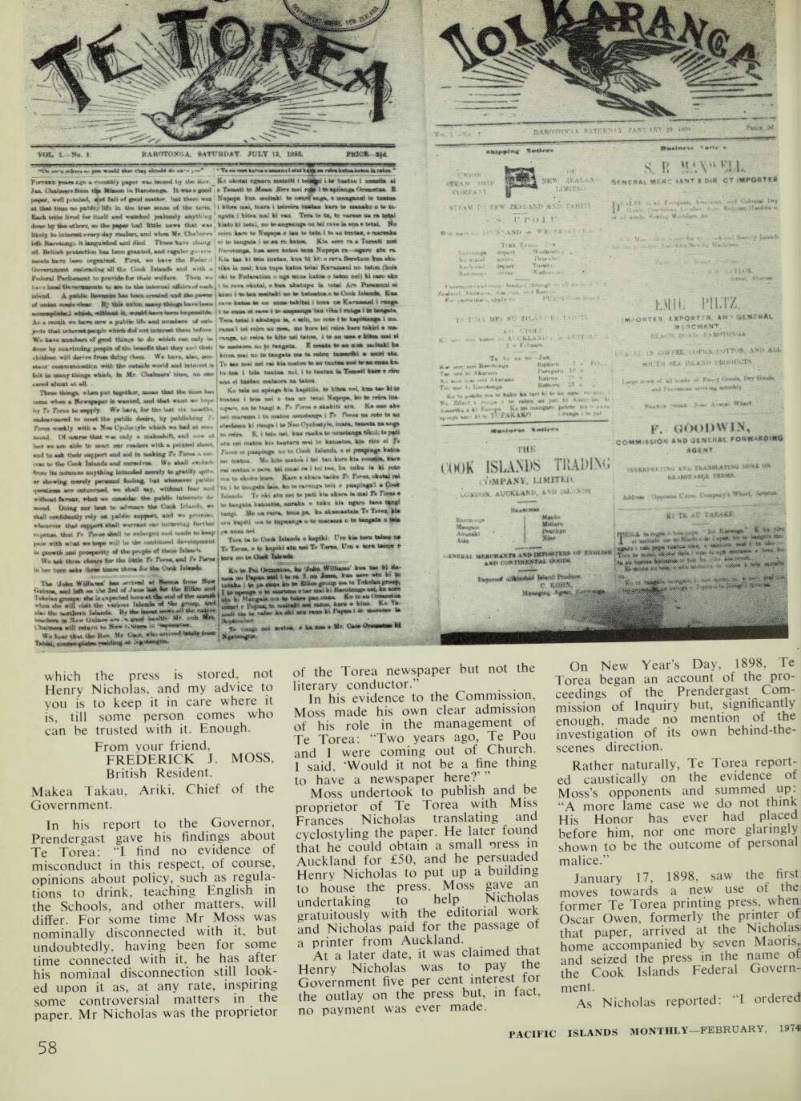
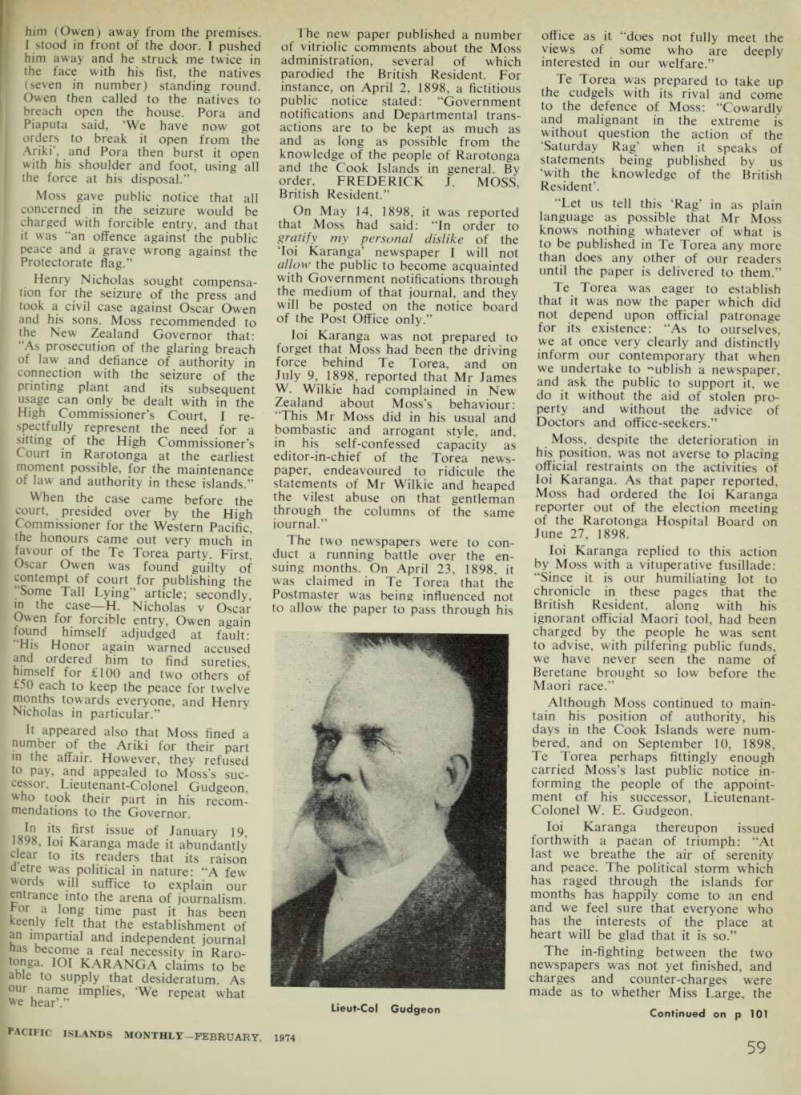
When Newspapers Waged
War In The Cooks
By W. G. Coppell
On January 26, 1895 the first issue was made of Te Torea, to all intents and purposes the first commercial newspaper in the Cook Islands. Te Torea first saw print as a 4-page newsheet, being handwritten and cyclostyled on poor quality paper, with Henry Nicholas, a trader who had lived on Rarotonga since the 1870 s, as its publisher, Te Torea always included items in both English and the vernacular, and was published every Saturday in its handwritten form until a letter press edition appeared on July 13, 1895.
The first notice to the public said: “Te Torea will be published every Saturday. It is to tell the news and to give the people an opportunity of exchanging ideas on all public affairs.
Our motto will be—‘Do unto others as you would that they should do unto you’.”
The editor of Te Torea clearly lent his weight to the innovations sponsored by Mr F. J. Moss, the British Resident, by bringing out editorials which patently supported his policies. The public, for instance, were urged to support the Public Schools Act: “The Act is a good one, and will, we hope, do great good.
No one, who has many children over five years of age, can complain of having to pay, as his children will be taught without further expense.”
His interest in both Te Torea and the judicial processes eventually were to be major contributors to Moss’s removal from office as British Resident, and it is interesting to read the Te Torea editorial of October 3, 1896: “In a recent issue we published a letter from John Strickland, of Aitutaki, saying that the Government there had fined him for giving a ring as a present to a girl friend. He paid the fine but the Government wouldn’t give the ring back. So he bought the ring from the government and gave it again to the girl, who in her turn gave it to another friend. Then this
This is the second of an occasional series of articles on newspapers in the Islands in the early days. Dr Coppell, who is now lecturing in education at Macquarie University, Sydney, was formerly Deputy Director of Education in the Cooks, the scene of a newspaper war in which the pen proved mightier than the British Resident.
good kind native government fined both girls.”
Moss fell out with a number of European residents on Rarotonga, and he also aroused the animosity of some of the Ariki (paramount chiefs).
Petitions were forwarded to the Governor in New Zealand seeking the removal of Moss.
In part. Moss’s difficulties were exacerbated by the fact that he had fallen out with the Rev J. J. K.
Hutchin, the London Missionary Society representative at Rarotonga. 111-feeling had arisen between the two men over the establishment of the public schools, the liquor question and, in particular, the High Court Bill.
The Chief Justice of New Zealand, Sir James Prendergast, conducted an inquiry at Rarotonga in December, 1897, during which the involvement of the British Resident in the publica tion of Te Torea was revealed.
The impending inquiry drastically affected Te Torea and on November 6, 1897, it announced: “It is with extreme regret we have to announce that with the present issue Te Torea will cease to exist. During the two years of our existence we have endeavoured to make ourselves use ful to the community as a whole and while believing generally that our humble efforts have been appreciated, the remuneration received has not been at all commensurate with the expense entailed and we have to re
luctantly confess that for some time Te Torea has not been a paying concern.”
However, the enterprise was not entirely moribund as on November 20, 1897 the paper again appeared in its original cyclostyled handwritten form: “We find, however, so un animous a wish that the paper be continued that we have decided to accede to the wishes of our friends and relaunch the little bird upon the sea of journalism.”
Te Torea continued to be produced in cyclostyled form until its ultimate demise on February 21, 1899. One of the accusations made against Moss at the inquiry was that he had used Te Torea for his own purposes although the press had, in fact, belonged to the Federal Government of the Cook Islands. The printing press, meantime, remained locked in a shed owned by Henry Nicholas, and the correspondence between Makea Ariki and Moss foreshadows actions which followed: British Resident’s Office, Rarotonga, January 13, 1898.
Sir, The printing-press and all that belongs to it is in the hand of Henry Nicholas. If they are the goods of the Government I wish to bring them to an open place, so that as to print the word of the Government. It is not right that the Government goods should re main with him, and do not work.
Let us know your thoughts, so as I can send my men to take it away tomorrow. Sufficient.
Salutations!
MAKEA, Ariki,
Chief of the Government.
The British Resident.
British Resident’s Office, Rarotonga, January 14, 1898.
Salutations!
I have today
received your letter, dated the 13th January.
I have the key of the place in
which the press is stored, not Henry Nicholas, and my advice to you is to keep it in care where it is, till some person comes who can be trusted with it. Enough.
From your friend,
Frederick J. Moss
British Resident.
Makea Takau, Ariki, Chief of the Government.
In his report to the Governor, Prendergast gave his findings about Te Torea: “I find no evidence of misconduct in this respect, of course, opinions about policy, such as regula tions to drink, teaching English in the Schools, and other matters, will differ. For some time Mr Moss was nominally disconnected with it, but undoubtedly, having been for some time connected with it, he has after his nominal disconnection still look ed upon it as, at any rate, inspiring some controversial matters in the paper. Mr Nicholas was the proprietor
of the Torea newspaper but not the literary conductor.”
In his evidence to the Commission, Moss made his own clear admission of his role in the management of Te Torea: “Two years ago, Te Pou and 1 were coming out of Church. 1 said, ‘Would it not be a fine thing to have a newspaper here?’ ”
Moss undertook to publish and be proprietor of Te Torea with Miss Frances Nicholas translating and cyclostyling the paper. He later found that he could obtain a small nress in Auckland for £5O, and he persuaded Henry Nicholas to put up a building to house the press. Moss gave an undertaking to help Nicholas gratuitously with the editorial work and Nicholas paid for the passage of a printer from Auckland.
At a later date, it was claimed that Henry Nicholas was to pay the Government five per cent interest for the outlay on the press but, in fact, no payment was ever made.
On New Year’s Day, 1898, Te Torea began an account of the pro ceedings of the Prendergast Com mission of Inquiry but, significantly enough, made no mention of the investigation of its own behind-the scenes direction.
Rather naturally, Te Torea report ed caustically on the evidence of Moss’s opponents and summed up: “A more lame case we do not think His Honor has ever had placed before him, nor one more glaringly shown to be the outcome of personal malice.”
January 17, 1898, saw the first moves towards a new use of the former Te Torea printing press, when Oscar Owen, formerly the printer of that paper, arrived at the Nicholas; home accompanied by seven Maoris* and seized the press in the name of the Cook Islands Federal Govern ment.
As Nicholas reported: “I ordered
him (Owen) away from the premises.
I stood in front of the door. I pushed I him away and he struck me twice in 1 the face with his fist, the natives (seven in number) standing round.
Owen then called to the natives to breach open the house. Pora and Piaputa said, ‘We have now got I orders to break it open from the Ariki’, and Pora then burst it open with his shoulder and foot, using all the force at his disposal.”
Moss gave public notice that all ! concerned in the seizure would be charged with forcible entry, and that it was “an offence against the public peace and a grave wrong against the Protectorate flag.”
Henry Nicholas sought compensa tion for the seizure of the press and took a civil case against Oscar Owen and his sons. Moss recommended to the New Zealand Governor that: “As prosecution of the glaring breach of law and defiance of authority in connection with the seizure of the printing plant and its subsequent usage can only be dealt with in the High Commissioner’s Court, I re spectfully represent the need for a sitting of the High Commissioner’s Court in Rarotonga at the earliest moment possible, for the maintenance of law and authority in these islands.”
When the case came before the court, presided over by the High Commissioner for the Western Pacific, the honours came out very much in favour of the Te Torea party. First, Oscar Owen was found guilty of contempt of court for publishing the Some Tall Lying” article; secondly, m the case—H. Nicholas v Oscar Owen for forcible entry, Owen again found himself adjudged at fault: “His Honor again warned accused and ordered him to find sureties, himself for £lOO and two others of £5O each to keep the peace for twelve months towards everyone, and Henry Nicholas in particular.”
It appeared also that Moss fined a number of the Ariki for their part m the affair. However, they refused to pay, and appealed to Moss’s suc cessor, Lieutenant-Colonel Gudgeon, who took their part in his recom mendations to the Governor.
In first issue of January 19, ,8, loi Karanga made it abundantly clear to its readers that its raison detre was political in nature: “A few words will suffice to explain our entrance into the arena of journalism, for a long time past it has been keenly felt that the establishment of an impartial and independent journal has become a real necessity in Raro tonga. 101 KARANGA claims to be able to supply that desideratum. As our name implies, ‘We repeat what we hear’.”
The new paper published a number of vitriolic comments about the Moss administration, several of which parodied the British Resident. For instance, on April 2, 1898, a fictitious public notice stated: “Government notifications and Departmental trans actions are to be kept as much as and as long as possible from the knowledge of the people of Rarotonga and the Cook Islands in general. By
Order, Frederick J. Moss,
British Resident.”
On May 14, 1898, it was reported that Moss had said: “In order to gratify my personal dislike of the ‘loi Karanga’ newspaper I will not allow the public to become acquainted with Government notifications through the medium of that journal, and they will be posted on the notice board of the Post Office only.” loi Karanga was not prepared to forget that Moss had been the driving force behind Te Torea, and on July 9, 1898, reported that Mr James W. Wilkie had complained in New Zealand about Moss’s behaviour: “This Mr Moss did in his usual and bombastic and arrogant style, and, in his self-confessed capacity as editor-in-chief of the Torea news paper, endeavoured to ridicule the statements of Mr Wilkie and heaped the vilest abuse on that gentleman through the columns of the same journal.”
The two newspapers were to con duct a running battle over the en suing months. On April 23, 1898, it was claimed in Te Torea that the Postmaster was being influenced not to allow the paper to pass through his
office as it “does not fully meet the views of some who are deeply interested in our welfare.”
Te Torea was prepared to take up the cudgels with its rival and come to the defence of Moss: “Cowardly and malignant in the extreme is without question the action of the ‘Saturday Rag’ when it speaks of statements being published by us ‘with the knowledge of the British Resident’.
“Let us tell this ‘Rag’ in as plain language as possible that Mr Moss knows nothing whatever of what is to be published in Te Torea any more than does any other of our readers until the paper is delivered to them.”
Te Torea was eager to establish that it was now the paper which did not depend upon official patronage for its existence: “As to ourselves, we at once very clearly and distinctly inform our contemporary that when we undertake to publish a newspaper, and ask the public to support it, we do it without the aid of stolen pro perty and without the advice of Doctors and office-seekers.”
Moss, despite the deterioration in his position, was not averse to placing official restraints on the activities of loi Karanga, As that paper reported.
Moss had ordered the loi Karanga reporter out of the election meeting of the Rarotonga Hospital Board on June 27, 1898. loi Karanga replied to this action by Moss with a vituperative fusillade: “Since it is our humiliating lot to chronicle in these pages that the British Resident, along with his ignorant official Maori tool, had been charged by the people he was sent to advise, with pilfering public funds, we have never seen the name of Beretane brought so low before the Maori race.”
Although Moss continued to main tain his position of authority, his days in the Cook Islands were num bered. and on September 10, 1898, Te Torea perhaps fittingly enough carried Moss’s last public notice in forming the people of the appoint ment of his successor, Lieutenant- Colonel W. E. Gudgeon. loi Karanga thereupon issued forthwith a paean of triumph: “At last we breathe the air of serenity and peace. The political storm which has raged through the islands for months has happily come to an end and we feel sure that everyone who has the interests of the place at heart will be glad that it is so.”
The in-fighting between the two newspapers was not yet finished, and charges and counter-charges were made as to whether Miss Large, the
Continued on p 101
Lieut-Col Gudgeon
teacher at the London Mission Society school at Tereora, had called for three cheers to mark the dis missal of Frederick J. Moss on the arrival of a party of tourists from New Zealand. The outcome was that H. Ellis, who was now conducting the business of Te Torea, sued Oscar Owen of loi Karanga for libel. loi Karanga stated; “To attack defenceless and unprotected females seems to be a disease with some people, and we are sorry to find that Rarotonga possesses an individual afflicted with this despicable com plaint. We are led to make these remarks by having our attention called to a statement published in A
Scurrilous And Ownerless
Rag.”
In its editorial on October 3, 1898, loi Karanga reported that the libel case—Ellis versus Owen—had been heard before Mr H. Hunter, the Judicial Commissioner, who found in favour of Ellis. It seems that the Te Torea party, although limited by physical resources, had not com pletely conceded the game, and that they had trapped Owen by means of journalistic skullduggery. loi Karanga claimed that Mr Hunter had been misled by the fact that Te Torea had dated an issue for July 20 but did not in fact publish it until July 23. loi Karanga complained: “Mr Hunter, in commenting on the case, used these words, ‘What was the use of our remarks, when an apology had already appeared?’, being led astray by the date of plaintiff’s paper and the falsehood told him by the plaintiff, that the statement and apology had both been published before the remarks appeared.”
Ellis’s triumph appears to have been short-lived as he was sentenced to 14 days imprisonment on March 3, 1899 for contempt of court, and he became the first occupant of the gaol which was then proclaimed on Raro tonga.
The precise ownership of loi Karanga remained a mystery, and Charles Banks wrote to Moss from Rarotonga in May 1899 that the elder Owen had left Rarotonga, and although the paper was run by “young Owen and Large”, it was not published who the proprietors were, and “Stephen Savage says he has £6 per month and that the Govern ment owns the paper.” loi Karanga did not long survive its rival. From April 29, 1899, it was stated that Stephen Savage was manager, and the paper ceased pub lication on August 25, 1900.
Official notices were thereafter published in the Cook Islands Gazette, and Savage, among other official duties, assumed that of Government Printer. Other than the church newspapers and magazines, there was to be no further serial publication in the Cook Islands until The Akatauira (The Morning Star) appeared in 1936.
That there had been powerful and implicitly official forces responsible for the life of loi Karanga is revealed in a despatch from Gudgeon to the British Resident, in 1901: “In order to economise, I have discontinued the “loi Karanga” newspaper and taken Mr Savage, the printer, as my secretary.”
Past The Old Track
(An exploration)
By Ata Ma'ia'i
SUNSET at the village of Loatai is topical: people talking about fishermen returning to shore with the sunset behind them or father and son hurrying home —from their plan tations before the sun sets. The sunset to the people is a poetic sojourn— that instills in their consciousness a far-away motion: that keeps their minds and souls alive. In fact, ac cording to observation, the sunset is the lifeblood of the village that con stantly carries each individual’s thinking to a new surge, about one’s existence. The sunset is the foreman that reminds the individual of his or her responsibilities—to say the evening prayers or to prepare meals.
In songs and rhetorics that crawl their cultures, in burning oratories highlighting a chiefs coronation— and even the sublime folklores mothers told their children before bedtime —the sunset is revered. Some times, such stories are masked by
“divine” whispers and laughter. All of these things are fleeting to the young, but the old think of them in their interests which is to say, “the sustaining of the tradition of the powerful”.
This sunset the symbol of power the godfather for our needs the big ray shining into our lives.
And now I think about the sunset in Loatai. It is not enough to think of it as a happening—but a symbol alive in the people’s mind. Yet, the passion and the outcries at sunset are underdeveloped, and most certainly embryonic when I come to think of eulogies delivered at the graveyard— when they are linked with Time.
That was a wrecked symbol, for to speak of the sunset and Time was like turning a logic upside-down.
Time flows as the common saying goes The sunset transforms the
individual’s day’s labour into inertia.
And as for the Pastor’s mysticism; the God Almighty thing, my mind turns to the pious revelations shouted from pulpits. Full of vanity and pomposity, the message has mean dered within my wandering thought processes and has reminded me of one good thing: that behind the veil of mysticism there is a logic in play, bridging (perhaps) the people’s God and the sunset. It is stark, I am certain and on the surface, a distorted symbolism, carved in peoples heads.
I have often heard them in their cool moments talking about their feelings; and a long epic voyage of which its connecting points are substantiated by biblical assertions. On second thoughts, these things are the con stitution of matters rebelling—and I remember the outbursts of the young, the erring evenings before the sun dying. But not all evenings were as such.
Appearing for the first time in MANA this month are works by Jack Lahui, from Papua New Guinea, and Makiuti Tongia, of the Cook Islands. Jack Lahui, Assistant Editor of Papua New Guinea Writing, is already an established poet who has published a number of poems in many literary magazines in PNG and overseas. Makiuti Tongia began writing poetry at Tereora College and has continued this interest at the University of the South Pacific, where a number of his poems have appeared in Unispac.
Ata Ma’ia’i, of Western Samoa, published in MANA last year, and editor Marjorie Crocombe starts a series of articles on the museums and Pacific artifacts in Europe.
FOR me one particular visit to Loatai, sums up my position.
That evening, the sun was seen partially behind the “highest peak”; its reflection cast a shadow on the Fale, built underneath the foot of the mountains. The mountains over shadowed the Fale: throwing a some what distorted image on the Fale’s appearance—like a lens out of focus.
Inside the Fale, an old woman sat.
She was partially blind; her head stooped forward as she was weaving a mat. In a while, darkness would descend on the land, filling out the vacuum of natural openings in the caves and in the soil—that muddy ponds were confused with the dry ones. But that was yet to happen.
The Fale and the sun now behind the highest peak presented to the observer the morbid passion known only in holy chapels. Very soon the sun would set. Before it went, it had a habit of sitting on the sea, and some reported that it plunged into the bottomless ocean after that.
Yet now while I revisit Loatai, the betwixt and between of the past (that lingering nausea) I become aware of the two arrows directing/ projecting those paths known for salvation. And the stubborn drag ging towards an undefined Promised Land has somehow triggered this stupid sensibility inside me. For while it lasted, I had wanted to shout—in order to sing heartily.
True enough, that scenery was pas sionate for me for the simple reason that it instilled in me one under standing of humanity; the same understanding that led one painter to transform the scenery onto canvas. He was, I gathered, a certain Mista Bridge, a suave grey-haired white-man; who painted the scenery mercilessly so that the outcome re vealed some mysterious eye—like a woman’s bosom. Nobody in the village liked the painting: it appealed
to them like a devil sucking the milk from a woman’s tit.
To talk of the landscape and the canvas is to re-echo a platitude popular to us all. For entangled in the thickness of complexes (the pastor’s sermons, the undefined Promised Land, etc), there is a meeting place; this is the world stage where nice, cynical, sane and insane actors and actresses develop their talents.
The rumour about mista is a point in mind; for after painting the out-offocus scenery he worked on the women. He did it with an earthly tact and he did it with passion too; developing a new awareness of posture and mannerism among the women— which is to say a living drama performed in all settings.
Going back to the landscape— those beautiful green valleys and the glittering sea at night—and determining its position in relation to one’s humanity, is opening up a new world punctuated by a question mark. But then maybe it is because it is now coloured by one’s present —that thief known to us all,
TOUT thinking of Loatai, that A# evening when this narrator saw it from a distance was warming enough. The village was half empty; for the young men had been on the open sea for many days and were expected soon. The women had gathered at the shore to wait for them, and in their pastime of gossip ing, they talked and laughed about their private loves; they knew who slept with whom and how rich was the richest merchant in Loatai. And before nightfall, the cool breezes blew. The flights of the seagulls— returning to hanging cliffs, with fishes hanging from their beaks— went unnoticed for the women. They laughed. More than often, they looked at the horizon; one of them reckoning that it was time the men appeared.
And as for the old woman in the Fale, she would not pay any attention to such things. She attended to her own business, often weaving away into the night, or complaining that she was dying slowly. In recent years, the old woman had lived between the
horns of death; when her fits would paralyse her for many days or when she would vomit blood after sitting too long into the night. She had be come so immune to those bouts that afterwards her pale face would always force a smile.
To tell the truth, she was a great fighter, whose greatness stays remote to me. I had wanted to share her arrogance—at least to feel the way she thought of the sunset —or eulogies at the graveyard. She had her reasons, as she told it, that one shouldn’t hope of living the last stretch for it was lonely. At her age —a span of 90 years —one would have thought that she had outlived loneliness. But no. For her loneliness was always stealing something from life, a process of debit and credit that digs into every human being's lifetime. And as for the long march the Pastor preached, the idea antagonised her for it was absurd.
Rather, life was a dictation of chal lenges, which she interpreted as a test of nerves, a hapnening that lived in people’s minds, a twisted parable that was still to be defined by theologians. Her moods were erratic and her outbursts captured the young rebels, for she was to them an old
woman rebelling against the thought of death. At Church, she sat with her whip; like a goddess presiding over her subjects and waved her whip about as if to warn the con gregation that it was a sign of authority and wisdom.
Indeed, she was lonely, but no more lonely than the young rebel who still loves the sunset. Was the split—the different aesthetic sojourns a sign of history? that was: the changing curtains open and close before ones eyes. If so, should I or the old woman change the scaffold to support the imposing forces —or should one let them fall through?
For that, I recalled the old chants: Wear a mask paint a face oil your body and see you are the same, A falling star moved towards the highest peak. By then darkness was settling in; the sea like an open bowl received the descending darkness and the village appeared like a half-lit arena. The old woman was still weaving and as usual mumbling
meaningless words as if she was her son and daughter-in-law. The horse tied to a coconut tree outside the Fale neighed and the noise set her goose-pimples alerted. The evening breezes blew hard, causing the blinds to rustle. She coughed: her finger placed like a V sign on her lips and spat the filth from her lungs. The mucus landed short of the track out side. She coughed again and she felt a pull in her stomach. She fell back and in a diabolical frenzy kicked the blinds. Her face covered with foaming saliva, she rolled over once. There was no sound of life. She was dead.
Life was too cunning for the old woman. That she overlooked. Even at her burial, that was not considered; for life is revered at her never ending existence, yet meaningless at cold hours. To speak kindly of life is a misnomer and the old woman had known that. She knew life the way she thought of God: an elusive pleasure that has its own demands: one suffers in order to trigger off some happy illusions. Life is a dead scenario, in which the actors and actresses are busy to resuscitate and pump into one corporate form. The sun had already set and it was for ever—for one more old woman.
Mana Contributions
MANA is a vehicle for Pacific Islands' writers and artists to publish their work. It is an organ of the South Pacific Creative Arts Society. Its editorial committee comprises Islanders from Western Samoa, Tonga, Fiji, New Hebrides, the Solomons, American Samoa and the Gilbert Islands. Material for publication must be sent direct to MANA's editor, Marjorie Crocombe, South Pacific Creative Arts Society, Box 5083, Suva.
Bride price
By Jack Lahui
Three hundred and sixty-five pounds A couple of hundred and sixty or so Weeks of killing labour That’s almost five years round And that was the sum I saved up Together with five score shiny armshells Father stored away for me Not including the rest Brought in by all my relatives To add to the worth of my bride According to our customs.
The armshells Tied and dangling from strings Along the thirty-foot horizontal poles Their coloured embroidery below Flapping and dancing in the wind Like the wagging of the tails Of the two pigs Limbs tied, kicking and swinging On the two five-foot rods Carried by the four young hunters.
Also: Fifty-two bags of rice for the price Fourteen or more bags of sugar Not forgetting the seven bags of flour Stacked and piled in rows Near the twenty-four bunches of bananas And my relatives brought in more.
That was how much we gathered With songs, dancing and laughter According to our Motuan customs— / could afford no more Nor could I afford any less
Rangatira
By Makiuti Tongia
First Voice:
I am the Rangatira Yes!
Give me the chance, and I’ll give you the means.
Together, we’ll make the flour or your children’s kai.
Together we’ll seek the comfort We want.
Then we’ll sing in triumph of the Fight we’ll win, And flood our Marae With what is ours.
Second Voice:
Nay, my people, Do not be deceived.
Listen, I am the Rangatira.
Listen to me, hear me out.
I am the Rangatira, fully ordained, Am I not the soul That once healed the pains?
Ami not the call You’ve been praying for?
So! Why be doubtful?
Why be sad?
At what has been?
Why cast that look To make me small?
Give me the chance!
Am 1 not?
Third Voice:
Thanks to you The fight is over.
The true Rangatira wins.
Where was he When the harvest was bad?
What did he do?
Shooting rockets to the moon.
Working for Big Daddy, Suit, necktie, and all!
His charms exposed, he Retreats to us, Seeks help and food.
Then!
Claims! 7 am the Rangatira! !
The harvest is bad, My people is sad.
Ah!—a scapegoat!
The expatriates, the Demos — Blame them!
They’re leeches, They’re the bandits.
Rake them out.
Give them hell.
Come, my people!
Your Rangatira commands!
Seek and sack, For they only pollute Our stated salutes.
Artifacts Back From Europe?
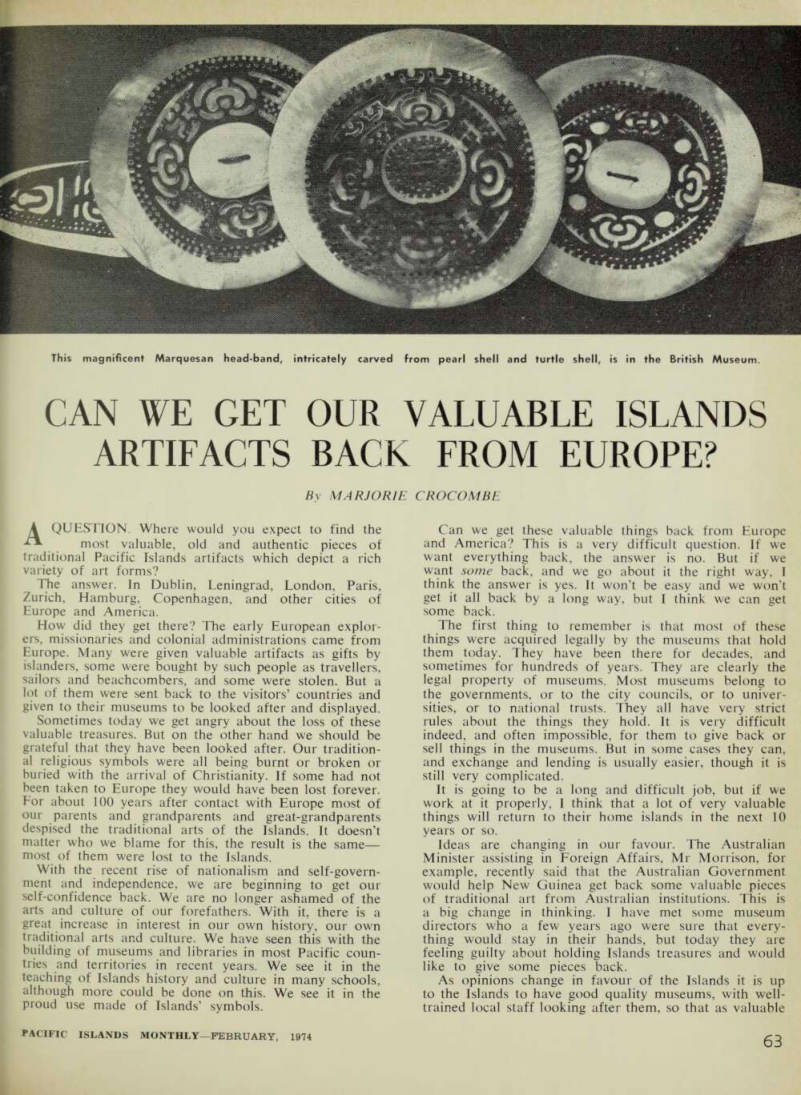
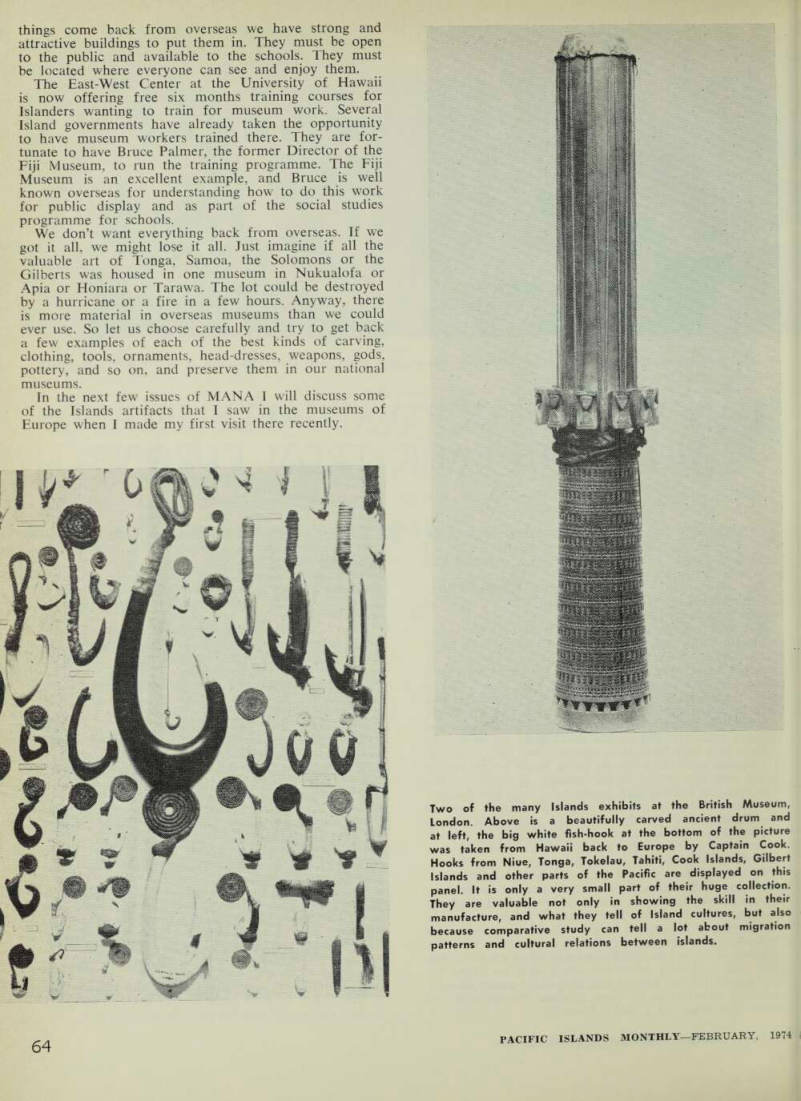


Can We Get Our Valuable Islands
By Marjorie Crocombe
A QUESTION. Where would you expect to find the most valuable, old and authentic pieces of traditional Pacific Islands artifacts which depict a rich variety of art forms?
The answer. In Dublin, Leningrad, London, Paris, Zurich, Hamburg, Copenhagen, and other cities of Europe and America.
How did they get there? The early European explor ers, missionaries and colonial administrations came from Europe. Many were given valuable artifacts as gifts by islanders, some were bought by such people as travellers, sailors and beachcombers, and some were stolen. But a lot of them were sent back to the visitors’ countries and given to their museums to be looked after and displayed.
Sometimes today we get angry about the loss of these valuable treasures. But on the other hand we should be grateful that they have been looked after. Our tradition al religious symbols were all being burnt or broken or buried with the arrival of Christianity. If some had not been taken to Europe they would have been lost forever.
For about 100 years after contact with Europe most of our parents and grandparents and great-grandparents despised the traditional arts of the Islands. It doesn’t matter who we blame for this, the result is the same— most of them were lost to the Islands.
With the recent rise of nationalism and self-govern ment and independence, we are beginning to get our self-confidence back. We are no longer ashamed of the arts and culture of our forefathers. With it, there is a great increase in interest in our own history, our own traditional arts and culture. We have seen this with the building of museums and libraries in most Pacific coun tries and territories in recent years. We see it in the teaching of Islands history and culture in many schools, although more could be done on this. We see it in the proud use made of Islands’ symbols.
Can we get these valuable things back from Europe and America? This is a very difficult question. If we want everything back, the answer is no. But if we want some back, and we go about it the right way, I think the answer is yes. It won’t be easy and we won’t get it all back by a long way, but I think we can get some back.
The first thing to remember is that most of these things were acquired legally by the museums that hold them today. They have been there for decades, and sometimes for hundreds of years. They are clearly the legal property of museums. Most museums belong to the governments, or to the city councils, or to univer sities, or to national trusts. They all have very strict rules about the things they hold. It is very difficult indeed, and often impossible, for them to give back or sell things in the museums. But in some cases they can, and exchange and lending is usually easier, though it is still very complicated.
It is going to be a long and difficult job, but if we work at it properly, I think that a lot of very valuable things will return to their home islands in the next 10 years or so.
Ideas are changing in our favour. The Australian Minister assisting in Foreign Affairs, Mr Morrison, for example, recently said that the Australian Government would help New Guinea get back some valuable pieces of traditional art from Australian institutions. This is a big change in thinking. I have met some museum directors who a few years ago were sure that every thing would stay in their hands, but today they are feeling guilty about holding Islands treasures and would like to give some pieces back.
As opinions change in favour of the Islands it is up to the Islands to have good quality museums, with well trained local staff looking after them, so that as valuable
This magnificent Marquesan head-band, intricately carved from pearl shell and turtle shell, is in the British Museum
things come back from overseas we have strong and attractive buildings to put them in. They must be open to the public and available to the schools. They must be located where everyone can see and enjoy them.
The East-West Center at the University of Hawaii is now offering free six months training courses for Islanders wanting to train for museum work. Several Island governments have already taken the opportunity to have museum workers trained there. They are for tunate to have Bruce Palmer, the former Director of the Fiji Museum, to run the training programme. The Fiji Museum is an excellent example, and Bruce is well known overseas for understanding how to do this work for public display and as part of the social studies programme for schools.
We don’t want everything back from overseas. If we got it all, we might lose it all. Just imagine if all the valuable art of Tonga, Samoa, the Solomons or the Gilberts was housed in one museum in Nukualofa or Apia or Honiara or Tarawa. The lot could be destroyed by a hurricane or a fire in a few hours. Anyway, there is more material in overseas museums than we could ever use. So let us choose carefully and try to get back a few examples of each of the best kinds of carving, clothing, tools, ornaments, head-dresses, weapons, gods, pottery, and so on, and preserve them in our national museums.
In the next few issues of MANA I will discuss some of the Islands artifacts that I saw in the museums of Europe when I made my first visit there recently.
Two of the many Islands exhibits at the British Museum, London. Above is a beautifully carved ancient drum and at left, the big white fish-hook at the bottom of the picture was taken from Hawaii back to Europe by Captain Cook.
Hooks from Niue, Tonga, Tokelau, Tahiti, Cook Islands, Gilbert Islands and other parts of the Pacific are displayed on this panel. It is only a very small part of their huge collection.
They are valuable not only in showing the skill in their manufacture, and what they tell of Island cultures, but also because comparative study can tell a lot about migration patterns and cultural relations between islands.
The BSIP economy is diversifying rapidly these days, but that was not so 20 years ago when Sir Geoffrey Clay, Agricultural Adviser to the Secretary of State for the Colonies, made an official visit. His main impression, while flying over the archipelago, was the reliance everywhere on coconuts and copra as the basis of the economy. He said one could not escape the prime importance of the problem created by the scarcity of labour, not only for reopening existing plantations, but for the extension and diversification of production. PIM commented there could be no develop ment till there were (a) a labour supply, and (b) inducements for investors, and criticised what it called the "stupid policies" of the Colonial Office scaring off whatever enterprise was inclined in recent years to take an interest in BSIP development.
Advertisements & other items, pp. 67-68 (1 item)
ammMo*
fs:% i f ?' > I
SBB
!% n- I
WimM
m UJtm* % '* tm
im mi#
Wi&r € S * . -., ... iioL C\ uSp'VWX V'?, h .- -»«f %t/kJ»£lL>£i (.*v L."v>'
VS'S&^VV’
>i- - f,4 t*\ -!o:^dvv j &&& *« fvfr-J f*£ I * <9i '"' *< & "'$ < * «r» V *•< ♦ * ■ *' A
-•/ AUSrRALIfi-S
Ns# A , MOST EXPERIENCED nj
EXPORT FLOUR MILLERS i/ ; L
/fr : <v£*r&2ir,£ v',~ • •'•- • '*
i I i I /
Ir i r
ammMo*
SINCE 1868
gfci:!f ;, • ' H
' PRODUCERS OF BRUNTONS
FAMOUS
* km ’rM \%\ X ) h \
ROYAL.BAKERS' FLOURS v ■ '*.'
CAKE, BISCUIT AND NOODLE
IRPS, ETC.
H v i-J • r: r O/ ' m
THE BIG FLAVOURS COME TO THE
SOUTH PACIFIC
IMP
trfi
§inqer<M eßw
JUCY
P I- *oo * The red hibiscus symbol proudly marKs the introduction of some of New Zealand's most popular soft drinks by Island Bottlers of Fiji Ltd., from their new modern factory.
In Apia in Western Samoa the same flavourful range is produced by the Apia Bottling Company and people everywhere are asking for these famous names -
LEMON and PAEROA, TARTAN DRY GINGER
ALE and the colourful fruity range of JU'CY
SOFT DRINKS.
They're yours to enjoy . . . time after time.
Manufactured under franchise to Innes Tartan Ltd., Auckland, New Zealand by- E 33 ISLAND BOTTLERS OF FIJI LTD.
W APIA BOTTLING COMPANY LTD.
RECORD 74
The f ourmost names
in tools
?i<&ecord RIDGWAY marples
1 RECORD 915 Handicutter
(SIIIIIb
MARPLES M 2252 Combination Metre Rule GILBOW G 245 Snips MARPLES M 373 Oval Split Proof Handled Bevel Edge Chisel RIDGWAY R 230 Scotch Auger Bit GILBOW G 33 Flat Chisel RIDGWAY R 355 Flatbit
RECORD RIDGWAY TOOLS LTD.
Parkway Works, Sheffield, England. ™
Yesterday
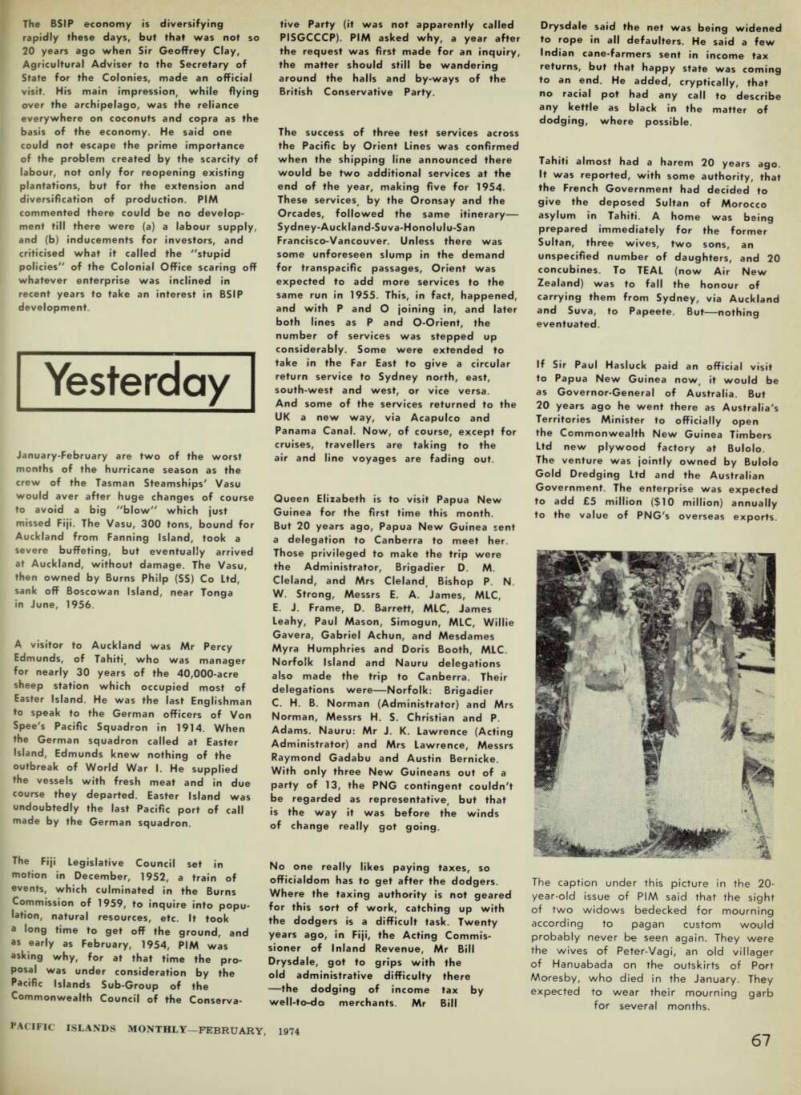
January-February are two of the worst months of the hurricane season as the crew of the Tasman Steamships' Vasu would aver after huge changes of course to avoid a big "blow" which just missed Fiji. The Vasu, 300 tons, bound for Auckland from Fanning Island, took a severe buffeting, but eventually arrived at Auckland, without damage. The Vasu, then owned by Burns Philp (SS) Co Ltd, sank off Boscowan Island, near Tonga in June, 1956.
A visitor to Auckland was Mr Percy Edmunds, of Tahiti, who was manager for nearly 30 years of the 40,000-acre sheep station which occupied most of Easter Island. He was the last Englishman to speak to the German officers of Von Spec's Pacific Squadron in 1914. When the German squadron called at Easter Island, Edmunds knew nothing of the outbreak of World War I. He supplied the vessels with fresh meat and in due course they departed. Easter Island was undoubtedly the last Pacific port of call made by the German squadron.
The Fiji Legislative Council set in motion in December, 1952, a train of events, which culminated in the Burns Commission of 1959, to inquire into popu lation, natural resources, etc. It took a long time to get off the ground, and as early as February, 1954, PIM was asking why, for at that time the pro posal was under consideration by the Pacific Islands Sub-Group of the Commonwealth Council of the Conserva
tive Party (it was not apparently called PISGCCCP). PIM asked why, a year after the request was first made for an inquiry, the matter should still be wandering around the halls and by-ways of the British Conservative Party.
The success of three test services across the Pacific by Orient Lines was confirmed when the shipping line announced there would be two additional services at the end of the year, making five for 1954.
These services by the Oronsay and the Orcades, followed the same itinerary— Sydney-Auckland-Suva-Honolulu-San Francisco-Vancouver. Unless there was some unforeseen slump in the demand for transpacific passages, Orient was expected to add more services to the same run in 1955. This, in fact, happened, and with P and O joining in, and later both lines as P and O-Orient, the number of services was stepped up considerably. Some were extended to take in the Far East to give a circular return service to Sydney north, east, south-west and west, or vice versa.
And some of the services returned to the UK a new way, via Acapulco and Panama Canal. Now, of course, except for cruises, travellers are taking to the air and line voyages are fading out.
Queen Elizabeth is to visit Papua New Guinea for the first time this month.
But 20 years ago, Papua New Guinea sent a delegation to Canberra to meet her.
Those privileged to make the trip were the Administrator, Brigadier D. M.
Cleland, and Mrs Cleland, Bishop P. N.
W. Strong, Messrs E. A. James, MLC, E. J. Frame, D. Barrett, MLC, James Leahy, Paul Mason, Simogun, MLC, Willie Gavera, Gabriel Achun, and Mesdames Myra Humphries and Doris Booth, MLC.
Norfolk Island and Nauru delegations also made the trip to Canberra. Their delegations were—Norfolk: Brigadier C. H. B. Norman (Administrator) and Mrs Norman, Messrs H. S. Christian and P.
Adams. Nauru: Mr J. K. Lawrence (Acting Administrator) and Mrs Lawrence, Messrs Raymond Gadabu and Austin Bernicke.
With only three New Guineans out of a party of 13, the PNG contingent couldn't be regarded as representative, but that is the way it was before the winds of change really got going.
No one really likes paying taxes, so officialdom has to get after the dodgers.
Where the taxing authority is not geared for this sort of work, catching up with the dodgers is a difficult task. Twenty years ago, in Fiji, the Acting Commis sioner of Inland Revenue, Mr Bill Drysdale, got to grips with the old administrative difficulty there —the dodging of income tax by well-to-do merchants. Mr Bill
Drysdale said the net was being widened to rope in all defaulters. He said a few Indian cane-farmers sent in income tax returns, but that happy state was coming to an end. He added, cryptically, that no racial pot had any call to describe any kettle as black in the matter of dodging, where possible.
Tahiti almost had a harem 20 years ago.
It was reported, with some authority, that the French Government had decided to give the deposed Sultan of Morocco asylum in Tahiti. A home was being prepared immediately for the former Sultan, three wives, two sons, an unspecified number of daughters, and 20 concubines. To TEAL (now Air New Zealand) was to fall the honour of carrying them from Sydney, via Auckland and Suva, to Papeete. But—nothing eventuated.
If Sir Paul Hasluck paid an official visit to Papua New Guinea now, it would be as Governor-General of Australia. But 20 years ago he went there as Australia's Territories Minister to officially open the Commonwealth New Guinea Timbers Ltd new plywood factory at Bulolo.
The venture was jointly owned by Bulolo Gold Dredging Ltd and the Australian Government. The enterprise was expected to add £5 million ($lO million) annually to the value of PNG's overseas exports.
The caption under this picture in the 20year-old issue of PIM said that the sight of two widows bedecked for mourning according to pagan custom would probably never be seen again. They were the wives of Peter-Vagi, an old villager of Hanuabada on the outskirts of Port Moresby, who died in the January. They expected to wear their mourning garb for several months.
Books, Reviews, writers
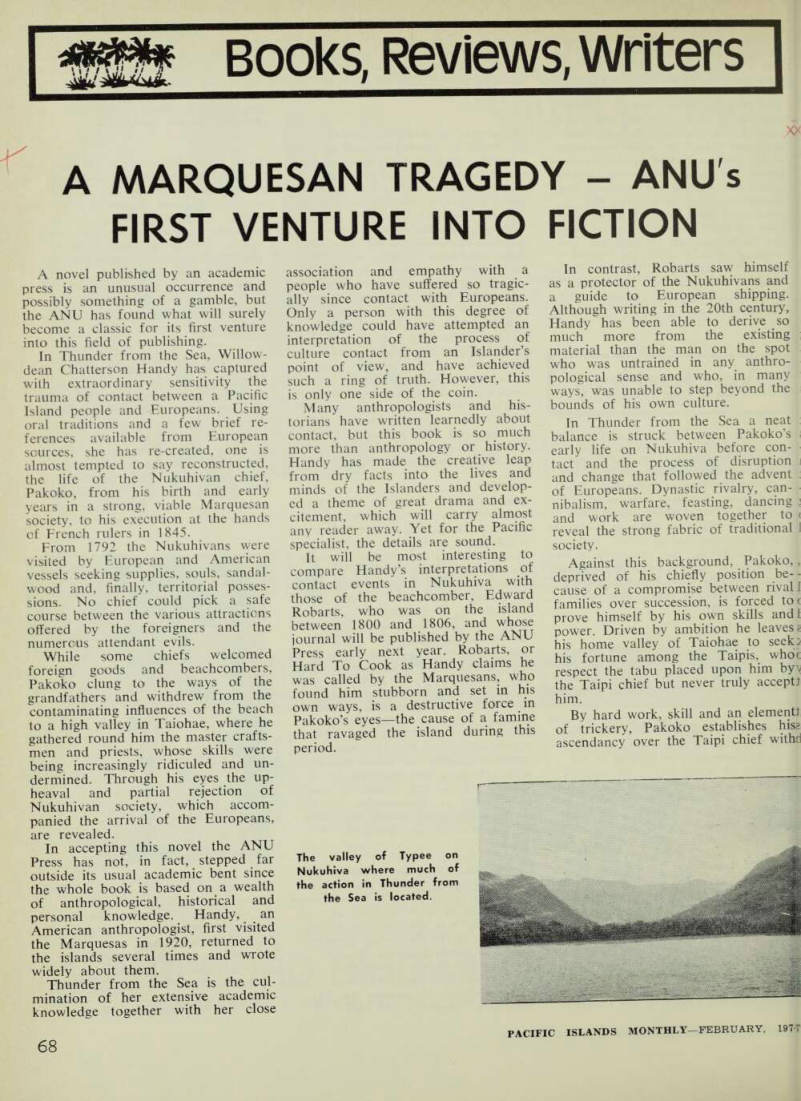
A Marquesan Tragedy - Anu's
First Venture Into Fiction
A novel published by an academic press is an unusual occurrence and possibly something of a gamble, but the ANU has found what will surely become a classic for its first venture into this field of publishing.
In Thunder from the Sea, Willow dean Chattel-son Handy has captured with extraordinary sensitivity the trauma of contact between a Pacific Island people and Europeans. Using oral traditions and a few brief re ferences available from European sources, she has re-created, one is almost tempted to say reconstructed, the life of the Nukuhivan chief, Pakoko, from his birth and early years in a strong, viable Marquesan society, to his execution at the hands of French rulers in 1845.
From 1792 the Nukuhivans were visited by European and American vessels seeking supplies, souls, sandal wood and, finally, territorial posses sions. No chief could pick a safe course between the various attractions offered by the foreigners and the numerous attendant evils.
While some chiefs welcomed foreign goods and beachcombers, Pakoko clung to the ways of the grandfathers and withdrew from the contaminating influences of the beach to a high valley in Taiohae, where he gathered round him the master crafts men and priests, whose skills were being increasingly ridiculed and un dermined. Through his eyes the up heaval and partial rejection of Nukuhivan society, which accom panied the arrival of the Europeans, are revealed.
In accepting this novel the ANU Press has not, in fact, stepped far outside its usual academic bent since the whole book is based on a wealth of anthropological, historical and personal knowledge. Handy, an American anthropologist, first visited the Marquesas in 1920, returned to the islands several times and wrote widely about them.
Thunder from the Sea is the cul mination of her extensive academic knowledge together with her close
association and empathy with a people who have suffered so tragic ally since contact with Europeans.
Only a person with this degree of knowledge could have attempted an interpretation of the process of culture contact from an Islander’s point of view, and have achieved such a ring of truth. However, this is only one side of the coin.
Many anthropologists and his torians have written learnedly about contact, but this book is so much more than anthropology or history.
Handy has made the creative leap from dry facts into the lives and minds of the Islanders and develop ed a theme of great drama and ex citement, which will carry almost any reader away. Yet for the Pacific specialist, the details are sound.
It will be most interesting to compare Handy’s interpretations of contact events in Nukuhiva with those of the beachcomber, Edward Robarts, who was on the island between 1800 and 1806, and whose journal will be published by the ANU Press early next year. Robarts, or Hard To Cook as Handy claims he was called by the Marquesans, who found him stubborn and set in his own ways, is a destructive force in Pakoko’s eyes—the cause of a famine that ravaged the island during this period.
In contrast, Robarts saw himself as a protector of the Nukuhivans and a guide to European shipping.
Although writing in the 20th century, Handy has been able to derive so much more from the existing : material than the man on the spot who was untrained in any anthro pological sense and who, in many ways, was unable to step beyond the ; bounds of his own culture.
In Thunder from the Sea a neat ; balance is struck between Pakoko’s j early life on Nukuhiva before con- ■ tact and the process of disruption j and change that followed the advent : of Europeans. Dynastic rivalry, can- ■ nibalism, warfare, feasting, dancing ; and work are woven together to ( reveal the strong fabric of traditional i society.
Against this background, Pakoko, < deprived of his chiefly position be- cause of a compromise between rival I families over succession, is forced toe prove himself by his own skills and! power. Driven by ambition he leaves? his home valley of Taiohae to seeki his fortune among the Taipis, whde respect the tabu placed upon him by\ the Taipi chief but never truly accept* him.
By hard work, skill and an element* of trickery, Pakoko establishes his? ascendancy over the Taipi chief withri
The valley of Typee on Nukuhiva where much of the action in Thunder from the Sea is located.
whom he exchanges names, and suc ceeds in accumulating a fortune in whales’ teeth.
By the time the first Europeans appear, about half-way through the book, the reader, while entirely wrapt in Pakoko’s rise to power and prestige, has also a good understand ing of the normal workings of society, its strengths and weaknesses, and against this the full impact of Euro pean actions and goods is vividly, cruelly depicted. Pakoko attempts to resist the changes, but neither his strength nor his commitment to the ways of old can stop the inevitable.
His death contains all the elements of great tragedy, as does the history of the Marquesas since contact.
I feel sure that, in time, Thunder from the Sea will become a classic of Pacific literature. It is beautifully written, enthralling to read, both for its gripping narrative and for the honesty of its anthropological and historical detail, and, most im portantly, it reveals a sensitivity and
imagination concerning the dynamics of contact as experienced by the islanders, that few Europeans can hope to achieve.
It seems likely that this book will be able to stand with the growing number of novels and autobiographies written by the Islanders themselves of their experiences of contact. Such empathy is rare and it is sad to realise that Handy did not live to write more.
With the text, which is published posthumously, Willowdean Handy left a note saying in part, “neither I nor my Marquesan friends would want anything to appear on their behalf that was not well done”. To my mind there can be no doubt that the whole work has been well done, down to the beautiful production of it by the ANU Press. —Caroline Ralston.
(Thunder From The Sea, By
Willowdean Chatterson Handy, Australian National University Press, Canberra.
Souter to go paperback
XTEW GUINEA: The Last Unknown, Gavin Souter’s history of the exploration of the island of New Guinea (both PNG and Irian Jaya), first published in 1963 and reprinted in hardcover several times since, is to be published in paperback during 1974.
The issue will be produced by the original publishers, Angus and Robertson, Sydney, but no effort will be made to update the book, as author Souter says it isn’t the kind of book that would profit from an updating N i' S?X! r 0 s s “9 h , a WKte sweep of reallu nea ISt ° ry ij- at there Is chimer „n P addmg ano her menK th?t Jn ® mp i° ra l7 de . v f l ? p : in jmlkf * d simply be outdated “It wr'ft/ anywa F’ ,u 3y i' for all seasons* and* iLf° rt ft. 0f hook want o leaTh” C Way 1 Last Unknown was Souter's first book. He has since published three others, none on island subjects, and is currently doing some research into an Australian historical subject” which may lead to another book.
Souter is a feature writer with the Sydney Morning Herald, by whom he has been employed all his career. has ,W W n,ll e r J^a gUS , Ro . be^ So s nas just published a reprint, in hard oi S S ft u C °y er i’ of Australian aut hor T»,- hen s drama t lC a nd true story of Minerva Reef—not the dream republic, but the Minerva Reef of the l / Tongans, who were marooned there for 102 days in 1962.
Their Auckland-bound 20 ton cutter Tuaikaepau ran on the reef on the night of July 7. Escaping death by a near-miracle when the cutter disintegrated under the tremendous pounding of a high sea, the Tongans, led by Captain Tevita Fifita, saw the answer to their prayers when dawn came—the hull of a Japanese wooden trawler lying on her side on the reef more than a mile away. That trawler, wrecked heaven-knows when, was their home for 102 days.
Ho w 13 men-four perishedfought to survive and did so, thanks to their almost superhuman courage and gift of leadership of Captain Fifita. their faith and the gifts which Providence scattered sparingly in their Path, makes an incredible story, one of the best sea stories ever read. That d comes from Olaf Ruhen’s gifted Pe " “ en ° Ugh ' (Minerva reff, by oiaf Ruhen. Angus
bounfTS soXuSniloj Ltd * Hard "
Journal of Pacific History A has lived up to its promise, made in its first issue in 1966, of filling a major gap in Pacific periodical literatUre ’ and w j th the advent of Volume 8, one wonders how the area managed without this annual record of articles, manuscripts and reviews. Of special value are the sections devoted to recording recent or insufficiently known discoveries or collections of manuscripts relating to the Islands,
and the bibliography of current pub lications.
Such a wealth of material is now being produced or turned up by the graduates of the boom in Pacific academia, that it needs more than an annual publication to keep up with it, and one day perhaps we may see the journal produced more frequently, as the Polynesian Society’s journal is.
Among the original articles in the current issue are German Firms in the Western Pacific Islands, 1857- 1914, by Stewart Firth; Monument to a Missionary: C. W. Abel and the Keveri of Papua, by David Wetherell; Private Interests and the Origins of American Involvement in Samoa, 1872-1878, by Barry Rigby; and From Polynesia to California: Samoan Migration and its Sequel, where sev eral authors discuss the history and development of the fairly recent American Samoan migration to the United States. The Beginnings of Foreign Contact with Truk is the sub ject of an article of Micronesian interest by Francis X. Hezel.
The journal is obtained from the Australian National University, Can berra at a subscription rate of $A4.75 per copy.
An interesting pictorial map of the Majuro Atoll in the Marshall Islands is available for 25c from the Publi cations and Printing Division of the Trust Territory of the Pacific Islands, Saipan, Mariana Islands, 96950.
The map has numerous notes and sketches on the natural history of the atoll environment with graphic illus trations on atoll formation and geo logy.
Advertisements & other items, pp. 71-72 (1 item)
Harris
BOOK COMPANY
(ESTABLISHED 1930)
We carry over 10,000 titles on all subjects in stock and would be pleased to quote for your requirements.
Please send your enquiries to:
HARRIS BOOK COMPANY,
G.P.O. Box 16670, Hong Kong
Bank of Hawaii is the bank of the Pacific.
You can bank on it... in Guam S&Tamuning t Koror YapJf Saipan Roi Namur jj£Wike JL Kwajalein JltPonape % American Samoa.
All in all, we have 70 branches throughout Hawaii and the Pacific offering full banking services. May we help you?
Bank of Hawaii the bank of the Pacific® • affiliate of Banque de Tahiti i
sky' came to Fiji
When 'men from under the sky' came to Fiji
If the Fijians, as the first western ers found them 200 years ago, were implacable savages, their savagery and cunning were well matched by some of the white adventurers who visited their islands.
The stories of a dozen of these men —Europeans and Americans—who made first contact with Fiji, have now been told by Captain Stanley Brown of Suva in a book called Men from under the Sky. Although primarily biographical, the book fulfils a sec ondary purpose as a compact history of Fiji from the late 18th century until Cession to Britain in 1874.
Not all of Captain Brown’s sub jects were skallywags; but it is true that none of these early Westerners went to Fiji for his health. If he was not after sandalwood, beche-de mer, land or trade, then he wanted to introduce a foreign religion or foreign laws.
Some, of course, were there be cause their ships had been wrecked on one or other of Fiji’s reefs and if they were lucky could use their wits or talent with a musket to their own advantage.
Bligh, on the other hand, whose story comes first in the book, was there because he and 17 loyal mem bers of the Bounty crew had been cast adrift in a small boat to fend for themselves after the celebrated mu tiny. Faced with his dilemma Bligh decided that wending a way through the Fiji group was the quickest way of reaching Timor and safety.
Dead northwest, sailing before the wind, was the safest course for a 23 ft boat with low freeboard and tight huddle of sailors. With a rudimentary sail and the forward thwarts removed to build up the stern to prevent fol lowing waves breaking into the boat, Bligh navigated through the Koro Sea and out of the group.
In the course of the journey he sighted a surprising number of the islands of Fiji but landed on none.
The small craft was deliberately kept far enough to seaward to escape the attention of watchers ashore. Little was known about these islands then but that little left no doubt as to the fierceness of the inhabitants and Bligh’s party was unarmed.
On this forced voyage through the Group, harrassed though he was, Bligh sketched in all the islands that he sighted and, his party intact, reach ed Timor in March 1790. A year
later he sailed on another (and successful) attempt to transplant breadfruit trees from Tahiti to the West Indies and during this voyage he again visited the Fiji islands. This time he completed the sketches made on the forced voyage in Bounty’s boat and, with facilities for measure ing angles, made a fairly accurate survey of the extent of the group.
However, his impact on Fiji did not come from confrontation with untamed Fijians but the chart he was able to produce of the Group suf ficed to guide adventurers to those islands for another 50 years.
But whether the newcomers were there by chance, for gain, for con verting heathens or for bringing foreign laws, the Fijians’ reception to all continued to be a chancy business.
Where men proved immediately use ful they could be used or tolerated; others were as quickly despatched and found their way to the cooking fires.
Some, like Charlie Savage, the Swede, became fixtures, attached to a group, favourites of the local chief.
But as well as danger from individual Fijians or groups, there was also danger when, having established him self as a chief’s or group’s favourite, that group was beaten in the inter minable wars between the Fiji “king doms” that were part of savage life.
After half a dozen years as chief gun of the kingdom of Bau, Savage led a party to the sandalwood coast of Vanua Levu in the hope of earn ing supplies of powder and shot.
While there Savage and his party became embroiled in a local war and during it were trapped. Savage and others sought refuge on a rock pinn acle but Savage, who had a misplaced idea of his influence on all Fijians, was enticed down to parley. He was grabbed, upended and his head held under water until he died. His body was cut up and apportioned to his enemies.
Savage was more than a protege of the Bauan chiefs; he had been accep ted into the clan and his life-style was that of the highest chief. He had numerous wives, some of high birth but the Fijians were realists and none of his male children were allowed to live. He was survived by one daughter, then four years old.
This was not the case with another arrival a decade later. This was young David Whippy, son of a Nantucket sea captain who had gone to the sea in
family ships at the age of 16. In the 1820’s he was put ashore on Ovalau, ostensibly to supervise the drying of beche-de-mer which had superseded sandalwood as the most sought-after trade in the Fiji islands. His captain sailed away to other islands and didn’t come back for 13 years.
In the meantime young David had been befriended by Tui Levuka, the leading chief of the island of Ovalau, under whose protection he lived, had disposed of his cargo of beche de-mer onto another wandering ship master, at a satisfactory price, and had taken to wife the first four women who were to bear his child ren. Each gave him a son as well as daughters and from these have de scended the several branches of the very numerous Whippy family that flourishes in Fiji, adjacent groups and elsewhere today.
The original David was no Charlie Savage. He lived in harmony with his Fijian neighbours, was highly respec ted by the early missionaries for his upright character and social con science, was, until his death in No vember 1871, recognised as the leader of the European traders of Fiji and the founder of Levuka, Fiji’s first capital.
During his middle years, Whippy was of great assistance to Lt Charles Wilkes of the United States Exploring Expedition. The information in The Narrative of the United States Ex ploring Expedition, still one of the most reliable works of reference on early Fiji, was largely supplied by Whippy. Because of his assistance to Wilkes, Whippy was made US vice consul in Fiji.
Bligh, Savage and Whippy are only three of the many characters that Captain Brown uses to tell the story of pre-Cession Fiji, in a consecutive, easy-to-read narrative. Bits and pieces about some of the people are known to most students of Fijiana, but, un like New Guinea, about which there is a large and ever expanding liter ature, there are few popular accounts of old Fiji.
Captain Brown is just the man to make good the deficiency. Well known as operator and commander of small ships and lately as an under water expert, he has taken a keen interest in Fiji history. —Judy Tudor.
(Men From Under The Sky, By
Stanley Brown. Charles E. Tuttle Co.
Susio.)
Advertisements & other items, p. 74 (1 item)
are really going places.
m I 1 I w ■ m 1
Now AIR NEW ZEALAND DC-lO’s
MORE PLACES MORE OFTEN.
AIR NEW ZEALAND expands DC-10 Pacific destinations. Wide-bodied DC-10 routes now cover Auckland, Christchurch, Melbourne, Sydney, Singapore, Fiji, Tahiti, Honolulu and Los Angeles.
Your travel agent has all the details Official International Carrier tolhe fSO* Xth British Commonwealth VK Games 1974
air /if ii/ ZEBLano
i/i//- /mi- rue o a mem
WE ARE THE PACIFIC
ANZ 182
Pacific Transport
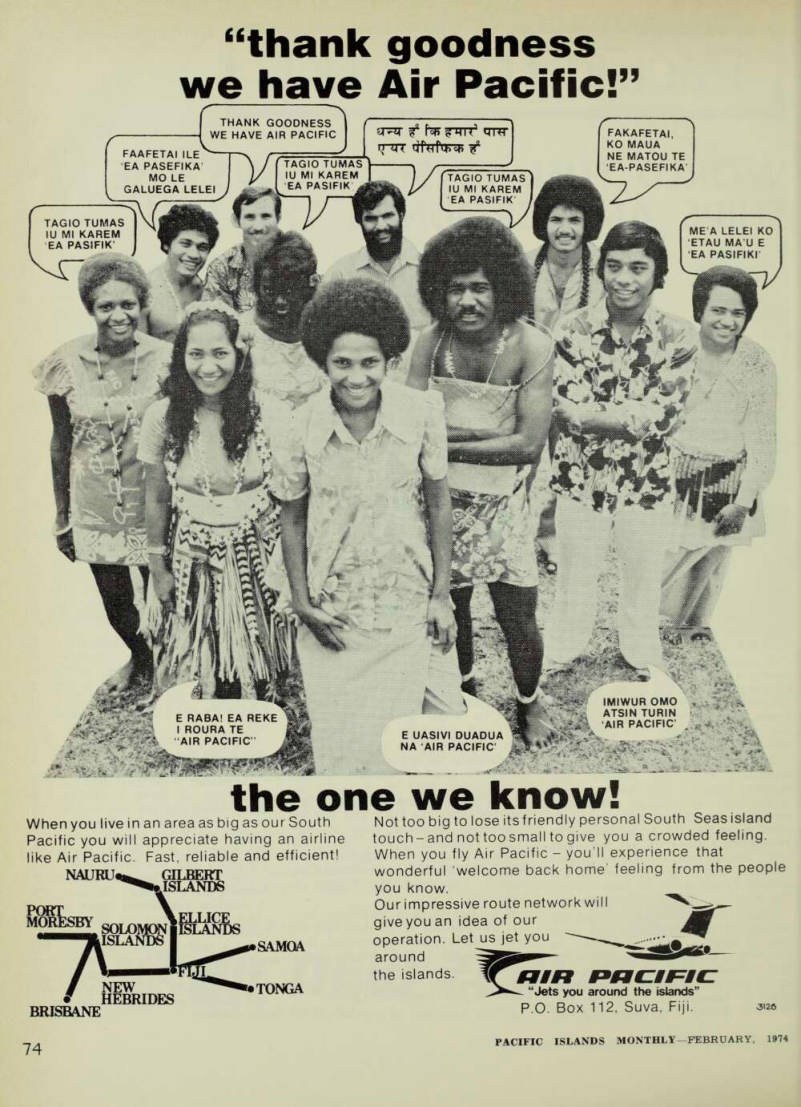
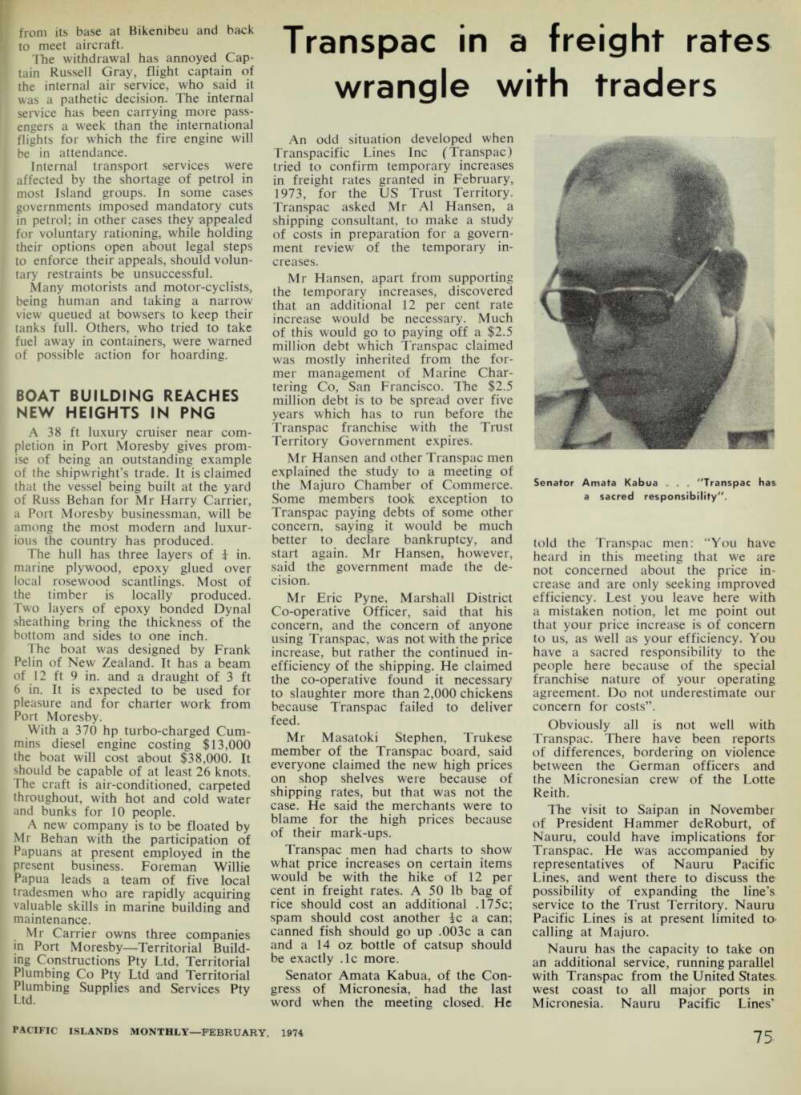
World Fuel Crisis Slows The
Ships And Grounds The Jets
The effect of the world fuel crisis on Pacific Islands transport was not immediately damaging. Most oil companies announced a cut in sup plies of up to 25 per cent, so that transport companies have had to keep a close eye on reserves.
One shipping company, China Navigation Co, which had its supply cut, temporarily reduced the speed of its ships and took an estimated day longer on each trip. P & O liners, on Pacific cruises and trips to the US west coast from Australia, travel led a little slower, reaching some ports a little later and leaving a little earlier.
Lloyd Triestino cancelled two Pacific holiday cruises from Sydney in the Marconi and Galileo. As each liner carries up to 1,500 free-spend ing Australians on these cruises, shop keepers in duty free ports suffered a heavy loss in income. Estimates of tourist spending vary, but at an aver age of $4O a person on shore dur ing a cruise, the cancellation of these two cruises meant a loss of more than $lOO,OOO to shops in various ports.
A number of shipping lines in De cember imposed a 2.5 per cent bunker surcharge on freight rates between Australia and Fiji, Apia, Tonga and Papua New Guinea ports. The last rise in bunker prices was SUS9.SO a ton on November 1, 1973.
The surcharge will be shown separately from the freights. The shipping lines say this will ensure it is removed or reduced if present events in the oil industry allow sup pliers to reduce the prices below the November 1 rates. If, on the other hand, bunker suppliers impose further increases over one per cent of the average freight rate, the lines reserve the right to increase the surcharge.
British Airways-BOAC reduced the number of transpacific services from five to three a week each way, in line with a British Government ruling that airlines reduce fuel consumption by 23 per cent. The reduction was to apply to January 31, unless the fuel position altered. The airline expected
it would be able to carry all who wanted to travel.
Qantas planned to restore the three weekly Boeing 707 services between Sydney and San Francisco on January 24. These services were terminated at Honolulu in November because of a shortage of fuel at Honolulu and San Francisco. The fuel situation in the United States had improved.
So far Qantas has overcome most of the problems created by the world fuel crisis.
International airlines passing through Fiji filled up elsewhere as far as possible to reduce the amount of fuel they would require at Nadi Airport. The Joint Users Hydrant Installation, which refuels overseas airliners at Nadi, reduced supply from about 60,000 gallons a day to 50,000 gallons.
One side-effect of the shortage was the withdrawal of the fire engine at Bonriki Airport in the GEIC for internal services. The engine used 65 gallons of petrol a week travelling
from its base at Bikenibeu and back to meet aircraft.
The withdrawal has annoyed Cap tain Russell Gray, flight captain of the internal air service, who said it was a pathetic decision. The internal service has been carrying more pass engers a week than the international flights for which the fire engine will be in attendance.
Internal transport services were affected by the shortage of petrol in most Island groups. In some cases governments imposed mandatory cuts in petrol; in other cases they appealed for voluntary rationing, while holding their options open about legal steps to enforce their appeals, should volun tary restraints be unsuccessful.
Many motorists and motor-cyclists, being human and taking a narrow view queued at bowsers to keep their tanks full. Others, who tried to take fuel away in containers, were warned of possible action for hoarding.
Boat Building Reaches
New Heights In Png
A 38 ft luxury cruiser near com pletion in Port Moresby gives prom ise of being an outstanding example of the shipwright’s trade. It is claimed that the vessel being built at the yard of Russ Behan for Mr Harry Carrier, a Port Moresby businessman, will be among the most modern and luxur ious the country has produced.
The hull has three layers of i in. marine plywood, epoxy glued over local rosewood scantlings. Most of the timber is locally produced.
Two layers of epoxy bonded Dynal sheathing bring the thickness of the bottom and sides to one inch.
The boat was designed by Frank Pelin of New Zealand. It has a beam of 12 ft 9 in. and a draught of 3 ft 6 in. It is expected to be used for pleasure and for charter work from Port Moresby.
With a 370 hp turbo-charged Cum mins diesel engine costing $13,000 the boat will cost about $38,000. It should be capable of at least 26 knots.
The craft is air-conditioned, carpeted throughout, with hot and cold water and bunks for 10 people.
A new company is to be floated by Mr Behan with the participation of Papuans at present employed in the present business. Foreman Willie Papua leads a team of five local tradesmen who are rapidly acquiring valuable skills in marine building and maintenance.
Mr Carrier owns three companies in Port Moresby—Territorial Build ing Constructions Pty Ltd, Territorial Plumbing Co Pty Ltd and Territorial Plumbing Supplies and Services Pty Ltd.
American Airlines bowing out
American Airlines is about to hand over to PAA its unprofitable services from Hawaii to Australia and New Zealand, via American Samoa and Fiji. The airline applied to the US Civil Aeronautics Board before Christmas for authority to suspend the services.
American is a virtual newcomer to the South Pacific. It started the ser vice in August, 1970, after a five-year battle over Pacific rights with 20 other carriers. It was a political decision which gave it South Pacific rights. In fact, the whole business seemed to be typical American wheeler-dealing.
In April, 1968, the US CAB recom mended that the services to the South Pacific be given to Eastern Airlines.
In December, 1968, in one of his last acts as US President, President John son over-ruled the CAB and selected Continental Airlines. Then in July, 1969, President Nixon who was President-elect at the time of Presi dent Johnson’s decision, rejected Con tinental and gave the licence to American.
It seemed to be a foolish decision —it was obvious at the time that the South Pacific was over-serviced. Aus tralia took the attitude that the Qantas services, plus nine then operated by PAA, plus the new services, would cause serious losses to Qantas.
In the exchange of services, PAA
will take over from American in the South Pacific, and American will take over unprofitable PAA services in the Caribbean. It is unlikely that PAA will operate all the nine ser vices American ran from Hawaii south. American had earlier discon tinued a service to Melbourne because of the fuel crisis.
At the time the exchange was an nounced, an American Airlines spokes man in New York, said the airline lost about SUS2S million in the first 11 months of 1973. The long-haul South Pacific flights were unprofit able.
PAA is reported to have made money on the Pacific routes, but lost consistently on Caribbean routes.
American might have had the right idea—one of those marketing con cepts which did not turn out right in practice. It intended to tap a new mar ket for the South Pacific in the east ern states of the US, but the market obviously did not materialise.
American Airlines will suspend the South Pacific services 30 days after it receives permission from the US CAB—but it may be some months before the CAB gives its decision.
PAA said that employees of both companies “at foreign points over seas” involved in the exchange would be offered jobs of comparable salary and benefits bv the airline taking over the route.
Advertisements & other items, p. 76 (1 item)
“thank goodness
we have Air Pacific!”
THANK GOODNESS
WE HAVE AIR PACIFIC
f* R> ?HI < dTTT
rrrrr Mrfa «*>
FAKAFETAI,
KO MAUA
NE MATOU TE
EA-PASEFIKA
FAAFETAI ILE "
EA PASEFIKA'
MO LE
GALUEGA LELEI
TAGIO TUMAS
IU Ml KAREM
EA PASIFIK A
TAGIO TUMAS
IU Ml KAREM
EA PASIFIK
TAGIO TUMAS
IU Ml KAREM
EA PASIFIK’
ME A LELEI KO
ETAU MA’U E
EA PASIFIKI’
vn %1 m m *9 m c £ mx % / m ?v‘i I L u 2* K f
IMIWUR OMO
ATSIN TURIN
m
E RABA! EA REKE
I ROURA TE
“AIR PACIFIC”
E UASIVI DUADUA
NA AIR PACIFIC
m
the one we know!
Vhenyou live in an area as big as our South > acific you will appreciate having an airline ike Air Pacific. Fast, reliable and efficient!
NAURU
“7
SAMOA
TONGA
iRISBANE
NEW
HEBRIDES
Nottoo big to lose itsfriendly personal South Seasisland touch-and nottoosmall to give you a crowded feeling.
When you fly Air Pacific - you’ll experience that wonderful ‘welcome back home’ feeling from the people you know. Our impressive route network will give you an idea of our operation. Let us jet you ' ... around ' the islands. am aacmm “Jets you around the islands”
P D Box 112. Suva. Fiji.
wrangle with traders
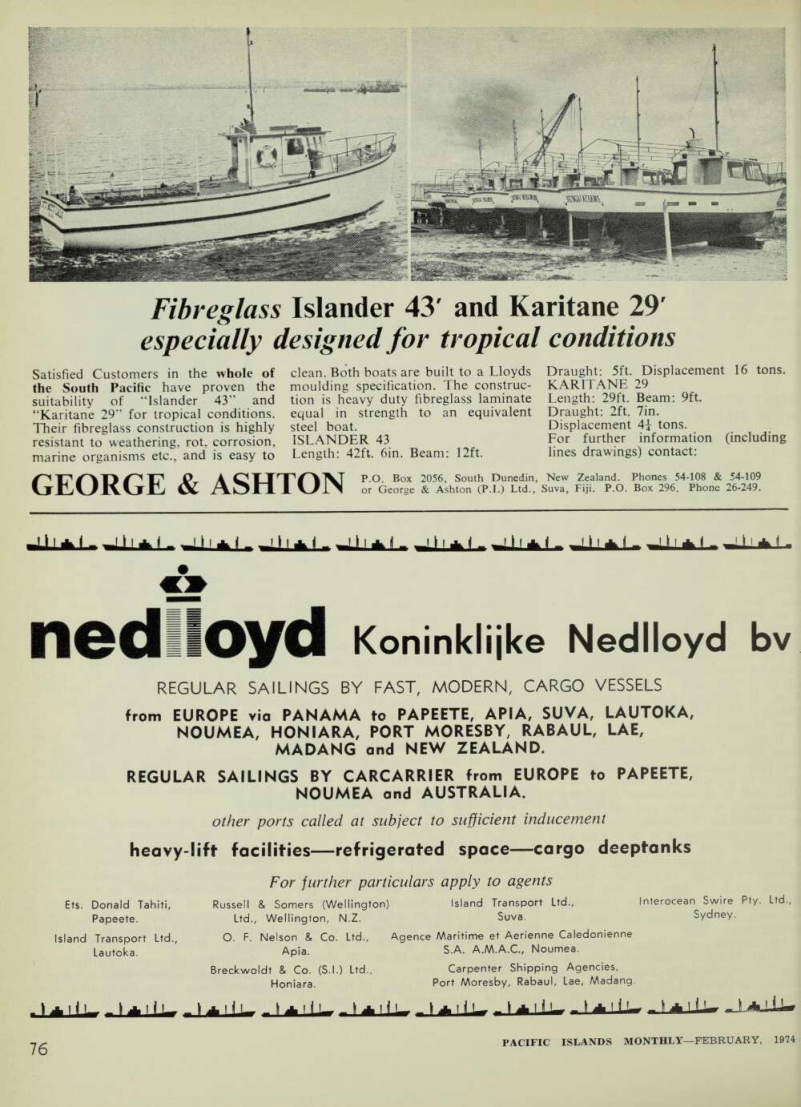

Transpac in a freight rates wrangle with traders
An odd situation developed when Transpacific Lines Inc (Transpac) tried to confirm temporary increases in freight rates granted in February, 1973, for the US Trust Territory.
Transpac asked Mr A 1 Hansen, a shipping consultant, to make a study of costs in preparation for a govern ment review of the temporary in creases.
Mr Hansen, apart from supporting the temporary increases, discovered that an additional 12 per cent rate increase would be necessary. Much of this would go to paying off a 52.5 million debt which Transpac claimed was mostly inherited from the for mer management of Marine Char tering Co, San Francisco. The 52.5 million debt is to be spread over five years which has to run before the Transpac franchise with the Trust Territory Government expires.
Mr Hansen and other Transpac men explained the study to a meeting of the Majuro Chamber of Commerce.
Some members took exception to Transpac paying debts of some other concern, saying it would be much better to declare bankruptcy, and start again. Mr Hansen, however, said the government made the de cision.
Mr Eric Pyne, Marshall District Co-operative Officer, said that his concern, and the concern of anyone using Transpac, was not with the price increase, but rather the continued in efficiency of the shipping. He claimed the co-operative found it necessary to slaughter more than 2,000 chickens because Transpac failed to deliver feed.
Mr Masatoki Stephen, Trukese member of the Transpac board, said everyone claimed the new high prices on shop shelves were because of shipping rates, but that was not the case. He said the merchants were to blame for the high prices because of their mark-ups.
Transpac men had charts to show what price increases on certain items would be with the hike of 12 per cent in freight rates. A 50 lb bag of rice should cost an additional .175 c; spam should cost another ic a can; canned fish should go up .003 c a can and a 14 oz bottle of catsup should be exactly .1c more.
Senator Amata Kabua, of the Con gress of Micronesia, had the last word when the meeting closed. He
told the Transpac men; “You have heard in this meeting that we are not concerned about the price in crease and are only seeking improved efficiency. Lest you leave here with a mistaken notion, let me point out that your price increase is of concern to us, as well as your efficiency. You have a sacred responsibility to the people here because of the special franchise nature of your operating agreement. Do not underestimate our concern for costs”.
Obviously all is not well with Transpac. There have been reports of differences, bordering on violence between the German officers and the Micronesian crew of the Lotte Reith.
The visit to Saipan in November of President Hammer deßoburt, of Nauru, could have implications for Transpac. He was accompanied by representatives of Nauru Pacific Lines, and went there to discuss the possibility of expanding the line’s service to the Trust Territory. Nauru Pacific Lines is at present limited to calling at Majuro.
Nauru has the capacity to take on an additional service, running parallel with Transpac from the United States, west coast to all major ports in Micronesia, Nauru Pacific Lines*
Senator Amata Kabua . . . "Transpac has a sacred responsibility".
major services operate from Australia to Pacific Islands ports. Currency realignments have lifted the cost of Australian products, as well as send ing up freight rates, in the Pacific Islands.
With American goods cheaper in the Islands, importers will be looking more to the US and Canada for sup plies. A natural corollary is a de mand for shipping space.
Ship Fire Marred
A Cruise
Nine-hundred and sixty-nine Aus tralian and New Zealand holiday makers had an enjoyable South Seas Christmas-New Year cruise marred when their ship, the Chandris Line’s Patris, caught fire in the main gener ating room on December 29. The ship had just left Vila.
Two generators were damaged by water as firemen won an hour’s fight with the fire, which was in the third generator. The ship then drifted for 29 hours while the generators dried out. Rather than return to Vila, the master decided to sail to Suva where there are better repair facilities.
Chandris flew six engineers from Greece to Fiji to help the Suva trades men repair the damaged generators.
Other engineers were flown from Greece to Sydney to await the return of the liner from the cruise, and carry out major repairs. The ship sailed to Suva on two generators, one of which failed on arrival. This was New Year’s Day.
Without full generating capacity some of the ship’s service was re stricted, and there were a few com plaints about stale food and over flowing lavatories. But the majority of passengers defended the ship, and claimed that meals were excellent, in spite of some shortages in refriger ation.
Uluilakeba Sinking
Isolates Lauans
The southern Lau Islands of Fiji lost their only marine link with Suva when the Uluilakeba sank with the loss of 79 lives in Hurricane Lottie on December 11. They were unable to get their copra to Suva to take ad vantage of the record high prices, which reached $423 a ton for top grade.
Now Rabi Holdings Ltd and Prin cess Shipping Ltd have agreed in principle to split the Uluilakeba’s services with the Komaiwai and the Fijian Princess. Whether the services become permanent depends on talks with the Marine Department, In the past the inter-island services
have omitted southern Lau services because they were not profitable.
This led to the Marine Co-operative Association, in which Lauans are the main shareholders, buying the Uluilakeba.
Even though the Uluilakeba ran at a loss during its 10 years service, it provided the vital link with Suva.
Should the association wish to buy another ship it will find it an expen sive proposition.
Meanwhile, an Indian firm has two ships for sale, one of 800 tons and the other of 200 tons, and has offered them to Fiji. A final decision about buying one or both of them rests with the Fiji Government.
Qantas May Get
Fiji Charter Flights
The Fiji Government, going against the wishes of the Society of Fiji Travel Agents, has given Qantas per mission to operate block inclusive tour charter flights on a one-year trial. The society’s opposition was based on claims that a monopoly for Qantas would damage the Fiji tourist industry.
Qantas will be restricted to one return flight a week on the Sydney- Nadi service, using a Boeing 707, with a maximum capacity of 172 pas sengers. Only genuine holiday-makers from Australia or Fiji, who pay a single inclusive fare of not less than the current Sydney-Nadi individual excursion fare, may travel on the flights.
The number of the holiday-makers on each flight to Fiji must be within the Fiji tourist industry’s capacity to
handle them. At least 50 passengers on each flight have to spend at least a week in either Taveuni or Vanua Levu. Another condition is that Qan tas reserves a specified number of seats on each flight for Fiji people wanting an inclusive holiday tour in Australia.
Qantas is required to give a firm undertaking to the Fiji Government that it will, through the International Air Transport Association, try to lower fares between Fiji and Aus tralia on scheduled services, covering special excursion, group and inclusive tour fares. It is now up to Qantas to say if it will accept the Fiji Govern ment’s conditions.
Freight Rates Up
For Png Coasters
Freight rate increases for ships operating along the Papua New Guinea coast were approved in Jan uary by the Minister for Transport, Mr Jephcott, There was to be a rise of two per cent on January 17, which was to be followed by a further hike of 10 per cent on February 1. The rises were granted to cover increased costs since the last rise, six per cent, two years ago. The PNG Ship Owners’ Association asked for a rise of 15 per cent.
The Papuan Planters Association was not altogether happy about the latest increases. The president, Mr Evan Cleland, said it was not clear whether the new rates would apply only to coastal shipping between rural areas and main ports, or only be tween main ports.
If they were to apply from rural
areas to main ports the rise was astounding, he said.
Mr Cleland said the latest rises were on top of a unilateral freight increase imposed on the Papuan coast in November 1973, If the rates applied from rural areas to main ports the whole population would be affected.
Shipping Pool
For Png Service
New Guinea Australia Line and Conpac will pool resources where possible to give a wider and more efficient shipping service to Papua New Guinea from Australia. New Guinea Australia Line is a China Navigation Co subsidiary, and Con pac is a joint venture of Burns Philp and Australia West Pacific Line.
Conpac loads at Melbourne, Syd ney and Brisbane for Port Moresby and Lae, using the Tenos and Nimos.
New Guinea Australia Line, from Sydney and Brisbane, using the Coral Chief, Island Chief, New Guinea Chief and Papuan Chief, services Port Moresby, Samarai, Lae, Madang Rabaul, Kavieng, Kieta, Honiara and Gizo.
The two companies will retain their separate agents in all ports and offer shipment to trade on their individual bills of lading. They de scribe the joint venture service as an
operational agreement between them “designed to provide the trade with a continuous, reliable and economic shipping service”.
They will provide a regular and evenly-spaced service to all ports.
One job which is likely to be tack led is the setting up of an efficient loading point in Sydney. Conpac, loading in Sydney from new wharves has been able to turn ships round quickly, but NGAL from older wharves has been subject to delays, with vehicles queueing along the streets, waiting to get to the load ing point.
The deputy chairman of NGAL, Mr Edward Scott, and the resident director in Sydney of Conpac, Mr Anders Hillstrom, went to Port Moresby to make a joint announce ment about the joint service. Mr Scott, while there, warned there could be a further increase in freight rates on top of the 2\ per cent surcharge imposed in December.
Mr Scott said he hoped any further increases would be less than 2i per cent. He added that PNG had had a “wonderful trot” over freight rates.
Freight rises on shipping lines oper ating from centres such as Hong Kong had risen by up to $2 a ton, while on the Australia-PNG run the increases had only been about 80c a ton.
Samoan Dories
Declared Unsafe
The US Coast Guard cracked down hard on American Samoa dory fleet recently and ordered 13 ships not to go to sea till they met the safety requirements of American Samoa. In a sudden inspection of the boats at the dory dock, inspectors found something wrong with all the boats.
Some were not properly registered and numbered. Others had not the required number of life preservers, failed to carry a radar reflector or were guilty of other violations. The Coast Guard said it would intercept any boat leaving the harbour to make sure it had a proper clearance, which included complying with safety re quirements.
Polynesian Airlines
Sells A View
There’s no point in flying all the way from Western Samoa to New Zealand if you can’t see the spec tacular seascape below in daylight.
Thus rationalises Polynesian Airlines.
So they have introduced early morn ing services from Apia to Nadi three times a week, flying, what’s more, at the very considerate height of 10,000 ft so passengers can fully appreciate the beautiful coral islets and lagoons
below. At Nadi, Polynesian’s HS74Bs connect with onward flights to Auck land and Sydney, still in broad day light although at somewhat higher altitudes.
Tarros Container
Charter Extended
The Union Steam Ship Co of NZ has taken up a 2i year charter of the Tarros class container ship, Union South Pacific. The USS Co had the ship on a temporary charter basis, and only confirmed the charter for the long term just before Christmas.
The Union South Pacific services Suva, Lautoka, Apia and Pago Pago from Auckland.
She was chartered from Sea Con tainers Inc, which now has a sub sidiary company based in Goldfields House, Sydney. Sea Containers will lease container ships to Pacific Islands and Australian companies. The mana ging director of the Sydney company is Mr Arvid Rasmussen, who became well known in Pacific shipping circles as traffic manager for Karlander.
A Princess
For Micronesia
The MS Micronesia Princess, the first of eight ships to be built for the US Trust Territory, was officially launched recently at Pusan, South Korea, by Mrs Bethwel Henry, wife of the Speaker of the House of Rep resentatives in the Congress of Micro nesia. The ship was about 60 per cent finished at the time of the launch ing, and delivery is expected by the end of June.
The MS Micronesia Princess, 242 ft and 2,050 tons, is being built by Daesun Shipbuilding and Engineer ing Co Ltd. It was designed, and will be specially equipped to meet the re quirements of transoceanic support and intra-district services.
The ship will operate to the outer islands of each district from district centres on approved schedules, carry ing special heavy lift cargo and diffi cult cargo on special runs. After 1978 it will operate as part of a total inte grated Micronesian transport system.
The Micronesia Princess has space for 36 20 ft containers, and cargo capacity of 800 tons. Special addition al container designs have been de veloped to enable her to carry extra refrigerated containers, as well as special 20 ft x 8 ft mobile cabins, which can serve alternately as extra passenger staterooms, multiple berth bunk rooms, extra galley, dispen saries and water reservoirs.
The ship is designed to carry a crew of 12 for long voyages and a smaller crew for the shorter hauls.
The maximum deck passenger capac
ity is more than 100. The passenger cabins can accommodate 12. Her speed is about 15 knots.
Air Fares Rise In
Samoa And Tonga
Polynesian Airlines have introduced a return excursion fare of SWS2O (SUS 33) between Apia and Pago Pago and group and student discounts for the route. The normal one-way Apia-Pago Pago fare has been in creased to SWSI4 (5U523.4). In line with international practice, a 10 per cent fare has been introduced for infants.
The airline has asked the Western Samoa and American Samoa govern ments for permission to increase fares to offset an average rise of 86.3 per cent in fuel costs. The new fares will be applied as soon as they are approved.
In Tonga, internal air fares have also been raised because of a heavy increase in the cost of aviation fuel.
On January 14 the Tongatapu-Vavau fares were lifted to $22.30 single and 544.60 return, and Tongatapu-Eua $5.40 and $lO.BO.
The Tonga Tourist and Develop ment Co’s airline incurred a heavy loss in its first 12 months of oper ation.
Transport Briefs
• Two landing craft from the Australian Government will give the Papua New Guinea Defence Force improved maritime mobility. They may be used for loading and unload ing across beaches, discharging fairly heavy cargo from ships standing off shore, and transport on the major rivers. The landing craft should be ready early in 1975. • Australian Army sappers will lay an airstrip at Lord Howe Island this year. The strip will be about 3,000 feet long and will cost about $3 million. Earlier estimates were that the strip would cost $5 million, but with the army doing the job and treating it as an exercise the cost will be lowered considerably. Part of the exercise will be for the army to transport the materials to the island.
The strip will not extend into the lagoon. • Reef Shipping Co, of Auckland, has a new freighter, the Fijian Swift, which it may use for the Fiji export banana trade. The Fijian Swift is a replacement for the Jean Phillipe, which Reef Shipping sold recently to Singapore interests. The Fijian Swift has capacity for 1,200 tons of cargo.
It is owned by Fijians, and Fiji cadet officers may be recruited.
Advertisements & other items, pp. 78-84 (1 item)
nediioyd Koninklijke Nedlloyd bv
I
ssfc
"1
Fibreglass Islander 43' and Karitane 29'
especially designed for tropical conditions
Satisfied Customers in the whole of the South Pacific have proven the suitability of “Islander 43” and “Karitane 29” for tropical conditions.
Their fibreglass construction is highly resistant to weathering, rot, corrosion, marine organisms etc., and is easy to clean. Both boats are built to a Lloyds moulding specification. The construction is heavy duty fibreglass laminate equal in strength to an equivalent steel boat.
ISLANDER 43
Length: 42ft. 6in. Beam: 12ft.
Draught: sft. Displacement 16 tons.
KARITANE 29
Length: 29ft. Beam: 9ft.
Draught: 2ft. 7in.
Displacement 4* tons.
For further information (including lines drawings) contact:
GEORGE & ASHTON
P.O. Box 2056, South Dunedin, New Zealand. Phones 54-108 & 54-109 or George & Ashton (P. 1.) Ltd., Suva, Fiji. P.O. Box 296. Phone 26-249.
nediioyd Koninklijke Nedlloyd bv
REGULAR SAILINGS BY FAST, MODERN, CARGO VESSELS from EUROPE via PANAMA to PAPEETE, APIA, SUVA, LAUTOKA,
NOUMEA, HONIARA, PORT MORESBY, RABAUL, LAE,
MADANG and NEW ZEALAND.
REGULAR SAILINGS BY CARCARRIER from EUROPE to PAPEETE,
NOUMEA and AUSTRALIA.
other ports called at subject to sufficient inducement
heavy-lift facilities—refrigerated space—cargo deeptanks
For further particulars apply to agents
Ets. Donald Tahiti, Papeete.
Island Transport Ltd., Lautoka.
Russell & Somers (Wellington) Ltd., Wellington, N.Z.
O. F. Nelson & Co. Ltd., Island Transport Ltd., Suva.
Interocean Swire Pty. Ltd., Sydney.
Agence Maritime et Aerienne Caledonienne Breckwoldt & Co. (5.1.) Ltd., Apia.
S.A. A.M.A.C., Noumea.
Carpenter Shipping Agencies, Honiara, Port Moresby, Rabaul, Lae, Madang.
STuarT
TURNER
O n H.P. • 5 H.P.
o 10 H.P. • 12 H.P.
Write for illustrated catalogue—
KNOX SCHLAPP
PTY. LTD.,
135-139 McEVOY STREET,
ALEXANDRIA, N.S.W. 2015.
TEL.: 699-8333. TELEX:
AA20483. TELEGRAMS:
"KNOXSCHLAP", SYDNEY.
MARINE
PETROL ENGINES
i
DISTRIBUTOR
ENQUIRIES
INVITED.
Caterpillar reliability, productivity, availability.
Now you can get it all in a wheel skidder. The 518.
A whole new standard in skidder engineering. 120 turbocharged horsepower, 17,400 pounds of working muscle with full articulation and frame oscillation for stability and minimum maintenance.
Single lever “on the go” powershift. Dual rate steering for controlled response at all speeds.
An operator’s compartment engineered for efficiency with safety features built in for man and machine.
You’ll find all the best skidder ideas, plus added refinement and top quality manufacturing that can make the 518 the backbone of your logging operation.
And Hastings Peering will ensure that your backbone stays in top condition no matter how far in the bush you are. Parts, maintenance, repairs or simply information —we’ll see that you get it fast. That’s People Power!
So go tackle the jungle with the new Cat 518 and Hastings Deering.
People Power:
25 Years in Papua New Guinea
we work as hard,backing-up a single sale,as we do for a fleet. You can depend on it! n
HASTINGS DEERING
YQUR
CATERPILLAR
DEALER
Throughout Queensland, Northern Territory and South-West Pacific. h
HD S5O
MARINE £t GENERAL ENGINEERS • SHIPBUILDERS IN WOOD & STEEL* SHIP REPAIR* METALOCK CASTINGS REPAIR FOUNDRYMEN • SHEETMETAL FABRICATORS • ELECTRICAL, AIRCONDITIONING & REFRIGERATION ENGINEERS ELECTROPLATERS • COMMERCIAL KITCHEN, COOLSTORE & BAR INSTALLATIONS • JOINERY, UPHOLSTERY & FURNITURE MANUFACTURERS • TIMBER. PLYWOOD & STEEL SUPPLIES.
CARPENTERS FIJI LTD.
P.0.80X 296. CABLES MILLERS SUVA.TELEX 2195FJ
D D A O
KNOX SCHLAPP PTY. LTD.
are proud to announce the appointment of:
NEW HEBRIDES MOTORS LTD.
[BURNS PHILP (NEW HEBRIDES) LTD.]
VILA • SANTO
As Sole New Hebrides
Distributor for;
DIESEL ENGINES
& SPARE PARTS
KNOX SCHLAPP PTY. LTD
135-139 McEVOY STREET, ALEXANDRIA, N.S.W., 2015.
PHONE: 699-8333. TELEX: AA20483. CABLE; "KNOXSCHLAPP",
SYDNEY.
*1 I- J ~;. *JpS*
< ’.ilwr
Mm. W3t sw
S# v ' d M * Jm ■■ yT
EDSUN for
positive control
Suitable for a wide range of domestic and industrial applications "from boats to boilers' Edsun Gas Cocks provide maximum efficiency wherever gas or liquid flow control is vital.
Manufactured to Australian Standard Specification A. 72 for Towns; L.P. Gas; Natural Gas; Low pressure water reticulation and Rural fire fighting equipment, Edsun Gas Cocks are available in cast and hot pressed brass. Sizes from V 8" to 2" M& F.
EDSUN
YORKSHIRE
IMPERIAL
* A product of Yorkshire Imperial Australia Pty. Ltd. 144 Milperra Road, Revesby, N.S.W., 2212. Tel: 77-0561 Melbourne: 569-0859, Brisbane: 36-0455, Perth: 24-1017, Adelaide: 57-4445
ED/2B
You get your choice
of 13 models.
Cat Diesels range from 85 HP for small craft and auxiliary needs up to the big 1125-HP Vl6. Paired with a generator, they fill auxiliary needs up to 875 KW.
All share Caterpillar dependability plus high parts interchangeability among engine families.
Ask your Cat Dealer to help you match your exact needs. « VS
MARINE
CAT MARINE SPECIFICATIONS
□ 1 TA Turbocharged Aftercooled ( Includes Marine Gear T Turbocharged NOTE- All continuous HP ratings are approved by the American Bureau of Shipping and Lloyd's Registrar of Shipping. For latest information on society approvals, please contact Caterpillar. (SL
CAR R ENTER S
TRACTOR E- EOUIRIVIEIMT
SERVING THE SOUTH PACIFIC ISLANDS
PRIVATE MAIL BAG, SUVA. PHONE: 24051-4.
m vo un
CATERPILLAR
DEALER
TELEX: CARPTRAC FJ2190. CABLES: CARPTRAC, SUVA
AB5O
Cruising
Yachts
• DEMARIS TAO, a 37 ft gaff-rigged ketch arrived at the Bay of Islands near Suva, Fiji, in December accompanied by the strong winds of the rapidly advanc ing hurricane Lottie. None of the boats at the Bay of Islands was damaged as Lottie passed to the south but brought gusts of 50 to 60 knots in the Suva anchorage. Demaris Tao, with owner builder James Johnson, has been cruising the South Pacific for almost three years.
Most recently, the ketch spent three months at the French islands of Wallis and Futuna, and is expected to stay in Fiji until the end of the hurricane season. • ENSENADA, a 27 ft Aitkens cutter from Townsville with Dave and Flo Croucher and son Daniel on board sailed from the Solomon Islands through Milne Bay and on to Port Moresby to arrive on Christmas Day. • SIXTEEN yachts taking part in the Whitbread round-the-world yacht race, left Sydney on December 29 on the third "leg", which was to take them across the south of the Pacific, round Cape Horn to Rio de Janiero. A French yawl, Export, 33 ft, did not take part in this start as it had not then reached Sydney to complete the second leg. One of the favourites to win, the French ketch, Pen Duick VI, broke her 81 ft mainmast in a 25-knot wind at night on December 30, and re turned to Sydney. The skipper, Eric Tabarly, said he was confident he would find a new mast and would be able to rejoin the race. At the time of the mis hap Pen Duick VI had drawn clear of the other yachts. The Pen Duick VI also broke a mast in the Atlantic on the first leg. Another mast was flown to Rio de Janiero and fitted there. The yacht then made record time from Rio de Janiero to Cape Town. It took line honours for the Cape Town-Sydney leg. The final leg of the race is from Rio de Janiero to Ply mouth. • Fewer than a dozen overseas cruise yachts are sheltering at Suva during the hurricane season, the majority of those calling there towards the opening of the season choosing to hightail it to Aus tralian and New Zealand ports. There was a general exodus of about 20 craft from the Tradewinds Hotel marina in Suva's Bay of Islands. Only three are tied up there at present, the Susan, from the United States, and Ariel from the United States, and Moonspinner, from Hawaii, and they are expected to wait out the season. Camelot, from Los Angeles, and Sea Fever, have been
berthed at the Royal Suva Yacht Club for several months, and look like staying several more months. The only recent arrivals at the club were the yachts Burdoon and Valhalla, which passed through regardless of any hurricane threat. • James L. Johnson, owner-skipper of the ketch Demaris Tao, now at Suva, writes to RIM of a discovery he has made, which, passed on, is sure to benefit others of the yachting fraternity.
"I have discovered that many cruising people are not aware that they can keep abreast of the weather in the South Paci fic by simply tuning in WWV at nine minutes before the hour, at which time the weather picture for the South Pacific is presented, giving the exact location of lows, cyclonic disturbances and conver gence zones. This report is given every hour and is regularly revised by the weather people in Hawaii using all avail able weather reports and satellite pic tures. I followed the cyclonic disturbance that turned into Lottie for days before she gained energy and turned into an actual cyclone just west of here. Since WWV can be picked up by any good shortwave radio, not only cruising people but all people in the South Pacific who understand English and have a chart of the Pacific can take advantage of these weather warnings."
Boat building the
easy way
The old cry that every man should build at least one boat in his lifetime is all very well, were it not such a time-consuming undertaking. Most would-be boat builders would be quite content with a little less than the completely home-built article, thus being able to take advantage of the more modern fibreglass hull with its lower maintenance and the econo mics of mass production.
Fibreglass Kit Boats, by Jack Wiley, takes advantage of the fact that most fibreglass boat manufac turers are willing to sell their pro ducts in something less than comple ted form, from the bare hull to var ious stages of completion.
The book lists quite a number of manufacturers (in the US) who mar ket sailing or power boats in kit form only. While this is certainly a cheaper way to own a boat and some what more satisfying than “buying off the shelf” it can hardly be compared
with building a big plastic model.
Consequently, the prospective build
er needs to know a little of his sub ject before he starts.
This is where Mr Wiley’s book
comes into its own.
J. Collins
(Fibreglass Kit Boats, By Jack
Wiley, $9.95, International Marine Pub lishing, Camden, Maine, USA.)
Advertisements & other items, p. 86 (1 item)
work harder, last longer!
■I f2t, V I
HOLDEN UTILITY
features a full length chassis, galvanised solid steel cargo floor, and saloon car comfort for driver and two passengers.
Holden., built to
work harder, last longer!
Holden commercials have smooth six or eight cylinder power for you to choose from. They offer you true Holden reliability and economy. I They are built to take all the rough stuff that really tough jobs hand out. And all Holdens are backed throughout the Pacific by a comprehensive dealer network.
All this plus the ready availability of genuine GM maintenance and low cost GM spares add up to more profit x mx for you.
HOLDEN ONE-TONNER
with sedan car comfort. 6-cylinder or V 8 performance, and an extra-long wheelbase to take the body of your choice.
HOLDEN PANEL VAN
has the same strength and comfort as the Holden utility plus big under-cover load space with lock-up security.
HOLDEN
THE GREAT WAY
TO MOVE
«&Igm
Cook Islands Trading Co. Ltd.: COOK ISLANDS Etablissements Ballande: NEW CALEDONIA Sirius Motors Ltd.: NORFOLK ISLAND Burns Philp (South Sea) Co.: TONGA FIJI ISLANDS; Burns Philp (South Sea) Co.
NEW HEBRIDES: Comptoir Francais des Nouvelles Hebrides PAPUA NEW GUINEA: Tutt Bryant Pacific Ltd.
WESTERN SAMOA; O. F. Nelson & Co. Ltd.
Boac News
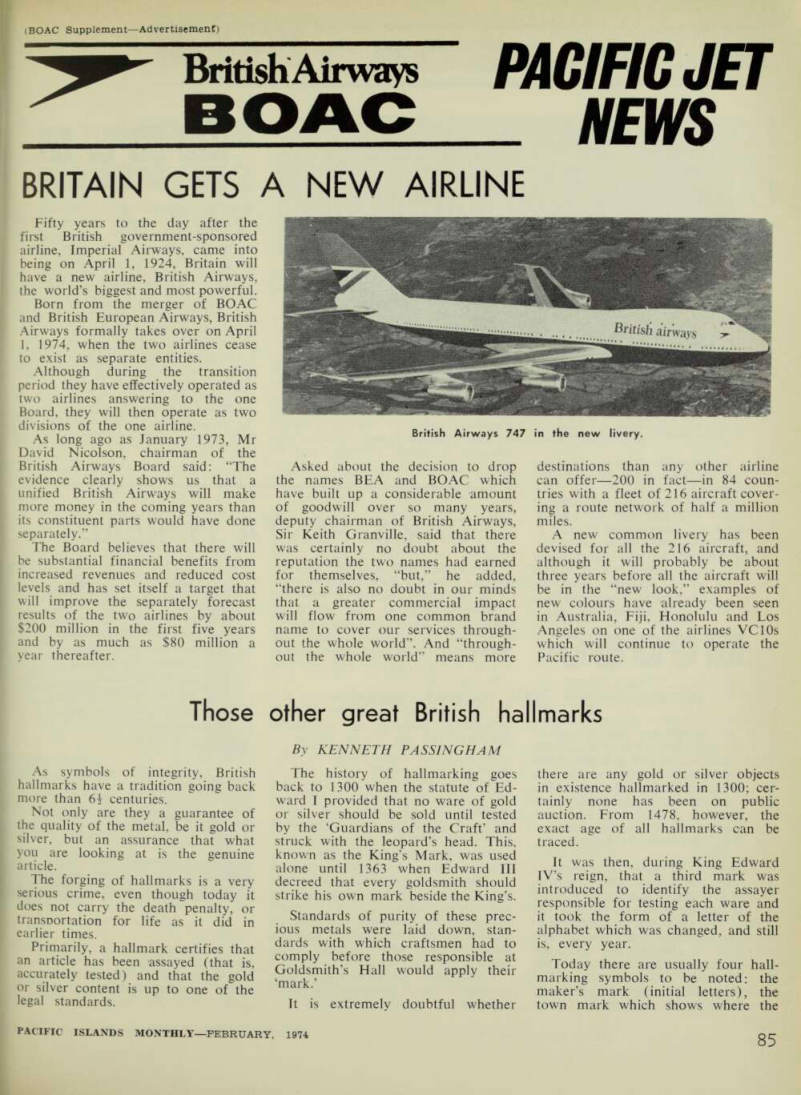
BritishAirways PACIFIC JET
Britain Gets A New Airline
(BOAC Supplement—Advertisement)
Fifty years to the day after the first British government-sponsored airline, Imperial Airways, came into being on April 1, 1924, Britain will have a new airline, British Airways, the world’s biggest and most powerful.
Born from the merger of BOAC and British European Airways, British Airways formally takes over on April 1, 1974, when the two airlines cease to exist as separate entities.
Although during the transition period they have effectively operated as two airlines answering to the one Board, they will then operate as two divisions of the one airline.
As long ago as January 1973, Mr David Nicolson, chairman of the British Airways Board said: “The evidence clearly shows us that a unified British Airways will make more money in the coming years than its constituent parts would have done separately.”
The Board believes that there will be substantial financial benefits from increased revenues and reduced cost levels and has set itself a target that will improve the separately forecast results of the two airlines by about $2OO million in the first five years and by as much as $BO million a year thereafter.
Asked about the decision to drop the names BEA and BOAC which have built up a considerable amount of goodwill over so many years, deputy chairman of British Airways, Sir Keith Granville, said that there was certainly no doubt about the reputation the two names had earned for themselves, “but,” he added, “there is also no doubt in our minds that a greater commercial impact will flow from one common brand name to cover our services through out the whole world”. And “through out the whole world” means more
destinations than any other airline can offer—2oo in fact—in 84 coun tries with a fleet of 216 aircraft cover ing a route network of half a million miles.
A new common livery has been devised for all the 216 aircraft, and although it will probably be about three years before all the aircraft will be in the “new look,” examples of new colours have already been seen in Australia, Fiji, Honolulu and Los Angeles on one of the airlines VC 10s which will continue to operate the Pacific route.
British Airways 747 in the new livery.
Those other great British hallmarks
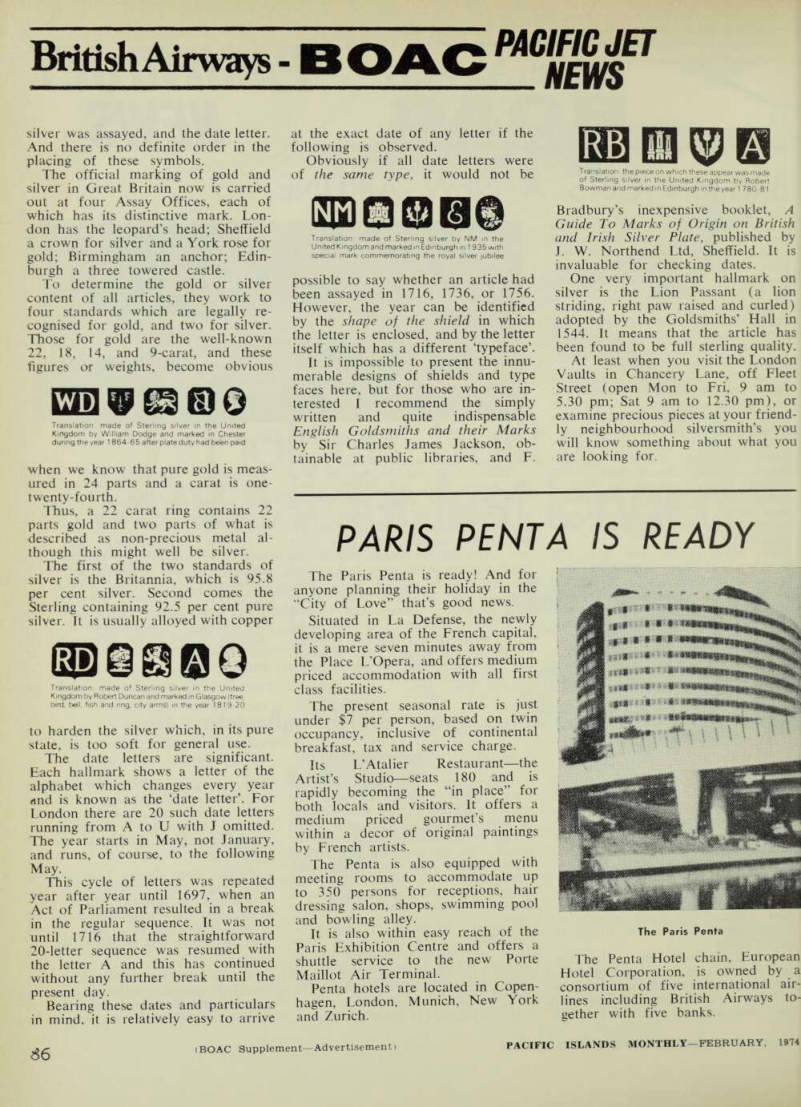
By Kenneth Passingham
As symbols of integrity, British hallmarks have a tradition going back more than 6i centuries.
Not only are they a guarantee of the quality of the metal, be it gold or silver, but an assurance that what you are looking at is the genuine article.
The forging of hallmarks is a very serious crime, even though today it does not carry the death penalty, or transDortation for life as it did in earlier times.
Primarily, a hallmark certifies that an article has been assayed (that is, accurately tested) and that the gold or silver content is up to one of the legal standards.
The history of hallmarking goes back to 1300 when the statute of Ed ward I provided that no ware of gold or silver should be sold until tested by the ‘Guardians of the Craft’ and struck with the leopard’s head. This, known as the King’s Mark, was used alone until 1363 when Edward 111 decreed that every goldsmith should strike his own mark beside the King’s.
Standards of purity of these prec ious metals were laid down, stan dards with which craftsmen had to comply before those responsible at Goldsmith’s Hall would apply their ‘mark.’
It is extremely doubtful whether
there are any gold or silver objects in existence hallmarked in 1300; cer tainly none has been on public auction. From 1478. however, the exact age of all hallmarks can be traced.
It was then, during King Edward IV’s reign, that a third mark was introduced to identify the assayer responsible for testing each ware and it took the form of a letter of the alphabet which was changed, and still is, every year.
Today there are usually four hall marking symbols to be noted; the maker’s mark (initial letters), the town mark which shows where the
silver was assayed, and the date letter.
And there is no definite order in the
placing of these symbols.
The official marking of gold and silver in Great Britain now is carried out at four Assay Offices, each of which has its distinctive mark. Lon don has the leopard’s head; Sheffield a crown for silver and a York rose for gold; Birmingham an anchor; Edin burgh a three towered castle.
To determine the gold or silver content of all articles, they work to four standards which are legally re cognised for gold, and two for silver.
Those for gold are the well-known 22, 18, 14, and 9-carat, and these figures or weights, become obvious
when we know that pure gold is meas ured in 24 parts and a carat is one twenty-fourth.
Thus, a 22 carat ring contains 22 parts gold and two parts of what is described as non-precious metal al though this might well be silver.
The first of the two standards of silver is the Britannia, which is 95,8 per cent silver. Second comes the Sterling containing 92.5 per cent pure silver. It is usually alloyed with copper
to harden the silver which, in its pure state, is too soft for general use.
The date letters are significant.
Each hallmark shows a letter of the alphabet which changes every year and is known as the ‘date letter’. For London there are 20 such date letters running from A to U with J omitted.
The year starts in May, not January, and runs, of course, to the following May.
This cycle of letters was repeated year after year until 1697, when an Act of Parliament resulted in a break in the regular sequence. It was not until 1716 that the straightforward 20-letter sequence was resumed with the letter A and this has continued without any further break until the present day.
Bearing these dates and particulars in mind, it is relatively easy to arrive
at the exact date of any letter if the following is observed.
Obviously if all date letters were of the same type, it would not be
possible to say whether an article had been assayed in 1716, 1736, or 1756.
However, the year can be identified by the shape of the shield in which the letter is enclosed, and by the letter itself which has a different ‘typeface’.
It is impossible to present the innu merable designs of shields and type faces here, but for those who are in terested I recommend the simply written and quite indispensable English Goldsmiths and their Marks by Sir Charles James Jackson, ob tainable at public libraries, and F.
Bradbury’s inexpensive booklet, A Guide To Marks of Origin on British and Irish Silver Plate, published by J. W. Northend Ltd, Sheffield. It is invaluable for checking dates.
One very important hallmark on silver is the Lion Passant (a lion striding, right paw raised and curled) adopted by the Goldsmiths’ Hall in 1544. It means that the article has been found to be full sterling quality.
At least when you visit the London Vaults in Chancery Lane, off Fleet Street (open Mon to Fri, 9 am to 5.30 pm; Sat 9 am to 12.30 pm), or examine precious pieces at your friend ly neighbourhood silversmith’s you will know something about what you are looking for.
Translation made of Sterling silver in the United Kingdom by William Dodge and marked in Chester during the year 1864 -65 after plate duty had been paid
Translation: made of Sterling silver by NM in the United Kingdom and marked in Edinburgh in 1935 with special mark commemorating the royal silver jubilee
Translation: the piece on which these appear was made of Sterling silver in the United Kingdom by Robert Bowman and marked in Edinburgh in the year 1780-81
Translation; made of Sterling silver in the United Kingdom by Robert Duncan and marked in Glasgow (tree, bird. bell, fish and ring, city arms) in the year 1819-20
Paris Penta Is Ready
The Paris Penta is ready! And for anyone planning their holiday in the “City of Love” that’s good news.
Situated in La Defense, the newly developing area of the French capital, it is a mere seven minutes away from the Place L’Opera, and offers medium priced accommodation with all first class facilities.
The present seasonal rate is just under $7 per person, based on twin occupancy, inclusive of continental breakfast, tax and service charge.
Its L’Atalier Restaurant —the Artist’s Studio—seats 180 and is rapidly becoming the “in place” for both locals and visitors. It offers a medium priced gourmet’s menu within a decor of original paintings by French artists.
The Penta is also equipped with meeting rooms to accommodate up to 350 persons for receptions, hair dressing salon, shops, swimming pool and bowling alley.
It is also within easy reach of the Paris Exhibition Centre and offers a shuttle service to the new Porte Maillot Air Terminal.
Penta hotels are located in Copen hagen, London. Munich, New York and Zurich.
The Penta Hotel chain, European Hotel Corporation, is owned by a consortium of five international air lines including British Airways to gether with five banks.
The Paris Renta
Advertisements & other items, p. 88 (1 item)
British Airways - BO AC
(BOAC Supplement —Advertisement)
86
PACIFIC ISLANDS MONTHLY—FEBRUARY, 1974
British Airways - BO AC
Africa
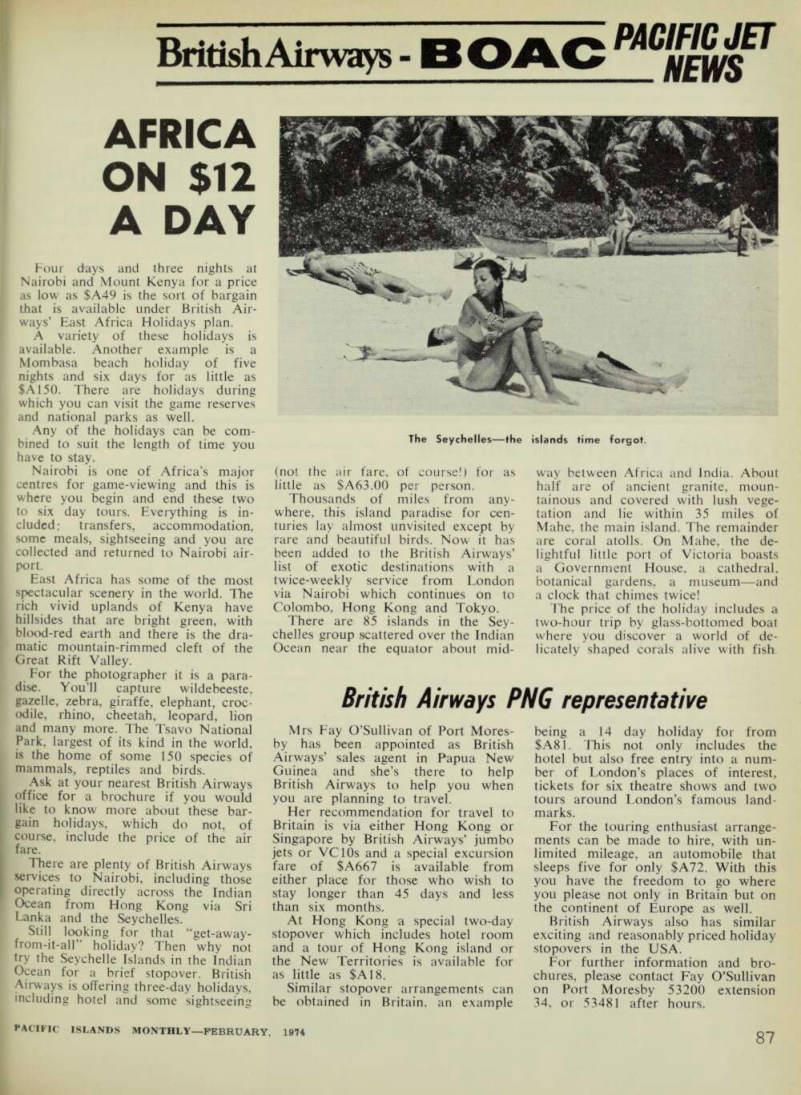
ON $l2
A Day
Four days and three nights at Nairobi and Mount Kenya for a price as low as SA49 is the sort of bargain that is available under British Air ways’ East Africa Holidays plan.
A variety of these holidays is available. Another example is a Mombasa beach holiday of five nights and six days for as little as SAISO. There are holidays during which you can visit the game reserves and national parks as well.
Any of the holidays can be com bined to suit the length of time you have to stay.
Nairobi is one of Africa’s major centres for game-viewing and this is where you begin and end these two to six day tours. Everything is in cluded: transfers, accommodation, some meals, sightseeing and you are collected and returned to Nairobi air port.
East Africa has some of the most spectacular scenery in the world. The rich vivid uplands of Kenya have hillsides that are bright green, with blood-red earth and there is the dra matic mountain-rimmed cleft of the Great Rift Valley.
For the photographer it is a para dise. You’ll capture wildebeeste, gazelle, zebra, giraffe, elephant, croc odile, rhino, cheetah, leopard, lion and many more. The Tsavo National Park, largest of its kind in the world, is the home of some 150 species of mammals, reptiles and birds.
Ask at your nearest British Airways office for a brochure if you would like to know more about these bar gain holidays, which do not, of course, include the price of the air fare.
There are plenty of British Airways services to Nairobi, including those operating directly across the Indian Ocean from Hong Kong via Sri Lanka and the Seychelles.
Still looking for that “get-away from-it-all” holiday? Then why not try the Seychelle Islands in the Indian Ocean for a brief stopover. British Airways is offering three-day holidays, including hotel and some sightseeing
(not the air fare, of course!) for as little as 5A63.00 per person.
Thousands of miles from any where, this island paradise for cen turies lay almost unvisited except by rare and beautiful birds. Now it has been added to the British Airways’ list of exotic destinations with a twice-weekly service from London via Nairobi which continues on to Colombo, Hong Kong and Tokyo.
There are 85 islands in the Sey chelles group scattered over the Indian Ocean near the equator about mid
way between Africa and India. About half are of ancient granite, moun tainous and covered with lush vege tation and lie within 35 miles of Mahe, the main island. The remainder are coral atolls. On Mahe, the de lightful little port of Victoria boasts a Government House, a cathedral, botanical gardens, a museum—and a clock that chimes twice!
The price of the holiday includes a two-hour trip by glass-bottomed boat where you discover a world of de licately shaped corals alive with fish.
The Seychelles—the islands time forgot.
British Airways PNG representative
Mrs Fay O’Sullivan of Port Moresby has been appointed as British Airways’ sales agent in Papua New Guinea and she’s there to help British Airways to help you when you are planning to travel.
Her recommendation for travel to Britain is via either Hong Kong or Singapore by British Airways’ jumbo jets or VClOs and a special excursion fare of 5A667 is available from either place for those who wish to stay longer than 45 days and less than six months.
At Hong Kong a special two-day stopover which includes hotel room and a tour of Hong Kong island or the New Territories is available for as little as SAIB.
Similar stopover arrangements can be obtained in Britain, an example
being a 14 day holiday for from SABI. This not only includes the hotel but also free entry into a num ber of London’s places of interest, tickets for six theatre shows and two tours around London’s famous land marks.
For the touring enthusiast arrange ments can be made to hire, with un limited mileage, an automobile that sleeps five for only SA72. With this you have the freedom to go where you please not only in Britain but on the continent of Europe as well.
British Airways also has similar exciting and reasonably priced holiday stopovers in the USA.
For further information and bro chures, please contact Fay O’Sullivan on Port Moresby 53200 extension 34, or 53481 after hours.
Advertisements & other items, p. 89 (1 item)
British Airways - BO AC MC «nSeP
87
PACIFIC ISLANDS MONTHLY—FEBRUARY, 1974
Two weeks in London
for $81
Two weeks in London for only SABI.OO is now available for travellers to Britain flying by British Airways-BOAC.
The price includes accommodation at a good class hotel (sharing twin room with private bath), continental breakfast, stalls or dress circle tickets to six of London's popular shows, two half-day sightseeing tours of London, Avis self-drive car, free of rental at only eight cents a mile for three days, free admission to Madame Tussauds, membership of the ‘Taste of London’ Club (which gives two meals for the price of one at many London restaurants), an evening pub tour and other attractions.
Single rooms and higher rated hotels are available for an additional charge. The price does not , of course, include the air fare!
Further details may be obtained from any British Airways office.
New Business
Magazine
British Airways is to publish a new worldwide business and business travel magazine that will replace the existing BOAC and BEA publications, Incentive and Agenda. To be called British Airways Executive, it will be published bi-monthly from next April. There will be two editions European and international.
The magazine will be produced for British Airways by Aviation Marketing Services. Advertising space contractors are Parrish- Rogers International.
July
Coming Events In Britain
Some highlights of the next few months 1974
March
4 Celebrations for the 150th Anniversary of the Foundation of the Royal National Lifeboat Institution various venues in Britain, to 7 January 1975. 5 Daily Mail Ideal Home Exhibition Olympia, London, to 30 March. 12 Spring Antiques Fair Chelsea Town Hall, London, to 23 March. 16 Rugby Football: England v Wales Twickenham, Middlesex. 16 Rugby Football: Scotland v France Murrayfield, Edinburgh. 16 Matthew Flinders Bicentenary Festival Lincolnshire, to May. 30 Horse Racing: Grand National Liverpool, Lancashire.
April
6 Oxford v Cambridge Boat Race. Putney to Mortlake. River Thames. 20 Royal Scottish Academy Exhibition Royal Scottish Academy, Edinburgh, to 4 August (provisional). 20 Pitlochry Festival Theatre Season. Pitlochry, Perthshire, to 28 September (provisional). 24 Badminton Horse Trials, Badminton, Gloucestershire, to 27 April. 24 International Dairy Farming Event National Agricultural Centre, Stoneleigh, Kenilworth, Warwickshire, and 25 April.
May
4 FA Cup Final. Wembley, London. 4 Royal Academy Summer Exhibition Royal Academy, London, to 29 July. 9 Royal Windsor Horse Show Home Park, Windsor, Berkshire, to 12 May. 10 Sir Winston Churchill Centenary Exhibition Somerset House, London to end September. 11 Rugby Football: League Challenge Cup Final Wembley, London. 22 Chelsea Flower Show Royal Hospital, Chelsea, London, to 24 May (Private view—2lst) (provisional).
June
5 Horse Racing: Epsom Summer Meeting Epsom, Surrey, to 8 June (provisional) (The Derby—sth; the Oaks—Bth). 11 Three Counties Agricultural Show. Malvern, Worcestershire, to 13 June.
12 Grosvenor House Antiques Fair. Grosvenor House, London, to 22 June. 15 The Queen's Official Birthday: Trooping the Colour. Horse Guards Parade, London. 15 Tennis: Wightman Cup: Ladies' International: G.B. v U.S.A.
Wimbledon, London, and 16 June. 18 Horse Racing: Royal Ascot Ascot, Berkshire, to 21 June (pro visional). 21 Bath Festival Bath, Somerset, to 30 June. 24 Lawn Tennis Championships Wimbledon, London, to 6 July. 26 Royal Norfolk Agricultural Show. Showground. New Costessey, Norwich, Norfolk, and 27 June. 28 Royal National Rose Society's Show. Royal Horticultural Society Halls, London, and 29 June (provisional).
July
1 City of London Festival. London, to 13 July. 4 Henley Royal Regatta, Henley-on-Thames, Oxfordshire, to 7 July. 9 Great Yorkshire Agricultural Show. Great Yorkshire Showground, Harrogate, Yorkshire, to 11 July. 10 Royal Tournament: Displays by the Armed Forces Earls Court, London, to 27 July. 10 Open Golf Championship Royal Lytham & St Annes, Lancashire to 13 July. 17 World Show Jumping Championships. Hickstead, near Bolney, Sussex, to 21 July. 19 Henry Wood Promenade Concerts Royal Albert Hall, London to 14 September, provisional. 20 The Daily Telegraph and BP Round-Britain Power Boat Race. Start and finish London, to 3 August. 26 County Landowners Association Game Fair Stratfield Saye, Hampshire, near Reading, Berkshire, to 27 July.
August
4 Tall Ships Parade of Sail Solent, Isle of Wight. 4 Harrogate Festival of Arts and Sciences. Harrogate, Yorkshire, to 17 August. 5 Royal National Eisteddfod, Carmarthen, to 10 August. 16 Edinburgh Military Tattoo. Castle Esplanade, Edinburgh, to 7 September. . 17 Royal Scottish Academy Festival Exhibition. Royal Scottish Academy, Edinburgh, to 15 September (provisional). 18 Edinburgh International Festival. Edinburgh, to 7 September.
September
2 International Air Show. Farnborough, Hampshire, to 8 September. 7 Braemar Royal Highland Gathering. Braemar, Aberdeenshire. 12 World 3-Day Event Championship (Horse Trials). Burley, Rmgwood,
Advertisements & other items, p. 90 (1 item)
British Airways - B OAC
88
PACIFIC ISLANDS MONTHLY—FEBRUARY, 1974
i BOAC Supplement—Advertisement)
British Airways - B OAC
Business and Development
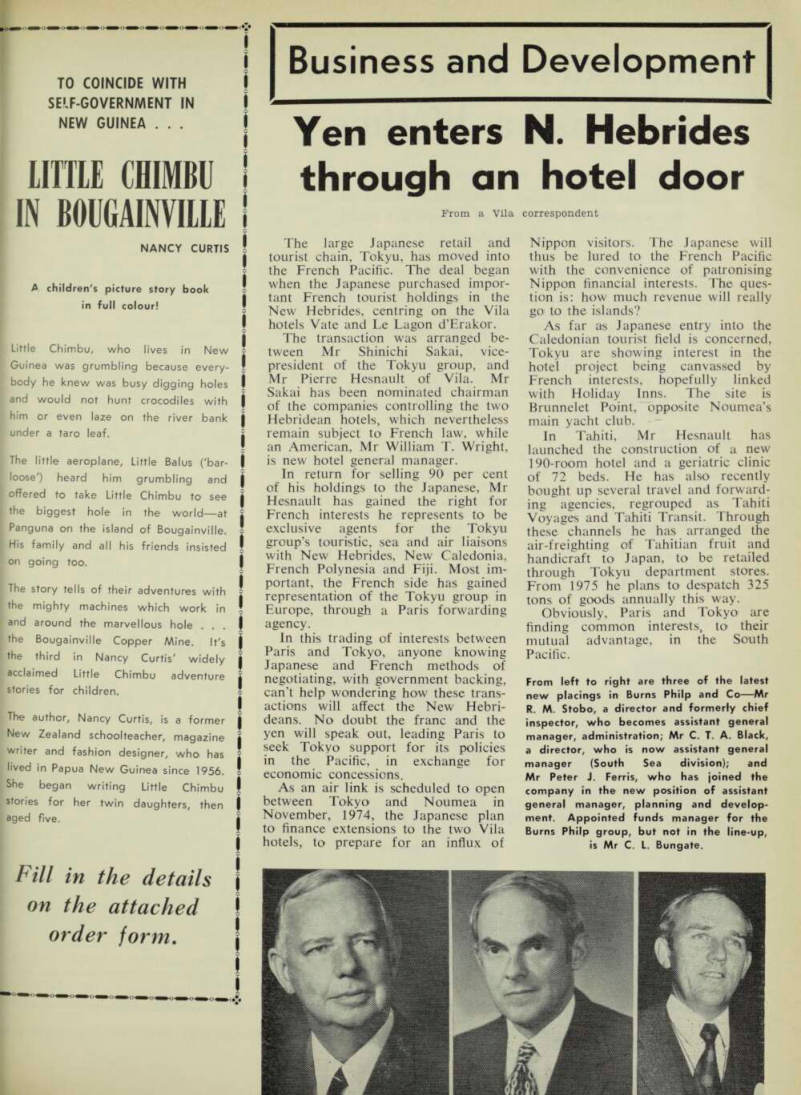
Yen enters N. Hebrides through an hotel door
From a Vila correspondent
The large Japanese retail and tourist chain, Tokyu, has moved into the French Pacific. The deal began when the Japanese purchased impor tant French tourist holdings in the New Hebrides, centring on the Vila hotels Vate and Le Lagon d’Erakor.
The transaction was arranged be tween Mr Shinichi Sakai, vice president of the Tokyu group, and Mr Pierre Hesnault of Vila. Mr Sakai has been nominated chairman of the companies controlling the two Hebridean hotels, which nevertheless remain subject to French law, while an American, Mr William T. Wright, is new hotel general manager.
In return for selling 90 per cent of his holdings to the Japanese, Mr Hesnault has gained the right for French interests he represents to be exclusive agents for the Tokyu group’s touristic, sea and air liaisons with New Hebrides, New Caledonia, French Polynesia and Fiji. Most im portant, the French side has gained representation of the Tokyu group in Europe, through a Paris forwarding agency.
In this trading of interests between Paris and Tokyo, anyone knowing Japanese and French methods of negotiating, with government backing, can’t help wondering how these trans actions will affect the New Hebri deans. No doubt the franc and the yen will speak out, leading Paris to seek Tokyo support for its policies in the Pacific, in exchange for economic concessions.
As an air link is scheduled to open between Tokyo and Noumea in November, 1974, the Japanese plan to finance extensions to the two Vila hotels, to prepare for an influx of
Nippon visitors. The Japanese will thus be lured to the French Pacific with the convenience of patronising Nippon financial interests. The ques tion is: how much revenue will really go to the islands?
As far as Japanese entry into the Caledonian tourist field is concerned, Tokyu are showing interest in the hotel project being canvassed by French interests, hopefully linked with Holiday Inns. The site is Brunnelet Point, opposite Noumea’s main yacht club.
In Tahiti, Mr Hesnault has launched the construction of a new 190-room hotel and a geriatric clinic of 72 beds. He has also recently bought up several travel and forward ing agencies, regrouped as Tahiti Voyages and Tahiti Transit. Through these channels he has arranged the air-freighting of Tahitian fruit and handicraft to Japan, to be retailed through Tokyu department stores.
From 1975 he plans to despatch 325 tons of goods annually this way.
Obviously, Paris and Tokyo are finding common interests, to their mutual advantage, in the South Pacific.
From left to right are three of the latest new placings in Burns Philp and Co —Mr R. M. Stobo, a director and formerly chief inspector, who becomes assistant general manager, administration; Mr C. T. A. Black, a director, who is now assistant general manager (South Sea division); and Mr Peter J. Ferris, who has joined the company in the new position of assistant general manager, planning and develop ment. Appointed funds manager for the Burns Philp group, but not in the line-up, is Mr C. L. Bungate.
Advertisements & other items, p. 91 (1 item)
Little Thimbu
TO COINCIDE WITH
SELF-GOVERNMENT IN
NEW GUINEA . . .
LITTLE THIMBU
IN BOUGAINVILLE
NANCY CURTIS
A children's picture story book in full colour! [ Little Chimbu, who lives in New Guinea was grumbling because everybody he knew was busy digging holes and would not hunt crocodiles with him or even laze on the river bank under a taro leaf.
The little aeroplane. Little Balus ('barloose') heard him grumbling and offered to take Little Chimbu to see the biggest hole in the world—at Panguna on the island of Bougainville.
His family and all his friends insisted on going too.
The story tells of their adventures with the mighty machines which work in and around the marvellous hole . . . the Bougainville Copper Mine. It's the third in Nancy Curtis' widely acclaimed Little Chimbu adventure stories for children.
The author, Nancy Curtis, is a former New Zealand schoolteacher, magazine writer and fashion designer, who has lived in Papua New Guinea since 1956.
She began writing Little Chimbu stories for her twin daughters, then aged five.
Fill in the details
on the attached
order form.
Complexion beauty that
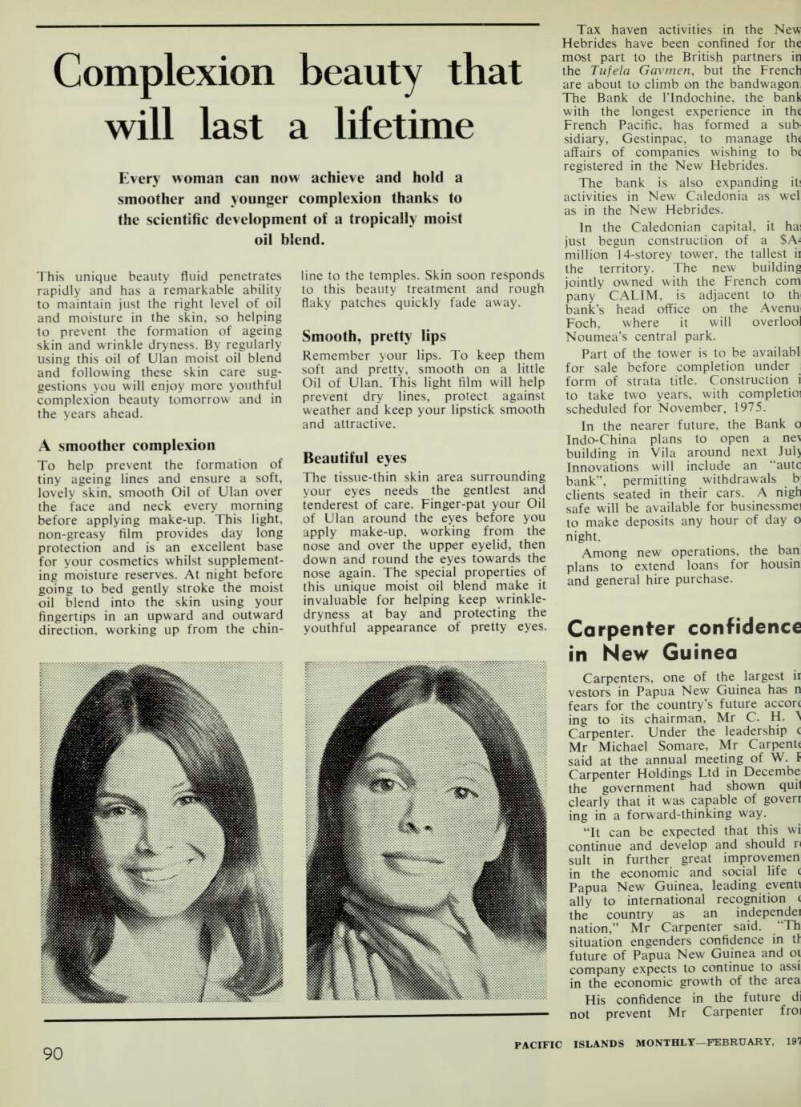
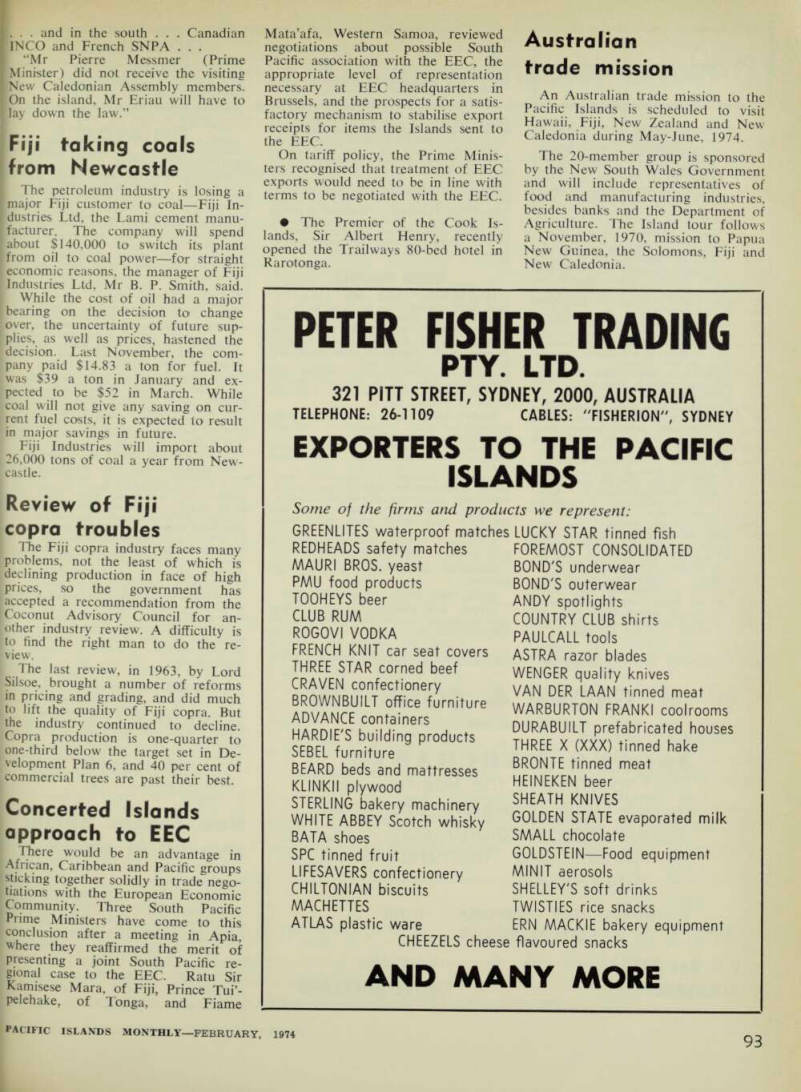
will last a lifetime
Every woman can now achieve and hold a smoother and younger complexion thanks to the scientific development of a tropically moist oil blend.
This unique beauty fluid penetrates rapidly and has a remarkable ability to maintain just the right level of oil and moisture in the skin, so helping to prevent the formation of ageing skin and wrinkle dryness. By regularly using this oil of Ulan moist oil blend and following these skin care sug gestions you will enjoy more youthful complexion beauty tomorrow and in the years ahead.
A smoother complexion To help prevent the formation of tiny ageing lines and ensure a soft, lovely skin, smooth Oil of Ulan over the face and neck every morning before applying make-up. This light, non-greasy film provides day long protection and is an excellent base for your cosmetics whilst supplement ing moisture reserves. At night before going to bed gently stroke the moist oil blend into the skin using your fingertips in an upward and outward direction, working up from the chin
line to the temples. Skin soon responds to this beauty treatment and rough flaky patches quickly fade away.
Smooth, pretty lips
Remember your lips. To keep them soft and pretty, smooth on a little Oil of Ulan. This light film will help prevent dry lines, protect against weather and keep your lipstick smooth and attractive.
Beautiful eyes The tissue-thin skin area surrounding your eyes needs the gentlest and tenderest of care. Finger-pat your Oil of Ulan around the eyes before you apply make-up, working from the nose and over the upper eyelid, then down and round the eyes towards the nose again. The special properties of this unique moist oil blend make it invaluable for helping keep wrinkle dryness at bay and protecting the youthful appearance of pretty eyes.
Tax haven activities in the New Hebrides have been confined for the most part to the British partners in the Tufela Gavmen, but the French are about to climb on the bandwagon, The Bank de I’lndochine, the bank with the longest experience in the French Pacific, has formed a sub sidiary, Gestinpac, to manage the affairs of companies wishing to be registered in the New Hebrides.
The bank is also expanding it; activities in New Caledonia as wel as in the New Hebrides.
In the Caledonian capital, it ha; just begun construction of a million 14-storey tower, the tallest ii the territory. The new building jointly owned with the French com pany CALIM, is adjacent to th« bank’s head office on the Avemn Foch, where it will overlool Noumea’s central park.
Part of the tower is to be availabl for sale before completion under ; form of strata title. Construction i to take two years, with completioi scheduled for November, 1975.
In the nearer future, the Bank o Indo-China plans to open a nev building in Vila around next Jul> Innovations will include an “autc bank”, permitting withdrawals b; clients seated in their cars. A nigh safe will be available for businessmei to make deposits any hour of day o night.
Among new operations, the baff plans to extend loans for housin and general hire purchase.
Carpenter confidence
in New Guinea
Carpenters, one of the largest ir vestors in Papua New Guinea has n fears for the country’s future accorc ing to its chairman, Mr C. H. \ Carpenter. Under the leadership c Mr Michael Somare, Mr Carpenff said at the annual meeting of W. f Carpenter Holdings Ltd in Decembe the government had shown quit clearly that it was capable of goven ing in a forward-thinking way.
“It can be expected that this wi continue and develop and should n suit in further great improvemen in the economic and social life c Papua New Guinea, leading eventi ally to international recognition c the country as an independei nation,” Mr Carpenter said. “Th situation engenders confidence in tl future of Papua New Guinea and oi company expects to continue to assi in the economic growth of the area His confidence in the future di not prevent Mr Carpenter froi
strongly criticising PNG’s decision to align its currency to Australia, at ■least in the early stages of the new status. He described it as an unrealistic alignment, as PNG relied extensively on exports of Hand commodities. These were at a disadvantage with competitors Iwhich had devalued their currencies, while the Australian dollar had been revalued.
I “Papua New Guinea cannot afford an over-valued currency,” Mr Car penter said. [ However, the world tea market re imains depressed, and it is here that devaluation could be of assistance to PNG growers and processors. But as Papua New Guinea will use Aus tralian currency till December 1, 1974, at the earliest, no relief is in i sight for the tea industry before then.
Mr Carpenter said that from the group’s point of view, in the event of a PNG devaluation, there would be a loss on conversion from PNG to Australian currency, but there would be a net improvement in returns from plantations and estates. He said the 'Australian currency changes had made the Carpenter tea estates, Kudjip, Kindeng and Aviamp, only marginally viable.
Mr Carpenter gave the following examples of how the Australian dollar had appreciated against several currencies. In the six years from ■967 to March, 1973, the apprecia tions were: East African shilling, 32.8 per cent; Indian rupee, 103 per cent; Indonesian rupiah, 89 per cent; Sri Tanka rupee, 66 per cent. Over the two-year period, November, 1971- November, 1973, the Philippine peso appreciated by 32 per cent. The £ sterling had depreciated affecting the exchange rates of the currencies tied to sterling.
Referring to activities in Fiji, Tonga and Western Samoa, Mr Car penter said the introduction in Fiji of a Central Monetary Authority and a
prices and income control policy, plus price controls in Tonga and Western Samoa, would have some effect on the development and results in those areas On the other hand if the current high prices for island commod.ties and sugar continued, as the . re r S in a f °T l ? d ,‘ catlon ’ and with the maintenance of tourism at its present level, economic conditions should remain fairly buoyant. (At the time Mr Carpenter spoke, he Fiji copra price was $2BO for the top grade and the London price of sugar was £stgl34 a ton. Later Fiji copra rose to $423 for top grade.) He said that the reconstruction of the Fiji group would, in time, facilitate local participation in the company. Similar arrangements were being made for Papua New Guinea.
Bit in the present circumstances there was a difficulty in arranging local participation, as an offer to invest in Carlton United Brewery, Fiji, showed. The offer was 15 per cent.
While there was a satisfactory respouse in attracting a comparatively large number of small holdings, the response in the actual amount of capital subscribed was disappointing.
It represented only 6.92 per cent of the issued capital.
I MYMri . ocfmf/a “" UAUr 7 CbraTe
qh TdVCUtli
A Californian land planner, Mr John Mclntire> is developing a 3,800acre t S oqulu plantation, just south of Waiyevo, on Fiji's “garden island .. Xave J ni as a self-contained town> with the accent on rest, recrea ti and tourism The lans include 18 . ho e go |f course, three beach resortSj and B a resid ential community ih J„ ameniti plus a tow ' neighbourhood shopping marts> ’ an(J se B veral hotels . i i , . , The development will take several Vf 3 , 1 !' T he flrs stage was the release 0f ,j 39 h om «.! lt s?’ and J 3s have been f ld - The F, )> Town Planning Board has now approved the marketing of 23 °. . mo . re bl f <K * s ; ™l| o a ™ r ?« e P. rlce f f b ' ocks - at $F \ BOO ha .s rl « n •? about $F6,900. All home sites for the h ls * few y ears W 1" be on at least one acre each * Roads will be laid through the area, which will have essential facili ties such as sewerage, power and water laid on. The development site rises gently from a series of beaches to about 1,800 feet, to give com
manding views of the sea, and across Somosomo Strait to Vanua Levu and Rabi Island.
Mr Mclntire’s spacious beach front home, which features the imaginative use of native timbers, will reflect the architectural tone of the project. He used local labour as a first step to wards building up a skilled work force.
The golf course will be ready in 1975 or 1976. It is not expected that membership will be restricted to Soqulu residents. Initial plans are to invite hotel chains to erect the hotels.
Marketing would be aimed mainly at Americans; but it is also expected Australians and Japanese, seeking somewhere “to get away from it all” will show interest in buying a site.
Tonga bank
goes 'Swiss-style'
The new Bank of Tonga will operate secret bank accounts, similar to the Swiss system. Foreigners will be able to open accounts using a secret code number known only to the owner of the account and one or two bank officers.
King Taufa’ahau Tupou IV said the bank would operate differently from any other bank already estab lished in the neighbouring islands.
The bank will open for business in Nukualofa on July 1, offering full banking services in addition to the numbered account service. Mr Car son Flint, on secondment from the Bank of New South Wales for three years, became general manager of the bank on January 4.
Mr Flint was manager of the Five Dock (NSW) branch of the bank till the end of May, 1973, after which he went to head office to prepare for the position in Tonga. The deputy general manager is Mr B. D. Holt, from the Bank of New Zealand. The Bank of Hawaii will supply the ac countant, who has yet to be named.
The board of the bank will com prise Dr S. Tapa, Acting Minister of Finance, Mr Cecil Cocker, Tonga Government Statistician, Mr D. M.
Arnold, general manager of the Bank of NSW, Mr B. M. Smith, general manager of the Bank of NZ, and Mr Clifton D. Terry of the Bank of Hawaii.
France lays
down the law
The French weekly L’Express, equivalent to American Newsweek, in its issue of December 17-23 reports on Caledonian problems: “Whoever speaks of economic crisis implies social malaise then, often, political unrest. The government has thus chosen a former director of the DST (Internal Security Service), Mr Gabriel Eriau, aged 59, as High Commissioner in New Caledonia.
This Pacific island is sick from its
monoproduction: nickel . . .
“To avoid complete breakdown, th« government has allowed, in the 1974 national budget, a credit allowance of 100 million French francs for New Caledonia (SAI4 million) ... Bui these isolated measures do not assure the economic future of the island.
“A delegation of local elected mer came to Paris last week to ask the government to speed up the realisa tion of nickel smelting projects: ir the north of the island . . . Patino
... and in the south . . . Canadian IINCO and French SNPA . . .
“Mr Pierre Messmer (Prime Minister) did not receive the visiting [New Caledonian Assembly members. On the island, Mr Eriau will have to [lay down the law.”
Fiji taking coals
from Newcastle
The petroleum industry is losing a [major Fiji customer to coal—Fiji In- I dustries Ltd, the Lami cement manu facturer. The company will spend about $140,000 to switch its plant from oil to coal power—for straight economic reasons, the manager of Fiji Industries Ltd, Mr B. P. Smith, said.
While the cost of oil had a major bearing on the decision to change over, the uncertainty of future sup plies, as well as prices, hastened the decision. Last November, the com pany paid $14.83 a ton for fuel. It was $39 a ton in January and ex pected to be $52 in March. While coal will not give any saving on cur rent fuel costs, it is expected to result in major savings in future, Fiji Industries will import about 26,000 tons of coal a year from New castle.
Review of Fiji
copra troubles
The Fiji copra industry faces many problems, not the least of which is declining production in face of high prices, so the government has accepted a recommendation from the Coconut Advisory Council for an other industry review. A difficulty is to find the right man to do the re view.
The last review, in 1963, by Lord Silsoe, brought a number of reforms in pricing and grading, and did much to lift the quality of Fiji copra. But the industry continued to decline.
Copra production is one-quarter to one-third below the target set in De velopment Plan 6, and 40 per cent of commercial trees are past their best.
Concerted Islands
approach to EEC
There would be an advantage in African, Caribbean and Pacific groups sticking together solidly in trade nego tiations with the European Economic Community. Three South Pacific Prime Ministers have come to this conclusion after a meeting in Apia, where they reaffirmed the merit of presenting a joint South Pacific re gional case to the EEC. Ratu Sir Kamisese Mara, of Fiji, Prince Tui’pelehake, of Tonga, and Fiame
Mata’afa, Western Samoa, reviewed negotiations about possible South Pacific association with the EEC, the appropriate level of representation necessary at EEC headquarters in Brussels, and the prospects for a satis factory mechanism to stabilise export receipts for items the Islands sent to the EEC.
On tariff policy, the Prime Minis ters recognised that treatment of EEC exports would need to be in line with terms to be negotiated with the EEC. • The Premier of the Cook Is lands, Sir Albert Henry, recently opened the Trailways 80-bed hotel in Rarotonga.
Australian
trade mission
An Australian trade mission to the Pacific Islands is scheduled to visit Hawaii, Fiji, New Zealand and New Caledonia during May-June, 1974.
The 20-member group is sponsored by the New South Wales Government and will include representatives of food and manufacturing industries, besides banks and the Department of Agriculture. The Island tour follows a November, 1970, mission to Papua New Guinea, the Solomons, Fiji and New Caledonia.
Advertisements & other items, pp. 93-95 (1 item)
Monark Fibreglass Boats
ss. »rr
UMITCI
P.O. BOX 507,
MANLY, N.S.W.
2095.
CABLE ADDRESS:
DEMKAY, SYDNEY.
ASK US FOR QUOTATIONS
FROM GERMANY
® kitchen appliances • deep freezers ® refrigerators • wines • lace materials • paper serviettes • sanitary towels • toilet papers • musical instruments • floor coverings • curtain materials • dress materials • automotive parts and tools • garage equipment • fork lifts • agricultural sprayers and tractors • fire extinguishes.
9
MONARK FIBREGLASS BOATS
• 10 ft to 22 ft • Standard & deluxe Prompt attention all enquiries ! !
Please send me complete details on Monark Fibreglass Boats.
NAME
ARDNEIL TRADING PTY. LTD.,
428 PRESIDENT AVENUE, KIRRAWEE, N.S.W. 2232.
PHONE; 521-2909. CABLE: "ANSTRADE" SYDNEY
ADDRESS
offers expert
insurance service
throughout
the Islands
QUEENSLAND INSURANCE
COMPANY LIMITED
(Incorporated 1886 in Australia)
Head Office: 82 Pitt Street, Sydney FIJI —Branch Office, Suva, Manager for Fiji: F. N. Davies
(A.A.I.L).
LAUTOKA—District Manager: U. Singh.
HONIARA (B.S.l.P.)—Breckwoldt & Company (5.1.) Pty.
Limited. „ T , NEW CALEDONIA —T. A. Hagen, Ste. W. A. Johnston, S.A.R.L. —Noumea. . .
NEW HEBRIDES —Resident Officer: R. J. Allsop (A.A.I.L) Vila; Santo: Burns Philp (New Hebrides) Ltd.
TAHITI —Arthur Chung: Immeuble 8.1., Front de Mer, Papeete.
NIUE, NORFOLK ISLAND, SAMOA, TONGA and other South Sea Islands—Burns Philp (South Sea) Company Ltd.
QUEENSLAND INSURANCE (P.N.G.) LTD
PAPUA NEW GUINEA
Head Office, Port Moresby: General Manager: D. J. Granter.
District Managers at Rabaul: C. D. Dickings; Lae; R. Jackson; Mt. Hagen: D. F. Carroll.
V33BR
PETER FISHER TRADING
PTY. LTD.
321 PITT STREET, SYDNEY, 2000, AUSTRALIA
TELEPHONE: 26-1109 CABLES; "FISHERION", SYDNEY
EXPORTERS TO THE PACIFIC
ISLANDS
Some of the firms and products we represent: GREENLITES waterproof matches LUCKY STAR tinned fish REDHEADS safety matches MAURI BROS, yeast PMU food products TOOHEYS beer
CLUB RUM
ROGOVI VODKA
FRENCH KNIT car seat covers THREE STAR corned beef CRAVEN confectionery BROWNBUILT office furniture ADVANCE containers HARDIE'S building products SEBEL furniture BEARD beds and mattresses KLINKII plywood STERLING bakery machinery WHITE ABBEY Scotch whisky BATA shoes SPC tinned fruit LIFESAVERS confectionery CHILTONIAN biscuits
MACHETTES
ATLAS plastic ware
FOREMOST CONSOLIDATED
BOND'S underwear BOND'S outerwear ANDY spotlights COUNTRY CLUB shirts PAULCALL tools ASTRA razor blades WENGER quality knives VAN DER LAAN tinned meat WARBURTON FRANK! coolrooms DURABUILT prefabricated houses THREE X (XXX) tinned hake BRONTE tinned meat HEINEKEN beer
SHEATH KNIVES
GOLDEN STATE evaporated milk SMALL chocolate GOLDSTEIN—Food equipment MINIT aerosols SHELLEY'S soft drinks TWISTIES rice snacks ERN MACKIE bakery equipment CHEEZELS cheese flavoured snacks
AND MANY MORE
Produce Prices
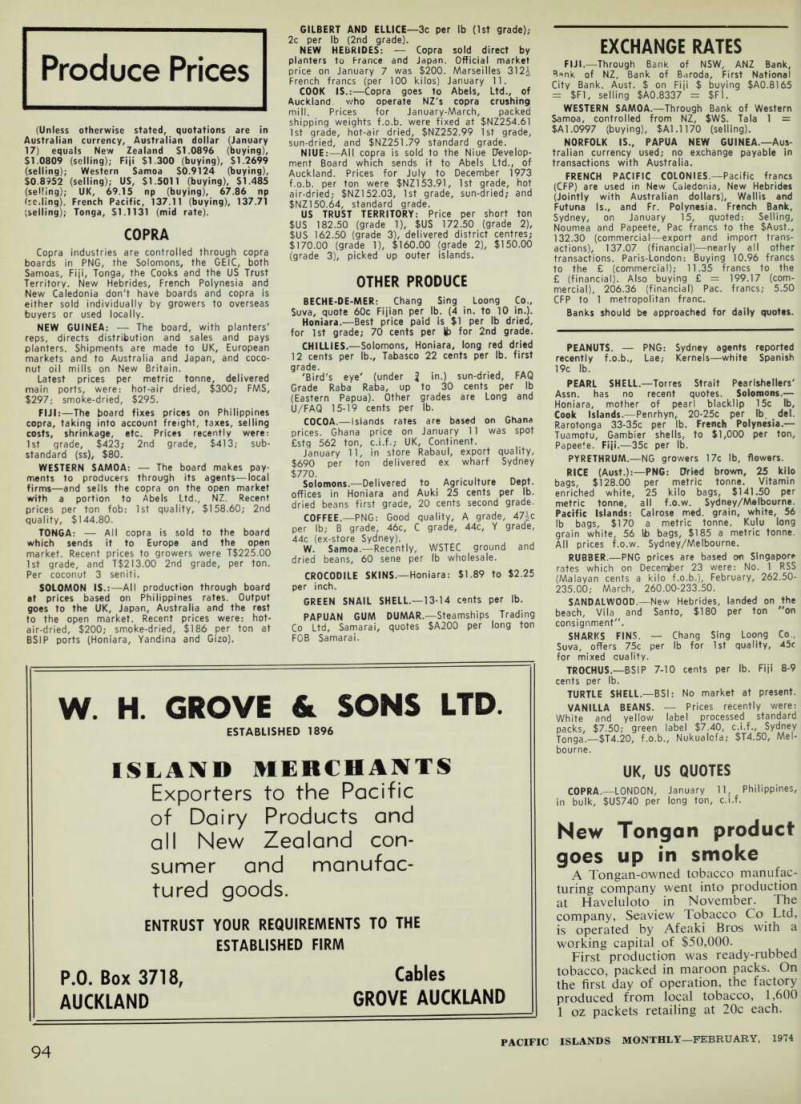
(Unless otherwise stated, quotations are in Australian currency, Australian dollar (January 17) equals New Zealand $1.0896 (buying), 51. 0809 (selling); Fiji $1,300 (buying), $1.2699 (selling); Western Samoa $0.9124 (buying), $0.8952 (selling); US, $1.5011 (buying), $1,485 (selling); UK, 69.15 np (buying), 67.86 np fse.ling). French Pacific, 137.11 (buying), 137.71 (selling); Tonga, $1.1131 (mid rate).
Copra
Copra industries are controlled through copra boards in PNG, the Solomons, the GEIC, both Samoas, Fiji, Tonga, the Cooks and the US Trust Territory. New Hebrides, French Polynesia and New Caledonia don't have boards and copra is either sold individually by growers to overseas buyers or used locally.
NEW GUINEA: The board, with planters' reps, directs distribution and sales and pays planters. Shipments are made to UK, European markets and to Australia and Japan, and coco nut oil mills on New Britain.
Latest prices per metric tonne, delivered main ports, were; hot-air dried, $300; FMS, $297; smoke-dried, $295.
FIJI: —The board fixes prices on Philippines copra, taking into account freight, taxes, selling costs, shrinkage, etc. Prices recently were: Ist grade, $423; 2nd grade, $413; sub standard (ss), $BO.
WESTERN SAMOA: The board makes pay ments to producers through its agents—local firms —and sells the copra on the open market with a portion to Abels Ltd., NZ. Recent prices per ton fob: Ist quality, $158.60; 2nd quality, $144.80.
TONGA: All copra is sold to the board which sends it to Europe and the open market. Recent prices to growers were T 5225.00 Ist grade, and T 5213.00 2nd grade, per ton.
Per coconut 3 seniti.
SOLOMON IS.: —All production through board at prices based on Philippines rates. Output goes to the UK, Japan, Australia and the rest to the open market. Recent prices were: hot air-dried, $200; smoke-dried, $lB6 per ton at BSIP ports (Honiara, Yandina and Gizo).
GILBERT AND ELLICE— 3c per lb (Ist grade); 2c per lb (2nd grade).
NEW HEBRIDES: Copra sold direct by planters to France and Japan. Official market price on January 7 was $2OO. Marseilles 312£ French francs (per 100 kilos) January 11.
COOK IS.; —Copra goes to Abels, Ltd., of Auckland who operate NZ's copra crushingj mill. Prices for January-March, packed shipping weights f.o.b. were fixed at $NZ254.61 Ist grade, hot-air dried, $NZ252.99 Ist grade, sun-dried, and $NZ251.79 standard grade.
NIUE: —All copra is sold to the Niue Develop ment Board which sends it to Abels Ltd., of Auckland. Prices for July to December 1973 f.o.b. per ton were $NZ153.91, Ist grade, hot air-dried; $NZ152.03, Ist grade, sun-dried; and $NZ150.64, standard grade.
US TRUST TERRITORY: Price per short ton SUS 182.50 (grade 1), SUS 172.50 (grade 2), SUS 162.50 (grade 3), delivered district centres; $170.00 (grade 1), $160.00 (grade 2), $150.00 (grade 3), picked up outer islands.
Other Produce
BECHE-DE-MER: Chang Sing Loong Co., Suva, quote 60c Fijian per lb. (4 in. to 10 in.).
Honiara.—Best price paid is $1 per lb dried, for Ist grade; 70 cents per lb for 2nd grade.
CHILLIES.— SoIomons, Honiara, long red dried 12 cents per lb.. Tabasco 22 cents per lb. first grade.
'Bird's eye' (under 2 in.) sun-dried, FAQ Grade Raba Raba, up to 30 cents per lb (Eastern Papua). Other grades are Long and U/FAQ 15-19 cents per lb.
COCOA. —Islands rates are based on Ghana prices. Ghana price on January 11 was spot £stg 562 ton, c.i.f.; UK, Continent.
January 11, in store Rabaul, export quality, $690 per ton delivered ex wharf Sydney $770.
Solomons. —Delivered to Agriculture Dept, offices in Honiara and Auki 25 cents per lb. dried beans first grade, 20 cents second grade.
COFFEE— PNG: Good quality, A grade, 47\c per lb; B grade, 46c, C grade, 44c, Y grade, 44c (ex-store Sydney).
W. Samoa.— Recently, WSTEC ground and dried beans, 60 sene per lb wholesale.
CROCODILE SKlNS.—Honiara: $1.89 to $2.25 per inch.
GREEN SNAIL SHELL.—I 3-14 cents per lb.
PAPUAN GUM DUMAR. —Steamships Trading Co Ltd, Samarai, quotes SA2OO per long ton FOB Samarai.
PEANUTS. PNG: Sydney agents reported recently f.0.b., Lae; Kernels—white Spanish 19c lb.
PEARL SHELL— Torres Strait Pearlshellers' Assn, has no recent quotes. Solomons. — Honiara, mother of pearl blacklip 15c lb.
Cook Islands. —Penrhyn, 20-25 c per lb. del.
Rarotonga 33-35 c per lb. French Polynesia.— Tuamotu, Gambier shells, to $l,OOO per ton, Papeete. Fiji. —3sc per lb.
PYRETHRUM.—NG growers 17c lb, flowers.
RICE (Aust.):—PNG: Dried brown, 25 kilo bags, $128.00 per metric tonne. Vitamin enriched white, 25 kilo bags, $141.50 per metric tonne, all f.o.w. Sydney/Melbourne.
Pacific Islands: Calrose med. grain, white, 56 lb bags, $l7O a metric tonne. Kulu long grain white, 56 lb bags, $lB5 a metric tonne.
All prices f.o.w. Sydney/AAelbourne.
RUBBER. —PNG prices are based on Singapore rates which on December 23 were: No. 1 RSS (Malayan cents a kilo f.0.b.), February, 262.50- 235.00; March, 260.00-233.50.
SANDALWOOD. —New Hebrides, landed on the beach, Vila and Santo, $lBO per ton "on consignment".
SHARKS FINS. Chang Sing Loong Co., Suva, offers 75c per lb for Ist quality, 45c for mixed Quality.
TROCHUS.— BSIP 7-10 cents per lb. Fiji 8-9 cents per lb.
TURTLE SHELL.— BSI: No market at present.
VANILLA BEANS. Prices recently were: White and yellow label processed standard packs, $7.50; green label $7.40, c.i.f., Sydney Tonga.—sl4.2o, f.0.b., Nukualofa; $14.50, Mel bourne.
Uk, Us Quotes
COPRA.—LONDON, January 11, Philippines, in bulk, SUS74O per long ton, c.i.f.
New Tongan product
goes up in smoke
A Tongan-owned tobacco manufac turing company went into production at Haveluloto in November. The company, Seaview Tobacco Co Ltd, is operated by Afeaki Bros with a
working capital of $50,000.
First production was ready-rubbed
tobacco, packed in maroon packs. On
the first day of operation, the factory produced from local tobacco, 1,600 1 oz packets retailing at 20c each.
Exchange Rates
FlJl.— Through Bank of NSW, ANZ Bank, B»nk of NZ, Bank of Baroda, First National City Bank. Aust. $ on Fiji $ buying $A0.8165 = SFI, selling $A0.8337 = SFI.
WESTERN SAMOA.— Through Bank of Western Samoa, controlled from NZ, SWS. Tala 1 = $A 1.0997 (buying), $A1.1170 (selling).
Norfolk Is., Papua New Gulnea.—Aus
tralian currency used; no exchange payable in transactions with Australia.
FRENCH PACIFIC COLONIES.— Pacific francs (CFP) are used in New Caledonia, New Hebrides (Jointly with Australian dollars), Wallis and Futuna Is., and Fr. Polynesia. French Bank, Sydney, on January 15, quoted: Selling, Noumea and Papeete, Pac francs to the sAust., 132.30 (commercial —export and import trans actions), 137.07 (financial) —nearly all other transactions. Paris-London: Buying 10.96 francs to the £ (commercial); 11.35 francs to the £ (financial). Also buying £ = 199.17 (com mercial), 206.36 (financial) Pac. francs; 5.50 CFP to 1 metropolitan franc.
Banks should be approached for daily quotes.
Advertisements & other items, p. 96 (1 item)
W. H. Grove & Sons Ltd.
ESTABLISHED 1896
ISLAND MERCHANTS
Exporters to the Pacific of Dairy Products and all New Zealand consumer and manufactured goods.
ENTRUST YOUR REQUIREMENTS TO THE
ESTABLISHED FIRM
P.O. Box 3718, Cables
AUCKLAND GROVE AUCKLAND
Shipping & Airways Information
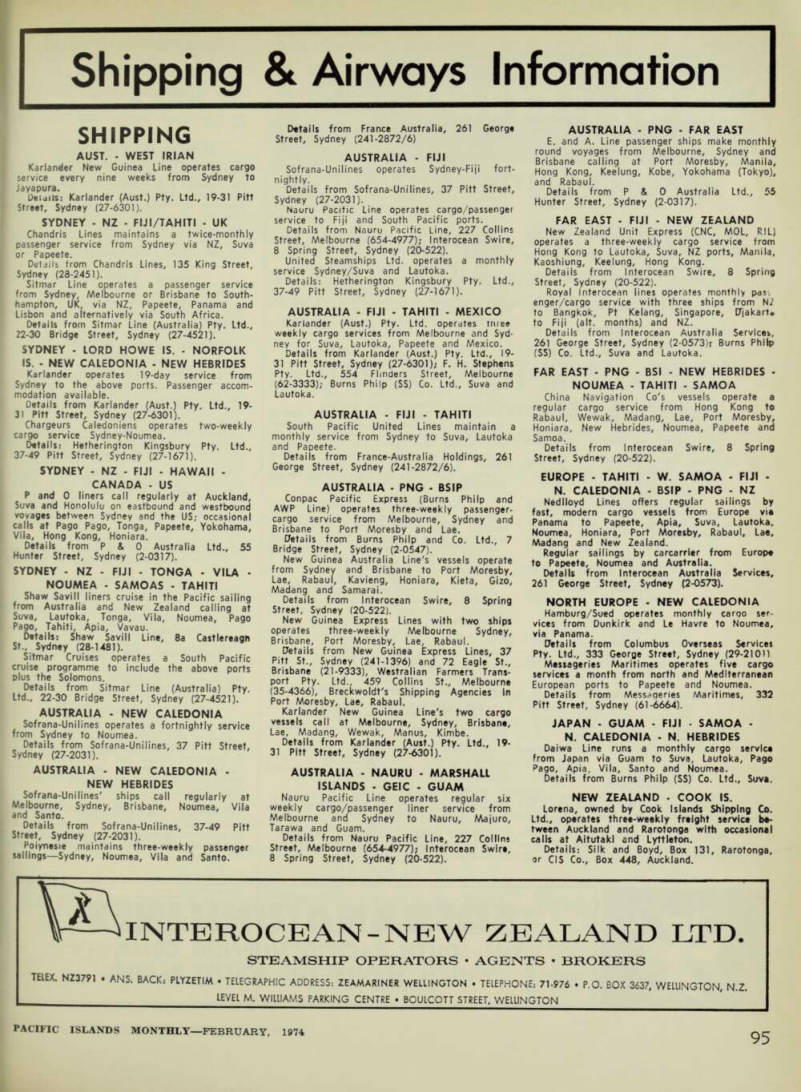
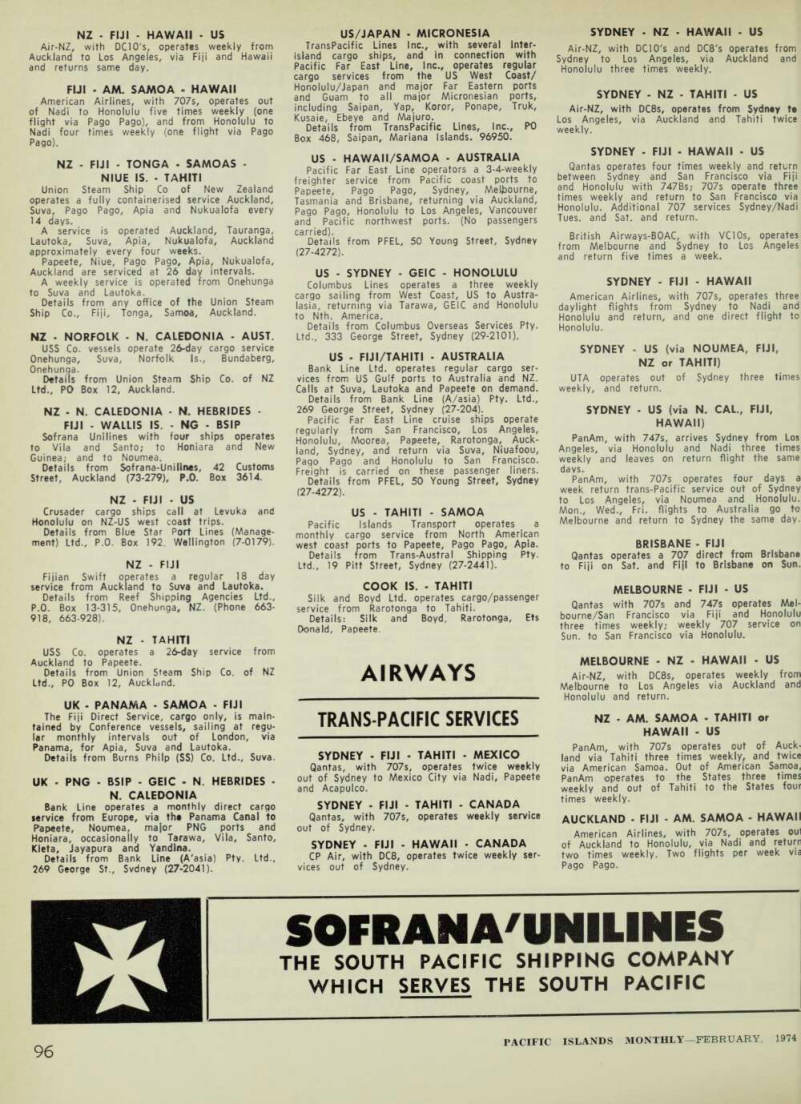
Shipping
Aust. - West Irian
Karlander New Guinea Line operates cargo service every nine weeks from Sydney to Jayapura.
Details: Karlander (Aust.) Pty. Ltd., 19-31 Pitt Street, Sydney (27-6301).
SYDNEY - NZ - FIJI/TAHITI - UK Chandris Lines maintains a twice-monthly passenger service from Sydney via NZ, Suva or Papeete.
Details from Chandris Lines, 135 King Street, Sydney (28-2451).
Sitmar Line operates a passenger service from Sydney, Melbourne or Brisbane to South hampton, UK. via NZ, Papeete, Panama and Lisbon and alternatively via South Africa.
Details from Sitmar Line (Australia) Pty. Ltd., 22-30 Bridge Street, Sydney (27-4521).
SYDNEY - LORD HOWE IS. - NORFOLK IS. • NEW CALEDONIA - NEW HEBRIDES Karlander operates 19-day service from Sydney to the above ports. Passenger accom modation available.
Details from Karlander (Aust.) Pty. Ltd., 19- 31 Pitt Street, Sydney (27-6301).
Chargeurs Caledonians operates two-weekly cargo service Sydney-Noumea.
Details: Hetherington Kingsbury Pty. Ltd., 37-49 Pitt Street, Sydney (27-1671).
SYDNEY - NZ - FIJI - HAWAII -
Canada - Us
P and 0 liners call regularly at Auckland, Suva and Honolulu on eastbound and westbound voyages between Sydney and the US; occasional calls at Pago Pago, Tonga, Papeete, Yokohama, Vila, Hong Kong, Honiara.
Details from P & 0 Australia Ltd., 55 Hunter Street, Sydney (2-0317).
SYDNEY - NZ - FIJI ■ TONGA - VILA ■
Noumea - Samoas - Tahiti
Shaw Savill liners cruise in the Pacific sailing from Australia and New Zealand calling at Suva, Lautoka, Tonga, Vila, Noumea, Pago Pago, Tahiti, Apia, Vavau.
Details; Shaw Savill Line, 8a Castlereagh St., Sydney (28-1481).
Sitmar Cruises operates a South Pacific cruise programme to include the above ports plus the Solomons, Details from Sitmar Line (Australia) Pty.
Ltd., 22-30 Bridge Street, Sydney (27-4521).
Australia - New Caledonia
Sofrana-Unilines operates a fortnightly service from Sydney to Noumea.
Details from Sofrana-Unilines, 37 Pitt Street, Sydney (27-2031).
Australia ■ New Caledonia -
New Hebrides
Sofrana-Unilines' ships call regularly at Melbourne, Sydney, Brisbane, Noumea, Vila and Santo.
Details from Sofrana-Unilines, 37-49 Pitt Street, Sydney (27-2031).
Poiynesie maintains three-weekly passenger sailings—Sydney, Noumea, Vila and Santo.
Details from France Australia, 261 George Street, Sydney (241-2872/6)
Australia ■ Fiji
Sofrana-Unilines operates Sydney-Fiji fort nightly.
Details from Sofrana-Unilines, 37 Pitt Street, Sydney (27-2031).
Nauru Pacific Line operates cargo/passenger service to Fiji and South Pacific ports.
Details from Nauru Pacific Line, 227 Collins Street, Melbourne (654-4977); Interocean Swire, 8 Spring Street, Sydney (20-522).
United Steamships Ltd. operates a monthly service Sydney/Suva and Lautoka.
Details: Hetherington Kingsbury Pty. Ltd., 37-49 Pitt Street, Sydney (27-1671).
AUSTRALIA - FIJI - TAHITI - MEXICO Karlander (Aust.) Pty. Ltd. operates rruee weekly cargo services from Melbourne and Syd ney for Suva, Lautoka, Papeete and Mexico.
Details from Karlander (Aust.) Pty. Ltd., 19- 31 Pitt Street, Sydney (27-6301); F. H. Stephens Pty. Ltd., 554 Flinders Street, Melbourne (62-3333); Burns Philp (SS) Co. Ltd., Suva and Lautoka.
Australia - Fiji - Tahiti
South Pacific United Lines maintain a monthly service from Sydney to Suva, Lautoka and Papeete.
Details from France-Australia Holdings, 261 George Street, Sydney (241-2872/6).
Australia - Png • Bsip
Conpac Pacific Express (Burns Philp and AWP Line) operates three-weekly passenger cargo service from Melbourne, Sydney and Brisbane to Port Moresby and Lae.
Details from Burns Philp and Co. Ltd., 7 Bridge Street, Sydney (2-0547).
New Guinea Australia Line's vessels operate from Sydney and Brisbane to Port Moresby, Lae, Rabaul, Kavieng, Honiara, Kieta, Gizo, Madang and Samarai.
Details from Interocean Swire, 8 Spring Street, Sydney (20-522).
New Guinea Express Lines with two ships operates three-weekly Melbourne Sydney, Brisbane, Port Moresby, Lae, Rabaul.
Details from New Guinea Express Lines, 37 Pitt St., Sydney (241-1396) and 72 Eagle St., Brisbane (21-9333), Westralian Farmers Trans port Pty. Ltd., 459 Collins St., Melbourne (35-4366), Breckwoldt's Shipping Agencies In Port Moresby, Lae, Rabaul.
Karlander New Guinea Line's two cargo vessels call at Melbourne, Sydney, Brisbane, Lae, Madang, Wewak, Manus, Kimbe.
Details from Karlander (Aust.) Pty. Ltd., 19- 31 Pitt Street, Sydney (27-6301).
Australia - Nauru • Marshall
Islands - Geic - Guam
Nauru Pacific Line operates regular six weekly cargo/passenger liner service from Melbourne and Sydney to Nauru, Majuro, Tarawa and Guam.
Details from Nauru Pacific Line, 227 Collins Street, Melbourne (654-4977); Interocean Swire, 8 Spring Street, Sydney (20-522),
Australia - Png - Far East
E. and A. Line passenger ships make monthly round voyages from Melbourne, Sydney and Brisbane calling at Port Moresby, Manila, Hong Kong, Keelung, Kobe, Yokohama (Tokyo), and Rabaul.
Details from P & 0 Australia Ltd., 55 Hunter Street, Sydney (2-0317).
FAR EAST - FIJI - NEW ZEALAND New Zealand Unit Express (CNC, MOL, RIL) operates a three-weekly cargo service from Hong Kong to Lautoka, Suva, NZ ports, Manila, Kaoshiung, Keelung, Hong Kong.
Details from Interocean Swire, 8 Spring Street, Sydney (20-522).
Royal Interocean lines operates monthly pas enger/cargo service with three ships from N 2 to Bangkok, Pt Kelang, Singapore, Djakart* to Fiji (alt. months) and NZ.
Details from Interocean Australia Services, 261 George Street, Sydney (2-0573)? Burns Phi Ip (SS) Co. Ltd., Suva and Lautoka.
FAR EAST - PNG - BSI - NEW HEBRIDES -
Noumea - Tahiti - Samoa
China Navigation Co's vessels operate a regular cargo service from Hong Kong to Rabaul, Wewak, Madang, Lae, Port Moresby, Honiara, New Hebrides, Noumea, Papeete and Samoa.
Details from Interocean Swire, 8 Spring Street, Sydney (20-522).
EUROPE - TAHITI - W. SAMOA - FIJI - N. CALEDONIA - BSIP - PNG - NZ Nediloyd Lines offers regular sailings by fast, modern cargo vessels from Europe via Panama to Papeete, Apia, Suva, Lautoka.
Noumea, Honiara, Port Moresby, Rabaul, Lae, Madang and New Zealand.
Regular sailings by carcarrier from Europe to Papeete, Noumea and Australia.
Details from Interocean Australia Services, 261 George Street, Sydney (2-0573).
North Europe - New Caledonia
Hamburg/Sued operates monthly cargo ser vices from Dunkirk and Le Havre to Noumea, via Panama.
Details from Columbus Overseas Services Pty. Ltd., 333 George Street, Sydney (29-2101) Messageries Maritimes operates five cargo services a month from north and Mediterranean European ports to Papeete and Noumea.
Details from Messageries Maritimes, 332 Pitt Street, Sydney (61-6664).
JAPAN - GUAM - FIJI - SAMOA -
N. Caledonia - N. Hebrides
Daiwa Line runs a monthly cargo service from Japan via Guam to Suva, Lautoka, Pago Pago, Apia, Vila, Santo and Noumea.
Details from Burns Philp (SS) Co. Ltd., Suva.
New Zealand - Cook Is.
Lorena, owned by Cook Islands Shipping Co.
Ltd., operates three-weekly freight service bo tween Auckland and Rarotonga with occasional calls at Aitutaki and Lyttleton.
Details: Silk and Boyd, Box 131, Rarotonga, or CIS Co., Box 448, Auckland.
NZ • FIJI - HAWAII - US Air-NZ, with DClO's, operates weekly from Auckland to Los Angeles, via Fiji and Hawaii and returns same day.
Fui • Am. Samoa • Hawaii
American Airlines, with 7075, operates out of Nadi to Honolulu five times weekly (one flight via Pago Pago), and from Honolulu to Nadi four times weekly (one flight via Pago Pago).
NZ - FIJI - TONGA • SAMOAS -
Niue Is. • Tahiti
Union Steam Ship Co of New Zealand operates a fully containerised service Auckland, Suva, Pago Pago, Apia and Nukualofa every 14 days.
A service is operated Auckland, Tauranga, Lautoka, Suva, Apia, Nukualofa, Auckland approximately every four weeks.
Papeete, Niue, Pago Pago, Apia, Nukualofa, Auckland are serviced at 26 day intervals.
A weekly service is operated from Onehunga to Suva and Lautoka.
Details from any office of the Union Steam Ship Co., Fiji, Tonga, Samoa, Auckland.
NZ - NORFOLK - N. CALEDONIA - AUST.
USS Co. vessels operate 26-day cargo service Onehunga, Suva, Norfolk Is., Bundaberg, Onehunga.
Details from Union Steam Ship Co. of NZ Ltd., PO Box 12, Auckland.
NZ - N. CALEDONIA - N. HEBRIDES • FIJI - WALLIS IS. • NG - BSIP Sofrana Unilines with four ships operates to Vila and Santo; to Honiara and New Guinea; and to Noumea.
Details from Sofrana-Unillnes, 42 Customs Street, Auckland (73-279), P.O. Box 3614.
Nz - Fiji - Us
Crusader cargo ships call at Levuka and Honolulu on NZ-US west coast trips.
Details from Blue Star Port Lines (Manage ment) Ltd., P.O. Box 192, Wellington (7-0179).
Nz - Fiji
Fijian Swift operates a regular 18 day service from Auckland to Suva and Lautoka.
Details from Reef Shipping Agencies Ltd., P.O. Box 13-315, Onehunga, NZ. (Phone 663- 918, 663-928).
Nz - Tahiti
USS Co. operates a 26-day service from Auckland to Papeete.
Details from Union Steam Ship Co. of NZ Ltd., PO Box 12, Auckland.
UK - PANAMA - SAMOA - FIJI The Fiji Direct Service, cargo only, is main tained by Conference vessels, sailing at regu lar monthly intervals out of London, via Panama, for Apia, Suva and Lautoka.
Details from Burns Philp (SS) Co. Ltd., Suva.
UK • PNG • BSIP - GEIC • N. HEBRIDES •
N. Caledonia
Bank Line operates a monthly direct cargo service from Europe, via the Panama Canal to Papeete, Noumea, major PNG ports and Honiara, occasionally to Tarawa, Vila, Santo, Kieta, Jayapura and Yandina.
Details from Bank Line (A'asia) Pty. Ltd., 269 George St., Svdney (27-2041).
Us/Japan • Micronesia
Transpacific Lines Inc., with several Inter island cargo ships, and in connection with Pacific Far East Line, Inc., operates regular cargo services from the US West Coast/ Honolulu/Japan and major Far Eastern ports and Guam to all major Micronesian ports, including Saipan, Yap, Koror, Ponape, Truk, Kusaie, Ebeye and Majuro.
Details from Transpacific Lines, Inc., PO Box 468, Saipan, Mariana Islands. 96950.
Us ■ Hawaii/Samoa - Australia
Pacific Far East Line operators a 3-4-weekly freighter service from Pacific coast ports to Papeete, Pago Pago, Sydney, Melbourne, Tasmania and Brisbane, returning via Auckland, Pago Pago, Honolulu to Los Angeles, Vancouver and Pacific northwest ports. (No passengers carried).
Details from PFEL, 50 Young Street, Sydney (27-4272).
US ■ SYDNEY ■ GEIC - HONOLULU Columbus Lines operates a three weekly cargo sailing from West Coast, US to Austra lasia, returning via Tarawa, GEIC and Honolulu to Nth. America.
Details from Columbus Overseas Services Pty.
Ltd., 333 George Street, Sydney (29-2101).
Us - Fiji/Tahiti - Australia
Bank Line Ltd. operates regular cargo ser vices from US Gulf ports to Australia and NZ.
Calls at Suva, Lautoka and Papeete on demand.
Details from Bank Line (A/asia) Pty. Ltd., 269 George Street, Sydney (27-204).
Pacific Far East Line cruise ships operate regularly from San Francisco, Los Angeles, Honolulu, Moorea, Papeete, Rarotonga, Auck land, Sydney, and return via Suva, Niuafoou, Pago Pago and Honolulu to San Francisco.
Freight is carried on these passenger liners.
Details from PFEL, 50 Young Street, Sydney (27-4272).
Us - Tahiti - Samoa
Pacific Islands Transport operates a monthly cargo service from North American west coast ports to Papeete, Pago Pago, Apia.
Details from Trans-Austral Shipping Pty.
Ltd., 19 Pitt Street, Sydney (27-2441).
Cook Is. - Tahiti
Silk and Boyd Ltd. operates cargo/passenger service from Rarotonga to Tahiti.
Details: Silk and Boyd, Rarotonga, Ets Donald, Papeete.
Advertisements & other items, p. 97 (1 item)
Interocean-New Zealand Ltd.
STEAMSHIP OPERATORS • AGENTS • BROKERS
TEIEX. NZ3791 . ANS. BACK: PLYZETIM • TELEGRAPHIC ADDRESS: ZEAMARINER WELLINGTON • TELEPHONE: 71-976 . P.O. BOX 3637, WELLINGTON, N.Z.
LEVEL M. WILLIAMS PARKING CENTRE • BOULCOTT STREET. WELLINGTON
Airways
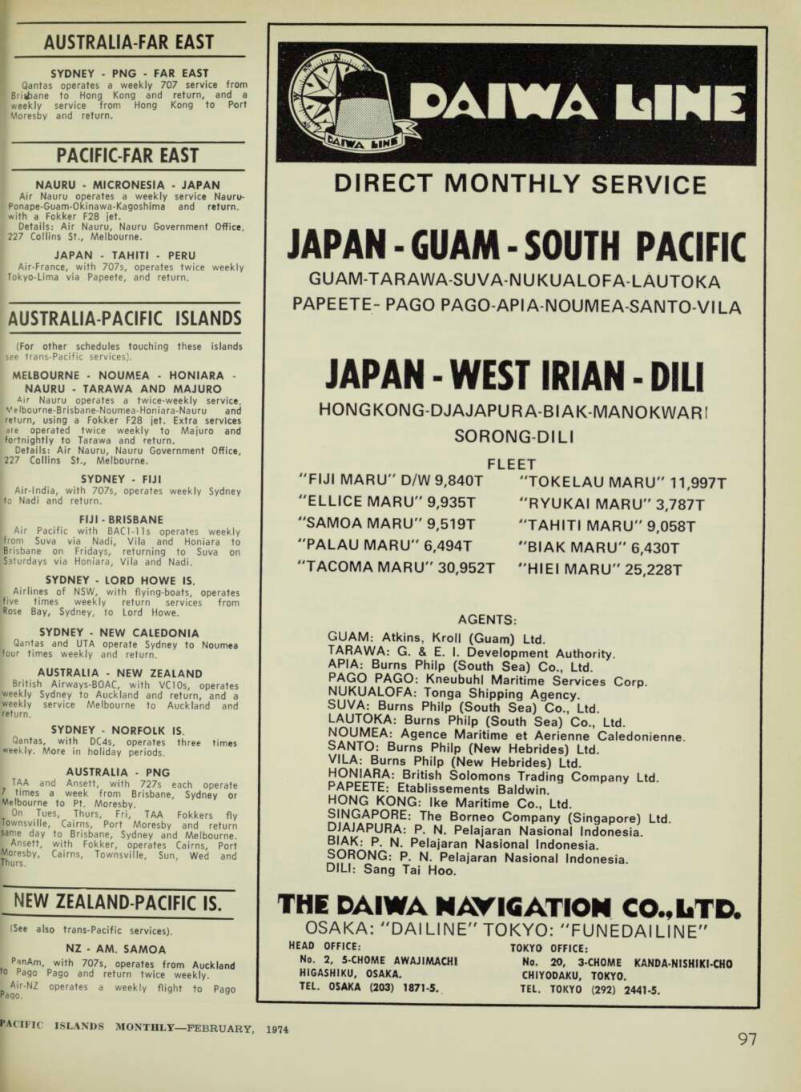
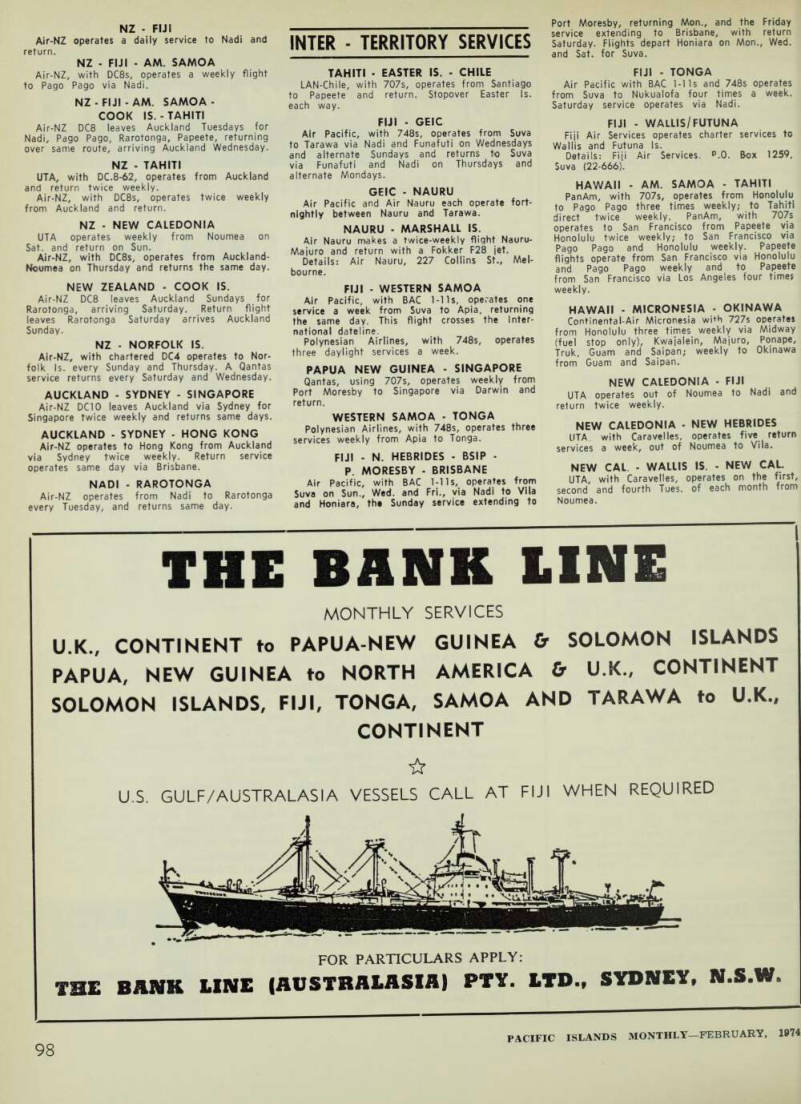
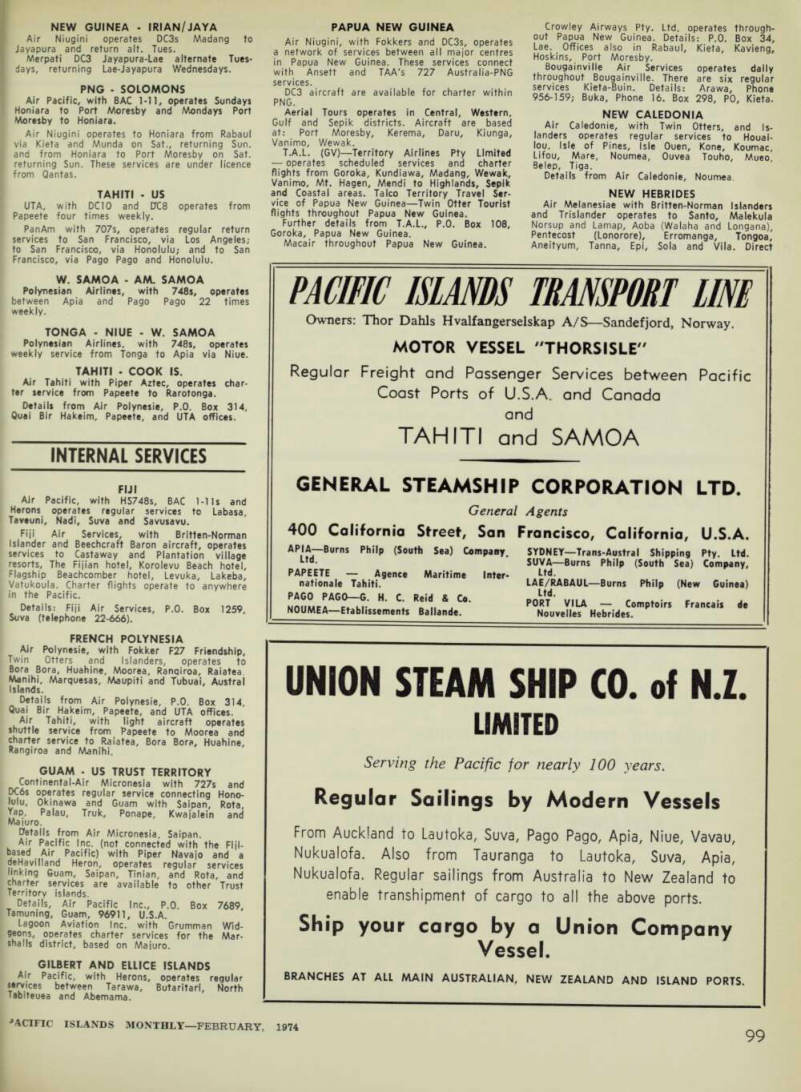
Trans Pacific Services
SYDNEY - FIJI - TAHITI • MEXICO Qantas, with 7075, operates twice weekly out of Sydney to Mexico City via Nadi, Papeete and Acapulco.
SYDNEY - FIJI - TAHITI - CANADA Qantas, with 7075, operates weekly service out of Sydney.
SYDNEY • FIJI ■ HAWAII • CANADA CP Air, with DCS, operates twice weekly ser vices out of Sydney.
SYDNEY - NZ - HAWAII - US Air-NZ, with DClO's and DCB's operates from Sydney to Los Angeles, via Auckland and Honolulu three times weekly.
SYDNEY - NZ - TAHITI - US Air-NZ, with DCBs, operates from Sydney te Los Angeles, via Auckland and Tahiti twice weekly.
SYDNEY - FIJI - HAWAII - US Qantas operates four times weekly and return between Sydney and San Francisco via Fiji and Honolulu with 74785; 707 s operate three times weekly and return to San Francisco via Honolulu. Additional 707 services Sydney/Nadi lues, and Sat. and return.
British Airways-BOAC, with VClOs, operates from Melbourne and Sydney to Los Angeles and return five times a week.
Sydney - Fiji - Hawaii
American Airlines, with 7075, operates three daylight flights from Sydney to Nadi and Honolulu and return, and one direct flight to Honolulu.
Sydney - Us (Via Noumea, Fiji,
Nz Or Tahiti)
UTA operates out of Sydney three times weekly, and return, SYDNEY • US (via N. CAL., FIJI,
Hawaii)
PanAm, with 7475, arrives Sydney from Los Angeles, via Honolulu and Nadi three times weekly and leaves on return flight the same days.
PanAm, with 707 s operates four days a week return trans-Pacific service out of Sydney to Los Angeles, via Noumea and Honolulu.
Mon., Wed., Fri, flights to Australia go to Melbourne and return to Sydney the same day.
Brisbane - Fiji
Qantas operates a 707 direct from Brisbane to Fiji on Sat. and Fiji to Brisbane on Sun.
Melbourne - Fiji - Us
Qantas with 707 s and 747 s operates Mel bourne/San Francisco via Fiji and Honolulu three times weekly; weekly 707 service on Sun. to San Francisco via Honolulu, MELBOURNE - NZ - HAWAII - US Air-NZ, with DCBs, operates weekly from Melbourne to Los Angeles via Auckland and Honolulu and return.
NZ - AM. SAMOA - TAHITI or
Hawaii • Us
PanAm, with 707 s operates out of Auck land via Tahiti three times weekly, and twice via American Samoa. Out of American Samoa, PanAm operates to the States three times weekly and out of Tahiti to the States four times weekly.
AUCKLAND - FIJI ■ AM. SAMOA - HAWAII American Airlines, with 7075, operates oul of Auckland to Honolulu, via Nadi and return two times weekly. Two flights per week via Pago Pago.
Australia-Far East
Sydney - Png - Far East
Qantas operates a weekly 707 service from Briiiane to Hong Kong and return, and a weekly service from Hong Kong to Port Moresby and return.
Pacific-Far East
Nauru - Micronesia • Japan
Air Nauru operates a weekly service Nauru- Ponape-Guam-Okinawa-Kagoshima and return.
I with a Fokker F2B jet.
Details: Air Nauru, Nauru Government Office, 227 Collins St., Melbourne.
Japan - Tahiti - Peru
Air-France, with 7075, operates twice weekly Tokyo-Lima via Papeete, and return.
Australia-Pacific Islands
I (For other schedules touching these islands I see trans-Pacific services).
Melbourne - Noumea - Honiara ■
Nauru - Tarawa And Majuro
Air Nauru operates a twice-weekly service, Velbourne-Brisbane-Noumea-Honiara-Nauru and [ return, using a Fokker F2B jet. Extra services are operated twice weekly to Majuro and [fortnightly to Tarawa and return.
Details: Air Nauru, Nauru Government Office, 1 227 Collins St., Melbourne.
Sydney - Fiji
Air-lndia, with 7075, operates weekly Sydney to Nadi and return.
Fiji - Brisbane
I Air Pacific with BACI-lls operates weekly [from Suva via Nadi, Vila and Honiara to Brisbane on Fridays, returning to Suva on Saturdays via Honiara, Vila and Nadi.
Sydney - Lord Howe Is.
Airlines of NSW, with flying-boats, operates [five times weekly return services from : Rose Bay, Sydney, to Lord Howe.
Sydney - New Caledonia
I Qantas and UTA operate Sydney to Noumea pour times weekly and return.
Australia - New Zealand
British Airways-BOAC, with VClOs, operates weekly Sydney to Auckland and return, and a weekly service Melbourne to Auckland and
peturn.
Sydney - Norfolk Is.
Qantas, with DC4s, operates three times weekly. More in holiday periods.
Australia - Png
I TAA and Ansett, with 727 s each operate 7 times a week from Brisbane, Sydney or .Melbourne to Pt. Moresby.
L On Tues, Thurs, Fri, TAA Fokkers fly [Townsville, Cairns, Port Moresby and return same day to Brisbane, Sydney and Melbourne. [Ansett, with Fokker, operates Cairns, Port Moresby, Cairns, Townsville, Sun, Wed and Bhurs.
New Zealand-Pacific Is.
(See also trans-Pacific services).
Nz - Am. Samoa
PanAm, with 7075, operates from Auckland T 0 Pa 9o Pago and return twice weekly.
Paqo F NZ operates a week| y flight to Pago
Nz ■ Fiji
Air-NZ operates a daily service to Nadi and return.
Nz - Fiji - Am. Samoa
Air-NZ, with DCBs, operates a weekly flight to Pago Pago via Nadi.
NZ ■ FIJI - AM. SAMOA -
Cook Is.-Tahiti
Air-NZ DCS leaves Auckland Tuesdays for Nadi, Pago Pago, Rarotonga, Papeete, returning over same route, arriving Auckland Wednesday.
Nz - Tahiti
UTA, with DC.B-62, operates from Auckland and return twice weekly.
Air-NZ, with DCBs, operates twice weekly from Auckland and return.
Nz - New Caledonia
UTA operates weekly from Noumea on Sat. and return on Sun.
Air-NZ, with DCBs, operates from Auckland- Noumea on Thursday and returns the same day.
New Zealand - Cook Is.
Air-NZ DCS leaves Auckland Sundays for Rarotonga, arriving Saturday. Return flight leaves Rarotonga Saturday arrives Auckland Sunday.
Nz - Norfolk Is.
Air-NZ, with chartered DC4 operates to Nor folk Is. every Sunday and Thursday. A Qantas service returns every Saturday and Wednesday.
Auckland - Sydney - Singapore
Air-NZ DCIO leaves Auckland via Sydney for Singapore twice weekly and returns same days.
Auckland - Sydney - Hong Kong
Air-NZ operates to Hong Kong from Auckland via Sydney twice weekly. Return service operates same day via Brisbane.
Nadi - Rarotonga
Air-NZ operates from Nadi to Rarotonga every Tuesday, and returns same day.
Inter - Territory Services
Tahiti ■ Easter Is. - Chile
LAN-Chile, with 7075, operates from Santiago to Papeete and return. Stopover Easter Is. each way.
Fiji • Geic
Air Pacific, with 7485, operates from Suva to Tarawa via Nadi and Funafuti on Wednesdays and alternate Sundays and returns to Suva via Funafuti and Nadi on Thursdays and alternate Mondays.
Geic ■ Nauru
Air Pacific and Air Nauru each operate fort nightly between Nauru and Tarawa.
Nauru - Marshall Is.
Air Nauru makes a twice-weekly flight Nauru- Majuro and return with a Fokker F2B jet.
Details: Air Nauru, 227 Collins St., Mel bourne.
Fiji • Western Samoa
Air Pacific, with BAC 1-1 Is, operates one service a week from Suva to Apia, returning the same day. This flight crosses the Inter national dateline.
Polynesian Airlines, with 7485, operates three daylight services a week.
Papua New Guinea - Singapore
Qantas, using 7075, operates weekly from Port Moresby to Singapore via Darwin and return.
Western Samoa - Tonga
Polynesian Airlines, with 7485, operates three services weekly from Apia to Tonga.
FIJI ■ N. HEBRIDES - BSIP •
P. Moresby - Brisbane
Air Pacific, with BAC 1-1 Is, operates from Suva on Sun., Wed. and Fri., via Nadi to Vila and Honiara, the Sunday service extending to
Port Moresby, returning Mon., and the Friday service extending to Brisbane, with return Saturday. Flights depart Honiara on Mon., Wed. and Sat. for Suva.
Fiji - Tonga
Air Pacific with BAC 1-1 Is and 748 s operates from Suva to Nukualofa four times a week.
Saturday service operates via Nadi.
Fiji - Wallis/Futuna
Fiji Air Services operates charter services to Wallis and Futuna Is.
Details: Fiji Air Services. p .O. Box 1259, Suva (22-666).
Hawaii - Am. Samoa - Tahiti
PanAm, with 7075, operates from Honolulu to Pago Pago three times weekly; to Tahiti direct twice weekly. PanAm, with 707 s operates to San Francisco from Papeete via Honolulu twice weekly; to San Francisco via Pago Pago and Honolulu weekly. Papeete flights operate from San Francisco via Honolulu and Pago Pago weekly and to Papeete from San Francisco via Los Angeles four times weekly.
Hawaii - Micronesia - Okinawa
Continental-Air Micronesia with 727 s operates from Honolulu three times weekly via Midway (fuel stop only), Kwajalein, Majuro, Ponape, Truk, Guam and Saipan; weekly to Okinawa from Guam and Saipan.
New Caledonia - Fiji
UTA operates out of Noumea to Nadi and return twice weekly.
New Caledonia - New Hebrides
UTA with Caravelles, operates five return services a week, out of Noumea to Vila.
NEW CAL • WALLIS IS. - NEW CAL.
UTA, with Caravelles, operates on the first, second and fourth Tues. of each month from Noumea.
New Guinea . Irian/Java
Air Niugini operates DC3s Madang to Jayapura and return alt. Tues.
Merpati DC3 Jayapura-Lae alternate Tues days, returning Lae-Jayapura Wednesdays.
Png - Solomons
Air Pacific, with BAC 1-11, operates Sundays Honiara to Port Moresby and Mondays Port Moresby to Honiara.
Air Niugini operates to Honiara from Rabaul via Kieta and Munda on Sat., returning Sun. and from Honiara to Port Moresby on Sat. returning Sun. These services are under licence from Qantas.
Tahiti • Us
UTA, with DCIO and DCS operates from Papeete four times weekly.
PanAm with 7075, operates regular return services to San Francisco, via Los Angeles; to San Francisco, via Honolulu; and to San Francisco, via Pago Pago and Honolulu.
W. Samoa - Am. Samoa
Polynesian Airlines, with 7485, operates between Apia and Pago Pago 22 times weekly.
Tonga - Niue - W. Samoa
Polynesian Airlines, with 7485, operates weekly service from Tonga to Apia via Niue.
Tahiti - Cook Is.
Air Tahiti with Piper Aztec, operates char ter service from Papeete to Rarotonga.
Details from Air Polynesie, P.O. Box 314, Quai Bir Hakeim. Papeete, and UTA offices.
Internal Services
Fiji
Air Pacific, with HS74Bs, BAC 1-1 Is and Herons operates regular services to Labasa, Taveuni, Nadi, Suva and Savusavu.
Fiji Air Services, with Britten-Norman Islander and Beechcraft Baron aircraft, operates services to Castaway and Plantation village resorts. The Fijian hotel, Korolevu Beach hotel, Flagship Beachcomber hotel, Levuka, Lakeba, Vatukoula. Charter flights operate to anywhere in the Pacific.
Details: Fiji Air Services, P.O. Box 1259, Suva (telephone 22-666).
French Polynesia
Air Polynesie, with Fokker F 27 Friendship, Twin Otters and Islanders, operates to Bora Bora, Huahine, Moorea, Ranqiroa, Raiatea Manihi, Marquesas, Maupiti and Tubuai, Austral Islands.
Details from Air Polynesie, P.O. Box 314 Quai Bir Hakeim, Papeete, and UTA offices.
Air Tahiti, with light aircraft operates shuttle service from Papeete to Moorea and charter service to Raiatea, Bora Bora, Huahine, Rangiroa and Manihi.
Guam - Us Trust Territory
Continental-Air Micronesia with 727 s and
DC6s operates regular service connecting Hono lulu, Okinawa and Guam with Saipan, Rota, Yap, Palau, Truk, Ponape, Kwajalein and Maiuro. details from Air Micronesia, Saipan.
Air Pacific Inc. (not connected with the Fiji based Air Pacific) with Piper Navajo and a deHavilland Heron, operates regular services linking Guam, Saipan, Tinian, and Rota, and charter services are available to other Trust Territory islands.
Details, Air Pacific Inc., P.O. Box 7689, Tamuning, Guam, 96911, U.S.A.
Lagoon Aviation Inc. with Grumman Wid geons, operates charter services for the Mar shalls district, based on Majuro.
Gilbert And Ellice Islands
Air Pacific, with Herons, operates regular services between Tarawa, Butaritari, North Tabiteuea and Abemama.
Papua New Guinea
Air Niugini, with Fokkers and DC3s, operates a network of services between all major centres in Papua New Guinea. These services connect with Ansett and TAA's 727 Australia-PNG services.
DC3 aircraft are available for charter within
Png.
Aerial Tours operates in Central, Western, Gulf and Sepik districts. Aircraft are based at: Port Moresby, Kerema, Daru, Kiunga, Vanimo, Wewak.
T.A.L. (GV) —Territory Airlines Pty Limited operates scheduled services and charter flights from Goroka, Kundiawa, Madang, Wewak, Vanimo, Mt. Hagen, Mendi to Highlands, Sepik and Coastal areas. Talco Territory Travel Ser vice of Papua New Guinea—Twin Otter Tourist flights throughout Papua New Guinea.
Further details from T.A.L., P.O, Box 108, Goroka, Papua New Guinea.
Macair throughout Papua New Guinea.
Crowley Airways Pty. Ltd. operates through out Papua New Guinea. Details: P.O. Box 34, Lae. Offices also in Rabaul, Kieta, Kavieng, Hoskins, Port Moresby.
Bougainville Air Services operates dally throughout Bougainville. There are six regular services Kieta-Buin. Details: Arawa, Phone 956-159; Buka, Phone 16. Box 298, PO, Kieta.
New Caledonia
Air Caledonie, with Twin Otters, and Is landers operates regular services to Houai lou. Isle of Pines, Isle Ouen, Kone, Koumac, Lifou, Mare, Noumea, Ouvea Touho, Mueo, Belep, Tiga.
Details from Air Caledonie, Noumea.
New Hebrides
Air Melanesiae with Britten-Norman Islanders and Trislander operates to Santo, Malekula Norsup and Lamap, Aoba (Walaha and Longana), Pentecost (Lonorore), Erromanga, Tongoa, Aneityum, Tanna, Epi, Sola and Vila. Direct
connections are available to and from Santo for all international flights arriving in Vila.
Details from Air Melanesiae, P.O. Box 72,
Solomon Islands
Solalr, with Beech Barons and Islanders operates to Auki, Avu Avu, Babanakira, Bara koma Bellona Is., Fera Is., Gizo, Honiara, Kira Kira, Marau, Munda, Parasi, Sega, Yandina, Santa Cruz, Mono, Rennell Is., Choiseul Bay, Ballalae and Ring! Cove.
Details from Solomon Islands Airways Ltd., Box 23, Honiara, BSIP.
Tonga
Tonga Tourist and Development Co, with Britten-Norman Islander and Aztec aircraft, operates from Fua'amotu, (airport for Nukualofa) to Vava'u (daily except Sunday) and Eua (twice daily except Sunday). Aircraft available for sightseeing and regional charters.
Details from Tonga Tourist and Development Co, P 0 Box 91, Nukualofa, Tonga.
Cook Islands
Cook Islands Airways Ltd, with a Britten Norman Islander, operates seven flights a week between Rarotonga and Aitutaki. Service will be extended to Atiu, Mangaia and Mitiaro when airstrips are built. • A new airfield for Air Samoa
at Lalomalava, Faasleleaga, Savaii,
was officially opened in December.
Before the opening of the strip, Air Samoa operated mainly between its airfield at Fagalii, near Apia, and the government strip at Asau. Another line, Samoa Aviation has almost com pleted a new airfield at Siutu, Salailua.
Advertisements & other items, pp. 98-102 (1 item)
Sofrana'unilines
THE SOUTH PACIFIC SHIPPING COMPANY
WHICH SERVES THE SOUTH PACIFIC
DAIWA LINE
DIRECT MONTHLY SERVICE
JAPAN - GUAM - SOUTH PACIFIC
GUAM-TARAWASUVA-NUKUALOFA-LAUTOKA
PAPEETE- PAGO PAGOAPIANOUMEA-SAIMTO-VILA
JAPAN-WEST IRIAN-DILI
HONGKONG-DJAJAPURA-BIAKMANOKWARI
SOROIMG-DILI
FLEET
"FIJI MARU" D/W 9.840 T
"ELLICE MARU" 9,935 T
"SAMOA MARU" 9,519 T
"PALAU MARU" 6.494 T
"TACOMA MARU" 30,952 T
"TOKELAU MARU" 11,997 T
"RYUKAI MARU" 3.787 T
"TAHITI MARU" 9,0581
"BIAK MARU" 6.430 T
"HIEI MARU" 25,228 T
AGENTS:
GUAM: Atkins, Kroll (Guam) Ltd.
TARAWA: G. & E. I. Development Authority.
APIA; Burns Philp (South Sea) Co., Ltd.
PAGO PAGO: Kneubuhl Maritime Services Corp.
NUKUALOFA: Tonga Shipping Agency.
SUVA: Burns Philp (South Sea) Co., Ltd.
LAUTOKA: Burns Philp (South Sea) Co., Ltd.
NOUMEA: Agence Maritime et Aerienne Caledonienne.
SANTO: Burns Philp (New Hebrides) Ltd.
VILA: Burns Philp (New Hebrides) Ltd.
HONIARA: British Solomons Trading Company Ltd.
PAPEETE: Etablissements Baldwin.
HONG KONG: Ike Maritime Co., Ltd.
SINGAPORE: The Borneo Company (Singapore) Ltd. diaJAPURA-' P- N. Pelajaran Nasional Indonesia.
BIAK: P. N, Pelajaran Nasional Indonesia.
SORONG: P. N. Pelajaran Nasional Indonesia.
DILI: Sang Tai Hoo.
THE DAIWA NAVIGATION CO.,LTD.
OSAKA: "DAILINE" TOKYO: "FUNEDAI LINE"
HEAD OFFICE: TOKYO OFFICE;
No. 2, 5-CHOME AWAJIMACHI No. 20, 3-CHOME KANDA-NISHIKI-CHO
HIGASHIKU, OSAKA. CHIYODAKU, TOKYO.
TEL. OSAKA (203) 1871-5. TEL. TOKYO (292) 2441-5.
THE BANK LINE
MONTHLY SERVICES
U.K., CONTINENT to PAPUA-NEW GUINEA & SOLOMON ISLANDS PAPUA, NEW GUINEA to NORTH AMERICA & U.K., CONTINENT SOLOMON ISLANDS, FIJI, TONGA, SAMOA AND TARAWA to U.K.,
CONTINENT
☆ U.S. GULF/AUSTRALASIA VESSELS CALL AT FIJI WHEN REQUIRED &
MLVIi
FOR PARTICULARS APPLY:
THE BANK LINE (AUSTRALASIA) PTY. LTD., SYDNEY, N.S.W.
PACIFIC ISLANDS TRANSPORT LINE
Owners: Thor Dahls Hvalfangerselskap A/S—Sandefjord, Norway.
MOTOR VESSEL "THORSISLE"
Regular Freight and Passenger Services between Pacific
Coast Ports of U.S.A. and Canada
and
TAHITI and SAMOA
GENERAL STEAMSHIP CORPORATION LTD.
General Agents
400 California Street, San
APlA—Burns Philp (South Sea) Company, Ltd.
PAPEETE Agence Maritime Internationale Tahiti.
PAGO PAGO—G. H. C. Reid & Co.
NOUMEA—Etablissements Ballande.
Francisco, California, U.S.A.
SYDNEY—Trans-Austral Shipping Pty. Ltd.
SUVA—Burns Philp (South Sea) Company, Ltd.
LAE/RABAUL—Burns Philp (New Guinea) PORT VILA Comptoirs Francais de Nouvelles Hebrides.
UNION STEAM SHIP CO. of N.Z.
LIMITED
Serving the Pacific for nearly 100 years.
Regular Sailings by Modern Vessels
From Auckland to Lautoka, Suva, Pago Pago, Apia, Niue, Vavau, Nukualofa. Also from Tauranga to Lautoka, Suva, Apia, Nukualofa. Regular sailings from Australia to New Zealand to enable transhipment of cargo to all the above ports.
Ship your cargo by a Union Company Vessel.
BRANCHES AT ALL MAIN AUSTRALIAN, NEW ZEALAND AND ISLAND PORTS.
MORE PORTS / MORE OFTEN
with
i€A Ft LAND Eft
KARLANDER NEW GUINEA LINE: Serving; Pt. Moresby, Samarai, Lae, Madang, Rabaul, Wewak, Manus Is., Kieta, Honiara, Yandina, Gizo, Vila, Norfolk Is., and Lord Howe Is.
KARLANDER KANGAROO LINE: Serving; Los Angeles, San Francisco,
Auckland, Melbourne, Suva, Lautoka.
AUSTRALIAN TERRITORY LINER SERVICES: Serving,- Melbourne,
Sydney, Newcastle, Brisbane, Weipa, Gove, Thursday Is.
Managing Agents
KARLANDER (AUSTRALIA) PTY. LIMITED
19-31 Pitt Street, Sydney
General Agents
Brisbane: F. H. Stephens Pty. Ltd.
Melbourne: F. H. Stephens (Vic.) Pty. Ltd.
Pt. Moresby; Carpenter Shipping Agencies.
Samarai: Burns Phi Ip (N.G.) Ltd.
San Francisco; Transpacific Transportation Co.
Los Angeles: Transpacific Transportation Co.
Madang: B. J. Back Pty. Ltd.
Yandina: Levers Pacific Plantations Co. Ltd.
Santo: Burns Philp (N.H.) Ltd.
Lord Howe Is.: R. Wilson Leanda Lei.
Thursday Is.: Torres Industries Ltd.
Manus Is.: Edged & Whiteley Ltd.
Rabaul: Rabaul Trading Co. Ltd.
Honiara: E. V, Lawson Pty. Ltd.
Kieta: Breckwoldt & Co. Pty. Ltd.
Lae: N.G.G. Trading Company.
Wewak; Burns Philp (N.G.) Ltd.
Fiji: Burns Philp (S.S.) Ltd.
Gizo: British Solomon Trading Co.
Vila: Burns Philp (N.H.) Ltd.
Norfolk Is.: Burns Philp (S.S.) Ltd.
Deaths of Islands People
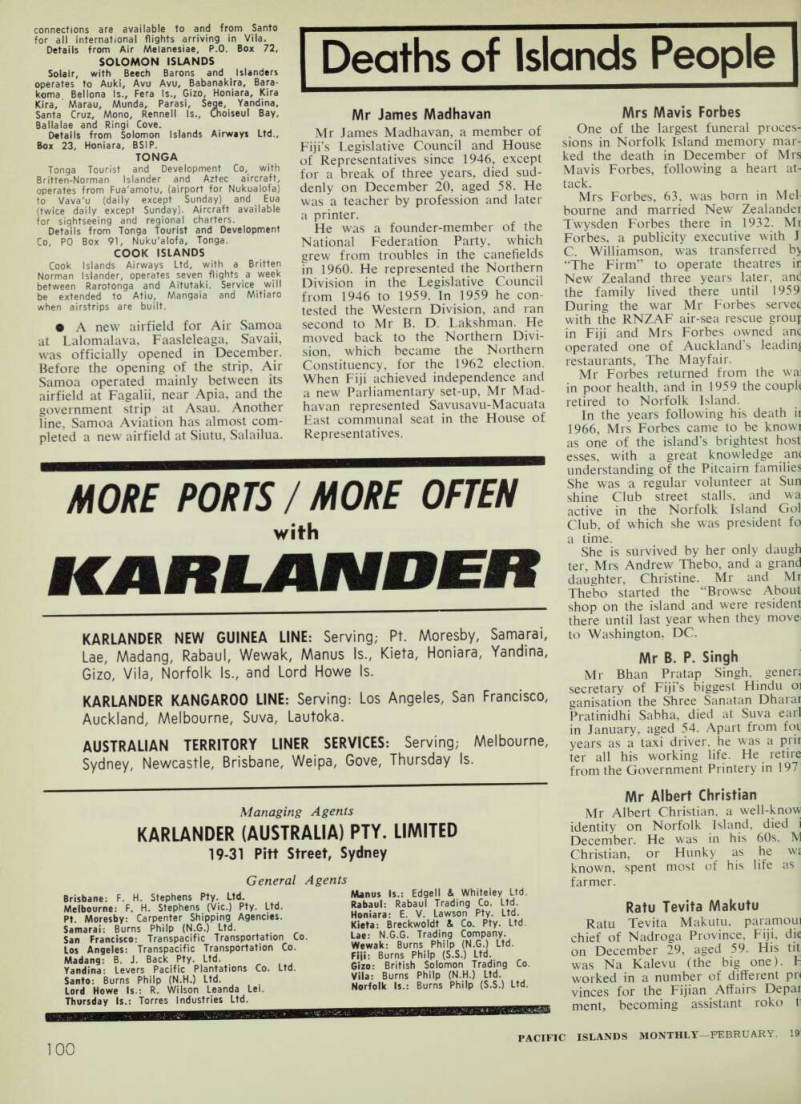
Mr James Madhavan Mr James Madhavan, a member of Fiji’s Legislative Council and House of Representatives since 1946, except for a break of three years, died sud denly on December 20, aged 58. He was a teacher by profession and later
a printer.
He was a founder-member of the National Federation Party, which grew from troubles in the canefields in 1960. He represented the Northern Division in the Legislative Council from 1946 to 1959. In 1959 he con tested the Western Division, and ran second to Mr B. D. Lakshman. He moved back to the Northern Divi sion, which became the Northern Constituency, for the 1962 election.
When Fiji achieved independence and a new Parliamentary set-up, Mr Mad havan represented Savusavu-Macuata East communal seat in the House of
Representatives.
Mrs Mavis Forbes One of the largest funeral proces sions in Norfolk Island memory mar ked the death in December of Mrs Mavis Forbes, following a heart at tack.
Mrs Forbes, 63, was born in Mel bourne and married New Zealander Twysden Forbes there in 1932. Mr Forbes, a publicity executive with J C. Williamson, was transferred b> “The Firm” to operate theatres ir New Zealand three years later, and the family lived there until 1959 During the war Mr Forbes server with the RNZAF air-sea rescue grouj in Fiji and Mrs Forbes owned anc operated one of Auckland’s leading restaurants, The Mayfair.
Mr Forbes returned from the wai in poor health, and in 1959 the couph retired to Norfolk Island.
In the years following his death ii 1966, Mrs Forbes came to be knowi as one of the island’s brightest host esses, with a great knowledge am understanding of the Pitcairn families She was a regular volunteer at Sun shine Club street stalls, and wa active in the Norfolk Island Gol Club, of which she was president fo a time.
She is survived by her only daugh ter, Mrs Andrew Thebo, and a grand daughter, Christine. Mr and Mr Thebo started the “Browse About shop on the island and were resident there until last year when they mo\o to Washington, DC.
Mr B. P. Singh Mr Bhan Pratap Singh, genen secretary of Fiji’s biggest Hindu oi ganisation the Shree Sanatan Dharar Pratinidhi Sabha, died at Suva earl in lanuary, aged 54. Apart from for years as a taxi driver, he was a prir ter all his working life. He retire from the Government Printery in 197 Mr Albert Christian Mr Albert Christian, a well-know identity on Norfolk Island, died i December. He was in his 60s. M Christian, or Hunky as he w< known, spent most of his life as farmer.
Ratu Tevita Makutu Ratu Tevita Makutu, paramoui chief of Nadroga Province, Fiji, die on December 29, aged 59. His tit was Na Kalevu (the big one). F worked in a number of different pr< vinces for the Fijian Affairs Depar ment, becoming assistant roko t
I and later acting roko tui in his own I province. Ratu Tevita was a member I of the Great Council of Chiefs for I 20 years.
Mr H. Huntley Mr Hamilton Huntley, manager of I ZJV broadcasting station in Suva I from 1936 to 1952, died recently in I Sydney. He was prominent in Fiji I tennis. He leaves a widow and four I sons.
Mr A. F. R. Stoddart I Mr A. F. R. Stoddart, Colonial I Secretary in Fiji from 1949 to 1957, died recently in England. He twice [ acted as Governor in Fiji. Mr Stoddart [ was Chief Assistant Colonial Sec j retary in Sierra Leone, Africa, before going to Fiji.
Lady Ragg
A personal tribute from R. W. Robson The gap made in the Suva com munity by the death of Lady Rene (Adrienne Josephine) Ragg, on De cember 5, at the age of 78, will re i main, simply because a woman of her quality is rarely seen.
She had an assured position as one of the heads of the Ragg family, and as the widow of the much-honoured Sir Hugh Ragg. But most of the pres tige she enjoyed in the later years of her long life came from her know- I ledge of and clear thinking about matters of public concern. She had many friends who admired her loyal ties and her readiness to assist any worthy cause; and quite a few enemies, especially in the feminine world, who did not like the forth rightness of her opinions, and her [readiness to express them.
She was a handsome and clever young woman when she married Hugh Ragg in 1920; and she devoted her self not only to rearing the brood of young children left to Hugh by the untimely death of his first wife, but also in making the success he achieved both as a trader and a politician.
She was at his right hand always as he built his ownership of a couple of country hotels into Northern Hotels Ltd, and pioneered Fiji’s now great tourist industry. The famous holiday resort now widely known as Korolevu Beach actually launched Fiji tourism, and there was as much Rene Ragg as Hugh Ragg in its con ception and establishment. She was a planner, a charming hostess and an entertaining conversationalist.
Rene Ragg was one of the last distinguished members of the old school of Fiji pioneers, and it is in that regard she will be fondly re membered.
Advertisements & other items, pp. 103-106 (3 items)
Cooks Newspapers
101
FUEL CRISIS
Continued from p 7
COOKS NEWSPAPERS
Continued from p 59
-ACIFIC ISLANDS MONTHLY—FEBRUARY, 1974
Tonga's
1 I tto I —I [uy
QJU]
(32 U
PARK VIEW MOTEL—BRISBANE
Quiet location—opp. Botanic Gardens.
Single, double, family suites, all with ref rig., air conditioning, phone, TV, radio, tea making facilities, from $lO. Pool and restaurant.
Phone 31-2695—Telex 40270.
Write for coloured brochure — Park View Motel, 128 Alice St, BRISBANE, Old., 4000.
beachcomber
hotel
PACIFIC HARBOUR, FIJI
Sophistication in the midst of uninhabited natural beauty.
Nestled snugly in a reef-protected bay on 5 miles of classical palm fringed Deuba beach. Far enough from Fiji's capital, Suva, to forget the worries of city life. Near enough to take in the colour and the Duty Free Bazaars.
Every suite is self-contained and airconditioned. The cuisine is as the service, superb.
PO Box 216, Suva. Telephone: Navua 43.
Telex 2324. Cables: FLAGTELS, Fiji. For reservations or information contact your travel agent.
Primitive luxury
(Polynesian style) Nestled away in the untouched Kingdom of Tonga is new, luxurious "Port of Refuge" International resort. Here is a unique opportunity for your clients to experience the tranquil and relaxed Tongan atmosphere while they enjoy the picturesque surroundings of the new "Port of Refuge". And only a short flight from Fiji.
Reasonable tariffs from $17.50 with special concessions for children. Agents commission 10 per cent.
Tonga's
Port of Refuge
jmu international resort 7?* Uava’u Tonga Cables; "Refuge" Tonga or "Tongatours' Sydney. Phone: Sydney 85-1603 or 282-472
FIJI
mM f i i
NAMALE PLANTATION
ESCAPE
FROM THE ORDINARY
Here is an idyllic paradise where you can enjoy the unspoiled beauty and serenity of a working coconut plantation. This privatelyowned Pacific retreat has been designed for a maximum of 16 people. Gracious surroundings, friendly service, relaxed 'Bure' accommodation overlooking the sea with individual balconies and private facilities. Licensed cocktail bar. Entire plantation available to groups of 14-16 people.
Activities available include: Deep sea fishing, reef and shell hunting, skin diving, snorkelling, water skiing, hiking, turf tennis court, badminton, horse riding, croquet course and a beautiful tropical garden to relax in. Sports equipment available on a complimentary basis include aquascopes, snorkelling and fishing equipment, inflatable rafts, tennis racquets etc. Coastal tours by boat or mini-bus on request. Boats for hire. Baby sitting service also available.
Write for a Free Brochure to:
THE MANAGER,
NAMALE PLANTATION,
SAVUSAVU, FIJI.
Or: Namale Plantation, P.O. Box 64, Suva, Fiji.
4 For Warm and Friendly Samoan Hospitality Apia, Western Samoa Phone: 880. Cable: 'Aggies' Tariff includes all meals.
In Lae stay at the
Huon Gulf Motel
FOR THE BEST OF EVERYTHING.
BOOK DIRECT OR THROUGH ANY OFFICE OF ANSETT AIRLINES.
Huon Gulf Motel
MARKHAM ROAD, LAE. PHONE: 42-4844.
A Division of Ansett Transport Industries Limited.
Line Advertisements
Per line, $1.35 Aust., Minimum rate. 4 lines.
D apua new guinea
printing co. ply. ltd.
Serving the Country from Aitape to Alotau, Manus to Moresby.
Leaders in Commercial Offset and Letterpress Printing. Stationery Office Supplies O Office Equipment O Rubber Stamps • Self-Adhesive Labels O In Fact:— Everything For The Office.
P.O. Box 633, Port Moresby P.O. Box 759, Lae P.O. Box 30, Mt Hagen P.O. Box 1239, Rabaul P.O. Box 466, Kieta
CONCRETE BLOCK MACHINE. Makes
blocks, flags, edgings, screen-blocks, garden stools—up to 8 at once and 96 an hour. SAIO7 c.i.f. main ports. Send for leaflets. Forest Farm Research, Londonderry, N.S.W., 2753.
DAIMANTE HEALTH BANDS plain $A4.00,
jewelled $5.00, air mail included. Write to: Sun Trading Co.. Box 377, Norfolk Island, South Pacific.
ALL BOOKS AND JOURNALS ON AUST-
RALASIA AND THE PACIFIC BOUGHT
AND SOLD. Catalogues Issued and sent free on application. Correspondence incited. Berkelouw, 15-19 Boundary St., Roshcutters Bay, Sydney, 2011. Phone: POSITION WANTED in South Pacific slands. European (German), aged 36, fitter md turner, experience in Australia as aotor mechanic, several years supervisor :ood knowledge English. Please reply: Mr! t. H. Frey, No. 3, Norman Pde., Marylorough, Q’ld., Australia, 4650. rOUNG ITALIAN MAN would appreciate nendly correspondence and, eventually tamp exchange with residents in any adependent Island. Write to: Giovanni e Santis, Casella Postale 97, 70100 Bari taly. ’
LEETS, 76 ft steel tug, profess, bit. 1945 mple fuel and water, $30,000. 45 ft rawler, profess, bit. 1955, Gardner 5 LW adio, sounder etc., $26,250. Fleets, Rowe’s Idg- Edward St, Brisbane. Cable “Fleets” nsbane.
E! * FRIENDS OVERSEAS. Individual prld wide postal introduction service! lus optional illustrated magazine! Write tr details today! Five Continents Co. Ltd.
O. Box 21219, Henderson, N.Z.
!i®s ?'S ft’ &
SOUTHERN PACIFIC INSURANCE
COMPANY LIMITED
Head Office: Equitable Life Building, 80 Alfred Street, AAilsons Point, N.S.W., 2061.
Specialising in Pacific Island Insurance requirements for over 30 years. • FIRE • FIRE AND VOLCANIC ERUPTION • HOUSEHOLD COMPREHENSIVE • MOTOR VEHICLE • COMPULSORY THIRD PARTY • COMPULSORY WORKERS' COMPENSATION
• PUBLIC LIABILITY • MARINE
Enquiries invited for all classes of insurance from special representatives at: f° R J r H -. A - K - McKee Manager for Papua New Guinea, Ist Floor, Carpenter's Supermarket, Champion Parade. P.O. Box 136. RABAUL: Mango Avenue. P.O. Box 123.
SUVA Fur’ MV M RMk 9e lA at Lae ' Kam . Hong's Building, Central Avenue, P.O. Box 758.
Box 521 L Rolls—Manager for Fi|i, McGowan's Building, Margaret Street, PO
(ff
W DATELINE HOTEL LT)
TONGA
Friendly Hotel" of the "Friendly Islands"
Situated along the Nukualofa waterfront. Only five minutes walk from town. Single, double, family suites, airconditioning, and hot and cold water showers. Pool, bar, restaurant, duty-free shop, tour desk and boutique.
Book through your travel agent or write to International Dateline Hotel, P.O. Box 62, Nuku'alofa Tonga.
Cable Address: "DATELINE".
Represented Overseas by: Charles J. Henry and Associates Pty. Ltd.
Sydney and Melbourne.
PROPERTY INVESTMENT
SUNSHINE COAST—QUEENSLAND
We invite inquiries regarding living or investment in this area.
We have a full coverage of holiday lettings, flats, motels, homes, farms, businesses and sub-divisional land.
Write direct to MABIN Cr BLOWERS Pty. Ltd. (Members R.E.1.Q.),
11 BURNETT STREET—BUDERIM, Q., 4556
FOR SALE
Business and property on 99 year leasehold. Plot 118 ft x 55 ft.
Situated Main Road Central Honiara.
Two air-conditioned shops and large upstair flat.
Fifteen-year-old, first class softgoods, jewellery, cosmetics, handicrafts business.
Genuine enquiries only.
Please Apply Lillian A. Dennis (Ent.) Ltd., P.O. Box 200, Honiara, 8.5.1. P.
SIVAMS ESTATE AGENCY
Fiji's Popular Real Estate Agent.
List with us and sell Inspect with us and buy Islands, land, farms, buildings etc.
Telephone 61 615, P.O. Box 488, Lautoka.
Telephone 22 497, P.O. Box 794, Suva.
TROPIC ISLES
LIMITED
(A division of Davis Consolidated Industries) Factory: Queens Rd., Sigatoka Processors of: Passion Fruit Juice Passion Fruit Nectar Passion Fruit Jelly Tropical Fruit Salad Purees —Paw Paw, Banana, Pineapple & Guava.
Contact: P.O. BOX 74,
SIGATOKA, FIJI.
Telephone 5011.
Turners and Growers
FRESH FRUIT & VEGETABLES
9828
Turners Supply Co
FRESH FRUIT & VEGETABLES
9813
Cific Islands Monthly—February, 1974
Index to Advertisers

Adams Ind 2, 90 Aggie Grey 102 Air New Zealand 72 Air Pacific 74 Allied Manufacturing & Trading Industries 49 Ansett Hotels 15, 102 Ardneil 91 Arnott's Biscuits 56 Bank of Hawaii 70 Bank Line 98 Beachcomber Hotel 102 B. 85-88 Braybon 28 Brockhoff's 26 Brunton 65 Burns Philp 52, 53 C. 37 Carpenter, W. R. 79, 82 Clae Engines 30
Com. N. G. Timbers 34 Daiwa Bank 4 Daiwa Line 97 Demka 91 Fisher, Peter 93 Fisher & Co. 12 Frigate Rum 38
G.M.H. 84
George & Ashton 76 Gillespie Bros 44 Grove, W.H. 94 Handi Works 45 Harris Book Co. 69 Harris, Keith 104 Hastings Deering 78 Hellaby, R. & W. 4 Honda cov. iii Innes Schweppes 68 Interocean-N.Z. Ltd. 95
International Dateline Hotel 1031 Jones, Lang, Wooton 46 Karlander Line 100 Kerr Bros 81 Knox Schlapp 77, 80 Kodak 20 Mabin Blowers 103 Massey-Ferguson 28 Motor Specialities 42 Mungo Scott 51 Namale Plantation 102 Nedlloyd 76 Nissan cov. iv Pacific Line 99 Park View Motel 102 Pioneer Electric 50 PNG Printing 103 Qantas 16 Q'ld. Insurance 92
Record Ridgeway 66 Revin International 13 Sandy, James 41 Sofrana Unilines 96 Soqulu Plantation 25 Southern Pac Ins 103 Sunbeam 32 Swire, John 36, 55 Tatham, S. E. 14 Tokyo Shibaura 54 Tonga's Port of
Refuge 102
Toyota cov. ii Tropic Isles 104 Turners 104 Union SS. Co 99 Warburton Franki 47 Welcome Homes 38 Wunderlich 22 Yanmar Diesels 40 Yorkshire Imperial 81
Advertisements & other items, pp. 106-108 (2 items)
Wholly set up and printed in Australia by (AUST.I PTY. Alberta Street. Sydney. =OO,
RFD . T THE G po SYDNEY FOR TRANSMISSION BY POST AS A NEWSPAPER CATEGORY B.
REGISTERED a AT ai T^ p GPO« i SYDNEY the front CQver ig recommended Australian retail price only.
Gold Badge
® To Islands Cordial-makers . . . Pastrycooks .
FOLLOW THE EXAMPLE OF
AUSTRALIA'S LEADING FOOD PROCESSORS
. .Canners . . ; WHO FOR 30 YEARS HAVE CONSISTENTLY USED
GOLD BADGE
FINE QUALITY
ESSENCES and EDIBLE COLOURS
Confectioners
BRAND
AND
CO.LT
Samples are available for manufacturers We are Flavouring Specialists producing highly concentrated soluble essences for the fooc industries and invite your enquiries, either direct or through your usual buying channe s.
KEITH HARRIS & CO. LTD
Sefton Road, Thornleigh, N.S.W.
Cables: Kehar, Sydney 1015 Ann Street, Valley N.l, Qld Cables: Keharbris, Brisbane
The blue
A path b
Making
bleach-w: te ond. The earth belo een the two. That only dless blue and sands one...
HONDA.
A young man whose desire to reach the summit of success knows no limits. At work or at play, he thrives on new challenges, new ways to satisfy his zest for the active life. Every day more people are finding themselves in HONDA. Leader in motorcycles . Holder of the title of having H of the world’s market. With sales in more than countries. By offering the right combination of power, performance, and ride in a wide range to suit every individual. It’s all of what it takes to be a world leader in motorcycles
... HONDA!
r 15 / k \ V TP* ’ hi ' II 1 u ■ <-■ «£ •* t'-v:-
NEW GUINEA:
Fw) fI»LANDS:|PiMraI Island MjjTOr D —.. V ' ■ * ' tf
*,*• And whfcfever you’ll go in over 120 nations throughout the world you’ll find proud DATSUN drivers.
Perhaps the main reason is that DATSUN was designed to meet a wide variety of conditions—mountain roads and super highways, blistering suns and freezing temperatures. DATSUN is indeed the international car that has precision engineering and a stunning string of rally victories behind it.
Its superb handling, safety features and high speed efficiency make DATSUN the choice of young and old alike, DATSUN-the car that really satisfies the world over.
DATSUN
NISSAN
DATSUN distributor network covers the following areas; Fiji*T,P.N.G.*W. Samoa* New Caledonia • New Hebrides* 8.5.1. P. Timor*Norfolk A Tonga- Saipan. Guam* Australia-New Zealand