Pacific Islands Monthly

News Magazine Of The South Pacific
January, 1974
Australia, N.Z., Western Samoa 60C
P.N.G., FIJI, COOKS, TONGA, G.E.1.C., 8.5.1. P., N. HEBRIDES 50c
Nauru, Niue, Norfolk 50C
American Samoa 70C Hawaii, Micronesia $L.Oo
N€W CALEDONIA AND FRENCH POLYNESIA 100 CFP
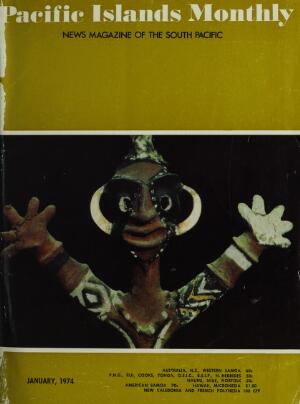
Our Cover
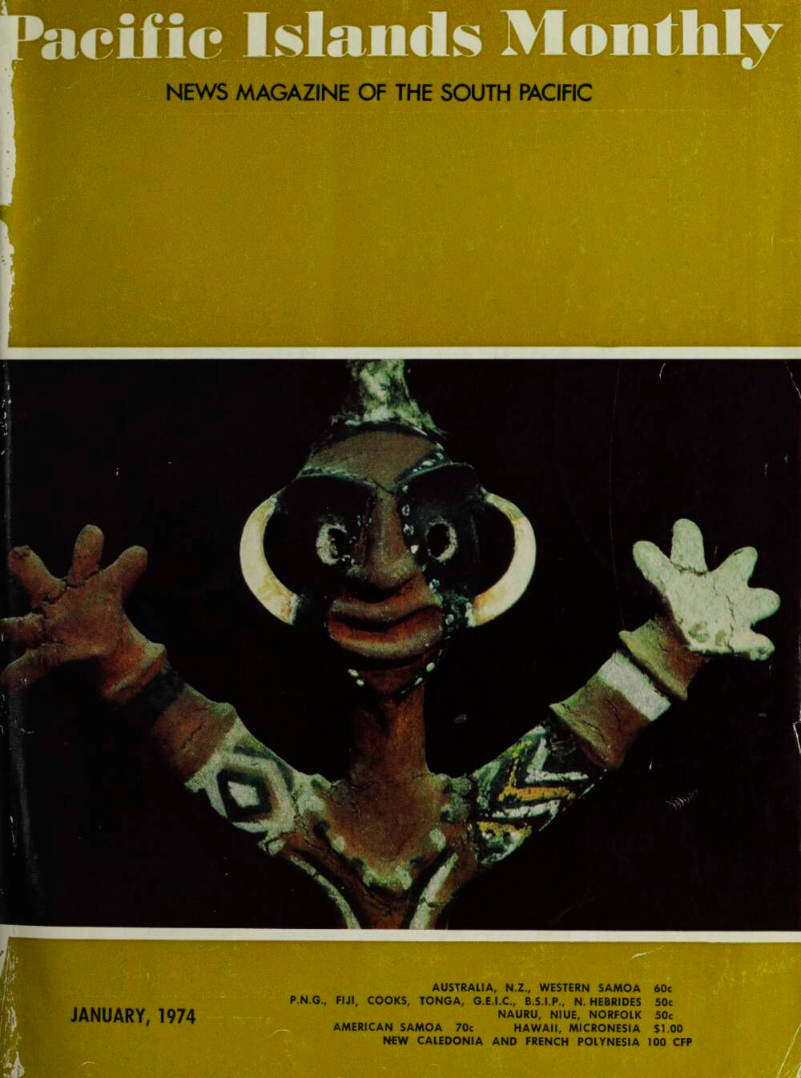
It’s not a nightmare but a femes nevinbur figure used in special ceremonies on the New Hebrides Island of Malekula.
The head is a coconut shell and the rest is of fibre and clay. Pig ment is made from ash, charcoal and clay. These figures were destroyed after the ceremony but, as they are fetching good prices from collectors, they are now preserved. The picture is by Dr Radomir Joura, of Parramatta,
Nsw.
Advertisements & other items, p. 2 (1 item)
Mazda1000&1200 Pickups.
■M a m a 10Q0 pfcKl£ in A lot of truck for your money.
Check the features for yourself
0 All steel cargo deck with snap shut tailgate 0 Big load carrying capacity 0 Tough, girder-section steel chassis [v] Choice of rugged 1000 or 1200 OHV engine 0 Large, 4-bladed engine fan 0 Laminated safety glass windscreen See your Mazda dealer soon 0 Corrosion-free grille with stylish square headlights 0 2-speed wipers with twin jet washer 0 Roomy bench seat adjustable 6 ways for height and reach 0 Flow-through ventilation system 0 Push in, pull out door lock knobs 0 Easy-to-get-at battery and engine r a real value-for-money buy.
MAZDA
1 973 TOYO KOGYO CO,, LTD.
FIJI ISLANDS Niranjans Autoport Ltd. G.P.O. Box 450, Suva TEL. 22691 NEW CALEDONIA Societe Riviere et Bernanos, 27, Rue de Sebastopol, Noumea NEW GUINEA PNG Motors Ltd. P.O. Box 1394, Boroko, Papua TEL: 55788 NEW ZEALAND Mazda Motors of New Zealand Ltd. Auckland P.O. Box 22-472 TEL: 69-099 WESTERN SAMOA H. &J.
Retzlaff, P.O. Box 195, Apia TEL: 237 NEW HEBRIDES Societe Bourgeois et Cie, P.O. Box 28, Port-Vila PORTUGUES TIMOR Sang Tai Hoo, Dili The trademark MAZDA in this advertisement stands for AUTOMOBILES MAZDA as far as France and her territories are concerned.
In This Issue
General
The rise of Hellabys 24 Putting the SP Games record straight 33 The fight for Saipan-Japan air route 75 Sofrana's new ship for NZ-PNG run (pic) 75 RAN and RNZN make new charts 81 Burns Philp report 92
American Samoa
No-vote for electing governor 41
Cook Islands
The jet age at last 77 Expansion of taxi company 82
Fiji
Big death toll in cyclone 5 MP's expulsion 6 Budget session 7 South Pacific Games debt 35 Waterside Workers' Union fails regis tration 77 Air routes agreement with UK 81 Australian interest in Fiji cruise com pany 81 Air charter licence refused 81 Maroro to be scrapped 81
Gilbert And Ellice Islands
Ellice may separate 4 Budget details 5
Nauru
Elections and shipping writ 11 Expansion of shipping services 82
New Caledonia
Regret over Guam Games date 10 Search for Japanese submarine 25 Mystery of beached aircraft 81
New Hebrides
British Resident Commissioner arrives 5 Church calls for change 43 Cruise ship boom 82
Niue
Praise for NZ administration 23
Norfolk Island
Development plan rejected 4] Burns Philp may pull out 92
Papua New Guinea
Quiet beginning of self-government 8 Plan to wipe out freeholds 9 Gala's appointment, and new Lord Mayor 9 Politicians to appoint public servants? 17 Assembly's last 'colonial' session 26 Working with the Land Commission 37 Climbing a volcano on Bougainville 57 New ship for NZ-PNG run (pic) . 75 Guide for investors 89 Bank of NSW optimistic about PNG 90
Pitcairn Island
Dentures' adventures 4
Solomon Islands
One political party planned 10 The birth of family planning 45 The Albatros expedition 58 New cargo ship 82 Guide for investors 89
Tonga
Tonga-Japanese airline 81 New airstrip opened 82 Greater Tonga-Japan co-prosperity 91 Bank of Tonga date set 91
United States Trust Territory
French regret over Games date 10 Collapse of status talks 21 New houses on Bikini Atoll (pic) 23 Airlines wrangle over Saipan-Japan route 75
Western Samoa
Albert Wendt's novel reviewed 68
DEPARTMENTS: Up Front with the Editor, 3; People, 11; In a Nutshell, 11; Topicalities, 12; Editor's Mailbag, 28; From the Islands Press, 48; Magazine Section, 57; MANA, 60; Yesterday, 67; Books, 68; Pacific Transport, 75; Cruising Yachts, 83; Business and Development, 89; Produce, 94; Shipping and Airways Information, 95; Deaths of Islands People, 100; Advertisers' Index, 104.
Advertisements & other items, p. 4 (1 item)
Clae sheds a little 110 on the Generator problem
There really isn’t very much point investing in a generator capable of running a hospital if all you want to operate is a hatchery!
CLAE has a complete range of mighty Detroit and Bedford Generator Sets priced to suit any pocket —geared to suit every purpose. Electric power systems for the electronic age.
Generators to provide instant power for light, heat, cooking, labor-saving, profit-producing industrial and agricultural equipment.
Efficiency to provide the power you need at the lowest possible operating costs.
Dependability. Rugged construction and a simple, time-proven, basic design result in a degree of dependability unapproached in the field by any other of their kind.
Simple Maintenance. Design is easy for service technicians to understand. Fewer components require adjustment. All components readily accessible.
Protection for the Future. Designed to utilize commercially available Generator Set equipment to prevent obsolescence.
Consult with Clae, and let them solve your problems of power. , .#• M>V K m
THE POWER MOTOR-VATORS
10455
Up Front
with the Editor
It’ll be cold in Ottawa early in the new year when Robert Trumbull takes up his new post of chief cor respondent in Canada for the New York Times. It won’t feel much like the South Pacific, where Bob has been based these last five years, building upon his long reputation for dis tinguished reporting for the Times.
Now 61, he has been a Times staff writer for 30 years.
I’m giving over this column in a personal tribute to him because Bob Trumbull’s genuine interest in the Pacific Islands has been of inestimable value in getting the problems and ambitions of the Islands understood in the corridors of power.
We hear lots of criticism, de servedly, of what Michael Somare refers to as the “two-day journalists” who race through an Island territory, beat up a highly coloured story, and race off again—but the Trumbulls of the area are inclined to get taken for granted. They are always on the job, and they make no fuss. For several days each week in the last five years, Trumbull has been reporting, ex plaining, examining the problems of the emerging Pacific in his stories cabled from Sydney to New York.
In that time there has not been one important island, with the exception of the Marquesas, he hasn’t visited on his beat—but his stories have always been accurate, thought ful, sympathetic. They have lacked only sensationalism. His face is familiar, and welcome, in the Islands, as it always will be.
Bob’s interest in the Islands didn’t really start in 1968 when he was sent to Australia. Before the war he lived in Hawaii, and as the city editor of the Honolulu Advertiser he witnessed “j® 194 1 attack on Pearl Harbour. (That particular wheel came full circle when in September, 1945, for the Times, he covered the Japanese surrender in Tokyo aboard the
Missouri.)
Shortiy after Pearl Harbour, in m2 > he published the first of many
books he has written en route, this one called The Raft, the true story of three US Navy men who drifted 34 days from Samoa to Pukapuka, Fren ch Polynesia, after their plane crashed.
It was a Book Society choice, and is still in print.
Paradise in Trust, the story of Micronesia, was published in 1958.
In 1946 he had been the first American correspondent to tour Micronesia (before the war, of course, Micronesia was held by the Japanese, who discouraged visitors, and the last American writer to visit there had been Willard Price, in the 19305.) Bob and his wife Jean leave behind them in Sydney their youngest daugh ter, Stephanie, who in 1972 married David Bates, son of a well-known New Guinea family, Roma and the late Charles Bates, and thus their ties with the South Pacific are now ties of flesh and blood.
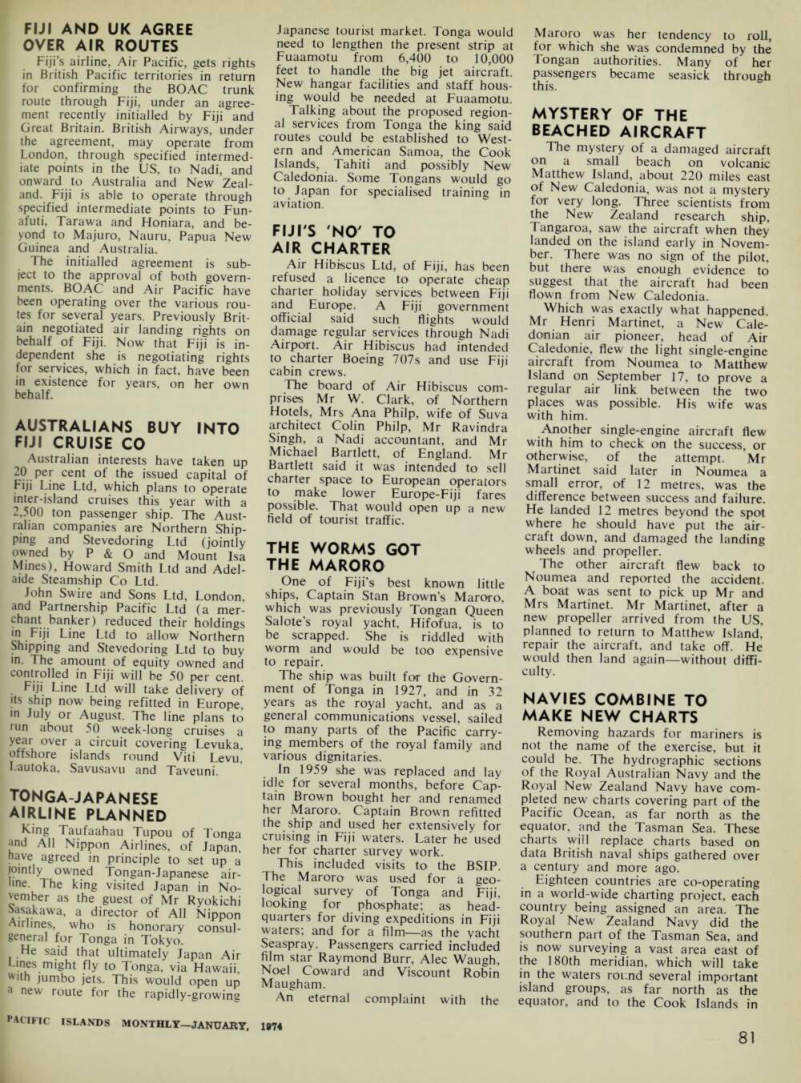
Bob Trumbull has been fascinated to observe the fight of the Pacific peoples to retain their own culture, and he says this is a problem shared by all Island people, from the Hawaiians to the Australian abo rigines.
“The Hawaiians have already lost out against the invading forces,” he says, “and I regret to have to say I think in time the others will fol low.”
There is no way in which Bob Trumbull’s knowledge of the Pacific Islands will not be used, even in Canada. And there is no way that he won’t continue to be roving am bassador for the peoples of the emerg ing Pacific.
Personally I’m glad he came our way when he did, because these are times when there is need for greater understanding of what is happening in the South Pacific—and informed, objective journalism of the kind that Bob Trumbull is master, is one of the best ways of ensuring it.
Stuart Inder
Pacific Islands
Monthly
FOUNDED BY R. W. ROBSON IN 1930
Published Monthly By
Pacific Publications (Aust.) Pty. Ltd.,
29 Alberta St., Sydney, N.S.W., 2000.
Postal Address: G.P.O. BOX 3408, SYDNEY
N.S.W., 2001.
Telegraphic Address; PACPUB, Sydney, Telex 25168.
Telephones: 61-9197, 61-7101, 61-4369.
Consulting Directors: R. W. Rabson, Judy Tudor.
Chief Executives: Manager: Selwyn Hughes.
Publisher; Stuart Inder.
Director of Advertising; W. A. Gasnier.
Pacific Islands Monthly
Editor: Stuart Inder.
Assistant Editor: John Carter.
Advertising Manager: W. A. Gasnier.
Circulation Manager: Barry Badger.
Subscription Rates:
"Pacific Islands Monthly" is airfreighted to all subscribers and agents in the Pacific Islands and the U.S.A.; copies to Nauru and other areas go by surface mail.
Australia (incl. Lord Howe and Thursday Is.); $6.70 Aust., Papua New Guinea: $5.50 Aust.; Fiji, Tonga, New Hebrides, Gilbert & Ellice Islands, Solomon Islands, Nauru Island and all other Pacific territories: $5.50 (local currency); Western Samoa; $6.70 (local currency); New Zealand: $6.70 NZ; Hawaii, Micronesia and Guam: $12.00 US; US Mainland: $14.00 US; New Caledonia and French Polynesia: 1,100 CFP; United Kingdom; £3.25; Elsewhere: $6.96.
Representatives
Fiji: A. F. Woods, Imex (Pacific) Limited, Suite 2A, Victoria Arcade, Suva, Fiji. P.O. Box 3117, Lami, SUVA. Telephone: 22-502. Telex. 2124.
Papua New Guinea: LAE, P.O. Box 227; RABAUL, Mr. Steve Simpson, P.O. Box 433 (c/- Rabaul Photographic. Tel.: 2677.) French Polynesia. Distribution—Hachette Paci fique, 10 Ave Bruat, Papeete.
New Zealand: Pacific Publications, C.P.O. Box 2229, Auckland. 379-494. Representative: John Spedding, Civic House, 291 Queen St., Auckland, Tel.: 379-494.
United Kingdom: Overseas Publicity Ltd., 214 Oxford Street, London, WIN OEA, Phone: 01-636 8296/7.
Japan: Advertising—Universal Media Corpora tion, C.P.O. Box 46, Tokyo. Tel.: 666-3036.
Victoria: Advertising Pacific Publications (Aust.) Pty. Ltd., 33 Lonsdale Street, Melbourne, Vic. 3006. Telephone: 662-3263.
Queensland: Advertising—Beale Media Services, 232 St. Paul's Terrace, Fortitude Valley, Qld., 4006. Tel.: 52-5827.
Hawaii and U.S. Mainland only: N. Grogan, 3354 Hayden Street, Honolulu, 96815. (Send change of address notices. Form 3579 and new subscriptions to P.O. Box 2193 Honolulu, Hawaii, U.S.A. 96805).
Second class postage paid at Honolulu, Hawaii.
Copyright ©, 1973,
Pacific Publications (Aust) Pty. Ltd.
January, 1974 Vol. 45, No. 1
Pacific Islands Monthly
Ellice To Get Their Chance To
Separate From The Gilberts
By a staff reporter
The Ellice islanders, who, accord ing to their representatives on the GEIC Legislative Council, want to separate from the Gilberts and form a territory of their own under British rule, will have to decide for themselves.
The British Government, after consideration of a report from Sir Leslie Monson, British-appointed commissioner to inquire into the Ellice islanders’ request, who was in the colony early last year, has decided that they shall have their wish if a referendum reveals that the majority want separation. But, the conditions, if separation is decided on, will be tougher than the Ellice people bargained for.
When they put their case to Sir Leslie Monson and, previously, to Sir John Field, who retired as governor last year, they asked that in any carve-up of assets, they should be given the Phoenix Group of islands or some of the Line Islands.
But the British Government laid it down in the statement read by Governor Mr John Smith in the Legislative Council towards Nov ember’s end that “the territory of the new Ellice Colony should be confined to the Ellice Islands them selves”.
A prerequisite of separation is that it should also be the wish of the GEIC Government. If the Ellice people decide on separation, it’s un likely that the Gilbertese will oppose it. Mr Reuben Uatioa, Leader of Government Business, told PIM last year (Jan, p 39) that they would not oppose separation if the Ellice wanted it.
Among alternatives to separation suggested by Sir John Field was either a federal system, which “might have certain political advantages”, or a regional system with different parts of the country having limited rights to regulate certain local affairs with out creating separate states.
Mr Uatioa, however, has said that the Gilbertese will agree only to
separation or the existing type of unitary government.
Other conditions laid down by the British Government which may make the Ellice people think again are: a No assets (fixed, movable or in cash) belonging to the present colony outside the Ellice Islands should be transferred to the Ellice Islands on separation except for one ship from the colony’s fleet, and e The Ellice Islands would have no claim to phosphate royalties.
The referendum will be in August or September, 1974, and if it shows a majority of Ellice people in favour of separation, and the colony govern ment also wishes it, Britain will invite representatives of the Gilbertese and Ellice people to discuss the detailed constitutional, administrative, financial and economic arrangements, including the question of future British aid.
“In the light of these consultations,
a date for separation will be decided,” the Legislative Council was told.
“In the meantime, it is the inten tion of Her Majesty’s Government that the new constitution and ensuing general elections in the GEIC shall proceed as planned.”
As they are scheduled for 1974, new elections may displace some of the Ellice leaders and result in some re-thinking by the Ellice people, who, according to Ellice opponents of separation, know very little of what separation means.
As the Ellice people are out numbered by nearly six to one by the Gilbertese, fear of domination is the driving force behind the Ellice people’s wish for separation and even the conditions imposed by Britain may not deter them.
They expect, if separation is agreed on, to remain a British dependency, in which case, they say, Britain will look after them, and their lot would be better than if they remain as part of an independent Gilbert and Ellice Islands country.
As Mr Telavi Fati, Legislative Council Member for Nanumea in the Ellice Islands, reasoned before Sir Leslie Monson, separation was better than loss of identity and loss of culture and tradition which would follow in the next 10 to 20 years if the Ellice remains with the Gilberts.
“We do not mind if our people get lost in the civilised world,” he said, suggesting that Britain should arrange a migration of about 2,000 Ellice islanders within the next 20 years to other Ccpmmonwealth countries and the imposition of some sort of tax on the migrants to help those back home. .
He also asked for the retention of the Ellice labour force on Ocean Island for as long as phosphate mining lasts or, if the Gilbertese ob ject, a transfer of the work force to Christmas Island in the Indian Ocean.
The Gilbertese, however, could be expected to protest against the con
tinued presence of Ellice workers on Ocean Island if separation comes, as they argue that Ellice would be a separate country, and Ocean Island is nearer to the rest of the Gilberts.
Governor Mr John Smith is quoted in the colony newspaper, Atoll Pioneer, as saying that if separation came, the earliest practical date would be January, 1976.
He was asked if, in the event of separation, Ellice people living on Tarawa would have to pack their bags and leave. He replied: “We are discussing constitutional separation and not a declaration of hostilities.
There are a great many individual Ellice islanders for whom the govern ment, the Development Authority and others have contractual obliga tions. There may be others who, for one reason or another, have decided to make their home in the Gilbert Islands.
“At the point of separation, I am assuming that both the Gilbert Islands and the Ellice Islands will still be dependencies of Britain. There will, therefore, be no question at that stage of Gilbertese or Ellice citizenship.”
Budget
Mr Douglas Freegard, Financial Secretary of the GEIC, is budgeting for a surplus of $1.34 million in 1974, even though expenditure will be $479,630 higher than 1973. He ex pects the higher expenditure will be offset by a lift of $747,000 in revenue.
The Appropriation Bill provides for recurrent revenue of $5,877 million and recurrent expenditure of $4,577.
Britain will provide additional aid of 51.053 million in 1974 to assist in the rehabilitation of Funafuti, which was devastated by hurricane Bebe in October, 1972. The increase in world price of phosphates will add about $680,000 to the 1974 revenue in phosphate tax.
Customs duty is expected to yield $42,000, income tax (including GEI Development Authority profits) $91,000 and Posts and Telecommuni cations $60,000. Against that revenue is loss of fishing revenue, which was expected to start in 1973, but the fleet was wiped out by hurricane Bebe.
That revenue had been estimated at $150,000. There was also loss of revenue from fees and licences which now go to urban councils.
Mr Freegard said that in 1973, GEIDA contributed about $33,000 to the revenue from the profit earned in 1972, its first year of operation.
The subsidy required by GEIDA for shipping services declined in the first half of 1973. For the last quarter °f 1972, the authority required a
shipping subsidy of $95,000. For the first quarter of 1973 it was $67,000, and in the second quarter, April-June, there was a small profit of $7,000.
The better result was achieved partly because of an increase in fares and freight charges, and partly through the considerable increase in
copra production.
Actual revenue and expenditure in 1972 were $4,650,930 and $5,012,579 respectivelv after putting $995,389 to reserve. The surplus of revenue over expenditure was $25,800, which was transferred to reserve in 1973. Thus the total put to reserve on the 1972 account was $1,021,189, which was $223,833 less than originally esti mated. The revised estimate for 1973 indicated a final out-turn to reserve of $1,039 million, or $33,000 less than originally estimated.
Mr Freegard said that while the GEIC was able to put about $.26 million more to reserve in 1973, members should not consider that any real reason for self-satisfaction.
“It must be borne in mind that the greater part of the increase in revenue next year will come from exports of phosphate,” he said. “When we lose the phosphate revenue we shall have a larger gap to plug than ever.”
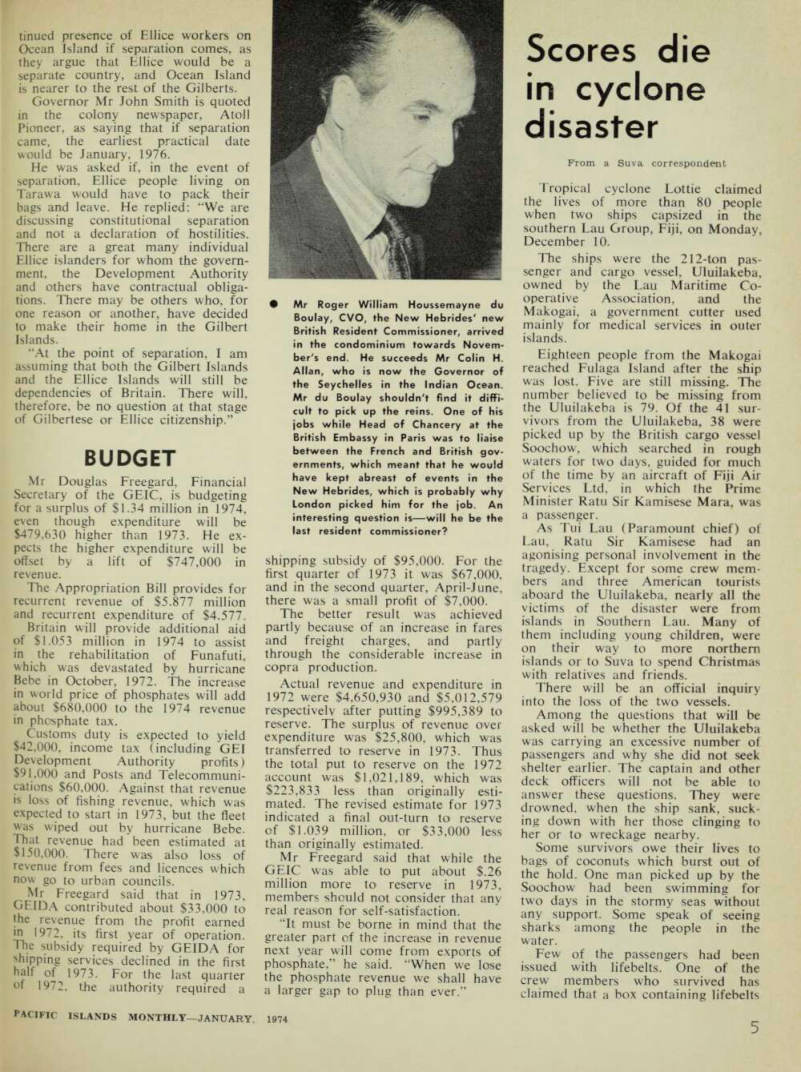
• Mr Roger William Houssemayne du Boulay, CVO, the New Hebrides' new British Resident Commissioner, arrived in the condominium towards Novem ber's end. He succeeds Mr Colin H.
Allan, who is now the Governor of the Seychelles in the Indian Ocean.
Mr du Boulay shouldn't find it diffi cult to pick up the reins. One of his jobs while Head of Chancery at the British Embassy in Paris was to liaise between the French and British gov ernments, which meant that he would have kept abreast of events in the New Hebrides, which is probably why London picked him for the job. An interesting question is—will he be the last resident commissioner?
adventures
Dentures ' adventures
Eighteen months ago, when Pitcairn islanders were putting out in one of their famous long boats to meet a passing ship, a massive wave overturned their craft. The crew was thrown into the sea and two of them, includ ing their radio spokesman Tom Christian, were seriously injured.
Another, Ivan Christian, lost his false teeth as he hit the water.
The sea delivered up the den tures a few weeks ago. They were spotted by a Pitcairner while fishing in the sea. “They’re kinda worn, like maybe a shark tried them for size, but Ivan says they’re still usable,” Tom Christian told the Seventh-day Adventist’s radio centre in Cali fornia.
in cyclone
Scores die in cyclone disaster
From a Suva correspondent Tropical cyclone Lottie claimed the lives of more than 80 people when two ships capsized in the southern Lau Group, Fiji, on Monday, December 10.
The ships were the 212-ton pas senger and cargo vessel, Uluilakeba, owned by the Lau Maritime Co operative Association, and the Makogai, a government cutter used mainly for medical services in outer islands.
Eighteen people from the Makogai reached Fulaga Island after the ship was lost. Five are still missing. The number believed to be missing from the Uluilakeba is 79. Of the 41 sur vivors from the Uluilakeba, 38 were picked up by the British cargo vessel Soochow, which searched in rough waters for two days, guided for much of the time by an aircraft of Fiji Air Services Ltd, in which the Prime Minister Ratu Sir Kamisese Mara, was a passenger.
As Tui Lau (Paramount chief) of Lau, Ratu Sir Kamisese had an agonising personal involvement in the tragedy. Except for some crew mem bers and three American tourists aboard the Uluilakeba, nearly all the victims of the disaster were from islands in Southern Lau. Many of them including young children, were on their way to more northern islands or to Suva to spend Christmas with relatives and friends.
There will be an official inquiry into the loss of the two vessels.
Among the questions that will be asked will be whether the Uluilakeba was carrying an excessive number of passengers and why she did not seek shelter earlier. The captain and other deck officers will not be able to answer these questions. They were drowned, when the ship sank, suck ing down with her those clinging to her or to wreckage nearby.
Some survivors owe their lives to bags of coconuts which burst out of the hold. One man picked up by the Soochow had been swimming for two days in the stormy seas without any support. Some speak of seeing sharks among the people in the water.
Few of the passengers had been issued with lifebelts. One of the crew members who survived has claimed that a box containing lifebelts
was blown overboard in the height of the storm.
The court of inquiry will certainly ask whether the warnings given by the Meteorological office at Nadi were adequate. Forecasts spoke of winds of up to 40 knots, and a small boat warning was issued. Spokesmen for the weather office insist that mes sages broadcast foretold with accuracy that the storm would deepen as it reached Kadavu (where cyclonic winds destroyed whole villages) and southern Lau.
Uluilakeba survivors speak of waves 60 ft high. Kadavu observers claim that wind speeds exceeded 60 knots.
The Prime Minister has opened a
fund for the Uluilakeba and Makogai survivors and the dependants those who were lost. The Fiji Times has a parallel fund. Prime Minister’s fund contributions should e . addressed to the secretary of the Prime Minister’s Hurricane Relief Committee, care of the Ministry of Fijian Affairs and Rural Develop ment, Victoria Parade, Suva, The hurricane claimed a life on Kadavu, of a 50-year-old woman, who died when her bure collapsed, The Roko Tui Kadavu, Mr Solomoni Momoivalu, reported much damage to buildings and crops. The Hurricane Relief Committee sent 300 tents to Kadavu as temporary houses.
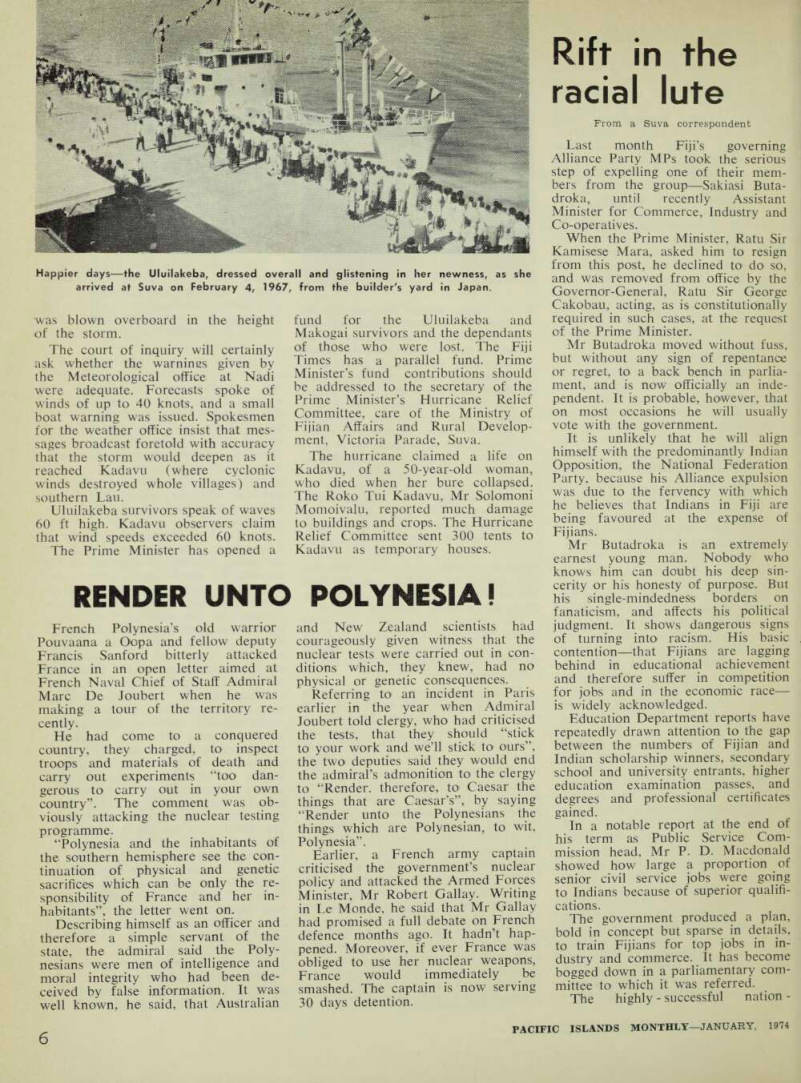
Happier days—the Uluilakeba, dressed overall and glistening in her newness, as she arrived at Suva on February 4, 1967, from the builder's yard in Japan.
Render Unto Polynesia!
French Polynesia’s old warrior Pouvaana a Oopa and fellow deputy Francis Sanford bitterly attacked France in an open letter aimed at French Naval Chief of Staff Admiral Marc De Joubert when he was making a tour of the territory recently.
He had come to a conquered country, they charged, to inspect troops and materials of death and carry out experiments “too dangerous to carry out in your own country”. The comment was obviously attacking the nuclear testing programme.
“Polynesia and the inhabitants of the southern hemisphere see the continuation of physical and genetic sacrifices which can be only the responsibility of France and her inhabitants”, the letter went on.
Describing himself as an officer and therefore a simple servant of the state, the admiral said the Polynesians were men of intelligence and moral integrity who had been deceived by false information. It was well known, he said, that Australian
and New Zealand scientists had courageously given witness that the nuclear tests were carried out in con ditions which, they knew, had no physical or genetic consequences.
Referring to an incident in Paris earlier in the year when Admiral Joubert told clergy, who had criticised the tests, that they should “stick to your work and we’ll stick to ours”, the two deputies said they would end the admiral’s admonition to the clergy to “Render, therefore, to Caesar the things that are Caesar’s”, by saying “Render unto the Polynesians the things which are Polynesian, to wit, Polynesia”, Earlier, a French army captain criticised the government’s nuclear policy and attacked the Armed Forces Minister, Mr Robert Gallay. Writing in Le Monde, he said that Mr Gallay had promised a full debate on French defence months ago. It hadn t hap pened. Moreover, if ever France was obliged to use her nuclear weapons, France would immediately be smashed. The captain is now serving 30 days detention.
racial lute
Rift in the racial lute
From a Suva correspondent Last month Fiji’s governing Alliance Party MPs took the serious step of expelling one of their mem bers from the group—Sakiasi Buta droka, until recently Assistant Minister for Commerce, Industry and Co-operatives.
When the Prime Minister, Ratu Sir Kamisese Mara, asked him to resign from this post, he declined to do so, and was removed from office by the Governor-General, Ratu Sir George Cakobau, acting, as is constitutionally required in such cases, at the request of the Prime Minister.
Mr Butadroka moved without fuss, but without any sign of repentance or regret, to a back bench in parlia ment, and is now officially an inde pendent. It is probable, however, that on most occasions he will usually vote with the government.
It is unlikely that he will align himself with the predominantly Indian Opposition, the National Federation Party, because his Alliance expulsion was due to the fervency with which he believes that Indians in Fiji are being favoured at the expense of Fijians.
Mr Butadroka is an extremely earnest young man. Nobody who knows him can doubt his deep sin cerity or his honesty of purpose. But his single-mindedness borders on fanaticism, and affects his political judgment. It shows dangerous signs of turning into racism. His basic contention —that Fijians are lagging behind in educational achievement and therefore suffer in competition for jobs and in the economic race— is widely acknowledged.
Education Department reports have repeatedly drawn attention to the gap between the numbers of Fijian and Indian scholarship winners, secondary school and university entrants, higher education examination passes, and degrees and professional certificates gained.
" In a notable report at the end of his term as Public Service Com mission head, Mr P. D. Macdonald showed how large a proportion of senior civil service jobs were going to Indians because of superior qualifi cations.
The government produced a plan, bold in concept but sparse in details, to train Fijians for top jobs in in dustry and commerce. It has become bogged down in a parliamentary com mittee to which it was referred.
The highly - successful nation -
building achievements of the Prime Minister have been based on a policy of dialogue and of negotiation rather than confrontation. Butadroka and his supporters argue that eagerness to reach agreement through discussion has too frequently resulted in a give in, with Fijian interests sacrificed.
The final Butadroka row stemmed from a by-election in which Mr Mosese Qionibaravi won the Suva East National (voters of all races) seat for the Alliance by a majority smaller than that gained by the late Ratu Sir Edward Cakobau.
Various reasons can be produced for the majority drop. The govern ment was blamed for inflation, and suffered from ineffectiveness and shortcomings in the prices and in comes policy to counter inflation.
The poll was small, as is usual in by elections. Many people on the roll had moved away from their former homes. There was strongly organised personal support for the Opposition candidate, Rewa woman of chiefly rank, Ro Asela Rogavatu. This was especially evident among Fijians from Rewa province who would naturally vote Alliance but were aggrieved be cause a Rewa man, Tomasi Vakatora, had been defeated in the pre-election ballot for the Alliance candidate.
Mr Butadroka gave a more sim plistic, and politically naive, explana tion. “Most Fijian supporters,” of the Alliance in the whole constituency, he said, had voted for Ro Asela—a contention which the election figures clearly did not justify.
He pointed to the unfulfilled promise of the institute scheme and the failure to create a special section for Fijians in the Development Bank as examples of the government’s neglect of Fijian interests.
The by-election gave the Prime Minister and the government a chance to reconsider their policies, Mr Butadroka said. MPs should not be “so satisfied with houses and chauffeur-driven cars that they forget the people who voted them into par liament”.
Mr Butadroka said all this in a statement to The Fiji Times. The newspaper referred the statement to the Prime Minister for comment. The events that followed ended in his sacking.
There has been talk of his forming a new, exclusively Fijian party but the prospects of an effective challenge to the Alliance from such a source are remote. What does seem certain is that Mr Butadroka will remain a mouthpiece of Fijian frustration until it can be shown that clear and vigorous steps are being taken to cor rect the imbalance on which that frustration is based.
New Tax System (Soon),
And New Taxes (Now)
From a Suva correspondent
The speech in which Fiji’s Minister of Finance, Mr C. A. Stinson, intro duced his 1974 Budget was long on words but short on details.
Mr Stinson spoke of the general principles that are to be applied in the new system customs tariff that comes into effect on January 1, but importers will have to wait till late December before they know what the charges will be on specific items.
The minister announced that Fiji’s income tax system is to be overhauled but did not cross the t’s or dot the i’s of the changes. These must wait till an-as-yet-unfinished bill is pub lished at some unspecified date.
The government hopes that the new system will become law in April, 1974, though the tax year for most people begins on January 1. April is also the appointed date for the be ginning of a new turnover tax of three per cent on hotel accommoda tion, food and beverages, but hotel owners are still uncertain whether they are expected to bear the full burden of the tax or whether the price control authorities will allow them to pass it, or some of it, on to customers.
His survey of government accounts, past and future, was unusually brief.
The 1973 estimated deficit of $721,000 is expected to be almost doubled by rising costs, in spite of a boost of nearly $5,000,000 in the estimated revenue for the year.
The 1974 estimates aim at a sur plus of $446,920. The estimated ex penditure is a record $73,527,780, with a further $27,510,734 provided for capital works.
Social services will absorb 36.1 per cent of government expenditure in 1974. Education will account for 22.2 per cent and health services for 10.2 per cent.
About 40 per cent of the money spent will be needed for civil service emoluments. Mr Stinson announced that a maximum annual growth rate of 5 per cent on the number of civil servants is to be enforced.
Another announcement—that no new government cars will be bought in 1974—was translated in an ABC news bulletin into a declaration that Fiji will ban the import of all new cars next year.
Drinkers and smokers, who now bow their heads and bare their necks automatically as budget time ap
proaches, received the expected and customary blow. Higher excise duties cn beer and cigarettes and higher import duties on beer, spirits, wine, tobacco and cigars will produce most of the additional revenue on which Mr Stinson is relying to balance his budget.
The major change in the customs tariff is to be its conversion to a one-line system—so-called because there will no longer be separate duty rates for goods from British Com monwealth and non-Commonwealth countries.
In general, Mr Stinson said, food, industrial raw materials, tourist items and goods used by rural people will be admitted at low rates or no duty.
Examples of “rural” goods exempt from customs duty are fishing nets, primus and similar stoves, outboard motors and kerosene refrigerators.
Fertilisers and a wide range of dairying, agricultural, horticultural and poultry-keeping machinery will be exempt from both customs and fiscal duty.
Income tax will begin at 545 (with a $3O rebate) on a chargeable income of $6OO and will mount in steady progression to $3,820 on a chargeable income of $12,000, with anything above $12,000 being taxed at the ceiling rate of 50 per cent. The basic tax of 2i per cent of gross income is additional.
Local company tax, which was converted from the pre-decimal cur rency rate of 6/3 in the £ to an untidy 32.6875 per cent, is to be raised slightly to the more easily calculated one-third.
The Opposition early seized on a proposal to do away with the present $640 personal allowance and replace it with a $3O tax rebate. The present additional married allowance of $640 is to be converted to a total of $750 for a married couple.
This, said the government’s critics, means discrimination against the lower-paid taxpayer while those with higher incomes are being given tax relief.
In reply, the government has pointed to such things as higher tax exemptions for savings bank interest and a new allowance for the cost of board for children at school or uni versity. There have been hints, too, of customs tariff concession goodies in store, especially for low income people.
With Silence
Not With A
Bang ... But
From a Port Moresby correspondent Self-government came to Papua New Guinea on Saturday, December 1, not with a bang or a whimper, but almost in utter silence. There was less traffic here in the capital on the Friday night than at any time since World War 11, and from 6 pm on wards hardly anyone was about.
When I drove from Korobosea via the city area and Konedobu at 8 pm to make a check on the eve of the great day I met only two police cars.
Another drive just before midnight revealed only half a dozen cars on Three-Mile Hill—and nothing and nobody else. There were only police cars on the way to the airport, and 1 noticed another 20 police trucks with police standing by at central police station, Boroko.
On the day itself only the news agencies were open to sell special self-government issues of the Post- Courier and it was not until 5 pm that one saw people about. There was a crowd at a meeting at Kaugere on behalf of the Papua Besena Move ment of Miss Josephine Abaijah, but there was no fuss.
In the morning Mr Michael Somare made a prepared broadcast in which he stressed that although New Guineans had “waited im patiently for this day for years”, there was little change in practical terms, and New Guineans would do the same things that day as they had done the day before.
The only official ceremony was the short swearing in of former Adminis trator, Mr Les Johnson, as Aus tralian High Commissioner, who in turn swore in Mr Somare as Chief Minister, and five others as members
of the PNG Executive Council (formerly the Administrator’s Coun cil).
Sunday was another quiet day in the capital, and at the Koke United Church, Bishop Riley Samson (a Western District man) said in his sermon that all Papuans were appre hensive about the future, but that too much stupid talk had gone on during the last few months and the people should work for national unity.
All hotels had closed on Friday for the long weekend, and licensees were instructed not to serve liquor even to guests. The liquor ban un doubtedly assisted in keeping the occasion trouble-free. A further ban on liquor supply will operate between December 24-26 and December 31 and January 1. Liquor can’t be drunk at any public place on Christmas Day and New Year’s Day apart from hotel dining rooms.
Meanwhile, clues on the way things will shape under self-government can be seen in two important reports— one on land (see opposite) and an other by the Constitutional Planning Committee, introduced into the House of Assembly. The committee, representing all political parties, will give its final report in February, and the Assembly is expected to debate and approve it at a special session next April.
Main proposals in this, its second interim report, are that dual citizen ship be rejected, a system of pro vincial governments be established, regional electorates be abolished and the total number of open electorates be increased to a minimum of 100. and the voting system be “first past
the post” and not preferential as at present.
On citizenship the committee said measures would have to be taken to protect the rights of New Guineans from being disadvantaged by “new citizens”, such as Australians, who because of their education, economic status and mobility could otherwise be in a more advantageous position.
The government had to minimise in equality of opportunity, and citizen ship laws thus “may have to be rather restrictive”, if only temporarily. For details, we’ll have to wait.
On regional government, the pro posal is for the present districts to become provinces, with their own popularly-elected provincial assem blies, headed by Premiers with cabinets. There would be a single PNG public service, with national public servants working also in the provinces, for the provinces, along side local personnel employed directly by the provincial governments.
The aim is to give PNG provinces significant powers without splitting PNG into autonomous regions. The powers of the provinces will be deter mined by a task force now being set up in Port Moresby.
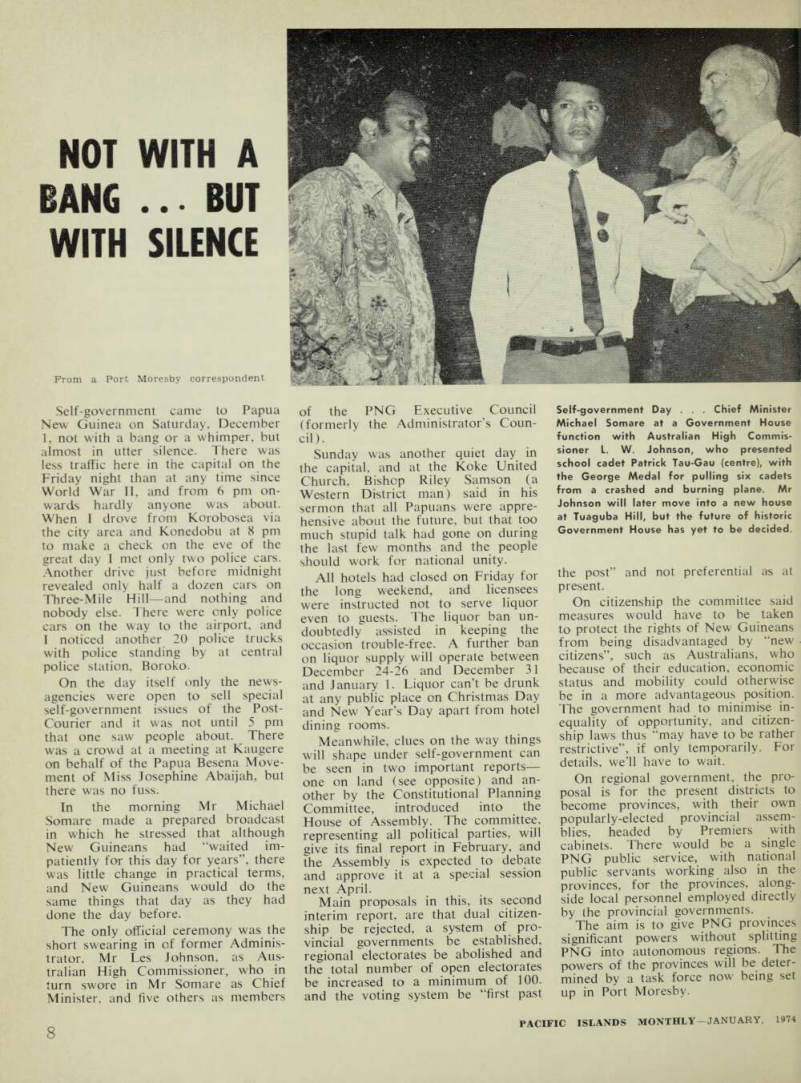
Self-government Day . . . Chief Minister Michael Somare at a Government House function with Australian High Commis sioner L. W. Johnson, who presented school cadet Patrick Tau-Gau (centre), with the George Medal for pulling six cadets from a crashed and burning plane. Mr Johnson will later move into a new house at Tuaguba Hill, but the future of historic Government House has yet to be decided.
wipe out freeholds
New Guinea plan to wipe out freeholds
From a Port Moresby correspondent
When the voluminous report of the Commission of Inquiry into Land Matters (typescript, three-quarters of an inch thick) was introduced into the November session of the House of Assembly, some of the cynics who thumbed through it predicted that 50 per cent of it would be rejected, and only 10 per cent of what was left would be enacted.
The prediction was based on ex perience of what normally happens to the extensive reports of com missions of inquiry once they get into national legislatures. But whether or not the cynics are right, there can be no denying that this report has to be considered seriously. (For the background on how it was compiled, see p 37.) The report is the most exhaustive and the most impressive report on land ever to be released in Papua New Guinea. It is lucid, and original.
Should most of its provisions be enacted, it would set an entirely new pattern of land control in the South Pacific, and alter the concept of land ownership which has been followed in the past by the PNG Administra tion.
Its very first recommendation, for example, says that “private land lordism must be checked”, thus re versing the view of the Australian Administration that individual owner ship of land is to be aimed for and that titles must be made safe. The commission is sympathetic to clans who want to assert their traditional rights against the holders of alienated land (who are usually Europeans), but it has no intention of simply allowing European landlords to be replaced by New Guinean landlords, with “colonial exploitation being replaced by exploitation of one class of New Guinean by another”.
It attempts to resolve this problem, and many others, by introducing what undoubtedly is the most controversial of its many recommendations— recommendations 21 and 22, which state bluntly that all freehold and leasehold titles, both urban and non urban, should be converted into gov ernment leaseholds from a specified date.
This means all titles, anywhere in New Guinea, including those large city holdings held by Messrs Burns Philp and the other big firms in
Port Moresby, whether or not they happen to have department stores or picture theatres on them.
The plan is to renew the newly created government leases for a period of 40 years, and to charge the lessees rent in the usual way, after a “holiday” period of five years. No compensation will be paid to the owners of the present freehold titles for the change in title, and the law will protect the government from compensation claims. The main aim of the policy will be to bring all urban land under government owner
ship.
Government will also have power to insist on development of any un developed areas of rural land, the work to commence within a year and be completed within five years. If not developed, the government will have power to reallocate the land, “with priority to land-short Papua New Guineans living on or near the land”.
The new government leases will be available for a maximum of 60 years for citizens, with right of re newal; for a maximum of 40 years for non-citizens, but for 60 years if they involve citizens “in substantial ownership and management of the business on the land”. Non-citizens will have no automatic right of re newal.
Present leases which now have less than 40 years or 60 years to run, as the case may be, will continue to expiry, but leases which have more than 40 or 60 years to run will be reduced.
Should these far-reaching pro visions be introduced they would, of course, affect the value of present business enterprises in PNG.
The present market value of planta tions particularly on the coast, are improved by the estimated value of the freehold. If the land is converted to leasehold, the value of the planta tion drops. Similarly the big enter prises in New Guinea have enormous asset backings based on their free hold land, particularly that held in the big towns. Burns Philp and Steamships between them control a large slice of the city area of Port Moresby.
A number of PNG politicians, some of them prominent, own valu
(Continued on p 10)
able freehold titles which could be affected in this way, and this aspect of the report is not likely to have an easy passage through the House.
Some freeholds—conditional free holds for customary land—will still be available in PNG if the commis sioners get their way, but they will not be available to outsiders. A gov ernment lease will be the only form of title which a non-citizen can acquire.
There is an interesting recom mendation numbered 71, which says that lawyers should be excluded from participating in early stages of land disputes which come before Local Land Courts, and admitted to the District Land Courts only in special circumstances.
The inquiry was aware of the diffi culties in Micronesia particularly, where millions of dollars have been spent, and there have been long delays, over land claims because legal men have debated technicalities.
The New Guinean commission suggests that lawyers should appear only in District Land Court cases in connection with those involving national land, or in disputes in which the government or a company is in volved.
Oala's 'Bigger Beer'
When PNG's Mr Oala Oala- Rarua did his self-effacing act at the South Pacific Conference at Noumea in September, 1971, and retired from the contest for a new Secretary-General, leaving a clear field for Western Samoa’s Mr Fred Betham, there was an understand ing that he would succeed Mr Betham in a few years' time.
PIM, sure that Oala was being groomed for something even better —and not meaning the job of Lord Mayor of Port Moresby, which he was until recently — said, “Oala may think the job’s small beer by then".
He should, because, as the December PIM forecast (p 5), Mr Oala-Rarua has been named as PNG’s official representative in Australia. He’s got no title yet, but, when independence comes, he is expected to be High Commis sioner.
A Sydney office will also be set up to house \a consul-general.
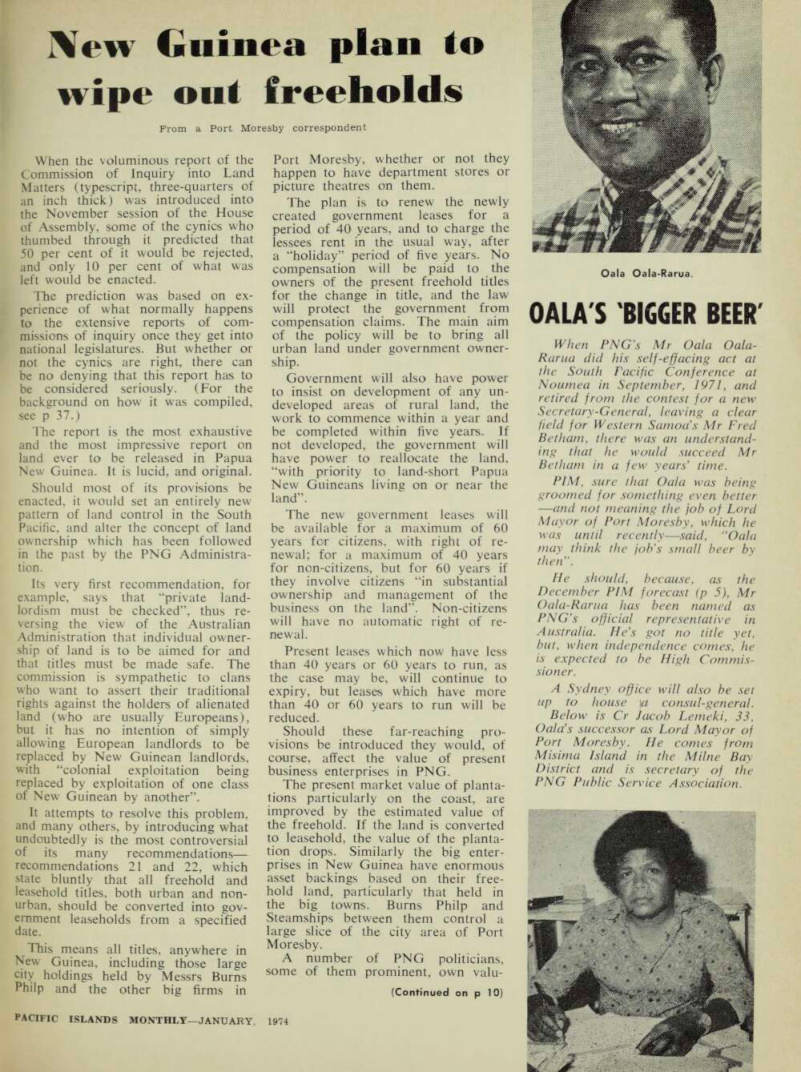
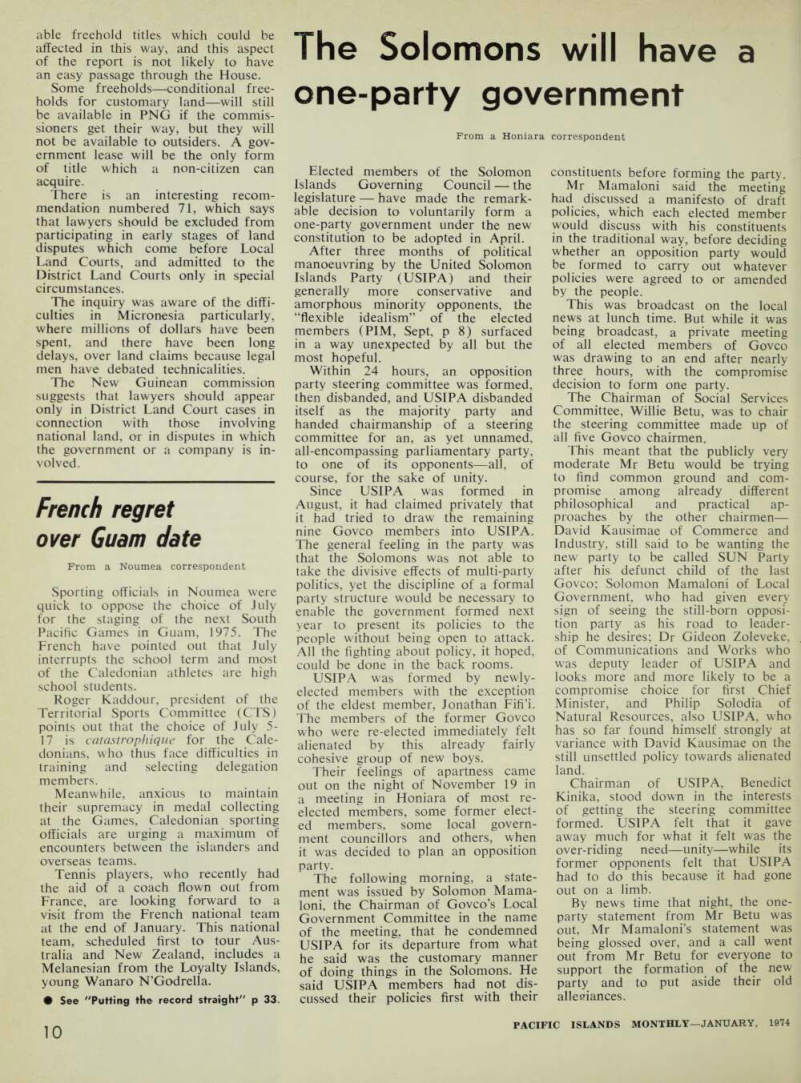
Below is Cr Jacob Lemeki, 33, Gala’s successor as Lord Mayor of Port Moresby. He comes from Misima Island in the Milne Bay District and is secretary of the PNG Public Service Association.
Oala Oala-Rarua.
French regret
over Guam date
From a Noumea correspondent Sporting officials in Noumea were quick to oppose the choice of July for the staging of the next South Pacific Games in Guam, 1975. The French have pointed out that July interrupts the school term and most of the Caledonian athletes are high school students.
Roger Kaddour, president of the Territorial Sports Committee (CTS) points out that the choice of July 5- 17 is catastrophique for the Cale donians, who thus face difficulties in training and selecting delegation members.
Meanwhile, anxious to maintain their supremacy in medal collecting at the Games, Caledonian sporting officials are urging a maximum of encounters between the islanders and overseas teams.
Tennis players, who recently had the aid of a coach flown out from France, are looking forward to a visit from the French national team at the end of January. This national team, scheduled first to tour Aus tralia and New Zealand, includes a Melanesian from the Loyalty Islands, young Wanaro N’Godrella. • See "Putting the record straight" p 33.
The Solomons will have a one-party government
one-party government
From a Honiara correspondent
Elected members of the Solomon Islands Governing Council the legislature have made the remark able decision to voluntarily form a one-party government under the new constitution to be adopted in April.
After three months of political manoeuvring by the United Solomon Islands Party (USIPA) and their generally more conservative and amorphous minority opponents, the “flexible idealism” of the elected members (PIM, Sept, p 8) surfaced in a way unexpected by all but the most hopeful.
Within 24 hours, an opposition party steering committee was formed, then disbanded, and USIPA disbanded itself as the majority party and handed chairmanship of a steering committee for an, as yet unnamed, all-encompassing parliamentary party, to one of its opponents—all, of course, for the sake of unity.
Since USIPA was formed in August, it had claimed privately that it had tried to draw the remaining nine Govco members into USIPA.
The general feeling in the party was that the Solomons was not able to take the divisive effects of multi-party politics, yet the discipline of a formal party structure would be necessary to enable the government formed next year to present its policies to the people without being open to attack.
All the fighting about policy, it hoped, could be done in the back rooms.
USIPA was formed by newly elected members with the exception of the eldest member, Jonathan Fifi’i.
The members of the former Govco who were re-elected immediately felt alienated by this already fairly cohesive group of new boys.
Their feelings of apartness came out on the night of November 19 in a meeting in Honiara of most re elected members, some former elect ed members, some local govern ment councillors and others, when it was decided to plan an opposition party.
The following morning, a state ment was issued by Solomon Mama loni, the Chairman of Govco’s Local Government Committee in the name of the meeting, that he condemned USIPA for its departure from what he said was the customary manner of doing things in the Solomons. He said USIPA members had not dis cussed their policies first with their
constituents before forming the party.
Mr Mamaloni said the meeting had discussed a manifesto of draft policies, which each elected member would discuss with his constituents in the traditional way, before deciding whether an opposition party would be formed to carry out whatever policies were agreed to or amended by the people.
This was broadcast on the local news at lunch time. But while it was being broadcast, a private meeting of all elected members of Govco was drawing to an end after nearly three hours, with the compromise decision to form one party.
The Chairman of Social Services Committee, Willie Betu, was to chair the steering committee made up of all five Govco chairmen.
This meant that the publicly very moderate Mr Betu would be trying to find common ground and com promise among already different philosophical and practical ap proaches by the other chairmen— David Kausimae of Commerce and Industry, still said to be wanting the new party to be called SUN Party after his defunct child of the last Govco; Solomon Mamaloni of Local Government, who had given every sign of seeing the still-born opposi tion party as his road to leader ship he desires; Dr Gideon Zoleveke, of Communications and Works who was deputy leader of USIPA and looks more and more likely to be a compromise choice for first Chief Minister, and Philip Solodia of Natural Resources, also USIPA, who has so far found himself strongly at variance with David Kausimae on the still unsettled policy towards alienated land.
Chairman of USIPA, Benedict Kinika, stood down in the interests of getting the steering committee formed. USIPA felt that it gave away much for what it felt was the over-riding need—unity—while its former opponents felt that USIPA had to do this because it had gone out on a limb.
By news time that night, the one party statement from Mr Betu was out, Mr Mamaloni’s statement was being glossed over, and a call went out from Mr Betu for everyone to support the formation of the new party and to put aside their old allegiances.
Nutshell
In a Nutshell
Helicopter Fatality.—An
Australian Army officer, Second Lieutenant K. D. J. Shoppee, was killed, and Sergeant C. E. Darch, of South Australia, was injured, when a Sioux helicopter crashed on Mt Wilhelm, 4,706 metres, on November 29. Mt Wilhelm is the highest moun tain in New Guinea.
GAZELLE TRUST—A meeting of leaders from three political groups on the PNG Gazelle Peninsula held in Rabaul has agreed to establish a trust to take over the functions of the Gazelle Peninsula Local Govern ment Council’s board of manage ment.
Establishment of the trust had been delayed for some months because of disagreement by differing factions on the Gazelle. The trust will com prise three representatives of the Warkurai Nigunan, Warbete Kivung and the Greater Toma Council.
Work In Australia—Seven
ty-five students from the University of the South Pacific, Suva, are in Australia on a working holiday. Some of their work is in the BHP steel works, Newcastle, on a week-on, week-off basis. The USP Students’
Association, in conjunction with the National Union of Australian Students and the Australian High Commission, Suva, organised the visit to Australia, which is described as a “cultural liaison visit”. The students, who will be in Australia for about three mon ths, will visit universities and colleges in Sydney, Melbourne, Brisbane and Canberra.
PNG ELECTION—The Gazelle Open seat in the PNG House of Assembly has been retained by the United Party in a by-election held to fill the seat of the former Leader of the Opposition, Mr Matthias Tollman, who died in September. Mr Martin Tovadek, 33, trade store manager and farmer, won the seat with 3,097 votes from his nearest rival, a Mata ungan Association candidate, who polled 1,005 votes. There were six candidates,
Siamese Twins
twin girls born in a cave on Malaita in September, have died in hospital near Auki, BSIP.
SI,OOO FlNE—Judge Hicks, of the NSW District Court on November 27, fined Robert Hunter, Fiji plan tation owner and land developer, $l,OOO for having attempted to take $16,782 in Australian currency out of Australia without Reserve Bank authority. Hunter pleaded guilty.
Judge Hicks said that Hunter’s ex planation that he was paying for a home unit and intended to bring the money back to Australia in five days was not very credible. He said he would impose a light fine because of Hunter’s previous good character.
Nauruan Elections.—Three
sitting members lost their seats at the Nauru general elections on December 15. Victor Eoaeo, Deputy Speaker, and Derog Gioura, were replaced by younger men Bernard Dowiyogo and Kennan Adeang in the Übenide electorate, and in Meneng, David Dabwido lost his seat to Bobby Eoe.
Nauru’s President, Hammer De- Roburt, and Speaker of the last House, Kenas Aroi, were returned un opposed. There were no other changes in the parliament.
Nauru Issues Wrlt.—Nauru
Local Government Council, owners of the Nauruan vessel Enna G which was black banned for a long period in Wellington last year, in late De cember issued a writ out of the NZ Supreme Court against the NZ Sea men’s Union, NZ Harbour Board Employees’ Union and Wellington Waterside Workers’ Union, claiming $386,000 damages for conspiracy to cause a breach of contract over the vessel.
Governor departs
Governor Louis Verger, High Commissioner for France in the Pacific, left Noumea on Decem ber 1 at the end of a four-year term in New Caledonia. Mr Verger has been nominated as presiding Prefect in the Provence- Cote d’Azur region of southern France.
One of the governor’s last acts, on the eve of his departure, was to invite the local population to join him in a wreath-laying cere mony. By this patriotic gesture, marking Caledonian sacrifices for France in two world wars, the French governor reminded the islanders of their attachment to la metropole.
Mr Jean-Gabriel Eriau, at pre sent the Prefect of Upper Nor mandy, has been nominated by Paris as Mr Verger’s successor.
Born in 1914, Mr Eriau is mar ried and has two children.
People
• Mr Mosese Qionibaravi, of Suva, and his wife Anaseini need never be short of something to talk about. They can always talk politics.
Mr Qionibaravi was elected to the Fiji House of Representatives in November, filling a vacancy caused by the death of Ratu Sir Edward Cakobau. His wife has been a mem ber of the Senate for some time. • Dr G. B. Gris, 32, graduate of the Fiji School of Medicine and the University of Michigan, has been ap pointed Deputy Vice-Chancellor of the University of Papua New Guinea.
A New Guinean, Dr Gris is Chief of Dental Services with the PNG De partment of Public Health. Dr Rex Mortimer, 47, an Australian, has been appointed the university’s Professor of Political Studies, and Dr John Ballard, 43, an American, has been appointed W. D. & H. O. Wills Pro fessor of Administrative Studies. Dr Mortimer is currently with the Uni versity of Sydney, and Dr Ballard with the Australian National Uni versity, Canberra. • President of the World Bank, Mr Robert McNamara, will visit PNG at the end of January, during which he will fly over the Purari and Ramu basins. The Minister for Defence and Foreign Relations, Mr Albert Maori Kiki, said in December Mr McNamara’s visit was “an honour” for PNG. • King Taufa’ahau Tupou IV, of Tonga, has been awarded an honour ary doctorate at the University of the South Pacific in Fiji, of which he was the first Chancellor. His suc cessor as chancellor, President Ham mer Deßoburt, of Nauru, conferred the doctorate on the king at a grad uation ceremony on December 4 and also handed out 54 bachelor degrees, 61 diplomas of education and seven certificates of education. • Bishop Louis Vangeke, the first indigenous Roman Catholic bishop of Papua New Guinea, has been ap pointed Bishop of Bereina. Since his consecration he has been auxiliary bishop to Archbishop V. Copas, of Port Moresby. • Nauru golfer Neville Pearson had a large “hole-in-one” sandwich one Sunday’s game in November. He holed in one at the seventh, which was meat for him and, following custom, drink for the other players at the 19th. But, as the Nauru Bulletin pointed out, that was the middle of the sandwich. His hole in one was preceded by an eight at the sixth and another eight at the eighth!
He didn’t win the trophy.
Tropicalities

The Lucky
Countrymen
PNG’s Minister for Trade and In dustry, Mr John Poe, summed it up for students in an address to the Tus bab High School in November. He said they would become the future leaders of the country not because they were more intelligent, or be cause they h.?.d any special talent for leadership, but because they were chosen to be given a better education just at the time when leaders were needed. “You are lucky,” he said.
Mr Poe, who is 41 and a Papuan who taught with the Catholic Mission at Yule Island for five years, said that traditionally leadership in PNG did not depend on education, but upon character, intelligence and ex perience.
“It had to be earned by hard work, loyalty and service to our clan and village,” he said. “It was not given away to young, inexperienced men and women, but was accorded only to those who had proved they had already acquired maturity and wis dom. However, these changing times have confused many of my gener ation and of yours.
“Many of those of our people who have not been lucky enough to re ceive a formal education feel they are not qualified to be leaders in modern Papua New Guinea. There fore they tend to stand back and leave the leadership to you and me. So whether we like it or not, whether we are the best ones for the job or not, leadership is given to us, just as education has been given to us. We are the lucky ones ...”
Thar’s gold in
them thar huts!
Genuine antiques from the Islands, ceremonial masks, clubs, witchdoctor garb, head-dresses, idols and what have-you are rocketing in price in the collectors’ markets in Sydney and other centres outside the Islands— all because the supply has dried up with the belated discovery by the
Islanders that they’ve been sitting on a goldmine over the years. Cere monial gear, which has usually been destroyed after being sanctified through association with tribal rites, is now being preserved and offered to the dealer.
But, places like Papua New Guinea, which have banned the export of such treasures, are blocking supplies.
Dealers, however, are finding that there is a rich source already in Australia, brought years ago from the Islands by district officers and others when they have retired.
One such treasure, a Tongan war club, pictured here, arrived in Aust ralia in the early 1800 s. It is esti-
mated to be about 150 years old and, as can be seen, is ornamented with intricate carvings, of Tongan myth ology, no doubt. There are turtles, porpoises, sharks, a man diving and many, meaningless marks, obviously for decorative purposes.
The market price when new isn’t known, but when its owner Laurie Marshall of Tapa Gallery in William Street, in Sydney’s Paddington, offer ed it for sale he got a return worth a block of building land which, these days, isn’t going for peanuts.
The club is of the same vintage as the one which cracked the skull of Captain James Cook on a Hawaiian beach. Yes, that was a Tongan club and only a few months ago was in the London market sup ported by a certificate, reputedly signed by Joseph Banks, testifying that it was the very weapon which battered the life out of the Pacific explorer. Laurie Marshall, who knows about such things, said he was sure that, if Cook had been able to choose which Tongan club took his life, he’d have picked the one pictured here in PIM, Of course, there may be hundreds of clubs labelled as the club which killed Cook just as there are in Eng land hundreds of beds which Good Queen Bess slept in. PIM heard of the museum keeper who produced a battle-axe and said it was the one used by Robert the Bruce of Scotland.
When it was pointed out that it look ed rather new, he replied, “Well, it’s had two new heads and three new handles!”
Cutting down
the pandemonium
Place names in the New Heb rides are likely to be standardised in the near future. The French and British Condominium administrations are co-operating in a programme to eradicate an embarrassing number of ambiguities on the New Hebrides map.
When a standardised list of place names has been agreed upon, with the active co-operation of the Melanesian community, the programme will be presented to the Advisory Council for
approval.
Some of the names at issue; • Malekula (Eng) or Mallicolo (Fr) and Erromanga (Eng) or Erro mango (Fr) are likely to be stand ardised by a little horse-trading. The French ( according to the Coconut Radio) will accept Malekula if they can keep Erromango.
Tongan war club, 150 years old and worth what anyone will pay!
• Vila (Eng), Port Vila (Fr), or Fila (Mel). The aforementioned are derived from the Melanesian name for the small island off the capital’s harbour. However, in the interests of brevity it looks as though Vila will become the official name of the cap ital. • Efate (Eng) or Vate (Fr) and Aneityum (Eng) or Anatom (Fr).
Discussion is still open on these two place-names and the decision could go either way. • Santo (Eng), Luganville (Fr) and Canal (Mel) is a cause celebre.
Frenchmen like to call it Luganville while the English, following the name of the island on which the town stands, prefer Santo. It appears that this is one place that will continue to appear either way, depending on whose map you use. • Pentecost (Eng) Pentecote (Fr) or Ragha (Mel). At first sight the French would have the best claim to naming the island. De Bougainville named it Pentecote on his travels of discovery; the English presumably translated their version from that. However, there are few Frenchmen on that island and it ap pears that the native Ragha will be chosen.
Others that could use a name cha nge but will probably be left alone are Hog Harbour, named after one Captain Hogg and not from a famous pig; and Shark Bay which is a trans lation of baye de requiem (Tranquil Bay)!
‘Thanks Sir Per cj 9
from Piteairn
No one will be sorry when the French discontinue nuclear tests at Mururoa, but the people of Pitcairn Island will miss a friend who’s been around while the tests have been on —the Royal Navy fleet auxiliary Sir Percivale. What her visits have meant to the little community is brought home vividly to readers of Pitcairn
Miscellany.
“Over the past four years Sir Percivale has become a well-known visitor,” it says. “She has come each year with a job to do but in most of our minds she is much more than a monitoring vessel. For just over three months she has been in this part of the Pacific and during that time she visited Pitcairn on five occasions, spending a total of approximately 13 days in the proximity of the island.
“Have you thought of the benefits we gain from her visits? There are the obvious things like the oppor tunity to trade for goods and sell
curios for the cash most of us like to have. There are the extra films we have when the ship is staying overnight. This year there was the trip to Henderson (uninhabited island 100 miles away) for wood. And what of the less intangible things?
Contacts established which may lead to future orders for curios; ideas and information gleaned from the many folk willing to share their knowledge; companionship of visitors to the island and to our homes and the friendships this engenders. Quite apart from the extra tin of paint or the packet of screws or the pound of butter, we all have much to be thankful for.
“Did you spare a thought for the men who sailed in her when they were spending long periods of time on sea station? Her design makes her an uncomfortable vessel in the best of seas and a month of unbroken sea duty aboard her probably doesn’t arouse envy in any of us.
“No-one likes the reason behind her visit to Pitcairn, but we all have to be grateful for the opportunities and experiences she brings us. Now that Sir Percivale has left us for an other year life does seem much quieter. For that, too, we say, ‘Thank vou Sir Percy’.”
To PIM, from
Nauru’s nurses
It looks as if Nauru’s nurses be lieve in more than medication! Into PlM’s post box in November came one of those idiotic chain letters, written on a Nauru General Hospital form usually reserved for “Nurses notes”.
The usual prayer, plus the dire
warning of what’ll happen if the chain is broken, is followed by a list of 20 names, with the instruction to strike off the first name and add PlM’s name to the bottom of the list. Judging by some of the names, the letter, supposed to have emanated from the Netherlands, has done the rounds in Fiji.
Alas! PIM has broken the chain.
Long sail to
prove a point
The La Balsa three-raft expedition sailed from Ecuador to Australia just to prove a point—that rafts could sail from one point to another across 8,600 miles of ocean. It also proved that 12 men of eight nationalities could live in harmony in confined space for a long time—l 79 days.
The rafts set out on May 26 for Mooloolaba, on the Queensland coast.
They did not quite make Mooloolaba.
They were within reach of it when they were caught in a current and swept south for a landing at Ballina, on the New South Wales north coast on November 21.
The leader of the expedition, Pro fessor Vital Alsar, told PI M's man in Sydney that the only land sightings were the Galapagos and the Mar quesas. After passing the Marquesas the rafts followed a course which took them to the north of the Cook Islands. They then turned south, and sailed south of Tonga, then west to the Australian coast.
The rafts were the Guayaquil, Mooloolaba and Aztaan. Professor Alsar was in the Guayaquil, which was left to drift at sea after he
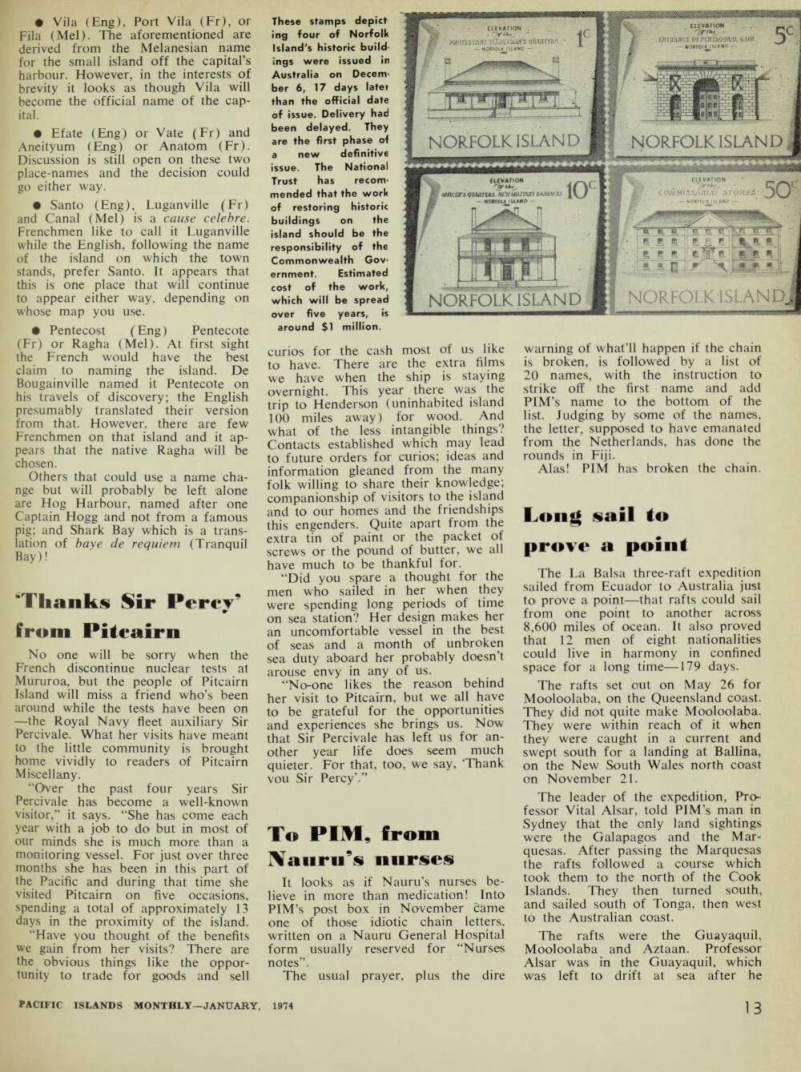
These stamps depict ing four of Norfolk Island's historic build ings were issued in Australia on Decem ber 6, 17 days later than the official date of issue. Delivery had been delayed. They are the first phase of a new definitive issue. The National Trust has recom mended that the work of restoring historic buildings on the island should be the responsibility of the Commonwealth Gov ernment. Estimated cost of the work, which will be spread over five years, is around $1 million.
and three of his companions were lifted from it by a Royal Australian Navy ship, the Labuan, off the Aus tralian coast. The Mooloolaba and the Aztaan were left at Ballina.
Sometimes the rafts sailed close to gether, almost at arm’s length. Some times they were several miles apart.
When passing south of Tonga the Mooloolaba disappeared and did not reappear for eight days. But that was only a slightly worrying incident for by that time all the men had full confidence in each other and their rafts.
The rafts passed eight ships. Apart from that their only company was sharks, which always seemed to be present, and a few whales. TTie men supplemented their rations with fish, which they caught almost daily, and they caught rainwater for drinking and ablutions.
The professor, who said he wouldn’t repeat the trip, intended to return to New Mexico, where he now lives, to build rafts for sale, an occu pation he has followed for nine years.
Before going to New Mexico he was professor of business administration at San Tander University in Spain.
The eight nationalities in the expe dition were Spanish, French, American, Ecuadorian, Mexican, Chilean, French Canadian and English Canadian. Among them were geologists, engineers, students and a businessman.
Late in November the men spent a few days sightseeing in Sydney before deciding on their next moves. During a tour of the Opera House, Professor Alsar insisted that he and his com panions sing Spanish songs in the 2,700-seat concert hall to a small audience of journalists, photographers and Opera House staff.
The bishop a
real sky pilot
Bishop Leo Arkfeld—farm boy, pilot, educationist, ship’s captain, radio operator—celebrated the silver anniversary of his ordination to the episcopacy at Wewak, on Papua New Guinea’s north-west coast, on November 28.
It was not long after his arrival in PNG in 1948 to help in the re staffing of war-devastated coastal mission stations that Leo Arkfeld really got off the ground.
Always an aviation enthusiast, he quickly realised that the best way to spread the word in the rugged PNG countryside was by air—and within months he had won his pilot’s licence.
Not long afterwards he pioneered two-way radio mission communi cations.
In the 25 years since his arrival
he has flown 8,000 hours involving a distance of around 800,000 miles.
Today there are 45 mission airstrips in the Wewak diocese and from the original de Havilland Auster mono plane the mission fleet has grown into a fully-fledged airline operating as Wirui Air Services.
Where have all
the $$ gone?
“Bring out your coins” is the cry on Niue and Nauru where there is a coin famine. In fact Niue’s latest issue of dollar (NZ) coins has com pletely disappeared into collectors’ pockets.
They’re not ordinary coins. They're commemorative coins from the New Zealand Treasury. A thousand were sent to Niue to replace the dollar note because paper money has a short life on the island, as it has on any of the South Pacific Islands. As few Islanders carry wallets, notes are carried in hands or pockets and what with that and the humidity, they become like pieces of dirty rag and then disintegrate.
Last year, Niue got a thousand dollar coins from New Zealand. Now they’ve asked for 2,000 with the hope that avaricious collectors will have already got all the coins they want.
The Bank of New South Wales on Nauru has the same worry.
There’s an acute shortage of coin and Christmas is coming. So an appeal has gone out to those who may be
hoarding them to return them to the bank in exchange for notes. This, says the bank, will greatly assist the free flow of transactions over the busy period.
Monument to
racial tolerance
Fiji plans to build a monument to racial tolerance, a cultural centre near Nadi in Fiji which will include a public library, theatres for dances, drama and music, model Pacific Island villages and parks. The Fiji Prime Minister, Ratu Sir Kamisese Mara, as centre president, has launched a national appeal for funds to help to set up the $2 million centre.
The centre has been in the plan ning stage for the last year, pie executive director is Senator Vive kanand Sharma. He said that several overseas governments had promised support for the proposal—practical support in terms of finance and expert staff.
“It is the avowed intention of the centre to nourish and develop the traditions and cultures of every race of our society,” Senator Sharma said.
Ratu Sir Kamisese, opening the appeal, said that in a multi-racial society, trust, understanding and tolerance were the cornerstones of peace and order. There were pro visions in the constitution to safe guard the cultures and interests of the various units which made up the multi-racial society of Fiji.
But a mere provision in the consti tution was not enough. More positive steps were needed, and the cultural centre was a positive step. It was an ambitious plan to bring together the many cultures of Fiji. Fiji would show to all what could be achieved by co-operation and mutual respect.
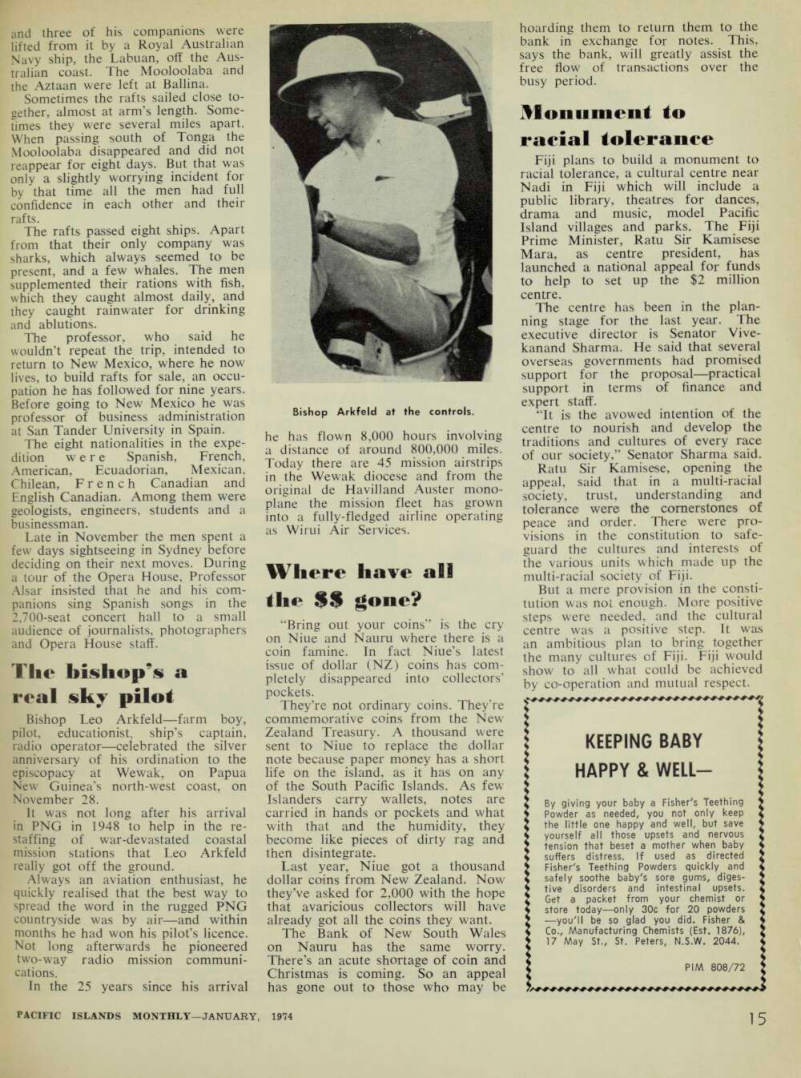
Bishop Arkfeld at the controls.
Advertisements & other items, pp. 16-19 (1 item)
Holden Handies It Better. I
WHEN THE GOING GETS TOUGH...
The sleek silhouette of Holden with its clean modern lines, excellent visibility and luxury comfort features sets the pace for others to follow throughout 72 countries.
Beneath its superbly engineered body is the muscle which has made Holden famous throughout the Pacific.
Holden built strong, built right with all these features: ■ Four-coil suspension ■ Insulated front chassis frame ■ Wide track stability ■ GM proven safety features ■ Forward mounted positive steering ■ 6 or 8-cylinder dependable power For 21 years Holden has been the sales leader because of its unchallenged reliability under all operating conditions. a Holden is backed by the most comprehensive dealer network providing GM maintenance service and genuine GM spare parts.
COOK ISLANDS: Cook Islands Trading Co. Ltd. FIJI islands: Burns Philp (South Sea) Co.
NEW Caledonia: Etablissements Ballande new Hebrides: Comptoir Francais des Nouvelles NORFOLK ISLAND: Sirius Motors Ltd. PAPUA NEW GUINEA: Tutt Bryant Pacific Ltd.
TONGA: Burns Philp (South Sea) Co. western SAMOA: O. F. Nelson & Co. Ltd.
A 558
KEEPING BABY
HAPPY & WELL-
By giving your baby a Fisher's Teething Powder as needed, you not only keep the little one happy and well, but save yourself all those upsets and nervous tension that beset a mother when baby suffers distress. If used as directed Fisher's Teething Powders quickly and safely soothe baby's sore gums, digestive disorders and intestinal upsets.
Get a packet from your chemist or store today—only 30c for 20 powders —you'll be so glad you did. Fisher & Co., Manufacturing Chemists (Est. 1876), 17 May St., St. Peters, N.S.W. 2044.
PIM 808/72
8228
IPC,
I
When you buy a
machine, make sure
everything you need
comes with it.
m m. 6* r wm And that includes a good dealer. Because even the best machines and best tools dont last forever. Then you need help . . and if it wasn't there to begin with it won't be there when you need it.
So evaluate the dealer behind the machine as carefully as you do the machine itself.
C.T.E. is a well established Caterpillar Dealer in the South Pacific with immediate Parts availability and unsurpassed in-shop or in-the-field service by fully qualified servicemen. , .. f AnH that’* A single source . . for parts, service, financing and machines. Thats what you ve been looking for. And thats what we can offer you.
L
CARPENTERS
TRACTOR E EQUIPMENT
YOUR
CATERPILLAR
DEALER
POSTAL: PRIVATE MAIL BAG SUVA FIJI ISLANDS. PHONE:24OST4
TELEX: CARPTRAC FJ2190. CABLES: CARPTRAC. SUVA
SERVING THE SOUTH PACIFIC ISLANDS
Become a part of PlM's
Pacific and subscribe now.
Pacific Islands
Monthly
Keeps you informed on
Pacific happenings.
The Pacific is PIAA!
For more than 40 years PIM has been reporting on events in the Pacific. Social and political changes, economic development, historical background, regular columnists and commentators, personalities and travel.
You'll read:— • A big magazine section • Extracts from the Islands Press • Fascinating historical articles • Island creative writers • Tropicalities • Shipping and cruising yachts • News of sport • Letters from readers • Business and development news • Plus all the latest Pacific news and views
Fill in the details
on the attached
order form .
Politicians to appoint PNG's

top public servants?
From a Port Moresby correspondent
The national convention of the Pangu Pati has outlined far-reaching new policies for the party, which could affect the direction in which self-governing Papua New Guinea heads.
The Pangu Pati is Mr Michael Somare’s party, and is the main plank of the present PNG coalition headed by Mr Somare. The coalition also comprises the Peoples Progress Party, the National Party, the Mataungan Association, as well as independents.
About 100 delegates from most districts attended the convention in Port Moresby. They elected as new national president, Mr Moi Avei, and as vice-president Mr Somare’s close adviser and one of the architects of the Pangu Pati, Tony Voutas, Other members of the executive are Pangu ministers, the Speaker of the House, Mr Barry Holloway, and district leaders of Pangu branches throughout PNG.
If implemented, some of the new policies would mean creation of political patronage in the public service.
Politics
The convention decided that the party’s new policies should be guided by the following broad aims: • That public servants may take active part in political party activities at all levels; • That departmental and divisional heads must be political appoint ments; • That District Commissioners should be appointed on a political basis; • That a political body, totally independent of the Public Service Board, should carry out a com plete review of the organisational structure of the public service, with a view to reform.
Commenting on these resolutions, Mr Avei, said that the convention recognised that re-organisation of the public service was essential to im plement the government aims, and
it was “becoming obvious that there must be substantial politicisation of the public service.”
Local government
Mr Avei said that the main aim of the new policy on local govern ment, education and business develop ment was to recognise and involve the strengths and traditions existing in the village communities of PNG in these areas. New policy would be that: • The party recognise that there had always been traditional systems of local government, village welfare and education in village life and that these should be incorporated into policy in these fields; • The government should give full support to all organisations which represented PNG aspirations at a local level, which wished to com mence forms of business or other development; • Children should attend schooling from an earlier age, five to six years, and that their education should continue to form two level or equivalent of a form two level, and that it should properly prepare them for a useful and meaningful role in the community; • There should be no selection examinations at a standard six level; • That the national education policy should re-orientate itself to these aims and should include such traditional activities, including crafts and other social activities, as fishing, hunting etc, to properly prepare New Guinean children for adult life within a PNG community; • Parents should be encouraged to take a greater interest in and involvement with the education of their children.
Foreign investment
Mr Avei said that the foreign investment policy must be geared to implement government aims of a rapidly increasing involvement of New Guineans in all forms of econo mic enterprise. The following policies were laid down by the convention:
One name, one country
• All production stages of primary industries should come under the control of New Guineans; • Preference must be given to New Guinean entrepreneurs who wished to buy out businesses being sold by expatriate companies; • The government must lay down a timetable of periods during which foreign investment will be welcome in individual business sectors. After these periods ex pire, no further foreign invest ment should be allowed in these fields and legitimate efforts should be made to buy out all exist ing foreign investment in those categories; • Joint venture enterprises are wel come provided that the expatriate element “phases out” its equity within 15 to 25 years, so that the enterprise is totally New Guinean. Part of profits of the venture should be used to in crease the PNG equity. However, if the PNG element is in a position to acquire total equity before 15 years then it should have this option; 0 Where there is large foreign owned investment in secondary industries, wholly New Guinean enterprises should supply all relevant servicing industries; • All new foreign investment must establish an increasing PNG shareholding as a condition of its entry into the country; • In all resource industries the com pany must provide the people of PNG a percentage of free shareholding.
National unity
Mr Avei said that the convention had re-affirmed the Pangu policy of national unity. The convention adopted the following policies: • A new single name for the country; 0 Re-affirmation of the Pangu policy—one name, one country, one people; 0 Emphasis should be laid by the government on development of the so far neglected districts; • More power should be given by the central government to dis tricts.
In summing up, Mr Avei said that in the past, there had been far too much talk about the principles of self reliance and equality, and not enough initiative to put these aims into action.
“This development and implemen tation must utilise the strengths of our village communities,” he said. “We cannot hope to do this by using the foreign institutions which have been brought here from outside, unless these institutions are in a supplemen tary role.
“In other words, we must revitalise our development programme, basing it on our own strengths, and in corporating imported ideas, only as they can be modified to achieve our aims.”
Opposition reaction
The Pangu Pati’s proposals brou ght swift reaction from the United Party which, according to Opposition Leader and United Party leader Mr Tei Abal, is “shocked and dis mayed at the new policies,” particu larly with regard to political patron age in the public service.
Declared Mr Abal: “The Pangu Pati is calling for what it calls ‘politicisation’ of the public service.
This is frankly ridiculous, unless a public service, which could serve a democratic government, is to be de stroyed and replaced.
“A public servant should be a man skilled in his job. He is a profess ional man. He is not a politician.
His appointment should not be poli tical. His ambition should be to serve the public as well as he can, not to climb the political party ladder.
“He should be picked for his ability to do the particular job he is given.
Ability means that he should know the work, be qualified and as ex perienced as possible. What kind of
men are we going to get in these jobs if the appointments are political?
“In his statement last December the late Mr Tollman expressed a fear of ministers dragging their wantoks into positions in the public service which they would be unqualified for.
The new Pangu policies would leave our public service wide open to this kind of dealing.
“This is the kind of arrangement one normally associates with a dic tatorship, rather than a democratic government.”
Mr Abal also attacked the govern ment’s plans for legalising the basic rights of investors in PNG and set ting up a National Investment and Development Authority (NIDA) to control foreign investment.
“The Pangu Pati’s policies on in dustry and foreign investment are equally alarming,” he said.
“Both seem aimed at squeezing out overseas interest as quickly as possible. Such policies lead to half hearted investment and management.
We want our people to be involved in strong, healthy and well run en terprise and we will only get this if investors have confidence in our policies.
“We want to develop our industries and the ability of the people of Papua New Guinea to manage these industries to the advantage of this country. But we cannot afford to be insular. Foreign investment and inter national trade are facts of life in the modem world.
“We have to develop our industry with an eye on the rest of the world.
We have to develop relations with business in other countries. We need the help and advice of these very experienced overseas concerns. The greatest challenge to developing coun tries today is modernisation. We have only a few years to fit into a world that has had centuries to develop its industries and societies.
“Obviously foreign investors in vest for their own good, but we can profit by their investments too. The Pangu Pati talks blithely of buying out foreign investments in various categories. But it is not just a matter of buying, its the ability to run them that we need.
“When will the Pangu Pati realise that we are a very, very young coun try, with a lot to learn. We need all the advice and support we can get at the present time, and for a long time to come. We cannot expect this advice and support by shutting the door on the outside world.
“The United Party strongly ex presses its condemnation of these policies.”
Mr Tei Abal.
Advertisements & other items, pp. 20-22 (1 item)
Qrnott's/ Biscuits
Sugg as® M wmm m i m%WsMm M £2 n
BBS*
& ms. stsa E&? »•
Give your family
these all-time favourites
from Arnott’s
Everybody likes them! Nourishing Milk Arrowroot... tasty Nice.. . delicious Coconut Bar... the egg-and-butter goodness of Scotch Finger... they’re all-time family favourites from the great big Arnott’s range. Taste them!
The triple-wrapped packs keep the biscuits fresh .
Qrnott's/ Biscuits
There is no Substitute for Quality
Save hundreds of dollars
on Australians most efficient
WALK IN, ALUMINIUM
COOLROOMS AND
FREEZE ROOMS
Hundreds already installed! The most economical supplementary coolrooms for bottles and food, providing the largest storage capacity of any comparable coolrooms of the same exterior dimensions. Five sizes —from 90-360 cu. ft. capacity; 16 models offering normal temp., two temp., deep freeze, or for pastry and ice storage applications. White vinyl interior, embossed rustproof aluminium exterior. • SUPPLIED IN EASY-TO-ERECT, DO-IT-YOURSELF KIT FORM • PETROL AND PETROL-ELECTRIC MODELS ARE AVAILABLE FOR AREAS WHERE POWER IS LIMITED OR NON-EXISTENT Available from: AUSTRALIAN NEW CALEDONIA EXPORTS (SILVER & BARDA), 363 George St., Sydney, 2000 and Branches.
BRECKWOLDT & CO., 276 Pitt St., Sydney, 2000 and Branches.
PETER FISHER TRADING PTY. LTD., 321 Pitt St., Sydney, 2000.
HAGEMEYER (A'SIA), 59 Anzac Pde., Kensington, 2033 and Branches.
Manufactured by:
KERR BROS, 65 York St., Sydney, 2000.
NELSON & ROBERTSON PTY. LTD., 197 Clarence St., Sydney 2000.
RABAUL TRADING CO. PTY. LTD., P.O. Box 219, Rabaul and Branches.
ROY GALLIMORE & ASSOCIATES, P.O. Box 179, Vila, New Hebrides.
C. SULLIVAN (EXPORT) PTY. LTD., 60 Margaret St., Sydney, 2000 and Branches.
W. S. TAIT & CO. PTY. LTD., 31 Macquarie Place, Sydney, 2000 and Branches. 199 Parramatta Road, Cnr. Skarratt Street, Auburn, N.S.W. 2144, Australia. Phone: 648-1711.
Powered by Kelvinator.
Five-year warranty on compressor. Early delivery.
Make light work of it!...
m tm
wRm
OTHER HANOI PRODUCTS!
‘Handi’ range of quality products also includes: a portable Twin - Burner Stovette and ‘Handi’ Pumpless Petrol Iron.
Keep a
handy!
B No need to fumble and fume! Throw light on the subject with a ‘Handi’. It’s twice as bright as electric light. Completely stormproof. Simple and safe to use.
PRESSURE OPERATED
One filling gives 12 hours of brilliant 300 candle-power lighting. Built to last, with chromed, rust - proofed finish. Petrol or Kerosene models.
Ask for Handi! Everywhere!
HANOI WORKS EB:
Evans Rd., Salisbury North. Ph. 47 2122
BRISBANE, QUEENSLAND, AUSTRALIA
Micronesian status talks collapse over
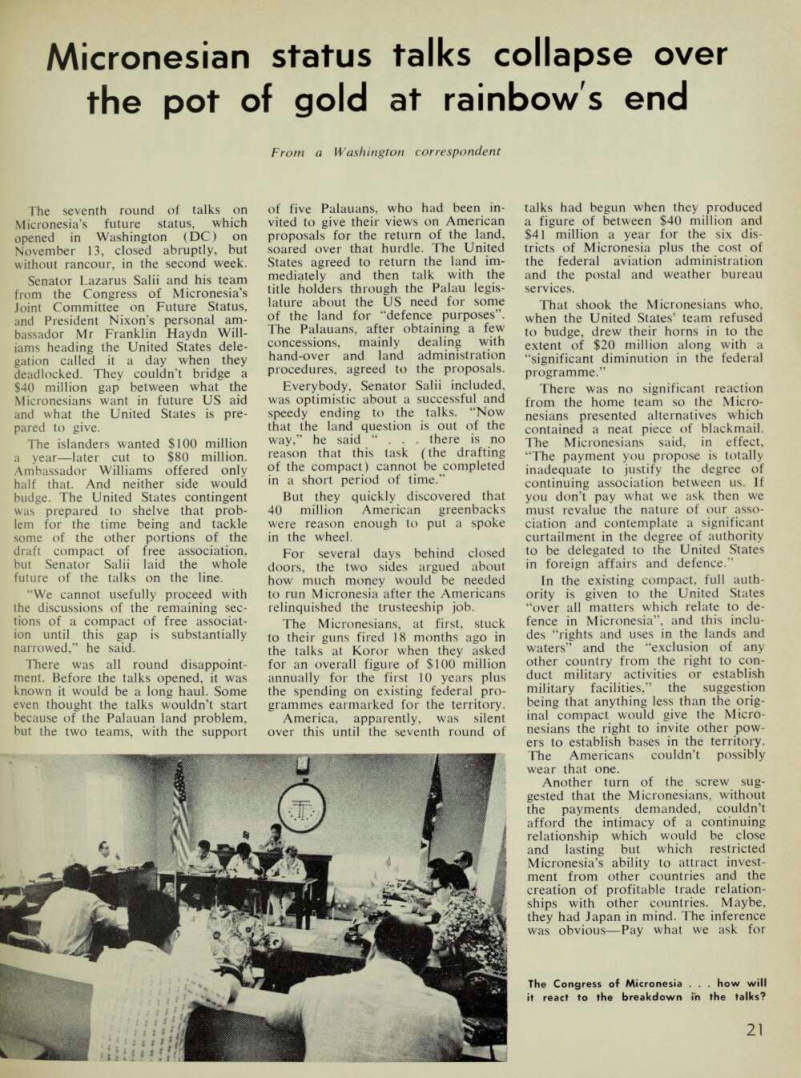
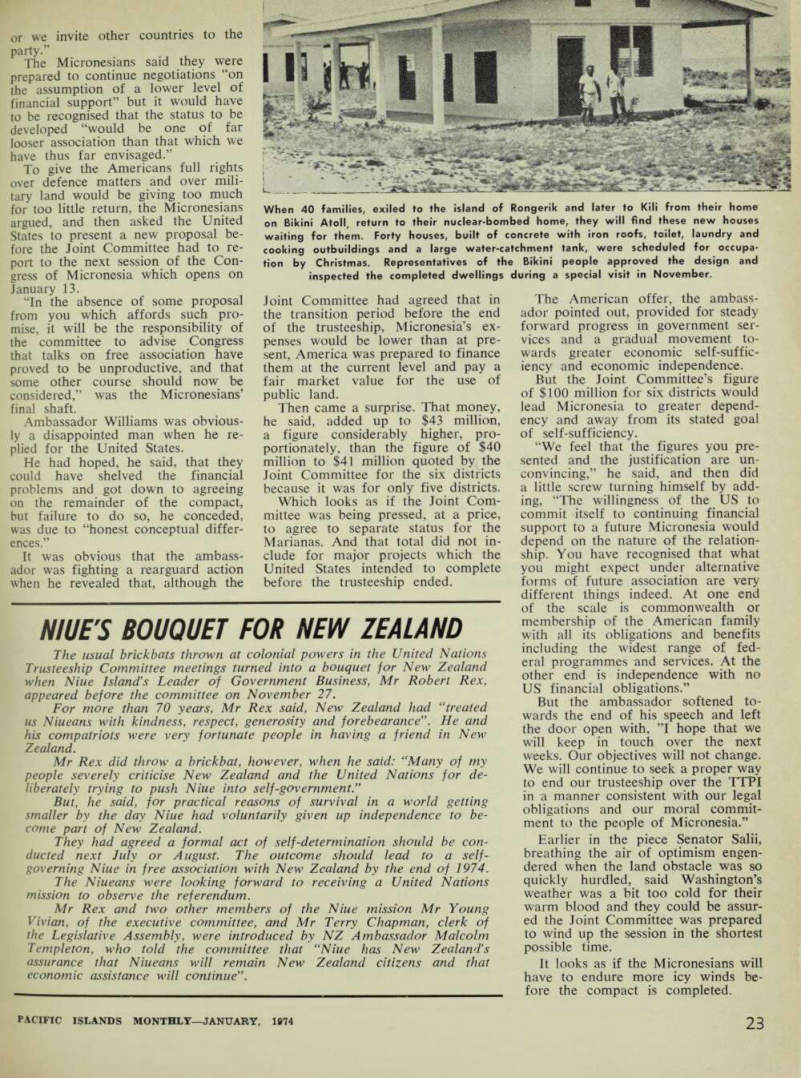
the pot of gold at rainbow's end
From a Washington correspondent
The seventh round of talks on Micronesia’s future status, which opened in Washington (DC) on November 13, closed abruptly, but without rancour, in the second week.
Senator Lazarus Salii and his team from the Congress of Micronesia’s Joint Committee on Future Status, and President Nixon’s personal ambassador Mr Franklin Haydn Williams heading the United States delegation called it a day when they deadlocked. They couldn’t bridge a $4O million gap between what the Micronesians want in future US aid and what the United States is prepared to give.
The islanders wanted $lOO million a year—later cut to $BO million.
Ambassador Williams offered only half that. And neither side would budge. The United States contingent was prepared to shelve that problem for the time being and tackle some of the other portions of the draft compact of free association, but Senator Salii laid the whole future of the talks on the line.
“We cannot usefully proceed with the discussions of the remaining sections of a compact of free association until this gap is substantially narrowed,” he said.
There was all round disappointment. Before the talks opened, it was known it would be a long haul. Some even thought the talks wouldn’t start because of the Palauan land problem, but the two teams, with the support
of five Palauans, who had been in vited to give their views on American proposals for the return of the land, soared over that hurdle. The United States agreed to return the land im
mediately the^
fitle holders through the P a l au legis lature about the US need for some of the land for defence purposes .
The Palauans, after obtaining a few concessions, mainly dealing with hand-over and land administration procedures, agreed to the proposals.
Everybody, Senator Salii included, was optimistic about a successful and speedy ending to the talks. “Now that the land question is out of the way, he said .. . there no reason that this task (the drafting the compact) cannot be completed in a short period of time, But they quickly discovered that 40 million American greenbacks were reason enough to put a spoke in the wheel.
For several days behind closed doors, the two sides argued about how much money would be needed to run Micronesia after the Americans relinquished the trusteeship job.
The Micronesians, at first, stuck to their guns fired 18 months ago in the talks at Koror when they asked for an overall figure of $lOO million annually for the first 10 years plus the spending on existing federal pro grammes earmarked for the territory, America, apparently, was silent over this until the seventh round of
talks had begun when they produced a figure of between $4O million and $4l million a year for the six dis tricts of Micronesia plus the cost of the federal aviation administration and the postal and weather bureau services.
That shook the Micronesians who, when the United States’ team refused to budge, drew their horns in to the extent of $2O million along with a “significant diminution in the federal programme.”
There was no significant reaction from the home team so the Micro nesians presented alternatives which contained a neat piece of blackmail.
The Micronesians said, in effect, “The payment you propose is totally inadequate to justify the degree of continuing association between us. If you don’t pay what we ask then we must revalue the nature of our asso ciation and contemplate a significant curtailment in the degree of authority to be delegated to the United States in foreign affairs and defence.”
In the existing compact, full auth ority is given to the United States “over all matters which relate to de fence in Micronesia”, and this inclu des “rights and uses in the lands and waters” and the “exclusion of any other country from the right to con duct military activities or establish military facilities,” the suggestion being that anything less than the orig inal compact would give the Micro nesians the right to invite other pow ers to establish bases in the territory.
The Americans couldn’t possibly wear that one.
Another turn of the screw sug gested that the Micronesians, without the payments demanded, couldn’t afford the intimacy of a continuing relationship which would be close and lasting but which restricted Micronesia’s ability to attract invest ment from other countries and the creation of profitable trade relation ships with other countries. Maybe, they had Japan in mind. The inference was obvious—Pay what we ask for
The Congress of Micronesia . . . how will it react to the breakdown in the talks?
or we invite other countries to the
party.”
The Micronesians said they were prepared to continue negotiations “on the assumption of a lower level of financial support” but it would have to be recognised that the status to be developed “would be one of far looser association than that which we have thus far envisaged.”
To give the Americans full rights over defence matters and over mili tary land would be giving too much for too little return, the Micronesians argued, and then asked the United States to present a new proposal be fore the Joint Committee had to re port to the next session of the Con gress of Micronesia which opens on January 13.
“In the absence of some proposal from you which affords such pro mise, it will be the responsibility of the committee to advise Congress that talks on free association have proved to be unproductive, and that some other course should now be considered,” was the Micronesians’ final shaft.
Ambassador Williams was obvious ly a disappointed man when he re plied for the United States.
He had hoped, he said, that they could have shelved the financial problems and got down to agreeing on the remainder of the compact, but failure to do so, he conceded, was due to “honest conceptual differ ences.”
It was obvious that the ambass ador was fighting a rearguard action when he revealed that, although the
Joint Committee had agreed that in the transition period before the end of the trusteeship, Micronesia’s ex penses would be lower than at pre sent, America was prepared to finance them at the current level and pay a fair market value for the use of public land.
Then came a surprise. That money, he said, added up to $43 million, a figure considerably higher, pro portionately, than the figure of $4O million to $4l million quoted by the Joint Committee for the six districts because it was for only five districts.
Which looks as if the Joint Com mittee was being pressed, at a price, to agree to separate status for the Marianas. And that total did not in clude for major projects which the United States intended to complete before the trusteeship ended.
The American offer, the ambass ador pointed out, provided for steady forward progress in government ser vices and a gradual movement to wards greater economic self-suffic iency and economic independence.
But the Joint Committee’s figure of Sioo million for six districts would lead Micronesia to greater depend ency and away from its stated goal of self-sufficiency.
“We feel that the figures you pre sented and the justification are un convincing,” he said, and then did a little screw turning himself by add ing, “The willingness of the US to commit itself to continuing financial support to a future Micronesia would depend on the nature of the relation ship. You have recognised that what you might expect under alternative forms of future association are very different things indeed. At one end of the scale is commonwealth or membership of the American family with all its obligations and benefits including the widest range of fed eral programmes and services. At the other end is independence with no US financial obligations,”
But the ambassador softened to wards the end of his speech and left the door open with, ”1 hope that we will keep in touch oyer the next weeks. Our objectives will not change.
We will continue to seek a proper way to end our trusteeship over the TTPI in a manner consistent with our legal obligations and our moral commit ment to the people of Micronesia.”
Earlier in the piece Senator Salii, breathing the air of optimism engen dered when the land obstacle was so quickly hurdled, said Washington’s weather was a bit too cold for their warm blood and they could be assur ed the Joint Committee was prepared to wind up the session in the shortest possible time.
It looks as if the Micronesians will have to endure more icy winds be fore the compact is completed.
When 40 families, exiled to the island of Rongerik and later to Kili from their home on Bikini Atoll, return to their nuclear-bombed home, they will find these new houses waiting for them. Forty houses, built of concrete with iron roofs, toilet, laundry and cooking outbuildings and a large water-catchment tank, were scheduled for occupa tion by Christmas. Representatives of the Bikini people approved the design and inspected the completed dwellings during a special visit in November.
Advertisements & other items, p. 24 (1 item)
Huon Gulf Motel
In Lae, we’re the motel
people come back to.
They come back for a dip in our pool, the individually air conditioned, comfortably fitted units, first class fully licensed restaurant, our friendliness, our cocktail bar, and attention to the finest detail.
In Lae, stay at the Huon Gulf, and next time round you’ll come back.
Book direct, or through any office of Ansett Airlines.
Huon Gulf Motel
Markham Road, Lae. Phone: Lae 42 4844 A Division of Ansett Transport Industries Limited
AHO/228R
YOU LL WELCOME OUR TROPICAL
MODULAR HOME UNITS...IN EVERYWAY!
• PRE-CONSTRUCTED IN N.Z. AND
PRE-TREATED FOR TROPIC CONDITIONS
• SHIPPED KNOCKED-DOWN TO YOUR
DESTINATION
• EASILY ERECTED ON SITE WITH MINIMUM
SKILLED LABOUR
• OFFER LUXURY AT A REASONABLE PRICE Perfect for holiday and permanent homes or commercial and industrial housing projects. 4 models to choose from: Leisu redeck', (illustrated) ‘Sunseeker’, ‘Castaway', Sunlover’ in 1,2,3-bedroom units. . . modular construction streamlines design, gives flexibility . . . pre-construction cuts costs and assembly-but not quality. . . maintenance-free pre-coated insulated Permalum metal weather-boarding . pre-piped plumbing unit. Plus many other quality features!
Already performance-proven in the New Hebrides, Pitcairn and Japan. m
welcome!homes limited
Mail this coupon now!
Like to know more?
To: The Manager, Welcome Homes Ltd Box 12203, Penrose, Auckland, N.Z.
Please send me, without obligation, brochureson your Modular Home Units.
Name ..
Address Property Located At 64^J
Niue's Bouquet For New Zealand
The usual brickbats thrown at colonial powers in the United Nations Trusteeship Committee meetings turned into a bouquet for New Zealand when Niue Island’s Leader of Government Business, Mr Robert Rex, appeared before the committee on November 27.
For more than 70 years, Mr Rex said, New Zealand had “treated us Niueans with kindness, respect, generosity and forebearance”. He and his compatriots were very fortunate people in having a friend in New Zealand.
Mr Rex did throw a brickbat, however, when he said: “Many of my people severely criticise New Zealand and the United Nations for de liberately trying to push Niue into self-government.”
But, he said, for practical reasons of survival in a world getting smaller by the day Niue had voluntarily given up independence to be come part of New Zealand.
They had agreed a formal act of self-determination should be con ducted next July or August. The outcome should lead to a self governing Niue in free association with New Zealand by the end of 1974.
The Niueans were looking forward to receiving a United Nations mission to observe the referendum.
Mr Rex and two other members of the Niue mission Mr Young Vivian, of the executive committee, and Mr Terry Chapman, clerk of the Legislative Assembly, were introduced by NZ Ambassador Malcolm Templeton, who told the committee that “Niue has New Zealand’s assurance that Niueans will remain New Zealand citizens and that economic assistance will continue”.
When Corned
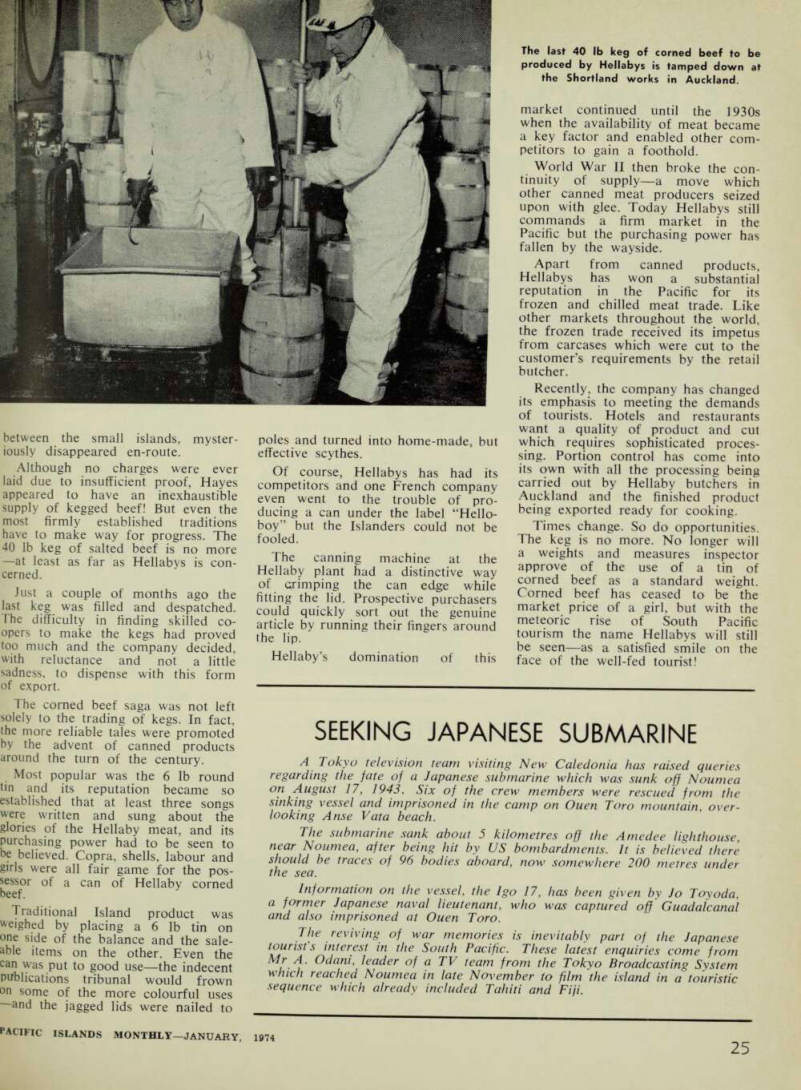
Beef Was King
From a special correspondent Look at a can or keg of corned beef and imagine drama, mystery, intrigue and romance! Difficult? Yet this humble product has been the cause of all criteria.
And as far as R. & W. Hellaby Limited is concerned, corned beef has the additional credit of founding an export business which today earns more than $5O million in overseas exchange each year. Hard to believe?
One hundred years ago, the brothers Richard and William Hel laby founded the business with the purchase of a small butcher shop in down-town Auckland.
Exporting had not been heard of and it certainly did not present the brothers with any flash of inspira tion. They were much more interested in surviving and recouping some of the finance and confidence which had been lost during their brief excursion in the realms of gold searching in Otago and Thames.
Fortunately, Richard and William were astute businessmen and estab lished the pattern of paying for the meat at the highest possible value to the producer and relying on the by products to produce the profit.
Just how successfully this philo sophy worked can be gauged from their business progress. Within three years of paying $l2O for Hammond’s butcher shop, they had moved further up Shortland Street into much larger premises and had added fertiliser and ice-making to their production.
They also began to keg and salt beef—a process that was well enough known to mariners but not parti cularly popular with local trade.
Some of the kegs of beef even tually found their way to the Pacific Islands and the reception was so dramatic that within a few years a regular export trade developed. It was the reputation of the Hellaby beef which gave rise to the first crop of rumours.
Tales drifted back to New Zealand that the sea rover Bully Hayes had discovered that kegged beef could purchase anything he needed in the Islands and more than one small trading vessel, transporting the kegs
between the small islands, myster iously disappeared en-route.
Although no charges were ever laid due to insufficient proof, Hayes appeared to have an inexhaustible supply of kegged beef! But even the most firmly established traditions have to make way for progress. The 40 lb keg of salted beef is no more —at least as far as Hellabys is con cerned.
Just a couple of months ago the last keg was filled and despatched.
The difficulty in finding skilled co opers to make the kegs had proved too much and the company decided, with reluctance and not a little sadness, to dispense with this form of export.
The corned beef saga was not left solely to the trading of kegs. In fact, the more reliable tales were promoted by the advent of canned products around the turn of the century.
Most popular was the 6 lb round tin and its reputation became so established that at least three songs were written and sung about the glories of the Hellaby meat, and its purchasing power had to be seen to be believed. Copra, shells, labour and girls were all fair game for the pos sessor of a can of Hellaby corned beef.
Traditional Island product was weighed by placing a 6 lb tin on one side of the balance and the sale able items on the other. Even the can was put to good use—the indecent publications tribunal would frown on some of the more colourful uses —and the jagged lids were nailed to
poles and turned into home-made, but effective scythes.
Of course, Hellabys has had its competitors and one French company even went to the trouble of pro ducing a can under the label “Hello boy” but the Islanders could not be fooled.
The canning machine at the Hellaby plant had a distinctive way of crimping the can edge while fitting the lid. Prospective purchasers could quickly sort out the genuine article by running their fingers around the lip.
Hellaby’s domination of this
market continued until the 1930 s when the availability of meat became a key factor and enabled other com petitors to gain a foothold.
World War II then broke the con tinuity of supply—a move which other canned meat producers seized upon with glee. Today Hellabys still commands a firm market in the Pacific but the purchasing power has fallen by the wayside.
Apart from canned products, Hellabys has won a substantial reputation in the Pacific for its frozen and chilled meat trade. Like other markets throughout the world, the frozen trade received its impetus from carcases which were cut to the customer’s requirements by the retail butcher.
Recently, the company has changed its emphasis to meeting the demands of tourists. Hotels and restaurants want a quality of product and cut which requires sophisticated proces sing. Portion control has come into its own with all the processing being carried out by Hellaby butchers in Auckland and the finished product being exported ready for cooking.
Times change. So do opportunities.
The keg is no more. No longer will a weights and measures inspector approve of the use of a tin of corned beef as a standard weight.
Corned beef has ceased to be the market price of a girl, but with the meteoric rise of South Pacific tourism the name Hellabys will still be seen—as a satisfied smile on the face of the well-fed tourist!
The last 40 Ib keg of corned beef to be produced by Hellabys is tamped down at the Shortland works in Auckland.
Advertisements & other items, p. 26 (1 item)
Keep those “Growing Older”
; m
signs at bay
The one possession that no woman would ever think of exchanging is the gift of a smooth flawless complexion.
Yet it is surprising that some women virtually surrender this prize possession as they grow older, in the mistaken belief that the outward signs of age are an inevitable result of the ageing process.
However, with the discovery of a tropically moist oil blend, modern science has provided the means whereby flaky patches and fine lines can be alleviated and the complexion assisted to retain its youthful softness and smoothness.
Everyone is born with a smooth, flawless baby-soft skin which is sustained through the early years by a plentiful supply of natural oil and moisture (sebum). As we grow older the body processes slow down, the glands do not produce sufficient fluids, and unless special care is taken the skin will deteriorate and wrinkle dryness will result.
Restore Skin Radiance How to restore that ‘baby’ bloom and counteract ageing skin? The answer
—use this moist oil blend to supplement the diminishing supply of natural fluids and restore smoothness and radiance to the skin. Known here as Oil of Ulan, the moist oil blend is identical in structure to the skin’s sebum and is thus able to merge readily with it and achieve the ideal level necessary to maintain a soft, naturally fresh complexion beauty.
An inevitable film of this moist oil blend should be smoothed over the face and neck each morning before applying make-up to ensure that your cosmetics will stay matt, and to protect your complexion through the day against the effects of the weather and artificial elements such as airconditioning. At night smooth your Oil of Ulan moist oil blend generously into the complexion for it will then exert its remarkable smoothing and softening influence on your skin while you are asleep.
Seeking Japanese Submarine
A Tokyo television team visiting New Caledonia has raised queries regarding the fate of a Japanese submarine which was sunk off Noumea on August 17, 1943. Six of the crew members were rescued from the sinking vessel and imprisoned in the camp on Ouen Toro mountain, over looking Arise Vat a beach.
The submarine sank about 5 kilometres off the Amedee lighthouse, near Noumea, after being hit by US bombardments. It is believed there should be traces of 96 bodies aboard, now somewhere 200 metres under the sea.
Information on the vessel, the Igo 17, has been given by Jo Toyoda, a former Japanese naval lieutenant, who was captured off Guadalcanal and also imprisoned at Ouen Toro.
The reviving of war memories is inevitably part of the Japanese tourists interest in the South Pacific. These latest enquiries come from Mr A. Odani, leader of a TV team from the Tokyo Broadcasting System which reached Noumea in late November to film the island in a touristic sequence which already included Tahiti and Fiji.
Assembly's Last 'Colonial' Session
Power Transfer Main Dish In Png
From a Port Moresby correspondent
The November meeting of PNG’s House of Assembly was its last be fore self-government, and during its 10 sitting days it despatched a var ied menu of bills, motions and reports.
A group of three liquor bills, based on the recommendations of a Com mission of Inquiry, were passed. One of them, the major one of the three, underwent a certain amount of amendment during the committee stage, but its basic “tough” provis ions were unchanged. The mood of the government, and of the nation, is undoubtedly one of toughness towards the abuse of liquor.
The second major measure enacted, the Village Courts Bill, also meets a widespread public demand for bet ter, quicker and more “melanesian” justice at the village level. Enthus iasm for the basic idea may have re sulted in a close look at the details, particularly those relating to appeals, than might have been desirable. Time alone will show whether these courts will live up to the high expectations entertained for them, or whether disillusion will set in.
Most of the remaining bills were concerned with the transfer of powers from Canberra to Port Moresby in preparation for Self-government Day on December 1. The Opposition made disapproving noises about the inadequate time allowed for their examination, but did not obstruct their passage.
The Minister for Agriculture, Stock and Fisheries, Mr lambakey Okuk, was not so lucky when he sought leave to bring down a group of five bills relating to fisheries and desig ned to ensure that after December 1 the PNG Government should control PNG’s coastal waters as well as its land masses. After an exchange of heated personalities with United Party’s Anton Parao, a fellow High lander, Mr Okuk was refused leave to present the bills.
Two very important reports were tabled on this occasion—the second interim report of the Constitutional Planning Committee and the final report of the Committee of Inquiry into Land Matters.
The Constitutional Planning Com mittee’s Report sprang no surprises but followed expected lines. It re commends the establishment of mid
die tier government at district rather than regional level, but proposes to rename the districts as “provinces”, in order, as the report puts it, “to signify a break from the colonial connotations, for this country, of the term district”.
The report recommends the estab lishment of provincial assemblies of between 15 and 30 members, accord ing to the population of the district, for each of the 19 districts in Papua New Guinea, with executives to be called provincial councils and with heads of government to be called premiers.
At one point the committee refers to the need “to keep expense at a moderate level”, but one cannot help wondering whether it has really worked out the likely cost of bring ing into existence a body of approx imately 300 provincial parliamen tarians in addition to the 100 national parliamentarians we already have.
If so, it hasn’t shared its findings with us.
Other important recommendations propose that there shall be no dual citizenship, and that elections for the national, and presumably for the pro vincial, assemblies shall be conduc ted on the “first past the post” rather than the present “optional preference” system.
The committee’s final report and,
hopefully, a draft Constitution basedt on it are due in February.
The Report on Land Matters is as tome of 180 pages with 132 recom mendations. It recommends that land reform should develop from a cus-. tomary base, that it must avoid col lective and individual extremes, must, keep inequalities to a minimum ancb restrain landlordism, and must favour those who are willing and able tc make use of the land. It does not* favour patching up existing legisla-j tion, which it considers should be repealed in toto and replaced by s completely new set of land laws — an exercise which may be expecteo to take some time.
An interesting current development in Papua New Guinea is for the tent dency to exclude professional lawyer from certain fields, for example, from village courts and from those dis pute settling bodies which the Comt mission on Land Matters propose: should replace the present Lam Titles Commission.
Motions included one recommend ing that the name of the nations airline should be changed from Air Niugini to Airlines of Papua Nev Guinea. This motion was carried am now goes to cabinet, which has hen so very thin ice to skate on.
On the other hand, the Govern ment survived by 46 votes to 28 censure motion touched off by th Chief Minister’s decision to includ all his ministers in Cabinet, and r consequence to increase the salan© of those who were formerly jumo ministers, from $6,000 to S7,OG p.a. Predictably this led to an n quiry as to whether the salaries o rank-and-file members were to If raised too, a question M Somare answered with a firm “nor Once again death cast a shador over proceedings of the House.
Within a few days of the attaLi ment of the self-government whio he had helped to plan and the comm into operation of the National Broai casting Commission which he h£ fathered, Mr Paulus Arek, Ministl for Information and Extension se vices, succumbed to a protracted n ness. It was sad indeed that he df not survive to see the accomplishme; of that for which he had worked hard.
Equality
Fight For
PNG Agriculture Minister lam bakey Okuk, told graduating stu dents at the Popondetta Agricul tural Training Institute in December that their work to help the PNG people might bring them into con flict with foreign interests, but if they believed their ideas were right they should fight to see them imple mented. He said development policies in the past led to inequality among New Guineans, but the PNG Govern ment’s new Eight-Point-Plan was aimed at reversing this, and the plan should be followed by graduates. The Institute, he added, was not concer ned with producing graduates with academic snobbery.
Advertisements & other items, p. 29 (1 item)
Every 7 Weeks Someone Wins
A MAGNIFICENT $45,000 HOME
LIKE THESE IH BRISBANE FOR 20'
The Mater Prize Home Art Union is something of an institution in Brisbane, with a new home being won every 7 weeks. In the past 13 years, 88 glorious Mater Homes have been built and won by delighted people throughout Australia, AND there have been quite a few winners from New Guinea!
FULLY FURNISHED
AND LANDSCAPED
The winners receive a fully furnished beautifully landscaped completely equipped home, with free title deeds, and immediate vacant possession. mm MATER HOME No. 89 is current prize home and is situated on a high and handsome homesite at Springwood, on the way to the Gold Coast. It's a $45,000 masterpiece of design and modern decor.
Drawn sth February, 1974.
Above: Mater Home No. 88 at Aspley Gardens Drawn 18th December, 1973.
Below: Mater Home No. 87 at Ridgewood Drawn 30th October, 1973.
BOOK BUYER’S PRIZE
OF A NEW TORANA
OR $2,200 HOLIDAY
By buying a book of tickets, you also have the chance of winning a new Torana Sedan or, if you prefer, a fabulous holiday to anywhere you'd like to go for $2,200.
There are other valuable prizes as well.
YOU CAN OBTAIN
TICKETS IN ALL
MATER ART UNIONS
Simply by writing to Mater Art Union, Box 708 G.P.0., Brisbane, Queensland 4001. To avoid disappointment in case you miss the drawing of the current home, it's a good idea to order tickets in advance for the next 7 prize Homes. For $l4 you can receive a $2 book in the next 7 drawings.
The Editor's Mailbag
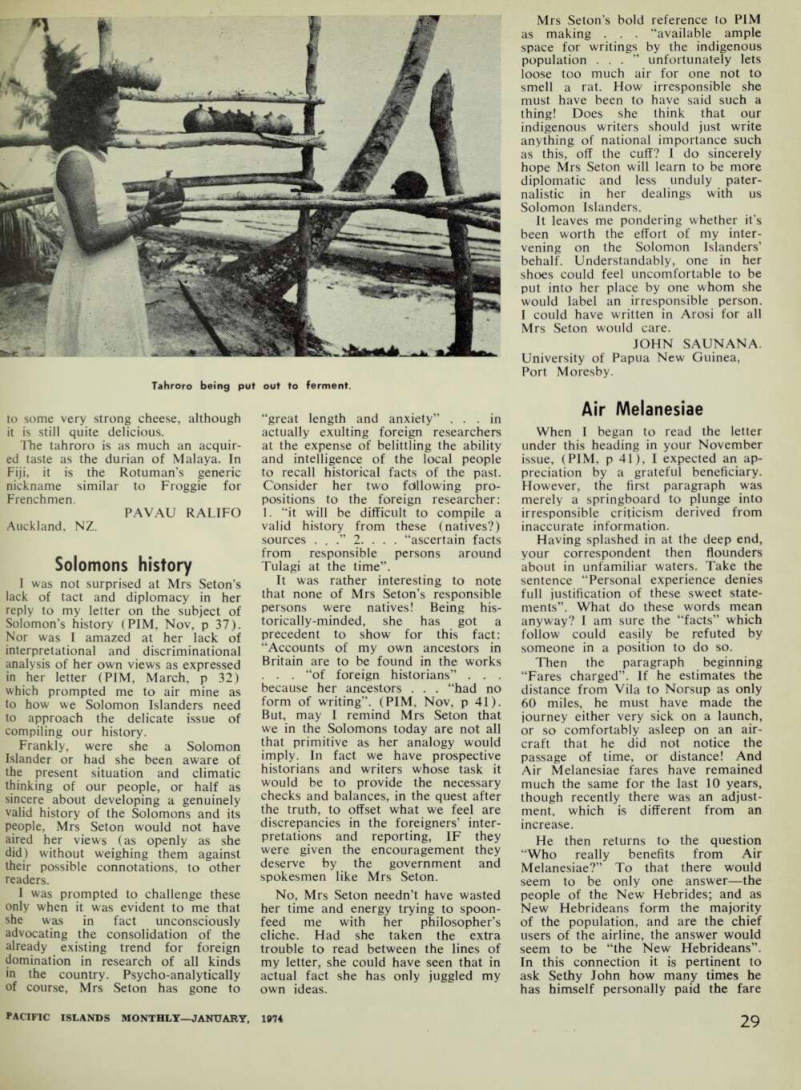
Danger Of High-Class Pidgin
As one of the ‘expatriate academ ics’ attracted to the September con ference on New Guinea pidgin des cribed in Percy Chatterton’s article (PIM Nov p 24), I would like to point out some errors of emphasis and even fact in that article.
While I object at least as much as he does to telling other people how they should speak, it is only fair to at least some of the ‘European ling uists’ (most of whom were in fact American or Australian) to point out that what they were afraid of was that a small elite of English-speaking Papua New Guineans would intro duce large numbers of English words and constructions into pidgin, thus producing a ‘high-class’ social dialect of the language which could be used for government communications but which would be largely incompre hensible to the masses of rural pidgin speakers.
That this is a very real danger, several of the papers explicitly poin ted out, but Mr Chatterton seems quite unaware of it, and still less aware of how it could be combatted.
Or does he, under the pretence of ‘non-interference’, actually support the driving of a linguistic wedge be tween the future rulers and the ruled in Papua New Guinea?
As for ‘overseas pisinophiles’ over estimating the universality of pidgin because they ‘don’t get beyond the main centres’, it so happens that a large number, perhaps a majority, of these ‘pisinophiles’ are workers with the Summer Institute of Linguistics, who are also engaged in bible trans lation into the indigenous languages, and whose work, therefore, takes them regularly and for long periods into the remotest villages.
Mr Chatterton’s claim that pidgin is still very far from ‘an adequate vehicle for transacting the business of a nation’ is bizarre, to say the least of it, in view of the fact that over the last few years, over 90 per cent of the House of Assembly’s business has been transacted in it.
Is Mr Chatterton claiming that a body of which he, apparently, was himself a member is 90 per cent inadequate?
Finally, Mr Chatterton claims that ‘only the lunatic fringe supposes that it is practicable to mediate secondary and tertiary education through pid gin’. Is he not aware that, if it hadn’t been for the ‘lunatic fringe’ of Renaissance Europe insisting on ‘mediating secondary and tertiary education’ through their own de spised vernaculars, he would have written this article, not in English, but in Latin?
Derek Bickerton
University of Hawaii, Honolulu.
Kubuna
We have read Mr Livingston’s comments on Kubuna (PIM Dec p 71) and we are concerned that our aim could be so easily misinterpreted.
We are not so presumptious as to see our series as an attempt to pre serve a “heritage” (Mr Livingston’s word).
Our aim has been to produce an inexpensive book that could be effect ively used in Papua New Guinea Primary Schools. We feel we have achieved this.
Despite what Mr Livingston im plies, material based upon Papua New Guinea stories is not readily available to Papua New Guinea tea chers—especially material that has been designed to be used for listening lessons, oral expression lessons, and also designed to encourage teachers to integrate primary school subject areas.
The ultimate judgment that can be made on the Kubunas (the final two books in the series are now avail able) is surely by the practising tea cher, and his pupils. The response has been very enthusiastic. Comments we have received from teachers, and our own observations to pupil re action and participation have con vinced us that the series have met a definite need.
We are in general agreement with Mr Livingston’s comments about improper use of traditional material, but it must be realised that the tra ditional material used in the Ku bunas is merely the vehicle that gives
the teacher the opportunity to im plement difficult aspects of the pri mary school syllabus. We could have easily selected current affairs, geography, Western myths and leg ends as our vehicle, but then, surely, pupil response to the related ac tivities would not have been so en thusiastic, nor the activities so rele vant.
Keith Downer
Daniel J. Doyle
Madang Teachers College,
Png.
Rotuma's home-brew
I read with interest Saumaru Fos ter’s letter in The Editor’s Mailbag (PIM Nov p 42), regarding Rotu ma’s national dish.
The tahroro (which is the correct spelling), according to the Rotuman Dictionary (by C. Maxwell Church ward), is a partly-grown coconut or kind of a native pudding made from it.
In actual fact, it is a coconut sauce used in a variety of Rotuman dishes. It is not a dish of soup as stated by your correspondent.
The preparation of tahroro is also popular in some parts of French Polynesia and Samoa. Traditionally, it is said that the tahroro was intro duced to Rotuma by Samoan ances tors of the Rotuman people. The Samoans called it samilolo.
It is made from young green coco nuts (niu tahroro, as the Rotumans called it) at the stage when they are most suitable for drinking. After re moving the husk, the coconut is cleaned and a small hole is made through one of the eyes to let out the juice. The coconut is then filled with either salted fresh water or sea water and closed with a cork made of dry banana leaves.
It is then stored in the sun for two or three weeks to ferment. After that the water is let out and the coconut is shaken to turn the flesh into sauce.
If the coconut has not been kept air-tight during the fermentation pro cess, it would smell “badly”, similar
to some very strong cheese, although it is still quite delicious.
The tahroro is as much an acquir ed taste as the durian of Malaya. In Fiji, it is the Rotuman’s generic nickname similar to Froggie for Frenchmen.
Pavau Ralifo
Auckland, NZ.
Solomons history
I was not surprised at Mrs Seton’s lack of tact and diplomacy in her reply to my letter on the subject of Solomon’s history (PIM, Nov, p 37).
Nor was I amazed at her lack of interpretational and discriminational analysis of her own views as expressed in her letter (PIM, March, p 32) which prompted me to air mine as to how we Solomon Islanders need to approach the delicate issue of compiling our history.
Frankly, were she a Solomon Islander or had she been aware of the present situation and climatic thinking of our people, or half as sincere about developing a genuinely valid history of the Solomons and its people, Mrs Seton would not have aired her views (as openly as she did) without weighing them against their possible connotations, to other readers.
I was prompted to challenge these only when it was evident to me that she was in fact unconsciously advocating the consolidation of the already existing trend for foreign domination in research of all kinds in the country. Psycho-analytically of course, Mrs Seton has gone to
“great length and anxiety” ... in actually exulting foreign researchers at the expense of belittling the ability and intelligence of the local people to recall historical facts of the past.
Consider her two fallowing pro positions to the foreign researcher; 1. “it will be difficult to compile a valid history from these (natives?) sources . . .” 2. . . . “ascertain facts from responsible persons around Tulagi at the time”.
It was rather interesting to note that none of Mrs Seton’s responsible persons were natives! Being his torically-minded, she has got a precedent to show for this fact: “Accounts of my own ancestors in Britain are to be found in the works . . . “of foreign historians” . . . because her ancestors . . . “had no form of writing”, (PIM, Nov, p 41).
But, may I remind Mrs Seton that we in the Solomons today are not all that primitive as her analogy would imply. In fact we have prospective historians and writers whose task it would be to provide the necessary checks and balances, in the quest after the truth, to offset what we feel are discrepancies in the foreigners’ inter pretations and reporting, IF they were given the encouragement they deserve by the government and spokesmen like Mrs Seton.
No, Mrs Seton needn’t have wasted her time and energy trying to spoon feed me with her philosopher’s cliche. Had she taken the extra trouble to read between the lines of my letter, she could have seen that in actual fact she has only juggled my own ideas.
Mrs Seton’s bold reference to PIM as making . . . “available ample space for writings by the indigenous population ...” unfortunately lets loose too much air for one not to smell a rat. How irresponsible she must have been to have said such a thing! Does she think that our indigenous writers should just write anything of national importance such as this, off the cuff? I do sincerely hope Mrs Seton will learn to be more diplomatic and less unduly pater nalistic in her dealings with us Solomon Islanders.
It leaves me pondering whether it’s been worth the effort of my inter vening on the Solomon Islanders’ behalf. Understandably, one in her shoes could feel uncomfortable to be put into her place by one whom she would label an irresponsible person.
I could have written in Arosi for all Mrs Seton would care.
John Saunana.
University of Papua New Guinea, Port Moresby.
Air Melanesiae
When I began to read the letter under this heading in your November issue, (PIM, p 41), I expected an ap preciation by a grateful beneficiary.
However, the first paragraph was merely a springboard to plunge into irresponsible criticism derived from inaccurate information.
Having splashed in at the deep end, your correspondent then flounders about in unfamiliar waters. Take the sentence “Personal experience denies full justification of these sweet state ments”. What do these words mean anyway? I am sure the “facts” which follow could easily be refuted by someone in a position to do so.
Then the paragraph beginning “Fares charged”. If he estimates the distance from Vila to Norsup as only 60 miles, he must have made the journey either very sick on a launch, or so comfortably asleep on an air craft that he did not notice the passage of time, or distance! And Air Melanesiae fares have remained much the same for the last 10 years, though recently there was an adjust ment, which is different from an increase.
He then returns to the question “Who really benefits from Air Melanesiae?” To that there would seem to be only one answer —the people of the New Hebrides; and as New Hebrideans form the majority of the population, and are the chief users of the airline, the answer would seem to be “the New Hebrideans”.
In this connection it is pertinent to ask Sethy John how many times he has himself personally paid the fare
Tahroro being put out to ferment.
Letters
between Vila and Norsup, and how often the church which has supported him in Fiji has accepted responsibility for his transport.
He next digresses to refer to an incident concerning an insult to an islander —not a New Hebridean incidentally, but an expatriate from another Pacific territory. The person concerned was punished by the Court, not by Air Melanesiae, and if the writer believed that the judgment was unjust, an appeal could have been addressed to the appropriate national administration.
It is the company’s declared policy to give seats on the “first come first served” principle and if anyone holds a booking, the company acknowledges an obligation to ful fil that contract, even though it may have been made by another airline anywhere in the world.
In view of the above, Sir, and much more that could be added, I think you will agree, as I hope does Sethy John, that his last paragraph is completely irrelevant.
Amnesia.
• Name and address supplied.
Fijian land
I wish to comment on an extract in your Islands Press column (PIM, Aug, p 36). The extract by Mr Joseph Mohammed was taken from The Fiji Times.
I am, however, rather inclined to comment on the manner in which Joseph has implied his envy of the Fijians for no reason about acres of land held in reserve by the Fijians and not giving it to the landless Indians.
The land that Fijians have in re serve belongs to them. If you have no land to develop, then that remains a fact. The jungles that result be cause of unused land are a blessing to the land. It is nature’s way of preserving the land for future Fijian generations. If they are shortsighted enough to give it to you now, then their future Fijian generation might suffer.
If the land is not used now, then it is the landowner’s own business.
If the Fijians are not willing to give it to you, then it is their own busi ness.
People who have no land should build themselves artificial islands to cultivate.
Jim Kasusu.
Honiara, BSIP.
Gilbertese spelling
Em afraid that Maunaa Itaia’s wish to ka-mauna modern Gilbertese spell ing and pronunciation and restore an older convention which he regards as more “correct” is doomed to failure.
Language is a living and therefore changing thing, and what is “correct” is the usage of the majority of edu cated speakers and writers of that language. Any method of spelling a language is a convention and the fact is there has never been one uni versal orthography for Gilbertese.
The fact that Maunaa Itaia wishes
to keep the older (European intro duced) “aa” for the long “a” sound and that many other Gilbertese use the “a” form (also European intro duced) is evidence of this. The only way to settle the dispute would be to poll every Gilbertese on the way to spell the language—and then force the minority side to accept the spell ing of the majority! The only other solution would be to change the orthography.
But there seems little point in Maunaa Itaia and me arguing about this in print. Since it seems that we are both admirers of the best of
Gilbertese culture and wish to see it kept alive, I should like to take this opportunity to wiwina him to join the newly-formed society to preserve and revitalise Gilbertese arts, skills and traditions that has recently begun on Tarawa. One of the society’s first tasks is to collect as much information as possible on Gilbertese culture —in conjunction with the new museum project—and make it all
available from a single Tarawa loca tion.
At the moment much is known and much has been recorded but it is located literally all over the world, The society is not asking people to give it any books or papers relating to the Gilberts, unless they would like to do so, but would be grateful to be told of anything that is in existence, The society hopes to sponsor a
Gilbertese Festival in 1975. Anyone who is interested should write to Kaburoro Tanielu at Radio Tarawa.
On a personal note: my name is transliterated as Bibian by people here who have only the 13 Gilbertese letters, not Wiwina, but that doesn’t make nearly such a good pun. Ka mauna is to erase, wipe out or abolish; wiwina is to inspire or sug gest; te bibi is the windpipe.
Vivienne Hayward.
Tarawa, GEIC.
No one can stay underwater for ages. I'm glad that Te leruru Karotu has come up to the surface. He cannot be the one who does all the wiwi to Nei Wiwinna. It makes all the dif ference to wrestle over a Gilbertese spelling with a pure Gilbertese who knows better Gilbertese than the European lady.
I appreciate Te Karotu’s contri bution. What is traditionally original is something that begins with Gil bertese in the past and is still main tained in the present because it is proper and correct. The traditional written Gilbertese originated from the spoken Gilbertese as it happens to every language. As a matter of fact the spoken language comes into existence first and gives birth to writ ten language in all time and places and not vice versa.
Te Karotu acknowledges Dr Hiram Bingham to be the first man to put into print or written form the Gilber tese spoken language. He is very correct. Dr Bingham was doing what I have been saying above and more over he was not on his own, he had Gilbertese helpers. Therefore, the origin of the written Gilbertese lang uage is not really Dr Bingham but the spoken Gilbertese language.
It is better to put aside Nei Wiwi nna’s complaint of the difficulties and confusion of the double vowels, consonants and apostrophe for to any literate Gilbertese they are not lin guistic problems. They help to make Gilbertese both oral and written clear, simple, less confusing and under standable. Moreover we have to con sider the future Gilbertese gener ations now in primary schools who will face a lot of confusion and problems when we do away with the “loaded double vowels, consonants and apostrophe”.
May I ask Te Karotu and his friend not to misinterpret me claiming to be the sole authority on the Gilbert ese language. In fact I am just putting forth what I believe to be the general Gilbertese reaction to foreign inter ference and defending the purity of our language.
Maunaa Itaia
Pacific Theological College, Suva, Fiji.
Advertisements & other items, pp. 32-34 (1 item)
Jones Lang
THE PROFESSIONALS IN PROPERTY
Property Consultants & Real Estate Agents
EXPERIENCED IN REAL ESTATE
VALUATIONS IN THE SOUTH
PACIFIC ISLANDS
SKILLED IN DEVELOPMENT
CONSULTANCY
«.< mm
% EXPERTS IN THE PREPARATION
OF FEASIBILITY STUDIES
i S ■ m m ■ mm m m 'A*
JONES UNO
\ f . >1 *■ .
SYDNEY
NORWICH HOUSE". 6-10 O'CONNELL STREET, SYDNEY. N.S.W.. 2000 • CABLES "WONDERMENT" SYDNEY • TELEX 22844 • TELEPHONE 2 03
MELBOURNE ADELAIDE BRISBANE PERTH CANBERRA
HONGKONG SINGAPORE NEW ZEALAND
W. H. GROVE & SONS LTD.
ESTABLISHED 1896
ISLAND MERCHANTS
Exporters to the Pacific of Dairy Products and all New Zealand consumer and manufactured goods.
ENTRUST YOUR REQUIREMENTS TO THE
ESTABLISHED FIRM
P.O. Box 3718, Cables
AUCKLAND GROVE AUCKLAND
D apua new guinea
printing co. pty. ltd.
Serving the Country from Aitape to Alotau, Manus to Moresby.
Leaders in Commercial Offset and Letterpress Printing. • Stationery • Office Supplies • Office Equipment • Rubber Stamps • Self-Adhesive Labels • In Fact: — Everything For The Office.
P.O. Box 633, Port Moresby P.O. Box 759, Lae P.O. Box 30, Mt Hagen P.O. Box 1239, Rabaul P.O. Box 466, Kieta
serves the
Islands with expert
insurance service
and advice.
QUEENSLAND INSURANCE
COMPANY LIMITED
(Incorporated 1886 in Australia)
Head Office: 82 Pitt Street, Sydney FlJl—Branch Office, Suva, Manager for Fiji: F. N. Davies (A.A.1.1.).
LAUTOKA—District Manager: U. Singh.
HONIARA (B.S.l.P.)—Breckwoldt & Company (5.1.) Pty.
Limited.
NEW CALEDONIA—T. A. Hagen, Ste. W. A. Johnston, S.A.R.L. —Noumea.
NEW HEBRlDES—Resident Officer: R. J. Allsop (A.A.1.1.) Vila; Santo: Bums Philp (New Hebrides) Ltd.
TAHlTl—Arthur Chung: Immeuble 8.1., Front de Mer, Papeete.
NIUE, NORFOLK ISLAND, SAMOA, TONGA and other South Sea Islands —Bums Philp (South Sea) Company Ltd.
QUEENSLAND INSURANCE (P.N.G.) LTD
PAPUA NEW GUINEA
Head Office, Port Moresby; General Manager: D. J Granter.
District Managers at Rabaul: C. D. Dickings; Lae: R. Jackson; Mt. Hagen: D. F. Carroll.
V337R
A Job To Do Before The Games At
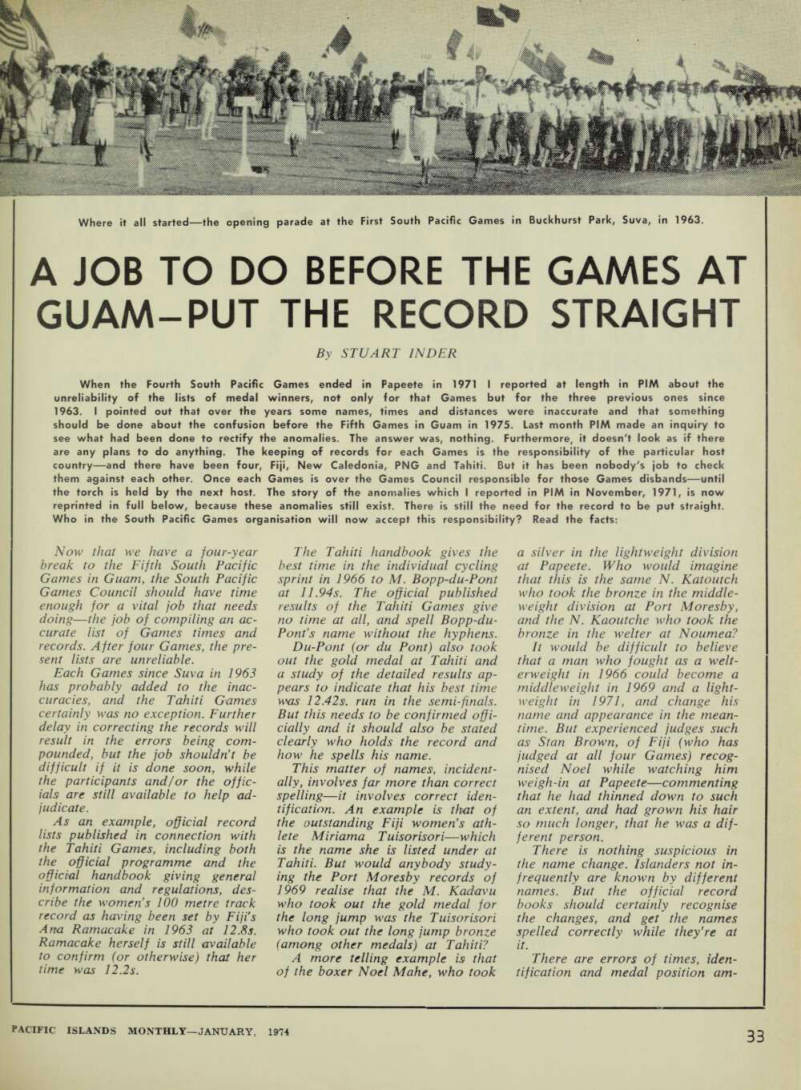
Guam-Put The Record Straight
By Stuart Inder
When the Fourth South Pacific Games ended in Papeete in 1971 I reported at length in PIM about the unreliability of the lists of medal winners, not only for that Games but for the three previous ones since 1963. I pointed out that over the years some names, times and distances were inaccurate and that something should be done about the confusion before the Fifth Games in Guam in 1975. Last month PIM made an inquiry to see what had been done to rectify the anomalies. The answer was, nothing. Furthermore, it doesn't look as if there are any plans to do anything. The keeping of records for each Games is the responsibility of the particular host country —and there have been four, Fiji, New Caledonia, PNG and Tahiti. But it has been nobody's job to check them against each other. Once each Games is over the Games Council responsible for those Games disbands—until the torch is held by the next host. The story of the anomalies which I reported in PIM in November, 1971, is now reprinted in full below, because these anomalies still exist. There is still the need for the record to be put straight.
Who in the South Pacific Games organisation will now accept this responsibility? Read the facts:
Now that we have a four-year break to the Fifth South Pacific Games in Guam, the South Pacific Games Council should have time enough for a vital job that needs doing—the job of compiling an accurate list of Games times and records. After four Games, the present lists are unreliable.
Each Games since Suva in 1963 has probably added to the inaccuracies, and the Tahiti Games certainly was no exception. Further delay in correcting the records will result in the errors being compounded, but the job shouldn’t be difficult if it is done soon, while the participants and/or the officials are still available to help adjudicate.
As an example, official record lists published in connection with the Tahiti Games, including both the official programme and the official handbook giving general information and regulations, describe the women’s 100 metre track record as having been set by Fiji’s Ana Ramacake in 1963 at 12.85.
Ramacake herself is still available to confirm (or otherwise) that her time was 12.25.
The Tahiti handbook gives the best time in the individual cycling sprint in 1966 to M. Bopp-du-Pont at 11.945. The official published results of the Tahiti Games give no time at all, and spell Bopp-du- Font’s name without the hyphens.
Du-Pont (or du Pont) also took out the gold medal at Tahiti and a study of the detailed results appears to indicate that his best time was 12.425. run in the semi-finals.
But this needs to be confirmed offidally and it should also be stated clearly who holds the record and how he spells his name.
This matter of names, incidentally, involves far more than correct spelling—it involves correct identification. An example is that of the outstanding Fiji women’s athlete Miriama Tuisorisori—which is the name she is listed under at Tahiti. But would anybody studying the Port Moresby records of 1969 realise that the M. Kadavu who took out the gold medal for the long jump was the Tuisorisori who took out the long jump bronze (among other medals) at Tahiti?
A more telling example is that of the boxer Noel Mahe, who took
a silver in the lightweight division at Papeete. Who would imagine that this is the same N. Katoutch who took the bronze in the middle weight division at Port Moresby, and the N. Kaoutche who took the bronze in the welter at Noumea?
It would be difficult to believe that a man who fought as a welt erweight in 1966 could become a middleweight in 1969 and a light weight in 1971, and change his name and appearance in the mean time. But experienced judges such as Stan Brown, of Fiji (who has judged at all four Games) recog nised Noel while watching him weigh-in at Papeete—commenting that he had thinned down to such an extent, and had grown his hair so much longer, that he was a dif ferent person, There is nothing suspicious in the name change. Islanders not in frequently are known by different names. But the official record books should certainly recognise the changes, and get the names spelled correctly while they’re at it.
There are errors of times, iden tification and medal position am
Where it all started—the opening parade at the First South Pacific Games in Buckhurst Park, Suva, in 1963.
ong the Tahiti records. What, for instance does the time of 59.5095. mean against the name of M.
Mouren in the 100 metres mens freestyle swim? The time of 4m. 31.85. given officially against C.
Martin in the 100 metres mens freestyle is I believe incorrect. PIM got it as 31.25. Is the winning time in the 4 x 100 metres men’s med ley 4m. 29.7 or 4m. 29.85.??
Again in swimming, the results published officially in Tahiti give the bronze medal to New Guinea in the 4 x 100 metres men’s relay, which is patently an error, because the winning team is also given as being New Guinea and the names of the bronze medallists are ob viously of the New Caledonian team. Nevertheless this simple error ( somebody has mistaken the initials NC for NG) resulted in the official medal tally being wrongly compiled.
There is another error in the medal tally, as a result of the offi cial lists incorrectly giving a bron ze medal to New Caledonia’s C.
Pita in the lightweight boxing.
Pita was eliminated because he was overweight, and no bronze was awarded.
One of the oddest errors in the final official results is the listing of a silver medal to Ricardo Bias of Guam, in the middleweight divis ion of judo. The first result sheet gave this medal to Frederic Briand, of New Caledonia, and Bias the bronze.
This was a celebrated bout in which Bias had complained about having to play off for the bronze and he did in fact stand on the podium in number three position, and receive his bronze. The final result sheet made some of the Guamanians think that the French officials were attempting to rectify an error in awarding him the silver but I believe it is simply another example of clerical confusion.
PIM corrected the error in its re cord lists, as it has in the others mentioned.
Again, we need an official record of distances translated into both metric and British systems. In the two Games so far held in the French territories, officials have given distances in the metric sys tem and made no effort to trans late them. The British areas did the same thing at Suva and Port Moresby, with the result that we have two different systems, nei
ther guaranteed accurate over the entire four Games, because the Press media have had to do their own arithmetic.
It is hardly surprising that medal tallies vary as a result of the con fusion over Games results. The official tally published in Papeete at the end of the Games was cer tainly incorrect, and while PIM hopes that its medal tally is cor rect (it worked hard at attempting to make it so) it unfortunately can’t guarantee it.
In Papeete, the editor of the monthly Suva paper, Fiji Sport, Mike Hohensee, and I worked into the night in an attempt to recon cile the official medal tally with our own—in vain. Not only were we unable to confirm the accuracy of the official tally, we were un able finally to agree on our own —with the result that the official medal tally and those of Fiji Sport and PIM are all different.
It’s time somebody found out just how many territories won what at the four Games and pub lished the results.
All this confusion was probably inevitable. All the Games have for the most part been run by ded icated volunteers, who gave up their own time to officiate. More than 200 of these people were used in Papeete. It was natural there should be occasional communi cation breakdowns, with even effi cient officials suffering as a result of confusion further down the line.
For instance, the swim officials were among the most efficient ai the Games, and I doubt if the final inaccuracies were their doing.
As an example of what could happen, the Papeete Games organ isation right at the beginning laid down certain abbreviations for the name of territories—Sl for the Solomons, PNG for Papua New Guinea, SA for American Samoa, etc. Some officials soon started calling PNG simply NG, which got confused with NC. The Solo mons became SA (the word is “Salomon” in French), which quickly became confused with American Samoa.
But witch hunts serve no pur pose.
The Games Council should es tablish a committee as soon as possible and come up with a com plete, accurate official list of cumulative results while it is still able to get one.
Advertisements & other items, p. 36 (1 item)
S. E. Tatham
SOME OF THE
WE REPRESENT
Asia Rubber Works (Singapore Rubber Shoes) Frappier (French Brandy) Huvef (French Brandy) Indika (Belgium Dairy Produce) Durobor S.A. (Belgium Glassware) Miroiterie Gen. de Belgiqe S.A. (Louvre glass and mirrors) City Engineers (U.K. Bicycles) F.H.I. Japan (Subaru Cars) Kraggs (Wines, Spirits, Ciders) Sunshine Biscuits Sunrise (Confectionery) Flamenco (Instant Coffee & Tea) Quaker Products (Oats, Jets) Hancocks (Spaghetti, Cereals) Melbourne Canning (Jams) Water Wheel (Flour, Sharps, Wheat) Amatil (Twisties, Twirlies) Edward Zorn (Margarine, Cooking Fats) Allens (Confectionery) Red Tulip (Fine Chocolates) Robert Timms (New Guinea Gold Instant Coffees and Teas) Highness (Canned Vegetables, Fruit Juices)
FIRMS
ARE;
S.P.C (Canned Fruit) S.P.C. (Abalone) Wing Lee (See You Sauce) Magnet (Mattresses) Essteel (Cookware) Warner-Drayton (Fans) Mitchell's (Abrasives) Tilbury & Lewis (Sports Trophies Silverplate) Regent (Swiss watches) Lega Marcasite (Jewellery) Austramax (Pressure Lanterns) Lawn Chair; Tubco (Garden Furniture) Electronic Industries (Electrical Household Appliances) Jex (Steelwool) Arnbro (Folding Beds) James Miller (Blankets) Elmaco (Plastics —Electrical Fittings) B.X. (Plastics) Stegbar (Wooden Louvres) Franklite (Light Fittings) JJ. Cash (Embroidered Labels) Disston (Saws) Supa-Swift (Motor Mowers, Tractors)
S. E. TATHAM
& CO. PTY. LTD.
ASKEW HOUSE, 364 LONSDALE ST.,
MELBOURNE, 3001, AUSTRALIA.
G.P.O. BOX 8—
CABLES "SET",
TELEPHONE: 601125
BUYERS FOR THE
PACIFIC ISLANDS
\ % 1 \ 1
DIRECT ENQUIRIES WELCOMED
PAPUA NEW GUINEA: S. E. TATHAM (P.N.G.) PTY. LTD.,
LAE: MALAITA STREET (P.O. BOX 1562).
PORT MORESBY: CNR. GOROA AND MUNAHU STREETS, GORDON
(P.O. BOX 6733, BOROKO).
FIJI: S. E. TATHAM (FIJI) LTD.,
LAUTOKA: P.O. BOX 366.
SUVA: G.P.O. BOX 671.
YOUR GUARANTEE
FOR SERVICE
T .2
SINCE 1924
Fiji has
to clear a $3,200 hurdle
Fiji has a big hurdle to get over before it can send a team to the Commonwealth Games in Christ church in February—paying a South Pacific Games debt of $3,200. If that hurdle is cleared safely there is still the question of raising finance for the current team.
But Fiji will not be unrepresented for three of the chosen team—Seru Gukilau, Tony Moore and Eliki Nukutabu—will be in New Zealand anyway. The Fiji Amateur Athletic Association named 14 athletes and two officials for the trip. Apart from the three already mentioned they are Samu Bulai, Sakaraia Tuva, Samuela Yavala, Rick Kermode, Sitiveni Rabuka, Aca Simolo, Mereoni Vibose, Eleanor Phillips, Miriama Tuisorisori, Torika Cavuka and Laisa Taga. The manager is Mr Tony Moore sen, and Viliame Saulekaleka has been named as coach.
Mr Derek Robinson, president of the FAAA, said naming of the athletes did not necessarily mean all would definitely go. Athletes could be dropped on the basis of per formance at any time up to depar ture. Three of the team, Tuisorisori, Kermode and Yavala, were overseas and were chosen on performances abroad.
Most of the team are track athletes. Among the men, Rabuka and Moore, who is a track athlete also, are the only field event men.
Of the women, Vibose and Tuisori sori will probably compete in the field events.
The team of eight boxers will have 1956 Olympic Games boxer, Hector Hatch, as manager, and Wate Naca gilevu as assistant manager. An Auck lander, Murray Goodwin, will be trainer and coach.
The team is: Salusali Viavia (light heavyweight); Manueli Bese (middle weight); Vai Afu (light-middle weight); Inoke Cakautini (welter weight); Sakiusa Vaka (light-welter weight); John Heritage (lightweight); Jioji Robo (bantamweight); Wili Tevita (flyweight) Timoci Belo (light-heavyweight) and Joseva Keresi (welterweight) have been named as reserves.
Among the swimmers, two girls in the national squad have equalled the qualifying standard for the games.
They are Lyndal Probert (67.4 sec for the 100 metres freestyle) and Julie Murphy (1 min 27 sec for the 100 metres breaststroke).
Advertisements & other items, p. 38 (1 item)
Our business is cargo.
; c ' =:
Your cargo: to anywhere in our Pacific.
Two paddle steamers on the Yangtse River in 1873 marked the beginning of the China Navigation Company. Today, the same flag flies above eighteen modern motor ships plying an extensive network of cargo routes between Papua New Guinea and Pacific Island ports (as far East as Tahiti] and Japan, New Zealand, Australia
and Thailand.
For 100 years, the flag of the China Navigation Company has meant experience, reliability and speed across the sea. Today, it’s flying as strong as ever.
For further details and all enquiries there are Agents at the following ports; Papua New Guinea; Steamships Trading Co. Ltd., Port Moresby. Samarai, Lae, Madang, Rabaul Kieta. Burns Philp (New Guinea) Ltd., Wewak, Kavieng. Fiji: Morris Hedstrom Ltd., Suva, Lautoka. Western Samoa: Morns Hedstrom Ltd Apia.
Tonga;' Morris Hedstrom Ltd., Nukualofa and Vava’u. Tahiti: Etablissements Donald Tahiti, Papeete. New Caledonia: Etablissements Ballande Noumea. 8.5.1. P.: British Solomons Trading Co. Ltd.. Honiara. New Hebrides: LesComptoirs Francais desNouvelles-Hebndes, Vila and Santa AUSTRALIA—Sydney: Interocean Swire Ptv Ltd. Melbourne; Interocean Australia Services Pty. Ltd. Brisbane; Wills, Gilchrist & Sanderson Pty. Ltd. NEW ZEALAND— P &□. (N-A) htd.
Auckland. Wellington. Christchurch, Dunedin, Bluff, Napier. Japan: Swire McKinnon, Tokyo. Yokohama, Osaka, Kobe and Nagoya. Eastern Managers: Buttertield & Swire, 9 Connaught Rd., Central, Hong Kong.
CN co JOHN SWIRE & SONS PTY. LTD. General Agents in Australia, 8 Spring Street, Sydney, Phone: 27 9351.
THE CHINA NAVIGATION CO LTD
MEMBER OF THE SWIRE GROUP.
Domesday
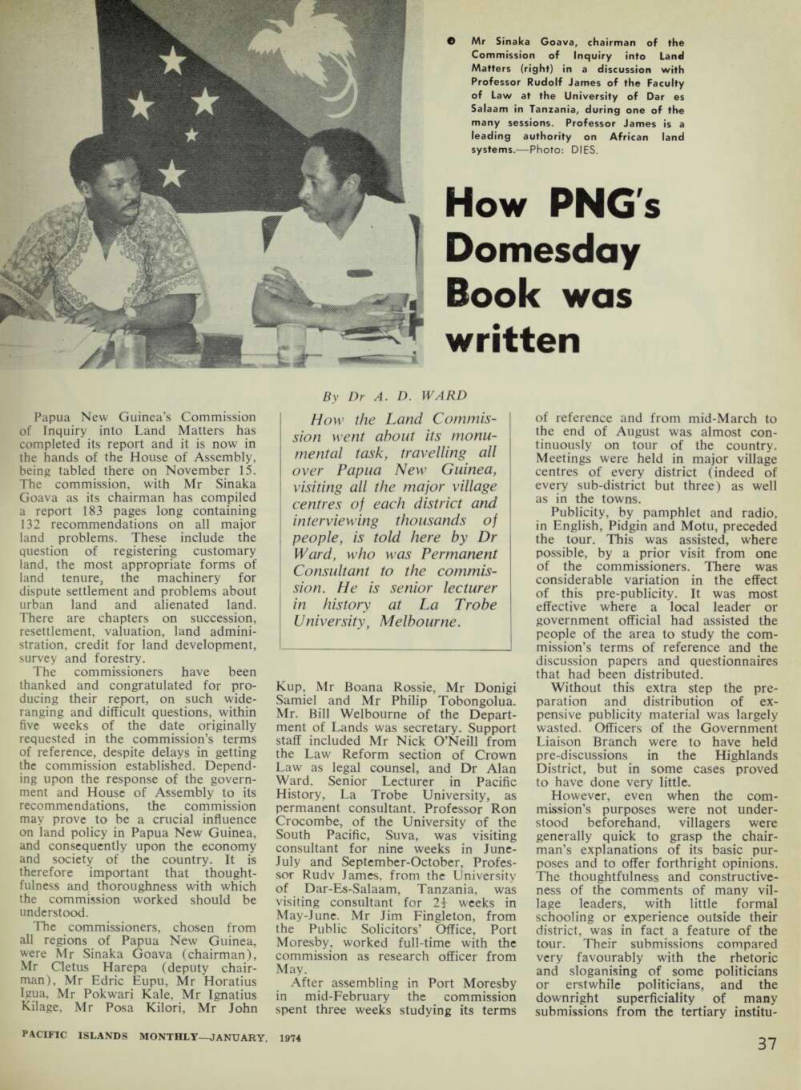
How PNG's Domesday Book was written
By Dr A. D. Ward
How the Land Commis sion went about its monu mental task, travelling all over Papua New Guinea, visiting all the major village centres of each district and interviewing thousands of people, is told here by Dr Ward, who was Permanent Consultant to the commis sion. He is senior lecturer in history at La Probe University, Melbourne.
Papua New Guinea’s Commission of Inquiry into Land Matters has completed its report and it is now in the hands of the House of Assembly, being tabled there on November 15.
The commission, with Mr Sinaka Goava as its chairman has compiled a report 183 pages long containing 132 recommendations on all major land problems. These include the question of registering customary land, the most appropriate forms of land tenure, the machinery for dispute settlement and problems about urban land and alienated land.
There are chapters on succession, resettlement, valuation, land admini stration, credit for land development, survey and forestry.
The commissioners have been thanked and congratulated for pro ducing their report, on such wide ranging and difficult questions, within five weeks of the date originally requested in the commission’s terms of reference, despite delays in getting the commission established. Depend ing upon the response of the govern ment and House of Assembly to its recommendations, the commission may prove to be a crucial influence on land policy in Papua New Guinea, and consequently upon the economy and society of the country. It is therefore important that thought fulness and thoroughness with which the commission worked should be understood.
The commissioners, chosen from all regions of Papua New Guinea, were Mr Sinaka Goava (chairman), Mr Cletus Harepa (deputy chair man), Mr Edric Eupu, Mr Horatius Igua, Mr Pokwari Kale, Mr Ignatius Kilage, Mr Posa Kilori, Mr John
Kup, Mr Boana Rossie, Mr Donigi Samiel and Mr Philip Tobongolua.
Mr. Bill Welbourne of the Depart ment of Lands was secretary. Support staff included Mr Nick O’Neill from the Law Reform section of Crown Law as legal counsel, and Dr Alan Ward, Senior Lecturer in Pacific History, La Trobe University, as permanent consultant. Professor Ron Crocombe, of the University of the South Pacific, Suva, was visiting consultant for nine weeks in Junc- July and September-October, Profes sor Rudv James, from the University of Dar-Es-Salaam, Tanzania, was visiting consultant for 2i weeks in May-June. Mr Jim Fingleton, from the Public Solicitors’ Office, Port Moresby, worked full-time with the commission as research officer from May.
After assembling in Port Moresby in mid-February the commission spent three weeks studying its terms
of reference and from mid-March to the end of August was almost con tinuously on tour of the country.
Meetings were held in major village centres of every district (indeed of every sub-district but three) as well as in the towns.
Publicity, by pamphlet and radio, in English, Pidgin and Motu, preceded the tour. This was assisted, where possible, by a prior visit from one of the commissioners. There was considerable variation in the effect of this pre-publicity. It was most effective where a local leader or government official had assisted the people of the area to study the com mission’s terms of reference and the discussion papers and questionnaires that had been distributed.
Without this extra step the pre paration and distribution of ex pensive publicity material was largely wasted. Officers of the Government Liaison Branch were to have held pre-discussions in the Highlands District, but in some cases proved to have done very little.
However, even when the com mission’s purposes were not under stood beforehand, villagers were generally quick to grasp the chair man’s explanations of its basic pur poses and to offer forthright opinions.
The thoughtfulness and constructive ness of the comments of many vil lage leaders, with little formal schooling or experience outside their district, was in fact a feature of the tour. Their submissions compared very favourably with the rhetoric and sloganising of some politicians or erstwhile politicians, and the downright superficiality of many submissions from the tertiary institu
Mr Sinaka Goava, chairman of the Commission of Inquiry into Land Matters (right) in a discussion with Professor Rudolf James of the Faculty of Law at the University of Dar es Salaam in Tanzania, during one of the many sessions. Professor James is a leading authority on African land
systems.—Photo: DIES.
tions, where few staff and students seem to have given much serious thought to land problems and alter native ways of solving them.
The commission regarded the question of how to treat customary land, the vast bulk of the land in Papua New Guinea, as by far the greatest question confronting it.
However, it was aware of the heat and potential for conflict surrounding the question of alienated land and submitted an interim report on that subject in June. A method of pro ceeding was devised for that purpose which was largely followed when the various sections of the main report were drawn up later.
Out of days and weeks of dis cussion, both in the conference room in Port Moresby and in buses, ships and hotel rooms during the tour, the important issues emerged. The full time consultant. Dr Ward, or the legal counsel, Mr O’Neill, then drew up a detailed question paper on the subject at issue—such as alienated land, dispute settlement and registra tion of customary land.
The question paper was considered by a drafting committee of the com mission—usually the chairman and three others—meeting without support staff present. The drafting committee then drew up a short paper which became the first draft of that section of the report and tended to establish the main lines of the commission’s approach to the problem.
The full committee and support staff considered the first draft in detail, noting the pros and cons of alternative courses of action and the reasons why the commissioners opted for one line or another. With this material Dr Ward or Mr O’Neill wrote a second draft.
The second draft was considered by the full commission and visiting consultants when present, paragraph by paragraph. Words, sentences, whole paragraphs were changed, sug gestions from all involved being em bodied in the prose. A third draft was written and the process repeated.
At this point the draft was usually shown to officials or academics in volved in the particular problem and their comments considered by the commission. The fourth draft ap proached final shape but when the whole report was put together further changes had to be made to achieve consistency through the various sec tions, and editorial uniformity. The final product was a fifth draft. A revised version of the interim report on alienated land became the fourth chapter of the main report.
The compilation of the report was very much a team effort. It basically embodied a consensus of the com
mission’s views, and evaluated various alternatives, as was required by the terms of reference. The evaluation was based on the evidence put before the commission, and on the commis sions’ own very considerable ex perience.
The report was compiled in a 10week period from the end of August.
During that period commissioners and support staff worked long hours, including evenings and weekends with few breaks. Aware of the enormous weight of the task, and of the need to put proposals before the govern ment and House of Assembly for prompt consideration, they accepted an exacting timetable from the chair man, whose earnestness and dedica
tion to the work was a vital factor in the smooth working of the com mission.
Largely at the commission’s urging a Policy Planning and Research sec tion is to be established in the Lands Department to prepare the commis sion’s recommendations for imple mentation, insofar as they are accepted by the government and the House of Assembly. In this way it is hoped that the new direction and impetus in land policy given by the commission will not be lost. Much, however, will depend upon a revita lising of the Lands Department which lacks the numbers of staff and the kind of training likely to be required for the new tasks envisaged.
Advertisements & other items, pp. 40-42 (1 item)
at its best...
sv> £ &
THE FINEST COUNTRY MADE
ICE CREAM IN THE SOUTH PACIFIC
BULK ICECREAM
In assorted flavours and fruited
STROLLAWAY SUNDAES
Assorted flavours in large round cartons
HOME PACKS
In pints, quarts and 3 pints.
Assorted flavours and fruited.
JOLLI LOLLIES
Assorted flavours: Iced lollies in Polythene
CHILLY CHUNKS STICK LINES
Assorted Ice lollies. Milk Ices and Fruit Juices Chocolate coated. In assorted flavours
R.&W HELLABY LTD.
t For
RUM
at its best... h&*
OVERPROOF AND UNDERPROOF
In 5 oz. and 13 oz. flasks and 26 oz. and 40 oz. bottles.
BLENDED AW) BOTTLED BY JOHN WALKER & SONS LIMITED, X
O O '%■ r -o 2r O Ip rm V & O n
76 Years' Experience
Selling
"SERVICE
to the Pacific Islands
NELSON & ROBERTSON
PTY. LIMITED
(Established 1895)
PLANTATION HOUSE, 197 CLARENCE STREET, SYDNEY
CABLES: "IVAN", SYDNEY, BRISBANE. TELEX. AA22381, SYDNEY.
ISLAND MERCHANTS
SHIPPING AGENTS
TRAVEL AGENTS
INSURANCE AGENTS
REAL ESTATE AGENTS
Branch Office; Nelson & Robertson Pty. Ltd., 303 Adelaide St., Brisbane, Old New Guinea Representatives: Rabaul Trading Co. Pty. Ltd., Rabaul Lae Madang Kieta.
OFFERS A COMPREHENSIVE AND EFFICIENT
BUYING SERVICE TO THE PACIFIC ISLANDS
OFFICES AT:
PORT MORESBY • LAE • RABAUL • KIETA • MOUNT HAGEN • BULUMA • SUVA • LAUTOKA • NOUMEA • HONIARA • PORT VILA
"SULLIVANS for SERVICE"
Felling, cutting,
parting, carpentering
DOLMAR
solves your problems
Distributors:
BRECKWOLDT & CO. (N.G.) PTY. LTD.
P.O. Box 222, RmBAUL.
P.O. Box 1549, Boroko, PORT MORESBY.
P.O. Box 185, MADANG.
P.O. Box 1188, LAE.
P.O. Box 72, KIETA.
P.O. Box 237, MT HAGEN
P.O. Box 178, WEWAK.
BRECKWOLDT & CO.,
P.O. Box 47, APIA.
BRECKWOLDT & CO. (5.1.) LTD.,
P.O. Box 140, HONIARA.
BRFCKWOIDT S.A.R.L., B.P. 65. NOUMEA.
DOLMAR
Hamburg/Germany
Saw Typ CL Guide Bar Ripping Saw Type S 150/200 C For big trunks of tropical hard wood with diameter up to 80"
Cold Shoulder For Norfolk Plan
AND A FEDERAL FOOT IN THE DOOR
By a staff reporter
Once more Norfolk Island looks like being split down the middle— this time over the Coldham Plan, which some of the islanders had come to regard as the planning bible for the small community. The plan, which would have rationalised de velopment, instituted various zones for industry, commerce and rural activities and controlled building, was thrown out by five votes to three by the Island Council at its meeting towards November’s end.
Out with the plan went the report of the special Steering Committee, which has been studying the plan for months and which came up with several amendments but, overall, recommended the plan’s adoption.
But there was no vacuum. The council adopted an amendment from Cr Randall who recommended the establishment of a Planning Control Authority incorporating the existing Building Board. The authority would work “within a broad policy as de fined by council in matters of de velopment planning, health, immigra tion and permanent population objectives, using the Coldham Plan as a reference”.
Mr Ray Coldham, of Harrison, Grierson and Partners of Auckland, the plan’s author, got a word in with a letter in which he warned of the need for a water supply, sewerage scheme and a town centre.
Voting for adoption of the plan were Crs Anderson, Mackenzie and Ryves. The anti-planners were Crs Randall, Quintal, Weslake, Evans and Smith.
Over the meeting was the shadow of the legislators in Canberra in the shape of a letter from Minister Gordon M. Bryant who suggested— maybe “threatened” was a" better word-legislation setting up a Town Planning Ordinance to govern a Town Planning Board on which would sit the Administrator as chair man, an island councillor, two resi dents, a “suitably qualified person appointed by the minister” and an officer of the Capital Territory De partment.
The board’s function would be to make recommendations to the minister regarding a broad develop ment plan breaking up the island into
zones. All approvals would have to come from the minister.
This was a federal foot in Norfolk’s door with a vengeance!
Although divided over the merits of the Coldham Plan, the council was united in its opposition to Minister Bryant’s proposals.
“I think we are quite capable of handling our own planning problems,” said Cr Anderson. “I feel it best for any plan to come from Norfolk Island and not from Canberra
as it looks as though it might,” echoed Cr Mackenzie.
With Canberra looking over the islanders’ shoulders, all eager to plan their future, maybe the council will now take the advice of Administrator Air Commodore Pickerd who told the councillors to stop talking about its advisory role and accept more responsibility.
If they didn’t, warned The Nor folk Islander’s editor Tom Lloyd, “we will be Norfolk in name only”.
There were reasons enough why
A. Samoans went conservative
From a Pago Pago correspondent
Why did the American Samoans, contrary to most expectations, reject by a margin of more than two to one, the proposal to elect their own governor and lieutenant-governor and other constitutional changes which would have put some power into their own hands and more money into the politicians pockets?
Many reasons have been advanced, Some have contended that there were no qualified Samoan leaders to take over. Others have argued that Samoan holders of high positions would not be as effective as Caucasians in obtaining funds or grants from Washington. There are those who say that Samoans would tend to abuse their positions and cncourage things like nepotism.
There is some basis for all these arguments. Giving evidence some time ago to a US Congressional Committee investigating proposals for constitutional changes, I pointed out that there were qualified Samoan leaders, highly educated, very experienced in administration and politics, who could hold their own anywhere in the world, and, perhaps, succeed better than their American counterparts in winning more funds for the territory. But the basic problem was a voter one. Which leader to elect?
The question was not so much the
availability of leaders but the need for a better-educated electorate, able to analyse each candidate and then make a good decision on their find ings. j n Samoa, as anywhere else, there wou d be good and bad candidateS; narrow-minded leaders indifferent to proper p i ann i ng and good bookkeep ing; leaders who were callous over the people’s interests and needs, and, perhaps, would-be dictators, i wou ld like to think the voters turned down the proposals for consti tutional change because they were basically uncertain of themselves and their ability to choose aright. This k f a j r enough. Change for change sake is no use . voters should not be hurried. Maybe, they are not yet ready for change, It is not surprising that they re jected the increase to the lawmakers’ salaries who now get about $6,000 (US) per annum, the issuing of bonds by the legislature and granting of more government authority to the villages. It seems this is also tied to the decision to reject the proposal to elect a Samoan governor and lieutenant-governor, With US imperialism on the one hand and a fistful of imponderables on the other, the voters probably made a good choice by going con servative.
Advertisements & other items, p. 44 (1 item)
lAffl£s JflflDV & COV.
222233
SPECIALISTS IN
EXPORT QUALITY...
m
‘SANDY’ ADJUSTABLE
ALUMINIUM VENTILATING
LOUVRE WINDOWS
SHOWERSCREENS
Made with • Sliding Doors • Folding Doors • Pivot Doors • Fixed Panels
i^sl
*in 2 m
■SANDY’ ALUMINIUM
GLAZING BAR FOR
ECONOMICAL SIDEWALL
GLAZING
ALUMINIUM SHOPFRONTS,
ENTRANCES AND WINDOW WALLS
lAffl£s JflflDV & COV.
637 GARDENERS ROAD, MASCOT, N.S.W., 2020, AUSTRALIA.
Clerics Call
N. Hebrides
For Change
From a Vila correspondent
“Now is the time for New Hebri deans to consider the question of in dependence,” was the call which came from Mele village in the New Heb rides mid-November. The call came from Father Walter Lini of the New Hebrides National Party.
He was speaking at a party con vention which was notable for one thing. The party’s guiding lights were two clergymen, Father Lini and Father John Bani, which poses the question—is the Church becoming radical in the New Hebrides when, in many other Island territories, it has seemed to be reactionary? Or is it that the Christian Church has to see justice done?
Father Lini, one of the founders of the National Party, indicated that Christian beliefs activated his party’s policy when he said that human rights came first in that policy. There was a need, he said, for a political system which enabled every individ ual to have his voice heard. There should be one legal system and one government for all.
Mr William Edgell called for more education for agricultural workers, an equal distribution of profits from exports and adequate controls on tourism to ensure protection for local culture.
Mr Kalpakor Kalsakau wanted a single co-operative federation instead of two and a similar stream-lining in the educational sector was deman ded by Mr Kalkat Mataakele, a law student at the University of Papua New Guinea, who also suggested Bis lama as the language of instruction, a unified health system and also church unity.
Obviously, two of a kind which is normal in the condominium, is be ginning to annoy the New Hebridean.
Land was another topic touched on by the convention when Mr Peter Taurakete proposed a Land Trust Board as the solution to the present dual system operated by New Heb ridean custom on the one hand and the White Man’s law on the other.
Land speculation, Mr Taurakete said, was a threat to the country’s welfare and made unity more difficult.
And unity was the theme of the convention—unity in politics, econ omy, social services and land, an impossibility in a condominium where there has to be, at least, two of a kind!
Advertisements & other items, pp. 45-46 (1 item)
Peter Fisher Trading
PTY. LTD.
321 PITT STREET, SYDNEY, 2000, AUSTRALIA
TELEPHONE: 26-1109 CABLES: "FISHERION", SYDNEY
EXPORTERS TO THE PACIFIC
ISLANDS
Some of the firms and products we represent: GREENLITES waterproof matches FOSTER —Beer in bottles or cans REDHEADS safety matches MAURI BROS, yeast PMU food products TOOHEYS beer
CARLTON UNITED beer
CLUB RUM
ROGOVI VODKA
FRENCH KNIT car seat covers THREE STAR corned beef CRAVEN confectionery BROWNBUILT office furniture ADVANCE containers HARDIE'S building products SEBEL furniture BEARD beds and mattresses KLINKII plywood STERLING bakery machinery WHITE ABBEY Scotch whisky BATA shoes SRC tinned fruit LIFESAVERS confectionery CHILTON lAN biscuits
MACHETTES
ATLAS plastic ware LUCKY STAR tinned fish
FOREMOST CONSOLIDATED
V.B.—Beer in bottles or cans BOND'S underwear BOND'S outerwear ANDY spotlights COUNTRY CLUB shirts PAULCALL tools ASTRA razor blades WENGER quality knives VAN DER LAAN tinned meat DEROPA gift paper WARBURTON FRANKI coolrooms DURABUILT prefabricated houses THREE X (XXX) tinned hake BRONTE tinned meat HEINEKEN beer
SHEATH KNIVES
GOLDEN STATE evaporated milk SMALL chocolate GOLDSTEIN—Food equipment RED TULIP chocolate MIN IT aerosols SHELLEY'S soft drinks TWISTIES rice snacks ERN MACKIE bakery equipment CHEEZELS cheese flavoured snacks STARK'S quality chocolate
AND MANY MORE
SOUTHERN PACIFIC INSURANCE
COMPANY LIMITED
Head Office: Equitable Life Building, 80 Alfred Street, Milsons Point, N.S.W., 2061.
Specialising in Pacific Island Insurance requirements for over 30 years. • FIRE • FIRE AND VOLCANIC ERUPTION • HOUSEHOLD COMPREHENSIVE • MOTOR VEHICLE • COMPULSORY THIRD PARTY • COMPULSORY WORKERS' COMPENSATION
• PUBLIC LIABILITY • MARINE
Enquiries invited for all classes of insurance from special representatives at: PORT MORESBY: H. A. K. McKee, Manager for Papua New Guinea, Ist Floor, Carpenter's Supermarket, Champion Parade. P.O. Box 136. RABAUL: D. F. J. Gross, Manager at Rabaul, Mango Avenue. P.O. Box 123. LAE: R. H. Myer—Manager at Lae, Kam Hong's Building, Central Avenue. P.O. Box 758. SUVA-FIJI: L. M. Rolls—Manager for Fiji, McGowan's Building, Margaret Street, P.O. Box 521.
S
I mm m * onr 9. *o* :' • ~f : s Ml# m <
mmusM
m h."% .dS mm IS 1 ■< •v ■ ■> 13
the most important ingredient
BREAD FI.OURS:
CAKE FLOURS:
BISCUIT FLOURS;
SPECIALITY FLOURS:
• MAINTOP —high protein bread flour • ANCHOR —bakers flour • 50/50 MEAL —brown bread • MEDIUM —cake and pastry • SPONGE —sponge cakes • SPECIAL CAKE —madeira and cup cakes • STRONG —cracker biscuits • MEDIUM —Shortbreads • SOFT —sweet biscuits • RYE flour • RYE meal • KIBBLED RYE • SHARPS —roti and chapati flour • 100% STONE GROUND
WHOLEMEAL
GILLESPIE BROS. PTY. LTD.
HEAD OFFICE: BRISBANE OFFICE:
52 UNION ST., PYRMONT, SYDNEY, N.S.W. CABLE ADDRESS; ALBION, BRISBANE, QUEENSLAND. (G.P.O. BOX 2518, SYDNEY, 2001.) "GILLESPIE", (P.O. BOX 8, ALBION, BRISBANE, 4010.) PHONE: 660-4933. SYDNEY AND BRISBANE. PHONE: 6-1121.
Sex Talk Is Taboo And The Babies
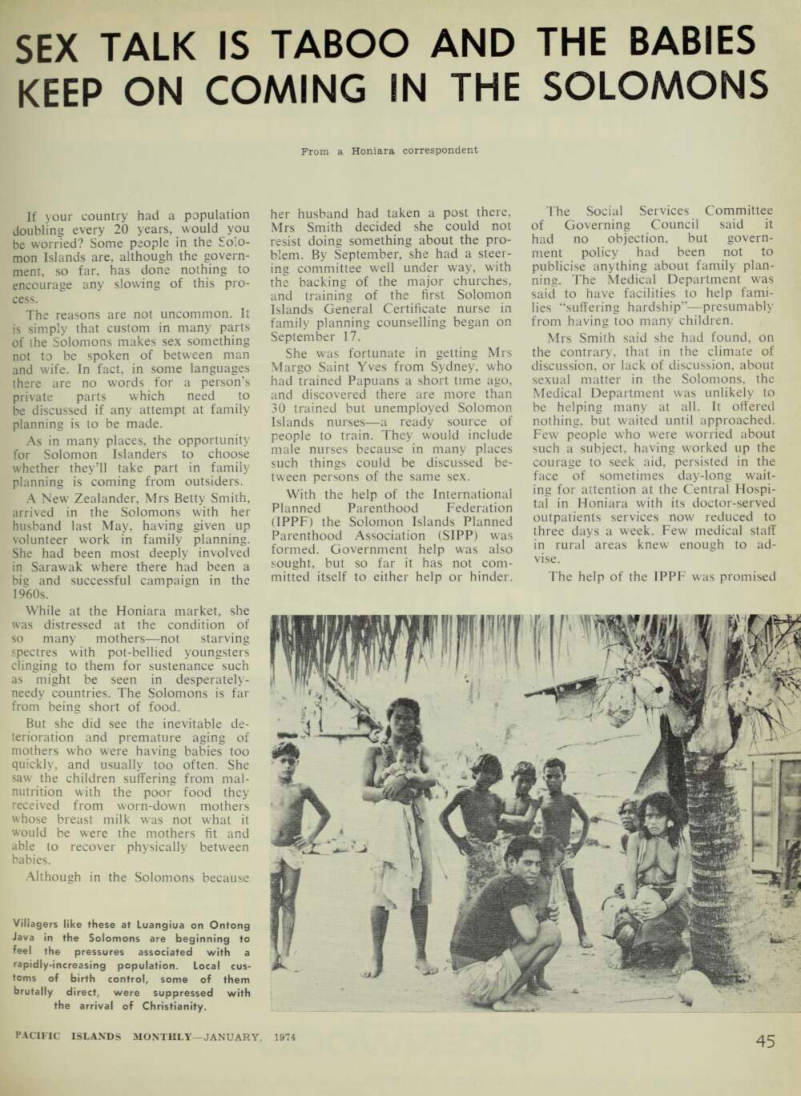


Keep On Coming In The Solomons
From a Honiara correspondent
If your country had a population doubling every 20 years, would you be worried? Some people in the Solo mon Islands are, although the govern ment, so far, has done nothing to encourage any slowing of this pro cess.
The reasons are not uncommon. It is simply that custom in many parts of the Solomons makes sex something not to be spoken of between man and wife. In fact, in some languages there are no words for a person’s private parts which need to be discussed if any attempt at family planning is to be made.
As in many places, the opportunity for Solomon Islanders to choose whether they’ll take part in family planning is coming from outsiders.
A New Zealander, Mrs Betty Smith, arrived in the Solomons with her husband last May, having given up volunteer work in family planning.
She had been most deeply involved in Sarawak where there had been a big and successful campaign in the 19605.
While at the Honiara market, she was distressed at the condition of so many mothers—not starving spectres with pot-bellied youngsters clinging to them for sustenance such as might be seen in desperately needy countries. The Solomons is far from being short of food.
But she did see the inevitable de terioration and premature aging of mothers who were having babies too quickly, and usually too often. She saw the children suffering from mal nutrition with the poor food they received from worn-down mothers whose breast milk was not what it would be were the mothers fit and able to recover physically between babies.
Although in the Solomons because Villagers like these at Luangiua on Ontong Java in the Solomons are beginning to feel the pressures associated with a rapidly-increasing population. Local cus toms of birth control, some of them brutally direct, were suppressed with the arrival of Christianity.
her husband had taken a post there, Mrs Smith decided she could not resist doing something about the pro blem. By September, she had a steer ing committee well under way, with the backing of the major churches, and training of the first Solomon Islands General Certificate nurse in family planning counselling began on
September 17.
She was fortunate in getting Mrs Margo Saint Yves from Sydney, who had trained Papuans a short time ago, and discovered there are more than 30 trained but unemployed Solomon Islands nurses—a ready source of people to train. They would include male nurses because in many places such things could be discussed be tween persons of the same sex.
With the help of the International Planned Parenthood Federation (IPPF) the Solomon Islands Planned Parenthood Association (SIPP) was formed. Government help was also sought, but so far it has not com mitted itself to either help or hinder.
The Social Services Committee of Governing Council said it had no objection, but govern ment policy had been not to publicise anything about family plan ning. The Medical Department was said to have facilities to help fami lies “suffering hardship"—presumably from having too many children.
Mrs Smith said she had found, on the contrary, that in the climate of discussion, or lack of discussion, about sexual matter in the Solomons, the Medical Department was unlikely to be helping many at all. It offered nothing, but waited until approached.
Few people who were worried about such a subject, having worked up the courage to seek aid, persisted in the face of sometimes day-long wait ing for attention at the Central Hospi tal in Honiara with its doctor-served outpatients services now reduced to three days a week. Few medical staff in rural areas knew enough to ad vise.
The help of the IPPF was promised
Sobering statistics
by its Medical Administrator for the Pacific Islands, Dr Asi Faletoese, of Western Samoa, who came to Honiara for a few days in September to lend Mrs Smith moral support and advise and to speak at a public meeting at which he promised IPPF financing as soon as a programme was completed for tackling the Solomons’ particular needs.
Despite the statistical projection that the Solomon Islands’ population will be four times as big in 40 years as its present population of 179,000, the SIPP is setting out first to im prove the health of mother and children by encouraging spacing of births.
Beginning there, it hopes to pro vide medical and welfare advice to help parents have fewer and heal thier children, to provide sex edu cation to anyone in the Solomon Islands when requested to prevent un wanted pregnancies, and generally to bring about a happier family life.
The committee working with Mrs Smith so far includes Mr Tucker from the United Church, Dean Palmer of the Anglican Church, three Solo mon Island women and three expat riate women.
The public meeting at which Dr Asi spoke was also addressed by Mr Tony Hughes, who was a leading figure in the GEIC’s development planning of recent years, and is now senior adviser to the Solomons Local Government Committee Chairman.
Mr Hughes told how the much more serious population pressure of the GEIC had made family planning number one priority, and how it had been so successful, partly because there was only a small population of 60,000.
Mr Hughes was talking in a coun try which has only a few smaller is lands feeling any large measure of pressure for land. But the statistics of only a few weeks before showing that the population of Honiara’s population had grown by more than half inside 3i years was sobering, even if much of that growth was from immigration from the rural areas. Honiara has grown from 11,191 in February 1970 to 17,090 in July this year, an increase of nearly 55 per cent.
The population as a whole had grown 11 per cent in the same time, from 161,000 to 179,000.
Birth and population control are by no means unknown among
numerous language groups in the Solomons. In some places, such as the weather coast of Guadalcanal, birth control in the face of a re lative land shortage has been carried out by abstinence from sexual in tercourse for a year or more after a birth, and herbally-induced abortions are traditional.
On one or two tiny islands, once the population reached a certain point, a communal decision would be made to send the excess people elsewhere. There has been a certain amount of immigration from small
islands or those with limited fertility to bigger groups although now there is population pressure building on these bigger, if still small, groups at times, such as in the Russell Islands where Tikopian and Bellonese people have settled.
The Polynesian outliers particularly —Ontong Java, Rennel and Bellona, Tikopia and Anuta, Sikaiana —are feeling the pressures of improved health combined with Christianity which broke down occasionally brut ally direct, but rational methods of population control.
Advertisements & other items, pp. 48-58 (3 items)
Fkenwood
IM 7 .\ ■ 1 ■I :: ■ m m i : : f 4 CD-2 J -t '4 e« \UV A
fid®
pu" tiC
Either
Way Terrific!
How
to
Use?
fU C c 0
KR-834D
KR-6340 There's an agony and an ecstasy about owning a KENWOOD two-four stereo receiver. The problem is this: Which form of stereo entertainment is better? The answer: it all depends on you —on your mood of the moment. Two-channel stereo buffs can feel secure in the knowledge that KR-8340 and KR-6340 have compatible BTL (Balanced Transformer-Less) systems for two-four use. So with these models you have the best of both possible stereo worlds. For 4-channel enthusiasts, the built-in decoders for SQ and RM and the plug-in type CD-4 (KCD-2) disc demodulator offers all the possibilities of 4-channel disc stereo. Add the KR-9340 and you have three models which satisfy all the varied requirements of 4-channel and 2-channel receivers. With KENWOOD you always have a wide area of choice. the sound approach to quality
fKENWOOD
For minute information, write to: P-SECTION, TRIO ELECTRONICS. INC. 6-17. 3-chome. Aobadai, Meguro-ku, Tokyo, Japan
The Forestmil
Portable Sawmill turns
trees into timber at
the rate oflooosuper
feet per hour.
‘Forestmil’ produces house building or construction size timber direct from the log in the forest. No need to resaw, it’s ready to use. Inter-acting vertical and horizontal blades cut simultaneously for speed and accuracy, (see illustration) ‘Forestmil’ is ideal for cutting usable timber from reject logs.
Produces any size up to 12" x 6" x 18', including boards, framing, bridge sizes, etc.
CHECK THESE FEATURES:
• Dismantles into small sections: • Only 2 men required to operate. • Total weight 1560 lbs. • Erected ready to use in 1 hr. • Powered by petrol or diesel motor.
Now easier than ever to operate Write for further information to:
MACQUARRIE INDUSTRIES PTY, LTD.
133 Bakers Road Coburg, Victoria, 3058. Australia Phone: 350 3411
MI-F 4
From the
Islands Press
From the Samoa Times, Apia;
The price hike and food shortage seem to have made some customers (or more correctly, some
would-be customers) make a philosophical turn
of mind. “We can't buy some items because they're not in stock,” said one father. “Others we're going to do without because they’re too dear. Now I’ll have a chance to find out whether we can have a Lotu Tamaiti (White
Sunday) without all those fancy foods
and clothes.”
From UNISPAC, University of South Pacific Student Association newspaper: Subsidised Sex—The lack of outlets for sexual gratification was suggested at the recent USPSA speech night as the most urgent problem of students on the campus. One of the candidates for Veep promised to set up a Sex Starvation Fund next year to help pay the fines of students who get hawled before the Disciplinary Committee for "Illicit sex". If campus sex is subsidised in this way, then one can say it is being given its due recognition as an important aspect of "Student Welfare". The University Admin will presumably look at it from a purely business angle, ie that the Disciplinary Committee will become a more lucrative subsidiary and the Student Body an important source revenue to help pay the salaries of our staff.
From the New Hebrides News: When Assistant Education Officer Michael Liliu was in North Pentecost six months ago, he wrote to his wife at Napangasale, Tongoa. But he got there again before the letter did. First it went to Tonga, then to South Africa, on its way to a place called Tonga in the Sudan. Then it started the long journey home, reaching Tongoa in October. But by then Michael had told his wife all about it anyway!
From a BSI News Sheet report of ceremonies for the reopening of custom houses on Santa Ana Island: Two Japanese photographers, who are photographing Melanesian art and peoples for Japanese magazines, caused some offence among the people by going inside the dancing groups at times to get their photographs.
However, they also caused some amusement when they were knocked over twice by dancers who ignored them and danced over them.
Extract from a report in the GEIC's Atoll Pioneer of a speech by the Governor, Mr John Smith, at an
induction course for expatriates in Tarawa:
It is all too easy to be a Robinson Crusoe, well-intentioned, humane and unknowingly arrogant.
One might expect change as the old establishment is eroded. But the present day young expatriate, secure m his own anti-colonial upbringing, is often as much of a Crusoe as his grandfather. His message is different but he still expects ready listeners and instant acceptance. He can be as wrong in trying to piece together a culture as his grandfather was to toss it aside.
From Tohi Tala Niue, Niue Island: Drive along on any major road on the island and admire the scenery—the lush green bush, the rugged coral outcrops, the wild flowers
AND THOSE BLASTED EMPTY BEER
CANS—AND CARTONS. It’s disgusting! If the Tourist Board is thinking of coining a catch-phrase for Niue, we’ve got one—COME
TO NIUE, THE EMPTY BEER CAN
PARADISE OF THE PACIFIC! SWIM IN
OUR UNSPOILED WATER, BUT KICK THE
EMPTY CANS ASIDE AS YOU WALK
DOWN THE TRACK.
From The Fiji Times: An anonymous Fiji citizen has sent an $B2 gift to the Ministry of Finance for use by the government. The money, in Fiji currency notes, arrived in an envelope with a Sigatoka postmark. The letter said: "Sir, please take $B2 cash which lies wrapped in Fiji Times in the envelope. Do not think it is for office use or anything, but this small money is for the Government of Fiji—let the Government decide where to use it.
With best wishes, I remain a Fiji citizen."
From the Arawa Bulletin on Bougainville: Compressor wanted urgently! For Editor's head which is now a gigantic size following excerpt of one of his incredible editorials appearing in Pacific Islands Monthly, November Issue.
From a Papua New Guinea Post-Courier report of an interview with Mr Laka Ayawa, executive officer of the Port Moresby Council of Trade Unions, on his return from a trip to Bulgaria, Rumania and Russia: “I want quick independence for Papua New Guinea so that we can get help from socialist countries like Rumania and Czechoslovakia,” Mr Ayawa said yesterday ... He said he felt more at ease in socialist countries than in communist countries . . .
“I don’t want any Papua New Guineans to go to communist countries and return with their ideas.
When I left Russia I promised never to go there again.”
From a speech reported in the Micronitor from Senator Roman Tmetuchl speaking to high school students on the Micronesian status negotiations
in Washington:
You have to learn to stand on your own feet even if It means you have to be hungry today in order for you to learn to fish, farm and work with your hands. Tomorrow and for the rest of your life you will be independent and self-ruling.
When only
“So this Is a Lamhorghini,” she breathed, os wo spoil down (ho ouloslrodo towards Turin.
“Yes,” I said, offering her a Benson and Hodges. “Five forward gears and 17(1 in (op.”
“Can you prove that?” she demanded.
“Do I really have to? You did say you only wanted a little car to do the
shopping.”
■ H y m m \ ' S OGts 20 V ¥ t.
Benson & H
When only
, *'V> < .-V.
St will do. •VC
THE PACIFIC’S
BEST WIDE
Tasty Corned Beef The Argentines’ finest
CORNED BEEF
wmmewm mi
CORNED BEEF
SOLE EXPORTERS TO THE PACIFIC ISLANDS
HAGEMEYER (AUSTRALASIA) B.V
P.O. Box 49 Kensington N.S.W. 2033 Australia Telephone 662.1222 Telex AA22214 Cables Hagemeyer Sydney Lae P.O, Box 90 Telephone 2718 Rabaul P.O. Box 63 Telephone 2633 Boroko/Porl Moresby — P.O. Box 1428 Telephone 56144 Madang P.O. Box 673 Telephone 2445
WTGDIP
Notes with the purity of a nightingale's call or the depth of a bullfrog’s complaint. This magnificent little cassette deck reproduces all, and better, because it has Dolby* Dolby: An incredibly effective noise reduction system that makes natural sounds leap from the deck, especially with new chromium dioxide tape. It makes everything you record seem super-realistic like looking through a highly polished mirror.
Other sets have Dolby. But other sets don’t have that go with the name. On the CT-4141 there’s a selector for your special chrome tapes. There’s automatic stop at tape-end in all tape travel functions. And there’s an ultra-smooth ferrite solid head (it just lasts and lasts).
We could go on and on, but your best bet is to flip on the CT-4141 at the nearest Pioneer dealers. & o © Me era
Mpioimeer
Brijlal & Company, G.P.O. Box No. 362, Suva, Fiji Islands A t . Tel: 222 58 Astromcs Australasia Pty. Ltd. 161-173 Sturt Street, South Melbourne, Victoria 3205 Australia Hagemeyer (Australasia) N.V. P.O. Box No, 90, Lae, New Guinea Tel: 2718 P.O. Box No. 63, Rabaul, New Guinea Tel: 2633 P.O. Box No. 673, Madang, T.P.N.G. Tel; 2445 P.O. Box 1428, Boroko, Port Moresby, New Guinea Tel; 5784 Tee Vee Radio Ltd. P.O. Box No. 5029, Auckland, New Zealand Tel; 763-064 Burns Philp (South Sea) Co. Ltd. Norfolk Islands, South Pacific Jacob Enterprises, P.O. Box No. 4, Nauru Island Ets. PERFECT, B.P. 594, Papeete,Tahiti Tel: 20 407 Menard Freres, B.P. 123, Noumea. New Caledonia Tel; 52-22 Transpac Corporation, P.O. Box 1477, Pago Pago, American Samoa 96799 Tel: 2227 * “DOLBY” is a trade mark of DOLBY LABORATORIES INC.
r. : MU' I® r * m ft: .. -•.v’-. rff^ / mm v>. \ » New TOYOTA Celica iV 1 *Fs .i-i $ - Mb % : X
Half the fun in driving
a Toyota is feeling
how well ifs made.
When Toyota puts a car together, they put it all together.
Like engines that deliver more power and more miles, and do it on less gas. Interiors that seem to shorten the longest trip.
And styling that keeps heads turning in your direction.
But that's only half the story.
Every Toyota you can buy comes complete with a suspension system that smooths out the roads.
Starting and cruising speeds that leave others behind. Cornering that keeps you glued to the road.
And brakes that stop you dead in your tracks.
That's the fun half And it's all tnnpthpr in each o So put yc of one so that greal
feeling.
PAPUA NEW GUINEA; ELA MOTORS LIMITED. Scratchley Rd., Badili, Papua U.S. TRUST TERRITORY; MICROLCORPORATION, PO Box 267, Saipan FIJI ISLANDS: AUTOMOTIVE SUPPLIES CO., LTD , G.P.O. Box 355, Suva AMERICAN SAMOA: BURNS PHI LP (SOUTH SEA) CO , LTD Pago Pago WESTERN SAMOA: BURNS PHILP (SOUTH SEA) LTD , P 0 Box 188, Apia GUAM: RICKYs AUTO CO , PO. Box 1458, Agana NEW HEBRIDES; NEW HEBRIDES MOTORS LTD , P.O. Box 18, Vila SOLOMON ISLANDS: ZEPHYR SERVILE ST A 1 lON PI Y LTD, P.O Box 1 74, Honiara NEW CALEDONIA: SOCIETE D'IMPORTATION AUTOMOBIL E DU PACIFIC, B P 438, Noumea TAHITI: ETABLISSEMENTS E.A. MARTIN & FILS, B P. 61 Papeete COOK ISLANDS: COOK ISLANDS TRADING CORPORATION LTD , P 0 Box 92, Rarotonga
TOYOTA 1000
New TOYOTA Corolla
TOYOTA
Reliable YA
Power.
Without it, there’s no way to make our lives fuller or richer.
Power. Reliable Power. Yanmar delivers it.
The people who developed the world’s first compact Diesel engine. The company with the largest Diesel engine production in Japan. Yanmar, where Diesel power spans the total range from 3 to 2,000 horsepower.
Yanmar, a name synonymous with reliable Diesel power in 130 countries.
You can now put this Yanmar reliability to use in electricity generation, too—with our series YSG and YPG Diesel powered generators. Wherever a sure supply of electricity is needed—single homes,small communities, as a stand by system, on outdoor job sites.
Electricity the safe and easy way, from compact, reliable Yanmar portable generators.
The same Yanmar technology comes in our YKS series of pumps for all purposes; irrigation, construction work, draining, etc.
Yanmar Diesel power. Put it to work for you.
DEALERSHIPS
YANMAR DIESEL GENERATOR
YPG Series
20-80KVA
,n 40 P 3 I
YSG Series
1.5 —IOKVA
YANMAR is seeking dealers on the following islands. Interested parties located on following islands please contact address given below.
Fiji, New Hebrides, New Caledonia, Gilbert and Ellice, Tahiti, Tonga, Nauru, American Samoa, Western Samoa, Cook Is.
YANMAR
DIESEL ENGINE
YANMAR DIESEL ENGINE CD.,LTD.
1-11-1, Marunouchi, Chiyoda-ku, Tokyo, Japan Cable: YANMAR TOKYO Telex: TOK 0222-2310
YANMAR DIESEL PUMP
YKS Series
2—6 inches
The blue beyond. The earth below.
A path between the two. That only youth may
Making the endless blue and
bleach-white sands one...
HONDA.
A young man whose desire to reach the summit of success knows no limits . At work or at play, he thrives on new challenges, new ways to satisfy his zest for the active life. Every day more people are finding themselves in HONDA. Leader in motorcycles. Holder of the title of having % of the world’s market. With sales in more than countries. By offering the right combination of power, performance, and ride in a wide range to suit every individual. It’s all of what it takes to be a world leader in motorcycles
... HONDA!
i k -. 15 vE. ¥ W ft*,-*,'.
M / /V 11 « a n : :2' * im m - K Worlds Largest Motorcycle Manufacturer n
HONDA MOXfcm cp.,LTD. TOKYO, JAPAN s
1 *■ \ RJTORY; J.C. Tenorio Enterprise P.O. Box 137. Saipan / Gilbert 8. EUifce-1 stands OteyeloQmenr Authority GilSwxm BljCe‘l staffs / .MCDITAM C AK/in KA r I. Ii n n iA new GUiftlEA; SteamshipsJQfiding Co., Ltd. 74 *• Noumew / TAHITI- Pt« camimdcv d o "--4 /.COrtK IS) 4wnl:- ■■ 'l.'-.. *" - ■ f ‘ ■ ' 4 T I Corporation Ltd. , jm
\i,d mmrn ' I i! : i *5 2S 9< ■'i %
Ulciu fewer ist \
ip %
Magazine Section
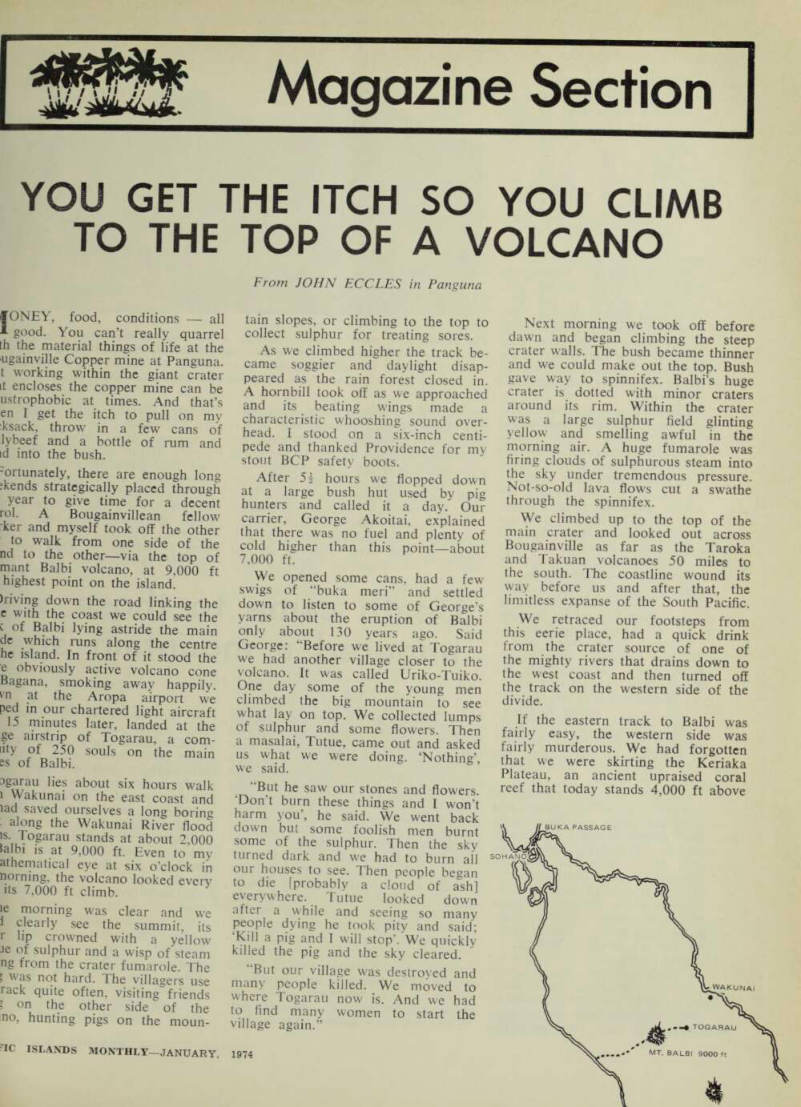
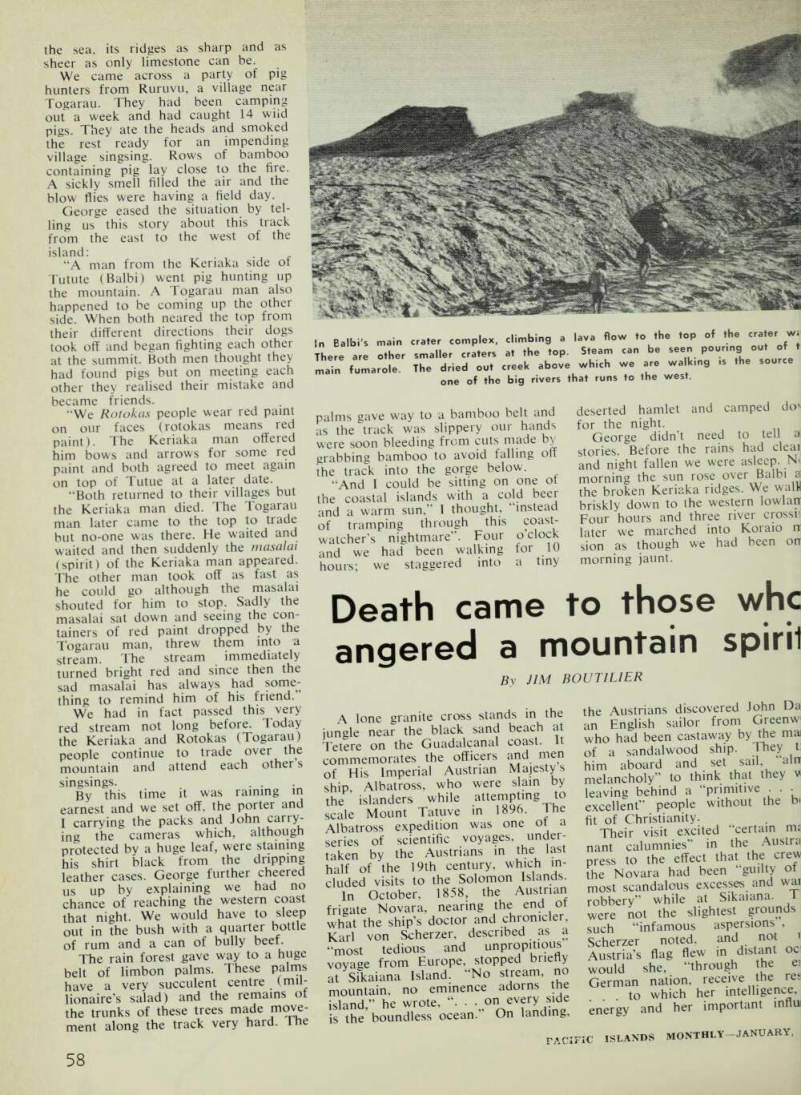
YOU GET THE ITCH SO YOU CLIMB
To The Top Of A Volcano
From JOHN ECCLES in Panguna
fONEY, food, conditions all 1 good. You can’t really quarrel th the material things of life at the ugainville Copper mine at Panguna. t working within the giant crater it encloses the copper mine can be ustrophobic at times. And that’s en I get the itch to pull on my :ksack, throw in a few cans of lybeef and a bottle of rum and id into the bush. fortunately, there are enough long ;kends strategically placed through year to give time for a decent rol. A Bougainvillean fellow ker and myself took off the other to walk from one side of the nd to the other—via the top of mant Balbi volcano, at 9.000 ft highest point on the island. ffiving down the road linking the c with the coast we could see the \ of Ba lbi lying astride the main dc which runs along the centre he island. In front of it stood the e obviously active volcano cone Bagana, smoking away happily. m at the Aropa airport we ped in our chartered light aircraft 15 minutes later, landed at the ge airstrip of Togarau, a com nty of 250 souls on the main ss of Balbi.
Jgarau lies about six hours walk i Wakunai on the east coast and lad saved ourselves a long boring along the Wakunai River flood is. Togarau stands at about 2,000 lalbi is at 9,000 ft. Even to my athematical eye at six o’clock in norning, the volcano looked everv its 7,000 ft climb. ie morning was clear and we I clearly see the summit, its r lip crowned with a yellow ie of sulphur and a wisp of steam ng from the crater fumarole. The 5 was not hard. The villagers use rack quite often, visiting friends » on the other side of the no, hunting pigs on the moun
tain slopes, or climbing to the top to collect sulphur for treating sores.
As we climbed higher the track be came soggier and daylight disap peared as the rain forest closed in.
A hornbill took off as we approached and its beating wings made a characteristic whooshing sound over head. I stood on a six-inch centi pede and thanked Providence for my stout BCP safety boots.
After hours we flopped down at a large bush hut used by pig hunters and called it a day. Our carrier, George Akoitai, explained that there was no fuel and plenty of cold higher than this point—about 7,000 ft.
We opened some cans, had a few swigs of “buka meri” and settled down to listen to some of George’s yarns about the eruption of Balbi only about 130 years ago. Said George: “Before we lived at Togarau we had another village closer to the volcano. It was called Uriko-Tuiko.
One day some of the young men climbed the big mountain to see what lay on top. We collected lumps of sulphur and some flowers. Then a masalai, Tutue, came out and asked us what we were doing. ‘Nothing’, we said.
“But he saw our stones and flowers. ‘Don’t burn these things and I won’t harm you’, he said. We went back down but some foolish men burnt some of the sulphur. Then the sky turned dark and we had to burn all our houses to see. Then people began to die [probably a cloud of ash] everywhere. Tutue looked down after a while and seeing so many people dying he took pity and said; ‘Kill a pig and I will stop’. We quickly killed the pig and the sky cleared.
“But our village was destroyed and many people killed. We moved to where Togarau now is. And we had to find many women to start the village again.”
Next morning we took off before dawn and began climbing the steep crater walls. The bush became thinner and we could make out the top. Bush gave way to spinnifex. Balbi’s huge crater is dotted with minor craters around its rim. Within the crater was a large sulphur field glinting yellow and smelling awful in the morning air. A huge fumarole was firing clouds of sulphurous steam into the sky under tremendous pressure.
Not-so-old lava flows cut a swathe through the spinnifex.
We climbed up to the top of the main crater and looked out across Bougainville as far as the Taroka and Takuan volcanoes 50 miles to the south. The coastline wound its way before us and after that, the limitless expanse of the South Pacific.
We retraced our footsteps from this eerie place, had a quick drink from the crater source of one of the mighty rivers that drains down to the west coast and then turned off the track on the western side of the divide.
If the eastern track to Balbi was fairly easy, the western side was fairly murderous. We had forgotten that we were skirting the Keriaka Plateau, an ancient upraised coral reef that today stands 4,000 ft above
the sea, its ridges as sharp and as sheer as only limestone can be.
We came across a party of pig hunters from Ruruvu, a village near Togarau. They had been camping out a week and had caught 14 wild pigs. They ate the heads and smoked the rest ready for an impending village singsing. Rows of bamboo containing pig lay close to the fire.
A sickly smell filled the air and the blow flies were having a field day.
George eased the situation by tel ling us this story about this track from the east to the west of the island: “A man from the Keriaka side of Tutute (Balbi) went pig hunting up the mountain. A Togarau man also happened to be coming up the other side. When both neared the top from their different directions their dogs took off and began fighting each other at the summit. Both men thought they had found pigs but on meeting each other they realised their mistake and became friends.
“We Rotokas people wear red paint on our faces (rotokas means red paint). The Keriaka man offered him bows and arrows for some red paint and both agreed to meet again on top of Tutue at a later date.
“Both returned to their villages but the Keriaka man died. The Togarau man later came to the top to trade but no-one was there. He waited and waited and then suddenly the masalai (spirit) of the Keriaka man appeared.
The other man took off as fast as he could go although the masalai shouted for him to stop. Sadly the masalai sat down and seeing the con tainers of red paint dropped by the Togarau man, threw them into a stream. The stream immediately turned bright red and since then the sad masalai has always had some thing to remind him of his friend.
We had in fact passed this very red stream not long before. Today the Keriaka and Rotokas (Togarau) people continue to trade over the mountain and attend each other s singsings. . .
By this time it was raining m earnest and we set off. the porter and I carrying the packs and John carry ing the cameras which, although protected by a huge leaf, were staining his shirt black from the dripping leather cases. George further cheered us up by explaining we had no chance of reaching the western coast that night. We would have to sleep out in the bush with a quarter bottle of rum and a can of bully beef.
The rain forest gave way to a huge belt of limbon palms. These palms have a very succulent centre (mil lionaire’s salad) and the remains of the trunks of these trees made move ment along the track very hard. Ihe
palms gave way to a bamboo belt and as the track was slippery our hands were soon bleeding from cuts made by grabbing bamboo to avoid falling off the track into the gorge below.
“And I could be sitting on one ot the coastal islands with a cold beer and a warm sun," I thought, ‘ instead of tramping through this coast watcher’s nightmare’ . Four o clock and we had been walking tor 10 hours; we staggered into a tiny
deserted hamlet and camped dov for the night.
George didn’t need to tell a stories. Before the rains had clear and night fallen we were asleep. Nil morning the sun rose over Balbi a the broken Keriaka ridges. We walH briskly down to the western lowlan Four hours and three river crossiu later we marched into Koraio nr sion as though we had been on morning jaunt.
In Balbi's main crater complex, climbing a lava flow to the top of the crater w[?] There are other smaller craters at the top. Steam can be seen pouring out of t[?] main fumarole. The dried out creek above which we are walking is the source one of the big rivers that runs to the west.
Advertisements & other items, p. 59 (1 item)
R Ic Islands Monthly—January, 1974
angered a mountain spirit
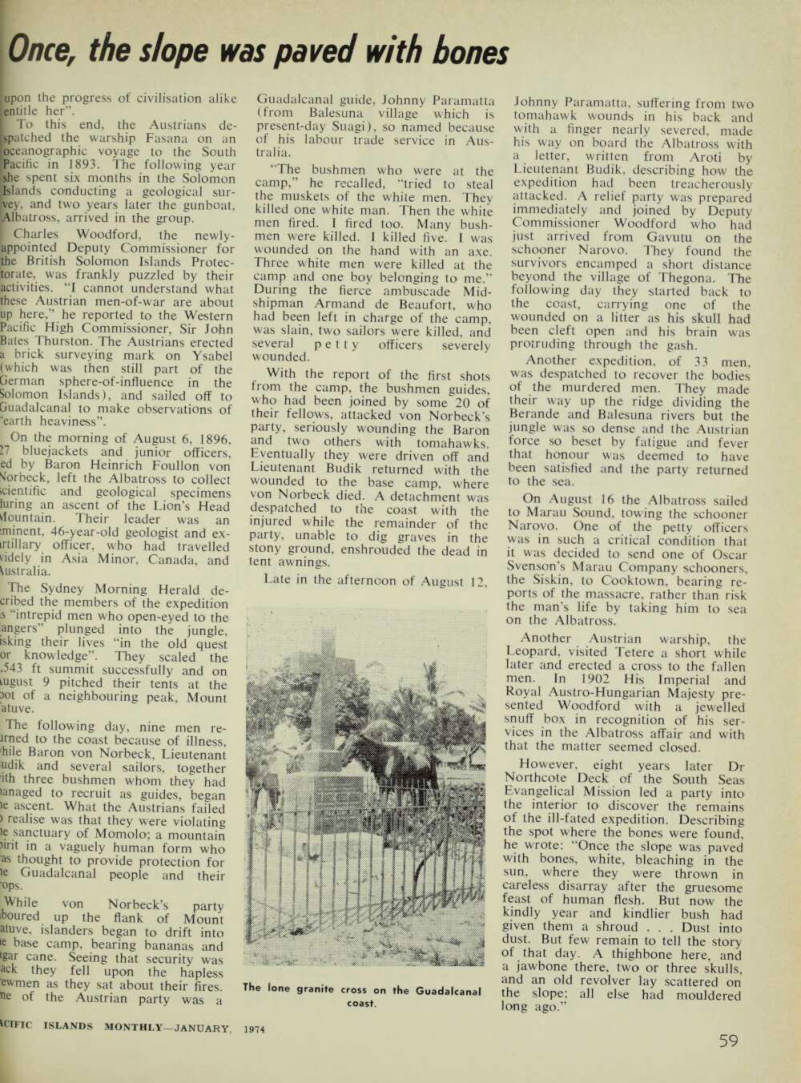
Death came to those who angered a mountain spirit
By Um Boutilier
Majesty
series of scientific voyages undertaken by the Austrians in the last half of the 19th century, which mduded visits to \ h s f oI X Aust?h,n In October, I*oB, me frigate Novara, ne armg , what the ship s doctor and chron , Karl von Scherzer described as a “most tedious and unp ™ pl *J9 voyage from Europe, stopped briefly =’i
H. aboard "certain nit * heir^™" ie s” in the Austra n u t h e crew pres:had been "guilty of most scandalous excesses and waj „ hil at Sikaiana. T were not the slightest grounds
“infamous aspersions”,
such i J d n ot t Austria’s flag flew in distant oc; , “through the ei energy^ 11 h h er imporlanl Infi.
Once, the slope was paved with bones
[upon the progress of civilisation alike 1 entitle her”.
I To this end, the Austrians de spatched the warship Fasana on an bceanographic voyage to the South (Pacific in 1893. The following year she spent six months in the Solomon [lslands conducting a geological sur vey, and two years later the gunboat, [Albatross, arrived in the group.
I Charles Woodford, the newly appointed Deputy Commissioner for the British Solomon Islands Protec torate, was frankly puzzled by their activities. “I cannot understand what these Austrian men-of-war are about up here,” he reported to the Western Pacific High Commissioner, Sir John Bates Thurston. The Austrians erected a brick surveying mark on Ysabel (which was then still part of the German sphere-of-influence in the Solomon Islands), and sailed off to Guadalcanal to make observations of “earth heaviness”.
On the morning of August 6, 1896, II bluejackets and junior officers, ed by Baron Heinrich Foullon von Norbeck, left the Albatross to collect icientific and geological specimens luring an ascent of the Lion’s Head fountain. Their leader was an iminent, 46-year-old geologist and ex irtillary officer, who had travelled videly in Asia Minor, Canada, and Australia.
The Sydney Morning Herald de creed the members of the expedition s “intrepid men who open-eyed to the angers” plunged into the jungle, isking their lives “in the old quest or knowledge”. They scaled the ,543 ft summit successfully and on uigust 9 pitched their tents at the x>t of a neighbouring peak, Mount ‘atuve.
The following day, nine men re irned to the coast because of illness, 'hile Baron von Norbeck, Lieutenant udik and several sailors, together ith three bushmen whom they had lanaged to recruit as guides, began ie ascent. What the Austrians failed ) realise was that they were violating ie sanctuary of Momolo; a mountain urit in a vaguely human form who as thought to provide protection for ie Guadalcanal people and their ■ops.
While von Norbeck’s party iboured up the flank of Mount atuve, islanders began to drift into ie base camp, bearing bananas and [ gar cane. Seeing that security was ack they fell upon the hapless ewmen as they sat about their fires, toe of the Austrian party was a
Guadalcanal guide, Johnny Paramatta (from Balesuna village which is present-day Suagi), so named because of his labour trade service in Aus tralia.
“The bushmen who were at the camp,” he recalled, “tried to steal the muskets of the white men. They killed one white man. Then the white men fired. I fired too. Many bush men were killed. I killed five. 1 was wounded on the hand with an axe.
Three white men were killed at the camp and one boy belonging to me.”
During the fierce ambuscade Mid shipman Armand de Beaufort, who had been left in charge of the camp, was slain, two sailors were killed, and several petty officers severely wounded.
With the report of the first shots from the camp, the bushmen guides, who had been joined by some 20 of their fellows, attacked von Norbeck’s party, seriously wounding the Baron and two others with tomahawks.
Eventually they were driven off and Lieutenant Budik returned with the wounded to the base camp, where von Norbeck died. A detachment was despatched to the coast with the injured while the remainder of the party, unable to dig graves in the stony ground, enshrouded the dead in
tent awnings.
Late in the afternoon of August 12,
Johnny Paramatta, suffering from two tomahawk wounds in his back and with a finger nearly severed, made his way on board the Albatross with a letter, written from Aroti by Lieutenant Budik, describing how the expedition had been treacherously attacked. A relief party was prepared immediately and joined by Deputy Commissioner Woodford who had just arrived from Gavutu on the schooner Narovo. They found the survivors encamped a short distance beyond the village of Thegona. The following day they started back to the coast, carrying one of the wounded on a litter as his skull had been cleft open and his brain was protruding through the gash.
Another expedition, of 33 men, was despatched to recover the bodies of the murdered men. They made their way up the ridge dividing the Berande and Balesuna rivers but the jungle was so dense and the Austrian force so beset by fatigue and fever that honour was deemed to have been satisfied and the party returned to the sea.
On August 16 the Albatross sailed to Marau Sound, towing the schooner Narovo. One of the petty officers was in such a critical condition that it was decided to send one of Oscar Svenson’s Marau Company schooners, the Siskin, to Cooktown, bearing re ports of the massacre, rather than risk the man’s life by taking him to sea on the Albatross.
Another Austrian warship, the Leopard, visited Tetere a short while later and erected a cross to the fallen men. In 1902 His Imperial and Royal Austro-Hungarian Majesty pre sented Woodford with a jewelled snuff box in recognition of his ser vices in the Albatross affair and with that the matter seemed closed.
However, eight years later Dr Northcote Deck of the South Seas Evangelical Mission led a party into the interior to discover the remains of the ill-fated expedition. Describing the spot where the bones were found, he wrote: “Once the slope was paved with bones, white, bleaching in the sun, where they were thrown in careless disarray after the gruesome feast of human flesh. But now the kindly year and kindlier bush had given them a shroud . . . Dust into dust. But few remain to tell the story of that day. A thighbone here, and a jawbone there, two or three skulls, and an old revolver lay scattered on the slope; all else had mouldered long ago.”
The lone granite cross on the Guadalcanal coast.
Advertisements & other items, p. 61 (1 item)
59
tCIFIC ISLANDS MONTHLY—JANUARY 1974
At The Seashore
Short Story
By Tili Peseta
4 FAINT salty breeze blows the thin lavalava against Pili’s legs as he steps out of the brush on to the rocks. Tbe familiar musty smell of mud, slaked with the derelict of infernal crawling invertebrates of the seashore makes him catch his breath once then accommodating his sense to the smell, Pili inhales deeply. He has to be selective in the gulps of air he takes in. Pili squats on the rocks to wait.
The seashore is a peculiar and mysterious place. The smell of deep rotting seaweeds can be foremost once, then it recedes and one is conscious of the slightly warm air, a fleeting shadow across the grave; an illusion. It is the smell old people associate with death. This is the smell Pili is extremely conscious of as he waits. A slight thrill of apprehension starts up Pili’s a feelmg of expectation, a fearful expec-
eyes ,search the honzon tatner s canoe.
It i s midday, the time when the a j r j s neither cool nor hot, a transit i ona i stage when the atmosphere seems a blend of shadow and light.
Legends tell that at midday, the ghosts pull up their boats on the shore after a night, a day, or a lifet j me 0 f fishing. Who knows how the dead measure time?
Now as p d i squats on the rocks, a stm and silent fi gure alone with the ghosts of his ancestors, he wills hims lf to become one with his forefathers in the shade . To speak to the dead has been the dedication of his Hfe Now he moving forms, dlusions of ligh t reflected from off the sea and off the dark rocks A shaft of diffused light thickens the atmospher e here and there, and now his body seems to be static, a puny vegetable, useless and ■non-funct oral
and^restrfetfons^of 1 this Sable
beyond the horizon, the intercour of space and matter, the meetn place of the dead t 0 t h e human fori but the acme of life to the soul coui terpart j-[ e sees the canoe that fills wn the catc h of all times, the nouns ment that seem s unconsumed. I sees the Hght-prowed canoe that skir tbe sea effortlessly on a waterw that is smooth and fluid. He sos above, higher and higher. . • But then, out of the tence a voice caught i rec linii a B ust ,9 f wave disturbs Pih s reverie, A an d t land with the voice cal 8 shadow beckoning to the i\\u the an sone canoe passe; a g • k \ lone woma]n . head in sympathy a Tome Little does j S Pili is happy.
In this first issue for 1974, MANA contains works by two of its most prolific contributors, Vanessa Griffen, from Fiji, and Konai Helu Thaman, from Tonga. Contributing for the first time are Hari Henderson, also from Tonga, and Western Samoans Tili Peseta and Sano Malifa.
Candles Glowing Orange
By Vanessa Griffen
JOHNNY opened his eyes slowly.
The million little eyes in the mosquito net stared back at him. A bright bar of sunlight had shot through the curtains to shine on his face. Hot. He had to wake up. Then he remembered it was his birthday today. Quick, pull aside the mosquito net, look under the bed!
There should be a present waiting for him, with a ribbon tying up its face.
Upside-down eyes saw only dust, cobwebs and last night’s Phantom comic. His throat felt funny inside, he swallowed, and gave one last look.
No present. He fell back on his pillow again, very quiet.
His eyes looked at the mosquito net, his ears picked up the noises of his mother’s movements in the kit chen. She was making sandwiches for his father’s lunch, and grumbling about the flies, and the butter melting in the heat.
He got out of bed and went into the kitchen, where he stood in the doorway, eyeing his mother timidly.
His mother’s arms were big and dark and round. Johnny watched them move, shaking, to scoop up butter with the knife, then swing back to slap the butter onto the bread. Her arms moved back and forth and still she said nothing. She worked quickly. Butter, cheese, slap of bread—a sandwich. Johnny wished she would stop and say
‘Happy Birthday”.
“Hurry up and have breakfast,” she >aid abruptly. Johnny stared. “Then go and help your sister.”
Furiously, he cut the biggest, thickest slices of bread that he could.
He swallowed big mouthfuls, gulped Jpwn tea, hating his mother, hating birthdays, trying not to cry. “I’ll run way, that’s what. I’ll run away till lark. That will show them.”
Out the back door before his sister Wild stop him, he ran to his friend Arthur’s place, and stood by the gate, ooking in. Arthur lived in a white 'Oncrete house that had changed jolour over the years to suit the aded green roof, “Ss-st!” he called.
No reply. “Ss-st!” again. Finally, onnny tried their special gang , .istle, which was a bit like a lying fox’s squeak in the night. It bought Arthur out, tousle-haired, ooking fearfully over his shoulder.
“Where we going?” Arthur asked.
“Tin boat. Quick, I side-stepped to day.”
“Me too. Let’s go.”
They ran down the street and through Mr Prasad’s short-cut. His dog, that mad black-and-white patchy one, chased them. Johnny took off, clutching his hand-me-down trousers in case they fell off.
Arthur, wide grin full of gaps, was laughing at him.
“Shut up. That bloody bugger nearly got me,” Johnny said. He felt much better for having said “bloody”.
The tin boat was hidden under a bush. It was full of water, dirty leaves and wriggling mosquito larvae.
They tipped out all the rubbish, and hauled it over the sea-wall onto the sand. The tide was out so they dragged the boat down to the water, making a trail in the sand that scattered all the little orange crabs.
Zip!—they went into their holes.
Johnny stuffed a few holes with the
red berries from the barka tree.
They fitted perfectly.
They played in the water all morn ing. The tin boat kept tipping over, spilling them into the water. It was hot, and the salt dried on their arms and back. It was lunch time and they were hungry. But who wanted to go back to mothers and sisters and cry ing babies. And lunch.
Arthur had an idea.
“Look,” he said. “Why don’t we run away today? Com’on. Let’s go!”
Johnny hesitated.
“Can’t,” he said. “Have to go home.”
“Com’on. Don’t be a baby!”
“I’m not a baby. I’m eight!”
He remembered his birthday again.
“Com’on then. We go . . .” Arthur was saying.
He saw his mother slapping butter over the bread, her back to him.
“OK. Let’s go,” Johnny said, and he started running along the sea-wall towards town.
WHEN they came to the Botanical Gardens, they saw a Fijian boy in khaki trousers and a blue shirt, sitting under a frangipani tree.
Hey, let’s go and see what he’s doing, Arthur said.
They crossed the road and went up to him. Head bent, he was absorbed in stringing together masses of white frangipani which were in a plastic bag beside him.
Johnny was the first to talk. “Hey bro, what you doing?”
The Fijian boy did not look up.
“Making some leis.”
“What you going to do with them?”
“Sell them.” He held up a string of the flowers, all massed together, to see how long it was, tied a few knots and bit off the extra thread with his teeth.
“Where?”
“Oh, down by the waterfront,” a hand waved vaguely towards town.
“All the tourists come and they buy them.”
Already he was making another lei, pushing the flowers along the string, twisting them into place. He looked very efficient, the two boys were impressed.
“Can we come too?”
“Sure. You help me first, but.”
Eagerly, they sat down and began making leis. Theirs were straggly
ones, with bunches and gaps but the Fijian boy, his name was Tevita, laughed at them, a big white grin splitting his face, and straightened up. Johnny still felt apprehensive about being so far from home.
Looking around at the green lawns and the lily pond, he knew he was in forbidden territory.
Tevita was perhaps 11 or 12. He took command of everything, speak ing very fast. .
“Come,” he said, when they had finished. “Let’s go now.”
Sitting on the sea-wall, they waited for the tourist cruise boats to come in. Johnny watched the boats. Early afternoon, the sun was still high and the sea seemed hemmed in by the green hills, which curved around majestically to shelter the small white sailing boats. Tevita got down to pursue a tourist, then disappeared.
The two boys sat dangling their legs and feeling very stupid holding all these flowers. A stray flower, pure white like a falling star, hit the water, disturbing the rainbow patterns of an oil slick.
“Here,” a hand thrust two meat pies at them. Tevita climbed up, ar ranged his meat pie, tucked away his change, and carefully balanced a big bottle of lemonade between them.
Then, quite calmly, he took out a packet of cigarettes.
“Want one?” Tevita asked, eye brow lifted casually. Johnny could only shake his head and stare. He couldn’t believe that Tevita would smoke.
Cupping his hands, Tevita lit his cigarette, then put it in his mouth.
Cough, a few impressive spits in the water, then he settled down to smoke his cigarette and tell them how to sell leis “Look here,” he said. “When they come off, you go up, quick, and ask if they want one. If they’re old people, and smile, you charge 30 cents. They’ll pay. If they don’t, all right—2o cents.”
THE boat came. The tourists got off. The three were waiting, leis in hand. Tevita darted forward first, faded shirt mingled with bright cotton print; he was soon involved in sale.
Johnny, big-eyed and wondering, looked around. They were sur rounded by tourists. There were no faces, just coloured cotton dresses, bags, hats, cameras, perfume all around them. Without knowing it, he found his arm out crookedly, his voice saying— “ Ma’am, would you like one/ It wasn’t his voice but a cheeky high pitched monkey’s.
It was an old lady with white curls and faded blue eyes he was talking
to. She looked at him, smiled a kind, crinkly smile, looked at the lei.
Johnny waited, eyes bright, smile brilliant. “Come, come,” he said, “only 20 cents.”
“No, no thank you,” she said softly.
Then she turned, confused, to wait for someone to show her the way.
Somehow, Johnny sold his leis.
His arms were empty; his pockets full. The tourists were wandering off towards the shops. Arthur came up.
They brought out their money, glee fully, and counted it.
“Ssst!” It was Tevita across the road, beckoning them and pointing towards the tourists.
Still excited, they ran across the road to join him.
“Come,” he said. “Carry their bags and things. You’ll get maybe money or food.”
Johnny had a sick moment of worry. This was too much. You couldn’t wander around the shops.
What if his mother knew . . ? But Arthur was already walking off, so he ran to catch up.
They followed Tevita all afternoon.
His thin bedraggled figure moved in and out of the crowd. He carried bags, pointed to shops, followed tourists, offering help.
“Come, sir, can I hold your bag?’ he smiled, hand outstretched.
Someone said “no” and pushed him away a little. Tevita stepped back, smile gone, an ugly look coming over his face. “Bastards, he said under his breath. Then he walked off, to lounge against a shop window, waiting for someone else to come.
It was late. Johnny looked around for Arthur. He was wandering along behind some tourists.
“Ssst-t!” Johnny called.
Arthur joined him.
“Let’s go. It’s dark. Look, he pointed to a fading sun.
“I’ll get into trouble.” Thinking of home, he felt scared. What would his mother say? It was so dark, and
he had never been in town alonea before.
Just as they were going Tevitas called them.
“Hey, where you going now?”
“Home,” Johnny said.
“Home?” He looked blank. “What* for?”
“Tea. I have to, or I’ll be im trouble. What about you?”
Tevita shrugged his shoulders.B “Me? I don’t have to go home.” He pointed up a dark street. “I’ll go un there. Get some more flowers . .
Okay, see you,” he said.
When they left him at the corner of the dark street, he was croucheo: down, and there was a brief orange* flicker as he lit a cigarette.
JOHNNY felt uneasy the nearer ha got home. The street lights hao come on and he knew it was veri late. Even before they got to hit street, he could see his sister waiting for him. Cold guilt and fear rushes through him. What would his mothea say? And the money. What could hr do with it? It was too late to thinr of that now.
His sister yelled at him. “Hum up. Mum’s cross with you. You” better watch out when you ge; home!”
He was quiet all the way home.
A warm square of light fell fro# the kitchen door and there was lovely smell of cooking. He sidled i the back door and stood hesitantl: on the door step, feeling exposed i the light. His mother’s big shape wz' bent over the stove, stirring soma thing in a pot. There was the moc delicious smell in the room. Tn smell of chop-suey- His favourri dish.
Johnny stood there, big-eyee guilty, his clothes dried stiff with tK: salt water.
His mother turned and looked him. . , “You naughty boy! she sau, “Where have you been?”
“Town,” he said in a quiet sma voice, eyes down.
“What were you doing?
“Went with Arthur. We . • • ▼ ... we just loafed around.”
“Humpf,” his mother snorted an turned back to the stove. “Anyws go and have your bath and chanjj Don’t you know it’s your birthday; Johnny had a shower and washi away all the salt. He soaped himse enjoying the smell of the soap, ae shivered under the onslaught of co: water. Clean clothes, a quick bru of the hair, and he was ready. Shy; he went to the table.
There was a cake, and on flickered the light of eight candll
glowing orange.
Resistance
By Konai Helu Thaman
We are like songs Sung out of tune You and I.
We sit around And drink Beer and whisky Indifferent to the rain That brings life and colour And washes the dusty pavement; We talk about things That do not matter And dream of lives That are not ours.
We are hostile To imagination And change And we cling To petty customs That uphold our right To maltreat our brother And strip him Of his human rights Because of an accident Of birth.
Advertisements & other items, p. 63 (1 item)
Short Story
61
ACIFIC ISLANDS MONTHLY—JANUARY, 1974
Mana Contributions
MANA is a vehicle for Pacific Islands' writers and artists to publish their work. It is an organ of the South Pacific Creative Arts Society. Its editorial committee comprises Islanders from Western Samoa, Tonga, Fiji, New Hebrides, the Solomons, American Samoa and the Gilbert Islands. Material for publication must be sent direct to MANA's editor, Marjorie Crocombe, South Pacific Creative Arts Society, Box 5083, Suva.
Pilioko
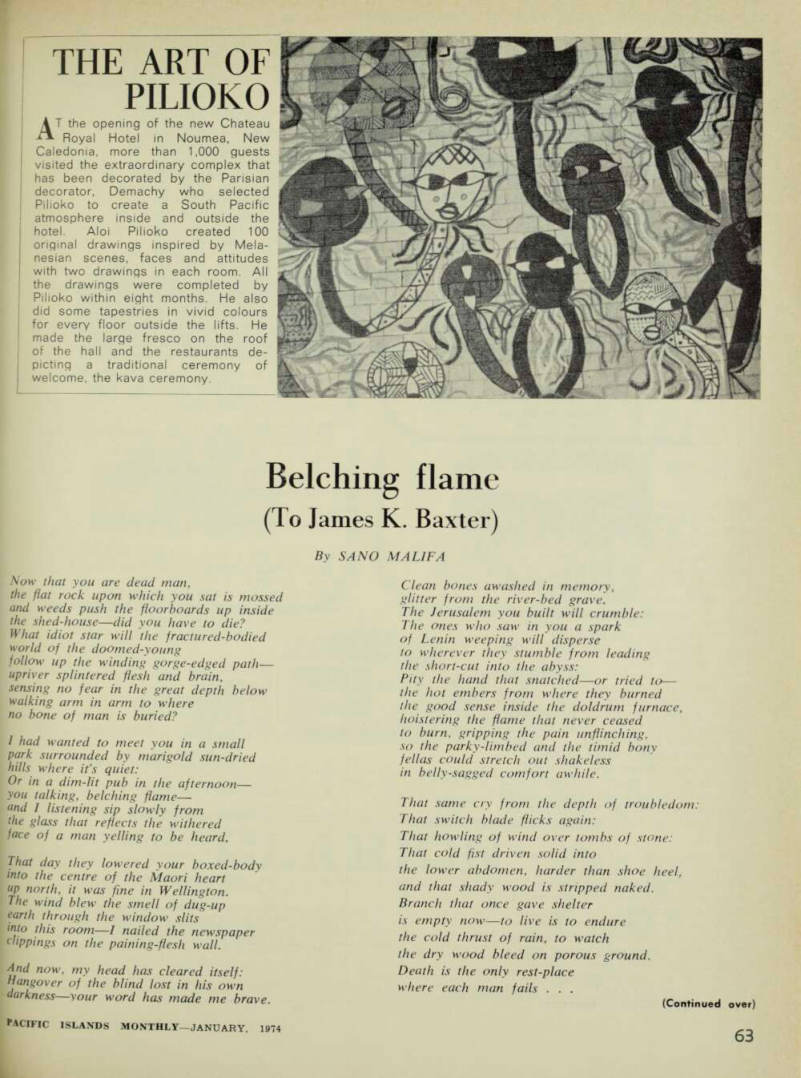
The Art Of
\ T the opening of the new Chateau Royal Hotel in Noumea, New Caledonia, more than 1,000 guests visited the extraordinary complex that has been decorated by the Parisian decorator, Demachy who selected Pilioko to create a South Pacific atmosphere inside and outside the hotel. Aloi Pilioko created 100 original drawings inspired by Mela nesian scenes, faces and attitudes with two drawings in each room. All the drawings were completed by Pilioko within eight months. He also did some tapestries in vivid colours for every floor outside the lifts. He made the large fresco on the roof of the hall and the restaurants de picting a traditional ceremony of welcome, the kava ceremony.
Belching flame
(To James K. Baxter)
By Sano Malifa
Now that you are dead man, the flat rock upon which you sat is mossed and weeds push the floorboards up inside the shed-house—did you have to die?
What idiot star will the fractured-bodied world of the doomed-young follow up the winding gorge-edged path— upriver splintered flesh and brain, sensing no fear in the great depth below walking arm in arm to where no bone of man is buried?
I had wanted to meet you in a small park surrounded by marigold sun-dried hills where it’s quiet: Or in a dim-lit pub in the afternoon — you talking, belching flame — a nd I listening sip slowly from the glass that reflects the withered face of a man yelling to be heard.
That day they lowered your boxed-body into the centre of the Maori heart up north, it was fine in Wellington.
The wind blew the smell of dug-up earth through the window slits into this room—l nailed the newspaper clippings on the paining-fiesh wall.
And now, my head has cleared itself: Hangover of the blind lost in his own darkness—your word has made me brave.
Clean bones awashed in memory, glitter from the river-bed grave.
The Jerusalem you built will crumble: The ones who saw in you a spark of Lenin weeping will disperse to wherever they stumble from leading the short-cut into the abyss: Pity the hand that snatched—or tried to — the hot embers from where they burned the good sense inside the doldrum furnace, bolstering the flame that never ceased to burn, gripping the pain unflinching, so the parky-limbed and the timid bony fellas could stretch out shakeless in belly-sagged comfort awhile.
That same cry from the depth of troubledom: That switch blade flicks again: That howling of wind over tombs of stone: That cold fist driven solid into the lower abdomen, harder than shoe heel, and that shady wood is stripped naked.
Branch that once gave shelter is empty now—to live is to endure the cold thrust of rain, to watch the dry wood bleed on porous ground.
Death is the only rest-place where each man fails . . . (Continued over)
though now, your word has carved itself on granite rock Aeon Entity: Good image polished clean in each century rain—that was your natal wish. If your other voice has lost its polemic pitch— distortion of tractor and sleek festive scream — it is inevitable. They sleep soundly now.
Eyeballs that refuse to focus on the binding web of fate—metal strand net that twists the breath from those entangled in it.
I walk the normal distance to the void: Depth where all things spring from to hecu• the guttural lion roar rumble from the grave: ‘Do not think the poor loves begging loves piss-hot poverty, or the shattered home kid prefers the hard floorboard to a family-warmed bed.
I have spent my life a bloody substitute and your funky eyes are still shut-tight.’
Well man, you fought a good fight.
In this world of money and glory, it is madness fighting to win.
You said yourself no one can fight the world. If out of the barren waves another of your kind emerge to launch letter bombs at the slinky screwballs, they would still remain politely unmoved.
It takes a fire between the legs to budge them—fire that burns a hole in steel.
Just last night they smashed a man’s skull and kneecaps at Civic Square, then took off on bikies —wrath on wheels.
Do we blame them? Mongrel, Black Power, Hell’s Devil?—while their fathers get stoned on booze, these kids get stoned on speed.
I have walked from where the tongue is silent to speak these words.
Simple enough to say the night is a dark angel. The quiet room yields a certain gratitude.
Outside maybe a ghost prowls there: This place of skulls and bones where no mind is free of fear.
The rich straddling fat-cushioned beds, cuddling ecstasy from woman breast and sensuous thighs lovely, dreaming—wealth soaring madly, japs the sky ribcage bugs the mind.
It’s cold now. I switch the heater on.
Warmth for a body shivering somewhere.
My father will hit the wall of heaven twice before he could understand: In this great city dark tunnel somewhere, shrivelled-up legs knee the groin, flesh shrunk and head hunched-in between shoulder stumps, someone is performing the cold yoga terrible act. Act of the saints whose teeth clank like steel, whose fists are knots of iron unprised open, whose eyes watch the river of life flowing away slowly into the dark.
Cursing at no one in narticular — moans of the lost child needing open hands to home in.
Not difficult at all to imagine being born to love and to hate— pub and pulpit are where men congregate: To see the hovering dove through clear or beer glazed eyes, is not difficult at all to imagine. It is when the eyes refuse to see that the mind loses all contact.
Man, your teaching is too humane, but I believe you. How you fought your war with fleas —too much.
The little devils have populated the bed, coming from inside the warm fur coat of Spooky the Siamese cat.
And each morning Gini sprays the bed with flea powder from the drug store.
A futile attempt really because the hopping creatures are miles away before she could spread the sheets out.
Good thing is that they don’t touch me— dark skin smell must irritate them.
Ah well, it’s good now to feel the quiet night around me. I cannot see through the curtains if other houses are lighted.
I cannot see the thought running through Ginfs head that gullies her brow now, lying by the fire asleep as the cat snuggles up cosily in the crotch of her thighs.
I cannot tell where my own mind will take me—life is a mystery, I accept that. A great enigma . . . who can split the shell open and walk through without stumbling?
Outside now the grass is wet with rain no doubt and the silent morepork up the hill respects the dead. I think of water bursting from a crack in the mountain , meandering down the plain slowly, not knowing when the sun will suck it dry before reaching the stone-deaf sea.
Heritage
By Hari Henderson
K Ko e ’Otua mo Tonga ko hoku tofia. 0 On this simple fact E Every citizen is informed.
S Symbolising unity, 1 Intertwined heredity, L Latent , grim complexity, A Adopted Christianity.
O On white ground, a red cross.
T Three swords, three stars, one crown, O Olive branch being whither born?
N Nobility is by abasement wreathed — G Green ' ifi leaves encircle coronet A Atop the shield. Motto : “God and Tonga are my inheritance”.
Advertisements & other items, pp. 67-68 (2 items)
65
ACIFIC ISLANDS MONTHLY— JANUARY, 1974
Greatest Stereo on Wheels!
Anybody with an ear for the exciting sounds of modern stereo, should get to hear one of these Clarion sets. They are the sets being chosen by those who want sound as good in their cars as they can get in their homes. Sound them out for yourself, and pick the quality model you prefer for
all-year-round driving pleasures.
PE-651A
Cassette stereo player and AM tuner.
Versatile combination with automatic tape reverse. Tuner picks up popular AM stations with sparkling clarity i| i
PE-810A
The 4-track cassette stereo player that calls you when the tape ends. Quick, smooth operation.
I ••• ••• •••# •••
PE-650A
Much, much more! 4-track cassette player with automatic reverse for nonstop play Mono or stereo Plus FM Multiplex tuner
PE-809A
4-track cassette stereo with a dynamic difference. Automatic reverse for continuous background music. Keep you entertained every mile. • Mif MiM • #•••
HE-503P
The cream of the cartridge systems. 3-way entertainer. 8-track cartridges, AM or FM Good for playing anyplace thru triple power source choice.. flashlight batteries, AC or car's cig. lighter. Includes two dynamic speakers. Amazing stereo value in a new distinctive style!
CLARION
Manufacturer CLARION CO., LTD. / Export Division CLARION SHOJI CO.. LTD. 3-5. Kojimachi, Chivoda-ku. Tokyo Tel: (2651 2931 Telex; J 22908 Overseas Branch Offices: SHOJI (EUROPA) G.M.B.H. 2000 Hamburg 76. Schbene Aussicht 36, West Germany Tel.: 220-7667, Telex: 214969.
CLARION SHOJI CO., LTD. (U.S.A.) NEW JERSEY 37 Swan St.. Ramsey. New Jersey 07446. U.S.A. Tel.: 201-825 0880. Telex: 13805.
CLARION SHOJI CO., LTD (U.S.A.) LOS ANGELES 2306 Corner Ave.. Los Angeles. Calif.. U.S.A. Tel.; 213-272-1179 Telex: 259103426976.
CLARION (MALAYSIA) SDN. BHD • l/2ms. Bayan Lepas. Penang. Malaysia, Tel.: 87-333, 87-334. Telex; PG 255 (Penang).
Fill Islands BRIJLAL & CO. G.P.O. BOX 362. SUVA. FIJI ISLANDS TEL; 22258 Tahiti COMIMPEX RUE DE COMMERCE, BOITE POSTALE 200 PAPEETE TEL: 20477 ew Caledonia CALDIS BOITE POSTALE 407, NOUMEA NEW CALEDONIA TEL: 57-89 Australia AMALGAMATED WIRELESS (AUST.) LTD.
CONSUMER PRODUCTS DIVISIONS P.O. BOX 24 ASHFIELD, NSW., AUSTRALIA. TEL; 7975757
Concentrated Pea-Ben
is lethal to flies, mosquitoes
and all insect pests ...
Yet so pure it's safe to spray anywhere With tropical weather providing ideal conditions for prolifically breeding flies and mosquitoes, serious outbreaks of disease can be spread by swarms of these insect invaders. Once more householders are urged to combat this threat to public health by killing every disease carrying insect seen. A.N.I. Research Chemists are constantly at work world-wide to ensure that Pea-Beu aerosol insecticide is effective in eliminating flies and mosquitoes from households. Pea-Beu is specifically formulated to contain pyrethrins, one of the most powerful insecticidal ingredients known deadly to mosquitoes, and all insect pests and yet harmless to man and his pets.
I I' r I; L The Deadliest Traffickers of Disease Four centuries ago flies were suspected of spreading tropical ulcers. Modern pathologists have proved they spread a whole list of infections, ranging from mild but unpleasant stomach upsets to infective hepatitis, bacillary, dysentery, typhoid and persistent ameobiasis. Worse still, flies transmit crippling scourges such as cholera, smallpox, poliomyelitis, opthalmia and trachoma. A highly efficient method of fly extermination is to use powerful Pea-Beu aerosol insecticide. A few short bursts of Pea-Beu in a room will kill all flies on the wing.
The permeating action of Pea-Beu also spreads into hidden
Isa
corners of the room, thus eliminating any hidden insects.
The mosquitoe’s record is just as grim.
Besides wrecking your night’s rest with their irritating whine and inflicting painful toxic bites, mosquitoes pass on many serious diseases including malaria, hepatitis, dengue and yellow fever, disfiguring elephantiasis and encephalitis.
Total Killing Power with Total Safety Controlling these dangerous diseasespreaders demands rapid destruction wherever they appear. Long-term research was needed to formulate the insect spray that combines high killing potential with complete safety for users, as powerful Pea-Beu aerosol does. Pea-Beu is particularly effective as the wide action spray ensures total coverage of any room. Pea Beu’s efficient spray seeks out and destroys insects before they have a chance to bring irritation and illness to your family. ii
Pea-Beu the safe, powerful insecticide
Yesterday
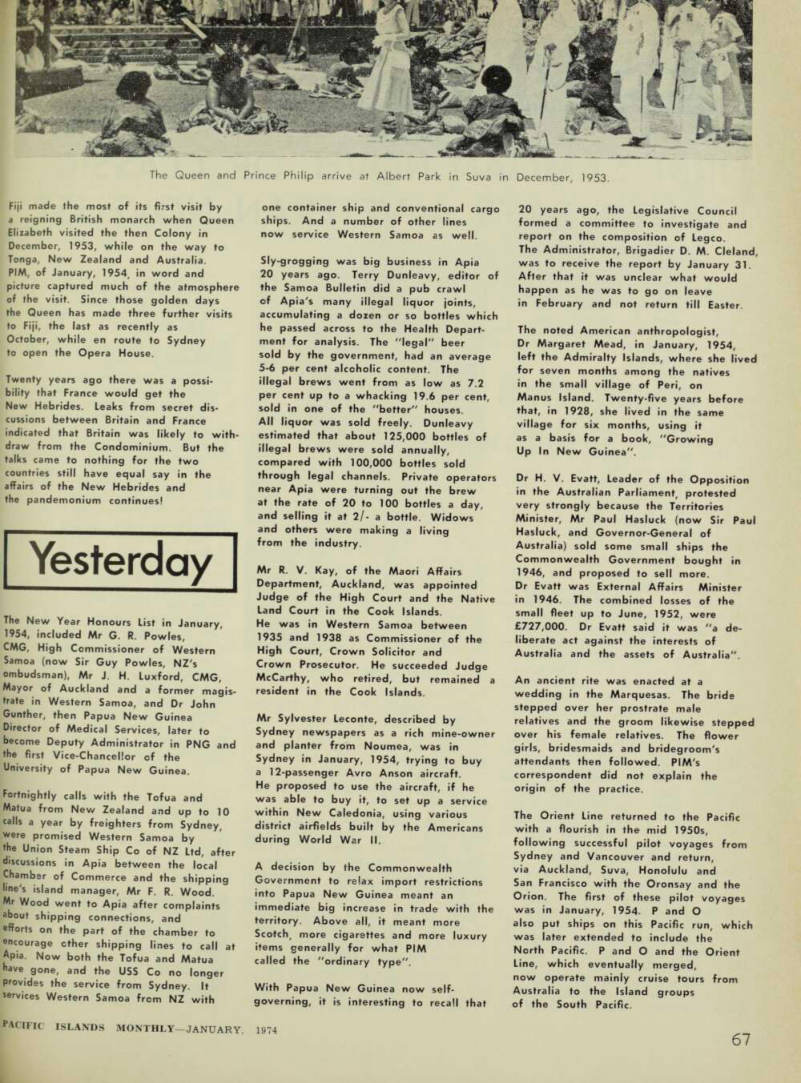
Fiji made the most of its first visit by a reigning British monarch when Queen Elizabeth visited the then Colony in December, 1953, while on the way to Tonga, New Zealand and Australia.
PIM, of January, 1954, in word and picture captured much of the atmosphere of the visit. Since those golden days the Queen has made three further visits to Fiji, the last as recently as October, while en route to Sydney to open the Opera House.
Twenty years ago there was a possi bility that France would get the New Hebrides. Leaks from secret dis cussions between Britain and France indicated that Britain was likely to with draw from the Condominium. But the talks came to nothing for the two countries still have equal say in the affairs of the New Hebrides and the pandemonium continues!
The New Year Honours List in January, 1954, included Mr G. R. Powles, CMG, High Commissioner of Western Samoa (now Sir Guy Powles, NZ's ombudsman), Mr J. H. Luxford, CMG, Mayor of Auckland and a former magis trate in Western Samoa, and Dr John Gunther, then Papua New Guinea Director of Medical Services, later to become Deputy Administrator in PNG and the first Vice-Chancellor of the University of Papua New Guinea.
Fortnightly calls with the Tofua and Matua from New Zealand and up to 10 calls a year by freighters from Sydney, were promised Western Samoa by the Union Steam Ship Co of NZ Ltd, after discussions in Apia between the local Chamber of Commerce and the shipping line's island manager, Mr F. R. Wood.
Mr Wood went to Apia after complaints about shipping connections, and efforts on the part of the chamber to encourage ether shipping lines to call at Apia. Now both the Tofua and Matua nave gone, and the USS Co no longer provides the service from Sydney. It services Western Samoa from NZ with
one container ship and conventional cargo ships. And a number of other lines now service Western Samoa as well.
Sly-grogging was big business in Apia 20 years ago. Terry Dunleavy, editor of the Samoa Bulletin did a pub crawl of Apia's many illegal liquor joints, accumulating a dozen or so bottles which he passed across to the Health Depart ment for analysis. The "legal" beer sold by the government, had an average 5-6 per cent alcoholic content. The illegal brews went from as low as 7.2 per cent up to a whacking 19.6 per cent, sold in one of the "better" houses.
All liquor was sold freely. Dunleavy estimated that about 125,000 bottles of illegal brews were sold annually, compared with 100,000 bottles sold through legal channels. Private operators near Apia were turning out the brew at the rate of 20 to 100 bottles a day, and selling it at 2/- a bottle. Widows and others were making a living from the industry.
Mr R. V. Kay, of the Maori Affairs Department, Auckland, was appointed Judge of the High Court and the Native Land Court in the Cook Islands.
He was in Western Samoa between 1935 and 1938 as Commissioner of the High Court, Crown Solicitor and Crown Prosecutor. He succeeded Judge McCarthy, who retired, but remained a resident in the Cook Islands.
Mr Sylvester Leconte, described by Sydney newspapers as a rich mine-owner and planter from Noumea, was in Sydney in January, 1954, trying to buy a 12-passenger Avro Anson aircraft.
He proposed to use the aircraft, if he was able to buy it, to set up a service within New Caledonia, using various district airfields built by the Americans during World War 11.
A decision by the Commonwealth Government to relax import restrictions into Papua New Guinea meant an immediate big increase in trade with the territory. Above all, it meant more Scotch, more cigarettes and more luxury items generally for what PIM called the "ordinary type".
With Papua New Guinea now self governing, it is interesting to recall that
20 years ago, the Legislative Council formed a committee to investigate and report on the composition of Legco.
The Administrator, Brigadier D. M. Cleland, was to receive the report by January 31.
After that it was unclear what would happen as he was to go on leave in February and not return till Easter.
The noted American anthropologist, Dr Margaret Mead, in January, 1954, left the Admiralty Islands, where she lived for seven months among the natives in the small village of Peri, on Manus Island. Twenty-five years before that, in 1928, she lived in the same village for six months, using it as a basis for a book, "Growing Up In New Guinea".
Dr H. V. Evatt, Leader of the Opposition in the Australian Parliament, protested very strongly because the Territories Minister, Mr Paul Hasluck (now Sir Paul Hasluck, and Governor-General of Australia) sold some small ships the Commonwealth Government bought in 1946, and proposed to sell more.
Dr Evatt was External Affairs Minister in 1946. The combined losses of the small fleet up to June, 1952, were £727,000. Dr Evatt said it was "a de liberate act against the interests of Australia and the assets of Australia".
An ancient rite was enacted at a wedding in the Marquesas. The bride stepped over her prostrate male relatives and the groom likewise stepped over his female relatives. The flower girls, bridesmaids and bridegroom's attendants then followed. PlM's correspondent did not explain the origin of the practice.
The Orient Line returned to the Pacific with a flourish in the mid 19505, following successful pilot voyages from Sydney and Vancouver and return, via Auckland, Suva, Honolulu and San Francisco with the Oronsay and the Orion. The first of these pilot voyages was in January, 1954. P and O also put ships on this Pacific run, which was later extended to include the North Pacific. P and O and the Orient Line, which eventually merged, now operate mainly cruise tours from Australia to the Island groups of the South Pacific.
The Queen and Prince Philip arrive at Albert Park in Suva in December, 1953.
Books, Reviews, writers
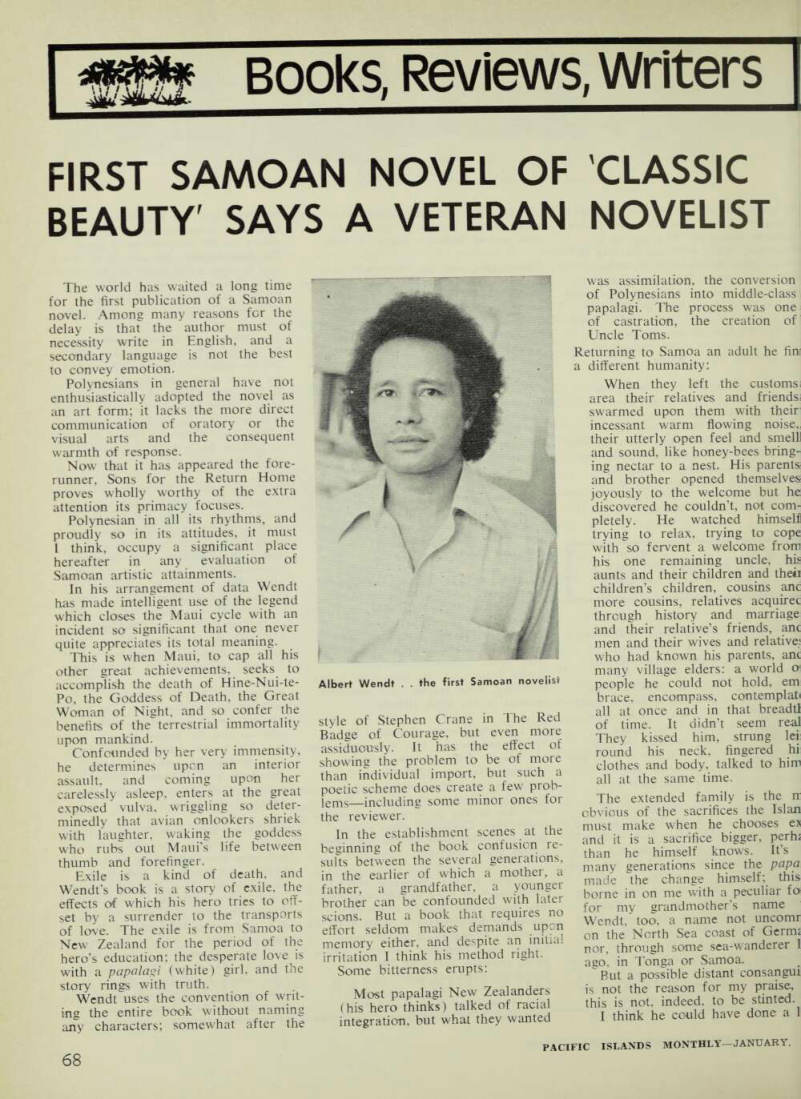
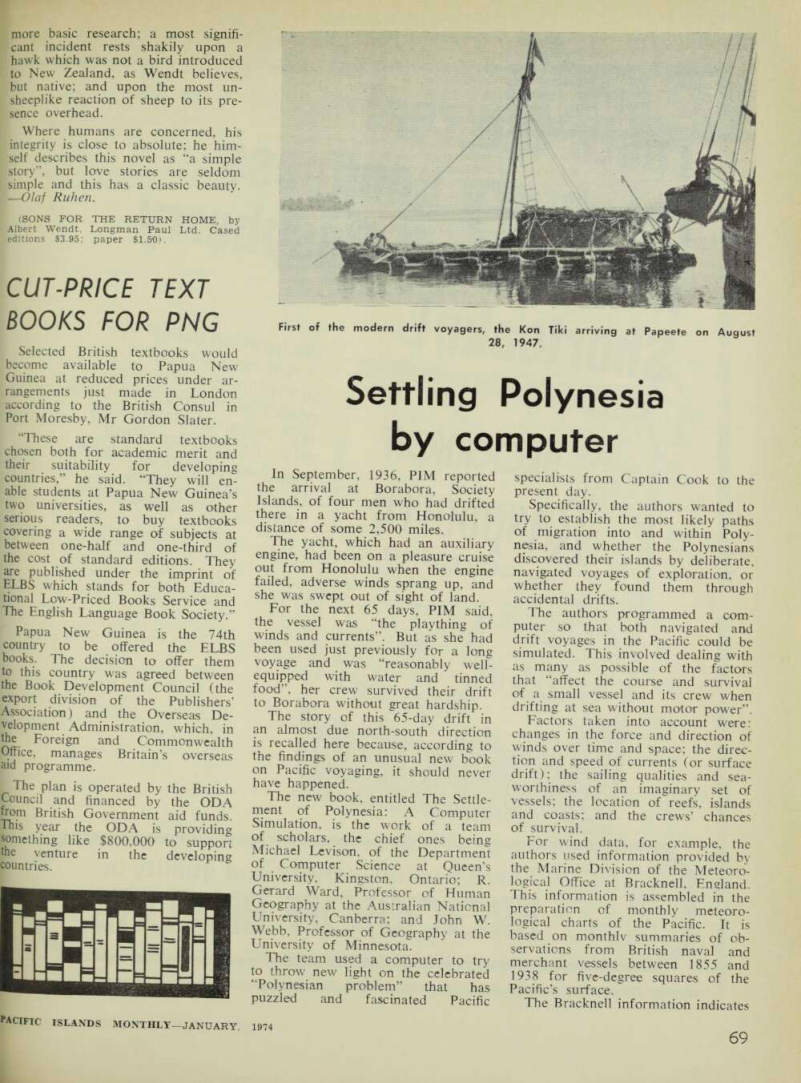
First Samoan Novel Of 'Classic
Beauty' Says A Veteran Novelist
The world has waited a long time for the first publication of a Samoan novel. Among many reasons for the delay is that the author must of necessity write in English, and a secondary language is not the best to convey emotion.
Polynesians in general have not enthusiastically adopted the novel as an art form; it lacks the more direct communication of oratory or the visual arts and the consequent warmth of response.
Now that it has appeared the fore runner, Sons for the Return Home proves wholly worthy of the extra attention its primacy focuses.
Polynesian in all its rhythms, and proudly so in its attitudes, it must I think, occupy a significant place hereafter in any evaluation of Samoan artistic attainments.
In his arrangement of data Wendt has made intelligent use of the legend which closes the Maui cycle with an incident so significant that one never quite appreciates its total meaning.
This is when Maui, to cap all his other great achievements, seeks to accomplish the death of Hine-Nui-te- Po, the Goddess of Death, the Great Woman of Night, and so confer the benefits of the terrestrial immortality upon mankind.
Confounded by her very immensity, he determines upon an interior assault, and coming upon her carelessly asleep, enters at the great exposed vulva, wriggling so deter minedly that avian onlookers shriek with laughter, waking the goddess who rubs out Maui’s life between thumb and forefinger.
Exile is a kind of death, and Wendt’s book is a story of exile, the effects of which his hero tries to off set by a surrender to the transports of love. The exile is from Samoa to New Zealand for the period of the hero’s education; the desperate love is with a papalagi (white) girl, and the story rings with truth.
Wendt uses the convention of writ ing the entire book without naming any characters; somewhat after the
style of Stephen Crane in The Red Badge of Courage, but even more assiduously. It has the effect of showing the problem to be of more than individual import, but such a poetic scheme does create a few prob lems —including some minor ones for the reviewer.
In the establishment scenes at the be sinning of the book confusion re sults between the several generations, in the earlier of which a mother, a father, a grandfather, a younger brother can be confounded with later scions. But a book that requires no effort seldom makes demands upon memory either, and despite an initial irritation I think his method right.
Some bitterness erupts: Most papalagi New Zealanders (his hero thinks) talked of racial integration, but what they wanted
was assimilation, the conversion of Polynesians into middle-class papalagi. The process was one of castration, the creation of Uncle Toms.
Returning to Samoa an adult he fim a different humanity: When they left the customs; area their relatives and friends; swarmed upon them with their 1 incessant warm flowing noise,, their utterly open feel and smelll and sound, like honey-bees bring ing nectar to a nest. His parents; and brother opened themselves joyously to the welcome but he discovered he couldn’t, not com pletely. He watched himself trying to relax, trying to cope with so fervent a welcome from his one remaining uncle, his aunts and their children and theii children’s children, cousins anc more cousins, relatives acquiree through history and marriage and their relative’s friends, anc men and their wives and relative; who had known his parents, anc many village elders: a world O" people he could not hold, em brace, encompass, contemplah all at once and in that breadtl of time. It didn’t seem real They kissed him, strung lei; round his neck, fingered hi clothes and body, talked to him all at the same time.
The extended family is the rr obvious of the sacrifices the Islan must make when he chooses ex and it is a sacrifice bigger, perh; than he himself knows. It’s many generations since the papa made the change himself; this borne in on me with a peculiar fo for my grandmother’s name Wendt, too. a name not uncomr on the North Sea coast of Gcrrm nor, through some sea-wanderer 1 ago, in Tonga or Samoa.
“ But a possible distant consangui is not the reason for my praise, this is not, indeed, to be stinted.
I think he could have done a 1
Albert Wendt . . the first Samoan novelist
more basic research; a most signifi cant incident rests shakily upon a hawk which was not a bird introduced to New Zealand, as Wendt believes, but native; and upon the most un sheeplike reaction of sheep to its pre sence overhead.
Where humans are concerned, his integrity is close to absolute; he him self describes this novel as “a simple story”, but love stories are seldom simple and this has a classic beauty. [ —Olaf Ruhen.
(Sons For The Return Home, By
Albert Wendt. Longman Paul Ltd. Cased editions $3.95; paper $1.50).
Cut-Price Text
Books For Png
Selected British textbooks would become available to Papua New Guinea at reduced prices under ar rangements just made in London according to the British Consul in Port Moresby, Mr Gordon Slater.
“These are standard textbooks chosen both for academic merit and their suitability for developing countries,” he said. “They will en able students at Papua New Guinea’s two universities, as well as other serious readers, to buy textbooks covering a wide range of subjects at between one-haif and one-third of the cost of standard editions. They are published under the imprint of ELBS which stands for both Educa tional Low-Priced Books Service and The English Language Book Society.”
Papua New Guinea is the 74th country to be offered the ELBS books. The decision to offer them to this country was agreed between the Book Development Council (the export division of the Publishers’
Association) and the Overseas De velopment Administration, which, in the Foreign and Commonwealth Office, manages Britain’s overseas aid programme.
The plan is operated by the British Council and financed by the ODA horn British Government aid funds.
This year the ODA is providing something like $BOO,OOO to support the venture in the developing countries.
Settling Polynesia

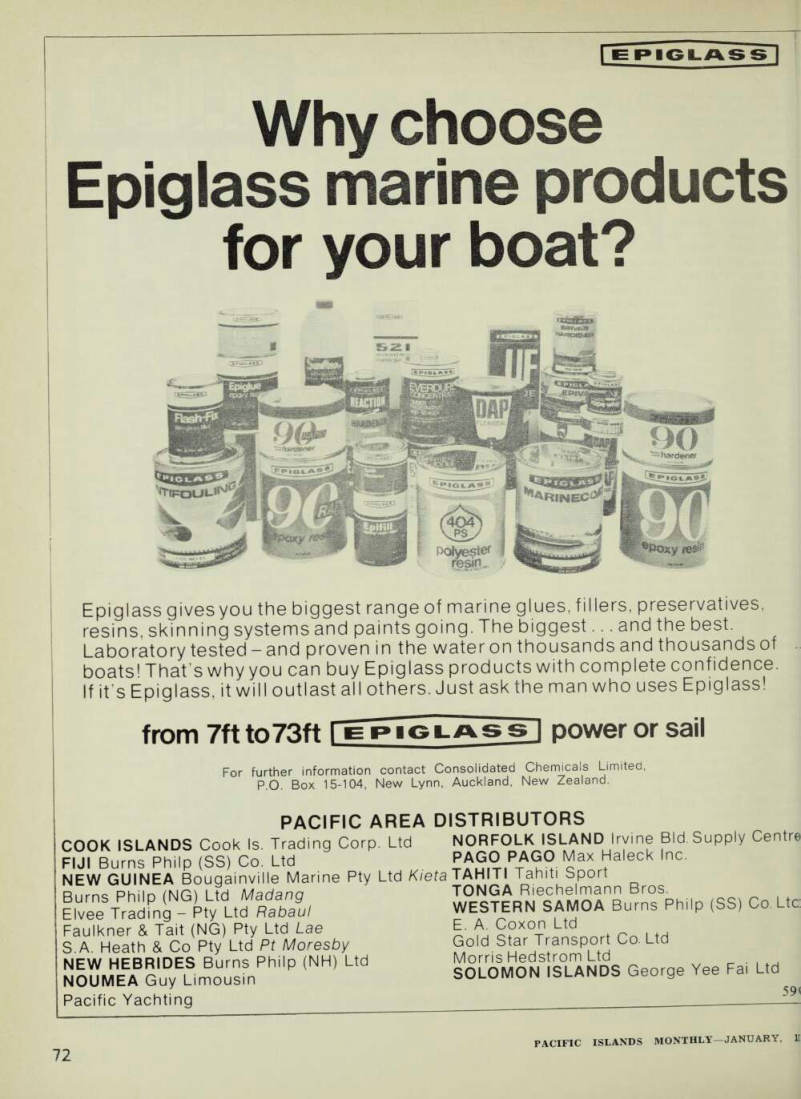
by computer
In September. 1936, PIM reported the arrival at Borabora, Society Islands, of four men who had drifted there in a yacht from Honolulu, a distance of some 2,500 miles.
The yacht, which had an auxiliary engine, had been on a pleasure cruise out from Honolulu when the engine failed, adverse winds sprang up, and she was swept out of sight of land.
For the next 65 days, PIM said, the vessel was “the plaything of winds and currents”. But as she had been used just previously for a long voyage and was “reasonably well equipped with water and tinned food”, her crew survived their drift to Borabora without great hardship.
The story of this 65-day drift in an almost due north-south direction is recalled here because, according to the findings of an unusual new book on Pacific voyaging, it should never have happened.
The new book, entitled The Settle ment of Polynesia: A Computer Simulation, is the work of a team of scholars, the chief ones being Michael Lcvison, of the Department of Computer Science at Queen’s University, Kingston, Ontario; R.
Gerard Ward, Professor of Human Geography at the Australian National University, Canberra; and John W.
Webb, Professor of Geography at the University of Minnesota.
The team used a computer to try to throw new light on the celebrated “Polynesian problem” that has puzzled and fascinated Pacific
specialists from Captain Cook to the present day.
Specifically, the authors wanted to try to establish the most likely paths of migration into and within Poly nesia, and whether the Polynesians discovered their islands by deliberate, navigated voyages of exploration, or whether they found them through accidental drifts.
The authors programmed a com puter so that both navigated and drift voyages in the Pacific could be simulated. This involved dealing with as many as possible of the factors that “affect the course and survival of a small vessel and its crew when drifting at sea without motor power”.
Factors taken into account were: changes in the force and direction of winds over time and space; the direc tion and speed of currents (or surface drift); the sailing qualities and sea worthiness of an imaginary set of vessels; the location of reefs, islands and coasts; and the crews’ chances of survival.
For wind data, for example, the authors used information provided by the Marine Division of the Meteoro logical Office at Bracknell, England.
This information is assembled in the preparation of monthly meteoro logical charts of the Pacific. It is based on monthlv summaries of ob servations from British naval and merchant vessels between 1855 and 1938 for five-degree squares of the Pacific’s surface.
The Bracknell information indicates
First of the modern drift voyagers, the Kon Tiki arriving at Papeete on August 28, 1947.
How The Computers 'Drifted'
how often winds blow from 16 points of the compass for each of 13 forces of the Beaufort scale, plus calms and variable winds. However, for some five-degree squares, this information is net available, so the authors had to aggregate observations for adjacent squares and “apply them to the whole area”.
The authors devote several pages :o explaining how they used their intricate data. Suffice it to say that ihey chose 62 different starting points n and near Polynesia for simulated irift voyages; that they started two irift voyages from each point for ;ach day of a 366-day year; and that hey simulated a total of 46,848 drift 'oyages from those points. In iddition, more than 50,000 other drift r oyages were simulated to take iccount of such things as wind shifts.
Vnd 8,052 “navigated voyages” were nade from 11 starting points.
The most positive of the authors’ omputerised findings are that there re several areas in the Pacific where he probability of making a success ul drift voyage is very high (20 per ent or more). These areas are: from lawaii to the Marshall Islands; 'onga to Fiji; Samoa to Wallis Island nd on to the Ellice Islands; Caro ne Island (Line Group) to the orthern Cooks and Tokelaus; Pit airn to Mangareva to the eastern uamotus; and Rapa to the Austral (lands, Tuamotus and southern 'ooks. In each of these areas, the witact is approximately south-east ) west, except in two cases where it north-east to west.
Areas of moderate and high con ict probability (five per cent to 10 sr cent and more) are the same as lose already described, except that ie pattern within Polynesia is in nsified and there are some exten ons. The extensions include; Fiji ► Central Melanesia; Socorro Island northern Mexico) to the Line ‘lands; and Easter Island to Pitcairn id the Marquesas.
When low contact probabilities )ne to 4.9 per cent) are considered, isterly links between Fiji and the nice Islands appear for the first me.
The most striking features of all lC drift experiments were that New Jaland remained isolated from all mer areas; there were no contact obabilities between South America id Polynesia (unless voyages from America were computed to igm 300 or 400 miles from the )uth American coast); and there
were only a few south to north and north to south contacts, all of them quite short.
The isolation of New Zealand quite surprised one of the authors, who once saw coconut palms being washed up in northern New Zealand from somewhere in the Pacific.
The lack of drift contact probabili ties from South America will also surprise many people, especially as the Las Balsas expedition has again demonstrated that balsa rafts can drift from Ecuador to Australia.
Finally, the drift voyage from Honolulu to Borabora, recorded in PIM, seems to prove beyond doubt that long north-scuth drift voyages can happen regardless of what the computer might say.
In the light of the three foregoing considerations, it is difficult to accept the conclusions that Messrs Levison, Ward and Webb have drawn from their experiments. These are; T Drift voyages are unlikely to have been responsible for the settle ment of Eastern Polynesia, either from the east or the west.
2. Drift voyages from Eastern Polynesia are unlikely to have re sulted in the settlement of Hawaii, New Zealand or Easter Island. 3. “Some element of purposeful voyaging was necessary for pre historic man to reach the outer [Polynesian] groups.”
The view of this reviewer is that no man, prehistoric or otherwise, ever made a purposeful voyage towards any goal unless he knew or suspected it was there.
It therefore follows that, if drift voyages to the outer edges of Poly nesia did not show up in the Levison- Ward-Webb experiments, this should not be interpreted to mean that such voyages did not occur in prehistoric times. It simply means that data on abnormal, perhaps freakish, con ditions in the Pacific that carry palm trees to New Zealand and disabled yachts from Honolulu to Borabora are not on record at Bracknell, England, for feeding into the L-W-W computer.
In short, the L-W-W book does not seem to throw any new light on the “Polynesian problem”. If anything, it obscures it by drawing dubious con clusions from inadequate evidence; and also by making an occasional assertion that is not based on any evidence at all.
An instance of the latter occurs on page 47 where the authors say it is unlikely that fishing or trading vessels in prehistoric Columbian times ever ventured sufficiently far from the South American coast to get clear of the coast-hugging Humboldt Cur rent, but that if they did “there is little reason to believe they could not have regained the coast . . . had the crew so wished”.
This, to put it bluntly, seems like wishful thinking to support anti- Heyerdahl preconceptions.
The fact is that well-fitted ships have frequently been carried well clear of the South American coast in storms, and there are several instances of derelicts having been drifted thence all the way to French Poly nesia.
One such derelict, the steel-hulled Dagonar, passed within a short dis tance of Easter Island in 1917 and finally came to rest at Mopelia to the west of Tahiti and Raiatea.
If the Dagonar had been a dis abled balsa raft of prehistoric times.
it might well have carried some South American Indians to Easter Island or the islands further west. If they, in turn, had established a colony wherever they made the land, they could later have provided more hap less drift voyagers for a further excursion westward.
So news of the existence of land in the Eastern Pacific could have been carried to the west by a few people who originated in South America.
And those who originated in south east Asia could later have made deliberate voyages to the west against the prevailing winds in search of them.
This, at any rate, seems a more logical view on the settlement of Polynesia than the principal conclusion in the new book of that name. And it would neatly solve the problem of how the sweet potato got into Poly nesia!
All of which goes to show that, despite the strictures made here about the new book, it is one that will stimulate all those who lie awake o’nights wondering where the Poly nesians came from, and how they progressed from point A to point B.
The authors, moreover, deserve the highest commendation for their ingenious new treatment of an old problem and for their lucid dis
cussion on it.-
Robert Langdon.
A < J^O^Sr Rlement Of Polynesia:
A Computer Simulation, By Michael
Levison, R. Gerard Ward and John W Webb, Australian National University Press, Canberra. $A8.95). • If you want to learn how to build a new nation and how to dis charge the duties of a good citizen, go to the Bible, says the Bible Society to New Guineans and gives the guide lines in a scripture booklet which is being distributed in the country’s three major languages to coincide with the attainment of self-govern ment. The booklet, Building a Nation, contains passages from Psalm o/ and the New Testament relating to citizenship and national life that are relevant to a forming nation. The book is attractively designed and features colour photographs of Papua New Guinea scenes. Fifty thousand copies were printed but before the nrst consignment reached PNG there was a request for a further 75,000
Advertisements & other items, p. 72 (1 item)
Ssss®«
Taste the
rea\
IMS
hpst richest taste
The treehe^J.
0 f real raspd e ”' nchv
, sanWioWj£ «, Spa**™
t golden shortc w w ,th f with sugar an Kho tt 1 fruity take 1 RaspberrV sho g v ,
“r^“ ,teeo '
\ C 1 \ 'N \ 3 U There’s value, variety and quality in
BROCKHOFF BISCUITS
5546/8x6 1 /4
Sailing Ships'
War
With The Horn
Until Sir Francis Chichester sailed single-handed round Cape Horn in his Gypsy Moth IV, few people over rhe last half-century gave much of a I thought to that greatest of all chal- j lenges to mariners in the days of sail, i To a certain extent, Chichester deni grated the Horn and its dangers. Was i it such a challenge to the big square riggers when an elderly man could take it on in a 57 ft ketch? Just how ! great was his feat and why the sea men of old, who had rounded the Horn, were never tired of boasting about it, is told graphically and with great detail by that deep-sea adven turer Alan Villiers in The War With Cape Horn. First published in 1971 and now out as a Pan paperback, Villiers' book tells the whole story of the battles lost and won with the Horn. Many of the famous sailing ships tell their own stories in their logs many of which Villiers found by chance in an old aeroplane hangar in Middlesex. (The War With Cape Horn, by Alan Villiers, Pan, $1.50.)
Advertisements & other items, pp. 73-74 (2 items)
71
ICIFIC ISLANDS MONTHLY— JANUARY. 1974
Why choose
r EPIGLASS
Epiglass marine products
for your boat?
DAP
mmm as?
Tmec^ I 'V KM PS
i f>o
> Epiglass gives you the biggest range of marine glues, fillers, preservatives, resins, skinning systems and paints going. The biggest... and the best.
Laboratory tested - and proven in the water on thousands and thousands of boats! That’s why you can buy Epiglass products with complete confidence.
If it’s Epiglass, it will outlast all others. Just askthemanwhouses Epiglass!
from 7ftto73ft [epiglassj power or sail
For further information contact Consolidated Chemicals Limited, P.O. Box 15-104, New Lynn, Auckland, New Zealand.
PACIFIC AREA DISTRIBUTORS
;OOK ISLANDS Cook Is. Trading Corp. Ltd NORFOLK ISLAND Irvine Bid. Supply Centre IJI Burns Philp (SS) Co. Ltd PAGO Max Haleck Inc.
JEW GUINEA Bougainville Marine Pty Ltd Kieta TAHITI Tahiti Sport ) . i r no Phiin I td Madana TONGA Riechelmann Bros.
ST™R4 - Pl» LW BaS WESTERN SAMOA Bums Philp (SS| Co LtC ; a A UI E.SsCo ( R, > UdVVl.t?lsPy Gofa StiTshspor, Co L,P svsKsrn raip ,NHI LW sscsassnssaue. <*-, »u.
Pacific Yachting
Png Legends In Colour
Kurt Pfund and \Rigby Limited have done it again! Yes, another book of surprisingly-pleasing prints of Kurt’s very pleasing paintings.
The book is Legends of Papua New Guinea, published by Rigby Limited and prepared from paintings Kurt Pfund has done over a period of time, most in private collections, with accompanying stories by Jack McCarthy. And the result is highly successful, beautifully printed in Hong Kong and a gift at $4.95. The book is published by Rigby in con junction with Robert Brown and Associates in Papua New Guinea.
I have said before all I can say about Kurt’s paintings: they are in themselves not only pleasing to the eye, colourful and exciting, a record of life in Papua New Guinea. I consider that they are the visual captivation of the spirit of the people among whom Kurt has chosen to live, and of all the hordes of paintings I have seen by artists in New Guinea (either there for a long time or just passing through) his are among those of three or four which in my opinion are outstanding, and hold the spirit of a people as well as being an in teresting representation of physical form. The book is worth buying for the prints in it alone.
Jack McCarthy is always readable. 1 find him readable even on those occasions when I disagree with him.
At this time, however, there is no thing with which to disagree for the legends which share the book are written convincingly and have a genuine atmosphere. They have been re-told in easily-read English which retains an aura of the verbal recount ing which Jack must often have heard and the sounds of the telling of which in many districts of Papua New Guinea will remain in my auditory memory forever.
For those not fortunate enough to have heard the recounting of legends by the old men of the village, Jack McCarthy has given them the nearest approach I have come upon yet of the real thing.
There is an interesting list of acknowledgements of source material, and no attempt to indicate anything like private possession of the legends.
This acknowledgement of sources, be sides sustaining the authenticity of the material, is a bibliography of interest to anyone wishing to study further this facet of Melanesian life.
The combination of Jack McCarthy’s authentically-told legends
with Kurt Pfund’s skilful paintings make a book worth having, and a book which makes a better reminder of Papua New Guinea than some of the spurious artifacts and hand crafts parading as genuine and offer ing their travesty at high prices.
Indeed, the indigene who does not buy the book as a record of his own culture may one day regret not hav ing done so. I recommend Legends of Papua New Guinea, Paintings by Kurt Pfund, Text by Jack McCarthy to residents leaving Papua New Guinea, and those who will live there for the rest of their lives, for memories of what may be passing away, and to those who are finding Papua New Guinea for the first time as an authentic introduction to some thing more than merely its moral life.
Peter Livingston.
(Legends Of Papua New Guinea
Paintings by Kurt Pfund. text by Jack McCarthy. Rigby Ltd. $4.95.»
Collecting Books
good practical common sense in Seumas Stewart’s Book Collecting: A Beginner’s Guide, for anybody with even a small collection of books. While he’s entertaining on such exotica as collecting fine bind ings and first editions, which is not open to all of us, his real value is in giving us basic information on caring for books and indexing them, and telling us about page sizes and abbreviations to be found in cata logues. About indexing, for instance: “Elaborate methods may profitably be ignored. A man who is sufficiently intelligent to become a book collec tor should have wit enough to devise his own author and title card-index system. Even if it is an ill-favoured thing it will be his own and he will know how to use it.’’ About mutila tion of endpapers: “One of the worst crimes committed against books.
Fear of black magic seems still to linger in the minds of apparently civilised people. When they come to sell books on which their names have been written, they are so terri fied lest the names fall into the hands of sorcerers who will work evil against them that they tear out the endpapers which bear the names.’’
The handsomely-produced volume is published by David and Charles, our copy from A. H. and A. W. Reed Pty Ltd, $8.50.
Advertisements & other items, p. 76 (1 item)
are really going places.
I * i l Now AIR NEW ZEALAND DC-1 O s
MORE PLACES MORE OFTEN
AIR NEW ZEALAND expands DC-10 Pacific destinations. Wide-bodied DC-10 routes now cover Auckland, Christchurch, Melbourne, Sydney, Singapore, Fiji, Tahiti, Honolulu and Los Angeles.
Your travel agent has all the details Official Menutioflal Carrier to the MR Xth British Commonwealth iKN) Games 1974
air riELU zeaiano
WE ARE THE PACIFIC
ANZ 182
Pacific Transport
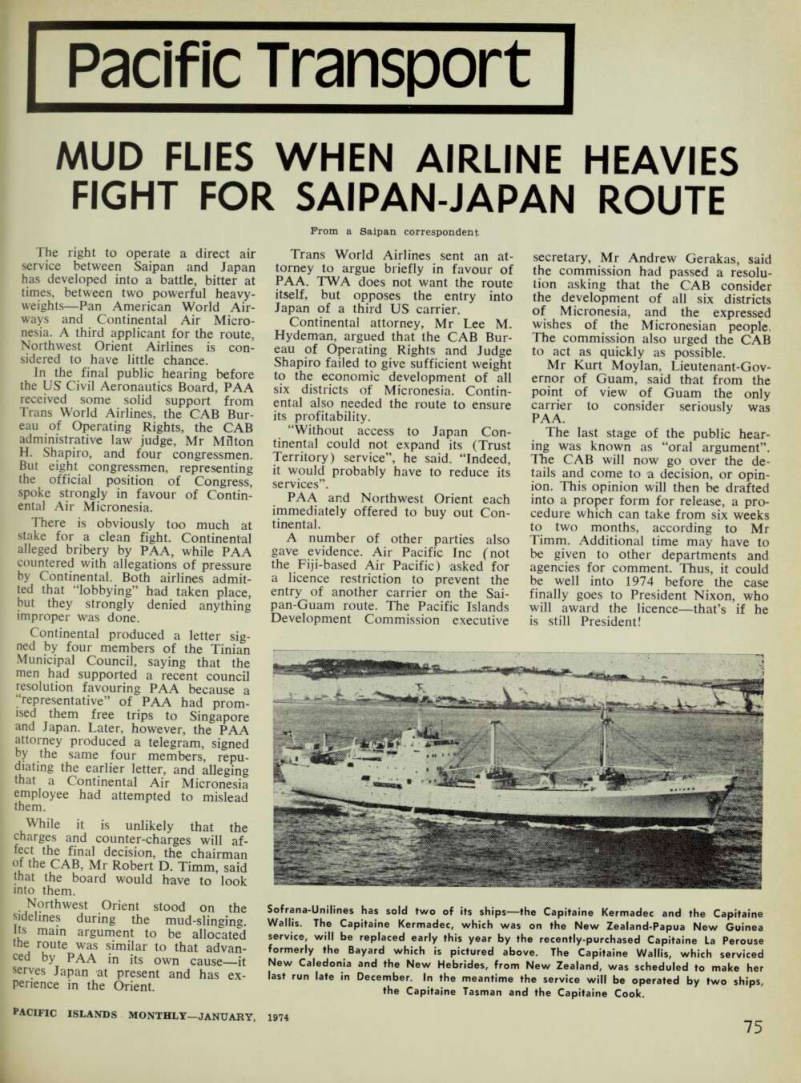
Mud Flies When Airline Heavies
Fight For Saipan-Japan Route
From a Saipan correspondent
The right to operate a direct air service between Saipan and Japan has developed into a battle, bitter at times, between two powerful heavy weights—Pan American World Air ways and Continental Air Micro nesia. A third applicant for the route, Northwest Orient Airlines is con sidered to have little chance.
In the final public hearing before the US Civil Aeronautics Board, PAA received some solid support from Trans World Airlines, the CAB Bur eau of Operating Rights, the CAB administrative law judge, Mr Milton H. Shapiro, and four congressmen.
But eight congressmen, representing the official position of Congress, spoke strongly in favour of Contin ental Air Micronesia.
There is obviously too much at stake for a clean fight. Continental alleged bribery by PAA, while PAA countered with allegations of pressure by Continental. Both airlines admit ted that “lobbying” had taken place, but they strongly denied anything improper was done.
Continental produced a letter sig ned by four members of the Tinian Municipal Council, saying that the men had supported a recent council resolution favouring PAA because a “representative” of PAA had prom ised them free trips to Singapore and Japan. Later, however, the PAA attorney produced a telegram, signed by the same four members, repu diating the earlier letter, and alleging that a Continental Air Micronesia employee had attempted to mislead them.
While it is unlikely that the charges and counter-charges will af fect the final decision, the chairman of the CAB, Mr Robert D. Timm, said that the board would have to look into them.
Northwest Orient stood on the sidelines during the mud-slinging.
Its mam argument to be allocated the route was similar to that advan ced by PAA in its own cause—it serves Japan at present and has ex perience in the Orient.
Trans World Airlines sent an attoniey to argue briefly in favour of PAA. TWA does not want the route itself, but opposes the entry into Japan of a third US carrier.
Continental attorney, Mr Lee M, Hydeman, argued that the CAB Bureau of Operating Rights and Judge Shapiro failed to give sufficient weight to the economic development of all six districts of Micronesia. Continental also needed the route to ensure
its profitability.
Without access to Japan Continental could not expand its (Trust Territory) service”, he said. “Indeed, it would probably have to reduce its services”.
PAA and Northwest Orient each immediately offered to buy out Continental.
A number of other parties also gave evidence. Air Pacific Inc (not the Fiji-based Air Pacific) asked for a licence restriction to prevent the entry of another carrier on the Saipan-Guam route. The Pacific Islands Development Commission executive
secretary, Mr Andrew Gerakas said the commission had passed a resolu tion asking that the CAB consider the development of all six districts of Micronesia, and the expressed wishes of the Micronesian people.
The commission also urged the CAB to act as quickly as possible.
Mr Kurt Moylan, Lieutenant-Gov ernor of Guam, said that from the point of view of Guam the only carrier to consider seriously was
Paa.
The last stage of the public hear ing was known as “oral argument”.
The CAB will now go over the de tails and come to a decision, or opin ion. This opinion will then be drafted into a proper form for release, a pro cedure which can take from six weeks to two months, according to Mr Timm. Additional time may have to be given to other departments and agencies for comment. Thus, it could be well into 1974 before the case finally goes to President Nixon, who will award the licence—that’s if he is still President!
Sofrana-Unilines has sold two of its ships—the Capitaine Kermadec and the Capitaine Wallis. The Capitaine Kermadec, which was on the New Zealand-Papua New Guinea service, will be replaced early this year by the recently-purchased Capitaine La Perouse formerly the Bayard which is pictured above. The Capitaine Wallis, which serviced New Caledonia and the New Hebrides, from New Zealand, was scheduled to make her last run late in December. In the meantime the service will be operated by two ships, the Capitaine Tasman and the Capitaine Cook.
Advertisements & other items, pp. 77-78 (2 items)
75
PACIFIC ISLANDS MONTHLI-JANUARY, 1974
These MF distributors,
PAPUA NEW GUINEA
Ela Motors Limited, P.O. Box 75,
PORT MORESBY
Branches and Dealers throughout Papua New Guinea
FIJI, TONGA. WESTERN
SAMOA AND OTHER SOUTH
PACIFIC TERRITORIES
Motor Division, Burns Philp (South Sea) Co. Ltd., P.O. Box 355,
SUVA. FIJI
Branches throughout the region
These MF distributors,
can shew you, the greater
the load on the MF2I Trailer
the better the grip!
The all-steel, hydraulictipping MF2I is a “goanywhere” unit with large section tyres to give good flotation on wet ground and MF’s famous rear axle design,which puts 25% of the load on the tractor’s rear wheels. The bigger the load, the better the grip! Capacity is 3 1 /2 tons, tray area 60 square feet. A powerful hydraulic ram tips the tray to 56 degrees for fast, clean unloading. Everything about this trailer is planned for one-man operation. What’s more, it’s built for years of tough work In the field or on the road.
MF Massey Ferguson MF 73045 row •»»«»*»
The Cooks are in the jet age
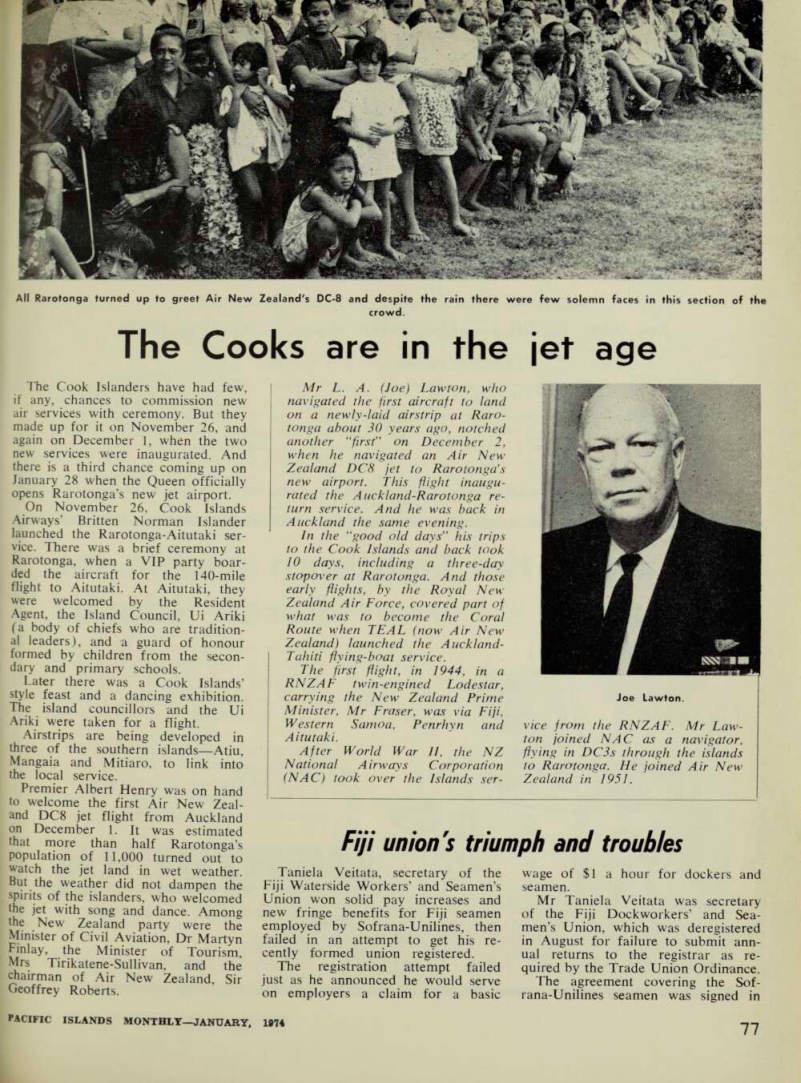
The Cook Islanders have had few, if any, chances to commission new air services with ceremony. But they made up for it on November 26, and again on December 1, when the two new services were inaugurated. And there is a third chance coming up on January 28 when the Queen officially opens Rarotonga’s new jet airport.
On November 26, Cook Islands Airways’ Britten Norman Islander launched the Rarotonga-Aitutaki ser vice. There was a brief ceremony at Rarotonga, when a VIP party boar ded the aircraft for the 140-mile flight to Aitutaki. At Aitutaki, they were welcomed by the Resident Agent, the Island Council, Ui Ariki fa body of chiefs who are tradition al leaders), and a guard of honour formed by children from the secon dary and primary schools.
Later there was a Cook Islands’ style feast and a dancing exhibition.
The island councillors and the Ui Ariki were taken for a flight.
Airstrips are being developed in three of the southern islands—Atiu, Mangaia and Mitiaro, to link into the local service.
Premier Albert Henry was on hand to welcome the first Air New Zeal and DCS jet flight from Auckland on December 1. It was estimated that more than half Rarotonga’s population of 11,000 turned out to watch the jet land in wet weather.
But the weather did not dampen the spirits of the islanders, who welcomed the jet with song and dance. Among the New Zealand party were the Minister of Civil Aviation, Dr Martyn Finlay, the Minister of Tourism, Mrs Tirikatene-Sullivan, and the chairman of Air New Zealand, Sir
Geoffrey Roberts.
Mr L. A. (Joe) Lawton, who navigated the first aircraft to land on a newly-laid airstrip at Raro tonga about 30 years ago, notched another “first” on December 2, when he navigated an Air New Zealand DCS jet to Rarotonga’s new airport. This flight inaugu rated the Auckland-Rarotonga re turn service. And he was back in Auckland the same evening.
In the “good old days” his trips to the Cook Islands and back took 10 days, including a three-day stopover at Rarotonga. And those early flights, by the Royal New Zealand Air Force, covered part of what was to become the Coral Route when TEAL (now Air New Zealand) launched the Auckland- Tahiti flying-boat service.
The first flight, in 1944, in a RNZAF twin-engined Lodestar, carrying the New Zealand Prime Minister, Mr Fraser, was via Fiji, Western Samoa, Penrhyn and Aitutaki.
After World War 11, the NZ National Airways Corporation (NAC) took over the Islands ser-
vice from the RNZAF. Mr Law ton joined NAC as a navigator, flying in DC3s through the islands to Rarotonga. He joined Air New Zealand in 1951.
All Rarotonga turned up to greet Air New Zealand's DC-8 and despite the rain there were few solemn faces in this section of the crowd.
Joe Lawton.
Fiji union's triumph and troubles


Taniela Veitata, secretary of the Fiji Waterside Workers’ and Seamen’s Union won solid pay increases and new fringe benefits for Fiji seamen employed by Sofrana-Unilines, then failed in an attempt to get his re cently formed union registered.
The registration attempt failed just as he announced he would serve on employers a claim for a basic
wage of Si a hour for dockers and seamen.
Mr Taniela Veitata was secretary of the Fiji Dockworkers’ and Sea men’s Union, which was deregistered in August for failure to submit ann ual returns to the registrar as re quired by the Trade Union Ordinance.
The agreement covering the Sof rana-Unilines seamen was signed in
Sydney, with officials of some mili tant Australian left-wing unions look ing on. They were the Seamen’s Union, the Waterside Workers Fed eration and the Firemen and Deck hands’ Union. It provides for a basic monthly salary of $134, up to $22 on the previous rate.
Other new monthly salaries, with the old rates in brackets, are: boats wain and electrician, $l7l ($151); chief cook, $l6O ($151); chief steward, $l5l ($131); shipwright, able seamen, greaser No 1, $144 ($128); sailors and greasers, $134 ($112).
It is calculated that the increases will cost Sofrana-Unilines about $l,OOO a month for each of its four ships.
The fringe benefits include insur ance, under an accident benefit con tract registered in Marseilles. For a death by accident on board, the payments are $6,000 for officers’ de pendants and $3,700 for crew depen dants. For permanent total disability through an accident on board the payments are $20,000 for officers and $16,000 for seamen. The men now get 35 days annual leave in stead of 24 days.
The salary increases are above the minimum eight per cent allowed by the Fiji Prices and Incomes Board, but
as the shipping company is based outside Australia, the Fiji guidelines do not apply.
The agreement which was signed on November 13, will be effective for 12 months.
Back in Fiji, the Registrar of Trade Unions, Mr Raman Kurup, refused to register the union led by Mr Vei tata. He also refused to register another maritime union, the Fiji Maritime Workers’ Union, as an al ternative. The application to register the latter union was made by Mr Isireli Vuibau, now the Mayor of Suva, and Mr lone Banuve.
Mr Kurup refused to register the unions because their constitution did not comply with the Trade Unions Ordinance. His office advised that either union could be registered—it depended on which represented the most watersiders and seamen, and whether the constitution was in line with the ordinance.
Mr Veitata said his union would be registered because it had the most members. The assets of the de registered union would be transferred to the new union when it was registered.
Mr Veitata, at first, was unper turbed about the failure of the new union to gain registration. He said he
would lodge the log of claims on the authority of the new union’s first meeting. Later, he added he would not serve the log on shipping com panies until his union was registered.
The claim for $1 an hour was 58c an hour more than the existing rate. The previous union won 42c an hour after its month-long strike in 1971.
Benefits for PNG dockers are also on the way. A roster system, a com mon pool of employment and attend ance money of $1 a day to casual watersiders who attend pick-up and are not employed, are among recom mendations of a board of inquiry to the PNG Government. The board was appointed to investigate the sys tem of employment on the Port Moresby waterfront. The cabinet has endorsed the board’s recommen dations.
The board also recommended a levy, to pay for the new benefits of the 7c a ton on all cargo loaded or discharged by Port Moresby water siders.
The board said that after intro duction of the new benefits there should be an investigation into the system of employment of permanent watersiders, and that licensed steve dores be required to keep detailed information about the deployment of watersiders.
Fiji And Uk Agree
Over Air Routes
Fiji’s airline, Air Pacific, gets rights in British Pacific territories in return for confirming the BOAC trunk route through Fiji, under an agree ment recently initialled by Fiji and Great Britain. British Airways, under the agreement, may operate from London, through specified intermed iate points in the US, to Nadi, and onward to Australia and New Zeal and. Fiji is able to operate through specified intermediate points to Fun afuti, Tarawa and Honiara, and be yond to Majuro, Nauru, Papua New Guinea and Australia.
The initialled agreement is sub ject to the approval of both govern ments. BOAC and Air Pacific have been operating over the various rou tes for several years. Previously Brit ain negotiated air landing rights on behalf of Fiji. Now that Fiji is in dependent she is negotiating rights for services, which in fact, have been in existence for years, on her own behalf.
Australians Buy Into
Fiji Cruise Co
Australian interests have taken up 20 per cent of the issued capital of Fiji Line Ltd, which plans to operate inter-island cruises this year with a 2,500 ton passenger ship. The Aust ralian companies are Northern Ship ping and Stevedoring Ltd (jointly owned by P & O and Mount Isa Mines), Howard Smith Ltd and Adel aide Steamship Co Ltd.
John Swire and Sons Ltd, London, and Partnership Pacific Ltd (a mer chant banker) reduced their holdings m Fiji Line Ltd to allow Northern Shipping and Stevedoring Ltd to buy m. The amount of equity owned and controlled in Fiji will be 50 per cent. , Fi ji. Line Ltd will take delivery of its ship now being refitted in Europe, m July or August. The line plans to run about 50 week-long cruises a year over a circuit covering Levuka, offshore islands round Viti Levu' Lautoka, Savusavu and Taveuni.
Tonga-Japanese
airline planned
King Taufaahau Tupou of Tonga and All Nippon Airlines, of Japan nave agreed in principle to set up a jointly owned Tongan-Japanese air line. The king visited Japan in No vember as the guest of Mr Ryokichi Sasakawa, a director of All Nippon Airlines, who is honorary consul general for Tonga in Tokyo.
He said that ultimately Japan Air Lines might fly to Tonga, via Hawaii, with jumbo jets. This would open up a new route for the rapidly-growing
Japanese tourist market. Tonga would need to lengthen the present strip at Fuaamotu from 6,400 to 10,000 feet to handle the big jet aircraft.
New hangar facilities and staff hous ing would be needed at Fuaamotu.
Talking about the proposed region al services from Tonga the king said routes could be established to West ern and American Samoa, the Cook Islands, Tahiti and possibly New Caledonia. Some Tongans would go to Japan for specialised training in aviation.
Fiji's No' To
Air Charter
Air Hibiscus Ltd, of Fiji, has been refused a licence to operate cheap charter holiday services between Fiji and Europe. A Fiji government official said such flights would damage regular services through Nadi Airport. Air Hibiscus had intended to charter Boeing 707 s and use Fiji cabin crews.
The board of Air Hibiscus com prises Mr W. Clark, of Northern Hotels, Mrs Ana Philp, wife of Suva architect Colin Philp, Mr Ravindra Singh, a Nadi accountant, and Mr Michael Bartlett, of England. Mr Bartlett said it was intended to sell charter space to European operators to make lower Europe-Fiji fares possible. That would open up a new field of tourist traffic.
The Worms Got
The Maroro
One of Fiji’s best known little ships, Captain Stan Brown’s Maroro, which was previously Tongan Queen Salote’s royal yacht, Hifofua, is to be scrapped. She is riddled with worm and would be too expensive to repair.
The ship was built for the Govern ment of Tonga in 1927, and in 32 years as the royal yacht, and as a general communications vessel, sailed to many parts of the Pacific carry ing members of the royal family and various dignitaries.
In 1959 she was replaced and lay idle for several months, before Cap tain Brown bought her and renamed her Maroro. Captain Brown refitted the ship and used her extensively for cruising in Fiji waters. Later he used her for charter survey work.
This included visits to the BSIP.
The Maroro was used for a geo logical survey of Tonga and Fiji, looking for phosphate; as head quarters for diving expeditions in Fiji waters; and for a film—as the yacht Seaspray. Passengers carried included film star Raymond Burr, Alec Waugh, Noel Coward and Viscount Robin Maugham.
An eternal complaint with the
Maroro was her tendency to roll, for which she was condemned by the Tongan authorities. Many of her passengers became seasick through this.
Mystery Of The
Beached Aircraft
The mystery of a damaged aircraft on a small beach on volcanic Matthew Island, about 220 miles east of New Caledonia, was not a mystery for very long. Three scientists from the New Zealand research ship, Tangaroa, saw the aircraft when they landed on the island early in Novem ber. There was no sign of the pilot, but there was enough evidence to suggest that the aircraft had been flown from New Caledonia.
Which was exactly what happened.
Mr Henri Martinet, a New Cale donian air pioneer, head of Air Caledonie, flew the light single-engine aircraft from Noumea to Matthew Island on September 17, to prove a regular air link between the two places was possible. His wife was with him.
Another single-engine aircraft flew with him to check on the success, or otherwise, of the attempt. Mr Martinet said later in Noumea a small error, of 12 metres, was the difference between success and failure.
He landed 12 metres beyond the spot where he should have put the air craft down, and damaged the landing wheels and propeller.
The other aircraft flew back to Noumea and reported the accident.
A boat was sent to pick up Mr and Mrs Martinet. Mr Martinet, after a new propeller arrived from the US, planned to return to Matthew Island, repair the aircraft, and take off. He would then land again—without diffi culty.
Navies Combine To
Make New Charts
Removing hazards for mariners is not the name of the exercise, but it could be. The hydrographic sections of the Royal Australian Navy and the Royal New Zealand Navy have com pleted new charts covering part of the Pacific Ocean, as far north as the equator, and the Tasman Sea. These charts will replace charts based on data British naval ships gathered over a century and more ago.
Eighteen countries are co-operating in a world-wide charting project, each country being assigned an area. The Royal New Zealand Navy did the southern part of the Tasman Sea, and is now surveying a vast area east of the 180th meridian, which will take in the waters round several important island groups, as far north as the equator, and to the Cook Islands in
tile east. France will be responsible for the area covering French Poly nesia.
The Royal Australian Navy covered two areas—the north Tasman Sea and the Pacific Ocean roughly to a line across Fiji and east to the 180th mer idian. The second “block” was from Fiji north to the equator and east again to the 180th meridian. These “blocks” extend to about 147 deg W, and cover a number of groups, inclu ding part of Papua New Guinea. The Royal Australian Navy will, event ually, survey all areas round Aust ralia. One of these will take in the part of Papua New Guinea not cover ed by the completed survey. The
charts for this particular area will be available in the first quarter of 1974, The Pacific Ocean north of the equator is divided into three areas.
The Netherlands will cover the north west area, including the Philippines, Japan the northern area, including the Trust Territory, and the United States the north-eastern area, including Hawaii. .
The International Hydrographic Organisation sponsored the project, which aims to give seamen a uniform standard coverage of the world. The new charts will give much more de tail than earlier charts, particular of the type of seabed in deep areas. The RAN and the RNZN drew on infer
mation from British, Russian, Japa nese and US oceanographic and hy drographic ships, as well as on their own surveys. The charts already prin ted may be bought from the RAN and the RNZN.
Tonga's New
Airstrip Opened
The airstrip on the Tongan island of Eua, which was opened on No vember 1 with several joyrides for special guests in the Tonga Tourist and Development Company’s Britten Norman Islander, catered for 480 passengers in November. The first six days of December saw the arrival and departure of 150 passengers. Joy riders at the opening included Crown Prince Tupouto’a, acting Deputy Prime Minister Tuita and Minister of Aviation Dr Langi Kavaliku. Eua was on holiday for the opening which was watched by 1,500 islanders. • The number of cruise ships calling at Vila in 1973 was 36, three times the number that visited in 1972. Already 26 ships have re served their berths for 1974. Boom months for cruise ships last year were August (five) and September (four), and the prize for the biggest load of tourists goes to the Fairstar which landed 1,291 at Vila in September. • President Hammer deßoburt, of Nauru, accompanied by represen tatives of Nauru Pacific Lines, went to Saipan in November to discuss the possibility of expanding the shipping services in the Trust Territory. At present the line is limited to calling at Majuro, under what the Trust Terri tory Government defines as a fran chise agreement for Transpacific Lines Inc to service the remaining Micronesian ports. • Ace Taxis, of Rarotonga, has been taken over by Stars Travel Rarotonga Ltd, a branch of a New Zealand travel firm. The manager Mr Tony Taylor, said the name, Ace Taxis, would be retained, but al vehicles would be replaced. Mi Taylor has applied for licences tc operate two taxis in Aitutaki Aitutaki has no public transpor system. • The Melan-Chine Shipping C( Ltd of the BSIP has a new ship, th Makambo, which cost $76,000. Th Makambo was built in Auckland b A and G. Price Ltd. It is a twin screw, ramp cargo ship, with a crms ing speed of eight knots. It is 76 1 long. It was specially designed to transporting cattle. She will carry crew of eight. There are two cabin for passengers.
Advertisements & other items, pp. 80-84 (1 item)
lightburn
nedlioyd Koninklijke Nedlloyd bv
REGULAR SAILINGS BY FAST, MODERN, CARGO VESSELS from EUROPE via PANAMA to PAPEETE, APIA, SUVA, LAUTOKA,
NOUMEA, HONIARA, PORT MORESBY, RABAUL, LAE,
MADANG and NEW ZEALAND.
REGULAR SAILINGS BY CARCARRIER from EUROPE to PAPEETE,
NOUMEA and AUSTRALIA.
other ports called at subject to sufficient inducement
heavy-lift facilities —refrigerated space—cargo deeptanks
Ets. Donald Tahiti, Papeete.
Island Transport Ltd., Lautoka.
For further particulars apply to agents Russell & Somers (Wellington) Island Transport Ltd., Interocean Swire Pty. Ltd., Ltd., Wellington, N.Z. Suva. Sydney.
O. F. Nelson & Co. Ltd., Agence Maritime et Aerienne Caledonienne Apia. S.A, A.M.A.C., Noumea.
Breckwoldt & Co. (5.1.) Ltd., Carpenter Shipping Agencies, Honiara. Port Moresby, Rabaul, Lae, Madang.
Kerr Bros, the Lightburn people for
I
Pacific Islands
We are able to offer immediate delivery of the complete range of Lightburn products . . . concrete mixers, hydraulic jacks, electric power tools and electric washing machines.
Due to the high standard of their engineering and their outstanding reliability, these Lightburn products are being exported in ever increasing volume to over 70 countries.
lightburn
Exported to over 70 Countries For further information or supplies contact KERR BROTHERS PTY. LIMITED, 65 York St., Sydney, N.S.W. 2001
tropic or temperate climate —Fibreglass Refrigerated
units by George & Ashton exceed all requirements George and Ashton moulded fibreglass refrigerated units are unaffected by rust, rot, fatigue, weathering or corrosion. No joints to harbour vermin, so cleaning is easy. Used for any type of vehicle or as static storage units. Any size units can be supplied assembled or in prefabricated sections for easy shipping and erection on site.
Approved by N.Z. Depts of Health and Agriculture.
GEORGE &
ASHTON
P.O. Box 2056, South Dunedin, New Zealand.
Phones 54-108, 54-109 George & Ashton (P. 1.) Ltd, Box 296, Suva, Fiji.
Phone 26-249.
FIJI MEATS
(LIMITED
The Fiji Meats unit illustrated is the second supplied to this Company
WILD COLOURS
COOt COMFORI
J 973 FRENCH KNIT RANGE OF CAR SEAT COVERS AND BEACH WEAR ARE THE "IN THING"
GIVE YOUR CAR THE BIG LIFT WITH RELAXARIDE ... THE SUPERIOR CAR SEAT COVER
fomm
Knit
NYLON
RELAXARIDE
11 * m m » m
AVAILABLE FROM:
FRENCH KNIT PTY. LTD., French Knit House, 18 Commonwealth Street, Sydney, 2000. Cable: Knitmills.
TRADE ENQUIRIES:
PETER FISHER TRADING PTY. LTD., 321 Pitt Street, Sydney, 2000. Cable: Fisherion.
Mercedes Benz 300 SL Roadster by courtesy of Mr Adrian Ashton, Melbourne, Victoria.
NEW VERSATILITY...
FRS-24
A highly reliable compact solid state radar for small craft.
Simple installation and maintenance. 7" PPI scope. With magnifying lens. 6 ranges (1/2 24n. miles). Automatic synchronization of display sweep and antenna rotation with no waveguide run between. Operates on DC 12, 24, 32 or 110 V. Low power consumption 160 W. • The future today with FURUNO's electronics technology.
H FURUNO ELECTRIC CO., LTD.
9-52, Ashihara-cho, Nishinomiya City, Japan
U CABLE: FURUNO NISHINOMIYA, TELEX: 5644-498
Cruising
Yachts
• SEA CHALLENGER, 44 ft sloop registered at Winter Park, Florida, arrived at Rarotonga on November 18 from Papeete and other Society islands. On board were owner-captain Dr D. M. D.
Schulke, his son Jeffrey, daughters Sheri and Carolyn and Australian friend lan Mordue. They are circumnavigating by sea and air, having left Florida last June.
They left Rarotonga on November 21 for Auckland. Dr Schulke plans to ship Sea Challenger back to the United States from NZ, then return in his converted Hudson bomber. Air Challenger, in which the family will fly to other Pacific Islands, Rangoon, Singapore, India, Iran and Iraq.
Dr Schulke hopes his will be the first private American plane to land in Russia before continuing to Western Europe, Scandinavia and back to the US, arriving there in September next year. • ARA MOANA, 40 ft Canadian tri maran, registered at Vancouver, arrived at Rarotonga from Papeete, Raiatea, Hua hine and Bora Bora on November 20 with owner-skipper Gregor J. Duffus, wife Fiona, and family, Elspet, Deborah, Jean and David. Plans were to sail direct to New Zealand where they hoped to stay for about a year. • DENEBOLA, 57 ft Herroshoff ketch from Cannes, France, left Fiji in July, sailed to the Solomon Islands and on to Port Moresby to arrive on November 10.
After a few weeks stay, skipper Bernard Catu, his wife Christine, son Gerard, daughter Sophie and crew Raemi Des forges and Paula Denk plan to sail to Indonesia. ® GAYNA-DARI, a 36 ft Nicol-design Cavalier trimaran from Gladstone waited out the south-east season in Port Moresby. Hugh Hunter, his wife Meralon and their children Nattolie and Alex sailed on November 17 for Rabaul via Samarai and Milne Bay. • ALLEGRA, 41 ft trimaran, arrived at Rarotonga from Bora Bora on October 31 with owner-skipper Ray Kisner, Clive Thomas, Ken Van Meter and Frank Hender son. Mr Kisner, who built the tri himself, started his cruise from San Francisco last March, and made calls in Mexico, the Marquesas Islands, the Tuamotus and Society Islands. After a brief stay at Rarotonga he sailed for Tonga and New Zealand. • ARWEN, 47 ft yawl, with owner skipper Adrian Hickey and Anne Hill, left
Rarotonga for Tahiti on October 31.
Arwen arrived at Rarotonga early last May and was chartered in June to take four Frenchmen, one of them a general, from Rarotonga to join the nuclear tests protest yacht, FRI, then near Mururoa Atoll. She also took provisions and spare parts for the Fri. Arwen left Australia in August, 1972, and made calls at New Caledonia, New Hebrides, Fiji and Tonga.
Plans are to complete a circumnavigation. • ALISIO, 40 ft sloop which arrived at Rarotonga from Tahiti on June 23 with owner-captain Frank MacCarthy of Santa Barbara, California, and two crew, left Rarotonga on October 31 for Papeete.
The sloop's forestay had been damaged, and it was dangerous to sail in that state, said Mr MacCarthy shortly after arrival at Rarotonga. He had to await the arrival of new steel-wire rope from NZ before proceeding with his cruising. • FAIR WINDS, 43 ft yawl, with owner-skipper Charles Rockwell, his two sons Jeff and Charles, Bruce Roland, and a cook called Lorraine, arrived at Raro tonga from Bora Bora on November 9.
The American yacht left San Diego on July 29, 1973, and called at the Mar quesas, Tuamotus, Tahiti, Huahine and Bora Bora. Plans were to sail to New Zealand. • MAYA, 43 ft ketch, arrived at Raro tonga on November 9 from Tahiti with Sandy Mill, his wife Joan, and their chil dren Emily, Charlotte and Daniel. The yacht is jointly owned by Sandy Mill and David Armstrong, and Mr Armstrong had sailed with his family in Maya as far as Tahiti. His son Barclay became seriously ill at Tahiti and Mr Armstrong took him to hospital in New Zealand, then arrived in Rarotonga by the MV Lorena in time to join the yacht there. The cruise
started from Limington, UK, in May, 1972, and calls were made at Corunna in northern Spain, Mediterranean ports, the Balearics, Gibraltar and the Canary Is lands. They visited Antigua, then spent five months cruising in the Bahamas, made calls at Cartagena and the San Bias islands before proceeding via Panama to the Galapagos, Marquesas and Tahiti. They plan to visit New Zealand's Bay of Islands, then Auckland. • QUEST, 51 ft motor yacht from San Diego, left Vila at the end of November for Noumea, Lord Howe Island and Sydney before spending the hurricane season in Adelaide and later New Zea land. The Carter family on board — Chuck, Van, Charles, Chris and Charla — have been at sea on and off for the past years including calls in Micronesia, Japan, Philippines, Korea, New Guinea and the Solomons. Chuck is writing a book on his travels and doesn't expect to stop travelling till he drops. From New Zealand they plan to head through Vila to Fiji, Tonga and Samoa and then from Indonesia and South-East Asian ports across the Indian Ocean to Cape Town. • ROUND-THE-WORLD Whitbread yacht race contestants began arriving in Sydney in December at the end of their second leg, from Cape Town. First to reach Sydney, on December 7, was PEN DUICK VI, 74 ft French ketch skippered by Eric Tabarly, followed by the British ketch, 72 ft GREAT BRITAIN, skippered by Chay Blyth. Both yachts have been specially built for the race. Blyth is the man who rowed the Atlantic and sailed solo non-stop round the world. It's the first round-the-world race for fully crew ed yachts. Next leg is across the Pacific to Rio de Janeiro, and the final leg is to P'ymouth.
The motor yacht Quest ready to leave the main harbour at Vila.
Advertisements & other items, p. 86 (1 item)
Bank of Hawaii
is the bank of the Pacific.
You can bank on it... in Guam l&Tamuning t Koror -mtt Yap Jt Saipan Roi Namur feWake jg? aSm. Kwajalein JltPonape Tahiti* 3* American Samoa.
All in all we have 70 branches throughout Hawaii and the Pacific offering full banking services. May we help you?
Bank of Hawaii the bank of the Pacific® • affiliate of Banque de Tahiti
News
British Airways
Boac
Pacific Jet
News
They're offering feasts fit for a king
By David Shaw And Norman Smith
(BOAC Supplement—Advertisement)
Now we know how Henry VIII and his well-heeled contemporaries felt when they sat down to dinner . . entertained by lute and song and served mountains of food and free-flowing wine by comely maidens.
Embark on a gastronomic ven ture to Chilham Castle, near Canter bury, Kent, and you step back 400 years, give or take a century or two, to the dolce vita of medieval times; feasting on boar’s head and venison and supping mead—“the drink of the kings”. It is a memorable trip.
Medieval banquets are held at the castle two or three times a week to give tourists and visitors the chance to live in regal fashion for a reason able outlay.
The banquets (£6.60 a head from April next; cheaper at the moment) were started at this old English cas tle three years ago as the brainchild of businessman Alex Jardine. And where better to eat and drink your fill of royal fare than in a majestic fortress marinated in history.
The banqueting hall has eight-foot thick walls covered in armour and weapons. Oaken tables support the food and benches clad in sheepskin support the guests.
As the players of lute and singers of song strike up their dulcet tones the diners are bebibbed by the velvet dad wenches, and then comes the highly succulent First Remove.
Thick white candles in wrought iron holders reflect on the glistening trout, fresh caught, we are told, from sparkling waters only hours before.
Steeped in white wine and fine herbs, the fish lies tempting on a bed of cress and lush lettuce on a earthen ware platter.
Trout disposed of, the Second Re move appears; terrine of boar’s head in brandy wine and gar nished with parsley and greener-than green herbs. It’s a distinguished flavour, and one to be enjoyed with the nut-brown, locally baked bread on hand in plenty.
The main course is venison—dark,
rich meat usually taken from the 700-strong herd of fallow deer which roam Chilham’s ample grounds. Spit roasted with a whisper of wood smoke, this regal dish is accompanied by crab apple sauce and thumbpots of blood-red Burgundy supplement ing the ever-flowing honey-based mead.
The Third Remove comes in two parts, the first a real confectioner’s delight; apple de Lucy, an apple, honey and cream concoction named after a former owner of the castle, Fulbert de Lucy.
With the minstrels—the Mad Maudlin—maintaining the musique with “Greensleeves” and other yes teryear hits of that ilk, the banquet rounds off with syllabubs, a smooth recipe of snow-white cream and sweet sherry. A touch of sorcery in that one.
The Chilham extravaganza was enough to evoke sentiment in Aus tralian Ken Hitchcock, from Perth: “Australians are just as much fas cinated by history as the Americans
—and this place is just captivating to people like me,” he said. “I have some relatives coming over to Eng land later this year, so Chilham Castle and its banquets will go on their itinerary—that’s for sure.”
The castle within whose walls these medieval blow-outs are held is of great interest to the history-consc ious and lovers of tradition. It was here that Julius Caesar trounced the Britons to introduce a breath of civil isation and it was here that he foun ded the beginning of Chilham’s fortress heritage.
The walls of part of the keep bear graffiti witness to guests gone by.
Some signatures dating back to 1610 are claimed to be genuine—but one somehow doubts the engraving “J.
Caesar”!
Many of history’s big names have owned or stayed at Chilham at some time. The aforementioned King Henry regarded Chilham as one of his favourite hunting haunts.
Now the castle is the family home of Viscount Massereene and Ferrard,
and stands sentinel over the sleeping, quaint village with its square of half timbered homes, shops and inns.
One of the banquet’s serving “wen ches” is Elizabeth Fay who comes to the functions as often as she can, sometimes three times a week.
“I don’t just see it as a job. Jt’s a pleasant evening out as well,” she says. “I don’t think any of us ever gets tired of coming here. Every party of people is different, every atmosphere enchanting”.
Though she did say that the en chanting atmosphere has been known to get a little hazy from the con vivial effects of that honey-sweet mead.
Alex Jardine, looking somewhat incongruous in his dinner suit and black bow tie, took a break from pouring out history to wide-eyed visitors. “As far as possible all the food is Kentish,” he says, “our Gar den of England apples, venison from our own fallow deer supplemented by meat from other reserves, and even the white wine which is blended with the mead is from vineyards near Dover,”
Satiated, it is hoped, with good food and history, the Chilham guests wheel away to a somewhat ironic note —not the musique of the jolly minstrels, but that of the castles Dungeon Bar disco, where liquid spirits now share the accommodation with the spirits of former residents, who sojourned there in less rhy thmical times.
Ah we u—even in this historic spot, progress, it seems has to catch up somewhere. And we’re not purists.
All-Star Cast For Hong Kong Festival
The Hong Kong Festival of Arts takes place again from February 4 to March 3, and British Airways is offering special low priced holidays at some of Hong Kong’s best hotels during the period.
Prices, which include seats at three Arts Festival performances of your own choice; three nights’ accommodation in room with private bath; hotel taxes and service charges; two half-day sightseeing tours; transfers airport/hotel/airport by private car are from as little as SAS6 for two persons in a twin-bedded room at the Grand Hotel to SAIO6 for the four days’ holiday in a single room at the Hyatt Hotel. The cost of an extra night is from SAB per person.
Appearing at the festival will be world-renowned orchestras, like the London Symphony and the Sydney Symphony with leading soloists such as Shura Cherkassky and Fou Ts’ong (piano).
The National Dance Company from Senegal, the spectacular Kathakali Dancers from India and two theatre companies from Britain will present a varied and interesting programme. Other attractions include renowned Chinese artists and operas.
Further details may be obtained from your nearest British Airways Office. J (It should be noted that the prices quoted, being based on Hong Kong currency, may vaiy slightly because of fluctuating currency rates).
Vic As Well As Vip
British Airways gives VIP treatment to your cargo as well as to your passengers.
With direct flights via Los Angeles, we provide a faster service to London and Europe than any other airline.
If you have cargo for Europe, it's better placed with British Airways, because in London we have a joint cargo warehouse with BEA (our European division) who fly to more than 80 European cities.
400 Years On
By John Withington
“Sollid, proporsionable, masculine and unaffected” lnigo Jones on ornament in architecture, 1615.
IN 1603, Whitehall, in London, was a kingly parish, housing king and courtiers—a motley collection by and large of two-storied, red-brick Tudor palaces and Royal appurtenances.
The architecture itself was informal, i ad hoc and medieval—crenellations, portcullises, irregularly spaced and differently sized windows and resi dual arrow-slits. It was the Whitehall lovingly recorded by Visscher and Wyngaerde, Wenceslaus Hollar and other lesser-known topographical ar tists —an architecture determinedly standing outside the European main stream, vernacular and idiosyncratic, insular and independent. But 1603 saw the entry of a new figure into English architecture. An architect who was to change the whole course of English architecture. A man who was to uproot the rude vernacular, who looked more to Europe, more to Andrea Palladio, more to Vicenzo Scarnozzi for his inspiration. An unusually well-travelled and gifted homo universale. He was Inigo Jones.
The court of 1603 could hardly
guess that Mr Jones, shortly to be ushered into their presence as masque maker to their monarch, would some 23 years later transform the provin cial architecture of the Whitehall they knew into an architectural assemblage of truly international stature. It is as hard for us today to realise what a towering palace of classicism Jones’ Banqueting House must have appeared, rising peerless and sheer from its humdrum neigh bours, as it must have been for his contemporaries to realise that a revo lution was at hand. The Banqueting House today stands overpowered by its coarser companions, but look at it alone and then go inside, and one of Britain’s rarest masterpieces can not fail to enthral.
But first let us go back to Inigo Jones’ early career. It is, alas, like that of Sir Christopher Wren, ano ther heroic figure of English archi tecture disappointingly shrouded m mystery. After all, only three build ings remain that are undisputably by Jones: the Queen’s House in Green
Part of the exterior of Hatfield House, widely believed to be by Inigo Jones.
wich( 1616-30), the Banqueting House (1622) and Covent Garden (1631).
His early years were spent in travel: France, Germany and Italy, with the Earl of Rutland (1598-1601); Den mark, again with Rutland, in 1603; France in 1609; and last, Italy in 1613 with the Earl of Arundel—a formative tour during which he and Arundel secured practically all Palla dio’s and Scarnozzi’s drawings.
During this period, he was design ing masques at court, both at Oxford and at Theobalds for James I. His first architectural commission seems to have been in 1608, when he de signed the New Exchange, or “Brit ains Burse”. In the same year, he was to be found repairing the cen tral tower of old St Paul’s. In 1611 he took his first post; surveyor to Henry, Prince of Wales. It was short lived; his master died in 1612 and off went Jones to Italy. On his re turn in 1614, he was, however, ap pointed Surveyor of Works—the top architectural job in the kingdom.
Minor royal works, masques and a house for a courtier, occupied him until he started the Banqueting Hall in 1619, after a fire had destroyed its predecessor. Of all Jones’ buildings —extant and lost—this is the most sophisticated synthesis of his English and Continental influences, “part English hall with high walls and light from above”, part basilica, part Ro man temple, part Palladian, part Scarnozzian. But the sum of the parts is Jones. No one else had the stature to weld together such diverse influ ences to produce one of Britain’s summations of artistic endeavour.
Simultaneously, Jones’ office was working on a lodging at Newmarket and a court for the Star Chamber.
They present us with one of the con flicts of architectural history. Were they Jones’ designs, suitably dele gated to his acolytes? Or were they the designs of his acolytes totally under his sway? We shall never but they tell us enough of John Webb’s capabilities to enable us to understand why Wilton had been at tributed for so long to Jones, when the hand is undoubtedly that of Webb.
Whose hand ultimately shaped the Queen’s Chapel in St James’ Palace (1623-25) we again shall never know for certain. What is certain is that the Queen’s Chapel perfectly express es the quintessential Jones—a Pall adian window, Scarnozzi coffers, a temple facade, and an English hall—
a scholarly synthesis by an architect of genius.
His last major work—the piazza and church at Covent Garden— gave London its first square and speculative development, its first honourable exemplar. His client was the Earl of Bedford and the speculation was for “houses and buildings fit for the habitacions of gentlemen and men of ability”. His model was the Place Royale in Paris but where Jones gave it his own especial
gloss was his inclusion of a Protest ant church designed to play an im portant visual and theoretical role, It was, after all, the first classical Protestant church in England. His instructions were to build a church “not much better than a barn”, Jones’ response was to build “the handsomest barn in England”—or so Walpole tells us. Today, after end less restorations, the Portico still stands proudly—a rare reminder of Jones’ innate classical verve.
Advertisements & other items, p. 88 (1 item)
British Airways - B OAC
86
PACIFIC ISLANDS MONTHLY— JANUARY, 1974
(BOAC Supplement—Advertisement)
British Airways - B OAC
See Europe in comfort—and cheaply
One of the best ways to see Europe in comfort at a budget price is under British Airways’ “Europe for you” programme. Before you fly to London you can buy at your local British Airways office a variety of coach tours, some taking in the mysteries of Leningrad and Moscow, to save you having to do all the planning yourself.
Travelling by coach is relaxed and friendly and you’ll find the wide vision panoramic windows and the comfortable padded seats a great boon.
The “Five Capitals” tour taking in Brussels, Amsterdam, Bonn, Luxem bourg, and Paris in eight days is priced as low as $A73.00. Starting from London it includes all transport from London back to London, by air Southend/Ostend/Southend and by modern touring coach in Europe:
seven nights’ accommodation at good class hotels and breakfasts and din ners throughout, A 1 . , , , . . A so t incl “ded m the prices are: taxes . anc * B rat uities to hotel s^ rv,ces of a multi-lingual courier from Ostend to Ostend; and Porterage of one suitcase per per
h?telS' The “g 1 - 6
JP 0 ® supplement costs you an addi
° A Sai - Uu -
The tour visiting Russia lasts for 20 days and takes in Scandinavia and Poland as well and your overnight stops are at Brussels, Bremen, Copen hagen, Linkoping, Stockholm, Turku (Finland),, Helsinki, Leningrad, Nov gorod, Moscow, Minsk, Warsaw, Ber lin and Brussels. The price is a mere 5A286.00 and this tour includes all meals.
Tivoli Gardens, Copenhagen, Denmark.
Advertisements & other items, p. 89 (1 item)
British Airways - B OAC
(BOAC Supplement—Advertisement)
First catch, your toad
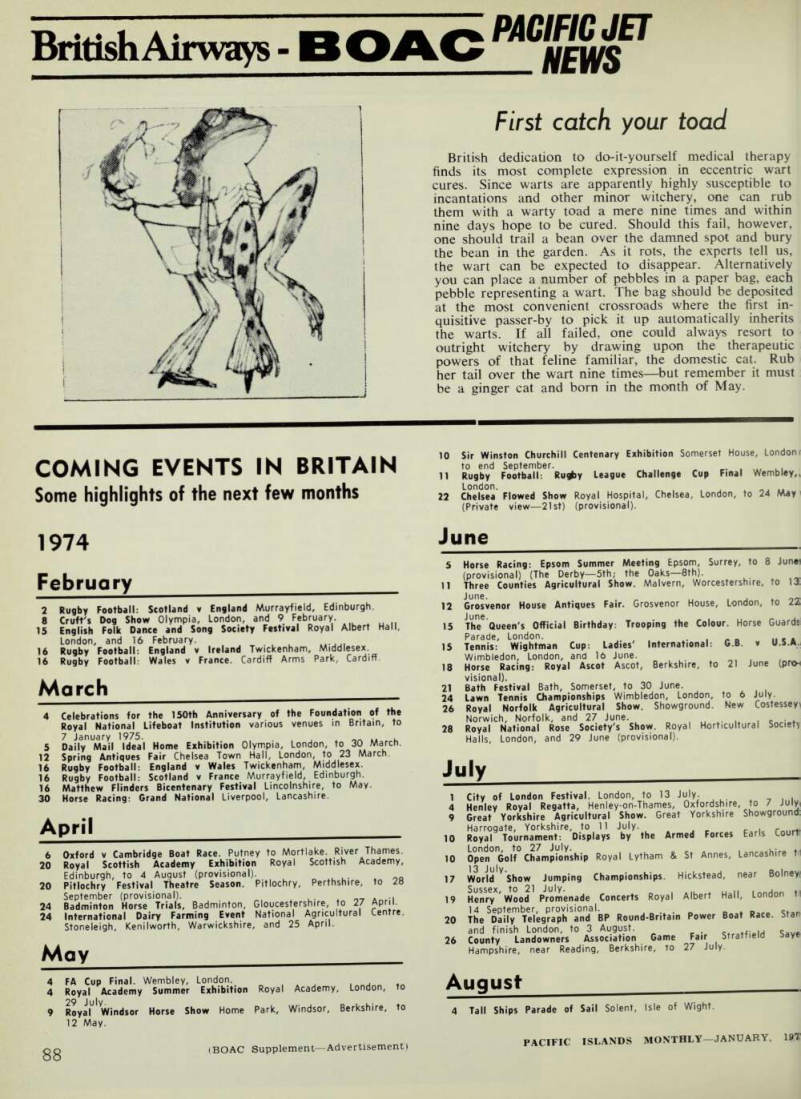
British dedication to do-it-yourself medical therapy finds its most complete expression in eccentric wart cures. Since warts are apparently highly susceptible to incantations and other minor witchery, one can rub them with a warty toad a mere nine times and within nine days hope to be cured. Should this fail, however, one should trail a bean over the damned spot and bury the bean in the garden. As it rots, the experts tell us, the wart can be expected to disappear. Alternatively you can place a number of pebbles in a paper bag, each pebble representing a wart. The bag should be deposited at the most convenient crossroads where the first in quisitive passer-by to pick it up automatically inherits the warts. If all failed, one could always resort to outright witchery by drawing upon the therapeutic powers of that feline familiar, the domestic cat. Rub her tail over the wart nine times—but remember it must be a ginger cat and born in the month of May.
July
Coming Events In Britain
Some highlights of the next few months 1974
February
2 Rugby Football: Scotland v England Murrayfield, Edinburgh. 8 Cruft's Dog Show Olympia, London, and 9 February. 15 English Folk Dance and Song Society Festival Royal Albert Hall, London, and 16 February. 16 Rugby Football: England v Ireland Twickenham, Middlesex. 16 Rugby Football: Wales v France. Cardiff Arms Park, Cardiff
Morch
4 Celebrations for the 150th Anniversary of the Foundation of the Royal National Lifeboat Institution various venues in Britain, to 5 ldeal Home Exhibition Olympia, London, to 30 March. 12 Spring Antiques Fair Chelsea Town Hall, London, to 23 March. 16 Rugby Football: England v Wales Twickenham, Middlesex. 16 Rugby Football: Scotland v France Murrayfield, Edinburgh. 16 Matthew Flinders Bicentenary Festival Lincolnshire, to May. 30 Horse Racing: Grand National Liverpool, Lancashire.
April
6 Oxford v Cambridge Boat Race. Putney to Mortlake. River Thames. 20 Royal Scottish Academy Exhibition Royal Scottish Academy, Edinburgh, to 4 August (provisional). 4U . . . OQ 20 Pitlochry Festival Theatre Season. Pitlochry, Perthshire, to 28 September (provisional). . 24 Badminton Horse Trials, Badminton, Gloucestershire, to 27 April. 24 International Dairy Farming Event National Agricultural Centre, Stoneleigh, Kenilworth, Warwickshire, and 25 April.
Moy
4 FA Cup Final. Wembley, London._ 4 Royal Academy Sommer Exhibition Royal Academy, London, to 29 July 9 Royal Windsor Horse Show Home Park, Windsor, Berkshire, to 12 May.
(BOAC Supplement—Advertisement)
10 Sir Winston Churchill Centenary Exhibition Somerset House, London to end September. 11 Rugby Football: Rus>y League Challenge Cup Final Wembley, 22 Chelsea Flowed Show Royal Hospital, Chelsea, London, to 24 May (Private view—2lst) (provisional).
June
5 Horse Racing; Epsom Sommer Meeting Epsom, Surrey, to 8 June) (provisional) (The Derby—sth; the Oaks —Bth). 11 Three Counties Agricultural Show. Malvern, Worcestershire, to 13, 12 Grosvenor House Antiques Fair. Grosvenor House, London, to 2Z 15 The 6 Queen's Official Birthday: Trooping the Colour. Horse Guards!
Parade, London. 15 Tennis: Wightman Cup: Ladies' International; G.B. v U.5.A.
Wimbledon, London, and 16 June. 18 Horse Racing: Royal Ascot Ascot, Berkshire, to 21 June (p«H
visional). ,
21 Bath Festival Bath, Somerset, to 30 June. 24 Lawn Tennis Championships Wimbledon, London, to 6 July. 26 Royal Norfolk Agricultural Show. Showground. New Norwich, Norfolk, and 27 June. c . . 28 Royal National Rose Society's Show. Royal Horticultural Society Halls, London, and 29 June (provisional).
July
1 City of London Festival. London, to 13 July. 4 Henley Royal Regatta, Henley-on-Thames, Oxfordshire, to 7 July* 9 Great Yorkshire Agricultural Show. Great Yorkshire Showground: Harrogate, Yorkshire, to 11 July. . r „ lir4 , 10 Royal Tournament; Displays by the Armed Forces Earls Courtt 10 Open 0 Golf 0 Championship Royal Lytham & St Annes, Lancashire M 17 World Jumping Championships. Hickstead, near Bolneyf 19 Henry* plomenade Concerts Royal Albert Hall, London M 14 September, provisional. . „ . 20 The Daily Telegraph and BP Round-Bntam Power Boat Race. Stan and finish London, to 3 August. . c . f . c av 26 County Landowners Association Game Fair Strattield aay Hampshire, near Reading, Berkshire, to 27 July.
August
4 Tall Ships Parade of Sail Solent, Isle of Wight.
Advertisements & other items, p. 90 (1 item)
British Airways - B OAC
88
PACIFIC ISLANDS MONTHLY —JANUARY, 19T
PNG, BSI outline guides
Business and Development
PNG, BSI outline guides for foreign investors
From Port Moresby and Honiara correspondents
Papua New Guinea has come up with guidelines to be followed by foreign investors in the new self governing nation, and at the same time, the Solomons has put forward proposals which are expected to be come its policy on the same matter.
The PNG guidelines were an nounced by the Chief Minister, Mr Michael Somare in Port Moresby.
In Honiara, the Chairman of the Commerce and Industry Committee of the BSIP Governing Council, Mr David Kausimae, introduced his policy with the comment that he believed “there would be little change in the proposals when policy is set next year”.
The guidelines for foreign invest ment announced by Mr Somare, on November 26 are, in essence, a re statement of the intentions expressed in the 1973-74 Eight-Point Improve ment Programme which the national coalition government tabled during the August sittings of the House of Assembly.
Foremost is the proposed creation of a National Investment and De velopment Authority, a statutory body whose policy will be controlled by a cabinet committee chaired by the Minister for Finance.
The new authority will have the job of ensuring that investment con tributes to the development of an economy giving New Guineans greater employment opportunities, and an increase in real income.
It will register all existing and new foreign enterprises (thereby indicat ing the government’s approval of par ticular projects), monitor the inflow, provide information for planning purposes, and assess whether benefits offered under legislation should be granted.
NIDA may also recommend on the establishment of government rations to carry out industrial de velopment, eg industrial estates; or assist where private investment is not forthcoming in an industry given high priority by the government or where industry has to be maintained or ex panded to serve regional needs.
The authority will have overall
responsibility for establishing in dustrial estates or free trade zones, and it is to collaborate with the Central Planning Office and depart ments in all aspects of investment planning. NIDA will, in fact, be in volved in all phases of investment in flow and operations.
The eight-point plan did make it quite clear that the government be lieves foreign investment will be needed for a considerable time to come. The new guidelines now seek to attract it by giving investors the basic rights of: • Remitting reasonable earnings and capital, subject to existing taxation and exchange control laws; • Being treated equally under the tax laws unless special provisions are agreed to by the investor; • Respect by the government for conditions contained in bi-lateral or multi-lateral agreements entered into, and settlement of any disputes by the Papua New Guinea courts and, where neces sary, reference to the convention on the Settlement of Disputes.
The Chief Minister referred to the range of incentives offered to existing or potential investors. The most im portant are that personal and com pany tax rates are lower than in Australia, import and customs duties on raw materials are relatively low or non-existent, and certain tax holi days are available.
Mr Somare mentioned that a system of reduced taxes for five years would be introduced in place of the pioneer certificate system. It can be assumed from this, in view of the government’s intention to develop rural areas, that investment assisting decentralisation will be favoured.
Among other basic incentives that may be offered are tariff protection and exemption or reduction in import duties.
The reaction to the new guidelines among foreign investors in the country has generally been favour able. But there is disappointment that the government has not spelled out
how and when it will exercise the right which it reserves to acquire equity in any new venture, “where it considers it is necessary to achieve its stated aims”.
Also it has not said what measures will be taken to achieve its aims that no expatriate occupy a position for which a suitably qualified New Guinean is available. (If no New Guinean is available, then training will have to be given to somebody to fill it.) While it is difficult to see how the government could at this early stage have done more than give an outline of NIDA’S objectives, it will be necessary for it to provide details, preferably incorporated in legislation and/or the new authority’s ‘rules’, if sizeable foreign investment is to be attracted to the right locality, at the right time.
Kausimae’s policy m the BMr recognises the need for an industrial base to supplement the development of natural resources, and the govern ment welcomes direct foreign invest ment. It adds: “However, government has no wish to exchange political for economic dependence and for that reason it intends to retain full overall control of the development of resources in the Solomon Islands, mainly by fiscal and exchange control policies, and
where appropriate through equity par ticipation. It will remain the master in its own home.”
The aim of the government’s fiscal and exchange control policies will be to ensure that the public, through taxation, receive a reasonable slice of profit, and it will also “encourage re investment in the Solomons and allow without obstruction repatriation of profits after tax, and where appro priate, capital”.
The government will encourage only investment that is likely to be viable and not cause social dis advantages. No foreign investor “will be able to build up a position of un due dominance in the economy as a whole”. Should this start to happen, the government might seek to achieve a major holding in the industry. The guidelines specially mention a copra mill and meat exporting plant as two industries which must not be allowed to be controlled by one major pro ducer.
The guidelines continue: “Overseas investors must recognise that there are areas of economic activity into which they will be pre vented from entering; for example only in the most unusual circum stances will new overseas investment in general trading be permitted. The policy of government is to encourage local people to piny as full a part as
possible in the commercial life of the country; overseas investors should be aware of this.”
The government will assist investors with tax concessions and customs remissions where they are needed, but will expect that local people be trained to take over from expatriates “as quickly as is reasonable”.
Bank optimistic
about PNG
Papua New Guinea should not have a foreign exchange problem for at least the next decade, according: to the December issue of the Bank of New South Wales quarterly Re view.
In a survey of the economic prob lems facing an independent Papua New Guinea, the Wales said that the country could look forward to balanced trade mainly as the result of exports of Bougainville copper.
Japan, West Germany and Spain have guaranteed to buy 1,992,50 C tons of copper concentrate at ruling market rates with a floor price ol US 30c per lb over 15 years.
Since copper at present constitute; half of PNG’s exports, such an ar rangement should assure the continu ation of substantial foreign exchangi
earnings whatever might be the pros f pects for its agricultural exports.
The Bougainville copper project has f boosted PNG’s exports to a point where they can offset imports. > Balanced trade, together with foreign aid and, perhaps, a re-invigorated capital inflow, should result in PNG not being short of foreign exchange I reserves for at least the next decade.
PNG is also fortunate in that it is not heavily indebted to other countries.
At present its indebtedness to multi-lateral aid agencies was only $41.3 million which did not impose a severe drain on its foreign ex change resources, the Review said, and added: “Furthermore, although Papua New Guinea’s rate of inflation is higher than in recent years, it is still slow compared with the rates experienced by most other developing countries.”
In the last financial year, the con sumer price index went up by only 4.8 per cent which is lower than t increases being experienced in the supposedly stable economies of Aus tralia and New Zealand.
The Wales said that PNG should not have to exercise stringent ex change controls or resort to import licensing to balance its external trade.
Absence of such measures should act as a spur to attract sorely-needed foreign capital, which would enable PNG to surmount many of the prob lems endemic to the economies of developing countries.
However, a foreign capital inflow would be required to offset low private savings. The advent of self government and independence had made foreign investors more hesitant to commit capital in Papua New Guinea. This reluctance applied es pecially to Australian investment which was unused to, and therefore shy of, a politically uncertain environ ment.
“If the vacuum left by Australian investors is to be filled, the most likely source will be international corporations, especially for big pro jects involving the exploitation of natural resources,” the bank said.
“Such corporations are more used to dealing with political vagaries, and in any case they consider PNG positively stable compared with more turbulent states in Africa, Asia and South America.
“Nevertheless, the immediate prob lem is that foreign capital has largely aried up and is being withheld pend ing the outcome of independence.
Ironically, those advocating a post ponement of independence so as to allay fear about the future are merely prolonging uncertainties rather than aelpmg to resolve them,” the Wales added.
Advertisements & other items, pp. 91-92 (3 items)
89
ACIFIC ISLANDS MONTHLY—JANUARY. 1974
Pacific
SOUTH
BRUCE PALMER & BETH DEAN
A must for those interested in South Pacific cultural art
and dance.
In this book, two skilled guides lead the reader on an exciting Pacific Ocean voyage of discovery.
Part of the voyage is backward in time, but great art takes no account of age.
Bruce Palmer and Beth Dean show that there is true greatness in Pacific art, whether its form be a carved figure, the pattern stencilled on bark cloth or woven into the fabric of a building, or the superbly controlled movement of a massed or individual dance.
The contents of the book total 104 glossy pages, with 64 beautiful colour plates and 56 blackand-white pictures.
It covers artifacts, culture and cultural dances from 17 Pacific Island countries with the inclusion of the Australian aboriginal whose origins date back more than 30,000 years.
Fill in the details
on the attached
order form.
The Daiwa Bank Ltd
DA/WA BANK SERVING YOU IN THE PACIFIC BASIN i Head Office Osaka,Japan With 137 Branches throughout Japan Singapore Representative Office Suite No. 1007, 10th Floor Robina House 1 Shenton Way, Singapore 1 Republic of Singapore Cable Address: SINGDAIWA Affiliated Bank P.T. BANK PERDANIA Djalan Raya Mangga Besar 7&9 Djakarta i Our Correspondent Banks are in city— Apia, Suva, Lae.
Madang Port Moresby, Rabaul Wewak. Guam, all Principal cities in Australia and New Zealand Contact your banker t or our office. y Los Angeles Agency 555 South Flower St. Suite 4040 Los Angeles, Calif. 90071 Sydney Representative Office Bth Floor Prudential Building 39-49, Martin Place, Sydney
Head Office: 21. Bingomachi 2-chome. Higashi-ku. Osaka. Japan Overseas : London. New York, Los Angeles, Frankfurt. Sydney. Smgopore_
co-prosperity sphere
A greater Japan-Tonga co-prosperity sphere
King Taufa’ahau of Tonga retur ned from a visit to Japan in Novem ber full of plans for possible closer commercial ties between the two countries. The most important, im mediately, is agreement by All Nippon Airlines to become a joint share holder with the Tongan Govern ment in launching a Tongan airline (see Transport section). Tonga will finalise arrangements after a Japan ese airline team visits Tonga soon.
The king also announced that two (un-named) Japanese hotel compan ies had offered to become sharehold ers with the Tonga Government in building more hotels in the kingdom; and he said he was approached by no fewer than six oil companies in Japan for prospecting rights to search for oil in the northern part of the kingdom (which is not included in the area the government has granted to the Tonga Oil Consortium).
Ha’apai and Vavau are included in the area available.
The Mitsui shipyard has offered to assist in building a slipway for Tonga, and Japan’s biggest television and broadcasting network, NHK, has agreed in principle to supply Tonga tapu, Tonga’s main island, with colour television—a complete pack age deal including technical equip ment, sets and programmes, on a loan to be repaid. The network will be closed circuit. Tonga has no tele vision at present.
NHK will go ahead with the ser vice when it gets a plan of the new automatic telephone network which is about to be laid in Tongatapu, so it can supply TV cables to be put
down in conjunction with the tele phones. NHK estimated that a large TV set including its wiring to the circuit would cost about $2OO.
King Taufa’ahau and Queen Mata ’aho were guests in Japan of the newly formed Japan-Tonga Assoc iation, represented by its chairman, Mr Ryokichi Sasakawa, who is a millionaire businessman and director of All Nippon Airlines, who also has tourist interests.
The association was formed by Mr Sasakawa after his visit to Tonga last August, and its membership in cludes leading politicians, and indus trialists. The king said the associa tion’s aim was to provide assistance to the kingdom, as “well as to pro mote friendly relationships between the two countries.”
Before he left Japan, King Taufa ’ahau appointed Mr Sasakawa as Tonga’s consul-general in Japan.
Date set for
Bank of Tonga
The new Bank of Tonga hopes to become a going concern on July 1, 1974, according to Mr G. H. Hiller man, secretary of the bank’s board, who was in Nukualofa in late No vember for discussions. He was accompanied by Mr C. Flint, the bank’s manager-designate.
The bank’s board includes repre sentatives of the Bank of New South Wales, the Bank of New Zealand and the Bank of Hawaii. The ac counts of the Tonga Government
Savings Bank will be taken over by the new bank, which has yet to decide on the details of services it will offer, and interest rates.
Mr Hillerman said he would re commend that Savings Bank accounts i be restricted to genuine savings and attract an interest rate of about four' per cent. But there will be no interest on “very small accounts”.
Among the amendments to be; made to Tongan laws in time for operation of the new bank is one: allowing Tongan residents to repat riate money from overseas.
Mr Flint with the assistant man ager, Mr B. Holt, who is from NZ„ and an accountant, from Hawaii, arei all expected to take up permanent! residence at the end of February,, and the bank’s staff will be engagedl in April and begin their training.
Norfolk Burns
Philp in doubt
The closure of Norfolk Island as a tax haven has jeopardised the future of Burns Philp and Co Ltd on the island. Although it has been a tradei there for about 50 years it may nol be able to enjoy the tax-free statin of other local traders and bring itsell into a competitive position with them The chairman, Mr J. D. O. Burns told shareholders why at the annua
meeting. , , , . ,
The Norfolk Island branch s trad ing activities had been conducted a a branch of Burns Philp (SS) C< Ltd and were subject to Fiji taxatioi of 32 per cent. The profits showe< an inadequate return on mvestmenl and Burns Philp (SS) Co Ltd wa not prepared to invest further mone; urgently needed for a hardwar operation. .
To overcome the problem, Consol: dated Holdings Ltd, a New Hebnde subsidiary of Bums Philp and C Ltd, acquired the Norfolk Island trac ing activities from Burns Philp (SS Co Ltd, and Bums Philp (Norfol Island) Ltd was incorporated.
Mr Burns said the Norfolk Islan profits were no longer subject to Fi taxation, and should have placed th company in a competitive positio with untaxed traders on the islan< The reorganisation, decided on tw years ago, only came into effect i the year ended last June 30. It c< incided with Australian federal legi lation preventing Norfolk Island s u: as a tax haven.
“The legislation, unfortunate! goes further than closing loophol. for taxation schemes,” he said. A though Burns Philp are genmr traders on the island and have bet so for approximately 50 years ar
there is no element of Australian source income in the Norfolk Island trading activities, nor any element of a tax haven scheme for which the legislation was drafted, it appears that Burns Philp is to be subject to full ' Australian taxation of 47J per cent on its profits from Norfolk Island.
This will place us at a severe dis- I advantage with locally-owned com petitiors who are not subject to taxa tion, and as a result the future of our trading in Norfolk Island is in
I doubt.”
As for the Papua New Guinea subsidiary, Mr Burns said the govern ment policy of speeding up localisa tion of the public service and industry was presenting grave problems, as the training rate for indigenes could not keep pace with the expatriates’ de ‘ parture.
The trading interests in PNG were maintained, although profits were reduced through continually rising costs and a marked decline in spend ing by the expatriate sector, particu larly on cars and other major items.
The drought affected trading in all centres. The PNG operations con tributed $1,633,239, or 21.8 per cent to the group profit of $7,482,072.
Looking to the future, Mr Burns said results from PNG merchandise trading would almost certainly be down in the current year. While Bums Philp had confidence in the future, it would be unrealistic to ignore the short-term adverse effects which must follow the exodus of a large number of expatriates, the tem porary drop in spending power and efficiency that would create, and the sale of a further 13i per cent of the PNG company to the PNG Invest ment Corporation.
Mr Burns said profits from Island plantation subsidiaries were better by 16.8 per cent than in the previous year, through higher world prices.
The plantations contributed $330,201, or four per cent to the group profit.
Burns Philp (SS) Co Ltd, covering Fiji, Samoa, Tonga and Niue, pro duced a net profit of $F1,019,778, compared with $F825,718 the pre vious year. That company con tributed $695,088 or 9.3 per cent of the group profit. The improved profit largely flowed from better results in Samoa and Tonga, higher produce prices and larger government and private spending. . There could be problems in Fiji in the future as restrictions by the Central Monetary Authority and scarcity of local finance compelled the company to look overseas for the additional money, with ensuring ex change fluctuation risks. The Fiji Prices and incomes policy was re
ducing margins and causing a sub stantial increase in costs.
Burns Philp (New Hebrides) Ltd contributed $390,581 (5.3 per cent) to the group profit. The problems there were problems of growth, as after a setback or two in copra and land subdivision, there was a strong recovery and renewed confidence in the group was expected to continue.
The latest result shows the effect of the policy announced in 1972 of making the group less dependent on its Island operations. The earnings from Islands operations in the latest year were 40.8 per cent, compared with 54.1 per cent the previous year.
New golden
age for Vafukoula
The operational life of the Emperor mine at Vatukoula in Fiji will end about 1998 at current rates of extrac tion, the chairman of Emperor Mines Ltd, Mr J. L. Reid, said at the com pany’s annual meeting in Melbourne.
Emperor’s operating subsidiary at Vatukoula is the Emperor Gold Mining Co Ltd.
There was little to be gloomy about at the annual meeting. The directors announced a two-for-one bonus issue, which the meeting duly endorsed; there will be an interim dividend of 5c a share on February 14 on the new capital, and the chairman fore cast a substantial increase in the price of gold in the next few months.
Mr Reid said the bonus issue rose from a $12,930,189 revaluation of the shares Emperor Mines Ltd held in Vatukoula Gold Mining Co Ltd.
Mr Reid said prospects looked en couraging. Profit for the first four months of the current financial year were significantly better than for the first four months of the previous year. With an expansion scheme under way, shareholders could ex pect to benefit from capital and in come growth.
In PNG, gold and silver min ing is paying off for the indigenous people. They earned $451,638.76 from 6,146.322 fine oz of gold and $7,509.84 from 4,239.91 fine oz of silver in the three months to Septem ber 30, 1973. Biggest production was in the Morobe District—s,l2l.49s fine oz of gold, worth $376,446.33 and 4,056.81 fine oz of silver, worth $7,192.77. • A 250-acre cocoa plantation on the Gazelle Peninsula is about to pass into Tolai hands, the New Guinea Islands Produce Co, which is believed to be paying Mr David Coleman about $40,000 for the estate.
The estate has a potential of 100 tons a year.
Fuel crisis
hits the islands
The sudden Arab cutback in fuel supplies after the latest war with Israel caught the world unprepared.
The Pacific Islands were no exception when it came to fuel rationing.
Transport and industrial, commercial and domestic users were affected, some severely, some marginally.
Shipping lines on regular schedules had to plan ahead carefully for the crisis has created operational prob lems. Ships use the heavier grade oil, and for ships operating out of Aus tralia that means an imported pro duct. Up to the middle of December there was no indication that shipping services from Australia to the Islands would be curtailed but charter ser vices were running into problems, as suppliers, unsure of the future were catering only for contract customers.
Some airlines reduced services, or ordered captains to fly aircraft at slower speeds to conserve fuel. In some areas, commercial and domestic supplies fell at an alarming rate, and services had to be reduced to the barest essentials.
In Papua New Guinea, soon after it became obvious that supplies would be restricted, the Chief Minister, Mr Michael Somare, said foreign shipping could no longer expect to get oil at PNG ports. Fiji could only supply bunkers to contract customers, and there was a strong possibility that some overseas shipping could be stranded.
US Lines, which serves Hawaii and Guam from the US east and west coasts, in response to a directive by the Federal Maritime Commission, said it expected to make fuel savings of 18 to 28 per cent by deleting two un-named ports, and cutting speeds from 23 to 20 knots.
The situation was bad in Japan, where the shortage was likely to have a drastic affect on Japan’s trade with the South Pacific, as well as with other areas. Japanese fishing ships in the Pacific were also expected to have bunkers problems.
British Airways cut eight of 20 scheduled flights over four weeks from November 16. Qantas ended three of its daily services to San Francisco. Air New Zealand can celled the Auckland-Honolulu-Los Angeles return flights, scheduled for December 4. American Airlines and Pan American World Airways carried on as usual, although American Air lines, before the crisis, cut out one transpacific service.
Airlines using Nadi were put under a fuel restriction, although it was not severe. The Joint Users Hydrant In stallation, at Nadi Airport, sent letters
to all overseas airlines, Air Pacific, and other regional services, saying fuel would be restricted to the off take rate in force in 1972, and that no extra fuel would be supplied.
Fiji tried a voluntary cut of 20 per cent in internal fuel consumption, with Prime Minister Ratu Sir Kami sese Mara indicating more drastic steps might be needed if the people did not co-operate. The Emperor Gold Mining Co Ltd, at Vatukoula, rationed petrol for all departments; restricted private sales; restricted street lighting; used motor-cycles and small cars instead of big cars; and ordered that hot water thermostats be lowered. The company, which controls the distribution of electric power to Vatukoula, Tavua and Ba through a subsidiary, made a 20 per cent cut in power supplies.
Restrictions became necessary in Papua New Guinea when there was a 20 per cent cut in imports of fuel oil, motor spirit, diesoline, kerosene, aviation fuel and bitumen. The PNG Government set up a National Energy Conservation Task Force to ensure there was minimum disrup tion to the national economy.
Motorists were asked to limit them selves to $ 1 a time for refills in urban areas and $2 a time in the country.
There was something of panic buying by motorists in American Samoa, even though retailers were receiving about 95 per cent of normal supplies. The government asked the US Government for a complete exemption from an order limiting allocations for some fuels to 95 per cent of the November, 1972, usage.
It feared the fishing industry would be in jeopardy if fishing ships were unable to refuel in Pago Pago.
Nauru, which relies on steady supplies of light marine diesel oil to run its electricity power station, also felt the pinch. Calls went to house holders to economise. Two sugges tions for saving on electricity were, to turn off all office air-conditioners outside office hours and not to use strings of coloured lights for outside parties. Another suggestion—which could only apply to the richest island in the Pacific—turn off all unessential home air-conditioners.
Micronesia’s fuel cut was about 12 per cent, and the Trust Territory administration, after receiving advice from Mobil Oil Micronesia, appealed for a voluntary reduction in fuel con sumption.
The New Caledonia Government Advisory Council brought in special restrictions early in December pro hibiting the sale of petrol from 3 pm on Fridays till 6 am on Mondays.
US and British suppliers have cut supplies by 20 per cent for diesel oil and 15 per cent for petrol.
Advertisements & other items, pp. 93-94 (1 item)
From Holland
P.o. BOX 507,
MANLY, N.S.W.
2095.
CABLE ADDRESS:
DEMKAY, SYDNEY.
ASK US FOR QUOTATIONS
FROM HOLLAND
• Canned hams • Biscuits • Chocolates • Cigars, cigarellos • Liqueurs • Hard boiled sweets • Pianos • Curtain materials • Damask table cloths • Towels (bath, beach, kitchen) • Delft blue • Furniture ® Tubular furniture O Household and automotive lamps • Automotive parts • Bicycles • Garage hoists • Sanding machinery • Weighing equipment Polyethelene and cellophane heat sealers.
"BRAYBON
Portable
Power
Units
240 VOLT
50 CYCLE A.C. f
ff Mobile or Stationary
Will work for YOU!
Suitable for field maintenance including welder, power tools, multiple shearing heads, pumping units, etc. and general household appliances and lighting. □ f
OUTPUT CAPACITIES AVAILABLE:
(Electric starts available on 33 and K.V.A. models) Write for illustrative brochure.
Braybon Bros
v PTY. LTD.,
2 ROTHWELL AVENUE, CONCORD WEST 2138.
Tel.: 73-3246.
SYDNEY, AUSTRALIA.
Produce Prices
(Unless otherwise stated, quotations are in Australian currency. Australian dollar (December 12) equals New Zealand, $1.0384 (buying), 51.0341 (selling); Fiji $1.2148 (buying).
Western Samoa. T 0.9093 (buying); US, $1.4900, $1.4850; UK, 64.1231 np, 63.6334 np; French Pacific 123.59 (buying), 121.83 (selling) FP francs; Tonga unavailable.
Copra
Copra industries are controlled through copra boards in PNG, the Solomons, the GEIC, both Samoas, Fiji, Tonga, the Cooks and the US Trust Territory. New Hebrides, French Polynesia and New Caledonia don't have boards and copra is either sold individually by growers to overseas buyers or used locally.
NEW GUINEA: The board, with planters' reps, directs distribution and sales and pays planters. Shipments are made to UK, European markets and to Australia and Japan, and coco nut oil mills on New Britain.
Latest prices per metric tonne, delivered main ports, were: hot-air dried, $200; FMS, $197; smoke-dried, $195.
FIJI: —The board fixes prices on Philippines copra, taking into account freight, taxes, selling costs, shrinkage, etc. Prices recently were: Ist grade, $285.50; 2nd grade, $275.50; sub standard (ss), $BO.
WESTERN SAMOA; The board makes pay ments to producers through its agents —local firms —and sells the copra on the open market with a portion to Abels Ltd., NZ. Recent prices per ton fob: Ist quality, $158.60; 2nd quality, $144.80.
TONGA; All copra is sold to the board which sends it to Europe and the open market. Recent prices to growers were T 5195.10 Ist grade, and T 5183.10 2nd grade, per ton.
Per coconut 3 seniti.
SOLOMON IS.: —All production through board at prices based on Philippines rates. Output goes to the UK, Japan, Australia and the rest to the open market. Recent prices were: hot air-dried, $200; smoke-dried, $lB6 per ton at BSIP ports (Honiara, Yandina and Gizo).
GILBERT AND ELLICE—3c per lb (Ist grade); 2c per lb (2nd grade).
NEW HEBRIDES: Copra sold direct by planters to France and Japan. Official market price on December 5 was $l5O. Marseilles 230 French francs (per 100 kilos) November 30.
COOK IS.: —Copra goes to Abels, Ltd., of Auckland, who operate NZ's copra crushing mill. Prices for October-December, packed shipping weights f.o.b. were fixed at $NZ251.22 Ist grade, hot-air dried, $NZ249.37 Ist grade, sun-dried, and $NZ247.99 standard grade.
NiuE: —All copra is sold to the Niue Develop ment Board which sends it to Abels Ltd., of Auckland. Prices for July to December 1973 f.o b per ton were $NZ153.91, Ist grade, hot air-dried; $NZ152.03, Ist grade, sun-dried; and $NZ150.64, standard grade.
US TRUST TERRITORY: Price per short ton SUS 182.50 (grade 1), SUS 172.50 (grade 2), SUS 162.50 (grade 3), delivered district centres; $170.00 (grade 1), $160.00 (grade 2), $150.00 (grade 3), picked up outer islands.
Other Produce
BECHE-DE-MER: Chang Sing Loong Co., Suva, quote 60c Fijian per lb. (4 in. to 10 m.).
Honiara.— Best price paid is $1 per lb dried, for Ist grade; 70 cents per lb for 2nd grade.
CHILLIES.— SoIomons, Honiara, long red dried 12 cents per lb.. Tabasco 22 cents per lb. first eye' (under 2 in.) sun-dried, FAQ Grade Raba Raba, up to 30 cents per lb (Eastern Papua). Other grades are Long and U/FAQ 15-19 cents per lb.
COCOA.— Islands rates are based on Ghanati prices. Ghana price on December 12 was spotc £stg 564 ton, c.i.f.; UK, Continent.
December 12. In store Rabaul, export quality,: $750 per ton delivered ex wharf $B5O.
Solomons. —Delivered to Agriculture Dept.l offices in Honiara and Auki 25 cents per Ib.c dried beans first grade, 20 cents second grades COFFEE.—PNG; Good quality, A grade, 470’ per lb; B grade, 44c, C grade, 42c, Y grade,s 43c (ex-store Sydney).
W. Samoa.—Recently, WSTEC ground ano dried beans, 60 sene per lb wholesale.
CROCODILE SKlNS.—Honiara: $1.89 to $2.2“ per inch.
GREEN SNAIL SHELL—I 3-14 cents per lb.
PAPUAN GUM DUMAR.—Steamships Trading Co Ltd, Samarai, quotes SA2OO per long ton FOB Samarai.
PEANUTS. PNG: Sydney agents reporteo recently f.0.b., Lae; Kernels —white Spanish 19c lb.
PEARL SHELL.—Torres Strait Pearlshellerss Assn, has no recent quotes. Solomons. — Honiara, mother of pearl blacklip 15c Ibc Cook Islands. —Penrhyn, 20-25 c per lb. dell Rarotonga 33-35 c per lb. French Polynesia.— Tuamotu, Gambier shells, to $l,OOO per tonr Papeete. Fiji.—3sc per lb.
PYRETHRUM.—NG growers 17c lb, flowers.
RICE (Aust.):—PNG: Dried brown, 25 kild bags, $128.00 per metric tonne. Vitamh enriched white, 25 kilo bags, $141.50 pei metric tonne, all f.o.w. Sydney/Melbourne) Pacific Islands: Calrose med. grain, white, 5* lb bags, $l7O a metric tonne. Kulu lomi grain white, 56 lb bags, $lB5 a metric tonne All prices f.o.w. Sydney/Melbourne.
RUBBER.—PNG prices are based on Singapore rates which on December 12 were: No. 1 RSi (Malayan cents a kilo f.0.b.), January, 209.0 C 190.25; February, 209.50-191.00; March 210.00-191.50.
SANDALWOOD.—New Hebrides, landed on thi beach, Vila and Santo, $lBO per ton "oi consignment".
SHARKS FINS. Chang Sing Loong Co Suva, offers 75c per lb for Ist quality, 45 for mixed quality.
TROCHUS.—BSIP 7-10 cents per lb. Fiji 8cents per lb.
TURTLE SHELL.—BSI: No market at present VANILLA BEANS. Prices recently were White and yellow label processed standan packs, $7.50; green label $7 40, c.i.f., Sydne Tonga.—sT4.2o, f.0.b., Nukualofa; $T4.50, Mei bourne.
Uk, Us Quotes
COPRA. —LONDON, November 23, Philippine in bulk, $U5451.87 per long ton, c.i.f.
Exchange Rates
FIJI. —Through Bank of NSW, ANZ Ban!
Sank of NZ, Bank of Baroda, First Nation} City Bank. Aust. $ on Fiji $ buying sAo.Blfi = SFI, selling $A0.8337 = SFI.
WESTERN SAMOA.— Through Bank of Wester Samoa, controlled from NZ, SWS. Tala 1 = $A 1.0997 (buying), $A1.1170 (selling).
Norfolk Is., Papua New Guinea.-Au.
tralian currency used; no exchange payable i transactions with Australia.
FRENCH PACIFIC COLONIES.—Pacific fran. (CFP) are used in New Caledonia, New Hebndt (Jointly with Australian dollars), Wallis ar Futuna Is., and Fr. Polynesia. French Bam Sydney, on December 12, quoted: e ' ' n .
Noumea and Papeete, Pac francs to the sAust 124.07 (commercial— export and import tran actions), 128.37 (financial)— nearly all othi transactions. Paris-London: Buying 1054 J[ ra " to the £ (commercial); 10.90 fra "“ « tO , *1 £ (financial). Also buying £ = 191.62 (cor mercial), 198.28 (financial) Pac. francs; 5..
CFP to 1 metropolitan franc.
Banks should be approached for daily quote
Shipping & Airways Information
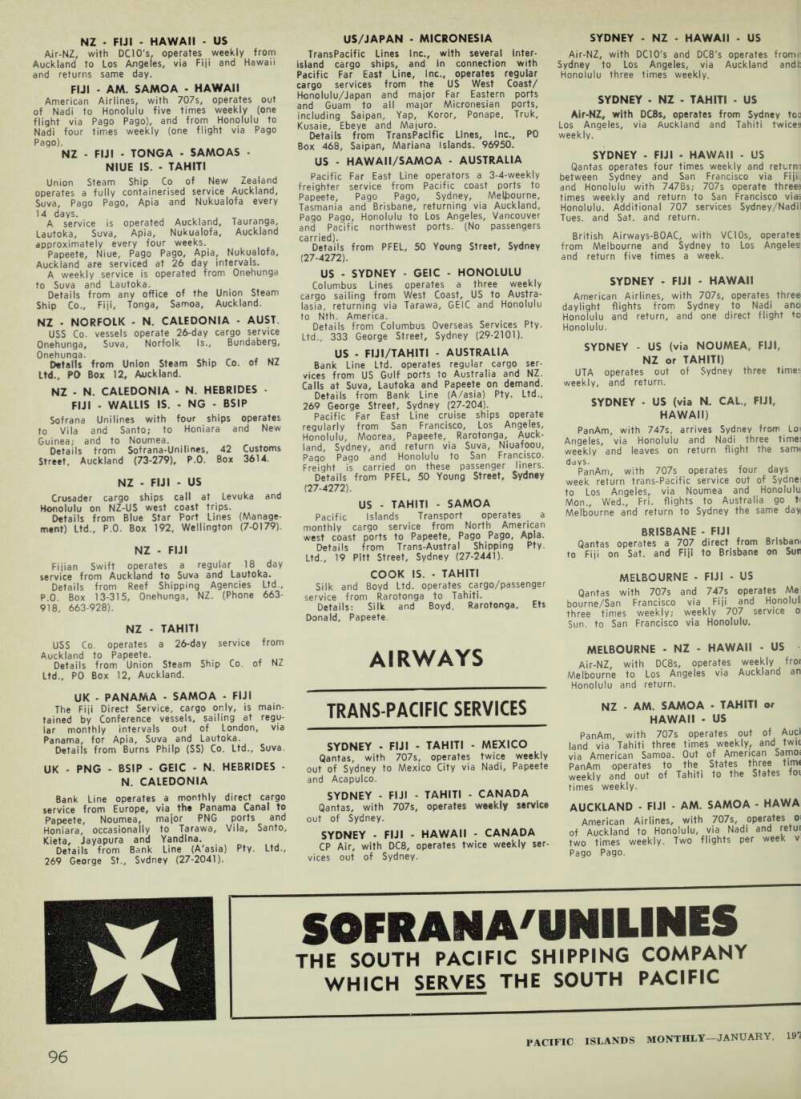
Shipping
Aust. - West Irian
Karlander New Guinea Line operates cargo service every nine weeks from Sydney to Jayapura.
Details: Karlander (Aust.) Pty. Ltd., 19-31 Pitt Street, Sydney (27-6301).
SYDNEY - NZ - FIJI/TAHITI - UK Chandris Lines maintains a twice-monthly passenger service from Sydney via NZ, Suva or Papeete.
Details from Chandris Lines, 135 King Street Sydney (28-2451).
Sitmar Line operates a passenger service trom Sydney, Melbourne or Brisbane to South hampton, UK via NZ, Papeete, Panama and Lisbon and alternatively via South Africa. D A tai l s .! rom Sitmar Lin « (Australia) Pty. Ltd., 22-30 Bridge Street, Sydney (27-4521), SYDNEY - LORD HOWE IS. - NORFOLK IS. • NEW CALEDONIA - NEW HEBRIDES Karlander operates 19-day service from Sydney to the above ports. Passenger accom modation available.
Details from Karlander (Aust.) Pty. Ltd. 19- 31 Pitt Street, Sydney (27-6301).
Chargeurs Caledoniens operates two-weekly cargo service Sydney-Noumea.
Details: Hetherington Kingsbury Pty. Ltd 37-49 Pitt Street, Sydney (27-1671).
SYDNEY - NZ - FIJI - HAWAII -
Canada - Us
c.w ant L 9 lir l e ' s caM regularly at Auckland, Suva and Honolulu on eastbound and westbound voyages between Sydney and the US; occasional ca Is at Pago Pago Tonga, Papeete, Yokohama, Vila, Hong Kong, Honiara.
Details from P & 0 Australia Ltd., 55 Hunter Street, Sydney (2-0317), SYDNEY - NZ - FIJI - TONGA ■ VILA -
Noumea - Samoas - Tahiti
Shaw Savill liners cruise in the Pacific sailing from Australia and New Zealand calling at Suva, Lautoka, Tonga, Vila, Noumea, Pago Fago, Tahiti, Apia, Vavau.
Details: Shaw Savill Line, 8a Castlereagn St., Sydney (28-1481).
Sitmar Cruises operates a South Pacific cruise programme to include the above ports plus the Solomons. i*P eta Ji s ™ fr 2 m Sitmar Line (Australia) Pty.
Ltd., 22-30 Bridge Street, Sydney (27-4521).
Australia - New Caledonia
Sofrana-Unilines operates a fortnightly service from Sydney to Noumea. |^ey' 5 (27-M3a' rana ‘ U " ilineS ' 37 Street '
Australia - New Caledonia -
New Hebrides
Sofrana-Unilines' ships call regularly at Melbourne, Sydney, Brisbane, Noumea, Vila and Santo.
Details from Sofrana-Unilines, 37-49 Pitt Street, Sydney (27-2031).
Poiynesie maintains three-weekly passenger sailings—Sydney, Noumea, Vila and Santo.
Details from France Australia, 261 George Street, Sydney (241-2872/6)
Australia - Fiji
Sofrana-Unilines operates Sydney-Fiii fort nightly.
Details from Sofrana-Unilines, 37 Pitt Street, Sydney (27-2031).
Nauru Pacific Line operates cargo/passenger service to Fiji and South Pacific ports.
Details from Nauru Pacific Line, 227 Collins Street, Melbourne (654-4977); Interocean Swire, 8 Spring Street, Sydney (20-522).
United Steamships Ltd. operates a monthly service Sydney/Suva and Lautoka.
Details: Hetherington Kingsbury Pty. Ltd., 37-49 Pitt Street, Sydney (27-1671).
AUSTRALIA - FIJI - TAHITI - MEXICO Karlander (Aust.) Pty. Ltd. operates three weekly cargo services from Melbourne and Syd ney for Suva, Lautoka, Papeete and Mexico.
Details from Karlander (Aust.) Pty Ltd. 19- 31 Pitt Street, Sydney (27-6301); F. H. Stephens Pty. Ltd., 554 Flinders Street, Melbourne (62-3333); Burns Philp (SS) Co. Ltd., Suva and Lautoka.
Australia - Fiji - Tahiti
South Pacific United Lines maintain a monthly service from Sydney to Suva, Lautoka and Papeete.
Details from France-Australia Holdings, 261 George Street, Sydney (241-2872/6).
Australia - Png - Bsip
Conpac Pacific Express (Burns Philp and AWP Line) operates three-weekly passenger cargo service from Melbourne, Sydney and Brisbane to Port Moresby and Lae.
Details from Burns Philp and Co. Ltd. 7 Bridge Street, Sydney (2-0547).
New Guinea Australia Line's vessels operate from Sydney and Brisbane to Port Moresby, Lae, Rabaul, Kavieng, Honiara, Kieta, Gizo, Madang and Samarai.
Details from Interocean Swire, 8 Spring Street, Sydney (20-522).
New Guinea Express Lines with two ships operates three-weekly Melbourne Sydney Brisbane, Port Moresby, Lae, Rabaul.
Details from New Guinea Express Lines, 37 Pitt St., Sydney (241-1396) and 72 Eagle St., Brisbane (21-9333), Westralian Farmers Trans port Pty. Ltd., 459 Collins St., Melbourne (35-4366), Breckwoldt's Shipping Agencies In Port Moresby, Lae, Rabaul, Karlander New Guinea Line's two cargo vessels call at Melbourne, Sydney, Brisbane, Lae, Madang, Wewak, Manus, Kimbe.
Details from Karlander (Aust.) Pty. Ltd 19- SI Pitt Street, Sydney (27-6301).
Australia - Nauru - Marshall
Islands - Geic - Guam
Nauru Pacific Line operates regular six weekly cargo/passenger liner service from Melbourne and Sydney to Nauru, Majuro, Tarawa and Guam.
Details from Nauru Pacific Line, 227 Collins Street, Melbourne (654-4977); Interocean Swire, 8 Spring Street, Sydney (20-522).
Australia - Png - Far East
E. and A. Line passenger ships make monthly round voyages from Melbourne, Sydney and Brisbane calling at Port Moresby, Manila, Hong Kong, Keelung, Kobe, Yokohama (Tokyo), and Rabaul.
Details from P & 0 Australia Ltd 55 Hunter Street, Sydney (2-0317).
FAR EAST - FIJI ■ NEW ZEALAND New Zealand Unit Express (CNC, MOL, RIL) operates a three-weekly cargo service from Hong Kong to Lautoka, Suva, NZ ports, Manila, Kaoshiung, Keelung, Hong Kong.
Details from Interocean Swire, 8 Spring Street, Sydney (20-522).
Royal Interocean lines operates monthly pass enger/cargo service with three ships from NZ to Bangkok, Pt Kelang, Singapore, Djakarta to Fiji (alt. months) and NZ.
Details from Interocean Australia Services, 261 George Street, Sydney (2-0573)? Burns Phllp (SS) Co. Ltd., Suva and Lautoka.
FAR EAST - PNG - BSI - NEW HEBRIDES -
Noumea - Tahiti - Samoa
China Navigation Co's vessels operate a regular cargo service from Hong Kong to Rabaul, Wewak, Madang, Lae, Port Moresby, Honiara, New Hebrides, Noumea, Papeete and Samoa.
Details from Interocean Swire, 8 Spring Street, Sydney (20-522).
EUROPE - TAHITI - W. SAMOA - FIJI - N. CALEDONIA - BSIP - PNG • NZ Nedlloyd Lines offers regular sailings by fast, modern cargo vessels from Europe via Panama to Papeete, Apia, Suva, Lautoka, Noumea, Honiara, Port Moresby, Rabaul, Lae, Madang and New Zealand.
Regular sailings by carcarrler from Europe to Papeete, Noumea and Australia.
Details from Interocean Australia Services, 261 George Street, Sydney (2-0573).
North Europe - New Caledonia
Hamburg/Sued operates monthly cargo ser vices from Dunkirk and Le Havre to Noumea, via Panama.
Details from Columbus Overseas Services Ptv. Ltd., 333 George Street, Sydney (29-2101).
Messageries Maritimes operates five cargo cervices a month from north and Mediterranean European ports to Papeete and Noumea.
Details from Messageries Maritimes, 332 Pitt Street, Sydney (61-6664).
JAPAN - GUAM - FIJI - SAMOA -
N. Caledonia ■ N. Hebrides
Daiwa Line runs a monthly cargo service from Japan via Guam to Suva, Lautoka, Pago Paqo, Apia, Vila, Santo and Noumea.
Details from Burns Philp (SS) Co. Ltd., Suva.
New Zealand - Cook Is.
Lorena, owned by Cook Islands Shipping Co.
Ltd., operates three-weekly freight service be tween Auckland and Rarotonga with occasional calls at Aitutaki and Lyttleton.
Details: Silk and Boyd, Box 131, Rarotonga, or CIS Co., Box 448, Auckland.
NZ - FIJI - HAWAII - US Air-NZ, with DClO's, operates weekly from Auckland to Los Angeles, via Fiji and Hawaii and returns same day.
Fiji - Am. Samoa - Hawaii
American Airlines, with 7075, operates out of Nadi to Honolulu five times weekly (one flight via Pago Pago), and from Honolulu to Nadi four times weekly (one flight via Pago Pago).
NZ - FIJI - TONGA - SAMOAS -
Niue Is. - Tahiti
Union Steam Ship Co of New Zealand operates a fully containerised service Auckland, Suva, Pago Pago, Apia and Nukualofa every 14 days.
A service is operated Auckland, Tauranga, Lautoka, Suva, Apia, Nukualofa, Auckland approximately every four weeks.
Papeete, Niue, Pago Pago, Apia, Nukualofa, Auckland are serviced at 26 day intervals.
A weekly service is operated from Onehunga to Suva and Lautoka.
Details from any office of the Union Steam Ship Co., Fiji, Tonga, Samoa, Auckland.
NZ - NORFOLK - N. CALEDONIA - AUST.
USS Co. vessels operate 26-day cargo service Onehunga, Suva, Norfolk Is., Bundaberg, Onehunga.
Details from Union Steam Ship Co. of NZ Ltd., PO Box 12, Auckland.
NZ • N. CALEDONIA - N. HEBRIDES - FIJI - WALLIS IS. - NG - BSIP Sofrana Unilines with four ships operates to Vila and Santo; to Honiara and New Guinea; and to Noumea.
Details trom Sofrana-Unilines, 42 Customs Street, Auckland (73-279), P.O. Box 3614.
Nz - Fiji - Us
Crusader cargo ships call at Levuka and Honolulu on NZ-US west coast trips.
Details from Blue Star Port Lines (Manage ment) Ltd., P.O. Box 192, Wellington (7-0179).
Nz - Fiji
Fijian Swift operates a regular 18 day service from Auckland to Suva and Lautoka.
Details from Reef Shipping Agencies Ltd., P.O. Box 13-315, Onehunga, NZ. (Phone 663- 918, 663-928).
Nz • Tahiti
USS Co. operates a 26-day service from Auckland to Papeete.
Details from Union Steam Ship Co. ot NZ Ltd., PO Box 12, Auckland.
UK - PANAMA - SAMOA - FIJI The Fiji Direct Service, cargo only, is main tained by Conference vessels, sailing at regu lar monthly intervals out of London, via Panama, for Apia, Suva and Lautoka.
Details from Burns Philp (SS) Co. Ltd., Suva, UK - PNG • BSIP • GEIC • N. HEBRIDES -
N. Caledonia
Bank Line operates a monthly direct cargo service from Europe, via the Panama Canal to Papeete, Noumea, major PNG ports and Honiara, occasionally to Tarawa, Vila, Santo, Kieta, Jayapura and Yandlna.
Details from Bank Line (A'asia) Pty. Ltd., 269 George St., Svdney (27-2041).
Us/Japan - Micronesia
Transpacific Lines Inc., with several inter island cargo ships, and in connection with Pacific Far East Line, Inc., operates regular cargo services from the US West Coast/ Honolulu/Japan and major Far Eastern ports and Guam to all major Micronesian ports, including Saipan, Yap, Koror, Ponape, Truk, Kusaie, Ebeye and Majuro.
Details from Transpacific Lines, Inc., PO Box 468, Saipan, Mariana Islands. 96950.
Us - Hawaii/Samoa • Australia
Pacific Far East Line operators a 3-4-weekly freighter service from Pacific coast ports to Papeete, Pago Pago, Sydney, Melbourne, Tasmania and Brisbane, returning via Auckland, Pago Pago, Honolulu to Los Angeles, Vancouver and Pacific northwest ports. (No passengers carried).
Details from PFEL, 50 Young Street, Sydney (27-4272).
US - SYDNEY - GEIC - HONOLULU Columbus Lines operates a three weekly cargo sailing from West Coast, US to Austra lasia, returning via Tarawa, GEIC and Honolulu to Nth. America.
Details from Columbus Overseas Services Pty.
Ltd., 333 George Street, Sydney (29-2101).
Us - Fiji/Tahiti - Australia
Bank Line Ltd. operates regular cargo ser vices from US Gulf ports to Australia and NZ.
Calls at Suva, Lautoka and Papeete on demand.
Details from Bank Line (A/asia) Pty. Ltd., 269 George Street, Sydney (27-204).
Pacific Far East Line cruise ships operate regularly from San Francisco, Los Angeles, Honolulu, Moorea, Papeete, Rarotonga, Auck land, Sydney, and return via Suva, Niuafoou, Pago Pago and Honolulu to San Francisco.
Freight is carried on these passenger liners.
Details from PFEL, 50 Young Street, Sydney (27-4272).
Us - Tahiti - Samoa
Pacific Islands Transport operates a monthly cargo service from North American west coast ports to Papeete, Pago Pago, Apia.
Details from Trans-Austral Shipping Pty.
Ltd., 19 Pitt Street, Sydney (27-2441).
Cook Is. - Tahiti
Silk and Boyd Ltd. operates cargo/passenger service from Rarotonga to Tahiti.
Details: Silk and Boyd, Rarotonga, Ets Donald, Papeete.
Advertisements & other items, p. 97 (1 item)
Interocean-New Zealand Ltd.
STEAMSHIP OPERATORS • AGENTS • BROKERS
TELEX. NZ37PI . ANS. BACK: PLYZETIM • TELEGRAPHIC ADDRESS: ZEAMARINER WELLINGTON • TELEPHONE: 71-976 . P.O. BOX 3637, WELLINGTON, N.Z.
LEVEL M. WILLIAMS PARKING CENTRE » BOULCOTT STREET, WELLINGTON
Airways
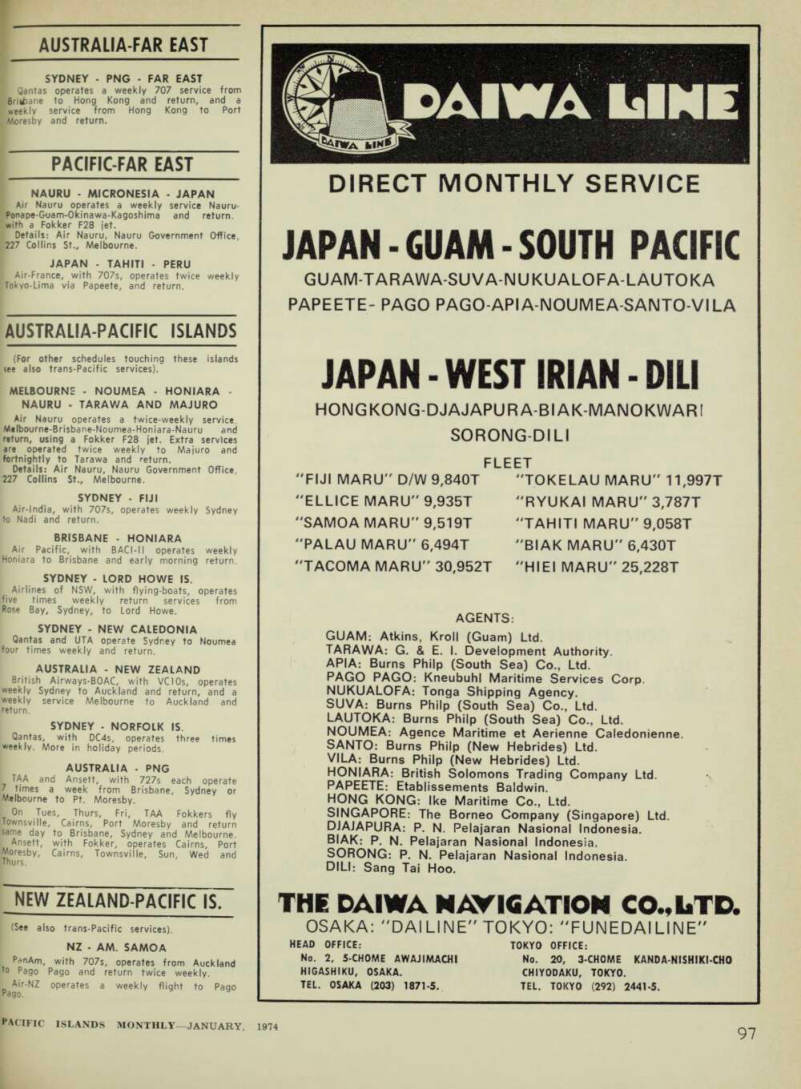
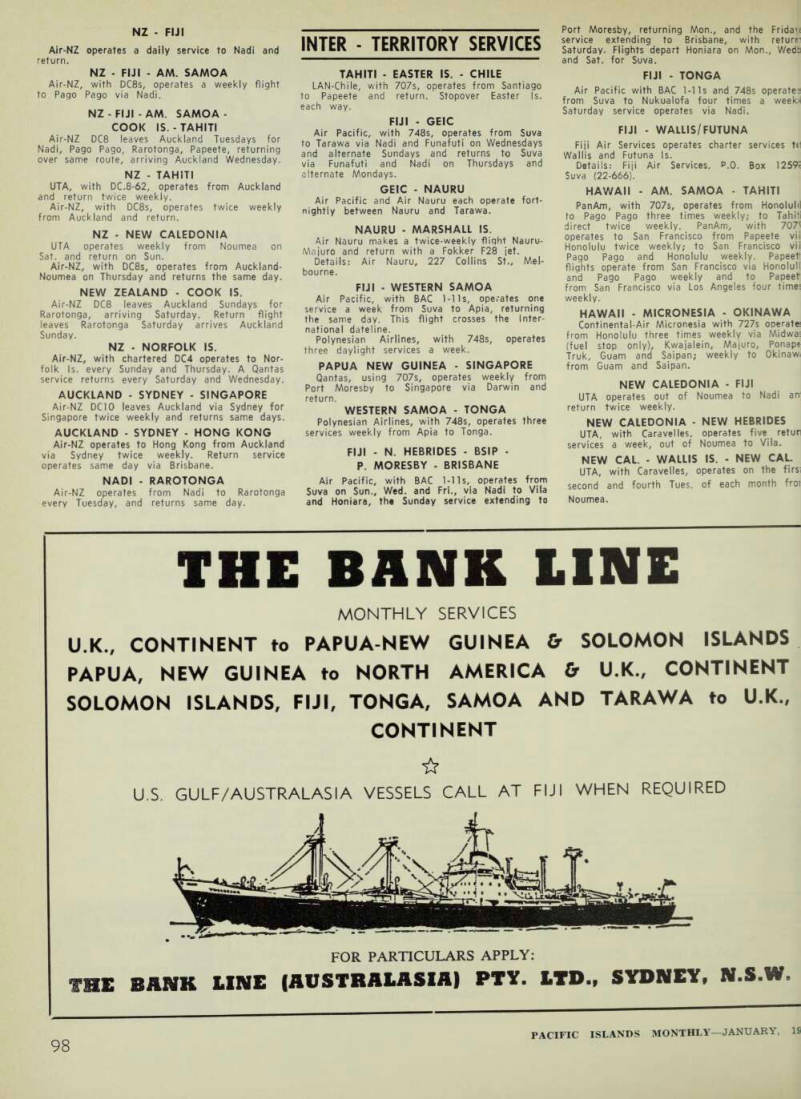
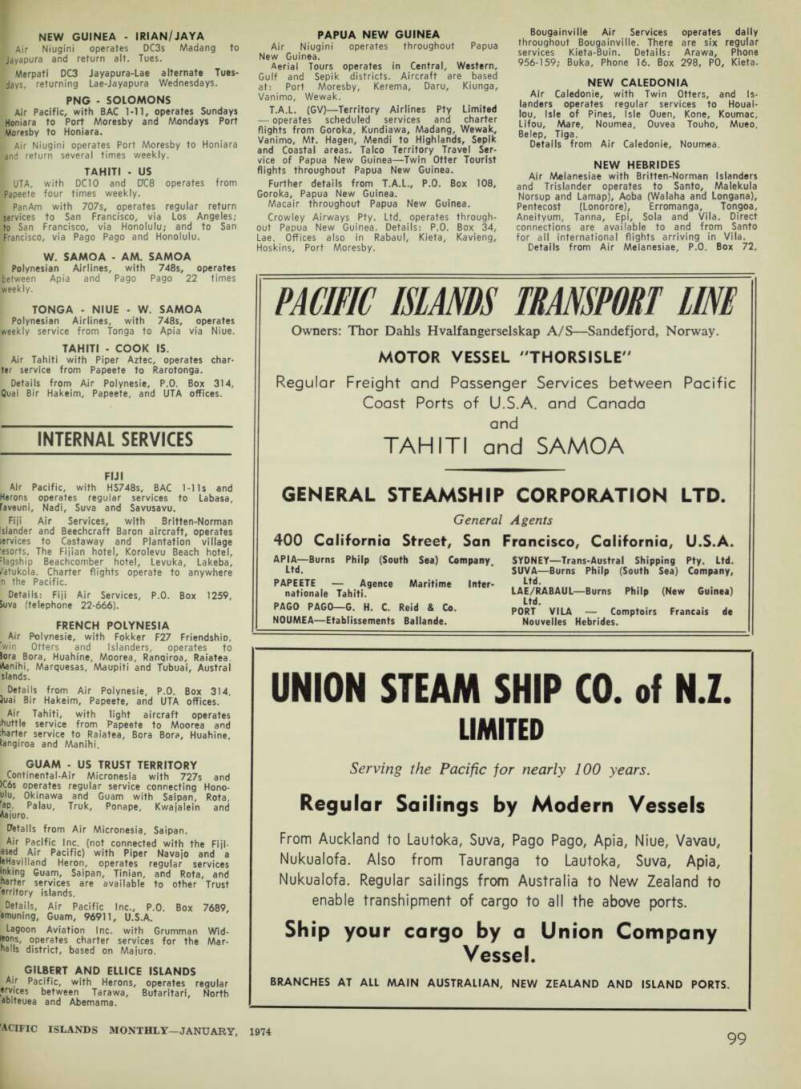
Trans Pacific Services
SYDNEY - FIJI - TAHITI ■ MEXICO Qantas, with 7075, operates twice weekly out of Sydney to Mexico City via Nadi, Papeete and Acapulco.
SYDNEY - FIJI - TAHITI - CANADA Qantas, with 7075, operates weekly service out of Sydney.
SYDNEY - FIJI - HAWAII - CANADA CP Air, with DCS, operates twice weekly ser vices out of Sydney.
SYDNEY • NZ - HAWAII - US Air-NZ, with DClO's and DCB's operates fromr Sydney to Los Angeles, via Auckland andfc Honolulu three times weekly.
SYDNEY - NZ - TAHITI ■ US Air-NZ, with DCBs, operates from Sydney toe Los Angeles, via Auckland and Tahiti twicea weekly.
SYDNEY - FIJI - HAWAII - US Qantas operates four times weekly and returnn between Sydney and San Francisco via Fijiij and Honolulu with 74785; 707 s operate threes times weekly and return to San Francisco viaa Honolulu. Additional 707 services Sydney/Nadil Tues. and Sat. and return.
British Airways-BOAC, with VClOs, operates from Melbourne and Sydney to Los Angeles and return five times a week.
Sydney - Fiji - Hawaii
American Airlines, with 7075, operates three daylight flights from Sydney to Nadi ano Honolulu and return, and one direct flight to Honolulu.
Sydney - Us (Via Noumea, Fiji,
Nz Or Tahiti)
UTA operates out of Sydney three time: weekly, and return.
SYDNEY - US (via N. CAL, FIJI,
Hawaii)
PanAm, with 7475, arrives Sydney from Los Angeles, via Honolulu and Nadi three time: weekly and leaves on return flight the sam# days.
PanAm, with 707 s operates four days week return trans-Pacific service out of Sydnei to Los Angeles, via Noumea and Honolulu Mon., Wed., Fri. flights to Australia go t< Melbourne and return to Sydney the same day
Brisbane - Fiji
Qantas operates a 707 direct from Brisbam to Fiji on Sat. and Fiji to Brisbane on Sun
Melbourne - Fiji - Us
Qantas with 707 s and 747 s operates Me bourne/San Francisco via Fiji and Honolul three times weekly; weekly 707 service o Sun. to San Francisco via Honolulu.
MELBOURNE - NZ - HAWAII ■ US Air-NZ, with DCBs, operates weekly fror Melbourne to Los Angeles via Auckland an Honolulu and return.
NZ - AM. SAMOA - TAHITI or
Hawaii - Us
PanAm, with 707 s operates out of Aucl land via Tahiti three times weekly, and twu via American Samoa. Out of American Samo< PanAm operates to the States three tim« weekly and out of Tahiti to the States foi times weekly.
AUCKLAND - FIJI - AM. SAMOA - HAWA American Airlines, with 7075, operates c of Auckland to Honolulu, via Nadi and retui two times weekly. Two flights per week v Pago Pago.
Australia-Far East
Sydney - Png • Far East
Qantas operates a weekly 707 service from Brisbane to Hong Kong and return, and a weekly service from Hong Kong to Port Moresby and return.
Pacific-Far East
Nauru - Micronesia - Japan
Air Nauru operates a weekly service Nauru- Ponape-Guam-Okinawa-Kagoshima and return, with a Fokker F2B jet.
Details: Air Nauru, Nauru Government Office, 227 Collins St., Melbourne.
Japan - Tahiti - Peru
I Air-France, with 7075, operates twice weekly [Tokyo-Lima via Papeete, and return.
Australia-Pacific Islands
(For other schedules touching these islands see also trans-Pacific services).
Melbourne • Noumea - Honiara
Nauru - Tarawa And Majuro
Air Nauru operates a twice-weekly service Mtlbourne-Brisbane-Noumea-Honiara-Nauru and return, using a Fokker F2B jet. Extra services are operated twice weekly to Majuro and fortnightly to Tarawa and return.
Details; Air Nauru, Nauru Government Office, 227 Collins St., Melbourne.
Sydney - Fiji
Air-lndia, with 7075, operates weekly Sydney to Nadi and return.
Brisbane - Honiara
Air Pacific, with BACI-II operates weekly Honiara to Brisbane and early morning return.
Sydney - Lord Howe Is.
; Airlines of NSW, with flying-boats, operates five times weekly return services from Rose Bay, Sydney, to Lord Howe.
Sydney - New Caledonia
Qantas and UTA operate Sydney to Noumea four times weekly and return.
Australia - New Zealand
British Airways-BOAC, with VClOs, operates weekly Sydney to Auckland and return, and a weekly service Melbourne to Auckland and return.
Sydney - Norfolk Is.
Qantas, with DC4s, operates three times weekly. More in holiday periods.
Australia - Png
1 TAA and Ansett, with 727 s each operate 7 times a week from Brisbane, Sydney or Melbourne to Pt. Moresby, i On Tues, Thurs, Fri, TAA Fokkers fly Townsville, Cairns, Port Moresby and return same day to Brisbane, Sydney and Melbourne.
Ansett, with Fokker, operates Cairns, Port Moresby, Cairns, Townsville, Sun, Wed and Thurs.
New Zealand-Pacific Is.
(See also trans-Pacific services).
Nz • Am. Samoa
PanAm, with 7075, operates from Auckland '0 Pago Pago and return twice weekly. operates a weekly flight to Pago
Nz - Fiji
Air-NZ operates a daily service to Nadi and return.
Nz ■ Fiji - Am. Samoa
Air-NZ, with DCBs, operates a weekly flight to Pago Pago via Nadi.
NZ - FIJI - AM. SAMOA -
Cook Is.-Tahiti
Air-NZ DCS leaves Auckland Tuesdays for Nadi, Pago Pago, Rarotonga, Papeete, returning over same route, arriving Auckland Wednesday.
Nz - Tahiti
UTA, with DC.B-62, operates from Auckland and return twice weekly.
Air-NZ, with DCBs, operates twice weekly from Auckland and return.
Nz - New Caledonia
UTA operates weekly from Noumea on Sat. and return on Sun.
Air-NZ, with DCBs, operates from Auckland- Noumea on Thursday and returns the same day.
New Zealand - Cook Is.
Air-NZ DCS leaves Auckland Sundays for Rarotonga, arriving Saturday. Return flight leaves Rarotonga Saturday arrives Auckland Sunday.
Nz - Norfolk Is.
Air-NZ, with chartered DC4 operates to Nor folk Is. every Sunday and Thursday. A Qantas service returns every Saturday and Wednesday.
Auckland - Sydney - Singapore
Air-NZ DCIO leaves Auckland via Sydney for Singapore twice weekly and returns same days.
Auckland - Sydney - Hong Kong
Air-NZ operates to Hong Kong from Auckland via Sydney twice weekly. Return service operates same day via Brisbane.
Nadi - Rarotonga
Air-NZ operates from Nadi to Rarotonga every Tuesday, and returns same day.
Inter - Territory Services
Tahiti - Easter Is. - Chile
LAN-Chile, with 7075, operates from Santiago to Papeete and return. Stopover Easter Is. each way.
Fiji - Geic
Air Pacific, with 7485, operates from Suva to Tarawa via Nadi and Funafuti on Wednesdays and alternate Sundays and returns to Suva via Funafuti and Nadi on Thursdays and
alternate Mondays.
Geic - Nauru
Air Pacific and Air Nauru each operate fort nightly between Nauru and Tarawa.
Nauru - Marshall Is.
Air Nauru makes a twice-weekly flight Nauru- Majuro and return with a Fokker F2B jet.
Details; Air Nauru, 227 Collins St., Mel bourne.
Fiji - Western Samoa
Air Pacific, with BAC 1-1 Is, operates one service a week from Suva to Apia, returning the same day. This flight crosses the Inter national dateline.
Polynesian Airlines, with 7485, operates three daylight services a week.
Papua New Guinea - Singapore
Qantas, using 7075, operates weekly from Port Moresby to Singapore via Darwin and return.
Western Samoa - Tonga
Polynesian Airlines, with 7485, operates three services weekly from Apia to Tonga.
FIJI - N. HEBRIDES - BSIP •
P. Moresby - Brisbane
Air Pacific, with BAC 1-lls, operates from Suva on Sun., Wed. and Fri., via Nadi to Vila and Honiara, the Sunday service extending to
Port Moresby, returning Mon., and the Fridavi service extending to Brisbane, with returr Saturday. Flights depart Honiara on Mon., Wedfc and Sat. for Suva.
Fiji - Tonga
Air Pacific with BAC 1-1 Is and 748 s operates from Suva to Nukualofa four times a week> Saturday service operates via Nadi.
Fiji - Wallis/Futuna
Fiji Air Services operates charter services t(i Wallis and Futuna Is.
Details: Fiji Air Services, p.O. Box 1259 i Suva (22-666).
Hawaii - Am. Samoa - Tahiti
PanAm, with 7075, operates from Honoluh to Pago Pago three times weekly; to Tahiti direct twice weekly. PanAm, with 707' operates to San Francisco from Papeete vii Honolulu twice weekly; to San Francisco vii Pago Pago and Honolulu weekly. Papeetf flights operate from San Francisco via Honoluli and Pago Pago weekly and to Papeett from San Francisco via Los Angeles four time! weekly.
Hawaii - Micronesia • Okinawa
Continental-Air Micronesia with 727 s operate; from Honolulu three times weekly via Midwai (fuel stop only), Kwajalein, Majuro, Ponape Truk, Guam and Saipan; weekly to Okinaw, from Guam and Saipan.
New Caledonia - Fiji
UTA operates out of Noumea to Nadi an return twice weekly.
New Caledonia - New Hebrides
UTA, with Caravelles, operates five retur services a week, out of Noumea to Vila.
NEW CAL. • WALLIS IS. - NEW CAL UTA, with Caravelles, operates on the firs second and fourth Tues. of each month froi Noumea.
New Guinea - Irian/Jaya
I Air Niugini operates DC3s Madang to Jayapura and return alt. Tues.
Merpati DC3 Jayapura-Lae alternate Tues days, returning Lae-Jayapura Wednesdays.
Png - Solomons
Air Pacific, with BAC 1-11, operates Sundays Honiara to Port Moresby and Mondays Port Moresby to Honiara. f Air Niugini operates Port Moresby to Honiara and return several times weekly.
Tahiti - Us
UTA, with DCIO and DCB operates from Papeete four times weekly.
PanAm with 7075, operates regular return services to San Francisco, via Los Angeles; to San Francisco, via Honolulu; and to San Francisco, via Pago Pago and Honolulu.
W. Samoa - Am. Samoa
Polynesian Airlines, with 7485, operates between Apia and Pago Pago 22 times weekly.
Tonga - Niue - W. Samoa
Polynesian Airlines, with 7485, operates weekly service from Tonga to Apia via Niue.
Tahiti - Cook Is.
Air Tahiti with Piper Aztec, operates char ier service from Papeete to Rarotonga.
Details from Air Polynesie, P.O. Box 314, 3uai Bir Hakeim, Papeete, and UTA offices.
Internal Services
Fiji
Air Pacific, with HS74Bs, BAC 1-11 s and Herons operates regular services to Labasa, laveuni, Nadi, Suva and Savusavu.
Fiji Air Services, with Britten-Norman Islander and Beechcraft Baron aircraft, operates services to Castaway and Plantation village esorts. The Fijian hotel, Korolevu Beach hotel, Magship Beachcomber hotel, Levuka, Lakeba, /atukola. Charter flights operate to anywhere n the Pacific.
Details: Fiji Air Services, P.O. Box 1259, tova (telephone 22-666).
French Polynesia
Air Polynesie, with Fokker F 27 Friendship, 'win Otters and Islanders, operates to Jora Bora, Huahine, Moorea, Ranqiroa, Raiatea.
Aanihi, Marquesas, Maupiti and Tubuai, Austral slands.
Details from Air Polynesie, P.O. Box 314, Juai Bir Hakeim, Papeete, and UTA offices.
Air Tahiti, with light aircraft operates shuttle service from Papeete to Moorea and Harter service to Raiatea, Bora Bora, Huahine, langiroa and Manihi.
Guam - Us Trust Territory
Continental-Air Micronesia with 727 s and )C6s operates regular service connecting Hono ur, Okinawa and Guam with Saipan, Rota, r ap, Palau, Truk, Ponape, Kwajalein and naiuro.
Details from Air Micronesia, Saipan.
Air Pacific Inc. (not connected with the Fijl ased Air Pacific) with Piper Navajo and a eHavilland Heron, operates regular services inking Guam, Saipan, Tinian, and Rota, and ; Harter services are available to other Trust erritory islands.
Details, Air Pacific Inc., P.O. Box 7689 amuning, Guam, 96911, U.S.A.
Lagoon Aviation Inc. with Grumman Wid leons, operates charter services for the Mar- Halls district, based on Majuro.
Gilbert And Ellice Islands
Air Pacific, with Herons, operates regular aryices between Tarawa, Butaritari, North abiteuea and Abemama.
Papua New Guinea
Air Niugini operates throughout Papua m-u, ruin** Aerial Tours operates in Central, Western, Gulf and Sepik districts. Aircraft are based at: Port Moresby, Kerema, Daru, Kiunga, Vanimo Wewak T-AX. Airlines P,v LirniM
flights Tom
Vanimo, Mt Hagen Mendi to Highlands Sepik and Coastal areas. Talco Territory Travel Service of Papua New Guinea — Twin Otter Tourist flights throughout Papua New Guinea Further details from T.A.L., P.O. Box 108, Goroka, Papua New Guinea.
Macair throughout Papua New Guinea.
Crowley Airways Pty. Ltd. operates throughout Papua New Guinea. Details: P.O. Box 34, Lae. Offices also in Rabaul, Kieta, Kavieng, Hoskins, Port Moresby.
Bougainville Air Services operates daily throughout Bougainville There are six regular services Kieta-Bum. Details: Arawa, Phone 956-159; Buka, Phone 16. Box 298, PO, Kieta.
New Caledonia
Air Caledome, with Twin Otters, and Is-
Kelt
Noumea, Ouvea Touho, Mueo, Details from Air Caledonie, Noumea, ' mc\a/ ucaoincc Air AAelanesia f Islanders and Trislander operates to Santo, Malekula Norsup and Lamap), Aoba (Walaha and Longana), Pentecost (Lonorore), Erromanga, Tongoa, Aneityum, Tanna, Epi, Sola and Vila. Direct connections are available to and from Santo for all international flights arriving in Vila.
Details from Air Melanesiae, P.O. Box 72,
Solomon Islands
Solair, with Beech Barons and Islanders operates to Auki, Avu Avu, Babanakira, Bara koma. Bellona Is., Fera Is., Gizo, Honiara, Kira Kira, Marau, Munda, Parasi, Sege, Yandma, Santa Cruz, Mono, Rennell Is., Choiseul Bay, Ballalae and Ringi Cove.
Details from Solomon Islands Airways Ltd., Box 23, Honiara, BSIP.
Tonga
Tonga Tourist and Development Co, with Britten-Norman Islander and Aztec aircraft, operates between Fua'amotu, (airport for Nukualofa) and Vava'u Monday to Saturday.
Service soon between Fua'amotu and Eua.
Aircraft available for sightseeing and regional charters.
Details from Tonga Tourist and Development Co, PO Box 91, Nukualofa, Tonga.
Cook Islands
Cook Islands Airways Ltd, with a Britten Norman Islander, operates seven flights a week between Rarotonga and Aitutaki. Service will be extended to Atiu, Mangaia and Mitiaro when airstrips are built. • From the beginning of the year to the end of October 20,000 tourists have visited Vila from cruise ships.
Nine more ships are expected be fore the end of the year, which should boost the total to 26,000.
Assuming each person, including the crews, spend 1,000 FNH, the total
income generated by cruise ship
tourists will be about 30 million
Fnh.
Advertisements & other items, pp. 98-101 (2 items)
Sofrana'unilines
THE SOUTH PACIFIC SHIPPING COMPANY
WHICH SERVES THE SOUTH PACIFIC
DAIWA LINE
DIRECT MONTHLY SERVICE
JAPAN - GUAM - SOUTH PACIFIC
GUAM-TARAWA-SUVA-NUKUALOFA-LAUTOKA
PAPEETE- PAGO PAGO-APIA-IMOUMEA-SANTOVI LA
JAPAN - WEST IRIAN - DILI
HONGKONG-DJAJAPURA-BIAK-MANOKWARI
SORONG-DI LI
FLEET
"FIJI MARU" D/W 9,840 T "TOKELAU MARU" 11,997 T "ELLICE MARU" 9,935 T "RYUKAI MARU" 3,787 T "SAMOA MARU" 9,519 T "TAHITI MARU" 9,058 T "PALAU MARU" 6,494 T "BIAK MARU" 6,430 T "TACOMA MARU" 30,952 T "HIEI MARU" 25,228 T
AGENTS:
GUAM; Atkins, Kroll (Guam) Ltd.
TARAWA: G. & E. I. Development Authority.
APIA: Burns Philp (South Sea) Co., Ltd.
PAGO PAGO: Kneubuhl Maritime Services Corp.
NUKUALOFA: Tonga Shipping Agency.
SUVA: Burns Philp (South Sea) Co., Ltd.
LAUTOKA: Burns Philp (South Sea) Co., Ltd.
NOUMEA: Agence Maritime et Aerienne Caledonienne.
SANTO: Burns Philp (New Hebrides) Ltd.
VILA: Burns Philp (New Hebrides) Ltd.
HONIARA: British Solomons Trading Company Ltd.
PAPEETE: Etablissements Baldwin.
HONG KONG: Ike Maritime Co., Ltd.
SINGAPORE; The Borneo Company (Singapore) Ltd.
DJAJAPURA: P. N. Pelajaran Nasional Indonesia.
BIAK: P. N. Pelajaran Nasional Indonesia.
SORONG: P. N. Pelajaran Nasional Indonesia.
DILI: Sang Tai Hoo.
THE DAIWA NAVIGATION CO.. LTD.
OSAKA; "DAILINE" TOKYO; "FUNEDAILINE"
HEAD OFFICE: TOKYO OFFICE:
No. 2, 5-CHOME AWAJIMACHI No. 20, 3-CHOME KANDA-NISHIKI-CHO
HIGASHIKU, OSAKA. CHIYODAKU, TOKYO.
TEL. OSAKA (203) 1871-5. TEL. TOKYO (292) 2441-5.
THE BANK LINE
MONTHLY SERVICES
U.K., CONTINENT to PAPUA-NEW GUINEA & SOLOMON ISLANDS PAPUA, NEW GUINEA to NORTH AMERICA & U.K., CONTINENT SOLOMON ISLANDS, FIJI, TONGA, SAMOA AND TARAWA to U.K.,
CONTINENT
☆ U.S. GULF/AUSTRALASIA VESSELS CALL AT FIJI WHEN REQUIRED ft /
ViVJL
FOR PARTICULARS APPLY:
THE BANK LINE (AUSTRALASIA) PTY. LTD., SYDNEY, N.S.W,
PACIFIC ISLANDS TRANSPORT LINE
Owners: Thor Dahls Hvalfangerselskap A/S —Sandefjord, Norway.
MOTOR VESSEL "THORSISLE"
Regular Freight and Passenger Services between Pacific
Coast Ports of U.S.A. and Canada
and
TAHITI and SAMOA
GENERAL STEAMSHIP CORPORATION LTD.
General Agents 400 California Street, San APIA —Burns Philp (South Sea) Company, Ltd.
PAPEETE Agence Maritime Internationale Tahiti.
PAGO PAGO—G. H. C. Reid & Co.
NOUMEA—Etablissements Ballande.
Francisco, California, U.S.A.
SYDNEY —Trans-Austral Shipping Pty. Ltd.
SUVA —Burns Philp (South Sea) Company, Ltd.
LAE/RABAUL—Burns Philp (New Guinea) Ltd.
PORT VILA Comptoirs Francais de Nouvelles Hebrides.
UNION STEAM SHIP CO. of N.Z.
LIMITED
Serving the Pacific for nearly 100 years.
Regular Sailings by Modern Vessels
From Auckland to Lautoka, Suva, Pago Pago, Apia, Niue, Vavau, Nukualofa. Also from Tauranga to Lautoka, Suva, Apia, Nukualofa. Regular sailings from Australia to New Zealand to enable transhipment of cargo to all the above ports.
Ship your cargo by a Union Company Vessel.
BRANCHES AT ALL MAIN AUSTRALIAN, NEW ZEALAND AND ISLAND PORTS.
99
ACIFIC ISLANDS MONTHLY—JANUARY, 1974
Deaths of Islands People
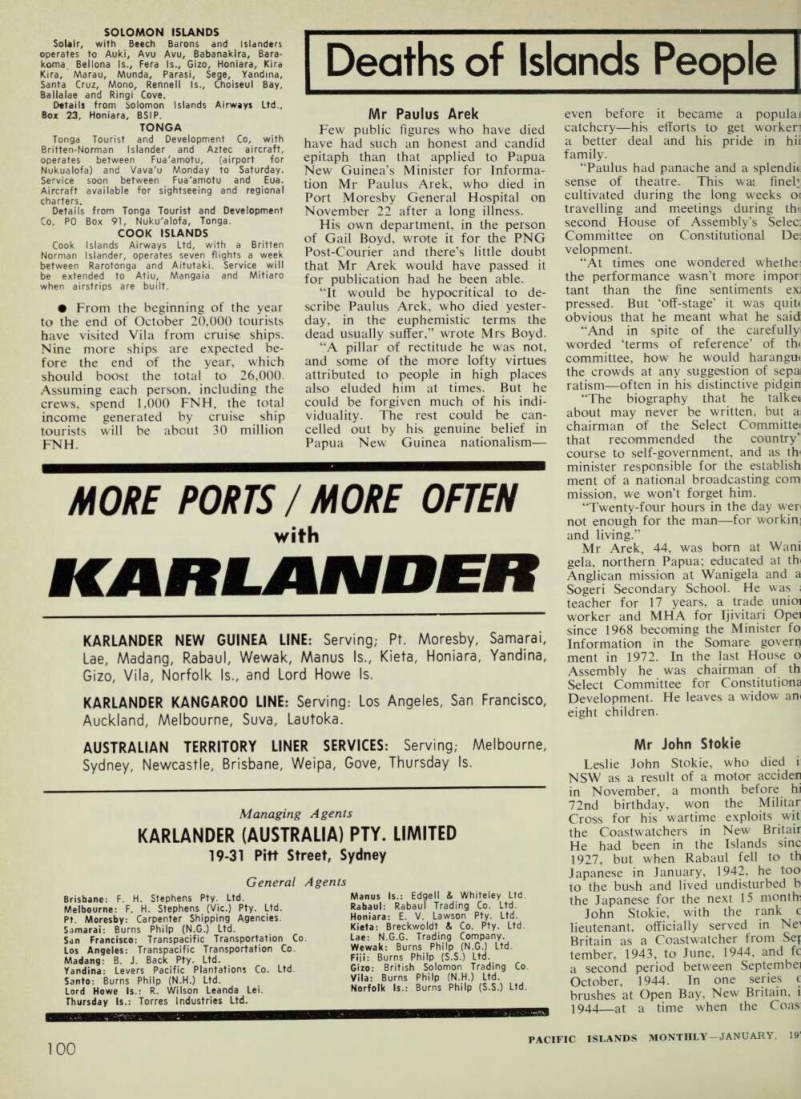
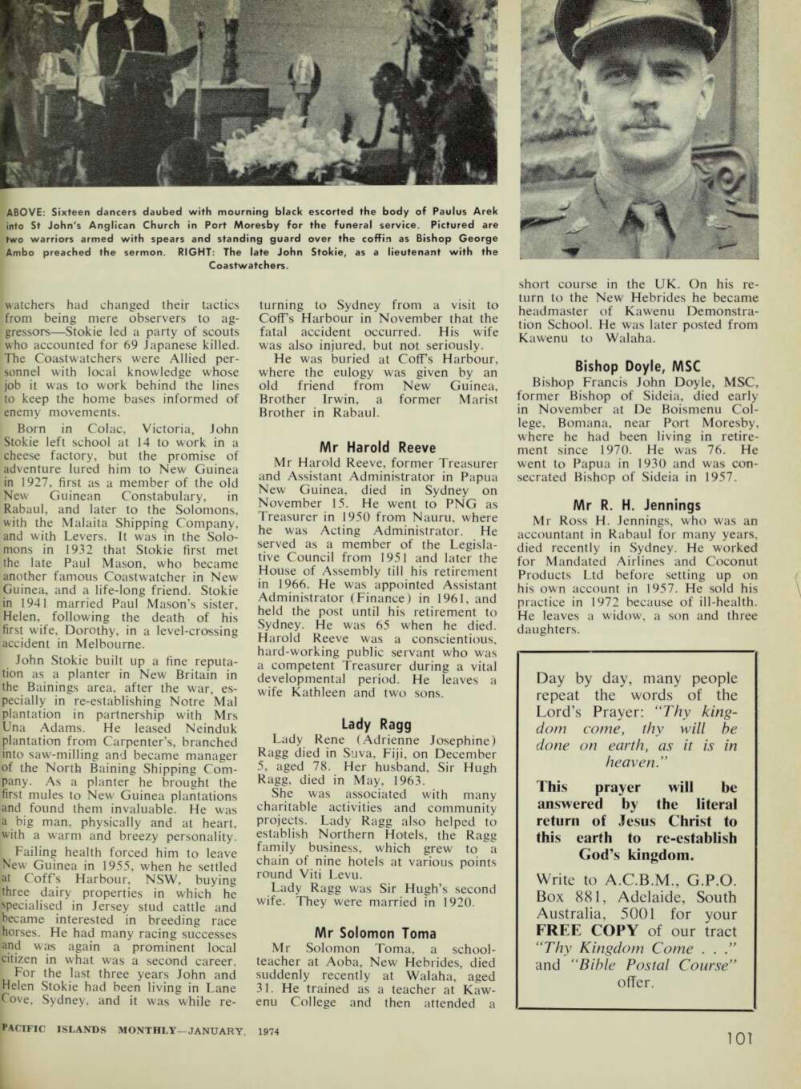
Mr Paulus Arek Few public figures who have died have had such an honest and candid epitaph than that applied to Papua New Guinea’s Minister for Informa tion Mr Paulus Arek, who died in Port Moresby General Hospital on November 22 after a long illness.
His own department, in the person of Gail Boyd, wrote it for the PNG Post-Courier and there’s little doubt that Mr Arek would have passed it for publication had he been able.
“It would be hypocritical to de scribe Paulus Arek, who died yester day, in the euphemistic terms the dead usually suffer,” wrote Mrs Boyd.
“A pillar of rectitude he was not, and some of the more lofty virtues attributed to people in high places also eluded him at times. But he could be forgiven much of his indi viduality. The rest could be can celled out by his genuine belief in Papua New Guinea nationalism—
even before it became a populai catchcry—his efforts to get worken a better deal and his pride in hii family.
“Paulus had panache and a splendk sense of theatre. This wat fineb cultivated during the long weeks o< travelling and meetings during thu second House of Assembly’s Selec; Committee on Constitutional De; velopment.
“At times one wondered whethe: the performance wasn’t more impor tant than the fine sentiments ex; pressed. But ‘off-stage’ it was quih obvious that he meant what he said “And in spite of the carefully worded ‘terms of reference’ of th< committee, how he would harangu* the crowds at any suggestion of sepa ratism—often in his distinctive pidgin “The biography that he talket about may never be written, but a chairman of the Select Committe< that recommended the country’ course to self-government, and as th' minister responsible for the establish ment of a national broadcasting com mission, we won’t forget him.
“Twenty-four hours in the day wer not enough for the man—for workin; and living.”
Mr Arek, 44, was born at Wani gela, northern Papua; educated at tfr Anglican mission at Wanigela and a Sogeri Secondary School. He was ; teacher for 17 years, a trade unioi worker and MHA for Ijivitari Opel since 1968 becoming the Minister fo Information in the Somare govern ment in 1972. In the last House o Assembly he was chairman of th Select Committee for Constitutions Development. He leaves a widow ani eight children.
Mr John Stokie Leslie John Stokie, who died i NSW as a result of a motor accider in November, a month before hi 72nd birthday, won the Militar Cross for his wartime exploits wit the Coastwatchers in New Britair He had been in the Islands sine 1927, but when Rabaul fell to th Japanese in January, 1942, he too to the bush and lived undisturbed b the Japanese for the next 15 month; John Stokie, with the rank c lieutenant, officially served in Ne 1 Britain as a Coastwatcher from Sei tember, 1943, to June, 1944, and fc a second period between Septembei October, 1944. In one series c brushes at Open Bay, New Britain, i 1944—at a time when the Coas
watchers had changed their tactics from being mere observers to ag gressors—Stokie led a party of scouts who accounted for 69 Japanese killed.
The Coastwatchers were Allied per sonnel with local knowledge whose job it was to work behind the lines to keep the home bases informed of enemy movements.
Born in Colac, Victoria, John Stokie left school at 14 to work in a cheese factory, but the promise of adventure lured him to New Guinea in 1927, first as a member of the old New Guinean Constabulary, in Rabaul, and later to the Solomons, with the Malaita Shipping Company, and with Levers. It was in the Solo mons in 1932 that Stokie first met the late Paul Mason, who became another famous Coast watcher in New Guinea, and a life-long friend. Stokie in 1941 married Paul Mason’s sister, Helen, following the death of his first wife, Dorothy, in a level-crossing accident in Melbourne.
John Stokie built up a fine reputa tion as a planter in New Britain in the Bainings area, after the war, es pecially in re-establishing Notre Mai plantation in partnership with Mrs Una Adams. He leased Neinduk plantation from Carpenter’s, branched into saw-milling and became manager of the North Baining Shipping Com pany. As a planter he brought the first mules to New Guinea plantations and found them invaluable. He was a big man, physically and at heart, with a warm and breezy personality. ; Failing health forced him to leave New Guinea in 1955, when he settled at Coff’s Harbour, NSW, buying three dairy properties in which he specialised in Jersey stud cattle and became interested in breeding race horses. He had many racing successes and was again a prominent local citizen in what was a second career.
For the last three years John and Helen Stokie had been living in Lane Cove, Sydney, and it was while re
turning to Sydney from a visit to Coff’s Harbour in November that the fatal accident occurred. His wife was also injured, but not seriously.
He was buried at CofFs Harbour, where the eulogy was given by an old friend from New Guinea, Brother Irwin, a former Marist Brother in Rabaul.
Mr Harold Reeve Mr Harold Reeve, former Treasurer and Assistant Administrator in Papua New Guinea, died in Sydney on November 15. He went to PNG as Treasurer in 1950 from Nauru, where he was Acting Administrator. He served as a member of the Legisla tive Council from 1951 and later the House of Assembly till his retirement in 1966. He was appointed Assistant Administrator (Finance) in 1961, and held the post until his retirement to Sydney. He was 65 when he died.
Harold Reeve was a conscientious, hard-working public servant who was a competent Treasurer during a vital developmental period. He leaves a wife Kathleen and two sons.
Lady Ragg
Lady Rene (Adrienne Josephine) Ragg died in Suva, Fiji, on December 5, aged 78. Her husband, Sir Hugh Ragg, died in May, 1963.
She was associated with many charitable activities and community projects. Lady Ragg also helped to establish Northern Hotels, the Ragg family business, which grew to a chain of nine hotels at various points round Viti Levu.
Lady Ragg was Sir Hugh’s second wife. They were married in 1920.
Mr Solomon Toma Mr Solomon Toma, a school teacher at Aoba, New Hebrides, died suddenly recently at Walaha, aged 31. He trained as a teacher at Kaw enu College and then attended a
short course in the UK. On his re turn to the New Hebrides he became headmaster of Kawenu Demonstra tion School. He was later posted from Kawenu to Walaha.
Bishop Doyle, MSC
Bishop Francis John Doyle, MSC, former Bishop of Sideia, died early in November at De Boismenu Col lege, Bomana, near Port Moresby, where he had been living in retire ment since 1970. He was 76, He went to Papua in 1930 and was con secrated Bishop of Sideia in 1957, Mr R. H. Jennings Mr Ross H. Jennings, who was an accountant in Rabaul for many years, died recently in Sydney. He worked for Mandated Airlines and Coconut Products Ltd before setting up on his own account in 1957. He sold his practice in 1972 because of ill-health.
He leaves a widow, a son and three daughters.
ABOVE: Sixteen dancers daubed with mourning black escorted the body of Paulus Arek into St John's Anglican Church in Port Moresby for the funeral service. Pictured are two warriors armed with spears and standing guard over the coffin as Bishop George Ambo preached the sermon. RIGHT: The late John Stokie, as a lieutenant with the Coastwatchers.
Advertisements & other items, pp. 102-106 (1 item)
Kahljuvoer
MORE PORTS / MORE OFTEN
with
KARLANDER NEW GUINEA LINE: Serving; Pt. Moresby, Samarai, Lae, Madang, Rabaul, Wewak, Manus Is., Kieta, Honiara, Yandina, Gizo, Vila, Norfolk Is., and Lord Howe Is.
KARLANDER KANGAROO LINE: Serving: Los Angeles, San Francisco, Auckland, Melbourne, Suva, Lautoka.
AUSTRALIAN TERRITORY LINER SERVICES: Serving, Melbourne,
Sydney, Newcastle, Brisbane, Weipa, Gove, Thursday Is.
Managing Agents
KARLANDER (AUSTRALIA) PTY. LIMITED
19-31 Pitt Street, Sydney
General Agents
Brisbane: F. H. Stephens Pty. Ltd.
Melbourne: F. H. Stephens (Vic.) Pty. Ltd.
Pt. Moresby: Carpenter Shipping Agencies.
Samarai: Burns Phi Ip (N.G.) Ltd.
San Francisco; Transpacific Transportation Co.
Los Angeles; Transpacific Transportation Co.
Madang: B. J. Back Pty. Ltd.
Yandina: Levers Pacific Plantations Co. Ltd.
Santo: Burns Philp (N.H.) Ltd.
Lord Howe Is.: R. Wilson Leanda Lei.
Thursday Is.: Torres Industries Ltd.
Manus Is.: Edgell & Whiteley Ltd Rabaul: Rabaul Trading Co. Ltd.
Honiara: E. V. Lawson Pty. Ltd.
Kieta: Breckwoldt & Co. Pty. Ltd.
Lae: N.G.G. Trading Company.
Wewak: Burns Philp (N.G.) Ltd.
Fiji: Burns Philp (S.S.) Ltd.
Gizo: British Solomon Trading Co Vila: Burns Philp (N.H.) Ltd.
Norfolk Is.: Burns Philp (S.S.) Ltd.
Day by day, many people repeat the words of the Lord’s Prayer: “ Thy kingdom come, thy will be done on earth, as it is in heaven”
This prayer will be answered by the literal return of Jesus Christ to this earth to re-establish God’s kingdom.
Write to G.P.O.
Box 881, Adelaide, South Australia, 5001 for your FREE COPY of our tract “Thy Kingdom Come . . and “ Bible Postal Course” offer.
n LnnJ BS) InnJ [r= §s) InnJ 1
ce For Warm and Friendly
Samoan Hospitality
to O Apia, Western Samoa Phone: 880. Cable: 'Aggies'.
Tariff includes all meals.
FIJI
NAMALE PLANTATION
ESCAPE
FROM THE ORDINARY
Here is an idyllic paradise where you can enjoy the unspoiled beauty and serenity of a working coconut plantation. This privatelyowned Pacific retreat has been designed for a maximum of 16 people. Gracious surroundings, friendly service, relaxed 'Bure' accommodation overlooking the sea with individual balconies and private facilities. Licensed cocktail bar. Entire plantation available to groups of 14-16 people.
Activities available include: Deep sea fishing, reef and shell hunting, skin diving, snorkelling, water skiing, hiking, turf tennis court, badminton, horse riding, croquet course and a beautiful tropical garden to relax in. Sports equipment available on a complimentary basis include aquascopes, snorkelling and fishing equipment, inflatable rafts, tennis racquets etc. Coastal tours by boat or mini-bus on request. Boats for hire. Baby sitting service also available.
Write for a Free Brochure to:
THE MANAGER,
NAMALE PLANTATION
SAVUSAVU, FIJI.
Or: Namale Plantation, P.O. Box 64, Suva, Fiji.
Primitive luxury
(Polynesian style) MestTed away in the untouched Kingdom of Tonga is new, luxurious "Port of Refuge" International resort. Here is a unique opportunity for your clients to experience the tranquil and relaxed Tongan atmosphere while they enjoy the picturesque surroundings of the new "Port of Refuge". And only a short flight from Fi|i.
Reasonable tariffs from $17.50 with special concessions for children. Agents commission 10 per cent.
Tonga's
Port of Refuge
jg* INTERNATIONAL RESORT
7?* Uava’u Tonga
Cables: "Refuge" Tonga or "Tongatours"
Sydney. Phone: Sydney 85-1603 or 282-472
beachcomber
hotel
PACIFIC HARBOUR, FIJI
Sophistication in the midst of uninhabited natural beauty.
Nestled snugly in a reef-protected bay on 5 miles of classical palm fringed Deuba beach. Far enough from Fiji's capital, Suva, to forget the worries of city life. Near enough to take in the colour and the Duty Free Bazaars.
Every suite is self-contained and airconditioned. The cuisine is as the service, superb.
PO Box 216, Suva. Telephone; Navua 43.
Telex 2324. Cables: FLAGTELS, Fiji. For reservations or information contact your travel agent.
GENUINE NATIVE
ARTIFACTS
FROM THE NEW GUINEA
ISLANDS AND OUTLYING
ATOLLS
• TEXTILES • CURIOS
• CARVINGS • BASKETWARE
« FIGURINES
For complete lists and prices write to us immediately; B. F. DARCEY & Co. PTY. LTD.
TONIVA BEACH,
KIETA,
PAPUA NEW GUINEA.
INTERNATIONA
DATELINE HOT
TONGA
"Friendly Hotel" of the "Friendly Islands"
Situated along the Nukualofa waterfront. Only five minutes walk from town. Single, double, family suites, airconditioning, and hot and cold water showers. Pool, bar, restaurant, duty-free shop, tour desk and boutique.
Book through your travel agent or write to International Dateline Hotel, P.O. Box 62, Nukualofa Tonga.
Cable Address: "DATELINE".
Represented Overseas by; Charles J. Henry and Associates Pty. Ltd.
Sydney and Melbourne. 2976
PARK VIEW MOTEL—BRISBANE
Quiet location —opp. Botanic Gardens.
Single, double, family suites, all with refrig., air conditioning, phone, TV, radio, tea making facilities, from $lO. Pool and restaurant.
Phone 31-2695—Telex 40270.
Write for coloured brochure — Park View Motel, 128 Alice St, BRISBANE, Qld., 4000.
mnna
UIAHD
Mana Island: 300 acres of lush, tropical vegetation surrounded by miles of palm fringed beach and sheltered lagoons.
Recreation: Snorkelling, scuba, skiing, spear, bottom and deep sea fishing, swimming excursions. Modest charges.
Accommodation: Resort hotel, secluded accommodation in 60 individual Fijiantype cottages. Self-contained bures with shower, toilet, refrigerator, tea and coffee facilities and exhaust fans.
International Standard Restaurant: Fijian and Continental cuisine. Terrace dancing to Fijian Band. Beach Bars Feast Nights.
Facilities: Island shop, travel agent, hairdresser, child minding and first aid.
Tariff: Single occupancy: $F 18.00 Double occupancy: 5F22.00 Triple occupancy; $F26.00 Children under 12: Half Rate Babies in cot: Free Duplex Bure from: $F42.00 Rates subject to change.
Pre paid tours through agents.
Transport: Bus or taxi Nadi to Lautoka (Bus fare 80c). SFB.OO return by fast 90' cruiser Lautoka to Mana Island.
Schedule: Dep. Lautoka 9.30 a.m. Arr.
Mana 11.20 a.m. Dep. Mana 3.30 p.m.
Arr. Lautoka 5.20 p.m. Water Taxi subject to reservations; $F6.00 per person one way, a minimum $F45.00 per trip.
CHECK OUT TIME - 11.00 a.m.
CANCELLATION NOTICE - 48 hours.
DEPOSITS Groups and ITX Prepaid.
Individual bookings, one night deposit required.
Bookings: Aust. & N.Z.; C.J. Henry & Associates.
Offices: Mana Island Resort (FIJI) Limited P.O. Box M 94, Sydney Mail Exchange 2012 69.5061 or P.O. Box 610, Lautoka, FIJI 61.210; 61.455 Telegrams and Telex: Mana Island, Lautoka, FIJI •J
HARRIS
BOOK COMPANY
(ESTABLISHED 1930)
We carry over 10,000 titles on all subjects in stock and would be pleased to quote for your requirements.
Please send your enquiries to:
HARRIS BOOK COMPANY,
G.P.O. Box 16670, Hong Kong
FOR SALE
TWO GARDNER MARINE DIESEL
ENGINES, fresh water cooled, 155 H.P., eight cylinders, Serial BL3, Nos. 106.445 and 106.446.
TWO PROPELLERS, 4 ft. diam. x 18 in. pitch.
TWO BRASS TAIL SHAFTS, 3* in
diam.
ONE SET OF NEW SPARE PARTS.
Engines, propellers and shafts in very good condition.
Write: Mr. Manner, Shipowner, P.O. Box 220, Noumea, New Caledonia.
FOR SALE
Enquiries are invited for the sale of approximately 7,000 obsolete Edisonscrew Series lamps, some of which are more than 20 years old. The lamps are packed in cardboard cartons, have not been used, and may be inspected by prior arrangement at the Council's Queen Street depot, Newcastle, New South Wales. No guarantee can be given as to the condition of these lamps. Closing date: January 31, 1974.
Written enquiries only should be addressed to: The County Clerk, The Shortland County Council, Box 487 G, P. 0., Newcastle, N.S.W. 2300, Australia.
PROPERTY INVESTMENT
SUNSHINE COAST—QUEENSLAND
We invite inquiries regarding living or investment in this area.
We have a full coverage of holiday lettings, flats, motels, homes, farms, businesses and sub-divisional land.
Write direct to MABIN & BLOWERS Pty. Ltd. (Members R.E.1.Q.),
11 BURNETT STREET—BUDERIM, Q„ 4556.
Turners Supply Co
FRESH FRUIT & VEGETABLES
' , 9813
DAIMANTE HEALTH BANDS plain $A4.03
jewelled $5.00, air mail included. Write t<3 Sun Trading Co., Box 377, Norfolk Islann South Pacific.
PLANTATION MANAGER
Hooker Papua New Guinea Developmem A Hooker Group Company Seeks an experienced Manager tor its copn< cocoa plantation Toboroi (300 acres), easia accessible by road from Kieta, Bougainville..
Pacific Island copra-cocoa plantation experienor preferably in New Guinea, is important wii\ a good record of employee and village relatioo essential.
The successful applicant, who should active and aggressive, will undertake extensii; rehabilitation of tree crops and plantatiii buildings with financial and managemes support by the Company. He will alh undertake employee training programmes.
Salary: $A8,500 to commence, plus products bonuses.
Usual plantation amenities, including rent fra furnished house and family air fares to Sydmr (capital city).
Kieta and nearby Arawa towns have wiv stocked supermarkets, high school, daily a service to Sydney and all sporting facilitll including yacht and golf clubs.
Apply, in strict confidence (with copies references) to;
GROUP PERSONNEL MANAGER,
HOOKER CORPORATION LIMITED, HOOKER
HOUSE, ANGEL PLACE, SYDNEY, AUSTRALII
2000. TELEPHONE: SYDNEY 20367.
Line Advertisements
Per line, $1.15 Aust., Minimum rate. 4 lines.
CONCRETE BLOCK MACHINE. Makes
blocks, flags, edgings, screen-blocks, garden stools—up to 8 at once and 96 an hour. SAIO7 c.i.f. main ports. Send for leaflets. Forest Farm Research, Londonderry, N.S.W., 2753.
ALL BOOKS AND JOURNALS ON AUST-
RALASIA AND THE PACIFIC BOUGHT
AND SOLD. Catalogues issued and sent free on application. Correspondence invited. Berkelouw, 15-19 Boundary St., Rushcutters Bay, Sydney, 2011. Phone; 31-8215.
PEN FRIEND, Indian, male or female, correspond English female. Stamps, travel, cooking, photography. Apply: “H.G.”, c/- Box 3408, G.P.0., Sydney, 2001.
HOT WATER SYSTEM FOR SALE. On
instructions from our client we offer two sets of oil fired boilers, caloriflers, pipework, valves and electrical connections, complete in their own houses. The units are new stainless steel boilers with gun type oil burners and mains pressure caloriflers. The reason for sale is that they were inadequate in size for the supply and have been replaced with a larger boiler. The units offered are ex Suva site or we are able to deliver and install to your instructions. For further details, price etc., apply: Air Conditioning (S.P.) Ltd., Box 526, Suva, Fiji.
FLEETS, 76 ft steel tug, profess, bit. 1945, ample fuel and water, $30,000. 45 ft trawler, profess, bit. 1955, Gardner 5 LW, radio, sounder etc., $26,250. Fleets, Rowe’s Bldg, Edward St, Brisbane. Cable “Fleets”.
Brisbane.
PEN FRIENDS OVERSEAS. Individual world wide postal introduction service!
Plus optional illustrated magazine! Write for details today! Five Continents Co. Ltd., P.O. Box 21219, Henderson, N.Z.
55 YEARS EXPERIENCE
TO THE
FUNERAL TRADE
H. H. WEBB
& CO. LTD
Manufacturers and Distributors of II 4 I
PRODUCTS
For details of our complete range of Funeral Directors 7 Requisites please write to:
HEAD OFFICE:
206 WHITEHALL STREET
FOOTSCRAY, VIC,
AUSTRALIA
CABLES: 'WEBCO' MELBOURNE
Turners and Growers
FRESH FRUIT & VEGETABLES
9828
SOFT DRINK MACHINERY
• 200 g.p.h. carbonator. • 120 d.p.h. hydro washer. ® 8 head filler.
These machines are completely rebuilt and ready for immediate sale.
For further information or inspection contact: HORITZ FRUIT JUICES, 1283 Kingsford Smith Drive, Eagle Farm, Brisbane, Q'ld., 4007.
Index to Advertisers
Adams Ind 24, 66 Aggie Grey 102 Air New Zealand 74 Allied Manufacturing & Trading Industries 49 Ansett Hotels 22 Arnott's Biscuits 18 Bank of Hawaii 84 Bank Line 98 Beachcomber Hotel 102 8.0.A.C. 92 Breckwoldt 40 Brockhoff's 70 Carnation 93 Christadelphian 101 Clarion Shoji 65 Consol Chemicals 72 Daiwa Bank 90 Daiwa Line 97 Demka 11
Fisher & Co.
Fisher, Peter French Knit Frigate Rum Furuno
G.M.H.
George & Ashton Gillespie Bros Grove, W. H.
Hagemeyer Handi Works Harris Book Co Hellaby, R. &. W.
Honda International Dateline Interocean-N.Z. Ltd Jones, Lang, Wooton
15 Karlander Line 100 43 Kerr Bros 78 80 38 Mabin & Blowers 103 82 Macquarrie Industries 47 14 79 Mana Island Resort 103 44 Massey Ferguson 76 31 Mater Art Union 27 N.Z. Breweries 56 50 Namale Plantation 102 20 Nediloyd 78 103 Nelson & Robertson 39 38 Nissan cov iv Pacific Line 99 Pioneer Electric 51 PNG Printing 31 102 95 Qantas cov in Queensland 30 Insurance 32
Sandy, James Sofrana/Unilines Southern Pac Ins Sullivan, C.
Swire, John Tatham, S. E.
Tonga's Port of Refuge 11 Toyo Kogyo cow Toyota 52, Trio Electronics Turners & Growers II Turners Supply If Union S.S. Co Warburton Frank!
Webb, H. H. If Welcome Homes Yanmar Diesels
Advertisements & other items, pp. 106-108 (3 items)
Wholly set up and printed in Australia by PACIFIC PUBLICATIONS (AUST.) PTY LTD., 29 Alberta Street. Sydney, 20H
(Telephone: 61-9197). r, REGISTERED AT THE OPO SYDNEY FOR TRANSMISSION BY POST AS A NEWSPAPER CATEGORY B Australian price given on the front cover is recommended Australian retail price only.
Acific Islands Monthly—January, 1974
Edge.
m mm mm ili .rSi mm
iIiSW
H
Shipboard romances seldom last.
...mind you we’ve had some good things going for a while. But I’ve been thinking a lot about us-and my export business-lately. You’re not the reliable girl I thought you were Twice last month you were late-and I can t afford to have all that capital tied up in you Now, don't go blowing your stacks-you'd be the first to admit that you cost me plenty for warehousing, multiple handling, cartage and insurance.
While you were weighing anchor someplace you shouldn’t have been; I’ve been weighing the facts. I know I didn’t dig planes before-but things have changed. While you’ve been charging me more and more each year, that beautifully groomed air cargo service has remained stable. You know the one I mean-Qantas. You always were a little jealous of her.
Let s not part bad friends-maybe we can take a nice sea holiday together again sometime. But business is business... Must be off now. Got to call my freight forwarder He s a real matchmaker for me and Qantas.
QT2958/73A
The
marketing
Edge.
OIHNTHS
canco
atotr-
':&jk ■ **
IIMUU
I*? r
VtriA
% * f I f.'s*\ > « r St •TP J 5£ Mi?
K . / 1 r 3» *sist./ % 5 &VX. v;* * ■-., *<S%- IP And wherever you’ll go in over 120 nations throughout the world you’ll find proud DATSUN drivers.
Perhaps the main reason is that DATSUN was designed to meet a wide variety of conditions—mountain roads and super highways, blistering suns and freezing temperatures. DATSUN is indeed the international car that has precision engineering and a stunning string of rally victories behind it.
Its superb handling, safety features and high speed efficiency make DATSUN the choice of young and old alike. DATSUN-the car that really satisfies the world over. :I
DATSUN
NISSAN
DATSUN distributor network covers the following areas: )Fiji*T.P.N.G.*W. Samoa*New Caledonia• New Hebrides* 8.5.1.P.* Timor-Norfolk A. Samoa-Tahiti *Cook *Nauru* Tonga* Saipan* Guam‘Australia* New Zealand