Pacific Islands Monthly
News Magazine Of The South Pacific
December, 1973
Australia, N.Z., Western Samoa 60C
P.N.G., FIJI, COOKS, TONGA, G.E.1.C., 8.5.1. P., N. HEBRIDES 50c
Nauru, Niue, Norfolk 50C
American Samoa 70C Hawaii, Micronesia $L.Oo
NEW CALEDONIA AND FRENCH POLYNESIA 100 CFP
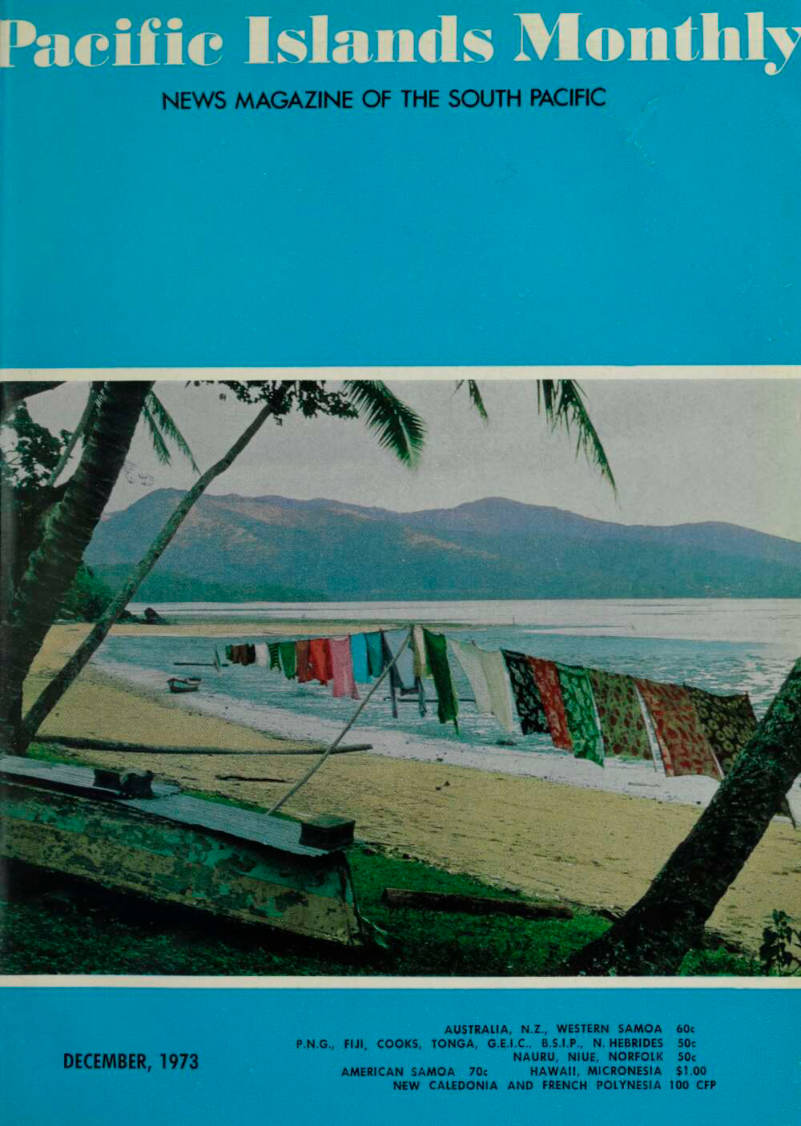
Our Cover
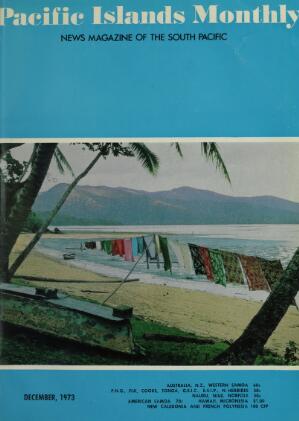
You wouldn’t think that anything so prosaic as a line of washing could make a PIM cover. This one did because it was a colourful line and where the washing was drying was also impor tant —on a beach on Daku Bay on Fiji’s lovely Kadavu Island. The picture is by Dr Radomir Jour a, of Parra matta, NSW.
Advertisements & other items, p. 2 (1 item)
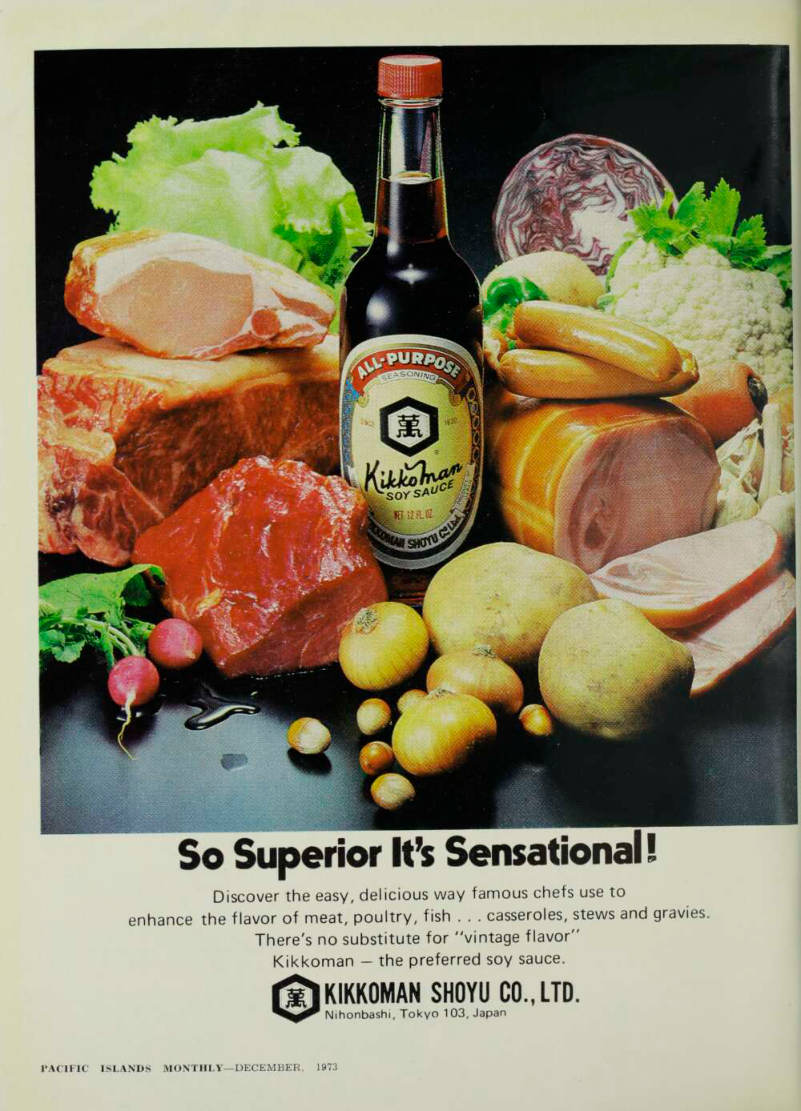
So Superior H’s Sensational!
■ m A \ >T 4 it c«
SOY
Discover the easy, delicious way famous chefs use to enhance the flavor of meat, poultry, fish . . . casseroles, stews and gravies.
There's no substitute for "vintage flavor"
Kikkoman - the preferred soy sauce.
mlkikkoman shoyu CO., ltd.
Nihonbashi, Tokyo 103, Japan
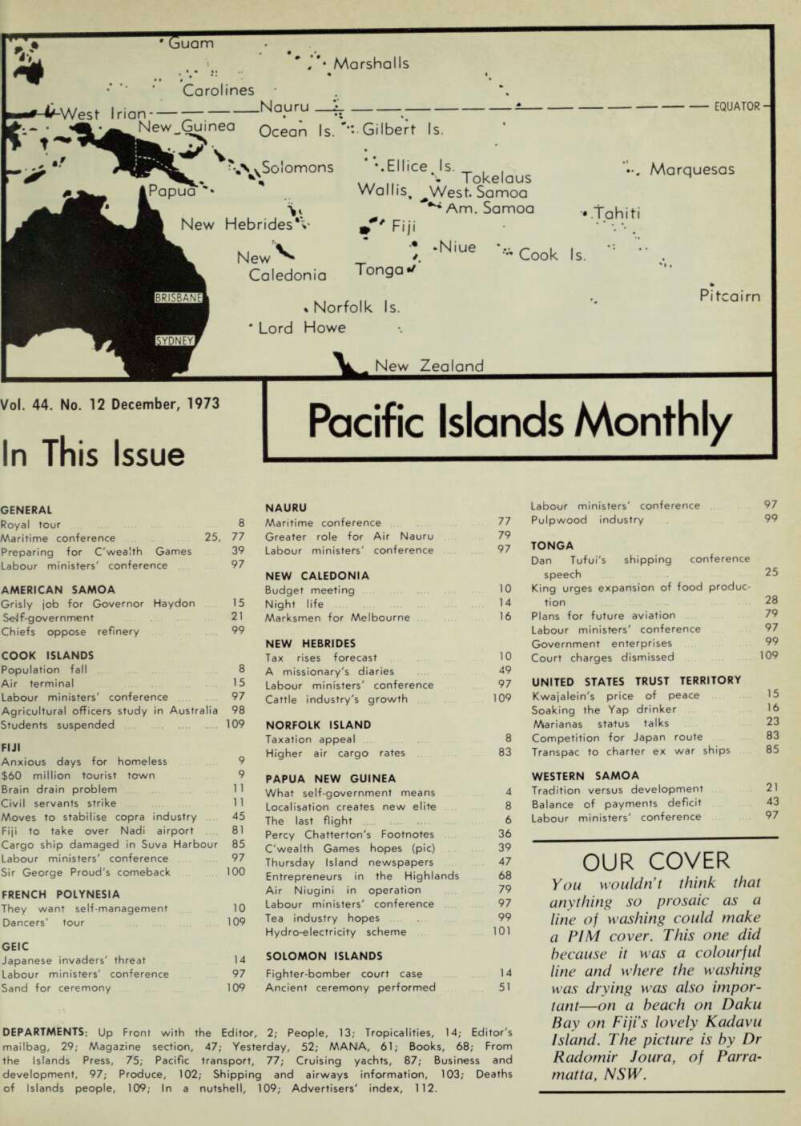
In This Issue
General
Royal tour 8 Maritime conference 25, 77 Preparing for C'wealth Games 39 Labour ministers' conference 97
American Samoa
Grisly job for Governor Haydon 15 Sedf-gov eminent ... 21 Chiefs oppose refinery 99
Cook Islands
Population fall 8 Air terminal 15 Labour ministers' conference 97 Agricultural officers study in Australia 98 Students suspended 109
Fiji
Anxious days for homeless 9 $6O million tourist town 9 Brain drain problem 11 Civil servants strike 11 Moves to stabilise copra industry 45 Fiji to take over Nadi airport ... 81 Cargo ship damaged in Suva Harbour 85 Labour ministers' conference 97 Sir George Proud's comeback 100
French Polynesia
They want self-management 10 Dancers' tour 109
Geic
Japanese invaders' threat 14 Labour ministers' conference 97 Sand for ceremony 109
Nauru
Maritime conference 77 Greater role for Air Nauru 79 Labour ministers' conference 97
New Caledonia
Budget meeting 10 Night life 14 Marksmen for Melbourne 16
New Hebrides
Tax rises forecast 10 A missionary's diaries 49 Labour ministers' conference 97 Cattle industry's growth 109
Norfolk Island
Taxation appeal 8 Higher air cargo rates 83
Papua New Guinea
What self-government means 4 Localisation creates new elite 8 The last flight 6 Percy Chatterton's Footnotes 36 C'wealth Games hopes (pic) 39 Thursday Island newspapers 47 Entrepreneurs in the Highlands 68 Air Niugini in operation 79 Labour ministers' conference 97 Tea industry hopes 99 Hydro-electricity scheme 101
Solomon Islands
Fighter-bomber court case 14 Ancient ceremony performed 51
Labour ministers' conference 97 Pulpwood industry 99
Tonga
Dan Tufui's shipping conference
speech 25
King urges expansion of food produc tion 28 Plans for future aviation 79 Labour ministers' conference 97 Government enterprises 99 Court charges dismissed 109
United States Trust Territory
Kwajalein's price of peace Soaking the Yap drinker 16 Marianas status talks 23 Competition for Japan route 83 Transpac to charter ex war ships 85
Western Samoa
Tradition versus development 21 Balance of payments deficit 43 Labour ministers' conference 97
DEPARTMENTS: Up Front with the Editor, 2; People, 13; Tropicalities, 14; Editor's mailbag, 29; Magazine section, 47; Yesterday, 52; MANA, 61; Books, 68; From the Islands Press, 75; Pacific transport, 77; Cruising yachts, 87; Business and development, 97; Produce, 102; Shipping and airways information, 103; Deaths of Islands people, 109; In a nutshell, 109; Advertisers' index, 112.
Pacific Islands
Monthly
FOUNDED BY R. W. ROBSON IN 1930
Published Monthly By
Pacific Publications (Aust.) Pty. Ltd.,
29 Alberta St., Sydney, N.S.W., 2000.
Postal Address: G.P.O. BOX 3408, SYDNEY,
N.S.W., 2001.
Telegraphic Address; PACPUB, Sydney.
Telex 25168.
Telephones: 61-9197, 61-7101, 61-4369.
Consulting Directors: R. W. Robson, Judy Tudor, Chief Executives: Manager: Selwyn Hughes.
Publisher: Stuart Inder.
Director of Advertising; W. A. Gasnier.
Pacific Islands Monthly
Editor: Stuart Inder.
Assistant Editor: John Carter.
Advertising Manager: W. A. Gasnier.
Circulation Manager: Barry Badger.
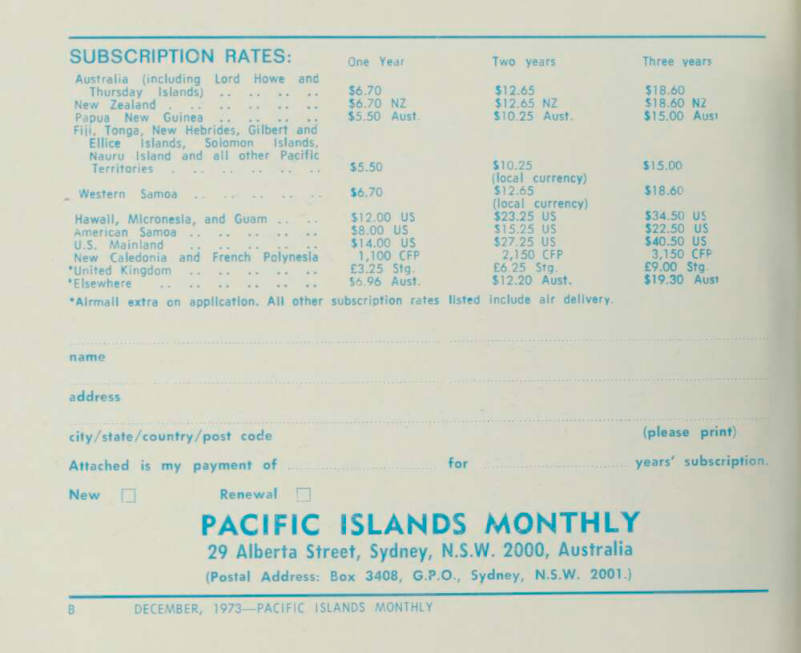
Subscription Rates:
"Pacific Islands Monthly" is airfreighted to all subscribers and agents in the Pacific Islands and the U.S.A.; copies to Nauru and other areas go by surface mail.
Australia (incl. Lord Howe and Thursday Is.): 56.70 Aust., Papua New Guinea: $5.50 Aust.; Fiji, Tonga, New Hebrides, Gilbert & Ellice Islands, Solomon Islands, Nauru Island and all other Pacific territories: $5.50 (local currency); Western Samoa: $6.70 (local currency); New Zealand: $6.70 NZ; Hawaii, Micronesia and Guam: $12.00 US; US Mainland: $14.00 US; New Caledonia and French Polynesia: 1,100 CFP; United Kingdom: £3.25; Elsewhere: $6.96.
Representatives
Fiji: A. F. Woods, Imex (Pacific) Limited, Suite 2A, Victoria Arcade, Suva, Fiji. P.O. Box 3117, Lami, SUVA. Telephone: 22-502. Telex: 2124.
Papua New Guinea: LAE, P.O. Box 227, RABAUL, Mr. Steve Simpson, P.O. Box 433 (c/- Rabaul Photographic. Tel.: 2677.) French Polynesia: Distribution —Hachette Paci fique, 10 Ave Bruat, Papeete.
New Zealand; Pacific Publications, C.P.O. Box 2229, Auckland. 379-494. Representative: John Spedding, Civic House, 291 Queen St., Auckland, Tel.: 379-494.
United Kingdom; Overseas Publicity Ltd., 214 Oxford Street, London, WIN OEA. Phone: 01-636 8296/7.
Overseas Newspapers (Agencies) Ltd., Cromwell House, Fulwood Place, London, W.C.I. Tel.: 01-242-0661. Cables: WESNEWS, London, DS4.
Japan; Advertising—Universal Media Corpora tion, C.P.O. Box 46, Tokyo. Tel.: 666-3036.
Victoria: Advertising Pacific Publications (Aust.) Pty. Ltd., 33 Lonsdale Street, Melbourne, Vic. 3006. Telephone: 662-3263.
Queensland; Advertising—Beale Media Services, 232 St. Paul's Terrace, Fortitude Valley, Qld., 4006. Tel.: 52-5827.
Hawaii and U.S. Mainland only: N. Grogan, 3354 Hayden Street, Honolulu, 96815. (Send change of address notices. Form 3579 and new subscriptions to P.O. Box 2193, Honolulu, Hawaii, U.S.A. 96805).
Second class postage paid at Honolulu, Hawaii.
Copyright ©, 1973,
Pacific Publications (Aust.) Pty. Ltd.
December, 1973 Vol. 44, No. 12
Up Front
with the Editor
INDONESIAN Foreign Minister, Dr Adam Malik, is pushing for the establishment of a South Pacific sub regional organisation which would in clude Australia, NZ, Indonesia and
Png.
He discussed the plan on his November visit to Australia, NZ and PNG, but it has not got to the stage of detailed development. If all the governments are agreed on one thing it is that more details are required.
Mr Malik’s idea embraces the poss ibility also of including other inde pendent South Pacific countries, and in this respect it could cut across the South Pacific Forum (comprising Fiji, Western Samoa, Tonga, Cook Islands, Nauru, Australia, NZ and soon PNG). Indonesia regards itself as both an Asian and a Pacific country and a bridgehead between Asia and the South Pacific. 1 think it probably is, and although that view might immediately be acceptable to PNG, I think it is too early for it to find acceptance among the Island members of the Forum, who are still attempting to work out a permanent satisfactory relationship with Aust ralia and NZ.
The possibility of having to listen to Messrs Suharto and Whitlam ex panding on the state of the Pacific would be just too much for some of the Forum leaders, who don’t have quite the same regard for Mr Whit lam as a statesman as he has for him self. To be blunt, his sincerity is in question with them. They wonder if he really has the Islanders' interest at heart, or is paying lip service.
Personally I think Mr Whitlam is a refreshing Australian Prime Minister but his personal relations with Island leaders are certainly not what they might be.
THE Republic of Nauru goes to the polls in mid-December for its second general election since inde pendence in 1968. Under the consti
tution the position of president comes up for grabs. President Deßoburt is the architect of Nauruan indepen dence, and still head and shoulders above any rivals for leadership. He feels he’s only now getting to grips with the problems that have faced the young republic, and there’s not the remotest chance of him not being re appointed. But from what I hear, the same may not be said about some of the “old guard” in the Nauruan cabinet, who will face opposition both at the ballot box and for cabinet re-selection. Younger Nauruans feel it’s time for change, and this time they might be influential. \|/’EST SAMOAN poet and author n Albert Wendt told a Sydney Opera House audience that the $lOO million spent on erecting that vast new building could have provided Western Samoa with its entire income for the next 10 years.
And Papuan poet John Kasaipwa lova, from the Trobriands, told the same audience that most Australians who went to Papua New Guinea to work were a pain in the neck, who gave nothing in return for what they took from the country. Each then pro ceeded to give a reading of his poetry to a stimulated hall.
Meanwhile, out in Sydney sub urbia, Fijian actors Manoa Rasigatale and Stanley Nagatalevu, two of the leads in the Fiji play “Pritchard”, were getting fascinated Australian playgoers to realise that Fijians might actually have a long history of in telligence, humanity and insight.
The 300 Islanders who brought the South Pacific to Australia in Octo ber-Nevember to mark the official opening of the Sydney Opera House left an impact that was considerably more impressive than you’d get from a mere song and dance act. There was plenty of song and dance, of course. But all of it was more vital than the “Hawaiian love song” stuff
that passes for Island music outside of the Islands.
Sydney saw and heard chants and legends, epic myths, colourful mekes, drum dances, bamboo bands. The spectacular 12 ft high feathered head dresses of Papua’s Mekeo dancers brought gasps at the crowded main Opera House concert that I attended.
Sydney’s streets were filled with joy and clash of rhythms; bank managers, to their surprise, got caught up in the dancing in Hyde Park.
The Family of Man Service—the open air ecumenical gathering at the end of the main festivities—was an extraordinary Sunday afternoon which gave us such variety as the Royal Fiji Police Band, Sione Aleki and his Tongan trio in a Tongan hymn, Fijian Manoa Rasigatale with Victor Rounds accompanying, singing Kalou Vu, a beautiful song he composed for the occasion, farewelling the old Fiji gods, and traditional singing by the Cook Islands National Arts Theatre.
Gifts from all over the Islands were presented to the Opera House in a spectacular symbolic offering—Maori carvings, fine hats, mats and baskets from the Cooks, a New Guinea dance mask from the Sepik, a full dance costume from the Banabans (with a miniature map of their old home.
Ocean Islands, carved from phosphate rock), a magnificent carved drum from the Solomons, a kava bowl and fly whisk from Western Samoa, a lali and masi from Fiji, more tapa from Tonga.
That husband and wife team of impressarios with souls, Victor Carell and Beth Dean, must be pleased with themselves over the success of it all.
Stuart Inder
Advertisements & other items, p. 5 (2 items)
3
ACIFIC ISLANDS MONTHLY—DECEMBER, 1973
skin beauty
m
The promise
of radiant
skin beauty
A smooth and radiant complexion has long been the dream of all women throughout the ages Now through the discovery of a tropically moist oil blend, every woman can be assisted in attaining the complexion she seeks simply by the daily use of a unique fluid and following a basic skin care routine.
Because of our harsh climatic conditions, most women are constantly faced with the problem of dry skin which if not checked can lead to the formation of tiny lines and eventually wrinkle dryness.
Flaky patches, the symptom of dryness, are primarily caused by hot sun and wind robbing the skin of its precious supply of oil and moisture.
Now it is possible to help replenish these natural fluids and give your skin the assistance it needs to always be at its radiant best. Today, you need not worry about the drying effects of these elements thanks to the development of a unique moist oil blend.
For a soft, flawless complexion This remarkable beauty fluid provides the skin with the same even balance of oil and moisture that nature normally lavishes on the soft, flawless complexion of the very young.
Known in Britain and Europe as Oil of Ulay and in America as Oil of Olay this beautifying fluid is available from pharmacies here as Oil of Ulan.
By smoothing Oil of Ulan over your face and neck each morning and evening you will protect your skin against loss of moisture and help preserve a soft supple complexion free from dryness.
It protects and nurtures your skin all day and is particularly helpful if you plan to enjoy life outdoors. Remember that direct sun rays dry out your skin at an accelerated rate and a couple of minutes spent smoothing in your Oil of Ulan moist oil blend will help promote a healthy skin texture and retain your youthful radiant complexion.
FIJI
JOHMI
REPRINT NOW AVAILABLE!
A delightful story for children in colour and black-and-white.
Priced at $2.50 Aust., plus 25c posted; $3.20 U.S. posted.
Pacific Publications (Aust.) Pty. Ltd., G.P.O. Box 3408, Sydney,
N.S.W. 2001.
Pacific Islands Monthly
Png's Rapid Hand-Over, And So
Much More To Think About!
From a Port Moresby correspondent
December 1, in Papua New Guinea, should be almost the same as any other Saturday providing the wishes of the Chief Minister Mr Michael Som are. are followed.
However, hotel bars will be closed for three days but any other celebra tions, Mr Somare believes, should be deferred until the more appropriate time of independence.
He did suggest that schools and “other institutions” could mark the occasion with special ceremonies and that church leaders could arrange special services for December 2. They will, and they have, and the very fact that the Chief Minister is attem pting to play it cool will guarantee that the advent of self-government will be remembered for a long time to come.
In theory PNG has been preparing for self-government since the elec tions in 1964, the year of the first House of Assembly, so the transition should, in theory, be smooth. But there have been a few final hectic weeks, and such a change of direction can hardly pass unnoticed.
Both the Commonwealth Parlia ment and the PNG House of Assem bly have passed a wide variety of acts and ordinances covering the transfer of powers. The Commonwealth Senate has been hostile to some legislation, not relating to PNG, and the effect of this means the pile up of a great backlog of work for Federal Parliament to get through.
But most important changes came before December 1. o On November 1, Air Niugini made its appearance as PNG’s own domestic airline, using aircraft bought from TAA, or chartered from Ansett. (see p 79). • On that date also the Australian Banking Act, 1959-73, and the reserve
Bank Act, 1959-73, ceased to extend to PNG, thus enabling PNG to pass its own banking laws. Mr Somare and the Governor of the Reserve Bank, Sir John Phillips, officially launched the Bank of Papua New Guinea on November 1.
Mr Henry Toßobert has been ap pointed Governor, with Mr P. S. Fer guson, now on secondment from the Reserve Bank for two years, as dep uty governor.
Mr Toßobert is from Bitagalip village. Gazelle Peninsula, and joined the Reserve Bank in 1965. He holds a B.Ec, from the University of Syd ney and became manager of the bank’s Port Moresby office in 1972. • On December 1, the Adminis trator, Mr L. W. Johnson, will cease to hold the office of Administrator and is appointed High Commissioner, assuming most of the powers held by the Minister for External Territories and some of the powers of the Gover nor-General.
During the period of self-govern ment the High Commissioner will act as the embryo Head of State for PNG, and as the Australian represen tative, functions which cover the appointment and transfers of minis sters on the advice of the Executive Council, and the acceptance of resig nations and filling of vacancies in the House of Assembly. Mr Johnson was Director of Education in PNG from 1962-1966, then was appointed Assistant Administrator, and finally in 1970 Administrator in succession to Mr David Hay. He has been a dedicated, warmly regarded Adminis trator, keeping in the background publicly.
It’s not likely that Mr Johnson’s appointment as High Commissioner will last for many months into 1974, as he has been selected to direct a new Australian Government agency for foreign aid (including aid for Papua New Guinea) with the De partment of Foreign Affairs in Can-
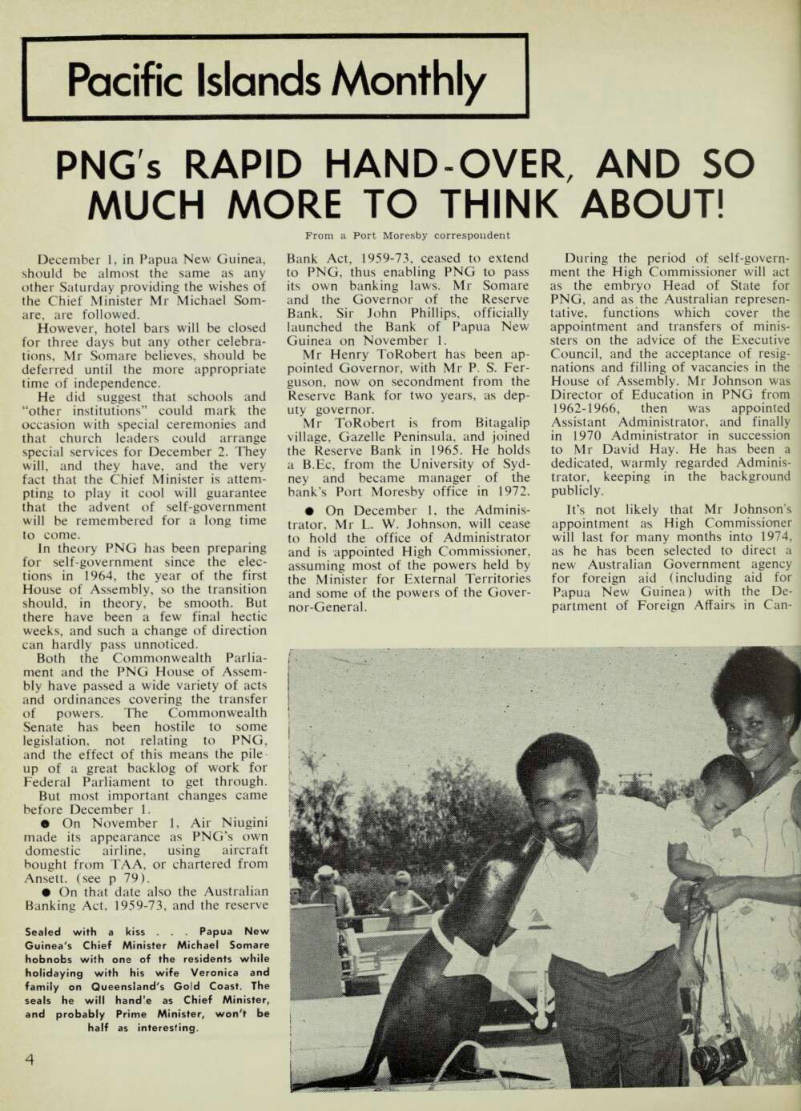
Sealed with a kiss... Papua New Guinea's Chief Minister Michael Somare hobnobs with one of the residents while holidaying with his wife Veronica and family on Queensland's Gold Coast. The seals he will handle as Chief Minister, and probably Prime Minister, won't be half as interesting.
jrra, a job he will fill with as much )mpetence. • The Administrator’s Executive ouncil has been renamed the Ex :utive Council, which will advise ic High Commissioner on matters dating to the administration of Dvernment. The High Commissioner ill accept the advice of the Executive ouncil in all areas not reserved to ustralia.
Official members have been re loved from the Executive Council nd from the House of Assembly, and le Chief Minister, as a member of le Executive Council, will be known y that title rather than as Deputy hairman of the Council. He will so have more flexibility in the choice f his ministry and, automatically, in ic composition of the Executive ouncil.
The old Administrator’s Execu ve Council consisted of the Admin trator, three official members and iree unofficial members, of whom vo were elected. • The Department of External ffairs will cease to exist, from De jmber 1, its functions being trans ited to the PNG Government, and le department becoming a division F the Australian Foreign Affairs De artment. Many officers of this di sion will continue to deal with apua New Guinea because of their >ecialised knowledge of the country. • The Sydney office of the PNG lovemment will operate as it did hen it was part of the External erritories Department, one of its lain functions being to secure sup ies and to process entry permits >r the PNG Government. It will ;come localised, and its functions ill include consular, tourism, busi es and trading matters. The Sydney Tice, will move into new premises ►metime in 1974, • The PNG National Broadcasting ommission also came into existence )mbining the functions of the ABC, hich has operated in PNG since ie end of World War 11, and the 17 nail stations run by the Adminis ation. The new commission is ex acted to work within the framework tablished by the ABC, and the staff ill remain in PNG on secondment i the NBC to help the management, ogramming and technical matters.
Mr Malcolm Naylor, the ABC re esentative in PNG, will join the )ard of PNG NBC, which is under e chairmanship of Mr Sam Piniau om Rabaul. • Bougainville will immediately ;t a constituent assembly to pave e way to district government, and her districts will get district govern ent in February.
An Area Authority—the present
system of conferences of local gov ernment councils in a district—will probably be recognised as a con stituent assembly. • The portfolio of Minister for External Territories in the Australian Government will be abolished on De cember 1, but the minister, Mr W. L, Morrison, will continue his associa tion as minister assisting the Minister for Foreign Affairs, Senator Willesee, on Papua New Guinea matters. • Immediately following self government, Papua New Guinea will actively plan for the appointment of diplomatic representation in Australia and abroad. At independence, PNG will have a High Commissioner in Canberra and possibly London (it may be decided in preference to ap point an ambassador to Brussels), and ambassadors to Jakarta and Tokyo, and a mission to the United Nations in New York. It is also likely there will be a representative in Suva, but not of high commissioner rank. Sydney will also get a consul general. Tipped for the Australian High Commissioner’s post is Mr Oala Oala-Rarua, who not long ago narrowly missed appointment as secretary-general of the South Pacific Commission. Oala will probably in the meantime represent Papua New Guinea in Sydney on a lesser status. • Mr Somare, and Indonesia’s Foreign Minister, Mr Adam Malik, signed an agreement on the border between Papua New Guinea and Irian Jay a in Port Moresby on November 13. PNG Minister for De fence and Foreign Relations, Mr Albert Maori Kiki, added his signa ture. Mr Malik, who arrived for a three-day visit on November 11, said he was convinced the two countries would move closer together.
Mr Somare said, in a public speech, that Indonesia and Papua New Guinea had a common colonial ex perience and it was most likely that PNG after independence could profit more from Indonesian experience than from Australia.
Routine Flight
With A Difference
Nostalgia was in the air as VH FNA Flight 613 took off from Kieta for Port Moresby on October 28 with Captain John W. Kessey, DFC, at the controls supported by his Ist Officer Aria Bou and hostess Joyce Wichham.
It was the last of the ANA flight numbers in Papua New Guinea.
Shortly afterwards, at midday, all flight members came under Air Niugini control.
John Kessey first took to the air when he joined the RAAF January, 1939, became commanding officer of 14th Squadron Beaufort bombers and won his DFC as CO of 100th Squadron.
He intends to stay with Air Niugini for from three to five years.
Aria Bou is one of Papua New Guinea’s three indigenous pilots all trained by the South Pacific Aero club. The others are Minsin Penei and Barry Awui. They are all on Air Niugini’s staff. Barry Awui, who has the distinction of holding an instructor’s rating, once had to make a forced landing on a salt pan in Bootless Bay. He accomplished it un der very difficult circumstances with out damage to the plane.
Anti Family Planning. —The
Kieta Local Government Council does not want family planning in his dis trict because of large areas of vacant land. The council was not happy either with a Welfare Office broad cast on family planning over Radio Bougainville, and will make written submissions to the authorities about it. • One striking effect of the large number of departures from Papua New Guinea is shown in the savings banks figures. In August, for the first time in 70 years, there v/as a fall in total deposits. In that month the de posits were $39.7 million, compared with $43.3 million in August, 1972.
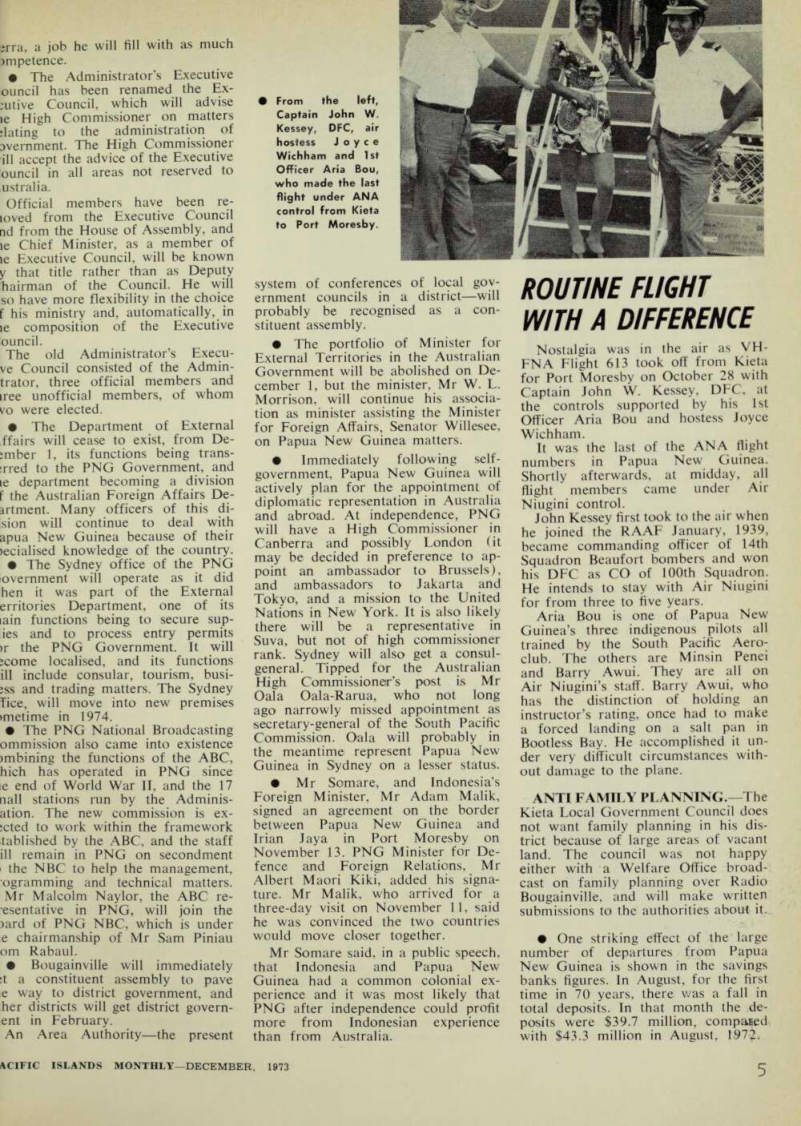
From the left, Captain John W.
Kessey, DFC, air hostess Joyce Wichham and 1st Officer Aria Bou, who made the last flight under ANA control from Kieta to Port Moresby.
New Jobs For Old
Changes in senior positions in the public service continue to be an nounced with great speed. Latest in clude the appointment of Mr Mekere Morauta, as Secretary of the Depart ment of Finance, in succession to Mr H. P. Ritchie, who will become an economic adviser with special respon sibilities.
Mr Morauta, Bachelor of Econo mics, University of PNG, was with the Labour Department and the former Office of Programming and Co-ordination before joining the Finance Department last February as deputy secretary.
Mr Elliot Elijah, who has had long experience in PNG with all forms of business enterprise, has been appointed acting Chief of Division, Business Extension, in the Business Development Department.
The important Eastern Highlands district of New Guinea has a new Acting District Commissioner, Mr Bernard Borok, 30, of Manus, who has taken over from the highly ex perienced Mr J. P. Sinclair, who has been transferred to Port Moresby on a special project—research for a his tory of PNG district administration.
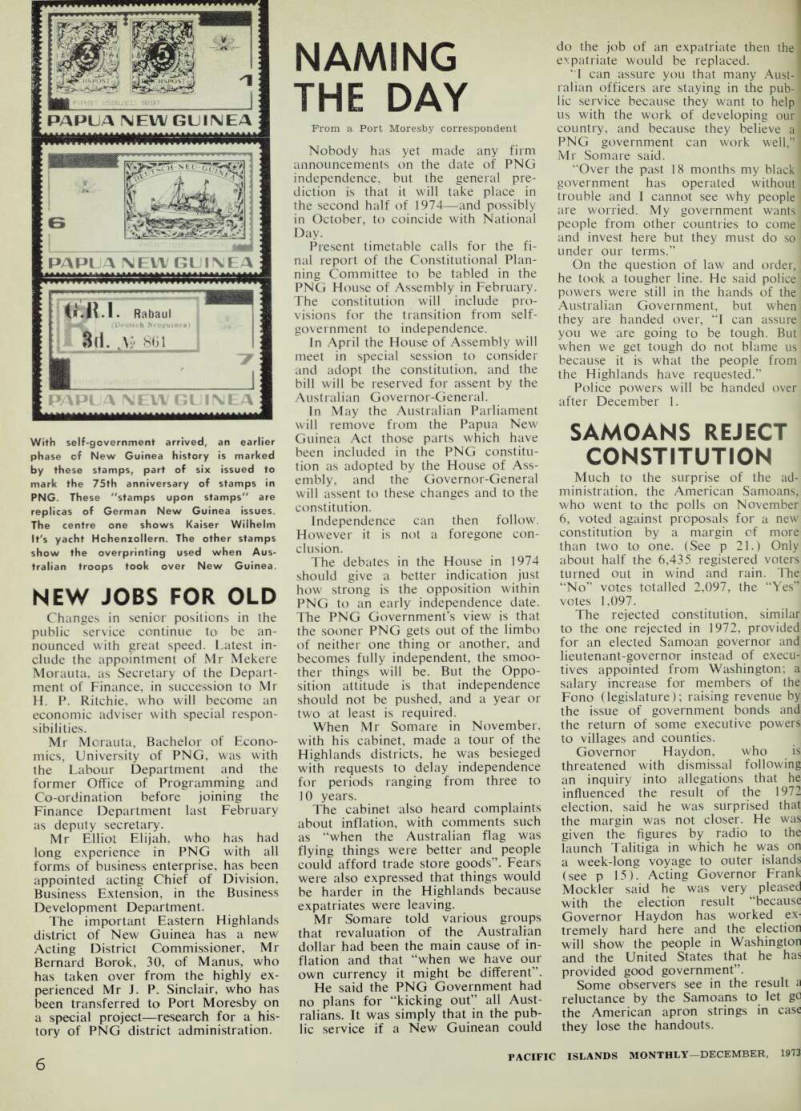
With self-government arrived, an earlier phase of New Guinea history is marked by these stamps, part of six issued to mark the 75th anniversary of stamps in PNG. These "stamps upon stamps" are replicas of German New Guinea issues.
The centre one shows Kaiser Wilhelm It's yacht Hohenzollern. The other stamps show the overprinting used when Aus tralian troops took over New Guinea.
Advertisements & other items, p. 7 (1 item)
5
ACIFIC ISLANDS MONTHLY—DECEMBER, 1973
Naming
The Day
From a Port Moresby correspondent
Nobody has yet made any firm announcements on the date of PNG independence, but the general pre diction is that it will take place in the second half of 1974 —and possibly in October, to coincide with National Day.
Present timetable calls for the fi nal report of the Constitutional Plan ning Committee to be tabled in the PNG House of Assembly in February.
The constitution will include pro visions for the transition from self government to independence.
In April the House of Assembly will meet in special session to consider and adopt the constitution, and the bill will be reserved for assent by the Australian Governor-General.
In May the Australian Parliament will remove from the Papua New Guinea Act those parts which have been included in the PNG constitu tion as adopted by the House of Ass embly, and the Governor-General will assent to these changes and to the constitution.
Independence can then follow.
However it is not a foregone con clusion.
The debates in the House in 1974 should give a better indication just how strong is the opposition within PNG to an early independence date.
The PNG Government’s view is that the sooner PNG gets out of the limbo of neither one thing or another, and becomes fully independent, the smoo ther things will be. But the Oppo sition attitude is that independence should not be pushed, and a year or two at least is required.
When Mr Somare in November, with his cabinet, made a tour of the Highlands districts, he was besieged with requests to delay independence for periods ranging from three to 10 years.
The cabinet also heard complaints about inflation, with comments such as “when the Australian flag was
flying things were better and people
could afford trade store goods”. Fears were also expressed that things would be harder in the Highlands because expatriates were leaving.
Mr Somare told various groups that revaluation of the Australian dollar had been the main cause of in flation and that “when we have our own currency it might be different”.
He said the PNG Government had no plans for “kicking out” all Aust ralians. It was simply that in the pub lic service if a New Guinean could
do the job of an expatriate then the I expatriate would be replaced.
“I can assure you that many Aust-J ralian officers are staying in the pub lic service because they want to help us with the work of developing our country, and because they believe a J PNG government can work well,” I Mr Somare said.
“Over the past 18 months my black government has operated without trouble and I cannot see why people are worried. My government wants] people from other countries to come and invest here but they must do sol under our terms.”
On the question of law and order, he took a tougher line. He said police powers were still in the hands of the Australian Government, but when they are handed over, “I can assure you we are going to be tough. But when we get tough do not blame us because it is what the people from the Highlands have requested.”
Police powers will be handed over after December 1.
Samoans Reject
Constitution
Much to the surprise of the ad ministration, the American Samoans, who went to the polls on November 6, voted against proposals for a new constitution by a margin of more than two to one. (See p 21.) Only about half the 6,435 registered voters turned out in wind and rain. The “No” votes totalled 2,097, the “Yes” votes 1,097.
The rejected constitution, similar to the one rejected in 1972, provided for an elected Samoan governor and lieutenant-governor instead of execu tives appointed from Washington; a salary increase for members of the Fono (legislature); raising revenue by the issue of government bonds and the return of some executive powers to villages and counties.
Governor Haydon, who is threatened with dismissal following an inquiry into allegations that he influenced the result of the 1972 election, said he was surprised that the margin was not closer. He was given the figures by radio to the launch Talitiga in which he was on a week-long voyage to outer islands (see p 15). Acting Governor Frank Mockler said he was very pleased with the election result “because Governor Haydon has worked ex tremely hard here and the election will show the people in Washington and the United States that he has
provided good government”.
Some observers see in the result a reluctance by the Samoans to let go the American apron strings in case they lose the handouts.
Localisation
Creates New
Elite - And
A Headache
7 rom AAP correspondent PETER BROWN in Port Moresby For young, educated New Guineans he government’s policy of local sation has led to meteoric promotions md the creation of a new black elite.
Senior expatriate public servants yho have administered the Australian erritory are rapidly being replaced •y local officers while the govern nent has introduced strict employ dent regulations into the private sec or. About 200 occupations from bar nan to boilermaker are restricted to 4ew Guineans only.
In two years the country’s white •opulation has fallen by about 20 per ent from 55,400 to 44,600. And his rate is expected to accelerate be ween now and the end of 1976 when he government’s localisation pro gramme should have reduced the lumber of expatriate public servants rom 7,500 to 3,000.
The New Guineans filling the va ancies are becoming the privileged lass in a previously classless society.
Vith salaries ranging up to about '8,500 a year they are becoming im neasurably more affluent than the ast majority of the country’s ,500,000 people.
The entire indigenous workforce is stimated at just over 200,000 so aost New Guineans do not take part n the cash economy at all.
The new elite are the university rained ministerial advisers, depart nent heads, district commissioners nd senior public service officers.
The new chairman of the Public ervice Board, Mr Sere Pitoi, said hat seven of the 18 government de triment heads have been localised nd the remainder will be replaced •y New Guineans by 1976.
The bulk of lower levels of public ervants are now New Guineans.
The demand for skilled manpower 5 so great that new graduates are doving straight into senior positions nd fears are now being expressed hat the entire process is getting out •f hand.
Dr Reuben Taureka, the Minister or Health, recently sparked a public lebate about localisation when he yarned that his department and the
medical service in general was suffer ing because of it.
He told a district health officers’ conference that his department was meeting the government’s requirement of 15 per cent localisation this year.
“But I am not sure this is alto gether something to be proud of,”
Dr Taureka said. “The fact is that there are not just the numbers of qualified New Guineans to meet the requirements of the public service and the private sector.”
The next day, the Minister for Trade and Industry, Mr John Baptist Poe, said he agreed “most strongly” with Dr Taureka.
“To attempt to replace experienced officers with the untrained ones just to achieve a nominal 15 per cent localisation in the present year will cause chaos and disruption,” Mr Poe said.
During a recent tour of the country, several senior local officers told him they were worried because they them selves were being promoted far more quickly than they thought they could handle.
Mr Poe said that if his department had to continue its present rate of localisation the government would lose revenue from customs and excise duty.
“My department is training as many trainees as its funds allow, and in fact has difficulty in finding suffi cient recruits to fill all the positions available,” he pointed out.
He said that without the expatriates in the department his staff would not have the experience or know-how to collect all the revenue due.
At the same time, the Leader of the Opposition United Party, Mr Tei Abal, said that only a slowdown in the localisation programme could save the public service from collapse.
“The United Party has long stated that it is unfair to expect local officers to assume responsibilities for which they were being inadequately trained, and with little prospect of gaining any worthwhile experience due to the rapid departure of the expatriates who could have helped them,*’ Mr Abal said.
“As early as October last year the opposition had called for a realistic attitude in the wanton dismissal of expatriate public servants without considering the availability of local resources.’’
He was referring to his unsuccess ful motion in the House of Assembly which stated: “That this House recog nises and fully supports the principle of localisation throughout the public service, but deplores that the accel erated termination of senior overseas officers is leading to a position where local officers are unfairly being forced to accept heavy responsibility while being denied sufficient opportunity to benefit from the long experience of these officers.”
Earlier this year Chief Minister Michael Somare indicated his ack nowledgement of the need for foreign expertise.
He circulated letters to selected expatriates offering continued em ployment till December 1976, which he said was the minimum time their services would be required.
In the letters Mr Somare said the government realised that experienced overseas officers would be needed
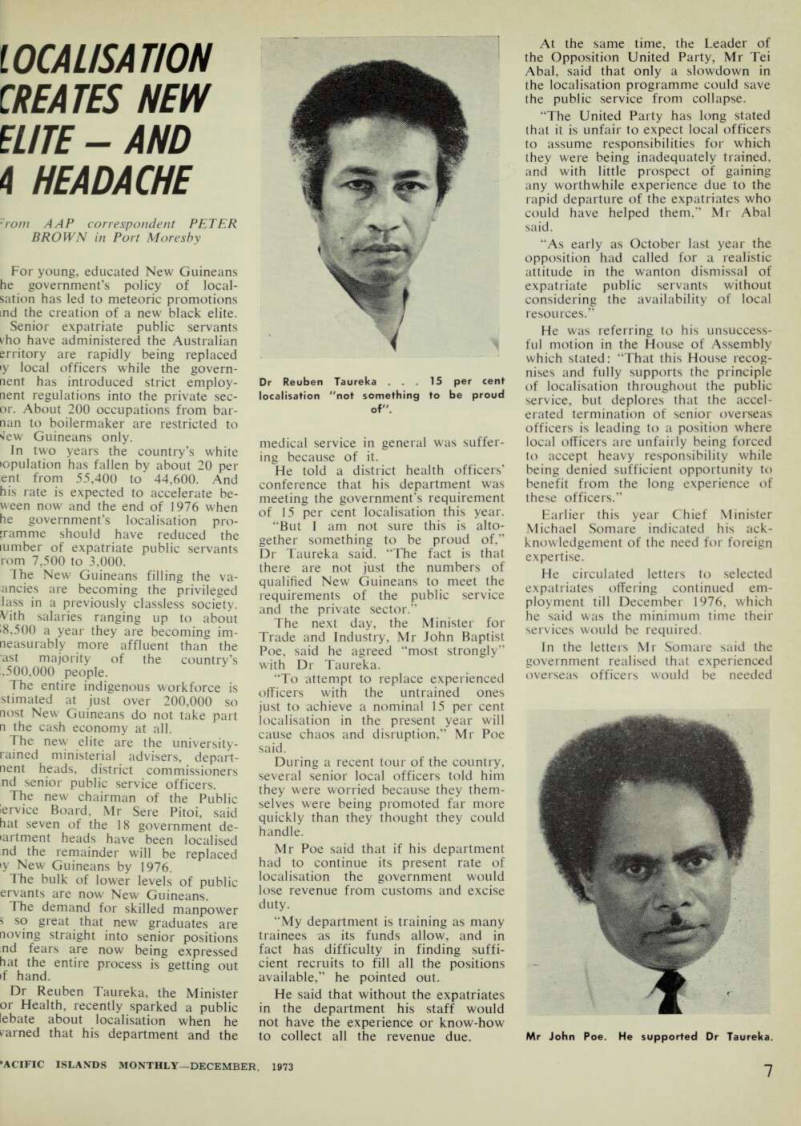
Dr Reuben Taureka ... 15 per cent localisation "not something to be proud of".
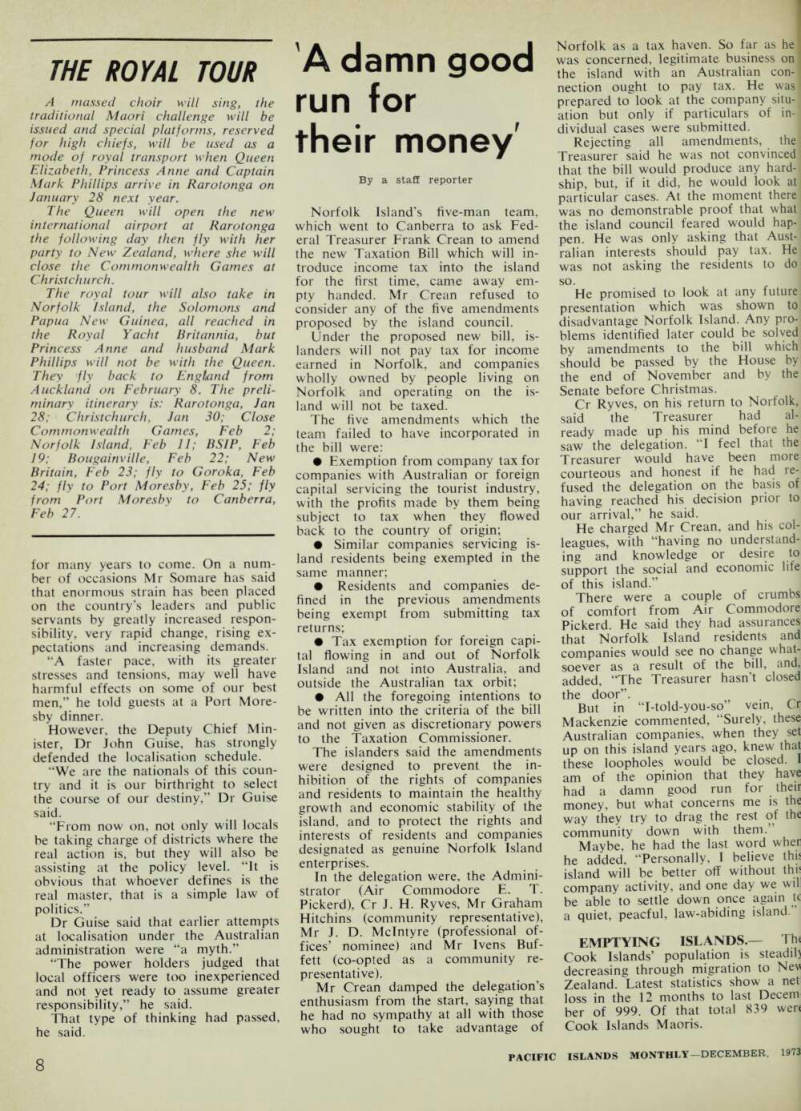
Mr John Poe. He supported Dr Taureka.
for many years to come. On a num ber of occasions Mr Somare has said that enormous strain has been placed on the country’s leaders and public servants by greatly increased respon sibility, very rapid change, rising ex pectations and increasing demands.
“A faster pace, with its greater stresses and tensions, may well have harmful effects on some of our best men,” he told guests at a Port More sby dinner.
However, the Deputy Chief Min ister, Dr John Guise, has strongly defended the localisation schedule.
“We are the nationals of this coun try and it is our birthright to select the course of our destiny,” Dr Guise said.
“From now on, not only will locals be taking charge of districts where the real action is, but they will also be assisting at the policy level. “It is obvious that whoever defines is the real master, that is a simple law of politics.”
Dr Guise said that earlier attempts at localisation under the Australian administration were “a myth.”
“The power holders judged that local officers were too inexperienced and not yet ready to assume greater responsibility,” he said.
That type of thinking had passed, he said.
Advertisements & other items, p. 9 (1 item)
7
ACIFIC ISLANDS MONTHLY—DECEMBER, 1973
The Royal Tour
A massed choir will sing, the traditional Maori challenge will be issued and special platforms, reserved for high chiefs, will be used as a mode of royal transport when Queen Elizabeth, Princess Anne and Captain Mark Phillips arrive in Rarotonga on January 28 next year.
The Queen will open the new international airport at Rarotonga the following day then fly with her party to New Zealand, where she will close the Commonwealth Games at Christchurch.
The royal tour will also take in Norfolk Island, the Solomons and Papua New Guinea, all reached in the Royal Yacht Britannia, but Princess Anne and husband Mark Phillips will not be with the Queen.
They fly back to England from Auckland on February 8. The preli minary itinerary is: Rarotonga, Jan 28; Christchurch, Jan 30; Close Commonwealth Games, Feb 2; Norfolk Island, Feb 11; BSIP, Feb 19; Bougainville, Feb 22; New Britain, Feb 23; fly to Goroka, Feb 24; fly to Port Moresby, Feb 25; fly from Port Moresby to Canberra, Feb 27.
their money'
'A damn good run for their money'
By a staff reporter
Norfolk Island’s five-man team, which went to Canberra to ask Fed eral Treasurer Frank Crean to amend the new Taxation Bill which will in troduce income tax into the island for the first time, came away em pty handed. Mr Crean refused to consider any of the five amendments proposed by the island council.
Under the proposed new bill, is landers will not pay tax for income earned in Norfolk, and companies wholly owned by people living on Norfolk and operating on the is land will not be taxed.
The five amendments which the team failed to have incorporated in the bill were: • Exemption from company tax for companies with Australian or foreign capital servicing the tourist industry, with the profits made by them being subject to tax when they flowed back to the country of origin; • Similar companies servicing is land residents being exempted in the same manner; • Residents and companies de fined in the previous amendments being exempt from submitting tax returns; • Tax exemption for foreign capi tal flowing in and out of Norfolk Island and not into Australia, and outside the Australian tax orbit; • All the foregoing intentions to be written into the criteria of the bill and not given as discretionary powers to the Taxation Commissioner.
The islanders said the amendments were designed to prevent the in hibition of the rights of companies and residents to maintain the healthy growth and economic stability of the island, and to protect the rights and interests of residents and companies designated as genuine Norfolk Island enterprises.
In the delegation were, the Admini strator (Air Commodore E. T.
Pickerd), Cr J. H. Ryves, Mr Graham Hitchins (community representative), Mr J. D. Mclntyre (professional of fices’ nominee) and Mr Ivens Buf fett (co-opted as a community re presentative).
Mr Crean damped the delegation’s enthusiasm from the start, saying that he had no sympathy at all with those who sought to take advantage of
Norfolk as a tax haven. So far as he was concerned, legitimate business on the island with an Australian con-j nection ought to pay tax. He was] prepared to look at the company situ-' ation but only if particulars of in-1 dividual cases were submitted.
Rejecting all amendments, the Treasurer said he was not convinced that the bill would produce any hard ship, but, if it did, he would look at particular cases. At the moment there was no demonstrable proof that what the island council feared would hap pen. He was only asking that Aust ralian interests should pay tax. He was not asking the residents to do so.
He promised to look at any future presentation which was shown to disadvantage Norfolk Island. Any pro-! blems identified later could be solved by amendments to the bill which should be passed by the House by the end of November and by the Senate before Christmas.
Cr Ryves, on his return to Norfolk, said the Treasurer had al ready made up his mind before he saw the delegation. “I feel that the Treasurer would have been more courteous and honest if he had re fused the delegation on the basis of having reached his decision prior to our arrival,” he said.
He charged Mr Crean, and his col leagues, with “having no understand ing and knowledge or desire to support the social and economic life of this island.”
There were a couple of crumbs of comfort from Air Commodore Pickerd. He said they had assurances that Norfolk Island residents and companies would see no change what soever as a result of the bill, and, added, “The Treasurer hasn’t closed the door”.
But in “I-told-you-so’ vein, Cr Mackenzie commented, “Surely, these Australian companies, when they set up on this island years ago, knew that these loopholes would be closed. 1 am of the opinion that they have had a damn good run for their money, but what concerns me is the way they try to drag the rest of the community down with them.
Maybe, he had the last word when he added, “Personally, I believe this island will be better off without this company activity, and one day we will be able to settle down once again tc a quiet, peacful, law-abiding island.”
Emptying Islands.— The
Cook Islands’ population is steadil} decreasing through migration to Nev Zealand. Latest statistics show a neti loss in the 12 months to last Decern ber of 999. Of that total 839 were Cook Islands Maoris.
Fiji's homeless
Anxious days for Fiji's homeless and . . .
... A $60 Million
Tourist Town
From SEONA MARTIN in Suva
This time last year many Fiji eople were assessing and repairing ic damage done to their houses by urricane Bebe.
In some ways, they were the lucky nes. They had houses to repair or sbuild. There are many in Fiji who ave no house at all. The hovels and ;mporary shelters they live in could ot be graced by the term “house”.
Most of them are squatters. They uild makeshift shacks on land hich does not belong to them and xist uneasily until someone orders lem off. Some of them even pay a ttle rent, but have no proper lease n the land.
Their problems are exposed every 3 often when developers move into squatter area and enforce a mass viction.
Many developers, including Fiji’s lousing Authority, which builds low ost housing estates for workers, do leir best to find them alternative ites.
If one is found, the situation is sually not much better for the imily involved. Sometimes they can ot be helped at all.
Suruj Kuar and her family, for sample.
She, her husband and their seven tiildren live in a mean, little grass nd rusting iron shack, so small they an hardly all fit lying down on the oor to sleep.
Sacks and mats form their bedding, hey don’t have any luxuries like roper beds, and very little of the >sentials, like food.
Suruj’s husband, Ramiji (45), is ckly and cannot often work. When e does he earns about $l5 a week ith a construction company. When b doesn’t work, the family exists n about $lO a month government imily assistance payments.
Now, even the security of their lack is threatened by a Housing uthority development. Each day the ulldozers loom closer, bringing sarer the day when the family will s homeless.
They have nowhere else to go, and mnot afford to move into a Housing uthority flat. They could not pos hly keep up the rent payments.
Hart (Housing Assistance and elief Trust) hopes they will be able
to do something about this family’s plight, and the plight of many others in similar situations.
Hart was formed about three years ago to build low-cost houses for destitutes.
The organisation is pledged to help those who simply cannot help them selves. Most of the families living in Hart houses receive less than $2O a month income and cannot afford to pay rent.
Hart is essential to their survival.
The houses Hart provides are in no way luxurious. They are bare shells of concrete block, wood or fibro, with one large, partially partitioned room and a lavatory and shower stuck on the back or front of the structure.
Nothing elaborate, but dry and comfortable. Better than a collapsing hovel of grass, beaten biscuit tins and plastic bags—a secure type of home for hundreds.
Building costs have risen enormously in the past couple of years in Fiji, and houses which used to cost Hart $5OO to build now cost $l,OOO or more.
This month the organisation is appealing for funds to keep its work going.
Contributions can be sent to Hart, PO Box 1106, Suva.
Work on a 200-room hotel at Wail oaloa Beach, near Nadi in Fiji will start in December. This will be the first step in a $6O million project which was recently approved by the Fiji Government under the zoning and town planning laws. The project, covering 120 acres, includes 14 major hotels, two commercial areas (with a 3-acre shopping centre) 35 home lots and a marina with a 170 ft boat wharf.
New Metal Mines Ltd, an Aust ralian company diversifying into tourism, is negotiating for a 90 per cent share of the Sunlover Hotel, at Nadi. The company secretary, Mr Hilton Robinson, said it was only waiting for the hotel’s balance sheet before completing the deal. The price was reported at $1 million.
A $22 million housing and tourist resort will be built at Saweni Beach, near Lautoka. Saweni Beach De velopment Ltd has leased 240 acres of beach frontage land. The project, to be completed over five years, in cludes two international hotels, 400 housing allotments, shopping facili ties and public amenities. A. V. Jen nings Industries (Aust) Ltd, has 40 per cent of the shares; Australian Finance and Investment Co Ltd and Mr Ben Kirk, a Californian develop er 25 per cent each and the Native Land Trust Board 10 per cent.
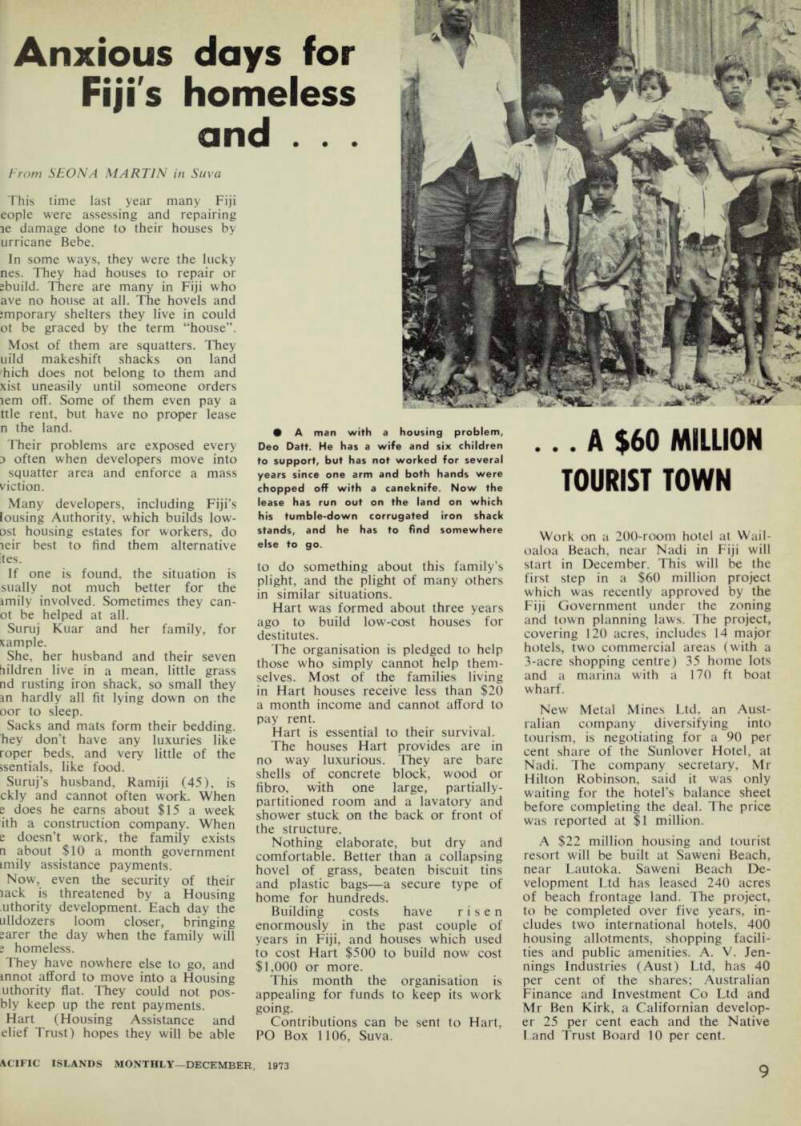
• A man with a housing problem, Deo Datt. He has a wife and six children to support, but has not worked for several years since one arm and both hands were chopped off with a caneknife. Now the lease has run out on the land on which his tumble-down corrugated iron shack stands, and he has to find somewhere else to go.
Caledonians
to play the Paris way
From a Noumea correspondent
Another swing in the precarious balance between Caledonian auton omists and anti-autonomists has brought a new leader to the Terri torial Assembly and assured French Governor Louis Verger of success in gaining acceptance of Paris plans for higher taxes, increased loan com mitments and concessions to French mining companies.
In return, the French Government is to subsidise New Caledonia to the extent of 1,800 million CFP (SAI6 million). This is the compromise being proposed to the Caledonians to over come the budgetary crisis at a time when territorial revenue promised otherwise to bring a SAIO million deficit in 1974.
This underlines the failure of the French Sixth Plan which called for the nickel island to be self-sufficient besides earning more than SUS2OO million in foreign currency for France in 1974.
After continuous opposition from the former autonomist majority in the Assembly, Governor Verger is again in command of the House, since leader of the Melanesian Union Multiraciale, M. Yann Celene Uregei, has been elected to be president of the Assembly with the support of the three anti-autonomist parties.
A self-declared autonomist, Celene. has thus finally succeeded in his at tempts to chair the House, but has brought upon himself the increasing wrath of the autonomists who already had suspicions about his relations with the French Administration.
The presidential vote took place at the opening of the current 1974 budget session, where 13 of the auto nomist members boycotted the ad dress of Governor Verger, to protest against the French Administration’s policy on New Caledonia.
Governor Verger’s speech out lined the budgetary terms which the Assembly is expected to vote upon by the end of 1973. In the 1974 bud get, Governor Verger has proposed that general expenditure should increase 12 per cent over last year to reach 7,800 million CFP (SA67 million). The growing public service will swallow almost all territorial revenue, leaving only 25 million CFP
(IA220,000) for investment expen diture. This must be supplemented by grants and loans from France.
Governor Verger pointed out that in view of the expected decline in territorial revenue from import and export tax, coupled with what he re garded as necessary increases in pub lic service expenses, the only way to stabilise the budget was by obtaining a subsidy from France. Paris is thus prepared to grant the territory 1,800 million CFP. This includes 1,000 million CFP (almost SAIO million) in return for which the territory must exempt the SLN nickel company from an equivalent amount of export tax.
Furthermore, the territory is asked to grant 250 acres of land for the building of the new nickel factory planned for the north of the island by Patino subsidiary, SOMMENI.
In addition, about SA4 million could be raised by extra taxes on alcohol, cigarettes and other items.
As a further measure, the French Governor insists that the territory should raise a further public loan in France, a policy the Assembly has persistently rejected over the past year. The Caledonians have instead urged that the French should save the Caledonian economy by allowing Canadian INCO in to work the island’s nickel.
But the French message to the Caledonians seems to be; let Paris make the decisions, play ball with the motherland, and she will meet any financial needs.
So the Assembly may go ahead playing their “amateur” game, to
amuse the public gallery, while the professional deal will be played be tween financiers and public servants directed from Paris.
With President Celene as new team leader in the Assembly, it seems a new majority has been formed that will play the game by Paris rules.
The New Hebrides National Party' has written to the United Nations asking for a fact-finding mission to study the chances of establishing a single government system in the con dominium with a view to future independence. The party said it was disturbed about the possibility of the present system causing disunity and instability.
Higher import duties on luxury goods and a rise in export taxes are forecast for the New Hebrides next year. These measures, proposed by the Advisory Council’s Standing Committee, are based on findings of the Budget Working Group who examined the 1974 outline budget.
Other recommendations include in creased charges for posts and com munications, water and sanitation, plus an airport tax, which was agreed at the last budget session but never implemented.
Expenditure has already been cut by 60 million FNH and the number of proposed new posts reduced, but 43 million FNH still has to be raised to meet the estimated 1974 expendi ture of 715 million FNH, which is 18 per cent higher than the 1973 figure.
Now It's Self-Management They Want
In a nicely-worded recent ex change of views in Tahiti, the leaders of the French Administration and Territorial Assembly both pointed up the need for greater local self-deter mination.
The word “autonomy” having be come such a frightening expression for the French authorities, the Tahiti Assembly president, anti-autonomist Gaston Flosse, called for greater lo cal “autogestion”, (self management).
Addressing Governor Daniel Vid eau, at the opening of the Assembly’s 1974 budget session late October, Mr Flosse pointed out that his group’s objective is for a statute giving in creased autogestion, and said that proposals to this end would be made in the coming months, without ques tioning the basic principle of adher ence to the French Republic.
Governor Videau, for his part,
promised the territory’s elected men greater participation in the running of local affairs. At the same time he warned against the instability which could result from too hasty a change in the existing political framework.
About the same time in Noumea, a leader of the Anti-Autonomist Front, Jacques Lafleur, repeated ac cusations against the autonomists as being separatists and anti-national, seeking independence from France.
Mr Lafleur nevertheless insisted that his side also wished for a change in the local balance of power, particu larly in making the Governor’s Ad visory Council (Conseil de Gouv ernement) more effective.
Of course, as long as the locals can be entertained fighting over one naughty word, the French authorities watch smiling, and unmoved . . .
Localisation Backlash
The Fiji Government has a brain-drain pro lem. The brains are those of their best men i the civil service and the drain is into the rivate business sector.
If the drain goes on, says Fiji Public Scr ee Commission chairman Mr Joseph Sykes, vil service efficiency will suffer.
Since independence in 1970. Fiji has lost some F its top civil servants to big business, which Ters financial rewards much higher than those : government. About two months ago, Mr harles Walker, Secretary for the Public Ser ce, and rated among the best of the “locals”, ft the government service after 20 years, join g the Carpenter organisation as personnel anager.
Earlier this year Mr Mosese Qionibaravi the ;cretary for Commerce, resigned to join Naviti ivestments Ltd, and Mr Lionel Yee, a com iter expert, is joining the Fiji Times and Her d group in the semor post of manager-Fiji.
To get a highly-qualified “local”, private firms e offering salaries undreamed of before in ;pendence and the reason isn’t far to seek— e government’s own policy of localisation and e work permit system which makes it diffi ilt for the commercial sector. Rather than ffer the ordeal of filling out 90-odd questions an application for a permit for an expatriate, en waiting on tenterhooks for months :fore getting the permit, and then sing him eventually when his permit has ex red, firms are looking around for suitable local ople. Which is the reason behind the permit stem anyhow.
It seems the government is hoist by its own ;tard, and will continue to be so unless it Fers more money.
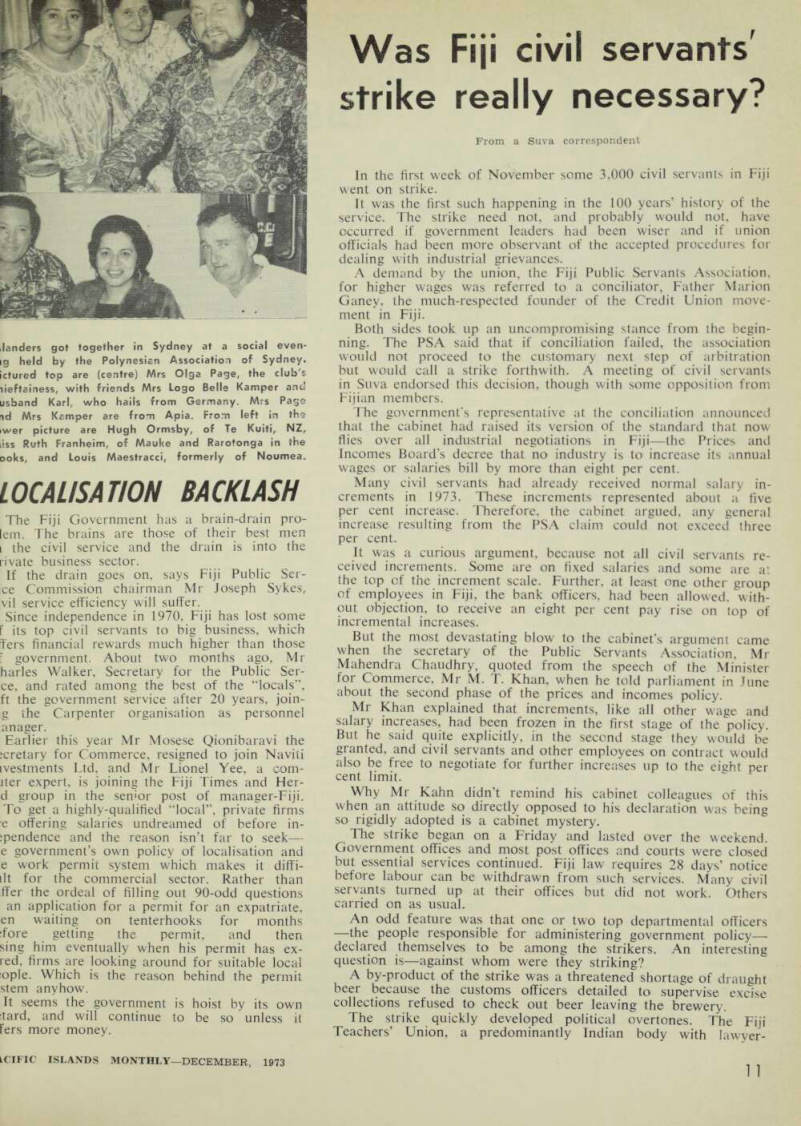
Islanders got together in Sydney at a social even [?] g held by the Polynesian Association of Sydney, pictured top are (centre) Mrs Olga Page, the club's [?]ieftainess, with friends Mrs Logo Belle Kamper and husband Karl, who hails from Germany. Mrs Page and Mrs Kemper are from Apia. From left in the [?]wer picture are Hugh Ormsby, of Te Kuiti, NZ, [?]iss Ruth Franheim, of Mauke and Rarotonga in the [?]ooks, and Louis Maestracci, formerly of Noumea.
strike really necessary?
Was Fiji civil servants' strike really necessary?
From a Suva correspondent
In the first week of November some 3,000 civil servants in Fiji went on strike.
It was the first such happening in the 100 years’ history of the service. The strike need not, and probably would not, have occurred if government leaders had been wiser and if union officials had been more observant of the accepted procedures for dealing with industrial grievances.
A demand by the union, the Fiji Public Servants Association, for higher wages was referred to a conciliator, Father Marion Ganey, the much-respected founder of the Credit Union move ment in Fiji.
Both sides took up an uncompromising stance from the begin ning. The PSA said that if conciliation failed, the association would not proceed to the customary next step of arbitration but would call a strike forthwith. A meeting of civil servants in Suva endorsed this decision, though with some opposition from Fijian members.
The government's representative at the conciliation announced that the cabinet had raised its version of the standard that now flies over all industrial negotiations in Fiji—the Prices and Incomes Board’s decree that no industry is to increase its annual wages or salaries bill by more than eight per cent.
Many civil servants had already received normal salary in crements in 1973. These increments represented about a five per cent increase. Therefore, the cabinet argued, any general increase resulting from the PSA claim could not exceed three per cent.
It was a curious argument, because not all civil servants re ceived increments. Some are on fixed salaries and some are at the top of the increment scale. Further, at least one other group of employees in Fiji, the bank officers, had been allowed, with out objection, to receive an eight per cent pay rise on top of incremental increases.
But the most devastating blow to the cabinet’s argument came when the secretary of the Public Servants Association, Mr Mahendra Chaudhry, quoted from the speech of the Minister for Commerce, Mr M. T. Khan, when he told parliament in June about the second phase of the prices and incomes policy.
Mr Khan explained that increments, like all other wage and salary increases, had been frozen in the first stage of the policy.
But he said quite explicitly, in the second stage they would be granted, and civil servants and other employees on contract would also be free to negotiate for further increases up to the eicht per cent limit.
Why Mr Kahn didn’t remind his cabinet colleagues of this when an attitude so directly opposed to his declaration was being so rigidly adopted is a cabinet mystery.
The strike began on a Friday and lasted over the weekend.
Government offices and most post offices and courts were closed but essential services continued. Fiji law requires 28 days’ notice before labour can be withdrawn from such services. Many civil servants turned up at their offices but did not work. Others carried on as usual.
An odd feature was that one or two top departmental officers —the people responsible for administering government policy— declared themselves to be among the strikers. An interesting question is—against whom were they striking?
A by-product of the strike was a threatened shortage of draught beer because the customs officers detailed to supervise excise collections refused to check out beer leaving the brewery.
The strike quickly developed political overtones. The Fiji Teachers’ Union, a predominantly Indian body with lawyer
politician Mr K. C. Ramrakha, the Opposition Whip, as president, jumped smartly on the bandwagon and declared a sympathy strike.
The parallel Fijian body, the Fijian Teachers’ Association, took a much more cautious stand. It said it would consult branches before making any decision. Pockets of Fiji Teachers’
Union members resisted the strike call, pointing out that pupils were on the eve of examinations, and com menting also that the FTU had been much less aggressive a few weeks previously, when the Prices and In comes Board had over-ruled cabinet approval for pay increases for assis tant teachers.
The Trades’ Union Congress, which seems to feel that it must match the militancy of the rival group headed by Mr Apisai Tora, also prepared to climb aboard the bandwagon, with a threat of a general strike in support of the civil servants’ demands.
The need for translating this threat into action was removed when groups of Fijian civil servants, while de claring support for the PSA action, insisted that the association should reverse its opposition to arbitration.
And that was the way it ended, with Suva lawyer Mr R. G. Kermode being appointed to head an arbitra tion tribunal with Professor Ashok Desai, of the University of the South Pacific, and Mr C. D. Aidney, presi dent of the Fiji Employers’ Consulta tive Association, as fellow-members.
Both sides agreed to the tribunal.
There was no talk of an arbitrary three per cent limit—or for that matter an eight per cent limit—and no talk of refusing to accept the arbitrator’s decision.
The alarms and excursions, the in convenience and the loss of the strike seemed more than ever unnecessary. • South Pacific Sugar Mills Ltd in its last year of business in Fiji as a subsidiary of the CSR Co Ltd, earned a net profit of $1,048,802. In the previous financial year the net profit was $387,271. The final result was achieved in spite of Hurricane Bebe of October, 1972, which was followed by flooding. The production target was 340,000 tons, but the final figure was 298,153 tons. The short fall in production meant that by the time it met quota obligations, the company did not have enough sugar over to take advantage of high world prices.
Advertisements & other items, p. 13 (1 item)
Lcific Islands Monthly—December, 1973
Cure-Alls In Natures
Dispensary
From a Noumea correspondent
A young woman setting up house in Noumea is not likely to be particularly flattered by her mother-in-law’s gift of a croton, with the advice that the sap of this plant helps remove skin blemishes. Mother-in-law may also insist that a certain cactus should be grown abundantly by the back door, its juice to be applied in the case of burns.
She may further warn against the growing of tradescantia creeper in the garden, as this plant, locally known as “misere”, is bound to bring misfortune.
Of course a daughter-in-law may always offer in return some strongly penetrating roots of san sevieria, known as “mother-in-law’s tongue”, or she may take some of these tips seriously, as French scientists and others have done.
In fact, the French National Centre for Scientific Research (CNRS) has just established a laboratory for the investigation of the medical properties of plants, in Noumea, while in November the South Pacific Commission (based in Noumea) organised a conference in Tahiti for scientists and local “healers” to discuss medical plants in tropic islands.
The Noumea laboratory is in the charge of young French scien tist Thieerry Sevenet, who has already made extensive excursions through inland New Caledonia, surveying the wide variety of flora which is endemic and thus found exclusively in this territory.
New Caledonia already has one plant extract used commercially for medicinal purposes: this is Gomenol, an essence distilled from the leaves of the “niaouli” paper bark tree (melaleuca leucaden dron). Gomenol is inhaled against colds or applied for rheumatism, the name originated as “oil from the town of Gomen”.
Numerous other Island medi cinal plants and techniques are detailed in two recently-published pamphlets, based on French re search. These works concern Polynesian remedies, published by the South Pacific Commission, and a study of New Caledonian medicinal plants, published by the
French research institute ORS TOM, which has a Noumea branch.
Some six hundred Caledonian plants are detailed in the ORSTOM booklet, with medical applications ranging from the treatment of over-eating to infer tility. Among the most useful pharmaceutical species is the coco nut palm: the pulp from the green nut may be rubbed on the skin to alleviate the effects of sunburn; coconut milk (which some people enjoy with whisky) may also be used with or with out seawater for laxative and anti scurvy effects; finally, the roots act against dysentery, and for those who enjoy chewing, are a means of strengthening the gums.
As far as Tahitian substances are concerned, one researcher has experimented with the extract of a sea anemone from the Bora Bora lagoon. This extract has been used to treat virus cancer in mice.
To promote further research in this field, laboratory studies of medicinal plants are designed to isolate the substances concerned and submit them to chemical an alysis, so as to determine whether their main components can be re produced by man, and to discover whether there are any impediments to their medical usage. If a plant does not have a pharmaceutical use, it is always possible that it may be of interest to manu facturers of perfume and cosmetics.
In New Caledonia, some of the obstacles to the current re search include the fact that much rare local flora is being destroyed by mining and bushfires. Botanists are forced into the most obscure plateaux and mountains to find specimens of species still in exis tence. At the same time, it is often difficult to determine whether the so-called medicinal properties of plants used by local natural “hea lers” are in fact clinically valid, or simply based on faith.
Through the years of research that inevitably lie ahead, the Noumea laboratory will concen trate on plants containing alkaloid substances, which are used as a base to many medicinal drugs.
Advertisements & other items, p. 14 (1 item)
Fiji Civil Servants'
STRIKE
(Continued from previous page)
People
• Governor Louis Verger of New Caledonia, who is also High Com missioner for France in the Pacific, visited the New Hebrides for four days in mid-October to inaugurate facilities at two new French Primary schools at Burumba and Matarara.
The French High Commissioner was accompanied by Mrs Verger, the French Resident Commissioner and Mrs Langlois as well as the regional delegate and the Director of Edu cation, Mr Surcoux. They travelled in the new French Residence vessel Armagnac and by Air Melanesiae. At the same time, eight young Hebrideans were being received in France for three weeks, invited by the Minister for Overseas Territories. The eight islanders, all aged below 25 years, are involved in co-operatives and rural work, including oyster farming. • Mr J. Hastie, the new Senior Information Officer for the British Information Department in the New Hebrides, his wife and two sons, have arrived in Vila. Mr Hastie has been seconded from the Ministry of Defence Information Office, London, for two years. He previously worked for major newspapers in Britain, including the Scotsman, the Scots Daily Mail and the Express. • Mr Sadaraka M. Sadaraka, Nauru’s Secretary for External Affairs, has been appointed Chief Secretary as well. He succeeded Mr Barry Connell, who resigned in July after a long illness. Mr Sadaraka, before secondment to Nauru, was Secretary of the Premier’s Depart ment in the Cook Islands. • Mr Reuben K. Uatioa, GEIC’s Leader of Government Business, is recovering from a successful opera tion on his heart at the University College Hospital in London. A valve in his heart has been replaced. • Americana Hotels, a branch of American Airlines, has appointed Miss Jeri Bostwick, who has been around hotels since 1955 when she served as public relations director for Matson Hotels, as regional director of public relations at Honolulu’s Ala Moana Hotel. From there she will co-ordinate public relations activities for the Beachcomber in Fiji, the Pago Pago Americana and the Chosun in Korea. • Mr G. K. Ansell, until recently minister in New Zealand’s Tokyo Em
bassy, has taken up his new post as NZ High Commissioner in Fiji. He succeeds Sir John Grace, who retired in October after a three-year term at Suva. e Fiji-born Mrs Louisa Jane How ell and husband Lewis Howell, who live in the Sydney suburb of Sea forth, recently celebrated their golden wedding. They were married at Holy Trinity Church, Suva. Mrs Howell was born on Laucala Island, which was then owned by her father, the late William Beddows, and brought up on Vuni Vasa plantation, on Taveuni, which her father bought after selling Laucala. • Cr Isireli Vuibau, elected in November as the Mayor of Suva, is the third Fijian to hold that office.
The first was Ratu Livai Volavola, who acted as mayor for three months in the 1960 s while the mayor was on holiday, and the second was Cr Macu Salato. • Father Harry Tevi is the first Melanesian to be appointed warden of the Bishop Patteson Theological Centre at Kohimarama, Guadalcanal.
He was an Anglican priest at Santo till early in 1973 and succeeds Father Eric Jones, who retires at the end of 1973. • The Rev C. F. Gribble, for the past 24 years General Secretary of Methodist Overseas Missions, has re tired from this position and is suc ceeded by the Rev Harvey L. Per kins. Mr Gribble came from Tonga where he served the Free Wesleyan Church (Methodist) in Tonga as Principal of Tupou College and then was appointed by the Government as Director of Education. As General Secretary Mr Gribble travelled widely in the Pacific and was also President of the NSW Methodist Conference, and later Secretary-General of the Methodist Church of Australasia and then President-General of that church.
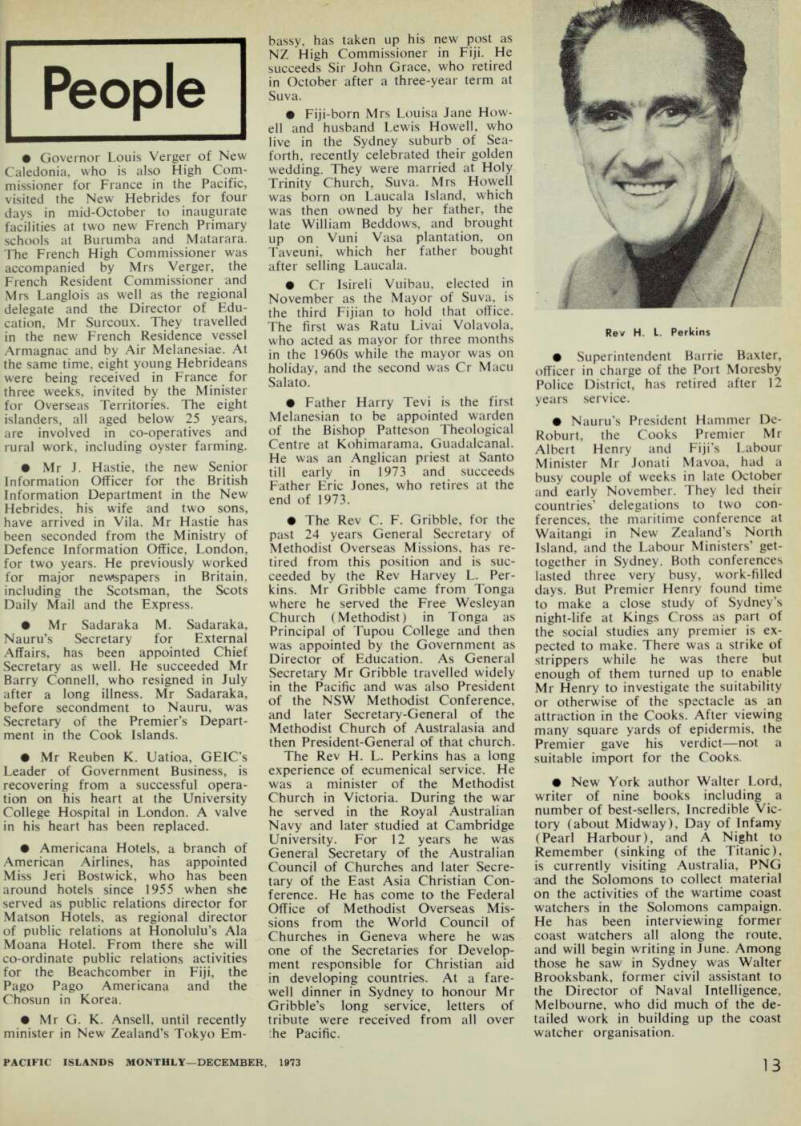
The Rev H. L. Perkins has a long experience of ecumenical service. He was a minister of the Methodist Church in Victoria. During the war he served in the Royal Australian Navy and later studied at Cambridge University. For 12 years he was General Secretary of the Australian Council of Churches and later Secre tary of the East Asia Christian Con ference. He has come to the Federal Office of Methodist Overseas Mis sions from the World Council of Churches in Geneva where he was one of the Secretaries for Develop ment responsible for Christian aid in developing countries. At a fare well dinner in Sydney to honour Mr Cribble’s long service, letters of tribute were received from all over :he Pacific.
• Superintendent Barrie Baxter, officer in charge of the Port Moresby Police District, has retired after 12 years service. • Nauru’s President Hammer De- Roburt, the Cooks Premier Mr Albert Henry and Fiji’s Labour Minister Mr Jonati Mavoa, had a busy couple of weeks in late October and early November. They led their countries’ delegations to two con ferences, the maritime conference at Waitangi in New Zealand’s North Island, and the Labour Ministers’ get together in Sydney. Both conferences lasted three very busy, work-filled days. But Premier Henry found time to make a close study of Sydney’s night-life at Kings Cross as part of the social studies any premier is ex pected to make. There was a strike of strippers while he was there but enough of them turned up to enable Mr Henry to investigate the suitability or otherwise of the spectacle as an attraction in the Cooks. After viewing many square yards of epidermis, the Premier gave his verdict —not a suitable import for the Cooks. • New York author Walter Lord, writer of nine books including a number of best-sellers, Incredible Vic tory (about Midway), Day of Infamy (Pearl Harbour), and A Night to Remember (sinking of the Titanic), is currently visiting Australia, PNG and the Solomons to collect material on the activities of the wartime coast watchers in the Solomons campaign.
He has been interviewing former coast watchers all along the route, and will begin writing in June. Among those he saw in Sydney was Walter Brooksbank, former civil assistant to the Director of Naval Intelligence, Melbourne, who did much of the de tailed work in building up the coast watcher organisation.
Rev H. L. Perkins
Tropicalities
An English pub in Fiji!
Ask any Englishman and he’ll tell you that the English pub, with its unique atmosphere, can't be exported.
Off Chicago’s Michigan Avenue there’s a pub which describes itself as the genuine English article. It has some English coaching signs inside.
The similarity ends there.
But Fiji’s Prime Minister, Ratu Sir Kamisese Mara, thinks there’s a chance of a pub transplant in Fiji’s suburban areas. At present, Fiji’s public bars are a replica of the New Zealand swill palaces with a notice outside Mamma sa tabu eke (Women not allowed in here). And no woman worth the name would want to drink in them.
There’s no such thing in Fiji as a tavern, used for food and drink only.
A hotel with a bar must also have accommodation, but there’s a change on the way according to Ratu Mara.
He says the government intends amending the Liquor Ordinance to allow the opening of suburban bars without bedroom accommodation. The new bars, to be called taverns, would be in selected residential areas.
The Prime Minister’s ideal, in his own words, is the English pub.
“I am sure many people who have visited the United Kingdom have been impressed, as I have been, by the congenial atmosphere and self-discip line of the local pub,” he said.
“The nearest we have in Fiji is the clubs, where there is control from members themselves but clubs are restricted to members and we would like to see these benefits more widely spread, particularly from the main urban areas.”
He added that some of the bars might operate as open-air beer gar dens.
You never know. We might still see a Rose and Crown in, say, Rai waqa, with the clientele busily play ing dominoes and darts and a gentle man presiding at the piano on top of which will be a row of full glasses donated by a grateful crowd of drink ing listeners.
*Sensassr Noumea
night life
International tourist promotions were finally launched in late October at Noumea’s new Chateau Royal hotel extensions, after French air flights through Australia had been suspended for five months, through nuclear boycott and other industrial troubles.
Once tourist traffic was normalised in the region, UTA French airlines promptly filled up one of their DC 10s with 150 Australian travel agents who were rushed across to sample the new Anse Vata beach facilities.
Also at the end of October, some 20 members of the Melanesian Tourist Federation were able to hold their annual meeting at the Chateau Royal. The federation’s objective is to promote regional tours incorporat ing the chain of Coral Sea islands from New Caledonia through the New Hebrides and Solomons to Papua New Guinea. This was the federation’s first meeting in Noumea and the date had been postponed from an earlier gathering planned in August, when anti-nuclear protests were of course hitting French tourist interests.
During this time, Noumea res taurants and night clubs vied with each other in presenting singers and other performers from Paris or neigh bouring Pacific islands.
One night spot had a novel way of attracting patrons. For the last Saturday of October, the “Tahiti Cabaret”, on Baie des Citrons beach, offered all visitors a “surprise en velope”. The envelopes contained tickets for free drinks or, for luckier patrons, a free bottle of champagne.
Added to the evening’s attraction of a Tahitian dancing troupe, it was, as the French say, all very sensation ally “sensass”.
The tremble
over a Wildcat Solomon Islander Mostyn Norua won a court case, and a World War II vintage Wildcat fighter-bomber.
Australian Barrie Coran lost the air craft and the S5O he paid for it. The trouble all started when Mr Clement Paratobo sold the plane, which he believed was on his land, to Mr Coran for $5O.
Everything was simple till the plane was taken to the BSIP Port Auth
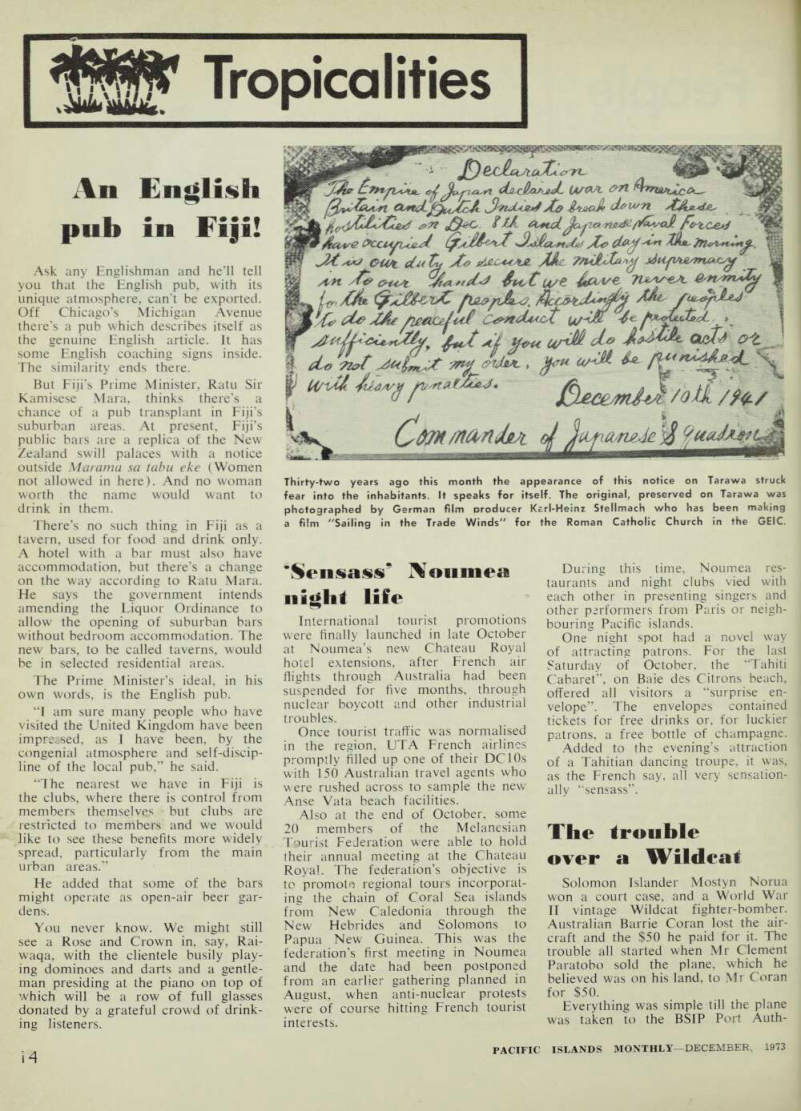
Thirty-two years ago this month the appearance of this notice on Tarawa struck fear into the inhabitants. It speaks for itself. The original, preserved on Tarawa was photographed by German film producer Kerl-Heinz Stellmach who has been making a film "Sailing in the Trade Winds" for the Roman Catholic Church in the GEIC.
ority to await shipment to Australia.
Mr Norua then claimed the land on which the aircraft was found be longed to him. and therefore the air craft was his property. The Native Court found in his favour.
Then the Port Authority told him that storage charges for the Wildcat had reached $3BO, and he could not remove it till the charge was paid.
This time Mr Norua appealed to the High Court, but by the time the case was heard the charges had reached $2,987.90. The High Court ruled the Wildcat must be returned to Mr Norua and the storage charges waived.
This did not satisfy the Port Auth ority, which lodged an appeal, claim ing it was entitled to its money. But it did suggest a compromise—that it would waive the storage charges if the aircraft was given to the BSIP.
The matter rests.
PS: The Wildcat was the best fighter aircraft available to the US Navy at the start of the Pacific war.
It was not as manoeuvrable as the Japanese Zero.
Air terminal
not island-style
There was some frantic head scratching by airport planners of the Cook Islands’ new international airport at the beginning of November when what was planned as a formal look-see at the new terminal buildings by Mr Tupui Henry, the chairman [)f the Cooks Parliamentary Cabinet, misfired.
Mr Henry took one look at the plans. He was expected to murmur ‘Very nice” and pass on, but he took a piece of the planners instead.
He wasn't happy with the layout, be said. Too much emphasis had been p’aced on documentation clearances than on the movement, freedom and :omfort of the people.
“It appears that Cook Islands re sidents would have to welcome their visitors arriving by jet on the foot path as there are no facilities for a proper lounge.” he said. “That’s not the Cook Island’s way of life to welcome visitors on the roadside.”
His point got home to members af the Cook Island Air Facilitations Committee who flew into Rarotonga a few days later. They explained that a covered lounge was provided for in the second phase of the complex to be added at some future date. That was no use to Mr Henry. The com mittee agreed and its New Zealand members promised to recommend that a covered reception lounge would be ane of the first things attended to by the planners.
No ‘pain’ in
the tummy
Ask a Frenchman to go without tea, and he would only think you were depriving him of unpalatable medicine. But take away his pain (bread) and you are denying him part of his life-source.
Still, it did happen that Caledon ians endured four days of abstinence late October, when local bakers went on strike over what was judged to be an inadequate rise in the price of bread. Pure economics eventually forced the bakers to refire their ovens; those selling cakes and pastries could withstand the halt in bread sales, but not those who sold only bread.
The Administration's fixed price of 20 francs CFP (A 17c) was finally accepted for the traditional 10 oz long wife-beater baguete. And so the Caledonians returned to their ritual of collecting hot loaves, fresh from the baker twice daily, seven days per week.
Kwajalein pays
price of peace
Kwajalein in Micronesia faces widespread unemployment because of the US-USSR strategic arms limi tation talks (SALT), claims recen tly-elected Marshall Islands Congress man John Heine. A cutback in acti vities at the Kwajalein missile base has been followed by elimination of overtime.
Mr Heine said the average working week would be cut from six to five days and he thought it would not be long before there would be lay-offs, starting at the top and working down.
He understood that the Vandenberg Air Force base in California would limit its activities because of SALT
agreements. Missiles for Kwajalein are fired from Vandenberg base.
“If there are big cutbacks at Kwa jalein then where will we get the money to pay the taxes talked about in our demands for 50 per cent”, he said. (This was a reference by the Marshalls delegation to the Congress of Micronesia that at least 50 per cent of the taxes generated within a district be set aside for the district generating the tax).
Mr Heine warned against the Mar shalls separating from the rest of Micronesia. He alleged the US was deliberately trying to divide Micro nesia. The dividing tactics were pro bably planned in the State Depart ment in Washington.
“They realise this is the way they can conquer our people”, he said.
The governor’s
grisly job
Governor John M. Haydon of American Samoa, whose official life these days isn’t exactly a bed of roses, had an unusual job to perform early in November —to witness the ex humation on the island of Manihiki in the northern Cooks of the body of an American Samoa fisherman who died there nearly 10 years ago.
It had been decided that it was time to bring the body home.
Governor Haydon, along with his wife and a group of scientists, was on a voyage to Rose Island, a pin point piece of American Samoa in habited by birds and turtles, and Swains Island,, and as Manihiki isn’t far away, it was decided to call there for the fisherman’s corpse. When the governor got to Manihiki it was Sunday and the islanders don’t dig up bodies on Sundays. However, after a meeting between the island council, the church pastor and deacons and the dead fisherman’s brother, it was un animously decided to do the job.
The Cook Islands News reported
Kwajalein.
that the grave was surrounded by locals when the digging started, all “anxious to see what remained.” Not surprisingly, there were only bones.
Each bone was taken out, wrapped in tapa cloth and placed in a bag which was covered with the American flag, after which the bag was taken on board the American Samoa launch.
Talitiga.
Caledonian§
safer targets
Someone in Paris seems to be making good propaganda out of the recent anti-French nuclear boycott, which ended in October. The French announced that for the world cham pionships in target shooting, scheduled in Australia in November, their con testants would come not from France but from New Caledonia.
According to a reliable Noumea source, the French Shooting Feder ation decided not to send metro politan representatives because they considered that security conditions for the marksmen were not adequate; the Australian ban on French im ports included cartridges. The feder ation also feared unpredictable re actions from hostile spectators.
But it was good news for New Caledonia, which prepared to send five marksmen to Melbourne . . . either they were more expendable, or the metropolitan French were over sensitive to Pacific hostility.
Making room
for a king
The Japanese are nothing if not polite. When King Taufa’ahau Tupou of Tonga and his Queen Mata’aho arrived in Tokyo on November 7 for a two-week friendship and sight seeing tour his hosts realised they had a problem.
The king, at a press conference, stressed the similarities between the two races and said they were both located in the Pacific and belonged to the same Mongolian race.
There the similarities ended.
There’s a big difference in build, and the king, weighing 136.077 kgs (300 lb), accentuated the difference, which is where the Japanese had a problem.
The royal couple was scheduled to take a Shingansen train from Tokyo to Nagoya on November 14. It would have been a tight squeeze for His Majesty but his hosts had a special seat made and installed in the train.
It was his first visit as King of Tonga but his sixth in all. He visited Japan five times as Prince Tungi.
Soaking the
Yap drinker
The drinker will get caught two ways in Yap District through a new sales tax and an alcoholic beverage consumption permit system. The sales tax is 1c a container, regardless of size, on the first sale in Yap of cans and bottles of beer, malt bever ages, soft drinks and non-alcoholic beverages. The money collected will be used to pay individuals or groups for the collection of discarded cans and bottles.
The newly-introduced liquor con sumption permit system, which makes Yap the third district in the Trust Territory to adopt it, applies to both locals and visitors. A regular permit for locals will cost $6; a tourist permit will cost S 2.
Another new tax is a 5 per cent hotel occupancy levy on the rental of hotel rooms.
Transforming the
fare of Vila
A new Intercontinental Island Inn with 200 rooms is scheduled to open early 1975 in Port Vila, New Heb rides. Work is timed to begin by the end of 1973 on the complex set in 35 acres amid the Tassiriki Park Es tate, overlooking the Vila lagoon.
This new Intercontinental, designed by American and French architects, will have a restaurant for 300, snack and coffee bars, together with lux uriant gardens, swimming pool and convention hall.
The Tassiriki Park estate in which the Intercontinental will operate is a combined residential and resort area of 175 acres, being developed by He brida Holdings Ltd, based in Port Vila.
Coinciding with construction of the new hotel, a new shopping block will be built at Port Vila at the corner of Cornwall Road and Rue Colar deau. Dominated by a “Prisunic” su permarket, the new complex will be managed by Hebrida Ltd. The 7-acre site will include boutiques and a swimming pool.
With its population having almost doubled in the past six years, Port Vila is being transformed to meet its new business and touristic career, with French and Anglo-Saxon finance vying to participate.
Meanwhile, the French owners of Le Lagon Hotel at Erakor, Vila, are seeking Japanese finance and patronage to build extra rooms and attract more visitors. The Japanese companies approached are the Tokyu and Seibu groups which are in trans port. departmental stores and hotels.
Advertisements & other items, pp. 18-24 (1 item)
Monthly
Become a part of PlM's
Pacific and subscribe now.
Pacific Islands
Monthly
Keeps you informed on
Pacific happenings.
The Pacific is PIAA!
For more than 40 years PIAA has been reporting on events in the Pacific. Social and political changes, economic development, historical background, regular columnists and commentators, personalities and travel.
You'll read:— • A big magazine section • Extracts from the Islands Press • Fascinating historical articles • Island creative writers
• Tropicalities
• Shipping and cruising yachts • News of sport • Letters from readers • Business and development news • Plus all the latest Pacific news and views
Fill in the details
on the attached
Pacific Islands Monthly
NEWS MAGAZINE OF THE SOUTH PACIFIC
Overleaf is your order form for a 12 months subscription . See our announcement opposite .
SUBSCRIPTION RATES:
Australia (including Lord Howe and Thursday Islands) $6.70 New Zealand $6.70 NZ Papua New Guinea $5.50 Aust.
Fiji, Tonga, New Hebrides, Gilbert and Ellice Islands, Solomon Islands, Nauru Island and all other Pacific Territories $5.50 . Western Samoa $6.70 Hawaii, Micronesia, and Guam .. $12.00 US American Samoa $B.OO US U.S. Mainland $14.00 US New Caledonia and French Polynesia 1,100 CFP •United Kingdom £3.25 Stg. •Elsewhere 56.96 Aust.
Two years $12.65 $12.65 NZ $10.25 Aust. $10.25 (local currency) $12.65 (local currency) $23.25 US $15.25 US $27.25 US
2,150 CFP
£6.25 Stg. $12.20 Aust. •Airmail extra on application. All other subscription rates listed Include air delivery.
Three years $18.60 $18.60 NZ $15.00 Aust $15.00 $18.60 $34.50 US $22.50 US $40.50 US
3,150 CFP
£9.00 Stg. $19.30 Aust New □ Renewal F]
PACIFIC ISLANDS MONTHLY
29 Alberta Street, Sydney, N.S.W. 2000, Australia (Postal Address: Box 3408, G.P.0., Sydney, N.S.W. 2001.)
B DECEMBER, 1973—PACIFIC ISLANDS MONTHLY
Come up to Kool
for extra freshness
C r m m
KQDI
p jm rm ..
S v « * % T. m • e r?V 4 U597-8/71
Si «•
ASL* * *
m pmtmina •« ie ItMi PQ •jm . 1® ■ W mm m wmmm H : M ""» d C.-s?
3W IVH3M
raw * K? u □a ■ as ■ :'s ■ H
3
they
O II 111 111 t % - With a little friendly help from Burns Philp!
While more and more tourists are discovering the Islands, more and more islanders are discovering the welcome flow of tourist dollars. This is business as business should be, both buyer and seller happy with the arrangement and the rest of the community profiting as well.
Throughout the Islands, Burns Philp are on the scene helping the good business to happen. Local people with local knowledge aid the tourists through a score and more of Burns Philp agencies—shipping agents, airline agents, travel agents and many others.
Over hundreds of thousands of square miles of the Pacific, the familiar Burns Philp name helps people to feel at home in these wonderful far away places.
DOING GOOD BUSINESS FOR THE ISLANDS
BUM/ PHILP
GROUP OF COMPANIES
PRINCIPAL OFFICE—7 BRIDGE STREET SYDNEY NSW 2000 AUSTRALIA
Oil
BROCKHOff
WOCKHOf
m w $■ . * .
A iV iy/ii WHOfc a*p* m e»0
ejf
s=4*
Christmas Crackers
Celebrate with Shapes Shapes give more flavour to any party . . . Christmas parties, birthday parties, any entertainment at all. They come in handy traypacks with six different varieties. Cheese, Savoury, Barbecue, Beef, Turkey and Cocktail. All tasty bite-size crackers for anytime you’re in a party mood.
BROCKHOff
oven-crisp biscuits Arnott-Brockhoff-Guest Pty. Ltd., 53 Huntingdale Road, Burwood. Victoria. Australia. Telex 33075. 478
economic development
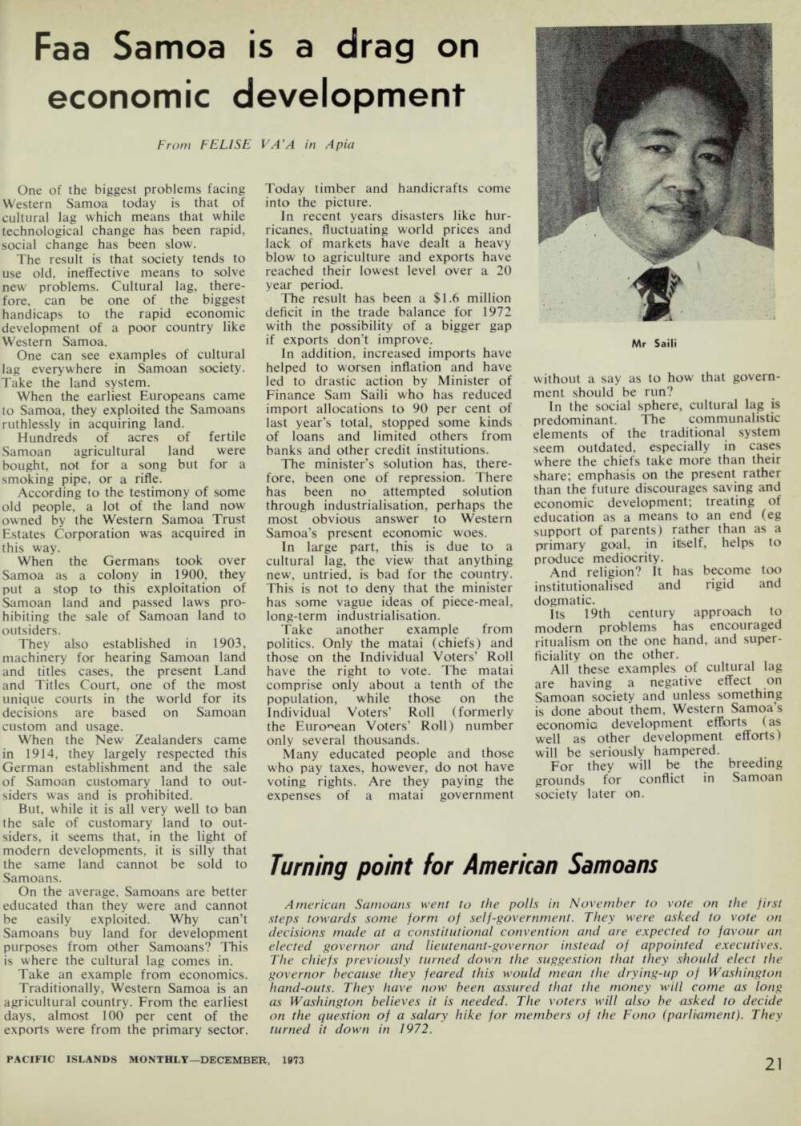
Faa Samoa is a drag on economic development
From FELISE VA’A in Apia
One of the biggest problems facing Western Samoa today is that of cultural lag which means that while technological change has been rapid, social change has been slow.
The result is that society tends to use old, ineffective means to solve new problems. Cultural lag, there fore, can be one of the biggest handicaps to the rapid economic development of a poor country like Western Samoa.
One can see examples of cultural lag everywhere in Samoan society.
Take the land system.
When the earliest Europeans came to Samoa, they exploited the Samoans ruthlessly in acquiring land.
Hundreds of acres of fertile Samoan agricultural land were bought, not for a song but for a smoking pipe, or a rifle.
According to the testimony of some old people, a lot of the land now owned by the Western Samoa Trust Estates Corporation was acquired in this way.
When the Germans took over Samoa as a colony in 1900, they put a stop to this exploitation of Samoan land and passed laws pro hibiting the sale of Samoan land to outsiders.
They also established in 1903, machinery for hearing Samoan land and titles cases, the present Land and Titles Court, one of the most unique courts in the world for its decisions are based on Samoan custom and usage.
When the New Zealanders came in 1914, they largely respected this German establishment and the sale of Samoan customary land to out siders was and is prohibited.
But, while it is all very well to ban the sale of customary land to out siders, it seems that, in the light of modern developments, it is silly that the same land cannot be sold to Samoans.
On the average, Samoans are better educated than they were and cannot be easily exploited. Why can’t Samoans buy land for development purposes from other Samoans? This is where the cultural lag comes in.
Take an example from economics.
Traditionally, Western Samoa is an agricultural country. From the earliest days, almost 100 per cent of the exports were from the primary sector.
Today timber and handicrafts come into the picture.
In recent years disasters like hur ricanes, fluctuating world prices and lack of markets have dealt a heavy blow to agriculture and exports have reached their lowest level over a 20 year period.
The result has been a $1.6 million deficit in the trade balance for 1972 with the possibility of a bigger gap if exports don’t improve.
In addition, increased imports have helped to worsen inflation and have led to drastic action by Minister of Finance Sam Saili who has reduced import allocations to 90 per cent of last year’s total, stopped some kinds of loans and limited others from banks and other credit institutions.
The minister’s solution has, there fore, been one of repression. There has been no attempted solution through industrialisation, perhaps the most obvious answer to Western Samoa’s present economic woes.
In large part, this is due to a cultural lag, the view that anything new, untried, is bad for the country.
This is not to deny that the minister has some vague ideas of piece-meal, long-term industrialisation.
Take another example from politics. Only the matai (chiefs) and those on the Individual Voters’ Roll have the right to vote. The matai comprise only about a tenth of the population, while those on the Individual Voters’ Roll (formerly the European Voters’ Roll) number only several thousands.
Many educated people and those who pay taxes, however, do not have voting rights. Are they paying the expenses of a matai government
without a say as to how that govern ment should be run?
In the social sphere, cultural lag is predominant. The communalistic elements of the traditional system seem outdated, especially in cases where the chiefs take more than their share; emphasis on the present rather than the future discourages saving and economic development; treating of education as a means to an end (eg support of parents) rather than as a primary goal, in itself, helps to produce mediocrity.
And religion? It has become too institutionalised and rigid and dogmatic.
Its 19th century approach to modern problems has encouraged ritualism on the one hand, and super ficiality on the other.
All these examples of cultural lag are having a negative effect on Samoan society and unless something is done about them, Western Samoa’s economic development efforts (as well as other development efforts) will be seriously hampered.
For they will be the breeding grounds for conflict in Samoan society later on.
Mr Saili
Turning point for American Samoans
American Samoans went to the polls in November to vote on the first steps towards some form of self-government. They were asked to vote on decisions made at a constitutional convention and are expected to favour an elected governor and lieutenant-governor instead of appointed executives.
The chiefs previously turned down the suggestion that they should elect the governor because they feared this would mean the drying-up of Washington hand-outs. They have now been assured that the money will come as long as Washington believes it is needed. The voters will also be asked to decide on the question of a salary hike for members of the Fono (parliament). They turned it down in 1972.
Advertisements & other items, p. 26 (1 item)
Christmas gifts
that click
with everyone ♦♦♦
Kodak pocket Instamatic cameras.
KODAK (Australasia) PTY. LTD. f K6l Choose from 5 ready-to-shoot outfits at your local island dealer.
Agreement
near' on Marianas
rom a Saipan correspondent
Members of the Marianas Political itatus Commission and the United ►tates team headed by President Dixon’s personal ambassador -ranklyn Hadyn Williams will begin he next round of talks on the Marianas' future on December 6 on Jaipan.
The communique issued in late )ctober after Senator Edward ’angelinan, chairman of the Marianas lommission, and Ambassador Wil iams had met in San Francisco, said he formal talks in December would >e “looking towards a political union >f the northern Marianas with the Jnited States”.
Judging by the communique’s tone, he two sides have come close to roning out difficulties over land natters including the virtual take >ver of Tinian by the United States nilitary, who are looking for bases hould they lose some in the rest of riicronesia, the “future disposition of jublic land now held in trust for the >eople of Micronesia,” and future inancial relationships.
The talks are expected to work owards a system of self-government receded by a Marianas constitutional invention. Both Senator Pangelinan md Ambassador Williams were con ident that further progress will be nade at the talks for a “mutually icceptable agreement” which will need he sanction of the United States Longress and the Marianas people vho will hold a plebiscite.
Nothing has been said for some ime about the Congress of Micro icsia’s views of the talks which, if iuccessful, will end in the separation )f the Marianas from the rest of Vlicronesia. It is expected, however, hat, if and when the talks end in a :loser union between the Marianas md the United States, the reaction }f Congress will be hostile. Senator Lazarus Salii, chairman of the Joint Committee on Future Status, has already protested that separate talks Dffend against the spirit and the letter jf the trusteeship articles.
Meanwhile, there is more dithering aver the date for the resumption of the status talks between the United States and the Joint Committee. After marking time for several months,
Ambassador Williams and Senator Salii announced November 10 as the resumption date. (PIM, Nov p 112).
At October's end they announced a three-day postponement, till Nov ember 13 in Washington (DC), to give members of the Joint Committee additional time for consultation among themselves and with their legal consultants”.
Several days after the announce ment of the postponement came a statement from Senator Salii that he had invited a delegation of four Palauan leaders to the talks.
Palauan agitation for the return of their land has been one of the obstacles to a renewal of the talks and looks like continuing as an obstacle. The Palauans said that unless the United States made its position on public lands clear and the Palauans accepted the Americans’ offer they could not agree to move ahead to the next round of talks.
The three days postponement could have been called to give the Ameri cans a chance to satisfy the Palauans about the future of their land.
Senator Salii said it was essential that the Palauans be in Washington for the talks so that the members of the status commission could consult them, as the commission was basing its stand on the land situation.
Some observers think, however, that the main purpose of their pre sence will be to act as a pressure group. Senator Salii gave added weight to this when he said: “If the conditions are not acceptable to the people of Palau, we will have to make a judgment and weigh seriously the opinions of the leaders of Palau.”
In the four-man Palauan contin gent, whose expenses are being met by the Palauan District Legislature, are the president, Itelbang Luii, and traditional high chiefs Rekaat and Ibedual.
Advertisements & other items, pp. 27-28 (1 item)
Yorkshire Insurance
W. H. GROVE & SONS LTD.
ESTABLISHED 1896
ISLAND MERCHANTS
Exporters to the Pacific of Dairy Products and all New Zealand consumer and manufactured goods.
ENTRUST YOUR REQUIREMENTS TO THE
ESTABLISHED FIRM
P.O. Box 3718,
AUCKLAND
Cables
GROVE AUCKLAND
THE
YORKSHIRE INSURANCE
CO LTD.
(Incorporated in England)
A MEMBER OF THE GENERAL ACCIDENT GROUP OF COMPANIES
ALL CLASSES OF INSURANCE
AUSTRALIAN HEAD OFFICE: 10-12 Spring Street, Sydney.
General Manager for Australia: J. Adam.
PAPUA AND NEW GUINEA BRANCH: Douglas Street, Port Moresby Manager: H. M. Harvey.
CHIEF ISLAND REPRESENTATIVES
Rabaul, A.S.P. (N.G.) Ltd.; Lae, Radio Cabs (Lae) Pty. Ltd.; Madang, W. Stokes; Manus, Edgell & Whiteley Ltd.; Honiara, 8.5.1. P., E. V. Lawson Ltd.; Suva, Williams & Gosling Ltd., Noumea, R. Laubreaux; Norfolk Island, Martin's Agencies; Apia, E. A. Coxon & Co.; Vila, C. Sullivan (INT) Pty. Ltd.
•<*> A
This little flower is your key
to the safe insect killer
One of the safest and most potent insect-killers known to contemporary science is derived from an innocentlooking small white flower, the African Pyrethrum daisy. Pure pyrethrins, as chemists call this substance, is the active ingredient in Pea-Beu insect spray, and the key to its concentrated killing power. Continuing research by the chemists in the laboratories of A.N.I. Chemical Research and by health and environmental authorities throughout the world, confirms that insects do not become immune to pyrethrum. Pea- Beu contains a high concentration of pyrethrins which means that short bursts only are needed to kill flies, mosquitoes and every type of insect pest.
The mosquito—a deadly
trafficker of disease The mosquito’s record as a killer is world recognised. Beside wrecking
mirp
ftmrll
so pure it’s safe to spray anywhere your night’s sleep with its irritating whine and inflicting its painful toxic bites, the mosquito passes on many serious diseases, including malaria, hepatitis, dengue and yellow fever, disfiguring elephantiasis and encephalitis. Pea-Beu is recommended to kill every mosquito that enters your home, because it is guaranteed completely effective, yet absolutely safe.
No fears near food Your kitchen and food-cupboards are the favourite places for houseflies, especially when attracted by exposed food as you cook or serve.
Of course you’re reluctant to use pungent insecticides, and fear toxic effects. But never hesitate to use Pea-Beu.
Its active ingredient guarantees it harmless to humans and pets, and thanks to the purity of all its ingredients, it is completely safe to spray anywhere in the home.
Pea-Beu the safe, powerful insecticide
the Pacific Islands'
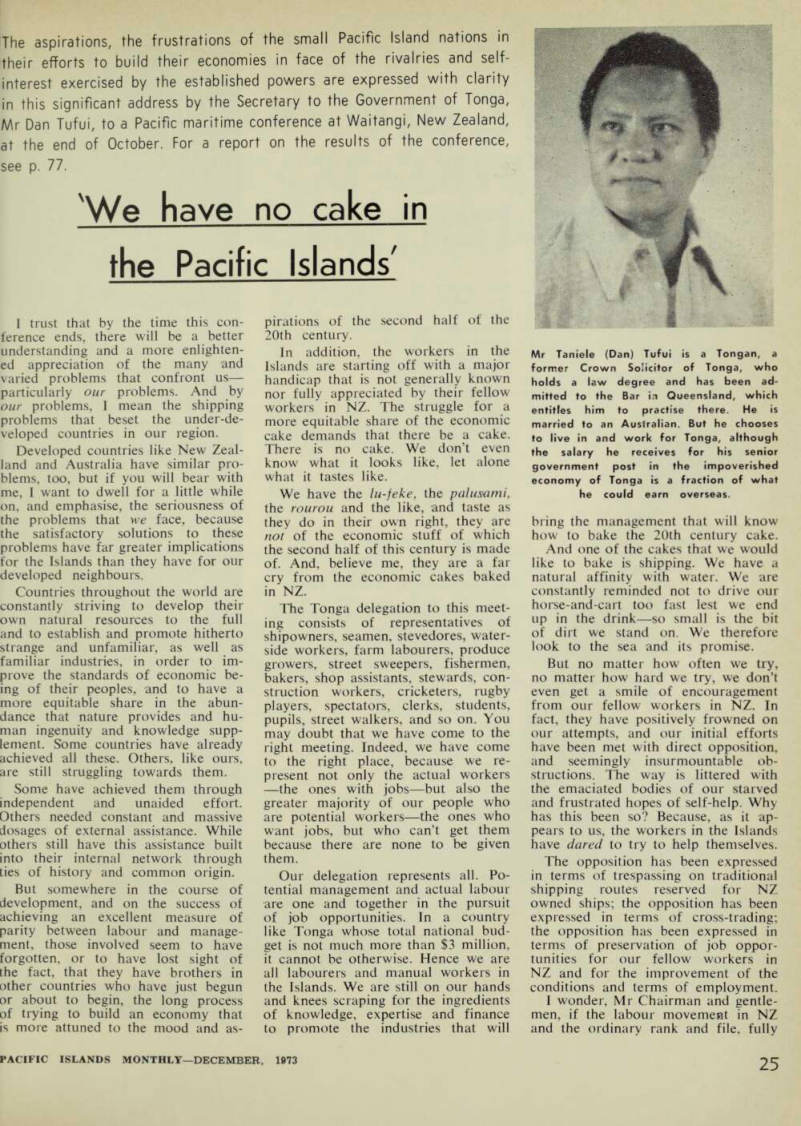

'We have no cake in the Pacific Islands'
The aspirations, the frustrations of the small Pacific Island nations in their efforts to build their economies in face of the rivalries and self interest exercised by the established powers are expressed with clarity in this significant address by the Secretary to the Government of Tonga, Mr Dan Tufui, to a Pacific maritime conference at Waitangi, New Zealand, at the end of October. For a report on the results of the conference, see p. 77.
I trust that by the time this con ference ends, there will be a better understanding and a more enlighten ed appreciation of the many and varied problems that confront us— particularly our problems. And by our problems, I mean the shipping problems that beset the under-de veloped countries in our region.
Developed countries like New Zeal land and Australia have similar pro blems, too, but if you will bear with me, I want to dwell for a little while on, and emphasise, the seriousness of the problems that we face, because the satisfactory solutions to these problems have far greater implications for the Islands than they have for our developed neighbours.
Countries throughout the world are constantly striving to develop their own natural resources to the full and to establish and promote hitherto strange and unfamiliar, as well as familiar industries, in order to im prove the standards of economic be ing of their peoples, and to have a more equitable share in the abun dance that nature provides and hu man ingenuity and knowledge supp lement. Some countries have already achieved all these. Others, like ours, are still struggling towards them.
Some have achieved them through independent and unaided effort.
Others needed constant and massive dosages of external assistance. While others still have this assistance built into their internal network through ties of history and common origin.
But somewhere in the course of development, and on the success of achieving an excellent measure of parity between labour and manage ment, those involved seem to have forgotten, or to have lost sight of the fact, that they have brothers in other countries who have just begun or about to begin, the long process of trying to build an economy that is more attuned to the mood and as
pirations of the second half of the 20th century.
In addition, the workers in the Islands are starting off with a major handicap that is not generally known nor fully appreciated by their fellow workers in NZ. The struggle for a more equitable share of the economic cake demands that there be a cake.
There is no cake. We don’t even know what it looks like, let alone what it tastes like.
We have the lu-feke, the palusami, the rourou and the like, and taste as they do in their own right, they are not of the economic stuff of which the second half of this century is made of. And, believe me, they are a far cry from the economic cakes baked in NZ.
The Tonga delegation to this meet ing consists of representatives of shipowners, seamen, stevedores, water side workers, farm labourers, produce growers, street sweepers, fishermen, bakers, shop assistants, stewards, con struction workers, cricketers, rugby players, spectators, clerks, students, pupils, street walkers, and so on. You may doubt that we have come to the right meeting. Indeed, we have come to the right place, because we re present not only the actual workers —the ones with jobs—but also the greater majority of our people who are potential workers—the ones who want jobs, but who can’t get them because there are none to be given them.
Our delegation represents all. Po tential management and actual labour are one and together in the pursuit of job opportunities. In a country like Tonga whose total national bud get is not much more than $3 million, it cannot be otherwise. Hence we are all labourers and manual workers in the Islands. We are still on our hands and knees scraping for the ingredients of knowledge, expertise and finance to promote the industries that will
bring the management that will know how to bake the 20th century cake.
And one of the cakes that we would like to bake is shipping. We have a natural affinity with water. We are constantly reminded not to drive our horse-and-cart too fast lest we end up in the drink—so small is the bit of dirt we stand on. We therefore look to the sea and its promise.
But no matter how often we try, no matter how hard we try, we don’t even get a smile of encouragement from our fellow workers in NZ. In fact, they have positively frowned on our attempts, and our initial efforts have been met with direct opposition, and seemingly insurmountable ob structions. The way is littered with the emaciated bodies of our starved and frustrated hopes of self-help. Why has this been so? Because, as it ap pears to us, the workers in the Islands have dared to try to help themselves.
The opposition has been expressed in terms of trespassing on traditional shipping routes reserved for NZ owned ships; the opposition has been expressed in terms of cross-trading; the opposition has been expressed in terms of preservation of job oppor tunities for our fellow workers in NZ and for the improvement of the conditions and terms of employment.
I wonder, Mr Chairman and gentle men, if the labour movement in NZ and the ordinary rank and file, fully
Mr Taniele (Dan) Tufui is a Tongan, a former Crown Solicitor of Tonga, who holds a law degree and has been ad mitted to the Bar in Queensland, which entitles him to practise there. He is married to an Australian. But he chooses to live in and work for Tonga, although the salary he receives for his senior government post in the impoverished economy of Tonga is a fraction of what he could earn overseas.
Brutal kick in teeth
appreciate what these mean to their fellow workers in the Islands? As I have said, the whole of the Islands is a labour movement and we are part of the rank and file of that move ment—but with this very significant difference—there is no employment in the Islands.
In 1966, which was when we had our last census (we have not had one since because we can’t afford one) Tonga had a total population of 77,429 of which only 18,998 or about 24.7 per cent were economically active, leaving 58,431 or 75.3 per cent of the population not economically active. Why? Because there was no where for that 75.3 per cent to be employed—there were no job oppor tunities for that 75.3 per cent.
The situation has not improved much, if at all, over the last seven years. Our initial, humble effort to create job opportunities for even a very small portion of that 75.3 per cent of the population, by having an Island-owned and Island-crewed ship to trade between NZ and the Islands, was met with a brutal kick in the teeth for our trouble, by no less than our fellow workers in NZ!
Whether this was done purposely to deny job opportunities to their fellow potential seamen in the Islands or through lack of understanding of the non-employment situation in the Islands, we do not know.
We do know that it is a meaningless exercise for labour in Tonga to mount
a campaign against a non-existing
management for the improvement of the terms and conditions of non-em ployment. The worker in the Islands first needs to be given the opportunity to work before he can improve the conditions under which he works!
Job opportunities for NZ seamen in NZ-owned ships represent but a tiny fraction of the total job oppor tunities available to workers generally in NZ. But to the 75.3 per cent of the total population of Tonga, an opportunity to be employed as a seaman in an Island-owned ship either means he has a job or he con tinues to have no job at all.
To demand that a ship owned and crewed by the Islands be run and manned on New Zealand Seamen’s Union terms and conditions of em ployment before it can be allowed, by the NZ labour movement, to ply in trade between NZ and the Islands, is like pitching the mighty All Blacks against a team of pygmy Eskimos at Eden Park at 12 noon in the height of summer.
And to further demand that the same Islands ship must not cross-trade between NZ and the Islands or sail
the so-called traditional shipping routes, and yet give free rein to a similar NZ ship to do so, is like requiring the Eskimos to field their team with their ankles tied together —and, what’s more, expecting the Eskimos to win! What a victory for the All Blacks to be proud of!
Mr Chairman, these last few re marks may seem somewhat frivolous.
They are not intended to be so. For a competition to be fair, parity or near equality in all things is essential, otherwise the situation quickly de teriorates into a complete farce. There may be parity in political status be tween NZ and the Islands, but at that the similarity abruptly ends. We need parity in job opportunities. We need parity in technical skill. We need parity in industrialisation. We need parity in mechanisation. We need parity in technological know-how.
We need parity in management. We need parity in finance. We need parity in production.
We need, in other words Mr Chair man and gentlemen, parity in econ omic strength before the labour move ment in NZ can fairly force us to play their game.
If our needs matter to anyone in NZ—and I know that the Govern ment of New Zealand and many many people in NZ do care —then we appeal to you, especially to the work ers of NZ, to give us a “fair go”.
We are not asking you to stop sailing between NZ and the Islands.
All we are saying is: “Don't deny us the right to do the same.” We are not asking that NZ seamen in NZ ships be paid less than New Zealand can afford. All we are saying is: “Let us do likewise and pay our sea men at the rate our economy can afford.” We are not trying to stop NZ shipowners altogether from carrying our imports and exports. We just want to carry a fair proportion of them. We do not want your seamen to be without work. We just want our people without work to be seamen.
If labour in NZ continues to per sist in placing unreasonable obstruct ions in our effort to help ourselves, as it has only too well, then do not wonder that we, in the Islands, view the resistance offered the joint ship ping venture by Nauru and Tonga as a deliberate attempt to quash the effort of Islands workers to improve their lot, as a deliberate attempt to perpetuate colonial trade policies of yesterday whereby the Islands, inclu ding NZ, were once looked upon as no more than a backyard garden of raw material for the industrialisation of other countries.
The sad episode of the Islands ship
(continued over next page)
An indelible blemish
Enna G will leave an indelible blemish on the good record of the labour movement in NZ, not because it achieved what it set out to do, but that in achieving it, the NZ workers, without fully realising it, lashed out blindly and violently, and caught their fellow workers in the Islands full flush in the face.
We were, and still are, disappoin ted. But we temper our disappoint ment with the reflection that had the workers in NZ, the officials as well as the ordinary rank and file, realised that in the Islands, particularly in my own country, shipowners, seamen, stevedores, and wharfies and all other workers, potential or actual, all pull in the same direction, the workers here would have given us a helping hand and a “fair go,” instead of knocking us down unkindly.
I earnestly urge delegates, and appeal to my fellow workers here in NZ, and in particular to the repre sentatives of the workers in the unions, to remember that unless we allow one another in equal measure the rights and privileges we each claim for ourselves, the future prospects of NZ Pacific Islands shipping, will be bright, as they have always been, for New Zealand alone.
I am sure Mr Chairman, that we were not invited to this historic place simply to be told that the lopsided conflict was to continue. If the middle eastern countries can agree to stop shooting at each other, I am sure that we, in our own Pacific way, can do much better. I would hope that by the time we have all left this place, a new treaty of Waitangi will have been signed to cease all further hostilities, so that we can get on with the job of reconstruction. • Cottage industries using local products such as kapok and limes were important to Tonga, King Tau faahau Tupou IV said when he opened the Niuatoputapu agricultural show. The people of Niuatoputapu sold kapok cheaply or even gave it away. It was then used by others for making quilts, etc, which sold at good prices. The king said lime juice could also be made locally and exported, to the benefit of Niuatoputapu.
At the Vavau show, the king stressed the importance of vanilla development as a supporting crop for coconuts, and urged produce growers to expand production of all food crops to cater for an increased demand from the tourist industry.
“We must cater for hotel require ments and avoid the necessity for imports,” he said.
Advertisements & other items, pp. 30-32 (1 item)
Concessionaires
FIAT
American Samoa Silver Star Transport Inc., P.O. Box CB-4, Pago Pago.
Fiji Motibhai & Co. Ltd.,
P.0.80x 40, BA.
Nauru Nauru Cooperative Society Nauru Island.
New Caledonia Agence Automobile S.A.,
P.0.80x 842, NOUMEA.
New Hebrides Societe Bourgeois & Cie.,
P.0.80x 28, PORT VILA.
New Zealand Torino Motors Ltd.,
P.O. 80x6240, AUCKLAND.
Norfolk Island Cascade Motors Ltd.,
P.O. Box 34, NORFOLK.
ISLAND.
Solomon Islands Chan Wing Motors Ltd.,
P.0.80x 820, HONIARA.
Tahiti Societe Tahitienne d'Automobiles S.A.R.L.,
P.O. Box 1723, PAPEETE.
Western Samoa E.A. Coxon & Co. Ltd.,
P.O. Box 38, APIA.
Only once in awhile
a motor car comps close
tobeing perfect*
It doesn’t happen very often. We came close in 1927 with our Fiat 519. It was functional, supremely elegant and magnificent to drive. It came close to being the absolute motor car: but not as close as our new Fiat 130.
In sedan and coupe versions the Fiat 130 is one of the most elegant and functional cars ever made.
The body line, designed by Pininfarina, is pure and very refined. The coupe has slight sporting overtones.
Both versions seat five in the comfort of plush velvet seats. The windows operate V electrically on the flick of a switch. The 130 has all the luxury of a limousine, with a Ferrari V 6 3.2 litre engine that makes it behave like an expensive Italian sports car.
It’s a pretty expensive motor car itself but can you really put a price on perfection?
The new Fiat 130 coupe and sedan. Body by Pininfarina; Ferrari V 6 3.2 litre engine.
anno
ana
BRAYBON PORTABLE
PETROL ELECTRIC SETS FOR:
cold stores
* refrigeration
appliances
* milking
machines
plant
1 K.V.A.
2 K.V.A.
3i K.V.A.
7\ K.V.A.
(240 Volt) MB
BRAYBON/LISTER
DIESEL ELECTRIC
SETS FOR:
• MOBILE
WORKSHOP
• REFRIGERATED
VAN
• ICE CREAM
DISPENSING
UNITS
• SHIPS AUXILIARY
POWER
HOTEL AND
DOMESTIC POWER
jP'Braybon Bros
SETS AVAILABLE
FROM 2 K.V.A.
TO 200 K.V.A.
Write for obligation
2 ROTHWELL AVENUE, CONCORD WEST 2138
Tel.: 73-3246. free brochure and c.i.f. price Pacific Islands.
SYDNEY, AUSTRALIA.
The Editor's Mailbag
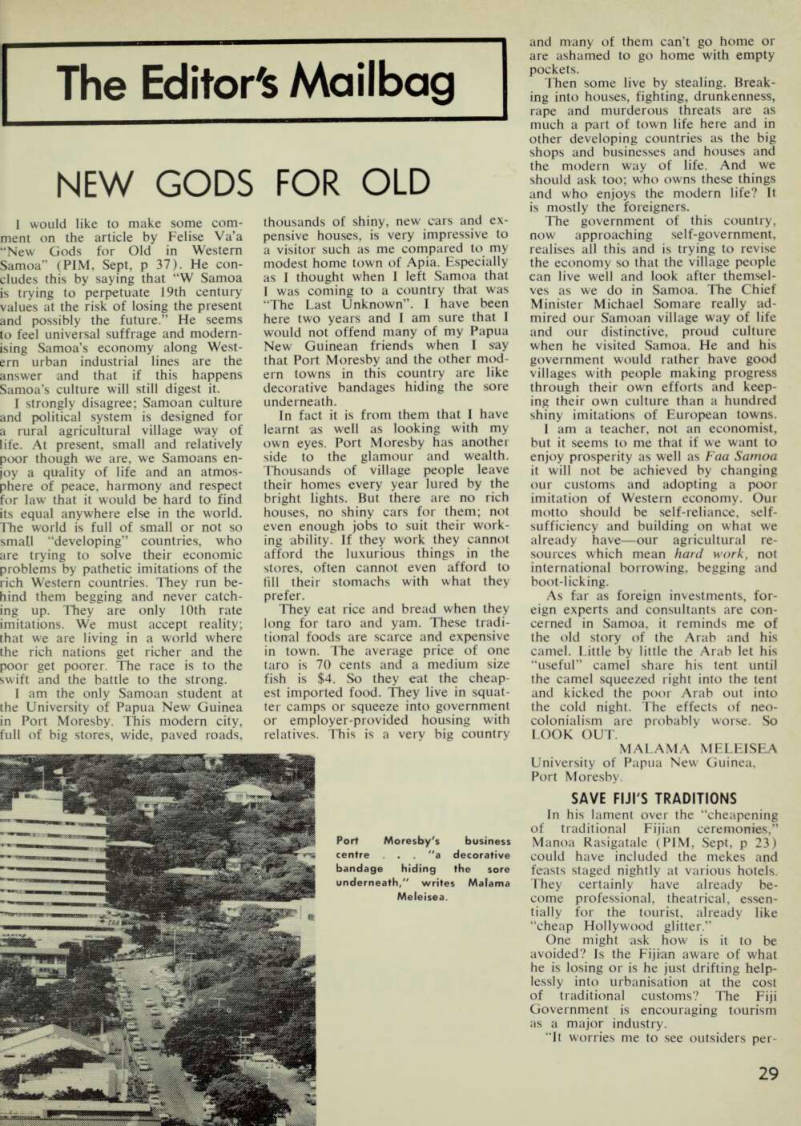
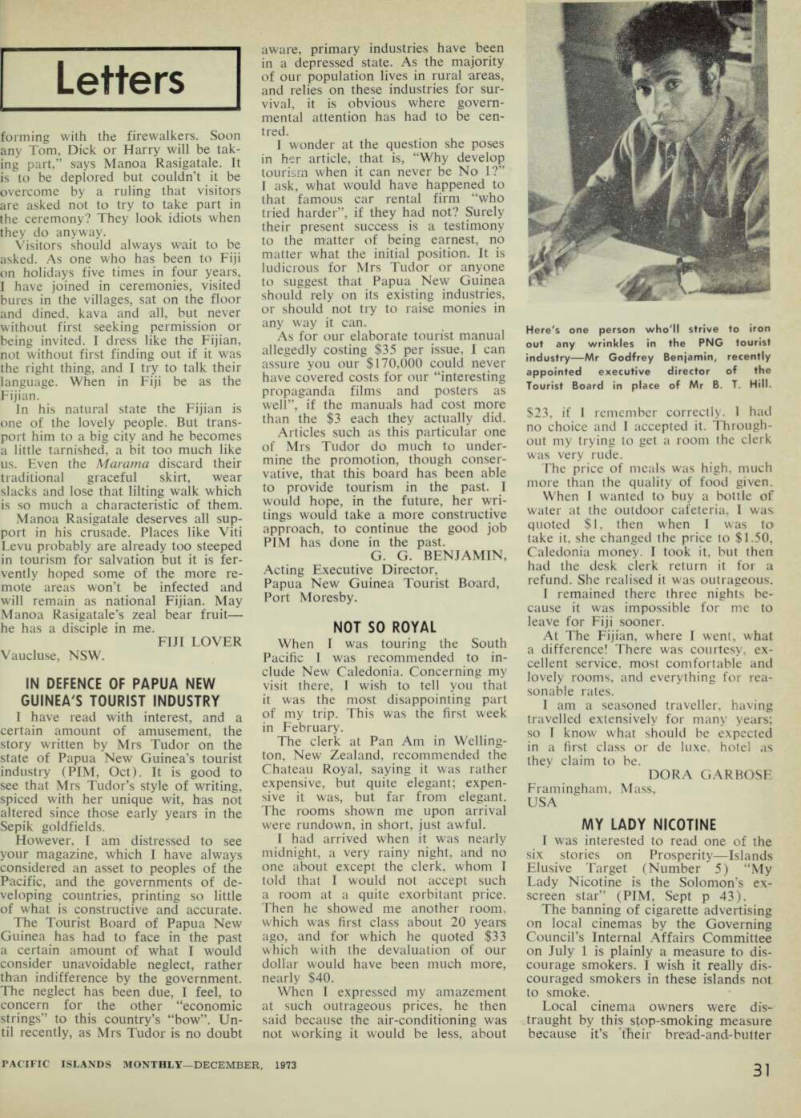

New Gods For Old
I would like to make some comment on the article by Felise Va’a “New Gods for Old in Western Samoa” (PIM, Sept, p 37). He coneludes this by saying that “W Samoa is trying to perpetuate 19th century values at the risk of losing the present and possibly the future.” He seems to feel universal suffrage and modernising Samoa’s economy along Western urban industrial lines are the answer and that if this happens Samoa’s culture will still digest it.
I strongly disagree; Samoan culture and political system is designed for a rural agricultural village way of life. At present, small and relatively poor though we are, we Samoans enjoy a quality of life and an atmosphere of peace, harmony and respect for law that it would be hard to find its equal anywhere else in the world.
The world is full of small or not so small “developing” countries, who are trying to solve their economic problems by pathetic imitations of the rich Western countries. They run behind them begging and never catching up. They are only 10th rate imitations. We must accept reality; that we are living in a world where the rich nations get richer and the poor get poorer. The race is to the swift and the battle to the strong.
I am the only Samoan student at the University of Papua New Guinea in Port Moresby. This modern city, full of big stores, wide, paved roads,
thousands of shiny, new cars and ex pensive houses, is very impressive to a visitor such as me compared to my modest home town of Apia. Especially as I thought when I left Samoa that 1 was coming to a country that was “The Last Unknown”. I have been here two years and I am sure that I would not offend many of my Papua New Guinean friends when I say that Port Moresby and the other mod ern towns in this country are like decorative bandages hiding the sore underneath, In fact it is from them that I have learnt as well as looking with my own eyes. Port Moresby has another side to the glamour and wealth, Thousands of village people leave their homes every year lured by the bright lights. But there are no rich houses, no shiny cars for them; not even enough jobs to suit their work ing ability. If they work they cannot afford the luxurious things in the stores, often cannot even afford to fill their stomachs with what they prefer.
They eat rice and bread when they long for taro and yam. These tradi tional foods are scarce and expensive in town. The average price of one taro is 70 cents and a medium size fish is $4. So they eat the cheap est imported food. They live in squat ter camps or squeeze into government or employer-provided housing with relatives. This is a very big country
and many of them can’t go home or are ashamed to go home with empty pockets.
Then some live by stealing. Break ing into houses, fighting, drunkenness, rape and murderous threats are as much a part of town life here and in other developing countries as the big shops and businesses and houses and the modern way of life. And we should ask too; who owns these things and who enjoys the modern life? It is mostly the foreigners.
The government of this country, now approaching self-government, realises all this and is trying to revise the economy so that the village people can live well and look after themsel ves as we do in Samoa. The Chief Minister Michael Somare really ad mired our Samoan village way of life and our distinctive, proud culture when he visited Samoa. He and his government would rather have good villages with people making progress through their own efforts and keep ing their own culture than a hundred shiny imitations of European towns.
I am a teacher, not an economist, but it seems to me that if we want to enjoy prosperity as well as Faa Samoa it will not be achieved by changing our customs and adopting a poor imitation of Western economy. Our motto should be self-reliance, self sufficiency and building on what we already have—our agricultural re sources which mean hard work, not international borrowing, begging and boot-licking.
As far as foreign investments, for eign experts and consultants are con cerned in Samoa, it reminds me of the old story of the Arab and his camel. Little by little the Arab let his “useful” camel share his tent until the camel squeezed right into the tent and kicked the poor Arab out into the cold night. The effects of neo colonialism are probably worse. So
Look Out.
Malama Meleisea
University of Papua New Guinea, Port Moresby.
Save Fiji's Traditions
In his lament over the “cheapening of traditional Fijian ceremonies,”
Manoa Rasigatale (PIM, Sept, p 23) could have included the mekes and feasts staged nightly at various hotels.
They certainly have already be come professional, theatrical, essen tially for the tourist, already like “cheap Hollywood glitter.”
One might ask how is it to be avoided? Is the Fijian aware of what he is losing or is he just drifting help lessly into urbanisation at the cost of traditional customs? The Fiji Government is encouraging tourism as a major industry.
“It worries me to see outsiders per
Port Moresby's business centre ... "a decorative bandage hiding the sore underneath," writes Malama Meleisea.
forming with the firewalkers. Soon any Tom, Dick or Harry will be tak ing part,” says Manoa Rasigatale. It is to be deplored but couldn’t it be overcome by a ruling that visitors are asked not to try to take part in the ceremony? They look idiots when they do anyway.
Visitors should always wait to be asked. As one who has been to Fiji on holidays five times in four years, I have joined in ceremonies, visited bures in the villages, sat on the floor and dined, kava and all, but never without first seeking permission or being invited. I dress like the Fijian, not without first finding out if it was the right thing, and I try to talk their language. When in Fiji be as the Fijian.
In his natural state the Fijian is one of the lovely people. But trans port him to a big city and he becomes a little tarnished, a bit too much like us. Even the Marama discard their traditional graceful skirt, wear slacks and lose that lilting walk which is so much a characteristic of them.
Manoa Rasigatale deserves all sup port in his crusade. Places like Viti Levu probably are already too steeped in tourism for salvation but it is fer vently hoped some of the more re mote areas won’t be infected and will remain as national Fijian. May Manoa Rasigatale’s zeal bear fruit— he has a disciple in me.
Fiji Lover
Vaucluse, NSW.
In Defence Of Papua New
Guinea's Tourist Industry
I have read with interest, and a certain amount of amusement, the story written by Mrs Tudor on the state of Papua New Guinea’s tourist industry (PIM, Oct). It is good to see that Mrs Tudor’s style of writing, spiced with her unique wit, has not altered since those early years in the Sepik goldfields.
However, I am distressed to see your magazine, which I have always considered an asset to peoples of the Pacific, and the governments of de veloping countries, printing so little of what is constructive and accurate.
The Tourist Board of Papua New Guinea has had to face in the past a certain amount of what I would consider unavoidable neglect, rather than indifference by the government.
The neglect has been due, I feel, to concern for the other “economic strings” to this country’s “bow”. Un til recently, as Mrs Tudor is no doubt
aware, primary industries have been in a depressed state. As the majority of our population lives in rural areas, and relies on these industries for sur vival, it is obvious where govern mental attention has had to be cen tred.
I wonder at the question she poses in her article, that is, “Why develop tourism when it can never be No 1?”
I ask, what would have happened to that famous car rental firm “who tried harder”, if they had not? Surely their present success is a testimony to the matter of being earnest, no matter what the initial position. It is ludicrous for Mrs Tudor or anyone to suggest that Papua New Guinea should rely on its existing industries, or should not try to raise monies in any way it can.
As for our elaborate tourist manual allegedly costing $35 per issue, I can assure you our $170,000 could never have covered costs for our “interesting propaganda films and posters as well”, if the manuals had cost more than the $3 each they actually did.
Articles such as this particular one of Mrs Tudor do much to under mine the promotion, though conser vative, that this board has been able to provide tourism in the past. I would hope, in the future, her wri tings would take a more constructive approach, to continue the good job PIM has done in the past.
G. G. Benjamin,
Acting Executive Director, Papua New Guinea Tourist Board, Port Moresby.
Not So Royal
When I was touring the South Pacific I was recommended to in clude New Caledonia. Concerning my visit there, I wish to tell you that it was the most disappointing part of my trip. This was the first week in February.
The clerk at Pan Am in Welling ton, New Zealand, recommended the Chateau Royal, saying it was rather expensive, but quite elegant; expen sive it was, but far from elegant.
The rooms shown me upon arrival were rundown, in short, just awful.
I had arrived when it was nearly midnight, a very rainy night, and no one about except the clerk, whom I told that I would not accept such a room at a quite exorbitant price.
Then he showed me another room, which was first class about 20 years ago, and for which he quoted $33 which with the devaluation of our dollar would have been much more, nearly $4O.
When I expressed my amazement at such outrageous prices, he then said because the air-conditioning was not working it would be less, about
$23, if I remember correctly. 1 had no choice and I accepted it. Through out my trying to get a room the clerk was very rude.
The price of meals was high, much more than the quality of food given.
When I wanted to buy a bottle of water at the outdoor cafeteria, 1 was quoted $l, then when I was to take it, she changed the price to $1.50, Caledonia money. I took it, but then had the desk clerk return it for a refund. She realised it was outrageous.
I remained there three nights be cause it was impossible for me to leave for Fiji sooner.
At The Fijian, where I went, what a difference! There was courtesy, ex cellent service, most comfortable and lovely rooms, and everything for rea sonable rates.
I am a seasoned traveller, having travelled extensively for many years; so I know what should be expected in a first class or de luxe, hotel as they claim to be.
Dora Garbose
Framingham, Mass,
Usa
My Lady Nicotine
I was interested to read one of the six stories on Prosperity—lslands Elusive Target (Number 5) “My Lady Nicotine is the Solomon's ex screen star” (PIM, Sept p 43).
The banning of cigarette advertising on local cinemas by the Governing Council’s Internal Affairs Committee on July 1 is plainly a measure to dis courage smokers. I wish it really dis couraged smokers in these islands not to smoke.
Local cinema owners were dis traught by this stop-smoking measure because it’s their bread-and-butter
Here's one person who'll strive to iron out any wrinkles in the PNG tourist industry—Mr Godfrey Benjamin, recently appointed executive director of the Tourist Board in place of Mr B. T. Hill.
jut they silently agreed in response o the voice of the Governing Coun ts Internal Affairs Committee.
While I have no objection to the Dan on cigarette advertising in cine lias, I think the committee is tackling he wrong man rather than the one with the ball.
While cigarette advertising through cinemas is banned shop owners and nanufacturers smile behind counters jelling their cigarettes and tobaccos.
Banning cigarette advertising in ocal cinemas is like banning matches o prevent a smoker lighting his cig arette, but that tobacco roll can still dc fired from any other source. You Dan cigarette advertising in cinemas Dut I can still get my cigarettes from ilmost every local shop and shop own ers get theirs from manufacturers without any objection or difficulties.
The aims of the Internal Affairs Committee of the Govco, as one can imagine, are to stop smokers or dis :ourage them from smoking or is Lis an attempt to reduce the high cost of living? If these aims had to dc achieved then tackle the main source, the cigarette and tobacco manufacturers which are the cause if cigarette advertising with glossy, wide-screen inducements in glorious technicolor in local cinemas and in more-advanced countries in the Pacific.
It’s like a disease, you won’t get real good results in curing it if you concentrate your treatment only on signs and symptoms unless you start /our treatment on the cause.
Also to me, there is no difference between trying to discourage and stop smokers hooked on overseas cigarettes and the setting-up of the locally re gistered company the Solomon Island Tobacco Company. Therefore, let Mr Black Twisted Tobacco and his “very thin-roll-your-owns-ready-rubbed” be advertised in cinemas instead of the attractive Lady Rothmans King Size because Mr Black Twisted Tobacco is now a very popular substitute among those who are hooked.
J. Tema.
Honiara.
Trouble In Noumea
In the September PIM (p 9, last paragraph) a subject appeared thanks to your Noumea correspondent which deserves my clarification.
The Frenchman of Vietnamese origin who threw the Molotov cock tail was mentally ill, having been in stitutionalised in the past for this
reason. Regarding the same type of attack against a Noumea store of which the city’s mayor is the director, your correspondent should have made the point that this was the act
of drunken, irresponsible people.
The way in which you presented these two incidents, without having said specifically that they were not political acts, seems a grave lack of attention on your part which could lead to a misunderstanding of the real facts.
Daniel Tardieu,
Newspaper Director.
Papeete, Tahiti. • Our Noumea correspondent’s reply: The Governor of the Colony of New Caledonia, a public servant appointed by President Pompidou, is the island chief executive on the poli tical administrative level. In fact, he enjoys the same powers as the Pre mier of the State of New South Wales. The Ballande store director, a Pompidou supporter, is Mayor of Noumea and member of the Terri torial Assembly. Any acts involving such personalities have political impli cations.
Gilbertese Spelling
With due respect to our budding minister Maunaa Itaia, (PIM, Nov, p 42), we (Gilbertese) should be very careful in following the so-called “original” ideas as to how to write our language. There is no traditional way of writing Gilbertese, hence it can be argued that there is really no original way of writing it. The art of writing needless to remind our bud ding minister at the PTC, came from other cultures. “Therefore both Maunaa’s “original” Gilbertese spell ing and Mrs Vivienne Hayward’s way of spelling are both together Euro pean in a sense. (Letters, PIM, Aug, p 23, Nov, p 42.) Dr Hiram Bingham, who made it possible for us to write Gilbertese, must have come (he or his progeni tors) from Europe or America. I have no complaints whatsoever of Dr Bingham’s very commendable effort in putting the Gilbertese language in print. What I disagree with is the mocking spirit with which Mr Maunaa Itaia attacked Mrs Vivienne’s way of spelling, implying her way may be European(?) whereas his way of spell ing (which is in fact the Bingham way) is correct, because it is “ori ginal” and may not be European, whereas in fact both ways of spelling are European (in the sense that their originators are Europeans) and there fore both are not traditionally original.
We Gilbertese should devise our own (if we can) way of spelling that
should be understandable by us. We must not be lured into believing (as Maunaa implies) that the only way to write Gilbertese sensibly is the so called “original” way (Bingham’s). I say this because all methods have a flow, and I don’t believe for a mo ment that the original way of spelling has solved all our problems as far as making the written word reflect as near as possible the sound of the spoken word.
Take the word mane which Maunaa used in his letter as an example to show this: mane spelt like that means money. Mane with an apostrophe means man. Now the trouble begins, because mane spelt exactly like the first mane (which means money) but differently pronounced means quite a different thing. It means tattered or worn out, eg Te mane ni Kunnikai meaning a tattered or worn out piece of cloth. Now this kind of written/ pronunciation problem is not taken care of by the Bingham way of spell ing.
I’m inclined to believe myself (as Mrs Vivienne seems to believe) that we should leave the words written simply as they are, without loading them with double vowels and conso nants and apostrophes, and let the Gilbertese pronounce them accord ing to the meaning of the words in the sentences. (Added to this, indi vidual scattered 16 islands' accents must be kept as showing where one comes from). Other advanced lang uages have done this (filling the problem gap of course by education) and they are remarkably all right.
For example in English when we see this sentence “I have read that book” we pronounce read as red, but if we see this sentence “I want to read Sir Arthur Grimble’s books”, we pro nounce read as if it is spelt reed.
Any better method of course will be welcome, but here we must make sure that at least the linguistic talent wherefrom we get this new method is at least of a high academic credi bility. Doubtful academics who write fake poetry based on other peoples talents are hardly the right source.
Ieruru Karotu
Dept of Agriculture,
Geic.
What Kind Of University?
The University of the South Pacific can’t survive without foreign aid. At the moment, it has Australian, Ameri can, British, Canadian and New Zeal and aid, not forgetting United Nations aid.
All these aid-givers have different ideas of a university for the South Pacific.
Since the birth of USP in 1968, no body seems to know what the role of
a university in a developing country should be.
Academics think that as long as it is a university, there should be per sonnel of high academic calibre — who normally live in a cloud. Stu dents should be free to pursue their own academic interests, and never mind what they do.
In the end, Arts students work as managers and Science students be come public servants.
USP should never have been allow ed to run second degrees. What could a MA student do in a country like the Ellice Islands where 5,000 people live and the only crop that grows is coco nut? What kind of a job is suited to a MSc student whose theory is up to world standard but who has in sufficient laboratory training?
India has a million unemployed graduates. What a difference it would make if India had had a million extra know-how farmers?
The recently proposed Diploma in Marine Biology, aided by the Can adian Government, makes better sense in a place such as the South Pacific.
In the last two or three years, Brit ish Overseas Development aid, and Australia and the United Nations have given a good hand on training in public administration and manage ment. This training in the eyes of the academics is not something to be proud of in a university; nevertheless, it has met a real need.
So far nobody has ever thought of doing something on forestry which is one of the things Fiji and several other countries need. Tourism should be the next on the list now that the South Pacific has become the world tourist dreamland.
Does it mean that USP students have no right to do what they want?
On the contrary, USP students can do what they want provided they can meet their own costs of fees and lodgings, otherwise, governments pay out enormous sums of money and still can't get the trained manpower that is needed.
One can understand the Fiji Min ister of Education, Mr lone Naisara’s threat to withhold funds to USP, un less USP produces the right men; “Then, somehow we will find the money,” he said.
Since the beginning of 1973, accord ing to UNISPAC, USP students from Fiji holding overseas scholar ships would be bonded to work for a number of years.
This seems to be a move in the right direction if the governments are going to benefit from this univer
sity.
Even all-mighty USSR can’t afford to let their Jewish graduates go to Israel without imposing a refund on
each graduate before they leave.
However, students who are involved in the bonding are not happy. Accord ing to UNISPAC, “It is not un reasonable to ask a student on schol arship to work for his or her govern ment after graduation, but it is un reasonable to spring a bond on a stu dent after the scholarship has already been held for some years.”
This is indeed a problem, but let’s hope that there will be an under standing soon, otherwise it will be very sad if USP produces a group of ‘disloyal’ public servants.
Grace Banks
University of the South Pacific, Suva.
Army's Role In Rotuma
Your article entitled “Rotuma: fascinating outpost” (PIM, Sept, p 47) was read with great interest in the New Zealand Army, as our en gineers played a large part in re building houses on the island after Hurricane Bebe.
I enclose the newspaper clippings covering this effort and will ensure that any news of further reconstruct ion projects in the Pacific Basin is passed on to you.
J. R. Webb (Capt)
Public Relations Officer (Army) Defence Headquarters, Wellington, NZ.
Advertisements & other items, pp. 34-39 (1 item)
Sullivans
MELBOURNE SYDNEY
C. SULLIVAN (EXPORT) PTY. LTD.,
4TH FLOOR. KEMBLA BUILDING,
60 MARGARET STREET. SYDNEY
(G.P.O. BOX 3373).
AUCKLAND CABLES AND TELEGRAMS: “CHASULL*’.
BRISBANE
LONDON
OFFERS A COMPREHENSIVE AND EFFICIENT
BUYING SERVICE TO THE PACIFIC ISLANDS
OFFICES AT:
PORT MORESBY • LAE • RABAUL • KIETA • MOUNT HAGEN • BULUMA • SUVA • LAUTOKA • NOUMEA • HONIARA • PORT VILA
SULLIVANS for SERVICE
HELLABY
1873 1973 One Hundred Years in the South Pacific and still the same consistently high quality
Hellaby’s Canned Meats
Quay St., Auckland. ** few
PACIFIC
AKRO
corn
/ / f
HAND
m
Offeree STOV£7T£
Australia's best selling non-electric Iron! For reliability, ease of handling, and excellence of quality at a low price, you can't beat the HANOI. It's simplicity itself to operate—NO PUMPING IS REQUIRED. IT'S IMPOSSIBLE TO OVERFILL THE FUEL TANK and one filling does approximately 2 hours effortless ironing. Attractively finished in nickel plate. Spare parts always available.
THE PORTABLE OUTDOORS COOKER at a sensible price!
Twin independent burners for fast cooking. Twin tanks for double capacity. Steel case, when opened, acts as triple-wind shield. Rustproof. Noisy or silent burners as required. Small or large porcelain enamel ovens also available separately. HANOI —the lowest priced QUALITY Twin Burner Portable!
' Evans Rd., Salisbury North. Ph. 47 2122
. BRISBANE, QUEENSLAND, AUSTRALIA
PROJECTS ANY FLAT IMAGE (4" wide or less) UP TO 6 FEET WIDE fo^S I#£ ”
AMAZING HOME THEATRE v-
¥ 4
FOR ONLY
FOR ONLY
$37 Actual photo of this
high quality
projector — Size 12" x B''
FULL GUARANTEE WITH EVERY PROJECTOR
Now . . . project a modest 4" wide illustration —and enlarge it monumentally up to 324 times its original picture area . . . breathtakingly sharp and clear! A 3i" x 3" illustration enlarges to 35" x 30" if screen is 6i ft away from projector—larger picture if screen is further away. No films or negatives required. Projects anything flat —magazine or book pages, photos, diagrams, draw- (plus 90c post and pack) (post free) mgs, charts, coins, snapshots, postcards, stamps, etc. in crisp black-and-white or beautiful true-to-life color! Has adjustable professional-type lenses. Great fun for all ages—educational—safe— and simple to operate. But hurryl Special prices for limited time only I Agents who can stock a minimum of 6 of these projectors are required in all areas. Enquiries welcome.
TO: R. HALL, 19 MARK STREET, NEW FARM, BRISBANE, QUEENSLAND, 4005.
Please rush to me □ 1 Home Theatre Projector (I enclose $19.90) □ 2 Home Theatre Projectors (I enclose $37).
NAME ADDRESS
PIM 12/73
LUILD COLOURS
COOL COMFORT
1973 FRENCH KNIT RANGE OF CAR SEAT COVERS AND BEACH WEAR ARE THE "IN THING' GIVE YOUR CAR THE BIG LIFT WITH RELAXARIDE ... THE SUPERIOR CAR SEAT COVER
Knit
NYLON
RELAXARIDE
mm ■r r h I
mmi
m —s * * * ' . M .. ■ ft w— •>< ■ r 4;
AVAILABLE FROM:
FRENCH KNITPTY. LTD., French Knit House, 18 Commonwealth Street, Sydney, 2000. Cable: Knitmills.
TRADE ENQUIRIES:
PETER FISHER TRADING PTY. LTD., 321 Pitt Street, Sydney, 2000. Cable: Fisherion.
Mercedes Benz 300 SL Roadster by courtesy of Mr. Adrian Ashton, Melbourne, Victoria.
In I tin
visit the
studio-museum
of French pointer
iV, Michautauchkine
CREATOR OF THE FIRST
ART GALLERY IN THE
SOUTH PACIFIC IN 1959
ON SALE • PAINTINGS
® DRAWINGS • FABRICS
O NEEDLE WORKS
O ADVISOR IN
SOUTH PACIFIC DECOR
ROAD TO PAGO VILLAGE.
BOX 224, PORT VILA.
NEW HEBRIDES.
Papua
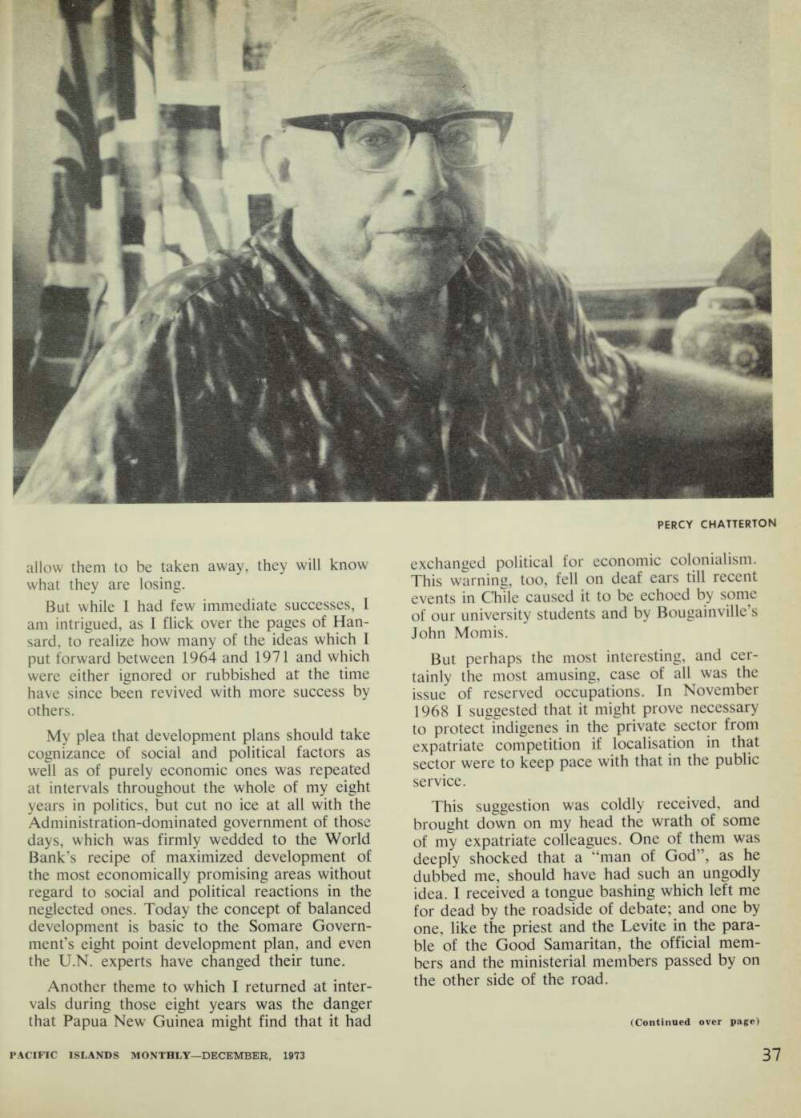
Footnotes
1 was about five years old my elder sister took me to Sunday School with her and, having dumped me unceremoniously in the kindergarten room, departed, leaving me to sink or swim.
I looked around me. On the walls were a number of brightly coloured pictures. One in particular caught my eye. It depicted a Papuan house, built on spindly posts at the water’s edge with the tide lapping round them. In front of the house, sitting on the beach, was a grass skirted Papuan girl watching over a baby in a string bag suspended from a projecting floor joist.
I fell in love at first sight, both with the picture and with the girl.
Twenty years later, after an education inter rupted by a stint of service as a British infan try private in northern France, followed by three years teaching in a Quaker boarding school in the north of England, I found myself sitting in the office of one of the secretaries
of the London Missionary So ciety, a stone’s throw from Westminster Abbey.
“Well”, he said, “we can offer you a teaching post either in Samoa or in Papua. Have you any preference?”
“Papua”, I said firmly.
That was just 50 years ago this month.
Eight months later I stood on the spot where, in 1884, Commodore Erskine had declared what was iater to become the Australian Territory of Papua, to be a British Protectorate. With my ministerial senior colleague I looked down the hill to where between four and five hundred children were milling around and gradually sor ting themselves out into a series of more or less straight lines. We went down the hill, and after hymn and prayer the infant classes hived off to a grass-thatched schoolroom nearby, with their Australian teacher and her Papuan helpers.
Gesturing towards those who were left, my colleague said, “The rest are yours”.
Percy Chatterton
Contributes
His Final
Footnotes
Thank you Papua
“Where are the classrooms?” I asked.
“There aren’t any”, he replied, and departed.
My induction course was over.
I spent the next 40 years as a member of a missionary team which was struggling with diminishing resources and through years of depression and war and their aftermath to maintain the far flung work begun by optimis tic missionary pioneers in the spacious, affluent heyday of 19th century English Noncon formity, But our weakness turned out to be our
strength. Due to our poverty and our chronic shortage of overseas staff, we were willy nilly “localising” well ahead of the field, and my closing years of mission service saw the es tablishment of a fully self governing indigenous church, the Papua Ekalesia, on the foundations laid by the L.M.S. over a period of 80 years.
In 1964 1 reached the age limit for L.M.S. missionaries, and retired from mission service.
But fortunately, or perhaps un fortunately, there is no age limit for politicians, and in that same year I became a member of Papua New Guinea’s House of Assembly. I remained an M.H.A. for two four-year terms, retiring for a second time in 1972.
I hated electioneering, but enjoyed being in the House, though looking back I realize that 1 expended most of my energy there in fighting for lost causes. My one substantial win was the passage of the Human Rights Bill in 1971.
Just how many of the rights set out in that ordinance will survive remains to be seen, but at least it ensures that if the people of Papua New Guinea decide to throw them away, or
allow them to be taken away, they will know what they are losing.
But while I had few immediate successes, I am intrigued, as I flick over the pages of Han sard, to realize how many of the ideas which I put forward between 1964 and 1971 and which were either ignored or rubbished at the time have since been revived with more success by others.
My plea that development plans should take cognizance of social and political factors as well as of purely economic ones was repeated at intervals throughout the whole of my eight years in politics, but cut no ice at all with the Administration-dominated government of those days, which was firmly wedded to the World Bank’s recipe of maximized development of the most economically promising areas without regard to social and political reactions in the neglected ones. Today the concept of balanced development is basic to the Somare Govern ment’s eight point development plan, and even the U.N. experts have changed their tune.
Another theme to which I returned at inter vals during those eight years was the danger that Papua New Guinea might find that it had
exchanged political for economic colonialism.
This warning, too, fell on deaf ears till recent events in Chile caused it to be echoed by some of our university students and by Bougainville’s John Momis.
But perhaps the most interesting, and cer tainly the most amusing, case of all was the issue of reserved occupations. In November 1968 I suggested that it might prove necessary to protect indigenes in the private sector from expatriate competition if localisation in that sector were to keep pace with that in the public service.
This suggestion was coldly received, and brought down on my head the wrath of some of my expatriate colleagues. One of them was deeply shocked that a “man of God”, as he dubbed me, should have had such an ungodly idea. I received a tongue bashing which left me for dead by the roadside of debate; and one by one, like the priest and the Levite in the para ble of the Good Samaritan, the official mem bers and the ministerial members passed by on the other side of the road.
(Continued over page)
Percy Chatterton
Three years later, in September 1971, the government brought down its Employment (Training and Regulation) Bill, which cleared the way for doing just what I had suggested on a larger scale than I had ever envisaged. It was passed without serious opposition, and today the list of reserved occupations runs into hundreds.
I am hopeful of seeing two other proposals of mine revived.
One is my proposal for the appointment of an Ombudsman, defeated at the time it was made by a cynical appeal to the cupidity of members whose vision did not extend beyond the need for more roads and bridges in their electorates. The other is my suggestion that the City of Port Moresby should be excised from the Central District and designated the National Capital District. Such a change would be to the benefit both of Port Moresby and of the rural areas of the Central District, whose people’s
interests are at present very much over-shadow ed by the interests of the city. now the time has come for my third re tirement, this time as a PIM columnist. 1 want more time to enjoy the view from my front verandah; and I think that the time has come when the kind of things which I have enjoyed saying in this column will have to be said by Paguineans or not at all.
It’s probably just a matter of genes, or hor mones or something, but I have a tempera mental liking for small things and simple people.
I like small cars which don’t hog the road, small radios which don’t blast the ear drums, small nations which don’t become arrogant, small villages in which people don’t become anonymous, and small churches which don’t lose the simplicity of the Man of Nazareth.
I detest ostentation, pomposity, and self assertiveness.
I deplore the cult of bigness. The dinosaur died of it; and it may yet turn out to be homo sapiens’ terminal illness.
In these days I seem to be odd man out. The Papua I came to and learned to love has been swallowed up in dinosaurian Papua New Guinea.
The Papua Ekalesia, the church which grew out of the work of the L.M.S. in Papua and the structure of which I helped to shape, has been swallowed up in the dinosaurian United Church of Papua, New Guinea and the Solo mon Islands. And all around me erstwhile friends and colleagues are busily engaged in dinosaurian activities like “nation building” and “creating a national identity”. I neither con demn nor applaud these activities. All I have to say about them is that they are not my cup of tea.
Odd man out? Well, not quite perhaps. There are still folk out in the villages, and even in the shanty settlements of the towns, who think as I do that the compiler of the Book of Proverbs knew what he was talking about when he said, “Better a dish of vegetables with love than the best beef served with hatred”. But their num bers are diminishing all the time; they’re being hooked by dinosaurianism.
Anyway I can’t complain. I’ve been very, very lucky. I’ve spent my working life among the kind of things and people I like best—small things and simple people.
Thank you, Papua, for all you have done for me. Thank you even more for what you have done to me.
Advertisements & other items, p. 42 (1 item)
To)
r-^l
PAPUA
NEW GUINEA
PRINTING CO.
PTY. LTD.
Serving the Country from Aitape to Alotau Manus to Moresby Leaders in Commercial Offset and Letterpress Printing • Stationery • Office Supplies • Office Equipment • Rubber Stamps • Self-Adhesive Labels • In Fact, Everything For the Office.
P.O. Box 633, Port Moresby P.O. Box 759, Lae P.O. Box 30, Mt Hagen P.O. Box 1239, Rabaul P.O. Box 466, Kieta
Islanders flex the muscles
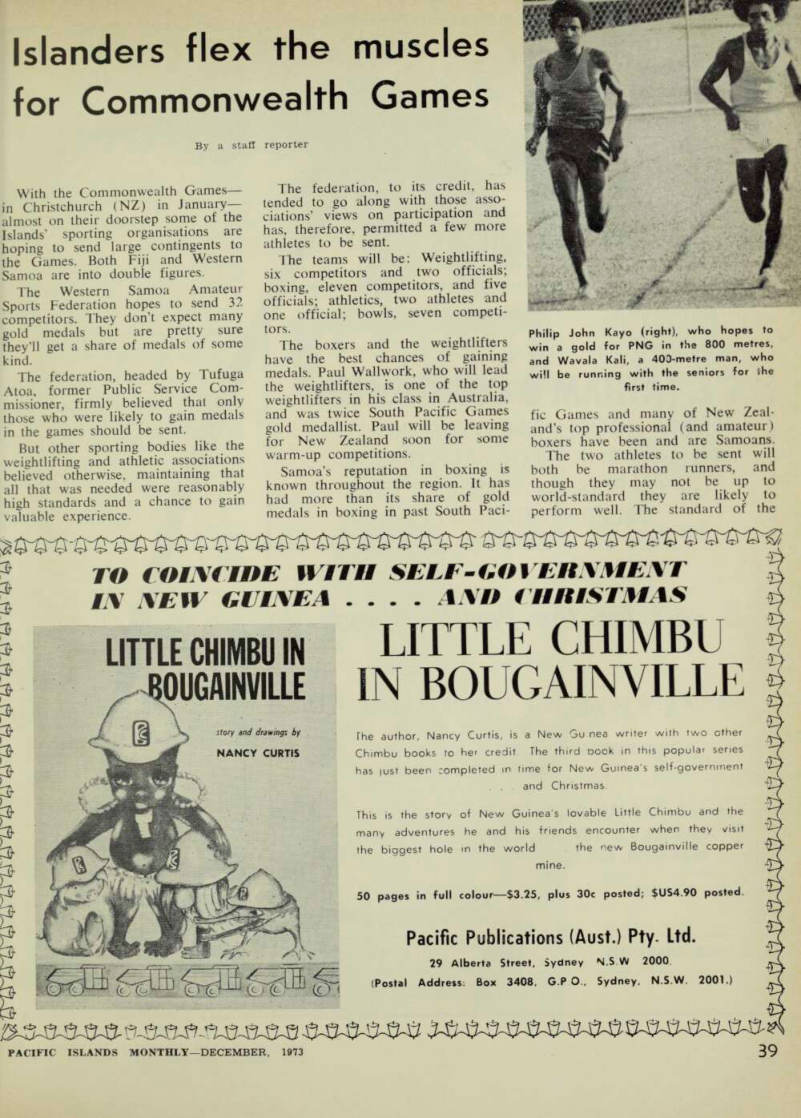
for Commonwealth Games
By a staff reporter
With the Commonwealth Games — in Christchurch (NZ) in January— almost on their doorstep some of the Islands’ sporting organisations are hoping to send large contingents to the Games. Both Fiji and Western Samoa are into double figures.
The Western Samoa Amateur Sports Federation hopes to send 32 competitors. They don’t expect many gold medals but are pretty sure they’ll get a share of medals of some kind.
The federation, headed by Tufuga Atoa, former Public Service Com missioner, firmly believed that only those who were likely to gain medals in the games should be sent.
But other sporting bodies like the weightlifting and athletic associations believed otherwise, maintaining that all that was needed were reasonably high standards and a chance to gain valuable experience.
The federation, to its credit, has tended to go along with those asso ciations’ views on participation and has, therefore, permitted a few more athletes to be sent.
The teams will be: Weightlifting, six competitors and two officials; boxing, eleven competitors, and five officials; athletics, two athletes and one official; bowls, seven competi tors.
The boxers and the weightlifters have the best chances of gaining medals. Paul Wallwork, who will lead the weightlifters, is one of the top weightlifters in his class in Australia, and was twice South Pacific Games gold medallist. Paul will be leaving for New Zealand soon for some warm-up competitions.
Samoa’s reputation in boxing is known throughout the region. It has had more than its share of gold medals in boxing in past South Paci-
fic Games and many of New Zeal and’s top professional (and amateur) boxers have been and are Samoans.
The two athletes to be sent will both be marathon runners, and though they may not be up to world-standard they are likely to perform well. The standard of the
Philip John Kayo (right), who hopes to win a gold for PNG in the 800 metres, and Wavala Kali, a 400-metre man, who will be running with the seniors for the first time.
New Guineans After The Gold
bowling is not known, but the bowlers are confident.
Five Papua New Guinean track athletes have been selected. They are Philip John Kayo, 27, Wavala Kali, 19, Wallace Hofagao, 19, Iroa Pamoa, 19 and Vivian Ore, 17, writes Michael Joyce in Port Moresby.
Kayo has most international ex perience having won gold medals in the 800 metres at Tahiti (1971) and the 5000 metres at Port Moresby (1969). The Papua New Guinea AAU realistically set selection stan dards at the potential to get past the first heat at Christchurch but Kayo, a determined competitor, is training three times a day and has his sights set on a gold in the 800 metres.
Wavala Kali, a Port Moresby Teachers’ College student, has just moved up to the senior ranks and refuses to discuss the tough task in front of him in the 400 metres. He has improved tremendously since he took third place in the Australian junior 400 metres in March and now shows much of the fitness and polish of the outstanding Fijian runners Saimoni Tamani and Samu Yavala.
Wallace Hofagao, the national cross country champion, has the for midable task of taking on Kenyan world steeplechase record holder Jipcho in the 1500 metres at Christ church and will also go for the 800 metres with Philip John Kayo whom he narrowly beat in that event in the Papua New Guinea titles in Lae in September, Wallace is very national istic and is willing to suffer many miles of training a day in Lae’s steamy heat for the honour of repre senting his country. He has made two trips to Australia this year where he gained a good idea of commonwealth middle distance standards.
Iroa Pamoa will go for the 110 metres hurdles and the 400 metres hurdles. He has great determination and is a good hurdler but has to gain a lot of fitness before the games.
Vivian Ore, the baby of the team, has the most formidable task of all.
He will run in the 10,000 metres and the marathon. Like the rest of the team he has outstanding dedication and determination, but few would give him much of a chance against Britain’s world record holder for the 10,000 metres David Bedford. Vivian styles himself on Ethiopia’s great marathon runner Abebe Bikila and he is currently running over 100 miles a week over Port Moresby’s barren hills. Selectors had long term aims
in mind in giving him his first taste of world-class competition at Christ church The ' track team will spend five weeks in Australia immediately before the Games and their sharpening up will end at the New South Wales Championships on Sydney’s new tar tan track.
Papua New Guinea is likely to be represented at six of the nine sports contested at Christchurch but with
expatriates dominating the “affluent” sports like shooting and bowls the interest of Papua New Guineans will centre on the performance of their ‘rack team. Sports observers in Papua New Guinea are unanimous hat he country s small track team will be the best prepared and the most determined ever to l eave these shores, Fiji will have a team of 57, made up of 48 participants and nine offi cials. There will be 18 athletes, with two officials, seven bowlers and one official, 11 boxers and two officials, eight swimmers and two officials and four weightlifters and two officials.
Advertisements & other items, pp. 43-46 (1 item)
In Bougainville
TO COIN! IDE WITH
t\ SEW GUINEA ... IVW
LITTLE CHIMBU IN
BOUGAINVILLE
story and drawings by
NANCY CURTIS
■ i A
LITTLE CHIMBU
IN BOUGAINVILLE
The author, Nancy Curtis, is a New Gu.nea writer with two other Chimbu books to her credit The third oook in this popular series has iust been completed in time Tor New Guinea's self-government and Christmas This is the story of New Guinea's lovable Little Chimbu and the many adventures he and his friends encounter when they visit the biggest hole in the world the new Bougainville copper mine. 50 pages in full colour—s3.2s, plus 30c posted; SUS4.9O posted.
Pacific Publications (Aust.) Pty. Ltd.
29 Alberta Street, Sydney N.S W 2000 (Postal Address; Box 3408, G.P 0., Sydney, N.S.W. 2001.)
% S. E. TATHAM & CO. PTY. LTD.
ASKEW HOUSE, 364 LONSDALE ST.,
MELBOURNE, 3001, AUSTRALIA.
G.P.O. BOX B—CABLES "SET"
TELEPHONE: 601125
Buyers for the Pacific Islands
AND IN
PAPUA NEW GUINEA: S. E. TATHAM (P.N.G.) PTY. LTD.,
LAE; MALEKULA ST. (P.O. BOX 1562).
PORT MORESBY: CNR. GOROA & MUNAHU STS., GORDON
(P.O. BOX 6733, BOROKO).
FUI: S. E. TATHAM (FIJI) LTD.,
LAUTOKA P.O. BOX 366,
SUVA G.P.O. BOX 671,
I
YOUR GUARANTEE
i
FOR SERVICE
SINCE 1924
VENTILATING
VRE
LO
OWB
IN THE HOME
Add beauty and sunshine to your home by installing Australia's most economical, attractive louvre windows ... Sandy adjustable all-louvre windows.
Every modern feature is incorporated-in them, and they can be fitted with plain or figured glass blades ... also, temparature reducing folded aluminium blades.
IN INDUSTRY
The most practical answer to provide weather-resistance and controlled ventilation to factories, offices and stores is the use of Sandy Adjustable Aluminium Louvres. They are most economical in installation and offer durability at such low cost!
the most versatile pwfor tropical
a^ication
m— fIPI
11 or mi “ u * jnKPct proofed, m are termite and msectp
1 -aKssgga
™ •• i .• are made by \ l& — Klinku plywoods aremadeby "■^^SSSSaass:
count on
RLINRII
Samoans Don't Like Tight Belts

From FELISE VA’A in Apia
Last year, Western Samoa was faced with a balance of payments deficit of SWS 1.5 million, the first since 1967. Although the amount itself is peanuts compared with the deficits of other countries, the pre sent Minister of Finance, Sam Saili, treated it almost as a matter of dis astrous proportions and one that had to be solved immediately.
In his budget speech in parliament, the minister said the deficit was due to a number of causes, the most important of which was “a serious drop in receipts from agricultural exports, which in 1972 totalled only SWS3.3 million, compared with SWS4.6 million in 1971”.
The other causes mentioned were the “rapid expansion of credit avai lability, government expenditure and some considerable increase in the importation of items which, for a developing country, can only be de scribed as luxuries”.
So Saili wasted no time in im plementing new policies designed to cure the country’s balance of pay ments position.
He said the government saw the rehabilitation of the banana industry as the quickest and best answer to the problem of reduced receipts from agricultural exports. The Agriculture Department, therefore;, was giving primary attention to achieving this end.
Additionally, Saili saw fit to re duce the level of credit availability; the National Provident Fund and the Public Trustee were both in structed to stop all loans, and the Bank of Western Samoa as well as other credit institutions were asked to co-operate and to limit the amount of their loans to the public as much as possible.
In the government sector, there was a mad scramble to save money and scores of employees, in the Public Works Department, for ex ample, were laid off. Saili also an nounced that the government would limit its overseas borrowing and try to save by cutting down on mini sterial travel.
But hardest hit of all was the com mercial sector whose import allo cations were drastically cut down to 90 per cent of the 1972 level.
Within six months of the new policies, the effects were beginning to be felt.
The standard of living either stood still or deteriorated because of lack of development capital, made available
mostly through loans from the credit institutions.
In the commercial sector, the effects were most noticeable. For there was a desperate shortage of goods of all sorts, in particular freezer goods canned fish, corned beef, and cigarettes. The merchants simply explained that the shortages were caused through an insufficient allocation for more goods. Indeed by June of this year, it is believed one major firm in Apia had already run out of its allocation!
Thus, though the minister may have partly succeeded in stemming the progress of the national deficit, he failed dismally in maintaining or improving the people’s standard of living, which after all is the primary concern of government, Indeed,, the minister could be questioned whether the deficit was really as bad as it looked; whether instead of repressive measures he could have resorted to a massive build-up of industries with export potential—but obviously this is the
aarder course. Of course the minister is talking about his “duty free zone” but to all appearances, this seems to be a long-term project if it is ever implemented, while what the country needs now is an additional
short-term industrialisation project.
Some local economists think that the minister’s policies will have the effect of putting the country’s deve lopment back by five to 10 years.
One thing is fairly clear now: the riinister’s economic policies are not Dopular with the masses or with the nerchants.
The rising expectations of the samoan people will not be put back lot even by Saili, whose political : uture now seems uncertain.
Advertisements & other items, pp. 47-48 (1 item)
Sunlovers International
1 11 .
COLLECTION
New Reactamatics Handmade Frames New Rainbows Gradu Tints Aluminium Frames Latest High Fashion New Super Polarised
A. RIETTE (EXPORT) PTY LIMITED
Telegrams & Cables Ramartime Telephone 255144. 300 George St. Sydney 2000
THE BIG FLAVOURS COME TO THE
SOUTH PACIFIC
iWf Hit 1-3* 3 wm ■I ';'.a
t E r»:
t- '
EytiAHV
The red hibiscus symbol proudly marks the introduction of some of New Zealand's most popular soft drinks by Island Bottlers of Fiji Ltd., from their new modern factory.
In Apia in Western Samoa the same flavourful range is produced by the Apia Bottling Company and people everywhere are asking for these famous names
LEMON and PAEROA, TARTAN DRY GINGER
ALE and the colourful fruity range of JU'CY
SOFT DRINKS.
They're yours to enjoy . . . time after time.
Manufactured under franchise to Innes Tartan Ltd., Auckland, New Zealand by-
ISLAND BOTTLERS OF FIJI LTD.
APIA BOTTLING COMPANY LTD.
Save hundreds of dollars
on Australia’s most efficient
WALK IN, ALUMINIUM
COOLROOMS AND
FREEZE ROOMS
Hundreds already installed! The most economical supplementary coolrooms for bottles and food, providing the largest storage capacity of any comparable coolrooms of the same exterior dimensions. Five sizes —from 90-360 cu. ft. capacity; 16 models offering normal temp., two temp., deep freeze, or for pastry and ice storage applications. White vinyl interior, embossed rustproof aluminium exterior. • SUPPLIED IN EASY-TO-ERECT, DO-IT-YOURSELF KIT FORM • PETROL AND PETROL-ELECTRIC MODELS ARE AVAILABLE FOR AREAS WHERE POWER IS LIMITED OR NON-EXISTENT Available from: AUSTRALIAN NEW CALEDONIA EXPORTS (SILVER & BARDA), 363 George St., Sydney, 2000 and Branches.
BRECKWOLDT & CO., 276 Pitt St., Sydney, 2000 and Branches.
PETER FISHER TRADING PTY. LTD., 321 Pitt St., Sydney, 2000.
HAGEMEYER (A'SIA), 59 Anzac Pde., Kensington, 2033 and Branches.
Manufactured by.
KERR BROS, 65 York St., Sydney, 2000.
NELSON & ROBERTSON PTY. LTD., 197 Clarence St., Sydney. 2000.
RABAUL TRADING CO. PTY. LTD., P.O. Box 219, Rabaul and Branches.
ROY GALLIMORE & ASSOCIATES, P.O. Box 179, Vila, New Hebrides.
C. SULLIVAN (EXPORT) PTY. LTD., 60 Margaret St., Sydney, 2000 and Branches.
W. S. TAIT & CO. PTY. LTD., 31 Macquarie Place, Sydney, 2000 and Branches. m 199 Parramatta Road, Cnr. Skarratt Street, Auburn, N.S.W. 2144, Australia. Phone: 648-1711.
Powered by Kelvinator.
Five-year warranty on compressor. Early delivery.
stable copra industry
Fiji wants a stable copra industry
Fiji is spearheading a move which nay lead to orderly marketing in the opra industry which is now enjoying i boom. The Fiji Coconut Board ecently asked the government to call n international meeting of copra iroducing countries to discuss sta •ilising world copra prices.
The board chairman, Mr lan Tiomson, told about 80 Fiji planters bat the fluctuating price of copra as not satisfactory. He hoped the rice could be stabilised about $2OO ton.
Mr Thomson spoke shortly before saving fc\ Geneva to attend the In srnational Sugar Conference. While lere he hoped to be able to sow the seds for a copra meeting, perhaps 3 set up an organisation to control le international price of copra.
The Fiji Minister for Agriculture, lr Doug Brown, followed up with suggestion that the planters launch combined campaign to get a stable uropean Economic Community price )r coconut products.
The South Pacific region produces ;ss than 10 per cent of the world’s Dpra. The Pacific Islands Producers’ .ssociation had discussed the possi ility of getting together on a re ional basis for such things as crush ig copra, but had not yet achieved iat.
The EEC had suggested a list of ght primary products from develop ig countries for which prices could i established, but coconut products ere not included.
It could well be that Samoa and onga could combine with Fiji at the *xt round of talks with the Com ion Market to press for the inclu on of copra, coconut oil and meal the proposed list, Mr Brown con uded.
Advertisements & other items, pp. 49-50 (2 items)
Cific Islands Monthly—December, 1973
Up! Goes the
Otis cater for increasing demands with a fully equipped Fiji office serving the complete Pacific area. Lifts or escalators.
Dumbwaiters or preventive maintenance. Whatever your demands in vertical transportation demand Otis.
G. B. Hari Building, 14 Pier Street, Suva. Phone 25-485 .
Up! Goes the
demand for Otis
''V'j □ 0T.33
Bank of Hawaii is the bank of the Pacific.
You can bank on it... in Guam iSLTamuning t Koror Yap Jf Saipan Roi Namur JSL Kwajalein JltPonape 2* American Samoa.
All in all, we have 70 branches throughout Hawaii and the Pacific offering full banking services. May we help you?
Bank of Hawaii the bank of the Pacific® • affiliate of Banque de Tahiti
Magazine Section
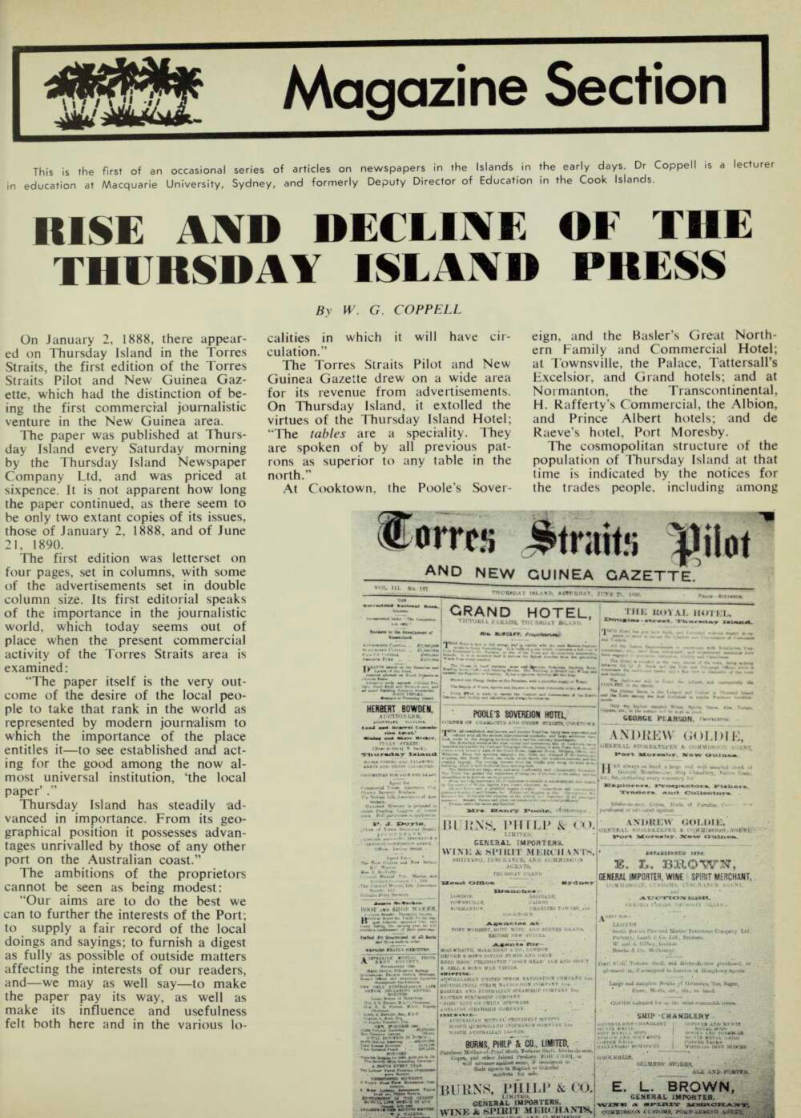


Rise And Decline Of The
Thursday Island Press
This is the first of an occasional series of articles on newspapers in the Islands in the early days. Dr Coppell is a lecturer in education at Macquarie University, Sydney, and formerly Deputy Director of Education in the Cook Islands.
By W. G. Coppell
On January 2, 1888, there appear ed on Thursday Island in the Torres Straits, the first edition of the Torres Straits Pilot and New Guinea Gaz ette, which had the distinction of be ing the first commercial journalistic venture in the New Guinea area.
The paper was published at Thurs day Island every Saturday morning by the Thursday Island Newspaper Company Ltd, and was priced at sixpence. It is not apparent how long the paper continued, as there seem to be only two extant copies of its issues, those of January 2, 1888, and of June 21, 1890.
The first edition was letterset on four pages, set in columns, with some of the advertisements set in double column size. Its first editorial speaks of the importance in the journalistic world, which today seems out of place when the present commercial activity of the Torres Straits area is examined: “The paper itself is the very out come of the desire of the local peo ple to take that rank in the world as represented by modern journalism to which the importance of the place entitles it—to see established and act ing for the good among the now al most universal institution, ‘the local paper’.”
Thursday Island has steadily ad vanced in importance. From its geo graphical position it possesses advan tages unrivalled by those of any other port on the Australian coast.”
The ambitions of the proprietors cannot be seen as being modest: “Our aims are to do the best we can to further the interests of the Port; to supply a fair record of the local doings and sayings; to furnish a digest as fully as possible of outside matters affecting the interests of our readers, and—we may as well say—to make the paper pay its way, as well as make its influence and usefulness felt both here and in the various lo
calities in which it will have cir culation.”
The Torres Straits Pilot and New Guinea Gazette drew on a wide area for its revenue from advertisements.
On Thursday Island, it extolled the virtues of the Thursday Island Hotel; “The tables are a speciality. They are spoken of by all previous pat rons as superior to any table in the north.”
At Cooktown, the Poole's Sover
eign, and the Basler’s Great North ern Family and Commercial Hotel; at Townsville, the Palace, Tattersall’s Excelsior, and Grand hotels; and at Normanton, the Transcontinental, H. Rafferty’s Commercial, the Albion, and Prince Albert hotels; and de Raeve’s hotel. Port Moresby.
The cosmopolitan structure of the population of Thursday Island at that time is indicated by the notices for the trades people, including among
others —Ernst Sturzebecher, store keeper; Miss Buschel, pianoforte tui tion; D. Mills, boatbuilder; Viggo Jacobsen, accountant; Ono Showgers, Japanese laundryman; Tommy Japan, shooting gallery; Antonia Spain, tail or and hairdresser; and Tong Sing Wah, Sun Ti Lee, Kwong Hang Hing, Wong Fat, Lee Foo and On Lee, Chinese storekeepers.
The paper carried a wide range of overseas reports—Lord Randolph Churchill was on his way to St Peters burg; Queen Victoria was to visit Florence in the spring months; and students were dissenting at St Peters burg.
The first edition Pilot and Gazette was obviously intent on meeting its objective of recording the local doings and sayings; “John Moreman is a man no more, No matter whether grave or mel low; Whate'er he may have been before, He’s now a jolly good fellow— at least his boarders at the Euro pean said so on Christmas night, and they clinched the bold assertion with a ‘nip, nip—hurrah’ and a flourish of Udopho Wolfe.’ (A reference obviously to the Schnapps which Burns Philp adver tised).
Thursday Island was quite patently a lively place. The local police force was congratulated “upon the excellent Drder which prevailed on the Island throughout the late Christmas holi days”; the Collector of Customs was reported to have seized 200 brilliants, 1,200 rubies, 650 sapphires, and some rings and pins smuggled on to the Island by Mr Joseph Levy, of Paris; and, four men during the previous week had tempted the unsophisticated inhabitants to adorn their persons with gorgeous jewellery and precious stones.”
Mr Levy—one of four, was repor ted to have been constrained in his activities by seizure of his stock.
“Solomon, when arrayed in the very zenith of his glory, would have tur ned green and yellow with envy ;ould he have seen the people of this little island decked out with the full :ontents of the show cases of this quartette. But we didn’t ‘deck’ to an nverwhelming extent, so Solomon need not feel jealous of us. We are a modest people here and are satis fied with the unassuming pearl—and iven that we do not use as wearing apparel, but transmute into a trifle nf gold, which in turn we convert
into the food we eat—and the drop we drink.”
The June 21, 1890 issue of the Pilot indicates that the paper’s pro prietors were not enamoured of Sir William McGregor, the Governor of British New Guinea.
“Sir William had proven an ex plorer among the very foremost ranks, but as an administrator he has not been a success. However much he may desire that his name shall be written on the pages of history as a great explorer, it is unquestionable that the colonies will not long toler ate the expenditure of the greater part of their money in making his name famous.”
This later edition of the Pilot shows considerable departures from the for mat of the first edition. One page is given almost entirely to advertise ments of Melbourne business houses —J. Taylor, Saddler of Hargreaves
Street; Clausen and Co, the complete home furnishers of Bourke Street and the Golden Specific Co of Collins Street with positive cure of drunken ness— “lt can be given in a cup of coffee or tea without the knowledge of the person taking it; it is absolutely harm less and will effect a speedy and permanent cure, whether the patient is a moderate drinker or an alcoholic
Wreck. It Never Fails.”
At this time the paper was printed and published for the Torres Straits Newspaper Coy Ltd and it had clear intentions of future expansion. This edition contained several items reprin ted from English and American newspapers—‘Four Monarchs in Prison’ from the New York Times, the Arizona Kicker from the Detroit Free Press as well as a lengthy ex
(Continued on p 51)
tract from My Mrs Fitzallen by Marie Virginia Harding.
These contributions were seen to enhance the value of the Pilot. “The Manager of this paper has completed arrangements by which he trusts to be able to supply his subscribers with a supplement each week. The first number appears with this issue. It will be found to contain a very large amount of acceptable reading matter; and we earnestly hope the venture will meet with sufficient reward to warrant a continuance of the supp lements.”
The successor to the Pilot and Gaz ette was The Torres Straits Daily Pilot, a few copies of which are also held in Australian libraries, the earl iest edition being August 1, 1918, and the most recent, August 29, 1940. All issues inform the reader that the Daily Pilot is published for the pro prietress by A. Corran, Thursday Island, and that the subscription is one shilling payable in advance, one
copy for each subscriber, or sixpence each for single copies.
All copies are printed on one side only of a single sheet, and are set out in either two or three columns.
The editions from 1933 onwards state that the paper is registered at the GPO Brisbane for transmission as a newspaper. The Daily Pilot carried shipping notes, some local advertise ments, and a few short items of Aus tralian or general world news.
The August 29, 1940 edition car ried this notice: “£5O reward for in formation leading to the conviction of any of my employees found guilty of selling or handing over trochus shell, Beche de Mer, or any other marine produce to any other person or other than my authorised agents —T. J. Farquhar.”
In 1957 the Torres News was es tablished on Thursday Island as a weekly news-sheet, published each Tuesday by G. and J. Maloney.
The Maloneys still print and pub lish a cyclostyled paper, which carries the masthead of Torres News Bulle tin of Thursday Island and Torres Straits News. The issue of September 18, 1973 which was priced at 10c is completely concerned with the local scene, including weather notes, the results of the Lions Club raffle, Bowls Club notes, an item on Thurs day Island’s new wharf, an appeal for blood donors and a report contributed by the Principal of Thursday Island High School.
The decline in the commercial im portance of Thursday Island since the days of the Torres Straits Pilot and New Guinea Gazette is seen in the four advertisements for accommo dation houses, The Rainbow Motel, The Grand Hotel, the Royal Hotel and the Torres Straits Hotel.
No longer are “tables a speciality”, in fact only the Rainbow Motel allu des to any culinary virtues, in its case a snack bar and restaurant.
Advertisements & other items, p. 52 (1 item)
Good? Year
ST X: m h
cat
' r I >
GOOD? YEAR
TRACTION HI-MILER HI-MILER G 8
TRACTION 100
SUPER ROAD LUG
ALL SERVICE
For rugged 'stop-go' de- Round shoulder tire With 3-T cord, Abrasion resistant ex- A non-directional livery work. Gives long- for highway trucks, stronger than steel, tra-thick tread and mud and snow tire, er mileage and easier Assures extra trac- developed for bus deep-grooved, sharp an- Reduces skidding steering. tion on all surfaces, and highway trucks, gle lugs assure positive and weaving. wet and dry. traction on all types of road surfaces. ar / s f I S mJm *\ H % m Wm
THE RIGHT TIRE FOR EVERY JOB
HIGHWAY - ON/OFF THE ROAD - CROSS COUNTRY Boroko Motors Ltd.
P.O. Box 1259 Boroko, Port Moresby
Papua, NEW GUINEA
Solomon Motors Ltd.
P.O. Box 20, Mendana Avenue, Honiara Guadalcanal, SOLOMON ISLANDS Societe Generate d’Automobiles B.P. 554 Noumea
NEW CALEDONIA
Coral Island Traders P.O. Box 296 Suva
FIJI
Guam Tire & Supply Co.
P.O. Box 1486 Agana
GUAM
SOHECO
B.P. 208 Port Vila
NEW HEBRIDES
Morris Hedstrom Ltd.
Apia
WESTERN SAMOA
Haleck Service Center P.O. Box 1138 Pago Pago
AMERICAN SAMOA 96920
Service Mobil B.P. 306 Papeete
TAHITI
Santo Engineers Santo
NEW HEBRIDES
Morris Hedstrom Ltd.
Nukualofa
TONGA
Q 641
Armed For Sabbath
Service
When the Rev Dr John Geddie took up missionary work on the island of Aneityum, the southernmost island in the New Hebrides, in 1848, he thought that place was ‘certainly less inviting as a field of missionary labour than many islands in the Pacific.’ ‘lt is inhabited by the Papuan, and Austral negro race, who in many respects are inferior to the Polynesians,’ he said in a letter to friends at home in Nova Scotia, Canada. ‘They are a most degraded people.
Many of the worst features of heathenism exist among them. The men are very indolent; and the cultivation of the land is usually performed by the women. Polygamy is common; and j-h!^r°t CO h^r^wT e nr , y hr^ r ‘nr more’wives h * ; At wife or wive are strangleS ’ and all children unable to take care of themselves are put to death.’
Dr Geddie went on to say that he and fellow missionary, the Rev Thomas Powell, together with three Samoan and two Rarotongan teachers, had taken a determined stand against the islanders’ ‘horrid’ practices and that some of the chiefs had promised to discontinue them. However, he thought any little excite-
ment would cause them to ‘break through all restraint.’
The natives will not venture any distance from their house without a spear or a club,’ he went on. ‘Even on the sabbath day they come armed to service . . . and so while we tell them of the Gospel of peace,, the front of our little chapel is usually adorned with the implements of destruction.’
Dr Geddie’s letter is one of hun dreds of documents concerning his career on Aneityum which have re cently been microfilmed for the Paci fic Manuscripts Bureau, Canberra, in Nova Scotia xhe originals are housed in Maritime Conference Archives, Pine Hill> Divinity Hall, Halifax.
The documents are in 13 folders, They cover the period from 1844, when the Synod of the Presbyterian Ch “ rch <* Novia , Sc °‘ ia * end a m.ss.onary to the South Seas, down *° Gedd * s death 'V There are also some documents concerning other Presbyterian mission aries * n New Hebrides between 1851 and 1877, namely I. Archibald, William McCullagh, J. W. Matheson, G. N. Gordon, J. McNair, J. Inglis, J* G. Paton and Joseph Annand.
Some of the material is printed, but most of it is in manuscript form.
Advertisements & other items, p. 54 (1 item)
Terrific!
m mj n 7 \ I WM: X 4. : i
KCD
c' my A l» c
Terrific!
Either
Way
Use?
How
to f=u£* 3 •> 9 KR-8340 KR-6340 There's an agony and an ecstasy about owning a KENWOOD two-four stereo receiver. The problem is this: Which form of stereo entertainment is better? The answer: it all depends on you —on your mood of the moment. Two-channel stereo buffs can feel secure in the knowledge that KR-8340 and KR-6340 have compatible BTL (Balanced Transformer-Less) systems for two-four use. So with these models you have the best of both possible stereo worlds. For 4-channel enthusiasts, the built-in decoders for SQ and RM and the plug-in type CD-4 (KCD-2) disc demodulator offers all the possibilities of 4-channel disc stereo. Add the KR-9340 and you have three models which satisfy all the varied requirements of 4-channel and 2-channel receivers. With KENWOOD you always have a wide area of choice. the sound approach to quality For minute information, write to: P-SECTION, TRIO ELECTRONICS. INC. 6-17, 3-chome. Aobadai, Meguro-ku, Tokyo, Japan
Ancient Solomons' ceremony 'a splendid affair'
By Gabrielle Lawson
The Gela people in the Solomon Islands’ Florida Group staged a cere mony in August which hadn’t been done for a century—all for a woman described by a friend as a “tiny bun dle of energy, loved, feared and re spected by thousands of Solomon [slanders”.
The “tiny bundle” is Matron Chris tine Woods MBE, known by many people now living in different parts 3f the world as Matron of St Clare’s Hospital at Taroaniara on Gela, a lospital she designed and helped to Duild with the blessings of the former Bishop of Melanesia, Bishop Alfred Hill.
The celebrations by the Gela peo- Dle were their very special and sacred thank you’ for all she had done for hem. Their thanks came in August >n the 40th anniversary of her arrival n the Solomons and the 10th mniversary of the opening of St Glare’s Hospital.
English-born Queensland-trained Matron Woods hid in the bush with he help of her friends on Malaita luring the Japanese occupation, then sscaped by ship, joined the American orces and returned to the Solomons, fhe well-known missionary Dr. Fox lepended on her alone in his last rears in the islands as the mission dosed its boat-building operations at faroaniara and they were the only Europeans left there.
This is Matron Woods’ own story
of the celebrations by the Gela peo ple.
“Of our old friends, there were only the Scotts and the Dudley Wrights. It was a wonderful occasion I haven’t got over it yet. The Gela people excelled themselves to the nth degree. I knew there was some thing afoot but had no idea what was to take place until the night be fore when one of the priests came to see me and told me there was to be a special ceremony that had not been done for over 100 years!
“I was told that I had to take part and would be the Queen of Gela!— that I had to dress in tapa cloth and would wear a special necklace of porpoise teeth to denote my rank.
Apparently this priest’s brother is the direct descendant of the old Gela kings and only he can say the cere mony may take place. The ceremony itself was most spectacular. About 50 took part all dressed as wild men in their war paint with spears and shields. I was darkened and dressed and stood out to await the arrival of my husband.
“From the other side came the pro cession led by the king who looked magnificent, tall, stately and ven' dig nified, flanked by two very fierce looking warriors, then more warriors with a huge pig with curly teeth. Only such a pig may be used they told me.
Behind them more warriors with a four-fathom pudding. 1 was supported
by six maidens in custom dress of early days carrying on their heads puddings made in the shape of canoes, and beautifully decorated with flowers. Behind them more war riors dancing round the whole pro cession.
“I was told that 1 must keep a distance of three yards from the king; that 1 must at no time turn my back on him or I would get a spear in my back! The procession stopped three yards from me. Then the king came up and gave me a gift of custom money and I was allowed to place my gift at his feet.
“Then the warriors approached and presented the pig; then other warriors with the four-fathom pud ding also in the shape of a canoe and decorated with flowers. Then my people approached with my gifts of food which they had asked to be a case of meat and a three-fathom pud ding. All this time more warriors were dancing around us keeping a lookout for a possible enemy.
“After all this was over the chief then came and greeted me in tradi tional fashion which was three pats on the shoulder and I had to greet him in the same way. In a very loud voice he told me that I must return his visit in two months. If I didn’t he and his warriors would return to Taroaniara and kill everybody. They then did a special dance for the queen and so did the ladies. It really was a
splendid affair.”
Yesterday
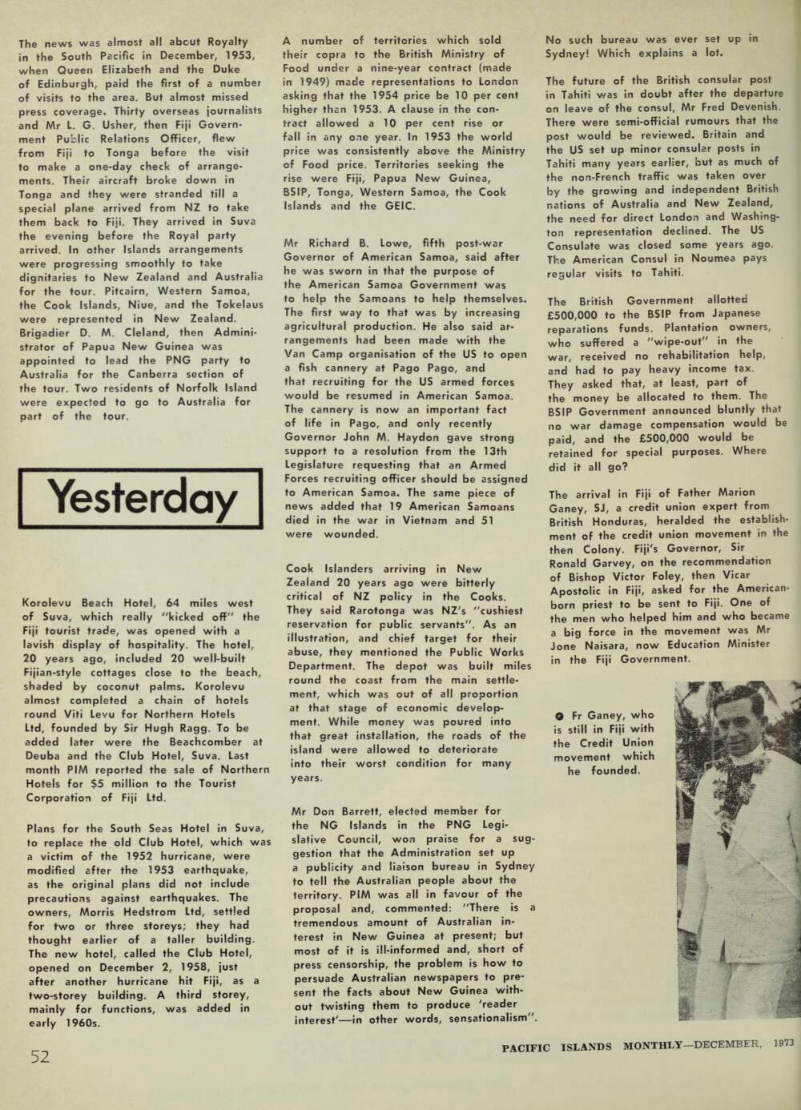
The news was almost all about Royalty in the South Pacific in December, 1953, when Queen Elizabeth and the Duke of Edinburgh, paid the first of a number of visits to the area. But almost missed press coverage. Thirty overseas journalists and Mr L. G. Usher, then Fiji Govern ment Public Relations Officer, flew from Fiji to Tonga before the visit to make a one-day check of arrange ments. Their aircraft broke down in Tonga and they were stranded till a special plane arrived from NZ to take them back to Fiji. They arrived in Suva the evening before the Royal party arrived. In other Islands arrangements were progressing smoothly to take dignitaries to New Zealand and Australia for the tour. Pitcairn, Western Samoa, the Cook Islands, Niue, and the Tokelaus were represented in New Zealand.
Brigadier D. M. Cleland, then Admini strator of Papua New Guinea was appointed to lead the PNG party to Australia for the Canberra section of the tour. Two residents of Norfolk Island were expected to go to Australia for part of the tour.
Korolevu Beach Hotel, 64 miles west of Suva, which really "kicked off" the Fiji tourist trade, was opened with a lavish display of hospitality. The hotel, 20 years ago, included 20 well-built Fijian-style cottages close to the beach, shaded by coconut palms. Korolevu almost completed a chain of hotels round Viti Levu for Northern Hotels Ltd, founded by Sir Hugh Ragg. To be added later were the Beachcomber at Deuba and the Club Hotel, Suva. Last month PIM reported the sale of Northern Hotels for $5 million to the Tourist Corporation of Fiji Ltd.
Plans for the South Seas Hotel in Suva, to replace the old Club Hotel, which was a victim of the 1952 hurricane, were modified after the 1953 earthquake, as the original plans did not include precautions against earthquakes. The owners, Morris Hedstrom Ltd, settled for two or three storeys; they had thought earlier of a taller building.
The new hotel, called the Club Hotel, opened on December 2, 1958, just after another hurricane hit Fiji, as a two-storey building. A third storey, mainly for functions, was added in early 19605.
A number of territories which sold their copra to the British Ministry of Food under a nine-year contract (made in 1949) made representations to London asking that the 1954 price be 10 per cent higher than 1953. A clause in the con tract allowed a 10 per cent rise or fall in any one year. In 1953 the world price was consistently above the Ministry of Food price. Territories seeking the rise were Fiji, Papua New Guinea, BSIP, Tonga, Western Samoa, the Cook Islands and the GEIC.
Mr Richard B. Lowe, fifth post-war Governor of American Samoa, said after he was sworn in that the purpose of the American Samoa Government was to help the Samoans to help themselves.
The first way to that was by increasing agricultural production. He also said ar rangements had been made with the Van Camp organisation of the US to open a fish cannery at Pago Pago, and that recruiting for the US armed forces would be resumed in American Samoa.
The cannery is now an important fact of life in Pago, and only recently Governor John M. Haydon gave strong support to a resolution from the 13th Legislature requesting that an Armed Forces recruiting officer should be assigned to American Samoa. The same piece of news added that 19 American Samoans died in the war in Vietnam and 51 were wounded.
Cook Islanders arriving in New Zealand 20 years ago were bitterly critical of NZ policy in the Cooks.
They said Rarotonga was NZ's "cushiest reservation for public servants". As an illustration, and chief target for their abuse, they mentioned the Public Works Department. The depot was built miles round the coast from the main settle ment, which was out of all proportion at that stage of economic develop ment. While money was poured into that great installation, the roads of the island were allowed to deteriorate into their worst condition for many years.
Mr Don Barrett, elected member for the NG Islands in the PNG Legi slative Council, won praise for a sug gestion that the Administration set up a publicity and liaison bureau in Sydney to tell the Australian people about the territory. PIM was all in favour of the proposal and, commented: "There is a tremendous amount of Australian in terest in New Guinea at present; but most of it is ill-informed and, short of press censorship, the problem is how to persuade Australian newspapers to pre sent the facts about New Guinea with out twisting them to produce 'reader interest' —in other words, sensationalism"
No such bureau was ever set up in Sydney! Which explains a lot.
The future of the British consular post in Tahiti was in doubt after the departure on leave of the consul, Mr Fred Devenish.
There were semi-official rumours that the post would be reviewed. Britain and the US set up minor consular posts in Tahiti many years earlier, but as much of the non-French traffic was taken over by the growing and independent British nations of Australia and New Zealand, the need for direct London and Washing ton representation declined. The US Consulate was closed some years ago.
The American Consul in Noumea pays regular visits to Tahiti.
The British Government allotted £500,000 to the BSIP from Japanese reparations funds. Plantation owners, who suffered a "wipe-out" in the war, received no rehabilitation help, and had to pay heavy income tax.
They asked that, at least, part of the money be allocated to them. The BSIP Government announced bluntly that no war damage compensation would be paid, and the £500,000 would be retained for special purposes. Where did it all go?
The arrival in Fiji of Father Marion Ganey, SJ, a credit union expert from British Honduras, heralded the establish ment of the credit union movement in the then Colony. Fiji's Governor, Sir Ronald Garvey, on the recommendation of Bishop Victor Foley, then Vicar Apostolic in Fiji, asked for the American born priest to be sent to Fiji. One of the men who helped him and who became a big force in the movement was Mr Jone Naisara, now Education Minister in the Fiji Government.
Fr Ganey, who is still in Fiji with the Credit Union movement which he founded.
Advertisements & other items, pp. 57-64 (1 item)
iff s> mous Biscuits
vfr.y \
% / V. * %' •:-■* * *# £w < •/* / >J
There is no Substitute for Quality
The finest Flours and Sharps
in the South Pacific.^^
h £ w w. \« »> V K ■ *
tit
* Seafoam Mills at Brisbane, Toowoomba, Roma, Maryborough, Rockhampton
SEAFOAM FLOUR
Queensland's largest flour milling organisation a division of
The Queensland Co-op Milling
Assn. Limited
Head office—Box 7, P.O. South Brisbane, Qld.
Phone: 44-1681. Cable Address: "Seafoam,"
Brisbane. manufacturers of
High quality products from Queensland
hard wheats
All products manufactured to suit your requirements—Engulries welcome.
SEAFOAM (High protein baker's flour) TOPIC (protein rich)
EXCELSIOR
SILVERSPRAY
(export flours)
SHARPS and MEALS
A little time in
portsaves
you a lot more money-
MADANG <
All our ships spend little time in port.
The reason? Side-port unit-loading. And
because we spend so
little time in port, we
can pass the bonus
savings on to you. If
you’ve cargo coming to
our corner of the
Pacific, send it with the
line that saves you
money on the side.
Our ships: Papuan
Chief, New Guinea
Chief, Island Chief,
Coral Chief.
Registered Office Port Moresby, Papua New Guinea.
General Agents: PORT MORESBY—Steamships Trading Co. Ltd. SYDNEY —John Swire & Sons Ptv. Ltd. Agents: SYDNEY—lnterocean Swire Pty.
Ltd. BRISBANE—WiIIs, Gilchrist & Sanderson Pty. Ltd. PAPUA NEW' GUlNEA—Steamships Trading Co. Ltd. (for New Guinea Chief at Rabaul and Island Chief at Kavieng—Burns Philp (N.G.) Ltd.)
' KAVIENG
ARABAUL^ 16 ™
PORT
% \ s s \ * I I
BRISBANE
HONIARA
\ \ \ \ I I
SYDNEY
New Guinea
Australia Line
MEMBER OF THE SWIRE GROUP.
, ; , - v i !
I * * »- • ♦» » ’ ,*■ i f-m ** • •»
YOTA
Dyna
Get tho
ffir !1
orara
222
\t with a Toyota.
When the going gets roughest, depend on Toyota to get you through everytime.
Road conditions, water,extremes of heat and cold-nothing,but nothing stops Toyota from coming through for you with the biggest loads faster and more economically.
World-famous for the engineering excellence of its automobiles, Toyota also makes a complete line of rugged, versatile commercial vehicles designed to keep costs down, profits rising.
The Toyota Land Cruiser defies all obstacles to get the job done.
The Dyna and Stout trucks come through better in the light and medium pickup categories, while the Hi-Ace makes an excellent all-purpose vehicle.
For the big jobs, Toyota offers the heavy-duty truck - to keep profits rising load after load. And for the big family, Toyota offers two roomy station wagons the trusty Toyota 1000 and the luxurious Corolla.
Make it a point to see your nearest Toyota dealer soon. When you do, ask him to prove how Toyota can keep coming through for you again and again.
TOYOTA Stout TOYOTA Land Cruiser
TOYOTA 1000
TOYOTA Truck
TOYOTA Hi Ace
U 3 1 TOYOTA Corolla
TOYOTA
PAPUA NEW GUINEA: ELA MOTORS LIMITED. Scratchley Rd., Badili, Papua U.S. TRUST TERRITORY: MICROL CORPORATION, P.O. Box 267, Saipan FIJI ISLANDS: AUTOMOTIVE SUPPLIES CO., LTD., G.P.O. Box 355, Suva AMERICAN SAMOA: BURNS PHILP (SOUTH SEA) CO., LTD.,Pago Pc WESTERN SAMOA: BURNS PHILP (SOUTH SEA) LTD., P.O. Box 188, Apia GUAM; RICKY's AUTO CO., P.O. Box 1458, Agana NEW HEBRIDES: NEW HEBRIDES MOTORS LTD., P.O. Box 18, Vila SOLOMON ISLANDS: ZEPHYR SERVICE STATION PTY LTD., P.O. Box 174, Honiara NEW CALEDONIA: SOCIETE D'IMPORTATION AUTOMOBILE DU PACIFIC, B.P. 438, Noumea TAHITI: ETABLISSEMENTS E.A. MARTIN & FILS, B.P. 61 Papeete COOK ISLANDS: COOK ISLANDS TRADING CORPORATION LTD,, P.O. Box 92, Rarotonga
Take flight with
Pan Am’sßig Bird.
m m f Three times every week a Pan Am 747 takes off for the world. Three times every week you have the chance to escape to just about anywhere in the world you feel like escaping to.
Every Sunday, Tuesday and Thursday Pan Am has a morning flight to Australia. And an evening flight to the U.S.A. and Europe. And because Pan Am takes care of everything, on the ground and in the air, all you have to worry about is where you want to go.
You’ll enjoy all the comforts that have made Pan Am’s Big Bird famous.
But it’s the extra things you’ll really appreciate. Extras like Pan Am’s world wide connections and extensive services.
Extras like immediate connections from Nadi to Suva. And extras like the U.S.A.
The U.S.A. where you can take a stopover on the way to London. A night in Los Angeles or San Francisco for $lO. See the sights and enjoy a good night’s sleep before continuing on Pan Am’s Polar route to London.
So if you’re thinking of taking a flight ask your travel agent about Pan Am’s Big Bird and wing your way to the world.
Every country has an airline.
The world has Pan Am.
gz.
I¥UV/MVI
Nadi: Nadi Airport 72.100 Suva: 38 Thompson Street 22.641 250.P.0
■ ■ c Hi M
GOO
■ n c- p •% sr . % «\w> m a
SYDNEY N.SM
*WCE OFAUSTBALI,
25 KG N£T
•** % £?* A 4. *► Vf
the most
BREAD FLOURS: •
CAKE FLOURS: •
BISCUIT FLOURS: •
SPECIALITY FLOURS: ♦
important ingredient
MAINTOP —high protein bread flour ANCHOR —bakers flour • 50/50 MEAL —brown bread MEDIUM —cake and pastry • SPONGE —sponge cakes SPECIAL CAKE —madeira and cup cakes STRONG —cracker biscuits • MEDIUM —Shortbreads SOFT —sweet biscuits RYE flour • RYE meal • KIBBLED RYE SHARPS —roti and chapati flour • 100% STONE GROUND
WHOLEMEAL
GILLESPIE BROS. PTY. LTD.
HEAD OFFICE: BRISBANE OFFICE;
52 UNION ST., PYRMONT, SYDNEY, N.S.W. CABLE ADDRESS: ALBION, BRISBANE, QUEENSLAND. (G.P.O. BOX 2518, SYDNEY, 2001.) "GILLESPIE", (P.O. BOX 8, ALBION, BRISBANE, 4010.) PHONE; 650-4933. SYDNEY AND BRISBANE. PHONE; 6-1121.
Notes with the purity of a nightingale’s call or the depth of a bullfrog’s complaint. This magnificent little cassette deck reproduces all, and better, because it has Dolby" Dolby: An incredibly effective noise reduction system that makes natural sounds leap from the deck, especially with new chromium dioxide tape. It makes everything you record seem super-realistic like looking through a highly polished mirror.
Other sets have Dolby. But other sets don’t have the name Pioneer and extra quality features that go with the name. On the CT-4141 there’s a selector for your special chrome tapes. There’s automatic stop at tape-end in all tape travel functions. And there’s an ultra-smooth ferrite solid head (it just lasts and lasts).
We could go on and on, but your best bet is to flip on the CT-4141 at the nearest Pioneer dealers.
U © a MlBf; ms
CJ) PIONEER
Briilal & Company, G.P.O. Box No. 362, Suva, Fiji Islands Tel; 222 58 Astronics Australasia Pty. Ltd. 161-173 Sturt Street, South Melbourne, Victoria 3205 Australia Hagemeyer (Australasia) N.V. P.O. Box No. 90, Lae, New Guinea Tel: 2718 P.O. Box No. 63, Rabaul, New Guinea Tel; 2633 P.O. Box No. 673, Madang, T.P.N.G. Tel: 2445 .O. Box 1428, Boroko, Port Moresby, New Guinea Tel; 5784 Tee Vee Radio Ltd. P.O. Box No. 5029, Auckland. New Zealand Tel: 763-064 Burns Philp (South Sea) Co. Ltd. Norfolk Islands, South Pacific Jacob Enterprises, P.O. Box No. 4, Nauru Island Ets. PERFECT, B.P. 594, Papeete,Tahiti Menard Freres, B.P. 123, Noumea, New Caledonia Transpac Corporation, P.O. Box 1477, Pago Pago, American Samoa 96799 Tel; 2227 “DOLBY" is a trade mark of DOLBY LABORATORIES INC.
Mana
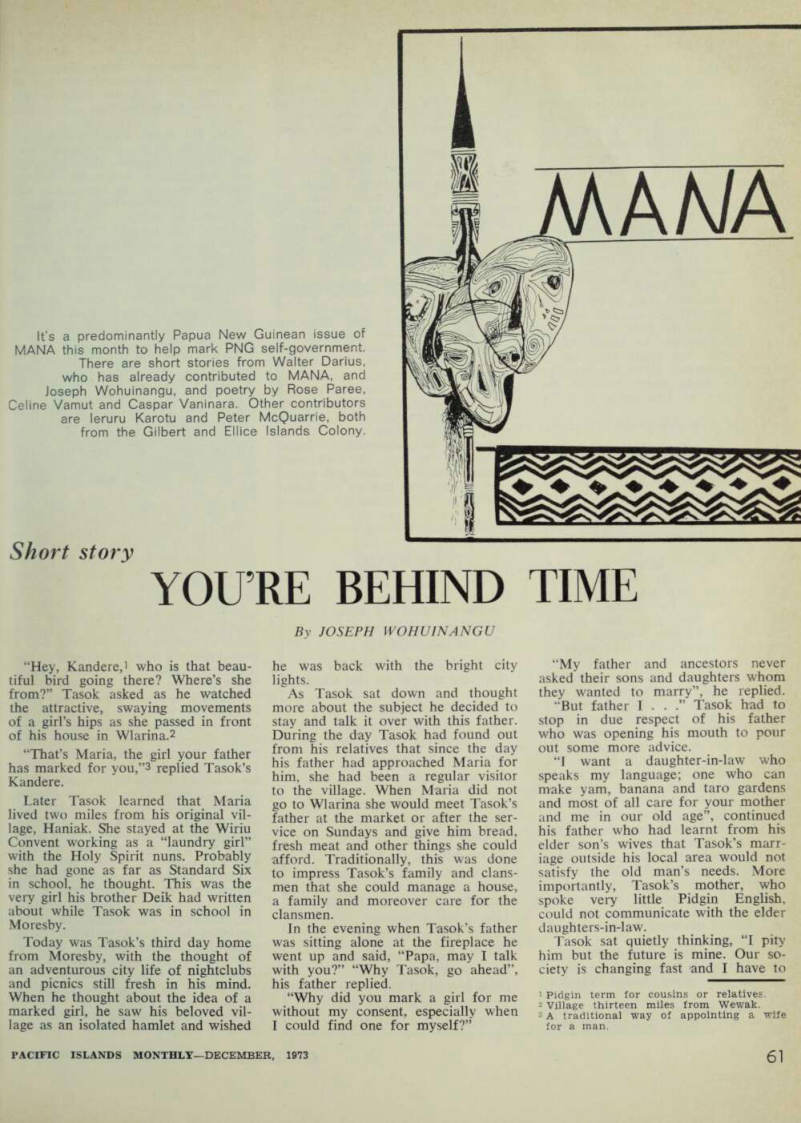
It’s a predominantly Papua New Guinean issue of MANA this month to help mark PNG self-government.
There are short stories from Walter Darius, who has already contributed to MANA, and Joseph Wohuinangu, and poetry by Rose Paree, Celine Vamut and Caspar Vaninara. Other contributors are leruru Karotu and Peter McQuarrie, both from the Gilbert and Ellice Islands Colony.
You’Re Behind Time
Short story
By Joseph Wohuinangu
“Hey, KandereJ who is that beau tiful bird going there? Where’s she from?” Tasok asked as he watched the attractive, swaying movements of a girl’s hips as she passed in front of his house in Wlarina. 2 “That’s Maria, the girl your father has marked for you,”3 replied Tasok’s Kandere.
Later Tasok learned that Maria lived two miles from his original vil lage, Haniak. She stayed at the Wiriu Convent working as a “laundry girl” with the Holy Spirit nuns. Probably she had gone as far as Standard Six in school, he thought. This was the very girl his brother Deik had written about while Tasok was in school in Moresby.
Today was Tasok’s third day home from Moresby, with the thought of an adventurous city life of nightclubs and picnics still fresh in his mind.
When he thought about the idea of a marked girl, he saw his beloved vil lage as an isolated hamlet and wished
he was back with the bright city lights.
As Tasok sat down and thought more about the subject he decided to stay and talk it over with this father.
During the day Tasok had found out from his relatives that since the day his father had approached Maria for him, she had been a regular visitor to the village. When Maria did not go to Wlarina she would meet Tasok’s father at the market or after the ser vice on Sundays and give him bread, fresh meat and other things she could afford. Traditionally, this was done to impress Tasok’s family and clans men that she could manage a house, a family and moreover care for the clansmen.
In the evening when Tasok’s father was sitting alone at the fireplace he went up and said, “Papa, may I talk with you?” “Why Tasok, go ahead”, his father replied.
“Why did you mark a girl for me without my consent, especially when I could find one for myself?”
“My father and ancestors never asked their sons and daughters whom they wanted to marry”, he replied.
“But father I . . Tasok had to stop in due respect of his father who was opening his mouth to pour out some more advice.
“I want a daughter-in-law who speaks my language; one who can make yam, banana and taro gardens and most of all care for your mother and me in our old age”, continued his father who had learnt from his elder son’s wives that Tasok’s marr iage outside his local area would not satisfy the old man’s needs. More importantly, Tasok’s mother, who spoke very little Pidgin English, could not communicate with the elder daughters-in-law.
Tasok sat quietly thinking, “I pity him but the future is mine. Our so ciety is changing fast and I have to 1 Pidgin term for cousins or relatives. 2 Village thirteen miles from Wewak. s a traditional way of appointing a wife for a man.
make a painful decision.” He said, “I have two more years to finish school, father”.
“I can look after her for those two years”, his father broke in.
Tasok had some other reasons to oppose the idea but he saw no point in talking, as he knew he could not convince his father. He tried to think of other ways to make Maria or his father see that there was no
point in marrying her.
His chance came on Saturday
evening during a party. Normally a
party or a big sing-sing time is a chance where single marked girls are free to seek love with single boys.
Tasok decided to do the same with Maria, so he passed the word through his cousin, Ana, to tell Maria to see him near the coconut tree on the left side of the party place.
Tasok’s nearness to Maria under the coconut tree made him feel a strange, unwanted desire for her. She was even more eager because she crept closer to him each time he spoke.
“Maria”, he whispered, shivering.
“Mm”.
“Do you really want to marry me?”
“Yes, with all my heart”, she said holding onto him more invitingly.
But, just as Tasok was tempted to lie with her on the ground he muttered, “Did you know that I don’t want to marry you?”
“You what?” Maria exclaimed, startled as if some horrible figure was standing over her, “Yes Maria. I'm afraid I can’t marry you. You can’t talk to my friends in a strange language which you know vaguely if I take them to our house. I think you can’t bring up my children without a sound knowledge of English, counting and other learnings expected of modern Niu Guinians. 4 You are behind and I would hate to see you suffer the consequences in our future life.”
After that Tasok left Maria. He felt satisfied that he had told Maria and proved to his father indirectly that he could not marry a marked wife. He found a group of boys of his own age near the sing-sing ground and sat with them. His Kandere found him there with the boys. “My dog, did you eat that abus s T' he said.
“Sorry Kandere,” Tasok replied.
“I followed a bandicoot but it went into a hole and I could not catch it.
But I picked up some fresh scent of
pigs though”.
“Maybe the dogs ought to be shar pened and strengthened?” some other boys in the group teased Tasok’s Kandere.
“Perhaps you might like to bring
your sister”, Tasok’s Kandere replied.
That made every boy burst into laugh ter which brought the village coun cillor to the group as a baby’s cry would rush the mother.
“What are you boys laughing about? Answer now, you bunch of idiots. Hurry up!” he demanded.
The younger boys in the mob took off.
“We are only laughing at some old jokes from the past—not at those girls dancing over there”, Tasok re plied. But the councillor was not satisfied, and he told the boys to scatter to their parents. He did not want any complaints from the villa gers tomorrow. Especially from parents with single daughters. Tasok left the boys and went home to bed.
He woke up next morning feeling lazy. He was about to go back to sleep after a short light breakfast when he heard the beat of the garamutb at the Womboli. 7 Though Tasok knew that was the tone of the councillor’s garamut he could not tell who it was the councillor wanted.
His father, who could interpret the beat of the garamut yelled, “Tasok, the garamut is calling you”.
Tasok’s heart immediately began to beat fast with fear. The cold, weak feeling crept up his spine and spread to his hands and legs as his father tgrumbled, “The councillor cannot
call you down for nothing. What did you do last night? Come on, tell me.”
With false confidence Tasok re plied, “Father, I honestly did not do anything. But it would be better for us to go down and find out, if you insist”.
The old man’s traditional instinct obliged him to take his son down to the Womboli where they saw the sing-sing ground a quarter full of people. As soon as the place was full, the councillor blew his whistle commanding silence in a military fashion. Then he said, “I want Tasok from Haniak and Maria from Borom to come forward to where my chair is”. The two young people went up without hesitation.
Maria’s relatives were pouring angry words at Tasok. Even Tasok’s father joined in with his future in laws. He yelled, “You think she is your playmate and you fooled around with her. In my young days we didn’t sleep around with marked
girls. You people nowdays have no
respect for tradition and customs so you fuck around like pigs and dogs”.
The councillor had to blow his whistle again. “Shut up you bunch of bush kanakas”, he ordered. “You people settle down. I want to question Maria and Tasok.”
Again the crowd became silent and still as night. The councillor turned to Maria. “All right Maria, tell us your side of the story”. Maria tried to talk but her lips moved in a mut tering manner. No words came out.
She was shivering with cold sweat.
Finally, the councillor announced that he would hear the case and then re-tell it to the people. So he settled down to listen to Maria in the way a priest hears a sinner confess but the councillor had to repeat loudly Maria’s words to the people; “Tasok’s father asked me nine months ago to marry his son. Every villager including the councillor knew that, therefore for the last nine months I have waited only for him.
I did not think of any other men, I have helped his parents, cousins and other relatives with money, clothes and what other things I could do.
And yet, last night he did not show any appreciation of what I have done when he told me that he did not want to marry me”.
As the councillor was finishing the last words, Maria burst into tears while her father grumbled angrily from his stool. Ten minutes later the councillor told Tasok to tell his side of the case. At first however, Tasok’s 1 Nationalistic term for Papua New Guineans. 5 Pidgin term for “meat”, a reference to an animal being hunted, e A drum used for sending messages. t Name of the meeting ground.
speech was disturbed by angry words from Maria’s clansmen. The coun cillor yelled above the noise, “Shut up you-you sidauses”. Everybody then became silent.
Soon the air was broken by Tasok’s father saying “Tasok, is that what you were taught at school, to disobey your parents? So you can leave a village girl and marry some school girl who has eaten out of some other boy’s hands? Is this part of your generosity for what I have been do ing for you?”
Again the councillor had to silence Tasok’s father. “You two shut up!” he said. “You think you can disobey me, hah! Okay. Man, if you do that again I’ll see the kiap tomorrow at Kubalia”.
“Mr Councillor,,” Tasok began, “My father and my people. Truly it is our custom that I have to marry a marked girl. Now I am sorry be cause I have a different way of think ing and 1 want to marry someone of my own choice. That is why I told Maria last night that I cannot marry her”. Tasok wanted to say more, but he realised that he could not make the people see the new way of life . He was unmarried so in the traditional way of doing things the villagers have little time for such people like him. He was hoping that the councillor, a competent man, would explain the rest to the people.
For the next ten minutes, the coun cillor fished out a puai (betel-nut) from his basket and sat chewing on his stool. The sing-sing ground was filled with mutterings and hissings like the noise made by canopy layers being whipped by a strong wind.
At the third whistle, the air turned silent. Then the councillor spoke.
“You have all heard the case be tween this young man and this woman. You see, my people, this country is changing, so this has in fluenced our little society as well as the whole country of Papua New Guinea. Some of the ways of our ancestors have to change. Before, we buried our dead in trees, now we have to bury them in cemeteries. Changes have affected Tasok too. Before, he would not have been able to reject Maria. Now, he has been to big towns with other white men and educated Niu Guinians. He has seen that in the new way he can marry someone of his choice.”
As the councillor stopped to rest a bit, some more bitter words poured in from the villagers. He had to speak more loudly and threateningly. “It is this very point that causes the major trouble in our area and in our little village here”, he continued. “You know Mana, the son of my brother in-law, Lusman? He wanted to marry
someone from the coast, but his father refused so he ran away to Rabaul and has never returned. When a person is forced by his relatives to marry someone he does not want, sometimes he finds it difficult to live with her. They quarrel like dogs over pig bones. Sometimes the young man runs away. I can give you plenty of examples of such cases. We must get the point that a marked girl is no longer desirable for our young people today.”
As was his practice, the councillor paused and waited for questions but this time nobody had anything to say. “If you don’t believe me”, said
the councillor, “see how the coconuts and betel-nut palms bend today, see how the clouds drift. They are not like what they were in the days of our ancestors. have change and are still changing - Then he tur ned to Maria and said You don t have to marry because your breast is still standing. You can always find another man. I know you young girls of today. You are just com peting to see who will marry the most prestigious man. But, I must tell you that the most educated men are not always the best husbands, bo forget about Tasok and marry some one who will make you happy.
Lakatoi
By Rose Paree
Come, come to the seas on the beautiful log.
On the beautiful log with its silver white sail, And out we go on the waves.
Float, float far away to a new land of dreams.
To a new land of dreams, and a life without toil, On our beautiful lakatoi.
How, how did we come?
Did we fly o'er the seas?
Did we fly o'er the seas or swimming did come?
No, we came on our lakatoi.
Dreams, dreams are all gone, Life is but a reality.
Life is but a reality, Till we float far away on a beautiful log, On a beautiful log with its white silver sail.
On a beautiful lakatoi.
My Mother
By Celine Vamut
Brown woman, Woman of Rabaul!
Oh, my mother, / am thinking of you, Where are you mother?
I cant see you any more.
Oh, my mother, You who carried me upon your breast, You who gave me suck, You who watched over my first faltering footsteps.
You who were the first to open my eyes To the wonders of the earth.
I am thinking of you, I am thinking of you.
Woman of the fields, Woman of the gardens!
Oh, my mother, I am thinking of you.
Where are you mother?
I cant see you any more.
Oh, my mother, You who patiently bore my many moods, You who dried my tears, You who filled my weary heart with laughter.
How I should love to be beside you now, to be a little child beside you, / am thinking of you, / am thinking of you.
Woman of simplicity, Woman of great resignation.
Oh, my mother, Oh, my mother, / am thinking of you, I am thinking of you.
(Introductory Note)
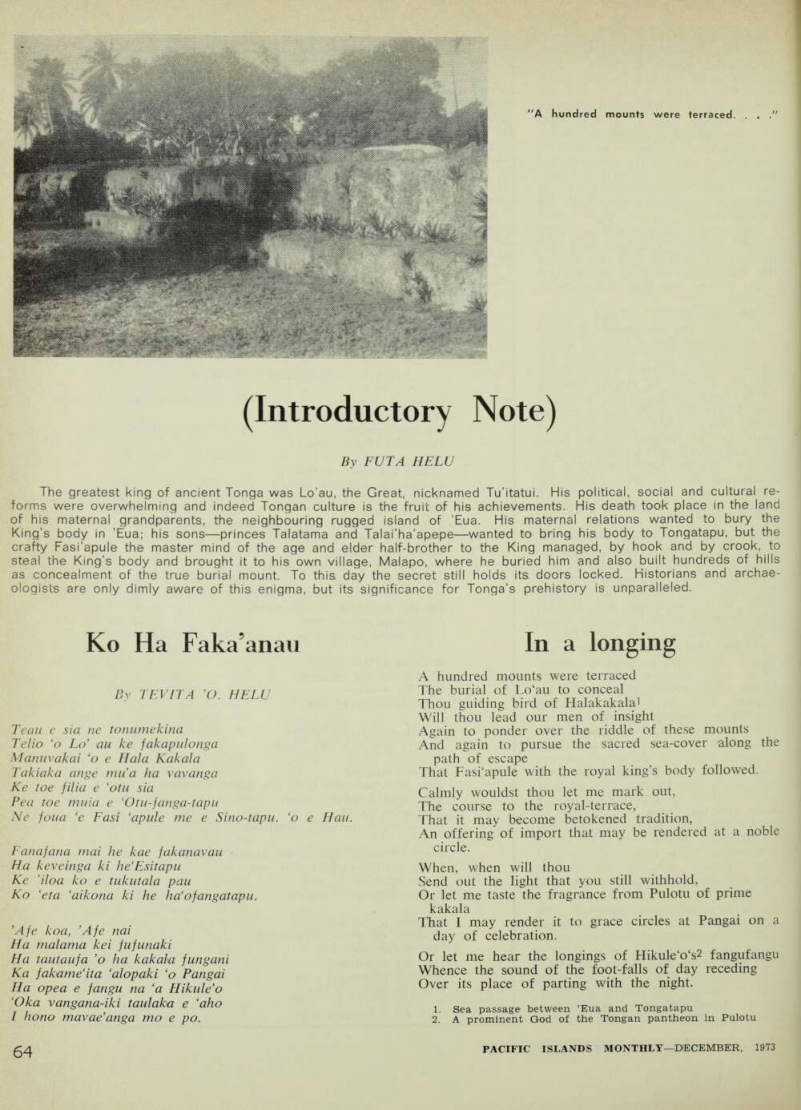
By Futa Helu
The greatest king of ancient Tonga was Lo’au, the Great, nicknamed Tu’itatui. His political, social and cultural re forms were overwhelming and indeed Tongan culture is the fruit of his achievements. His death took place in the land of his maternal grandparents, the neighbouring rugged island of 'Eua. His maternal relations wanted to bury the King’s body in ’Eua; his sons—princes Talatama and Talai’ha’apepe—wanted to bring his body to Tongatapu, but the crafty Fasi’apule the master mind of the age and elder half-brother to the King managed, by hook and by crook, to steal the King’s body and brought it to his own village, Malapo, where he buried him and also built hundreds of hills as concealment of the true burial mount. To this day the secret still holds its doors locked. Historians and archae ologists are only dimly aware of this enigma, but its significance for Tonga’s prehistory is unparalleled.
"A hundred mounts were terraced. . .
Ko Ha Faka’anau
By Tevita ’O. Helu
Teau e sia ne tonumekina Telio ‘o Lo’ au ke fakapulonga Manuvakai ‘o e Hala Kakala Takiaka ange mu’a ha vavanga Ke toe filia e ‘otu sia Pea toe muia e ‘Otu-fanga-tapu Ne foua ‘e Easi ‘apule me e Sino-tapu. ‘o e Hau.
Fanafana mai he kae fakanavau Ha keveinga ki he'Esitapu Ke ’iloa ko e tukutala pan Ko ‘eta ‘aikona ki he ha'ofangatapu. ’Afe koa, ’Afe nai Ha malama kei fufunaki Ha tautaufa ’o ha kakala fungani Ka fakame'ita ‘alopaki ‘o Pangai Ha opea e fangu na ‘a Hikule’o ‘Oka vangana-iki taulaka e ‘aho I hono mavae’anga mo e po.
In a longing
A hundred mounts were terraced The burial of Lo‘au to conceal Thou guiding bird of Halakakala 1 Will thou lead our men of insight Again to ponder over the riddle of these mounts And again to pursue the sacred sea-cover along the path of escape That Fasi‘apule with the royal king’s body followed.
Calmly wouldst thou let me mark out, The course to the royal-terrace, That it may become betokened tradition, An offering of import that may be rendered at a noble circle.
When, when will thou Send out the light that you still withhold, Or let me taste the fragrance from Pulotu of prime kakala That I may render it to grace circles at Pangai on a day of celebration.
Or let me hear the longings of Hikule‘o‘s 2 fangufangu Whence the sound of the foot-falls of day receding Over its place of parting with the night. 1. Sea passage between ’Eua and Tongatapu 2. A prominent God of the Tongan pantheon in Pulotu
Matupit’S First Businessman
Short story
By Walter Darius
MY uncle, Pius Tomaana, was the first man to start up a small busi ness in the island of Matupit in Ra baul harbour, New Britain. Without the help of his brothers, Tomaana had been always busy with his plan tation of copra and cocoa. He was a hard-working man. Time was always more important to him than to any other ordinary village man.
After nearly seven long years of hard work, Tomaana was able to save up a few dollars which he used to buy a new Toyota truck for his taxi business. When he finally bought his brand new truck everyone on the island was pleased with him. Most of them, especially his brothers, were surprised. For many years back, the people had been either walking to work in the town or using canoes as their only means of transport. Now they were able to ride for a few cents a day.
The day Uncle Tomaana bought the truck was on a government fort night Friday. I was out in town with him for the last time as I was just about to leave home to go back to school. We walked up to the garage after withdrawing some money from his savings account in the New South Wales Bank and I waited for him as he approached the salesman.
“Yes big man, yu laikim wanem?” (What do you want?) The young European salesman greeted him with a tap on the shoulder. My uncle did not know how to speak English nor even clean Pidgin, but somehow he managed a few understandable words to the seller and he pointed at the truck for sale. He was a typical vil lage man, I must add, and I felt a bit sorry for him but I was late in talking for him.
“Oh yes, that’s $2,759 and that’s $9,000”. The salesman pointed at the two trucks and asked, “Which one do you want.” My uncle looked at me for an answer and I nodded my head to the $2,759 one. I was not an expert in trucks but I picked the $2,759 one only because I liked its colour.
He told the salesman and they walked off into the office. After waiting for nearly half an hour they came out and I could see my uncle smiling.
“But yu mas look afterim good truck ya, papa,” the saleman said.
“It is guaranteed for 10 years’ service if you follow all the regula tions of the manufacturers. So you must always keep this truck in good condition and you won’t get any trouble from it, OK?”
My uncle nodded happily then curiously asked, “Ah. . . . masta . . . a wanem toktok ‘kondison’? Yu inap tokim me gen, tenk you? (What is this “condition”? Please tell me again). He struggled hard with his Pidgin words, but the salesman un derstood him.
“Oh well,” said the salesman, “You must always see that the truck gets enough petrol in the tank every morning, enough water in the radia tor and clean distilled water in the battery before you drive it.” The salesman stopped and pointed at the different parts he had named while my uncle followed his hand with curiosity.
“Another thing too,” he continued, “you must always use the right kind of chemicals in the right places. Don’t put petrol in the water tank and water in the petrol tank, because this will only ruin the engine and it won’t last long. You must always clean and wash the truck every day after work ing it, OK?” Again Tomaana nodded happily pretending he had understood everything that had been said.
“Bai me bihainim olgeta samting yu toktokim pinis i kam long mi, masta, tenk yu tumas.” He finally
thanked the salesman and took the driver’s seat then indicated me to take the opposite seat beside him. I could see that he was impatient to drive. He could not waste any more time. Two weeks before he had received his driving licence and now he was going to show me how good he was at dri ving. He threw his right hand out of the window and shook hands for the last time with the young salesman and we took off.
I knew he had not really under stood all that the salesman had told him and I was expecting a long con versation from him during our drive around the town but no, he did not bother. He thought he had learnt everything. But he was only fooling himself. We drove into nearly all the well-known streets in town, and I could easily see that he was very proud of his truck. We drove home late in the evening and a crowd of admirers grouped around the new truck and started gossiping over it.
Two weeks went by and his little business was quietly taking shape. He was making good money out of the people who were working in town.
He kept up with the few instructions he was given when he bought the truck. He was the happiest man on the island, as his name came out both in the papers and the radio. But suddenly, things got changed on his way to success. He was too careless to look after the truck. By this time I was already in school but my father kept informing me about Tomaana because I was still thinking about him.
He completely ignored the instruct ions and took things into his own hands. Pride was quickly taking over in the long run.
“I don’t care long kar bilong mi.”
Tomaana said one day after getting himself drunk and coming to my parents’ home.
“Mi gat mani pinis long pocket ya, papa.” (I have plenty of money).
But he forgot the fact that he was fortunate to be the first man on the island with a good little business like this. He did not care very much now.
It was a new world for him. The truck was only five months old but here its service was being totally neglected.
One day he drove to his copra plantation and found that his radia
tor was boiling hot. He was surprised, but instead of filling it up with fresh water, the fool decided to use some rusty old water from a nearby drum.
After doing this he looked at the battery water level and it was also low. Again, he took some water from a green coconut and filled it up.
He did the same to the petrol tank.
Instead of using petrol, he ran out of it one day and decided to use fuel mixed with kerosene. He felt guilty after doing all these things but no one saw him, not even the salesman.
Oh what a foolish uncle he was. My parents tried their best to tell him all the advantages he had in possess ing the truck and even his real bro thers tried to encourage him, but no. the man would not listen to anyone.
“Yupela i bin stap we bipo taim mi no bairn trak yet?” (Where were all of you before 1 bought the truck?) This was all he had to say for his answer to anyone who tried to bother him with his truck.
One morning he woke up early and was going to do some very early trips to town when he discovered that his truck would not go. He was scolded by the islanders. Many of the people working in the town were let down, in fact most of them had to walk all the way to work. My uncle called in the salesman and a mech anic to check over his truck, but the only answer he got from both of them was, “Papa, we’re terribly sorry, but your truck can never be repaired again. It is now out of use for good.
We cannot repair it nor can any other firm. It is far beyond repair.
Either you buy a new one or don’t bother if you cannot look after trucks and follow instructions!”
Tomaana shook his empty head and dropped it without saying any thing. The salesman tapped him on the shoulder and said, “Papa, we have given you instructions to follow. But you have failed to do it, and your truck has refused to work for you.
There’s nothing else we can do now but leave you to fix it yourself. Bye now man!” They walked off quietly and drove off with a loud roar.
These last words struck Tomaana’s heart like a sharp knife driven into him from the back. He was shamed in the face of the crowds who had come to gather around the truck. My little sister was there to witness the scene and she wrote to me two days later and told me everything. I felt sorry for my uncle but I was glad because he had now learnt his lesson the hard way. Not only himself but many other people who were still planning to buy trucks did have a chance to learn something from my uncle’s failure.
Mana Contributions
MANA is a vehicle for Pacific Islands 7 writers and artists to publish their work. It is an organ of the South Pacific Creative Arts Society. Its editorial committee comprises Islanders from Western Samoa, Tonga, Fiji, New Hebrides, the Solomons, American Samoa and the Gilbert Islands. Material for publication must be sent direct to MANA's editor, Marjorie Crocombe, South Pacific Creative Arts Society, Box 5083, Suva.
The ghostly wind
By Caspar Vaninara
0 ghostly wind, the gossiper. 1 marvel at your presence.
You are my source of life, I hear you talk I feel your coolness Yet I see you not.
Your ghostly touch Is sometimes pleasant,
Sometimes shivering,
But you do service to all.
Men and birds you carry Across wide seas Over deep valleys And steep hills Above green treetops And blue mountain ranges.
At times you are fierce, angry, A destroyer.
I hear you roaring, crackling Through the forest Like charging elephants.
I see the boughs you break , The leaves you carry like birds gliding, And my heart shrinks in my bosom.
O powerful wind, your words are obeyed.
The blue seas and deep oceans swirl, They rise aloft to change my course.
They sink my boat and drown me.
Thunderstorms grind and snarl at me.
The sea creatures go deep below To find shelter and safety.
On land too birds and beasts and men take fright.
The clothes they wear, The long feathers, The hairs and bristles Lie smoothly to protect.
Indoors, in nests and dens They wait impatiently For you to fulfil your task. 0 wind, you are a hard worker.
You bring me happiness and sadness, The smell of delicious food You carry from far away.
It is sweet, my appetite grows Like fire on dry grass.
The stink of decaying things You bring too. 1 stuff my nostrils and run away.
The smell of smoke you send To indicate the presence of man. 0 wind, you chatter like talkative women.
Your anger is like a hungry husband’s.
You swear loudly and beat, But you are a ghost. 1 hear you talk I feel your nearness I breathe you in, O source of life.
Yet I don’t see you O ghostly wind, the gossiper.
A legend from the Gilbert Islands
By Ieruru Karotu
ALONG time ago there was a couple living on an islet of Buariki at North Tarawa in the Gilbert Is lands. Both were young and happy and they always enjoyed everything they did on their island.
One day, Tabontatang fell sick but it was not very serious so Naakun, her husband, told her not to do any work in the house. Unfortunately, she became worse. The husband tried his best to find a cure but it was no use. Tabontatang died after three days. Oh, poor Naakun. He was left crying all day and night. The next day, he began jump : ng up and down, shout ing out his beloved wife’s name.
Finally he went to the ocean side, yelling and shouting ‘Tabontatang oh!
Tabontatang oh!”
Soon a reply came like an echo and it made Naakun frightened. The Ghostess, Nei Tutuabine asked, “What are you crying about? Can I help you?” Naakun was surprised. He lifted up his head and with a smile he said “Oh. please, help me. My wife died three days ago. Could you tell me where she is now?”
The Ghostess told Naakun that his wife had not died but was assisting the other dead people to support the sky. However, the Ghostess com manded Naakun to go with her to find his missing wife.
Off they swam through the big waves. On the way, the Ghostess ad vised Naakun who was riding on her back, to hold on firmly because they were approaching the village at the bottom of the sea. She also reminded him that if he saw a butterfly that was the sign that they were getting close to the village. All these things came true and Naakun proved that there was indeed a village at the bottom of the sea. Nei Tutuabine guided Naakun in the village and instructed him what to do before he entered.
Naakun did what he was told. He walked through the village while the Ghostess waited for him. Unex pectedly, Naakun heard a soft voice calling “Naakun,. Naakun. Come here and help me. I’m nearly dead”. Naa kun became rather nervous so he didn’t move. Soon he was filled with courage and, eager to see his beloved wife’s face again he managed to get inside the house. Suddenly he met a woman whose hair was white and whose eyes shone like the full moon.
Her legs were as thin as a stick of coconut frond and she had teeth painted red. She had just been eating some people. But in spite of these digressions, Naakun kept looking at the beams of the house where he sud denly recognised his wife’s face bring ing back all the beautiful memories of her.
The woman asked Naakun to come a bit closer, pretending to treat him like a son but she really intended to eat him. Luckily, Naakun knew all about these tricks because Ghostess Tutuabine had told him about them.
So, Naakun pretended to do what the old woman wanted, then he quickly grabbed his wife’s eyes and ran off quickly with them.
The cannibal woman chased Naa kun for dear life but Naakun was
way ahead of her. To give herself some energy, she cut and ate one of her own legs. Poor Naakun. While he was trying to escape, his legs got caught in a coconut log lying on the ground. He fell but managed to escape because he was about 10 yards ahead.
The old woman did not catch up to Naakun even though she had eaten her other leg to give her more energy.
Nei Tutuabine appeared and fought the old woman. Finally, Naakun re turned home happily riding on the back of the Ghostess Tutuabine and clutching the eyes of his wife.
There is an islet at North Tarawa in the Gilbert Islands where Naakun stayed with Tabontatang until she died. Even today some Gilbertese still believe that there is a village at the bottom of the sea.
Gilbertese children’s song
Translated by PETER McQUARRIE To get a drinking nut, I climb the coconut tree.
I tear loose the nut, and down it falls free.
What luck that it should strike, the husking stick a blow.
My nut is almost husked, laying on the sand below.
By chance my drink is now, much easier to gain, I quickly quench my thirst, then run and play again.
Books, Reviews, writers
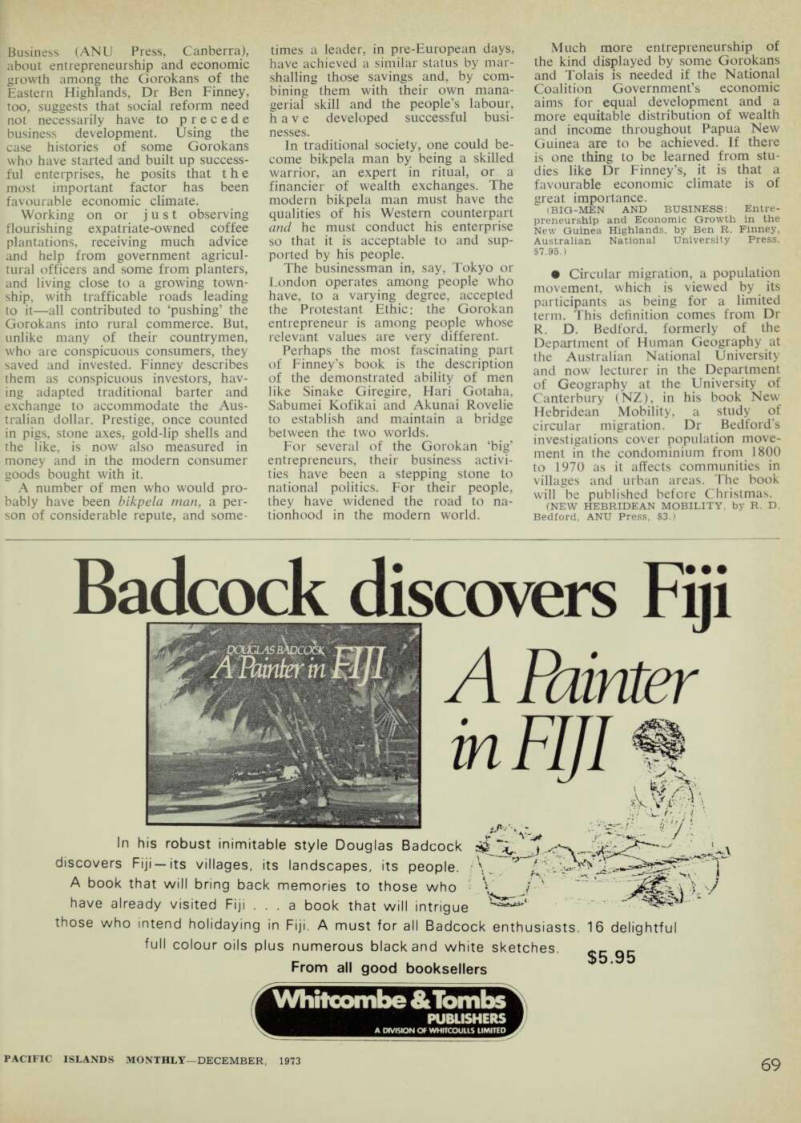
Secrets Of The New Guinean
Entrepreneur
By Harry Jackman
There are now few Papua New Guineans who have not come into contact with the cash economy which Europeans and Asians have brought to their country. More and more of the people have given up subsistence farming and now depend upon a cash income, mostly from wage labour in towns and on plantations, not in frequently from growing export crops, but rarely from owning and managing a business.
Since World War 11, thousands have aspired to own and conduct businesses, and very many have been or are so involved, usually village stores, produce buying and marketing, and road transport. Relatively few have succeeded even though just about every form of business organisation, eg, sole trader, partnership, com pany, co-operative, has been tried.
The government has provided some advice and assistance, especially to co-operatives. There are now busi ness development officers in every district, and small industries exten sion officers in some.
The Development Bank, which be gan lending in 1967, last year made 413 loans totalling $1.5 million to Papua New Guineans, but not enough, expatriate enterprises, fore mo s t among them Bougainville Mining Ltd, are fostering business ventures among the people.
Last year’s $9 million turnover of the co-operatives and whatever the thousands of small and the handful of medium-size other businesses among the people have turned over has, however, been of little signifi ca<n c e, except for the ‘learning aspect’, in the total economy. The current situation, apart from 20 per cent equity in Bougainville Mining and equity varying from 20 to 35 per cent in several other locally-based expatriate companies, held on behalf of the people by the government and the Investment Corporation respec tively, appears to be very much as J. V. Langmore, an economist, des cribed it in 1971; expatriate-owned enterprises produce 60 per cent of all export crops, .all but one or two per
cent of manufactured goods, and most mining output, and are respon sible for most building, construction and services.
Apart from competition by ex patriate firms and individuals, the main obstacles to business develop ment among Papua New Guineans have been (1) shortage of manager ial and technical skills, and (2) socio-cultural institutions—the ‘wan tok system’ of mutual responsibility
and wealth distribution in an exten ded family or, sometimes, larger group. Many outsiders, especially Europeans, believe there is also in sufficient motivation to enter modern business, partly because the people live in affluent subsistance or can re turn to it should a business fail, and partly because of their inelastic de mand for consumer goods.
Taking these last two points first, relatively few of those who have be come urbanised, or have more or less regularly been engaged in wage la bour or cash cropping have shown any desire to return to subsistence farming. Even where land is still available to them—and there is a growing shortage of it in several areas—they would in most cases find it difficult to change their current way of life.
As for the inelasticity of con sumer goods demand, it must b e doubted whether any Papua New Guinean who has used modern tools, household goods and transport would fail to want more of them.
Because their skilled relatives and friends usually prefer secure jobs in the public service or with expat riate firms, Papua New Guinean en trepreneurs often find it difficult to obtain permanent staff. The increas ing turnout of secondary and tech nical schools, overcomes this problem.
It has frequently been stated that modern business, especially the capi tal formation it requires, cannot flourish among Papua New Guinea’s traditional societies.
The economic history of at least one relatively large group, the Tolai on New Britain, whose per capita in come is the highest in the country, does, however, show that an appro priate infrastructure provided by the government, ready access to a mar ket, and the demonstration effect of foreign entrepreneurship provide the necessary impetus. The people have demonstrated enough pragmatism to make a successful entry into modem business, without the need for major social change.
In his latest book, Big-Men and
Business (ANU Press, Canberra), about entrepreneurship and economic growth among the Gorokans of the Eastern Highlands, Dr Ben Finney, too, suggests that social reform need not necessarily have to precede business development. Using the case histories of some Gorokans who have started and built up success ful enterprises, he posits that the most important factor has been favourable economic climate.
Working on or just observing flourishing expatriate-owned coffee plantations, receiving much advice and help from government agricul tural officers and some from planters, and living close to a growing town ship, with trafficable roads leading to it—all contributed to ‘pushing’ the Gorokans into rural commerce. But, unlike many of their countrymen, who are conspicuous consumers, they saved and invested. Finney describes them as conspicuous investors, hav ing adapted traditional barter and exchange to accommodate the Aus tralian dollar. Prestige, once counted in pigs, stone axes, gold-lip shells and the like, is now also measured in money and in the modern consumer goods bought with it.
A number of men who would pro bably have been bikpela man, a per son of considerable repute, and some
times a leader, in pre-European days, have achieved a similar status by mar shalling those savings and, by com bining them with their own mana gerial skill and the people’s labour, have developed successful busi nesses.
In traditional society, one could be come bikpela man by being a skilled warrior, an expert in ritual, or a financier of wealth exchanges. The modern bikpela man must have the qualities of his Western counterpart and he must conduct his enterprise so that it is acceptable to and sup ported by his people.
The businessman in, say, Tokyo or London operates among people who have, to a varying degree, accepted the Protestant Ethic: the Gorokan entrepreneur is among people whose relevant values are very different.
Perhaps the most fascinating part of Finney’s book is the description of the demonstrated ability of men like Sinake Giregire, Hari Gotaha, Sabumei Kofikai and Akunai Rovelie to establish and maintain a bridge between the two worlds.
For several of the Gorokan ‘big’ entrepreneurs, their business activi ties have been a stepping stone to national politics. For their people, they have widened the road to na tionhood in the modern world.
Much more entrepreneurship of the kind displayed by some Gorokans and Tolais is needed if the National Coalition Government’s economic aims for equal development and a more equitable distribution of wealth and income throughout Papua New Guinea are to be achieved. If there is one thing to be learned from stu dies like Dr Finney’s, it is that a favourable economic climate is of great importance.
(Big-Men And Business: Entre
preneurship and Economic Growth in the New Guinea Highlands, by Ben R. Finney, Australian National University Press. $7.95.) • Circular migration, a population movement, which is viewed by its participants as being for a limited term. This definition comes from Dr R. D. Bedford, formerly of the Department of Human Geography at the Australian National University and now lecturer in the Department of Geography at the University of Canterbury (NZ), in his book New Hebridean Mobility, a study of circular migration. Dr Bedford’s investigations cover population move ment in the condominium from 1800 to 1970 as it affects communities in villages and urban areas. The book will be published before Christmas.
(New Hebridean Mobility, By R. D.
Bedford, ANU Press, $3.)
Bougainville
Little Chimbu in Bougainville
That popular New Guinean character, Little Chimbu, and his special pal Little Balus (meaning aeroplane in New Guinea pidgin) have captured a lot of hearts since New Guinea resident Nancy Curtis introduced them in 1966.
The stories were originally writ ten for Mrs Curtis’s twin daught ers, but in book form, with Nancy’s own illustrations, they have been reprinted several times, and distributed throughout the world. In recent years Nancy Curtis has been living on Bou gainville, where the giant Boug ainville mining company has changed the landscape, so it was inevitable that Little Chimbu and his friends should replace head dresses with hard hats and pay her a visit.
Little Chimbu in Bougainville is published in time for self government and for Christmas —5O pages of drawings in full colour—fatter than Little Chim bu’s earlier adventure books— and the story is full of fascin ating {and accurate) information about the workings of this big new mining enterprise.
In the bookshops, or direct from Pacific Publications at $3.25 plus postage.
Advertisements & other items, pp. 73-74 (1 item)
in FIJI
Badcock discovers Fiji
A Painter
.A U.y* * ’^3 >:V In his robust inimitable style Douglas Badcock discovers Fiji —its villages, its landscapes, its people. .
A book that will bring back memories to those who V / have already visited Fiji ... a book that will intrigue those who intend holidaying in Fiji. A must for all Badcock enthusiasts. 16 delightful full colour oils plus numerous black and white sketches.
From all good booksellers
Whitcombe & Tombs
PUBLISHERS
A DIVISION OF WHITCOULIS LIMITED
»7; ■ m
(oj*Wv
/$ *4j*sts seadfy
ihcv ?s &ju^
Rvk&r isoutyrt&>
\ i £f w '*?“' #Sv v ' A v* -V ,-> -"V - ■ :• : v c s j>< ♦* V &'»' '> : ■
: |S*o»w|y^
y. jr. fust dial a different angle until the nib position is exactly how you want it.
Your fingers rest in the curved grip of a Parker 75/so you write relaxed.
Fill up from an ink bottle, or load with a special Parker cartridge. It has a 'tap tank in reserve, for up to 700 more words after you think your ink's run out!
Every Parker 75 passes 792 inspections before you see it. Sterling quality, so it’s sterling silver. Or rolled gold, or Vermeil which is 14 ct gold on silver.
tPARKER
Maker o< ihr world's most wanted pens s /•„' ' ' w
are playing with fire
'Kubunas' of New Guinea are playing with fire
To attempt to preserve tradition for the mere sake of preserving it, is the surest way of destroying it.
This is the end to which the two issues of Kubuna, which I have be fore me, may well contribute.
Mr D. J. Doyle and Mr K. Dow ner, both of the Madang Teachers College, have compiled and edited the two volumes. Mr Doyle and Mr Downer claim to own the copyright of the publications. Since most of the stories used are traditional, if there is any copyright at all it must be held by the ethnic group to whom the stories rightly belong, or, if it has to be invested in an individual, to the pupils who supplied the original stories.
It is time in Papua New Guinea that somebody made a ruling on this sort of thing. Mr Doyle and Mr Dow ner are by no means the only ones to claim copyright over things classi fied as traditional.
Mr Doyle, in his introduction to Kubuna writes, “The word comes from the language of the Siwai peo ple of Bougainville. It means ‘story’ and simply describes the contents of this book, stories for Papua New Guinea children”. (In which case, Mr Doyle might have rendered it in the plural and not in the singular!!) This first paragraph might belong to the introduction of any of the thousands, yes, thousands of similar productions produced throughout Papua New Guinea and the adjacent islands in schools, by small and large mission groups, and even by more than one government department. I made, a few years ago, a survey for UNESCO of the number of these publications being produced in Papua New Guinea and I cannot now re member how many thousands the total reached, remembering that a great many tiny primary schools have their duplicated folded foolscap reader to be included in these thousands and not taking into account vernacular publications, all of them in some issue or another using traditional legends or stories.
The very fact that Mr Doyle and Mr Downer have taken a Siwai word as the title of the Madang Teachers College publication would indicate that they felt that something is being done by these books to preserve this heritage. Is it carping to point out that the use of the word as the title
to a publication written entirely in English has done nothing more than preserve one word and that without any meaning to all but a very few?
Mr Doyle’s explanation of it in his introduction does not give it mean ing. This has been done from the time Kibi first started at the Sogeri Central Training School, and meant no more then than Kubuna does now.
I am tired of the number of Ku bunas I’ve seen in the past, all iden tical but with a Medlpa, a Tintutz or a Kerewa word instead of Kubuna.
Now, that is not to say Kubuna may not serve a useful purpose, it is not to say they all did not serve a useful purpose. But they might have had an adverse effect too. It is this calculated attempt to preserve traditional stories which is the bad aspect of it. People must not be pushed into a respect and regard for the past.
It is easy to show that those west ern countries, which deliberately tried to crystalise past tradition, stayed where they were and are not numbered among the advanced na tions of the western world.
Kubuna is better produced and the illustrations are better than those of most similar publications and the Kristen Pres, Madang has done a very nice job on them. It is just un fortunate that Kubuna is one of these similar publications which behave in Phoenix-like manner to cross my line of attack on the artificial preservation (whether deliberate or not) of what Kubuna is preserving. The very eff ort at preservation must lead to arti ficiality. (Read also Rev Percy Chat terton’s article in the August PIM.).
The sensible person of good in tentions will leave well alone, and let the traditional take care of itself.
What is needed will survive with the aid of the Madang Teachers College and what is useless will perish. But if it’s mucked about with, all that will be left will be a spurious thing. This is the danger of publications like Kubuna.
Michael Somare has expressed himself on this matter of the pre servation of culture only in the terms used by do-gooding and ill-informed expatriates. It would be interesting to know if he has any of his own thoughts on the matter apart from his tirade about Sepik artifacts. Is he content to leave the mutilation of the
traditions of the country in the hands of the Kubunas of the country?
What do you think about this, Author Vincent Eri? Since it is the habit of PIM to publish correspon dence about its book reviews, and since my reviews seem to provoke correspondence both personal and published, perhaps it is not hoping too much that Vincent Eri might be the first to argue with me on what I have written, or even to hurry to tell me he agrees with me.
Sinaka Goava used once to have strong ideas about the preservation of Papuan culture. Has becoming a magistrate changed his outlook? I don’t think so: I’m sure he still thinks that such stories as appear in Kubuna belong to an oral tradition and are best not tampered with.
To sum it up, Mr Doyle and Mr Downer are not to blame: they are merely following behind a long line stretching away back for 30 years, of producers of Kubunas, and none of them had any suspicion that they might be playing with fire —Peter Livingston.
KUBUNA, numbers 1 and 2, are pub lished by the Madang Teachers College, Madang, New Guinea, compiled and edited by D. Doyle and K. Downer, with illustrations by R. Christensen. Printed by Kristen Pres, Madang. Our copies from the Teachers’ College.
Advertisements & other items, pp. 75-76 (1 item)
Book Company
HARRIS
(ESTABLISHED 1930)
We carry over 10,000 titles on all subjects in stock and would be pleased to quote for your requirements.
Please send your enquiries to:
HARRIS BOOK COMPANY,
G.P.O. Box 16670, Hong Kong
■■■ i i k El . ■ i w iHi^Bn ... ■;!;:: - ■ ■ -■■■-■, ■ :. ■■ : \ d "' ■ ' v -.v
Shot-of-Steam Iron
A revolutionary new concept in ironing
A totally new concept in irons.
Cruises effortlessly over woollens, linen, cotton and all synthetics. Removes unwanted creases and wrinkles with a penetrating shot-of-steam —at the touch of a button.
Friction-free sole-plate has 36 steam holes. Cool, white mfn rtah Ip> HanrllP rfidlJCeS irOPinO L 83.4139
Places and people
people of the islands
A blockbuster of a picture book is Jack and Dorothy Fields’ lavishly produced South Pacific, more than 250 pages of art paper in large for mat, full colour, weighing lb. I don’t know of a more ambitious cof fee table volume on the Pacific.
Jack and Dorothy Fields are an American husband-wife photographer and writer team. Jack being known especially through his work with Nat ional Geographic and the American glossies. And his work really is superb —capturing in a variety of moods, and especially those in the outer is lands, the people of New Guinea, the New Hebrides, New Caledonia, Fiji, Micronesia, Tonga, American Samoa, Tahiti and Hawaii.
Obviously some groups are missing, but in a book that is already so gener ous in its coverage, one can’t com plain— except perhaps at the pictorial omission of Western Samoa, since the “lesser half” of the Samoas is repre sented.
The text is not as evocative as the photographs, but then, that would be difficult. It serves as an adequate introduction to the Island groups and is clearly a combination of solid re search and personal knowledge. (There are some minor errors of fact, ie, explorer Bougainville passed well north of New Caledonia and didn’t sight the islands, and the Rev Shirley Baker was not dismissed over the Tongan money issue—his case was far more involved than that}.
A handsome Christmas gift, this book, published by Kodansha Inter national Ltd, with South Pacific dis tribution by arrangement with A. H. and A. W. Reed Ltd, at an Aust ralian price of $17.95.
A more specialised, less ambitious picture book is James Sinclair’s Faces of New Guinea (Jacaranda Press, $4.95), which is a companion to the Highlanders, and Wigmen of Papua. About 140 colour photographs taken by District Commissioner Sin
clair in his travels depict New Guineans in every aspect—head-hunters, chiefs, students, brides, sorcerers, mourning widows, traders. Sinclair’s portfolio reveals as much about the sensitivity of the photographer as about the diversity of character of the New Guinean.
NEW ZEALAND artist Douglas Badcock sees his South Pacific with palette and brush, and offers us reproductions of 16 colour paintings in oils of Fiji scenes. With them are a number of black and white sketches, done mostly as preliminaries to the oils. A Painter in Fiji is an attractive book, Badcock’s style being bold, his canvases cheerfully alive and colourful. There is no doubt he has captured the essence of Fiji. Some people
will want to frame the reproductions and at a price of $5.99 (Whitcombe and Tombs Ltd) they can afford to do it.
AN interesting historical and geo graphic tourist map of fishing. boating and skin-diving on Koror and the Palau Islands is available from the Palau Tourist Commission, Koror Palau, Western Caroline Islands 96940. The map describes the World War II battles at Angaur and Peleiu as well as little-known characteristics of Palauan traditional life, exotic foods, and native money which is among the rarest in the world. There are many other comments about the surrounding ocean. Several ship wrecks are indicated along with relics of the Japanese Army,
Pick of the paperbacks
AMERICAN SAMOA, by Chris Chris tensen is a bright but brief publi cation which should give tourism a boost in the Samoas. But that's as far as it goes. Christensen is undoub tedly a good photographer and his 58 colour shots of America's only South Seas possession are among the best to come from there. He was also responsible for the 3,000-word text which adds nothing to literature on Samoa and the Samoans. Copra planters will be surprised to learn that "Today copra is of much less economic importance than formerly when the coconut yield had signi ficant trade value." Tell that to the copra producers. (The Robert Boom Co, Honolulu. SUS 2).
The Australians In Nine Wars,
by Peter Firkins, will come as a sur prise to many people. Such a new nation and yet it has been involved in nine wars, none of its own making.
This 510-pager recounts, sketchily of course because it's a huge subject, the victories and defeats of the Aust ralian fighting man from the Maori Wars in the 1860 s down to the latest schemozzle in Vietnam. It brid ges a gap because the Australian, in most war histories, is usually lumped with the Allies. Here he is given his proper place. He went to war because he was at first a colonial and later a member of the British Commonwealth. If Australia becomes a republic, will he be involved in nine more wars in the next 100 years? (Pan, $2.85).
THE TIMELESS LAND, by Eleanor
Dark, is the first of her trilogy about the early years of Australian settle ment. It's not history but fiction culled from historical records and tells the story of the first settle ment of Sydney as recorded by mem bers of the First Fleet and others as seen by the Aborigines from the surrounding hills which is where most of the fiction comes in. At the time the first settlers laid the flimsy foundations of what has be come the greatest city in the South Pacific, settlers were too busy hunt ing the Aborigine to ask for his im pressions. (Fontana, $2.15).
Australian Government Today,
by Geoffrey Sawer, first appeared in 1948 and has sold its way through 11 editions. This last edition is a complete revision and incorporates constitutional amendments up to July this year. For those who want a lucid account of what makes Australia tick, how it is governed and by whom with chap ters on political parties, the Civil Service and industrial tribunals, with out having to wade through miles of parliamentary and legal records, this is just the thing. There's a brief paragraph on the federal territories, which, with reference to Papua New Guinea, ends with a kind of prophecy —"The events so far in 1973 suggest that the new nation would at first have a highly centralised Westmin ster-style parliamentary democracy, but this could soon be altered, other pos sibilities being a presidential one party state, Tanzania-fashion, or a federal system." (Melbourne Univer sity Press, $1.20).
Advertisements & other items, p. 78 (1 item)
Export Award
Motospecs didn’t
win a New Zealand
just because of the
names behind
m&i Names like SCANIA. WIX. MONROE-WYLIE.
OUm Mm Sim i l6f repco. armoured knight, turtle WAX, ARROW INSTRUMENTS. S-K WAYNE. WOLF. RUBERY OWEN. BLACK- HAWK. SIDCHROME. Etc. Etc. Big names that mean, quite simply, the best automotive/industrial parts in the World. Of course, the quality of our products played an important part in our winning the Export Award. But so did service. And remarkable sales success. Which explains why Motospecs are New Zealand's largest exporters of automotive/industrial parts, and why our reputation for efficient, personal service is known throughout the South Pacific. We can prove it. Think of a problem, drop Motospecs a line, and we'll solve it. Personally.
DISTRIBUTED BY MOTOR SPECIALITIES INDUSTRIES LIMITED
GROUP EXPORT DIVISION, P.O. BOX 3201
AUCKLAND, NEW ZEALAND
MOTOR SPECIALTIES LTD
HEAD OFFICE. 80-90 ANZAC AVENUE, AUCKI AND
-RfIANCHES THROUGHOUT NEW ZEALAND.'
Islands Press
From the Islands Press
From a letter by Sethi in the New Hebrides Nakamal: New law for taboo not allow making or expose people say porno. What is this kind of porno?
Bad luck for island carve things, they not have nambas in front and very naked. Our custom is very bad for Europe people and it will be porno for the queen if nambas man dance for her in Australia. Goodby.
From the New Hebrides Group News: A large turtle that wandered off limits into the school grounds at IDS last Thursday night later served as a de licious meal for the school kids. ... It had apparently gone ashore to lay eggs but probably went a bit too far and got stranded. . . . Because of water on both sides of the Pango peninsula, it is believed that this is one point that plays funny tricks on turtle's sense of hearing in this particular area.
From a report in The Fiji Times of a speech by Education Minister Jone Naisara at a seminar at the University of the South Pacific: The Fiji Government is prepared to pay its fair share of these very high costs provided the students it is paying for, or helping to pay for, are being trained to fill known manpower needs. It is not prepared to finance students who have no very clear idea of how they propose to use that education in helping their country to progress.
From the BSI News Sheet: A correspondent on Choiseul has written of the perils of creeping about at night seeking the favours of women of the village. . . . Two men went to a girl's house and put a ladder to the window. They woke one of the girls whom they had heard liked to do wrong things. However, the girl and her friend spat at the two boys and threw a bucket of water over them. With the two girls shouting into the night, the two boys tried to run away but one fell into a ditch and broke his leg.
From an editorial in the PNG Post-Courier on Minister of State Mr Sali's call for an end to the
"peculiarly-Australian practice" of shouting drinks:
It is an unfortunate fact of Papua New Guinea life that the local pastime in many places is to wait, ready to pounce on friends buying liquor on the basis that any gifts will eventually be returned in kind. If Mr Sali can crack this practice he will find any number of well-wishers prepared to shout him a drink.
From Perry Langston's new series on nature in the Colony in the GEIC's Atoll Pioneer: Te Kabanei (long-tailed NZ cuckoo) is one of the totems of my wife's family. My mother-in-law used to respectfully greet this bird, and offer it a puff of smoke from her pipe as it used to perch regularly on the ridge of her house.
From the Arawa Bulletin: OFF WITH A BANG: Referring to the latest blasts, Ireca blundered with amusing repercussions two months ago. Local Married Hill gal on a regular nature call, suffered a rude awakening and was thrown from her seating. She gave the personal bruised area a rub and with a sigh of relief settled back . . . only to be jolted off again. Nothing is held sacred in our search for copper! . . . she is regrettably going finish, but not for the above reason.
From New Hebrides Group News: Another news from Agriculture Monitor Seth Timothy at Aulua says an exceptionally big fish was caught off Aulua at the end of last month. The fish had never been known in the area before . . . part of the body is shaped like a shark and it has a tail of a ray-fish. Measurement given was 12 feet in length and 3 feet for width. Mr Timothy says even though he is happy with the catch, the fish made a complete mess of his fishing net.
From the BSI News Sheet: Stones and a piece of wood found in a copra bag at Gizo in mid-September caused an entire shipment from the Shortlands to be rebagged. . . . Some bags felt too heavy and stones were discovered in a bag weighing 189 pounds. The average weight of a bag of copra is about 160 pounds. . . . Foreign matter has been found in bags of copra for several years in Gizo in the Western District but attempts to catch people responsible had failed in the past.
From a letter in the Micronitor from Franklin P.
Smith, Holiness Missionary:
I have just recently arrived on your fair island, the generous gift of the Holy Almighty, and one of the first blasphemies that met my astonished eyes was your unholy sensuous blot upon the art of printing. I can tell you, sir, any newspaper editor that wished to enjoy the everlasting glories of singing paeans of praise around God’s Holy Throne will follow closely the art of printing as practised by those blessed printers who first composed the immortal triumph of Holy Writ as represented in its only true form, the King James Version. Your printing, sir, is obviously inspired by Evil Satan himself. . . .
From an editorial in the Samoa Times on the proposed merger of the South Pacific Conference and the South Pacific Commission: It is important to realise that the new South Pacific Commissiorr should not be considered as a confrontation between black and white, the rich and the poor, the civilised and the relatively uncivilised. Instead, it should be regarded as a school of learning, where all are students.
Advertisements & other items, p. 80 (1 item)
are really going places.
Now AIR NEW ZEALAND DC-lOs
MORE PLACES MORE OFTEN.
AIR NEW ZEALAND expands DC-10 Pacific destinations. Wide-bodied DC-10 routes now cover Auckland, Christchurch, Melbourne, Sydney, Singapore, Fiji, Tahiti, Honolulu and Los Angeles.
Your travel agent has all the details Official International Carrier to the MX Xth British SMB Commonwealth Games 1974
air /if u/
WE ARE THE PACIFIC
ANZ 182
Pacific Transport
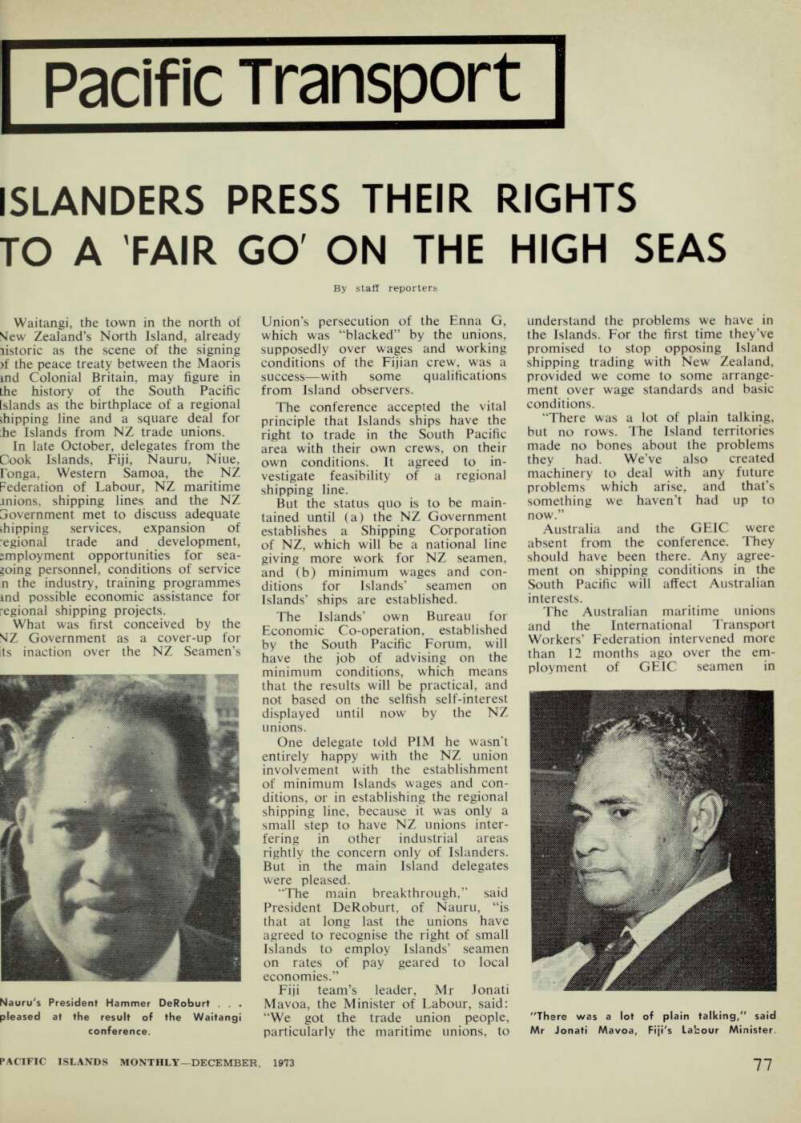
Islanders Press Their Rights
TO A 'FAIR GO' ON THE HIGH SEAS
By staff reporters
Waitangi, the town in the north of Mew Zealand’s North Island, already listoric as the scene of the signing )f the peace treaty between the Maoris md Colonial Britain, may figure in the history of the South Pacific islands as the birthplace of a regional shipping line and a square deal for he Islands from NZ trade unions.
In late October, delegates from the Cook Islands, Fiji, Nauru, Niue, Ponga, Western Samoa, the NZ Federation of Labour, NZ maritime anions, shipping lines and the NZ government met to discuss adequate shipping services, expansion of •egional trade and development, employment opportunities for sea going personnel, conditions of service n the industry, training programmes md possible economic assistance for regional shipping projects.
What was first conceived by the SZ Government as a cover-up for its inaction over the NZ Seamen’s
Union’s persecution of the Enna G, which was “blacked” by the unions, supposedly over wages and working conditions of the Fijian crew, was a success—with some qualifications from Island observers.
The conference accepted the vital principle that Islands ships have the right to trade in the South Pacific area with their own crews, on their own conditions. It agreed to in vestigate feasibility of a regional shipping line.
But the status quo is to be main tained until (a) the NZ Government establishes a Shipping Corporation of NZ, which will be a national line giving more work for NZ seamen, and (b) minimum wages and con ditions for Islands’ seamen on Islands’ ships are established.
The Islands’ own Bureau for Economic Co-operation, established by the South Pacific Forum, will have the job of advising on the minimum conditions, which means that the results will be practical, and not based on the selfish self-interest displayed until now by the NZ unions.
One delegate told PIM he wasn’t entirely happy with the NZ union involvement with the establishment of minimum Islands wages and con ditions, or in establishing the regional shipping line, because it was only a small step to have NZ unions inter fering in other industrial areas rightly the concern only of Islanders.
But in the main Island delegates were pleased.
“The main breakthrough,” said President Deßoburt, of Nauru, “is that at long last the unions have agreed to recognise the right of small Islands to employ Islands’ seamen on rates of pay geared to local economies.”
Fiji team’s leader, Mr Jonati Mavoa, the Minister of Labour, said: “We got the trade union people, particularly the maritime unions, to
understand the problems we have in the Islands. For the first time they’ve promised to stop opposing Island shipping trading with New Zealand, provided we come to some arrange ment over wage standards and basic conditions.
“There was a lot of plain talking, but no rows. The Island territories made no bones about the problems they had. We’ve also created machinery to deal with any future problems which arise, and that’s something we haven’t had up to now.”
Australia and the GEIC were absent from the conference. They should have been there. Any agree ment on shipping conditions in the South Pacific will affect Australian interests.
The Australian maritime unions and the International Transport Workers’ Federation intervened more than 12 months ago over the em ployment of GEIC seamen in
Nauru's President Hammer DeRoburt . . . pleased at the result of the Waitangi conference.
"There was a lot of plain talking," said Mr Jonati Mavoa, Fiji's Labour Minister.
German ships. Talks at Tarawa last December ended in an agreement over wages and conditions.
Will that agreement and the wage standards established there differ from any agreement which SPEC is able to work out? GEIC’s Member for Communications, Works and Utilities, Mr Naboua Ratieta and Commissioner of Labour Mr A. T.
Martin, agreed with PIM that they could be affected by decisions made as a result of the Waitangi con ference. The colony government will watch the position closely.
Some of the other benefits to come out of the Waitangi conference will be provision of technical and capital assistance to the Islands, including help and study to develop port and wharf facilities and training in shipbuilding.
Back in Nukualofa, Secretary to the Government, Mr Dan Tufui, who attended the conference with Captain Chris Hill-Willis in his capacity as a director of the government-owned Pacific Navigation Co, expressed satisfaction that the Islands had won their point.
But Captain Hill-Willis paid high tribute to Mr Tufui. He said the opening speech by Mr Tufui on the rights of Islanders had made a tremendous impact at the conference, and “paved the way for its success ful outcome”. The speech is reported in full on p 25.
Pacific airlines in a state of flux!
Air Nauru To
Be More Active
Air Nauru, the Republic of Nauru’s international airline, is planning a more active role in the Pacific, with an increase in promotion and routes.
To put the airline in a better posi tion it may acquire a back-up aircraft in support of its existing F2B jet. This may be either another F2B or a 737, but probably the latter.
Air Nauru currently operates a major service between Melbourne- Tontouta (New Caledonia)-Honiara- Nauru, but it also flies between Nauru-Tarawa and Nauru-Majuro- Okinawa-Kagoshima (Japan). It is interested in rights into Fiji and also into Apia.
If it could establish a link between Nauru and Apia via Funafuti it would have a worthwhile service connecting Polynesia with the North Pacific, which at present Continental has the theoretical rights to operate (that is, it has been approved by the US but by nobody else).
Air Nauru also has an eye on New Guinea developments now that Air
Niugini has been established, and can see another possibility for a direct Honiara-Port Moresby service.
It seems unlikely that Nauru will get Fiji rights because of its current uneasy relationship with the Air Pacific consortium, from which it has withdrawn —preferring to make its own way. Western Samoa is in the consortium and any discussions with Air Nauru about a Samoan leg could possibly prove embarrassing—but there is greater possibility of an arrangement there than with Fiji.
Air Nauru’s situation vis-a-vis the Air Pacific consortium, including the disposal of Air Nauru’s shareholding in Air Pacific, is to be discussed at a meeting of consortium delegates in December. The various independent moves which could be regarded as a threat to the consortium, such as the Nauruan, Samoan and Tongan de velopments (see separate story of King Taufa’ahau’s hopes) will pro bably also be raised at the meeting.
Because of these developments the internal South Pacific airline situa tion is currently in a state of flux, almost of turmoil.
Nauru’s 5,600 ft airport has a hot mix seal and is currently being instal led with DME (distance measuring equipment, a navigational aid) and night lighting. Service on the Air Nauru Fokker is noted as being super first class, with passengers spoiled by an abundance of food and drink.
Other airline development are:
Air Niugini
Takes The Air
Air Niugini got off the ground on schedule on November 1, owner of a fleet of four Fokker Friendships, 12 DC3 passenger and cargo aircraft and another four Fokker Friendships leased from Ansett.
The four Friendships Air Niugini owns were bought from TAA for SI million. The DC3s cost $15,000 each and included a large stock of spare parts.
The members of the board of Air Niugini are Messrs Paul Pora, Mekere Morauta, Simon Kenehe. Dr K. N. E.
Bradfield (representing the PNG Government). Captain Frank Ball (TAA). Dr Harold Poulton (Ansett) and Captain R. J. Ritchie (Qantas).
Mr Pora is chairman and Captain Ritchie vice-chairman.
The first flight of the new airline was from Port Moresby to Lae on November 1. The aircraft arrived late at Lae because of bad weather.
The airline’s manager in Lae, Mr W.
Johnston, described the first day of operations as “right up to expecta tions. Things have gone really well.”
The ribbon “holding” the aircraft to take off on the first flight was cut
by the Chief Minister, Mr Michael Somare. Later, at a reception mark ing the occasion, he said Air Niugini would prosper towards a profit making airline in spite of “prophets of doom”.
The “prophet of doom” to whom he referred was Professor Keith Cleland, head of the Accountancy and Business Studies Department at the University of Technology, Lae.
Professor Cleland said that setting up Air Niugini was a “classic case” of the lack of government advisers in implementing ideas.
“It is madness to think that within three months of appointing a general manager, you can successfully merge two airlines and go on in a normal way,” he said. “1 predict there will be chaos in the next few months with Air Niugini. Not enough work has been done. They are on a snowball and don’t know how to get off.”
One fly in the ointment on the first day’s flying was when engineers walked out at 10.30 am and stayed off their jobs for nearly five hours.
Tongas King Is
Thinking Big
King Taufa’ahau Tupou IV of Tonga is thinking big about the future of the country’s aviation industry. In his speech from the throne at the closing of parliament in October he spoke of making Fua’amotu a full jet airport by extending the runway from 6,000 feet to 10,000 feet or more.
Admitting that such a project, along with other plans for aviation would cost a lot, he said financial assistance was “procurable” and he hoped to have talks about it during a visit to Japan. It is from Japan that Tonga, has been offered, free, a Boeing 8737 twin engined 100-seater jet aircraft.
On the Japan visit King Taufa’ahau also expected to talk about the equip ment necessary for the jet aircraft, and to negotiate ways and means of getting pilots and ground crews to maintain it, and train staff to run the new Tongan airlines.
Negotiations are under way with Fiji and Western Samoa which fly to Tonga, with France which administers New Caledonia and Tahiti, with New Zealand, about Rarotonga airport and Niue, and with the US about Pago Pago. When arrangements with these countries were completed, it would be possible to set up a Tongan airline.
The king did not spell out details about these negotiations, but presum ably they related to landing rights.
He said that Tonga could have connections with the “busy airports” of New Caledonia, Nadi, Pago Pago, Tahiti, the Cook Islands, and any
other destination which might be •developed later.
Turning to shipping the king said it was important that Tonga should have its own slipway because of the number of ships it operated. Tonga was an important country in its part of the Pacific in cargo handling and providing transport. It would be of tremendous advantage if Tonga could build its own ships to suit its par ticular requirements. But it had to aim first at docking and repairing its own ships before embarking on ship-building.
The Cooks Take
To The Air
White, green and blue will soon become familiar colours to Cook Islanders as they look up at a Britten Norman Islander aircraft winging its way between Rarotonga and Aitutaki, 160 miles apart. The trim little nine seater will be white (top) and blue, separated by a green band. On the tailfin will be a green and white stylised tropical flower.
The service, the first domestic ser vice in the Cooks, was scheduled to start in November, a month before Air New Zealand opens its DCS ser vice to Rarotonga. It will be oper ated by Cook Islands Airways, in which Air NZ and the Cook Islands government are partners. The man ager of the new airline will be Mr N. A, Nisbet, who will continue in his present post as Cook Islands manager for Air NZ.
Fiji To Take Over
Nadi Airport
Fiji has set July 1, 1975, as the take-over date for running Nadi International Airport. This decision follows a recommendation by the South Pacific Air Transport Council.
The NZ Government at present ad ministers the airport on behalf of
Spatc.
Although control of the airport is still more than 18 months away, this has not deterred Fiji from enter ing into agreements for landing rights.
Nadi is in a strategic position, which puts the Fiji Government in a posi tion of bargaining from strength when seeking landing rights for Air Pacific, in which she is a partner.
In the last few months Fiji has signed aircraft landing rights agree ments with Chile and New Zealand.
Agreements with Australia, India and Canada, have been negotiated, and are waiting for government ap proval before signature. Fiji hopes to negotiate an agreement with the United Kingdom before the end of
1973, and also plans to meet France and the US over landing rights.
The agreement with New Zealand gives Air New Zealand terminating flights to Nadi and flights through Nadi to North America, Asia and other Pacific Islands. New Zealand, in return, has given Air Pacific land ing rights at Auckland, via Tonga, and on to New Caledonia, the New Hebrides. Air Pacific may also land at Niue and Rarotonga on flights to Tahiti and Chile.
Some of these rights, of course, may not be taken up for years; but they are now there for the benefit of Air Pacific if and when it becomes an international airline.
Zooming Oil Prices
Worry Shipowners
Substantially higher prices for mar ine and diesel oil fuel could rub off in higher Pacific freight rates. So far there has been little talk of a further hike, but shipping companies are con cerned about oil prices.
If freight rates do go up because of higher fuel costs, it is more likely to be a surcharge, which can be re moved if prices drop, rather than an across-the-board increase, such as that applied between Australia and Papua New Guinea from April 1.
On December 23, 1972, marine
fuel oil cost shipowners 1U526.35 a tonne. At April 1 it had risen to 5U528.60 a tonne, and it is now 5U540.35 a tonne. It has increased by 46 per cent between April 1 and now.
Diesel fuel oil has risen more sharp ly from $U539.20 a tonne on De cember I, 1972. At April 1 it was 5U5'44.45 a tonne and now it is 5U570.70 a tonne. The rise since April 1 is 71 per cent.
Cargo Rates Up
For Norfolk
Qantas will apply higher air cargo rates between Australia and Norfolk Island from December 3. It is the first hike in these rates since 1951.
The average increase is 8c a kilo gram.
For shipments less than 45 kg, the new rate will be 53c (previously 44c). For shipments more than 45 kg. the rate will rise from 33c to 40c.
A 52.20 minimum charge will apply for small articles.
Previously there had been no min imum charge on the route, although such charges applied on domestic and international flights throughout the world. The minimum rate between Norfolk Island and New Zealand is $5.
Another new measure will be prior ity cargo rate of $1 a kg. The mini mum charge will be S 3. Qantas will not guarantee this cargo will travel on the next flight to Norfolk after receipt, but it will take precedence over ordinary cargo as space becomes available.
Airlines Compete
For Japan Route
Pan American World Airways is early favourite to be the American flag carrier on the lucrative Saipan- Japan route. But there is still a long way to go before the end of the race. Other contenders for the route are Northwest Orient Airlines and Continental/Air Micronesia.
Continental/Air Micronesia has had its hopes boosted through letters from the US Departments of State and Interior reminding CAB that, under the Trusteeship Agreement, America must promote the political, economic, social and educational advancement of the Micronesians and the Congress of Micronesia favoured Continental/Air Micronesia for the route. ® Trans Tours Ltd, of New Zeal and, has chartered the Italian liner, Marco Polo, for a year. The ship will operate exclusively in the South Pacific.
No Tt Flag, Yet
The time for the Trust Territory to become a country of registry for ships is not yet. The Deputy High Commissioner, Mr Peter T. Coleman, in the absence of the High Commis sioner, Mr Edward E. Johnston, vetoed the enabling act after it had been passed by the Congress of Micronesia. The act also had a pro vision to establish a body of law re lating to admiralty and maritime matters.
Mr Coleman wrote to congress saying the basic objectives of the legislation were not opposed; the veto was applied because of rapid develop ment in international shipping law.
Several recent conventions required careful study to see where the re sponsibilities for the US and the Trust Territory lay in the Pacific.
Uss May Sail Into
The Cruise Business
The Union Steam Ship Co of NZ Ltd will not put a passenger/cargo ship on the New Zealand-Fiji-Samoa- Tonga service to replace the Tofua, which was withdrawn in May. But it is “examining the possibility” of using a passenger ship for cruising, accord ing to a company spokesman in Sydney.
The spokesman said the company was finding it difficult to get what it considered was a suitable ship—one with first-class facilities and capable of carrying about 400 passengers.
Facilities had to be good to attract tourists.
Meanwhile the company has not exercised its option to end its char ter on the Tarros class container ship, the Union South Pacific, which is servicing Suva, Pago Pago, Apia and Nukualofa from Auckland every 14 days. The company took a three year charter of the ship, with the option to end it after five months.
The five months have elapsed.
The spokesman for the USS Co said the service had been “quite successful”. The ship could not carry as much cargo as hoped, and the economics were not as good as was anticipated.
“But from a shipper’s point of view we can say it was quite successful”, he said. “If the ship was a little bigger it would be more suitable, but there is no bigger ship available that does not need better facilities in the
Islands ports”.
Between 15 and 20 containers were being put ashore in Suva each visit, because that was all the port could handle. A further container ship
would not be added till the required unit-load handling facilities were available.
End Of A
Mission Ship
The Manutai, a former New Heb rides inter-island trading ship has been bought by Rabi Holdings Ltd, Fiji, the Banabans' company and will be broken up. The hull will be used as a copra store and the rest of the ship will be used for spare parts.
Ihe Manutai, built in 1946, was well known in the South Pacific. She was then the Empire Sloane, but in 1948 the London Missionary Society bought her and renamed her John Williams VI. As a missionary ship she spent most of the time in the GEIC, sailing between the GEIC and Fiji.
In 1963, Burns Philp bought the ship, and sent her to the New Heb rides where she was renamed Manu tai and became an inter-island trader.
Some Pacific Islands will be visited by the former NZ inter-island ferry, Maori, 7,600 tonnes (7,480 tons), which has been converted into a floating school of evangelism to train young people for missionary work. The new owners, Youth with a Mission based in Switzerland, bought the ship from the Union Steam Ship Co of NZ Ltd. The ship, renamed Agape, has accommodation for 920 passengers and crew and a 1,000-seat auditorium for conferences.
Mr John Rippin who has been appointed secretary of the Papua New Guinea Harbours Board. Mr Rippin, who has been living in Melbourne, has had wide ex perience as an economic and financial consultant in the Pacific region.
Ex-War Transports
For Transpac Hire
The Trust Territory Government is expected soon to take delivery of two World War II transport ships, the Herkimer and Muskigum from the Federal Maritime Administration.
These ships are at present being re paired at Yokohama.
No date has been fixed for the arrival of the ships in the Trust Ter ritory as the government is negotiating with Transpac to charter them.
Mr Robert Laird, chief of the ship technical branch under Mr Beadles, recently inspected the ships in Yoko hama and reported they were in “ex cellent condition”.
The TT Government operates 11 ships. A new one is being built in Korea and two more have been bud geted for in 1975.
Transport briefs
• The Fiji Government will extend the Levuka wharf and build pas senger terminals there and at Natovi during Development Plan Seven. The wharf at Levuka, badly damaged a year ago by Hurricane Bebe, is now too small for the traffic which uses it. • A Soviet liner, the Taras Sheven ko, 19,862 tonnes (19,549 tons) will arrive in New Zealand in December for several summer voyages and cruises. She is a sister ship to the Shota Rustaveli, the first Russian liner to make regular cruises to the Pacific. • Gurney aerodrome in Papua New Guinea will be upgraded to take Fokker Friendship aircraft. The work will cost $lBO,OOO and when work is finished there will be a sealed runway, 5,600 ft long and 100 ft wide. • The Reef Shipping Company, of New Zealand, has bought a re placement for the MV Jean Philippe, the MV Fijian Swift, which sailed on its maiden voyage from Auckland in November to Suva and Lautoka in Fiji. • A 11,256-ton cargo ship, the Illyric, from London, was slightly damaged in Suva Harbour late in October in an accident with the Cap itaine Tasman while berthing at Walu Bay. The Illyric glanced off the Cap itaine Tasman and then off the wharf front. The ship was “patched up” in Suva before sailing to New Zealand for major repairs to starboard plates.
Advertisements & other items, pp. 81-90 (3 items)
77
ACIFIC ISLANDS MONTHLY—DECEMBER, 1973
New Hebrides Motors Ltd.
D D A
KNOX SCHLAPP PTY. LTD.
are proud to announce the appointment of:
NEW HEBRIDES MOTORS LTD.
[BURNS PHILP (NEW HEBRIDES) LTD]
VILA • SANTO
As Sole New Hebrides
Distributor for:
DIESEL ENGINES
& SPARE PARTS
KNOX SCHLAPP PTY. LTD.
135-139 McEVOY STREET, ALEXANDRIA, N.S.W., 2015.
PHONE: 699-8333. TELEX: AA20483. CABLE: "KNOXSCHLAPP",
SYDNEY.
nedliOyd Koninklijke Nedlloyd bv
REGULAR SAILINGS BY FAST, MODERN, CARGO VESSELS from EUROPE vio PANAMA to PAPEETE, APIA, SUVA, LAUTOKA,
NOUMEA, HONIARA, PORT MORESBY, RABAUL, LAE,
MADANG and NEW ZEALAND.
REGULAR SAILINGS BY CARCARRIER from EUROPE to PAPEETE,
NOUMEA and AUSTRALIA.
other ports called at subject to sufficient inducement
heavy-lift facilities —refrigerated space—cargo deeptanks
For further particulars apply to agents
Russell & Somers (Wellington) Island Transport Ltd., Interocean Swire Pty. Ltd., Ltd., Wellington, N.Z. Suva. Sydney.
O. F. Nelson & Co. Ltd., Agence Maritime et Aerienne Caledonienne Apia. S.A. A.M.A.C., Noumea.
Breckwoldt & Co. (S.l.) Ltd., Carpenter Shipping Agencies, Honiara. Port Moresby, Rabaul, Lae, Madang.
Ets. Donald Tahiti, Papeete.
Island Transport Ltd., Lautoka - > a H L- - \ A I IJ— I A I I L— - I A l I i—. t A I \ L- - Ul<L - > a Hl, \ A I IL- 1 A I i_L— . A 1 li»
THE BANK LINE
MONTHLY SERVICES
U.K., CONTINENT to PAPUA-NEW GUINEA & SOLOMON ISLANDS PAPUA, NEW GUINEA to NORTH AMERICA & U.K., CONTINENT SOLOMON ISLANDS, FIJI, TONGA, SAMOA AND TARAWA to U.K.,
CONTINENT
☆ U.S. GULF/AUSTRALASIA VESSELS CALL AT FIJI WHEN REQUIRED
FOR PARTICULARS APPLY;
THE BANK LINE (AUSTRALASIA) PTY. LTD., SYDNEY, N.S.W
KERR RROS. THE VICON PEOPLE
FOR THE PACIFIC ISLANDS
■ *m
YOU'LL SPREAD A LOAD MORE ACCURATELY
WITH THE VICON VARI/SPREADER
And with the Vari/Spreader it is accuracy built to last —the use of corrosion resistant materials sees to that. • Strong, rust free, easy to clean hopper, moulded from glass fibre reinforced polyester. • Stainless steel regulating plate. • Polyester spreading bowl. • Stainless steel spout.
"Versatility" is the right word for the Vicon Vari/Spreader. It broadcasts fertilisers, grain, grass and clover seeds all with equal guaranteed precision. • Spreads as little as 5 lb of grass seed per acre < 2,500 lb per acre of fertiliser. • P.T.O. driven. • Effective spreading with up to 24 ft
MAKE THE VARI/SPREADER YOUR CHOICE FOR
LONG DISTANCE ACCURACY
For further information contact:
KERR BROTHERS PTY. LIMITED
65 YORK STREET, SYDNEY, N.S.W. 2000.
These MF distributors
can show you how the
MF2I blade keeps levelling
and grading costs low
No special operating skill is required with this versatile implement. You’ll beamazed at the way the MF2I handles general dirt moving, road building, ditching, back-filling, levelling, cleaning and dozens of other jobs. The MF2I quickly attaches to an MFl3stractor and depth controlled by the tractors’ hydraulics. Pitch and angle of the blade are adjustable from the tractor seat and blade can be completely reversed for back-filling.
Make a full 6 foot or 8 foot cut with blade extensions.
Grader wheel, side plate and scarifier kits available.
MF Massey Ferguson MF 73047 k ft © ST ©
6- "3
Fibreglass Islander 43' and Karitane 29'
especially designed for tropical conditions
Satisfied Customers in the whole of the South Pacific have proven the suitability of “Islander 43” and “Karitane 29” for tropical conditions.
Their fibreglass construction is highly resistant to weathering, rot, corrosion, marine organisms etc,, and is easy to clean. Both boats are built to a Lloyds moulding specification. The construction is heavy duty fibreglass laminate equal in strength to an equivalent steel boat.
ISLANDER 43
Length: 42ft. 6in. Beam: 12ft.
Draught: sft. Displacement 16 tons.
KARITANE 29
Length: 29ft. Beam: 9ft.
Draught: 2ft. 7in.
Displacement 4j tons.
For further information (including lines drawings) contact: TT 1 T 7 P AOT T" I TVJ P.O. Box 2056, South Dunedin, New Zealand. Phones 54-108 & 54-109 vJ VJT JL Ow 1 or George & Ashton (P. 1.) Ltd., Suva, Fiji. P.O. Box 296. Phone 26-249.
For
RUM
at its best... say
OVERPROOF AND UNDERPROOF
In 5 oz. and 13 oz. flasks and 26 ol and 40 oz. bottles.
BLENDED AND BOTTLED BY JOHN WALKER & SONS LIMITED.
fEZ z Z T2Z22
Throughout
the Islands
are foremost in
General Insurance
QUEENSLAND INSURANCE
COMPANY LIMITED
(Incorporated 1886 in Australia)
Head Office: 82 Pitt Street, Sydney FIJI —Branch Office, Suva, Manager for Fiji: F. N. Davies (A.A.1.1.).
LAUTOKA —District Manager: U. Singh.
HONIARA (8.5.1. P.) —Breckwoldt & Company (5.1.) Ply.
Limited.
NEW CALEDONIA—T. A. Hagen, Ste. W. A. Johnston, S.A.R.L.—Noumea.
NEW HEBRlDES—Resident Officer: R. J. Allsop (A.A.1.1.) Vila; Santo: Bums Philp (New Hebrides) Ltd.
TAHlTl—Arthur Chung; Immeuble 8.1., Front de Mer, Papeete.
NIUE, NORFOLK ISLAND, SAMOA, TONGA and other South Sea Islands—Bums Philp (South Sea) Company Ltd.
Assets exceed $75,000,000
QUEENSLAND INSURANCE(P.N.G.)LTD
PAPUA NEW GUINEA
Head Office, Port Moresby: Manager for Papua New Guinea: D. J. Granter.
District Managers at Rabaul: C. D. Dickings; Lae: R. Jackson; Mt. Hagen: G. F. Donnelly.
LA AU A The MANA section of Pacific Islands Monthly is to be published each year as a fV\ MIN A\“book by the South Pacific Creative Arts Society. As a society member you get your copy. Life membership of the SPCAS is $lOO Fijian or equivalent; foundation membership (good for three years) $25, ordinary membership $4 for those outside the Islands served by the South Pacific Commission and $2.50 for those addresses within the islands. Send subscriptions to the Secretary, Box 5083, Suva, Fiji.
8228 When you buy a machine, make sure everything you need comes with it.
I i »<SK »3**: W: * U And that includes a good dealer. Because even the best machines and best tools dont last forever. Then you need help . . and if it wasn’t there to begin with it won't be there when you need it So evaluate the dealer behind the machine as carefully as you do the machine itself.
C.T.E. is a well established Caterpillar Dealer in the. South Pacific with immediate Parts availability and unsurpassed in-shop or in-the-field service by fully qualified servicemen. . , t A single source ... for parts, service, financing and machines. Thats what you ve been looking for. And mats what we can offer you.
L
CARPENTERS
TRACTOR E EQUIPMENT
Evauß
CATERPILLAR
DEALER
POSTAL: PRIVATE MAIL BAG SUVA FIJI ISLANDS. PHDNE:24OSI 4
TELEX: CARPTRAC FJ2ISO- CABLES: CARPTRAC. SUVA
rehi
33-ssmi
81
ACIFIC ISLANDS MONTHLY—DECEMBER, 1073
Cruising
Yachts
9 QUINTILA, 40 ft ketch, arrived at Rarotonga with Mike Briar, Madeleine Rogers and watchdog. They left Dart mouth, England, 18 months ago and called at Madeira, the Canary Islands, Brazil, French Guiana, Venezuela, Colum bia, the West Indies, Panama, the Gala pagos, the Marquesas and the Society Islands. Because of the high incidence of thieving in South American ports they bought an Alsatian-Doberman watchdog called El Pampa. Plans were to sail direct to Russell in the North Island of New Zealand. e CRUSADER, 51 ft sloop, arrived at Rarotonga from Tahiti on October 1 with owner-skipper Don Sorte (US), three crew and three passengers. Crew were John Faske (US), Heinrich Landwers (Germany), and Susan Davmiller (US) and the passen gers were Tom Goodwin, Anna Goodwin and Easter Goodwin, all from the United States. Starting from Vancouver, Don Sorte's cruise took him down the Ameri can and Mexican coasts, then to the Galapagos, Marquesas and Society Islands. They planned to call at Suva, but from there the route was uncertain. • RAINBOW 11, 30 ft ketch, was in Suva in October with Canadian owners, Roger Miles and his wife, Evelyn. The ketch, built in 1910, was formerly a Royal Navy pinnance. The Miles bought it in 1970 and have since sailed along the American west coast and across the Paci fic to the Marquesas, the Tuamotus, Tahiti, Borabora, Samoa and New Zealand. The next move is to New Zealand, where they hope to find work before moving on again.
9 PAUANA, 52 ft schooner, which was in Papua New Guinea for about nine years, has been bought by Mike and Georgie Green. They sailed from Port Moresby to Townsville on October 11, and in time, plan to sail round the world. 0 The 1974 single-handed transtasman yacht race from New Plymouth to Brisbane will start on April 27. So far five entries have been received for the 1,200mile race. The race is open to boats 20 ft and over. One of the main qualifications is a 500-mile single-handed non-stop trip. Rules for the race may be obtained from Mr W. L. Williams, 89 Belt Road, New Plymouth, New Zealand, with whom entries close on December 31. • SOLITAIRE 11, an extended H 23 from Sydney, arrived back in Port Moresby on October 1 after sailing to Samarai, Trobriands, Rabaul, Bougainville, the Solomons and various islands in between.
After a few weeks stay, Keith Thompson
and Valerie Shine sailed for Thursday Island from where they plan to go back to Sydney. NAOMI is a 46 ft Alan Payne de sign stee) yaw! from Pago Pago . Mogens hjs wjfe M ar i anne and their daughters Nette and Lena sailed from Pago Pago to Port Moresby via Vila to arrive early m October. After a short stay, Naomi sailed for Torres Strait, Timor, Bal. and Singapore. 9 LEDA, a 23 ft steel sloop from Ger many arrived in Port Moresby in mid- October after a 10-day sail from Brisbane, Q n board is Heinrich Henze. , . * THE S E EKER - 48 ft Canadian s oop, from Bora Bora, RAINBOW, 40 ft sloop, from Sydney, and MERIDIAN 11, also from Canada, were all in Rarotonga late Octo ber. Nuclear-protest yacht SPIRIT OF PEACE departed for NZ. Rainbow is headed for England, The Seeker for Tonga and NZ.
Advertisements & other items, pp. 91-92 (1 item)
STuarT
TURNER
® U H.P. • 5 H.P.
© 10 H.P. • 12 H.P.
Write for illustrated catalogue—
KNOX SCHLAPP
PTY. LTD.,
135-139 McEVOY STREET,
ALEXANDRIA, N.S.W. 2015.
TEL.: 699-8333. TELEX:
AA20483. TELEGRAMS:
"KNOXSCHLAP", SYDNEY.
MARINE
PETROL ENGINES
I
DISTRIBUTOR
ENQUIRIES
INVITED.
■1
SAFE TROUBLE FREE
BOATING WITH BROOKER
■■■•■■*£ tails • Aluminium boats from 10 to 14 ft. • Direct shipment arranged. • Send coupon to Ardneil Trading for comprehensive brochure showing complete details and c.i.f. prices.
ARDNEIL TRADING PTY. LTD. 428 president avenue, KIRRAWEE, N.S.W., 2232. PHONE: 521-2909. CABLE: "ANSTRADE", SYDNEY.
NAME
ADDRESS
DAIWA BANK SERVING YOU IN THE PACIFIC BASIN <¥ Head Office ; Osaka, Japan With 137 Branches throughout Japan Singapore Representative Office Suite No. 1007, 10th Floor Robina House 1 Shenton Way, Singapore 1 Republic of Singapore Cable Address: SINGDAIWA Affiliated Bank P.T. BANK PERDANIA Djalan Raya Mangga Besar 7&9 Djakarta Our Correspondent Banks are in city— Apia, Suva. Lae.
Madang Port Moresby. Rabaul, Wewak. Guam, all Principal cities in Australia and New Zealand Contact your banker or our office.
Los Angeles Agency 555 South Flower St. Suite 4040 Los Angeles, Calif. 90071 Sydney Representative Office Bth Floor Prudential Building 39-49, Martin Place, Sydney
THE DAIWA BANK LTD.
Head Office : 21. Bingomachi 2-chome, Higashi-ku, Osaka, Japan Overseas ; London, New York, Los Angeles, Frankfurt, Sydney, Singapore
BREWO BUSH KNIVES No. 625
TWO LION BRAND
exclusively sold by:
Breckwoldt & Co. (N.G.) i
P.O. Box 222, P.O. Box 1549, Boroko, P.O. Box 185,
RABAUL PORT MORESBY. MADANG.
P.O Box 72, P.O. Box 237,
KIETA. MT. HAGEN.
BRECKWOLDT & CO. BRECKWOLDT S.A.R.L. BRECKWOLDT & CO. (5.1.) LTD.
P.O. Box 47, APIA. B.P. 65, NOUMEA. P.O. Box 140, HONIARA.
Pty. Ltd.
188, P.O. Box
LAE.
P.O. Box 178,
WEWAK.
or
SUPERIOR
qualit:/
' WSUPERABUT***
News
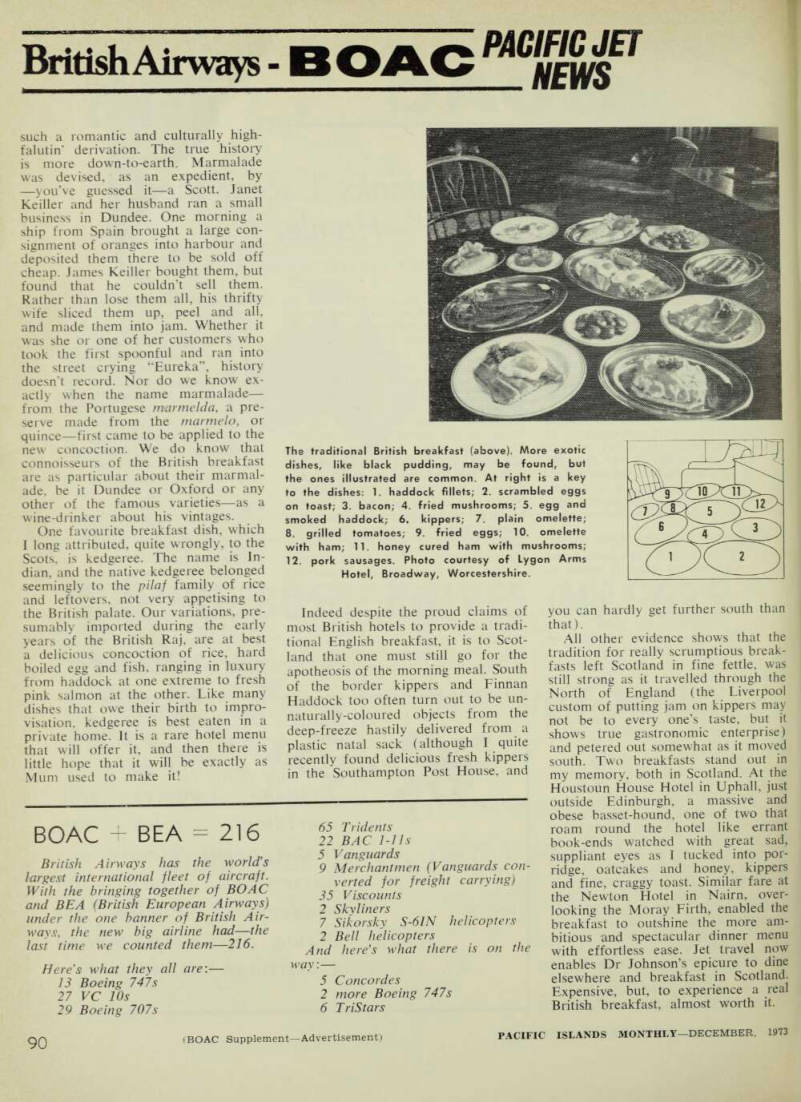
British Airways
Boac
Pacific Jet
News
"But, soft! methinks I scent the morning air"—Hamlet I iv
(BOAC Supplement—Advertisement)
By Humphrey Lyttelton
Bishop Gore, an eminent theologian in the early part of this century, was in America on a lecture tour at the time when a new, crunchy, brown coloured breakfast cereal, that is now very popular, came on the market.
Knowing that the English set great store by their breakfast, his hosts de cided to offer him the new delicacy, tipping some into a bowl and setting it before him with expressions of great expectancy. He didn’t wait to add milk and sample it, but gave the verdict on sight in his precise clergy man’s voice. “Gravel?” he said, put ting the emphasis on the second syll able, “I positively refuse to eat gravel.”
In fact, his hosts had got it wrong.
The English have always been timid and unadventurous when it comes to the first meal of the day. In his soc ial History of England, G. M. Trevel yan records that, in the mid-17th century, breakfast in most upper and middle class homes consisted of no more than a “morning draft” of ale with a little bread and butter. The proverb current at that time —“He that would eat a good dinner, let him eat a good breakfast”—sounds in the circumstances like the advertising slogan of some contemporary Break fast Marketing Board.
It was Dr Johnson, visiting Scot land some hundred years later, who stumbled grudgingly on the truth. He had no great opinion of the North Britons, asserting that “the noblest prospect which a Scotsman ever sees is the high road that leads him to England.” Before his tour of Scot land, he dismissed the Scots’ diet con temptuously with a reference to oats as “a grain which in England is gen erally given to horses but in Scotland supports the people”. He is not the only Englishman to this day to be lieve that the Scots subsist solely on oatcakes and porridge, with haggis thrown in on special occasions. But when he actually went there, he had to concede that “in the breakfast, the
Scots, whether of the Lowlands or Highlands, must be confessed to ex cel us ... if an epicure could remove by a wish in quest of sensual gratifi cation, wherever he had supped, he would breakfast in Scotland”.
It’s interesting to note that Dr Johnson’s rapture of “tea and coffee accompanied by honey, conserves and marmalade” was not shared by all Scots. In his novel “Old Mortality”, Sir Walter Scott described a feudal breakfast in terms which seem to mirror the 20th century Englishman’s view of the “Continental breakfast”.
No tea, no coffee, no variety of rolls, but solid and substantial viands—the priestly ham, the knightly sirloin, the noble baron of beef, the princely venison pastry; while silver flagons . . . mantled some with ale, some with mead and some with generous wine of various qualities and descriptions”.
The truth is then, that we owe most of what we now call the “English breakfast” to the Scots. It is some years—two hundred, perhaps—since we have tucked without thought for
liver or waistline into the “solid and substantial viands” of our ancestors.
Tea and coffee have long been the norm, though some bon viveurs, the late Sir Winston Churchill reputedly among them, have perpetuated with champagne the tradition of the “mor ning draft”. But even I, from the standpoint of no great age, can recall in childhood staying at stately homes in which an Edwardian style of breakfast prevailed. Innumerable sil ver dishes were lined up on a hot plate, offering a staggering choice as one moved along them raising lids.
Eggs boiled, scrambled or fried, bacon, ham, kidney, huge flapping field mushrooms, sausages, kippers, haddock, sometimes even a cheese souffle and kedgeree.
A certain amount of misinforma tion was taken in with the food. I was brought up on the theory that mar malade was invented in France as a sort of tonic food (for Marie-Antoin ette, perhaps) and that the name de rived from Marie malade”. It was typical of the Edwardians to devise
British A irways staff worldwide wish our travel agent friends, our passengers, and all readers of Pacific Jet News, a very happy Christmas.
such a romantic and culturally high falutin’ derivation. The true history is more down-to-earth. Marmalade was devised, as an expedient, by —you’ve guessed it—a Scott. Janet Keiller and her husband ran a small business in Dundee. One morning a ship from Spain brought a large con signment of oranges into harbour and deposited them there to be sold off cheap. James Keiller bought them, but found that he couldn't sell them.
Rather than lose them all, his thrifty wife sliced them up, peel and all, and made them into jam. Whether it was she or one of her customers who took the first spoonful and ran into the street crying “Eureka”, history doesn’t record. Nor do we know ex actly when the name marmalade — from the Portugese marmelda, a pre serve made from the marmelo, or quince—first came to be applied to the new concoction. We do know that connoisseurs of the British breakfast are as particular about their marmal ade, be it Dundee or Oxford or any other of the famous varieties—as a wine-drinker about his vintages.
One favourite breakfast dish, which I long attributed, quite wrongly, to the Scots, is kedgeree. The name is In dian, and the native kedgeree belonged seemingly to the pilaf family of rice and leftovers, not very appetising to the British palate. Our variations, pre sumably imported during the early years of the British Raj, are at best a delicious concoction of rice, hard boiled egg and fish, ranging in luxury from haddock at one extreme to fresh pink salmon at the other. Like many dishes that owe their birth to impro visation. kedgeree is best eaten in a private home. It is a rare hotel menu that will offer it, and then there is little hope that it will be exactly as Mum used to make it!
Indeed despite the proud claims of most British hotels to provide a traditional English breakfast, it is to Scotland that one must still go for the apotheosis of the morning meal. South of the border kippers and Finnan Haddock too often turn out to he unnaturally-coloured objects from t e deep-freeze hastily delivered from a plastic natal sack (although I quite recently found delicious fresh kippers in the Southampton Post House, and
you can hardly get further south than that).
All other evidence shows that the tradition for really scrumptious break fasts left Scotland in fine fettle, was still strong as it travelled through the North of England (the Liverpool custom of putting jam on kippers may not be to every one’s taste, but it shows true gastronomic enterprise) and petered out somewhat as it moved south. Two breakfasts stand out in my memory, both in Scotland. At the Houstoun House Hotel in Uphall, just outside Edinburgh, a massive and obese basset-hound, one of two that roam round the hotel like errant book-ends watched with great sad, suppliant eyes as I tucked into por ridge, oatcakes and honey, kippers and fine, craggy toast. Similar fare at the Newton Hotel in Nairn, over looking the Moray Firth, enabled the breakfast to outshine the more am bitious and spectacular dinner menu with effortless ease. Jet travel now enables Dr Johnson’s epicure to dine elsewhere and breakfast in Scotland.
Expensive, but, to experience a real British breakfast, almost worth it.
Bo Ac + Bea = 216
British Airways has the world’s largest international fleet of aircraft.
With the bringing together of BO AC and BEA (British European Airways) under the one banner of British Air ways, the new big airline had—the last time we counted them — 216.
Here’s what they all are: — 13 Boeing 747 s 27 VC 10s 29 Boeing 707 s
65 Tridents 22 BAC 1-lls 5 Vanguards 9 Merchantmen (Vanguards con verted for freight carrying) 35 Viscounts 2 Skyliners 7 Sikorsky S-6IN helicopters 2 Bell helicopters And here's what there is on the way :— 5 Concordes 2 more Boeing 747 s 6 TriStars
The traditional British breakfast (above). More exotic dishes, like black pudding, may be found, but the ones illustrated are common. At right is a key to the dishes: 1. haddock fillets; 2. scrambled eggs on toast; 3. bacon; 4. fried mushrooms; 5. egg and smoked haddock; 6. kippers; 7. plain omelette; 8. grilled tomatoes; 9. fried eggs; 10. omelette with ham; 11. honey cured ham with mushrooms; 12. pork sausages. Photo courtesy of Lygon Arms Hotel, Broadway, Worcestershire.
Advertisements & other items, p. 94 (1 item)
British Airways - B OAC
90
PACIFIC ISLANDS MONTHLY—DECEMBER, 1973
i BOAC Supplement—Advertisement)
New Trans-Pacific Services
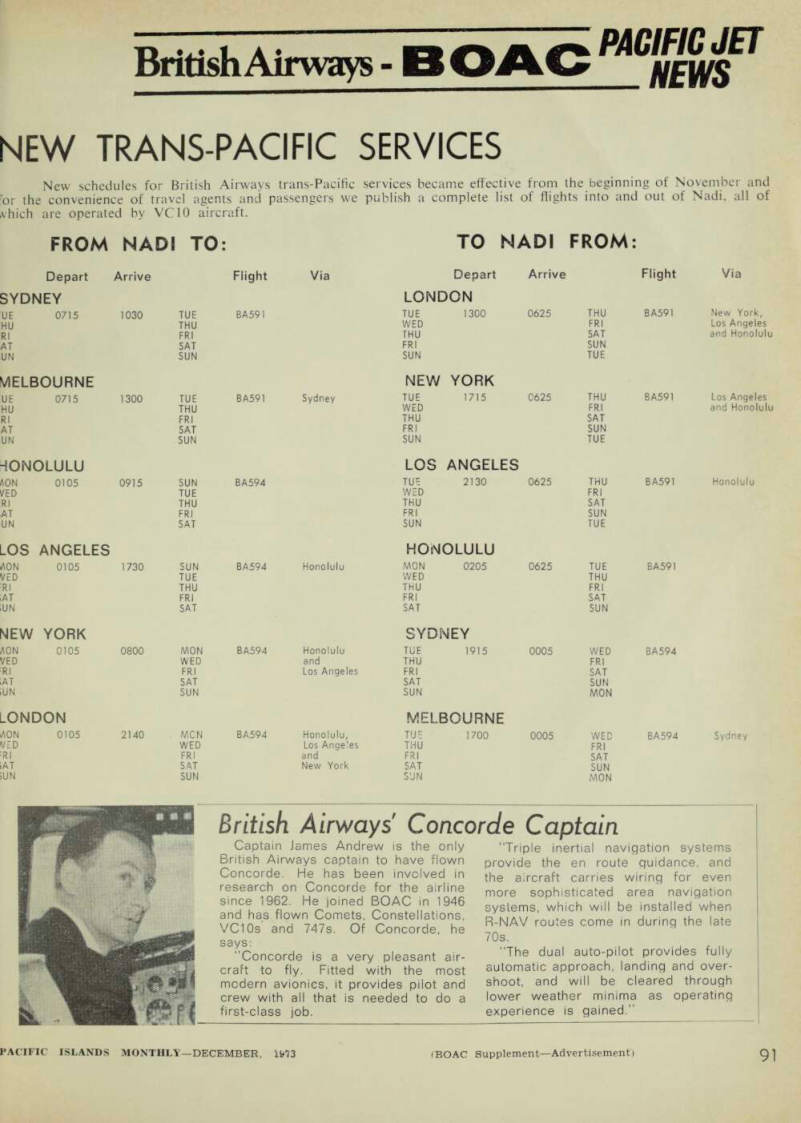
New schedules for British Airways trans-Pacific services became effective from the beginning of November and : or the convenience of travel agents and passengers we publish a complete list of flights into and out of Nadi, all of vhich are operated by VC 10 aircraft.
From
Nadi
TO:
Depart
Arrive
Flight
Via
Sydney
UE 0715 HU Rl AT UN 1030
Tue
Thu
Fri
Sat
Sun
BA591
Melbourne
UE 0715 HU Rl AT UN 1300
Tue
Thu
Fri
Sat
Sun
BA591
Sydney
Honolulu
Aon 0105
Ved
Rl At Un 0915
Sun
Tue
Thu
Fri
Sat
BA594
Los Angeles
Aon 0105
Ved
Rl AT :un 1730
Sun
Tue
Thu
Fri
Sat
BA594 Honolulu
New York
Aon 0105
Ved
Rl At Un 0800
Mon
Wed
Fri
Sat
Sun
BA594 Honolulu and Los Angeles
London
Aon 0105
Ved
: Ri Iat Iun 2140
Mcn
Wed
Fri
Sat
Sun
BA594
Honolulu,
Los Angeles and New York
To Nadi
From:
Depart
Arrive
Flight
Via
London
Tue 1300
0625
Thu
BA591 New York,
Wed
Fri
Los Angeles
Thu
Sat
and Honolulu
Fri
Sun
Sun
Tue
New York
Tue 1715
0625
Thu
BA591 Los Angeles
Wed
Fri
and Honolulu
Thu
Sat
Fri
Sun
Sun
Tue
Los Angeles
Tue 2130
0625
Thu
BA591 Honolulu
Wed
Fri
Thu
Sat
Fri
Sun
Sun
Tue
Honolulu
Mon 0205
0625
Tue
BA591
Wed
Thu
Thu
Fri
Fri
Sat
Sat
Sun
Sydney
Tue 1915
0005
Wed
BA594
Thu
Fri
Fri
Sat
Sat
Sun
Sun
Mon
Melbourne
Tue 1700
0005
Wed
BA594 Sydney
Thu
Fri
Fri
Sat
Sat
Sun
Sun
Mon
British Airways' Concorde Captain
Captain James Andrew is the only British Airways captain to have flown Concorde. He has been involved in research on Concorde for the airline since 1962. He joined BOAC in 1946 and has flown Comets, Constellations, VCIOs and 7475. Of Concorde, he says: “Concorde is a very pleasant air craft to fly. Fitted with the most modern avionics, it provides pilot and crew with all that is needed to do a first-class job.
“Triple inertial navigation systems provide the en route guidance, and the aircraft carries wiring for even more sophisticated area navigation systems, which will be installed when R-NAV routes come in during the late 70s.
“The dual auto-pilot provides fully automatic approach, landing and over shoot, and will be cleared through lower weather minima as operating experience is gained.”
Advertisements & other items, p. 95 (1 item)
British Airways - BOAC^j
91
(BOAC Supplement—Advertisement)
ACIFIC ISLANDS MONTHLY—DECEMBER, 1973
«St. jetufh
British Airways Helps
Students
When students of St Joseph's Secondary School, Suva, planned their variety concert at the Civic Auditorium in October, British Airways advertised it for them in a direct mail shot.
As a result Peter Carter, our district sales manager in Suva, has received a hand-drawn thank you card, which is reproduced here.
In writing their thanks, the prefects said they had been able to make a net profit of about $500.00 and had made donations to HART, the Crippled Children Society, Home of Compassion, Red Cross, St Christopher’s Home, the Blind Society, St Vincent de Paul and the YWCA.
T«a»K f it *ea*t a ux to «St. jetufh
Jonuary
Coming Events In Britain
Some highlights of the next few months 1974
2 International Boat Show Earls Court, London, to 12 January (Press Day 1 January).
February
2 Rugby Football: Scotland v England Murrayfield, Edinburgh. 8 Cruft's Dog Show Olympia, London, and 9 February. 15 English Folk Dance and Song Society Festival Royal Albert Hall, London, and 16 February. 16 Rugby Football; England v Ireland Twickenham, Middlesex. 16 Rugby Football; Wales v France. Cardiff Arms Park, Cardiff.
March
4 Celebrations for the 150th Anniversary of the Foundation of the Royal National Lifeboat Institution various venues in Britain, to 7 January 1975. 5 Daily Mail Ideal Home Exhibition Olympia, London, to 30 March. 12 Spring Antiques Fair Chelsea Town Hall, London, to 23 March. 16 Rugby Football: England v Wales Twickenham, Middlesex. 16 Matthew Flinders Bicentenary Festival Lincolnshire, to May. 30 Horse Racing; Grand National Liverpool, Lancashire.
April
6 Oxford v Cambridge Boat Race. Putney to Mortlake. River Thames. 20 Royal Scottish Academy Exhibition Royal Scottish Academy, Edinburgh, to 4 August (provisional). 20 Pitlochry Festival Theatre Season. Pitlochry, Perthshire, to 28 September (provisional). 24 Badminton Horse Trials, Badminton, Gloucestershire, to 27 April. 24 International Dairy Farming Event National Agricultural Centre, Stoneleigh, Kenilworth, Warwickshire, and 25 April.
Moy
4 FA Cup Final. Wembley, London. 4 Royal Academy Sommer Exhibition Royal Academy, London, to 29 July. 9 Royal Windsor Horse Show Home Park, Windsor, Berkshire, to 12 May. 11 Rugby Football: League Challenge Cup Final Wembley, London. 22 Chelsea Flowed Show Royal Hospital, Chelsea, London, to 24 May (Private view—2lst) (provisional).
June
5 Horse Racing: Epsom Summer Meeting Epsom, Surrey, to 8 June (provisional) (The Derby—sth; the Oaks—Bth). 11 Three Counties Agricultural Show. Malvern, Worcestershire, to 13 June. „ 12 Grosvenor House Antiques Fair. Grosvenor House, London, to 22 15 The Queen's Official Birthday; Trooping the Colour. Horse Guards Parade, London. 15 Tennis: Wightman Cup: Ladies' International: G.B. v U.S.A.
Wimbledon, London, and 16 June. 18 Horse Racing: Royal Ascot Ascot, Berkshire, to 21 June (pro visional). 21 Bath Festival Bath, Somerset, to 30 June. 24 Lawn Tennis Championships Wimbledon, London, to 6 July. 26 Royal Norfolk Agricultural Show. Showground. New Costessey, Norwich, Norfolk, and 27 June. , . 28 Royal National Rose Society's Show. Royal Horticultural Society Halls, London, and 29 June (provisional).
July
1 City of London Festival. London, to 13 July. 4 Henley Royal Regatta, Henley-on-Thames, Oxfordshire, to 7 July. 9 Great Yorkshire Agricultural Show. Great Yorkshire Showground, Harrogate, Yorkshire, to 11 July. 10 Royal Tournament: Displays by the Armed Forces Earls Court, London, to 27 July. 17 World Show Jumping Championships. Hickstead, near Bolney, Sussex, to 21 July. „ J 20 The Daily Telegraph and BP Round-Britain Power Boat Race. Start and finish London, to 3 August. . e 26 County Landowners Association Game Fair Stratf le Id Saye, Hampshire, near Reading, Berkshire, to 27 July.
Advertisements & other items, pp. 96-103 (2 items)
British Airways - B OAC
92
PACIFIC ISLANDS MONTHLY —DECEMBER, 1973
(BOAC Supplement—Advertisement)
The blue beyond. The earth below.
A path between the two. That only youth may
Making the endless blue and
bleach-white sands one..*
•••. HONDA.
A young man whose desire to reach the summit of success knows no limits. At work or at play he thrives on new challenges, new ways to satisfy his zest for the active life. Every day more people are finding themselves in HONDA. Leader in motorcycles. Holder of the title of having % of the world’s market. With sales in more than 75 countries. By offering the right combination of power, performance, and ride in a wide range to suit every individual. It's all of what it takes to be a world leader in motorcycles
... HONDA!
lOW.
MO A' y H m r h. 5 a « m World’s Largest Motorcycle Manufacturer t HONDA MOXbR CO..LTD. TOKYO, JAPAN , . ling Co., Ltd. 74* 0 66x 296, £uva /tARAW
:U.S TR
e Gilbert &.
NEW
FIJI VSLANDS;;tforaI Island Mentor
.WESTERN SAMOA;
RITORY: J.C. Tenorio Enterprise Box 137.^ .standifiSsvelPOmenr.AofKdrlw■ x - • itrF.o:'Box^7COT/AMERICAN S/yUOA 7 JMax ttalecklrfc. P ; 0. Box 99. fa^P^oTOjlOA: h'Solontons'Trading Co., L{d: P.O.'Box 94, Honiara CALEDONIA: [ S ra% E M. Jones Ltd, P.O Box 34, / SOLOMON ISLANOST British Solomons' Trading Establissements Ballande, Noumea / TAHITI.vEts P.O Box 92, Rarotonga / NAURU ISLAND: Nauru 'I: Ets. COMIMPEX P. 6. B6}^bo,.Papeete /.COOK fSLANDIS: Codk Islands Trading Corporation Ltd. auru * ’ < —.
5 &*S . >«h , K " a r ,-' ',f •; / vv-.Vi.vj f / i t (V . i• /“ /■: .-/■ .. £ p '' : KM : A ''A: • X... lv- •• • v ’■'» j
Ir/y
m mx 1 is
JIU
||« w* IW lIM m *S% Si yr l£Sm a: £ ‘ -♦ ill & vV : v;.
WHi
V sasfeliltfMS ». Bit cm
Sound has "heart”...
CJ* * TD|<
Asse^e
ro K
M Ybu can feet it withTDK SD Cassette True High-Fidelity Sound Reproduction in cassettes has never been achieved until TDK SD cassettes. TDK, specialist in tape technology, developed SD cassettes only 4 years ago, and now they are favoured by audiophiles in as many as 93 countries. SD cassettes give the people such a true sound emotion as no other tape could. True High-Fidelitythat's what TDK has! • SD Cassettes are offered in both the popular C-60, C-90 and the C-30 type, as well as reel type 1800-SD and 1200-SD. ♦Also available low noise cassettes in C-30, C-40, C-60, C-90 and C-120.
&TDK
TDK ELECTRONICS CO.. LTD.
2-14-6, Uchikanda, Chiyoda-ku, Tokyo, Japan
DISTRIBUTORS WANTED FOR:
New Caledonia, New Hebrides, Tonga, West Samoa, American Samoa, Marquesas Nauru, Cook Islands, British Solomon Islands.
TDK Authorised distributors; Australia
CONVOY INTERNATIONAL PTY. LTD.
Cnr. Plunkett and Maclean Sts.
Woolloomooloo 2011 Sydney, Australia New Guinea & Papua Turner & Davey Electrical Pty. Ltd.
P.O. Box 255, Lae, P.N.G.
Tahiti
Ets. WIKING
132 Rue du Marechal Foch Papeete, Tahiti Fiji ... Maganlal & Co. 119 Vitogo Parade Lautoka, Fiji
Cable: TDK CORE TOKYO
Telex; TODENKA J 24270
EHMPM
CL Series 265 HP Series ¥M 22^ 37 HP * YANMAR is a Japanese diesel engine maker, and was the first in the world to succeed to developing a truly small diesel engine. From 3HP up to 2,00()HP, YANMAR is producing a full range of diesel engines, ideal for an unlimited variety of applications. YANMAR diesel engines are already winning high reputations in more than 130 countries around the world.
In the YSE, lE, and KDE series, YANMAR has developed a line of high performance diesels specially for marine power units. The secret of the exceptional power which these units develop lies in the unique combustion performance, not attainable by any competitive unit.
YANMAR diesels are ideal for the rationalization of the fishing industry among the pacific islands and for inter-island transport.
DEALERSHIPS
YANMAR is seeking dealers on the following islands. Those who would like to be considered are invited to contact the company representative at the address below.
Fiji, New Hebrides, New Caledonia. Gilbert and Ellice, Tahiti, Tonga. Nauru, American Samoa, Western Samoa, Cook Is.. Norfolk Is.
I Series
S»I2HP
YANMAR DIESEL ENGINE CO LTD
1-11-1, Marunouchi, Chiyoda-ku, Tokyo, JAPAN Telex: TOK 0222-2310
CABLE: YANMAR TOKYO
SOUTH PACIFIC
BY BRUCE PALMER & BETH DEAN
A must for those interested in Pacific Islands art and dance .
Overleaf is your order form for South Pacific.
See our announcement opposite.
"SOUTH PACIFIC" sells in Australia and Overseas for $2.95 Aust., plus 25c posted; U.S.A., $4.40 U.S., posted.
Please send copy(ies) "South Pacific" to: — name address
city/state/country/post code
for which payment of is enclosed.
Pacific Publications (Aust.) Pty. Ltd.,
29 Alberta Street, Sydney, N.S.W. 2000. (Postal address: Box 3408, G.P.0., Sydney, N.S.W. 2001) When ordering ask for our Pacific book catalogue
D DECEMBER, 1973—PACIFIC ISLANDS MONTHLY
SOUTH
PACIFIC
BRUCE PALMER & BETH DEAN
A must for those interested
in South Pacific cultural art
and dance.
In this book, two skilled guides lead the reader on an exciting Pacific Ocean voyage of discovery.
Part of the voyage is backward in time, but great art takes no account of age.
Bruce Palmer and Beth Dean show that there is true greatness in Pacific art, whether its form be a carved figure, the pattern stencilled on bark cloth or woven into the fabric of a building, or the superbly controlled movement of a massed or individual dance.
The contents of the book total 104 glossy pages, with 64 beautiful colour plates and 56 blackand-white pictures.
It covers artifacts, culture and cultural dances from 17 Pacific Island countries with the inclusion of the Australian aboriginal whose origins date back more than 30,000 years.
Fill in the details
on the attached
order form .
Australia, NZ, begin to
Business and Development
Australia, NZ, begin to understand the Islands
By a staff reporter
Premier of the Cook Islands, Mr Albert Henry, summed up the pro blem in Sydney in early November in only a few words —which is unusual for him. Infiltration by Aust ralian and New Zealand unions is com plicating industrial relations in the South Pacific Islands, he said, and will continue to do so until the unions understand Island conditions better. The unions have to realise that what is good for Australia might not be good for Samoa and the Cook Islands, he pointed out.
Mr Henry might well have added to the list Fiji, Tonga, Nauru. New Guinea, Micronesia and the rest of the Pacific Islands represented at the three-day conference of South Paci fic Labour Ministers, which was held in Sydney that week under the spon sorship of the Australian Department of Labour. The conference sessions were open to the press, who were thus able to see for themselves that union activity in the Pacific Islands can generate a lot of heat even among leaders sympathetic to the union movement, such as Premier Henry himself. Mr Henry was active in the NZ Labour Party after the war and his rise to power in the Cooks was from the base of in dustrial unionism.
But it was Mr Henry’s complaints, with those of Fiji’s Prime Minister Ratu Sir Kamisese Mara, made at a conference in Western Samoa in April, that set the stage for the Syd ney meeting. Ratu Mara told the South Pacific Forum in Apia, which was attended by Mr Whitlam and Mr Kirk, that New Zealand unions were interfering with Fiji sover eignty in their opposition to industrial relations legislation which was then going through the Fiji parliament.
Australian unions were also interfering in industrial aspects of Fiji, he said.
The forum agreed to support the Sydney conference to discuss the various problems.
Since then there had been other complaints of union interference in Island affairs by President Deßoburt
of Nauru, who attended the Sydney conference, and Mr Michael Somare, of New Guinea —Nauru having gone to the trouble of inserting full-page advertisements in the New Zealand newspapers in an effort to put its point of view over the blackballing in Wellington of one of its ships, the Enna G.
The Enna G affair caused anger in important quarters in the South Paci fic, because it was no simple shipping dispute. It was the independent powers of the South Pacific versus the metropolitan powers for the right to operate their own businesses their own way. (see p 25, 77).
It’s a matter of irritation, and anger, to Islanders to feel the con descension of the average Australian or New Zealander towards the Islands.
This sort of thing: “Fiji is a great place for a holiday, what with all that duty free grog and stuff, but you couldn’t expect them to know how to run the place fair and square, now could you?”
Also, “Australia is actually giving self-government to New Guinea, where it’ll be another 50 years before some of them are out of the trees!’* the insinuation being that those lucky enough to be out of the trees wouldn’t be capable of making an intelligent decision anyway.
It doesn’t occur to the ignoramuses who go on with this type of nonsense that Islanders might understand their own needs best, or might come to terms with their own environment de spite the disruption caused by an im posed colonial experience, from which most of them have emerged in better temper than the rest of the world had a right to expect.
But, conferences such as the Labour Ministers Conference are not now convened because Australia is magn animous; they’re occurring with in creasing frequency because the South Pacific nations have something im portant to say, and they will make their points with growing insistence until the metropolitan powers under stand them. One of the items on the
countries. Therefore, solutions can’t be conference agenda for instance dealt with employment in the South Pacific and an important facet of the discus sion centred on employment possibi lities for Islanders in Australia and New Zealand.
Fiji’s ministers in particular, es pecially Prime Minister Ratu Sir Kamisese Mara, have been very vocal over this. So has the Cook’s Albert Henry but Island views are changing.
A few years ago they wanted their nationals to be given jobs in the de veloped countries. Now, they’re not so sure, It often means a brain drain, so the emphasis has been shifted to a request for the creation of new industries in the Islands by the de veloped countries.
The conference got around to this view, recognising, as the communique said, “that employment opportunities could be fostered by creating indus tries, by removing barriers to the ex port of goods and commodities they produce and by enabling industries adapted to the needs and resources of the region, such as the maritime industry, to be developed.”
Which brought the conference to the need for skilled technicians and tradesmen. The ministers agreed to pool information about existing and proposed training facilities and courses to enable them to be used as widely as possible inside the region.
Both Australia and New Zealand expressed willingness to fill part of this gap, but the Island representatives made it clear that they’d prefer the training experts to be sent to the Islands rather than the trainees go ing to the developed countries. They argued that training was most ef fective in the trainee’s own environ ment. Behind that view was the situ ation so often experienced by the Is land leaders of finding that their nationals, after training abroad, were reluctant to leave the fleshpots and more comfortable ways of life found in the developed countries. It’s likely, therefore, that training will be carried out in the Islands.
Another view was that the admis sion of Islanders to Australia and New Zealand to work on a short-term basis—it’s been going on for years in New Zealand —“did not provide a real solution to unemployment.”
Not much was said about one of the Islands’ main grievances—inter ference by overseas trade unions. It was anticipated that Nauru, Tonga and Fiji would “have a go” over past examples of this, but there were mainly oblique references and the conference was content to record that “there was an urgent need to create greater awareness among international
trade union organisations (in particu lar the International Transport Workers Federation) and among trade union officials in the region, of the real problems and circumstances of the Island communities in order to obtain their co-operation in working towards fair and reasonable condi tions for those employed in the mari time services which will be consistent with the economic and social position of the peoples of the region.” The Waitangi (NZ) shipping conference (p 77) said much the same thing.
Australian Labour Minister Clyde Cameron promised to get his govern ment to foot part of the bill for a proposed seminar for government, employer, trade union representatives and academics to study labour pro blems.
There was much play over the deve loped countries helping the Islands with labour relations but about that there was an air of the blind leading the blind. Wildcat strikes and bad labour relations are facts of life in Australia and New Zealand!
All in all, the delegates were satisfied with the conference. Australia, origi nator of it, certainly improved its image among the Islanders, who went home convinced that what Ratu Mara, when the conference was first proposed by Mr Whitlam in Apia last April, suspected was a red her ring, turned out to be a much more fruitful product.
Fiji Labour Minister Mr Jonati Mavoa told PIM, “There seems to be a real shift in the thinking of Australia and New Zealand towards the Island countries. The conference has made them realise that the pro blems we have are not exactly the same as those in the more sophisticated
reached by using conventional meth ods, and new solutions must be found.”
There were no hard and fast de cisions made but the main points agreed by all were: © The need to develop employ ment opportunities and make im mediate efforts to create those op
portunities;
9 The provision of training faci lities and co-ordinating educational and labour market policies; 9 A review of training require ments and facilities should be made by the South Pacific Commission in collaboration with the International Labour Office before the SPC’s pro posed conference on Manpower Plan ning next year; ® The strengthening of vocational guidance and counselling services to school children; © Compliance by the participating countries as far as circumstances permit, with internationally-accepted minimum standards in the labour field, but with the right to adopt own legislation and practices according to local needs: ® A seminar to discuss labour pro blems and a training course for trade union officials and others in industrial relations, usine instructors from Aust ralia and NZ and other suitable countries; ® The collecting of labour stati stics and the exchange of information on legislative changes and develop ments in the labour field: © The training of labour admini stration staff, and @ A request to the ILO to devote more resources to the South Pacific region and set up an office there.
Fruit Juice Is Not Enough
The Cook Islands needs tourism to back up its citrus fruit industry. But will tourism adversely affect a virtually unspoiled island group? That is a poser worrying three young Cook Islanders, agricultural officers who are examining the citrus fruit industry in Australia under a United Nations FAO scholarship.
The men are Anau Manarangi (Rarotonga) Julian Dashwood (Mauke) and Ngaro Solomana (Aitutaki). They all attended Massey Agricultural Col lege, near Palmerston North, NZ„ in the mid-19605. All believe the citrus industry must be developed to its full potential. Each is optimistic that ef forts to build up the canning industry and the export of fruit will eventually be successful.
One of their aims when they re
turn to the Cook Islands about the end of December will be to increase the number of citrus trees to the
acre through improved farming
methods —spraying, the use of ferti lisers and building irrigation dams if possible.
“Irrigation is a must if we want to boost our production because the rainfall is not evenly distributed”, Mr Dashwood said to PIM.
The three men were most im pressed with the way some citrus farmers in Australia were able to build their own irrigation dams with bulldozers.
Mr Solomana said the government was doing a lot to help the Cooks economy. It was encouraging the people of Atiu to grow pineapples, supplying materials to help citrus
rowers and encouraging tourism irough which it was hoped to pro ide more employment.
Mr Manarangi had reservations bout tourism, although recognising s potential.
“I reckon the influence of tourism ill spoil the natural look of the ilands”, he said. “It (the Cook Is tnds) will be the next small Hawaii”.
However, from an economic point f view, the Cook Islands needed jurism.
Mr Dash wood was doubtful 'hether tourism would bring money ) everyone; he thought earnings 'ould get into the hands of just a ;w.
The three men agreed the Cook dands could grow most of the food jurists would need, but meat would ave to be imported.
After those remarks they posed for picture, then went off to inspect ome river orchards near Sydney, be are leaving to see some of Australia’s est citrus farms in the Murrumbidgee rrigation Area in NSW.
Zooks hotel
vill open on time
Despite delays on building materials rom New Zealand, Brahne and Cook slands Motels are confident that the krorangi Beach Motel in the Cooks yill be open for business by the end if November. Stage One of the motel s being built by the local firm of ohn Short Construction. The double mits have concrete block walls and he roofs of heavy fibrolite will be inished with coconut palm thatch.
Grouped in a “U” formation, the mits will enclose a central meeting louse to be used for entertainment. >tage Two will comprise a two-storey lotel with 72 rooms, a conference oom and swimming pool.
Samoan chiefs'
'no' to refinery
Tualauta County matais in Ameri can Samoa have set their eyes firmly against the proposed oil refinery (PIM, Oct, p 97). They will use every means within their power to stop it going on their land, or any other area of Tutuila, they say. They feared the pollution could reduce land values, villages would have to adopt life-styles foreign to the Samoan com munity, future generations would face relocation and restriction on their land, and there would be an increase in the number of outsiders who would have an undesirable effect on the community. They admitted there would be revenue benefits, but valu able land could be tied up for 50 to 60 years. And the refining company had selected American Samoa, not because of any affinity to it and the people, but for purely economical reasons.
Hope infused into
PNG tea industry
A faint glimmer of hope has emer ged for the Papua New Guinea tea industry. Buyers from leading British tea houses at a promotion of PNG tea at Australia House, London, praised the tea, which is used in the UK for blending. That suggests an increased demand, but price remains the key factor.
Mr R. G. Bradshaw, a buyer and partner of one of the UK’s leading tea merchants, who has visited PNG several times, said he could see a future where more tea could be im ported from PNG if the price was competitive with the world market.
PNG can offer tea which is com petitive on the London market; but what the grower gets is a different brew. The cost of labour in the PNG tea industry in 1967 was 60c a day.
By 1973 the cost had risen to $1.07 a day. In 1967 the growers received 39c a pound. Now, because of cur rency changes they receive about 30c a pound.
The two major suppliers to the London market, India and Sri Lanka (formerly Ceylon) are tied to ster ling, so they have not lost anything through currency movements. The currencies of other big tea producers are tied to the US dollar. PNG is the only tea producer tied to the Australian dollar. The PNG tea pro ducers have suffered a 26 cent loss in earnings through Australian re valuations.
The PNG tea industry has grown rapidly. In 1969 production was 345
tonnes, worth $200,000. Since then production and value figures are: 1970, 757 tonnes, $500,000; 1971, 1,283 tonnes, $900,000; 1972, 2,043 tonnes, $1.4 million; 1973, 2,990 tonnes, $2.1 million.
The industry, through the PNG Government, has asked the Australian Government for compensation to offset the effects of the revaluations.
The compensation for the year to June 30. 1973, is estimated at $360,000. Based on the estimated production for the year to June 30, 1974, and currency readjustments at September 25. 1973, the compensation for the current financial year would be $700,000.
Ups and downs
in Tongan companies
Tongan Government enterprises met with varied success in recent years, according to figures given in Parlia ment by the Acting Finance Minister, Dr Sione Tapa.
The Tonga Produce Board had a loss of $10,908 in 1971 and an esti mated loss of $13,822 for 1972.
The Dateline Hotel operated pro fitably—in 1971 it netted $52,203 and in 1972, $22,192. Those figures ex cluded net profits from the duty free shop of $13,000 in 1971 and $32,499' in 1972.
The Tongan Construction Company returned a net profit of $46,055 in 1972 and $32,802 in 1971. The Tonga Copra Board would have an esti mated profit of $40,000 in 1972 from the sales of copra, coconuts and desiccated coconut, compared with
Sio,Ooo In 1971.
Dr Tapa said some of the figures; quoted were subject to audit.
Pulpwood industry
for Solomons
Hard on the heels of the opening of the Solomon-Taiyo factory at Tul agi (PIM, Oct p 99) comes the news that the Solomon Islands are likely to have a pulpwood timber plantation industry financed by the Japan Over seas Afforestating Association—seven of the biggest pulp and paper com panies in Japan.
After visiting Tokyo with Conser vator of Forests Keith Trenaman, Mr Philip Solodia (Natural Resources Chairman) announced that the Gov erning Council had approved the planning of a trial forest of various hardwood and softwood species on 750 acres of public land on Kolom bangara Island, an extinct volcano* which also carries an oil palm ex
ook Islands agricultural officers in Aus alia examining the citrus industry (from [?]ft), Ngaro Solomana (Aitutaki), Julian ashwood (Mauke) and Anau Manarangi (Rarotonga).
periment by the Agriculture Depart ment.
The JO A A sent a mission in Aug ust last year as part of a survey it has been making of tropical countries to find places suitable for quick growing trees to meet Japan’s paper
scarcity.
Mr Solodia went to Tokyo armed with a refusal by Govco to accept a proposal that the JO A A carry out the trial in the Solomons and then decide whether to go ahead.
With the backing of his fellow members, and a message to JO A A that Solomon Islanders would almost certainly be running the country under a new constitution next year, Mr Solodia re-formed the proposal.
He got the JO A A to agree to the Solomons Forestry Department carry ing out the trial because it was capa ble, because it would bring employ ment to Solomon Islanders, and be cause it would avoid any suspicions and opposition such as occurred with the sudden influx of Japanese dur ing the Taiyo Fishery Co’s survey in 1971-72.
He also came away with the agree ment in principle that the Solomons would receive a large share in a joint venture company, if the trial was successful and both parties agreed that the plantations should be plan ted. Many thousands of acres of Kolombangara, and possibly other areas would be involved.
Sir George's
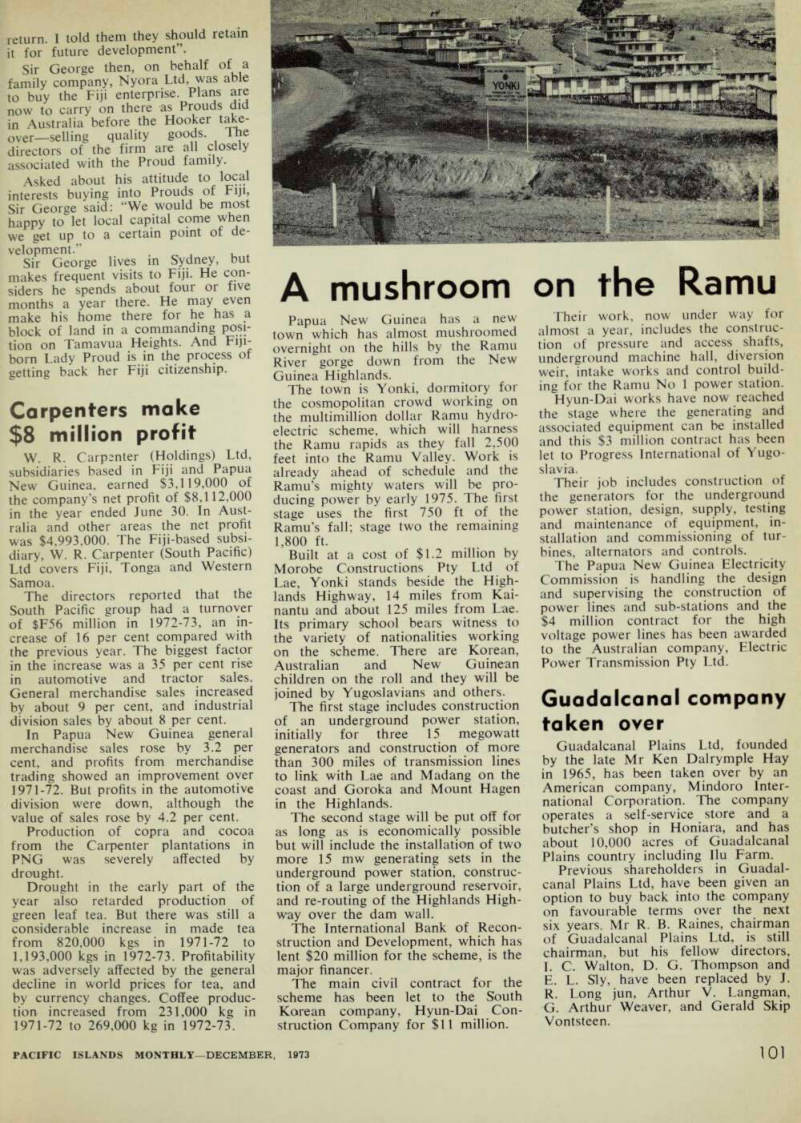
come-back
By a staff reporter
It could have been sentiment which led Sir George Proud, then managing director of the well known Australian jewellery firm of Prouds, to set up a subsidiary in Fiji more than 10 years ago to take advantage of its new duty free status. He had plenty of links with Fiji as his wife was born there (she is the daughter of the late Sir Walter Carpenter), and he passed through the place many times on overseas business visits.
But Sir George is a businessman, and he considered Fiji’s decision to go “duty free” in selected luxury items opened business opportunities. Prouds of Fiji was formed and opened shop at Lautoka, Nadi and Sigatoka, and more will follow with the develop ment of tourist and holiday home complexes.
One of these could be at Natadola, south-east from Nadi, where tourist consultants suggested in a survey there could eventually be 14 hotels.
Sir George considers the prospects are bright. There could be 800,000 visitors a year in the 1980’s. They will come from much further afield than the traditional areas of Aust ralia, New Zealand and North Ame rica. Japan and Europe were likely to be good sources of tourists. He does not think the development of tourism will spoil Fiji—rather it will give employment to thousands of lo cal people.
The Proud shops in Fiji are backed by a newly formed wholesale com pany —Prouds Wholesale (Pacific Islands) Ltd which holds about 30 important agencies. This subsidiary supplies the retail trade in Fiji with jewellery, high grade cosmetics, etc, and also supplies retail outlets, main ly for tourists in New Caledonia, the BSIP, Samoa, Tonga, the Cook Is lands and Tahiti. The manager is Mr Harry Le Vesconte, formerely Chief Fire Officer in the Suva Fire Brigade.
Prouds of Fiji Ltd, was acquired from the L. J. Hooker group, Aust ralian real estate firm and developer, on July 1, 1972. Hookers, through a takeover, secured control of all Proud interests some years ago. Sir George, although remaining as managing director, did not agree with the sales and marketing policies, and was not slow to say so. Eventually he stopped going to board meetings, and recently resigned.
Speaking about the Hooker atti tude to Fiji, Sir George said: “They did not want to carry on because the return on the investment was not in line with their view of an investment
return. I told them they should retain it for future development”.
Sir George then, on behalf of a family company, Nyora Ltd, was able to buy the Fiji enterprise. Plans are now to carry on there as Prouds did in Australia before the Hooker take over-selling quality goods. The directors of the firm are all closely associated with the Proud family.
Asked about his attitude to local interests buying into Prouds of Fiji, Sir George said: “We would be most happy to let local capital come when we get up to a certain point of de velopment.” „ , , , Sir George lives in Sydney, but makes frequent visits to Fiji. He con siders he spends about four or five months a year there. He may even make his home there for he has a block of land in a commanding posi tion on Tamavua Heights. And Fiji born Lady Proud is in the process of getting back her Fiji citizenship.
Carpenters make
$8 million profit
W. R. Carpenter (Holdings) Ltd, subsidiaries based in Fiji and Papua New Guinea, earned $3,119,000 of the company’s net profit of $8,112,000 in the year ended June 30. In Aust ralia and other areas the net profit was $4,993,000. The Fiji-based subsi diary, W. R. Carpenter (South Pacific) Ltd covers Fiji, Tonga and Western Samoa.
The directors reported that the South Pacific group had a turnover of SFS6 million in 1972-73, an in crease of 16 per cent compared with the previous year. The biggest factor in the increase was a 35 per cent rise in automotive and tractor sales.
General merchandise sales increased by about 9 per cent, and industrial division sales by about 8 per cent.
In Papua New Guinea general merchandise sales rose by 3.2 per cent, and profits from merchandise trading showed an improvement oyer 1971-72. But profits in the automotive division were down, although the value of sales rose by 4.2 per cent.
Production of copra and cocoa from the Carpenter plantations in PNG was severely affected by drought.
Drought in the early part of the year also retarded production of green leaf tea. But there was still a considerable increase in made tea from 820,000 kgs in 1971-72 to 1,193,000 kgs in 1972-73. Profitability was adversely affected by the general decline in world prices for tea, and by currency changes. Coffee produc tion increased from 231,000 kg in 1971-72 to 269,000 kg in 1972-73.
Advertisements & other items, p. 106 (1 item)
Peter Fisher Trading
PTY. LTD.
321 PITT STREET, SYDNEY, 2000, AUSTRALIA
TELEPHONE: 26-1109 CABLES: "FISHERION", SYDNEY
EXPORTERS TO THE PACIFIC
ISLANDS
Some of the firms and products we represent: GREENLITES waterproof matches FOSTER—Beer in bottles or cans REDHEADS safety matches V.B.—Beer in bottles or cans MAURI BROS, yeast BOND'S underwear PMU food products BOND'S outerwear ANDY spotlights TOOHEYS beer
CARLTON UNITED beer
CLUB RUM
ROGOVI VODKA
FRENCH KNIT car seat covers THREE STAR corned beef CRAVEN confectionery BROWNBUILT office furniture ADVANCE containers HARDIE'S building products SEBEL furniture BEARD beds and mattresses KLINKII plywood STERLING bakery machinery WHITE ABBEY Scotch whisky BATA shoes SRC tinned fruit LIFESAVERS confectionery CHILTONIAN biscuits
MACHETTES
ATLAS plastic ware LUCKY STAR tinned fish
FOREMOST CONSOLIDATED
COUNTRY CLUB shirts PAULCALL tools ASTRA razor blades WENGER quality knives VAN DER LAAN tinned meat DEROPA gift paper WARBURTON FRANKI coolrooms DURABUILT prefabricated houses THREE X (XXX) tinned hake BRONTE tinned meat HEINEKEN beer
SHEATH KNIVES
GOLDEN STATE evaporated milk SMALL chocolate GOLDSTEIN —Food equipment RED TULIP chocolate MIN IT aerosols SHELLEY'S soft drinks TWISTIES rice snacks ERN MACKIE bakery equipment CHEEZELS cheese flavoured snacks
AND MANY MORE
A mushroom on the Ramu
Papua New Guinea has a new town which has almost mushroomed overnight on the hills by the Ramu River gorge down from the New Guinea Highlands.
The town is Yonki, dormitory for the cosmopolitan crowd working on the multimillion dollar Ramu hydro electric scheme, which will harness the Ramu rapids as they fall 2,500 feet into the Ramu Valley. Work is already ahead of schedule and the Ramu’s mighty waters will be pro ducing power by early 1975. The first stage uses the first 750 ft of the Ramu’s fall; stage two the remaining 1,800 ft.
Built at a cost of 51.2 million by Morobe Constructions Pty Ltd of Lae, Yonki stands beside the High lands Highway, 14 miles from Kai nantu and about 125 miles from Lae.
Its primary school bears witness to the variety of nationalities working on the scheme. There are Korean, Australian and New Guinean children on the roll and they will be joined by Yugoslavians and others.
The first stage includes construction of an underground power station, initially for three 15 megowatt generators and construction of more than 300 miles of transmission lines to link with Lae and Madang on the coast and Goroka and Mount Hagen in the Highlands.
The second stage will be put off for as long as is economically possible but will include the installation of two more 15 mw generating sets in the underground power station, construc tion of a large underground reservoir, and re-routing of the Highlands High way over the dam wall.
The International Bank of Recon struction and Development, which has lent $2O million for the scheme, is the major financer.
The main civil contract for the scheme has been let to the South Korean company, Hyun-Dai Con struction Company for $ll million.
Their work, now under way for almost a year, includes the construc tion of pressure and access shafts, underground machine hall, diversion weir, intake works and control build ing for the Ramu No 1 power station.
Hyun-Dai works have now reached the stage where the generating and associated equipment can be installed and this $3 million contract has been let to Progress International of Yugo slavia.
Their job includes construction of the generators for the underground power station, design, supply, testing and maintenance of equipment, in stallation and commissioning of tur bines, alternators and controls.
The Papua New Guinea Electricity Commission is handling the design and supervising the construction of power lines and sub-stations and the $4 million contract for the high voltage power lines has been awarded to the Australian company, Electric Power Transmission Pty Ltd.
Guadalcanal company
taken over
Guadalcanal Plains Ltd, founded by the late Mr Ken Dalrymple Hay in 1965, has been taken over by an American company, Mindoro Inter national Corporation. The company operates a self-service store and a butcher’s shop in Honiara, and has about 10,000 acres of Guadalcanal Plains country including Ilu Farm.
Previous shareholders in Guadal canal Plains Ltd, have been given an option to buy back into the company on favourable terms over the next six years. Mr R. B. Raines, chairman of Guadalcanal Plains Ltd, is still chairman, but his fellow directors, I. C. Walton, D. G. Thompson and E. L. Sly, have been replaced by I.
R. Long jun, Arthur V. Langman, G. Arthur Weaver, and Gerald Skip Vontsteen.
Produce Prices
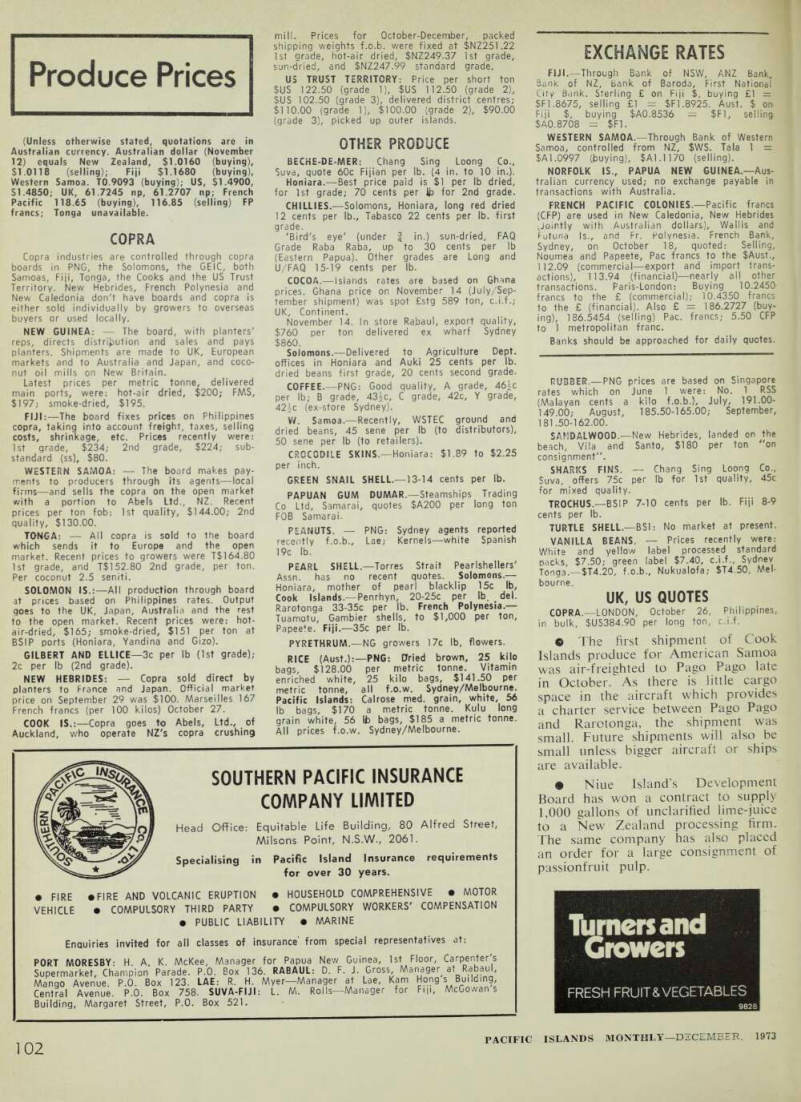
(Unless otherwise stated, quotations are in Australian currency. Australian dollar (November 12) equals New Zealand, $1.0160 (buying), SI .0118 (selling); Fiji $1.1680 (buying), Western Samoa. T 0.9093 (buying); US, $1.4900, $1.4850; UK, 61.7245 np, 61.2707 np; French Pacific 118.65 (buying), 116.85 (selling) FP francs; Tonga unavailable.
Copra
Copra industries are controlled through copra boards in PNG, the Solomons, the GEIC, both Samoas, Fiji, Tonga, the Cooks and the US Trust Territory. New Hebrides, French Polynesia and New Caledonia don't have boards and copra is either sold individually by growers to overseas buyers or used locally.
NEW GUINEA: The board, with planters' reps, directs distribution and sales and pays planters. Shipments are made to UK, European markets and to Australia and Japan, and coco nut oil mills on New Britain.
Latest prices per metric tonne, delivered main ports, were; hot-air dried, $200; FMS, $197; smoke-dried, $195.
FIJI: —The board fixes prices on Philippines copra, taking into account freight, taxes, selling costs, shrinkage, etc. Prices recently were: Ist grade, $234; 2nd grade, $224; sub standard (ss), $BO.
WESTERN SAMOA: The board makes pay ments to producers through its agents—local firms —and sells the copra on the open market with a portion to Abels Ltd., NZ. Recent prices per ton fob: Ist quality, $144.00; 2nd quality, $130.00.
TONGA: All copra is sold to the board which sends it to Europe and the open market. Recent prices to growers were T 5164.80 Ist grade, and T 5152.80 2nd grade, per ton.
Per coconut 2.5 seniti.
SOLOMON IS.: —All production through board at prices based on Philippines rates. Output goes to the UK, Japan, Australia and the rest to the open market. Recent prices were: hot air-dried, $165; smoke-dried, $l5l per ton at BSIP ports (Honiara, Yandina and Gizo).
GILBERT AND ELLICE—3c per lb (Ist grade); 2c per lb (2nd grade).
NEW HEBRIDES: Copra sold direct by planters to France and Japan. Official market price on September 29 was $lOO. Marseilles 167 French francs (per 100 kilos) October 27.
COOK IS.: —Copra goes to Abels, Ltd., of Auckland, who operate NZ's copra crushing
mill. Prices for October-December, packed shipping weights f.o.b. were fixed at $NZ251.22 Ist grade, hot-air dried, $NZ249.37 Ist grade, sun-dried, and $NZ247.99 standard grade.
US TRUST TERRITORY; Price per short ton SUS 122.50 (grade 1), SUS 112.50 (grade 2), SUS 102.50 (grade 3), delivered district centres; $llO.OO (grade 1), $lOO.OO (grade 2), $90.00 (grade 3), picked up outer islands.
Other Produce
BECHE-DE-MER: Chang Sing Loong Co., Suva, quote 60c Fijian per lb. (4 in. to 10 in.).
Honiara. —Best price paid is $1 per lb dried, for Ist grade; 70 cents per lb for 2nd grade.
CHILLIES. —SoIomons, Honiara, long red dried 12 cents per lb., Tabasco 22 cents per lb. first grade.
'Bird's eye' (under 2 in.) sun-dried, FAQ Grade Raba Raba, up to 30 cents per lb (Eastern Papua). Other grades are Long and U/FAQ 15-19 cents per lb.
COCOA. —Islands rates are based on Ghana prices. Ghana price on November 14 (July/Sep tember shipment) was spot £stg 589 ton, c.i.f.; UK, Continent.
November 14. In store Rabaul, export quality, $760 per ton delivered ex wharf Sydney $B6O.
Solomons. —Delivered to Agriculture Dept, offices in Honiara and Auki 25 cents per lb. dried beans first grade, 20 cents second grade.
COFFEE.— PNG: Good quality, A grade, per lb; B grade, C grade, 42c, Y grade, 42£c (ex-store Sydney).
W. Samoa. —Recently, WSTEC ground and dried beans, 45 sene per lb (to distributors), 50 sene per lb (to retailers).
CROCODILE SKlNS.—Honiara: $1.89 to $2.25 per inch.
GREEN SNAIL SHELL.—I 3-14 cents per lb.
PAPUAN GUM DUMAR.— Steamships Trading Co Ltd, Samarai, quotes SA2OO per long ton FOB Samarai.
PEANUTS. PNG: Sydney agents reported recently f.0.b., Lae; Kernels —white Spanish 19c lb.
PEARL SHELL. —Torres Strait Pearlshellers' Assn, has no recent quotes. Solomons. — Honiara, mother of pearl blacklip 15c lb, Cook Islands. —Penrhyn, 20-25 c per lb. del.
Rarotonga 33-35 c per lb. French Polynesia.— Tuamotu, Gambier shells, to $l,OOO per ton, Papeete. Fiji. —3sc per lb.
PYRETHRUM.— NG growers 17c lb, flowers.
RICE (Aust.):—PNG: Dried brown, 25 kilo bags, $128.00 per metric tonne. Vitamin enriched white, 25 kilo bags, $141.50 per metric tonne, all f.o.w. Sydney/Melbourne.
Pacific Islands: Calrose med. grain, white, 56 lb bags, $l7O a metric tonne. Kulu long grain white, 56 lb bags, $lB5 a metric tonne.
All prices f.o.w. Sydney/Melbourne.
RUBBER. —PNG prices are based on Singapore rates which on June 1 were: No. 1 RSS (Malayan cents a kilo f.0.b.), July, 191.00- 149.00; August, 185.50-165.00; September, 181.50-162.00.
SANDALWOOD. —New Hebrides, landed on the beach, Vila and Santo, $lBO per ton "on consignment".
SHARKS FINS. Chang Sing Loong Co., Suva, offers 75c per lb for Ist quality, 45c for mixed quality.
TROCHUS.— BSIP 7-10 cents per lb. Fiji 8-9 cents per lb.
TURTLE SHELL.— BSI: No market at present.
VANILLA BEANS. Prices recently were: White and yellow label processed standard packs, $7.50; green label $7.40, c.i.f., Sydney Tonga.—sT4.2o, f.0.b., Nukualofa; $T4.50, Mel bourne.
Uk, Us Quotes
COPRA.— LONDON, October 26, Philippines, in bulk, $U5384.90 per long ton, c.i.f. e The first shipment of Cook Islands produce for American Samoa was air-freighted to Pago Pago late in October. As there is little cargo space in the aircraft which provides a charter service between Pago Pago and Rarotonga, the shipment was small. Future shipments will also be small unless bigger aircraft or ships are available. 9 Niue Island’s Development Board has won a contract to supply 1,000 gallons of unclarified lime-juice to a New Zealand processing firm.
The same company has also placed an order for a large consignment of
passionfruit pulp.
Exchange Rates
FlJl.— Through Bank of NSW, ANZ Bank.
Sank of NZ, Bank of Baroda, First National City Bank. Sterling £ on Fiji $, buying £1 = $F1.8675, selling £1 = $F1.8925. Aust. $ on Fiji $, buying $A0.8536 SFI, selling
$A0.8708 = Sfi.
WESTERN SAMOA.— Through Bank of Western Samoa, controlled from NZ, SWS. Tala 1 = $A1.0997 (buying), $A1.1170 (selling).
Norfolk Is., Papua New Gulnea.—Aus
tralian currency used; no exchange payable in transactions with Australia.
FRENCH PACIFIC COLONIES.— Pacific francs (CFP) are used in New Caledonia, New Hebrides jointly with Australian dollars), Wallis and Futuna Is., and Fr. Polynesia. French Bank, Sydney, on October 18, quoted: Selling, Noumea and Papeete, Pac francs to the sAust., 112.09 (commercial —export and import trans actions), 113.94 (financial) —nearly all other transactions. Paris-London; Buying 10.2450 francs to the £ (commercial); 10.4350 francs to the £ (financial). Also £ = 186.2727 (buy ing), 186.5454 (selling) Pac. francs; 5.50 CFP to 1 metropolitan franc.
Banks should be approached for daily quotes.
Advertisements & other items, p. 108 (2 items)
Southern Pacific Insurance
if® $
COMPANY LIMITED
Head Office: Equitable Life Building, 80 Alfred Street, AAilsons Point, N.S.W., 2061.
Specialising in Pacific Island Insurance requirements for over 30 years. • FIRE • FIRE AND VOLCANIC ERUPTION • HOUSEHOLD COAAPREHENSIVE • MOTOR VEHICLE • COMPULSORY THIRD PARTY • COMPULSORY WORKERS' COMPENSATION
• PUBLIC LIABILITY • MARINE
Enquiries invited for all classes of insurance’ from special representatives at: PORT MORESBY- H A K. McKee, Manager for Papua New Guinea, Ist Floor, Carpenter's Supermarket, Champion Parade. P.O. Box 136. RABAUL: D. F. J. Gross, Manager at Rabaul, Mango Avenue. P.O. Box 123. LAE: R. H. Myer—Manager at Lae, Kam Hong s Building, Central Avenue. P.O. Box 758. SUVA-FIJI: L. M. Rolls—Manager for Fi|i, McGowans Building, Margaret Street, P.O. Box 521.
Turners and Growers
Growers
FRESH FRUIT & VEGETABLES
9826
Shipping & Airways Information
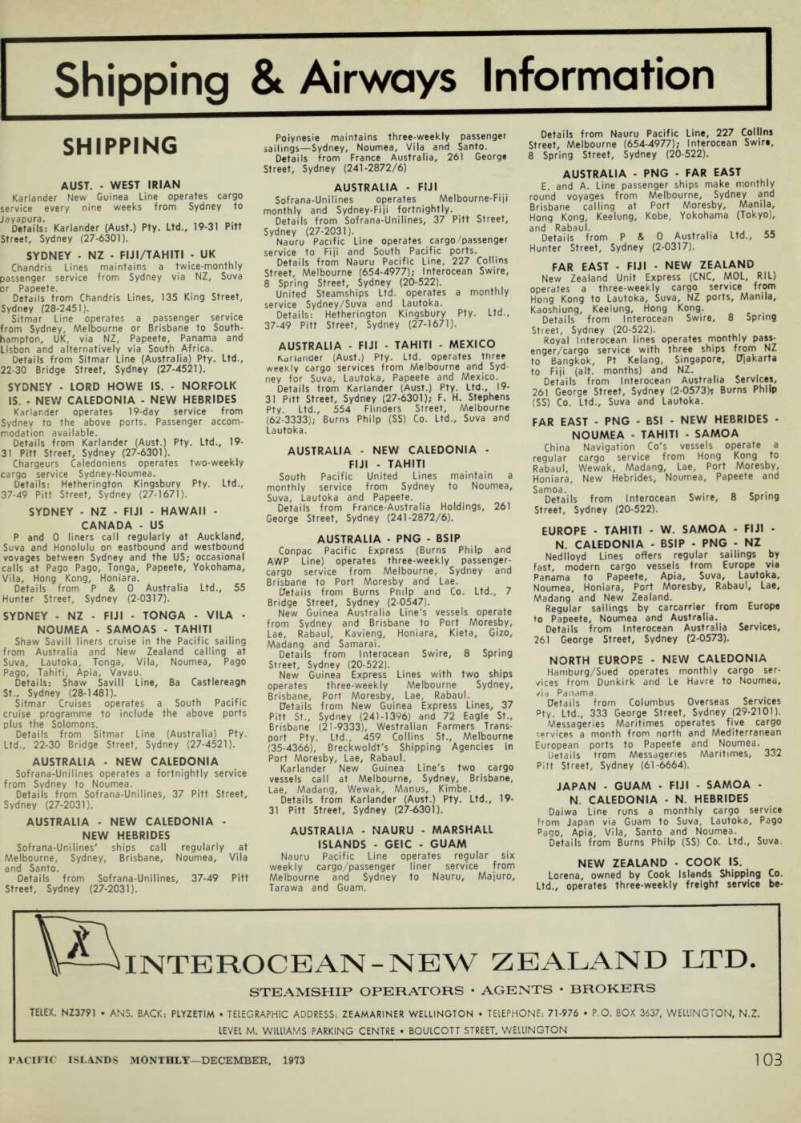
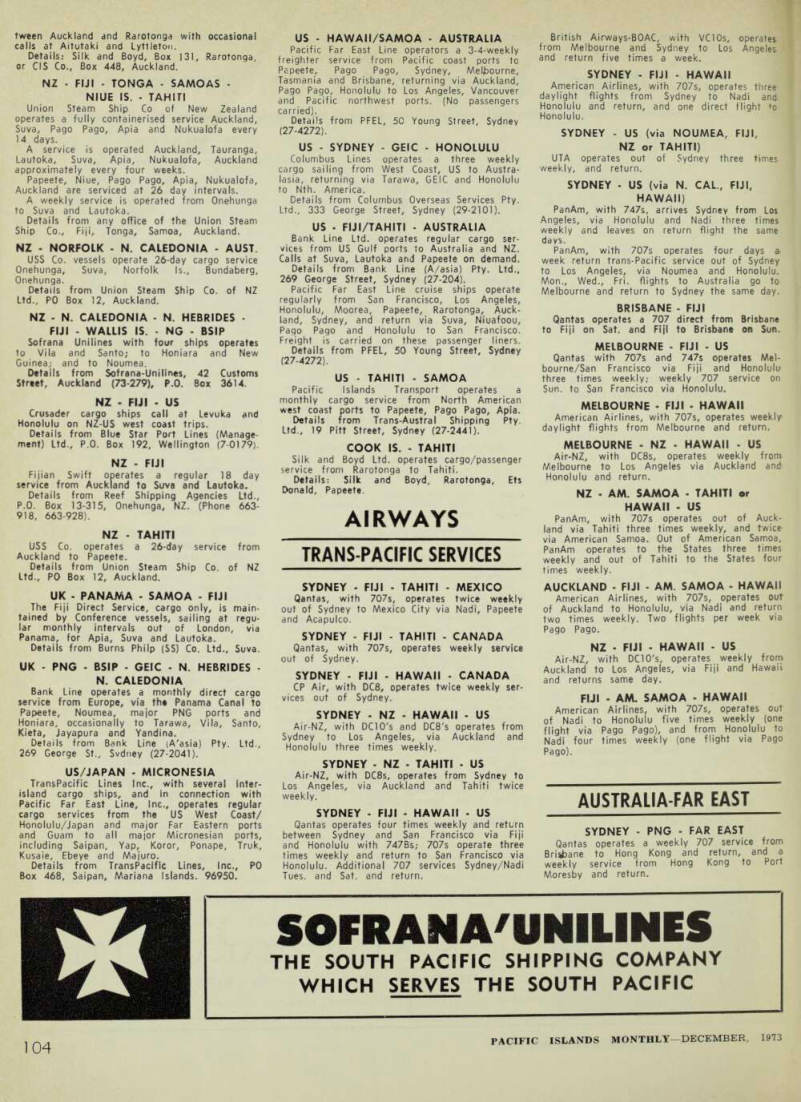
Shipping
Aust. - West Irian
Karlander New Guinea Line operates cargo service every nine weeks from Sydney to Jayapura.
Details: Karlander (Aust.) Pty. Ltd., 19-31 Pitt Street, Sydney (27-6301).
SYDNEY - NZ - FIJI/TAHITI - UK Chandris Lines maintains a twice-monthly passenger service from Sydney via NZ, Suva or Papeete.
Details from Chandris Lines, 135 King Street, Sydney (28-2451).
Sitmar Line operates a passenger service from Sydney, Melbourne or Brisbane to South hampton, UK, via NZ, Papeete, Panama and Lisbon and alternatively via South Africa.
Details from Sitmar Line (Australia) Pty. Ltd., 22-30 Bridge Street, Sydney (27-4521).
SYDNEY - LORD HOWE IS. - NORFOLK IS. - NEW CALEDONIA - NEW HEBRIDES Karlander operates 19-day service from Sydney to the above ports. Passenger accom modation available.
Details from Karlander (Aust.) Pty. Ltd., 19- 31 Pitt Street, Sydney (27-6301).
Chargeurs Caledonians operates two-weekly cargo service Sydney-Noumea.
Details: Hetherington Kingsbury Pty. Ltd., 37-49 Pitt Street, Sydney (27-1671).
SYDNEY - NZ - FIJI - HAWAII ■
Canada - Us
P and 0 liners call regularly at Auckland, Suva and Honolulu on eastbound and westbound voyages between Sydney and the US; occasional calls at Pago Pago, Tonga, Papeete, Yokohama, Vila, Hong Kong, Honiara.
Details from P & 0 Australia Ltd., 55 Hunter Street, Sydney (2-0317).
SYDNEY - NZ - FIJI - TONGA - VILA -
Noumea - Samoas - Tahiti
Shaw Savill liners cruise in the Pacific sailing from Australia and New Zealand calling at Suva, Lautoka, Tonga, Vila, Noumea, Pago Pago, Tahiti, Apia, Vavau.
Details: Shaw Savill Line, 8a Castlereagn St., Sydney (28-1481).
Sitmar Cruises operates a South Pacific cruise programme to include the above ports plus the Solomons.
Details from Sitmar Line (Australia) Pty.
Ltd., 22-30 Bridge Street, Sydney (27-4521).
Australia - New Caledonia
Sofrana-Unilines operates a fortnightly service from Sydney to Noumea.
Details from Sofrana-Unilines, 37 Pitt Street, Sydney (27-2031).
Australia - New Caledonia •
New Hebrides
Sofrana-Unilines' ships call regularly at Melbourne, Sydney, Brisbane, Noumea, Vila and Santo.
Details from Sofrana-Unilines, 37-49 Pitt Street, Sydney (27-2031).
Poiynesie maintains three-weekly passenger sailings—Sydney, Noumea, Vila and Santo.
Details from France Australia, 261 George Street, Sydney (241-2872/6)
Australia - Fiji
Sofrana-Unilines operates Melbourne-Fiji monthly and Sydney-Fiji fortnightly.
Details from Sofrana-Unilines, 37 Pitt Street, Sydney (27-2031).
Nauru Pacific Line operates cargo/passenger service to Fiji and South Pacific ports.
Details from Nauru Pacific Line, 227 Collins Street, Melbourne (654-4977); Interocean Swire, 8 Spring Street, Sydney (20-522).
United Steamships Ltd. operates a monthly service Sydney/Suva and Lautoka.
Details: Hetherington Kingsbury Pty. Ltd., 37-49 Pitt Street, Sydney (27-1671).
AUSTRALIA - FIJI - TAHITI - MEXICO (Wlander (Aust.) Pty. Ltd. operates three weekly cargo services from Melbourne and Syd ney for Suva, Lautoka, Papeete and Mexico.
Details from Karlander (Aust.) Pty. Ltd., 19- 31 Pitt Street, Sydney (27-6301); F. H. Stephens Pty. Ltd., 554 Flinders Street, Melbourne (62-3333); Burns Philp (SS) Co. Ltd., Suva and Lautoka.
Australia - New Caledonia -
Fiji - Tahiti
South Pacific United Lines maintain a monthly service from Sydney to Noumea, Suva, Lautoka and Papeete.
Details from France-Australia Holdings, 261 George Street, Sydney (241-2872/6).
Australia - Png - Bsip
Conpac Pacific Express (Burns Philp and AWP Line) operates three-weekly passenger cargo service from Melbourne, Sydney and Brisbane to Port Moresby and Lae.
Details from Burns Philp and Co. Ltd., 7 Bridge Street, Sydney (2-0547).
New Guinea Australia Line's vessels operate from Sydney and Brisbane to Port Moresby, Lae, Rabaul, Kavieng, Honiara, Kieta, Gizo, Madang and Samarai.
Details from Interocean Swire, 8 Spring Street, Sydney (20-522).
New Guinea Express Lines with two ships operates three-weekly Melbourne Sydney, Brisbane, Port Moresby, Lae, Rabaul.
Details from New Guinea Express Lines, 37 Pitt St., Sydney (241-1396) and 72 Eagle St., Brisbane (21-9333), Westralian Farmers Trans port Pty. Ltd., 459 Collins St., Melbourne (35-4366), Breckwoldt's Shipping Agencies in Port Moresby, Lae, Rabaul.
Karlander New Guinea Line's two cargo vessels call at Melbourne, Sydney, Brisbane, Lae, Madang, Wewak, Manus, Kimbe.
Details from Karlander (Aust.) Pty. Ltd., 19- 31 Pitt Street, Sydney (27-6301).
Australia - Nauru - Marshall
Islands • Geic - Guam
Nauru Pacific Line operates regular six weekly cargo/passenger liner service from Melbourne and Sydney to Nauru, Majuro, Tarawa and Guam.
Details from Nauru Pacific Line, 227 Collins Street, Melbourne (654-4977); Interocean Swire, 8 Spring Street, Sydney (20-522).
Australia - Png - Far East
E. and A. Line passenger ships make monthly round voyages from Melbourne, Sydney and Brisbane calling at Port Moresby, Manila, Hong Kong, Keelung, Kobe, Yokohama (Tokyo), and Rabaul. IA . Details from P & 0 Australia Ltd., 55 Hunter Street, Sydney (2-0317).
FAR EAST - FIJI - NEW ZEALAND New Zealand Unit Express (CNC, MOL, RIL) operates a three-weekly cargo service from Hong Kong to Lautoka, Suva, NZ ports, Manila, Kaoshiung, Keelung, Hong Kong.
Details from Interocean Swire, 8 Spring Street, Sydney (20-522).
Royal Interocean lines operates monthly pass enger/cargo service with three ships from NZ to Bangkok, Pt Kelang, Singapore, Djakarta to Fiji (alt. months) and NZ.
Details from Interocean Australia Services, 261 George Street, Sydney (2-0573)? Burns Phi Ip (SS) Co. Ltd., Suva and Lautoka.
FAR EAST - PNG - BSI - NEW HEBRIDES •
Noumea - Tahiti - Samoa
China Navigation Co's vessels operate a regular cargo service from Hong Kong to Rabaul, Wewak, Madang, Lae, Port Moresby, Honiara, New Hebrides, Noumea, Papeete and Samoa. . . , .
Details from Interocean Swire, 8 Spring Street, Sydney (20-522).
EUROPE - TAHITI - W. SAMOA - FIJI • N. CALEDONIA - BSIP - PNG - NZ Nedlloyd Lines offers regular sailings by fast, modern cargo vessels from Europe via Panama to Papeete, Apia, Suva, Lautoka, Noumea, Honiara, Port Moresby, Rabaul, Lae, Madang and New Zealand.
Regular sailings by carcarrier from Europe to Papeete, Noumea and Australia.
Details from Interocean Australia Services, 261 George Street, Sydney (2-0573).
North Europe - New Caledonia
Hamburg/Sued operates monthly cargo ser vices from Dunkirk and Le Havre to Noumea, via Panama.
Details from Columbus Overseas Services Pty. Ltd., 333 George Street, Sydney (29-2101).
Messageries Maritimes operates five cargo services a month from north and Mediterranean European ports to Papeete and Noumea.
Details from Messageries Maritimes, 332 Pitt Street, Sydney (61-6664).
JAPAN - GUAM - FIJI - SAMOA -
N. Caledonia - N. Hebrides
Daiwa Line runs a monthly cargo service from Japan via Guam to Suva, Lautoka, Pago Pago, Apia, Vila, Santo and Noumea.
Details from Burns Phi Ip (SS) Co. Ltd., Suva.
New Zealand • Cook Is.
Lorena, owned by Cook Islands Shipping Co.
Ltd., operates three-weekly freight service be
tween Auckland and Rarotonga with occasional calls at Aitutaki and Lyttleton.
Details: Silk and Boyd, Box 131, Rarotonga, or CIS Co., Box 448, Auckland.
NZ - FIJI - TONGA - SAMOAS -
Niue Is. • Tahiti
Union Steam Ship Co of New Zealand operates a fully containerised service Auckland, Suva, Pago Pago, Apia and Nukualofa every 14 days.
A service is operated Auckland, Tauranga, Lautoka, Suva, Apia, Nukualofa, Auckland approximately every four weeks.
Papeete, Niue, Pago Pago, Apia, Nukualofa, Auckland are serviced at 26 day intervals.
A weekly service is operated from Onehunga to Suva and Lautoka.
Details from any office of the Union Steam Ship Co., Fiji, Tonga, Samoa, Auckland.
NZ - NORFOLK - N. CALEDONIA - AUST.
USS Co. vessels operate 26-day cargo service Onehunga, Suva, Norfolk Is., Bundaberg, Onehunga.
Details from Union Steam Ship Co. of NZ Ltd., PO Box 12, Auckland.
NZ - N. CALEDONIA - N. HEBRIDES ■ FIJI - WALLIS IS. - NG • BSIP Sofrana Unilines with four ships operates to Vila and Santo,- to Honiara and New Guinea; and to Noumea.
Details from Sofrana-Unillnes, 42 Customs Street, Auckland (73-279), P.O. Box 3614.
Nz - Fiji - Us
Crusader cargo ships call at Levuka and Honolulu on NZ-US west coast trips.
Details from Blue Star Port Lines (Manage ment) Ltd., P.O. Box 192, Wellington (7-0179).
Nz • Fiji
Fijian Swift operates a regular 18 day service from Auckland to Suva and Lautoka.
Details from Reef Shipping Agencies Ltd., P.O. Box 13-315, Onehunga, NZ. (Phone 663- 918, 663-928).
Nz - Tahiti
USS Co. operates a 26-day service from Auckland to Papeete.
Details from Union Steam Ship Co. of NZ Ltd., PO Box 12, Auckland.
UK - PANAMA - SAMOA - FIJI The Fiji Direct Service, cargo only, is main tained by Conference vessels, sailing at regu lar monthly intervals out of London, via Panama, for Apia, Suva and Lautoka.
Details from Burns Philp (SS) Co. Ltd., Suva.
UK - PNG - BSIP - GEIC - N. HEBRIDES -
N. Caledonia
Bank Line operates a monthly direct cargo service from Europe, via the Panama Canal to Papeete, Noumea, major PNG ports and Honiara, occasionally to Tarawa, Vila, Santo, Kieta, Jayapura and Yandina.
Details from Bank Line (A'asia) Pty. Ltd., 269 George St., Svdney (27-2041).
Us/Japan • Micronesia
Transpacific Lines Inc., with several inter island cargo ships, and in connection with Pacific Far East Line, Inc., operates regular cargo services from the US West Coast/ Honolulu/Japan and major Far Eastern ports and Guam to all major Micronesian ports, including Saipan, Yap, Koror, Ponape, Truk, Kusaie, Ebeye and Majuro.
Details from Transpacific Lines, Inc., PO Box 468, Saipan, Mariana Islands. 96950.
Us - Hawaii/Samoa - Australia
Pacific Far East Line operators a 3-4-weekly freighter service from Pacific coast ports to Papeete, Pago Pago, Sydney, Melbourne, Tasmania and Brisbane, returning via Auckland, Pago Pago, Honolulu to Los Angeles, Vancouver and Pacific northwest ports. (No passengers carried).
Details from PFEL, 50 Young Street, Sydney (27-4272).
US - SYDNEY - GEIC - HONOLULU Columbus Lines operates a three weekly cargo sailing from West Coast, US to Austra lasia, returning via Tarawa, GEIC and Honolulu to Nth. America.
Details from Columbus Overseas Services Pty.
Ltd., 333 George Street, Sydney (29-2101).
Us - Fiji/Tahiti • Australia
Bank Line Ltd. operates regular cargo ser vices from US Gulf ports to Australia and NZ.
Calls at Suva, Lautoka and Papeete on demand.
Details from Bank Line (A/asia) Pty. Ltd., 269 George Street, Sydney (27-204).
Pacific Far East Line cruise ships operate regularly from San Francisco, Los Angeles, Honolulu, Moorea, Papeete, Rarotonga, Auck land, Sydney, and return via Suva, Niuafoou, Pago Pago and Honolulu to San Francisco.
Freight is carried on these passenger liners.
Details from PFEL, 50 Young Street, Sydney (27-4272).
Us - Tahiti - Samoa
Pacific Islands Transport operates a monthly cargo service from North American west coast ports to Papeete, Pago Pago, Apia.
Details from Trans-Austral Shipping Pty.
Ltd., 19 Pitt Street, Sydney (27-2441).
Cook Is. - Tahiti
Silk and Boyd Ltd. operates cargo/passenger service from Rarotonga to Tahiti.
Details: Silk and Boyd, Rarotonga, Ets Donald, Papeete.
Advertisements & other items, p. 109 (1 item)
Interocean-New Zealand Ltd
AGENTS • BROKERS
STEAMSHIP OPERATORS
TELEX. NZ3791 • ANS. BACK: PLYZETIM • TELEGRAPHIC ADDRESS: ZEAMARINER WELLINGTON • TELEPHONE: 71-976 • P.O. BOX 3637, WELLINGTON, N.Z.
LEVEL M. WILLIAMS PARKING CENTRE • BOULCOTT STREET, WELLINGTON
Airways
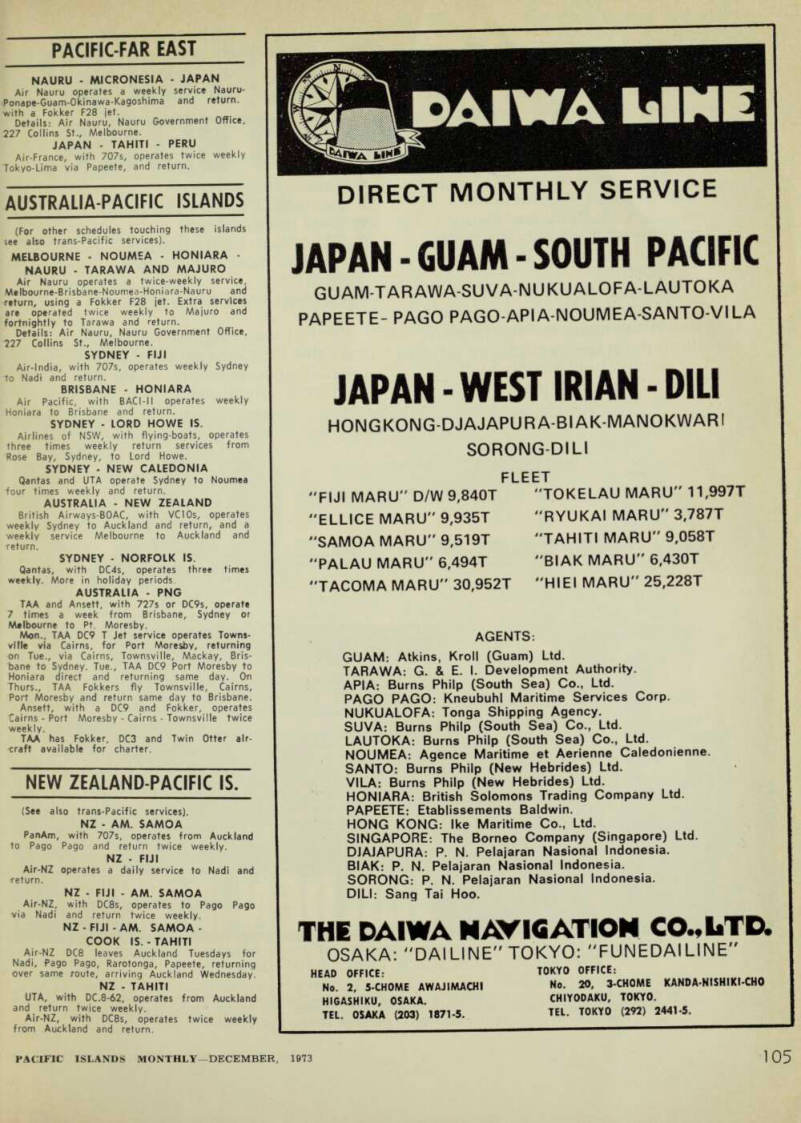

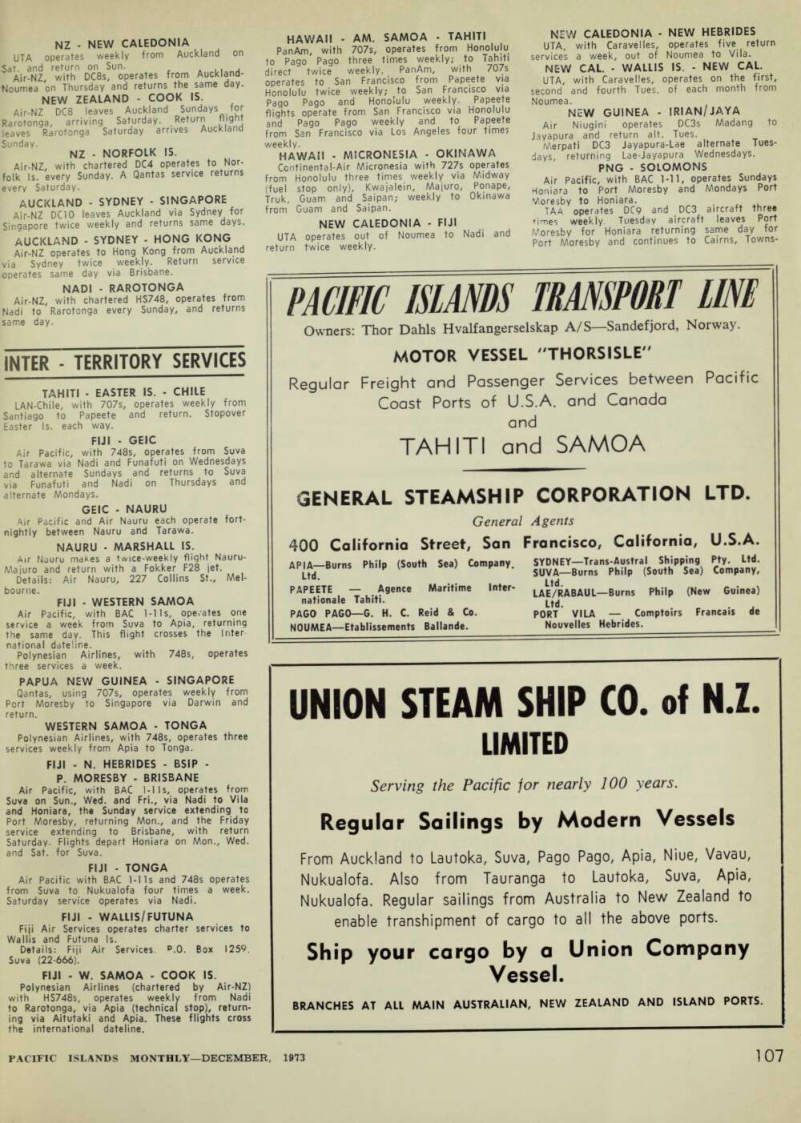
Trans Pacific Services
SYDNEY - FIJI - TAHITI - MEXICO Qantas, with 7075, operates twice weekly out of Sydney to Mexico City via Nadi, Papeete and Acapulco.
SYDNEY - FIJI - TAHITI - CANADA Qantas, with 7075, operates weekly service out of Sydney.
SYDNEY - FIJI • HAWAII - CANADA CP Air, with DCS, operates twice weekly ser vices out of Sydney.
SYDNEY - NZ - HAWAII - US Air-NZ, with DClO's and DCB's operates from Sydney to Los Angeles, via Auckland and Honolulu three times weekly.
SYDNEY - NZ • TAHITI • US Air-NZ, with DCBs, operates from Sydney to Los Angeles, via Auckland and Tahiti twice weekly, SYDNEY - FIJI - HAWAII - US Qantas operates four times weekly and return between Sydney and San Francisco via Fiji and Honolulu with 74785,- 707 s operate three times weekly and return to San Francisco via Honolulu. Additional 707 services Sydney/Nadi lues, and Sat. and return.
British Airways-BOAC, with VClOs, operates from Melbourne and Sydney to Los Angeles and return five times a week.
Sydney - Fiji • Hawaii
American Airlines, with 7075, operates three daylight flights from Sydney to Nadi and Honolulu and return, and one direct flight to Honolulu.
Sydney - Us (Via Noumea, Fiji,
Nz Or Tahiti)
UTA operates out of Sydney three times weekly, and return.
SYDNEY • US (via N. CAL, FIJI,
Hawaii)
PanAm, with 7475, arrives Sydney from Los Angeles, via Honolulu and Nadi three times weekly and leaves on return flight the same days.
PanAm, with 707 s operates four days a week return trans-Pacific service out of Sydney to Los Angeles, via Noumea and Honolulu.
Mon., Wed., Fri. flights to Australia go to Melbourne and return to Sydney the same day.
Brisbane - Fiji
Qantas operates a 707 direct from Brisbane to Fiji on Sat. and Fiji to Brisbane on Sun.
Melbourne - Fiji • Us
Qantas with 707 s and 747 s operates Mel bourne/San Francisco via Fiji and Honolulu three times weekly,- weekly 707 service on Sun. to San Francisco via Honolulu.
Melbourne • Fiji • Hawaii
American Airlines, with 7075, operates weekly daylight flights from Melbourne and return, MELBOURNE - NZ - HAWAII - US Air-NZ, with DCBs, operates weekly from Melbourne to Los Angeles via Auckland and Honolulu and return.
NZ - AM. SAMOA . TAHITI or
Hawaii • Us
PanAm, with 707 s operates out of Auck land via Tahiti three times weekly, and twice via American Samoa. Out of American Samoa, PanAm operates to the States three times weekly and out of Tahiti to the States four times weekly.
AUCKLAND - FIJI - AM. SAMOA • HAWAII American Airlines, with 7075, operates out of Auckland to Honolulu, via Nadi and return two times weekly. Two flights per week via Pago Pago.
NZ • FIJI - HAWAII - US Air-NZ, with DClO's, operates weekly from Auckland to Los Angeles, via Fiji and Hawaii and returns same day,
Fiji - Am. Samoa - Hawaii
American Airlines, with 7075, operates out of Nadi to Honolulu five times weekly (one flight via Pago Pago), and from Honolulu to Nadi four times weekly (one flight via Pago Pago).
Australia-Far East
Sydney - Png - Far East
Qantas operates a weekly 707 service from Brisbane to Hong Kong and return, and a weekly service from Hong Kong to Port Moresby and return.
Pacific-Far East
Nauru • Micronesia ■ Japan
Air Nauru operates a weekly service Nauru- Ponape-Guam-Okinawa-Kagoshima and return, with a Fokker F2B jet.
Details: Air Nauru, Nauru Government Office, 227 Collins St., Melbourne.
Japan - Tahiti ■ Peru
Air-France, with 7075, operates twice weekly Tokyo-Lima via Papeete, and return.
Australia-Pacific Islands
(For other schedules touching these islands see also trans-Pacific services).
Melbourne ■ Noumea - Honiara •
Nauru - Tarawa And Majuro
Air Nauru operates a twice-weekly service, Melbourne-Brisbane-Noumea-Honiara-Nauru and return, using a Fokker F2B jet. Extra services are operated twice weekly to Majuro and fortnightly to Tarawa and return.
Details: Air Nauru, Nauru Government Office, 227 Collins St., Melbourne.
Sydney - Fiji
Air-lndia, with 7075, operates weekly Sydney to Nadi and return.
Brisbane - Honiara
Air Pacific, with BACI-ll operates weekly Honiara to Brisbane and return.
Sydney - Lord Howe Is.
Airlines of NSW, with flying-boats, operates three times weekly return services from Rose Bay, Sydney, to Lord Howe.
Sydney - New Caledonia
Qantas and UTA operate Sydney to Noumea tour times weekly and return.
Australia - New Zealand
British Airways-BOAC, with VClOs, operates weekly Sydney to Auckland and return, and a weekly service Melbourne to Auckland and return.
Sydney • Norfolk Is.
Qantas, with DC4s, operates three times weekly. More in holiday periods.
Australia - Png
TAA and Ansett, with 727 s or DC9s, operate 7 times a week from Brisbane, Sydney or Melbourne to Pt. Moresby.
Mon., TAA DC9 T Jet service operates Towns ville via Cairns, for Port Moresby, returning on Tue., via Cairns, Townsville, Mackay, Bris bane to Sydney. Tue., TAA DC9 Port Moresby to Honiara direct and returning same day. On Thurs., TAA Fokkers fly Townsville, Cairns, Port Moresby and return same day to Brisbane.
Ansett, with a DC9 and Fokker, operates Cairns - Port Moresby - Cairns - Townsville twice weekly.
TAA has Fokker, DC3 and Twin Otter air craft available for charter.
New Zealand-Pacific Is.
(See also trans-Pacific services).
Nz - Am. Samoa
PanAm, with 7075, operates from Auckland to Pago Pago and return twice weekly.
Nz - Fiji
Air-NZ operates a daily service to Nadi and return.
Nz - Fiji - Am. Samoa
Air-NZ, with DCBs, operates to Pago Pago via Nadi and return twice weekly.
NZ - FIJI - AM. SAMOA -
Cook Is.-Tahiti
Air-NZ DCS leaves Auckland Tuesdays for Nadi, Pago Pago, Rarotonga, Papeete, returning over same route, arriving Auckland Wednesday.
Nz - Tahiti
UTA, with DC.B-62, operates from Auckland and return twice weekly.
Air-NZ, with DCBs, operates twice weekly from Auckland and return.
Nz - New Caledonia
UTA operates weekly from Auckland on Sat. and return on Sun.
Air-NZ, with DCBs, operates from Auckland- Noumea on Thursday and returns the same day.
New Zealand - Cook Is.
Air-NZ DCB leaves Auckland Sundays for Rarotonga, arriving Saturday. , Retur " r J.‘ g n h t leaves Rarotonga Saturday arrives Auckland Sunday.
Nz - Norfolk Is.
Air-NZ, with chartered DC4 operates to Nor folk Is. every Sunday. A Qantas service returns every Saturday.
Auckland - Sydney - Singapore
Air-NZ DCIO leaves Auckland via Sydney for Singapore twice weekly and returns same days.
Auckland - Sydney - Hong Kong
Air-NZ operates to Hong Kong from Auckland via Sydney twice weekly. Return service operates same day via Brisbane.
Nadi - Rarotonga
Air-NZ, with chartered HS74B, operates from Nadi to Rarotonga every Sunday, and returns same day.
Inter ■ Territory Services
Tahiti • Easter Is. - Chile
LAN-Chile, with 7075, operates weekly from Santiago to Papeete and return. Stopover Easter Is. each way.
Fiji - Geic
Air Pacific, with 7485, operates from Suva to Tarawa via Nadi and Funafuti on Wednesdays and alternate Sundays and returns to Suva via Funafuti and Nadi on Thursdays and alternate Mondays.
Geic - Nauru
Air Pacific and Air Nauru each operate fort nightly between Nauru and Tarawa.
Nauru ■ Marshall Is.
Air Nauru makes a twice-weekly flight Nauru- Majuro and return with a Fokker F2B jet.
Details: Air Nauru, 227 Collins St., Mel bourne.
Fiji - Western Samoa
Air Pacific, with BAG 1-1 Is, operates one service a week from Suva to Apia, returning the same day. This flight crosses the Inter national dateline.
Polynesian Airlines, with 7485, operates three services a week.
Papua New Guinea - Singapore
Qantas, using 7075, operates weekly from Port Moresby to Singapore via Darwin and return.
Western Samoa ■ Tonga
Polynesian Airlines, with 7485, operates three services weekly from Apia to Tonga.
FIJI - N. HEBRIDES - 6SIP -
P. Moresby - Brisbane
Air Pacific, with BAC 1-1 Is, operates from Suva on Sun., Wed. and Fri., via Nadi to Vila and Honiara, the Sunday service extending to Port Moresby, returning Mon., and the Friday service extending to Brisbane, with return Saturday. Flights depart Honiara on Mon., Wed. and Sat. for Suva.
Fiji - Tonga
Air Pacific with BAC 1-1 Is and 748 s operates from Suva to Nukualofa four times a week.
Saturday service operates via Nadi.
Fiji - Wallis/Futuna
Fiji Air Services operates charter services to Wallis and Futuna Is.
Details: Fiji Air Services. D .O. Box 1259, Suva (22-666).
FIJI ■ W. SAMOA - COOK IS.
Polynesian Airlines (chartered by Air-NZ) with HS74Bs, operates weekly from Nadi to Rarotonga, via Apia (technical stop), return ing via Aitutaki and Apia. These flights cross the international dateline.
Hawaii - Am. Samoa - Tahiti
PanAm with 7075, operates from Honolulu to three times weekly; to Tahiti direct twice weekly. PanAm, with 707 s operates to San Francisco from Papeete via Honolulu twice weekly; to San Francisco via Pago Pago and Honolulu weekly. Papeete flights operate from San Francisco via Honolulu and Pago Pago weekly and to Papeete from San Francisco via Los Angeles four times weekly.
Hawaii - Micronesia - Okinawa
Continental-Air Micronesia with 727 s operates from Honolulu three times weekly via Midway (fuel stop only), Kwajalein, Majuro, Ponape, Truk, Guam and Saipan; weekly to Okinawa from Guam and Saipan.
New Caledonia - Fiji
N ° Umea and
New Caledonia - New Hebrides
UTA, with Caravelles, operates five return services a week, out of Noumea to Vila NEW CAL. - WALLIS IS. - NEW CAL.
UTA, with Caravelles, operates on the first, second and fourth Tues. of each month from Noumea.
New Guinea - Irian/Jaya
Aj Niugin i operates DC3s Madang to j 3yapura a nd return alt. Tues.
Merpati DCS Jayapura-Lae alternate Tues dayS( returning Lae-Jayapura Wednesdays.
P Ng - Solomons
Ajr Pac jf ic> w j t h BAC 1-11, operates Sundays Honiara to Port Moresby and Mondays Port Voresby t o Honiara.
TAA opera tes DC9 and DCS aircraft three rimes weekly. Tuesday aircraft leaves Port Por7 $ Moresby ' to
ville, Mackay, Brisbane and Sydney. Twice weekly aircraft leave Rabaul for Honiara via Buka, Kieta, Munda and Yandina, returning following days.
Air Niugini Fokker Friendship leaves Port Moresby direct for Kieta four times weekly and returns via Rabaul, Lae, Buka.
Tahiti - Us
UTA, with DCIO and DCS operates from Papeete four times weekly, PanAm with 7075, operates regular return services to San Francisco, via Los Angeles; to San Francisco, via Honolulu; and to San Francisco, via Pago Pago and Honolulu.
W. Samoa - Am. Samoa
Polynesian Airlines, with 7485, operates between Apia and Pago Pago twenty times weekly.
Tonga - Niue - W. Samoa
Polynesian Airlines, with 7485, operates weekly service from Tonga to Apia via Niue.
Tahiti - Cook Is.
Air Tahiti with Piper Aztec, operates char ter service from Papeete to Rarotonga.
Details from Air Polynesie, P.O. Box 314, Quai Bir Hakeim, Papeete, and UTA offices.
Internal Services
Fiji
Air Pacific, with HS74Bs, BAG Mis and Herons operates regular services to Labasa.
Taveuni, Nadi, Suva and Savusavu.
Fiji Air Services, with Britten-Norman Islander and Beechcraft Baron aircraft, operates services to Castaway and Plantation village resorts. The Fijian hotel, Korolevu Beach hotel,
Flagship Beachcomber hotel, Levuka, Lakeba, Vatukola. Charter flights operate to anywhere in the Pacific, Details: Fiji Air Services, P.O. Box 1259, Suva (telephone 22-666).
French Polynesia
Air Polynesie, with Fokker F 27 Friendship, DC4s, Twin Otters and Islanders, operates to Bora Bora, Huahine, Moorea, Rangiroa, Raiatea, Manihi, Marquesas, Maupiti and Tubuai, Austral Islands.
Details from Air Polynesie, P.O. Box 314, Quai Bir Hakeim, Papeete, and UTA offices.
Air Tahiti, with light aircraft operates shuttle service from Papeete to Moorea and charter service to Raiatea, Bora Bora, Huahine, Rangiroa and Manihi.
Guam - Us Trust Territory
Continental-Air Micronesia with 727 s and DC6s operates regular service connecting Hono lulu, Okinawa and Guam with Saipan, Rota, Yap, Palau, Truk, Ponape, Kwajalein and Majuro.
Details from Air Micronesia, Saipan.
Air Pacific Inc. (not connected with the Fiji based Air Pacific) with Piper Navajo and a deHavilland Heron, operates regular services linking Guam, Saipan, Tinian, and Rota, and charter services are available to other Trust Territory islands.
Details, Air Pacific Inc., P.O. Box 7689, Tamuning, Guam, 96911, U.S.A.
Lagoon Aviation Inc. with Grumman Wid geons, operates charter services for the Mar shalls district, based on Majuro.
Gilbert And Ellice Islands
Air Pacific, with Herons, operates regular services between Tarawa, Butaritari, North Tabiteuea and Abemama.
Papua New Guinea
Air Niugini operates throughout Papua.
New Guinea.
Aerial Tours operates in Central, Western, Gulf and Sepik districts.
T.A.L. (GV) —Territory Airlines Pty Limited operates scheduled services and charter flights from Goroka, Kundiawa, Madang, Wewak, Vanimo, Mt. Hagen, Mendi to Highlands, Sepik and Coastal areas. Talco Territory Travel Ser vice of Papua New Guinea—Twin Otter Tourisf flights throughout Papua New Guinea.
Further details from T.A.L., P.O. Box 108, Goroka, Papua New Guinea.
Macair throughout Papua New Guinea.
Bougainville Air Services operates daily throughout Bougainville. There are six regular services Kieta-Buin. Details: Arawa, Phone 956-159; Buka, Phone 16. Box 298, PO, Kieta.
New Caledonia
Air Caledonia, with Twin Otters, and Is landers operates regular services to Houai lou, Isle of Pines, Isle Ouen, Kone, Koumac, Lifou, Mare, Noumea, Ouvea Touho, Mueo, Belep, Tiga.
Details from Air Caledonie, Noumea.
New Hebrides
Air Melanesiae with Britten-Norman Islanders and Trislander operates to Santo, Malekula Norsup and Lamap), Aoba (Walaha and Longana), Pentecost (Lonorore), Erromanga, Tongoa, Aneityum, Tanna, Epi, Sola and Vila. Direct connections are available to and from Santo* for all international flights arriving in Vila.
Details trom Air Melanesiae, P.O. Box 72, Vila.
Solomon Islands
Solalr, with Beech Barons and Islanders operates to Auki, Avu Avu, Babanakira, Bara koma. Bellona Is., Fera Is., Gizo, Honiara, Kira Kira, Marau, Munda, Parasi, Sege, Yandina, Santa Cruz, Mono, Rennell Is., Choiseul Bay, Ballalae and Ring! Cove.
Details from Solomon Islands Airways Ltd., Box 23, Honiara, BSIP.
Tonga
Tonga Tourist and Development Co, with Britten-Norman Islander and Aztec aircraft, operates between Fua'amotu, (airport for Nukualofa) and Vava'u Monday to Saturday.
Service soon between Fua'amotu and Eua.
Aircraft available for sightseeing and regional charters. . „ Details from Tonga Tourist and Development Co, PO Box 91, Nukualofa, Tonga.
Cook Islands
Cook Islands Airways Ltd, with a Britten Norman Islander, operates seven flights a week between Rarotonga and Aitutaki. Service will be extended to Atiu, Mangaia and Mitiaro when airstrips are built.
Air Nz's New
Service To Cooks
Air New Zealand will open sched uled services from Auckland to the Cook Islands on December 2. A DCS aircraft will leave Auckland that day at 10 am for Rarotonga, arriving across the date line at 3.25 pm on December 1. It will leave Rarotonga at 4.30 am on December 1, and will arrive back at Auckland at 7.10 pm on December 2.
Two Air-NZ DCS flights will call at Rarotonga each week. The first is
the Sunday (Saturday in Rarotonga)
flight and the second leaves Auckland each Tuesday at 8 pm for Tahiti, via Nadi, Pago Pago and Rarotonga. The aircraft returns over the same route and is due back at Auckland on Wed
nesday nights.
Advertisements & other items, pp. 110-114 (1 item)
Sofrana'unilines
THE SOUTH PACIFIC SHIPPING COMPANY
WHICH SERVES THE SOUTH PACIFIC
DAIWA LINE
DIRECT MONTHLY SERVICE
JAPAN-GUAM-SOUTH PACIFIC
GUAM-TARAWA-SUVANUKUALOFA-LAUTOKA
PAPEETE- PAGO PAGOAPIA-NOUMEA-SAIMTO-VILA
JAPAN-WEST IRIAN-DILI
HONGKONG-DJAJAPURA-BIAK-MANOKWAR!
SORONG-DILI
FLEET
"FIJI MARU" D/W 9,840 T
"ELLICE MARU" 9,935 T
"SAMOA MARU" 9.519 T
"PALAU MARU" 6,494 T
"TACOMA MARU" 30,952 T
"TOKELAU MARU" 11,997 T
"RYUKAI MARU" 3,7871
"TAHITI MARU" 9.058 T
"BIAK MARU" 6.430 T
"HIEI MARU" 25,228 T
AGENTS:
GUAM: Atkins, Kroll (Guam) Ltd.
TARAWA: G. & E. I. Development Authority.
APIA: Burns Philp (South Sea) Co., Ltd.
PAGO PAGO: Kneubuhl Maritime Services Corp.
NUKUALOFA: Tonga Shipping Agency.
SUVA: Burns Philp (South Sea) Co., Ltd.
LAUTOKA: Burns Philp (South Sea) Co., Ltd.
NOUMEA: Agence Maritime et Aerienne Caledonienne.
SANTO: Burns Philp (New Hebrides) Ltd.
VILA: Burns Philp (New Hebrides) Ltd.
HONIARA: British Solomons Trading Company Ltd.
PAPEETE: Etablissements Baldwin.
HONG KONG: Ike Maritime Co., Ltd.
SINGAPORE; The Borneo Company (Singapore) Ltd.
DJAJAPURA; P. N. Pelajaran Nasional Indonesia.
BIAK; P. N. Pelajaran Nasional Indonesia.
SORONG: P. N. Pelajaran Nasional Indonesia.
DILI: Sang Tai Hoo.
THE DAIWA NAVIGATION CO.,LTD.
OSAKA: "DAILINE" TOKYO: "FUNEDAILINE"
HEAD OFFICE: TOKYO OFFICE:
No. 2, 5-CHOME AWAJIMACHI No. 20, 3-CHOME KAHDA-HISHIKI-CHO
HIGASHIKU, OSAKA. CHIYODAKU, TOKYO.
TEL. OSAKA (203) 1871-5. TEL. TOKYO (292) 2441-5.
WHEN THE GOING GEIS TOUGH
HOLDEN HANDIES IT BETTER.
The sleek silhouette of Holden with its clean modern lines,
excellent visibility and luxury
comfort features sets the pace for others to follow throughout 72 countries.
Beneath its superbly engineered body is the muscle which has made Holden famous throughout the Pacific.
Holden built strong, built right with all these features: ■ Four-coil suspension ■ Insulated front chassis frame ■ Wide track stability ■ GM proven safety features ■ Forward mounted positive steering ■ 6 or 8-cylinder dependable power For 21 years Holden has been the sales leader because of its unchallenged reliability under all operating conditions.
Holden is backed by the most comprehensive dealer network providing GM maintenance service and genuine GM spare parts.
COOK islands: Cook Islands Trading Co. Ltd. FIJI islands: Burns Philp (South Sea) Co.
NEW CALEDONIA: Etablissements Baliande new HEBRIDES: Comptoir Francais des Nouvelles NORFOLK IS'. and; Sirius Motors Ltd. PAPUA new GUINEA: Tutt Bryant Pacific Ltd.
TONGA: Burns Philp (South Sea) Co. western SAMOA: 0. F. Nelson & Co. Ltd.
A 556
PACIFIC mms TRANSPORT IMF
Owners: Thor Dahls Hvalfangerselskap A/S—Sandefjord, Norway.
MOTOR VESSEL "THORSISLE"
Regular Freight and Passenger Services between Pacific Coast Ports of U.S.A. and Canada and
TAHITI and SAMOA
GENERAL STEAMSHIP CORPORATION LTD.
General Agents 400 California Street, San Francisco, California, U.S.A.
APIA —Burns Philp (South Sea) Company. fYDNEY-Tra ns-Austral Shipping My. ltd. . t j SUVA —Burns Philp (South Sea) Company, Ll °* • • Ltd PAPEETE Agence Maritime Inter- laE/RABAUL—Burns Philp (New Guinea) nationale Tahiti.
PAGO PAGO—6. H. C. Reid & Co. PORT VILA Comptoirs Francais de NOUMEA—Etablissements Ballande, Nouvelles Hebrides.
UNION STEAM SHIP CO. of N.Z.
LIMITED
Serving the Pacific for nearly 100 years.
Regular Sailings by Modern Vessels
From Auckland to Lautoka, Suva, Pago Pago, Apia, Niue, Vavau, Nukualofa. Also from Tauranga to Lautoka, Suva, Apia, Nukualofa. Regular sailings from Australia to New Zealand to enable transhipment of cargo to all the above ports.
Ship your cargo by a Union Company Vessel.
BRANCHES AT ALL MAIN AUSTRALIAN, NEW ZEALAND AND ISLAND PORTS.
MORE PORTS / MORE OFTEN
with
ICA H LANDER
KARLANDER NEW GUINEA LINE: Serving; Ft. Moresby, Samarai, Lae, Madang, Rabaul, Wewak, Manus Is., Kieta, Honiara, Yandina, Gizo, Vila, Norfolk Is., and Lord Howe Is.
KARLANDER KANGAROO LINE: Serving: Los Angeles, San Francisco, Auckland, Melbourne, Suva, Lautoka.
AUSTRALIAN TERRITORY LINER SERVICES: Serving, Melbourne,
Sydney, Newcastle, Brisbane, Weipa, Gove, Thursday Is.
Managing Agents
KARLANDER (AUSTRALIA) PTY. LIMITED
19-31 Pitt Street, Sydney
General Agents
Brisbane: F. H. Stephens Pty. Ltd.
Melbourne: F, H. Stephens (Vic.) Pty. Ltd.
Pt. Moresby: Carpenter Shipping Agencies.
Samarai; Burns Philp (N.G.) Ltd.
San Francisco; Transpacific Transportation Co.
Los Angeles: Transpacific Transportation Co.
Madang: B. J. Back Pty. Ltd.
Yandina: Levers Pacific Plantations Co. Ltd.
Santo: Burns Philp (N.H.) Ltd.
Lord Howe Is.: R. Wilson Leanda Lei.
Thursday Is.: Torres Industries Ltd.
Manus Is.: Edged & Whiteley Ltd.
Rabaul: Rabaul Trading Co. Ltd.
Honiara: E. V. Lawson Pty. Ltd.
Kieta: Breckwoldt & Co. Pty. Ltd.
Lae: N.G.G. Trading Company, Wewak: Burns Philp (N.G.) Ltd.
Fiji: Burns Philp (S.S.) Ltd.
Giio: British Solomon Trading Co Vila: Burns Philp (N.H.) Ltd.
Norfolk Is.: Burns Philp (S.S.) Ltd.
Nutshell
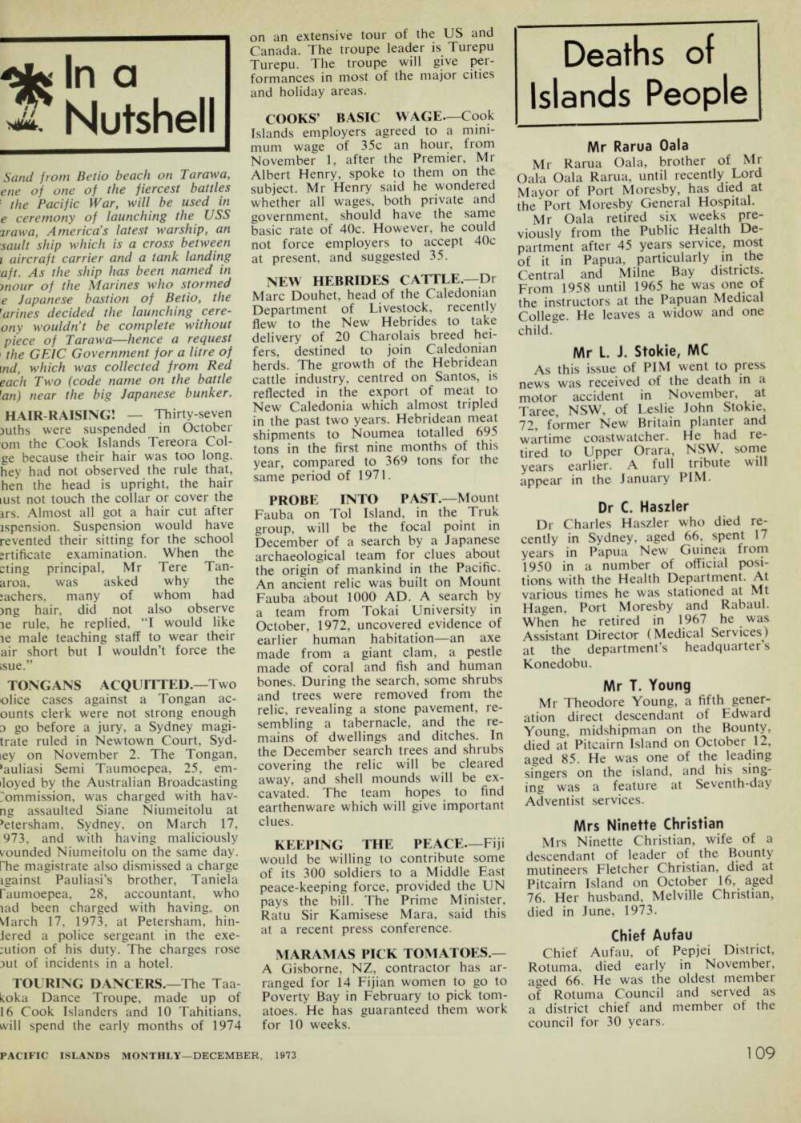
In a Nutshell
Sand from Betio beach on Tarawa, ene of one of the fiercest battles ■ the Pacific War, will be used in e ceremony of launching the USS irawa, America’s latest warship, an sault ship which is a cross between i aircraft carrier and a tank landing aft. As the ship has been named in mour of the Marines who stormed e Japanese bastion of Betio, the \arines decided the launching cere ony wouldn’t be complete without piece of Tarawa —hence a request the GEIC Government for a litre of md, which was collected from Red each Two (code name on the battle [, an) near the big Japanese bunker.
HAIR RAISING! Thirty-seven mths were suspended in October om the Cook Islands Tereora Col ge because their hair was too long, hey had not observed the rule that, hen the head is upright, the hair lust not touch the collar or cover the ars. Almost all got a hair cut after ispension. Suspension would have revented their sitting for the school srtificate examination. When the cting principal, Mr Tere Tan aroa, was asked why the cachers, many of whom had mg hair, did not also observe le rule, he replied, “I would like le male teaching staff to wear their air short but I wouldn’t force the ;sue.”
Tongans Acquitted.—Two
olice cases against a Tongan ac ounts clerk were not strong enough a go before a jury, a Sydney magi trate ruled in Newtown Court, Syd icy on November 2. The Tongan, •auliasi Semi Taumoepea, 25, em iloyed by the Australian Broadcasting Commission, was charged with hav ng assaulted Siane Niumeitolu at ’etersham, Sydney, on March 17, 973, and with having maliciously vounded Niumeitolu on the same day.
Tie magistrate also dismissed a charge igainst Pauliasi’s brother, Taniela faumoepea, 28, accountant, who lad been charged with having, on Vlarch 17, 1973, at Petersham, hin iered a police sergeant in the exe cution of his duty. The charges rose mt of incidents in a hotel.
Touring Dancers.—The Taa
koka Dance Troupe, made up of 16 Cook Islanders and 10 Tahitians, will spend the early months of 1974
on an extensive tour of the US and Canada. The troupe leader is Turepu Turepu. The troupe will give per formances in most of the major cities and holiday areas.
Cooks’ Basic Wage—Cook
Islands employers agreed to a mini mum wage of 35c an hour, from November 1, after the Premier, Mr Albert Henry, spoke to them on the subject. Mr Henry said he wondered whether all wages, both private and government, should have the same basic rate of 40c. However, he could not force employers to accept 40c at present, and suggested 35.
New Hebrides Cattle.—Dr
Marc Douhet, head of the Caledonian Department of Livestock, recently flew to the New Hebrides to take delivery of 20 Charolais breed hei fers, destined to join Caledonian herds. The growth of the Hebridean cattle industry, centred on Santos, is reflected in the export of meat to New Caledonia which almost tripled in the past two years. Hebridean meat shipments to Noumea totalled 695 tons in the first nine months of this year, compared to 369 tons for the same period of 1971.
Probe Into Past. —Mount
Fauba on Tol Island, in the Truk group, will be the focal point in December of a search by a Japanese archaeological team for clues about the origin of mankind in the Pacific.
An ancient relic was built on Mount Fauba about 1000 AD. A search by a team from Tokai University in October, 1972, uncovered evidence of earlier human habitation —an axe made from a giant clam, a pestle made of coral and fish and human bones. During the search, some shrubs and trees were removed from the relic, revealing a stone pavement, re sembling a tabernacle, and the re mains of dwellings and ditches. In the December search trees and shrubs covering the relic will be cleared away, and shell mounds will be ex cavated. The team hopes to find earthenware which will give important clues.
Keeping The Peace—Fiji
would be willing to contribute some of its 300 soldiers to a Middle East peace-keeping force, provided the UN pays the bill. The Prime Minister, Ratu Sir Kamisese Mara, said this at a recent press conference.
Maramas Pick Tomatoes.—
A Gisborne, NZ, contractor has ar ranged for 14 Fijian women to go to Poverty Bay in February to pick tom atoes. He has guaranteed them work for 10 weeks.
Islands People
Deaths of Islands People
Mr Rarua Oala Mr Rarua Oala, brother of Mr Oala Oala Rarua, until recently Lord Mayor of Port Moresby, has died at the Port Moresby General Hospital.
Mr Oala retired six weeks pre viously from the Public Health De partment after 45 years service, most of it in Papua, particularly in the Central and Milne Bay districts.
From 1958 until 1965 he was one of the instructors at the Papuan Medical College. He leaves a widow and one child.
Mr L. J. Stokie, MC As this issue of PIM went to press news was received of the death in a motor accident in November, at Taree, NSW, of Leslie John Stokie, 72, former New Britain planter and wartime coastwatcher. He had re tired to Upper Orara, NSW, some years earlier. A full tribute will appear in the January PIM.
Dr C. Haszler Dr Charles Haszler who died re cently in Sydney, aged 66, spent 17 years in Papua New Guinea from 1950 in a number of official posi tions with the Health Department. At various times he was stationed at Mt Hagen, Port Moresby and Rabaul.
When he retired in 1967 he was Assistant Director (Medical Services) at the department’s headquarter s Konedobu.
Mr T. Young Mr Theodore Young, a fifth gener ation direct descendant of Edward Young, midshipman on the Bounty, died at Pitcairn Island on October 12, aged 85. He was one of the leading singers on the island, and his sing ing was a feature at Seventh-day Adventist services.
Mrs Ninette Christian Mrs Ninette Christian, wife of a descendant of leader of the Bounty mutineers Fletcher Christian, died at Pitcairn Island on October 16, aged 76. Her husband, Melville Christian, died in June, 1973.
Chief Aufau Chief Aufau, of Pepjei District, Rotuma, died early in November, aged 66. He was the oldest member of Rotuma Council and served as a district chief and member of the council for 30 years.
Advertisements & other items, pp. 116-118 (1 item)
LnnJ
n §s) Is) LnnJ §s) LnnJ D= i i §s) LnnJ 1
beachcomber
hotel
PACIFIC HARBOUR, FIJI
Sophistication in the midst of uninhabited natural beauty.
Nestled snugly in a reef-protected bay on 5 miles of classical palm fringed Deuba beach. Far enough from Fiji's capital, Suva, to forget the worries of city life. Near enough to take in the colour and the Duty Free Bazaars.
Every suite is self-contained and airconditioned. The cuisine is as the service, superb.
PO Box 216, Suva. Telephone: Navua 43.
Telex 2324. Cables: FLAGTELS, Fiji. For reservations or information contact your travel agent.
FIJI
f M
NAMALE PLANTATION
ESCAPE
FROM THE ORDINARY
Here is an idyllic paradise where you can enjoy the unspoiled beauty and serenity of a working coconut plantation. This privatelyowned Pacific retreat has been designed for a maximum of 16 people. Gracious surroundings, friendly service, relaxed 'Bure' accommodation overlooking the sea with individual balconies and private facilities. Licensed cocktail bar. Entire plantation available to groups of 14-16 people.
Activities available include: Deep sea fishing, reef and shell hunting, skin diving, snorkelling, water skiing, hiking, turf tennis court, badminton, horse riding, croquet course and a beautiful tropical garden to relax in. Sports equipment available on a complimentary basis include aquascopes, snorkelling and fishing equipment, inflatable rafts, tennis racquets etc. Coastal tours by boat or mini-bus on request. Boats for hire. Baby sitting service also available.
Write for a Free Brochure to:
THE MANAGER,
NAMALE PLANTATION,
SAVUSAVU, FIJI.
Or: Namale Plantation, P.O. Box 64,
Suva, Fiji.
Primitive luxury
(Polynesian style) (Nestled away in the untouched Kingdom of Tonga is new, luxurious "Port of Refuge" International resort. Here is a unique opportunity for your clients to experience the tranquil and relaxed Tongan atmosphere while they enjoy the picturesque surroundings of the new "Port of Refuge". And only a short flight from Fiji.
Reasonable tariffs from $17.50 with special concessions for children. Agents commission 10 per cent.
Tonga's
Port of Refuge
Jgu INTERNATIONAL RESORT U
Uava’u Tonga Cables: "Refuge" Tonga or "Tongatours"
Sydney. Phone: Sydney 85-1603 or 282-472
AN INVITATION FROM
MOTOR HOLIDAYS (N.Z.) LTD.
WHEN YOU CAN ENJOY THE WORLD IN
MINIATURE IN NEW ZEALAND, WHY GO
FURTHER AFIELD FOR THE HOLIDAY OF
YOUR LIFETIME?
'y
PIONEERS
FOLLOWING THE
SUN SINCE '6l
COMPETITIVE RATES
HIRE MOTOR
CARAVANS FROM $3O
PER WEEK
PLUS 10c PER MILE
NORTH - SOUTH
FERRY BOOKINGS
AVAILABLE
MAKE YOUR RESERVATIONS
EARLY FOR 1974
SPECIALISTS IN FULLY- EQUIPPED
MOTOR CARAVAN TOURIST
RENTALS
AVAILABLE FROM AUCKLAND
AND CHRISTCHURCH
BOOKINGS AND ENQUIRIES
412 MT. EDEN ROAD, AUCKLAND. PHONE 600-288
PARK VIEW MOTEL—BRISBANE
Quiet location—opp. Botanic Gardens.
Single, double, family suites, all with refrig., air conditioning, phone, TV, radio, tea making facilities, from $lO. Pool and restaurant.
Phone 31-2695—Telex 40270.
Write for coloured brochure— Park View Motel, 128 Alice St, BRISBANE, Old., 4000.
INTERNATIONA
DATELINE HOT
TONGA
"Friendly Hotel" of the "Friendly Islands"
Situated along the Nukualofa waterfront. Only five minutes walk from town. Single, double, family suites, airconditioning, and hot and cold water showers. Pool, bar, restaurant, duty-free shop, tour desk and boutique.
Book through your travel agent or write to International Dateline Hotel, P.O. Box 62, Nukualofa Tonga.
Cable Address: "DATELINE".
Represented Overseas by: Charles J. Henry and Associates Pty. Ltd.
Sydney and Melbourne. 297(
mflfm
ismnn
IVlana Island: 300 acres of lush, tropical vegetation surrounded by miles of palm fringed beach and sheltered lagoons.
Recreation: Snorkelling, scuba, skiing,
spear, bottom and deep sea fishing, swimming excursions. Modest charges.
Accommodation: Resort hotel, secluded accommodation in 60 individual Fijiantype cottages. Self-contained bures with shower, toilet, refrigerator, tea and coffee facilities and exhaust fans.
International Standard Restaurant; Fijian and Continental cuisine. Terrace dancing to Fijian Band. Beach Bars - Feast Nights.
Facilities: Island shop, travel agent, hairdresser, child minding and first aid.
Tariff: Single occupancy: SFIB.OO Double occupancy: $F22.00 Triple occupancy: $F26.00 Children under 12: Half Rate Babies in cot; Free Duplex Bure from; $F42.00 Rates subject to change Pre paid tours through agents.
Transport: Bus or taxi Nadi to Lautoka (Bus fare 80c). SFB.OO return by fast 90' cruiser Lautoka to Mana Island.
Schedule: Dep. Lautoka 9.30 am. Arr.
Mana 11.20 a.m. Dep. Mana 3.30 p.m.
Arr. Lautoka 5.20 p.m. Water Taxi subject to reservations; $F6.00 per person one way, a minimum $F45.00 per trip.
CHECK OUT TIME - 1 1.00 a.m.
CANCELLATION NOTICE 48 hours.
DEPOSITS Groups and ITX Prepaid.
Individual bookings, one night deposit required.
Bookings; Aust. & N.Z.: C.J. Henry & Associates.
Offices: Mana Island Resort (FIJI) Limited P.O. Box M 94, Sydney Mail Exchange 2012 69.5061 or P.O. Box 610, Lautoka, FIJI 61.210; 61.455 Telegrams and Telex; Mana Island, Lautoka, FIJI
GENUINE NATIVE
ARTIFACTS
FROM THE NEW GUINEA
ISLANDS AND OUTLYING
ATOLLS
• TEXTILES • CURIOS
• CARVINGS • BASKETWARE
• FIGURINES
For complete lists and prices write us immediately: B. F. DARCEY & Co. PTY. LTD.
TONIVA BEACH,
KIETA,
PAPUA NEW GUINEA.
to
A SOOTHING
AID FOR BABY
You'll be delighted what a soothing and effective aid Fisher's Teething Powders are to baby's natural teething disorders. Sore gums, digestive disturbances and intestinal upsets quickly respond to Fisher's Teething Powders.
So safe too, if used as directed, they do not contain Calomel, Opiates, Bromides, or any harmful substances. Save yourself distress and keep the little one happy and well by using Fisher's Teething Powders as needed. Only 30c for 20 powders from your chemist or store.
Fisher & Co., Manufacturing Chemists (Est. 1876), 17 May St., St. Peters,
N.S.W. 2044.
PIM 807/72
PROPERTY INVESTMENT
SUNSHINE COAST—QUEENSLAND
We invite inquiries regarding living or investment in this area.
We have a full coverage of holiday lettings, flats, motels, homes, farms, businesses and sub-divisional land.
Write direct to MABIN & BLOWERS Pty. Ltd. (Members R.E.1.Q.),
II BURNETT STREET—BUDERIM, Q., 4556.
For Warm and Friendly
Samoan Hospitality
Apia, Western Samoa Phone: 880. Cable: 'Aggies'.
Tariff includes all meals.
PEN FRIENDS OVERSEAS. Individual world wide postal introduction service!
Plus optional illustrated magazine! Write for details today! Five Continents Co. Ltd., P.O. Box 21219, Henderson, N.Z.
DAIMANTE HEALTH BANDS plain $A4.00
jewelled $5.00, air mail included. Write to; Sun Trading Co., Box 377, Norfolk Island, South Pacific.
FLEETS, 76 ft steel tug, profess, bit. 1945, ample fuel and water, $30,000. 45 ft trawler, profess, bit. 1955, Gardner 5 LW, radio, sounder etc., $26,250. Fleets, Rowe’s Bldg, Edward St, Brisbane. Cable “Fleets", Brisbane.
A 60 ft FERRO-CEMENT CARGO LAUNCH
for the Solomons is nearing completion al Ogilvie’s Boatbuilding Works, Queensland 4805. Shell ferro-cement with frames anc deck steel is recommended for 50, 60, 7( footers and larger.
RESTAURANT AND NIGHT CLUB for
lease, in heart of Suva, fully furnished with modern kitchen and bars, fully carpeted floors, modern interior design with magnificent view of harbour. Area 3 floors. You have to see it to believe it.
Enquiries: P.O. Box 1122, Suva, Fiji.
In Lae stay at the
Huon Gulf Motel
FOR THE BEST OF EVERYTHING.
BOOK DIRECT OR THROUGH ANY OFFICE OF ANSETT AIRLINES.
Huon Gulf Motel
MARKHAM ROAD, LAE. PHONE: 42-4844.
A Division of Ansett Transport Industries Limited.
FOR ALL BOOK REQUIREMENTS
and free catalogues contact:
LEAP FOUNDATION BOOKSHOP,
116 A Abercrombie Street, Chippendale, N.S.W. 2008, Aust.
Phone: 699-1126.
CONCRETE BLOCK MACHINE. Makes
blocks, flags, edgings, screen-blocks, garden stools —up to 8 at once and 96 an hour. SAIO7 c.i.f main ports. Send for leaflets. Forest Farm Research, Londonderry, N.S.W., 2753.
ALL BOOKS AND JOURNALS ON AUST-
RALASIA AND THE PACIFIC BOUGHT
AND SOLD. Catalogues issued and sent free on application. Correspondence invited. Berkelouw, 15-19 Boundary St., Rashcutters Bay, Sydney, 2011. Phone: 81-8215.
Line Advertisements
Per line, $1.15 Ansi., Minimum rate. 4 Udn.
Turners Supply Co
FRESH FRUIT & VEGETABLES
9813
YOUNG ITALIAN MAN would appreciate friendly correspondence and, eventually, stamp exchange with residents in any Independent Island. Write to: Giovanni de Santis, Casella Postale 97, 70100 Bari, Italy.
Index to Advertisers
Adams Ind 3, 24 Aggie Grey 112 Air New Zealand 76 Allied Manufacturing & Trading Industries 17 Ansett Hotels 112 Ardneil 87 Arnott's Biscuits 53 Bacardi cov. iii Bank of Hawaii 46 Bank Line 80 Beachcomber Hotel 110 8.0.A.C. 89-92 Braybon 28 Breckwoldt 88
Brockhoff's 20 Brunton 94 Burns Philp 18, 19 Com. N. G. Timbers 42 Daiwa Bank 88 Daiwa Line 105 Darcey, B. F. 11l Fiat 26, 27 Fisher, Peter 100 Fisher & Co. 11l French Knit 34 Frigate Rum 84
G.M.H. 106
George & Ashton 84 Gillespie Bros 59
Goodyear 48
Grove, W. H. 23 Hall, R. 32 Handi Works 32 Harris Book Co. 73 Hellaby, R. & W. 30 Honda 93 Innes Schweppes 44 Interocean-N.Z. Ltd. 103 International Dateline Hotel 111
Karlander Line 108 Kerr Bros 81 Knox Schlapp 78, 87 Kikkoman cov. ii Kodak 30 Mabin Blowers 111 Mana Island Resort 111 Massey-Ferguson 82 Motor Holidays 110 Motor Specialities 74 Namale Plantation 110
Nedlloyd 80
Nissan cov. iv
Otis 45 Pacific Line 107
P.A.A. 58
Parker Pen 70 Pioneer Electric 60 PNG Printing 38 Q'ld. Co-Op. 54 Q'ld. Insurance 85 Revin International 43 Sandy, James 41 Sofrana Unilines 104 Southern Pac Ins 102 Sullivan, C. 30
Sunbeam Swire, John Tatham, S. E. 40 T.D’.K. Electronics 95 Tonga's Port of Refuge HO Toyota 56/ 57 Trio Electronics 50 Turners 102, 112 Union S.S. Co 107 Warburton Frank! 44 Whitcombe & Tombs 69 Yanmar Diesels 96 Yorkshire Insurance 23
Advertisements & other items, pp. 118-120 (2 items)
Wholly set up and printed in Australia by PACIFIC PUBLICATIONS (AUST.) PTY. LTD.. 29 Alberta Street, Sydney. 2000.
REGISTERED AT THE GPO SYDNEY FOR TRANSMISSION BY POST AS A NEWSPAPER CATEGORY B.
REGISTERED Au AT a] T^ p OPO gi SYU on Y the coyer is recommended Austr alian retail price only.
what else?
Bacardi
ice and
... nothing else if you feel so inclined, for there’s no real problem where and how and what you drink Bacardi rum with.
Because Bacardi rum is so light, dry, highly refined and pure it complements every mixer, yet remains distinctively itself. Bacardi and Coke and ice ... Bacardi and ginger... Bacardi and tonic with a zest of lemon or lime ... Bacardi and fruit juice ... Mix up your own Bacardi party.
Because ...
Anything
goes with
Bacardi rum
BACARDI
rum-the mixableone. s
I VAC
tm 0 mm c « Bacardi and the Bat Device are registered trade marks of Bacardi and Company Limited.
"Coca-Cola” and "Coke” are the registered trade marks of The Coca-Cola Company.
BAC/2382/72
r m mm m mil i i I * ■V I * « *? % f* v.; : -k And wherever you’ll go in over 120 nations throughout the world you’ll find proud DATSUN drivers.
Perhaps the main reason is that DATSUN was designed to meet a wide variety of conditions—mountain roads and super highways, blistering suns and freezing temperatures. DATSUN is indeed the international car that has precision engineering and a stunning string of rally victories behind it.
Its superb handling, safety features and high speed efficiency make DATSUN the choice of young and old alike. DATSUN—the car that really satisfies the world over.
DATSUN
NISSAN
DATSUN distributor network covers the following areas: Fiji*T.P.N.G.*W. Samoa* New Caledonia• New Hebrides* B.S.l.P.*Timor*Norfolk* A. Samoa'Tahiti* Cook *Nauru* Tonga* Saipan* Guam'Australia* New Zealand