Pacific Islands Monthly

News Magazine Of The South Pacific
November, 1973
Australia, N.Z., Western Samoa 60C
P.N.G., FIJI, COOKS, TONGA, G.E.1.C., 8.5.1. P., N. HEBRIDES 50c
Nauru, Niue, Norfolk 50C
American Samoa 70C Hawaii, Micronesia $L.Oo
NEW CALEDONIA AND FRENCH POLYNESIA 100 CFP
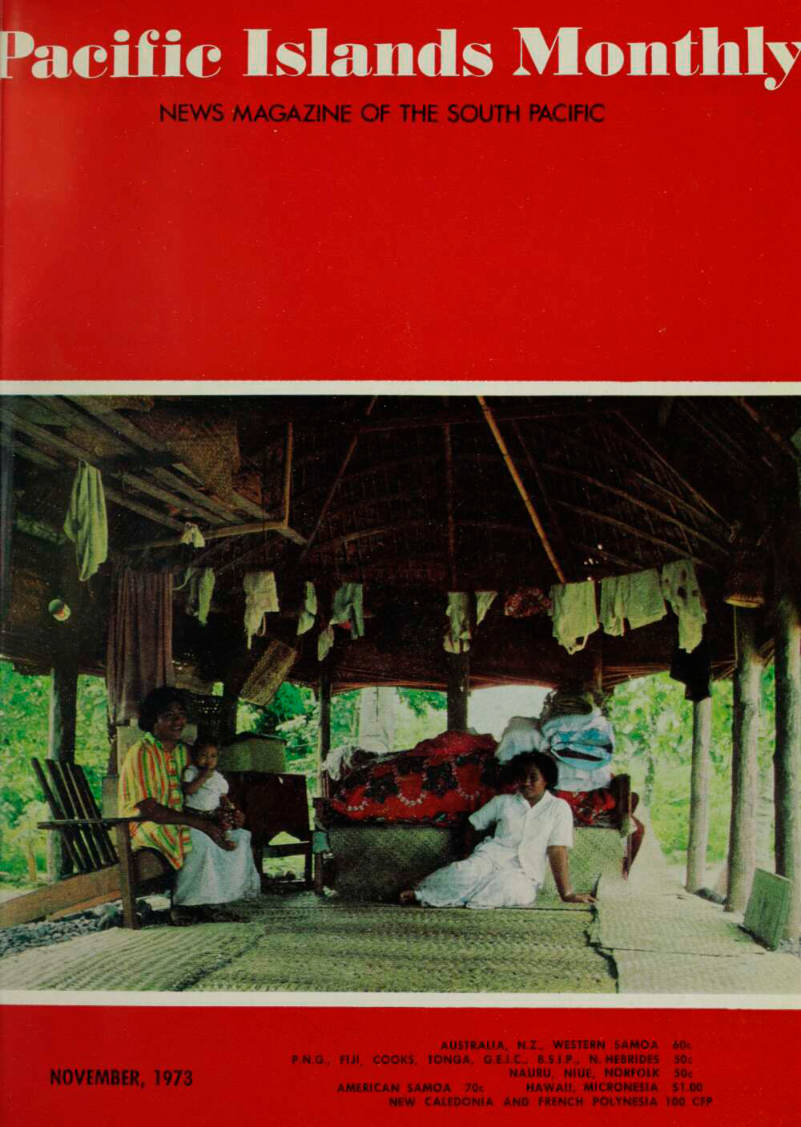
Our Cover
It's open-house in Western Samoa! At least it was the day English photographer, Steve Vidler, visited this fale, where he got a smiling wel come as well as a colourful picture.
Advertisements & other items, p. 2 (1 item)
Mazda1000&1200 Pickups.
jpm •m) .L~ iogo
PICKUP
*s« A lot of truck for your money.
Check the features for yourself
0 All steel cargo deck with snap shut tailgate 0 Big load carrying capacity 0 Tough, girder-section steel chassis 0 Choice of rugged 1000 or 1200 OHV engine 0 Large, 4-bladed engine fan 0 Laminated safety glass windscreen 0 Corrosion-free grille with stylish square headlights 0 2-speed wipers with twin jet washer 0 Roomy bench seat adjustable 6 ways for height and reach 0 Flow-through ventilation system 0 Push in, pull out door lock knobs 0 Easy-to-get-at battery and engine See your Mazda dealer soon for a real value-for-money buy.
MAZDA
1973 TOYO KOGYO CO., LTD,
FIJI ISLANDS Niranjans Autoport Ltd. G.P.O. Box 450, Suva TEL; 22691 NEW CALEDONIA Societe Riviere et Bernanos 27. Rue de Sebastopol, Noumea NEW GUINEA PNG Motors Ltd. P.O. Box 1394, Boroko, Papua TEL: 55788 NE\A ZEALAND Mazda Motors of New Zealand Ltd. Auckland P.O. Box 22-472 TEL: 69-099 WESTERN SAMOA H. & J Retzlaff, P.O. Box 195, Apia TEL; 237 NEW HEBRIDES Societe Bourgeois et Cie, P.O. Box 28, Port-Vila PORTUGUE.
TIMOR Sang Tai Hoo, Dili The trademark MAZDA in this advertisement stands for AUTOMOBILES MAZDA as far as France and her territories are concerned.
In This Issue
Eneral
landers at Opera House opening 6 airport strike 11 >uth Seas labour trade 71 irlines agreement 11l jic raft voyage 11l
Merican Samoa
ov Haydon's trial 8 idigenous medicine 16 jmoan named Director of Public Safety 35
Ook Islands
ooks go duty free 29 Z grant for agriculture 102
ifluenza epidemic 11l
Jl nti-inflation moves 9 tew stamps (pic) 14 mguage difficulties 15 iary Edwell-Burke's career 51 ollecting Marine Dept debts 83 leak outlook for sugar 97 <-postmaster dies 109 tan on currency charge 111 ew Parliament House 11l SR record 11l 5 million hotel deal 112
Ord Howe Island
ust army to build airstrip 83
Nauru
Enna G leaves Wellington 81
New Caledonia
The nickel crisis 7 Lost revenue compensation 13 Double anniversary celebrations 14 Wooing the customers 15
New Hebrides
Church backs independence 11 Coral reefs recovering 11l Plane crash 112 Bishop appointed 112
Norfolk Island
Income tax bill 13 Mr Buffett returns 33
Papua New Guinea
Special adviser sacked 10 West Irian development 11 Migrant regulations 11 Restricted drinking hours 12 Distinctive PNG currency 14 House of Assembly meets 21 Percy Chatterton's Footnotes 24 Eruption of Vulcan Island 47 Local playwrights 73 New airport for Lae 77 Japanese for Madang 81 Dockworkers' gains 83 New Britain mountain erupts 111
Pitcairn Island
The Bomb and revaluation 15
Solomon Islands
Strange fish caught 16 Solomons' fleet earnings 83 Development money available 97 Siamese twins born 112
Tonga
Search for Spanish bottle 5 Arrival of the jet age 77 Tonga's ships in the red 78
United States Trust Territory
Autonomy move rejected 8 Return to Bikini Atoll 14 Repaying loans 15 Future status talks 27 and 112 Support for Continental Airlines 78 Transpac under fire 79
Western Samoa
Tusitala's trainee manager 10 Hopes for C'wealth Games marathon 33 Visitors' permits extended 11l No revaluation 112
EPARTMENTS: Up Front with the Editor, ii; Tropicalities, 14; People, 33; Editor's mail ag, 37; From the Islands Press, 45; Magazine section, 47; Yesterday, 52; MANA, 61; ooks, 71; Pacific transport, 77; Cruising yachts, 85; Business and development, 97; reduce, 102; Shipping and airways information, 103; Deaths of Islands people, 109; In a nutshell. 111; Advertisers' index, 116.
Pacific Islands
Monthly
FOUNDED BY R. W. ROBSON IN 1930
Published Monthly By
Pacific Publications (Aust.) Pty. Ltd.,
29 Alberta St., Sydney, N.S.W., 2000.
Postal Address: G.P.O. BOX 3408, SYDNEY,
N.S.W., 2001.
Telegraphic Address: PACPUB, Sydney.
Telex 25168.
Telephones: 61-9197, 61-7101, 61-4369.
Consulting Directors: R. W. Robson, Judy Tudor.
Chief Executives: Manager: Selwyn Hughes.
Publisher: Stuart Inder.
Director of Advertising: W. A. Gasnier.
Pacific Islands Monthly
Editor; Stuart Inder.
Assistant Editor: John Carter.
Advertising Manager: W. A. Gasnier.
Circulation Manager; Barry Badger.
Subscription Rates;
"Pacific Islands Monthly" is airfreighted to all subscribers and agents in the Pacific Islands and the U.S.A.; copies to Nauru and other areas go by surface mail.
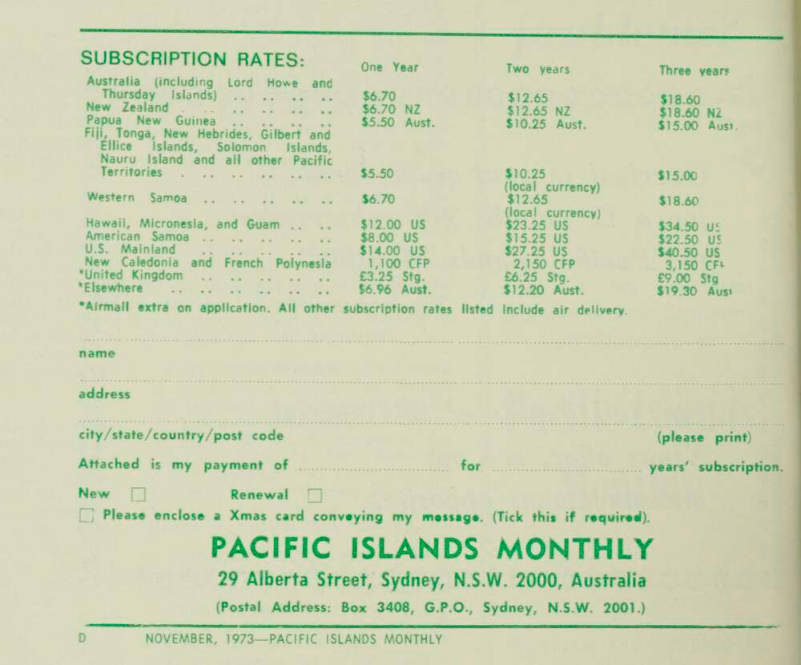
Australia (incl. Lord Howe and Thursday Is.); $6.70 Aust., Papua New Guinea: $5.50 Aust.; Fiji, Tonga, New Hebrides, Gilbert & Ellice Islands, Solomon Islands, Nauru Island and all other Pacific territories: $5.50 (local currency); Western Samoa: $6.70 (local currency); New Zealand: $6.70 NZ; Hawaii, Micronesia and Guam: $12.00 US; US Mainland: $14.00 US; New Caledonia and French Polynesia: 1,100 CFP; United Kingdom: £3.25; Elsewhere: $6.96.
Representatives
Fiji: A. F. Woods, Imex (Pacific) Limited, Suite 2A, Victoria Arcade, Suva, Fiji. P.O. Box 3117, Lami, SUVA. Telephone: 22-502. Telex: 2124.
Papua New Guinea: LAE, P.O. Box 227; RABAUL, Mr. Steve Simpson, P.O. Box 433 (c/- Rabaul Photographic. Tel.: 2677.) French Polynesia: Distribution—Hachette Paci fique, 10 Ave Bruat, Papeete.
New Zealand: Pacific Publications, C.P.O. Box 2229, Auckland. 379-494. Representative: John Spedding, Civic House, 291 Queen St., Auckland, Tel.: 379-494.
United Kingdom: Overseas Publicity Ltd., 214 Oxford Street, London, WIN OEA. Phone: 01-636 8296/7.
Overseas Newspapers (Agencies) Ltd., Cromwell House, Fulwood Place, London, W.C.I. Tel.: 01-242-0661. Cables: WESNEWS, London, DS4.
Japan: Advertising—Universal Media Corpora tion, C.P.O. Box 46, Tokyo. Tel.; 666-3036.
Victoria: Advertising Pacific Publications (Aust.) Pty. Ltd., 33 Lonsdale Street, Melbourne, Vic. 3006. Telephone: 662-3263.
Queensland; Advertising—Beale Media Services, 232 St. Paul's Terrace, Fortitude Valley, Qld., 4006. Tel.: 52-5827.
Hawaii and U.S. Mainland only: N. Grogan, 3354 Hayden Street, Honolulu, 96815. (Send change of address notices. Form 3579 and new subscriptions to P.O. Box 2193, Honolulu, Hawaii, U.S.A. 96805).
Second class postage paid at Honolulu, Hawaii.
Copyright ©, 1973,
Pacific Publications (Aust.) Pty. Ltd.
November, 1973 Vol. 44, No. 11
Up Front
with the Editor
Despite a certain air of finality in Patricia Matheson’s report on p 5, I’m hopeful that Captain Alejandro Malaspina’s bottle may yet be re covered from that tiny islet in Vavau’s superb harbour. No buried treasure story ought to be blown out so quickly, and especially one that has taken 168 years to get attention.
Malaspina, last of the great Spanish navigators, buried his bottle on the unnamed islet in 1793 after planting the Spanish flag that annexed Vavau to Spain. The captain and his two ships, Descubierta and Atrevida, then sailed out of history, to be ignored for the next 50 years, until an edited version of some of Mala spina’s travels was published, in Spanish.
Believe it or not, but the first ac count in English of Malaspina’s Vavau exploits, including the bottle burying episode, appeared in PIM in February, 1962. It was written by Robert Langdon, now executive officer of the Pacific Manuscripts Bureau, Australian National Uni versity, but then PlM’s assistant editor. Bob is fluent in Spanish in addition to being a bull terrier at Pacific research. Bob learned that the bottle had been buried on the islet beneath a tent the Spaniards used as an observatory.
There were no precise details in the available Malaspina documents to indicate just where the unnamed islet was, but we were entitled to assume it was in the area of Port Refuge, named by Malaspina’s colleague, Maurelle, who had discovered Vavau for the white world 12 years earlier.
Malaspina was in fact consolidating Maurelle’s work.
Just before PlM’s story was pub lished in 1962, Bob and I showed a copy of the typescript to the Hon Ve’ehala, then secretary of the Tongan Tradition Committee and now Governor of Haapai, who hap pened to be in Sydney on a visit with the late Queen Salote. We gave Ve’ehala a sketch of where we thought the islet was, and suggested
an official Tongan expedition be mounted to search and dig for this bit of history.
Ve’ehala was fascinated, Queen Salote was amused (“We can’t have Spain claiming our northern islands,” she said jokingly), but Tonga de cided not to take the matter any further. I don’t know who made the decision, or whether it was simply that other things in Tonga were more urgent at the time.
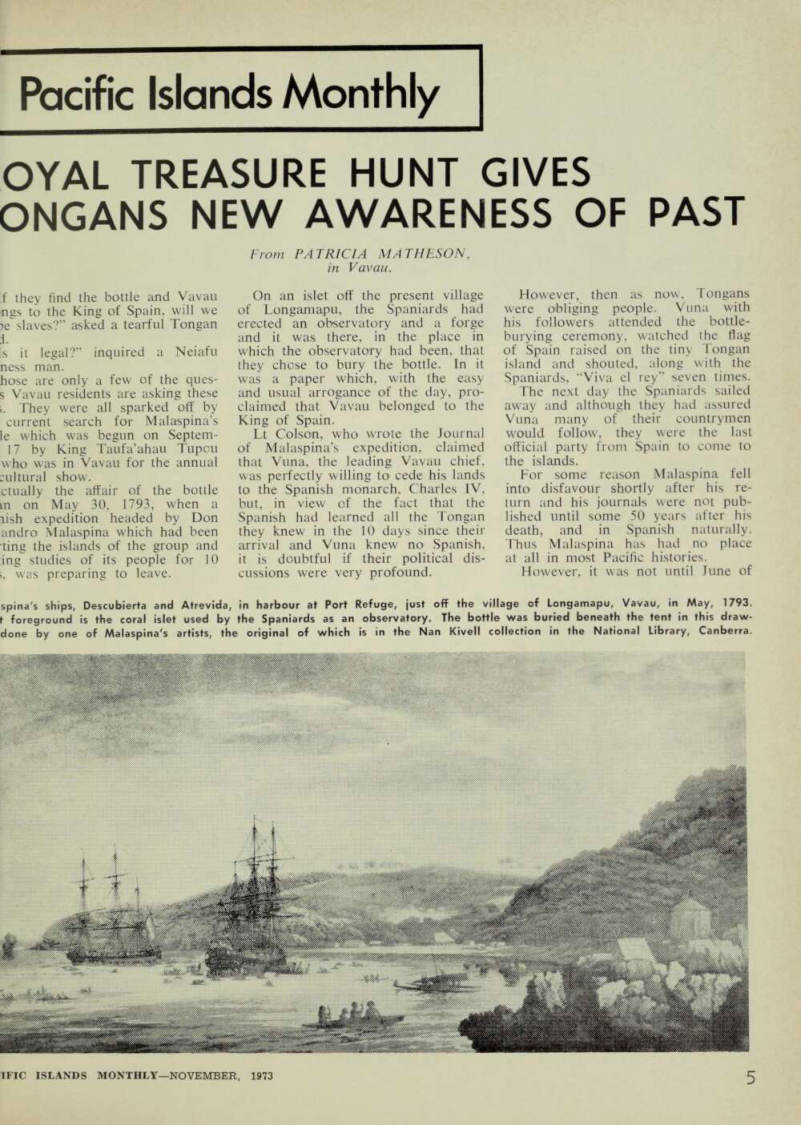
We here on PIM had a hankering over the next few years to go and search for that bottle, especially after I stumbled on a drawing of the treasure spot. I happened to be look ing through part of a collection of drawings held by the National Library of Australia in Canberra (in those days the library had no grand building as it has now, and the material was stored in a tin shed), and 1 identified a contemporary drawing of Malaspina’s two ships in Port Refuge, with what had to be THE island nearby, showing the very tent under which we knew the bottle to be buried. The library was almost as pleased as we were at having the Malaspina drawing identified and pre sented PIM with a large copy of it, from which our reproduction on p 5 was made.
In June this year I was in Tonga, with my wife Jo, and thought I might try to identify the island. I took copies of the Malaspina draw ing with me, and recounted the Mala spina story to King Taufa’ahau in a pleasant audience he gave us.
King Taufa’ahau is deservedly noted for his wide range of interests, and his enthusiasm, and he was not only willing for me to “scratch around a bit”, he was prepared to do some treasure hunting of his own when he visited Vavau to open the Agricultural Show in September, and to actually dig for the bottle once the site was identified. You can’t get more help than that!
So Jo and I visited that glorious harbour of Vavau which Malaspina “annexed” in 1793, and there we saw
ny old friend Patricia Matheson, in ler lovely waterside house that over lows with books and good conversa ion. The whole world comes to Pat hrough a continuous supply of )ooks, and letters from her many fiends. As luck had it, also in the larbour was the 70 ft White Squall I, with Ross and Minene Norgrove, vhom 1 had last met in Tahiti. So vith the generous help, on the first lay, of one of the Port of Refuge iotel’s fast speedboats, and, on the iecond day, of White Squall, we sur veyed the outer bays until we decided mr bottle island had to be one of wo high coral outcrops, each within i boat’s length of the shore on one ide, but with deep water on the ither.
Pat and I climbed them both. We till have coral scratches to prove it.
Ve decided that the second of the wo islets showed faint signs of laving at some distant time received pedal attention. The top was over sown with scrub, small trees and r ines, but it seemed that at one time t may have been roughly levelled vith picks to make room for the tents —just as Malaspina’s islet had been.
Ve also thought we found the site if Malaspina’s forge which was mown to be on the islet.
The thrill came when we took Vhite Squall up the coast and re raced Malaspina’s entry to Vavau, ising a spoken translation of his □urnal which had laboriously been iut on tape the previous evening by he enthusiastic, Spanish - speaking dinene. Following Malaspina’s own [irections, White Squall dropped nchor just where Malaspina’s flagship ad anchored, and found the same lepth to the same sandy bottom! by studying our copy of the fawing, there was no doubt now hat we were in Port Refuge and we ad correctly identified Bottle Island.
We contentedly left the next moves 3 the king, after I reported our xperiences to him.
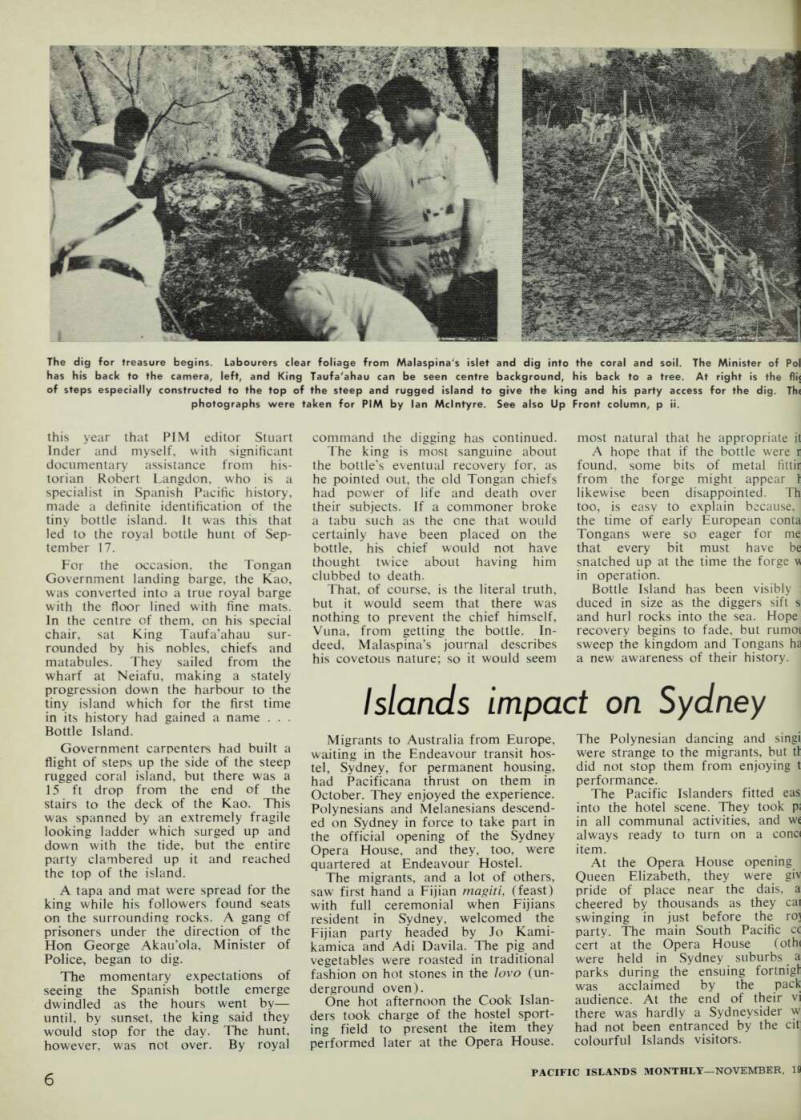
As Pat reports in her story on p 5, he king expended his efforts in Sepaltering his show schedule and lead the treasure hunt. Although he bottle was not found, there were igns, I believe, that identify the tent ite, and the bottle might yet be un overed. The search party included, esides Pat, lan Mclntyre, general lanager of Pacific Resorts, owners f the Port of Refuge Hotel, who lappens to be a first-rate photo rapher. lan went along at the king’s ivitation to keep a pictorial record, nd he tells me that on one side of le islet a group of diggers un overed, in the coral, five holes laced in a square, with another irger hole in the centre. The holes
were filled with small stones, and they didn’t dig them all out. Ian’s view is that the central hole probably held a flag pole, and that the five outside holes held the stays which kept it up, but I think it is far more likely that this was the site of the main tent, and that the tent pole went into that centre hole. I hope some more work is done on this possibility.
But meanwhile, as Pat says in her report, thanks to the king Tongans have discovered another aspect of their history, and identified another historic landmark. What was just a coral outcrop that nobody noticed, now has a place in the history of Tongan exploration. It is accessible to visitors, who can tread the very spot the Spaniards trod, and enjoy the same scene, unspoiled to this day.
THAT report about Norfolk Island affairs on p 13 looks like a com plicated commercial wrangle, but it has a simple base. The island was once a “distinct and separate settle ment”; the islanders don’t really be lieve it is anything else today, and they are defiant at any move, from any direction, to impose authority on them without what they consider to be proper consultation. Constitu tionally, Norfolk Island is neither fish nor fowl, and until the Australian Government announces clearly, un equivocally what real responsibility the islanders have, if any, Australia will continue to have Norfolk Island in revolt over some issue or other.
Oapua New Guinea, On The
* other hand, is getting too much attention from Australia—most of it destructively critical. It’s almost as if, after decades of Australian ad ministration, Australians have sud denly dismissed Papua New Guinea as “something nothing”; a land of savages whose future is chaos. To read Australian newspapers, to view television commentaries, to listen to radio broadcasts of parliament, a visitor could believe New Guineans are about to embark on civil war, throw out the whites and take over commerce, and that the only “goody” in the country, Michael Somare, is powerless against the forces of evil.
Ratbag nonsense! There will be nothing the matter with New Guinea’s team of leaders and its people during the forthcoming moves to indepen dence that can’t be smoothed by the support of a genuine vote of confi dence, friendship and understanding from Australian commerce, politi cians, writers and the man-in-the street. Do all these people want to see New Guinea fall on its face?
Stuart Inder
Advertisements & other items, pp. 5-12 (3 items)
Iii
’ACIFIC ISLANDS MONTHLY—NOVEMBER. 1973
Cool, easy-to-lay
Vmylflex floor tiles
Vinylflex floor tiles are unaffected by tropical conditions — they go on looking good as new.
The Vinylflex range includes embossed, smooth surface and marbleised patterns — suitable for homes, offices, shops and commercial buildings.
Floor tiles are much easier to lay.
When you want wall-to-wall comfort and over a hundred fashion colours to choose from, ask for CSR Vinylflex Floor Tiles.
Stockists: T.P.N.G.
Steamships Trading Company Limited, Port Moresby, Lae, Samarai, Madang, Goroka, Mt. Hagen, Rabaul, Kieta.
Bowmans (P. & N.G.) Pty. Ltd., Port Moresby, Kieta.
FIJI AND WESTERN SAMOA: Burns Philp (S.S.) Co. Ltd.
csr Vinyl
VINYL ASBESTOS FLOOR AND WALL TILE 9
MARKETED BY C.S.R. BUILDING MATERIALS
Export Sales. 4 O'Connell St., Sydney, Australia 2000,
25PE322E
Christmas Gift Problems?
This selection from Pacific Publications book list should solve your problems . there is something here for everyone. So do all your shopping in one hit. Well post your choice to you, or direct to anyone you nominate (and enclose a card bearing your message).
FUI FIJI
A beautifully produced, hard bound book of 128 pages and 145 full-colour photographs. Whether or not you intend to visit Fiji . . . "Fiji Fiji" will make a fascinating addition to your library . . . There's a short illustrated history of Fiji and its 300 islands . . . Customs and ceremonies of the charming people of this multi-racial society that really works . . . What to see . . .
How to get there . . . Colourful maps of the islands and the cities and towns . . . these are just some of the subjects covered in this splendid book.
Price: Australia and P.N.G., $4.50 Aust., plus $l.OO posted, Overseas countries, $4.50 Aust., plus $l.lO posted; U.S.A., $8.40 U.S. posted.
TAHITI AND ITS ISLANDS
Here is a book of the stuff that dreams are made of! 128 pages, 164 fullcolour photographs and many informative colour maps of one of the most beautiful areas on earth. This is a book that will appeal to the dreamer or the tourist, and covers all the 120 islands of French Polynesia . . . Tahiti, AAoorea, Bora Bora, the Tuamotus, the Australs, etc. The text is as fascinating as the pictures and covers the history, the people, their customs and culture.
Price: Australia and P.N.G., $4.50 Aust., plus $l.OO posted; Overseas countries, $4.50 Aust., plus $l.lO posted; U.S.A., $8.40 U.S. posted.
MARINE SHELLS OF THE PACIFIC VOL. II
Walter O. Cernohorsky
Marine Shells of the Pacific—Volume 11, carries on where Volume I left off.
Its enlarged format provides greater scope for the arrangement of illustrations and text and describes and illustrates 600 species of mollusc not included in the revised first volume. Volume II has 68 full-page plates, some in superb full colour, covering approximately 600 species, plus 28 text figures. An authoritative handbook for all collectors. 412 pages, cloth bound, illustrated.
Price: Australia and P.N.G., $13.00 Aust., plus 43c posted; Pacific Islands and overseas countries, $13.00 Aust., plus 70c posted; U.S.A., $19.40 U.S. posted.
LITTLE CHIMBU IN BOUGAINVILLE Nancy Curtis
Little Chimbu, who lives in New Guinea, was grumbling because everybody he knew was busy digging holes and would not hunt crocodiles with him or even laze on the river bank under a taro leaf.
The little aeroplane. Little Balus ('Bar-loose') heard him grumbling and offered to take Little Chimbu to see the biggest hole in the world —at Panguna on the island of Bougainville. His family and all his friends insisted on going too. 50 pages, in full colour.
Price: Australia and Overseas $3.25 Aust., plus 30c posted; U.S.A., $4.90 U.S. posted. 3rd Edition QUEEN EMMA R. W. Robson This is the story of Queen Emma of New Guinea. It has drama, comedy, high adventure and colourful romance. It has the added merit of being true. This is not only the story of how a Polynesian-American girl entered a man's world in the 19th century and beat it on her own terms; it also is the history of an era. This was a period when empire-building was not only respectable but also was accounted a virtue; when New Guinea was completely untamed and almost unknown. 239 pages, cloth bound, illustrated.
Price: Australia and P.N.G., $4.00 Aust., plus 30c posted; Pacific Islands and overseas countries, $4.00 Aust., plus 70c posted; U.S.A., $6.65 U.S. posted.
Fill in the details on the attached order form.
Overleaf is your order form for Xmas books
ORDER FORM
Please send copies of the following books for which my payment of is enclosed. (Indicate books required.) □ FIJI FIJI □ LITTLE CHIMBU IN BOUGAINVILLE □ TAHITI AND ITS ISLANDS □ QUEEN EMMA □ MARINE SHELLS OF THE PACIFIC Vol. II I would like the above books sent to the following address:— Name Address (please print) □ Please enclose a Xmas card conveying my message. (Tick this if required).
Pacific Publications (Aust.) Pty. Ltd.
29 Alberta Street, Sydney, N.S.W, 2001.) (Postal address: Bos 3408, G.P.0., Sydney, N.S.W, 2001.)
m mm ssl mm mm :> m m Sss» Wm&s t&m k V mmm '. vr'
Arnott’s Cracker Biscuits...
always crispy-fresh and
good to eat!
Always keep Arnott’s famous Cracker Biscuits handy for parties, for light snacks, for nibbling anytime.
They’re always crisp and fresh, ready to go with your favourite foods or just to eat straight from the pack.
The triple-wrapped packs keep the biscuits fresh.
j™* Biscuits
||l I There is no Substitute for Quality T 602
Four Hi-Protin milk rings give
Protein is vital in assisting the healthy growth of children.
HI-PROTIN milk rings also contain essential vitamins and minerals for balanced development.
HI-PROTIN is specially baked to assist the healthy development of infants gums and jaws.
Delicious HI-PROTIN, good for everyone-from baby to grandpa.
All enquiries: Arnott-Brockhoft-Guest Pty. Ltd., Burwood, Victoria, Australia, 3125
Concentrated Pea-Ben
is lethal to flies, mosquitoes
and all insect pests ...
Yet so pure it's safe to spray anywhere With tropical weather providing ideal conditions for prolifically breeding flies and mosquitoes, serious outbreaks of disease can be spread by swarms of these insect invaders. Once more householders are urged to combat this threat to public health by killing every disease carrying insect seen. A.N.I. Research Chemists are constantly at work world-wide to ensure that Pea-Beu aerosol insecticide is effective in eliminating flies and mosquitoes from households. Pea-Beu is specifically formulated to contain pyrethrins, one of the most powerful insecticidal ingredients known deadly to mosquitoes, and all insect pests and yet harmless to man and his pets. ■> /■■ ■, . ,y.-. ■ , '/y/*mm*, The Deadliest Traffickers of Disease Four centuries ago flies were suspected of spreading tropical ulcers. Modern pathologists have proved they spread a whole list of infections, ranging from mild but unpleasant stomach upsets to infective hepatitis, bacillary, dysentery, typhoid and persistent ameobiasis. Worse still, flies transmit crippling scourges such as cholera, smallpox, poliomyelitis, opthalmia and trachoma. A highly efficient method of fly extermination is to use powerful Pea-Beu aerosol insecticide. A few short bursts of Pea-Beu in a room will kill all flies on the wing.
The permeating action of Pea-Beu also spreads into hidden corners of the room, thus eliminating any hidden insects.
The mosquitoe’s record is just as grim.
Besides wrecking your night’s rest with their irritating whine and inflicting painful toxic bites, mosquitoes pass on many serious diseases including malaria, hepatitis, dengue and yellow fever, disfiguring elephantiasis and encephalitis.
Total Killing Power with Total Safety Controlling these dangerous diseasespreaders demands rapid destruction wherever they appear. Long-term research was needed to formulate the insect spray that combines high killing potential with complete safety for users, as powerful Pea-Beu aerosol does. Pea-Beu is particularly effective as the wide action spray ensures total coverage of any room. Pea Beu’s efficient spray seeks out and destroys insects before they have a chance to bring irritation and illness to your family. m
Pea-Beu the safe, powerful insecticide
fflore lime on the job!
Com more per hour!
It's a fact. You get more out of Cat-built equipment as contractors have proved for years. Other earthmoving equipment may have similar features. But machine for machine . . . hour for hour . . .
Cat-built equipment is more productive . . . more reliable . . . more profitable . . . than any other. Reasons include the more advanced design features. The more testing. Factors that make Cat-built machines the most reliable of all. And rugged construction. The more rigorous
TRACTOR E EQUIPIVIEIMT
when a repair is needed. Cat-built equipment is back on the job again in next to no time, thanks to the reliable daily airfreight Parts Backup Service available to our neighbouring Pacific Islands.
CATERPILLAR
A <S>
YOUR
DEALER
TELEX: CARPTRAC FJ2190 SUVA. PHONE: 24051-4
CABLES: CARPTRAC, SUVA
SERVICING THE SOUTH PACIFIC ISLANDS
3
ICIFIC ISLANDS MONTHLY—NOVEMBER, 1973
Pacific Islands Monthly
Oyal Treasure Hunt Gives
Ongans New Awareness Of Past
From Patricia Matheson,
in Vavau.
f they find the bottle and Vavau ngs to the King of Spain, will we )e slaves?” asked a tearful Tongan 1.
Is it legal?” inquired a Neiafu ness man. hose are only a few of the ques s Vavau residents are asking these i. They were all sparked off by current search for Malaspina’s le which was begun on Septem -17 by King Taufa’ahau Tupou who was in Vavau for the annual cultural show. ctually the affair of the bottle in on May 30, 1793, when a lish expedition headed by Don andro Malaspina which had been ting the islands of the group and ing studies of its people for 10 ;, was preparing to leave.
On an islet off the present village of Longamapu, the Spaniards had erected an observatory and a forge and it was there, in the place in which the observatory had been, that they chose to bury the bottle. In it was a paper which, with the easy and usual arrogance of the day, pro claimed that Vavau belonged to the King of Spain.
Lt Colson, who wrote the Journal of Malaspina’s expedition, claimed that Vuna, the leading Vavau chief, was perfectly willing to cede his lands to the Spanish monarch, Charles IV, but, in view of the fact that the Spanish had learned all the Tongan they knew in the 10 days since their arrival and Vuna knew no Spanish, it is doubtful if their political dis cussions were very profound.
However, then as now, Tongans were obliging people. Vuna with his followers attended the bottle burying ceremony, watched the flag of Spain raised on the tiny Tongan island and shouted, along with the Spaniards, “Viva el rey” seven times.
The next day the Spaniards sailed away and although they had assured Vuna many of their countrymen would follow, they were the last official party from Spain to come to the islands.
For some reason Malaspina fell into disfavour shortly after his re turn and his journals were not pub lished until some 50 years after his death, and in Spanish naturally.
Thus Malaspina has had no place at all in most Pacific histories.
However, it was not until June of
[?]spina's ships, Descubierta and Atrevida, in harbour at Port Refuge, just off the village of Longamapu, Vavau, in May, 1793. [?]t foreground is the coral islet used by the Spaniards as an observatory. The bottle was buried beneath the tent in this draw [?]done by one of Malaspina's artists, the original of which is in the Nan Kivell collection in the National Library, Canberra.
this year that PIM editor Stuart Inder and myself, with significant documentary assistance from his torian Robert Langdon, who is a specialist in Spanish Pacific history, made a definite identification of the tiny bottle island. It was this that led to the royal bottle hunt of Sep tember 17, For the occasion, the Tongan Government landing barge, the Kao, was converted into a true royal barge with the floor lined with fine mats.
In the centre of them, on his special chair, sat King Taufa’ahau sur rounded by his nobles, chiefs and matabules. They sailed from the wharf at Neiafu, making a stately progression down the harbour to the tiny island which for the first time in its history had gained a name . . .
Bottle Island.
Government carpenters had built a flight of steps up the side of the steep rugged coral island, but there was a 15 ft drop from the end of the stairs to the deck of the Kao. This was spanned by an extremely fragile looking ladder which surged up and down with the tide, but the entire party clambered up it and reached the top of the island.
A tapa and mat were spread for the king while his followers found seats on the surrounding rocks. A gang of prisoners under the direction of the Hon George Akau’ola, Minister of Police, began to dig.
The momentary expectations of seeing the Spanish bottle emerge dwindled as the hours went by— until, by sunset, the king said they would stop for the day. The hunt, however, was not over. By royal
command the digging has continued.
The king is most sanguine about the bottle’s eventual recovery for, as he pointed out, the old Tongan chiefs had power of life and death over their subjects. If a commoner broke a tabu such as the one that would certainly have been placed on the bottle, his chief would not have thought twice about having him clubbed to death.
That, of course, is the literal truth, but it would seem that there was nothing to prevent the chief himself, Vuna, from getting the bottle. In deed, Malaspina’s journal describes his covetous nature; so it would seem
most natural that he appropriate it A hope that if the bottle were r found, some bits of metal fittir from the forge might appear 1: likewise been disappointed. Th too, is easy to explain because, the time of early European conta Tongans were so eager for me that every bit must have be snatched up at the time the forge v in operation.
Bottle Island has been visibly ] duced in size as the diggers sift S' and hurl rocks into the sea. Hope recovery begins to fade, but rumot sweep the kingdom and Tongans ha a new awareness of their history.
The dig for treasure begins. Labourers clear foliage from Malaspina's islet and dig into the coral and soil. The Minister of Pol[?] has his back to the camera, left, and King Taufa'ahau can be seen centre background, his back to a tree. At right is the flic[?] of steps especially constructed to the top of the steep and rugged island to give the king and his party access for the dig. The[?] photographs were taken for PIM by lan Mclntyre. See also Up Front column, p ii.
Advertisements & other items, p. 13 (1 item)
5
IFIC ISLANDS MONTHLY—NOVEMBER, 1973
Islands impact on Sydney
Migrants to Australia from Europe, waiting in the Endeavour transit hos tel, Sydney, for permanent housing, had Pacificana thrust on them in October. They enjoyed the experience.
Polynesians and Melanesians descend ed on Sydney in force to take part in the official opening of the Sydney Opera House, and they, too, were quartered at Endeavour Hostel.
The migrants, and a lot of others, saw first hand a Fijian magiti, (feast) with full ceremonial when Fijians resident in Sydney, welcomed the Fijian party headed by Jo Kami kamica and Adi Davila. The pig and vegetables were roasted in traditional fashion on hot stones in the lovo (un derground oven).
One hot afternoon the Cook Islan ders took charge of the hostel sport ing field to present the item they performed later at the Opera House.
The Polynesian dancing and singi were strange to the migrants, but tl did not stop them from enjoying t performance.
The Pacific Islanders fitted eas: into the hotel scene. They took pi in all communal activities, and we always ready to turn on a conc( item.
At the Opera House opening Queen Elizabeth, they were giv pride of place near the dais, a cheered by thousands as they cai swinging in just before the roj party. The main South Pacific cc cert at the Opera House (oth< were held in Sydney suburbs a parks during the ensuing fortnigl was acclaimed by the pack audience. At the end of their vi there was hardly a Sydneysider w had not been entranced by the cit; colourful Islands visitors.
that mother' will help
New Caledonia's Woes
Rench Writer Takes The Wraps
[?]FF FRANCE'S NEW PROBLEM CHILD . . .
. . . And the governor promises that mother' will help
m influential Paris newspaper has made a perceptive analysis of nch tardiness in solving the Cale ian nickel crisis and the subse nt deterioration in relations be en the territory and France, rench journalist J-C Guillebaud :ing in early September for Le tide (The World) presented a es of articles which Caledonians e hailed as the most accurate nch interpretation of current local blems.
Juillebaud wrote that New Cale ia, the only French overseas terri r with considerable wealth :kel), is the territory now giving >t problems to France. Admitting cyclic nature of nickel prosperity, writer noted the 1969 boom, d extravagant promises made by is, now followed by the brutality the current crisis with unemploy it, mines closing and bankruptcies. :n, whom do the Caledonians ne—the “colonialist” administra , the “zozo invaders” (metropoli- French immigrants) or Paris, ch continues to block the entry INCO to build the hoped-for md factory to develop the island? unid what some describe as the lure of the French policy” on the nd, Le Monde noted Caledonian umism and aggressive reactions ards Paris. The writer learned ; Caledonians prefer Americans French for the operation of a md factory, while Paris is deter ed to avoid American domination the island. is Paris dallies and fails to fulfil cel development promises made by Gaulle in 1966, Caledonian in sts no longer coincide with those France and anti-French feeling in ises. While promises of pros ity were once used to deflate the momist cause, the current decep i is a rallying point for the auto lists.
Meanwhile, the administration faces eased unpopularity among Mela ians and whites and in trying to md its position “now allows itself luxury of encouraging a process lisintegration—which serves metro itan interests”.
'he writer pointed out that what governor’s office most seems to
Prom a Noumea correspondent fear is co-operation between white autonomists and the Melanesians, a co-operation now achieved by ex tremists in the Union of Caledonian Youth (UJC). He also mentioned that while the Europeans are made to feel threatened by the blacks, the adminis tration is busy telling the Melanesians that they need the presence of France to protect them against exploitation by local whites.
However, it seems that Melanesians have not rallied to the French regime; official “smiles” during fre quent administrators’ visits to tribal areas fail to disguise “repressive” tactics employed at the slightest sign
of disrespect. The writer wonders at official insistence upon the efficiency of the “forces for the maintenance of law and order” and notes that such forces on the island have been in creased to 2,260 men, including 351 gendarmes, 131 police, 1,778 armed servicemen (for a population of 120,000).
Amid the general animosity over Paris policy on the island, the French writer sensed a certain “violence in the air—at least verbal”. And all the while, the Melanesians have not fallen into line to support the ad ministration, as they continue to vote autonomist.
From a Noumea correspondent
French Governor Louis Verger assured the Caledonians in October that France would support the terri tory through its current budget crisis.
The Governor, returning from a light ning trip to Paris, also repeated that the central government would assist the SLN nickel company in its grave plight (a loss of 3,000 million francs, over SA2S million, predicted for 1973). Government aid would help avoid further dismissal of workers and loss of nickel export tax for the territory.
Concerning the SOMMENI group nickel project for the north of the island, Patino company President, General R. Leveque, told the Cale donians in October he hoped work would begin on port installations by the end of 1973. Following the with drawal of French Pechiney-Ugine Kuhlmann and Swedish Granges from the project, the initial produc tion level is reduced to 16,000 tons with the first output hoped for early in 1976.
In the south, the French govern ment is intent on dividing the ore reserves between Canadian INCO and the Franco-American alliance of Aquitane Petrol (SNPA) and Free port Minerals. This division under lines the French determination to
stall off strong North American in terest in the island.
However, Governor Verger has insisted on France’s determination to guarantee the future of New Cale donia with investments amounting to millions of dollars. These assurances are destined to cut the ground from under the feet of the autonomists.
Paris is in fact repeating “Be patient and good. France will look after you. whatever your financial difficulties at the moment”. It is hard for Cale donians to shrug off such benevolent paternalism.
At the same time, the state-con trolled radio and TV network ol ORTF continues as a stronger defen der of the French administration. It was after extraordinarily lengthv publicity given on ORTF to a recent “split” in the Melanesian Union Multiraciale party that the leader of another autonomist party asked the administration whether all parties could now have their complete com muniques read over the ORTF net work or is this right only extended to certain parties?
The Caledonian autonomists thus face continuing obstacles with the lure of Paris subsidies and political propaganda in a tightly-controlled, isolated community.
Advertisements & other items, p. 15 (1 item)
7
:iFIC ISLANDS MONTHLY—NOVEMBER, 1973
American Samoa hatches
its own mini-Watergate
From a Pago Pago correspondent
In probably the first case of its kind, the Governor of American Samoa, John M. Haydon, recently appeared before an administrative tribunal of the United States Civil Service Commission to answer char ges involving malpractices in his ad ministration.
Governor Haydon was charged with putting pressure on the district governors to tell the voters to vote “no” on the proposal to replace the appointed governor with an elected one. (This national referendum re sulted in an overwhelming “no” vote against the proposal.) He was also charged that he had stated in a radio broadcast, just be fore the last general elections, that in his belief no palagi (Caucasian) should be elected to the Samoan legislature. At that election, a palagi, Wilbur Reinie, ran for one of the Manu’a constituencies, and lost.
There was also a number of other minor charges but these were the chief ones.
No one can deny that the main charges were serious ones dealing as they did with alleged interference with public elections, a matter speci fically forbidden in the US Hatch Act. According to this act, no civil servant can take part in or try to in fluence the course of a public elec tion.
Is Haydon guilty or not? This is a matter which only the tribunal can decide and its decision is expected before the end of the year. If Hay don is guilty, he may have to go.
But what strikes an observer of American Samoan affairs is the fact that the trial has come as a climax to many crises that have affected the Haydon administration—a sure sign of the political turmoil in which American Samoa is enmeshed as the result of the conflicts experienced in the political and social spheres.
There is, firstly, the conflict be tween the traditional Samoan social system and the foreign American social system and this is evident throughout all levels of Samoan society.
The Samoans, by and large, want to maintain the Samoan social system but find that, in reality, the faaSamoa system is no use against the white man’s law, administrative procedures and general standards of behaviour.
Hence, the average Samoan tends to be uncertain of himself.
In the political sphere, the question arises how much political power should be given to the Samoans, who are a ward of the United States Con gress? Samoans want political power but not to the extent of pushing out the Americans or of stopping US grants to the territory. This again creates an ambivalent attitude to wards the American.
In such an uncertain situation, op portunists have their way in Ameri can Samoa.
It would not be fair to label Gover nor Haydon as an opportunist for it could be argued on his side (as was done in the trial) that he was try ing to guide a generally-uninformed population as to the best decision to make in the two elections.
Perhaps he had reason to suppose that the Samoans were not yet ready to elect their own governor and that competition from palagis in the legis lature would not be a good thing for the majority of Samoans.
On the other hand, Haydon’s super iors at the Interior Department or the White House could say it was not Haydon’s discretion that was wanted in this case, but the will of the Samoan people regardless of their stage of intellectual development.
This is where Haydon will either stand or fall.
As to the minor charges, Haydon was contradicted by subordinates on the matter of the amount of the de-
ficit when he came into power i 1969 and of the number of feden grants then in operation. But even : Haydon was wrong, and his subordii ates right, this would merely prov that Haydon had been inconsisten that he had not been efficient in gel ting the facts first. The conclusio that he lied doesn’t necessarily follov Though it is quite conceivable th£ Haydon had overstepped himself i an important issue, it should be n membered on the other hand that h has had to operate in a murky ai mosphere ever since he became govet nor. His duel with Jake King, editc of the Samoan News, had bee splashed on the pages of the York Times, the Washington Po: and other national newspapers.
His image had been cruelly vil lied by the Samoa News and politic* aspirants and this in a manner ind eating a lack of understanding.
Haydon is probably a nice Amer can who tries his best but is clums at times. Call him an Ugly America / if you like but he is not the crimim he is often painted.
A sequel to the hearing involvin Governor Haydon was the dismiss* of the man who filed another charg< Assistant Attorney-General Jim Kinj zett. He charged the governor wit interfering with the civil rights c two individuals at the hearing.
Kingzett’s alleged offence accordin to Attorney-General Donald Williarr was that he had seen fit to privatel investigate certain charges involvin Governor Haydon and file them i Williams’s name with absolutely n discussion with Williams or othe attorneys in the department.
Kingzett replied that he was mere! doing his job. He had been r< sponsible for criminal prosecutior for the last two years and as a matte of practice did not consult Williarr before filing charges. Anyway, would not have been proper for hii to consult Williams as Williams wa already defending Haydon in th Hatch Act hearings, he said.
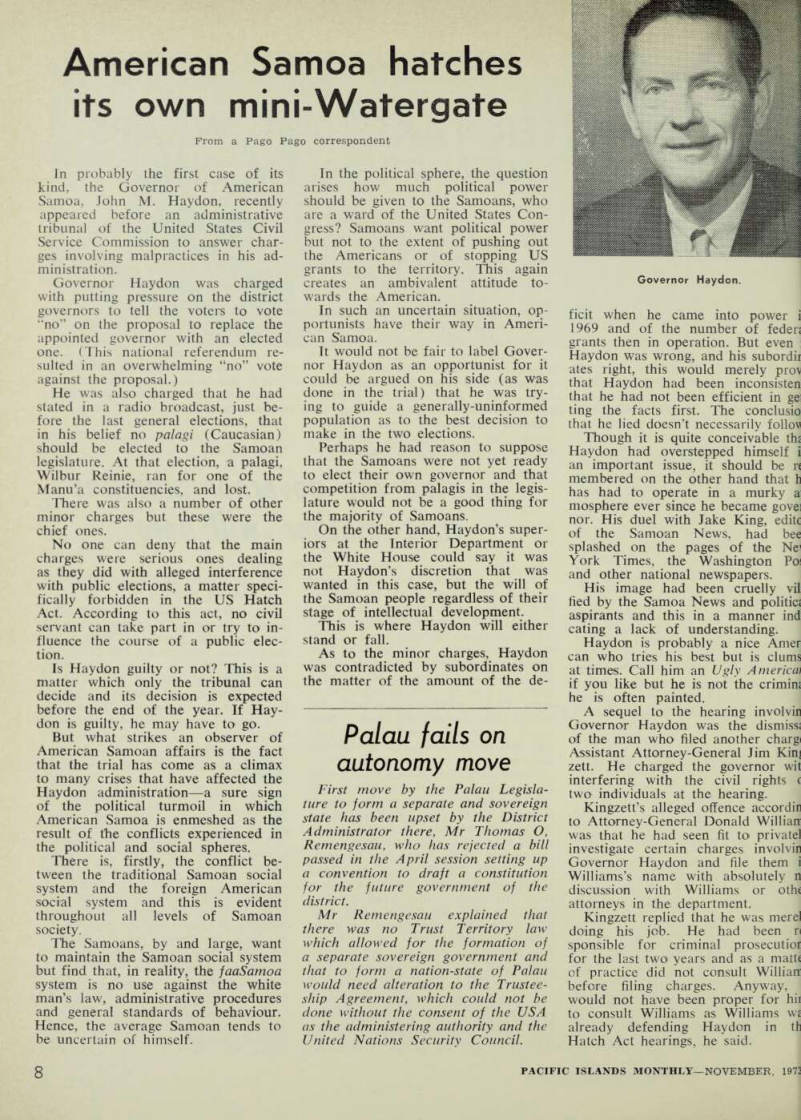
Governor Haydon.
Palau fails on autonomy move
autonomy move
First move by the Palau Legisla ture to form a separate and sovereign state has been upset by the District Administrator there, Mr Thomas O.
Remengesau, who has rejected a bill passed in the April session setting up a convention to draft a constitution for the future government of the district.
Mr Remengesau explained that there was no Trust Territory law which allowed for the formation of a separate sovereign government and that to form a nation-state of Palau would need alteration to the Trustee ship Agreement, which could not be done without the consent of the USA as the administering authority and the United Nations Security Council.
How Fiji Fights Price Rises
PIB has become a dirty set of initials in Fiji. It stands for Prices and Incomes Board, the activities of lich are under fire from the parliamentary Opposition and the trade unions. The board is the Fiji Govern 3nt's attempt to stem inflation. Is it succeeding? Below are some of the answers.
From a Suva correspondent
Fiji’s prices and incomes policy to mbat inflation has followed a pat rn that seems to have become mdard.
First, there was a sudden, dramatic claration that all prices, charges, iges and house rents were to be >zen for 90 days from April 1. iring the freeze period a permanent ces and Incomes Board would be up and a representative National onomic Council established.
The declaration was generally well :eived. A common reaction was, flank God somebody is doing mething about the cost of living at ,t”.
Three months later, an expert ving been recruited from the lited Kingdom to head the Prices d Incomes Board and to formulate d administer a permanent anti lationary policy, details or Stage yo were announced.
They defined guidelines within lich changes in prices and incomes re to be restricted.
The next stage, to begin in Novem r, will be an attempt to resolve the esses and reconcile the pressures it have developed during Stage /o, and still try to flatten the in tionary spiral.
Hanging over all efforts to keep : cost of living down in Fiji is the m fact that a major element in it cost is outside Fiji’s control. So my goods are imported that prices ; basically determined by cost >vements in overseas countries, irrency exchange fluctuations edu cate things still further.
The gap between Fiji’s currency d those of Australia and New aland, countries which supply many Fiji’s imports, has widened imatically this year. When New aland revalued by 10 per cent and istralia by 5 per cent in September i followed with a 5 per cent re flation.
But the Fiji dollar has since floated wnwards with the pound sterling, th which it remains linked, and it now worth about 14 per cent less in the New Zealand dollar and out 15 per cent less than the Aus lian.
Add these percentages to the in ice cost of imported goods, plus ;ight and Customs charges based the landed cost, and add a further
percentage profit mark-up and you have a pretty formidable built-in price inflation.
The Fiji Prices and Incomes Board, consisting of two imported experts and a local civil servant, bases some of its price controls on percentage mark-ups, but in most cases fixes specific selling prices.
A commonly-heard complaint from merchants is that the margins per mitted are unrealistically low, and show that the board members know nothing about, or will not acknow ledge, the hard facts of commercial life, including the cost of financing purchases and of shipping delays and of storage and selling on credit.
Even the Consumer Council, a body set up by the government to act as a watchdog on prices and selling practices, concedes that it is difficult to police price controls in small stores, or where itemised dockets are not issued.
Cases have occurred where traders, faced with loss or what they regard as an inadequate return on imported goods, have just stopped importing them. Resulting shortages, especially in foodstuffs in popular demand, have led to a hasty upward revision of the permitted selling price.
But if the Prices and Incomes Board is not exactly the most loved body in the commercial world of Fiji, its
most vehement opponents have come from the trade union world.
The Stage Two guidelines fixed a limit of 8 per cent in the overall annual increase in the wages and salaries bill of a given business or industry.
Union leaders, beset by rivalries within the trade union movement generally and under pressure from their own members, have refused to acknowledge that such a discipline is necessary in the national interest.
They declare that all it does is to interfere with the collective bargain ing process and so stop them from getting wage increases which they would otherwise be able to get from employers.
A strike at the Fiji Industries Ltd cement works at Lami in September arose, not from any dispute between employers and employees, but be cause a 15 per cent wage increase, negotiated before the “freeze”, was disallowed by the Prices and Incomes Board as it exceeded the 8 per cent guideline.
The Board explained that a 15 per cent rise in wages would inevit ably lead to an application by Fiji Industries for an increase in the con trolled price of cement. This would in turn raise building costs and so contribute to the general inflationary movement.
But this lesson in the economics of control of inflation was brushed aside by the president of the Fiji Trades Union Congress, Mr James Raman, who said that the PIB was enabling employers to benefit by keep ing money which they would other wise have passed on to employees in increased wages.
Mr Raman later resigned from the National Economic Council, and then led a walk-out from a widely repre sentative conference called by the NEC to discuss the principles to be adopted in Phase Three of the prices and incomes policy.
“A political gesture”, commented the chairman of the Prices and In comes Board, Dr Norman Ross, adding, with obvious justification, that it seemed that union representatives did not consider it worthwhile to discuss problems which concerned the interests, welfare and well-being of Fiji’s workers. (Over)
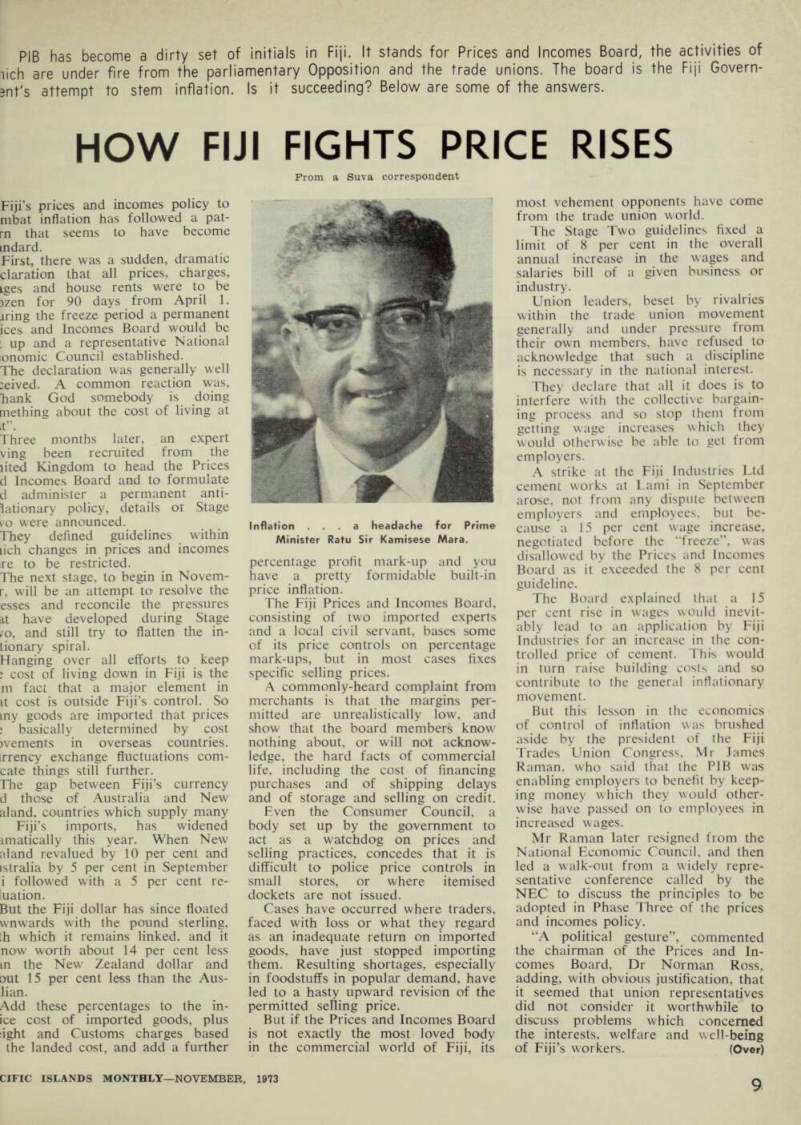
Inflation ... a headache for Prime Minister Ratu Sir Kamisese Mara.
The board can rightly claim some success. The cost of living, as measured by an official index, is still rising but the rate of increase has gone down.
The 8 per cent limit on wage lifts is being pretty generally applied, in spite of the loud noises being made by trade union leaders and by poli ticians for whom any stick is good enough with which to beat the gov ernment.
Price and rent controls are having an effect, in spite of protests by traders about heavy-handed and often inept interference by officialdom with commercial processes.
In the famous Punch cartoon the curate told his host, the bishop, that his breakfast egg was good in parts.
Fiji’s Prices and Incomes Board can at least make a similar claim.
Advertisements & other items, p. 17 (1 item)
9
CIFIC ISLANDS MONTHLY—NOVEMBER. 1973
Spoke out, tossed out
Mr Leo Hannett, 28, has been dismissed as special adviser on Bougainville to the Chief Minister of Papua New Guinea, Mr Michael Somare. He was appointed in March, 1973, in a bid to end moves for Bougainville’s secession from PNG.
Late in September he made a public
call for the removal of two senioi ministers from the PNG Cabinet.
He said the Minister for Mines Mr Paul Lapin, and the Minister foi Business Development, Mr Donatu; Mola, were not working hard enougt for the people of Bougainville, whorr they represented. They should b< replaced by a third Bougainvillea! member of the House of Assembly, Father John Momis.
Mr Somare, announcing Mr Han nett’s dismissal, said his actions had been embarrassing to everyone con cerned. It was clear he was unable to separate his political activities from his duties and responsibilities to him (Mr Somare).
Mr Somare said Mr Hannett had 2 clear right to continue as head of the Bougainville Special Committee, sei up earlier this year to work oul alternatives to secession.
Mr Somare’s action was endorsed by the Leader of the Opposition, Mi Tei Abal, who said Mr Somare had the right to expect the loyalty and support of his personal staff in the government.
Mr Abal also had something to say about the new Minister for Justice, Mr John Kaputin, appointing his own brother to a post on his staff.
The appointment, he said, had shades of nepotism and added “Generally, it is not good for gov ernment ministers to appoint theii relatives as members of the minis terial staff”. But he softened the criticism by pointing out that the case of Mr Kaputin’s brother might be different considering his qualifica tions. Mr William Kaputin, was a law student and employee of the Public Solicitor’s office.
For The Tusitala. —Visitoi
Co-ordinator in Western Samoa since 1966 when the post was created tc assist the tourist industry, Mr Vitc Meisake has been appointed trainee manager of the new Tusitala Hotel which is nearing completion ir Apia. He will understudy Mr Johr Gaffney, present manager of the Men dana Hotel in Honiara, who will take over the Tusitala when it opens. Mi Meisake will become manager aftei three years. After education at Marist Brother’s School in Apia and SI of Finance and public relations of came private secretary to the Ministei Mary’s College, Philadelphia, he be ficer in the Prime Minister’s depart ment.
IN BUSINESS.— The Bena peopl in PNG’s Eastern Highland District have formed the Bena Developmeii Society and plan to buy shops anc other businesses in the area. The societf has a membership of nearly 18.000
Advertisements & other items, p. 18 (1 item)
Peter Fisher Trading
PTY. LTD.
321 PITT STREET, SYDNEY, 2000, AUSTRALIA
TELEPHONE: 26-1109 CABLES; "FISHERION", SYDNEY
EXPORTERS TO THE PACIFIC
ISLANDS
Some of the firms and products we represent: GREENLITES waterproof matches LUCKY STAR tinned fish REDHEADS safety matches RENA vegetables in glass jars MAURI BROS, yeast PMU food products TOOHEYS beer
CARLTON UNITED beer
CLUB RUM
ROGOVI VODKA
FRENCH KNIT car seat covers THREE STAR corned beef CRAVEN confectionery BROWNBUILT office furniture ADVANCE containers
HARDIE'S building products
SEBEL furniture BEARD beds and mattresses HUNTER DOUGLAS furniture KLINKII plywood
STERLING bakery machinery
WHITE ABBEY Scotch whisky BATA shoes SRC tinned fruit LIFESAVERS confectionery CHILTONIAN biscuits
MACHETTES
ATLAS plastic ware POLARIS stainless steel ware
FOREMOST FOODS CO.
FOREMOST CONSOLIDATED
FOSTER—Beer in bottles or cans V.B.—Beer in bottles or cans BOND'S underwear BOND'S outerwear
ANDY spotlights
COUNTRY CLUB shirts FILLETTA tinned fish PAULCALL tools ASTRA razor blades WENGER quality knives GLYNGORE tinned fish VAN DER LAAN tinned meat DEROPA gift paper WARBURTON FRANKI coolrooms DURABUILT prefabricated houses THREE X (XXX) tinned hake BRONTE tinned meat HEINEKEN beer
SHEATH KNIVES
GOLDEN STATE evaporated milk SMALL chocolate TULIP chocolate GOLDSTEIN—Food equipment
AND MANY MORE
[?]elanesia
[?]ith Asian [?]avour
rom a Port Moresby correspondent Jevelopment in Indonesian Irian a has speeded up, after a number years of neglect following the tch withdrawal in 1962. There e been considerable improvements communications and transport, lough village economies have been ;n little assistance. ►apua New Guinea observers who e visited the Indonesian province mdy (it was formerly West Irian), art favourably on the new de >pments.
"he central Indonesian government spending more money in the pro ce, mainly because there is tre ndous potential there in minerals [ petroleum. Revenue from these Id possibly wipe out the current 30 million annual subsidies being d from external sources, t is most noticeable, however, that new developments are centring und the towns, especially Manok -i, Sorong and Jayapura, and that town populations are to a large ent composed of immigrants from er parts of Indonesia. Only a ill proportion of Irianese live in m and prosper from income levels ich now are often higher than in st other Indonesian provinces, dining ventures will continue to ig in Indonesians from other as, particularly from Java, and so elop Indonesian towns in Irian a, rather than Melanesian towns, fhe Indonesians see nothing in igruous about this—nor in the fact t fewer Irianese now have top s than when the Dutch were in itrol —because they don’t agree re is any “localisation” problem h as Papua New Guinea has. mese are Indonesians like every ly else and are entitled to no cial concessions. fhe observers say that this attitude the Indonesians has helped create greater feeling of unity in the r ns, although it is unlikely there e been any changes at the village ;1 because of the comparative lack development there. In the towns ny aspects of Indonesian culture e been absorbed by the Irianese, life goes on as before in the ages.
Jndoubtedly there is still resent nt against the Indonesians in some as—often simply local resentment 1 uneasiness that things aren’t
going as well as they might—but the observers believe that reports of re volt being stirred by Free Papua Movement supporters have been greatly exaggerated.
There is no evidence of any wide spread anti - Indonesian nationalist movement, and the number of armed dissidents is probably only a few hundred. With such a small and un organised group it is unlikely that the anti-Indonesian feeling held by refugees in Papua New Guinea can be whipped into a state which could threaten unity between Papua New Guinea and Irian Jay a following PNG’s independence.
Meanwhile talks on demarcation of the border between PNG and Irian Jaya have been completed and Chief Minister Somare will sign an agree ment in Djakarta in November on behalf of the Australian Government.
PNG tightens
controls
People who entered Papua New Guinea on a short term or visitor visa could not break the terms of their permit. Minister for Defence and Foreign Rela tions, Mr Albert Maori Kiki, who is in charge of migration matters, said this when announc ing a clamp-down against those who entered the country for a short time, and stayed. He told airlines, shipping companies and employers of the decision, and added that offenders broke the migration and restricted employ ment policy. There were pro cedures to be followed when ex patriates applied for employment as a range of jobs was barred to new arrivals.
For Independence
Church Calls
The Presbyterian Church in the New Hebrides, which claims to repre sent more than half the population, has come out strongly on the side of the small but growing band of New Hebrideans clamouring for self government or independence.
New Hebridean Viewpoints re ported that the church’s General Assembly, meeting at Tanna, issued a statement headed “The Presbyterian Church’s declaration of its conviction concerning independence” and de claring that it “confidently looks to wards the goal of responsible self government of the New Hebrides people as a nation”.
The statement added, “We see the British, French and Condominium administrations as partners with us as together we move towards this goal”.
The assembly asked the South Pacific Commission and the United Nations Organisation to co-operate with the New Hebrides administra tions “in achieving self-government without delay, without violence and with due preparation of our people for the duties, functions, rights and responsibilities of independent gov ernment”.
G. Leymang, writer in the maga zine Nakamal, formerly a bi-monthly magazine and now a weekly, went further.
“The condominium is getting into a deadlock,” he wrote. “Are New Hebrideans going to wait until a John Frum cries ’freedom and inde pendence for the New Hebrides’ and rises the English in revolt against the French or vice-versa? In short, the New Hebrides Condominium is slowly but surely disintegrating and being suffocated by its infantile colonial attitude: the condominium is a two-headed monster”.
Overland from Nadi to Sydney
The patience of air travellers in the Pacific wore thin, when a union-im posed ban eliminated Australia and Fiji from the UTA-French Airlines route to Noumea, Papeete and Los Angeles. Just when that ban was lif ted air control and telecommuni cations technicians at Sydney airport staged a 30-day strike for higher pay, and forced most international flights into Australia to go to Melbourne.
The only way to Sydney then was by chartered train, road or one of the few interstate aircraft able to operate in fine weather. A serious
side-effect of the technicians’ strike was to cut off telex communications from Sydney with the outside world.
The Cook Islands National Arts Theatre, instead of being able to fly to Nadi and then to Sydney, had to go to Nadi, Auckland and Melbourne by air, and from Melbourne to Syd ney by train.
The Fiji unions boycott of UTA cost Fiji more than $42,000 in land ing fees at Nadi Airport. During the three months’ ban at least 30 DC 10s and about the same number of DCBs overflew Nadi.
Advertisements & other items, p. 19 (1 item)
11
:iFIC ISLANDS MONTHLY—NOVEMBER, 1973
Saving the New Guinean
from the demon Drink
From a special correspondent in Port Moresby
The less-than-gentle Australian art of “boozing” seems likely to be re stricted in a self-governing Papua New Guinea.
Kisim wanpela greenie and other bar noises will not be heard after 8 pm if liquor bills tabled in the House of Assembly last month are approved. The proposed restrictive legislation is seen as a bid by the government to prevent alcoholism and its associated problems.
Such problems were spelt out by the Commission of Inquiry into Alcoholic Drink in a report to the House of Assembly last year. The commission toured the country to see what effect alcohol was having on the lives of Papua New Guineans. It came up with evidence to support the view that the great Australian social habit had become a pernicious Papua New Guinea pastime. The commission blamed drink for all manner of evils —from racial violence and other crimes, to family neglect.
The substance of the bills to be debated in the November sitting of the house is drawn from the com mission’s report.
The bills were introduced by the Minister for the Interior, Dr Guise, who described them as “a big matter” and nothing to do with party politics.
They did, however, have a lot to do with Papua New Guineans, their wives and families. They added up to the simple fact that the govern ment is determined to protect Papua New Guineans from alcohol, and if necessary from themselves.
Such a concept may be strongly criticised, and even rejected by Aust ralians and people of so-called ad vanced Western countries. However, the reception it gets from many thinking Papua New Guineans may be interesting. For if an alcohol pro blem is emerging in Papua New Guinea, and ample evidence shows that there is, many Papua New Guin eans may see it as the government’s duty to do something about it.
Whatever the reaction, no one can say the legislation is being imposed on the people. The commission’s re port, showing the concern of many people, cited examples of wives having little with which to feed their families because their husbands had drunk their meagre wages.
The bills will give people a say in liquor licensing in their areas through local advisory committees set up to represent the local people in such matters as the licensing of hotels, taverns and tradestores. The govern ment also agrees with the commission that people have too great an oppor tunity to drink alcohol in public. It proposes to cut drinking hours from twelve to seven hours a day. Bars would close at 8 pm instead of 10 pm.
Licensed stores would not be per mitted to sell liquor after 6 pm, ma king it impossible for a drinker to leave a bar at closing time and go to a tradestore for a carton of beer on which to continue a drinking session elsewhere.
Sunday drinking would be cut from five hours to four. The government believes that if people are going to drink alcohol it is better for them to drink beer than wine or spirits, so it is proposed to make it illegal for fortified wines and spirits to be bought at public bars.
Believing that too many stores, par ticularly in rural areas, have licences to sell liquor, it is argued that many Papua New Guineans enter trade stores to buy food, but change their minds when they see alcohol for sale.
The bills also make it difficult for people to get drunk in public and
make it illegal for licencees to sens drunks. Licencees would also be re sponsible for removing drunks froq the premises, rather than leaving 1 to the police.
The government’s attitude was re cently summed up by the Chief Minis ter, Mr Michael Somare, when hi said alcohol restrictions were in thi best interests of Papua New Guinei because Papua New Guineans ha< not yet learned to use alcohol.
Acceptance of the government’ proposals by the House of Assembly at the November sitting seems likely Dr Guise has no doubt that the bill will have an easy passage.
To many Euroneans living in Papui New Guinea, the proposals appear t( be unduly restrictive. A comment b] the European member for Southerj Highlands, Mr Neville, when D Guise outlined the proposed drinkinj hours, may be indicative of wha many Europeans think. Mr Neville! interjection was a mere “Gee 1 Dr Guise’s answer “ it is goo< ” may, however, indicate wha many Papua New Guineans think; How “good” it will be for Papu| New Guinea’s much sought-afte tourists looking for another place ti go for a drink after 8 pm has yet ti be assessed.
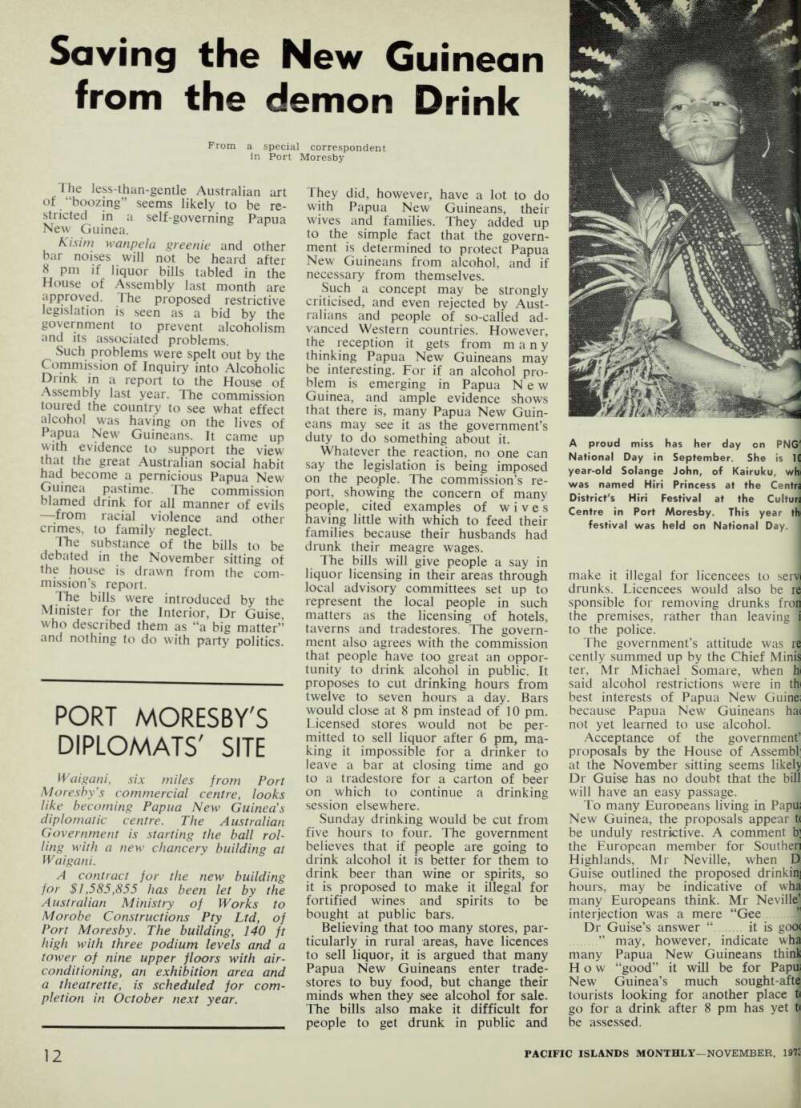
A proud miss has her day on PNG[?] National Day in September. She is 1[?]
year-old Solange John, of Kairuku, wh[?]
was named Hiri Princess at the Centra[?] District's Hiri Festival at the Cultur[?] Centre in Port Moresby. This year th[?] festival was held on National Day.
Port Moresby's
Diplomats' Site
Wmgani, six miles from Port Moresby’s commercial centre, looks like becoming Papua New Guinea’s diplomatic centre. The Australian Government is starting the ball rol ling with a new chancery building at Waigani.
A contract for the new building for $1,585,855 has been let by the Australian Ministry of Works to Morobe Constructions Pty Ltd, of Port Moresby. The building, 140 ft high with three podium levels and a tower of nine upper floors with air conditioning, an exhibition area and a theatrette, is scheduled for com pletion in October next year.
Tax Objections
Court Supports Norfolk's
By a staff reporter
Norfolk Island has again been in news following the introduction a bill into the Australian Parlia nt to introduce income tax into rfolk Island. rhe bill has yet to be debated. It s introduced by the Australian usurer, Mr Crean, without any or consultation with the Norfolk md Advisory Council. It is a lical and far-reaching piece of islation which affects not only rfolk Island, but the territories of cos (Keeling) Islands, and Christ s Island. It drops the description ;rritory of” before the words orfolk Island” and it seems that 5 may be an admission by the islature of the distinct and separate iition of Norfolk Island.
Following introduction of the bill, iresentations have been made by people of Norfolk Island to all stralian political parties for its hdrawal pending a full enquiry 0 the status of Norfolk Island and effects of the bill on the people the island.
Under the provisions of the bill, residents of the island, as well as idents of the other specified terri ies, will be subject to Australian ome tax, unless they can show that ir income is derived from strictly ined sources within their own, or other territories. [t is so far-reaching in its effect it it has been necessary to clothe 1 Commissioner of Taxation with cretions to allow people immunity m tax where they would otherwise vc been liable under the strict ms of the legislation. In a nut :ll, the bill provides that income : is payable on all forms of income :ept those specifically, or by the ;rcise of the commissioner’s dis ition, exempted from tax. There : no provisions for ensuring that y of the revenues collected are paid the territories concerned.
In the meantime, there have been lumber of other developments. On itember 22 four tax investigators ived on the island, and immedi ;ly started to scrutinise many of the mer island companies, almost all which are now in liquidation. Two ys later, on September 24, the Full gh Court of Australia delivered its Igment in the case of Esquire iminees Limited (as trustee for the anolas Trust) v. the Commissioner Taxation. By a majority of three
to one, the court ruled that the divi dend received by Esquire Nominees Limited had been derived from a source in Norfolk Island, and was net subject to Australian tax.
The court ruled, in effect, that once it was established that income had been derived by a resident of Norfolk Island from sources within the island, the Australian Income Tax Act did not apply at all to such income. The Esquire case was a test case.
Subsequently there have been public meetings on the island and a special meeting of the Norfolk Island Advisory Council, as a result of which a delegation put its views in Canberra on October 23. Mr Lani gan, the Second Commissioner of Taxation, arrived on the island on October 1, and the following day the two banks on the island were served with notices purporting to be issued under Section 263 of the Australian Income Tax Act, requiring the pro duction of records relating to named customers of the banks.
This brought an immediate chal lenge later the same day. In the High Court in Sydney, an application was made on behalf of one of the com panies concerned to serve short notice
for an injunction to restrain the Com missioner of Taxation and the Bank of New South Wales from producing the records.
The matter was argued briefly on October 3 and again later in the month, when the Chief Justice, Sir Garfield Barwick, reserved his de cision.
It is understood that Mr Lanigan has admitted that some aspects of the proposed bill go too far, and that it should be withdrawn and redrafted in part.
The present situation in which Norfolk Island finds itself is pre carious. Considerable capital expendi ture has been embarked upon by the Administration on the basis of ex pected high continuing returns from annual company registration fees.
This was recommended from Can berra. But this source of income has now virtually dried up and it is not going to be easy to balance the budget.
More importantly, Norfolk Is landers, without any corresponding advantages or handouts, are now to have the Australian Commissioner of Taxation scrutinise their personal affairs.
Them Eat Cream
If They've No Bread. Let
From a Noumea correspondent
At a time when the French Administration is suggesting the pro duction of honey, trochus, shrimps, tuna, paper pulp and tourism to compensate for the loss of nickel revenue, Caledonians are now to get home-made cream plus more foreign currency if they wish to eat abroad.
As the dollar earnings of the ter ritory shrink millions below what Paris had planned for this time, Caledonians have been told that they could help recover some of the lost millions by producing more food at home and thus spending less ex change on foreign imports most of which come from Australia and New Zealand.
A preliminary step concerns dairy products which a new company, Socalait, is preparing for the Cale donian market, under the franchise of a French label, Yoplait. About October, a factory near Ducos,
Noumea was to begin supplying flavoured yogurt and cream dessert, as well as light cheeses. Basic ingre dient is powdered milk imported from France. Freshness and easy transport of the foods is assured, while packag ing is to bear the date limit for fresh consumption.
Meanwhile, Caledonians wishing to travel now have greater means of treating themselves well abroad. Since August, Caledonian tourists may take almost 50 per cent more foreign currency out of the territory—up to CFP90,900-worth (over SA7OO) with an extra allowance for business men. In addition, Caledonians can have double the original funds per mitted for the purchase of a house abroad, with a new limit of CFPS.4 million (almost $A45,000). It could mean a greater sprinkling of Cale donian apartments around the shores of Sydney Harbour.
Advertisements & other items, p. 21 (1 item)
13
CIFIC ISLANDS MONTHLY—NOVEMBER, 1973
Tropicalities
Holster for
patriots
New Caledonia’s main festival day, celebrating the French taking of possession in 1853, received a new slant this year when the date was allied with Caledonian patriotism in the two world wars.
The island festival day of Septem ber 24 is traditionally celebrated with sporting events such as the end of the feverish 11-day Tour de Cale donie bicycle trial around the island, petanque bowls and Melanesian women’s cricket championship. In addition, as on most patriotic occas ions, there is the march past of troops along the Anse Vata beach promenade—gendarmes joining with infantry, paratroopers and navy de tachments.
This year is the 120th anniversary of the French taking of possession and for the first time it was an nounced that this festival day would also commemorate the September, 1940, rallying of Caledonians to fight for France. This way, the double anniversary honours pioneers, mis sionaries and soldiers.
The new interpretation of the island festival day was described by the Nickel Co press as “We shall unite all those who made New Cale donia a French land, better still, a French province”.
I'XG coins
going local
When New Guinea gets its own currency “not before December, 1974”, it will have little resemblance to Australian notes and coins. The Finance Minister, Mr Julius Chan, has agreed that the notes and coins should be distinctive and clearly PNG
in character. Papua New Guineans will be able to submit designs for the new money.
Australia’s revalued, but rapidly inflating dollar note will be replaced by a coin. Altogether there will be six coin and three note denomin ations. The notes will be of $2, $5 and $lO, and the coins of 1,2, 5, 10 and 50 cents, plus the $1 coin.
Initially, there will be no 50c coin, or an equivalent of the $2O note. Mr Chan made no mention of anything equivalent to Australia’s new $5O note.
The PNG coins will be similar to Australian coins in one respect—they will have the same diameter, to re duce the possibility of confusion while two currencies are circulating to gether. The $1 coin will be slightly larger than the Australia 50c.
And some financial experts, look ing a long way ahead, are tipping that PNG will devalue its currency against Australia to help recover some of the losses, not disastrous by any means, suffered by primary producers through Australian revalu ations.
On Bikini
kv Christmas
The “victims” of the United States nuclear tests off Bikini Atoll in the late 40’s and early 50’s may be back on their island by Christmas. Forty Bikini families, living on Kili Island in the Marshalls, were scheduled to go to Bikini late in October to inspect houses under construction for them.
They were taken to Kili Island to make way for the testing programme.
Two houses are finished, 38 are nearly finished. The people them selves will decide if they are accept able. If they like them the Trust Territory Government will go ahead and finish them and fix a definite date for the people to return to Bikini to live. The date will be before Christmas.
The Bikini rehabilitation pro gramme started several years ago.
The Bikini people, like the Pitcairn Islanders after two evacuations in the 19th century, always wanted to return to their own island. Their dreams seem near fulfilment.
Fiji festival
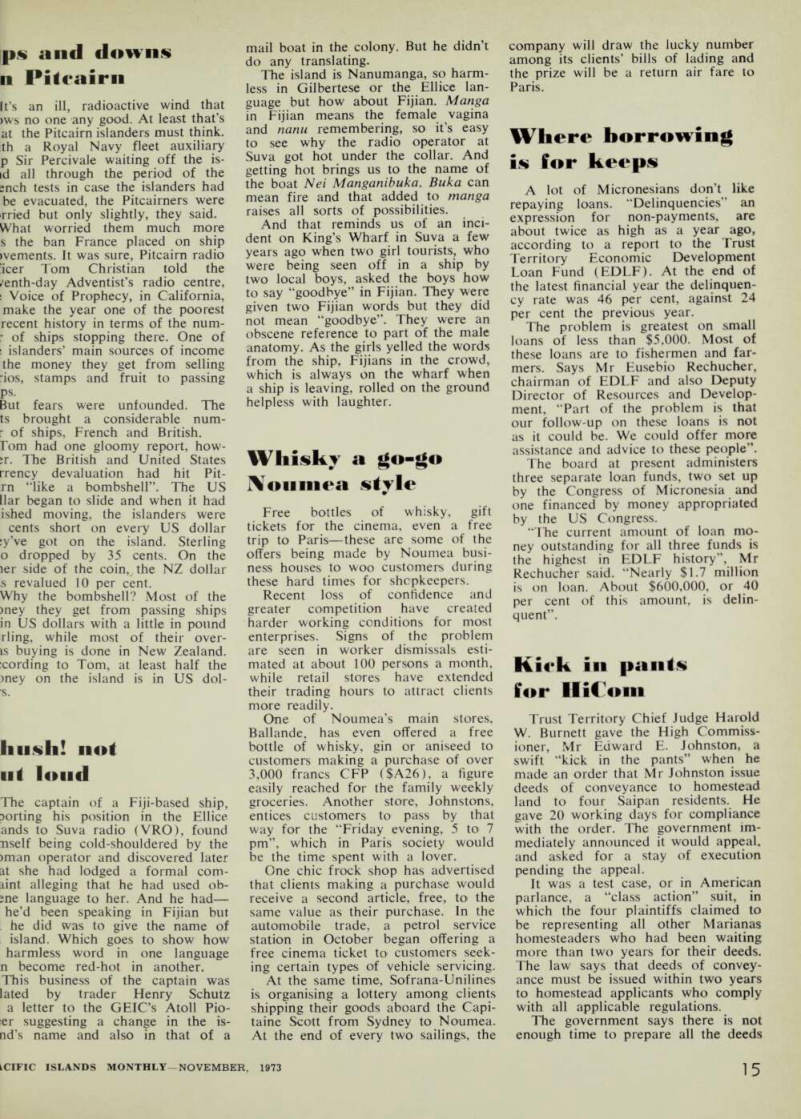
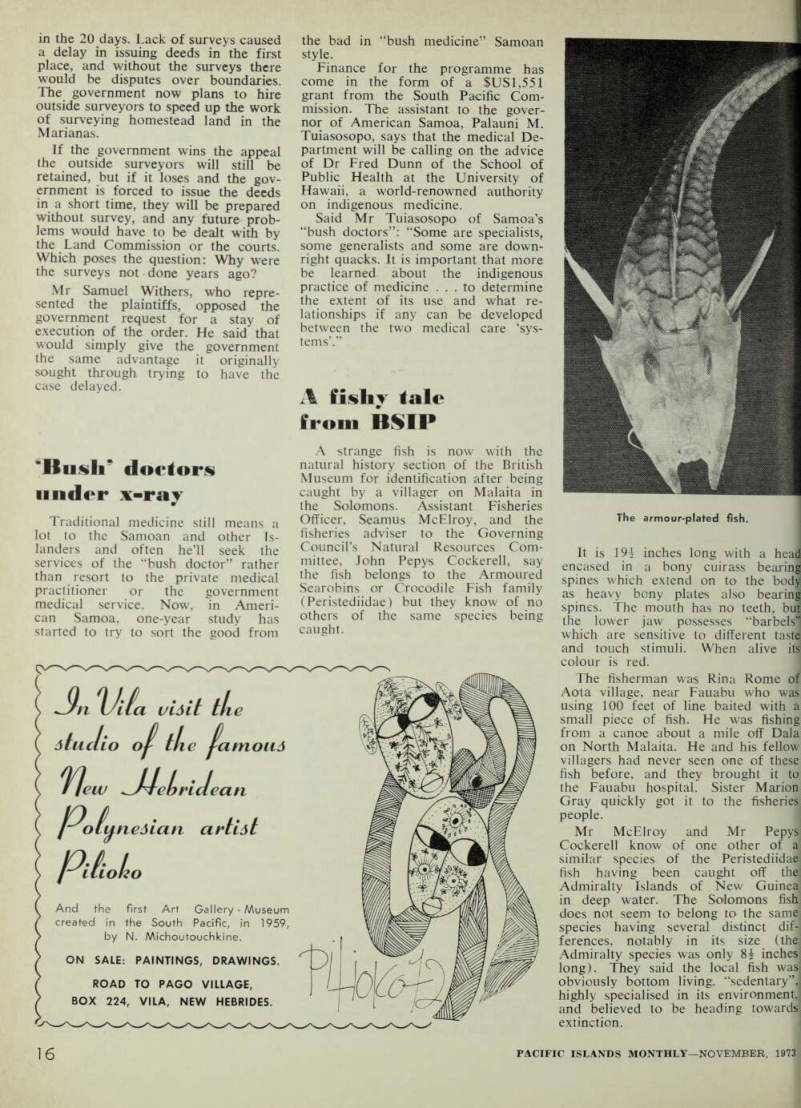
Of the making of stamps, like books, there is no end. October saw the appear ance of several series of stamps in the Islands, one of the most picturesque sets to be issued being those reproduced above—four Fiji "Festivals of Joy" stamps commemorating the festivals of the main races, the Christian Christmas, Hindu Diwali festival, the Muslim Id-ul-Fitar festival and the Chinese New Year.
Western Samoa issued four new Christ mas stamps on October 15. A commemo rative issue for the 75th anniversary of stamps in Papua New Guinea appeared on October 24 —all reproductions of earlier stamps issued by the German and British administrations. Another October issue was three Christmas stamps from the Solomons. The Cook Islands scored a first with the issue in September of a set of seven stamps, claimed to be the first to commemorate the original explora tion and peopling of the Pacific Islands.
The stamps all feature canoes.
p§ and downs
n Pitcairn
It’s an ill, radioactive wind that >ws no one any good. At least that’s at the Pitcairn islanders must think, th a Royal Navy fleet auxiliary p Sir Percivale waiting off the is id all through the period of the ;nch tests in case the islanders had be evacuated, the Pitcairners were rried but only slightly, they said.
What worried them much more s the ban France placed on ship wements. It was sure, Pitcairn radio ; icer Tom Christian told the /enth-day Adventist’s radio centre, ! Voice of Prophecy, in California, make the year one of the poorest recent history in terms of the num * of ships stopping there. One of : islanders’ main sources of income the money they get from selling :ios, stamps and fruit to passing ps.
But fears were unfounded. The ts brought a considerable num r of ships, French and British.
Lorn had one gloomy report, how ir. The British and United States rrency devaluation had hit Pit rn “like a bombshell”. The US liar began to slide and when it had ished moving, the islanders were cents short on every US dollar ;y’ve got on the island. Sterling o dropped by 35 cents. On the ler side of the coin, the NZ dollar s revalued 10 per cent.
Why the bombshell? Most of the )ney they get from passing ships in US dollars with a little in pound rling, while most of their over is buying is done in New Zealand, cording to Tom, at least half the )ney on the island is in US dol s.
linslil not
ut loud
The captain of a Fiji-based ship, porting his position in the Ellice ands to Suva radio (VRO), found nself being cold-shouldered by the rnian operator and discovered later at she had lodged a formal com aint alleging that he had used ob jne language to her. And he had— he’d been speaking in Fijian but he did was to give the name of island. Which goes to show how harmless word in one language n become red-hot in another.
This business of the captain was lated by trader Henry Schutz a letter to the GEIC’s Atoll Pio er suggesting a change in the is nd’s name and also in that of a
mail boat in the colony. But he didn’t do any translating.
The island is Nanumanga, so harm less in Gilbertese or the Ellice lan guage but how about Fijian. Manga in Fijian means the female vagina and nanu remembering, so it’s easy to see why the radio operator at Suva got hot under the collar. And getting hot brings us to the name of the boat Nei Manganibuka. Buka can mean fire and that added to manga raises all sorts of possibilities.
And that reminds us of an inci dent on King’s Wharf in Suva a few years ago when two girl tourists, who were being seen off in a ship by two local boys, asked the boys how to say “goodbye” in Fijian. They were given two Fijian words but they did not mean “goodbye”. They were an obscene reference to part of the male anatomy. As the girls yelled the words from the ship, Fijians in the crowd, which is always on the wharf when a ship is leaving, rolled on the ground helpless with laughter.
Whisky a go-go
Noumea style
Free bottles of whisky, gift tickets for the cinema, even a free trip to Paris—these are some of the offers being made by Noumea busi ness houses to woo customers during these hard times for shopkeepers.
Recent loss of confidence and greater competition have created harder working conditions for most enterprises. Signs of the problem are seen in worker dismissals esti mated at about 100 persons a month, while retail stores have extended their trading hours to attract clients more readily.
One of Noumea’s main stores, Ballande, has even offered a free bottle of whisky, gin or aniseed to customers making a purchase of over 3,000 francs CFP (SA26), a figure easily reached for the family weekly groceries. Another store, Johnstons, entices customers to pass by that way for the “Friday evening, 5 to 7 pm”, which in Paris society would be the time spent with a lover.
One chic frock shop has advertised that clients making a purchase would receive a second article, free, to the same value as their purchase. In the automobile trade, a petrol service station in October began offering a free cinema ticket to customers seek ing certain types of vehicle servicing.
At the same time, Sofrana-Unilines is organising a lottery among clients shipping their goods aboard the Capi taine Scott from Sydney to Noumea.
At the end of every two sailings, the
company will draw the lucky number among its clients’ bills of lading and the prize will be a return air fare to Paris.
Where borrowing
is (or keeps
A lot of Micronesians don’t like repaying loans. “Delinquencies” an expression for non-payments, are about twice as high as a year ago, according to a report to the Trust Territory Economic Development Loan Fund (EDLF). At the end of the latest financial year the delinquen cy rate was 46 per cent, against 24 per cent the previous year.
The problem is greatest on small loans of less than $5,000. Most of these loans are to fishermen and far mers. Says Mr Eusebio Rechucher, chairman of EDLF and also Deputy Director of Resources and Develop ment, “Part of the problem is that our follow-up on these loans is not as it could be. We could offer more assistance and advice to these people”.
The board at present administers three separate loan funds, two set up by the Congress of Micronesia and one financed by money appropriated by the US Congress.
“The current amount of loan mo ney outstanding for all three funds is the highest in EDLF history”, Mr Rechucher said. “Nearly $1.7 million is on loan. About $600,000, or 40 per cent of this amount, is delin quent”.
Ki«*k in pants
lor HiCom
Trust Territory Chief Judge Harold W. Burnett gave the High Commiss ioner, Mr Edward E. Johnston, a swift “kick in the pants” when he made an order that Mr Johnston issue deeds of conveyance to homestead land to four Saipan residents. He gave 20 working days for compliance with the order. The government im mediately announced it would appeal, and asked for a stay of execution pending the appeal.
It was a test case, or in American parlance, a “class action” suit, in which the four plaintiffs claimed to be representing all other Marianas homesteaders who had been waiting more than two years for their deeds.
The law says that deeds of convey ance must be issued within two years to homestead applicants who comply with all applicable regulations.
The government says there is not enough time to prepare all the deeds
in the 20 days. Lack of surveys caused a delay in issuing deeds in the first place, and without the surveys there would be disputes over boundaries.
The government now plans to hire outside surveyors to speed up the work of surveying homestead land in the Marianas.
If the government wins the appeal the outside surveyors will still be retained, but if it loses and the gov ernment is forced to issue the deeds in a short time, they will be prepared without survey, and any future prob lems would have to be dealt with by the Land Commission or the courts.
Which poses the question: Why were the surveys not done years ago?
Mr Samuel Withers, who repre sented the plaintiffs, opposed the government request for a stay of execution of the order. He said that would simply give the government the same advantage it originally sought through trying to have the case delayed.
'Rush 9 doctors
under x-ray
Traditional medicine still means a lot to the Samoan and other Is landers and often he’ll seek the services of the “bush doctor” rather than resort to the private medical practitioner or the government medical service. Now, in Ameri can Samoa, one-year study has started to try to sort the good from
the bad in “bush medicine” Samoan style.
Finance for the programme has come in the form of a SUS 1,551 grant from the South Pacific Com mission. The assistant to the gover nor of American Samoa, Palauni M.
Tuiasosopo, says that the medical De partment will be calling on the advice of Dr Fred Dunn of the School of Public Health at the University of Hawaii, a world-renowned authority on indigenous medicine.
Said Mr Tuiasosopo of Samoa’s “bush doctors”: “Some are specialists, some generalists and some are down right quacks. It is important that more be learned about the indigenous practice of medicine ... to determine the extent of its use and what re lationships if any can be developed between the two medical care ‘sys tems’.”
A fislir tale
from BSIP
A strange fish is now with the natural history section of the British Museum for identification after being caught by a villager on Malaita in the Solomons. Assistant Fisheries Officer, Seamus McElroy, and the fisheries adviser to the Governing Council’s Natural Resources Com mittee, John Pepys Cockerell, say the fish belongs to the Armoured Searobins or Crocodile Fish family (Peristediidae) but they know of no others of the same species being caught.
It is 19i inches long with a head encased in a bony cuirass bearing spines which extend on to the bods as heavy bony plates also bearing spines. The mouth has no teeth, but the lower jaw possesses “barbels’] which are sensitive to different tastd and touch stimuli. When alive its colour is red.
The fisherman was Rina Rome of Aota village, near Fauabu who was using 100 feet of line baited with a small piece of fish. He was fishing from a canoe about a mile off Dala on North Malaita. He and his fellow villagers had never seen one of these fish before, and they brought it to the Fauabu hospital. Sister Marion Gray quickly got it to the fisheries people.
Mr McElroy and Mr Pepys.
Cockerell know of one other of a similar species of the Peristediidae fish having been caught off the Admiralty Islands of New Guinea] in deep water. The Solomons fish; does not seem to belong to the same] species having several distinct dif ferences, notably in its size (the Admiralty species was only 8i inches long). They said the local fish was! obviously bottom living. “sedentary”,! highly specialised in its environment,! and believed to be heading towardsj extinction.
The armour-plated fish.
Advertisements & other items, pp. 23-28 (2 items)
15
LCIFIC ISLANDS MONTHLY—NOVEMBER, 1973
Polynesian artist
e a mo us l ean
A Vita uisit th
studio op the p
Pew Pdelridi
Polynesian artist
PifioL
And the first Art Gallery - Museum created in the South Pacific, in 1959, by N. Michoutouchkine.
ON SALE: PAINTINGS, DRAWINGS.
ROAD TO PAGO VILLAGE,
BOX 224, VILA, NEW HEBRIDES.
“So this is a Lamborghini,” she breathed, as we sped down the autostrada towards Turin.
“Yes,” I said, offering her a Benson and Hedges. “Five forward gears and 170 in top.”
“Can you prove that?” she demanded.
“Do I really have to? You did say you only wanted a little car to do the shopping.”
She never
sleeps.
The Coral Chief and her three sister ships are working 24 hours a day, seven days a week. They
never sleep. They never
can. With side-port unit-loading, their time in Port barely gives their crews time to see more than the wharf.
If your cargo is bound for our corner of the Pacific, send it by the
ships that never sleep—
the four Chiefs of the New Guinea Australia Line. ‘New Guinea Chief’, ‘lsland Chief’, ‘Coral Chief’ ‘Papuan Chief’.
New Guinea Australia Line Pty. Ltd., Registered Office Port Moresby, Papua New Guinea.
General Agents: PORT MORESBY—Steamships Trading Co. Ltd.
SYDNEY —John Swire & Sons Pty. Ltd.
Agents: SYDNEY—lnterocean Swire Pty. Ltd.
BRISBANE—WiIIs, Gilchrist & Sanderson Pty. Ltd.
PAPUA NEW GUlNEA—Steamships Trading Co. Ltd. (for “New Guinea Chief” at Rabaul and “Island Chief” at Kavieng—Burns Philp (N.G.) Ltd.]. m m ■ mss w
1 s IS 0 m W.
V (UU $
no a
■ i ' ■ -- P ‘ 4* ./i -
mm scorrs
FINEST
ee 2 m $ y>is
RALIAN
m&sm
mt m IS
-’3MEY
AUSTRALIA
' BE i xf
Flour that's milled fresh
when called for by your shipping agent Willed fresh—when called for—then packed in clean, strong sacks or drums. That's the reason why Mungo Scott's have the largest output of any mill in Australia Mungo Scott's skilled laboratory staff put to practice every modern method to ensure you receive the Finest quality entoleted flour.
Since 1894 . . . Mungo Scott "a good firm to do business with''. We pride ourselves on documentation.
BAKERS FLOUR • SHARPS • MEALS
CAKE FLOUR • BISCUIT FLOUR • SPONGE FLOUR
MUNGO SCOTT -
FLOUR MILLERS
A DIVISION OF ALLIED MILLS INDUSTRIES PTY. LTD.
Summer Hill, N.S.W., Australia Cable & Telegraphic SUPERB Sydney Phone: 797-8383
♦ & * w I W /
SOY SAt
izuft * a *
So Superior It’s Sensational!
Discover the easy, delicious way famous chefs use to enhance the flavor of meat, poultry, fish . . . casseroles, stews and gravies.
There's no substitute for "vintage flavor"
Kikkoman - the preferred soy sauce.
mjKIKKOMAN SHOYU CO.,LTD.
Nihonbashi, Tokyo 103, Japan
On Png's Legislative Menu
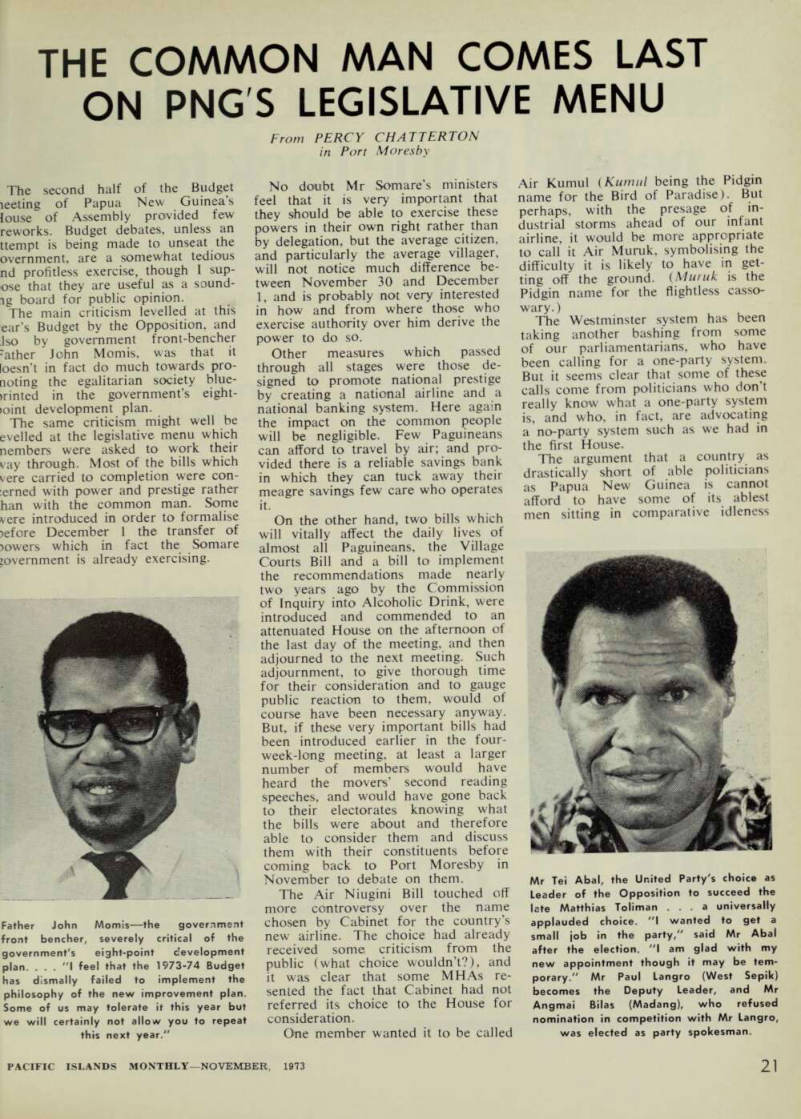
The Common Man Comes Last
From Percy Chatterton
in Port Moresby
The second half of the Budget leeting of Papua New Guinea’s louse of Assembly provided few reworks. Budget debates, unless an ttempt is being made to unseat the overnment, are a somewhat tedious nd profitless exercise, though I sup ose that they are useful as a sound ig board for public opinion.
The main criticism levelled at this ear’s Budget by the Opposition, and Iso by government front-bencher father John Momis, was that it loesn’t in fact do much towards pro noting the egalitarian society blue tinted in the government’s eight loint development plan.
The same criticism might well be evelled at the legislative menu which nembers were asked to work their vay through. Most of the bills which vere carried to completion were con :erned with power and prestige rather han with the common man. Some vere introduced in order to formalise jefore December 1 the transfer of lowers which in fact the Somare government is already exercising.
No doubt Mr Somare’s ministers feel that it is very important that they should be able to exercise these powers in their own right rather than by delegation, but the average citizen, and particularly the average villager, will not notice much difference be tween November 30 and December 1, and is probably not very interested in how and from where those who exercise authority over him derive the power to do so.
Other measures which passed through all stages were those de signed to promote national prestige by creating a national airline and a national banking system. Here again the impact on the common people will be negligible. Few Paguineans can afford to travel by air; and pro vided there is a reliable savings bank in which they can tuck away their meagre savings few care who operates it.
On the other hand, two bills which will vitally affect the daily lives of almost all Paguineans, the Village Courts Bill and a bill to implement the recommendations made nearly two years ago by the Commission of Inquiry into Alcoholic Drink, were introduced and commended to an attenuated House on the afternoon of the last day of the meeting, and then adjourned to the next meeting. Such adjournment, to give thorough time for their consideration and to gauge public reaction to them, would of course have been necessary anyway.
But, if these very important bills had been introduced earlier in the four week-long meeting, at least a larger number of members would have heard the movers’ second reading speeches, and would have gone back to their electorates knowing what the bills were about and therefore able to consider them and discuss them with their constituents before coming back to Port Moresby in November to debate on them.
The Air Niugini Bill touched off more controversy over the name chosen by Cabinet for the country’s new airline. The choice had already received some criticism from the public (what choice wouldn’t?), and it was clear that some MHAs re sented the fact that Cabinet had not referred its choice to the House for consideration.
One member wanted it to be called
Air Kumul (Kumul being the Pidgin name for the Bird of Paradise). But perhaps, with the presage of in dustrial storms ahead of our infant airline, it would be more appropriate to call it Air Muruk, symbolising the difficulty it is likely to have in get ting off the ground. (Muruk is the Pidgin name for the flightless casso wary.) The Westminster system has been taking another bashing from some of our parliamentarians, who have been calling for a one-party system.
But it seems clear that some of these calls come from politicians who don’t really know what a one-party system is, and who, in fact, are advocating a no-party system such as we had in the first House.
The argument that a country as drastically short of able politicians as Papua New Guinea is cannot afford to have some of its ablest men sitting in comparative idleness
Father John Momis —the government front bencher, severely critical of the government's eight-point development plan. ... "I feel that the 1973-74 Budget has dismally failed to implement the philosophy of the new improvement plan.
Some of us may tolerate it this year but we will certainly not allow you to repeat this next year."
Mr Tei Abal, the United Party's choice as Leader of the Opposition to succeed the late Matthias Tollman ... a universally applauded choice. "I wanted to get a small job in the party," said Mr Abal after the election. "I am glad with my new appointment though it may be tem porary." Mr Paul Langro (West Sepik) becomes the Deputy Leader, and Mr Angmai Bilas (Madang), who refused nomination in competition with Mr Langro, was elected as party spokesman.
One Way To Unity
on the Opposition benches is a sound one. But the belief that, if we abolish parties, disunity in the House will fade away and everyone will think alike seems to me to be unfounded.
It is differences of opinion on how the country should be run which give rise to parties, not parties which give rise to differences of opinion.
If there were no parties at all in the present House, its members would still disagree with one another as violently as they do now, and as we did between 1964 and 1968 in the party-less first House. There is only one way in which perfect parliamentary “unity” can be achieved, and it is this: call new elections, outlaw all parties except one, and debar any candidates, who don’t belong to that party, from standing for election. You will then get a perfectly united parliament.
This is an increasingly common blue print for national unity in the third world. Is this what the opponents of the Westminster system want?
The Constitutional Planning Com mittee has tabled an interim report.
This report contains no recommenda tions, but attempts to summarise the general trends of public opinion as they have emerged during the com mittee’s grand tour.
Roughly, these are a widespread demand for a system of strong dis trict government with powers greater than those of the present area authorities, and calls for the abolition of regional electorates and the adop tion of first-past-the-post voting instead of the present optional pre ference system.
The committee’s final report and recommendations are scheduled for November.
The United Party’s choice of Tei Abal as Leader of the Opposition in succession to the late Matthias Toliman has been universally ap plauded. Tei Abal was elected to the first House in 1964 as member for Wabag in the Western Highlands.
One of a number of members who entered the House at that time with no formal schooling behind them, he quickly emerged as a man deter mined to overcome this handicap, and by sheer hard work and dedica tion to the job made himself an able parliamentarian, capable of holding his own against more highly-educated opponents.
Though as a fellow member of the first and second House I rarely found myself in agreement with him, I liked him enormously and respected his complete sincerity. He is a worthy successor to Matthias Toliman.
Advertisements & other items, pp. 30-31 (1 item)
Huon Gulf Motel
In Lae, we’re the motel
people come back to.
They come back for a dip in our pool, the individually air conditioned, comfortably fitted units, first class fully licensed restaurant, our friendliness, our cocktail bar, and attention to the finest detail.
In Lae. stay at the Huon Gulf, and next time round you’ll come back.
Book direct, or through any office of Ansett Airlines.
Huon Gulf Motel
Markham Road Lae. Phone: Lae 3204 (As from October Ist phone 42 4844) A Division of Ansett Transport Industries Limited
AHO/228
Kerr Bros, the Lightburn people for
Pacific Islands
We are able to offer immediate delivery of the complete range of Lightburn products . . . concrete mixers, hydraulic jacks, electric power tools and electric washing machines.
Due to the high standard of their engineering and their outstanding reliability, these Lightburn products , are being exported in ever increasing volume to over 70 countries.
LIGHTBURN
Exported to over 70 Countries For further information or supplies contact KERR BROTHERS PTY. LIMITED, 65 York St., Sydney, N.S.W. 2001
What your business
can learn
from the stegosaurus.
* „r The stegosaurus was heavily protected against obvious dangers-yet so vulnerabl in other ways that he vanished from the earth. Just as many businesses are heavil insured against obvious risks-yet frighteningly vulnerable to other, less apparen hazards. Let Bain Dawes’ risk management experts study your operation. Identif your risk areas. Advise you how to minimise them. Tell you where you’re over c under insured. And arrange a balanced insurance programme that gives you security. Let’s talk about it. Soon. re;
Bain Dawes
formerly Harvey Tnnder
Insurance Brokers and Risk Managemer Consultants Hunter Street, Port Moresby. Phone 2241.
And at Sydney, Newcastle, Melbourne, Brisbane, Adelaide, Perth, Hobart, Launceston.
UNITED KINGDOM, EUROPE, NORTH AMERICA, NEW ZEALAND.
Footnotes
'T'HERE seems to be something about New A Guinea Pidgin which attracts expatriate academics like jam attracts wasps, and in Sep tember pisinophiles from overseas converged on Port Moresby to share in a love feast organised for them by their wantoks at the University of Papua New Guinea.
Some of them appear to have a purely scientific interest in the study of lingua franca and creole languages. Such an interest is to be commended. But in the case of others it is difficult to believe that they are not in fact propagandists trying to promote the cause of Pidgin as a national language, and eager, in the goodness of their hearts and out of their superior wisdom, to teach New Guineans to speak and write Pidgin “properly”.
One had thought that the age of paternalism was over. But what are we to make of this from a European academic who, by the way, has decided unilaterally that Pidgin is to be renamed Nuginian. ?
“Stop murdering Nuginian through indiscriminate borrow ing from English. There is an other way and, if you will only listen to me, I will tell you how.” And again, “We must warn off, and if possible pre vent, Urban Pidgin speakers from etc etc.”
This is a European address ing not his fellow Europeans but New Guineans, and parti cularly, judging by some of his other remarks, Papua New
Guinea’s national leaders. It does not seem a very tactful way of promoting the cause of Pidgin as a national language.
Again, for unctuous condescension what could better the suggestion of one participant that some Motu words might be introduced into Pidgin so that “Papuans should not feel left out”! This proposal was put forward, quite sincerely I am sure, in the interests of “unity”.
I am beginning to detest the word “unity”.
Not because 1 don’t believe in unity. I do. But most of those who use the word in Papua New Guinea equate it with “uniformity”. I
With Percy Chatterton
in Port Moresby
A long, hard road for Pidgin
believe in unity. I will fight with my last breath against uniformity.
As a matter of fact most Paguineans are very tolerant in matters of language. They are good at learning new languages, and they are both polite and pragmatic in using them.
Polite in that they will choose from their re pertory, which may well run to half-a-dozen languages, the one most likely to put the people to whom they are talking at their ease; pragmatic because they will choose the one which will promote maximum communication.
Generally, though not always, these criteria point to the same choice. I say not always be cause sometimes a prestige language is chosen out of politeness when it is not in fact the best medium of communication in a particular
situation. In the case of Papuans it is often the dual criteria of politeness and prag matism, rather than a liking for the language, which leads them to use Pidgin.
Overseas pisinophiles who don’t get beyond our main centres tend to overestimate the universality of Pidgin, and in particular to overestimate the extent of its spread into Papua.
It is true that in Port Moresby most Papuan men, and a few
Papuan women, can understand and speak Pidgin. In the rural parts of Papua it is little known, and there is neither opportunity nor incentive for learning it.
The in-phrase among pisinophiles just now seems to be “language engineering”. This appears to mean leaving it to the experts to decide for us what is or is not “correct”
Pidgin. It also means leaving it to them to invent the new words and phrases which will be required if Pidgin is to cope with the needs of Papua New Guinea’s new social, poli tical and economic structures.
This is not the way in which languages have grown in the past. Usage—the usage of ordinary people, not of academics —has de cided what is, or is not, “correct”. For ex ample, “Between you and I” and “Never ever” may now be described as “correct” Australian English, though I must admit that both of them still make me shudder. In the same way, “correct” New Guinea Pidgin is what New Guineans actually say when they talk to one another, not what the experts think they ought to say.
The job of the academic linguists is to re cord, analyse and, if they can, explain lan guages as they are actually spoken by those who use them as media of communication.
Usage may sometimes be hard to explain and may give pain to language engineers. But that can’t be helped.
A polite Motuan guest taking leave of his host will say Na maimu. Then he will go. But Na maimu doesn’t mean “I’m going”. It means “I’m coming”!
I do not suggest that “language engineering” is entirely illegitimate. I believe it has been en gaged in extensively in Indonesia, though by Indonesians, not by foreigners. What I do suggest is that the inventions of the language engineers should be submitted to the test of acceptance by usage or rejection by disuse before they are included in dictionaries.
I am not a pisinophile myself, but I rate highly the possibilities of Pidgin as a medium for creative writing, and I have read with de light some of the plays, poems and short stories which have found their way into print.
But after eight years in the House of Assembly I am convinced that Pidgin has a long long way to go, and will have to submit to a lot of “language engineering”, before it can be an adequate vehicle for transacting the busi ness of a nation caught up willy-nilly in the complexities of the 20th century world.
Is it worth the effort? Only the lunatic fringe supposes that it is practicable to mediate secondary and tertiary education through Pidgin. Apart from any other consideration, the cost of translating and printing the neces sary text and reference books would be astro
nomical. This means that in the future our public servants, and hopefully our legislators, will be competent to transact the nation’s business in English. Why handicap them by making them transact it in pepped-up Pidgin?
In the meantime, in our desperate need for effective communication, we cannot afford to ignore any language medium. Pidgin, Hiri Motu, the vernaculars —we must use them all.
In the field of broadcasting, the administration radio network, shortly to be absorbed into a national broadcasting service, has set a fine
precedent.
Attempts to promote any one language at the expense of others can only, at this junc ture, lessen the effectiveness of communication in the supposed interest of a phoney kind of unity.
As one of those involved in getting the ineptly-named “Police Motu” renamed “Hiri Motu” (which was fair enough since a pid ginised form of Motu was the language of the Hiri long before it became the language of Sir William MacGregor’s police), 1 sympathise with those who want to find a new name for Pidgin.
A few years ago Pidgin did acquire a new name—Neo-Melanesian; but this seems to have dropped out of use. Perhaps it was a bit pom pous. Now a prominent pisinophile has sug gested Kumula (from kumul, bird of paradise).
Certainly a pleasant-sounding name, and one which won’t have to be changed if Mr Somare should decide to get the gremlins out of Papua New Guinea by finding us a new name which won’t remind us of either.
Advertisements & other items, p. 34 (1 item)
Motospecs didn’t
win a New Zealand
Export Award
just because of the
names behind
mm if OfMA Names like SCANIA. WIX. MONROE-WYLIE.
\JmKm llCflllCrff REPCO. ARMOURED KNIGHT. TURTLE
WAX. ARROW INSTRUMENTS. S-K WAYNE. WOLF. RUBERY OWEN. BLACK- HAWK. SIDCHROME. Etc. Etc Big names that mean, quite simply, the best automotive/industrial parts in the World. Of course, the quality of our products played an important part in our winning the Export Award. But so did service. And remarkable sales success. Which explains why Motospecs are New Zealand's largest exporters of automotive/industrial parts, and why our reputation for efficient, personal service is known throughout the South Pacific. We can prove it. Think of a problem, drop Motospecs a line, and we'll solve it. Personally.
DISTRIBUTED BY
MOTOR SPECIALTIES LTD
HEAD OFFICE. 80-90 ANZAC AVENUE, AUCKLAND, I.
MOTOR SPECIALITIES INDUSTRIES LIMITED
GROUP EXPORT DIVISION, P.O. BOX 3201
AUCKLAND, NEW ZEALAND
•BRANCHES THROUGHOUT NEW ZEALAND:’
Land is key to Micronesian talks

From a SAIPAN correspondent
Land ownership seems to be the one big obstacle in the way of the resumption of future status talks between the United States and the Congress of Micronesia’s Joint Com mittee on Future Status.
The Palauans in the Carolines, backed up by the rest of Micronesia, have demanded the return of all their land to their chiefs. Up to now the United States has been dragging its feet over the matter but there are signs that a formula might be agreed on so that the talks, which terminated abruptly last October when the Micro nesians dragged in a new target, independence, might be resumed around November.
There are 32,040 acres of Palauan land involved and the fate of this land was one of the main topics for discussion when the United States in the person of Ambassador Franklyn Haydn Williams and Micro nesian Senator Lazarus Salii, chair man of the Joint Committee on Future Status, met in Honolulu in October in an attempt to get the talks under way.
While marking time, the United States has been preparing its arguments for retaining this land and also for holding on to some of its other bases as well as taking over Tinian in the Marianas. The outcome of the meeting had not been revealed at the time of writing but Senator Salii, speaking in Saipan in late September, was not hopeful.
There are questions of future financial aid for the Micronesians, the timing of any unilateral decision the Micronesians might like to make on the termination of “free associa tion” with America, the separate talks with the Marianas and a dozen other hot potatoes to be swallowed before agreement is reached, even after the land problem has been solved.
While the Micronesians have many goals—self-government or indepen dence, solid financial aid, schemes for helping the economy, and other forms of help from their trustees— the Americans have only one —to ensure that these 2,141 islands scat tered over 3,000,000 square miles of ocean fit into their defence system and never again become bases for an enemy force. That’s the reason why the Americans are haggling so strenuously over land and until that question is settled there’ll be no suc cessful end to the talks.
Most people expect the talks to resume in November but there are
those who point to December as the month of the talks. There are prob lems associated with that month also.
The US is practically committed to another round of talks with the Marianas political status commission in late November. Then the second session of the Fifth Congress of Micronesia opens on Saipan on January 7. Both sides would like to get another round of talks in before the Congress session but if this proves
impossible then the seventh round could not begin before next March.
Time is of the essence for the longer the talks are held up, the more impatient the Micronesians will be come and the louder and stronger will be the calls for complete indepen dence. About the only thing which is muting those calls at present is the question, “Where does the finance come from if not from the United States?”
Advertisements & other items, pp. 35-36 (1 item)
Portable Sawmill turns
The Forestmil
trees into timber at
the rate oflooosuper
feet per hour.
‘Forestmil’ produces house building or construction size timber direct from the log in the forest. No need to resaw, it’s ready to use. Inter-acting vertical and horizontal blades cut simultaneously for speed and accuracy, (see illustration) ‘Forestmil’ is ideal for cutting usable timber from reject logs.
Produces any size up to 12" x 6" x 18', including boards, framing, bridge sizes, etc. m-- T
CHECK THESE FEATURES;
• Dismantles into small sections: • Only 2 men required to operate. • Total weight 1560 lbs. • Erected ready to use in 1 hr. • Powered by petrol or diesel motor. .
Now easier than ever to operate.
Write for further information to:
MACQUARRIE INDUSTRIES PTY. LTD.
133 Bakers Road Coburg, Victoria, 3058. Australia Phone: 350 3411 MI-F-4
De-watering
the brown coal
open cuts.
Hardie’s help remove 21,600,000 gallons a day. m ; .. >.. 1 M m m m ■ *5 Us The largest coal deposit in the world; great seams, hundreds of feet thick, stretch across 40 miles of Victoria in a belt sto 10 miles wide. It’s being mined by the State Electricity Commission of Victoria using huge dredges in an open cut which one day will be over 700 feet deep. But there’s a problem. Two sand beds contain high pressure water, corrosive to metals, and hot up to 58 C.
Melbourne contractors W. L. Sides & Son Pty. Ltd. have been involved in the installation of pumping bores necessary to relieve this water pressure in the open cuts.
The casings of the bores must withstand severe chemical corrosives, horizontal movement of the coal through which it passes, longitudinal tension and compression, backfill pressures, and a few other things besides.
Hardie’s asbestos cement pipes have proyen ideal for the job.
A specially developed coupling system ‘Linelok’ speeds installation, and now opens up completely new areas of use for Hardie’s asbestos cement pipes.
The S.E.C. open cut de-watering project is another example of the way Hardie’s pipelines work to meet the special requirements of Australia’s public authorities and industries.
For an illustrated technical report on the project, write to: Publications Dept., James Hardie & Coy. Pty. Limited GPO Box 3935, Sydney 2001, Australia.
James Hardie & Coy.
Pty. Limited.
Sydney, Melbourne, Hobart, Brisbane, Townsville, Rockhampton, Adelaide, Darwin, Perth, Auckland.
Hardie's Linelok coupling: an innovation.
JH1973
are duty-free!
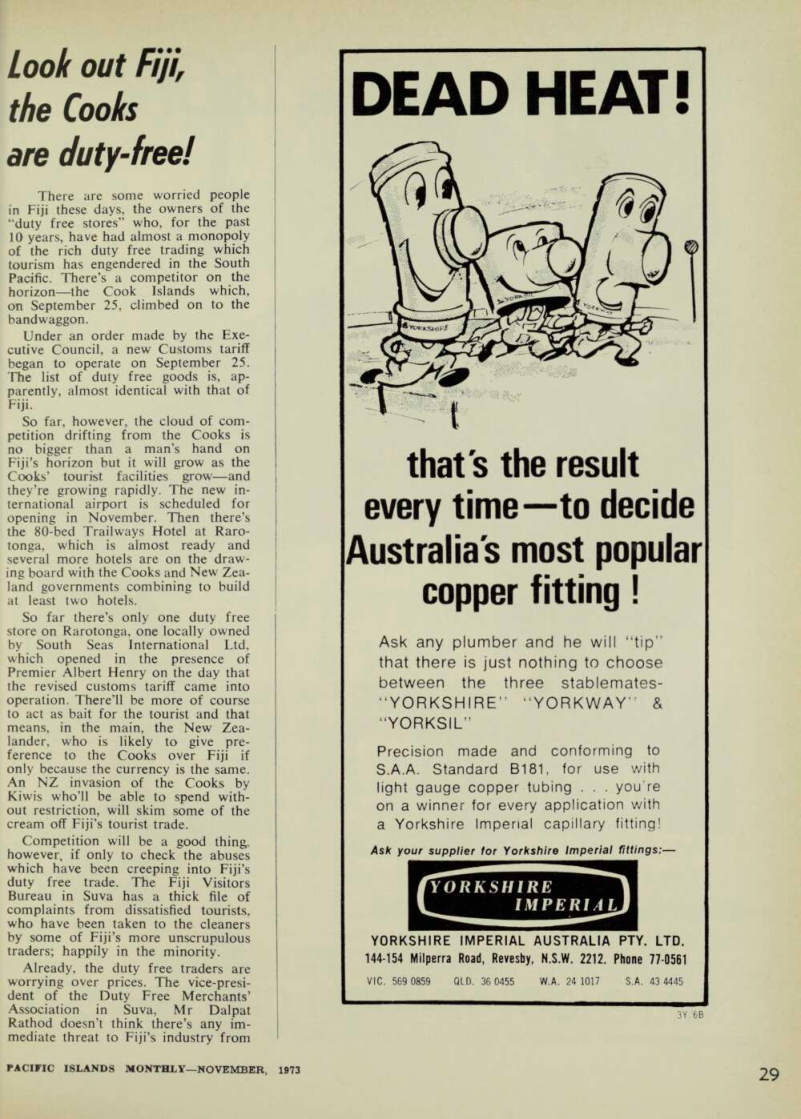
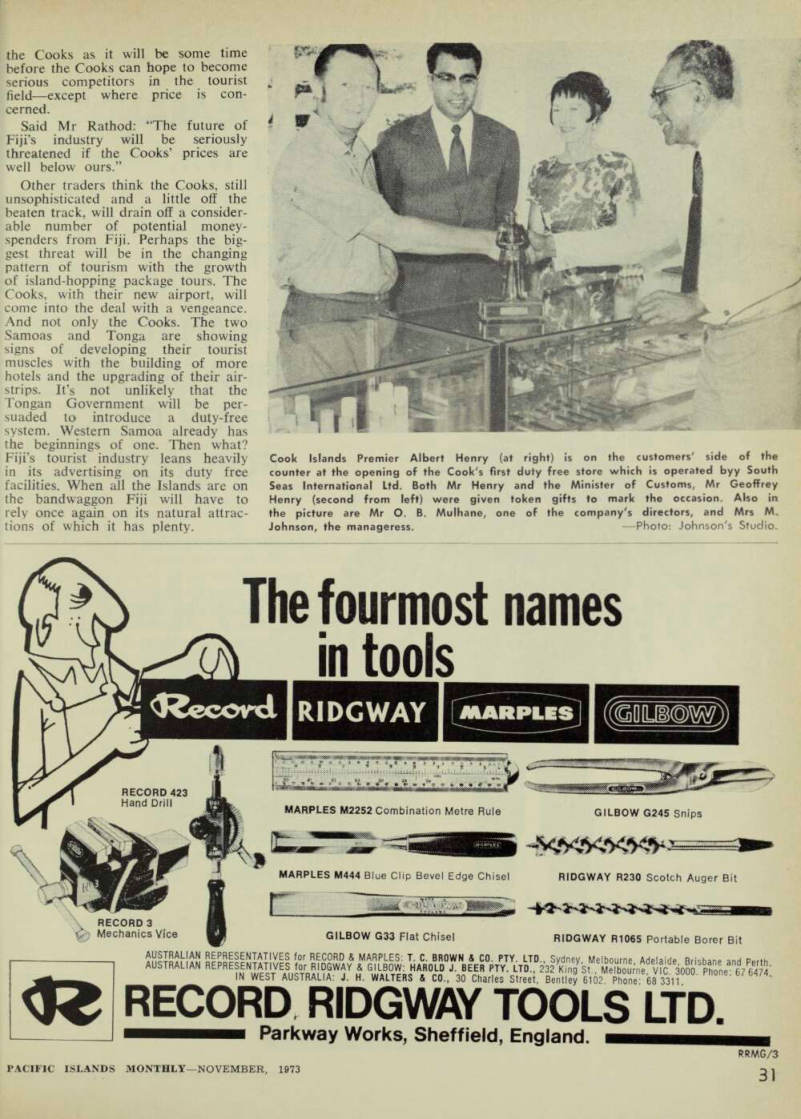
Look out Fiji, the Cooks are duty-free!
There are some worried people in Fiji these days, the owners of the “duty free stores” who, for the past 10 years, have had almost a monopoly of the rich duty free trading which tourism has engendered in the South Pacific. There’s a competitor on the horizon —the Cook Islands which, on September 25, climbed on to the band waggon.
Under an order made by the Exe cutive Council, a new Customs tariff began to operate on September 25.
The list of duty free goods is, ap parently, almost identical with that of Fiji.
So far, however, the cloud of com petition drifting from the Cooks is no bigger than a man’s hand on Fiji’s horizon but it will grow as the Cooks’ tourist facilities grow—and they’re growing rapidly. The new in ternational airport is scheduled for opening in November. Then there’s the 80-bed Trailways Hotel at Raro tonga, which is almost ready and several more hotels are on the draw ing board with the Cooks and New Zea land governments combining to build at least two hotels.
So far there’s only one duty free store on Rarotonga, one locally owned by South Seas International Ltd, which opened in the presence of Premier Albert Henry on the day that the revised customs tariff came into operation. There’ll be more of course to act as bait for the tourist and that means, in the main, the New Zea lander, who is likely to give pre ference to the Cooks over Fiji if only because the currency is the same.
An NZ invasion of the Cooks by Kiwis who’ll be able to spend with out restriction, will skim some of the cream off Fiji’s tourist trade.
Competition will be a good thing, however, if only to check the abuses which have been creeping into Fiji’s duty free trade. The Fiji Visitors Bureau in Suva has a thick file of complaints from dissatisfied tourists, who have been taken to the cleaners by some of Fiji’s more unscrupulous traders; happily in the minority.
Already, the duty free traders are worrying over prices. The vice-presi dent of the Duty Free Merchants’
Association in Suva, Mr Dalpat Rathod doesn’t think there’s any im mediate threat to Fiji’s industry from
the Cooks as it will be some time before the Cooks can hope to become serious competitors in the tourist field—except where price is con cerned.
Said Mr Rathod: “The future of Fiji’s industry will be seriously threatened if the Cooks’ prices are well below ours.”
Other traders think the Cooks, still unsophisticated and a little off the beaten track, will drain off a consider able number of potential money spenders from Fiji. Perhaps the big gest threat will be in the changing pattern of tourism with the growth of island-hopping package tours. The Cooks, with their new airport, will come into the deal with a vengeance.
And not only the Cooks. The two Samoas and Tonga are showing signs of developing their tourist muscles with the building of more hotels and the upgrading of their air strips. It’s not unlikely that the Tongan Government will be per suaded to introduce a duty-free system. Western Samoa already has the beginnings of one. Then what?
Fiji’s tourist industry leans heavily in its advertising on its duty free facilities. When all the Islands are on the bandwaggon Fiji will have to rely once again on its natural attrac tions of which it has plenty.
Cook Islands Premier Albert Henry (at right) is on the customers' side of the counter at the opening of the Cook's first duty free store which is operated byy South Seas International Ltd. Both Mr Henry and the Minister of Customs, Mr Geoffrey Henry (second from left) were given token gifts to mark the occasion. Also in the picture are Mr O. B. Mulhane, one of the company's directors, and Mrs M.
Johnson, the manageress. Photo: Johnson's Studio.
Advertisements & other items, pp. 37-40 (1 item)
Dead Heat!
9 m c />
that's the result
every time—to decide
Australia's most popular
copper fitting!
Ask any plumber and he will “tip” that there is just nothing to choose between the three stablemates-
“YOßKSHlßE” “YORKWAY" &
“YORKSIL"
Precision made and conforming to S.A.A. Standard 8181. for use with light gauge copper tubing . . . you're on a winner for every application with a Yorkshire Imperial capillary fitting!
Ask your supplier tor Yorkshire Imperial fittings: —
YORKSHIRE
IMPERIAL
YORKSHIRE IMPERIAL AUSTRALIA PTY. LTD.
144-154 Milperra Road, Revesby, N.S.W. 2212. Phone 77-0561 VIC. 569 0859 QLD. 36 0455 W.A. 24 1017 S.A. 43 4445 3Y68
e d h ; ; te ; 'V.
M m '. t - *4l mk I 9 111 I B I :
HIS
i —g IWP m * v- J ’ - r *rm M ' I A.R.C. Welded Wire Fabric is made to work hard. The fabric is steel reinforcing that's electrically welded at every joint for maximum strength.
It is used extensively in the reinforcement of concrete structures and for industrial, domestic and rural purposes.
The wide choice of mesh sizes and gauges means that there’s a fabric to suit just about every requirement. It comes in both oblong and square mesh, in flat sheets and rolls and is manufactured from both bright and galvanised wire.
Shipments can be arranged to meet most requirements. Further details and prices are available from our Export Department.
A.R.C. Industries Limited, 440 Collins Street, Melbourne, 3000, Victoria, Australia.
Cable “Benignant” Melbourne.
The fourmost names
yih in tools
I RI DC WAY I marries
RECORD 423
Hand Drill J', iiuuf.i,, MARPLES M 2252 Combination Metre Rule
gji
GILBOW G 245 Snips MARPLES M 444 Blue Clip Bevel Edge Chisel rr RIDGWAY R 230 Scotch Auger Bit
RECORD 3
v; Mechanics Vice GILBOW G 33 Flat Chisel RIDGWAY R 1065 Portable Borer Bit AUSTRALIAN REPRESENTATIVES for RECORD & MARPLES; T. C. BROWN & CO. PTY. LTD., Sydney Melbourne Adelaide Brisbane and Perth AUSTRALIAN REPRESENTATIVES for RIDGWAY & GILBOW: HAROLD J. BEER PTY. LTD., 232 King St Melbourne vfc 3000 Phone fi7fi474‘ IN WEST AUSTRALIA: J. H. WALTERS & CO., 30 Charles Street. Bentley 6102 Phone: 68 3311 Phone ’ 676474 ‘
RECORD RIDGWAY TOOLS LTD.
Parkway Works, Sheffield, England,
RRMG/3
I /f IF
NEW ZEALAND’S
GOT 1T...
AND
YOU WANT 1T...
MARAC
INTERNATIONAL
CAN BUY IT
FOR YOU...
We can’t supply the dancer but we can buy the Maori pois*; plus a wide range of other New Zealand produced goods, ranging from canned foods to factory machinery. We also offer a complete range of financial services as well e.g. medium term finance for the importing of capital equipment from New Zealand. And our executives call frequently to your territory.
Want to know more? Just post the coupon and we’ll reply post haste.
LJ
INTERNATIONAL
POST THIS COUPON
To MARAC International Limited PO Box 366 Auckland, New Zealand Please send me complete details of your import/finance service for New Zealand goods.
Name.
Address. woven flax balls used in traditional Maori action songs
PIM/9
5725
People
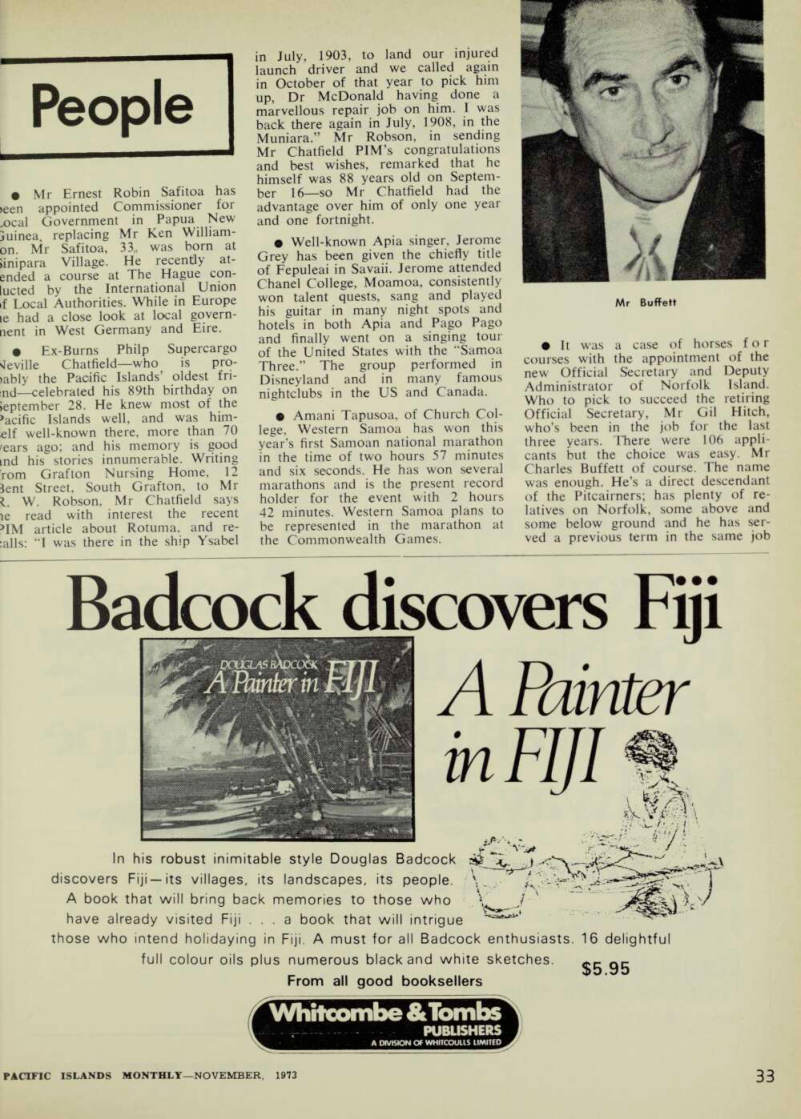
• Mr Ernest Robin Safitoa has >een appointed Commissioner for X)cal Government in Papua New }uinea replacing Mr Ken William on. Mr Safitoa, 33„ was bom at iinipara Village. He recently at ended a course at The Hague con lucted by the International Union if Local Authorities. While in Europe le had a close look at local govern nent in West Germany and Eire. • Ex-Burns Philp Supercargo Seville Chatfield—who is pro >ably the Pacific Islands’ oldest fn ;nd—celebrated his 89th birthday on Jeptember 28. He knew most of the >acific Islands well, and was him elf well-known there, more than 70 rears ago; and his memory is good ind his stories innumerable. Writing rom Grafton Nursing Home, 12 lent Street, South Grafton, to Mr C W. Robson, Mr Chatfield says le read with interest the recent S IM article about Rotuma, and re :alls: “I was there in the ship Ysabel
in July, 1903, to land our injured launch driver and we called again in October of that year to pick him up, Dr McDonald having done a marvellous repair job on him. I was back there again in July, 1908, in the Muniara.” Mr Robson, in sending Mr Chatfield PlM’s congratulations and best wishes, remarked that he himself was 88 years old on Septem ber 16—so Mr Chatfield had the advantage over him of only one year and one fortnight. • Well-known Apia singer, Jerome Grey has been given the chiefly title of Fepuleai in Savaii. Jerome attended Chanel College, Moamoa, consistently won talent quests, sang and played his guitar in many night spots and hotels in both Apia and Pago Pago and finally went on a singing tour of the United States with the “Samoa Three.” The group performed in Disneyland and in many famous nightclubs in the US and Canada. • Amani Tapusoa, of Church Col lege, Western Samoa has won this year’s first Samoan national marathon in the time of two hours 57 minutes and six seconds. He has won several marathons and is the present record holder for the event with 2 hours 42 minutes. Western Samoa plans to be represented in the marathon at the Commonwealth Games.
• It was a case of horses for courses with the appointment of the new Official Secretary and Deputy Administrator of Norfolk Island.
Who to pick to succeed the retiring Official Secretary, Mr Gil Hitch, who’s been in the job for the last three years. There were 106 appli cants but the choice was easy. Mr Charles Buffett of course. The name was enough. He’s a direct descendant of the Pitcairners; has plenty of re latives on Norfolk, some above and some below ground and he has ser ved a previous term in the same job
Mr Buffett
for seven years, from 1952. After leaving Norfolk in 1959, he joined the Australian Public Service, acted as official representative on Christ mas Island for six months and then did seven years on Cocos Island.
Then followed another two years on Christmas Island and since 1969 he has been in Canberra with the Ex ternal Territories Department. Now, he’s back on Norfolk with wife Van da and four-year-old son Charles. • Mr Li’a Tufele, 33, recently appointed Director of Public Safety in American Samoa, is the first Samoan to hold the post. He is a high chief from Manu’a. His appoint ment follows an investigation into the police department. He succeeded Mr Robert Ranney, who retired as Public Safety Commissioner because of ill-health. Mr Tufele previously worked in the Attorney-General’s Office and the Public Works Depart ment. • Mr Jean Doutrelant has been appointed French Charge d’Affaires and Consul for Fiji, Tonga and Western Samoa. He will be stationed in Suva. He was previously in the French Embassy in Canberra. He said on arrival in Suva, “I was not sent here to plead the case for the (nuclear) tests. We have relations with most of the world’s sovereign countries. Why shouldn’t we have relations with Fiji?” 9 Mr Richard W. Guy has been appointed general manager, marketing and tours, of Hunts of the Pacific Ltd, Suva. He will also be involved in the marketing services of the group’s overseas operations in New Zealand, Australia and the BSIP. He has been in the travel industry for 10 years, mainly in the United States, where he was born. 9 Manus District Commissioner Mr Des Ashton and Deputy District Commissioner Mr Rolfe Bourne left Manus at the end of September for Australia after a combined total of 54 years service with the PNG Government. Mr Ashton joined the Department of Native Affairs in 1946 as a patrol officer. He first came to Papua New Guinea in 1939 as a master of a ship trading in the south-west Pacific. He worked in many districts and was a district commissioner in the Morobe and later Bougainville districts before being appointed District Commission er at Manus. Mr Bourne also joined the department in 1946 and served in the Morobe District and Papuan districts. Mr Les Hastings has been appointed acting District Commis sioner.
Advertisements & other items, pp. 41-44 (1 item)
in FIJI
Badcock discovers Fiji
A Painter
oouglas ■ ss /V
Aim
)n his robust inimitable style Douglas Badcock discovers Fiji —its villages, its landscapes, its people.
A book that will bring back memories to those who \ have already visited Fiji ... a book that will intrigue those who intend holidaying in Fiji. A must for all Badcock enthusiasts. 16 delightful full colour oils plus numerous black and white sketches.
From all good booksellers $5.95 I
Whitcombe & Tombs
PUBLISHERS
A DIVISION Of WHITCOUIIS LIMITED
Bank of Hawaii is the bank of the Pacific.
You can bank on it... in Guam 2&Tamuning t Koror -mSL Yap Saipan Roi Namur ££ JL Kwajalein 3Lt Ponape Tahiti 2* American Samoa.
All in all, we have 70 branches throughout Hawaii and the Pacific offering full banking services. May we help you?
Bank of Hawaii the bank of the Pacific affiliate of Banque de Tahiti
How to Gain Youthful
Complexion Beauty
A SMOOTH flawless skin is one of the fundamentals of beauty. You are born with this priceless asset and it is your responsibility to keep it soft and youthfully smooth by caring for it every day. Here are some beauty suggestions, which, if followed faithfully, will help every woman to gain and retain a smooth, youthfully radiant complexion.
Make Your Dry Skin Blossom A unique tropically moist oil blend can bring the smooth, dewy look of beauty to your dry complexion. A parched skin develops when tiny glands do not produce enough oil and moisture to protect the complexion surface. Oil of Ulan supplements essential skin fluids, smooths flaky patches and helps prevent characteristic tautness and dry shine. Oil of Ulan moist oil blend provides an ideal skin cherishing base for make-up and should be used generously at night to capture fresh, blossoming beauty for your complexion.
A Smooth, Youthful Neckline The neck is perhaps one of the most wrinkle-prone areas and also one of the most neglected, and needs extra care and attention to counteract wrinkle-dryness and maintain the necessary suppleness of the skin. This can be done by the daily use of Oil of Ulan moist oil blend. Simply smooth it on to the neck and the chin line and then stroke in, using firm upward movements of the hands. The skin nurturing properties of Oil of Ulan will ensure that your neck and chin line are always beautifully smooth and soft.
Repeated hand-washing (wetting and drying) alters the natural defences of the skin. This results in drying and irritation. To make the most of hands and keep them soft and beautiful, smooth on a few drops of Oil of Ulan after they have been immersed _in water.
Remarkable in its degree of penetration, Oil of Ulan maintains the necessary balance of oil and moisture thus providing the hands with ideal surface protection, making them nice to hold, nice to show.
By a Leading Skin Care Consultant The Softest Hands
m d r % 111 l Mi i m A '4 <CD 4 4 '4 , t *r cV \%tV 4 fU" tIC How to Use?
tu**S
Either Way Terrific!
f=U 3 £ 9 6340 KR-8340 There's an agony and an ecstasy about owning a KENWOOD two-four stereo receiver. The problem is this: Which form of stereo entertainment is better? The answer: it all depends on you —on your mood of the moment. Two-channel stereo buffs can feel secure in the knowledge that KR-8340 and KR-6340 have compatible BTL (Balanced Transformer-Less) systems for two-four use. So with these models you have the best of both possible stereo worlds. For 4-channel enthusiasts, the built-in decoders for SQ and RM and the plug-in type CD-4 (KCD-2) disc demodulator offers all the possibilities of 4-channel disc stereo. Add the KR-9340 and you have three models which satisfy all the varied requirements of 4-channel and 2-channel receivers. With KENWOOD you always have a wide area of choice. the sound approach to quality
fKENWOOD
For minute information, write to: P-SECTION, TRIO ELECTRONICS, INC. 6-17, 3-chome, Aobadai, Meguro-ku, Tokyo, Japan
The Moilbag
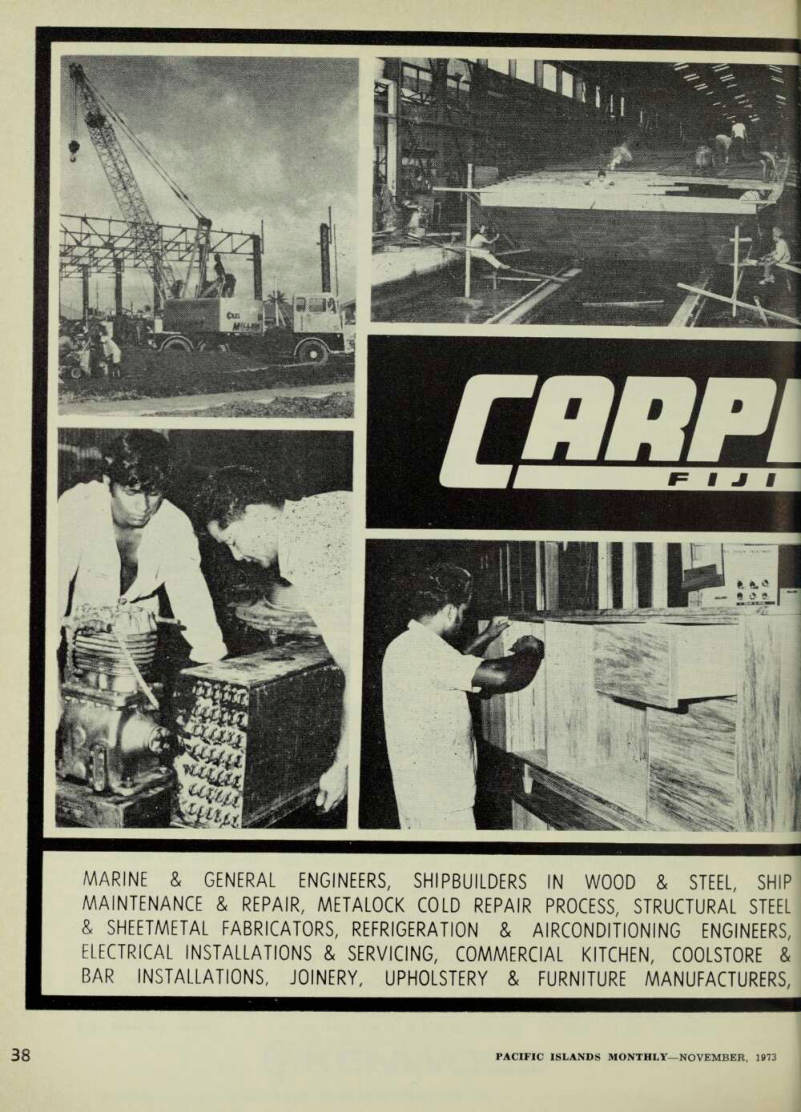
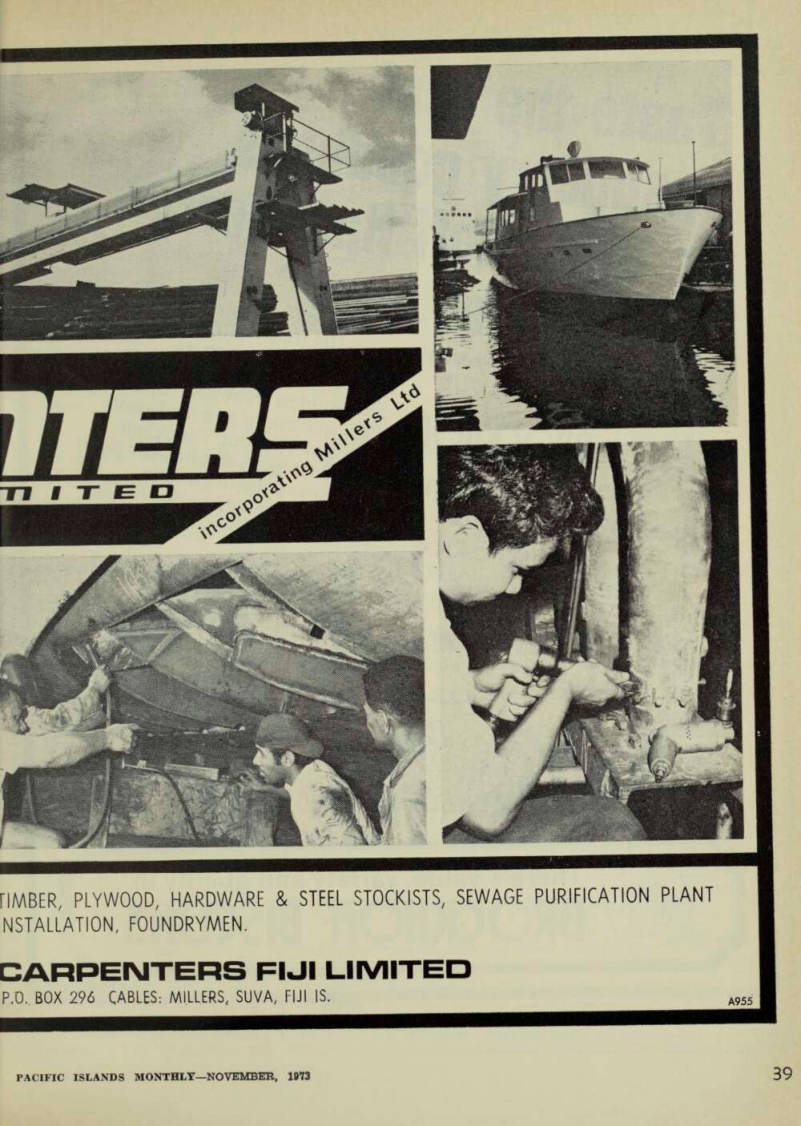

Murder On Niue
The reference in your September issue to the murder of the Resident Commissioner on Niue Island in 1953 evokes many memories, as I had left the island only three days beforehand, after an inspection visit of a month’s duration, during which I was the guest of the Larsens at the Residency.
After the tragedy I was sent back to Niue to act as Resident Commis sioner, accompanied by a judge and two legal counsel, and can confirm what you say about the speed with which the culprits were brought to trial and sentenced.
Further action had to await the result of an appeal to the Appeal Court in New Zealand, and when this was dismissed the writer found him self in the unpleasant position of having to organise a triple execution on the island.
Orders were orders, and my pro tests were over-ruled, so a scaffold was erected, and a large grave dug in readiness for the grim business.
At the last minute an appeal to the Privy Council in London was lodged by an Auckland legal firm, and this effectively held things up for some months, resulting in the govern ment finally deciding to commute the sentences to life imprisonment.
I have been a reader of PIM since your first issue, as my interest in Island affairs goes back to 1927, when I joined the staff of Sir George Richardson, Administrator of Western Samoa. I retired in 1955 as Assistant Secretary of Island Territories.
C. E. Quin
Paraparaurau, NZ
Tongans In The
'Big Smoke'
I was moved by Mr Slender’s article on Tongans in Sydney (PIM, Aug, p 31) and hereby express my hopes that authorities in Tonga as well as in Australia consider some of his suggested solutions.
The situations which Mr Slender dealt with in his article are very simi lar to those which occur in other cities (in more or lesser extent) such as Auckland, Honolulu, Los Angeles, San Francisco —wherever there is a sizable Tongan population. Further more, the situations are not peculiar
to Tongans; other Pacific Islanders experience similar problems and cause similar troubles. In all cases, however, it stresses the urgent need for education —realistic education — such as one which deals with the harsh realities of city life and the cultural stresses and strains that many Islanders have to face in another country. . „ „ It is sad that the “dollar and “higher education” have drawn so many Islanders away from the rela tive security of their families and friends into an impersonal, money oriented and fast world with which they are neither familiar nor pre pared for. It is about time more Island educators took a closer look at what is being taught in their schools, and make conscious efforts to de emphasise the memorisation of his torical and geographical facts about countries such as Australia, New Zealand, USA, Great Britain, etc, and instead, stress the understanding of differing ways of life in these places; how they may differ from their own island environments.
“Understanding” rather than “rote learning” may help bring about better performances from Tongans overseas, especially students; it may also be one way of minimising the occurrences of troubling and embarrassing events such as those reported in PIM.
Konai Helu Thaman
University of California, Santa Barbara
Arts Festival Filmed
Naturally I am pleased that your correspondent, Claire Slatter (PIM, Sept Mana, p 65) found the First South Pacific Festival of Arts “so magnificent” and that she had “little doubts over the motives of the organisers”. I agree with her when she states: “to have captured this magnificence would be beyond the power of any film”.
However, in the interests of clarifi cation I feel that two observations must be made. In the making of any film there can be a script for the actor to follow and a “shooting” script fol lowing the plans and ideas of the director. In a purely documentary film there is usually a narration script made after the scenes have been filmed and edited. It was such a nar
ration script that I wrote. It was a pre-festival obligation of my position that I did so.
It should have been obvious to all that the Fiji Government was most generous in fulfilling its obligations as the host and producing country.
To have added the high cost of making a film on to this was out of the question. It would not have helped to have given the right to commercial Hollywood and TV in terest. That Pacific Hotels and De velopment and the producing com pany went into the venture knowing full well that they were not making a commercially-viable film is very much to their credit. They donated their time, equipment and cost of film, processing, recording and print ing and by doing so made sure that there would be at least some record of the festival for the peoples of the Pacific to see. They went beyond this and gave to each of the participating countries free copies of the film as a
Victor Carell
Sydney
Solomons History
I was somewhat surprised (and I confess, amused), at John Saunana’s letter (PIM, Aug, p 21) accusing me of going on “to such great length and anxiety” about “ natives being allowed no hand in the documentation” of their own history. How he came to such a conclusion is beyond my imagination. I have never thought any such thing, and would hardly credit Mr Burne, also accused of the same matter, with being likely to think anything so silly and ridiculous. 1 would wish to remind Mr Sau nana, that the important element in history is truthfulness. A philosopher has said that “Truth lies at the bottom of a well.” The same object at the bottom of a well will look completely different to any number of observers, depending on their angle, depth of water, time of day, etc.
No reportage is infallible. There fore everything that can be written needs to be written and studied. In
(letters continued on p 41)
Mr Carell.
this way a student of a particular time or part of social history can draw conclusions from as many sources as are available.
The PIM has made available ample space for writings by the indigenous population on history, native beliefs and typically Melanesian phenomena.
So let the indigenous historians get to work on the space that is available to them.
Accounts of my own ancestors in Britain are to be found in the works of the Roman Historian Tacitus (AD 78) and the monk Gildas (circ 450 AD). They themselves (my ances tors), clad in wolfskins and woad, had no form of writing.
K. W. Seton
New Farm, Queensland.
Air Melanesiae
Air Melanesiae, owned jointly by New Hebrides Airways and UTA-Air France, is the only airline operating air services between the islands of the New Hebrides. It is providing a wonderful service for the people with in the region as PIM (Aug, p 97) pointed out. Transport between islands is much faster and more direct for many people. People are now able to take a bird’s-eye view of their own village and places of settle ment. Many New Hebrideans boast that they have been up in the air. The airline agents are given all the credit for the services and opportunities they initiated in this somewhat less sophisticated group of islands (from the point of view of western civilisa tion), or as tourist agents call it, the “Last paradise in the Pacific”.
But who really benefits from the airline and the services it provides?
Perhaps the other side of the coin would give us a fairer picture of the situation than what we learn in PIM.
“The airline feels that the New Heb rides is the best air-served archi pelago in the Pacific.”—“Many of the ground support staff are New Hebrideans.”—“The airline is a good example of Anglo-French co operation.”
Wow! New Hebrides must be quite fortunate to have this airline!
Personal experience denies full jus tification of these sweet statements.
The New Hebridean members of the ground staff referred to are a few indigenous people who help to load or unload the aircraft and operate the airline buses in Vila and Santo coupled with one or two who manage two airstrips—all of whom make up
about 20 or less per cent of the ground staff. The office staff and pilots are all expatriates—Europeans together with the British and French subjects from other territories.
The fares charged by the airline are beyond anything within the writer’s experience. For example, it charges $l9 (one way) for a distance of 60 miles (Vila-Norsup); $23 for 80 miles (Vila-Longana, Aoba). Of course this is nothing for an expatriate who receives wages of $3OO- $6OO a month; but it is something to an indigenous person of no regular income to an income of about $9O a mont h Apart from the emergency cases for which the services of the airline
are very essential, who really benefits from Air Melanesiae? are ' the New Hebridean people spoken of in PIM? “The Anglo-French co operation” m the airline is often maintained at the expense of the non whites. An incident is recalled when a European lady insulted an islander member of the ground staff by spit ting at him. The latter in retaliation sent her outside by physical force. He was fined for ‘causing an insult and the lady was counted innocent.
Readers can judge for themselves which party is guilty of the insult. As far as the two heads are concerned a good diplomatic relationship be tween them is more important than fairness between individuals. Two
other incidents have been known of by the author, and many more have been reported where New Hebridean passengers have been put off the air craft so that some Europeans or government officials may get in.
Has the unfair dealing exercised by the airline arisen because there is no other airline operating in the region to compete with Air Melanesiae and so keep watch over it? It is self deception on the part of Air Melan esiae and being false to the public to make statements as those in the August PIM, while behind the screen the airline is making unjust gains at the expense of the other sector of the community.
Sethy John
Suva, Fiji
Reaction To Fiji
I am writing in reply to the letter from Mr Colyer (PIM, Aug, p 25).
I don’t know what Mr Batten said in his letter in July, but I agree with Mr Colyer’s comment that Fiji is a truly wonderful place.
However, 1 want to correct in correct information contained in Mr Colyer’s comments concerning prices at the Nadi Airport duty-free store in respect of electronic calculators.
The reason why prices for calcula tors at the airport—and in fact right throughout Fiji are higher than Singa pore, is very simple. Electronic calcu lators are not duty-free in Fiji; they are in Singapore.
In case other readers of your ex cellent magazine gain the same in correct impression as I did initially— that the airport store is trying to make a huge profit—l hope you will pub lish my letter.
J. N. Walmsley
Sydney
Gilbertese Spelling
Spoken words with their correct pronunciation are very important, therefore the written word should as nearly as possible reflect the correct sound of the spoken word. The Gilbertese language and vocabulary keep the distinctive form of expres sion which is understandable and clear to the Gilbertese themselves.
Nei Wiwinna (Vivienna), (Letters, PIM Aug, p 23), says that she is right with her spelling bangota because she was told (e wiwinnaki?) that this is correct. However, she fails to explain why it should be correct. Perhaps the following examples will help Nei Wiwinna to understand how long
sounds are written in Gilbertese with a double letter. For instance: Mangko with one o means a con tainer —a cup.
Mangkoo with double or long o. is mango-mango tree, mango fruit.
Te kai with a single or short a, means tree; stick; a curse.
Te kaai with a double or long a, is a heron.
Mane with a single or quick m, is money.
M’ane with an apostrophe, which represents the other m (mmane) and indicates the correct pronunciation of the double or long m, is man.
These illustrations show why the sound of the long a in Gilbertese word for ancestral shrine is most clearly shown in the spelling of baangota. The original spelling of baangota is correct. Nei Wiwinna's ‘bangota’ is a mistake by those (Euro peans?) who write it down in diction aries. It is important to maintain our original Gilbertese spelling and cor rect pronunciation in our daily con versation at home and in school.
Maunaa Itaia
Pacific Theological College.
Suva.
Rotuma's Home-Brew
As a Rotuman 1 was glad to see Bruce Walkley’s article on Rotuma (PIM, Sept, p 47). However, I am disappointed to find so many factual mistakes in it. Let me mention but one. What he calls the “island’s ‘home brew’ ” we call tehroro and you can no more get drunk on it than you can on Heinz’s vegetable soup! For tehroro is our national dish—as a soup or as part of a variety of dishes.
Rotuma has made the Sydney papers several times (most recently in connection with hurricane Bebe) —on the front pages, too. It is not altogether an unimportant island in the Pacific so if Pitcairn can make it on your regular map, why not Rotuma?
Saumaru Foster.
Moore Park, NSW.
Coastwatchers
Walter Lord, American author of A Night to Remember, Incredible Victory, and other books you may know, is trying to locate people who were Coastwatchers —or who assisted Coastwatchers —in the Solomon Is lands during World War 11. He will be in Australia in October and November and hopes to talk with Coastwatchers living in this part of the world. Can any of your readers help him find them, through me?
Myrick E. Land,
Lecturer in Journalism.
University of Queensland.
St Lucia, Qld. 4067.
Advertisements & other items, pp. 46-54 (3 items)
Marine & General Engineers, Shipbuilders In Wood & Steel, Ship
MAINTENANCE & REPAIR, METALOCK COLD REPAIR PROCESS, STRUCTURAL STEEL & SHEETMETAL FABRICATORS, REFRIGERATION & AIRCONDITIONING ENGINEERS, ELECTRICAL INSTALLATIONS & SERVICING, COMMERCIAL KITCHEN, COOLSTORE & BAR INSTALLATIONS, JOINERY, UPHOLSTERY & FURNITURE MANUFACTURERS,
riMBER, PLYWOOD, HARDWARE & STEEL STOCKISTS, SEWAGE PURIFICATION PLANT
NSTALLATION, FOUNDRYMEN.
CARPENTERS FIJI LIMITED
P.D., BOX 296 CABLES: MILLERS, SUVA, FIJI IS.
A 955
laste the rea\
The „eshes..r^f' as,e ot real sandwiched in c™ kUng 90' with sugar arra roC kho« fruity aV °chortcake take BaspberrV sh s^eetWi I
BROCKHOff
fesPi«
SHOP
8 OZ.NU
'V y a a u There's value, variety and quality in
BISCUITS
BROCKHOFF
5546/Bx6 V4
KEEP , TRIM
and HEALTHY . . .
take FORD PILLS
Ford Pills and the Ford Pill diet chart help you to lose that extra weight.
Ford Pills are a mild laxative containing the gentlest of ingredients to rid your body of excess fluids and toxins.
AVAILABLE FROM CHEMISTS AND
STORES EVERYWHERE.
BRITISH MEDICAL LABORATORIES,
BML 115-125 Turrella Street, Turrella, N.S.W. 2205, Australia. s? i; I. 2 or 3 or n i Pifc keep *
KEEP IN GOOD SHAPE
WITH . . .
MACKENZIES MENTHOIDS
Mackenzies Menthoids stop
muscular and rheumatic pain.
Take Menthoids as directed.
Available from Chemists and Stores everywhere.
Hint
UEBMtTItM
ItttS UO f»IB uuumn • iuiub -J. A product of BRITISH MEDICAL LABORATORIES (A wholly Australian owned company) BML DISTRIBUTORS ARE BURNS PHILP, W. R. CARPENTER, D. J. FOWLER, PETER JACKETT & CO., C. SULLIVAN EXPORT.
FIAT
CONCESSIONAIRES
American Samoa Silver Star Transport Inc., P.O. Box CB-4, Pago Pago.
Fiji Motibhai &Co. Ltd.,
P.0.80x 40, BA.
Nauru Nauru Cooperative Society Nauru Island.
New Caledonia Agence Automobile S.A.,
P.0.80x842, NOUMEA.
New Hebrides Societe Bourgeois & Cie.,
P.0.80x 28, PORT VI LA.
New Zealand Torino Motors Ltd.,
P.0.80x 6240, AUCKLAND.
Norfolk Island Cascade Motors Ltd.,
P.O. Box 34, NORFOLK.
ISLAND.
Solomon Islands Chan Wing Motors Ltd.,
P.O. Box 820, HONIARA.
Tahiti Societe Tahitienne d'Automobiles S.A.R.L.,
P.O. Box 1723, PAPEETE.
Western Samoa E.A. Coxon & Co. Ltd.,
P.O. Box 38, APIA.
9/
#pij*
* *■ r The new 124 Sport Coupe shows its breeding. The lines are unmistakably Italian. The finish is magnificent. The interior is luxurious and seats four in comfort. The powerful new y \ $ 1800 cc twin OHC engine is engineered in the finest Euro- / pean tradition. It will take you effortlessly up to top speed with the safety of power assisted disc brakes all round. It’s not everybody’s car. But for the few who still like to feel their driving ... it’s a revelation.
The return
of the well-bred sports car.
The newßat 124
sport coupe 1800
f&t i /fys/ustcp/ic/es
Greatest Stereo on Wheels!
Anybody with an ear for the exciting sounds of modern stereo, should get to hear one of these Clarion sets. They are the sets being chosen by those who want sound as good in their cars as they can get in their homes. Sound them out for yourself, and pick the quality model you prefer for
all-year-round driving pleasures.
PE-651A
Cassette stereo player and AM tuner Versatile combination with automatic tape reverse Tuner picks up popular AM stations with sparkling clarity
PE-650A
Much, much more! 4-track cassette player with automatic reverse for nonstop play Mono or stereo Plus FM Multiplex tuner
PE-810A
The 4-track cassette stereo player that calls you when the tape ends. Quick, smooth operation. • ••• • ••• • •••
PE-809A
4-track cassette stereo with a dynamic difference. Automatic reverse for continuous background music. Keep you entertained every mile. • ••• #••• • ••• • •••
HE-503P
The cream of the cartridge systems. 3-way entertainer. .8-track cartridges, AM or FM Good for playing anyplace thru triple power source choice. . .flashlight batteries, AC or car's cig. lighter. Includes two dynamic speakers. Amazing stereo value in a new distinctive style!
CLARION
Manufacturer: CLARION CO., LTD. / Export Divis.on: CLARION SHOJI CO.. LTD. 3-5, Kojimachi, Chiyoda-ku, Tokyo Tel; 1265) 2931 Telex; J 22908 Overseas Branch Offices: CLARION SHOJI (EUROPA) G.M.B.H. 2000 Hamburg 76. Schoene Aussicht 35. West Germany Tel.: 220-7667. Telex: 214969.
CLARION SHOJI CO., LTD. (U.S.A.) NEW JERSEY 37 Swan St.. Ramsey, New Jersey 07446, U.S.A. Tel.: 201 825 0880. Telex: 13805.
CLARION SHOJI CO.. LTD. (U.S.A.) LOS ANGELES 2306 Cotner Ave.. Los Angeles, Calif.. U.S.A. Tel.; 213-272-1179. Telex: 259103426976 CLARION (MALAYSIA) SDN. BHD -1/2m3. Bayan Lepas. Penang, Malaysia. Tel.; 87-333, 87-334. Telex: PG 255 (Penang).
Fiji Islands BRIJLAL & CO. G.P.O. BOX 362, SUVA. FIJI ISLANDS TEL; 22258 Tahiti COMIMPEX RUE OE COMMERCE, BOITE POSTALE 200 PAPEETE TEL: 20477 New Caledonia CALDIS BOITE POSTALE 407. NOUMEA NEW CALEDONIA TEL: 57-89 Australia AMALGAMATED WIRELESS (AUST.) LTD.
CONSUMER PRODUCTS DIVISIONS P.O. BOX 24 ASHFIELD, NSW.. AUSTRALIA. TEL: 7975757
From the
Islands Press
Part of statement by Cook Islands Premier, Mr Albert Henry, on security for the visit by Queen Elizabeth in 1974, reported in Cook Islands News: “Have we got enough security measures to protect her? The airport will be open. Anyone could come and shoot her. What a shame it would be for this little nation,” he said.
Extract from a report in the New Hebrides Group News of a lecture by anthropologist Dr Robert Tonkinson who propounded a theory why people left south-east Ambrym in spite of the fact there was good garden land and no over-population
problem:
Dr Tonkinson sees sorcery as being the main cause. . . .
With poor medical facilities the area has a high infant mortality rate, and it is very easy for a sorcerer to suggest that the death of a child indicates some bad deed committed by the child's family. In south-east Ambrym few deaths are believed to occur from natural causes. The sorcerer has an explanation for most deaths.
Extract from an editorial in the Tonga Chronicle condemning the behaviour of Tu'ilatai Mataele, No 1 MP for Tongatapu, who had been criticised in letters in the newspaper: He took the criticism in last week’s Chronicle as a personal action, and wrongly claimed the letters were written by the editor himself. Tu’ilatai approached this newspaper’s office last week demanding the originals of these letters which I think he has no right to have access to,, for a newspaper, in principle, must protect its source of information, and under no circumstance must disclose it. Furthermore, Tu’ilatai also said the editor needs a good bashing. That is all he deserved, he said.
From a letter by W. N. Selby-Newbald in the Norfolk Islander on the increased /7 civil service 77 activity on the island: One can see Canberra smiling up their sleeve at their progressive success at bringing the island to its knees financially—chiefly because we have no sense, no strength, no policy and no aims for the future. Do we aim to be prosperous and independent, a Dominion of Australia, a State of Australia or just a suburb of Canberra? Many, to whom it matters least, just think it is pathetic and very sad.
From the Arawa Bulletin's editorial: It came as no surprise that this year's National Day celebrations on Bougainville were, in general, a flop.
It had been previous practice that such a day (formerly
Territory Day) was held on a Monday where everyone could be assured that at least the day was different. The granting of a public holiday on a Saturday did little to stir any* one's imagination for a start. . . . Most people con sidered that with self-government coming on 1 December, it was pointless to celebrate a National Day in mid- September. . . . National Day 1973 therefore can safely be written off as a Non-National Day. It can be written down though as a lesson for all that special purpose days must be meaningful. This one had none for nobody!
From the New Hebrides Group News: We have heard from Mr Joshua Toa-rest of Narovorovo of a big feast recently held on Maewo which brought people from many villages from all over the island. The feast was to commemorate the death of ' four people earlier this year. Apart from four bullocks, and three pigs, 2,100 taros were consumed, along with 57 heads of kava. Dancing continued all night and into the next day.
From a letter by Tevita Folau in the Tonga Chronicle: One wet Wednesday I went to attend a court case at Mu'a Tongatapu. It was a very busy day and the court proceedings were carried out in a house with a measurement of 18 ft in length, 10 ft in width and a height of 9 ft with ceiling. It is situated at Police Headquarters at Mu’a, on the south-western side facing the street from the direction of Lavenhatonga.
The area on which the house stands is fenced, measur ing 36 ft in length and 20 ft in width. It is said that this house was initially constructed as a storehouse for farm machinery before it was converted into a courthouse in March, 1965.
From a letter in the Micronitor signed 7 A Kwajalein resident who is pissed off at certain Marshallese 7 : . . . Concerning your article on the people of Roi Namur, the part about the army not compensating the "landowners" is not true. Many times I see Micronesians from Ebeye walk into the Kwajalein branch of the Bank of Hawaii with more than $15,000; now I know the maids don't make $15,000 a year by scrubbing floors. They have to get it from somewhere else, for instance the US Army.
From The Fiji Times: Suva City Council may employ women to sweep the streets. The Keep Suva Clean campaign committee has recommended that the council consider employing women cleaners instead of men. Committee members said they believed women would be better and more conscientious at the job.
From the Papua New Guinea Post-Courier: Members of the House of Assembly picked for a tour of Asia were "honeymoon holiday-makers” the Lord Mayor of Lae, Councillor John Rogers, said yesterday. He said their tour was a waste of valuable public money. Cr Rogers said he estimated the members’ fares alone would cost Papua New Guinea $ 15,000 without considering hotel and other expenses. “They are just a pack of honeymoon holiday-makers,” he said.
Goodfyear
Goodyear's advanced tire technology is
contributing to many new transportation concepts.
u
(Jjsmm
The first tires on the moon were built by Goodyear.
The fastest tires on earth were made by Goodyear.
Now, Goodyear produces the world’s largest tires. > < V Boroko Motors Ltd.
P.O. Box 1259, Boroko Port Moresby, PAPUA NEW GUINEA Solomon Motors Ltd.
P.O. Box 20, Mendana Avenue, Honiara Guadalcanal, SOLOMON ISLANDS Societe Generate d'Automobiles B.P. 554, Noumea
NEW CALEDONIA
Coral Island Traders P.O. Box 296, Suva, FIJI Guam Tire & Supply Co.
P.O. Box 1486, Agana, GUAM Santo Engineers
Santo, NEW HEBRIDES
SOHECO
B.P. 208, Port Vila, NEW HEBRIDES
Morris Hedstrom Ltd.
Apia, WESTERN SAMOA
Morris Hedstrom Ltd.
Nuku'Alofa, TONGA Haleck Service Center P.O. Box 1138, Pago Pago
AMERICAN SAMOA 96920
Service Mobil B.P. 306, Papeete, TAHITI
Magazine Section
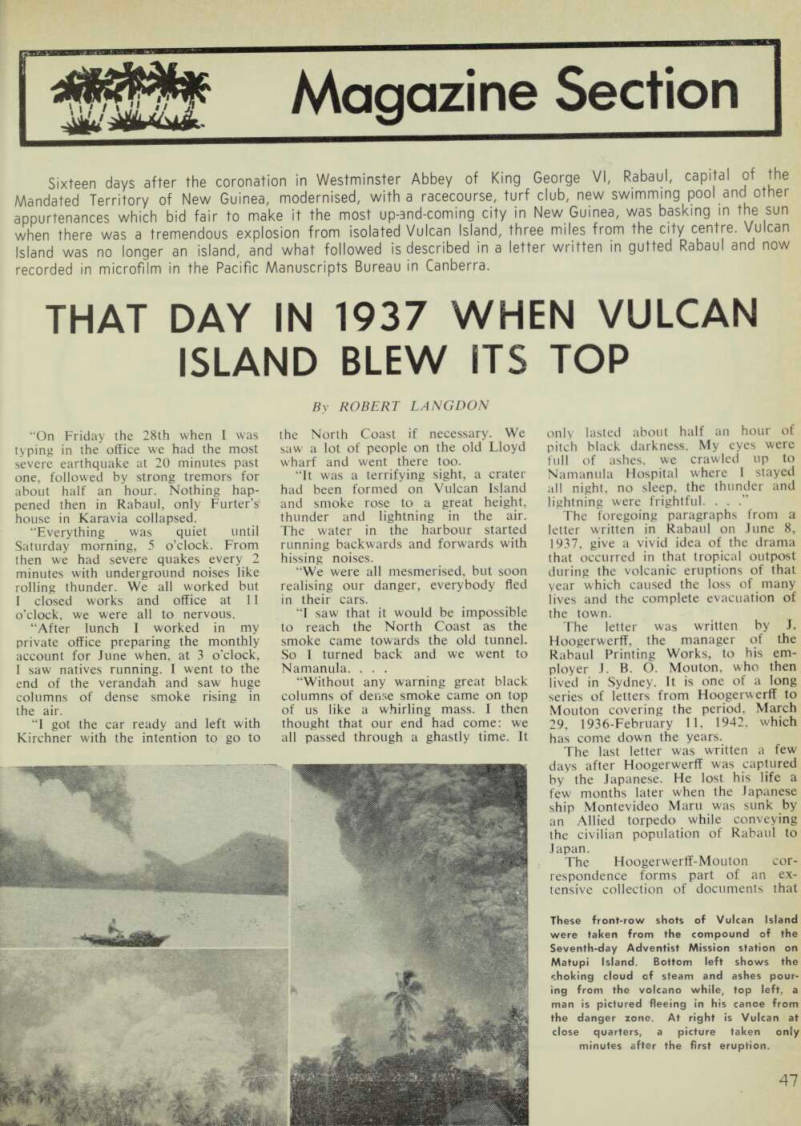
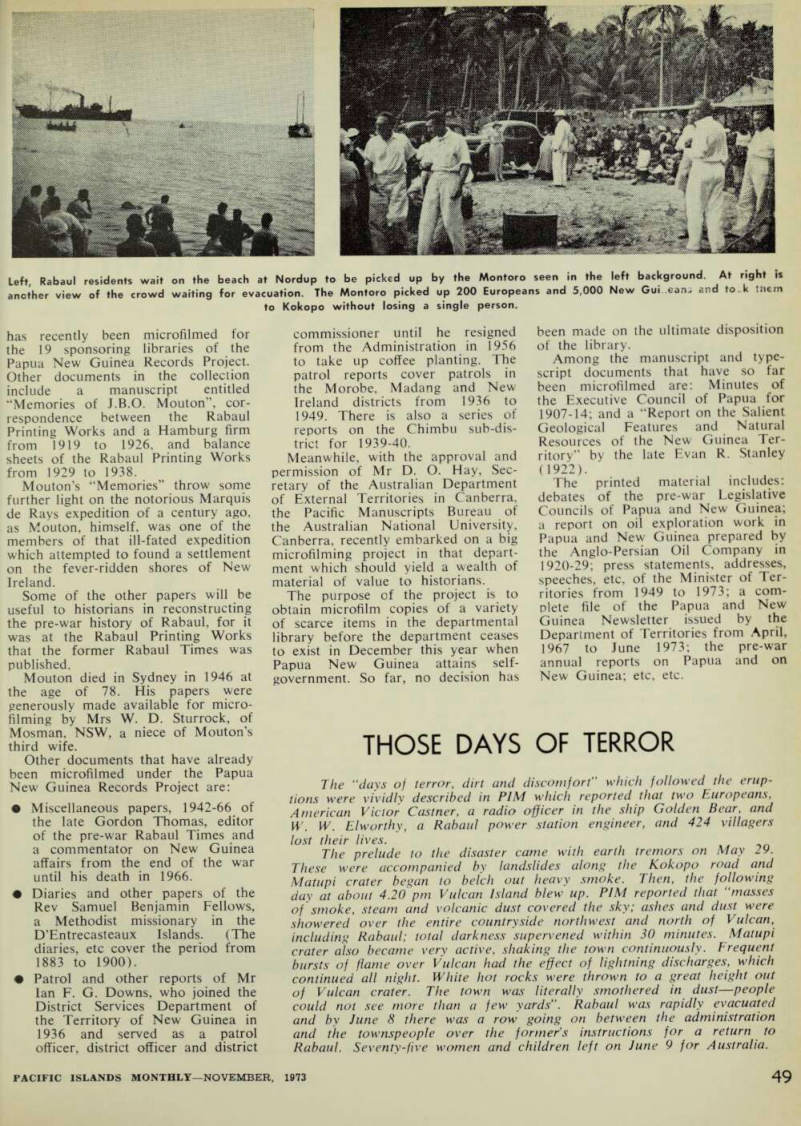
That Day In 1937 When Vulcan
Island Blew Its Top
Sixteen days after the coronation in Westminster Abbey of King George VI, Rabaul, capital of the Mandated Territory of New Guinea, modernised, with a racecourse, turf club, new swimming pool and other appurtenances which bid fair to make it the most up-and-coming city in New Guinea, was basking in the sun when there was a tremendous explosion from isolated Vulcan Island, three miles from the city centre. Vulcan Island was no longer an island, and what followed is described in a letter written in gutted Rabaul and now recorded in microfilm in the Pacific Manuscripts Bureau in Canberra.
By Robert Langdon
“On Friday the 28th when I was typing in the office we had the most severe earthquake at 20 minutes past one, followed by strong tremors for about half an hour. Nothing hap pened then in Rabaul, only Furter’s' house in Karavia collapsed.
“Everything was quiet until
Saturday morning, 5 o’clock. From then we had severe quakes every 2 minutes with underground noises like rolling thunder. We all worked but I closed works and office at 11 o’clock, we were all to nervous.
“After lunch I worked in my private office preparing the monthly account for June when, at 3 o’clock, I saw natives running, I went to the end of the verandah and saw huge columns of dense smoke rising in the air.
“I got the car ready and left with Kirchner with the intention to go to
the North Coast if necessary. We saw a lot of people on the old Lloyd wharf and went there too.
“It was a terrifying sight, a crater had been formed on Vulcan Island and smoke rose to a great height, thunder and lightning in the air.
The water in the harbour started running backwards and forwards with hissing noises.
“We were all mesmerised, but soon realising our danger, everybody fled in their cars.
“I saw that it would be impossible to reach the North Coast as the smoke came towards the old tunnel.
So I turned back and we went to Namanula, . . .
“Without any warning great black columns of dense smoke came on top of us like a whirling mass. I then thought that our end had come: we all passed through a ghastly time. It
only lasted about half an hour of pitch black darkness. My eyes were full of ashes, we crawled up to Namanula Hospital where I stayed all night, no sleep, the thunder and lightning were frightful. . .
The foregoing paragraphs from a letter written in Rabaul on June 8, 1937, give a vivid idea of the drama that occurred in that tropical outpost during the volcanic eruptions of that year which caused the loss of many lives and the complete evacuation of the town.
The letter was written by J.
Hoogerwerff, the manager of the Rabaul Printing Works, to his em ployer J. B. O. Mouton, who then lived in Sydney. It is one of a long series of letters from Hoogerwerff to Mouton covering the period, March 29, 1936-February 11, 1942. which has come down the years.
The last letter was written a few days after Hoogerwerff was captured by the Japanese. He lost his life a few months later when the Japanese ship Montevideo Maru was sunk by an Allied torpedo while conveying the civilian population of Rabaul to Japan.
The Hoogerwerff-Mouton cor respondence forms part of an ex tensive collection of documents that
These front-row shots of Vulcan Island were taken from the compound of the Seventh-day Adventist Mission station on Matupi Island. Bottom left shows the choking cloud of steam and ashes pour ing from the volcano while, top left, a man is pictured fleeing in his canoe from the danger zone. At right is Vulcan at close quarters, a picture taken only minutes after the first eruption.
has recently been microfilmed for the 19 sponsoring libraries of the Papua New Guinea Records Project.
Other documents in the collection include a manuscript entitled “Memories of J. 8.0. Mouton”, cor respondence between the Rabaul Printing Works and a Hamburg firm from 1919 to 1926, and balance sheets of the Rabaul Printing Works from 1929 to 1938.
Mouton’s “Memories” throw some further light on the notorious Marquis de Rays expedition of a century ago, as Mouton, himself, was one of the members of that ill-fated expedition which attempted to found a settlement on the fever-ridden shores of New Ireland.
Some of the other papers will be useful to historians in reconstructing the pre-war history of Rabaul, for it was at the Rabaul Printing Works that the former Rabaul Times was published.
Mouton died in Sydney in 1946 at the age of 78. His papers were generously made available for micro filming by Mrs W. D. Sturrock, of Mosman, NSW, a niece of Mouton’s third wife.
Other documents that have already been microfilmed under the Papua New Guinea Records Project are: • Miscellaneous papers, 1942-66 of the late Gordon Thomas, editor of the pre-war Rabaul Times and a commentator on New Guinea affairs from the end of the war until his death in 1966. • Diaries and other papers of the Rev Samuel Benjamin Fellows, a Methodist missionary in the D’Entrecasteaux Islands. (The diaries, etc cover the period from 1883 to 1900). • Patrol and other reports of Mr lan F. G. Downs, who joined the District Services Department of the Territory of New Guinea in 1936 and served as a patrol officer, district officer and district
commissioner until he resigned from the Administration in 1956 to take up coffee planting. The patrol reports cover patrols in the Morobe, Madang and New Ireland districts from 1936 to 1949. There is also a series of reports on the Chimbu sub-dis trict for 1939-40.
Meanwhile, with the approval and permission of Mr D. O. Hay, Sec retary of the Australian Department of External Territories in Canberra, the Pacific Manuscripts Bureau of the Australian National University, Canberra, recently embarked on a big microfilming project in that depart ment which should yield a wealth of material of value to historians.
The purpose of the project is to obtain microfilm copies of a variety of scarce items in the departmental library before the department ceases to exist in December this year when Papua New Guinea attains self government. So far, no decision has
been made on the ultimate disposition of the library.
Among the manuscript and type script documents that have so far been microfilmed are: Minutes of the Executive Council of Papua for 1907-14; and a “Report on the Salient Geological Features and Natural Resources of the New Guinea Ter ritory” by the late Evan R. Stanley (1922).
The printed material includes: debates of the pre-war Legislative Councils of Papua and New Guinea; a report on oil exploration work in Papua and New Guinea prepared by the Anglo-Persian Oil Company in 1920-29; press statements, addresses, speeches, etc, of the Minister of Ter ritories from 1949 to 1973; a com plete file of the Papua and New Guinea Newsletter issued by the Department of Territories from April, 1967 to June 1973; the pre-war annual reports on Papua and on New Guinea; etc, etc.
Left, Rabaul residents wait on the beach at Nordup to be picked up by the Montoro seen in the left background. At right is another view of the crowd waiting for evacuation. The Montoro picked up 200 Europeans and 5,000 New Gui can; and to[?]k tnem to Kokopo without losing a single person.
Advertisements & other items, p. 56 (1 item)
Solve Your Island Building Problems
Tl
THE FINEST COUNTRY MADE
ICE CREAM IN THE SOUTH PACIFIC
BU LK ICE CREAM HOME PACKS
In assorted flavours and fruited In pints, quarts and 3 pints.
Assorted flavours and fruited,
STROLLAWAY SUNDAES JOLLI LOLLIES
Assorted flavours in large round cartons Assorted flavours: Iced lollies in Polythene Bags-
CHILLY CHUNKS STICK LINES
Assorted Ice lollies. Milk Ices and Fruit Juices Chocolate coated. In assorted flavours
i* R.&W HELLABY LTD. TuclL.
SOLVE YOUR ISLAND BUILDING PROBLEMS
with the GEORGE HUDSON THERMA-PANEL SYSTEM
The complete building system with virtually no limit to the range of design, purpose and size. Hospitals, offices, schools, shops, homes, any commercial or in-
dustrial buildings.
Simple easy erection— no need for skilled labour. * Regd. Trade Name.
For detailed brochure contact:
A. RIETTE (EXPORT) PTY. LIMITED
300 GEORGE STREET, SYDNEY 2000. Cables; Ramaritime, Sydney.
SOLE PACIFIC AGENT
Those Days Of Terror
The “days of terror, dirt and discomfort” which followed the erup tions were vividly described in PIM which reported that two Europeans, American Victor Costner, a radio officer in the ship Golden Bear, and W. W. Elworthy, a Rabaul power station engineer, and 424 villagers lost their lives.
The prelude to the disaster came with earth tremors on May 29.
These were accompanied by landslides along the Kokopo road and Matupi crater began to belch out heavy smoke. Then, the following day at about 4.20 pm Vulcan Island blew up. PIM reported that “masses of smoke, steam and volcanic dust covered the sky; ashes and dust were showered over the entire countryside northwest and north of Vulcan, including Rabaul; total darkness supervened within 30 minutes. Matupi crater also became very active, shaking the town continuously. Frequent bursts of flame over Vulcan had the effect of lightning discharges, which continued all night. White hot rocks were thrown to a great height out of Vulcan crater. The town was literally smothered in dust—people could not see more than a few yards”. Rabaul was rapidly evacuated and by June 8 there was a row going on between the administration and the townspeople over the former’s instructions for a return to Rabaul. Seventy-five women and children left on June 9 for Australia.
Advertisements & other items, p. 58 (1 item)
S. E. Tatham
SOME OF THE FIRMS
Wi REPRESENT ARE:
(Singapore Asia Rubber Works Rubber Shoes) Frappier (French Brandy) Huvet (French Brandy) Indika (Belgium Dairy Produce) Durobor S.A. (Belgium Glassware) Miroiterie Gen. de Belgiqe S.A. (Louvre glass and mirrors) City Engineers (U.K. Bicycles) F.H.I. Japan (Subaru Cars) Kraggs (Wines, Spirits, Ciders) Sunshine Biscuits Sunrise (Confectionery) Flamenco (Instant Coffee & Tea) Quaker Products (Oats, Jets) Merchants (Canned Soft Drinks, Cordials) Hancocks (Spaghetti, Cereals) Melbourne Canning (Jams) Water Wheel (Flour, Sharps, Wheat) Amatil (Twisties, Twirlies) Edward Zorn (Margarine, Cooking Fats) Allens (Confectionery) Red Tulip (Fine Chocolates) Robert Timms (New Guinea Gold Instant Coffees and Teas) Highness (Canned Vegetables, Fruit Juices) S.P.C (Canned Fruit) S.P.C. (Abalone) Wing Lee (See You Sauce) Magnet (Mattresses) Essteel (Cookware) Warner-Drayton (Fans) Mitchell's (Abrasives) Tilbury & Lewis (Sports Trophies & Silverplate) Regent (Swiss watches) Lega Marcasite (Jewellery) Austramax (Pressure Lanterns) Preservene (Soap Products) Lawn Chair; Tubco (Garden Furniture) Sunrise Lusterton (S.S. Sinks, Plumbers Supplies) Electronic Industries (Electrical Household Appliances) Jex (Steelwool) Arnbro (Folding Beds) James Miller (Blankets) Elmaco (Plastics —Electrical B.X. (Plastics) Stegbar (Wooden Louvres) Franklite (Light Fittings) J.J. Cash (Embroidered Labels) Disston (Saws) Supa-Swift (Motor Mowers, Tractors)
S. E. TATHAM
& CO. PIY. LTD.
ASKEW HOUSE, 364 LONSDALE ST.,
MELBOURNE, 3001, AUSTRALIA.
G.P.O. BOX 8—
CABLES "SET",
TELEPHONE: 601125
BUYERS FOR THE
PACIFIC ISLANDS
« t Fittings)
DIRECT ENQUIRIES WELCOMED
PAPUA NEW GUINEA: S. E. TATHAM (P.N.G.) PTY
LAE: MALEKULA STREET (P.O, BOX 1562).
PORT MORESBY: CNR. GOROA AND MUNAHU STREETS,
(P.O. BOX 6733, BOROKO).
FIJI: S. E. TATHAM (FIJI) LTD.,
LAUTOKA; P.O. BOX 366.
SUVA; G.P.O. BOX 671.
YOUR GUARANTEE
~m«o
SINCE 1924
1 1 1
LTD
GORDON
FOR SERVICE
painting
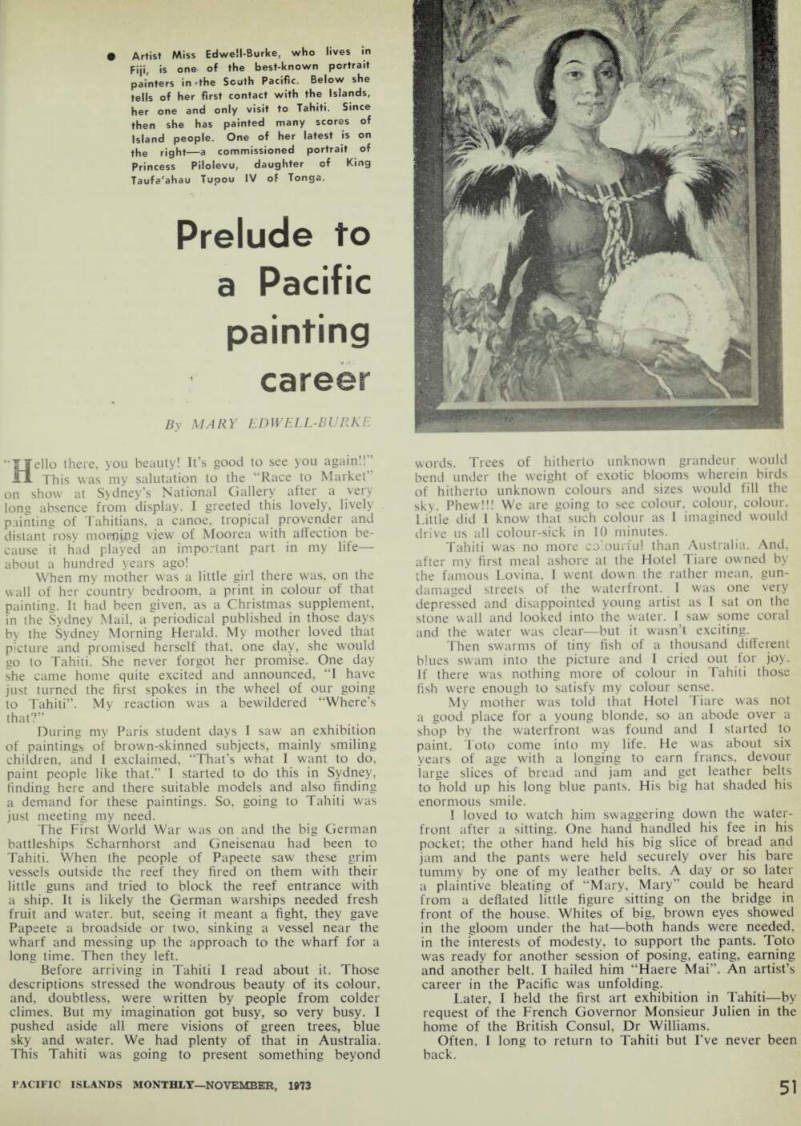
Prelude to a Pacific painting career
By Mary Edwell-Burke
• |Tello there, you beauty! It’s good to see you again!!” 11 This was my salutation to the “Race to Market” on show at Sydney’s National Gallery after a very long absence from display. I greeted this lovely, lively painting of Tahitians, a canoe, tropical provender and distant rosy mornyig view of Moorea with affection be cause it had played an important part in my life— about a hundred years ago!
When my mother was a little girl there was, on the wall of her country bedroom, a print in colour of that painting. It had been given, as a Christmas supplement, in the Sydney Mail, a periodical published in those days by the Sydney Morning Herald. My mother loved that picture and promised herself that, one day, she would go to Tahiti. She never forgot her promise. One day she came home quite excited and announced, “I have just turned the first spokes in the wheel of our going to Tahiti”. My reaction was a bewildered “Where’s that?”
During my Paris student days I saw an exhibition of paintings of brown-skinned subjects, mainly smiling children, and I exclaimed, “That’s what I want to do, paint people like that.” 1 started to do this in Sydney, finding here and there suitable models and also finding a demand for these paintings. So, going to Tahiti was just meeting my need.
The First World War was on and the big German battleships Scharnhorst and Gneisenau had been to Tahiti. When the people of Papeete saw these grim vessels outside the reef they fired on them with their little guns and tried to block the reef entrance with a ship. It is likely the German warships needed fresh fruit and water, but, seeing it meant a fight, they gave Papeete a broadside or two, sinking a vessel near the wharf and messing up the approach to the wharf for a long time. Then they left.
Before arriving in Tahiti I read about it. Those descriptions stressed the wondrous beauty of its colour, and, doubtless, were written by people from colder climes. But my imagination got busy, so very busy. I pushed aside all mere visions of green trees, blue sky and water. We had plenty of that in Australia.
This Tahiti was going to present something beyond
words. Trees of hitherto unknown grandeur would bend under the weight of exotic blooms wherein birds of hitherto unknown colours and sizes would fill the sky. Phew!!! We are going to see colour, colour, colour.
Little did 1 know that such colour as I imagined would drive us all colour-sick in 10 minutes.
Tahiti was no more colourful than Australia. And, after my first meal ashore at the Hotel Tiare owned by the famous Lovina, I went down the rather mean, gun damaged streets of the waterfront. 1 was one very depressed and disappointed young artist as I sat on the stone wall and looked into the water. 1 saw some coral and the water was clear—but it wasn’t exciting.
Then swarms of tiny fish of a thousand different blues swam into the picture and I cried out for joy.
If there was nothing more of colour in Tahiti those fish were enough to satisfy my colour sense.
My mother was told that Hotel Tiare was not a good place for a young blonde, so an abode over a shop by the waterfront was found and I started to paint. Toto come into my life. He was about six years of age with a longing to earn francs, devour large slices of bread and jam and get leather belts to hold up his long blue pants. His big hat shaded his enormous smile.
I loved to watch him swaggering down the water front after a sitting. One hand handled his fee in his pocket; the other hand held his big slice of bread and jam and the pants were held securely over his bare tummy by one of my leather belts. A day or so later a plaintive bleating of “Mary, Mary” could be heard from a deflated little figure sitting on the bridge in front of the house. Whites of big, brown eyes showed in the gloom under the hat —both hands were needed, in the interests of modesty, to support the pants. Toto was ready for another session of posing, eating, earning and another belt. I hailed him “Haere Mai”. An artist’s career in the Pacific was unfolding.
Later, I held the first art exhibition in Tahiti—by request of the French Governor Monsieur Julien in the home of the British Consul, Dr Williams.
Often, I long to return to Tahiti but I’ve never been back.
Artist Miss Edwell-Burke, who lives in Fiji, is one of the best-known portrait painters in-the South Pacific. Below she tells of her first contact with the Islands, her one and only visit to Tahiti. Since then she has painted many scores of Island people. One of her latest is on the right—a commissioned portrait of Princess Pilolevu, daughter of King
Taufa'ahau Tupou IV of Tonga.
Yesterday
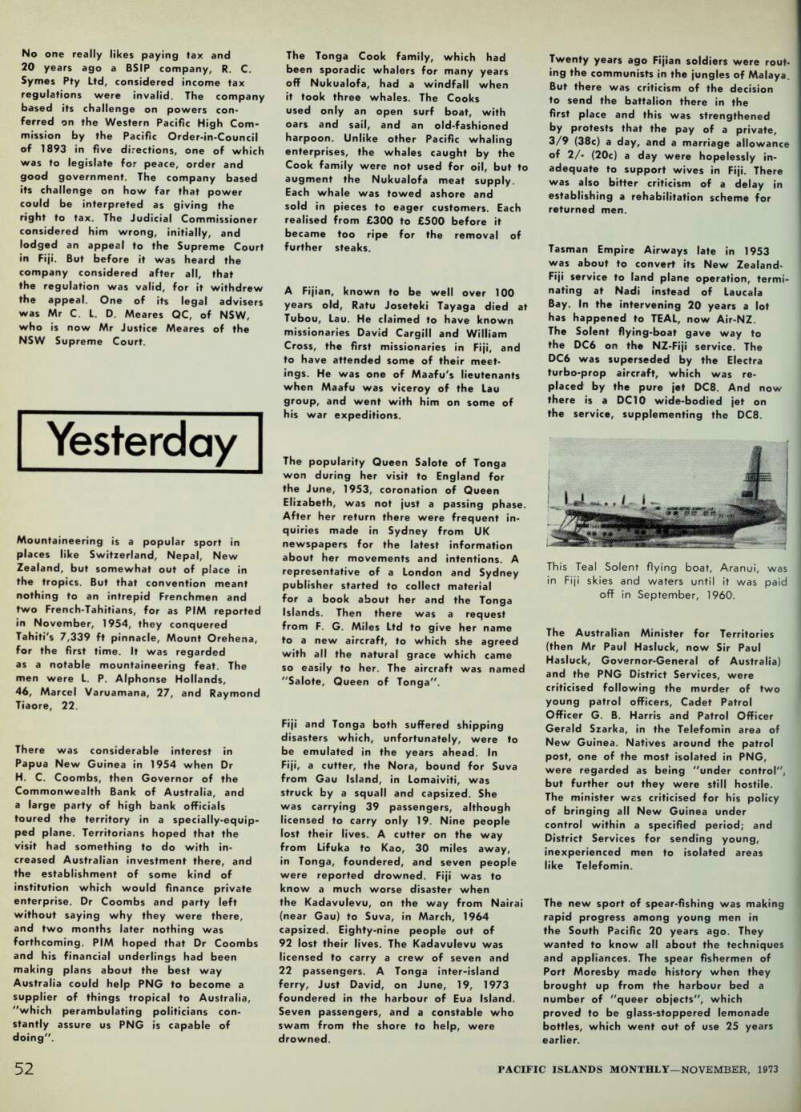
No one really likes paying tax and 20 years ago a BSIP company, R. C.
Symes Pty Ltd, considered income tax regulations were invalid. The company based its challenge on powers con ferred on the Western Pacific High Com mission by the Pacific Order-in-Council of 1893 in five directions, one of which was to legislate for peace, order and good government. The company based its challenge on how far that power could be interpreted as giving the right to tax. The Judicial Commissioner considered him wrong, initially, and lodged an appeal to the Supreme Court in Fiji. But before it was heard the company considered after all, that the regulation was valid, for it withdrew the appeal. One of its legal advisers was Mr C. L. D. Meares QC, of NSW, who is now Mr Justice Meares of the NSW Supreme Court.
Mountaineering is a popular sport in places like Switzerland, Nepal, New Zealand, but somewhat out of place in the tropics. But that convention meant nothing to an intrepid Frenchmen and two French-Tahitians, for as PIM reported in November, 1954, they conquered Tahiti's 7,339 ft pinnacle, Mount Orehena, for the first time. It was regarded as a notable mountaineering feat. The men were L. P. Alphonse Hollands, 46, Marcel Varuamana, 27, and Raymond Tiaore, 22.
There was considerable interest in Papua New Guinea in 1954 when Dr H. C. Coombs, then Governor of the Commonwealth Bank of Australia, and a large party of high bank officials toured the territory in a specially-equip ped plane. Territorians hoped that the visit had something to do with in creased Australian investment there, and the establishment of some kind of institution which would finance private enterprise. Dr Coombs and party left without saying why they were there, and two months later nothing was forthcoming. PIM hoped that Dr Coombs and his financial underlings had been making plans about the best way Australia could help PNG to become a supplier of things tropical to Australia, "which perambulating politicians con stantly assure us PNG is capable of doing".
The Tonga Cook family, which had been sporadic whalers for many years off Nukualofa, had a windfall when it took three whales. The Cooks used only an open surf boat, with oars and sail, and an old-fashioned harpoon. Unlike other Pacific whaling enterprises, the whales caught by the Cook family were not used for oil, but to augment the Nukualofa meat supply.
Each whale was towed ashore and sold in pieces to eager customers. Each realised from £3OO to £5OO before it became too ripe for the removal of further steaks.
A Fijian, known to be well over 100 years old, Ratu Joseteki Tayaga died at Tubou, Lau. He claimed to have known missionaries David Cargill and William Cross, the first missionaries in Fiji, and to have attended some of their meet ings. He was one of Maafu's lieutenants when Maafu was viceroy of the Lau group, and went with him on some of his war expeditions.
The popularity Queen Salote of Tonga won during her visit to England for the June, 1953, coronation of Queen Elizabeth, was not just a passing phase.
After her return there were frequent in quiries made in Sydney from UK newspapers for the latest information about her movements and intentions. A representative of a London and Sydney publisher started to collect material for a book about her and the Tonga Islands. Then there was a request from F. G. Miles Ltd to give her name to a new aircraft, to which she agreed with all the natural grace which came so easily to her. The aircraft was named "Salote, Queen of Tonga".
Fiji and Tonga both suffered shipping disasters which, unfortunately, were to be emulated in the years ahead. In Fiji, a cutter, the Nora, bound for Suva from Gau Island, in Lomaiviti, was struck by a squall and capsized. She was carrying 39 passengers, although licensed to carry only 19. Nine people lost their lives. A cutter on the way from Lifuka to Kao, 30 miles away, in Tonga, foundered, and seven people were reported drowned. Fiji was to know a much worse disaster when the Kadavulevu, on the way from Nairai (near Gau) to Suva, in March, 1964 capsized. Eighty-nine people out of 92 lost their lives. The Kadavulevu was licensed to carry a crew of seven and 22 passengers. A Tonga inter-island ferry. Just David, on June, 19, 1973 foundered in the harbour of Eua Island.
Seven passengers, and a constable who swam from the shore to help, were drowned.
Twenty years ago Fijian soldiers were rout ing the communists in the jungles of Malaya.
But there was criticism of the decision to send the battalion there in the first place and this was strengthened by protests that the pay of a private, 3/9 (38c) a day, and a marriage allowance of 2/- (20c) a day were hopelessly in adequate to support wives in Fiji. There was also bitter criticism of a delay in establishing a rehabilitation scheme for returned men.
Tasman Empire Airways late in 1953 was about to convert its New Zealand- Fiji service to land plane operation, termi nating at Nadi instead of Laucala Bay. In the intervening 20 years a lot has happened to TEAL, now Air-NZ.
The Solent flying-boat gave way to the DC6 on the NZ-Fiji service. The DC6 was superseded by the Electra turbo-prop aircraft, which was re placed by the pure jet DCS. And now there is a DCIO wide-bodied jet on the service, supplementing the DCS.
The Australian Minister for Territories (then Mr Paul Hasluck, now Sir Paul Hasluck, Governor-General of Australia) and the PNG District Services, were criticised following the murder of two young patrol officers, Cadet Patrol Officer G. B. Harris and Patrol Officer Gerald Szarka, in the Telefomin area of New Guinea. Natives around the patrol post, one of the most isolated in PNG, were regarded as being "under control", but further out they were still hostile.
The minister was criticised for his policy of bringing all New Guinea under control within a specified period; and District Services for sending young, inexperienced men to isolated areas like Telefomin.
The new sport of spear-fishing was making rapid progress among young men in the South Pacific 20 years ago. They wanted to know all about the techniques and appliances. The spear fishermen of Port Moresby made history when they brought up from the harbour bed a number of "queer objects", which proved to be glass-stoppered lemonade bottles, which went out of use 25 years earlier.
This Teal Solent flying boat, Aranui, was in Fiji skies and waters until it was paid off in September, 1960.
Advertisements & other items, pp. 61-68 (1 item)
Pioneer’s cassette sounds...
ey leap at you like they’re live! vt Notes with the purity of a nightingale’s call or the depth of a bullfrog’s complaint. This magnificent little cassette deck reproduces all, and better, because it has DolbyfDolby: An incredibly effective noise reduction system that makes natural sounds leap from the deck, especially with new chromium dioxide tape. It makes everything you record seem super-realistic like looking through a highly polished mirror.
Other sets have Dolby. But other sets don’t have the name Pioneer and extra quality features that go with the name. On the CT-4141 there’s a selector for your special chrome tapes. There’s automatic stop at tape-end in all tape travel functions. And there’s an ultra-smooth ferrite solid head (it just lasts and lasts).
We could go on and on, but your best bet is to flip on the CT-4141 at the nearest Pioneer dealers. & © & & * » w
0 PIONEER
Brijlal & Company, G.P.O. Box No. 362, Suva, Fiji Islands Tel; 222 58 P.O, Astronics Australasia Pty. Ltd. 161-173 Sturt Street, South Melbourne, Victoria 3205 Australia Hagemeyer (Australasia) N.V. P.O. Box No. 90, Lae, New Guinea Tel: 2718 P.O. Box No. 63, Rabaul, New Guinea Tel: 2633 P.O. Box No. 673, Madang, T.P.N.G. Tel; 2445 Box 1428, Boroko, Port Moresby, New Guinea Tel: 5784 Tee Vee Radio Ltd. P.O. Box No. 5029, Auckland, New Zealan Tel; 763-064 Burns Philp (South Sea) Co. Ltd. Norfolk Islands, South Pacifi Jacob Enterprises, P.O. Box No. 4, Nauru Island Ets. PERFECT, B.P. 594, Papeete,Tahiti Tel: 20 407 Menard Freres, B.P. 123, Noumea. New Caledonia Tel: 52-22 Transpac Corporation, P.O. Box 1477, Pago Pago, American Samoa 96799 Tel: 2227 * “DOLBY" is a trade mark of DOLBY LABORATORIES INC,
« V*. m wm ■ £ 1
miv
m ■ ■ m :**.
jmEYHSM..
%WCEff4USmA t ’ i
25KG«r
a • - ■A r -
the most
BREAD FLOURS: •
CAKE FLOURS: •
BISCUIT FLOURS: ♦
SPECIALITY FLOURS: •
important ingredient
MAINTOP —high protein bread flour ANCHOR —bakers flour • 50/50 MEAL —brown bread MEDIUM —cake and pastry • SPONGE —sponge cakes SPECIAL CAKE —madeira and cup cakes STRONG —cracker biscuits • MEDIUM —Shortbreads SOFT —sweet biscuits RYE flour • RYE meal • KIBBLED RYE SHARPS— roti and chapati flour • 100 % STONE GROUND
WHOLEMEAL
GILLESPIE BROS. PTY. LTD.
HEAD OFFICE: BRISBANE OFFICE:
52 UNION ST., PYRMONT, SYDNEY, N.S.W. CABLE ADDRESS: ALBION, BRISBANE, QUEENSLAND. (G.P.O. BOX 2518, SYDNEY, 2001.) "GILLESPIE", (P.O. BOX 8, ALBION, BRISBANE, 4010.) PHONE: 660-4933. SYDNEY AND BRISBANE. PHONE; 6-1121.
I
GENERATOR
YANMAR
Power.
Without it, there’s no way to make our lives fuller or richer.
Power. Reliable Power. Yanmar delivers it.
The people who developed the world’s first compact Diesel engine. The company with the largest Diesel engine production in Japan. Yanmar, where Diesel power spans the total range from 3 to 2,000 horsepower.
Yanmar, a name synonymous with reliable Diesel power in 130 countries.
You can now put this Yanmar reliability to use in electricity generation, too—with our series YSG and YPG Diesel powered generators. Wherever a sure supply of electricity is needed—single homes,small communities, as a stand by system, on outdoor job sites.
Electricity the safe and easy way, from compact, reliable Yanmar portable generators.
The same Yanmar technology comes in our YKS series of pumps for all purposes; irrigation, construction work, draining, etc.
Yanmar Diesel power. Put it to work for you.
DEALERSHIPS
YANMAR is seeking dealers on the following islands. Those who would like to be considered are invited to contact the company representative at the address below.
Fiji, New Hebrides, New Caledonia, Gilbert and Ellice, Tahiti, Tonga. Nauru, American Samoa, Western Samoa, Cook Is., Norfolk Is. ri
YANMAR
DIESEL ENGINE
YPG Series
20—80KVA
< * 9 40 s— — mm S il U
IjH
,v.-' &
YSG Series
1.5-lOKVA
YANMAR DIESEL PUMP
YANMAR DIESEL ENGINE CD.,LTD.
1-11-1, Marunouchi, Chiyoda-ku, Tokyo, Japan Cable: YANMAR TOKYO Telex; TOK 0222-2310
YKS Series
2—6 inches & V: "•*1 /
* »« . * . • . * ♦ \ *: ” • ’] * '.• *:,* " ■ % ; v v/r>- ‘i t ' • . * k » ; ~.♦**»• , \ i' e> vN; **a A ‘ * \*- I ;' ’ r i't^X - . ■ ; v: ; '-v i i * * i L. *** tf i , i i f .-V 1 t ,| •'/*'. I * ■ J »• ' i ' •* ' 'v 4 v > V v
U ,* ,;■ * Y'-J
fe ••’V.'- v 'v • m\ • I i i ■ i d ' - V % * V*
lailiil
:m^‘- ®Wsi m
YOTA
Dyna E
Get through
When the going gets roughest, depend on Toyota to get you through everytime.
Road conditions, water,extremes of heat and cold-nothing,but nothing stops Toyota from coming through for you with the biggest loads faster and more economically World-famous for the engineering excellence of its automobiles, Toyota also makes a complete line of rugged, versatile commercial vehicles designed to keep costs down, profits rising.
The Toyota Land Cruiser defies all obstacles to get the job done.
The Dyna and Stout trucks come through better in the light and medium pickup categories, while the Hi-Ace makes an excellent all-purpose vehicle.
For the big jobs, Toyota offers the heavy-duty truck - to keep profits rising load after load. And for the big family, Toyota offers two roomy station wagons - the trusty Toyota 1000 and the luxurious Corolla.
Make it a point to see your nearest Toyota dealer soon. When you do, ask him to prove how Toyota can keep coming through for you again and again.
TOYOTA Stout » TOYOTA Land Cruiser
TOYOTA 1000
TOYOTA Truck
TOYOTA Hi Ace
TOYOTA Corolla
TOYOTA
PAPUA NEW GUINEA: ELA MOTORS LIMITED. Scratchley Rd., Badili, Papua U.S. TRUST TERRITORY: MICROL CORPORATION, P.O. Box 267, Saipan FIJI ISLANDS: AUTOMOTIVE SUPPLIES CO., LTD., G.P.O. Box 355, Suva AMERICAN SAMOA: BURNS PHILP (SOUTH SEA) CO., LTD.,Pago Pa WESTERN SAMOA: BURNS PHILP (SOUTH SEA) LTD., P.O. Box 188, Apia GUAM; RICKY's AUTO CO., P.O. Box 1458, Agana NEW HEBRIDES: NEW HEBRIDES MOTORS LTD., P.O. Box 18, Vila SOLOMON ISLANDS: ZEPHYR SERVICE STATION PTY LTD., P.O Box 174, Honiara NEW CALEDONIA: SOCIETE D'IMPORTATION AUTOMOBILE DU PACIFIC, B.P. 438, Noumea TAHITI: ETABLISSEMENTS E.A. MARTIN & FILS, B.P. 61 Papeete COOK ISLANDS: COOK ISLANDS TRADING CORPORATION LTD., P.O. Box 92, Rarotonga
The Portable Power
You've Been Waiting
& x// Trt r In the wilds you want a dependable, lightweight power source. A generator built to take rough handling. Like the one-hand portable Kawasaki KG 600.
This "whisper quiet" 4-cycle air-cooled petrol engine economically handles a variety of recreation and light utility tasks. A.C. 110, 220 V and D.C. 12V output. It's designed for long, low-maintenance performance. The transistorised automatic voltage regulator insures stable power levels.
For your largerpower requirements, Kawasaki makes the KG9OO and KGI3OO portable petrol generators.
Marketed by
PACIFIC DIESEL AND TECHNICAL AGENCIES
P.O. Box 7, 1 9 Carrington Road, Marrickville, N.S.W., Australia 2204 Teleohone: 55 3473. 55 3867 Cable; DIESELTECH SYDNEY S. A. HEATH V. DAWSON ENG. BYERS ENG. SHERWOOD ENG. KAMSCO UNITED TRADERS CATHOLIC WORKSHOPS HONIARA MARINA AND SHIPYARD CO.
MALAITA DEVELOPMENT CORP P.S.S. CO.
Our business is cargo.
Your cargo: to anywhere in our Pacific.
Two paddle steamers on the Yangtse River in 1873 marked the beginning of the China Navigation Company. Today, the same flag flies above eighteen modern motor ships plying an extensive network of cargo routes between Papua New Guinea and Pacific Island ports (as far East as Tahiti) and Japan, New Zealand, Australia and Thailand.
For 100 years, the flag of the China Navigation Company has meant experience, reliability and speed across the sea. Today, it’s flying as strong as ever.
For further details and all enquiries there are Agents at the following ports: Papua New Guinea; Steamships Trading Co. Ltd., Port Moresby, Samarai, Lae, Madang, Rabaul, Kieta. Burns Philp (New Guinea) Ltd., Wewak, Kavieng, Fiji: Morris Hedstrom Ltd., Suva, Lautoka. Western Samoa; Morris Hedstrom Ltd., Apia.
Tonga: Morris Hedstrom Ltd., Nukualofa and Vava’u. Tahiti: Etablissements Donald Tahiti, Papeete. New Caledonia; Etablissements Ballande, Noumea. 8.5.1. P.: British Solomons Trading Co. Ltd., Honiara. New Hebrides: Les Comptoirs Francais desNouvelles-Hebrides, Vila and Santo. AUSTRALIA—Sydney: Interocean Swire Pty. Ltd. Melbourne; Interocean Australia Services Pty. Ltd. Brisbane; Wills. Gilchrist & Sanderson Pty. Ltd. NEW ZEALAND —P. & O. (N.Z.) Ltd.
Auckland, Wellington, Christchurch, Dunedin, Bluff, Napier. Japan: Swire McKinnon, Tokyo, Yokohama, Osaka, Kobe and Nagoya. Eastern Managers; Butterfield & Swire, 9 Connaught Rd., Central, Hong Kong.
CN co JOHN SWIRE & SONS PTY. LTD. General Agents in Australia, 8 Spring Street, Sydney, Phone: 27 9351.
THE CHINA NAVIGATION CO LTD
MEMBER OF THE SWIRE GROUP.
Even a legendary
paradise
needs a modern
water supply.
Hardie’s are helping to update it at Denpasar, Bali. £ : ' ; m The island of Bali is famous for many things—its beautiful women, beaches, music, culture, its perfect harmony with nature. But even the most desirable paradise, f it is to prosper, must eventually relate to the 20th Century. Bali has taken that step —by initiating one of the most modern water supply systems in Asia. The modernisation programme, which will serve 90,000 people will also assist commerce and boost the island’s tourist facilities.
An Australian company. James Hardie, has won a contract to supply asbestos cement pipes, cast iron fittings and valves for this scheme at Bali’s capital, Denpasar.
Because the experience of working in an export market has proved so interesting, James Hardie has prepared a special llustrated leaflet on the scheme. It reports on the problems they experienced, how they were overcome, and the part played by the Colombo Aid Plan in bringing a higher standard of living to the area. For your free copy, write to: Publications Department, James Hardie & Coy. Pty. Limited, Box 3935, G.P.0., Sydney 2001, James Hardie & Coy.
• > KmJ SWSftSa
irV /IM Townsville. Rockhampton, lH Adelaide, Perth, Hobart, Darwin. Auckland.
Hardie’s: pipelines for the export jobs.
28940
JH71.87C
Mana
This issue of MANA is devoted to creative writing by residents of Fiji. It reflects the multi cultural experience of Fiji's society. It is edited by Satendra Nandan, a lecturer at the University of the South Pacific. Contributors are Vanessa Griffen, Sam Simpson, and Dhrup Chand, who have already published in MANA, and Mele Nasalivata, James Movick, Mary Mills, Julie Murphy, Kamla Kushal, Lalita Devi, A. M. O'Brien, students, Birmati Lakhan, Malakai Tawake, and Jack Davis. Jack Davis is an Australian Aborigine who visited Fiji for the South Pacific Festival of Arts.
Short Story
Marama
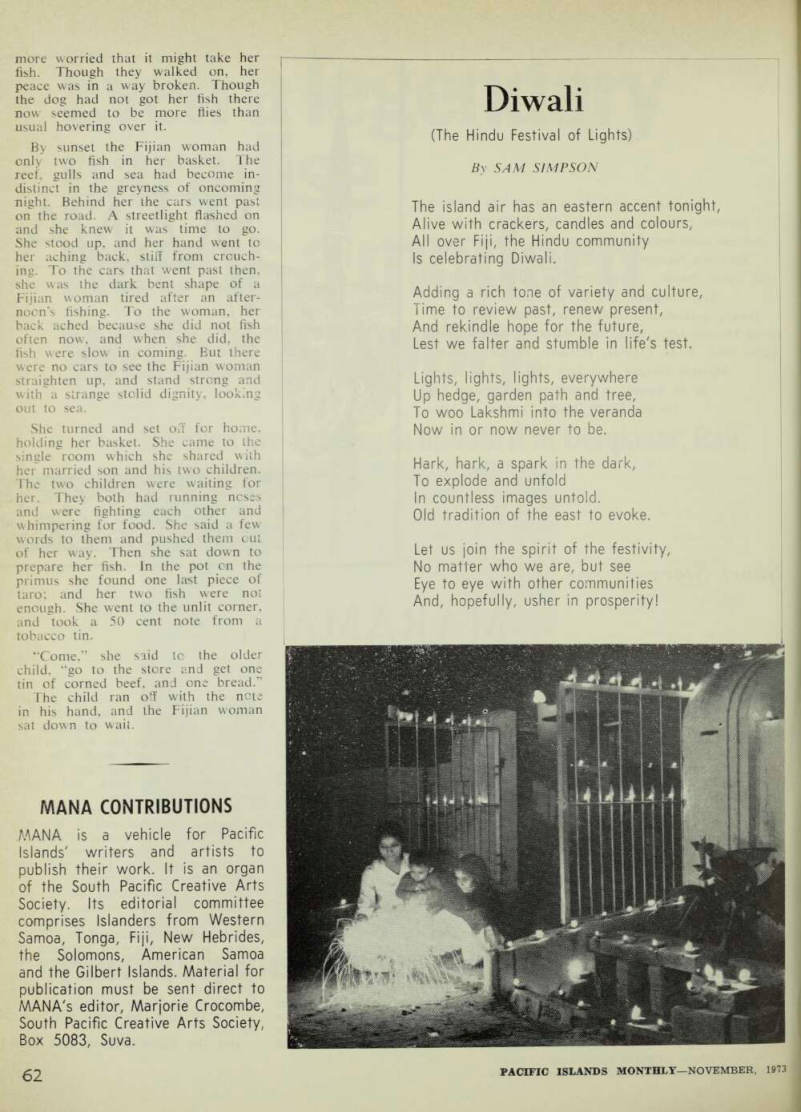
By Vanessa Griffen
THE Fijian woman spat generously on the small piece of bait on her hook, then she straightened up from her half-crouching position on the sea wall. She turned slightly side ways, and spun her line, making a wide hissing circle as the nylon cut through the air. Then, with a swift movement of her arm, she flung it far out into the still sea. She stood for a minute, watching the ripple where it had fallen, then she crouched down again, tucking her skirt about her, to wait.
There was in her pose an air of tireless, endless patience. The woman held the line lightly between her smooth hard fingers, and the slightest twitch brought her fingers firmly down on it. Sometimes she felt a harder tug at her bait, then she jerked the line quickly so that her hook would tear at the fish’s mouth.
With unhurried swiftness she then pulled in her line. There was nothing on it. Again, patiently, she spat on
the bait, rubbed her hands together, and cast her line into the water.
She sat down to wait.
This Fijian woman, any Fijian woman, was a common sight on the sea wall, sitting crouched, with faded cotton skirt billowing in the wind; or standing tall against the sky. Beside her, in a basket plaited out of green coconut leaf, she kept her bait.
A long interval of waiting passed and she scratched her head often and frowned against the glare of the sun. She watched the inter-island cutter chug past in the distance, and all the time her fingers were ready at her line.
Gulls appeared out of the sky to perch on the black beacon, and be hind them the borders of the reef curled white and brilliant. The Fijian woman sat on, with these things about her so familiar that she hardly noticed them. At last her patience was rewarded. When she
pulled in her line, there was a small fish flipping at the end of it. Still holding the line, she thumped the fish on the rough sea wall, until it lay still, silver and dead. She held it in her brown hand, and reaching in, took out the hook, and placed the fish in her basket.
The woman added fresh bait, spat, spun her line and cast it into the water. Again, she crouched down to wait. The sun, getting lower in the sky, shone indirectly; the sky deepened and the breeze grew cool.
She was interrupted by a dog sniffing around her basket. She was about to cuff it, when looking up, she saw that it belonged to a Euro pean couple who were hurrying up.
Instantly, a wide, shy good-natured grin spread across her face. The man got hold of the dog and smiled briefly at the Fijian woman.
“It’s all right, he won’t bite you,” he said.
But the Fijian woman had been
more worried that it might take her fish. Though they walked on, her peace was in a way broken. Though the dog had not got her fish there now seemed to be more flies than usual hovering over it.
By sunset the Fijian woman had only two fish in her basket. The reef, gulls and sea had become in distinct in the greyness of oncoming night. Behind her the cars went past on the road. A streetlight flashed on and she knew it was time to go.
She stood up, and her hand went to her aching back, stiff from crouch ing. To the cars that went past then, she was the dark bent shape of a Fijian woman tired after an after noon’s fishing. To the woman, her back ached because she did not fish often now, and when she did, the fish were slow in coming. But there were no cars to see the Fijian woman straighten up, and stand strong and with a strange stolid dignity, looking out to sea.
She turned and set off for home, holding her basket. She came to the single room which she shared with her married son and his two children.
The two children were waiting for her. They both had running noses and were fighting each other and whimpering for food. She said a few words to them and pushed them cut of her way. Then she sat down to prepare her fish. In the pot on the primus she found one last piece of taro: and her two fish were not enough. She went to the unlit corner, and took a 50 cent note from a tobacco tin.
“Come,” she said to the older child, “go to the store and get one tin of corned beef, and one bread.”
The child ran off with the note in his hand, and the Fijian woman sal down to wait.
Mana Contributions
AAANA is a vehicle for Pacific Islands' writers and artists to publish their work. It is an organ of the South Pacific Creative Arts Society. Its editorial committee comprises Islanders from Western Samoa, Tonga, Fiji, New Hebrides, the Solomons, American Samoa and the Gilbert Islands. Material for publication must be sent direct to MANA's editor, Marjorie Crocombe, South Pacific Creative Arts Society, Box 5083, Suva.
Diwali
(The Hindu Festival of Lights)
By Sam Simpson
The island air has an eastern accent tonight, Alive with crackers, candles and colours, All over Fiji, the Hindu community Is celebrating Diwali.
Adding a rich tone of variety and culture, Time to review past, renew present, And rekindle hope for the future, Lest we falter and stumble in life's test.
Lights, lights, lights, everywhere Up hedge, garden path and tree, To woo Lakshmi into the veranda Now in or now never to be.
Hark, hark, a spark in the dark, To explode and unfold In countless images untold.
Old tradition of the east to evoke.
Let us join the spirit of the festivity, No matter who we are, but see Eye to eye with other communities And, hopefully, usher in prosperity!
A Legend Of Love And Death
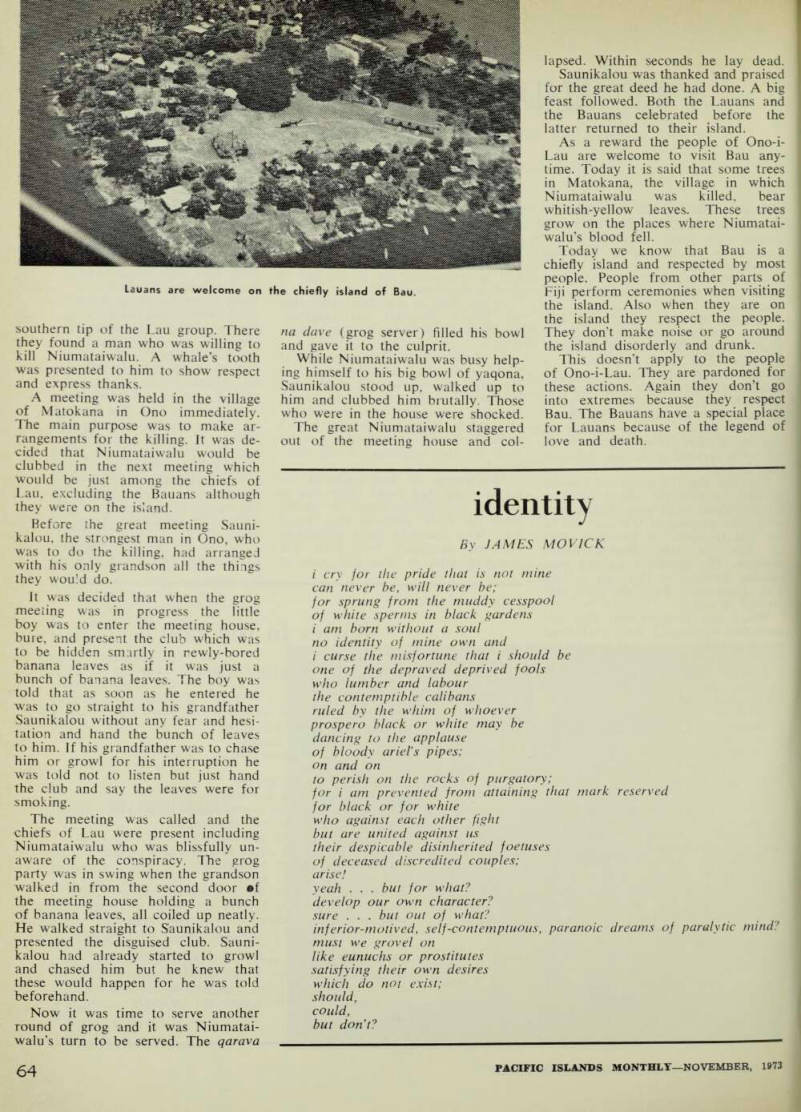
By Mele Nasalivata
IN the olden days the inhabitants of various islands in the Fiji group visited each other. The people of Lakeba, in the Lau group, followed the same custom. They often visited Tonga which is outside Fiji. Another island group which they were fond of was Bau.
Among the islands of the Lau group, Lakeba is known to be a chiefly island. At that time in each island of Fiji there was usually a person, a man, who was the strongest and handsomest and he was the chief.
Strength and beauty were the main characteristics of the island chiefs.
There dwelt, in the island of Lakeba, a chief called Niumataiwalu who was reputed to be the strongest man in Lau.
One fine day the people of Lakeba decided to visit the island of Bau.
Usually these visits were with a pur pose. The purpose of this one was to see and to meet the strongest chief in Bau to test Niumataiwalu’s strength. The people of Lakeba were looking forward to this trip to Bau with excitement. Soon the great day arrived to leave.
When they reached Bau they im mediately performed their traditional ceremony of sevusevu and qaloqalovi.
These Fijian ceremonies are usually done when people visit others in other parts or when a big chief returns to his original abode.
After all these ceremonies were performed the Lakebans were allowed to stay on the island for a few days.
All went ashore except Niumataiwalu who stayed on board. Unfortunately they didn’t find any strong man who could challenge Niumataiwalu.
People of Bau who went on board to see this great man began to talk about him, admiring his handsome features and prowess. This was the gossip mostly among the ladies. Be fore long the daughter of one of the chiefs heard about this. She wanted to see it for herself. She decided to visit him on the boat.
Early every morning she would cook food and sneak out of the house.
She did all this secretly for fear of being caught. She would take a small raft and row furtively via the back of the island, so that nobody could see her. She would then approach the boat from the starboard side. This went on for quite a while and, as
days passed, more frequently. Their daily relationship grew and they were lovers without anybody in Bau realising it.
The day came when the Lakebans had to return and the lovers had to part. Niumataiwalu left.
Before long, it was discovered that the chiefs daughter was pregnant.
The great Niumataiwalu was respon sible.
In those days it was very serious to have an affair outside or before marriage and worse still if the girl becomes pregnant. As a punishment for this crime the man responsible was usually killed with a wait (club) while the expectant mother was ostra cised by the members of the com munity.
The people of Bau gathered to gether when they heard about this to plot to put Niumataiwalu to death.
Now the main problem they faced was: Who would be brave enough to kill the accused? Not even the strongest man in Bau had guts to
kill him. The Bauans then went through the whole of Fiji to ask the people whether anybody could solve their problem. They went from island to island, village to village and they took with them tabua (whales' teeth) for this was a custom. A whale’s tooth is usually presented to show re spect and thanks for a particular favour or task. Also this is presented when you are in great need and would like some help.
It so happened that Niumataiwalu heard about the terrible plan. He started to escape to other villages and islands within Lau. The Bauans heard of his escape from Lakeba and were not sure of his whereabouts. They sent whales’ teeth to the villages he was likely to visit. Together with the tabua were what we call Matanivanua (spokesmen) who would explain to the people the purpose of the whale’s tooth. Niumataiwalu knew nothing about this.
At last the people from Bau came to the island Ono which is at the very
southern tip of the Lau group. There they found a man who was willing to kill Niumataiwalu. A whale’s tooth was presented to him to show respect and express thanks.
A meeting was held in the village of Matokana in Ono immediately.
The main purpose was to make ar rangements for the killing. It was de cided that Niumataiwalu would be clubbed in the next meeting which would be just among the chiefs of Lau, excluding the Bauans although they were on the island.
Before the great meeting Sauni kalou, the strongest man in Ono, who was to do the killing, had arranged with his only grandson all the things they would do.
It was decided that when the grog meeting was in progress the little boy was to enter the meeting house, bure, and present the club which was to be hidden smartly in rewly-bored banana leaves as if it was just a bunch of banana leaves. The boy was told that as soon as he entered he was to go straight to his grandfather Saunikalou without any fear and hesi tation and hand the bunch of leaves to him. If his grandfather was to chase him or growl for his interruption he was told not to listen but just hand the club and say the leaves were for
smoking.
The meeting was called and the chiefs of Lau were present including Niumataiwalu who was blissfully un aware of the conspiracy. The grog party was in swing when the grandson walked in from the second door »f the meeting house holding a bunch of banana leaves, all coiled up neatly.
He walked straight to Saunikalou and presented the disguised club. Sauni kalou had already started to growl and chased him but he knew that these would happen for he was told beforehand.
Now it was time to serve another round of grog and it was Niumatai walu’s turn to be served. The qarava
na dave (grog server) filled his bowl and gave it to the culprit.
While Niumataiwalu was busy help ing himself to his big bowl of yaqona, Saunikalou stood up. walked up to him and clubbed him brutally. Those who were in the house were shocked.
The great Niumataiwalu staggered out of the meeting house and col
lapsed. Within seconds he lay dead.
Saunikalou was thanked and praised for the great deed he had done. A big feast followed. Both the Lauans and the Bauans celebrated before the latter returned to their island.
As a reward the people of Ono-i- Lau are welcome to visit Ban any time. Today it is said that some trees in Matokana, the village in which Niumataiwalu was killed, bear whitish-yellow leaves. These trees grow on the places where Niumatai walu’s blood fell.
Today we know that Bau is a chiefly island and respected by most people. People from other parts of Fiji perform ceremonies when visiting the island. Also when they are on the island they respect the people.
They don’t make noise or go around the island disorderly and drunk.
This doesn’t apply to the people of Ono-i-Lau. They are pardoned for these actions. Again they don’t go into extremes because they respect Bau. The Bauans have a special place for Lauans because of the legend of love and death.
Lauans are welcome on the chiefly island of Bau.
Kisses in the rain
By Dhrvp Chand
It's been raining all day— only a few people are about.
A chilly wind is blowing; no-one wants to come out.
The lights are soft, orange.
You wait, alone, in the rain.
Your eyes shine, you smile, you're happy.
You know today he will come again.
The sky is dark and gloomy, cold; and the rain comes down and down.
People hide beneath umbrellas and move about the town.
You stand in a mac, in the wind and rain, your hair is wet, but you do not mind.
And as you walk along the wet pavement, your footsteps and your troubles are left behind.
Light walk, happy walk, walk through the rain.
Dreams in the water, so wonderful today.
You whom I don't know, you who don't know me; you dream of someone now not far away.
identity
By James Movick
i cry for the pride that is not mine can never be, will never be; for sprung from the muddy cesspool of white sperms in black gardens i am born without a soul no identity of mine own and i curse the misfortune that i should be one of the depraved deprived fools who lumber and labour the contemptible Calibans ruled by the whim of whoever prospero black or white may be dancing to the applause of bloody oriel’s pipes: on and on to perish on the rocks of purgatory; for i am prevented from attaining that mark reserved for black or for white who against each other fight but are united against us their despicable disinherited foetuses of deceased discredited couples; arise! yeah . . . but for what? develop our own character? sure . . . but out of what? inferior-motived, self-contemptuous, paranoic dreams of paralytic mind? must we grovel on like eunuchs or prostitutes satisfying their own desires which do not exist; should, could, but don’t?
Return to Paradise
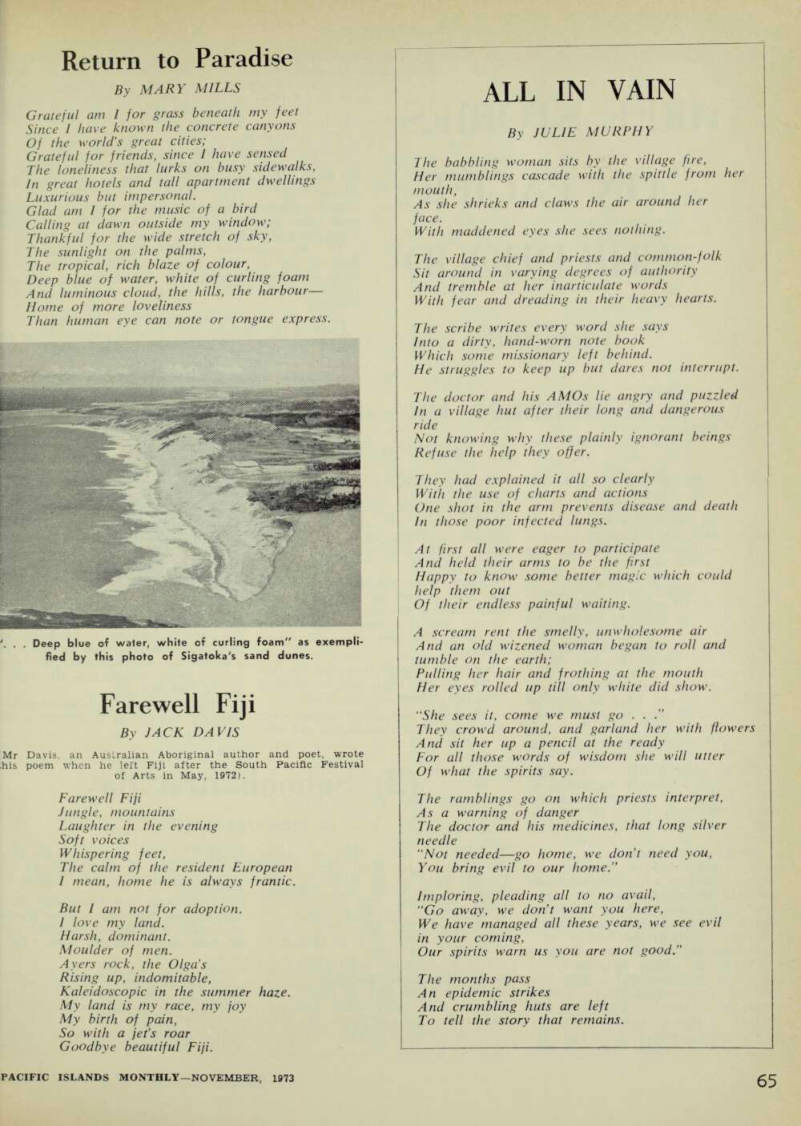
By Mary Mills
Grateful am I for grass beneath my feet Since I have known the concrete canyons Of the world’s great cities; Grateful for friends, since I have sensed The loneliness that lurks on busy sidewalks, In great hotels and tall apartment dwellings Luxurious but impersonal.
Glad am I for the music of a bird Calling at dawn outside my window; Thankful for the wide stretch of sky, The sunlight on the palms, The tropical, rich blaze of colour, Deep blue of water, white of curling foam And luminous cloud, the hills, the harbour — Home of more loveliness Than human eye can note or tongue express.
. . Deep blue of water, white of curling foam" as exempli fied by this photo of Sigatoka's sand dunes.
Farewell Fiji
By Jack Davis
Mr Davis, an Australian Aboriginal author and poet, wrote his poem when he left Fiji after the South Pacific Festival of Arts in May, 1972).
Farewell Fiji Jungle, mountains Laughter in the evening Soft voices Whispering feet, The calm of the resident European I mean, home he is always frantic.
But 1 am not for adoption.
I love my land.
Harsh, dominant.
Moulder of men.
Ayers rock, the Olga’s Rising up, indomitable, Kaleidoscopic in the summer haze.
My land is my race, my joy My birth of pain, So with a jet’s roar Goodbye beautiful Fiji.
All In Vain
By Julie Murphy
The babbling woman sits by the village fire, Her mumblings cascade with the spittle from her mouth, As she shrieks and claws the air around her face.
With maddened eyes she sees nothing.
The village chief and priests and common-folk Sit around in varying degrees of authority And tremble at her inarticulate words With fear and dreading in their heavy hearts.
The scribe writes every word she says Into a dirty, hand-worn note book Which some missionary left behind.
He struggles to keep up but dares not interrupt.
The doctor and his AMOs lie angry and puzzled In a village hut after their long and dangerous ride Not knowing why these plainly ignorant beings Refuse the help they offer.
They had explained it all so clearly With the use of charts and actions One shot in the arm prevents disease and death In those poor infected lungs.
At first all were eager to participate And held their arms to be the first Happy to know some better magic which could help them out Of their endless painful waiting.
A scream rent the smelly, unwholesome air And an old wizened woman began to roll and tumble on the earth; Pulling her hair and frothing at the mouth Her eyes rolled up till only white did show.
“She sees it, come we must go . . .”
They crowd around, and garland her with flowers And sit her up a pencil at the ready For all those words of wisdom she will utter Of what the spirits say.
The rumblings go on which priests interpret, As a warning of danger The doctor and his medicines, that long silver needle “Not needed—go home, we don’t need you, You bring evil to our home.”
Imploring, pleading all to no avail, “Go away, we don’t want you here, We have managed all these years, we see evil in your coming, Our spirits warn us you are not good.”
The months pass An epidemic strikes And crumbling huts are left To tell the story that remains.
(2) School: first day
Three Stories
On Pacific
Childhood
A number of students taking the three-year Diploma of Education course at the University of the South Pacific are preparing a collection of childhood reminis cences for possible publication. The collection is being edited by Satendra Nandan and Noel Harrison , two lecturers at the university.
The main idea is to present a personal impression of\ childhood in the Pacific by gathering together ex-\ periences from the 10 island groups which make up the university’s region. They’ll cover mainly the six to 12 age-span.
The collection is not intended to be in any way com- 1 plete. Nor can any claim be made that the experiences\ are typical of all children in all places in the Pacific.
The reminiscences should, however, show with honesty and intimacy part of the life of the Pacific] from the point of view {low, and close to the ground) of some of the young—filtered admittedly by a selective\ memory.
Here are three short extracts from accounts written] by two of the students, Miss Birmati Lakhan, from Ba,\ and Mr Malakai Tawaki, from the Lau Islands.
(1) The summer the sun did not blow up
By Birmati Lakhan
SOME time during the Christmas holidays, when I was about six, a rumour spread rapidly among the children in our village that soon the sun would break. Instead of sunshine and rain, showers of fire and glowing splinters would fall.
This story filled me with great fear. My younger sister, my cousins and friends all wanted to know just when this was going to happen. An aunt told us it would be just over a month that the sun would blow up, and the sea would rise and drown all the land and all the houses.
At first we all cried. Then we got into a group and tried to think of ways we could save ourselves. I sug gested that we dig a large hole, get inside, and cover ourselves with a big wet rug.
But an older cousin—he was eight —said that we would be baked to death inside, and that when the seas rose boiling water would fill the hole and all our dead bodies would float away.
My idea was dropped.
We then decided that if we managed to buy a big boat we could get into it and float on the water that would save us from drowning.
But we still had to solve the problem of being baked by the heat.
We thought that if we could carry a big—very big—refrigerator on the boat we would be safe. We decided that we’d have to light a small fire inside the refrigerator, just enough to stop us from freezing.
With this bright idea we all went to our eldest brother and told him
what we needed—a steel boat (so it wouldn’t burn), and a refrigerator.
He was surprised, because most adults hadn't heard the rumour. It was circulating almost entirely among the children. He scolded us and told us not to be silly.
When we went to our parents with the same request for immediate help they called a meeting of all the older people. The rumour was getting out of hand. Children were not eating properly.
Later on my mother told us that if we ate our food we’d be given a boat just before the sun broke.
My father and older brother were very angry and tried to find out who
had started the rumour. It was finally; traced back to the Readers’ Digest.
A 14-year-old girl had read an article in the Digest which said that after millions of years the sun might explode. As the story went from mouth to mouth the time changed from “millions of years” to “next month.”
My brother explained to us that God would never allow such a thing to happen because if he killed all the people in the world he would be committing a great sin. And God would never commit sin. This helped us to lose our fear.
Months passed, the holidays ended, and the sun stayed in one piece. We relaxed.
(2) School: first day
By Birmati Lakhan
IWAS 5i years when my elder brother and Mum decided that I was ready to go to school. My mother went to the town, bought some material for my uniform, and made it. I was very excited and impatiently waited for the day when I would go to school.
One morning my mother woke me early and prepared everything for me.
She dressed me smartly into a blue uniform with white collar and belt, and brushed my hair nicely. My older sister parcelled my lunch and made me eat breakfast.
At 7.30 I left home with my elder brother, who was in Class 6, and walked about 3i miles to school.
I saw many new faces, and above all. teachers who appeared very strict and ordered children to do duties such as picking the papers and cutting grass.
My brother took me to the office where the head teacher enrolled me into the school. He was middle-aged and wore glasses, of which I was very frightened. However, he told me not to fear him, patted me on my.
nead and told me to go to the Class I classroom.
My brother took me, gave me my food, chalk and slate and told me to stay there till he came back at recess.
This first day was adventurous. At 8.30 am I found myself in a class room with many small boys and girls af my age. Many children were :rying and trying to run out of the room. There was only one teacher and she was busy controlling the naughty children who were making things harder for her.
Those children who remained quiet
she gave them a piece of chalk and told them to write numbers one to ten on our slates. Slowly we started to write the numbers.
Most children stopped crying and running away but one boy was very difficult to control. He ran from the classroom and when the teacher asked some big boys to catch him he started to bite and spit on them.
The teacher became very cross and beat him with a thick ruler on his back and head. This made all of us very frightened and we all remained quiet. The boy stopped being naughty.
After a long time the teacher asked us to show her the numbers we had written. We all took our work and showed it to her. The teacher gave us ticks and crosses. I remember a big cross on my slate while a girl sitting beside me had a big tick.
I did not know the meaning of the cross but was very happy because to me the cross appeared more interest ing than the tick. Instead of rubbing it off 1 took the slate home and showed it to everyone. My brothers teased me. My mother told me what it meant.
She had never been to school herself.
(3) The old order changeth
By Malakai Tawake
A BIG change came into the life of our family when we were converted to another Christian religion. I never knew what religion we belonged to before this time but at about the age of four we became Seventh-day Adventists, Changes came very quickly. We were forbidden to eat pork and many other things. Therefore we had to give all our pigs away to relatives during our reformation. This was really great. It meant we didn’t have to feed the pigs any more, and that was one of the jobs I hated most.
But my father also had to sell his movie theatre—to a Chinaman—and that wasn’t so good, because I’d enjoyed seeing the films.
In the home things began to change also. More emphasis was placed on the Sabbath and its observance. As the Sabbath approached all the things at home were kept in order. My mother would be busy preparing food and mending clothes and getting everything ready so nothing would have to be done on the Sabbath itself.
The Sabbath began at sunset on Friday and finished at sunset on Saturday. We weren’t allowed to make any unnecessary noise, or play, or work during those hours.
When we played during the week with other children they mocked and laughed at us, calling us the Seventh day-keepers, particularly when we didn’t participate in school sports on Saturdays.
I was very miserable and ashamed when students of my own age made a great fuss about my not eating pork or crabs because this was con trary to my new belief. These re marks were insults to my religion and to my parents.
We weren’t even allowed to take part in school bazaars which were held on Saturdays and which included mekes and yaqona ceremonies, I wanted to attend but it was all pro nounced evil and wrong.
Similarly, when there was death or marriage in the village, members of the clan were expected through custom to show signs of respect by attending the various ceremonies. This was one of the occasions when children were taught about traditions and customs. You were made aware of your status and of the social order of the community.
To this day 1 still don’t under stand why my brothers, sisters and myself weren’t allowed to join in these ceremonies.
While the other children would be having fun and would be feasting in the ceremonial ground—known as vanua-ni-soqo —we’d be carrying on with our normal everyday activities at home. We were forbidden to attend any ceremonial gatherings.
Furthermore, if food were offered to us from such gatherings we weren’t allowed to eat it. The new religion forbade it, for what reason I never knew.
I was deprived from learning the essential and important ceremonial activities of our community in the traditional manner. I never knew my roles, my status, my social class.
I was never able to understand my link with the rest of the clan mem bers (mataqali), or of my duties and obligations to them and them to me.
I knew only my very few close relatives.
At the other extreme I was under constant pressure from home to devote my time to learning my Bible,
and memorising verse after verse from it. 1 was not only learning par rot-fashion, but I was also drilled on what not to eat. how to keep the Sabbath “holy", how to conduct my self before elders, how to dress, and, specially, how to be a hard worker.
Time passed very slowly at church services, and I remember one day when I tried to slip away and join the rest of the boys swimming in the river.
The sermon was long and boring.
It was the same sermon preached over and over again; the same intro duction, the same illustrations, and the same Bible verse. My mind was not on the message. It was on swim ming. 1 had to keep an eye on the head deacon. He acts as the disciplinary man in the church, makes sure that everyone closes their eyes in prayer, and that there's no talking and
whispering or anything that might
distract from the church atmosphere.
If anyone was guilty of an offence the head deacon would escort him out of church. Usually he carries a rod as an instrument of peace.
When everyone was praying and the head deacon was not looking in my direction I crawled without hesitation toward the door. I made one last cat-like jump. While I was still in the air I felt a huge hand clutch the collar of my white shirt.
Shaking, I stood in silence. My face was pale and I was frightened.
At the end of the service I was reported to my parents. I missed my Sabbath lunch and was told to wait for the afternoon to be caned.
This was not the only time I was in this sort of trouble. I was penalised on these occasions even
more severely for breaking the rules and conduct of the church.
Much emphasis was placed on reverence, particularly inside the church.
My whole childhood was filled with “Don’t do this” and “Don’t do that”. I was like a piece of delicate machinery tuned and driven accord ing to the desire of the driver. I had lost my right and honour to be my self, to be an individual with his own perspective.
I was deeply confused at this time.
I was lost among my own people, I wasn’t readily accepted into the community. The new religion had brought a new way of life to the family. The spirit of individualism and desire for material wealth and riches was encouraged as a result.
At times I felt that we were ostracised by our own clan members and friends. The great bond of kin ship, and communal ownership and communal togetherness, had disinte grated. I was lost because I never knew my traditional customs, I am a lost soul.
And Child
Legend
The Mother
By Lalita Devi
IN Dreketi, 53 miles from Labasa on the island of Vanua Levu, there is a small ageless hill. On the very top of the hill there’s a stone in the shape of a mother and child.
Villagers who visit this stone image often talk of the legend of the stone mother. It is said that once a Fijian woman was left alone at home with her child. The husband had gone hunting, the relatives were visiting other relatives.
As the mother was feeding her baby, a stranger arrived. And the wind whispered to her his evil designs.
The woman, at once, gathered her child in her lap and fled. The stranger followed, each step increasing his appetite.
The woman scrambled up the hill, panting and praying. As she reached the summit, totally exhausted, she sat down, closed her eyes, pressed her child to her naked bosom and prayed: Dear God, Save me. Turn me into stone.
God listened.
The stone mother today is the living symbol of chastity and love.
Epitaph to a toad
By A. M. O’Brien
In Suva when the rains come down, the roads seethe with toads. They are frantically alive until flattened by cars . . .
Toad squatted statue Still at the pothole drinking in the dew of a new day it seemed he glistened blistered with polychrome warts beautiful Buddha of the road disgorging technicolour croak still-steaming cascade squeezed out
almost delicately
by a passing car crystal eyes glowed deep in death "I was what you are: you will be what I am" so ran the inscription on a Goanese tombstone I remembered . . .
Who?
By Kamla Kushal
Born Actors We are all and our Stage, is the World nature provides Us with scenery, Who is Our Director? and to improve Ourselves, imitation stages on the Stage created actors out of Actors trained, Who trained Us Actors? fame achieved through performances by producers, directors and people graded Soon recognised according to their classes Who graded Us in Classes?
Ah, cunning actors when fed up with acting, you resigned Saying, your health has declined, But what do we do when we want to resign To whom should we send our Resignation?
Advertisements & other items, pp. 77-78 (1 item)
Skillet
m •••# w V
New round gourmet
The handiest new appliance
since trypans
Bacon and eggs for two? With a Sunbeam “Skillet” it’s easier than ever. Just the right size. Yet “Skillet” is big enough itself to roast a size 8 chicken to perfection. And it washes easier than a plate.
Just remove the control and dunk the whole pan in the sink.
“Skillet” is another great new idea from Sunbeam. Handier for small families and singles. It looks like a frypan, cooks like a frypan. But it has a talent of its own. It’s designed to be versatile, to be both compact and roomy. “Skillet” looks beautiful, cooks beautifully.
Nobody but Sunbeam can offer you a Round Gourmet Skillet. It’s absolutely on its own. It only comes from Sunbeam. L 85.4186
SPECIALISTS IN
EXPORT QUALITY...
y & &s
SHOWERSCREENS
Made with • Sliding Doors • Folding Doors • Pivot Doors • Fixed Panels
‘SANDY’ ADJUSTABLE
ALUMINIUM VENTILATING
LOUVRE WINDOWS
... .. n
‘SANDY’ ALUMINIUM
GLAZING BAR FOR
ECONOMICAL SIDEWALL
GLAZING
ALUMINIUM SHOPFRONTS,
ENTRANCES AND WINDOW WALLS
JAAAES SANDY & COY
657 GARDENERS ROAD, MASCOT, N.S.W., 2020, AUSTRALIA.
Books, Reviews, writers
When Volunteers Serving Abroad
Earned A Mere $6 A Year
As a rip-roaring adventure story f rough life in the Pacific in the Id days, William T. Wawn’s The outh Sea Islanders and the Queens ind Labour Trade is one of the ;adable items of classic Pacific terature. But the book went into nly one edition, and that published l 1893 in London, so it has been mailable only to the keener col ctors or specialist libraries, and at price the average reader would ardly be prepared to pay.
H. E. Maude, who writes a fore ord for this reprint by the Austra an National University Press, re tarks that he paid only 3/6d for the )py that he picked up as a youth i Charing Cross Road; I got mine >r about $B, by mail from a British ookseller at a time when prices adn’t started their current climb, Lit today you might have to pay lore than $lOO for it in the original.
ANU’s new edition, photo -aphically reproduced, with a new idex, bibliography, notes and long itroduction by its editor, Dr Peter orris, is available for less than SAIO, ad is better value than the original ayway. There is no point in obtain ig high-priced originals when there a more informative reprint avail ble, unless you have an eye for ivestment. Who, for instance, but an yid collector/investor would want ook’s voyages in the originals when e can have Beaglehole’s massively (formative Hakluyt Society works?
One certainly gets a picture of aptain Wawn by reading his account f his many labour recruiting oyages over the final quarter of the ist century, when 100,000 Islanders, om every Pacific environment, were jcruited to work in the cattle ations, mines and plantations of lueensland, Fiji. Samoa and New aledonia. But Dr Corris is able to anfirm our picture of Wawn, or at mes change it, in his notes on /awn’s book, which he compares ith Wawn’s journals, so that he an show us what has been glossed ver or added to.
Wawn was not an entirely pleasant haracter. Born in Durham in 1837,
the son of a banker, shipowner and member of parliament, he had the kind of comfortable background and sound education which enabled him to write his one and only book. He also became a competent ship’s master, with experience in command of many ships operating throughout the Pacific Islands, including New Guinea and the Marshalls, but he was a stormy petrel, who had frequent clashes with officials and missionaries.
He had the sailor’s poor opinion of landsmen and took his bias out on the Government Agents sent aboard the labour recruiting ships to see justice was done.
But of course it wasn’t an easy trade for anybody to be involved in.
Although Wawn’s accounts help to make it clear that the incidence of kidnapping in those times has been exaggerated, kidnapping and cruelty there certainly were, but the more horrible excesses are the ones that we
keep hearing about. The vast majority of the recruits who went to Queens land volunteered for their three-year terms as a way of seeing the world, of becoming big men or of escaping village problems.
Having signed on, the recruit’s kinsmen ashore would receive an immediate parcel of trade goods, and what the recruit got for his three years’ work was $lB, his keep and his memories. But first he had to survive the voyage to Queensland, and with frequent outbreaks of diseases such as dysentery aboard the recruiting ships, his chances were reduced for a start. Then he had to survive the rigours of work he was not used to; the mortality rate in Queensland being five or six times as high among recruits as among the European population generally.
Each year he worked his chances of remaining the full term increased, as he became fitter and acclimatised.
Then he had the problem of being returned, because the recruiting ship, despite regulations, might not always put him ashore among friends, and at best he ran the risk of being robbed of his hard-won possessions, end at worst of being despatched by an enemy.
The recruiters too had their share of problems, with the frequent risk of a tomahawk attack or a stray shot even in areas where they had previously been well received. The Government Agents, poor fellows, responsible for the general welfare of the recruits, often had their life made a misery by masters and crew anxious to bend the regulations and to expect the GA to look the other way while they did it.
The smell of it all comes through strongly in this great adventure story of fights, murders, blockades, mutiny, cannibalism, human greed and endeavour in the early days of Euro pean penetration of the Pacific Islands. —Stuart Inder.
(The South Sea Islanders And
The Queensland Labour Trade, By
William T. Wawn, edited by Peter Corns.
Australian National University Press.
Canberra. $A9.95).
Author's new post
Mr Vincent Eri, author of The Crocodile, first published novel of a Papua New Guinean, has been appointed the acting Direc tor of the PNG Department of Information and External Ser vices, replacing Mr Sam Piniau, who has been made chairman of the National Broadcasting Com mission. A Bachelor of Arts from the University of Papua New Guinea and holder of the Diploma of Education, Mr Eri comes to his new job from that of acting First Assistant Director of Education. He was born at Moveave village in the Gulf District in 1936 and began work as a teacher in 1959. The author of several works, he is actively associated with the Literature Bureau in the promotion of Papua New Guinea writing and writers and is a member of the University Council.
Advertisements & other items, pp. 79-80 (2 items)
71
ACIFIC ISLANDS .MONTHLY—NOVEMBER, 1973
Another First
■| m Wunderplank now in long 14 foot lengths Wunderplank the high quality exterior walling with the look of today, is now available in lengths up to 14' 0".
Wunderplank now gives you more cover, goes up faster, with less joints and wastage.
Available from your timber and hardware merchants in smooth plank lengths of 8'0", 9'o", 10'0", 12'0" and 14'0" and in widths of Bf"and Ilf”.
Suitable for use on all types of buildings as exterior walls and gable infills ... as plankfencing, screens, etc. Wunderplank combines economy with in-built Wunderlich quality.
MADE IN AUSTRALIA. MARKETED BY C.S.R. BUILDING MATERIALS EXPORT SALES: 4 O'CONNELL STREET, SYDNEY, AUSTRALIA 2000
AVAILABLE FROM
Papua and New Guinea:
Steamships Trading Company Ltd.
Norfolk Island:
Irvine's Building Supply Centre
Wunderplank
building products that have a
beautiful place in your plans
E323AY
Pick of the paperlacks
THE CROCODILE, by Vincent Eri, was first published in 1970 and was hailed as a milestone in South Pacific Islands literary history being the first published novel written by a Papua New Guinean. It did two things. It opened a window onto the Papuan scene which, less than 50 years ago, was a closed book to most people.
And it became an example to other would-be authors in Papua New Guinea and, indeed, in the other South Pacific Islands. What one Islander could do, another could emulate, so that, today, there is a growing and important circle of writers, of poetry, of prose, of plays, in Papua Ntew Guinea and, through MANA in PIM, in Fiji, Western Samoa and the other Island territories. The Crocodile is now in paperback to reach an even wider circle. Eri tells the story of a Papuan villager's dilemma —one which must exist in emerging communities all over the undeveloped world —as he finds him self between the cultures of his own world and that of the white man, between pagan ways and the ways of a Christian. His wife has been taken by a crocodile. As one born into Papuan culture he must revenge his wife's death on the sorcerer who caused it. But the beliefs and ways of the European must also be con sidered. (Penguin, $1.20.) THE BARBARIANS, by Catherine H. Berndt and Ronald M. Berndt, asks the question "Who are the bar barians?" Are they the Aborigines of Australia, the men of the New Guinea Highlands, or the people of Britain or the United States? The authors, both anthropologists, who have worked in the Australian Abo riginal field and in New Guinea, demonstrate, by contrasting the societies of the European with those of the so-called undeveloped peoples, how each society is both civilised and barbaric. After all, what's the dif ference between a shrunken human head from the Jivaro Indians of South America and a lampshade made from the skin of a Jew killed in a Nazi concentration camp? (Pelican, $1.70.)
Homosexual, Oppression And
LIBERATION, by Dennis Altman, is one man's account of his personal liberation as a homosexual—libera tion as, not from. Apart from being the odyssey of what the heterosexual
regards as an odd bod, it answers many of the criticisms aimed at Gay Lib. Before World War 11, in a court room in the north of England more than 20 men crowded into the dock for sentence for homosexual offences.
One shouted across the courtroom before being led out to start a prison term, "Our love will be recognised some day". His prophecy is coming true all over the world! For those who would wish to delve even deeper than Altman goes, there's an impressive bibliography covering eight pages. (Penguin, $1.60.)
A History Of New Zealand, By
Keith Sinclair, is a study in the de velopment of New Zealand's society from the voyages of Captain Cook and the foundation of the colony to the present day. The work was first published in 1959 and has been re vised by the author to bring it up to date. Mr Sinclair ranges wide over the New Zealand scene, covering race relations—important in a country which has a city (Auckland) with the largest Polynesian community in the world —politics, economics and cul tural change. The New Zealander, unlike the Australian, sees himself as a Pacific Islander which is perhaps why New Zealand has been so generous with the Island territories, pouring into the Islands more money and aid, per head of population, than any other country. (Pelican, $1.60.)
Britain's Legacy Overseas, By
Geoffrey Bolton, is a paperback study of Britain's relationship with her colonies and former colonies. The author is Professor of Modern History at the University of Western Aus tralia, and he brings a fresh approach to this study of the Empire, "the histories of which," he says, "have declined like the decline of the British Empire". He dives right into his subject in the first paragraph: "The British Empire was founded under Elizabeth I and dispersed under Elizabeth 11. It survived no longer than the Roman or the Spanish Em pires, but its impact was greater than that of either, because it involved a greater number and variety of peoples. Four nations, the US, Canada, Australia and NZ originated in British colonies of settlement." Full of fascinating tacts about the diffusion of British customs and institutions. (Oxford University Press, $2.10.)
'Rapture'
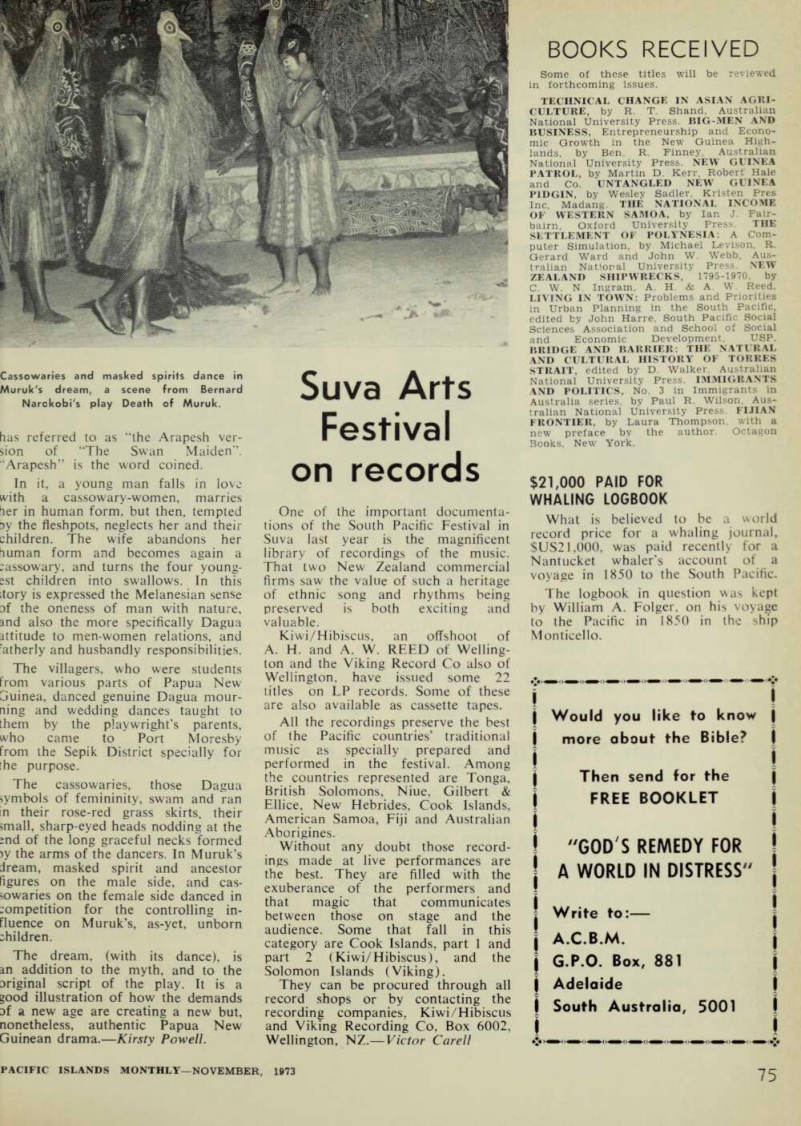
Continues
In Png
Here in Port Moresby we had be gun to fear that the “first fine care less rapture” of Papua New Guinean theatre had dwindled into silence.
But two recent successful productions have allayed our fears. And the prospects for the rest of 1973 look hopeful, with the Third Niugini Festival of Arts in Port Moresby get ting under way as I write.
Sogeri High School’s production of Russell Soaba’s Scattered by the Wind brought out strongly the theme of the blending of old and new, village and city, in modern Papua New Guinea.
The lyrics, set to haunting Anuki tunes, were sung by a very with-it looking group of young men and women dressed in slick flares and singlets, who, between-whiles, did cool, jazzy, mod dances, rather sub dued in tone.
At the end of the play, their cool, urban dance alternated with the grass skirted bobbing and jogging of a Milne Bay traditional dance group, until, in a final scene, the lights went up on the whole stage, and on the two groups, and grass skirts and flares danced together in a symbolic blend ing of old and new, village and town.
I thought Eleanor Boyd’s interesting production over-emphasised this old new theme at the expense of the other principal theme of the play (which was better served by the UPNG perform ance of the same play at the First Niugini Festival of Arts in 1971): namely, the theme of humanistic pro test against the narrow rigidity of village Christianity. James, the protest ing son of a Papuan pastor has his counterparts all round the world. He rejects all labels, including the label Christian, and calls himself simply “a true dedicated human being” using language that sets up Existentialist echoes in western ears: “I am neither good nor bad, neither right nor wrong—l just simply am”.
If anyone thinks that in so Chris tianised a society as Papua New Guinea there is no place for modem, radical doubt, then he should read this play in Kovave (Nov 1972).
The second theatrical success of the year was Death of Muruk by Ber nard Narokobi. This is not a play about conflict of cultures or ideas: it is play which reasserts traditional Melanesian values. It is based on a Dagua myth which Margaret Mead
has referred to as “the Arapesh ver sion of “The Swan Maiden’’.
“Arapesh” is the word coined.
In it, a young man falls in love with a cassowary-women, marries fier in human form, but then, tempted ay the fleshpots, neglects her and their children. The wife abandons her liuman form and becomes again a cassowary, and turns the four young est children into swallows. In this itory is expressed the Melanesian sense af the oneness of man with nature, and also the more specifically Dagua attitude to men-women relations, and atherly and husbandly responsibilities.
The villagers, who were students from various parts of Papua New Guinea, danced genuine Dagua mour ning and wedding dances taught to them by the playwright’s parents, who came to Port Moresby from the Sepik District specially for the purpose.
The cassowaries, those Dagua symbols of femininity, swam and ran in their rose-red grass skirts, their small, sharp-eyed heads nodding at the end of the long graceful necks formed >y the arms of the dancers. In Muruk’s dream, masked spirit and ancestor figures on the male side, and cas sowaries on the female side danced in competition for the controlling in fluence on Muruk’s, as-yet, unborn children.
The dream, (with its dance), is an addition to the myth, and to the ariginal script of the play. It is a good illustration of how the demands af a new age are creating a new but, nonetheless, authentic Papua New Guinean drama. —Kirsty Powell.
Cassowaries and masked spirits dance in Muruk's dream, a scene from Bernard Narokobi's play Death of Muruk.
Advertisements & other items, p. 82 (1 item)
lhau 'k LLju^Jh
fi&tJw' /S Msmts arn^f
/S&o^cf£
f?
lhau 'k LLju^Jh
ffarks# 75outyuA&>
w,*s Just dial a different angle until the nib position is exactly how you want it.
Your fingers rest in the curved grip of a Parker 75; so you write relaxed.
Fill up from an ink bottle, or load with a special Parker cartridge. It has a 'tap tank in reserve, for up to 700 more words after you think your ink's run out!
Every Parker 75 passes 792 inspections before you see it. Sterling quality, so it's sterling silver. Or rolled gold, or Vermeil which is 14 ct gold on silver.
+PARKER
Maker of itie world'* moit warned pens - «. X
on records
Suva Arts Festival on records
One of the important documenta tions of the South Pacific Festival in Suva last year is the magnificent library of recordings of the music.
That two New Zealand commercial firms saw the value of such a heritage of ethnic song and rhythms being preserved is both exciting and valuable.
Kiwi/Hibiscus, an offshoot of A. H. and A. W. REED of Welling ton and the Viking Record Co also of Wellington, have issued some 22 titles on LP records. Some of these are also available as cassette tapes.
All the recordings preserve the best of the Pacific countries’ traditional music as specially prepared and performed in the festival. Among the countries represented are Tonga, British Solomons, Niue, Gilbert & Ellice, New Hebrides, Cook Islands, American Samoa, Fiji and Australian Aborigines.
Without any doubt those record ings made at live performances are the best. They are filled with the exuberance of the performers and that magic that communicates between those on stage and the audience. Some that fall in this category are Cook Islands, part 1 and part 2 (Kiwi/Hibiscus). and the Solomon Islands (Viking).
They can be procured through all record shops or by contacting the recording companies, Kiwi/Hibiscus and Viking Recording Co, Box 6002, Wellington, NZ. —Victor Carell
Advertisements & other items, pp. 83-84 (1 item)
Books Received
Some of these titles will be reviewed in forthcoming issues.
TECHNICAL CHANGE IN ASIAN AGRI-
CULTURE, by R. T. Shand. Australian National University Press. BIG-MEN AND BUSINESS, Entrepreneurship and Economic Growth in the New Guinea Highlands, by Ben. R. Finney. Australian National University Press. NEW GUINEA PATROL, by Martin D. Kerr. Robert Hale
and Co. UNTANGLED NEW GUINEA
PIDGIN, by Wesley Sadler, Kristen Pres
Inc. Madang THE NATIONAL INCOME
OF WESTERN SAMOA, by lan J. Fairbairn, Oxford University Press THE
SETTLEMENT OF POLYNESIA; A Com-
puter Simulation, by Michael Levison, R.
Gerard Ward and John W. Webb, Australian National University Press NEW
ZEALAND SHIPWRECKS, 1795-1970. by
C. W. N. Ingram, A. H. & A W Reed.
LIVING IN TOWN: Problems and Priorities in Urban Planning in the South Pacific, edited by John Harre, South Pacific Social Sciences Association and School of Social and Economic Development, USP.
BRIDGE AND BARRIER: THE NATURAL
AND CULTURAL HISTORY OF TORRES
STRAIT, edited by D. Walker, Australian National University Press. IMMIGRANTS AND POLITICS, No. 3 in Immigrants in Australia series, by Paul R. Wilson. Australian National University Press. FIJIAN FRONTIER, by Laura Thompson, with a new preface by the author. Octagon Books, New York.
$21,000 PAID FOR
WHALING LOGBOOK
What is believed to be a world
record price for a whaling journal,
SUS2I,OOO, was paid recently for a
Nantucket whaler's account of a
voyage in 1850 to the South Pacific.
The logbook in question was kept
by William A. Folger. on his voyage to the Pacific in 1850 in the ship
Monticello.
Would you like to know more about the Bible?
Then send for the
FREE BOOKLET
"GOD'S REMEDY FOR
A WORLD IN DISTRESS"
Write to: —
A.C.B.M.
G.P.O. Box, 881 Adelaide South Australia, 5001
I EPIGLASS
Why choose
Epiglass marine products
for your boat?
I 'V 404 PS POlyeSt# resin v !)() ’^'hardenef *•» Epiglass gives you the biggest range of marine glues, fillers, preservatives, resins, skinning systems and paints going. The biggest... and the best.
Laboratory tested - and proven in the water on thousands and thousands of boats! That's why you can buy Epiglass products with complete confidence.
If it’s Epiglass, it will outlast all others. Just ask the man who uses Epiglass! from 7ft to73ft I epiglass power or sail For further information contact Consolidated Chemicals Limited, P.O. Box 15-104, New Lynn, Auckland, New Zealand.
PACIFIC AREA DISTRIBUTORS
COOK ISLANDS Cook Is. Trading Corp. Ltd NORFOLK ISLAND Irvine Bid,Supply Centre FIJI Burns Philp (SS) Co. Ltd PAGO PAGO Max Haleck Inc.
NEW GUINEA Bougainville Marine Pty Ltd Kieta TAHITI Tahiti Sport Burns Philp (NG) Ltd Madang TONGA Riechelmann Bros.
Elvee Trading - Pty Ltd Rabaul WESTERN SAMOA Burns Philp (SS) Co. Ltd Faulkner & Tait (NG) Pty Ltd Lae E. A. Coxon Ltd S.A. Heath &Co Pty Ltd Pt Moresby Gold Star Transport Co. Ltd NEW HEBRIDES Burns Philp (NH) Ltd Morris Hedstrom Ltd NOUMEA Guy Limousin SOLOMON ISLANDS George Yee Fai Ltd Pacific Yachting 598
pacific Transport
Jets Over Tonga-On
A Wing And A Promise
The opening of Tongatapu’s new sealed 6,400 ft international airstrip in early October means the ad vent of jet services for the kingdom, plus a new era in international con nections which may cut across pre sent alliances.
Tonga is now on the threshold of operating its own international char ter services, and it may soon follow with a bid for a regular international airline of its own.
The new international strip, tarmac sealed on coral, crosses the existing 4,800 ft grass strip at Fua’amotu, and will allow Air Pacific’s BAG 1-11 to make connections from Suva. Ai r Pacific has been operating 748 s on this run, and anxiously awaiting the completion of the strip, which has been behind schedule.
But Tonga now has its eye on the possibility of becoming its own inter national carrier.
If it does, it’s likely to be the only one flying on a wing and a promise.
Out of the blue in August came an offer of a Boeing 8737 twin pas senger 100-seater jet aircraft from a Japanese millionaire philanthropist, 74-year-old Mr Ryoichi Sasakawa, who visited Tonga early in August.
He liked what he saw and, later, bearing out a statement he made that his only hobbies were work and sharing what he has with other peo ple, he offered King Taufa’ahau Tupou a twin jet. All Nippon Air lines, of which Mr Sasakawa is a director, is ordering several new pla nes. As a multi-millionaire it was easy for Mr Sasakawa to say, “Put one in for Tonga”.
The king doesn’t think he will have to wait long for the gift. He thinks it may arrive before the kingdom is really ready for it, but negotiations are to begin soon with two, as yet un-named, overseas airlines which might be interested in building more hotels in Tonga. Outside help will also be sought over creating an inter national airline.
Meanwhile, its internal airline,
operated by the Tonga Tourist and Development Co Ltd, is currently tak ing delivery of a Beechcraft Baron 58, able to take five passengers plus pilot, to augment its present 10-seat er Britten-Norman Islander and Piper Aztec aircraft. The Aztec is tem porary and will be replaced at the end of the year by another Islander.
The Beechcraft will be available for charter operations from Vavau, Tonga’s northern group, to Pago Pago, Apia, Niue, and Nadi and Nau sori in Fiji. Vavau’s present strip is 2,300 ft although there are plans to extend it to 4,800. The only other airstrip in Tonga, apart from Fua’amotu, is on the big southern island of ’Eua, which is also 2,300 ft long and which will be operated in No vember. Work will shortly begin on a 2,200 ft strip for the central group of Tongan islands, Haapai, on that group’s main island of Lifuka, which
should be finished by February.
Tonga Tourist and Development Co has the rights to service these strips.
The international charter opera tions will be especially valuable, be cause the same organisation operates the first-class Vavau resort hotel, Port of Refuge, which has been suf fering from lack of clients because of the inadequate air services to date. Present connection is a daily flight from Nukualofa, but as Nukua lofa has not had its jet strip operating, passenger traffic into Tonga has been only a fraction of what it could be.
Both Air Pacific and Polynesian Air lines are encouraging more traffic on the run with cheap “Pacific Triangle” fares connecting Fiji, Western Samoa and Tonga.
Direct services into Vavau par ticularly from the Samoas will mean an additional increase in the traffic.
The hotel group also has a licence to build a resort hotel at Ha’atafu beach, on Tongatapu, and hopes to start construction before December and complete the first stage by 1975.
First stage is 96 bedrooms in what will eventually be a 162-bed hotel in competition with the Nukualofa Dateline Hotel for resort hotel visitors.
Obstacles not planes
on Lae's new runway
Plans for a new airport at Nadzab (up the Markham Valley road outside of Lae) may be shelved if the Papua New Guinea Government can b e persuaded that other projects should have priority. A suggestion to post pone starting work on the new air port has been made by the Coombs Task Force, Australian Prime Minis ter Gough Whitlam’s bunch of ex perts on whose recommendations the 1973-74 Budget was based.
The plan, approved by Parliament in October, 1972, is to provide a new airport, including runway, taxiway and apron works, roads, car parks, engineering services and terminal buildings, plus operations and main tenance accommodation.
The cost has been put at $l.B mil lion for 1973-74, $1.9 million in
1974-75 and $150,000 in 1975-76.
The airport will be one of Aust ralia’s contributions to developing PNG transport facilities.
The existing airport at Lae is suit able only for medium-range aircraft and daylight operations. Other draw backs are a noise problem, especially for the local hospital, and the lack of available land for developing an cillary services. The airport’s critics also allege that it is interfering with the “orderly development of the town.”
Apart from these problems at the existing site, the task force pointed out, it was argued in support of the new project that, in time, Lae would become the second major centre in Papua New Guinea and would need a first class aerodrome.
Continental assured support
Continental Airlines will continue as the national carrier for the US Trust Territory under an amended franchise.
The new agreement will remain in force till August 2, 1978, after which it will be automatically renewed for four additional periods of five years each. Either side may end the agree ment at six months’ notice.
With a virtual assurance of of ficial support for 25 years, Continen tal is in a happy position for forward planning. The TT Government is obliged to “assist and support” Con tinental in efforts to operate to other countries from the Trust Territory.
The immediate significance of this provision is that Continental is one of three airlines seeking rights between Saipan and Japan. But a TT Govern ment spokesman refused to confirm or deny the agreement had the effect of putting the government on record in support of Continental’s bid.
The agreement takes away Con tinental’s tax free status. In return, the government has freed the airline from carrying civil servants on official busi ness at a discount. The airline was wil ling to continue offering the discount, provided the Civil Aeronautics Board agreed. However, the government felt the benefit to the territory through Continental’s new liability to the gross business receipts tax would more than offset the loss of the discontinued fares.
Continental is not now obliged to build six hotels, one in each district as under the old agreement, it more than met its obligations in providing hotel rooms. It built hotels in Truk and Palau districts and is building one in Saipan. It has spent more money and provided more rooms in these hotels than it was required to provide in the six hotels. The Mar shalls, Ponape and Yap districts will not now have Continental-owned hotels.
But the airline has agreed to train Micronesian management staff for any Micronesian-owned hotel.
The agreement records that the airline has exceeded the minimum level of scheduled air services re quired and that it has spent more than the required 6 per cent of pass enger revenue on tourism promo tion.
Shipping Additions
Sofrana-Unilines has bought a ship from Japan for the Australia-Pacific Islands trade. The ship, to be named Capitaine La Perouse, is being re
fitted, and will arrive in Australia about the end of November.
Meanwhile, two ships, the Jette Bue and the Gamma, which Sofrana had under charter, have been returned to their Danish owners.
The schedules for two Sofrana ships servicing Fiji from Australia have been slightly altered. The Cap tain Cook now leaves Melbourne every 28 days, and the Captain Bou gainville leaves Sydney every 28 days.
Two new ships in the Bank Line will be used to replace some of the smaller tramps used to carry copra and coconut oil from the Pacific Islands to Europe. These ships, the Corabank and Meadowbank, each 15,240 tonnes (15,000 tons), are the first of 10 new multi-purpose ships for the Bank Line world-wide tramp services.
Each ship is able to load 252 6.096 metre (20 ft) containers.
Pal Is Now
On Its Own
Tonga, Western Samoa and Fiji have decided to release Air Pacific from its responsibility to manage Polynesian Air Lines, provided there is a firm arrangement for regular con sultation between the two airlines.
Ministers from the three countries, responsible for air matters, decided this at a recent meeting in Nukualofa.
The ministers discussed a paper
from President Hammer Deßoburt, of Nauru, about Nauru’s partici pation in Air Pacific. They agreed to defer a decision about Nauru to a meeting, to be held soon, of minis ters from the UK, Australia and New Zealand, as well as the island coun tries. The ministers also deferred a request from President Deßoburt for a refund of Nauru’s capital sub scription in Air Pacific.
Tonga's Ships
In The Red
Tonga’s Pacific Navigation Com pany had an audited loss of 172,590 from May 8, 1972 to June 30, 1973.
Some ships showed a profit. The act ing Finance Minister, Dr Sione Tapa, in reply to questions in Parliament, gave details as follows for each ship.
Loss —Tauloto I (from May 8, 1972, to March, 1973), $94,430; Hifofua, $22,470; Pakeina, $31,760; Fonualei, $3,960; Fangailifuka, $430.
Profit —Tauloto II (December, 1972 to June, 1973), $28,530; 01ovaha, $15,550; Niuvakai, $14,300; Aoniu, $8,060; Ulufonua, $4,620.
As part of a long-range plan for a regional shipping service, Tonga has swapped the agency in Australia for the Pacific Navigation Company from Burns Philp to Karlander (Australia) Pty Ltd.
According to Burns Philp, Tonga made the change as the result of a study by members of the South Paci fic Forum of plans for a regional shipping service. The plans drawn up an Australian adviser specifically named Karlander (see p 79).
Full shipping hire service

A ship hire service will soon be available in the South Pacific leasing container ships, containers and cranes to shipping companies. The services will be offered by an Australian sub sidiary of Sea Containers Inc, of which Mr Arvid Rasmussen, of Syd ney, will be managing director.
Mr Rasmussen was traffic manager of Karlander in Sydney for four and a half years and resigned to take up his new position on September 1.
Sea Containers Inc is already in the South Pacific. It chartered the Tarros class container ship, Union South Pacific, to the Union Steam Ship Co of NZ Ltd, to operate a container service from Auckland to Fiji and Samoa, The Union South Pacific, by the end of August, had made four trips to Suva, Lautoka, Apia and Pago Pago. According to a USS Co spokes
man in Sydney, physically it is work ing well. However, the company still has to work out the economics of the operation before making any decision about extending the charter of the Union South Pacific, or chartering an additional Tarros ship. But it is satisfied with the speed at which the ship can unload—eight containers an hour. One small problem at present is a shortage of containers.
The Sea Containers Inc group owns 17 container ships of various sizes, and all are on lease. It has close to 40,000 containers, and four shore-side container cranes out on lease.
Sea Containers Inc is a United States company, of which the Austra
lian operation, covering Australia,
New Zealand, Papua New Guinea and the South Pacific, will be a subsidiary.
It has a new ship building programme in progress.
Franspac Under
Congress Fire
Transpac Lines Inc is not providing jatisfactory services to the US Trust Ferritory from Japan and the US west eoast, allege US TT parliamentarians.
Both Houses of Congress are in stigating the services by their com nittees on resources and develop ment. Mr Sasauo Haruo, of Truk, ehairman of the House of Representa ives Committee, said after a recent oint meeting of the committees, there lad been a steady decrease of service md a steady increase in shipping eosts in Micronesia since the creation }f MILI, which was later reorganised nto Transpac.
All terminal operators in the Trust Ferritory have been asked their opinions about improving the services.
Fhe United Nations Economic Com mission for Asia and the Far East las been asked to supply a shipping eonsultant to Congress.
Mr Polycarp Basilius, of Palau District, a member of Mr Haruo’s eommittee, was also critical of Trans pac services. He said his district egislature had adopted a resolution expressing dissatisfaction with the Franspac services.
“According to the information I now have, it would appear that to
protect the best interests of all the people of Micronesia, Transpac should be dissolved, and either a new company or a new organisation should be allowed to provide shipping ser vices to our people,” he said. “The present situation is more than just a crisis—it is a disaster.”
Integrated
Shipping
The pattern of shipping in the Paci fic Islands in the future will depend to a large extent on a number of in depth studies and conferences. For many years shipping services within and between Island groups have been haphazard. Services to the Islands from metropolitan countries have not given full satisfaction, although they have been better organised, and run to some sort of schedule.
Positive steps so far include the regional Pacific shipping conference in New Zealand in October, although the Enna G dispute created some pre conference bitterness. A report has been prepared by an Australian ship ping expert about the operational and financial structure of a regional ship ping line for the South Pacific Bureau of Economic Co-operation
(Spec).
This report may not be distributed till it has been cleared by the South
Pacific Forum, which will not meet till April.
One of its recommendations is that Karlander Pty Ltd be involved as a spearhead in a regional shipping line for the South Pacific.
There has also been a United Na tions Conference on Trade and De velopment survey. This covered a wider area than the report on the re gional shipping line. Discussions about the latter, initially, covered Fiji, Western Samoa, and Tonga.
Two Pacific Islands governments, Nauru and Tonga, already operate shipping lines covering a number of groups and territories.
The 13th South Pacific Conference at Guam discussed sea and air trans port during a debate about th e UNCTAD survey. Guam called for an extensive study to set up an “effi cient, economic and integrated sys tem covering the entire Pacific area”.
The proposal noted that member governments had done little about orderly transport; existing systems were inefficient, uneconomical and cumbersome.
Most speakers confined their re marks to shipping as it was generally agreed that air transport matters should be dealt with on a govern ment-to-government basis.
Mr W. Hussey, speaking on behalf of UNDP (United Nations Develop
lent programme), said a number of had been received to investi ate port and harbour facilities.
The speakers were concerned more /i t h broad outlines of transport ather than in getting down to de ail. No doubt that will be left to the xperts. The Pacific Islands have one riceless asset in shipping—an abun ance of natural raw material to turn ito efficient seamen.
The conference did not vote on the Juam proposal. Instead it referred ; to the 14th Conference, when the PEC report and the UNCTAD sur ey will be discussed.
Apanese Eyes
>N Madang
A Japanese company, Kambara Lisen Co, is believed to be interest d in setting up a ship-building corn lex at Mililat Harbour, Madang.
"h e company operates the cruise hip, Tropical Rainbow.
The PNG Government’s Madang irban study, of 1972, listing possible >ort locations, said Mililat was bigger han Nagada. However, it had nayi ;ation problems because larger ships yould have to approach through waters dotted with islands and reefs.
The shoreline was also uneven, vhich would make straight lengths >f wharf face expensive to construct.
Advertisements & other items, pp. 87-88 (1 item)
tropic or temperate climate —Fibreglass Refrigerated
units by George & Ashton exceed requirements George and Ashton moulded fibreglass refrigerated units are unaffected by rust, rot, fatigue, weathering or corrosion. No joints to harbour vermin, so cleaning is easy. Used for any type of vehicle or as static storage units. Any size units can be supplied assembled or in prefabricated sections for easy shipping and erection on site.
Approved by N.Z. Depts of Health and Agriculture.
GEORGE &
ASHTON
P.O. Box 2056, South Dunedin, New Zealand.
Phones 54-108, 54-109 George & Ashton (P. 1.) Ltd, Box 296, Suva, Fiji.
Phone 26-249.
FIJI MEATS
W form The Fiji Meats unit illustrated is the second supplied to this Company
Take flight with
Pan Am’sßig Bird
Three times every week a Pan Am 747 takes off for the world. Three times every week you have the chance to escape to just about anywhere in the world you feel like escaping to.
Every Sunday, Tuesday and Thursday Pan Am has a morning flight to Australia. And an evening flight to the U.S.A. and Europe. And because Pan Am takes care of everything, on the ground and in the air, all you have to worry about is where you want to go.
You'll enjoy all the comforts that have made Pan Am's Big Bird famous.
But it's the extra things you'll really appreciate. Extras like Pan Am’s world wide connections and extensive services.
Extras like immediate connections from Nadi to Suva. And extras like the U.S.A.
The U.S.A. where you can take a stopover on the way to London. A night in Los Angeles or San Francisco for $lO. See the sights and enjoy a good night's sleep before continuing on Pan Am's Polar route to London.
So if you're thinking of taking a flight ask your travel agent about Pan Am's Big Bird and wing your way to the world.
Every country has an airline.
The world has Pan Am.
Nadi: Nadi Airport 72.100 Suva: 38 Thompson Street 22.641 250.P.M
Enna G tiptoes out of NZ

From Kathleen Hancock In
Wellington.
There was a subdued bustle aboard Nauru’s Enna G in Wellington in Sep tember. With the arrival of Captain D. J. Ball, now acting marine super intendent for the Nauru Pacific Line, and five officers, work in getting the ship back into service got under way.
However, mouths were buttoned up tight as to the rights and wrongs of the Enna G dispute.
Captain Ball said he could not comment, but a crew member said, “We feel as if we’re walking on a crate of eggs”. No one wanted any more trouble in Wellington. All they wanted to do was to get the pride of the line back to sea and into action.
In Wellington, interest in the ship flared again as preparations for the Enna G’s departure for Melbourne progressed under the command of Captain Jim Brunton, with a crew of Nauruans and Solomon Islanders.
A NZ television feature, Joe Cote’s documentary on Nauru was well-timed and produced some in teresting comments from both Nauru ans and Kiwis working on the island.
Nauruans reckoned that the pros pect of competition with New Zea land shipping was at the bottom of the trouble, which was reported to have cost Nauru more than $200,000, including a payment of $51,566.18 to have her released from a writ of arrest for debt. The payment was made to William Cable Ltd. Th e Naurans on Cote’s documentary said that the NZ awards were based on NZ conditions and living standards and were not applicable in their area.
New Zealanders working in Nauru said that NZ had a big responsibility to the Island territories. The N Z image had been damaged, and Nauru considered its efforts to provide work for the future when the phosphate industry dries up had been sabo taged.
Ashore in Wellington it was hard to get two stories that tallied on the initial cause of the hold-up. But one crew member said, “PlM’s August editorial just about hit the nail on the head”. The secretary of the Wel lington Seamen’s Union, Mr Toby
Hill, thought otherwise. He said that the dispute only arose when the Fijian seamen approached the union, which referred the whole matter to the wide-ranging Maritime Union.
The Minister for Island Affairs, Mr Amos, put it a bit differently. He said it had simply been a matter be tween the Fiji unions and Nauru. in Wellington the view is that the Enna G is unlikely to go on to the Auckland-Pacific Islands run, which badly needs the service.
The Enna G left Wellington on September 20, 118 days after it had tied up, for Melbourne. It sailed from Melbourne on October 6 for Nauru under the command of Captain Ball.
Captain Brunton returned to the Eigamoiya as master after the arri val of the Enna G in Melbourne.
The Enna G issue was expected to be hotly debated at the regional ship ping conference at Waitangi, NZ, on October 27 and 28. Before that she was the subject of questions in Par liament. The Minister of Labour, Mr Watt, said the NZ Government did not pay to settle the dispute. He said only the parties concerned could re lease details of the settlement.
Present plans are for the Enna G to resume its Pacific Islands cruising from Sydney—taking in Noumea, Vila, Suva, Pago and Apia, among other ports.
Nauru Pacific Line’s Hydra has been transferred to the Australian- Fiji-Samoa service. She was previously on the Australian-Papua New Guinea run, but sufficient cargo was not available. The Eiga moya will now go on this service, but will omit Port Moresby. After calling at New Guinea ports the Eigamoya will carry on to Guam and Nauru.
The Hydra is on charter from Nor way. The last charter expired at the end of June, after which she was chartered for another seven months.
Airstrip For
Lord Howe—Maybe?
An airstrip, about 3,000 feet long will be built at Lord Howe Island between January and May, 1974, pro vided the Australian Prime Minis ter Mr E. G. Whitlam, approves a request by the NSW Premier, Si r Robert Askin, for the Australian Army to do the job. With the army laying the strip the cost will fall con siderably—to about $750,000 from the $2.6 million which was talked about for several years.
The strip will be built entirely on land, and will involve the relocation of only four homes.
The airstrip will be capable of handling smaller twin-engined air craft like the Cessna and the Nomad.
The Tourist Board hopes that Air lines of NSW will continue the flying boat service till the strip is ready to take aircraft.
Airlines of NSW ran two special flying-boat services from the island on October 7 to bring back to Sydney about 80 holidaymakers who had been stranded there because of the strike by Sydney Airport technicians.
Earlier the airline had made tentative arrangements to divert a liner to the island to pick up the passengers.
Beating
The Curfew
American Airlines, on October 28, changed the routing and time of some flights into Australia from the US mainland because of the start of day light saving in New South Wales and Victoria, and the need to comply with the 11 pm curfew at Sydney airport.
The Friday and Sunday flights will overfly Nadi to arrive and terminate at Sydney at 10.25 pm. One weekly flight into Melbourne will still stop at Nadi as there is no curfew in Melbourne and, consequently, no need to make up time. On Wed nesdays, a flight from Honolulu will stop at Nadi on the way south, and is scheduled to arrive at Sydney at 10.15 pm.
On Tuesday northbound flight out of Melbourne is now diverted through Sydney, and overflies Nadi on the way to Honolulu.
Dockworkers' Gains
At Port Moresby
Port Moresby Watersiders have made some major industrial gains, chief of which is a rise of 8c an hour.
Other gains are three weeks’ paid annual leave, 20 per cent dirt money and 10 minutes tea break.
An arbitration tribunal handed down the new award late in Septem ber after hearing claims by the Cen tral District Waterside Workers’
Union and representations from the Employers’ Federation of PNG on rates of pay and employment. The union had asked for a rise of 14c an hour for casual workers and 16c for winchmen and hatchmen, a daily minimum pay of four hours, and a 15 minute tea break for casual em ployees.
Casual workers will be paid for at least two hours’ work if the work finishes within two hours of starting.
The union also asked for a work ing week of 40 hours (44 at present) and for sick leave to 10 days. The tribunal rejected both claims.
The chairman, Mr R. Maro, said: “We believe that employees will be much happier and more settled if
they receive a regular, known wage.
This means we believe as many em ployees as possible be made per manent”.
The tribunal did not fully accept that workers needed three weeks annual leave to visit their families; they needed it for rest and recreation.
The working week could not be re duced from 44 hours because of the likely effects on the economy.
The award requires the employer to give absolute priority to the em ployment of registered casual work ers, provided they are at the pick-up centres at the required time, and that work is available. The award came into force on October 1 and will last for a year.
In Fiji, the Dockworkers' and Sea men’s Union, after being deregis tered because it had failed to keep its accounts as required under the Trade Unions Ordinance, formed another union, styling it the Fiji Waterside Workers’ and Seamen’s Union, with Taniela Veitata, sec retary of the old union, unanimously elected secretary. This new union takes in the Fiji Maritime Workers Union, which was formed after de registration of the Dockworkers’ and Seamen’s Union.
The treasurer of the new union, Manueli Raivasi, who was also treasurer in the deregistered union, said after the meeting the union wan ted to set up a regional shipping line.
It already had a ship in mind, cost ing $25,000.
Solomons' Fleet
Earned $380,000
The BSIP Government fleet steamed 582,581 km (362,000 miles) in 1972, with an average load of just over nine passengers and 2.54 tonnes (2J tons) of cargo on each ship each trip. The fleet earned more than $380,000.
Another new ship, the Wataro, a sister ship of the Wango, was commis sioned in May, replacing the Mary, which was withdrawn pending a de cision about her future. Two other ships, the Wakio and the Wagina, are being built and should be in service early in 1974. A new landing craft, to replace the Vonu, is on order in the UK.
The introduction of the Mark worth Shipping Co’s Regina M made a big impact on passenger services to the west of the group, and set a new standard of comfort for deck passenger travel.
The BSIP Marine Department sur veyed Onebia, Kira Kira, Waimasi, Suuomoli and Suulopo harbours.
Many beacons and lights damaged by Cyclones Carlotta and Ida have been, or are being, repaired.
Advertisements & other items, pp. 89-92 (1 item)
at its best...
For
RUM
say
OVERPROOF AND UNDERPROOF
In 5 oz. and 13 oz. flasks and 26 oz. and 40 oz. bottles.
BLENDED AND BOTTLED BY JOHN WALKER & SONS LIMITED.
V 36
Its every word is
crystal clear.
:-0 1 -
SSB 025
HHi
ACiTROIM
You won’t miss a word with this fully solid state Acitron 558025 transceiver. The crystal stability combined with the special ‘noise blanker’ ensures maximum clarity at all times.
It operates in the frequency range of 2-12 MHz and is ideal for long range communications.
Operation is simplicity itself.
The transceiver is particularly compact and light but it’s tough too. Takes any amount of handling whether in mobile, portable or fixed station use.
The Acitron 558025 is designed and made by ACI Electronics in Australia to R 8209 and fully backed by service. Like to know more? Then mail this coupon for a technical brochure.
I ACI ELECTRONICS,
310-324 FERNTREE GULLY ROAD,
CLAYTON NORTH, VICTORIA, 3168.
Please send me technical details of your Acitron 558025 I transceiver. * Name: ...
Company position:
I c I
Company name: Address:
I Postcode: i
I —. — \ m &
A.C.I. Electronics
Now AIR NEW ZEALAND DC-lO’s
are really going places.
MORE PLACES MORE OFTEN.
AIR NEW ZEALAND expands DC-10 Pacific destinations. Wide-bodied DC-10 routes now cover Auckland, Christchurch, Melbourne, Sydney, Singapore, Fiji, Tahiti, Honolulu and Los Angeles.
Your travel agent has all the details Official International Carrier to the |fcl»Xth British Commonwealth Games i9M
air new z
WE A FIE THE PACIFIC
ANZ 182
Cruising

Yachts
• VALIANT, a 40 ft ketch, arrived at irotonga on September 3 from Honolulu id Tahiti with Mr Verne Bixby, s wife, Bonnie, and their two lildren, Wendy and Bradford. The Bixbys >ught Valiant last December, left Hono lu in June and arrived at Tahiti three eeks later. Mr Bixby is a physics teacher the Kamehameha Boarding School Hono lu, which has 1,500 Hawaiian students. » is on 12 months furlough during hich he is carrying out research on )lynesian countries. Plans were to call American Samoa, Tonga, Fiji and New ‘aland, returning to Honolulu next ■ptember. • RAVENSONG, a 40 ft cutter, arrived Rarotonga on September 4 from Cali rnia, Papeete, Huahine, Raiatea, Tahaa id Bora Bora. On board were surveyor ;nnis Brown, his wife, Eva, a journa t, their son Stephen, and friends Robert id Karen Arris and Tom Wyneken. essrs Aris and Wyneken are also jour ilists. They intend sailing to New Zea nd. • ARCHIV, 29 ft steel sloop, arrived Rarotonga on September 5 from ipeete with owner-skipper Warwick Bain id crew John Gauntlett and Jenifer Hop ood. All three are Britishers and the icht is registered at Cowes, Isle of ight. Archiv was built in Holland about ! years ago and left England in Septem ir last year on her present voyage. It planned to call at Tonga, Fiji and New ‘aland. • YANDA, 35 ft steel-hulled sloop, so arrived at Rarotonga from Papeete i September 5 with owner-skipper Peter ransky, his wife, Robyn, and their two lildren, Rachel aged 10 and Andrew, 8. >ey are Australians and started their >yage from Holland to Australia three *ars ago. They will sail to Sydney with ills at Tonga and Fiji. Yanda is re stored at Sydney.
• VAHINE, 26 ft sloop, arrived at Rarotonga from Bora Bora on September 7 with Ortwin Ahrens and his wife, Elli. The Ahrens started their cruise from Hamburg, Germany, and ports of call included the Canary Islands, West Indies, Panama, Galapagos, Marquesas, Tuamotus and Society islands. Plans were to visit Niue, the Vavau Group in Tonga, Fiji and New Zealand. • FIONA, a 42 ft ketch from Poole, England, arrived in Port Moresby on September 8 from the New Hebrides.
After a week's stay, Jo Menell and Brian Mcgarry sailed for Singapore, Vietnam.
They plan to sail to Shanghai, Vladivostok and Murmansk.
• AOTAHI, a 40 ft fibreglass slop from Auckland, with skipper, Hal Con way wife, Elaine and crew Brian Wyatt, Beth Ellingworth and Steve Durney ar rived in Port Moresby from Cairns on September 29. After a short stay, Aotahi sailed for Samarai the north coast of New Guinea then on to Indonesia. • ALAUNTO, 33 ft trimaran, arrived at Rarotonga from Bora Bora on Septem ber 11 with San Franciscan owner-skipper Don Schmidtkev and wife, Caroline. Mr Schmidtkev, a schoolteacher, took five years to build the tri which he sailed from San Francisco last November, calling at Mexican ports and the Marquesas. Plans were to spend some years teaching in
Jew Zealand after calling at Aitutaki and pending the hurricane season in American amoa. • SANTA LENA, 30 ft motor yacht, vent on a reef off the Nadroga coast of iji late in September. She was later owed to Suva for inspection. The owner, 16-years-old Ted Warner, an Englishman, lad put the yacht on automatic pilot and lone below just before she grounded, he keeled over after the grounding, and he pounding from the heavy seas tore gaping hole in her side. Mr Warner “ft England in the yacht about four ears ago on a projected 10-year round he-world voyage from east to west. • ENSENADA, 27 ft Aitkens cutter i/ith owner-skipper Dave Croucher, /ife Flo and 11-year-old son Daniel, was i Gizo (BSIP) in September. From home iort Townsville in Queensland, the Touchers sailed to Lae and then visited inschhafen, Madang, Rabaul and Kieta. hey left Kieta on August 11, planning to ruise to Fiji via the Solomons and New lebrides but had two setbacks. The motor roke down and then, on reaching Gizo, lave had to go into hospital for three ays. Wife Flo, in a letter to PIM, wrote:" ince leaving Nila in the Shortland Islands /e've had the pleasure of sailing with nother yacht, RAMBLER 11, a 36 t Alden ketch, six years out f Berkley (California) owned and ailed by Dick and Ann Willis. Dick nd Ann are keen shellers and are looking Drward to meeting other shell collectors i their travels. They are also heading or Fiji."
O ASTRAEA, a 44 ft cutter, arrived t Rarotonga on September 18 from Bora ora with owner-skipper John Orr, his rife, Annette, their daughter, Penelope, nd relatives John Brooks and Lindsay rown. The family is from Hilo, Hawaii, istraea was built in Vancouver and was lunched in May, 1972. The leg from lawaii to Papeete was made in un sttled weather. Plans are to call at onga and New Zealand and to return d Hawaii in four years' time. • SEAFARER, a 65 ft gaff-rigged ketch, rrived at Rarotonga from Bora Bora on )ctober 9 with owner-skipper Andrew egal, his wife Wendy, their 2i year-old laughter, Darrian, and friend Jerry Jacobs, hey called at Hawaii, the Tuamotous and lost of the Society Islands. Plans were o sail to Russell in New Zealand's Bay f Islands and, eventually, to circum lavigate.
(Sk The Slocum
The Slocum Society, of Hilo
lawaii, offers an extensive range of
nformation for cruising yachtsmen,
t is a repository of information on ong-distance small boat passages, dembers may call on the society for dvice when planning cruises. Mem bership is open to all; offshore ex perience is not a requirement.
Advertisements & other items, pp. 93-96 (3 items)
85
LCIFIC ISLANDS MONTHLY—NOVEMBER. 1973
New Versatility...
FROM FURUNO
FRS-24
A highly reliable compact solid state radar for small craft.
Simple installation and maintenance. 7" PPI scope. With magnifying lens. 6 ranges (1/2 24n. miles). Automatic synchronization of display sweep and antenna rotation with no waveguide run between. Operates on DC 12, 24, 32 or 110 V. Low power consumption 160 W. 0 The future today with FURUNO's electronics technology.
FURUNO ELECTRIC CO., LTD.
9-52, Ashihara-cho, Nishinomiya City, Japan
CABLE: FURUNO NISHINOMIYA, TELEX; 5644-498
Turners and Growers
FRESH FRUIT & VEGETABLES
tfqnjil
iTT
MADE IN GERMANY
Petromax products exclusively available from:
Breckwoldt & Co.
Head Office: Hamburg / Germany 1111111 1| i^j > 4 m m 1 if rn m a P^Xlid our branches are: lll4VliT
BRECKWOLDT & CO. (N.G.) PTY. LTD.
P.O. Box 222, RABAUL.
PO. Box 1549, Boroko, PORT MORESBY.
P.O Box 185, MADANG
P.O. Box 1188, LAE.
PO. Box 72, KIETA.
P.O. Box 237, MT. HAGEN.
PO Box 178, WEWAK.
BRECKWOLDT & CO.
P.O. Box 47, APIA.
BRECKWOLDT & CO. (5.1.) LTD.
P.O. Box 140, HONIARA.
BRECKWOLDT S.A.R.L.
B.P. 65, NOUMEA.
PROJECTS ANY FLAT IMAGE (4" wide or less)
UP TO 6 FEET WIDE
AMAZING HOME THEATRE
Actual photo of this high quality projector— Size 12" x 8" mm as
1 FOR ONLY $l9
2 FOR ONLY $37
(plus 90c post and pack) (post free)
FULL GUARANTEE WITH EVERY PROJECTOR
Now . . . project a modest 4" wide illustration—and enlarge it monumentally up to 324 times its original picture area . . . breathtakingly sharp and clear! A x 3" illustration enlarges to 35" x 30" if screen is 6£ ft away from projector—larger picture if screen is further away. No films or negatives required. Projects anything flat —magazine or book pages, photos, diagrams, drawings, charts, coins, snapshots, postcards, stamps, etc. in crisp black-and-white or beautiful true-to-life color! Has adjustable professional-type lenses. Great fun for all ages—educational—safe— and simple to operate. But hurry! Special prices for limited time only! Agents who can stock a minimum of 6 of these projectors are required in all areas. Enquiries welcome.
TO: R. HALL, 19 MARK STREET, NEW FARM, BRISBANE, QUEENSLAND, 4005.
Please rush to me □ 1 Home Theatre Projector (I enclose $19.90) Q 2 Home Theatre Projectors (I enclose $37).
NAME ADDRESS
PIM 11/73
offers expert
insurance service
throughout
the Islands
QUEENSLAND INSURANCE
COMPANY LIMITED
(Incorporated 1886 in Australia)
Head Office: 82 Pitt Street, Sydney FIJI —Branch Office, Suva, Manager for Fiji: F. N. Davies
(A.A.LI.).
LAUTOKA—District Manager; U. Singh.
HONIARA (8.5.1. P.) —Breckwoldt & Company (5.1.) Pty.
Limited.
NEW CALEDONIA—T. A. Hagen, Ste. W. A. Johnston, S.A.R.L. —Noumea.
NEW HEBRlDES—Resident Officer: R. J. Allsop (A.A.LI.) Vila; Santo: Burns Philp (New Hebrides) Ltd.
TAHlTl—Arthur Chung: Immeuble 8.1., Front de Mer, Papeete.
NIUE, NORFOLK ISLAND, SAMOA, TONGA and other South Sea Islands—Burns Philp (South Sea) Company Ltd.
Assets exceed $75,000,000
QUEENSLAND INSURANCE(P.N.G.)LTD
PAPUA NEW GUINEA
Head Office, Port Moresby: Manager for Papua New Guinea: D. J. Granter.
District Managers at Rabaul: C. D. Dickings; Lae: R. Jackson; Mt. Hagen; G. F. Donnelly.
V 338
LA AU A The MANA section of Pacific Islands Monthly is to be published each year as a IYIMrjM-book by the South Pacific Creative Arts Society. As a society member you get your copy. Life membership of the SPCAS is $lOO Fijian or equivalent; foundation membership (good for three years) $25, ordinary membership $4 for those outside the islands served by the South Pacific Commission and $2.50 for those addresses within the islands. Send subscriptions to the Secretary, Box 5083, Suva, Fiji.
DUNLOP IBC: A SERVICE TO
ALL INDUSTRY
K 6* US* • Stops Squeaks • Protects Metal • Loosens Rusted Parts • Frees Sticky Mechanisms • Displaces Moisture.
Available in and 17 fl oi Aerosol Quart c< and 1 Gallon cans with dispenser.
jaBSCD
SELF PRIMING PUMPS
am m
"AQUA MAID"
AC and DC automatic water pressure system, g in. size. Capacity up to 220 gph. Water at the turn of a tap for boats, caravans, weekenders and small properties. 240 Volt AC and 6, 12, 24 and 32 volt DC models. Perfect for sinks, showers and washbasins.
Easily installed. $75.00 Plus 15 per cent Sales Tax Brisbane Prices FOB
"WATER PUPPY"
DC operated motor pump units, i in. size. Capacity up to 220 gph.
Available in 6, 12, 24 and 32 volt DC models. Very popular with boat, caravan and weekender owners. Ideal for sinks, shower, standby bilge pumps, bait tanks and deck washdown. Ready for easy connection to battery er DC power system. $53.00
REMEMBER OUNLOP/IBC FOR
• Bolts & Nuts, Screws • Tools —Hand, Electric, Garden • Engineering Supplies • Automotive Spare Parts • Machinery, Electrical Accessories • Steel Wire Rope, Tubing Abrasives • Pumping and Water Filtration & Swimming Pool Equipment • Builders' & Hardware Supplies. & i
DUNLOP
Formerly IBC/ESCA LTD
STATION ROAD, YEERONGPILLY, BRISBANE,
QUEENSLAND, 4105, AUSTRALIA.
QEI
TZZzz
/V.
LIGHT
WEIGHT
PORTABLE
SPRAY
PAINTING
OUTFIT
TZ-34 $75.50
(plus Tax)
87
ACIFIC ISLANDS MONTHLY—NOVEMBER, 1973
BritisKAirways PACIFIC JET
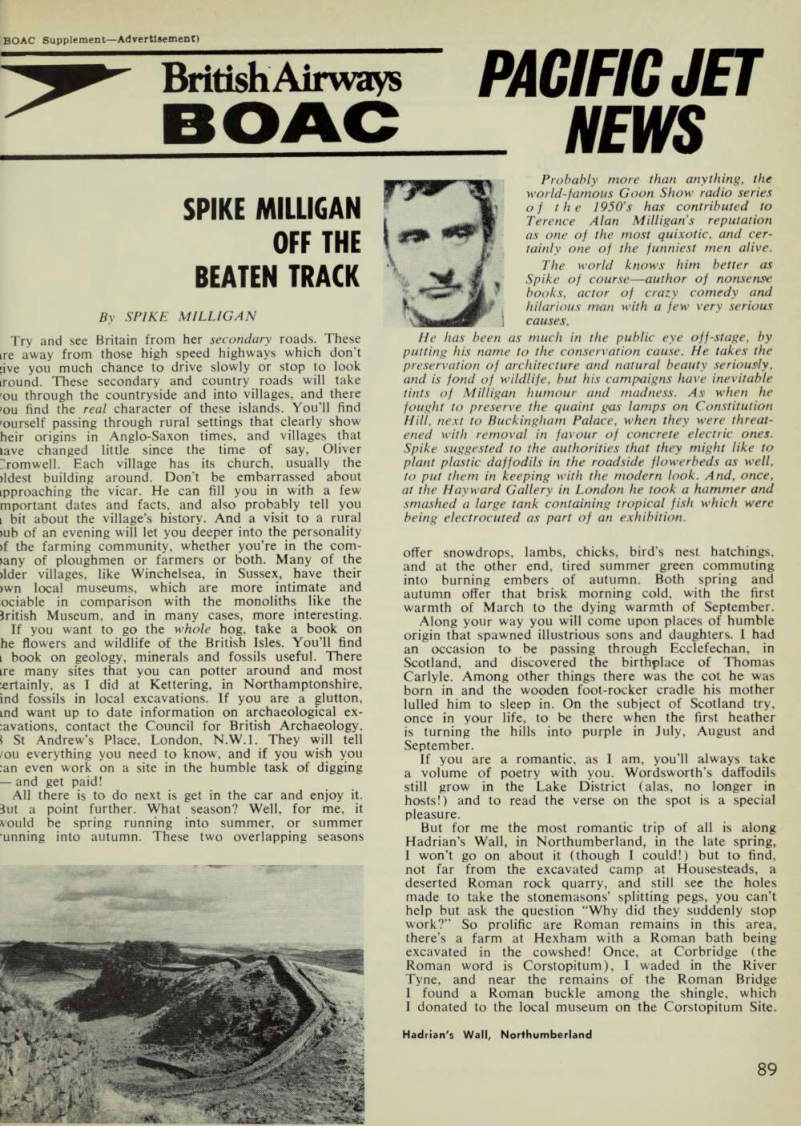
Boac News
Spike Milligan
Off The
Beaten Track
BOAC Supplement—Advertisement)
By Spike Milligan
Try and see Britain from her secondary roads. These ire away from those high speed highways which don’t ;ive you much chance to drive slowly or stop to look iround. These secondary and country roads will take r ou through the countryside and into villages, and there 'ou find the real character of these islands. You’ll find r ourself passing through rural settings that clearly show heir origins in Anglo-Saxon times, and villages that lave changed little since the time of say, Oliver Cromwell. Each village has its church, usually the >ldest building around. Don’t be embarrassed about ipproaching the vicar. He can fill you in with a few mportant dates and facts, and also probably tell you i bit about the village’s history. And a visit to a rural mb of an evening will let you deeper into the personality if the farming community, whether you’re in the com iany of ploughmen or farmers or both. Many of the ilder villages, like Winchelsea, in Sussex, have their >wn local museums, which are more intimate and ociable in comparison with the monoliths like the British Museum, and in many cases, more interesting.
If you want to go the whole hog, take a book on he flowers and wildlife of the British Isles. You’ll find i book on geology, minerals and fossils useful. There ire many sites that you can potter around and most certainly, as I did at Kettering, in Northamptonshire, ind fossils in local excavations. If you are a glutton, md want up to date information on archaeological ex cavations, contact the Council for British Archaeology.
I St Andrew’s Place, London, N.W.I. They will tell everything you need to know, and if you wish you can even work on a site in the humble task of digging and get paid!
All there is to do next is get in the car and enjoy it.
But a point further. What season? Well, for me, it vould be spring running into summer, or summer unning into autumn. These two overlapping seasons
Probably more than anything, the world-famous Goon Show radio series of the 1950’s has contributed to Terence Alan Milligans reputation as one of the most quixotic, and cer tainly one of the funniest men alive.
The world knows him better as Spike of course —author of nonsense books, actor of crazy comedy and hilarious man with a few very serious causes.
He has been as much in the public eye off-stage, by putting his name to the conservation cause. He takes the preservation of architecture and natural beauty seriously, and is fond of wildlife, but his campaigns have inevitable tints of Milligan humour and madness. As when he fought to preserve the quaint gas lamps on Constitution Hill, next to Buckingham Palace, when they were threat ened with removal in favour of concrete electric ones.
Spike suggested to the authorities that they might like to plant plastic daffodils in the roadside flowerbeds as well, to put them in keeping with the modern look. And, once, at the Hayward Gallery in London he took a hammer and smashed a large tank containing tropical fish which were being electrocuted as part of an exhibition. offer snowdrops, lambs, chicks, bird’s nest hatchings, and at the other end, tired summer green commuting into burning embers of autumn. Both spring and autumn offer that brisk morning cold, with the first warmth of March to the dying warmth of September.
Along your way you will come upon places of humble origin that spawned illustrious sons and daughters. 1 had an occasion to be passing through Ecclefechan, in Scotland, and discovered the birthplace of Thomas Carlyle. Among other things there was the cot he was born in and the wooden foot-rocker cradle his mother lulled him to sleep in. On the subject of Scotland try, once in your life, to be there when the first heather is turning the hills into purple in July, August and September.
If you are a romantic, as I am, you’ll always take a volume of poetry with you. Wordsworth’s daffodils still grow in the Lake District (alas, no longer in hosts!) and to read the verse on the spot is a special pleasure.
But for me the most romantic trip of all is along Hadrian’s Wall, in Northumberland, in the late spring, I won’t go on about it (though I could!) but to find, not far from the excavated camp at Housesteads, a deserted Roman rock quarry, and still sec the holes made to take the stonemasons’ splitting pegs, you can’t help but ask the question “Why did they suddenly stop work?” So prolific are Roman remains in this area, there’s a farm at Hexham with a Roman bath being excavated in the cowshed! Once, at Corbridge (the Roman word is Corstopitum), I waded in the River Tyne, and near the remains of the Roman Bridge I found a Roman buckle among the shingle, which I donated to the local museum on the Corstopitum Site.
Hadrian's Wall, Northumberland
America For You
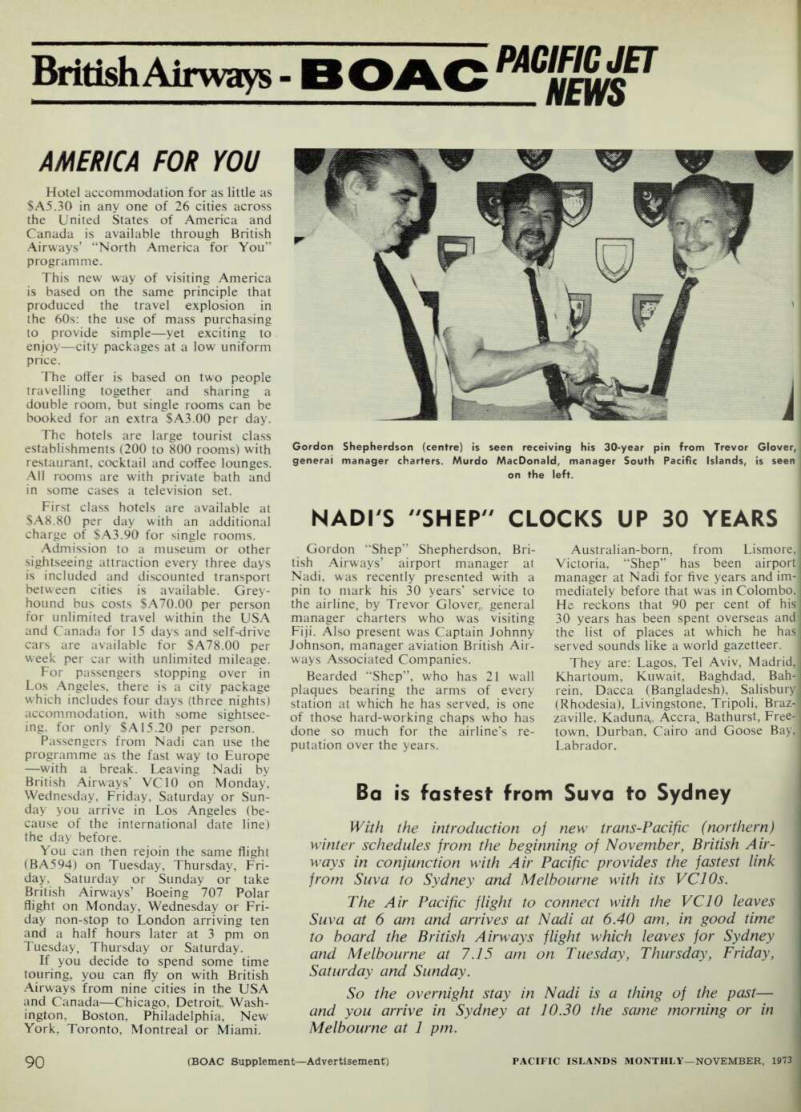
Hotel accommodation for as little as 5A5.30 in any one of 26 cities across the United States of America and Canada is available through British Airways’ “North America for You” programme.
This new way of visiting America is based on the same principle that produced the travel explosion in the 60s: the use of mass purchasing to provide simple—yet exciting to enjoy—city packages at a low uniform price.
The offer is based on two people travelling together and sharing a double room, but single rooms can be booked for an extra 5A3.00 per day.
The hotels are large tourist class establishments (200 to 800 rooms) with restaurant, cocktail and coffee lounges.
All rooms are with private bath and in some cases a television set.
First class hotels are available at SAB.BO per day with an additional charge of 5A3.90 for single rooms.
Admission to a museum or other sightseeing attraction every three days is included and discounted transport between cities is available. Grey hound bus costs 5A70.00 per person for unlimited travel within the USA and Canada for 15 days and self-drive cars are available for 5A78.00 per week per car with unlimited mileage.
For passengers stopping over in Los Angeles, there is a city package which includes four days (three nights) accommodation, with some sightsee ing, for only SA 15.20 per person.
Passengers from Nadi can use the programme as the fast way to Europe —with a break. Leaving Nadi by British Airways’ VC 10 on Monday, Wednesday, Friday, Saturday or Sun day you arrive in Los Angeles (be cause of the international date line) the day before.
You can then rejoin the same flight (8A594) on Tuesday, Thursday, Fri day, Saturday or Sunday or take British Airways’ Boeing 707 Polar flight on Monday, Wednesday or Fri day non-stop to London arriving ten and a half hours later at 3 pm on Tuesday, Thursday or Saturday.
If you decide to spend some time touring, you can fly on with British Airways from nine cities in the USA and Canada—Chicago, Detroit Wash ington, Boston, Philadelphia, New York, Toronto, Montreal or Miami.
Nadi's "Shep" Clocks Up 30 Years
Gordon “Shep" Shepherdson, Bri tish Airways’ airport manager at Nadi, was recently presented with a pin to mark his 30 years’ service to the airline, by Trevor Glover,, general manager charters who was visiting Fiji. Also present was Captain Johnny Johnson, manager aviation British Air ways Associated Companies.
Bearded “Shep", who has 21 wall plaques bearing the arms of every station at which he has served, is one of those hard-working chaps who has done so much for the airline’s re putation over the years.
Australian-born, from Lismore, Victoria, “Shep” has been airport! manager at Nadi for five years and im mediately before that was in Colombo.
He reckons that 90 per cent of his 30 years has been spent overseas and the list of places at which he hasj served sounds like a world gazetteer. !
They are: Lagos, Tel Aviv, Madrid, Khartoum, Kuwait, Baghdad, Bah rein, Dacca (Bangladesh), Salisbury (Rhodesia), Livingstone, Tripoli, Braz-j zaville, Kaduna,. Accra, Bathurst, Free-] town, Durban, Cairo and Goose Bay, Labrador.
Gordon Shepherdson (centre) is seen receiving his 30-year pin from Trevor Glover, general manager charters. Murdo MacDonald, manager South Pacific Islands, is seen on the left.
Ba is fastest from Suva to Sydney
With the introduction of new trans-Pacific (northern) winter schedules from the beginning of November, British Air ways in conjunction with Air Pacific provides the fastest link from Suva to Sydney and Melbourne with its VC 10s.
The Air Pacific flight to connect with the VC 10 leaves Suva at 6 am and arrives at Nadi at 6.40 am, in good time to board the British Airways flight which leaves for Sydney and Melbourne at 7.15 am on Tuesday, Thursday, Friday, Saturday and Sunday.
So the overnight stay in Nadi is a thing of the past — and you arrive in Sydney at 10.30 the same morning or in Melbourne at 1 pm.
Advertisements & other items, p. 98 (1 item)
British Airways - BO AC
90
PACIFIC ISLANDS MONTHLY—NOVEMBER, 1973
(BOAC Supplement—Advertisement)
When In England (Said Vespasian)
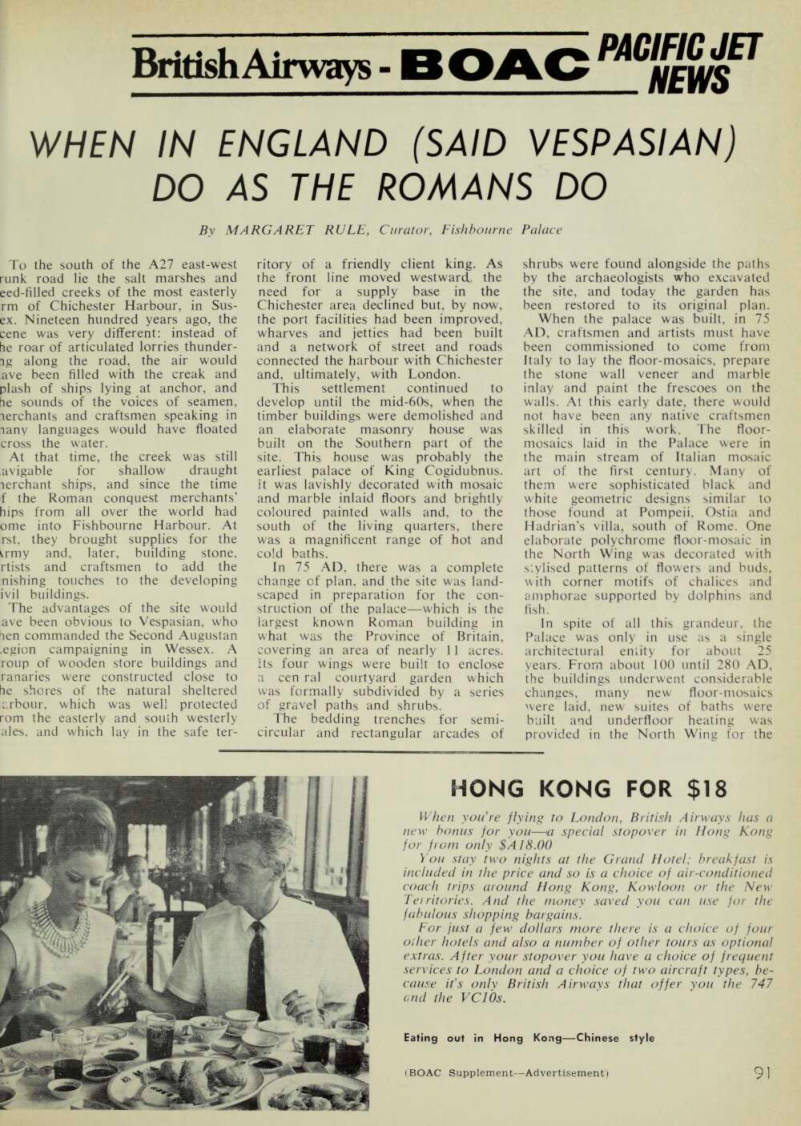
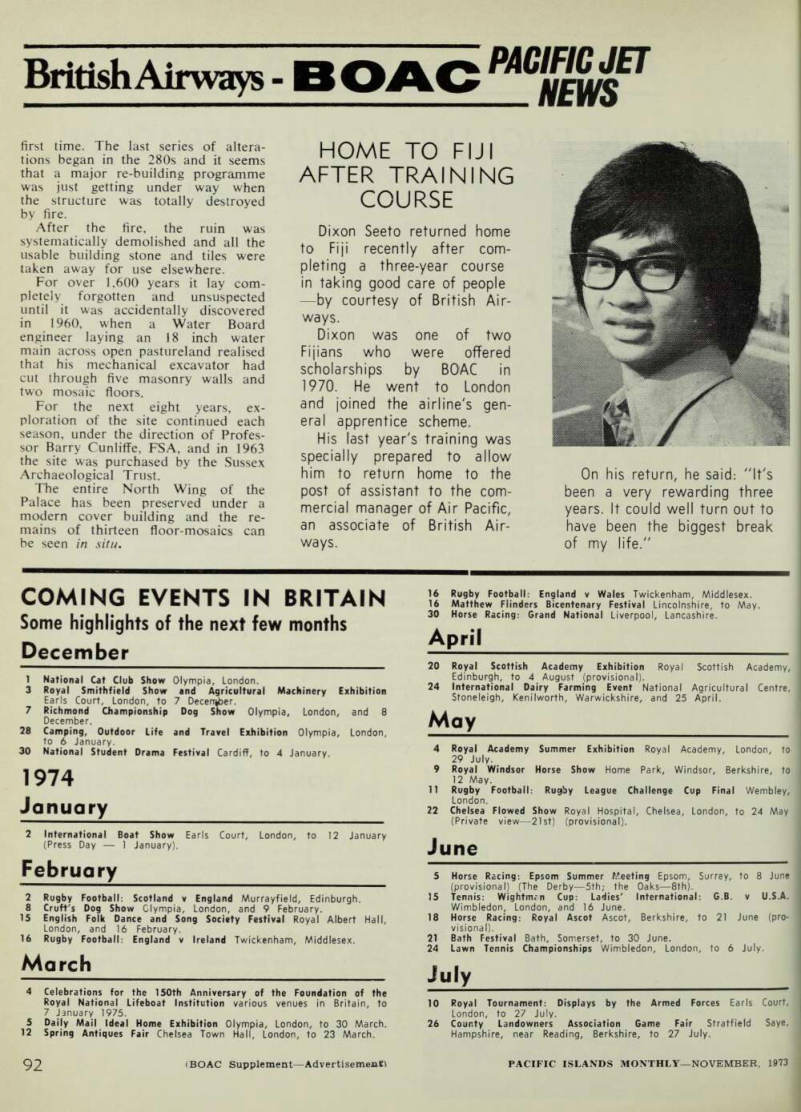
Do As The Romans Do
By MARGARET RULE, Curator, Fishbourne Palace
To the south of the All east-west runk road lie the salt marshes and eed-filled creeks of the most easterly rm of Chichester Harbour, in Sus ex. Nineteen hundred years ago, the cene was very different: instead of he roar of articulated lorries thunder ig along the road, the air would ave been filled with the creak and plash of ships lying at anchor, and he sounds of the voices of seamen, lerchants and craftsmen speaking in lany languages would have floated cross the water.
At that time, the creek was still avigable for shallow draught lerchant ships, and since the time f the Roman conquest merchants’ hips from all over the world had ome into Fishbourne Harbour. At rst, they brought supplies for the trmy and, later, building stone, rtists and craftsmen to add the nishing touches to the developing ivil buildings.
The advantages of the site would ave been obvious to Vespasian, who hen commanded the Second Augustan .egion campaigning in Wessex. A roup of wooden store buildings and ranaries were constructed close to he shores of the natural sheltered arbour, which was well protected rom the easterly and south westerly ales, and which lay in the safe ter
ritory of a friendly client king. As the front line moved westward,, the need for a supply base in the Chichester area declined but, by now, the port facilities had been improved, wharves and jetties had been built and a network of street and roads connected the harbour with Chichester and, ultimately, with London.
This settlement continued to develop until the mid-60s, when the timber buildings were demolished and an elaborate masonry house was built on the Southern part of the site. This house was probably the earliest palace of King Cogidubnus. it was lavishly decorated with mosaic and marble inlaid floors and brightly coloured painted walls and, to the south of the living quarters, there was a magnificent range of hot and cold baths.
In 75 AD, there was a complete change of plan, and the site was land scaped in preparation for the con struction of the palace—which is the largest known Roman building in what was the Province of Britain, covering an area of nearly 11 acres.
Its four wings were built to enclose a cen ral courtyard garden which was formally subdivided by a series of gravel paths and shrubs.
The bedding trenches for semi circular and rectangular arcades of
shrubs were found alongside the paths by the archaeologists who excavated the site, and today the garden has been restored to its original plan.
When the palace was built, in 75 AD, craftsmen and artists must have been commissioned to come from Italy to lay the floor-mosaics, prepare the stone wall veneer and marble inlay and paint the frescoes on the walls. At this early date, there would not have been any native craftsmen skilled in this work. The floor mosaics laid in the Palace were in the main stream of Italian mosaic art of the first century. Many of them were sophisticated black and white geometric designs similar to those found at Pompeii. Ostia and Hadrian’s villa, south of Rome. One elaborate polychrome floor-mosaic in the North Wing was decorated with stylised patterns of flowers and buds, with corner motifs of chalices and amphorae supported by dolphins and fish.
In spite of all this grandeur, the Palace was only in use as a single architectural entity for about 25 years. From about 100 until 280 AD. the buildings underwent considerable changes, many new floor-mosaics were laid, new suites of baths were built and underfloor heating was provided in the North Wing for the
first time. The last series of altera tions began in the 280 s and it seems that a major re-building programme was just getting under way when the structure was totally destroyed by fire.
After the fire, the ruin was systematically demolished and all the usable building stone and tiles were taken away for use elsewhere.
For over 1,600 years it lay com pletely forgotten and unsuspected until it was accidentally discovered in 1960, when a Water Board engineer laying an 18 inch water main across open pastureland realised that his mechanical excavator had cut through five masonry walls and two mosaic floors.
For the next eight years, ex ploration of the site continued each season, under the direction of Profes sor Barry Cunliffe, FSA, and in 1963 the site was purchased by the Sussex Archaeological Trust, The entire North Wing of the Palace has been preserved under a modern cover building and the re mains of thirteen floor-mosaics can be seen in situ.
Hong Kong For $L8
When you're flying to London, British Airways has a new bonus for you—a special stopover in Hong Kong for from only SAIB.OO You stay two nights at the Grand Hotel; breakfast is included in the price and so is a choice of air-conditioned coach trips around Hong Kong, Kowloon or the New Tei ritories. And the money saved you can use for the fabulous shopping bargains.
For just a few dollars more there is a choice of four other hotels and also a number of other tours as optional extras. After your stopover you have a choice of frequent services to London and a choice of two aircraft types, be cause it’s only British Airways that offer you the 747 and the VClOs.
Eating out in Hong Kong—Chinese style
Advertisements & other items, p. 99 (1 item)
British Airways • BO AC MB jS&s r
91
(BOAC Supplement—Advertisement)
After Training
Home To Fiji
Course
Dixon Seeto returned home to Fiji recently after com pleting a three-year course in taking good care of people —by courtesy of British Air ways.
Dixon was one of two Fijians who were offered
scholarships by BOAC in
1970. He went to London and joined the airline's gen eral apprentice scheme.
His last year's training was specially prepared to allow him to return home to the post of assistant to the com mercial manager of Air Pacific, an associate of British Air ways.
On his return, he said: "It's been a very rewarding three years. It could well turn out to have been the biggest break of my life."
February
Coming Events In Britain
Some highlights of the next few months
December
1 National Cat Club Show Olympia, London. 3 Royal Smithfield Show and Agricultural Machinery Exhibition Earls Court, London, to 7 Deceniber. 7 Richmond Championship Dog Show Olympia, London, and 8 December, 28 Camping, Outdoor Life and Travel Exhibition Olympia, London, to 6 January. 30 National Student Drama Festival Cardiff, to 4 January. 1974
January
2 International Boat Show Earls Court, London, to 12 January (Press Day 1 January).
February
2 Rugby Football: Scotland v England Murrayfield, Edinburgh. 8 Cruft's Dog Show Olympia, London, and 9 February. 15 English Folk Dance and Song Society Festival Royal Albert Hall, London, and 16 February. 16 Rugby Football; England v Ireland Twickenham, Middlesex.
March
4 Celebrations for the 150th Anniversary of the Foundation of the Royal National Lifeboat Institution various venues in Britain, to 7 January 1975. 5 Daily Mail Ideal Home Exhibition Olympia, London, to 30 March. 12 Spring Antiques Fair Chelsea Town Hall, London, to 23 March.
16 Rugby Football: England v Wales Twickenham, Middlesex. 16 Matthew Flinders Bicentenary Festival Lincolnshire, to May. 30 Horse Racing: Grand National Liverpool, Lancashire.
April
20 Royal Scottish Academy Exhibition Royal Scottish Academy, Edinburgh, to 4 August (provisional). 24 International Dairy Farming Event National Agricultural Centre, Stoneleigh, Kenilworth, Warwickshire, and 25 April.
May
4 Royal Academy Summer Exhibition Royal Academy, London, to 29 July. 9 Royal Windsor Horse Show Home Park, Windsor, Berkshire, to 12 May. 11 Rugby Football; Rugby League Challenge Cup Final Wembley, London. 22 Chelsea Flowed Show Royal Hospital, Chelsea, London, to 24 May (Private view—21st) (provisional).
June
5 Horse Racing; Epsom Summer Meeting Epsom, Surrey, to 8 June (provisional) (The Derby—sth; the Oaks —Bth). 15 Tennis: Wightmrn Cup: Ladies' International: G.B. v U.S.A.
Wimbledon, London, and 16 June. 18 Horse Racing: Royal Ascot Ascot, Berkshire, to 21 June (pro visional). 21 Bath Festival Bath, Somerset, to 30 June. 24 Lawn Tennis Championships Wimbledon, London, to 6 July.
-Eu»y
10 Royal Tournament: Displays by the Armed Forces Earls Court, London, to 27 July. 26 County Landowners Association Game Fair Stratfield Saye, Hampshire, near Reading, Berkshire, to 27 July.
Advertisements & other items, pp. 100-104 (2 items)
British Airways - BOAC
92
PACIFIC ISLANDS MONTHLY—NOVEMBER, 1973
(BOAC Supplement—Advertisement
Carnation
coffee.
Try it. Watch how Carnation blends right in like it belongs.
It makes a good cup of coffee a great cup of coffee. All you do is punch and pour. Carnation your coffee.
Everybody’s doing it. * m w Carnation-from contented cows’
Bacardi
ice and
what else?
... nothing else if you feel so inclined, for there's no real problem where and how and what you drink Bacardi rum with.
Because Bacardi rum is so light, dry, highly refined and pure it complements every mixer, yet remains distinctively itself. Bacardi and Coke and ice ... Bacardi and ginger... Bacardi and tonic with a zest of lemon or lime ... Bacardi and fruit juice ... Mix up your own Bacardi party.
Because ...
Anything
goes with
Bacardi rum
BACARDI
rum-the mixable one.
Sansui makes it so easy to
start out in stereo.
AU-9SOO
UJ-6600 55 % AU-505 ///.
A ''A ssss.
""SSA
y/A V/ 7 There’s a Sansui stereo amplifier that'll fit exactly into your hi-fi budget. You'll get exactly the right amount of power for your listening room (or rooms), and all the versatility you need to expand your stereo system.
The beautiful sound of Sansui is available throughout the Pacific area now.
Find out how easy it is to start out in stereo. Talk to your nearest Sansui dealer soon. isui's products are available through: Fiji: PRABHU BROTHERS LTD., P.O. Box 183, Nadi. Tel: 701 83/Papua & New Guinea: OCEANIA INDENT ENCY, P.O. Box 5518, Boroko, Port Moresby. Tel: 56406/New Caledonia: Ets. MICHAEL MERGER, 9 Rue de Sebastopol, B.P. 1123, Noumea. : 759-11 I Norfolk Island: MILTONS DEPARTMENT STORES LTD., P.O. Box 146, Norfolk Island 2899 / Tahiti: SERVONNAT, Rue des Polius, utiens Pafeete. Tel: 03-29 / SANSUI ELECTRIC CO., LTD., 14-1, 2-chome, Izumi, Suginami-ku, Tokyo 168, Japan
MEAT LOAF
Combine 1 lb. minced steak, IV2 cups soft breadcrumbs, 1 finely chopped onion, Vz cup NESTLE’S IDEAL MILK, 1 tsp. salt and 1/4 tsp. pepper. Place 1/3 of the meat onto a greased tray. Pat out into a rectangle. Place 3 hard cooked eggs along the centre. Mould remaining meat mixture around, form a loaf shape. Bake in a moderate oven for VA hours. Decorate with olives. Serves 4 6.
CHOCOLATE SOUFFLES
Tie collars around 2 small souffle dishes so that mixture comes above lip of dishes. Melt 1 pkt. NESTLE'S CHOC- BITS over hot (not boiling) water. Dissolve 1 tbsp. gelatine in Va cup hot water. Add to melted chocolate. Beat in 1/3 cup sugar. Beat 1 cup well chilled NESTLE’S IDEAL MILK until doubled. Fold through cooled chocolate mixture. Pour into dishes. Chill. Remove collars. Decorate. Serves 2.
JELLY TOPPED CHIFFON PIE
Combine 12 crushed chocolate flavoured biscuits, 3 oz. melted butter. Press over base of 8" spring form tin or a foil lined 8" tin. Chill. Dissolve 1 pkt. strawberry jelly in cup hot water. Partially set. Beat 2x4 oz. pkts. cream cheese with Vz cup sugar. Gradually beat in jelly, finely grated rind of 1 lemon. Beat V/2 cups well chilled NESTLE’S IDEAL MILK until doubled. Gently fold jelly and Vz cup chopped maraschino cherries (optional) through whipped IDEAL. Pour over crust. Refrigerate. Dissolve 1 pkt. strawberry jelly in % cup hot water. Chill. Chop jelly. Place over pie. Refrigerate. Serves 6 8.
ALL SPOON MEASUREMENTS ARE LEVEL UNLESS OTHERWISE STATED. 8 FL. OZ. MEASURING CUP USED.
Cooking with Ideal
Milk that’s what. Great
new cooking ideas.
And new creaminess
and richness in
everything you cook.
That’s because Ideal
is milk and cream
rolled into one.
Isn’t it time you
discovered the
“Ideal thing”?
Business and Development
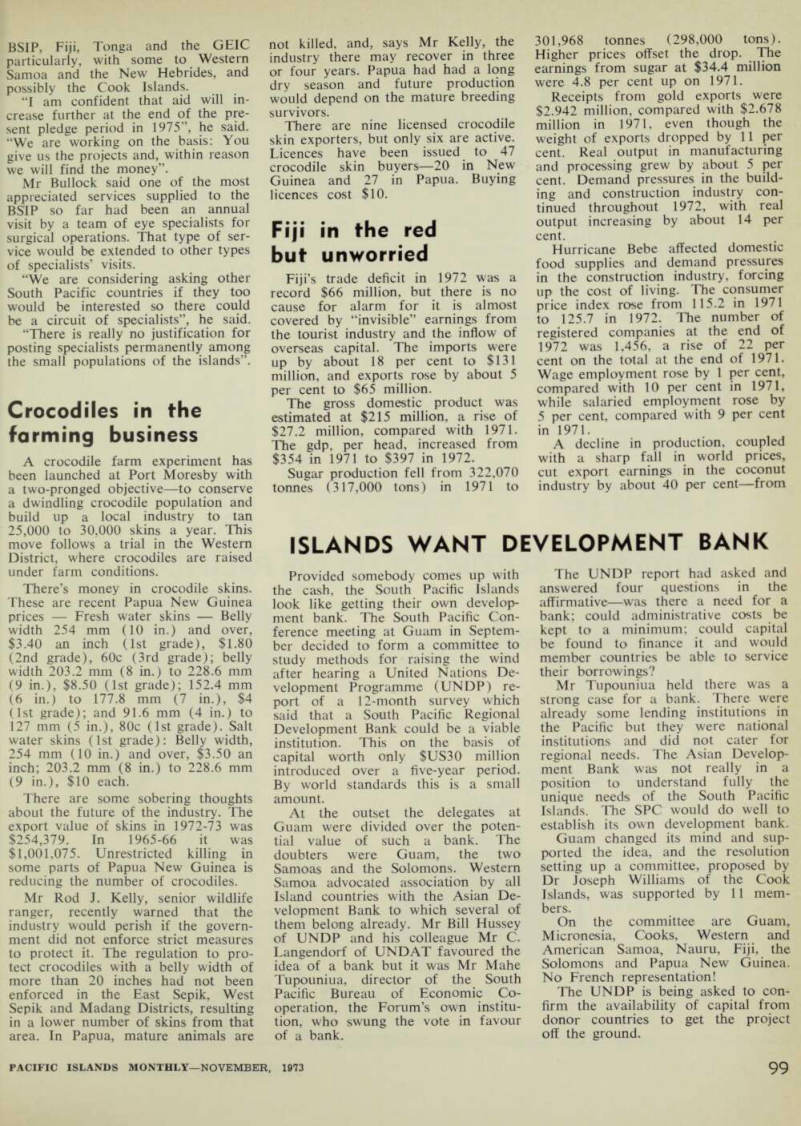
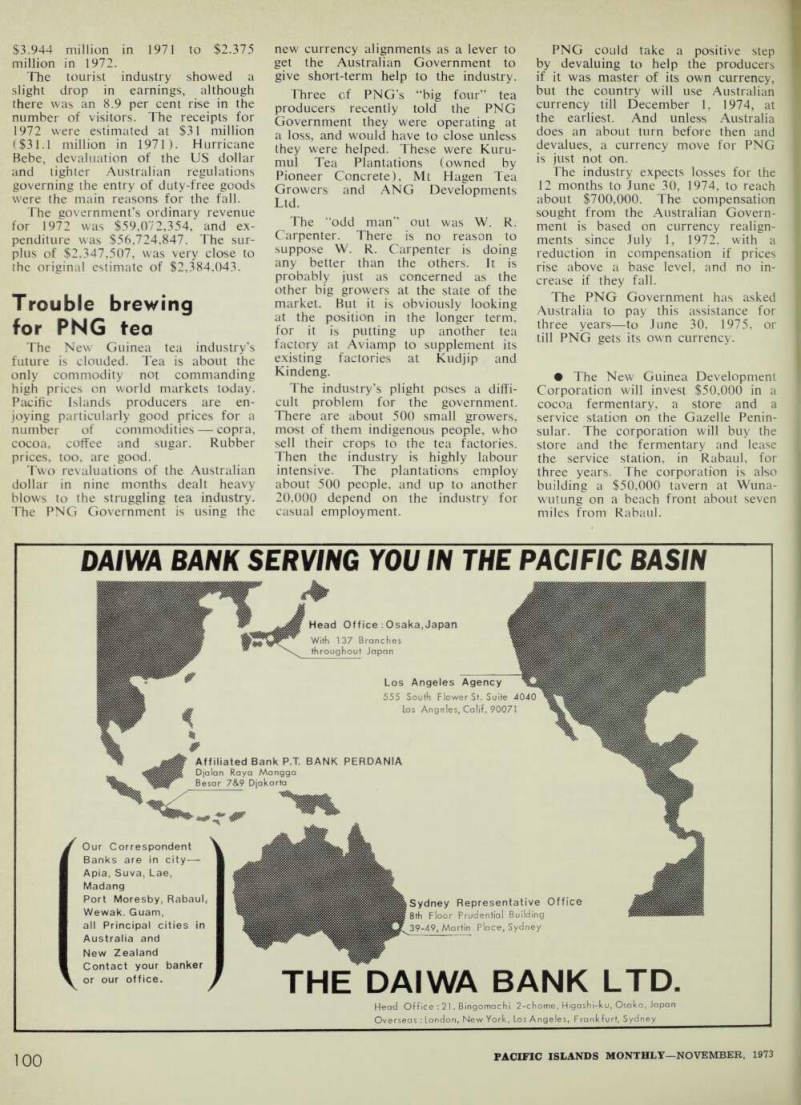
Australian Aid Mission Sees Very
Bright Future' For The Solomons
From a Honiara correspondent
Really big money is available for development in the Solomon Islands from two main sources—Australia, if the protectorate shows it can “pro duce the goods”, and the Asian De velopment Bank. There are other sources, including the Common wealth Development Corporation. An Australian aid mission recently visi ted the BSIP. So did the protec torate’s newly appointed alternate director at the ADB headquarters in Manila, Mr Christopher Conybeare, an Australian.
The BSIP is pinning great hopes on an oil palm industry, which inclu des building a mill with associated buildings for Solomon Islands Plan tation Ltd on Guadalcanal Plains.
Mr Conybeare dashed immediate hopes of a $3 million to $4 million loan because the mill is in such a “tender stage”. The BSIP Govern ment, backing the project, now seems likely to look elsewhere for a loan, possibly from the Commonwealth Development Corporation, so that the mill may be built on schedule, ready to process the first palm fruits.
The Australian attitude is to make grants, provided a case can be made out for a project. Aid has been given in the past, but not of any great magnitude. Current aid is mainly heavy equipment for road building, provision of two experts on pasture improvement working on the Guadal canal Plains, a study of animal dis eases, Brahman cattle for breeding, and technical advice.
Mr J. Starey, who headed the Aus tralian aid mission, had a look at aid possibilities. He formed a “quick conclusion” that the future of the BSIP was “very bright indeed”. He inspected the cattle industry, particu larly the large communal develop ment on Holokama plantation, Santa Ysabel, and the small, but growing cocoa industry.
The BSIP now has a cattle popu lation of 15,721 (15.4 per cent up on 1972) and is well on the way to in ternal self-sufficiency in beef with 40,000 head by the early 1980 s.
Self-sufficiency could well be fol lowed by a beef export industry.
Mr Starey said he was impressed by the possibilities of bauxite deposits on Rennell and Wagina Islands, the flourishing skipjack tuna industry, and the oil palm industry. He considered the Solomon Islands far more capa ble of developing than some other groups the aid mission visited, espec ially through diversifying in agricul ture. The mission visited the GEIC, Fiji, Tonga and Western Samoa be fore going to the BSIP.
An obvious extension of aid, Mr Starey said, would be to provide long landing barges to carry cattle and equipment between the islands. There was also a short-term need for a can
nery. Depending on a NZ study of such a proposal, it might be appro priate for Australia to help to build a cannery for beef and other local foodstuffs.
Also with the Australian mission was Mr Harold Bullock, the Aust ralian High Commissioner in Fiji, who said all the individual projects the BSIP government proposed would fit into the seventh development plan, which would start in 1975. Australia was most interested in helping high priority projects. It was up to the BSIP government to set its priorities.
Australian aid in the Pacific till mid-1972 had been small; the em phasis was on helping SE Asia. Now more aid was to be given to the
BSIP, Fiji, Tonga and the GEIC particularly, with some to Western Samoa and the New Hebrides, and possibly the Cook Islands.
“I am confident that aid will in crease further at the end of the pre sent pledge period in 1975”, he said.
“We are working on the basis: You give us the projects and, within reason we will find the money”.
Mr Bullock said one of the most appreciated services supplied to the BSIP so far had been an annual visit by a team of eye specialists for surgical operations. That type of ser vice would be extended to other types of specialists’ visits.
“We are considering asking other South Pacific countries if they too would be interested so there could be a circuit of specialists”, he said, “There is really no justification for posting specialists permanently among the small populations of the islands”.
Crocodiles in the
forming business
A crocodile farm experiment has been launched at Port Moresby with a two-pronged objective—to conserve a dwindling crocodile population and build up a local industry to tan 25,000 to 30,000 skins a year. This move follows a trial in the Western District, where crocodiles are raised under farm conditions.
There’s money in crocodile skins.
These are recent Papua New Guinea prices Fresh water skins Belly width 254 mm (10 in.) and over, $3.40 an inch (Ist grade), $l.BO (2nd grade), 60c (3rd grade); belly width 203.2 mm (8 in.) to 228.6 mm (9 in.), $8,50 (Ist grade); 152.4 mm (6 in.) to 177.8 mm (7 in.), $4 (Ist grade); and 91.6 mm (4 in.) to 127 mm (5 in.), 80c (Ist grade). Salt water skins (Ist grade): Belly width, 254 mm (10 in.) and over, $3.50 an inch; 203.2 mm (8 in.) to 228.6 mm (9 in.), $lO each.
There are some sobering thoughts about the future of the industry. The export value of skins in 1972-73 was $254,379. In 1965-66 it was $1,001,075. Unrestricted killing in some parts of Papua New Guinea is reducing the number of crocodiles.
Mr Rod J. Kelly, senior wildlife ranger, recently warned that the industry would perish if the govern ment did not enforce strict measures to protect it. The regulation to pro tect crocodiles with a belly width of more than 20 inches had not been enforced in the East Sepik, West Sepik and Madang Districts, resulting in a lower number of skins from that area. In Papua, mature animals are
not killed, and, says Mr Kelly, the industry there may recover in three or four years. Papua had had a long dry season and future production would depend on the mature breeding survivors.
There are nine licensed crocodile skin exporters, but only six are active.
Licences have been issued to 47 crocodile skin buyers—2o in New Guinea and 27 in Papua. Buying licences cost $lO.
Fiji in the red
but unworried
Fiji’s trade deficit in 1972 was a record $66 million, but there is no cause for alarm for it is almost covered by “invisible” earnings from the tourist industry and the inflow of overseas capital. The imports were up by about 18 per cent to $l3l million, and exports rose by about 5 per cent to $65 million.
The gross domestic product was estimated at $215 million, a rise of $27.2 million, compared with 1971.
The gdp, per head, increased from $354 in 1971 to $397 in 1972.
Sugar production fell from 322,070 tonnes (317,000 tons) in 1971 to
301,968 tonnes (298,000 tons).
Higher prices offset the drop. The earnings from sugar at $34.4 million were 4.8 per cent up on 1971.
Receipts from gold exports were $2,942 million, compared with 52.678 million in 1971, even though the weight of exports dropped by 11 per cent. Real output in manufacturing and processing grew by about 5 per cent. Demand pressures in the build ing and construction industry con tinued throughout 1972, with real output increasing by about 14 per cent.
Hurricane Bebe affected domestic food supplies and demand pressures in the construction industry, forcing up the cost of living. The consumer price index rose from 115.2 in 1971 to 125.7 in 1972. The number of registered companies at the end of 1972 was 1,456, a rise of 22 per cent on the total at the end of 1971.
Wage employment rose by 1 per cent, compared with 10 per cent in 1971, while salaried employment rose by 5 per cent, compared with 9 per cent in 1971.
A decline in production, coupled with a sharp fall in world prices, cut export earnings in the coconut industry by about 40 per cent —from
$3,944 million in 1971 to $2,375 million in 1972.
The tourist industry showed a slight drop in earnings, although there was an 8.9 per cent rise in the number of visitors. The receipts for 1972 were estimated at $3l million ($31.1 million in 1971). Hurricane Bebe, devaluation of the US dollar and tighter Australian regulations governing the entry of duty-free goods were the main reasons for the fall.
The government’s ordinary revenue for 1972 was $59,072,354, and ex penditure was $56,724,847. The sur plus of $2,347,507, was very close to the original estimate of $2,384,043.
Trouble brewing
for PNG teo
The New Guinea tea industry’s future is clouded. Tea is about the only commodity not commanding high prices on world markets today.
Pacific Islands producers are en joying particularly good prices for a number of commodities copra, cocoa, coffee and sugar. Rubber prices, too, are good.
Two revaluations of the Australian dollar in nine months dealt heavy blows to the struggling tea industry.
The PNG Government is using the
new currency alignments as a lever to get the Australian Government to give short-term help to the industry.
Three of PNG’s “big four” tea producers recently told the PNG Government they were operating at a loss, and would have to close unless they were helped. These were Kuru mul Tea Plantations (owned by Pioneer Concrete), Mt Hagen Tea Growers and ANG Developments Ltd.
The “odd man” out was W. R.
Carpenter. There is no reason to suppose W. R. Carpenter is doing any better than the others. It is probably just as concerned as the other big growers at the state of the market. But it is obviously looking at the position in the longer term, for it is putting up another tea factory at Aviamp to supplement its existing factories at Kudjip and Kindeng.
The industry’s plight poses a diffi cult problem for the government.
There are about 500 small growers, most of them indigenous people, who sell their crops to the tea factories.
Then the industry is highly labour intensive. The plantations employ about 500 people, and up to another 20,000 depend on the industry for casual employment.
PNG could take a positive step by devaluing to help the producers if it was master of its own currency, but the country will use Australian currency till December 1, 1974, at the earliest. And unless Australia does an about turn before then and devalues, a currency move for PNG is just not on.
The industry expects losses for the 12 months to June 30, 1974, to reach about $700,000. The compensation sought from the Australian Govern ment is based on currency realign ments since July 1, 1972, with a reduction in compensation if prices rise above a base level, and no in crease if they fall.
The PNG Government has asked Australia to pay this assistance for three years—to June 30, 1975, or till PNG gets its own currency. • The New Guinea Development Corporation will invest $50,000 in a cocoa fermentary, a store and a service station on the Gazelle Penin sular. The corporation will buy the store and the fermentary and lease the service station, in Rabaul, for three years. The corporation is also building a $50,000 tavern at Wuna wutung on a beach front about seven miles from Rabaul.
Soar days ahead for sugar
Fiji’s hopes for a bigger and better sugar market were dashed within one disastrous week in October. The International Sugar Conference in Geneva failed to draw up a new international agreement to regulate the world free sugar market from next January.
Only four days previously it had been a different story. The leader of Fiji’s delegation to the talks, Minister without Portfolio Ratu David Toganivalu, told the country to count on a quota boost from 155,000 tons a year to 180,000.
“But although disappointed, we are not discouraged,” the Minister for Agriculture, Mr Doug Brown, said after he heard of the conference breakdown.
“It makes us more determined to maximise efforts to perform even better than in the past as far as sugar production is concerned. We will keep and even improve our good name as a reliable producer of top quality sugar.”' Sugar officials hope for a chance to salvage the talks, but so far they have broken down completely.
The Fiji Sugar Corporation’s general manager, Mr Gwynfor Bowen- Jones, admitted he was disappointed with the breakdown, but he wanted to wait for the return of Fiji’s sugar talks team before commenting further.
Banking on an increased market, Fiji was eagerly making plans to expand the industry by bringing under cane an extra 15,000 acres adding another 1,000 cane farmers to the present force of 15,000.
Representatives of Australia’s sugar industry said that, in the short term at least, the absence of an ISA seemed unlikely to have any adverse effects on Australia’s industry.
Looking further ahead, however, the main area of concern was that some countries, encouraged by the high prices and the absence of regulations of exports to the free market as the ISA ends on January 1, might pursue policies of irresponsible production.
Meanwhile, Fiji still has her customers and commitments, in spite of international hassles. The Prime Minister, Ratu Sir Kamisese Mara, has discussed Commonwealth sugar agreements at European Economic Community talks in Brussels.
Advertisements & other items, p. 106 (1 item)
Sullivans For Service
OFFERS A COMPREHENSIVE AND EFFICIENT
BUYING SERVICE TO THE PACIFIC ISLANDS
OFFICES AT:
PORT MORESBY • LAE • RABAUL • KIETA • MOUNT HAGEN • BULUMA • SUVA • LAUTOKA • NOUMEA • HONIARA • PORT VILA
SULLIVANS for SERVICE
DUNLITE GENERATING SETS
rs^LrE A x R PORT O ScHiEVEM E NT give you totally reliable A.C. power —and plenty of it!
DUNLITE
PORTABLE
POWER PACKS
Dunlite provides "on-the-job” power for any project! Dunlite 240 volt A.C. Power Packs weigh as little as 80 lbs., have capacities ranging from 500 watts {Vz K.V.A.) to 5 K.V.A., and are made by Australia’s largest and most experienced generating set manufacturers. Available with either petrol or diesel engine, Dunlite Power Packs provide the world’s most dependable portable electric power.
J Enjoy all the comforts of a city power supply. Dunlite A.C. generating sets provide full 240 volt power to your home so you can use any electrical appliances at all. Famous Dunlite generating sets are powered by diesel engines of world wide renown, and have output capacities from 2 K.V.A. to 350 K.V.A. You’ll get years of trouble-free operation from your Dunlite generating set, plus the comfort and convenience of an ample supply of electric power. •BELOW: Dunlite 6 K.V.A. Brushless Alternator Plant, powered by Lister SR2 Diesel Engine.
Idunlite
ELECTRICAL COMPANY
of m industries *See your local Dunlite Dealer or mail this coupon.
To: DUNLITE ELECTRICAL COMPANY,
2-22 HARGREAVES ST., HUNTINGDALE,
VICTORIA, 3166, AUSTRALIA.
Please post (tetails of Dunlite Generating Sets.
Name Address.. -
DP5669/V
Islands Want Development Bank
Provided somebody comes up with the cash, the South Pacific Islands look like getting their own develop ment bank. The South Pacific Con ference meeting at Guam in Septem ber decided to form a committee to study methods for raising the wind after hearing a United Nations De velopment Programme (UNDP) re port of a 12-month survey which said that a South Pacific Regional Development Bank could be a viable institution. This on the basis of capital worth only SUS3O million introduced over a five-year period.
By world standards this is a small amount.
At the outset the delegates at Guam were divided over the poten tial value of such a bank. The doubters were Guam, the two Samoas and the Solomons. Western Samoa advocated association by all Island countries with the Asian De velopment Bank to which several of them belong already. Mr Bill Hussey of UNDP and his colleague Mr C.
Langendorf of UNDAT favoured the idea of a bank but it was Mr Mahe Tupouniua, director of the South Pacific Bureau of Economic Co operation, the Forum’s own institu tion, who swung the vote in favour of a bank.
The UNDP report had asked and answered four questions in the affirmative—was there a need for a bank; could administrative costs be kept to a minimum; could capital be found to finance it and would member countries be able to service their borrowings?
Mr Tupouniua held there was a strong case for a bank. There were already some lending institutions in the Pacific but they were national institutions and did not cater for regional needs. The Asian Develop ment Bank was not really in a position to understand fully the unique needs of the South Pacific Islands. The SPC would do well to establish its own development bank.
Guam changed its mind and sup ported the idea, and the resolution setting up a committee, proposed by Dr Joseph Williams of the Cook Islands, was supported by 11 mem bers.
On the committee are Guam, Micronesia, Cooks, Western and American Samoa, Nauru, Fiji, the Solomons and Papua New Guinea.
No French representation!
The UNDP is being asked to con firm the availability of capital from donor countries to get the project off the ground.
Advertisements & other items, p. 108 (1 item)
The Daiwa Bank Ltd.
DAIWA BANK SERVING YOU IN THE PACIFIC BASIN r * Head Office :Osaka,Japan With 137 Branches throughout Japan Los Angeles Agency 55 5 South Flower St. Suite 4040 Los Angeles, Calif. 90071 Affiliated Bank P.T. BANK PERDANIA Djalan Raya Mangga Besar 7&9 Djakarta Our Correspondent \ Banks are in city— Apia, Suva, Lae, Madang Port Moresby, Rabaul, Wewak. Guam, all Principal cities in Australia and New Zealand Contact your banker or our office. y Sydney Representative Office Bth Floor Prudential Building 39-49, Martin Place, Sydney
Head Office :21. Bingomachi 2-chome, Higashi-ku, Osaka, Japan Overseas: London, New York, Los Angeles, Frankfurt, Sydney
Business Briefs
9 Tourist spending in Micronesia in the 12 months ended June 30, 1973, estimated at more than $3.5 million, makes tourism the fastest growing source of overseas earnings.
Most of the visitors were from the US and Japan. The six districts recorded 47,115 arrivals, compared with 36,199 in the previous year. The Marianas attracted the majority, 69 per cent or 32,467. 9 Tourism was the biggest industry in the New Hebrides in 1972 when estimated earnings were $3 million, with copra next at $1,372 million.
But copra, now in a boom, is back as the No 1 earner of foreign ex change. Visitor arrivals in 1972 totalled 19,381 —9 per cent more than 1971. Most came from New Caledonia, followed by Australia and the US. 9 The Abemama Island Council in the GEIC has agreed to build a small hotel as an extension of the existing rest house. Initially, ex tensions with include two chalet-type blocks, a new kitchen and store, small maneaba, tennis court, a larger lounge and dining room and a small bar. The project will cost about $9,000. 9 Two Honolulu businessmen are looking at the possibility of setting up a juice extraction industry in Tonga. They are interested in using various by-products at present wasted.
The men are Mr B. M. (Fred) Ber vang and Mr Harold T. Chikamoto.
Mr Chikamoto said products which had possibilities were tropical fruits such as guava and passionfruit. Some vegetables could be suitable. It might be possible to can coconut milk, ano process other by-products of the coconut. 9 Seven Western Samoa farmers have been given a pat on the back by the Samoa Development Bank for paying back loans made by the bank for their farming projects. The bank made the pats gilt-edged by giving each man another loan—sl,6oo each to buy second-hand pick-up vehicles specially ordered for them. The good payers were listed as F. C. Falana’i, Fata Ututau, Fetalaiga Lafai, J. S.
Lafai, O. T. Fonoti, Aleki Sosene Feagai and C. Popi. 9 The Southern Highlands Area Authority of Papua New Guinea is unhappy about a scarcity of air ser vices to Mendi hampering the de velopment of tourism, the only in dustry in the area. The authority con siders there is enough traffic between Mt Hagen and Mendi to allow two airlines to operate in competition without financial hardship, and that DCA regulations covering Fokker
and DC3 operation on the Mendi air strip are restrictive and hampering the tourist industry. DCA and the cen tral government have been asked to urgently reconsider allowing Territory Airlines to operate to Mendi in com petition with Macair Charters from Mt Hagen. 9 W. R. Carpenter Holdings Ltd is making a l-for-5 bonus issue, following another sharp rise in profit.
The directors said the results for the year ended June 30, were much better than expected. Trading results for 1972-73 would be maintained at the previous year’s level of more than $7 million. The directors expect to maintain the dividend rate of 10c a share on the higher capital.
9 Burns Philp (SS) Co Ltd over came difficult trading conditions to earn a record net profit of $1,019,778 in the latest financial year. Hurricane Bebe, industrial unrest, fewer tourists and price control were some of the problems. Apart from merchandise trading, the company improved results in most areas. The directors recom mended a final dividend of 6i per cent, to make an annual payout of 12i per cent. 9 Tonga had a visible adverse balance of trade of $5,405,845 in 1972. The value of imports was $7,455,916 (up $1,150,999 on 1971), compared with exports valued at $2,050,071 (down $150,161 on 1971).
Advertisements & other items, p. 109 (1 item)
"Service”
76 Years' Experience
Selling
to the Pacific Islands
NELSON & ROBERTSON
PTY. LIMITED
(Established 1895)
PLANTATION HOUSE, 197 CLARENCE STREET, SYDNEY
CABLES: "IVAN", SYDNEY, BRISBANE. TELEX: AA22381, SYDNEY.
ISLAND MERCHANTS
SHIPPING AGENTS
TRAVEL AGENTS
INSURANCE AGENTS
REAL ESTATE AGENTS
Branch Office: Nelson & Robertson Pty. Ltd., 303 Adelaide St., Brisbane, Old.
New Guinea Representatives: Rabaul Trading Co. Pty. Ltd., Rabaul Lae Madang Kieta.
Produce Prices
(Unless otherwise stated, quotations are in Australian currency. Australian dollar (October 17) equals New Zealand, $1.0062 (buying), $1.0022 (selling); Fiji $1.1612 (buying), Western Samoa. T 0.9093 (buying); US, $1.4900, $1.4850; UK, 61.4024 np, 60.9533 np; French Pacific 115.23 (buying), 113.47 (selling) FP francs; Tonga unavailable.
Copra
Copra industries are controlled through copra boards in PNG, the Solomons, the GEIC, both Samoas, Fiji, Tonga and the US Trust Territory.
New Hebrides, the Cooks, French Polynesia and New Caledonia don't have boards and copra is either sold individually by growers to overseas buyers or used locally.
NEW GUINEA: The board, with planters' reps, directs distribution and sales and pays planters. Shipments are made to UK, European markets and to Australia and Japan, and coco nut oil mills on New Britain.
Latest prices per metric tonne, delivered main ports, were: hot-air dried, $200; FMS, $197; smoke-dried, $195.
FIJI: —The board fixes prices on Philippines copra, taking into account freight, taxes, selling costs, shrinkage, etc. Prices recently were: Ist grade, $219; 2nd grade, $209; sub standard (ss), $BO.
WESTERN SAMOA: The board makes pay ments to producers through its agents—local firms—and sells the copra on the open market with a portion to Abels Ltd., NZ. Recent prices per ton fob: Ist quality, $144.00; 2nd quality, $130.00.
TONGA: All copra is sold to the board which sends it to Europe and the open market. Recent prices to growers were T 5198.40 Ist grade, and T 5186.40 2nd grade, per ton.
Per coconut 2.5 seniti.
SOLOMON IS.: —All production through board at prices based on Philippines rates. Output goes to the UK, Japan, Australia and the rest to the open market. Recent prices were: hot air-dried, $165; smoke-dried, $l5l per ton at BSIP ports (Honiara, Yandina and Gizo).
GILBERT AND ELLICE—3c per lb (Ist grade); 2c per lb (2nd grade).
NEW HEBRIDES: Copra sold direct by planters to France and Japan. Official market price on September 29 was $lOO. Marseilles 146 French francs (per 100 kilos) October 3.
COOK IS.:—Copra goes to Abels, Ltd., of Auckland, who operate NZ's copra crushing
mill. Prices for October-December, packed shipping weights f.o.b. were fixed at $NZ251.22 Ist grade, hot-air dried, $NZ249.37 Ist grade, sun-dried, and $NZ247.99 standard grade.
US TRUST TERRITORY: Price per short ton SUS 112.50 (grade 1), SUS 102.50 (grade 2), SUS 92.50 (grade 3), delivered district centres; $lOO.OO (grade 1), $90.00 (grade 2), $BO.OO (grade 3), picked up outer islands.
Other Produce
BECHE-DE-MER: Chang Sing Loong Co., Suva, quote 60c Fijian per lb. (4 in. to 10 in.).
Honiara.—Best price paid is $1 per lb dried, for Ist grade; 70 cents per 4b for 2nd grade.
CHILLIES.—SoIomons, Honiara, long red dried 12 cents per lb.. Tabasco 22 cents per lb. first grade.
'Bird's eye' (under % in.) sun-dried, FAQ Grade Raba Raba, up to 30 cents per lb (Eastern Papua). Other grades are Long and U/FAQ 15-19 cents per lb.
COCOA. —Islands rates are based on Ghana prices. Ghana price on October 17 (July/Sep tember shipment) was spot £stg 609 ton, c.i.f.; UK, Continent.
October 17. In store Rabaul, export quality, $B4O per ton delivered ex wharf Sydney $950.
Solomons. —Delivered to Agriculture Dept, offices in Honiara and Auki 25 cents per lb. dried beans first grade, 20 cents second grade.
COFFEE. —PNG: Good quality, A grade, 46c per lb; B grade, 43c, C grade, 41£c, Y grade, 41 |c (ex-store Sydney).
W. Samoa. —Recently, WSTEC ground and dried beans, 45 sene per lb (to distributors), 50 sene per lb (to retailers).
CROCODILE SKlNS.—Honiara: $1.89 to $2.25 per inch.
GREEN SNAIL SHELL.—I 3-14 cents per lb.
PAPUAN GUM DUMAR.—Steamships Trading Co Ltd, Samarai, quotes SA2OO per long ton FOB Samarai.
PEANUTS. PNG: Sydney agents reported recently f.0.b., Lae; Kernels —white Spanish 19c lb.
PEARL SHELL. —Torres Strait Pearlshellers' Assn, has no recent quotes. Solomons. — Honiara, mother of pearl blacklip 15c lb.
Cook Islands.—Penrhyn, 20-25 c per lb. del.
Rarotonga 33-35 c per lb. French Polynesia.— Tuamotu, Gambier shells, to $l,OOO per ton, Papeete. Fiji.—3sc per lb.
PYRETHRUM.—NG growers 17c lb, flowers.
RICE (Aust.):—PNG: [Tried brown, 25 kilo bags, $128.00 per metric tonne. Vitamin enriched white, 25 kilo bags, $141.50 per metric tonne, all f.o.w. Sydney/Melbourne.
Pacific Islands: Calrose med. grain, white, 56 lb bags, $l7O a metric tonne. Kulu long grain white, 56 lb bags, $lB5 a metric tonne.
All prices f.o.w. Sydney/Melbourne.
RUBBER. —PNG prices are based on Singapore rates which on June 1 were: No. 1 RSS (Malayan cents a kilo f.0.b.), July, 191 .CO -149.00; August, 185.50-165.00; September, 181.50-162.00.
SANDALWOOD. —New Hebrides, landed on the beach, Vila and Santo, $lBO per ton "on consignment".
SHARKS FINS. Chang Sing Loong Co., Suva, offers 75c per lb for Ist quality, 45c for mixed quality.
TROCHUS.—BSIP 7-10 cents per lb. Fiji 8-9 cents per lb.
TURTLE SHELL.—BSI: No market at present.
VANILLA BEANS. Prices recently were: White and yellow label processed standard packs, $7.50; green label $7.40, c.i.f., Sydney.
Tonga.—sT4.2o, f.0.b., Nukualofa; $T4.50, Mel bourne.
Uk, Us Quotes
COPRA.—LONDON, September 28, Philippines, in bulk, $U5354.39 per long ton, c.i.f.
NZ aid for
Cooks agriculture
The NZ Cabinet has approved a $63,000 grant to the Cook Islands Government to help the Cooks buy
agricultural machinery and equip
ment, and sheds for storing equip ment. The Cooks Minister of Economic Services, Mr W. Estall, said the NZ Cabinet had also agreed to give the Cook Islands a grant of 80 per cent of the cost of agricultural spray materials needed for this year.
This would amount to an additional maximum sum of $70,000.
Exchange Rates
FlJl.—Through Bank of NSW, ANZ Bank, Bank of NZ, Bank of Baroda, First National City Bank. Sterling £ on Fiji $, buying £1 = $F1.8675, selling £1 = $F1.8925. Aust. $ on Fiji $, buying $A0.8536 = SFI, selling
5A0.8708 = Sfi.
WESTERN SAMOA.—Through Bank of Western Samoa, controlled from NZ, SWS. Tala 1 = $A 1.0997 (buying), $A1.1170 (selling).
Norfolk Is., Papua New Gulnea.—Aus
tralian currency used; no exchange payable in transactions with Australia.
FRENCH PACIFIC COLONIES.—Pacific francs (CFP) are used in New Caledonia, New Hebrides (Jointly with Australian dollars), Wallis and Futuna Is., and Fr. Polynesia. French Bank, Sydney, on October 18, quoted: Selling, Noumea and Papeete, Pac francs to the sAust., 112.09 (commercial —export and import trans actions), 113.94 (financial) —nearly all other transactions. Paris-London: Buying 10.2450 francs go the £ (commercial); 10.4350 francs to the £ (financial). Also £ = 186.2727 (buy ing), 186.5454 (selling) Pac. francs; 5.50 CFP to 1 metropolitan franc.
Banks should be approached for daily quotes.
Advertisements & other items, p. 110 (1 item)
Supply Co
SOUTHERN PACIFIC INSURANCE
COMPANY LIMITED
Head Office; Equitable Life Building, 80 Alfred Street, AAilsons Point, N.S.W., 2061.
Specialising in Pacific Island Insurance requirements for over 30 years. • FIRE • FIRE AND VOLCANIC ERUPTION • HOUSEHOLD COMPREHENSIVE • MOTOR VEHICLE • COMPULSORY THIRD PARTY • COMPULSORY WORKERS' COMPENSATION
• PUBLIC LIABILITY • MARINE
Enauiries invited for all classes of insurance from special representatives at: PORT MORESBY: H. A. K. McKee, Manager for Papua New Guinea, Ist Floor, Carpenter's Supermarket, Champion Parade. P.O. Box 136. RABAUL: D. F. J. Gross, Manager at Rabaul, Mango Avenue. P.O. Box 123. LAE: R. H. Myer—Manager at Lae, Kam Hongs Building, Central Avenue. P.O. Box 758. SUVA-FIJI: L. M. Rolls—Manager for Fiji, McGowans Building, Margaret Street, P.O. Box 521.
'*sd.
Turners Supply Co
FRESH FRUITS.VEGETABLES
Shipping & Airways Information
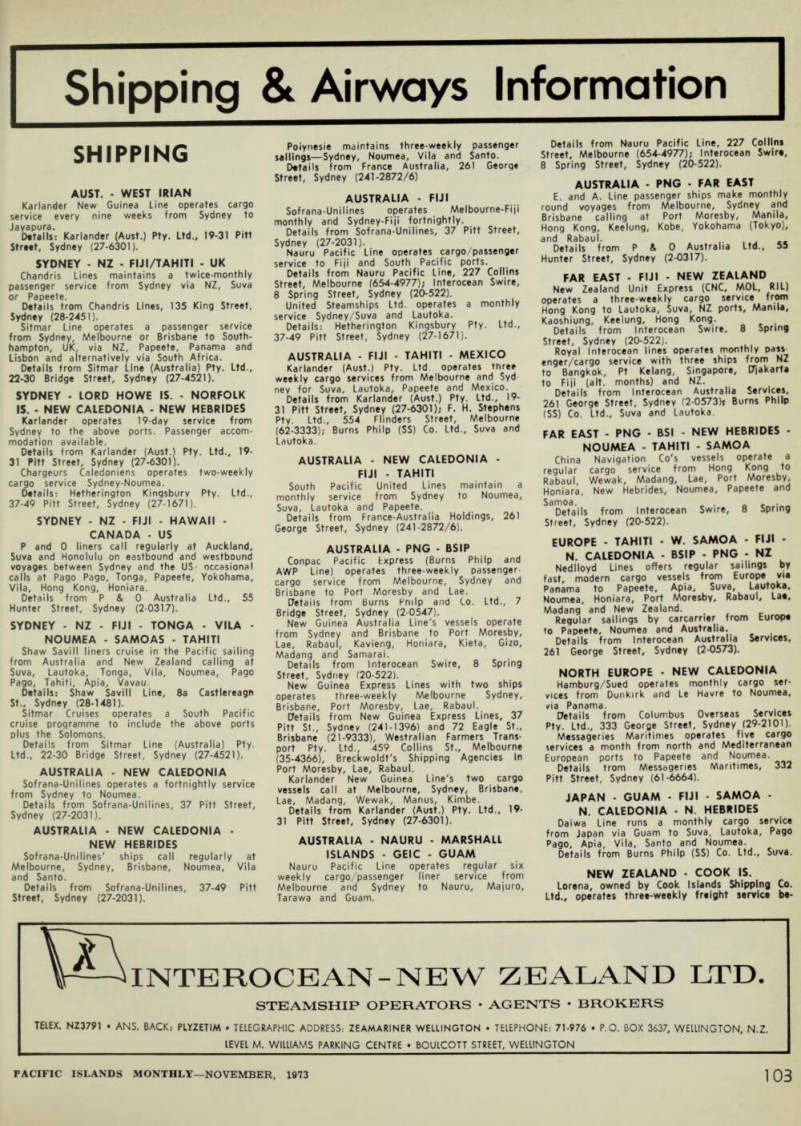
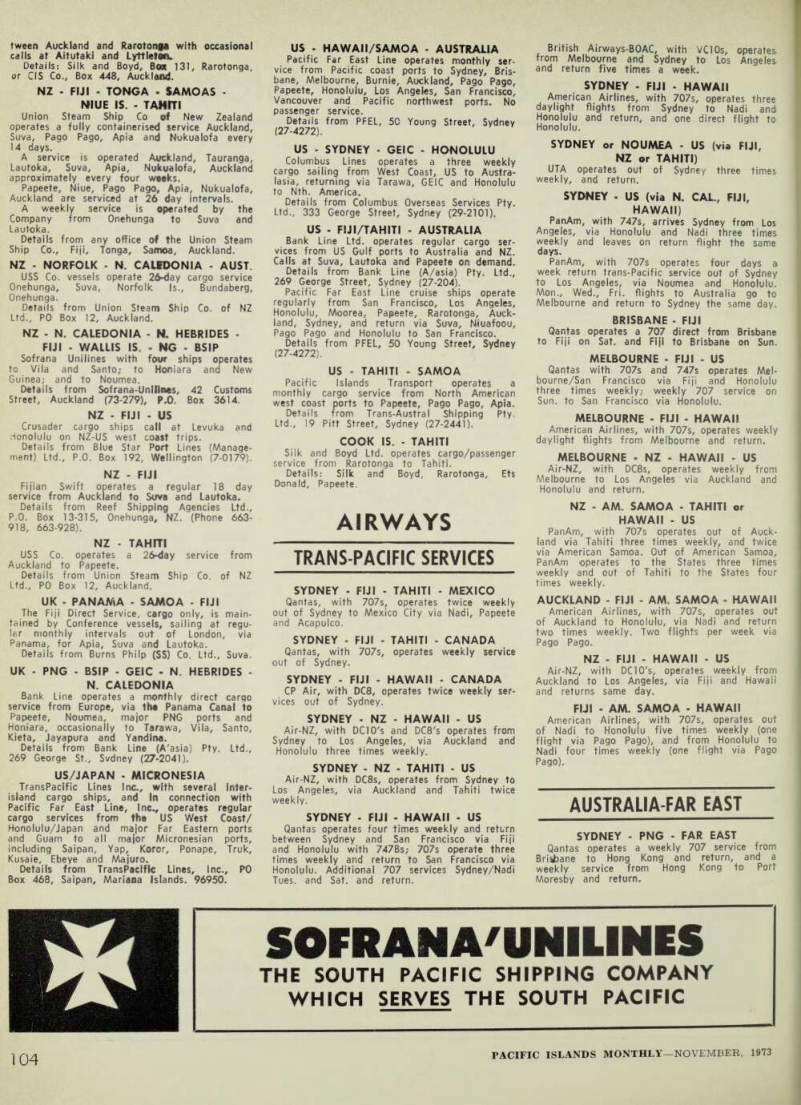
Shipping
Aust. ■ West Irian
Karlander New Guinea Line operates cargo service every nine weeks from Sydney to Jayapura.
Details: Karlander (Aust.) Pty. Ltd., 19-31 Pitt Street, Sydney (27-6301).
SYDNEY - NZ - FIJI/TAHITI - UK Chandris Lines maintains a twice-monthly passenger service from Sydney via NZ, Suva or Papeete.
Details trom Chandris Lines, 135 King Street, Sydney (28-2451).
Sitmar Line operates a passenger service from Sydney, Melbourne or Brisbane to South hampton, UK, via NZ, Papeete, Panama and Lisbon and alternatively via South Africa.
Details from Sitmar Line (Australia) Pty. Ltd., 22-30 Bridge Street, Sydney (27-4521).
SYDNEY - LORD HOWE IS. - NORFOLK IS. • NEW CALEDONIA - NEW HEBRIDES Karlander operates 19-day service from Sydney to the above ports. Passenger accom modation available.
Details from Karlander (Aust.) Pty. Ltd., 19- SI Pitt Street, Sydney (27-6301).
Chargeurs Caledoniens operates two-weekly cargo service Sydney-Noumea.
Details; Hetherington Kingsbury Pty. Ltd., 37-49 Pitt Street, Sydney (27-1671).
SYDNEY - NZ - FIJI - HAWAII -
Canada - Us
P and 0 liners call regularly at Auckland, Suva and Honolulu on eastbound and westbound voyages between Sydney and the US- occasional calls at Pago Pago, Tonga, Papeete, Yokohama, Vila, Hong Kong, Honiara.
Details from P & 0 Australia Ltd., 55 Hunter Street, Sydney (2-0317).
SYDNEY - NZ - FIJI - TONGA • VILA •
Noumea - Samoas - Tahiti
Shaw Savill liners cruise in the Pacific sailing from Australia and New Zealand calling at Suva, Lautoka, Tonga, Vila, Noumea, Pago Pago, Tahiti, Apia, Vavau.
Details: Shaw Savill Line, 8a Castlereagn St., Sydney (28-1481).
Sitmar Cruises operates a South Pacific cruise programme to include the above ports plus the Solomons.
Details from Sitmar Line (Australia) Pty.
Ltd., 22-30 Bridge Street, Sydney (27-4521).
Australia - New Caledonia
Sofrana-Unilines operates a fortnightly service from Sydney to Noumea.
Details from Sofrana-Unilines, 37 Pitt Street, Sydney (27-2031).
Australia - New Caledonia -
New Hebrides
Sofrana-Unilines' ships call regularly at Melbourne, Sydney, Brisbane, Noumea, Vila and Santo.
Details from Sofrana-Unilines, 37-49 Pitt Street, Sydney (27-2031).
Poiynesie maintains three-weekly passenger sailings—Sydney, Noumea, Vila and Santo.
Details from France Australia, 261 George Street, Sydney (241-2872/6)
Australia - Fiji
Sofrana-Unilines operates Melbourne-Fi j i monthly and Sydney-Fiji fortnightly.
Details from Sofrana-Unilines, 37 Pitt Street, Sydney (27-2031).
Nauru Pacific Line operates cargo/passenger service to Fiji and South Pacific ports.
Details from Nauru Pacific Line, 227 Collins Street, Melbourne (654-4977); Interocean Swire, 8 Spring Street, Sydney (20-522).
United Steamships Ltd. operates a monthly service Sydney/Suva and Lautoka.
Details; Hetherington Kingsbury Pty. Ltd., 37-49 Pitt Street, Sydney (27-1671), AUSTRALIA - FIJI - TAHITI - MEXICO Karlander (Aust.) Pty. Ltd. operates three weekly cargo services from Melbourne and Syd ney for Suva, Lautoka, Papeete and Mexico.
Details from Karlander (Aust.) Pty. Ltd., 19- 31 Pitt Street, Sydney (27-6301); F. H. Stephens Pty Ltd., 554 Flinders Street, Melbourne (62-3333); Burns Philp (SS) Co. Ltd., Suva and Lautoka.
Australia - New Caledonia -
Fiji - Tahiti
South Pacific United Lines maintain a monthly service from Sydney to Noumea, Suva, Lautoka and Papeete.
Details from France-Australia Holdings, 261 George Street, Sydney (241-2872/6).
Australia - Png - Bsip
Conpac Pacific Express (Burns Philp and AWP Line) operates three-weekly passenger cargo service from Melbourne, Sydney and Brisbane to Port Moresby and Lae.
Details from Burns Pmlp and Co. Ltd., 7 Bridge Street, Sydney (2-0547).
New Guinea Australia Line's vessels operate from Sydney and Brisbane to Port Moresby, Lae, Rabaul, Kavieng, Honiara, Kieta, Gizo, Madang and Samarai.
Details from Interocean Swire, 8 Spring Street, Sydney (20-522).
New Guinea Express Lines with two ships operates three-weekly Melbourne Sydney, Brisbane, Port Moresby, Lae, Rabaul.
Details from New Guinea Express Lines, 37 Pitt St., Sydney (241-1396) and 72 Eagle St., Brisbane (21-9333), Westralian Farmers Trans port Pty. Ltd., 459 Collins St., Melbourne (35-4366), Breckwoldt's Shipping Agencies In Port Moresby, Lae, Rabaul.
Karlander New Guinea Line's two cargo vessels call at Melbourne, Sydney, Brisbane, Lae, Madang, Wewak, Manus, Kimbe.
Details from Karlander (Aust.) Pty. Ltd., 19- SI Pitt Street, Sydney (27-6301).
Australia - Nauru - Marshall
Islands - Geic • Guam
Nauru Pacific Line operates regular six weekly cargo/passenger liner service from Melbourne and Sydney to Nauru, Majuro, Tarawa and Guam.
Details from Nauru Pacific Line, 227 Collins Street, Melbourne (654-4977); Interocean Swire, 8 Spring Street, Sydney (20-522).
Australia - Png - Far East
E. and A. Line passenger ships make monthly round voyages from Melbourne, Sydney and Brisbane calling at Port Moresby, Manila, Hong Kong, Keelung, Kobe, Yokohama (Tokyo), and Rabaul. .. . , Details from P & 0 Australia Ltd., 55 Hunter Street, Sydney (2-0317).
FAR EAST - FIJI - NEW ZEALAND New Zealand Unit Express (CNC, MOL, RIL) operates a three-weekly cargo service from Hong Kong to Lautoka, Suva, NZ ports, Manila, Kaoshiung, Keelung, Hong Kong.
Details from Interocean Swire, 8 Spring Street, Sydney (20-522).
Royal Interocean lines operates monthly pass enger/cargo service with three ships from NZ to Bangkok, Pt Kelang, Singapore, Djakarta to Fiji (alt. months) and NZ.
Details from Interocean Australia Services, 261 George Street, Sydney (2-0573); Burns Phi Ip (SS) Co. Ltd., Suva and Lautoka.
FAR EAST - PNG - BSI - NEW HEBRIDES ■
Noumea - Tahiti - Samoa
China Navigation Co's vessels operate a regular cargo service from Hong Kong to Rabaul, Wewak, Madang, Lae, Port Moresby, Honiara, New Hebrides, Noumea, Papeete and Samoa. . . . . Details from Interocean Swire, 8 Spring Street, Sydney (20-522).
EUROPE - TAHITI - W. SAMOA - FIJI • N. CALEDONIA - BSIP - PNG - NZ Nedlloyd Lines offers regular sailings by fast, modern cargo vessels from Europe via Panama to Papeete, Apia, Suva, Lautoka, Noumea, Honiara, Port Moresby, Rabaul, Laa, Madang and New Zealand.
Regular sailings by carcarrier from Europe to Papeete, Noumea and Australia.
Details from Interocean Australia Services, 261 George Street, Sydney (2-0573).
North Europe - New Caledonia
Hamburg/Sued operates monthly cargo ser vices from Dunkirk and Le Havre to Noumea, via Panama.
Details from Columbus Overseas Services Pty. Ltd., 333 George Street, Sydney (29-2101).
Messageries Maritimes operates five cargo services a month from north and Mediterranean European ports to Papeete and Noumea.
Details trom Messageries Maritimes, 332 Pitt Street, Sydney (61-6664).
JAPAN • GUAM - FIJI • SAMOA -
N. Caledonia - N. Hebrides
Daiwa Line runs a monthly cargo service from Japan via Guam to Suva, Lautoka, Pago Pago, Apia, Vila, Santo and Noumea.
Details from Burns Philp (SS) Co. Ltd., Suva.
New Zealand - Cook Is.
Lorena, owned by Cook Islands Shipping Co.
Ltd., operates three-weekly freight service be
tween Auckland and Rarotonga with occasional calls at Aitutaki and Lyttleton.
Details: Silk and Boyd, Box 131, Rarotonga, or CIS Co., Box 448, Auckland.
NZ - FIJI • TONGA . SAMOAS -
Niue Is. - Tahiti
Union Steam Ship Co of New Zealand operates a fully containerised service Auckland, Suva, Pago Pago, Apia and Nukualofa every 14 days.
A service is operated Auckland, Tauranga, Lautoka, Suva, Apia, Nukualofa, Auckland approximately every four weeks.
Papeete, Niue, Pago Pago, Apia, Nukualofa, Auckland are serviced at 26 day intervals.
A weekly service is operated by the Company from Onehunga to Suva and Lautoka.
Details from any office of the Union Steam Ship Co., Fiji, Tonga, Samoa, Auckland.
NZ - NORFOLK - N. CALEDONIA - AUST.
USS Co. vessels operate 26-day cargo service Onehunga, Suva, Norfolk Is., Bundaberg, Onehunga.
Details from Union Steam Ship Co. of NZ Ltd., PO Box 12, Auckland.
NZ - N. CALEDONIA - N. HEBRIDES - FIJI - WALLIS IS. - NG - BSIP Sofrana Unilines with four ships operates to Vila and Santo; to Honiara and New Guinea; and to Noumea.
Details from Sofrana-UnlOnes, 42 Customs Street, Auckland (73-279), P.O. Box 3614.
Nz - Fiji - Us
Crusader cargo ships call at Levuka and Honolulu on NZ-US west coast trips.
Details from Blue Star Port Lines (Manage ment) Ltd., P.O. Box 192, Wellington (7-0179).
Nz ■ Fiji
Fijian Swift operates a regular 18 day service from Auckland to Suva and Lautoka.
Details from Reef Shipping Agencies Ltd., P.O. Box 13-315, Onehunga, NZ. (Phone 663- 918, 663-928).
Nz - Tahiti
USS Co. operates a 26-day service from Auckland to Papeete.
Details from Union Steam Ship Co. of NZ Ltd., PO Box 12, Auckland.
UK - PANAMA - SAMOA - FIJI The Fiji Direct Service, cargo only, is main tained by Conference vessels, sailing at regu lar monthly intervals out of London, via Panama, for Apia, Suva and Lautoka.
Details from Burns Philp (SS) Co. Ltd., Suva.
UK - PNG - BSIP - GEIC - N. HEBRIDES -
N. Caledonia
Bank Line operates a monthly direct cargo service from Europe, via the Panama Canal to Papeete, Noumea, major PNG ports and Honiara, occasionally to Tarawa, Vila, Santo, Kieta, Jayapura and Yandlna.
Details from Bank Line (A'asia) Pty. Ltd., 269 George St., Svdney (27-2041).
Us/Japan - Micronesia
Transpacific Lines Inc., with several Inter island cargo ships, and In connection with Pacific Far East Line, Inc., operates regular cargo services from the US West Coast/ Honolulu/Japan and major Far Eastern ports and Guam to all major Micronesian ports, including Saipan, Yap, Koror, Ponape, Truk, Kusaie, Ebeye and Majuro.
Details from Transpacific Lines, Inc., PO Box 468, Saipan, Mariana Islands. 96950.
Us - Hawaii/Samoa ■ Australia
Pacific Far East Line operates monthly ser vice from Pacific coast ports to Sydney, Bris bane, Melbourne, Burnie, Auckland, Pago Pago, Papeete, Honolulu, Los Angeles, San Francisco, Vancouver and Pacific northwest ports. No passenger service.
Details from PFEL, 50 Young Street, Sydney (27-4272).
US - SYDNEY - GEIC - HONOLULU Columbus Lines operates a three weekly cargo sailing from West Coast, US to Austra lasia, returning via Tarawa, GEIC and Honolulu to Nth. America.
Details from Columbus Overseas Services Pty.
Ltd., 333 George Street, Sydney (29-2101).
Us - Fiji/Tahiti - Australia
Bank Line Ltd. operates regular cargo ser vices from US Gulf ports to Australia and NZ.
Calls at Suva, Lautoka and Papeete on demand.
Details from Bank Line (A/asia) Pty. Ltd., 269 George Street, Sydney (27-204).
Pacific Far East Line cruise ships operate regularly from San Francisco, Los Angeles, Honolulu, Moorea, Papeete, Rarotonga, Auck land, Sydney, and return via Suva, Niuafoou, Pago Pago and Honolulu to San Francisco.
Details from PFEL, 50 Young Street, Sydney (27-4272).
Us - Tahiti - Samoa
Pacific Islands Transport operates a monthly cargo service from North American west coast ports to Papeete, Pago Pago, Apia.
Details from Trans-Austral Shipping Pty.
Ltd., 19 Pitt Street, Sydney (27-2441).
Cook Is. - Tahiti
Silk and Boyd Ltd. operates cargo/passenger service from Rarotonga to Tahiti.
Details: Silk and Boyd, Rarotonga, Ets Donald, Papeete.
Advertisements & other items, p. 111 (1 item)
Interocean-New Zealand Ltd.
STEAMSHIP OPERATORS • AGENTS • BROKERS
TEIEX. NZ37PI . ANS. BACK: PLYZETIM - TELEGRAPHIC ADDRESS: ZEAMARINER WELLINGTON • TELEPHONE: 71-976 • P.O. BOX 3637, WELLINGTON, N.Z.
LEVEL M. WILLIAMS PARKING CENTRE • BOULCOTT STREET, WELLINGTON
Airways
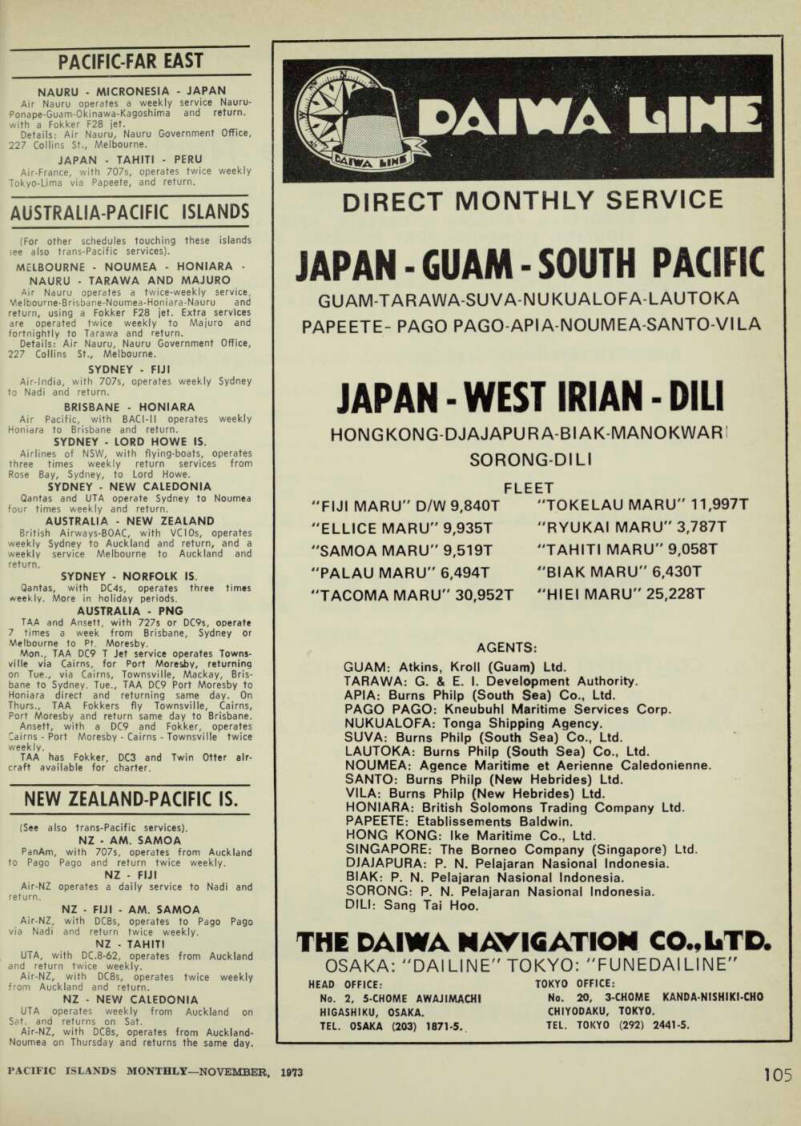
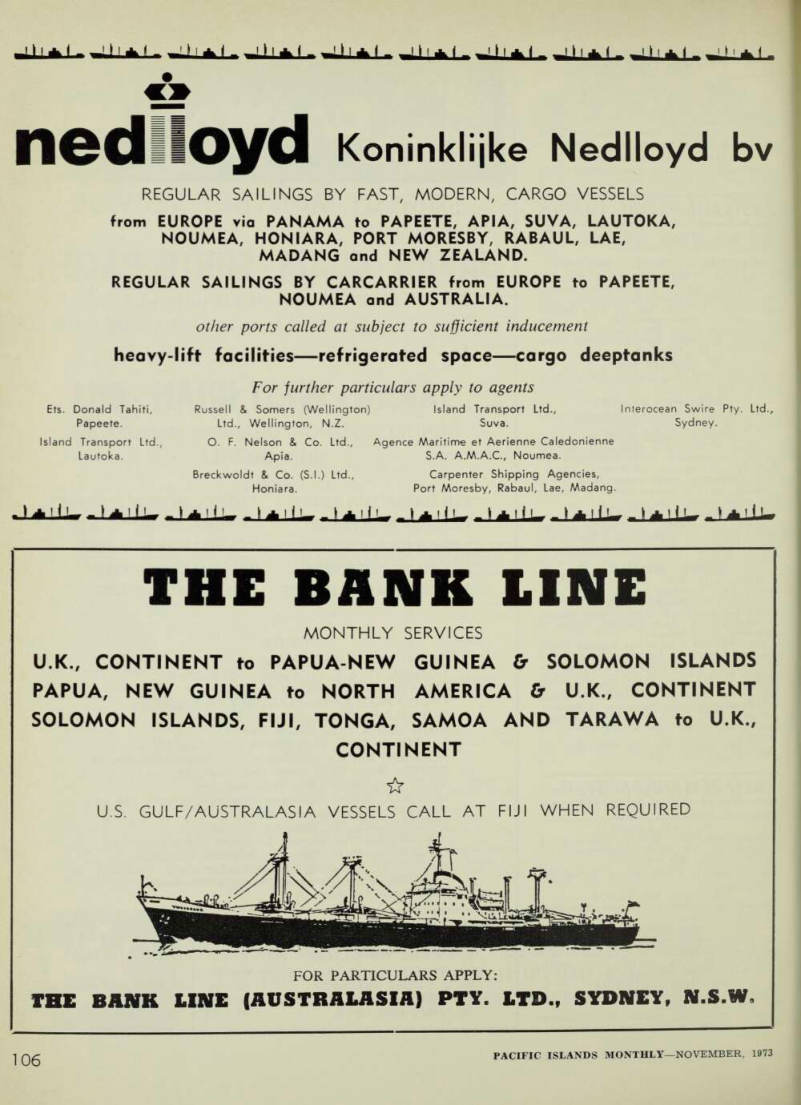
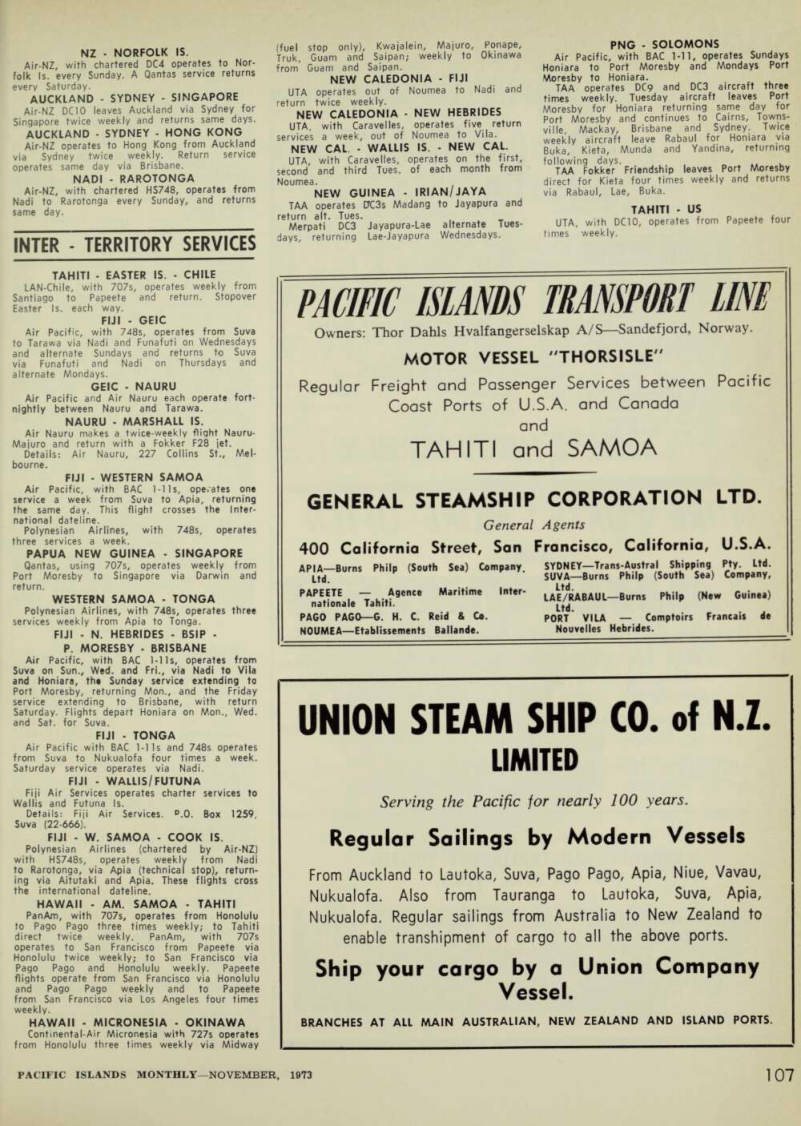
Trans Pacific Services
SYDNEY - FIJI - TAHITI - MEXICO Qantas, with 7075, operates twice weekly out of Sydney to Mexico City via Nadi, Papeete and Acapulco.
SYDNEY - FIJI - TAHITI - CANADA Qantas, with 7075, operates weekly service out of Sydney.
SYDNEY - FIJI - HAWAII - CANADA CP Air, with DCS, operates twice weekly ser vices out of Sydney.
SYDNEY - NZ - HAWAII - US Air-NZ, with DClO's and DCB's operates from Sydney to Los Angeles, via Auckland and Honolulu three times weekly.
SYDNEY - NZ - TAHITI ■ US Air-NZ, with DCBs, operates from Sydney to Los Angeles, via Auckland and Tahiti twice weekly, SYDNEY - FIJI - HAWAII - US Qantas operates four times weekly and return between Sydney and San Francisco via Fiji and Honolulu with 74785; 707 s operate three times weekly and return to San Francisco via Honolulu. Additional 707 services Sydney/Nadi Tues. and Sat. and return.
British Airways-BOAC, with VClOs, operates from Melbourne and Sydney to Los Angeles and return five times a week,
Sydney - Fiji - Hawaii
American Airlines, with 7075, operates three daylight flights from Sydney to Nadi and Honolulu and return, and one direct flight to Honolulu.
SYDNEY or NOUMEA - US (via FIJI,
Nz Or Tahiti)
UTA operates out of Sydney three times weekly, and return.
SYDNEY - US (via N. CAL., FIJI,
Hawaii)
PanAm, with 7475, arrives Sydney from Los Angeles, via Honolulu and Nadi three times weekly and leaves on return flight the same days.
PanAm, with 707 s operates four days a week return trans-Pacific service out of Sydney to Los Angeles, via Noumea and Honolulu.
Mon., Wed., Fri. flights to Australia go to Melbourne and return to Sydney the same day.
Brisbane • Fiji
Qantas operates a 707 direct from Brisbane to Fiji on Sat. and Fiji to Brisbane on Sun.
Melbourne - Fiji - Us
Qantas with 707 s and 747 s operates Mel bourne/San Francisco via Fiji and Honolulu three times weekly; weekly 707 service on Sun. to San Francisco via Honolulu.
Melbourne - Fiji - Hawaii
American Airlines, with 7075, operates weekly daylight flights from Melbourne and return.
MELBOURNE - NZ - HAWAII - US Air-NZ, with DCBs, operates weekly from Melbourne to Los Angeles via Auckland and Honolulu and return.
NZ - AM. SAMOA - TAHITI or
Hawaii • Us
PanAm, with 707 s operates out of Auck land via Tahiti three times weekly, and twice via American Samoa. Out of American Samoa, PanAm operates to the States three times weekly and out of Tahiti to the States four times weekly.
AUCKLAND - FIJI - AM. SAMOA - HAWAII American Airlines, with 7075, operates out of Auckland to Honolulu, via Nadi and return two times weekly. Two flights per week via Pago Pago.
NZ - FIJI - HAWAII - US Air-NZ, with DClO's, operates weekly from Auckland to Los Angeles, via Fiji and Hawaii and returns same day.
Fiji - Am. Samoa • Hawaii
American Airlines, with 7075, operates out of Nadi to Honolulu five times weekly (one flight via Pago Pago), and from Honolulu to Nadi four times weekly (one flight via Pago Pago).
Australia-Far East
Sydney ■ Png - Far East
Qantas operates a weekly 707 service from Bri&ane to Hong Kong and return, and a weekly service from Hong Kong to Port Moresby and return.
Pacific-Far East
Nauru - Micronesia - Japan
Air Nauru operates a weekly service Nauru- Ponape-Guam-Okinawa-Kagoshima and return, with a Fokker F2B jet.
Details: Air Nauru, Nauru Government Office, 227 Collins St., Melbourne.
Japan - Tahiti - Peru
Air-France, with 7075, operates twice weekly Tokyo-Lima via Papeete, and return.
Australia-Pacific Islands
(For other schedules touching these islands see also trans-Pacific services).
Melbourne - Noumea - Honiara -
Nauru - Tarawa And Majuro
Air Nauru operates a twice-weekly service, Melboume-Brisbane-Noumea-Honiara-Nauru and return, using a Fokker F2B jet. Extra services are operated twice weekly to Majuro and fortnightly to Tarawa and return.
Details: Air Nauru, Nauru Government Office, 227 Collins St., Melbourne.
Sydney - Fiji
Air-lndia, with 7075, operates weekly Sydney to Nadi and return.
Brisbane - Honiara
Air Pacific, with BACI-1I operates weekly Honiara to Brisbane and return.
Sydney - Lord Howe Is.
Airlines of NSW, with flying-boats, operates three times weekly return services from Rose Bay, Sydney, to Lord Howe.
Sydney ■ New Caledonia
Qantas and UTA operate Sydney to Noumea four times weekly and return.
Australia - New Zealand
British Airways-BOAC, with VClOs, operates weekly Sydney to Auckland and return, and a weekly service Melbourne to Auckland and return.
Sydney - Norfolk Is.
Qantas, with DC4s, operates three times weekly. More in holiday periods.
Australia - Png
TAA and Ansett, with 727 s or DC9s, operate 7 times a week from Brisbane, Sydney or Melbourne to Pt. Moresby.
Mon., TAA DC9 T Jet service operates Towns ville via Cairns, for Port Moresby, returning on Tue., via Cairns, Townsville, Mackay, Bris bane to Sydney. Tue., TAA DC9 Port Moresby to Honiara direct and returning same day. On Thurs., TAA Fokkers fly Townsville, Cairns, Port Moresby and return same day to Brisbane.
Ansett, with a DC9 and Fokker, operates Cairns - Port Moresby - Cairns - Townsville twice weekly.
TAA has Fokker, DC3 and Twin Otter air craft available for charter.
New Zealand-Pacific Is.
(See also trans-Pacific services).
Nz - Am. Samoa
PanAm, with 7075, operates from Auckland to Pago Pago and return twice weekly.
Nz - Fiji
Air-NZ operates a daily service to Nadi and return.
Nz - Fiji - Am. Samoa
Air-NZ, with DCBs, operates to Pago Pago via Nadi and return twice weekly.
Nz - Tahiti
UiA, with DC.B-62, operates from Auckland and return twice weekly.
Air-NZ, with DCBs, operates twice weekly from Auckland and return.
Nz • New Caledonia
UTA operates weekly from Auckland on Sat. and returns on Sat.
Air-NZ, with DCBs, operates from Auckland- Noumea on Thursday and returns the same day.
Nz ■ Norfolk Is.
Air-NZ, with chartered DC4 operates to Nor folk Is. every Sunday. A Qantas service returns every Saturday.
Auckland - Sydney - Singapore
Air-NZ DCIO leaves Auckland via Sydney for Singapore twice weekly and returns same days.
Auckland - Sydney - Hong Kong
Air-NZ operates to Hong Kong from Auckland via Sydney twice weekly. Return service operates same day via Brisbane.
Nadi - Rarotonga
Air-NZ, with chartered HS74B, operates from Nadi to Rarotonga every Sunday, and returns same day.
Inter - Territory Services
Tahiti - Easter Is. - Chile
LAN-Chile, with 7075, operates weekly from Santiago to Papeete and return. Stopover Easter Is. each way.
Fiji - Geic
Air Pacific, with 7485, operates from Suva to Tarawa via Nadi and Funafuti on Wednesdays and alternate Sundays and returns to Suva via Funafuti and Nadi on Thursdays and alternate Mondays.
Geic - Nauru
Air Pacific and Air Nauru each operate fort nightly between Nauru and Tarawa.
Nauru ■ Marshall Is.
Air Nauru makes a twice-weekly flight Nauru- Majuro and return with a Fokker F2B jet.
Details: Air Nauru, 227 Collins St., Mel bourne.
Fiji ■ Western Samoa
Air Pacific, with BAC 1-1 Is, operates one service a week from Suva to Apia, returning the same day. This flight crosses the Inter national dateline.
Polynesian Airlines, with 7485, operates three services a week.
Papua New Guinea • Singapore
Qantas, using 7075, operates weekly from Port Moresby to Singapore via Darwin and return.
Western Samoa • Tonga
Polynesian Airlines, with 7485, operates three services weekly from Apia to Tonga.
FIJI - N. HEBRIDES • BSIP -
P. Moresby - Brisbane
Air Pacific, with BAC 1-1 Is, operates from Suva on Sun., Wed. and Fri., via Nadi to Vila and Honiara, the Sunday service extending to Port Moresby, returning Mon., and the Friday service extending to Brisbane, with return Saturday. Flights depart Honiara on Mon., Wed. and Sat. for Suva.
Fiji - Tonga
Air Pacific with BAC 1-1 Is and 748 s operates from Suva to Nukualofa four times a week.
Saturday service operates via Nadi.
Fiji - Wallis/ Futuna
Fiji Air Services operates charter services to Wallis and Futuna Is.
Details: Fiji Air Services. °.O. Box 1259, Suva (22-666).
FIJI - W. SAMOA - COOK IS.
Polynesian Airlines (chartered by Air-NZ) with HS74Bs, operates weekly from Nadi to Rarotonga, via Apia (technical stop), return ing via Aitutaki and Apia. These flights cross the international dateline.
Hawaii - Am. Samoa - Tahiti
PanAm, with 7075, operates from Honolulu to Pago Pago three times weekly; to Tahiti direct twice weekly. PanAm, with 707 s operates to San Francisco from Papeete via Honolulu twice weekly; to San Francisco via Pago Pago and Honolulu weekly. Papeete flights operate from San Francisco via Honolulu and Pago Pago weekly and to Papeete from San Francisco via Los Angeles four times weekly.
Hawaii - Micronesia - Okinawa
Continental-Air Micronesia with 727 s operates from Honolulu three times weekly via Midway
(fuel stop only), Kwajalein, Majuro, Ponape, Truk, Guam and Saipan; weekly to Okinawa from' Guam and Saipan.
New Caledonia - Fiji
UTA operates out of Noumea to Nadi and return twice weekly.
Mbiai Taipoonia New Hebrides
New Caledonia - New MtßKiuts
UTA. with Ca rave lies, operates five return services a week, out of Noumea to Vila.
NEW CAL. • WALLIS IS. - NEW CAL.
UTA, with Caravelles, operates on the first, second and third Tues. of each month from Noumea.
New Guinea - Irian/Jaya
TAA operates DG3s Madang to Jayapura and re Me"pa a 'i' lef Jayapura-Lae alternate Tuesdays, returning Lae-Jayapura Wednesdays.
Png - Solomons
Air Pacific, with BAG 1-11, operates Sundays Honiara to Port Moresby and Mondays Port Moresby to Honiara.
TAA operates DC9 and . DC3^al^l« times weekly. Tuesday aircraft leaves Port Moresby for Honiara returning same day for Moresby and continues to Cairns, Towns- Brisbane gnd Sydney . Twice wee kly aircraft leave Rabaul for Honiara via Buka/ Kieta/ Munda and Yandina, returning following days, JAA Fokker Friendship leaves Port Moresby direct for Kieta four times weekly and returns via Rabaul, Lae, Buka.
Tahiti - Us
UTA, with OCIO, operates from Papeete four times weekly.
PanAm with 7075, operates regular return services to San Francisco, via Los Angeles; to San Francisco, via Honolulu; and to San Francisco, via Pago Pago and Honolulu.
W. Samoa - Am. Samoa
Polynesian Airlines, with 7485, operates between Apia and Pago Pago twenty times weekly.
Tonga - Niue - W. Samoa
Polynesian Airlines, with 7485, operates weekly service from Tonga to Apia via Niue.
Tahiti - Cook Is.
Air Tahiti with Piper Aztec, operates char ter service from Papeete to Rarotonga.
Details from Air Polynesie, P.O. Box 314, Quai Bir Hakeim, Papeete, and UTA offices.
Internal Services
Fiji
Air Pacific, with HS74Bs, BAC 1-1 Is and Herons operates regular services to Labasa, Taveuni, Nadi, Suva and Savusavu.
Fiji Air Services, with Britten-Norman Islander and Beechcraft Baron aircraft, operates services to Castaway and Plantation village resorts. The Fijian hotel, Korolevu Beach hotel, Flagship Beachcomber hotel, Levuka, Lakeba, Vatukola. Charter flights operate to anywhere in the Pacific.
Details; Fiji Air Services, P.O. Box 1259, Suva (telephone 22-666).
French Polynesia
Air Polynesie, with Fokker F 27 Friendship, DC4s, Twin Otters and Islanders, operates to Bora Bora, Huahine, Moorea, Rangiroa, Raiatea,
Manihi, Marquesas, Maupiti and Tubuai, Austral Islands.
Details from Air Polynesia, P.O. Box 314 Quai Bir Hakeim, Papeete, and UTA offices.
Air Tahiti, with light aircraft operates shuttle service from Papeete to Moorea and charter service to Raiatea, Bora Bora, Huahine, Rangiroa and Manihi.
Guam - Us Trust Territory
Continental-Air Micronesia with 727 s and
DC6s operates regular service connecting Hono lulu, Okinawa and Guam with Saipan, Rota, Yap, Palau, Truk, Ponape, Kwajalein and Maiuro.
Details from Air Micronesia, Saipan.
Air Pacific Inc. (not connected with the Fiji based Air Pacific) with Piper Navajo and a deHavilland Heron, operates regular services linking Guam, Saipan, Tinian, and Rota, and charter services are available to other Trust Territory islands.
Details, Air Pacific Inc., P.O. Box 7689, Tamuning, Guam, 96911, U.S.A.
Lagoon Aviation Inc. with Grumman Wid geons, operates charter services for the Mar shalls district, based on Majuro.
Gilbert And Ellice Islands
Air Pacific, with Herons, operates regular services between Tarawa, Butaritari, North Tabiteuea and Abemama.
Papua New Guinea
TAA and Ansett operate throughout Papua New Guinea.
Aerial Tours operates in Central, Western, Gulf and Sepik districts.
T.A.L. (GV) —Territory Airlines Pty Limited operates scheduled services and charter flights from Goroka, Kundiawa, Madang, Wewak, Vanimo, Mt. Hagen, Mendi to Highlands, Sepik
and Coastal areas. Talco Territory Travel Ser vice of Papua New Guinea—Twin Otter Tourist flights throughout Papua New Guinea.
Further details from T.A.L., P.O. Box 108 Goroka, Papua New Guinea.
Macair throughout Papua New Guinea.
Bougainville Air Services operates daily throughout Bougainville. There are six regular services Kieta-Buin. Details: Arawa, Phone 956-159; Buka, Phone 16. Box 298, PO, Kieta.
New Caledonia
Air Caledonie, with Twin Otters, and Is landers operates regular services to Houal ou. Isle of Pines, Isle Ouen, Kone, Koumac, Lifou, Mare, Noumea, Ouvea Touho, Mueo Belep, Tiga.
Details from Air Caledonie, Noumea.
New Hebrides
Air Melanesiae with Britten-Norman Islanders and Trislander operates to Santo, Malekula Norsup and Lamap), Aoba (Walaha and Longana), Pentecost (Lonorore), Erromanga, Tongoa, Aneityum, Tanna, Epi, Sola and Vila. Direct connections are available to and from Santo for all international flights arriving in Vila.
Details from Air Melanesiae, P.O. Box 72, Vila.
Solomon Islands
Solair, with Beech Barons and Islanders operates to Auki, Avu Avu, Babanaklra, Bara koma, Bel lona Is., Fera Is., Gizo, Honiara, Kira Kira, Marau, Munda, Parasi, Sege, Yandina, Santa Cruz, Mono, Rennell Is., Choiseul Bay, Ballalae and Ring! Cove.
Details from Solomon Islands Airways Ltd., Box 23, Honiara, BSIP.
Tonga
Tonga Tourist and Development Co, with Britten-Norman Islander and Aztec aircraft, operates between Fua'amotu, (airport for Nukualofa) and Vava'u Monday to Saturday.
Service soon between Fua'amotu and Eua.
Aircraft available for sightseeing and regional charters.
Details from Tonga Tourist and Development Co, PO Box 91, Nukualofa, Tonga.
Cook Islands
Cook Islands Airways Ltd, with a Britten Norman Islander, starts service on November 25. Seven flights a week will operate between Rarotonga and Aitutaki. Service will be ex tended to Atiu, Mangaia and Mitiaro when airstrips are built.
BOOMING TONGA.— The tourist industry is beginning to boom in Tonga which played host to 4,722 air visitors between January and Sep tember, 125 more than for the whole of last year. There were eight more cruise ships in the nine months than in the same period last year and 6,892 more cruise passengers and crew.
BOOTED OUT. —Twenty-eight Tongans arrived in Apia by air on October 10 and were kept in police custody until they could be flown to Tonga. They had been deported from New Zealand after being de clared illegal immigrants with ex
pired permits.
White Ghetto.— The New Zea
land Race Relations Council has asked for an immediate, radical and public review of the NZ immigration policy.
The council’s secretary, the Rev D.
Borrie, said that white migrants to NZ were helping the development of a white ghetto in the South Pacific at a time when the country needed to encourage the growth of its Polynesian
identity.
Advertisements & other items, pp. 112-116 (1 item)
Sofrana'unilines
hrb
THE SOUTH PACIFIC SHIPPING COMPANY
WHICH SERVES THE SOUTH PACIFIC
DAIWA LINE
DIRECT MONTHLY SERVICE
JAPAN - GUAM - SOUTH PACIFIC
GUAM TARAWA-SUVA NUKUALOFA-LAUTOKA
PAPEETE- PAGO PAGO APIA-IMOUMEA SAIMTO-VILA
JAPAN - WEST IRIAN - DILI
HONGKONG-DJAJAPURA-BIAK-MANOKWARI
SORONGDILI
FLEET
"FIJI MARU" D/W 9,840 T
“ELLICE MARU" 9,935 T
“SAMOA MARU" 9,519 T
“PALAU MARU" 6,494 T
“TACOMA MARU" 30,952 T
“TOKELAU MARU" 11,997 T
“RYUKAI MARU" 3,787 T
“TAHITI MARU" 9,058 T
“BIAK MARU" 6,430 T
“HIEI MARU" 25,228 T
AGENTS:
GUAM: Atkins, Kroll (Guam) Ltd.
TARAWA: G. & E. I. Development Authority.
APIA: Burns Philp (South Sea) Co., Ltd.
PAGO PAGO: Kneubuhl Maritime Services Corp.
NUKUALOFA: Tonga Shipping Agency.
SUVA: Burns Philp (South Sea) Co., Ltd.
LAUTOKA; Burns Philp (South Sea) Co., Ltd.
NOUMEA: Agence Maritime et Aerienne Caledonienne.
SANTO: Burns Philp (New Hebrides) Ltd.
VILA: Burns Philp (New Hebrides) Ltd.
HONIARA: British Solomons Trading Company Ltd.
PAPEETE: Etablissements Baldwin.
HONG KONG: Ike Maritime Co., Ltd.
SINGAPORE: The Borneo Company (Singapore) Ltd.
DJAJAPURA: P. N. Pelajaran Nasional Indonesia.
BIAK; P. N. Pelajaran Nasional Indonesia.
SORONG: P. N. Pelajaran Nasional Indonesia.
DILI: Sang Tai Hoo.
THE DAIWA MA¥IGATIOM CO.* LTD.
OSAKA: “DAILINE" TOKYO: “FUNEDAILINE"
HEAD OFFICE: TOKYO OFFICE:
No. 2, 5-CHOME AWAJIMACHI No. 20, 3-CHOME KANDA-NISHIKI-CHO
HIGASHIKU, OSAKA. CHIYODAKU, TOKYO.
TEL. OSAKA (203) 1871-5. TEL. TOKYO (292) 2441-5.
nediioyd Koninklijke Nedlloyd bv
REGULAR SAILINGS BY FAST, MODERN, CARGO VESSELS from EUROPE via PANAMA to PAPEETE, APIA, SUVA, LAUTOKA,
NOUMEA, HONIARA, PORT MORESBY, RABAUL, LAE,
MADANG and NEW ZEALAND.
REGULAR SAILINGS BY CARCARRIER from EUROPE to PAPEETE,
NOUMEA and AUSTRALIA.
other ports called at subject to sufficient inducement
heavy-lift facilities—refrigerated space—cargo deeptanks
For further particulars apply to agents
Ets. Donald Tahiti, Papeete.
Island Transport Ltd., Lautoka.
Russell & Somers (Wellington) Ltd., Wellington, N.Z.
O. F. Nelson & Co. Ltd., Apia.
Island Transport Ltd., Suva.
Interocean Swire Pty. Ltd., Sydney.
Agence Maritime et Aerienne Caledonienne Breckwoldt & Co. (5.1.) Ltd., S.A. A.M.A.C., Noumea.
Carpenter Shipping Agencies, Honiara.
Port Moresby, Rabaul, Lae, Madang.
THE BANK LINE
MONTHLY SERVICES
U.K., CONTINENT to PAPUA-NEW GUINEA & SOLOMON ISLANDS PAPUA, NEW GUINEA to NORTH AMERICA & U.K., CONTINENT SOLOMON ISLANDS, FIJI, TONGA, SAMOA AND TARAWA to U.K.,
CONTINENT
☆ U.S. GULF/AUSTRALASIA VESSELS CALL AT FIJI WHEN REQUIRED &
FOR PARTICULARS APPLY;
BANK LINE (AUSTRALASIA) PTY. LTD., SYDNEY, N.S.W,
PACIFIC ISLANDS TRANSPORT LINE
Owners: Thor Dahls Hvalfangerselskap A/S—Sandefjord, Norway.
MOTOR VESSEL "THORSISLE"
Regular Freight and Passenger Services between Pacific Coast Ports of U.S.A. and Canada and
TAHITI and SAMOA
GENERAL STEAMSHIP CORPORATION LTD.
General Agents 400 California Street, San Francisco, California, U.S.A.
APlA—Burns Philp (South Sea) Company. SYDNEY— Trans-Aostral Shipping Pty. Ltd.
Lu SUVA —Burns Philp (South Sea) Company, PAPEEYE Agence Maritime Inter- LA g%ABAUL— Burns Philp (Hew Guinea) nationale Tahiti.
PAGO PAGO—G. H. C. Reid & Co. PORT VILA Comptoirs Francais de NOUMEA—Etablissements Ballande. Nouvelles Hebrides.
UNION STEAM SHIP CO. of N.Z.
LIMITED
Serving the Pacific for nearly 100 years.
Regular Sailings by Modern Vessels
From Auckland to Lautoka, Suva, Pago Pago, Apia, Niue, Vavau, Nukualofa. Also from Tauranga to Lautoka, Suva, Apia, Nukualofa. Regular sailings from Australia to New Zealand to enable transhipment of cargo to all the above ports.
Ship your cargo by a Union Company Vessel.
BRANCHES AT ALL MAIN AUSTRALIAN, NEW ZEALAND AND ISLAND PORTS.
MORE PORTS / MORE OFTEN
with
ICA HLJUMDEK
KARLANDER NEW GUINEA LINE: Serving; Pt. Moresby, Samarai, Lae, Madang, Rabaul, Wewak, Manus Is., Kieta, Honiara, Yandina, Gizo, Vila, Norfolk Is., and Lord Howe Is.
KARLANDER KANGAROO LINE: Serving: Los Angeles, San Francisco,
Auckland, Melbourne, Suva, Lautoka.
AUSTRALIAN TERRITORY LINER SERVICES: Serving,- Melbourne,
Sydney, Newcastle, Brisbane, Weipa, Gove, Thursday Is.
Managing Agents
KARLANDER (AUSTRALIA) PTY. LIMITED
19-31 Pitt Street, Sydney
General Agents
Brisbane: F. H. Stephens Pty. Ltd.
Melbourne: F. H. Stephens (Vic.) Pty. Ltd.
Pt. Moresby: Carpenter Shipping Agencies.
Samarai: Burns Philp (N.G.) Ltd.
San Francisco; Transpacific Transportation Co.
Los Angeles: Transpacific Transportation Co.
Madang; B. J. Back Pty. Ltd.
Yandina: Levers Pacific Plantations Co. Ltd.
Santo: Burns Philp (N.H.) Ltd.
Lord Howe Is.; R. Wilson Leanda Lei.
Thursday Is.: Torres Industries Ltd.
Manus Is.: Edgell & Whiteley Ltd.
Rabaul: Rabaul Trading Co. Ltd.
Honiara: E. V. Lawson Pty. Ltd.
Kieta: Breckwoldt & Co. Pty. Ltd.
Lae: N.G.G. Trading Company.
Wewak: Burns Philp (N.G.) Ltd.
Fiji: Burns Philp (S.S.) Ltd.
Gizo: British Solomon Trading Co.
Vila: Burns Philp (N.H.) Ltd.
Norfolk Is.: Burns Philp (S.S.) Ltd.
Islands People
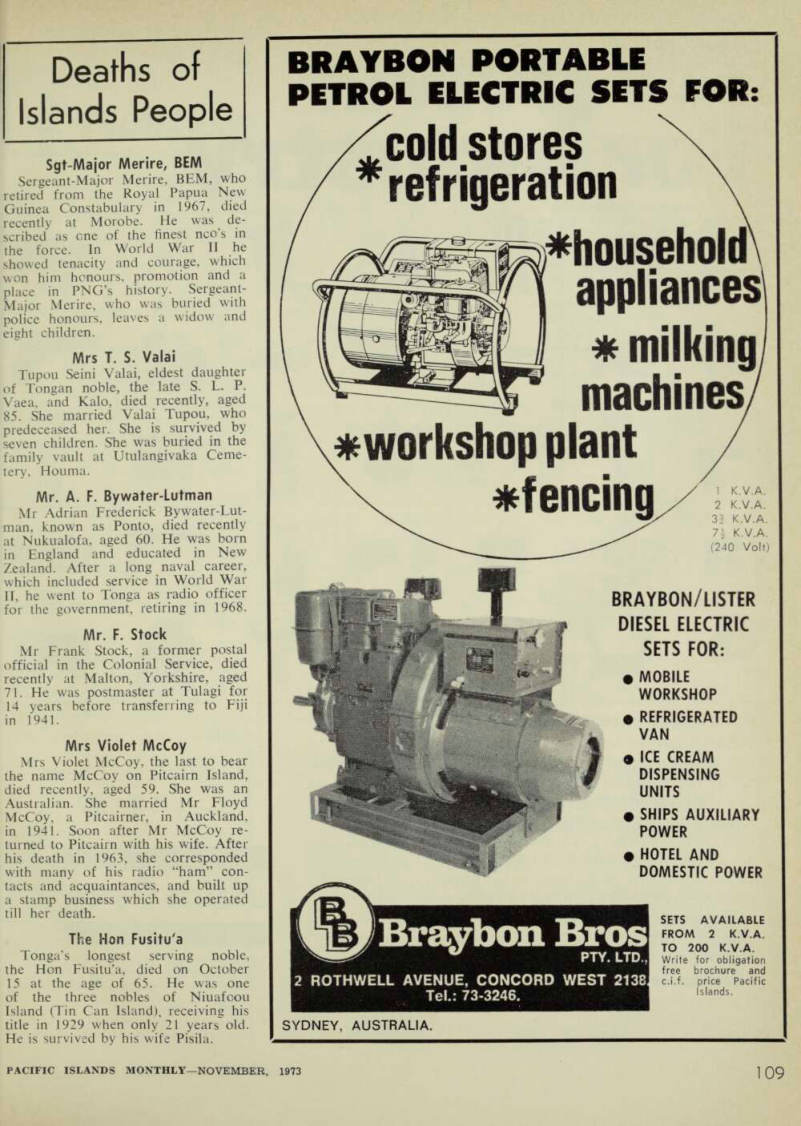
Deaths of Islands People
Sgt-Major Merire, BEM
Sergeant-Major Merire, BEM, who retired from the Royal Papua New Guinea Constabulary in 1967, died recently at Morobe. He was de scribed as one of the finest nco’s in the force. In World War II he showed tenacity and courage, which won him honours, promotion and a place in PNG’s history. Sergeant- Major Merire, who was buried with police honours, leaves a widow and eight children.
Mrs T. S. Valai Tupou Seini Valai, eldest daughter of Tongan noble, the late S. L. P.
Vaea, and Kalo, died recently, ageda 85. She married Valai Tupou, who predeceased her. She is survived by seven children. She was buried in the family vault at Utulangivaka Ceme tery, Houma.
Mr. A. F. Bywater-Lutman Mr Adrian Frederick Bywater-Lut man, known as Ponto, died recently at Nukualofa, aged 60. He was born in England and educated in New Zealand. After a long naval career, which included service in World War 11, he went to Tonga as radio officer for the government, retiring in 1968.
Mr. F. Stock Mr Frank Stock, a former postal official in the Colonial Service, died recently at Malton, Yorkshire, aged 71. He was postmaster at Tulagi for 14 years before transferring to Fiji in 1941.
Mrs Violet McCoy Mrs Violet McCoy, the last to bear the name McCoy on Pitcairn Island, died recently, aged 59. She was an Australian. She married Mr Floyd McCoy, a Pitcairner, in Auckland, in 1941. Soon after Mr McCoy re turned to Pitcairn with his wife. After his death in 1963, she corresponded with many of his radio “ham” con tacts and acquaintances, and built up a stamp business which she operated till her death.
The Hon Fusitu'a Tonga’s longest serving noble, the Hon Fusitu’a, died on October 15 at the age of 65. He was one of the three nobles of Niuafcou Island (Tin Can Island), receiving his title in 1929 when only 21 years old.
He is survived by his wife Pisila.
Advertisements & other items, pp. 117-118 (1 item)
* refrigeration
BRAYBON PORTABLE
PETROL ELECTRIC SETS FOR:
cold stores
* refrigeration
♦workshop plant
♦fencing
r i m
appliances
♦ milking
machines
(240 Volt)
BRAYBON/LISTER
DIESEL ELECTRIC
SETS FOR:
• MOBILE
WORKSHOP
• REFRIGERATED
VAN
• ICE CREAM
DISPENSING
UNITS
• SHIPS AUXILIARY
POWER
• HOTEL AND
DOMESTIC POWER
Braybon Bros
PTY. LTD,
2 ROTHWELL AVENUE, CONCORD WEST 2138
Tel.: 73-3246.
SETS AVAILABLE
FROM 2 K.V.A.
TO 200 K.V.A.
Write for obligation free brochure and c.i.f. price Pacific Islands.
SYDNEY, AUSTRALIA
Air power
for industry
Atlas Copco have it in hand.
When it comes to industrial hand tools, Atlas Copco manufacture and market everything from the small screwdriver used in the mass production of television sets to the large impact wrench used by shipyards, and a comprehensive range of air line fittings for industry, sand blasting units, as well as spray painting equipment. And each Atlas Copco sales company or agency is equipped to provide expert advice on the most rational application of compressed air in all its forms, and to back Atlas Copco products with the finest after-sales service and spares availability.
Atlas Copco ...
Service through 14 compressed air centres throughout Australia.
Mtlas Copco
Enquiries can be made direct to our special Pacific Territories Division at Head Office, Blacktown, or through such appointed distributors as Steamships Machinery, Port Moresby and Lae.
Nutshell
In a Nutshell
Currency Charge.—F I J I
plantation owner and land developer Robert Hunter bade a temporary farewell to his wife and new baby at a Sydney wharf towards the end of October and they returned to their home at Savusavu on Fiji’s Vanua Levu. Mr Hunter had to stay. Ap pearing at a Sydney Petty Sessions Court a few days earlier on a cur rency offence, he was allowed bail on $l,OOO and had to surrender his pass port until his trial at the NSW District Court in November. Mr Hunter was charged with having at tempted to take $16,782 in Australian currency out of Australia without Reserve Bank authority. The magis trate was told that the money was found in Mr Hunter’s suitcase during a luggage check at the airport on September 5 when he was waiting to board a Fiji-bound plane.
Mr Hunter had told a constable he did not know of any regulation requiring him to have Reserve Bank permission before taking out the money which he had received from business associates in Sydney for a deposit on a home unit and which he intended bringing back to Aus tralia within five days. Constable Tonkin said in court that Mr Hunter had been co-operative.
Reefs Recovering.—Corai
reefs in the New Hebrides, which had been badly damaged by the Crown of Thoms starfish, are re covering and the starfish are rapidly
decreasing in numbers. It is believed that the starfish are being eaten by two species of fish which were not thought to include it in their diet, the PuTer fish and the Trigger fish.
Scientists at Cambridge University in England have discovered that these two fish do, in fact, feed on the stomach and egg-producing organs of the starfish.
NEW ‘GASWORKS’.—Fiji looks like getting an elaborate Parliament House in a commanding position on Battery Hill, Suva about a mile from the centre of the city. A joint select committee of both houses of par liament recommended the building be erected in phases over five years.
Without the assistance of designs and plans, the committee estimated the cost at S4million. The final figure, no doubt will be much higher. The committee recommended an inter national competition for the designs and plans for the various buildings.
FLU IN COOKS—AII Rarotonga schools and cinemas were closed late in September because of an influenza epidemic. Public meetings and church services were postponed as part of control measures. By September 28, 636 victims had been treated.
Airline Expansion. Al
though Air New Zealand refused to confirm, or deny reports, it is be lieved agreement is expected with British Airways for Air NZ planes to fly to London. BA would lease Air NZ’s DC 10s for the Los Angeles to London route. At present Air NZ does not operate beyond Los Angeles.
RAFTS WINNING—The three balsa-log rafts which left Ecuador in South America on May 27 to sail to Australia were reported on October
17 to be in Tongan waters. The crews, four on each raft, were keeping the rafts close together and expected to reach Queensland early in November.
They have survived hurricane-force winds and a near-miss when they al most ran on an uncharted reef in the Cook Islands. The voyagers are at tempting to repeat the 1970 voyage of La Balsa which sailed 8,564 miles in 161 days.
Ulawun Erupts—Mt Ulawun
erupted fiercely early in October, and many people in West New Britain were evacuated to safer ground.
Lava poured from the 7,500 ft moun tain and black ash and smoke rose to 12,000 ft. A glowing gas cloud, which incinerated everything in its path, rolled down the mountain.
Boulders, up to 6 ft in diameter, ex ploded into ash as they were thrown from the crater, leaving trails of sparks and smoke.
WARMER WELCOME. —After sit ting for years on requests from the tourist industry to extend the present automatic three-day stay permit for visitors, the Western Samoa Govern ment has decided to make it a seven day permit. Cabinet has approved the extension but parliament meeting in November will have the last word.
Localisation In Png.—The
Papua New Guinea Service Board is aiming at having all posts for de partment heads localised by 1975-76.
There are 18 departments, seven of which are held by Papua New Guineans.
Csr Record.—The Csr Co Ltd,
in the last year in which profits from its Fiji subsidiary, South Pacific Sugar Mills Ltd, were included in the balance sheet, turned in a record net
profit of $23,339,596 in the year ended March 31. The Fiji contribution to the result was about $1.14 million. The effect on the group, which now covers building materials, chemicals and min ing, as well as the traditional sugar, will depend on what the company does with the money it gets from the sale of SPSM Ltd to the Fiji Government, compared with the loss of $1.14 million in profit. There is, however, still a small return from Fiji for services.
NEW BISHOP. —Archdeacon Derek Rawcliff, of the New Hebrides, who has been Archdeacon of Southern Melanesia since 1959, will be con secrated Bishop of the New Hebrides on January 25. He will be the third assistant bishop for the Anglican Dio cese of Melanesia.
No Revaluation.—The Wes
tern Samoan Cabinet has decided against revaluing the tala (dollar) as a result of an earlier Cabinet decision that the Samoan tala would be fixed to the United States dollar. Minister of Finance Sam Saili said this would mean that the tala would be devalued in terms of the three revalued cur rencies of Australia, New Zealand and Fiji. $5 MILLION DEAL.—Fiji’s first chain of hotels, Northern Hotels Ltd, which included the first tourist resort.
Korolevu Beach Hotel near Sigatoka. has been bought by a new Fiji public company, with New Zealand backing, for $5 million. The buyer, the Tourist Corporation of Fiji Ltd, is backed by the New Zealand-based company Trans Tours, which will take over on December 1. Chairman of the Tourist Corporation of Fiji is Mr Roger Probert, managing director of the Fiji Gas Co. In the deal are Korolevu Beach Hotel, the Club Hotel in Suva and hotels in Nadi, Ba, Lautoka and Sigatoka.
NEW AIRLINE.—Cook Islands Airways Ltd, and Air New Zealand- Cook Islands Government joint ven ture, will commence operations on November 25. Using a nine-passenger Britten Norman Islander plane, Cook Islands Airways will make seven flights a week between Rarotonga and Aitutaki, 140 nautical miles, and an hour apart. The service will be extended to the southern Cook Islands of Atiu, Mangaia and Mitiaro when airstrips have been built there. Man ager of the new airline is Mr N. A.
Nisbet, who arrived in Rarotonga re cently and who will combine this position with that of Air New Zea land’s manager in the Cook Islands.
Advertisements & other items, p. 119 (1 item)
■Grasslands Pty
to easy farming. Australia’s finest agricultural
equipment is now illustrated
in one new folder by Grasslands,
Send for your free copy today.
■GRASSLANDS PTY
■ 25 Fairfield St., Villawood,
■n.S.W. 2163 AUSTRALIA
■NAME
LTD,
Group memoet
SIMS CONSOLIOAItO LID
■ ADDRESS
■ P.C.
WHAT'S THE MATTER
WITH BABY?
Most probably it's teething troubles and the surest way of soothing baby's sore gums, digestive disturbances and intestinal upsets, is to give baby Fisher's Teething Powders. You'll be delighted how effective they are—and so safe too, if used as directed. Fisher's Teething Powders are available from your chemist or store —only 30c for 20 powders. Fisher & Co., Manufacturing Chemists (Est. 1876), 17 May St., St.
Peters, N.S.W. 2044.
PIM 806/72
Micronesia And
Us Agree On
Talks Date
The seventh round of talks be tween the Micronesians’ Joint Com mittee on Future Status and the Uni ted States’ representatives will open in Washington (DC) on November 10.
The date was fixed at a two-day meeting in Honolulu in mid-October between Senator Lazarus Salii, the joint committee chairman, and Am bassador Franklyn Hadyn Williams.
Senator Salii said,, after the meeting, that the joint committee expected to receive before the next round of talks America's views on the return of pub lic lands. “Ambassador Williams in dicated that the people of Palau will be satisfied with his response so far as the return of public lands in that district is concerned, and it will also be satisfactory to all other districts,” said Senator Salii. He added that both he and the ambassador believe that the next round would see much pro gress accomplished in the drafting of a Compact of Free Association.
PNG BANK BOARD.—First board of the Bank of Papua New Guinea will comprise the bank governor Mr H. Toßobert (chairman); the deputy governor, Mr P. S. Ferguson; Mr Laho Karukuru, Mr Peter Roni, Mr Walter Zavattaro, Mr Dian Roo, Dr Ron May and Mr Francis Seeto. The Secretary for Finance, Mr H. P.
Ritchie would also be a member.
SIAMESE TWlNS.—Siamese twins born to a North Malaita (Solomons) woman in a cave on September 13 are thriving in Kilu’ufi hospital. The twins, who are joined at the abdomen but have all limbs and organs separate, may go overseas for an operation to separate them but the father has to give permission. Because of custom, however, he cannot see them until some time after birth. Custom played a big part in the after-care of the twins and mother. No men were allowed near the cave and the mother and children had to be taken to hospital along a path specially carved out of the bush as they could not use a road on which the men walked.
LUCKY ESCAPE.—An Australian pilot,, 24-year-old Chris Baker, on a delivery flight with a twin-engined Cessna 310 from America to Aust ralia, crashed into Mele Bay, off Vila in the New Hebrides on October 6, but escaped with a few bruises. One of the engines failed while flying over the bay waiting for the Bauerfield landing lights to be switched on.
Advertisements & other items, pp. 120-126 (3 items)
Monthly
Christmas
gift
problems?
Then why not solve those problems with a 12 months' gift subscription to
Pacific Islands
Monthly
We'll post a subscription to you, or direct to anyone you nominate (and enclose a card bearing your message).
Fill in the details on the attached order form.
Overleaf is your order form for a 12 months gift subscription to “Pacific Islands Monthly”.
For full details of this special Xmas offer, see our announcement opposite.
SUBSCRIPTION RATES:
Australia (including Lord Howe and Thursday Islands) $6.70 New Zealand $6.70 NZ Papua New Guinea $5.50 Aust.
Fiji, Tonga, New Hebrides, Gilbert and Ellice Islands, Solomon Islands, Nauru Island and all other Pacific Territories $5.50 Western Samoa $6.70 Hawaii, Micronesia, and Guam .. .. $12.00 US American Samoa $B.OO US U.S. Mainland $14.00 US New Caledonia and French Polynesia 1,100 CFP •United Kingdom £3.25 Stg. •Elsewhere $6.96 Aust.
Two years $12.65 $12.65 NZ $10.25 Aust. $10.25 (local currency) $12.65 (local currency) $23.25 US $15.25 US $27.25 US
2,150 CFP
£6.25 Stg. $12.20 Aust. •Airmail extra on application. All other subscription rates listed Include air delivery.
Three years $18.60 $18.60 N 2 $15.00 Ausi. $15.00 $18.60 $34.50 US $22.50 US $40.50 US 3,150 £9.00 Stg $19.30 A us' name address city/state/country/post code (please print) Attached is my payment of for years' subscription.
New □ Renewal □ Please enclose a Xmas card conveying my message. (Tick this if required).
PACIFIC ISLANDS MONTHLY
29 Alberta Street, Sydney, N.S.W. 2000, Australia (Postal Address: Box 3408, G.P.0., Sydney, N.S.W. 2001.)
D NOVEMBER, 1973—PACIFIC ISLANDS MONTHLY
ndreds already installed! The most economical supplementary coolmis for bottles and food, providing the largest storage capacity of / comparable coolrooms of the same exterior dimensions. Five sizes From 90360 cu. ft. capacity; 16 models offering normal temp., two np., deep freeze, or for pastry and ice storage applications. White yl interior, embossed rustproof aluminium exterior.
SUPPLIED IN EASY-TO-ERECT, DO-IT-YOURSELF KIT FORM
PETROL AND PETROL-ELECTRIC MODELS ARE AVAILABLE
R AREAS WHERE POWER IS LIMITED OR NON-EXISTENT FRALIAN NEW CALEDONIA EXPORTS (SILVER & BARDA), 363 qe St., Sydney, 2000 and Branches.
EKWOLDT & CO., 276 Pitt St., Sydney, 2000 and Branches.
ER FISHER TRADING PTY. LTD., 321 Pitt St., Sydney, 2000.
EMEYER (A'SIA), 59 Anzac Pde., Kensington, 2033 and Branches.
inufactured by:
KERR BROS, 65 York St., Sydney, 2000. j NELSON & ROBERTSON PTY. LTD., 197 Clarence St., Sydney. 2000.
RABAUL TRADING CO. PTY. LTD., P.O. Box 219, Rabaul and Branches.
ROY GALLIMORE & ASSOCIATES, P.O. Box 179, Vila, New Hebrides.
C. SULLIVAN (EXPORT) PTY. LTD., 60 Margaret St., Sydney, 2000 and Branches. .
W. S. TAIT & CO. PTY. LTD., 31 Macquarie Place, Sydney, 2000 and Branches.
WARBURTON FRANK)
199 Parramatta Road, Cnr. Skarratt Street, Auburn, N.S.W. 2144, Australia. Phone: 648-1711.
Powered by Kelvinator.
Five-year warranty on compressor. Early delivery.
V\
OTHER HANOI PRODUCTS!
‘Handi’ range of quality products also includes; a portable Twin - Burner Stovette and ‘Handi’ Pumpless Petrol Iron.
Keep a
H
handy!
No need to fumble and fume! Throw light on the subject with a ‘Handi’. It’s twice as bright as electric light. Completely stormproof. Simple and safe to use.
PRESSURE OPERATED
One filling gives 12 hours of brilliant 300 candle-power lighting. Built to last, with chromed, rust - proofed finish. Petrol or Kerosene models.
Ask for Handi! Everywhere!
HANDI WORKS ltd
Evans Rd, Salisbury North. Ph. 47 2122
BRISBANE, QUEENSLAND, AUSTRALIA
n p §s) Ltu-lJ 0 1 i Se) LnnJ
beachcomber
hotel
PACIFIC HARBOUR, FIJI
Sophistication in the midst of uninhabited natural beauty.
Nestled snugly in a reef-protected bay on 5 miles of classical palm fringed Deuba beach. Far enough from Fiji's capital, Suva, to forget the worries of city life. Near enough to take in the colour and the Duty Free Bazaars.
Every suite is self-contained and airconditioned. The cuisine is as the service, superb.
PO Box 216, Suva. Telephone: Navua 43.
Telex 2324. Cables: FLAGTELS, Fiji. For reservations or information contact your travel agent.
Primitive luxury
(Polynesian style) Nestled away in the untouched Kingdom of Tonga is new, luxurious "Port of Refuge" International resort. Here is a unique opportunity for your clients to experience the tranquil and relaxed Tongan atmosphere while they enjoy the picturesque surroundings of the new "Port of Refuge". And only a short flight from Fi|i.
Reasonable tariffs from $17.50 with special concessions for children. Agents commission 10 per cent.
Tonga's
Port of Refuge
Jgo INTERNATIONAL RESORT
Uava’u Tonga Cables: "Refuge" Tonga or "Tongatours"
Sydney. Phone: Sydney 85-1603 or 282-472
i For Warm and Friendly
Samoan Hospitality
Apia, Western Samoa Phone: 880. Cable: 'Aggies'.
Tariff includes all meals.
mftftfl
iiiaod
Mana Island: 300 acres of lush, tropical vegetation surrounded by miles of palm fringed beach and sheltered lagoons.
Recreation: Snorkelling, scuba, skiing, spear, bottom and deep sea fishing, swimming excursions. Modest charges.
Accommodation: Resort hotel, secluded accommodation in 60 individual Fijiantype cottages. Self-contained bures with shower, toilet, refrigerator, tea and coffee facilities and exhaust fans.
International Standard Restaurant: Fijian and Continental cuisine. Terrace dancing to Fijian Band. Beach Bars Feast Nights.
Facilities: Island shop, travel agent, hairdresser, child minding and first aid.
Tariff; Single occupancy: $F 18.00 Double occupancy: $F22.00 Triple occupancy; $F26.00 Children under 12: Half Rate Babies in cot; Free Duplex Bure from: $F42.00 Rates subject to change.
Pre paid tours through agents.
Transport: Bus or taxi Nadi to Lautoka (Bus fare 80c). SFB.OO return by fast 90' cruiser Lautoka to Mana Island.
Schedule: Dep. Lautoka 9.30 a.m. Arr.
Mana 11.20 a.m. Dep. Mana 3.30 p.m.
Arr. Lautoka 5.20 p.m. Water Taxi subject to reservations; $F6.00 per person one way, a minimum $F45.00 per trip.
CHECK OUT TIME - 1 1.00 a.m.
CANCELLATION NOTICE - 48 hours.
DEPOSITS Groups and ITX Prepaid.
Individual bookings, one night deposit required.
Bookings: Aust. & N.Z.: C.J. Henry & Associates.
Offices; Mana Island Resort (FIJI) Limited P.O. Box M 94, Sydney Mail Exchange 2012 69.5061 or P.O. Box 610, Lautoka, FIJI 61.210; 61.455 Telegrams and Telex: Mana Island, Lautoka, FIJI
PARK VIEW MOTEL—BRISBANE
Quiet location—opp. Botanic Gardens.
Single, double, family suites, all with refrig., air conditioning, phone, TV, radio, tea making facilities, from $lO. Pool and restaurant.
Phone 31-2695—Telex 40270.
Write for coloured brochure— Park View Motel, 128 Alice St, BRISBANE, Old., 4000.
£f\\ W D
INTERNATIONAL
DATELINE HOTEL
TONGA
•riendly Hotel" of the "Friendly Islands" tuated along the Nukualofa aterfront. Only five minutes walk am town. Single, double, family lites, airconditioning, and hot and >ld water showers. Pool, bar, staurant, duty-free shop, tour jsk and boutique, aok through your travel agent or rite to International Dateline Hotel, 0. Box 62, Nukualofa Tonga, able Address: "DATELINE", apresented Overseas by: Charles Henry and Associates Pty. Ltd. /dney and Melbourne. 3975
W. H. GROVE & SONS LTD.
ESTABLISHED 1896
ISLAND MERCHANTS
Exporters to the Pacific of Dairy Products and all New Zealand consumer and manufactured goods.
ENTRUST YOUR REQUIREMENTS TO THE
ESTABLISHED FIRM
P.O. Box 3718, Cables
AUCKLAND GROVE AUCKLAND
IJI
NAMALE PLANTATION
ESCAPE
FROM THE ORDINARY
> is an idyllic paradise where you can y the unspoiled beauty and serenity of /orking coconut plantation. This privatelyed Pacific retreat has been designed for laximum of 16 people. Gracious surround- , friendly service, relaxed 'Bure' accommoon overlooking the sea with individual onies and private facilities. Licensed cockbar. Entire plantation available to groups 14-16 people. vities available include: Deep sea fishing, and shell hunting, skin diving, snorkelling, er skiing, hiking, turf tennis court, badton, horse riding, croquet course and a jtiful tropical garden to relax in. Sports ipment available on a complimentary basis ude aquascopes, snorkelling and fishing ipment, inflatable rafts, tennis racquets Coastal tours by boat or mini-bus on jest. Boats for hire. Baby sitting service i available. te for a Free Brochure to:
THE MANAGER,
NAMALE PLANTATION,
SAVUSAVU, FIJI.
Or: Namale Plantation, P.O. Box 64, Suva, Fiji.
D
tapua new guinea
printing co. pty. ltd.
Serving the Country from Aitape to Alotau, Manus to Moresby.
Leaders in Commercial Offset and Letterpress Printing. • Stationery • Office Supplies • Office Equipment • Rubber Stamps • Self-Adhesive Labels • In Fact: — Everything For The Office.
P.O. Box 633, Port Moresby P.O. Box 759, Lae P.O. Box 30, Mt Hagen P.O. Box 1239, Rabaul P.O. Box 466, Kieta
PROPERTY INVESTMENT
SUNSHINE COAST—QUEENSLAND
We invite inquiries regarding living or investment in this area.
We have a full coverage of holiday lettings, flats, motels, homes, farms, businesses and sub-divisional land.
Write direct to MABIN & BLOWERS Pty. Ltd. (Members R.E.1.Q.),
11 BURNETT STREET—BUDERIM, Q„ 4556.
Line Advertisements
Per line, $1.15 Aust., Minimum rate. 4 lines.
PEN FRIENDS OVERSEAS. Individual world wide postal introduction service' Plus optional illustrated magazine! Write for details today! Five Continents Co. Ltd P.O. Box 21219, Henderson, N.Z.
FLEETS, 76 ft steel tug, profess, bit. 1945 ample fuel and water, $30,000. 45 ft trawler, profess, bit. 1955, Gardner 5 LW radio, sounder etc., $26,2&0. Fleets, Rowe’s Bldg, Edward St, Brisbane. Cable “Fleets"
Brisbane.
55 YEARS EXPERIENCE
TO THE
FUNERAL TRADE
H. H. WEBB
& CO. LTD.
For details of our complete range of Funeral Directors' Requisites please write to:
HEAD OFFICE:
206 WHITEHALL STREET
FOOTSCRAY, VIC.,
AUSTRALIA
CABLES: 'WEBCO' MELBOURNE
Manufacturers and Distributors of
A 60 ft FERRO-CEMENT CARGO LAUNCH
for the Solomons is nearing completion a\ Ogilvie’s Boatbuilding Works, Queensland 4805. Shell ferro-cement with frames anc deck steel is recommended for 50, 60, 7( footers and larger.
CONCRETE BLOCK MACHINE FOR SALE,
Makes blocks, flags, edgings, screen-blocks, garden stools—up to 8 at once and 96 an hour. SAI2O c.i.f. main ports. Send for leaflets. Forest Farm Research, Londonderry, N.S.W., 2753.
ALL BOOKS AND JOURNALS ON AUST-
RALASIA AND THE PACIFIC BOUGHT
AND SOLD. Catalogues issued and sent free on application. Correspondence invited. Berkelouw, 15-19 Boundary St., Rushcutters Bay, Sydney, 2011. Phone; 31-8215.
FOR SALE
Business and property on 99 year leasehold. Plot 118' x 55'.
Situated Main Road Central Honiara. Two air conditioned shops and large upstair flat. 15 year old first class, softgoods, jewellery, cosmetics, handicrafts business.
Genuine enquiries only. Please apply Lillian A. Dennis (Ent) Ltd, PO Box 200 Honiara, 8.5.1. P.
SOFT DRINK MACHINERY
• 200 g.p.h. carbonator. • 120 d.p.h. hydro washer. • 8 head filler.
These machines are completely rebuilt and ready for immediate sale.
For further information or inspection contact: HORITZ FRUIT JUICES, 1283 Kingsford Smith Drive, Eagle Farm, Brisbane, Q'ld., 4007.
THE
YORKSHIRE INSURANCE
CO, LTD.
(Incorporated in England)
A MEMBER OF THE GENERAL ACCIDENT GROUP OF COMPANIES
ALL CLASSES OF INSURANCE
AUSTRALIAN HEAD OFFICE: 10-12 Spring Street, Sydney.
General Manager for Australia: J. Adam.
PAPUA AND NEW GUINEA BRANCH: Douglas Street, Port Moresby Manager: H. M. Harvey.
CHIEF ISLAND REPRESENTATIVES
Rabaul, A.S.P. (N.G.) Ltd.; Lae, Radio Cabs (Lae) Pty. Ltd.; Madang, W. Stokes; Manus, Edgell 4 Whiteley Ltd.; Honiara, 8.5.1. P., E. V. Lawson Ltd.; Suva, Williams & Gosling Ltd.; Noumea, R. Laubreaux; Norfolk Island, Martin's Agencies; Apia, E. A. Coxon & Co.; Vila, C. Sullivan (INT) Pty. Ltd.
113
\CIFIC ISLANDS MONTHLY—NOVEMBER, 1973
115
CIFIC ISLANDS MONTHLY—NOVEMBER, 1973
Index to Advertisers
Adams Ind 3, 35 A.C.I. Electronics 82 Aggie Grey 114 Air New Zealand 84 Allied Manufacturing & Trading Industries 17 Ansett Hotels 22 A. Engineering 30 Arnott's Biscuits 1 Atlas Copco 110 Bacardi 94 Bain Dawes 23 Bank of Hawaii 34 Bank Line 106 Beachcomber Hotel 114 B. 89-92 Braybon 100 Breckwoldt 86 British Med Lab 41 Brockhoff's 40 Carnation 93 Carpenter 4, 38., 39 Clarion Shigi 44
Consol Chemicals 76 C.S.R. iii Daiwa Bank 100 Daiwa Line 105 Davey Dunlite 98 Fiat 42, 43 Fisher & Co. 11l Fisher, Peter 10 Frigate Rum 81 Furuno 85 George Hudson 48 George & Ashton 79 Gillespie Bros 54 Goodyear 46 Grasslands 111 Grove, W. H. 115 Hall, R. 86 Handi Works 113 Hellaby, R. & W. 48 Honda cov. iii International Dateline 115 Interocean-N.Z. Ltd. 103
James Hardie 28, 60 Karlander Line 108 Kawatetsu 58 Kerr Bros 22 Kikkoman 20 Mabin & Blowers 115 AAana Island Resort 114 Motor Specialities 26 Mungo Scott 19 Namale Plantation 115 Nedlloyd 106 Nelson & Robertson 109 Nestle 96 Nissan cov. iv Pacific Line 107
P.A.A. 80
Parker Pen 74 Pioneer Electric 53 PNG Printing 115 Queensland Insurance 87 Record Ridgeway 31 Sandy, James 70
Sansui Sofrana/Unilines 104 Saqulu Plantation 4 Southern Pac Ins 102 Sullivan, C.
Sunbeam 69 Swire, John 18, 59 Tatham, S. E. 50 Tonga's Port of Refuge 114 Toyo Kogyo cov. ii Toyota 56, 57 Trio Electronics 36 Turners Supply 102 Union S.S. Co 107 Warburton Franki 113 Webb, H. H. 116 Wunderlich Yanmar Diesels 55 Yorkshire Imperial 29 Yorkshire Insurance 116
Advertisements & other items, pp. 126-128 (2 items)
Wholly set up and printed in Australia by PACIFIC PUBLICATIONS (AUST.) PTY. LTD., 29 Alberta Street, Sydney, 2000.
REGISTERED AT THE GPO SYDNEY FOR SSION BY POST AS A NEWSPAPER CATEGORY B.
Australian price given on the front cover is recommended Australian retail price only.
Making the endless blue and
The blue beyond. The earth below.
A path between the two. That only youth may
bleach-white sands one...
A young man whose desire to reach the summit of success knows no limits. At work or at play, he thrives on new challenges, new ways to satisfy his zest for the active life. Every day more people are finding themselves in HONDA. Leader in motorcycles. Holder of the title of having % of the world’s market. With sales in more than 75 countries. By offering the right combination of power, performance, and ride in a wide range to suit every individual. It's all of what it takes to be a world leader in motorcycles
... HONDA!
OW. \ . \ m «. 4- World’s Largest Motorcycle Manufacturer /■-
HONDA MOTOR'CO..LTD. TOKYO, JAPAN
RITORY: J.C. Tenorio Enterprise P.O. Box stands. ©feyelopmenr.AutKdrity Eljide' ... / AMERICAN S/yvtOAf .Max Haleck I ho. P 0. Box 99, Pago Pago*) r tpN QA: ISLANDS? British" Solomons" Trading Co., Ltd: 94, Honiara /:NEW CALEDONIA: Establissements Ballande, Noumea / TAHITI: Ets. COMIMPEX P;0. BbjS&OO, .Papeete ACOdK ISLANDS; Cook Islands Trading Corporation Ltd. ociety * » •" ** 7 • „ f ■■' *- . »• ■ ■*' ' * ♦ » ■ .I: r. < sw/l E.M. Jones Ltd, P.O, Box 54, Nukualofa/ umera / TAH P.O. Box 92, Rarotonga ISLAND: Nauru Cooperative^Society
m 9 * m > J* * ** fW i \ •Si 99: r V. * m
WMMk
]MR 'tr s*i- 5 / ..;' And wherever you’ll go in over 120 nations throughout the world you’ll find proud DATSUN drivers.
Perhaps the main reason is that DATSUN was designed to meet a wide variety of conditions—mountain roads and super highways, blistering suns and freezing temperatures. DATSUN is indeed the international car that has precision engineering and a stunning string of rally victories behind it.
Its superb handling, safety features and high speed efficiency make DATSUN the choice of young and old alike. DATSUN—the car that really satisfies the world over.
V:
DATSUN
NISSAN
DATSUN distributor network covers the following areas: FiJi*T.P.N.G.*W. Samoa* New Caledonia • New Hebrides* 8.5.1.P.* Timor‘Norfolk- A. Samoa • Tahiti • Cook • Nauru • Tonga • Saipan • Guam • Australia • New Zealand