Artifacts Back From Europe?
pp. 65-69 · Read in the full issue
Can We Get Our Valuable Islands
By Marjorie Crocombe
A QUESTION. Where would you expect to find the most valuable, old and authentic pieces of traditional Pacific Islands artifacts which depict a rich variety of art forms?
The answer. In Dublin, Leningrad, London, Paris, Zurich, Hamburg, Copenhagen, and other cities of Europe and America.
How did they get there? The early European explor ers, missionaries and colonial administrations came from Europe. Many were given valuable artifacts as gifts by islanders, some were bought by such people as travellers, sailors and beachcombers, and some were stolen. But a lot of them were sent back to the visitors’ countries and given to their museums to be looked after and displayed.
Sometimes today we get angry about the loss of these valuable treasures. But on the other hand we should be grateful that they have been looked after. Our tradition al religious symbols were all being burnt or broken or buried with the arrival of Christianity. If some had not been taken to Europe they would have been lost forever.
For about 100 years after contact with Europe most of our parents and grandparents and great-grandparents despised the traditional arts of the Islands. It doesn’t matter who we blame for this, the result is the same— most of them were lost to the Islands.
With the recent rise of nationalism and self-govern ment and independence, we are beginning to get our self-confidence back. We are no longer ashamed of the arts and culture of our forefathers. With it, there is a great increase in interest in our own history, our own traditional arts and culture. We have seen this with the building of museums and libraries in most Pacific coun tries and territories in recent years. We see it in the teaching of Islands history and culture in many schools, although more could be done on this. We see it in the proud use made of Islands’ symbols.
Can we get these valuable things back from Europe and America? This is a very difficult question. If we want everything back, the answer is no. But if we want some back, and we go about it the right way, I think the answer is yes. It won’t be easy and we won’t get it all back by a long way, but I think we can get some back.
The first thing to remember is that most of these things were acquired legally by the museums that hold them today. They have been there for decades, and sometimes for hundreds of years. They are clearly the legal property of museums. Most museums belong to the governments, or to the city councils, or to univer sities, or to national trusts. They all have very strict rules about the things they hold. It is very difficult indeed, and often impossible, for them to give back or sell things in the museums. But in some cases they can, and exchange and lending is usually easier, though it is still very complicated.
It is going to be a long and difficult job, but if we work at it properly, I think that a lot of very valuable things will return to their home islands in the next 10 years or so.
Ideas are changing in our favour. The Australian Minister assisting in Foreign Affairs, Mr Morrison, for example, recently said that the Australian Government would help New Guinea get back some valuable pieces of traditional art from Australian institutions. This is a big change in thinking. I have met some museum directors who a few years ago were sure that every thing would stay in their hands, but today they are feeling guilty about holding Islands treasures and would like to give some pieces back.
As opinions change in favour of the Islands it is up to the Islands to have good quality museums, with well trained local staff looking after them, so that as valuable
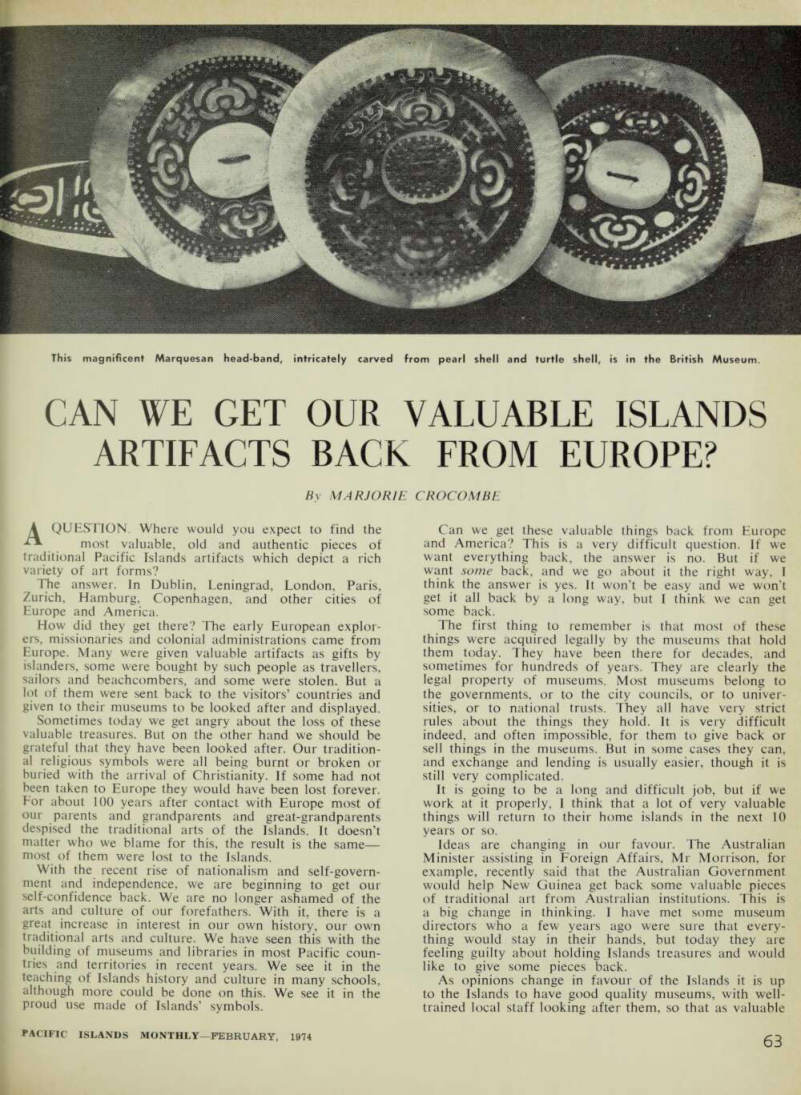
This magnificent Marquesan head-band, intricately carved from pearl shell and turtle shell, is in the British Museum
things come back from overseas we have strong and attractive buildings to put them in. They must be open to the public and available to the schools. They must be located where everyone can see and enjoy them.
The East-West Center at the University of Hawaii is now offering free six months training courses for Islanders wanting to train for museum work. Several Island governments have already taken the opportunity to have museum workers trained there. They are for tunate to have Bruce Palmer, the former Director of the Fiji Museum, to run the training programme. The Fiji Museum is an excellent example, and Bruce is well known overseas for understanding how to do this work for public display and as part of the social studies programme for schools.
We don’t want everything back from overseas. If we got it all, we might lose it all. Just imagine if all the valuable art of Tonga, Samoa, the Solomons or the Gilberts was housed in one museum in Nukualofa or Apia or Honiara or Tarawa. The lot could be destroyed by a hurricane or a fire in a few hours. Anyway, there is more material in overseas museums than we could ever use. So let us choose carefully and try to get back a few examples of each of the best kinds of carving, clothing, tools, ornaments, head-dresses, weapons, gods, pottery, and so on, and preserve them in our national museums.
In the next few issues of MANA I will discuss some of the Islands artifacts that I saw in the museums of Europe when I made my first visit there recently.
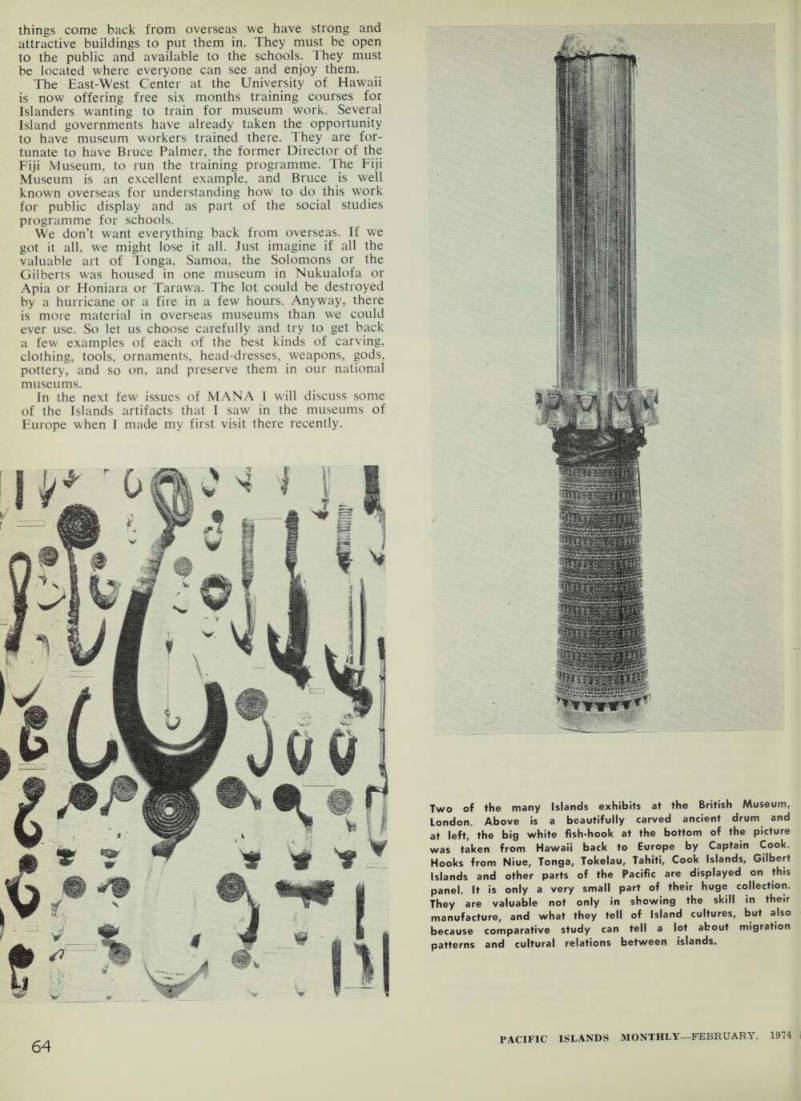
Two of the many Islands exhibits at the British Museum, London. Above is a beautifully carved ancient drum and at left, the big white fish-hook at the bottom of the picture was taken from Hawaii back to Europe by Captain Cook.
Hooks from Niue, Tonga, Tokelau, Tahiti, Cook Islands, Gilbert Islands and other parts of the Pacific are displayed on this panel. It is only a very small part of their huge collection.
They are valuable not only in showing the skill in their manufacture, and what they tell of Island cultures, but also because comparative study can tell a lot about migration patterns and cultural relations between islands.
The BSIP economy is diversifying rapidly these days, but that was not so 20 years ago when Sir Geoffrey Clay, Agricultural Adviser to the Secretary of State for the Colonies, made an official visit. His main impression, while flying over the archipelago, was the reliance everywhere on coconuts and copra as the basis of the economy. He said one could not escape the prime importance of the problem created by the scarcity of labour, not only for reopening existing plantations, but for the extension and diversification of production. PIM commented there could be no develop ment till there were (a) a labour supply, and (b) inducements for investors, and criticised what it called the "stupid policies" of the Colonial Office scaring off whatever enterprise was inclined in recent years to take an interest in BSIP development.