The Editor's Mailbag
pp. 29-33 · Read in the full issue


Memories Of Tommy Grahamslaw
I While listening to the radio on December 17 I was shocked to hear of the death of Tommy Grahamslaw at Gosford, NSW.
I first met Tommy in the 1930 s in Samarai when he was with Customs and the Post Office. A poker school in progress showed that Tommy had reached the ‘hawk’ stage and he and Hobart Spiller outclassed the rest of the players considerably.
I From then on we met at infre quent intervals until one day when I staggered along the Kokoda Track into Brigade HQ in 1942 at, I think, Isurava village, and found Tommy there.
He had been in charge of the Northern District when the enemy landed at Buna and he and Jack McKenna walked down the road to get some definite information of the ;nemy’s progress. While having some lunch, they were fired on.
In the ensuing mix-up they became icparated. Jack McKenna getting Jack to Moresby first and Tommy wentually making his way to Abau, oining up en route with Harry Bit nead, who had been captured by the snemy and had escaped, and who had fathered up several wounded, crashed liers and was taking them out with lim.
Tommy went ahead and sent back iclp to Bitmead, then continued on o Moresby. There, he insisted on chiming to the forward area to liaise Jith the local natives and the Army, ye at Kokoda could get no word of im and we thought he may have captured or killed. Seeing him gain was wonderful.
After some weeks and numerous indents, some frightening, we were iven the job of leaving Naura village nd putting a guard across a bush rack leading towards Moresby. How ycr, we missed this and finished up t lavarere, where we contacted HQ nd eventually got to 7th Div HQ.
The next day. Tommy was hos italised with dysentry and after sev . days of photo interpreting and jmg interrogated, I went down to and An § au ’ where I found nad been marked as AWL for the I had been on the Kokoda Track, nis was a bit annoying but was soon
rectified. Communications were bad in those days.
A little over a week later—of sun bathing and salt water swimming—I had a call from Tommy who asked if I would like to go with him to Garaina and do some patrolling from there. This trip did not eventuate but all our gear was sent there while we flew to Wanigela and then travel led up the coast towards Buna by canoe.
Anything that moved on the water during the day was bombed and shot up by the Air Force so we travelled by night, sliding into our daylight hiding places very silently in the early hours just before daylight. We had two radio operators, two police and two PIB and a radio set, and oil.
It was quite exciting not quite knowing what was ashore until we had patrolled the area and sometimes found natives who could give us in formation. This was at the end of October, 1942. Eventually, we reach ed Waiwai village past Pongani and the Americans landed behind us at
Pongani. From then on we joined with the Americans, liaising with the native people, also sending back air craft spotting reports.
All was quiet on that front until General MacArthur broadcast that Americans were travelling up the coast to Buna. The enemy took great note of this and when we had just arrived at Eroro village, where the forward base of the Americans was, with 150 recently-recruited carriers, the enemy sent over planes to see if MacArthur was right.
They sank six boats and shot up the village, making at least seven passes by six planes. We had only arrived that night before and had had no time to get a camp ready for the carriers away from the soldiers.
However, we had seen the planes circling and started the carriers out of the village. By this time we had been joined by several others, inclu ding Ivan Hoggard, who was a tower of strength. With Tommy lead ing the way through the swamp, my self directing the carriers on to the
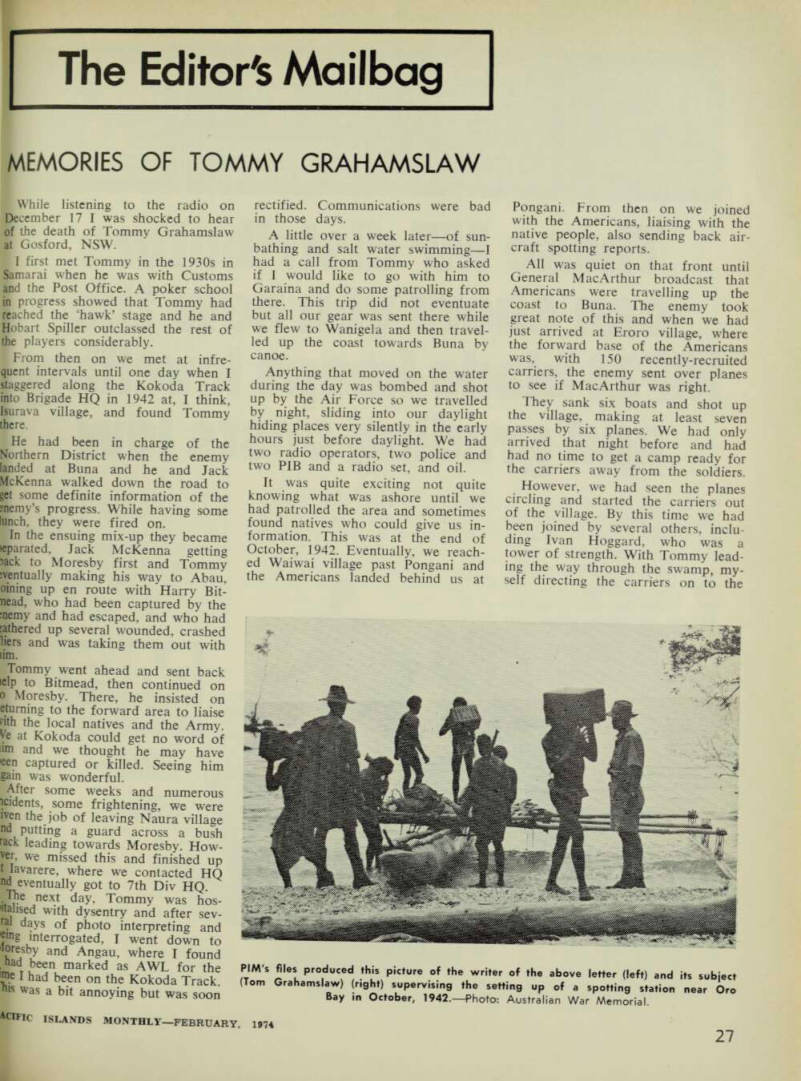
PIM's files produced this picture of the writer of the above letter (left) and its subject (Tom Grahamslaw) (right) supervising the setting up of a spotting station near Oro Bay in October, 1942. Photo: Australian War Memorial.
Letters
correct road and Ivan pushing them out of their houses, we had only just started the evacuation when the first attack came.
Tommy was about half-way through the coastal belt of swamp and 50 yards from me, when I saw him jump into the air and then fall into the water. Leaves and twigs fell all round him and bullets slashed through the undergrowth.
I ran over to where he was under water with smoke from the incen diaries all round him. Hauling him out I saw he showed no very ob vious signs of wounds so I put him behind a fair-sized tree and some natives behind another, while I scraped the mud off him.
He was unhurt but a bit stunned by having so many bullets around him. I think there were seven passes made from different directions and we had to keep circling the tree.
The planes were very low and I emptied two tommy gun mags at them, I could hear Ivan doing the same. The Americans were taken too much by surprise to get their arms to work.
By this time, some of our own planes had arrived, having been war ned by the radio operators out in the bush nearby, and soon there was a dreadful silence. I don’t know what the casualties were but not one na tive was injured.
Ivan and I took Tommy back later and tried to make out just how he had not been hit. It was almost a miracle as the leaves and brush above where he had been had been cut about and the sticks under him were also slashed, behind him as well as in front. He must have been in a blind spot somehow as everything missed him. Ground fire was credited with one plane and Ivan and I used to stick our chests out as no one else had fired, or we had not heard any one.
From then on Tommy was given increasingly greater responsibility with appropriate rank and at the end of the war was in charge of what the Army called Southern Region.
After the war we met in Samarai a few times and again in Moresby.
Once he took me around all the old Army camps which are now built over. We corresponded regularly, once a year or so, and my letter and card for this year were written and awaiting a boat for posting when the news of his death was received.
Tommy Grahamslaw, civilian sold ier, who rose through sheer ability to the positions he held, did not shout from the house tops. He was rather unassuming and a very ap proachable person who helped many people to the best of his ability, which was considerable. His staff, after the war and never to his face, called him “Uncle Tom” affectionately and 1 know that many others besides myself will mourn the loss of a true friend and an honest and upright man. —Goodbye Tommy, old friend.
John D. Wilkinson
Sewa Bay, Papua New Guinea.
Gutter language
I have been a regular reader of PIM, for many years, and 1 always have enjoyed reading it, and finding out how ‘The other half lives in our Pacific region; also 1 took pride in the fact that, here at least, there was one publication one could pick up and read without being subjected to pornographic tripe.
This does not now appear to be the case, as evidenced by the ‘gutter language’ in the December copy of PIM, (line 29, p 62, col 3).
In any case, to compare the prom iscuous sexual habits of the human race to the simple act of procreation of pigs and dogs, is to demean those lowly animals.
Please endeavour to keep your pages clean, as they have been in the past.
Should there be any repetition of a similar nature, I for one, will no doubt cease to peruse your otherwise interesting publication.
You, Sir, are now on probation, which my dictionary defines as, ‘sus pension of sentence with liberty on good behaviour, under supervision, especially allowed to a first offender’.
Unquote.
I feel, also, that I will not be alone in my decision to cease receiving your magazine, if further breaches occur.
H. W. Cummings
North Queensland.
O The reference by Mr Cum mings is the only instance we can remember of that particular four letter word having appeared in PIM —and Mr Cummings need have no fear that PIM is suddenly about to become pornographic. The expression was contained in a short story by New Guinean writer Joseph Wohuin angu, in our regular MAN A pages, which are edited independently, and most competently, by Marjorie Tuainekore Crocombe. She presum ably considered the expression an apt
description of an old man’s attitude to the behaviour of the young, and important in the context of the story.
Certainly we did.
Samoan land
Asa constant reader of PIM I have come to appreciate and value Mr Felise Va’a’s articles on Western Samoa.
PIM has considerable historical value, and Mr Va’a’s articles will un doubtedly help it to sustain this function, I think, therefore, that it is proper to make a historical com ment so that present-day readers will not misunderstand important events in Samoa which occurred many years ago.
Mr Va’a, in his December article (PIM, Dec, p 21) says that the earliest Europeans exploited the Sam oans ruthlessly in acquiring land; fertile Samoan land was bought not for a song but for a pipe or a rifle; a lot of the land now owned by the Western Samoa Trust Estates Cor poration was acquired in this way; and the Germans put a stop to this in 1900.
I doubt whether this is historically accurate. The whole story is well told by the late and well-remembered R. P. Gilson in chapter 16 of his book Samoa, 1830-1900. The rivalry among Britain, Germany and the United States over the competing in terests in Samoa nearly caused a war, which may have been averted by the hurricane of 1889.
However, immediately after the hurricane, the three powers sat down in Berlin and drew up an agreement which became known as the Berlin Act of 1889, and which was accepted and agreed to by the then King of Samoa. This act established a con dominium, which in Samoa came to be known as “the rule of the three powers”.
It contained general provisions for the ordering of European and Samoan affairs, but the most important and enduring were the provisions relating to land. The Berlin Act set up a land commission to which all European claims to Samoan land were to be brought, and issued strict instruct iors as to the conditions which had to be fulfilled before any European claims to Samoan land could be ad judged valid.
This applied to all purported dis posals of Samoan land to Europeans, no matter when the transaction had taken place. It is unnecessary to re capitulate here the conditions for validity laid down by the act, but Gilson obviously considers them to have been reasonably sound. He notes that the total land claims presen ted to the commission amounted to
Letters
[ 1,691,893 acres, whereas the com- I mission validated claims to only 135,300 acres, namely 8 per cent of the total claims.
The claims of the big German plantation firm (Deutsche Handels un Plantagen-Gesellschaft der Sudsee Inseln zu Hamburg; known as ‘the long handled name firm’, or DHPG) were mostly allowed because they complied with the conditions relating to defined boundaries, adequate con sideration, and development capital already spent.
These lands became reparations to the New Zealand Government in 1919 after World War I; were then passed by the New Zealand Government to the Samoan Government in 1959 as part of the move towards indepen dence, and now form the Western Samoa Trust Estates.
Considering the history of colonial territories generally, the Berlin Act, with its total prohibition of sales of Samoan land for the future, and its establishment of the land commission with strict conditions applicable to approvals of disposal of Samoan land already made, has placed Samoa in a somewhat unique position.
This prohibition on the sale of Samoan land was continued by the German regime in 1900 and, as Mr Va’a says, the Land & Titles Court was then established, to control dis posal of and succession to Samoan land. This situation continued through the New Zealand regime, and on into independence.
The Constitution of the Indepen dent State of Western Samoa bears in its provisions relating to land, the distinct imprint of the Berlin Act of 1889.
Guy Powles
Wellington.
NZ. • Sir Guy Powles, the New Zeal and Ombudsman, is a former High Commissioner of Western Samoa , before Samoan independence.
A prehistoric Columbus
Through either a printing or editor ial error, my review of the book The Settlement of Polynesia: A Computer Simulation (PIM, Jan, p 69), at tributed both to me and to the auth ors something that neither of us said or would wish to say (p 71).
In my original typescript, 1 stated that the authors had made a certain assertion about voyages away from the South American coast in “pre- Columbian times”. This was, some how, altered to “prehistoric Colum bian times”. The first phrase means before Columbus; the second, if not meaningless, can only mean that Columbus himself was prehistoric.
Robert Langdon
Canberra,
Act.
Arts festival filmed
Every time Victor Carell comes out of his shell to defend his good work in the South Pacific Festival of Arts, he emphasises the contri butions made by countries, organi sations and individuals. Carell’s stand is now well-known and it reinforces the good spirit that made the first South Pacific Festival of Arts such a success—the spirit that makes this part of the world well-known for its hospitality.
However, if such a viewpoint is used continuously to defend the fes tival against the questions and criti cisms raised, then, in my opinion, the festival loses the artistic intregrity it deserves. For one thing, there is an honest outcry from the Islanders that the festival’s stance on arts reflected a cultural sell-out: emphasised in the styles used during the festival. Here, 1 am thinking of the emphasis placed on the professionalism of the perfor mances done in the Civic Centre and other such venues.
Such a criticism should not be swayed aside because some rich guy sacrificed his time, or energy, or money in order to make the festival a successful occasion. Rather, Carell’s answers (to such criticisms) ought to spotlight the dynamics of a cul tural festival: the artistic lifestyles of such things created to suit the whims of hotel owners. It is for that reason that Carell should listen to what Islanders are saying, now. It is under this chapter of the festival that I would consider the views expressed by Dr Larkin (PIM, Nov, 1972 p 65). It is also under the heading that I now review the film, The South Pacific Festival of Arts, Personally, I felt that C. Slatter’s review of the film (PIM, Sept, 1973, p 65) was too kind. The film should never have been made at all. The rea sons are the results of my obser vations in the festival, and also my disappointment in the obvious themes depicted in the movie.
For the first film of the South Pacific Festival of Arts, one would hope that it would be a portrait in motion, that would document the
meaning of cultural arts m the South Pacific. This would be achieved if the historical scenarios, and the meanings of the performances were explained.
The legends, myths, folklores depicted in performances should also have been treated as such. Instead the film was still: in that it harboured the usual colourful, and meaningless, scenes which have been associated with ‘kaleidoscopic eyes’ of the moneylenders. How many people who saw the mekes or the lakalakas under stood the themes of these perform ances? As to now, I can only re member these performances by the painted faces of the performers; and the Fiji Military Forces Band playing God Save The Queen —as a prelude to these items.
There is no doubt that there is an art in praising the Queen (if one is thinking of an investiture!), but such art is stupid. However, there is no doubt these things have been over looked due to the lack of knowledge of the Pacific precepts, which have been unfortunately missed in the narration.
With due respect to Raymond Burr, I find his narration superficial: he scans over the pretty objects and boringly glorifies such things as the sunsets, floodlights, etc. Everyone should know by now that the South Pacific is the place where there arc swaying palms and golden sunsets. (Thanks to Hollywood for perpetu ating that die-hard, way-out, distorted myth.) The South Pacific is attractive enough to sell on its own image with out Raymond Burr, who has no doubt good intentions, but his bourgeois image invites charges of commercial ism.
Finally, in the future, we, the Island ers, will need a document to help us in our studies or in our thinking towards a South Pacific Identity. The festival would have been an ideal forum in which we hope to develop a dialectic in Cultural Arts and that would have been achieved if the film had offered lucid and deep frames of references for such a hope.
I would love to have seen the Tongan Me’etu’upaki and the New Hebridean dances being filmed. But above all, I wish that the film had provided a documented piece of cul tural work put together in a coherent and straightforward manner. How ever, I wish to state that these views are not against Mr Carell, per se, whom I regard very highly. Rather they are aired in the hope that all of us who participate in cultural arts will see that the consequences or complacency kills creativity.
Ata Ma’Ia’I
University of the South Pacific Suva, Fiji.