Png, Proudly Independent In
pp. 25-26 · Read in the full issue
The Long Mary Frock
By Elizabeth Grylls
As they approach independence the shy Papuans are breaking away from the drab, mission-inspired products of the trade stores into new, crisp,
adaptations of European styles, in a burst of colours which challenge the local butterflies.
These colours, printed in gay florals on hardy, drip-dry Japanese fabrics, may drain many pale complexions, but the rich, wood-tones of New Guinean skins blend successfully, and in the full blast of tropical sunshine they look wonderful, Papua New Guinea has lagged be hind many Pacific countries in estab lishing its own, distinctive style of modem dress, and the fabric designs to match. Now its textile patterns are emerging via small, handprint businesses. They make a change from the familiar, floral Island designs—the palm tree and the hibiscus. The New Guinea designs are geometric, ab stract, based on legends and tra ditional art rather than on the jungle flowers.
In addition to the Australian im
ports, the Japanese drip-dries, and the local handprints, there are the expensive but popular Indonesian batiks, and the African Java-prints.
The African prints were originally copied from Indonesian designs. The African interpretations are brighter and more varied in colour, and their designs geometric rather than linial.
The uses of the panel prints have
changed from bottoms to tops. The Indonesian batik lengths were sarongs.
The African panels are printed for shirt lengths, some with decorative borders round the necklines—popular hippy wear in Western society. In turn the Japanese have printed their style of African materials, with free and dramatic designs, but in this range, the colours are limited and more muted.
A popular Port Moresby fashion, started by Europeans a few years ago, was for the African-styled, collar less shirts, made in the local, Kara hara handprints. These certainly brightened the appearance of the Aus tralian male, and the cool, casual, easy-to-make shorts have become generally worn.
Meanwhile. their womenfolk struggle with the old problem of what
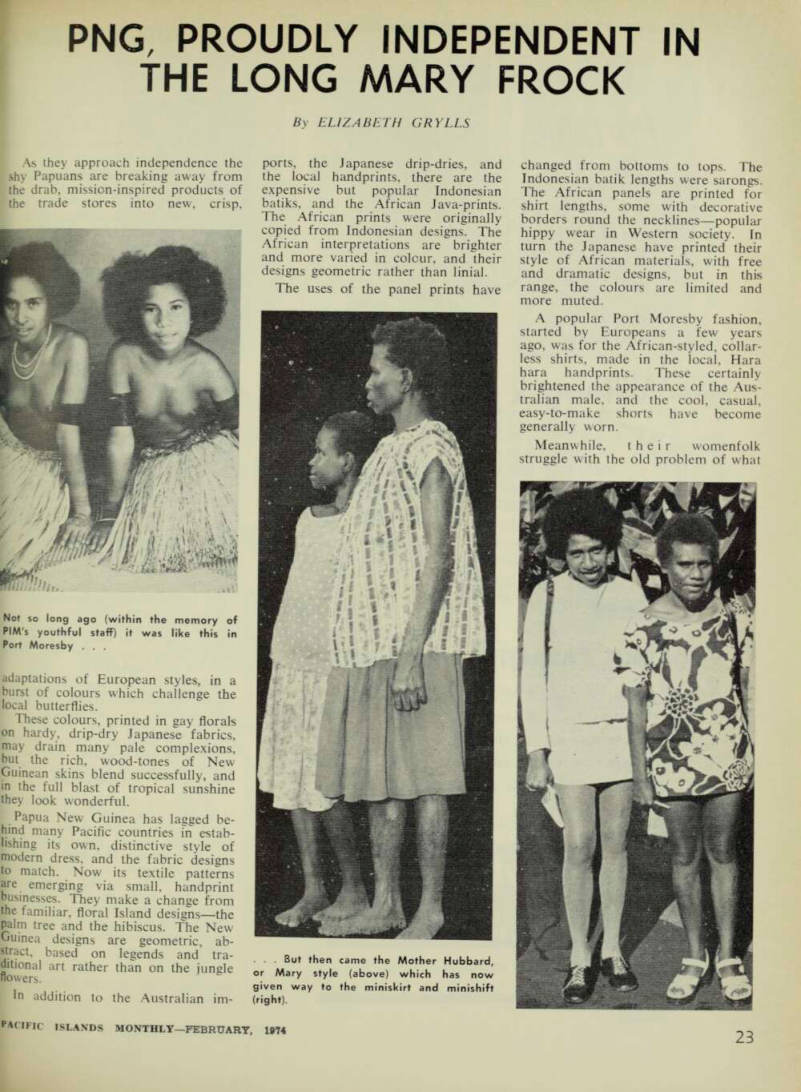
Not so long ago (within the memory of PIM's youthful staff) it was like this in Port Moresby . . .
. . But then came the Mother Hubbard, or Mary style (above) which has now given way to the miniskirt and minishift (right).
Big Success Story
they are wearing South, fearful ■ arriving on leave in Australia win suitcases of frocks, either too lore or too short. The advent of the mioi with boots, struck horror into thei hearts. It would make melting wee in the tropics.
The maxi had a different receptioo Changing into a long frock for ajf evening occasion is a welcome relil in an area of one-climate dressim and the various longs—frocks, pam frocks, pant-suits, skirts—have ; been worn as they come into vogu; The big success story is the lox Mary frock.
The Mary blouse, familiar all ow the South Pacific, was used to cow Tolai nakedness during the Germ* administration. The pattern was oft Bavarian peasant blouse, originally \ garment of rustic charm; roum necked, gathered bodice, puffs' sleeved.
The New Guinea version was j limp, faded, figure-muffling garmen Its use, over the years, spread to ; parts of New Guinea. In the Hig lands, where the weather can be ch:r the blouse gained length. Came tt days when the mini was really mil the Australian girls saw the posi bilities of the brighter, better mas blouses in the Chinese shops.
They wore them, not as bulL tops over skirts and laplaps, but gay, knee-displaying frocks, partioi larly useful during pregnancies. T 1 Chinese dressmakers were not slol to catch on. More mini-Marys we’ made, and in its next variation tr Mary frock went all the way dow making the maxi-Mary.
Falling straight from the bodii narrowing slightly round the knea and bursting into a flounce at t bottom, in vivid florals the style gained its old-time charm. Its u;i are endless and it blooms everywhea from the beach to the ballroom, fro' dining out to going to market.
Melanesian dressing is more stah than the Australian. Few have t thrill, or the bother about going leave, and, having little, they spea less on clothes. The young sophisi cates have settled for the mini shr which is right for the climate, as suits their looks very well; but t Mary has made some sort of ciro - They have also adopted the miu Mary, and wear the long-Mary :
special occasions.
Perhaps it will prove to be 1 national dress of new, independo Papua New Guinea.