Lie Through The Villages
pp. 35-37 · Read in the full issue
Solomons' Road To Unity May
From a Honiara correspondent
Gearing the Protectorate for the next step along the road to independence, the British Solomon Islands Governing Council at its last meeting of the old year approved a Budget which was aimed at plugging a few holes blown into the economic fabric by hurricanes and currency revaluations, and cleared the ground for a programme designed to bring government nearer to the people.
Much was done and talked about in the Govco session. Locally, the most important could be said to be the publication of the draft plan for decentralising government in the Solomons, It’s no long range plan. Next year the poor, and generally disorganised, local councils will begin to be amal gamated, to reduce them from 17 some times very tiny organisations into probably eight councils. These will progressively take over many func tions at present carried out by central government. Staff will be transferred from central to local government councils, training of local staff will be organised, and a change expected to involve people right down to village and suburban level will be underway.
In a long speech putting flesh on the bones of a policy statement, Mr Solomon Mamaloni (Local Govern ment Chairman) said if a realistic look was taken at the Solomons, it was very clear that a highly centralised system of government was ridiculous.
“To succeed, it has to pretend the Solomons are united in culture, language, or way of life,” he said.
“A centralised system is bound to fail.”
Solomon Islanders were proud of their differences but at the same time wanted to feel proud of their country and to feel secure from interference from outside. A system of govern ment which respected local feelings and united people on matters which affected them as a whole was needed, Mr Mamaloni said.
It was intended to transfer the functions of general field admini stration, agricultural and associated extension services, certain functions of public works and health and education services to local councils.
Among other things, this would mean the end of present district com missioners’ powers, with their muta-
tion into nominally powerless but im portant liaison men between central and local governments.
The central government’s Ministry of Local Government would make policy, plan and co-ordinate on a national basis, watch over and advise and control local government, con trol central government staffing and financial assistance for councils, carry out inspections and organise systems and training of staff, intro duce legislation and regulations and vet council by-laws.
Answering common criticisms, Mr Mamaloni said local government’s demonstration of incapacity to con duct important activities or handle large sums of money was a matter of providing the right systems and staff; and the suggested danger of splitting the Solomons by giving councils more power was in fact the opposite of reality, that unity would come from first satisfying the reason
able hopes and needs of people locally.
Three other important subjects came before the House for debate, all vital in their different ways to the future of the Solomons as a whole. ® The Education Policy Review Committee’s report tabled right at the end of the session called for what can only be called a revolutionary change in education in the Solomons, making out a case for universal edu cation, eventually completely free, to form II secondary, and the reversal of the manpower planning-oriented system at present which the report said produced an elite educated by a foreign system and an increasing number of unskilled and aimless dropouts. • Chairman of Commerce and Industry, David Kausimae, intro duced proposals on encouraging foreign investment, and controlling it, in which he made it plain that the Solomons hoped to rely on private enterprise investment for economic growth, but at the same time would ensure that it did not exchange political for economic dependence.
The government intended to retain overall control of the development of resources, mainly by fiscal and exchange control policies (it was con firmed by Financial Secretary, Mr Wallace, that a local currency would be introduced to this end in January 1976), and by equity participation in major and monopoly enterprises “where appropriate”. Mr Kausimae expected that the proposals would become policy next year.
The proposals were seen by the government as an answer to the “crisis of confidence” among private interests as brought to light by Mr Wallace during his budget speech. o Motions by members raised several times the emotion-charged subject of alienated land. Philip Solodia, as Natural Resources Chair man, battled for recognition of a
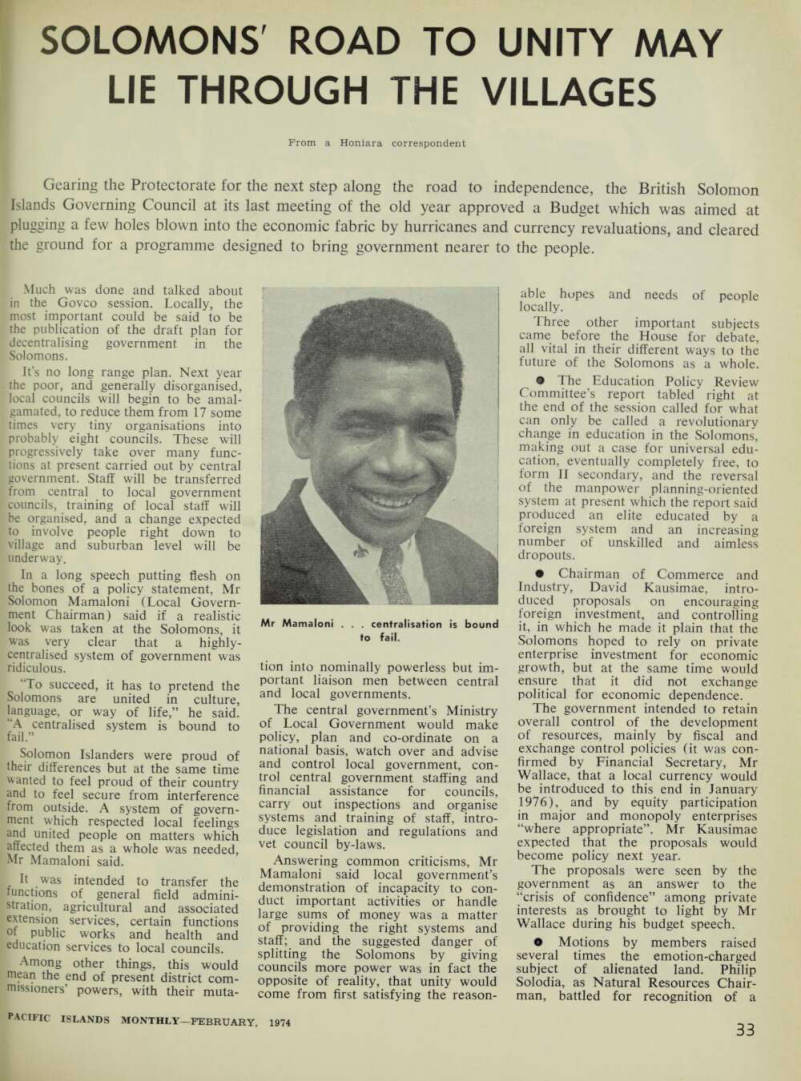
Mr Mamaloni . . . centralisation is bound to fail.
policy of government controlled and planned acquisition of large tracts of agricultural land and their development generally as joint ventures with foreign investors who could supply expertise, as these lands could be taken over A number of members shouted for return of land to the original owners, but it was difficult to know whether they were only putting forward their constituents’ desires (which they certainly were) or whether they really wanted all foreign-owned land resumed. No motions actually called for this to happen, and in the light of the foreign investment policy proposals it seems that emotion will give way to pragmatism when it comes to the crunch.
The government also came out with a statement defining its attitude to matters of tradition and custom.
Summing up, the preservation by
each ethnic or linguistic area of the Solomons of its way of life was to be encouraged, so long as it was acceptable to the local people and in accordance with natural justice, „ . . ‘ he n B ht °f pagans to follow their religious practices was to be respected, £***? th f dominance of the various C , hnst,an faiths m the Solomons, and p ‘ ani ?l ng for . econ L omi c development sh ° uld recognise the power and un- PoHance of traditional leaders and chiefs , and the llnes and other com rnunal groups.
The next session of Governing Council scheduled for April will see its transformation into a legislative assembly, the choosing by members of a chief minister and ministry, and the reality of self-government by a body of legislators committed to collective responsibility for the first time.