Books, Reviews, writers
pp. 70-71 · Read in the full issue
First Samoan Novel Of 'Classic
Beauty' Says A Veteran Novelist
The world has waited a long time for the first publication of a Samoan novel. Among many reasons for the delay is that the author must of necessity write in English, and a secondary language is not the best to convey emotion.
Polynesians in general have not enthusiastically adopted the novel as an art form; it lacks the more direct communication of oratory or the visual arts and the consequent warmth of response.
Now that it has appeared the fore runner, Sons for the Return Home proves wholly worthy of the extra attention its primacy focuses.
Polynesian in all its rhythms, and proudly so in its attitudes, it must I think, occupy a significant place hereafter in any evaluation of Samoan artistic attainments.
In his arrangement of data Wendt has made intelligent use of the legend which closes the Maui cycle with an incident so significant that one never quite appreciates its total meaning.
This is when Maui, to cap all his other great achievements, seeks to accomplish the death of Hine-Nui-te- Po, the Goddess of Death, the Great Woman of Night, and so confer the benefits of the terrestrial immortality upon mankind.
Confounded by her very immensity, he determines upon an interior assault, and coming upon her carelessly asleep, enters at the great exposed vulva, wriggling so deter minedly that avian onlookers shriek with laughter, waking the goddess who rubs out Maui’s life between thumb and forefinger.
Exile is a kind of death, and Wendt’s book is a story of exile, the effects of which his hero tries to off set by a surrender to the transports of love. The exile is from Samoa to New Zealand for the period of the hero’s education; the desperate love is with a papalagi (white) girl, and the story rings with truth.
Wendt uses the convention of writ ing the entire book without naming any characters; somewhat after the
style of Stephen Crane in The Red Badge of Courage, but even more assiduously. It has the effect of showing the problem to be of more than individual import, but such a poetic scheme does create a few prob lems —including some minor ones for the reviewer.
In the establishment scenes at the be sinning of the book confusion re sults between the several generations, in the earlier of which a mother, a father, a grandfather, a younger brother can be confounded with later scions. But a book that requires no effort seldom makes demands upon memory either, and despite an initial irritation I think his method right.
Some bitterness erupts: Most papalagi New Zealanders (his hero thinks) talked of racial integration, but what they wanted
was assimilation, the conversion of Polynesians into middle-class papalagi. The process was one of castration, the creation of Uncle Toms.
Returning to Samoa an adult he fim a different humanity: When they left the customs; area their relatives and friends; swarmed upon them with their 1 incessant warm flowing noise,, their utterly open feel and smelll and sound, like honey-bees bring ing nectar to a nest. His parents; and brother opened themselves joyously to the welcome but he discovered he couldn’t, not com pletely. He watched himself trying to relax, trying to cope with so fervent a welcome from his one remaining uncle, his aunts and their children and theii children’s children, cousins anc more cousins, relatives acquiree through history and marriage and their relative’s friends, anc men and their wives and relative; who had known his parents, anc many village elders: a world O" people he could not hold, em brace, encompass, contemplah all at once and in that breadtl of time. It didn’t seem real They kissed him, strung lei; round his neck, fingered hi clothes and body, talked to him all at the same time.
The extended family is the rr obvious of the sacrifices the Islan must make when he chooses ex and it is a sacrifice bigger, perh; than he himself knows. It’s many generations since the papa made the change himself; this borne in on me with a peculiar fo for my grandmother’s name Wendt, too. a name not uncomr on the North Sea coast of Gcrrm nor, through some sea-wanderer 1 ago, in Tonga or Samoa.
“ But a possible distant consangui is not the reason for my praise, this is not, indeed, to be stinted.
I think he could have done a 1
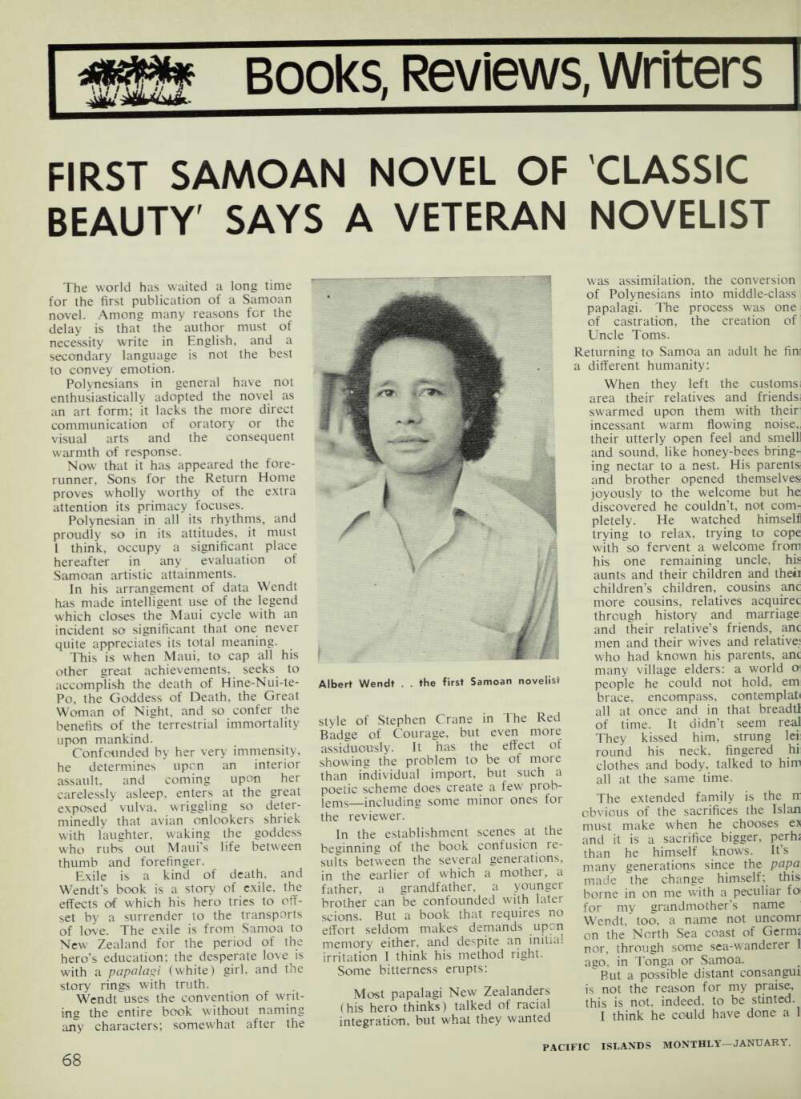
Albert Wendt . . the first Samoan novelist
more basic research; a most signifi cant incident rests shakily upon a hawk which was not a bird introduced to New Zealand, as Wendt believes, but native; and upon the most un sheeplike reaction of sheep to its pre sence overhead.
Where humans are concerned, his integrity is close to absolute; he him self describes this novel as “a simple story”, but love stories are seldom simple and this has a classic beauty. [ —Olaf Ruhen.
(Sons For The Return Home, By
Albert Wendt. Longman Paul Ltd. Cased editions $3.95; paper $1.50).
Cut-Price Text
Books For Png
Selected British textbooks would become available to Papua New Guinea at reduced prices under ar rangements just made in London according to the British Consul in Port Moresby, Mr Gordon Slater.
“These are standard textbooks chosen both for academic merit and their suitability for developing countries,” he said. “They will en able students at Papua New Guinea’s two universities, as well as other serious readers, to buy textbooks covering a wide range of subjects at between one-haif and one-third of the cost of standard editions. They are published under the imprint of ELBS which stands for both Educa tional Low-Priced Books Service and The English Language Book Society.”
Papua New Guinea is the 74th country to be offered the ELBS books. The decision to offer them to this country was agreed between the Book Development Council (the export division of the Publishers’
Association) and the Overseas De velopment Administration, which, in the Foreign and Commonwealth Office, manages Britain’s overseas aid programme.
The plan is operated by the British Council and financed by the ODA horn British Government aid funds.
This year the ODA is providing something like $BOO,OOO to support the venture in the developing countries.