Yesterday
p. 69 · Read in the full issue
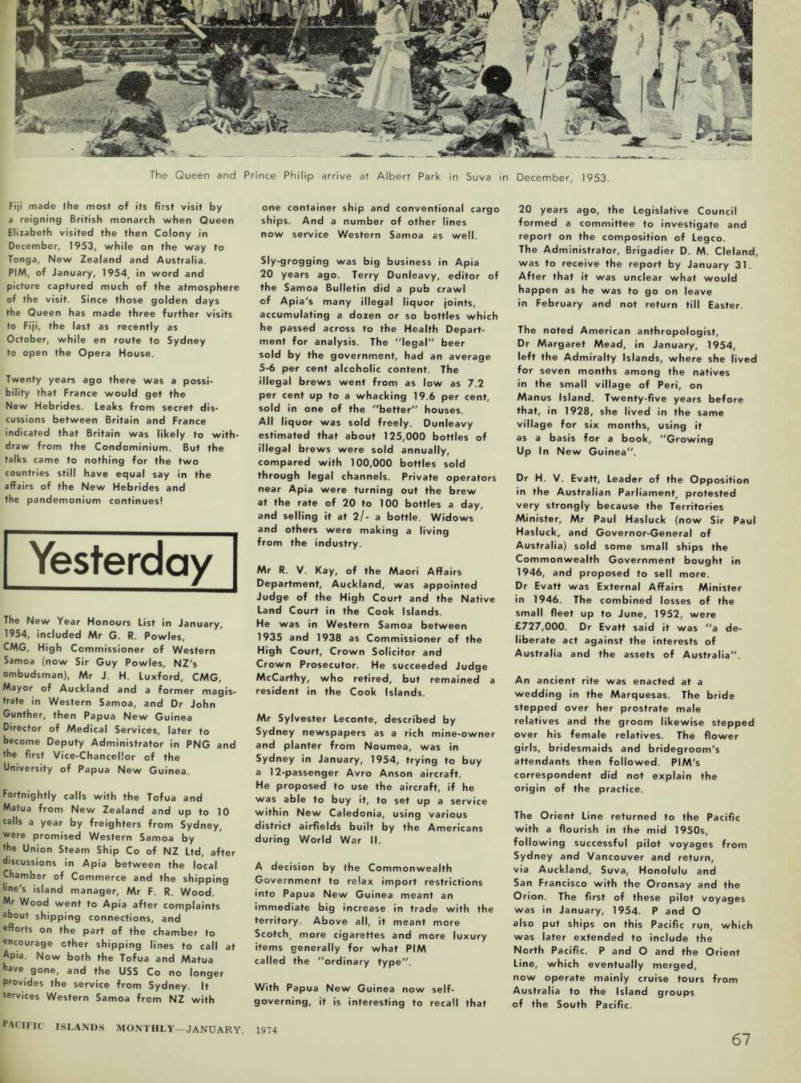
Fiji made the most of its first visit by a reigning British monarch when Queen Elizabeth visited the then Colony in December, 1953, while on the way to Tonga, New Zealand and Australia.
PIM, of January, 1954, in word and picture captured much of the atmosphere of the visit. Since those golden days the Queen has made three further visits to Fiji, the last as recently as October, while en route to Sydney to open the Opera House.
Twenty years ago there was a possi bility that France would get the New Hebrides. Leaks from secret dis cussions between Britain and France indicated that Britain was likely to with draw from the Condominium. But the talks came to nothing for the two countries still have equal say in the affairs of the New Hebrides and the pandemonium continues!
The New Year Honours List in January, 1954, included Mr G. R. Powles, CMG, High Commissioner of Western Samoa (now Sir Guy Powles, NZ's ombudsman), Mr J. H. Luxford, CMG, Mayor of Auckland and a former magis trate in Western Samoa, and Dr John Gunther, then Papua New Guinea Director of Medical Services, later to become Deputy Administrator in PNG and the first Vice-Chancellor of the University of Papua New Guinea.
Fortnightly calls with the Tofua and Matua from New Zealand and up to 10 calls a year by freighters from Sydney, were promised Western Samoa by the Union Steam Ship Co of NZ Ltd, after discussions in Apia between the local Chamber of Commerce and the shipping line's island manager, Mr F. R. Wood.
Mr Wood went to Apia after complaints about shipping connections, and efforts on the part of the chamber to encourage ether shipping lines to call at Apia. Now both the Tofua and Matua nave gone, and the USS Co no longer provides the service from Sydney. It services Western Samoa from NZ with
one container ship and conventional cargo ships. And a number of other lines now service Western Samoa as well.
Sly-grogging was big business in Apia 20 years ago. Terry Dunleavy, editor of the Samoa Bulletin did a pub crawl of Apia's many illegal liquor joints, accumulating a dozen or so bottles which he passed across to the Health Depart ment for analysis. The "legal" beer sold by the government, had an average 5-6 per cent alcoholic content. The illegal brews went from as low as 7.2 per cent up to a whacking 19.6 per cent, sold in one of the "better" houses.
All liquor was sold freely. Dunleavy estimated that about 125,000 bottles of illegal brews were sold annually, compared with 100,000 bottles sold through legal channels. Private operators near Apia were turning out the brew at the rate of 20 to 100 bottles a day, and selling it at 2/- a bottle. Widows and others were making a living from the industry.
Mr R. V. Kay, of the Maori Affairs Department, Auckland, was appointed Judge of the High Court and the Native Land Court in the Cook Islands.
He was in Western Samoa between 1935 and 1938 as Commissioner of the High Court, Crown Solicitor and Crown Prosecutor. He succeeded Judge McCarthy, who retired, but remained a resident in the Cook Islands.
Mr Sylvester Leconte, described by Sydney newspapers as a rich mine-owner and planter from Noumea, was in Sydney in January, 1954, trying to buy a 12-passenger Avro Anson aircraft.
He proposed to use the aircraft, if he was able to buy it, to set up a service within New Caledonia, using various district airfields built by the Americans during World War 11.
A decision by the Commonwealth Government to relax import restrictions into Papua New Guinea meant an immediate big increase in trade with the territory. Above all, it meant more Scotch, more cigarettes and more luxury items generally for what PIM called the "ordinary type".
With Papua New Guinea now self governing, it is interesting to recall that
20 years ago, the Legislative Council formed a committee to investigate and report on the composition of Legco.
The Administrator, Brigadier D. M. Cleland, was to receive the report by January 31.
After that it was unclear what would happen as he was to go on leave in February and not return till Easter.
The noted American anthropologist, Dr Margaret Mead, in January, 1954, left the Admiralty Islands, where she lived for seven months among the natives in the small village of Peri, on Manus Island. Twenty-five years before that, in 1928, she lived in the same village for six months, using it as a basis for a book, "Growing Up In New Guinea".
Dr H. V. Evatt, Leader of the Opposition in the Australian Parliament, protested very strongly because the Territories Minister, Mr Paul Hasluck (now Sir Paul Hasluck, and Governor-General of Australia) sold some small ships the Commonwealth Government bought in 1946, and proposed to sell more.
Dr Evatt was External Affairs Minister in 1946. The combined losses of the small fleet up to June, 1952, were £727,000. Dr Evatt said it was "a de liberate act against the interests of Australia and the assets of Australia".
An ancient rite was enacted at a wedding in the Marquesas. The bride stepped over her prostrate male relatives and the groom likewise stepped over his female relatives. The flower girls, bridesmaids and bridegroom's attendants then followed. PlM's correspondent did not explain the origin of the practice.
The Orient Line returned to the Pacific with a flourish in the mid 19505, following successful pilot voyages from Sydney and Vancouver and return, via Auckland, Suva, Honolulu and San Francisco with the Oronsay and the Orion. The first of these pilot voyages was in January, 1954. P and O also put ships on this Pacific run, which was later extended to include the North Pacific. P and O and the Orient Line, which eventually merged, now operate mainly cruise tours from Australia to the Island groups of the South Pacific.
The Queen and Prince Philip arrive at Albert Park in Suva in December, 1953.