Settling Polynesia
pp. 71-75 · Read in the full issue


by computer
In September. 1936, PIM reported the arrival at Borabora, Society Islands, of four men who had drifted there in a yacht from Honolulu, a distance of some 2,500 miles.
The yacht, which had an auxiliary engine, had been on a pleasure cruise out from Honolulu when the engine failed, adverse winds sprang up, and she was swept out of sight of land.
For the next 65 days, PIM said, the vessel was “the plaything of winds and currents”. But as she had been used just previously for a long voyage and was “reasonably well equipped with water and tinned food”, her crew survived their drift to Borabora without great hardship.
The story of this 65-day drift in an almost due north-south direction is recalled here because, according to the findings of an unusual new book on Pacific voyaging, it should never have happened.
The new book, entitled The Settle ment of Polynesia: A Computer Simulation, is the work of a team of scholars, the chief ones being Michael Lcvison, of the Department of Computer Science at Queen’s University, Kingston, Ontario; R.
Gerard Ward, Professor of Human Geography at the Australian National University, Canberra; and John W.
Webb, Professor of Geography at the University of Minnesota.
The team used a computer to try to throw new light on the celebrated “Polynesian problem” that has puzzled and fascinated Pacific
specialists from Captain Cook to the present day.
Specifically, the authors wanted to try to establish the most likely paths of migration into and within Poly nesia, and whether the Polynesians discovered their islands by deliberate, navigated voyages of exploration, or whether they found them through accidental drifts.
The authors programmed a com puter so that both navigated and drift voyages in the Pacific could be simulated. This involved dealing with as many as possible of the factors that “affect the course and survival of a small vessel and its crew when drifting at sea without motor power”.
Factors taken into account were: changes in the force and direction of winds over time and space; the direc tion and speed of currents (or surface drift); the sailing qualities and sea worthiness of an imaginary set of vessels; the location of reefs, islands and coasts; and the crews’ chances of survival.
For wind data, for example, the authors used information provided by the Marine Division of the Meteoro logical Office at Bracknell, England.
This information is assembled in the preparation of monthly meteoro logical charts of the Pacific. It is based on monthlv summaries of ob servations from British naval and merchant vessels between 1855 and 1938 for five-degree squares of the Pacific’s surface.
The Bracknell information indicates
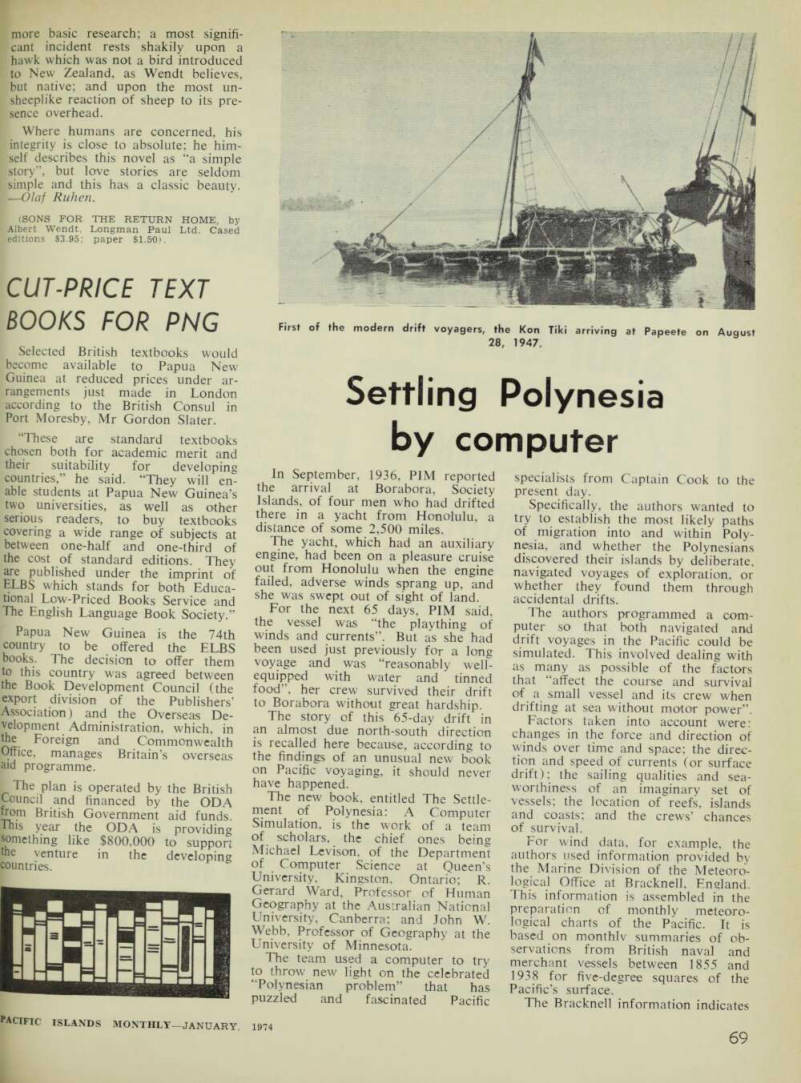
First of the modern drift voyagers, the Kon Tiki arriving at Papeete on August 28, 1947.
How The Computers 'Drifted'
how often winds blow from 16 points of the compass for each of 13 forces of the Beaufort scale, plus calms and variable winds. However, for some five-degree squares, this information is net available, so the authors had to aggregate observations for adjacent squares and “apply them to the whole area”.
The authors devote several pages :o explaining how they used their intricate data. Suffice it to say that ihey chose 62 different starting points n and near Polynesia for simulated irift voyages; that they started two irift voyages from each point for ;ach day of a 366-day year; and that hey simulated a total of 46,848 drift 'oyages from those points. In iddition, more than 50,000 other drift r oyages were simulated to take iccount of such things as wind shifts.
Vnd 8,052 “navigated voyages” were nade from 11 starting points.
The most positive of the authors’ omputerised findings are that there re several areas in the Pacific where he probability of making a success ul drift voyage is very high (20 per ent or more). These areas are: from lawaii to the Marshall Islands; 'onga to Fiji; Samoa to Wallis Island nd on to the Ellice Islands; Caro ne Island (Line Group) to the orthern Cooks and Tokelaus; Pit airn to Mangareva to the eastern uamotus; and Rapa to the Austral (lands, Tuamotus and southern 'ooks. In each of these areas, the witact is approximately south-east ) west, except in two cases where it north-east to west.
Areas of moderate and high con ict probability (five per cent to 10 sr cent and more) are the same as lose already described, except that ie pattern within Polynesia is in nsified and there are some exten ons. The extensions include; Fiji ► Central Melanesia; Socorro Island northern Mexico) to the Line ‘lands; and Easter Island to Pitcairn id the Marquesas.
When low contact probabilities )ne to 4.9 per cent) are considered, isterly links between Fiji and the nice Islands appear for the first me.
The most striking features of all lC drift experiments were that New Jaland remained isolated from all mer areas; there were no contact obabilities between South America id Polynesia (unless voyages from America were computed to igm 300 or 400 miles from the )uth American coast); and there
were only a few south to north and north to south contacts, all of them quite short.
The isolation of New Zealand quite surprised one of the authors, who once saw coconut palms being washed up in northern New Zealand from somewhere in the Pacific.
The lack of drift contact probabili ties from South America will also surprise many people, especially as the Las Balsas expedition has again demonstrated that balsa rafts can drift from Ecuador to Australia.
Finally, the drift voyage from Honolulu to Borabora, recorded in PIM, seems to prove beyond doubt that long north-scuth drift voyages can happen regardless of what the computer might say.
In the light of the three foregoing considerations, it is difficult to accept the conclusions that Messrs Levison, Ward and Webb have drawn from their experiments. These are; T Drift voyages are unlikely to have been responsible for the settle ment of Eastern Polynesia, either from the east or the west.
2. Drift voyages from Eastern Polynesia are unlikely to have re sulted in the settlement of Hawaii, New Zealand or Easter Island. 3. “Some element of purposeful voyaging was necessary for pre historic man to reach the outer [Polynesian] groups.”
The view of this reviewer is that no man, prehistoric or otherwise, ever made a purposeful voyage towards any goal unless he knew or suspected it was there.
It therefore follows that, if drift voyages to the outer edges of Poly nesia did not show up in the Levison- Ward-Webb experiments, this should not be interpreted to mean that such voyages did not occur in prehistoric times. It simply means that data on abnormal, perhaps freakish, con ditions in the Pacific that carry palm trees to New Zealand and disabled yachts from Honolulu to Borabora are not on record at Bracknell, England, for feeding into the L-W-W computer.
In short, the L-W-W book does not seem to throw any new light on the “Polynesian problem”. If anything, it obscures it by drawing dubious con clusions from inadequate evidence; and also by making an occasional assertion that is not based on any evidence at all.
An instance of the latter occurs on page 47 where the authors say it is unlikely that fishing or trading vessels in prehistoric Columbian times ever ventured sufficiently far from the South American coast to get clear of the coast-hugging Humboldt Cur rent, but that if they did “there is little reason to believe they could not have regained the coast . . . had the crew so wished”.
This, to put it bluntly, seems like wishful thinking to support anti- Heyerdahl preconceptions.
The fact is that well-fitted ships have frequently been carried well clear of the South American coast in storms, and there are several instances of derelicts having been drifted thence all the way to French Poly nesia.
One such derelict, the steel-hulled Dagonar, passed within a short dis tance of Easter Island in 1917 and finally came to rest at Mopelia to the west of Tahiti and Raiatea.
If the Dagonar had been a dis abled balsa raft of prehistoric times.
it might well have carried some South American Indians to Easter Island or the islands further west. If they, in turn, had established a colony wherever they made the land, they could later have provided more hap less drift voyagers for a further excursion westward.
So news of the existence of land in the Eastern Pacific could have been carried to the west by a few people who originated in South America.
And those who originated in south east Asia could later have made deliberate voyages to the west against the prevailing winds in search of them.
This, at any rate, seems a more logical view on the settlement of Polynesia than the principal conclusion in the new book of that name. And it would neatly solve the problem of how the sweet potato got into Poly nesia!
All of which goes to show that, despite the strictures made here about the new book, it is one that will stimulate all those who lie awake o’nights wondering where the Poly nesians came from, and how they progressed from point A to point B.
The authors, moreover, deserve the highest commendation for their ingenious new treatment of an old problem and for their lucid dis
cussion on it.-
Robert Langdon.
A < J^O^Sr Rlement Of Polynesia:
A Computer Simulation, By Michael
Levison, R. Gerard Ward and John W Webb, Australian National University Press, Canberra. $A8.95). • If you want to learn how to build a new nation and how to dis charge the duties of a good citizen, go to the Bible, says the Bible Society to New Guineans and gives the guide lines in a scripture booklet which is being distributed in the country’s three major languages to coincide with the attainment of self-govern ment. The booklet, Building a Nation, contains passages from Psalm o/ and the New Testament relating to citizenship and national life that are relevant to a forming nation. The book is attractively designed and features colour photographs of Papua New Guinea scenes. Fifty thousand copies were printed but before the nrst consignment reached PNG there was a request for a further 75,000