angered a mountain spirit
pp. 60-61 · Read in the full issue
Death came to those who angered a mountain spirit
By Um Boutilier
Majesty
series of scientific voyages undertaken by the Austrians in the last half of the 19th century, which mduded visits to \ h s f oI X Aust?h,n In October, I*oB, me frigate Novara, ne armg , what the ship s doctor and chron , Karl von Scherzer described as a “most tedious and unp ™ pl *J9 voyage from Europe, stopped briefly =’i
H. aboard "certain nit * heir^™" ie s” in the Austra n u t h e crew pres:had been "guilty of most scandalous excesses and waj „ hil at Sikaiana. T were not the slightest grounds
“infamous aspersions”,
such i J d n ot t Austria’s flag flew in distant oc; , “through the ei energy^ 11 h h er imporlanl Infi.
Once, the slope was paved with bones
[upon the progress of civilisation alike 1 entitle her”.
I To this end, the Austrians de spatched the warship Fasana on an bceanographic voyage to the South (Pacific in 1893. The following year she spent six months in the Solomon [lslands conducting a geological sur vey, and two years later the gunboat, [Albatross, arrived in the group.
I Charles Woodford, the newly appointed Deputy Commissioner for the British Solomon Islands Protec torate, was frankly puzzled by their activities. “I cannot understand what these Austrian men-of-war are about up here,” he reported to the Western Pacific High Commissioner, Sir John Bates Thurston. The Austrians erected a brick surveying mark on Ysabel (which was then still part of the German sphere-of-influence in the Solomon Islands), and sailed off to Guadalcanal to make observations of “earth heaviness”.
On the morning of August 6, 1896, II bluejackets and junior officers, ed by Baron Heinrich Foullon von Norbeck, left the Albatross to collect icientific and geological specimens luring an ascent of the Lion’s Head fountain. Their leader was an iminent, 46-year-old geologist and ex irtillary officer, who had travelled videly in Asia Minor, Canada, and Australia.
The Sydney Morning Herald de creed the members of the expedition s “intrepid men who open-eyed to the angers” plunged into the jungle, isking their lives “in the old quest or knowledge”. They scaled the ,543 ft summit successfully and on uigust 9 pitched their tents at the x>t of a neighbouring peak, Mount ‘atuve.
The following day, nine men re irned to the coast because of illness, 'hile Baron von Norbeck, Lieutenant udik and several sailors, together ith three bushmen whom they had lanaged to recruit as guides, began ie ascent. What the Austrians failed ) realise was that they were violating ie sanctuary of Momolo; a mountain urit in a vaguely human form who as thought to provide protection for ie Guadalcanal people and their ■ops.
While von Norbeck’s party iboured up the flank of Mount atuve, islanders began to drift into ie base camp, bearing bananas and [ gar cane. Seeing that security was ack they fell upon the hapless ewmen as they sat about their fires, toe of the Austrian party was a
Guadalcanal guide, Johnny Paramatta (from Balesuna village which is present-day Suagi), so named because of his labour trade service in Aus tralia.
“The bushmen who were at the camp,” he recalled, “tried to steal the muskets of the white men. They killed one white man. Then the white men fired. I fired too. Many bush men were killed. I killed five. 1 was wounded on the hand with an axe.
Three white men were killed at the camp and one boy belonging to me.”
During the fierce ambuscade Mid shipman Armand de Beaufort, who had been left in charge of the camp, was slain, two sailors were killed, and several petty officers severely wounded.
With the report of the first shots from the camp, the bushmen guides, who had been joined by some 20 of their fellows, attacked von Norbeck’s party, seriously wounding the Baron and two others with tomahawks.
Eventually they were driven off and Lieutenant Budik returned with the wounded to the base camp, where von Norbeck died. A detachment was despatched to the coast with the injured while the remainder of the party, unable to dig graves in the stony ground, enshrouded the dead in
tent awnings.
Late in the afternoon of August 12,
Johnny Paramatta, suffering from two tomahawk wounds in his back and with a finger nearly severed, made his way on board the Albatross with a letter, written from Aroti by Lieutenant Budik, describing how the expedition had been treacherously attacked. A relief party was prepared immediately and joined by Deputy Commissioner Woodford who had just arrived from Gavutu on the schooner Narovo. They found the survivors encamped a short distance beyond the village of Thegona. The following day they started back to the coast, carrying one of the wounded on a litter as his skull had been cleft open and his brain was protruding through the gash.
Another expedition, of 33 men, was despatched to recover the bodies of the murdered men. They made their way up the ridge dividing the Berande and Balesuna rivers but the jungle was so dense and the Austrian force so beset by fatigue and fever that honour was deemed to have been satisfied and the party returned to the sea.
On August 16 the Albatross sailed to Marau Sound, towing the schooner Narovo. One of the petty officers was in such a critical condition that it was decided to send one of Oscar Svenson’s Marau Company schooners, the Siskin, to Cooktown, bearing re ports of the massacre, rather than risk the man’s life by taking him to sea on the Albatross.
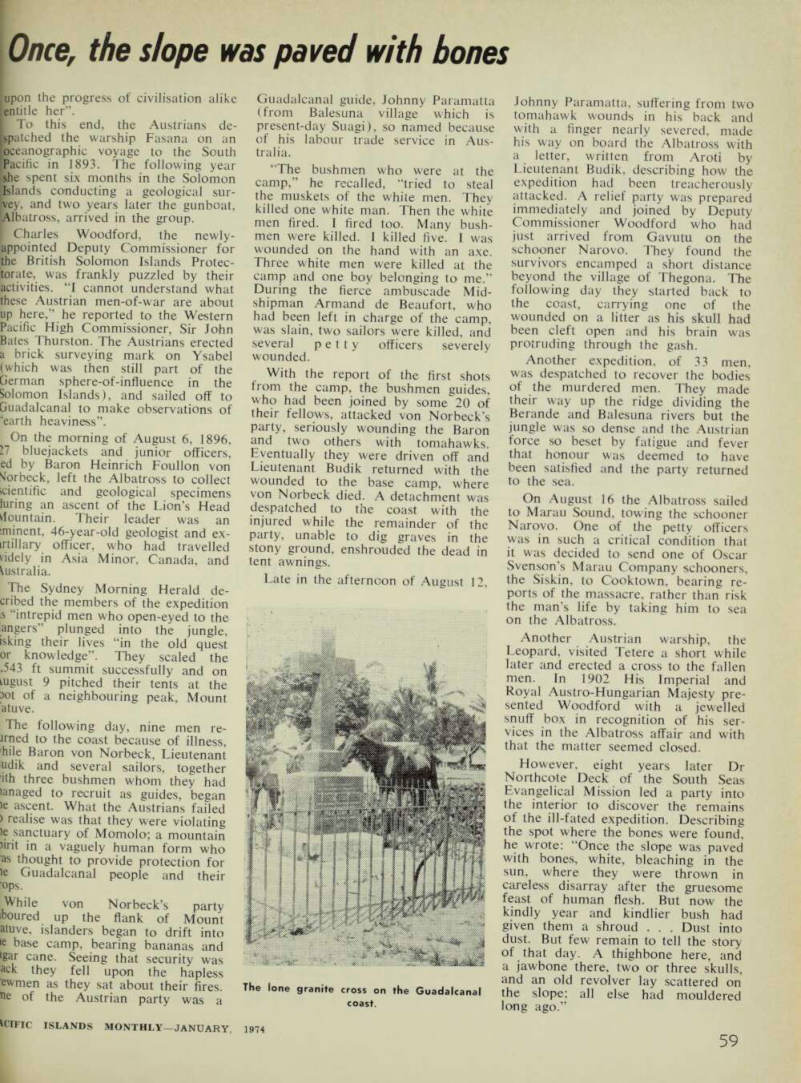
Another Austrian warship, the Leopard, visited Tetere a short while later and erected a cross to the fallen men. In 1902 His Imperial and Royal Austro-Hungarian Majesty pre sented Woodford with a jewelled snuff box in recognition of his ser vices in the Albatross affair and with that the matter seemed closed.
However, eight years later Dr Northcote Deck of the South Seas Evangelical Mission led a party into the interior to discover the remains of the ill-fated expedition. Describing the spot where the bones were found, he wrote: “Once the slope was paved with bones, white, bleaching in the sun, where they were thrown in careless disarray after the gruesome feast of human flesh. But now the kindly year and kindlier bush had given them a shroud . . . Dust into dust. But few remain to tell the story of that day. A thighbone here, and a jawbone there, two or three skulls, and an old revolver lay scattered on the slope; all else had mouldered long ago.”
The lone granite cross on the Guadalcanal coast.